
Kri and Ktiv - וכתיב קרי
By Rabbi Dr. Hillel ben David (Greg Killian)
Kri and ktiv usage in the Torah
Kri and ktiv usage in Yehoushua
Kri and ktiv usage in Megillat Ruth
Kri and ktiv usage in Shmuel and Melachim
Kri and ktiv usage in Megillat Esther
Kri and ktiv usage in Iyov and Tehillim
Kri and ktiv usage in the Prophets

In this paper I would like to study this concept that a pasuk[1] can have two meanings: One that is read or chanted, and one that is written in the Tanakh. I wanted to understand this concept in relation to my study on Megilat Ruth. In the PaRDeS[2] break down, I need to define significant words according to their genre. This poses a problem when I encountered kri and ktiv words. This kri (qere) and ktiv (ktib) concept did not lend itself to the way I had been translating the words. Hence this study.
One of the most common examples of a word that is written one way and read a different way is the yod-hay-vav-hay name of HaShem. We read “Adonai”, but what is written is the yod-hay-vav-hay name. Our Sages teach[3] that in future time the Name of the Holy One, blessed be He, will be read as it is written, whereas now its pronunciation (the kri, viz., Adonai) differs from its spelling (the ktiv, viz., yod-hay-vav-hay).
There are a number of words in the Tanakh[4] which are read differently from the way that they are spelled in the text. These words are called, in Aramaic, “Qere or kri - קרי” in their reading version and “Kethib or ktiv - כתיב” in their written version. This phenomenon occurs roughly thirteen hundred times in the Tanakh.
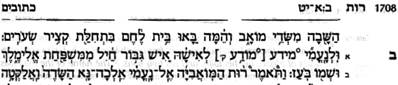
The kri - קרי is the way the verse is chanted, or read. The kri is usually denoted by enclosing the Hebrew word in brackets [][5], as you can see in the following graphic:
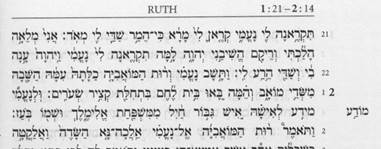
The kri can also be depicted as in the Messoretic[6] text of the Biblia Hebraica,[7] by putting the kri in margin, as we can see in the following graphic:
Meam Loez[8] represents the kri within parenthesis, as in the following example:

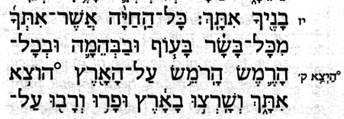
Finally, one of the more common methods of depicting the kri is with a small circle over the word, which directs your attention to a word in the margin, as we can see from the Artscroll Rashi[9] volume:
The ktiv - כתיב is the way it is written in the Torah scroll. The ktiv transcends conception and comprehension. That is, a particular word in its written form has no comprehensible “garment”, though as read aloud it does have such a “garment”, i.e., it is readily comprehensible.
“kri-and-ktiv”, is a word, in the Tanakh, that is pronounced (kri) one way, but written (ktiv) in the scroll a different way. These two ways of reading the word also imply different shades of meaning. These dual word forms are Masoretic vehicles for passing down additional teachings, unavailable without the additional word form.
In general, a kri is the logical meaning of the word, given its context. The meaning of the ktiv however, is often beyond logic,[10] and may even seem to be out of context, yet it reveals unexpected mystical implications. When we encounter a kri-and-a-ktiv we are invited into contemplation: how can we embrace this conflict in meaning?
ktiv always indicates the inner meaning, accessible only to those who can understand the deeper aspects of a word.
The ktiv represents the realm of Divine self-concealment; the kri represents the realm of Divine self-revelation. In the future, when the Name of HaShem will be read as it is written, these two realms will unite.
On Sinai, Moses received three things: the Torah Shebichtav (Written Law) and the Torah Shebaal Peh (Oral Law). The kri and ktiv cases were all handed down to Moses as part of the Oral Law, which is why it is stated so, specifically, in the Talmud, one part of the Oral Law. These were deliberate parts of the Tanakh, not mistakes by the scribes or copyists. These parts were given by HaShem. It is as the Rashba[11] say, “the Kri/Ktiv is halachah l’Moshe mi’Sinai”. If this is true, how can it be that we have kri and ktiv in the Prophets?
The simple and most obvious explanation for kri and ktiv, in the Prophets, is that offered by the Maharal[12] and Radbaz.[13] The prophets who wrote their books included both kri and ktiv in them. Since, as some suggest, these books were revealed to Moshe at Sinai and then later to the prophets to say and write down, the kri and ktiv originate at Sinai. What this means is that the books were originally written with the kri and ktiv.
The Shulchan Aruch[14] teaches us that every word that has a Kri and Ktiv is a tradition from Sinai to write it the way it is written in the Torah, and to pronounce it differently. A case occurred in which one read it in front of Gedolei ha’Dor the way it is written. They warned him to read it according to the tradition, and he refused. They excommunicated him and dismissed him (from reading).
The Mishna Berura[15] notes that although the reader must not read any words of the Torah from memory, and must rather read it from the Torah scroll, he nevertheless reads the words according to the “Kri” even if it differs from the “Ktiv.” Since this is how tradition teaches that we read the word, even though it is spelled differently in the written text, one may and must read in accordance with the “Kri.” This applies even to the rare instances where an entirely different word is read in place of the word that appears in the written text.[16]
Nevertheless, Hakham David Yosef, in his work “Halacha Berura”, writes that the reader should look at the written word as he reads, even in cases of a “Kri” and “Ktiv” where the pronunciation does not correspond to the spelling. Even though one does not read the word as it is written, he should nevertheless look at the written word in the Torah scroll as he reads the “Kri.” He draws proof to this ruling from the reading of HaShem’s Name, which is written “H-V-H-Y” yet pronounced “Ado-nai.” Halacha requires the reader to look at the written Name as He recites “Ado-nai,” even though he does not pronounce the word as it is written. Similarly, in all cases where there is a discrepancy between the pronunciation and spelling, the reader must look at the word as he reads it, even though he does not read according to the spelling.
The oral law can be vocalized (with vowel points) and it has two important characteristics:
1. It is “un-writeable” and
2. It would explain itself.
The written Torah is consonantal only, it has no vowels. The kri and the ktiv form a bridge between these two parts of Torah in that the kri is vocalized and the ktiv is consonantal, and written, only.
Throughout the Tanakh we find instances of kri and ktiv. However, outside of the Torah we also find: ktiv vilo kri (ktiv without kri) and kri vilo ktiv (kri without ktiv). The latter two phenomena only exist in the Neviim (Prophets) and Ketuvim (Writings), not the Torah.[17] Both types can be found in Megillat Ruth.
Kiddushin 18b For it was taught: [To sell her unto a strange people he shall have no power], seeing he hath dealt deceitfully with her [be-bigedo bah]:[18] once he spread his cloak over her,[19] he can no longer sell her: this is R. Akiba’s view.[20] R. Eliezer said: seeing he hath dealt deceitfully with her — having dealt deceitfully with her, he may not sell her [again]. Wherein do they differ? R. Eliezer maintains: the traditional text [i.e., letters without vowels] is authoritative; R. Akiba maintains: the text as read is authoritative; whereas R. Simeon holds: both the traditional text and the vocalization are authoritative.[21]
Sanhedrin 4a but the Rabbis [who hold that only three are needed] adopt the written form yarshi’un.
R. Isaac b. Joseph said in the name of R. Johanan: Rabbi and R. Judah b. Ro’ez, the Shammaites. R. Simeon and R. Akiba, all hold that Mikra[22] is determinant in Biblical exposition.
Rabbi’s opinion is reflected in what has been said; that he reads yarshi’un.
The opinion of R. Judah b. Ro’ez is given in the following: For it has been taught: The disciples of R. Judah b. Ro’ez asked him: Why not read shibe’im [seventy] instead of shebu’ayim [two weeks][23] [extending the period of uncleanliness to seventy days]? He answered: The law has fixed the period of purity and impurity in the case of a male child and it has fixed the period of purity and impurity in case of a female child. Just as the period of purification after the birth of a female child is double that after the birth of a male child, so must the period of uncleanness after the birth of a female child be no more than double that after the birth of a male child [which is only seven days]. After they left him he sought them out again and said ‘You have no need of that explanation since Mikra is determinant, and we read shebu’ayim [two weeks].
The opinion of the Shammaites is advanced in the following [Mishnah]: For we learned:[24] Beth Shammai said: If the blood of sacrifices that is to be sprinkled on the outer altar was applied only once,[25] the offering is valid, as it is said, the blood of thy sacrifice shall be poured out[26] [denoting one application]. In the case of a sin offering, however, they hold that two applications are required; but the Hillelites hold that in the case of a sin offering also a single sprinkling effects atonement. And R. Huna said: What is the Shammaites’ reason for their opinion? — It is that the plural ‘karnoth’ [horns of the altar] occurs three times in this context[27] denoting six, and so implying that four sprinklings are prescribed in the first instance, but that two are indispensable. But the Hillelites argue that since ‘karnoth’ is twice written defectively, and can be read ‘karnath’[28] [singular], only four sprinklings are implied, three being prescribed in the first instance, and that only one is indispensable. But why not argue that all the four are merely prescribed without a single one being indispensable? — We do not find an act of expiation effected without an accompanying rite.
R. Simeon’s opinion is expressed in the following [Baraitha]: It has been taught:[29] A Sukkah needs at least two walls of the prescribed dimensions and a third of the width of at least a hand-breadth. R. Simeon says; Three complete walls and the fourth the width of a hand-breadth. What is really their point of dispute? — The Rabbis hold that Masorah is determinant in Biblical exegesis, while R. Simeon holds that Mikra is determinant. The Rabbis, taking the former view, argue that as the word ‘bassukoth’ which occurs three times[30] is written once plene [in the plural] and twice defectively[31] making in all four references. So, subtracting one as required for the command itself, there are three left. Next comes the Sinaitic Halachah[32] and diminishes the third and fixes it at a hand-breadth. But R. Simeon is of the opinion that Mikra is determinant and thus all the three bassukkoth are to be read in the plural, making a total of six. One of these is required for the command itself, leaving four, and the fourth is diminished in virtue of the Sinaitic Halachah, to a handbreadth.
As to R. Akiba’s opinion — it has been taught:[33] R. Akiba said: Whence is it deduced that a fourth of a log[34] of blood which issues front two corpses carries uncleanness according to the law relating to the pollution of tents.[35] It is said: He shall not go in unto any dead body.[36] [The plural nafshoth translated ‘body‘ indicates that] even from two bodies a single [vital] quantity suffices to carry uncleanness; but the Rabbis argue that it is written nafshath [singular], [denoting that a vital quantity can defile only if it issues from one corpse].
R. Aha b. Jacob questioned this statement of R. Isaac b. Joseph — Is there no one [apart from those above mentioned] who does not accept the Mikra as determinant? Has it not been taught: Thou shalt not seethe a kid in the milk of [bahaleb] its mother[37] in which verse you might read beheleb [in the fat of]?
Sanhedrin 4b Say: this is unacceptable, as Mikra is determinant?[38] — Hence all agree that Mikra is determinant, but Rabbi and the Rabbis differ in the following: Rabbi holds that the plural yarshi’un[39] refers to two judges [elohim] other than those prescribed in the previous verse;[40] while the Rabbis maintain that it refers to elohim here [its own subject] and to that in the previous clause.[41]
As to R. Judah b. Ro’ez, the Rabbis do not oppose him.
As for the Hillelites, they derive their ruling[42] from the following: For it has been taught: wekipper[43] has to be repeated three times [in connection with the sin offering][44] to indicate that even one application is adequate, contrary to an analogy which might otherwise be advanced in favor of the need of four applications. But could we not have deduced this by [the following] analogy? The use of blood is mentioned [for application] above the line;[45] and the use of blood is mentioned [for application] below the line.[46] Just as in the case of the blood to be applied below the line, one application effects atonement,[47] so should it be with the blood to be applied above the line.
But you may argue this way: Sprinkling is prescribed for sacrifices offered on the outer altar[48] and also for those offered on the inner altar. As in the case of those offered on the inner altar, expiation is not effected if one application has been omitted, so should it be with sacrifices offered on the outer altar!
Let us, however, see to which it is to be compared. Comparisons may be made between sacrifices offered on [the same] the outer altar, but not between sacrifices offered on the outer and inner altars.[49]
But may you not, on the other hand, argue in this way? We can compare sin offerings, the blood of which is applied on the four horns of the altar,[50] to other sin offerings, the blood of which is applied on the four horns,[51] but no proof can be deduced from such a sacrifice as is neither a sin offering nor has the blood sprinkled on the four horns of the altar![52] Hence on account of this latter analogy, Wekipper has to be repeated three times, to indicate that atonement is effected by means of three sprinklings, or even by means of two, or indeed even by means of one alone.
Now as to R. Simeon and the Rabbis, their real point of difference is the following: R. Simeon holds that a cover for a Sukkah needs no textual basis,[53] while the Rabbis maintain that a special textual basis is necessary for a cover.
R. Akiba and the Rabbis again disagree on the following point: According to the former, nafshoth denotes two bodies,[54] while the Rabbis say that nafshoth is a general term for bodies.[55]
But do all, indeed, regard the Mikra as determinant? Has it not been taught: ‘letotafoth [frontlets] occurs thrice in the Torah, twice defective and once plene,[56] four in all, to indicate [that four sections are to be inserted in the phylacteries]. Such is the opinion of R. Ishmael. But R. Akiba maintains that there is no need of that interpretation, for the word totafoth itself implies four, [it being composed of] tot which means two in Katpi and foth which means two in Afriki? — Hence, in reality, it is disputable whether Mikra is always determinant in Biblical exegesis, but this is true only of cases where Mikra and Masorah differ in the spelling of a word.[57] But where-as for example, in the case of the milk — the reading behaleb involves no change in the spelling,[58] Mikra is determinant. But does not the text, Three times in the year all thy males shall appear [shall be seen] before the Lord,[59] occasion a dispute whether we shall follow the Mikra [yera’eh][60] or read yir’eh[61] according to Masorah?[62] For it has been taught: R. Johanan b. Dahabai said on behalf of R. Judah b. Tema: One who is blind in one eye is exempted from visiting the Temple, for we read YR’H[63] which according to Mikra means he shall be seen and according to Masorah, he shall see. That is to say, as He comes to see the worshipper, so should man come to be seen by Him; as He [the Lord] comes to see [so to speak] with both eyes.[64] so should he, who comes to be seen by Him, come with both eyes![65] Hence, says R. Aha, the son of R. Ika: The scriptural text says. Thou shalt not seethe a kid in its mother’s milk. It is seething, as a method of cooking, that the law forbids.[66]
End Talmudic references.
Most English translations follow the kri in their translation. This means that the idea of “sola scriptura”[67] is completely ignored in most Christian Bibles. While they profess to use this standard, in reality they follow Jewish oral law to obtain their translation, while completely ignoring what was written.
The Biblia Hebraica Leningradensia shows the following abbreviated list of kri and ktiv usage. While incomplete, the list is sufficient to demonstrate its usage.
I have attempted to add some small parts to the overall understanding, while realizing that many thousands of hours would be required to complete such a task.
Bereshit (Genesis) 8:17
|
kri - קרי |
ktiv - כתיב |
|
הַיְצֵא |
הוצא |
|
Let them come out |
Take them out |
This is the first use of kri and ktiv in the Torah. This passage is describing the aftermath of the flood when Noach and the animals were permitted to leave the ark.
Rashi - HaShem told Noach to allow each animal to leave the ark together with its mate. Noach was merely to inform them, but not to remove them physically. However, if animals refused to leave, Noach was to “take them out” – even physically.
Bereshit (Genesis) 9:21
|
kri - קרי |
ktiv - כתיב |
|
אָהֳלוֹ |
אָהֳלֹה |
|
His tent |
The (Her) tent |
As Rashi notes, the written word (the ketiv) "the tent" in v 21 has the feminine possessive suffix, "her tent," although we read (keri) the word as "his tent".
Bereshit (Genesis) 14:2
|
kri - קרי |
ktiv - כתיב |
|
צְבוֺיִים |
צביים |
|
Tzevoyim |
|
This is a place name.
Bereshit (Genesis) 14:8
|
kri - קרי |
ktiv - כתיב |
|
צְבוֺיִם |
צביים |
|
Tzevoyim |
|
This is a place name.
Bereshit (Genesis) 24:33
|
kri - קרי |
ktiv - כתיב |
|
וַיּוּשַׂם |
ויישם |
|
|
|
Hirsch:[68] Eliezer had to look after the camels perhaps also for himself and his men - the subject is doubt (from ישם, like טוב and יטב) and יושם, the way it is written and the way it is to be read shows that the food was just placed before him with distinct uncertainty to what extent Laban assisted thereat.
When they set food before Eliezer. The pasuk states ויישם (וַיּוּשַׂם) לְפָנָיו. Note that sam means ‘place’, but also means ‘poison’. Thus, poison was set before him, that is Eliezer, most probably. We also have the krei and ketiv, where the word is pronounced vayusam, but rather than a vav, there is a yud in the ketiv. This would be the difference between active and passive. With the yud, it would be "and he placed," or "and he poisoned," but as we pronounce it, it is "and it was placed" or "and it was poisoned." We then link this with Betuel's disappearance and note that Betuel tried to place and poison, but instead it was placed (by the angel) before him and he was poisoned.
Bereshit (Genesis) 27:3
|
kri - קרי |
ktiv - כתיב |
|
צָיִד |
צֽידה |
|
|
|
Bereshit (Genesis) 27:29
|
kri - קרי |
ktiv - כתיב |
|
וְיִשְׁתַּחַווּ |
וישתחו |
|
|
|
Bereshit (Genesis) 30:11
|
kri - קרי |
ktiv - כתיב |
|
גָד בָּא |
בגד |
|
A good sign has come |
He has betrayed |
A four-letter word that is to be read as two separate two-letter words. BA GAD (in the naming of GAD b. Zilpa by Leah). It is the first four letters of the Alef-Bet that are involved in BA GAD.
The translation is according to Rashi.
Bereshit (Genesis) 30:19
|
kri - קרי |
ktiv - כתיב |
|
|
יִשָׂשכָר |
|
|
|
Yissaskhar – The second sin/shin has no vocalization not even a dot to indicate whether it is a sin or shin.
Bereshit (Genesis) 36:5
|
kri - קרי |
ktiv - כתיב |
|
יְעוּשׁ |
יעיש |
|
|
|
Bereshit (Genesis) 36:14
|
kri - קרי |
ktiv - כתיב |
|
יְעוּשׁ |
יעיש |
|
|
|
Bereshit (Genesis) 39:20
|
kri - קרי |
ktiv - כתיב |
|
אֲסִירֵי |
אסורי |
|
(a noun) a [temporary] prisoner |
(a verb) a prison |
Hirsch: If the first sentence tells us he put him in prison, the second seems completely superfluous. But Potiphar was also the Governor of the State prison thither he now placed him, transferred him to the prison to make himself useful there as he had been in his house, and so he became an inmate there. This would presuppose that in his heart he was really convinced of Joseph’s innocence, and only for the sake of his honor did he have to take the action that he did, אסיר is a noun, אסור a verb, the former, a prisoner, a permanent character, the latter, as verb, imprisoned, just temporarily. By the kri and ktiv, both are indicated here. This was a prison to which both those condemned and those committed for trial were brought. The sequel, too, bears this out. Through that Joseph could come into contact with men who were only temporarily interned, and who, when acquitted returned to important position. As in fact the Lord High Baker and His Highness the Butler also seem to have been in the prison only awaiting trial.
Bereshit (Genesis) 43:28
|
kri - קרי |
ktiv - כתיב |
|
וַיִשְׁתַּוְוּ |
וישתחו |
|
And prostrated themselves |
|
Bereshit (Genesis) 49:10
|
kri - קרי |
ktiv - כתיב |
|
שִׁילוֺ |
שילה |
|
Shilo “gift to him” |
|
Bereshit (Genesis) 49:11
|
kri - קרי |
ktiv - כתיב |
|
עִירוֹ |
עירה |
|
|
|
Bereshit (Genesis) 49:12
|
kri - קרי |
ktiv - כתיב |
|
סוּתְוֹ |
סותה |
|
|
|
Shemot (Exodus) 4:2
Shemot (Exodus) 16:1
Shemot (Exodus) 16:7
Shemot (Exodus) 22:4
Shemot (Exodus) 22:26
Shemot (Exodus) 28:28
Shemot (Exodus) 32:19
Shemot (Exodus) 37:8
Shemot (Exodus) 39:4
Shemot (Exodus) 39:33
Leviticus 9:22
Leviticus 11:21
Leviticus 16:21
Leviticus 21:5
Leviticus 25:9
If someone sells a house in a walled city, he has up to one year to redeem it; if not, it remains the new owner’s forever. Redemption during the year is by returning the full amount paid, i.e. no deduction for the time that the buyer lived there. (This is technically an exemption from the Torah’s ban against interest.) Redemption of a house in a walled city is a mitzva. On the other hand, houses in non-walled cities have the same rules as land - viz., redemption is possible until Yovel, at which time the house reverts to its original hereditary owners. Houses in Levite cities (even walled cities) are redeemable beyond the one-year limit, and do revert to the Levi at Yovel. The Levi has hereditary rights to those special (48 in number) cities. It is forbidden to alter the areas around those cities by selling off parts of the land on a permanent basis.
The verse that teaches us that a house in a walled city is not returned at Yovel if it weren’t redeemed within a year, uses the words ASHER LO CHOMA - a city which has a wall. However, the word LO is spelled in the Torah lamed-alef, which if read literally would mean the opposite - a city which has NO wall... Tradition dictates that although the word is written lamed-alef, it is to be read as lamed-vav, this LO meaning a city which HAS a wall. The Gemara explains this kri/ktiv by saying that even if the city has NO wall now, as long as it HAD a wall from the time of Israel’s original entry into the Land, it’s houses are non-returnable. This is another example of many of the absolute necessity of considering the Written Word and the Oral Law as the two inseparable components of Torah.
Leviticus 25:30
|
kri - קרי |
ktiv - כתיב |
|
לאֹ |
לוֹ |
|
and the kri, לאֹ (to it), i.e., ‘which has a wall to it’, hence the combination of the meanings: Even if it has no wall now, as long as it had one in the long ago it is, for the purposes of these laws, considered a walled city. |
Asher lo homah (E.V. ‘that is in the walled city’); the kethib is spelt לוֹ (not), meaning lit., ‘which has no wall’ and the kri, לאֹ (to it), i.e., ‘which has a wall to it’, hence the combination of the meanings: Even if it has no wall now, as long as it had one in the long ago it is, for the purposes of these laws, considered a walled city. |
Vayiqra (Leviticus) 25:30 Rashi: that has a wall Heb. אֲשֶׁר לֹא חֹמָה, [meaning “which has no wall”]. [However, Oral Tradition teaches us that] we read לוֹ, [meaning “to him” or “to it,” [hence, “a city that has a wall”]. Our Rabbis of blessed memory said: [The written version of this phrase namely, בָָּעִיר אֲשֶׁר לֹא חֹמָה teaches us that] even if [the city] does not (לֹא) have a wall now, since it had one before [from the days of Joshua, the laws of our passage still apply to it].-[Arachin 32a] [Since the word] עִיר is grammatically feminine, Scripture should have written [בָָּעִיר אֲשֶׁר] לָהּ [חֹמָה], [לָהּ being the feminine form of “to it”]. However, since לֹא had to be written inside [i.e., in the written text of the Torah, our Rabbis] set this word to be read according to the Oral Tradition as לוֹ, because they match [in pronunciation, unlike לָהּ].
Bamidbar (Numbers) 1:15
Bamidbar (Numbers) 12:3
Bamidbar (Numbers) 14:36
Bamidbar (Numbers) 16:11
Bamidbar (Numbers) 21:32
Bamidbar (Numbers) 26:9
Bamidbar (Numbers) 32:7
Bamidbar (Numbers) 34:4
Devarim (Deuteronomy) 2:33
Devarim (Deuteronomy) 5:9
Devarim (Deuteronomy) 7:9
Devarim (Deuteronomy) 8:2
Devarim (Deuteronomy) 21:7
Devarim (Deuteronomy) 28:27
Devarim (Deuteronomy) 28:30
Devarim (Deuteronomy) 29:22
Devarim (Deuteronomy) 32:13
Devarim (Deuteronomy) 33:2
|
kri - קרי |
ktiv - כתיב |
|
דָּת אֵשׁ |
אשדת |
|
|
|
A four-letter word that is to be read as two separate two-letter words. Here, the letters involved are the first and fourth of the Alef-Bet - ALEF and DALET, and the last two letters, SHIN and TAV. The word(s) is/are read EISH DAT, as two separate words, even though they are written together.
Devarim (Deuteronomy) 33:9
Yehoushua (Joshua) 2:13
Yehoushua (Joshua) 3:4
Yehoushua (Joshua) 3:16
Yehoushua (Joshua) 4:18
Yehoushua (Joshua) 5:1
Yehoushua (Joshua) 6:5
|
kri - קרי |
ktiv - כתיב |
|
כְּשָׁמְעֲכֶם |
בשמעכם |
|
when you hear |
can mean “by”, or “as a result of your hearing”. Because you hear, because you recognize and remember the hidden power of God, hinted at by the shofar tone at Mount Sinai.[69] |
Yehoushua (Joshua) 6:9
Yehoushua (Joshua) 6:14
Yehoushua (Joshua) 7:21
Yehoushua (Joshua) 8:12
Yehoushua (Joshua) 8:16
Yehoushua (Joshua) 9:7
Yehoushua (Joshua) 9:8
Yehoushua (Joshua) 15:4
Yehoushua (Joshua) 15:47
Yehoushua (Joshua) 15:52
Yehoushua (Joshua) 15:63
While the kri means “they could not”, the ktiv means “they will not be able to”. Many drashot come out of such divergences between the kri and the ktiv. Here it indicates that Judah did not drive out the Jebusites not because they were not physically able to but because they were not allowed to. This was because Avraham’s oath still stood because Avimelech’s great grandson was still alive. It was only King David who took Jerusalem after the elapse of the oath, when the appointed time came, and thus it was called David’s city as destined by HaShem. David purchased the site of the Temple from Aravna, the last king of the Yebusite Philistines. Everything comes at its proper time, especially when it comes to the possession of the Holy Land.
Yehoushua (Joshua) 16:3
Yehoushua (Joshua) 18:12
Yehoushua (Joshua) 18:14
Yehoushua (Joshua) 18:19
Yehoushua (Joshua) 18:23
Yehoushua (Joshua) 19:22
Yehoushua (Joshua) 19:29
Yehoushua (Joshua) 20:8
Yehoushua (Joshua) 21:27
Yehoushua (Joshua) 22:7
Yehoushua (Joshua) 24:3
Yehoushua (Joshua) 24:7
Yehoushua (Joshua) 24:15
Shoftim (Judges) 6:5
Shoftim (Judges) 7:13
Shoftim (Judges) 7:21
Shoftim (Judges) 11:37
Shoftim (Judges) 13:18
Shoftim (Judges) 16:26
Ruth 1:8
|
kri - קרי |
ktiv - כתיב |
|
יַעַשׂ |
יעשה |
|
May [He] deal |
|
Meam Loez[70]: However, God’s kindness would be fuller if they remained faithful than if they returned to idolatry. This is conveyed by the expression “may [He] deal:” Although the Hebrew original is written in full (ya’ase, יעשה), in pronunciation it is truncated (ya’as, יַעַשׂ) [as if the letter heh ה, (numerical value is five) was missing. HaShem would deal differently with them if they remained faithful to the five Books of Moses, than if they did not.]
Ruth 2:1
|
kri - קרי |
ktiv - כתיב |
|
מוֺדַע |
Meidah - מידע |
|
[Naomi had a] kinsman. Can mean “relative” or imply “sexual knowledge”. |
A kinsman [of her husband] |
The word “moda” — “relative” — is read as though it were written with a vav (מודע), but in the actual text it is spelled with a yud (מידע) — what is the significance of the yud?
ANSWER: The Midrash Rabbah (Shemot 15:26) says that the moon operates on a 30-day cycle. In the beginning its illumination becomes stronger each day, and on the fifteenth day of the month it reaches its peak. Afterwards, it starts a downward trend. Likewise, there were fifteen generations from Avraham to King Shlomo. Avraham began to illuminate the world and the full glory of the Jewish people was manifest in the days of Shlomo. A verse states, “King Shlomo became greater than all the kings of the land in wealth and wisdom. All the kings of the world wanted to see Shlomo, to hear his wisdom which Hashem put in his heart”.[71]
Elimelech, Salmon (father of Boaz) and Ploni Almoni (Tov, the would-be redeemer) were all brothers. When Boaz married Ruth, a child was born named Oved — Oved’s son was Yishai, and his grandson was David (4:21). Since Shlomo was the fifteenth generation, David was the fourteenth, and Boaz was the eleventh. Had Ploni Almoni (Tov) who was Elimelech’s brother redeemed the property and married Ruth, then King Shlomo would be the fourteenth and not the fifteenth generation after Avraham.
Therefore, when Boaz is first introduced on the scene as a relative, there is a yud in the word “moda” — “relative” — which has the numerical value of ten. This indicates that from Avraham until him there were already ten generations and he was the eleventh. Prophetically, Naomi knew that Shlomo had to be the fifteenth generation, and thus she knew that Boaz and not his uncle, Tov, was the one who Providence destined to marry Ruth.
(אלשיך, זאת נחמתי – מר' שלמה ז"ל יאנאווסקי)
* * *
Alternatively, the yud, which has the numerical value of 10, is indicating that from this relative [Boaz] will emanate David who will be the 10th generation descendant from Peretz (see genealogy at end of Ruth).
(שמחת הרגל)
* * *
According to the above that the yud in moda — relative — is a reference to David who was the tenth generation, the word moda (מודע) is an acronym for “matzati David avdi” (מצאתי דוד עבדי) — “I found David My servant” — which is the way Hashem expresses Himself about David (Psalms 89:21), (see p. 209).
Thus, perhaps the extra yud tells us that the way David was found to be a legitimate member of Klal Yisrael is thanks to the extra yud in the word Mo’avi (מואבי) from which the Sages derived that only a Mo’avi, a male Moabite is precluded from entering into the Congregation of Hashem (but not Mo’avit — a female). Since David’s link to Moab was through his great-grandmother Ruth, who halachically converted, he is an authentic member of Klal Yisrael.
Midrash Rabbah - Ruth IV:3 AND NAOMI HAD A MODA OF HER HUSBAND'S, A MIGHTY MAN OF VALOUR (II, 1). The word ’moda’ means kinsman.3 R. Abbahu said: If a giant marries a giantess, what do they produce? Mighty men. Boaz married Ruth. Whom did they produce? David, of whom it is said, Skilful in playing, and a mighty man of valour,
Meam Loez: The term מוֺדַע evidently means “kinsman,” for as Boaz was later to say to Ruth: “There is also a redeemer closer than I” (v. 3:12). Thus, although Naomi had this wealthy kinsman of noble lineage who would have readily helped her, she preferred to receive her sustenance through leket, the gleaning in the field which the Torah awards the poor. By refusing to accept gifts from a relative, she was true to the teaching that “one who hates gifts shall live”.[72]
She did, however, rely on her well-known kinship to the eminent Boaz to protect her daughter-in-law from being molested while picking in the fields.
Naomi “had a kinsman of her husband”; they were, however, also related from her side of the family. For as she was to say later: “The man is related to us” (v. 20), both she and Elimelech were related to Boaz.
Thus the Talmud records the tradition that the father of Boaz, Salmon (Ruth 4:21); Elimelech, Plony Almony (4:1), and Naomi’s father were all sons of Nachshon son of Aminadav, prince of the tribe of Judah. (An amended text there reads: Elimelech, Salmon, Boaz, and Naomi’s father were all the sons of Nachshon son of Aminadav.)
This dual kinship is here alluded to in the word מוֺדַע (“kinsman”) appearing between ולנעמי (“Naomi”) and לאשה (“of her husband”). So the verse can be read “Naomi had a kinsman,” or else “a kinsman of her husband.”
The scripture nonetheless calls Boaz “a kinsman of her husband” because once a woman leaves her father’s house for that of her husband, she is closer to her husband than to her father. However, Naomi’s name appears first to reflect her personal stature.
Since Boaz has been identified as a kinsman of her husband, the phrase “of the family of Elimelech” would seem to be superfluous. But this accents that even among the distinguished family of Elimelech, Boaz stood out as “a mighty man of valor”.
Elimelech is mentioned also for another reason, to contrast him with Boaz. Both were righteous men and both were descendants of Nachshon son of Aminadav, of Peretz and Judah, but neither personal worth nor ancestral merit were of any help to him when he abandoned the land of Israel.
Elimelech - אלי־מלך, “let Kingship come to me” - foresaw that the monarchy would come through Moab, and went there to seek it. But his ambition was not fulfilled. Boaz on the other hand made no effort in this direction, indeed, was even willing to give away the kingship by offering another the opportunity of wedding Ruth. So God awarded him the privilege of being the forefather of David.
The word מידע, “kinsman,” is spelled with the letter yud (י, numerically equivalent to ten), rather than with the expected vav (ו, מוֺדַע) to hint to the ten years that Naomi lived in Moab (v. 1:4). For during this time Boaz had repeatedly sent her messages urging her to return to the land of Israel and fulfill the commandment of aiding the poor, which is mentioned ten times in the Torah.
The letter yud also alludes to the ten generations from Abraham to Boaz. David had to be the fourteenth generation, so that Solomon [whose reign climaxed Israel’s splendor as the bearer of HaShem’s glory on earth] would be the fifteenth generation, corresponding to the full moon on the fifteenth day of the lunar month. Had Salmon’s brother Tov agreed to wed Ruth, the kingship of David would have to wait an additional generation.
The unusual spelling of מידע also conveys that Boaz did not behave like a true kinsman. He knew that Naomi and Ruth had returned to Bethlehem in pitiful condition; for as he later said to Ruth, “ it has been fully related to me all that you have done for your mother-in-law“ (v. 1). Yet he offered them no immediate help, although they were so poor that Ruth was forced to go pick in the fields and, when that was not enough to sustain them, Naomi was forced to sell her field, as it is written: “The portion of field that was our brother Ellimelech’s has Naomi sold” (v. 4:3).
Or else, Boaz apparently estranged himself in order to test Ruth. How she reacted to her difficult circumstances would disclose whether she was worthy of entering his house.
Another interpretation is that Boaz did not come out to greet Naomi and Ruth upon their arrival in Bethlehem because he was in mourning for his wife, who had died that very day. It is revealing in this regard that when, after the week of mourning, he went out to his fields, the field-hands did not greet him until he greeted them. This accords with the halacha that one who is in mourning greets others; others do not greet him first.
When he then saw Ruth gleaning there, he understood that Naomi did not want to accept help from her relatives. Out of respect for her wishes, he refrained from offering her gifts [and helped instead through his benevolent treatment of Ruth while she gleaned in his field.]
Moreover, he knew that they owned fields and other possessions. For as he was to say later (v. 4:9), “I have purchased all that is Elimelech’s and all that is Kilyon’s and Machlon’s from the hand of Naomi”. It also stands to reason that [when they left Bethlehem for Moab] Elimelech and Naomi had not sold any part of their fields, since Torah law forbids selling a field and hoarding the purchase money.
Ginsburg:[73] The author of Geza Yishai notes that since Naomi and Boaz were relatives, both through Elimelech and in their own right (for Chazal tell us that Naomi’s father, Elimelech, and Salmon, the father of Boaz, were all children of Nachshon ben Aminadav), how can it be that when Naomi and Ruth came to Bethlehem and “the entire city was tumultuous over them” (1:19), Boaz did not immediately send for them and offer to support them? After all, he was a wealthy man and the provider of the generation. Even though there were certainly good reasons why Boaz did not do so, as Geza Yishai points out, he nevertheless did not act as the Judges of those days did. After all, it was the duty of the judge to be the provider of the generation, as Rashi notes. Thus, in answer to our question above as to why Boaz was not identified as a judge, we can say that this is because he did not act toward Naomi as the Judges of his times did. Furthermore, the Hebrew word for relative used here, moda, is not written here with the customary letter vav between the mem and the daled, but with a yud instead, to show us that Boaz did not act like a close relative but as someone who was distant. Furthermore, as we saw earlier how Elimelech was so miserly that he left eretz Israel because of all the beggars who were beseeching him, the verse here tells us that Elimelech’s relative, Boaz, acted in the same way, and did not hasten to offer aid to Naomi and Ruth.
Bachrach:[74] Moda’ is the reading (kri); the spelling (ktiv) is mi-da, perhaps to convey: Who knows what his relationship will be to her now?
* * *
The story in the beginning of chapter three has great depth. In these few sentences there are no less than seventeen “kri v’ktiv”, words that are spelled in one way but read in another. Most of these otherwise rare variants are can be read as if it is Naomi herself who descends to the threshing floor, changes into festival clothing and lies at Boaz’s feet. “And you shall go down to the barn” – the ktiv: I shall go down. She said: May my merit go with you.[75]
It may be that Naomi understood two crucial things. First she knew that HaShem has not in vain led Ruth to the field of Boaz, has for a reason inclined Boaz’s heart to notice her, and did not for naught bring about an inner connection between the two, even if Boaz has not yet acted upon it. However, she also understood that not everything in life can be planned and that a life in which every detail has its place is bereft of Divine influence. She gave HaShem a chance, she created the situation in which He could work a miracle. It is tempting to leave nothing to chance but doing so leaves HaShem out and is not the way of those with true faith.
Naomi knew that Ruth must act out her destiny. The verses just before this chapter emphasize that Ruth was a Moabite. True, she converted but it was specifically that Moabite quality of Royalty that she was to bring to the Davidic line. “My kidneys advised me: Go, do as your ancestral mother, the daughter of Lot has done, when Lot finished eating and drinking, and she came unto her father in the darkness…[76] The conventional conduct was not the best fitting, the most appropriate behavior, not the right way. The spiritual forces that Ruth’s conduct would awaken raised a tempest of forces and opportunities and offered the highest peak. Fortunately, Boaz and Ruth proved equal to the challenge of containing and elevating these forces and in so doing changed the course of all human history.
Ruth 3:3
|
kri - קרי |
ktiv - כתיב |
|
שִׂמְלֹתַיִךְ |
שמלתך |
|
Your clothes |
|
Alshich: The Midrash[77] teaches that Naomi told Ruth to put on her Sabbath garments. But these could not have been expensive silk or embroidered clothes, for Ruth had arrived penniless. She would have had to have borrowed nice clothes from someone else. Again, this would have placed her in a predicament. “Why do you need fine garments all of a sudden?” they would ask. “Is it Sabbath or Rosh Chodesh?” They would, of course, be very suspicious and start to gossip. To prevent this Na’omi stressed שמלתך, your clothes - and not anyone else’s.
Ruth 3:3
|
kri - קרי |
ktiv - כתיב |
|
וְיָרַדְתְּ |
וירדתי |
|
You will go down |
I will go down |
וְיָרַדְתְּ, “go down”, is spelled וירדתי, “I will go down”. That is, Naomi’s merit would accompany Ruth on her mission.[78]
Ginsburg: The kri (the way the word is read) of the word is veyaradet, “you will go down”, but the ktiv (the way the word is actually written) is veyaradeti, “I will go down”. On this Rashi comments that “my merit will go down with you”. Maharsha on Sotah 45b comments on the halachah that if a person is found murdered outside a city, the chachamim (the wise men) of the city have to place their hands upon a calf and state, “We did not let the person go without food and did not let him leave without an escort”. Based on this, Maharsha writes about on the importance of escorting someone on his way within the city. Obviously, the intention is to protect him along the way. Thus, the angels which escort the person performing a mitzva go along with the person being escorted to protect him from injury. This is what Naomi meant when she said, “1 will go down”, namely that her angels would protect Ruth from injury.
Which injury did Naomi have in mind? First, because Boaz was guarding his threshing floor against thieves, it was important that he should not mistake Ruth for a thief, for a thief who comes secretly at night may be killed. Furthermore, according to the Midrash Rabbah (6:1), David praised and thanked HaShem for the kindness which He had done with his ancestors, “that had he (Boaz) uttered a single curse, from where would I have come?”
Ruth 3:4
|
kri - קרי |
ktiv - כתיב |
|
וְשָׁכָבְתְּ |
ושכבתי |
|
You shall lie down |
I will lie down |
Alshich:[79] Naomi knew that there existed a man who was a closer relative than Boaz. By rights, he should have been given the first choice to marry Ruth. This is where the extra yud in ושכבתי comes from. Naomi meant to say as follows: “It is quite probable that he will not accept you immediately. Don’t be too concerned about that. He does not doubt that you are the destined one from Moab. The problem here is the spirit of my son Machlon that lies within you.” Hence, she said ושכבתי. The yud in the ktiv changes the meaning to ‘I’ will lie. Naomi was hinting that since the spirit of her son was inside Ruth it would be as if she herself were lying next to Boaz. “Since there is another redeeming relative who takes priority over Boaz, that person must first be offered the chance to redeem you and perpetuate the name of my son.”
The extra nun in the word תעשין changes it into a plural form. Again, this is an allusion to the addition of Machion’s spirit that rested within Ruth.
* * *
Bachrach: Read as imperatives, the verbs: “go down”, “lie down”, are spelled as if they were first person future verbs, as if to say: I shall go down, I shall lie down.
From the spelling (ktiv) our Rabbis have. sensed Naomi’s trepidation at sending off Ruth on such a mission.
She sympathized with Ruth, who might not have had the temerity for, or might have doubted the propriety of such an act.
Naomi therefore identified herself with the deed. Similarly Rebeccah, when she sent Jacob to deceive Isaac, said: “Upon me be your curse, my son.”
* * *
“And you shall to down to the barn” - the ktiv: I sha1l go down. She said: May my merit go down with you.[80]
Ruth 3:5 [כתיב ולא קרי]
|
kri - קרי |
ktiv - כתיב |
|
אֵלַי |
|
|
To me |
|
Meam Loez: Although Ruth did not understand the reason for the strange plan, which ran counter to her sense of modesty and dignity, she agreed to do whatever Naomi said, certain that Naomi’s instructions were אֵלַי, “to me”, that is, for her benefit.
But אֵלַי, though pronounced, is not written in the text, to convey that even if Naomi’s instructions had not been for her benefit and addressed directly to her, Ruth would have carried them out nevertheless, simply because Naomi had spoken.
Also conveyed by the missing אֵלַי, is that Ruth went on her mission only to fulfill Naomi’s wish, not to gain anything for herself. It was as if Ruth had no personal stake in the outcome.[81]
* * *
אלי, to me, is read but not written. Although the advice seemed improper to her, nevertheless, Ruth would obey because Naomi had given it.[82]
Ruth 3:12 [קרי ולא כתיב]
|
kri - קרי |
ktiv - כתיב |
|
|
אם |
|
|
if |
Meam Loez: The “redeemer“ of whom Boaz spoke was Tov. According to our sages, Salmon [father of Boaz], Elimelech, and Tov were brothers. Tov, being a brother of Elimelech, was a closer relative than Boaz, who was only a nephew. According to others, Tov, Boaz, and Elimelech were brothers, which would mean that Tov must have been older than Boaz and hence took precedence.
Since the closer relative had to be given the option of redeeming Machlon’s field, the outcome of the matter appeared to be uncertain, as reflected by the conditional אם, “if.” The text is read, however,
אנכי גואל כי “that I am a redeemer,” without the word אם, to hint that there was actually no uncertainty. Boaz would indeed be the one to redeem her.
Ginsburg: In the Hebrew, the word “im” (alef mem) is written, but is not read. With that added word, the verse would read, “Now while it is true that I may be a redeemer, but there is also another redeemer closer than I”. It appears that this is a hint to what lmrei Yosher wrote, for it seems strange that since Ruth wanted to marry him and Boal wanted to marry her, they would have to wait for the other person’s approval. After all, there was no requirement by Torah law for the redeemer to marry her.
lmrei Yosher writes that when Ruth said to Boaz, “You are a redeemer“, she hinted that she knew from Naomi something which Naomi had found out with ruach hakodesh (Divine inspiration) that the Redeemer would come from him. Furthermore, it would only be fitting that Boaz should be the father, because he was from the tribe of Yehudah, of which it states,[83] “The scepter will not depart from Yehudah”. Also, Boaz was the head of the Sanhedrin and the most important person of that generation. To this, Boaz answered, “There is also another redeemer closer than I”, because the descendants of Amalek would eventually fall to the descendants of Rachel, while Yehudah was a descendant of Leah.
Now we were told that Elimelech and his sons were Ephrathites, and Tov and Elimelech were brothers (as Rashi states), and they might also have had the same mother. And in Tehillim (132:6) it states, “Behold, we heard of it in Ephrath,” on which Rashi comments that he came from Ephraim, and lbn Ezra writes the same thing. Here too we can say that on their mother’s side they were from the tribe of Ephraim, which is a tribe descended from Rachel, and thus it would be appropriate for Tov to be the forefather of the redeemer. Boaz, though, was only a brother in terms of a common father, but did not share the same mother. Now we can understand why the word “im “ is in the verse, for it hints at the reason why Tov was more appropriate than Boaz to be the redeemer, because of his mother’s side, even though on their father’s side they were both from Yehudah.
Alshich:[84] The word אם is ktiv but not kri, for even if there was originally some doubt as to whether Boaz or Tov would be the redeemer, nevertheless that doubt, expressed by the phrase כי אם, was left ‘hanging in the air,’ as it were, and the אם is thus not read out, for Boaz was of the opinion that he was definitely the true redeemer. On the other hand, the word אמנם which expresses certainty, is firmly rooted in its place, as Boaz intended to redeem Ruth.
When Tov came to redeem Ruth, Boaz had planned to tell him that if he redeemed the field, he must be prepared to marry Ruth immediately so that the name of the deceased could be perpetuated over his inheritance. Boaz knew that Tov, who did not know Ruth’s true worth, would reject her out of hand, and he would relinquish his right to redeem the field. This is indeed what transpired, and as soon as Boaz broached the subject of marrying Ruth, he declined the offer (see 4:5 ff.). This showed that Boaz was the true and worthy redeemer, and in anticipation of the future, he said here: For I am the redeemer: “Though there may be another redeemer, who is closer than I, I am certain that I am the one who is destined to redeem you.”
Ruth 3:14
Ruth 3:14
|
kri - קרי |
ktiv - כתיב |
|
בְּטֶרֶם |
בטרום |
|
|
|
There is another way of understanding the passage:
The word בטרום, before, has an extra vav that is not pronounced. Concerning the episode of Lot and his daughters, our Sages[85] tell us that even though Scripture relates that he knew not when she lay down nor when she arose - Bereshit (Genesis) 19:33, the point above the vav in the word ובקומה, when she arose, indicates he was aware that she rose from him; thus, he did know that she had slept with him.
The question is: Why is the vav in particular singled out from the other letters by having a point above it? Furthermore, earlier in the chapter (verse 7), we read that Ruth came in stealth. The Hebrew for in stealth here is בלט, but a more correct form would have been לאט (stealthily). Some commentators[86] explain this form of the word as being related to the word בלטיהם (with their secret arts), which appears in Shemot (Exodus) 7:22: And the sorcerers of Egypt did likewise with their secret arts.
There may be another purpose for the extra vav in the word בטרום. Boaz had resolved to marry Ruth even while she lay at his feet. When she rose, it was as if she were wearing a royal crown, for she was now destined to be the mother of a royal dynasty. The numerical value of the Hebrew נזר, (crown) is 257, which equals the numerical value of the word בטרום (with the extra vav).
Ruth 3:17 [כתיב ולא קרי]
|
kri - קרי |
ktiv - כתיב |
|
אֵלַי |
|
|
To me |
|
Meam Loez: The term אֵלַי, “to me,” though pronounced, is not written in the text, to hint at Ruth‘s hidden potential to become the forebear of the six righteous men (see earlier, on v. 15), symbolized by the six seedling grains.
* * *
We see additional evidence of Ruth‘s characteristic lack of ego when she returns from her fateful meeting with Boaz and, in the course of giving a present from Boaz to Naami, she says to her role model that “Boaz said to me, ‘Don’t go empty-handed to your mother-in-law.’ “Again, in the actual text of the Megillah, the words “to me” are absent.
1 Shmuel (Samuel) 4:13
1 Shmuel (Samuel) 5:6
1 Shmuel (Samuel) 5:9
1 Shmuel (Samuel) 5:12
1 Shmuel (Samuel) 6:4
|
kri - קרי |
ktiv - כתיב |
|
טְחֹרֵי |
עפלי |
|
Emerod hemorrhoid |
Ophali literally means rounded eminence or swelling |
The Rabbis taught in a Baraita: All verses that are written in the Torah indelicately, when recited for the congregation are read delicately. For example: for apoli we read tchori…[87]
1 Shmuel (Samuel) 6:5
|
kri - קרי |
ktiv - כתיב |
|
טְחֹרֵיכֶם |
עפליכם |
|
Your emerods Your hemorrhoids |
Ophalichem literally means rounded eminences or swellings. |
The Rabbis taught in a Baraita: All verses that are written in the Torah indelicately, when recited for the congregation are read delicately. For example: for apolichem we read tchorichem…[88]
1 Shmuel (Samuel) 13:8
1 Shmuel (Samuel) 17:7
1 Shmuel (Samuel) 17:23
1 Shmuel (Samuel) 17:34
1 Shmuel (Samuel) 20:2
1 Shmuel (Samuel) 20:38
1 Shmuel (Samuel) 27:4
1 Shmuel (Samuel) 30:24
2 Shmuel (Samuel) 3:2
2 Shmuel (Samuel) 3:15
2 Shmuel (Samuel) 3:25
2 Shmuel (Samuel) 6:23
2 Shmuel (Samuel) 8:3
II Shmuel (Samuel) 8:3 David smote also Hadadezer the son of Rehob, king of Zobah, as he went to establish his dominion at the river Euphrates.
According to Masoretic tradition, the word “Euphrates” is an example of kerei ve-lo ketiv, a word that is read along with the rest of the verse but not actually written in the traditional text (2 Samuel 8:3). Thus, the “ketiv” of the verse reads, simply, “to restore his monument at the River.” Which version we accept – the ketiv or the kerei – is irrelevant; the two traditions are equivalent in meaning. Whether we read “the River” or “the Euphrates River,” the identity of the river here is never in question.
2 Shmuel (Samuel) 11:1
2 Shmuel (Samuel) 12:22
2 Shmuel (Samuel) 13:37
2 Shmuel (Samuel) 15:20
2 Shmuel (Samuel) 15:28
2 Shmuel (Samuel) 16:12
2 Shmuel (Samuel) 17:16
2 Shmuel (Samuel) 18:3
2 Shmuel (Samuel) 19:40
2 Shmuel (Samuel) 20:5
2 Shmuel (Samuel) 20:14
2 Shmuel (Samuel) 20:23
2 Shmuel (Samuel) 20:25
2 Shmuel (Samuel) 21:9
2 Shmuel (Samuel) 21:12
2 Shmuel (Samuel) 21:20
2 Shmuel (Samuel) 22:8
2 Shmuel (Samuel) 22:51
2 Shmuel (Samuel) 23:13
1 Melachim (Kings) 6:5
1 Melachim (Kings) 6:6
1 Melachim (Kings) 6:10
1 Melachim (Kings) 6:21
1 Melachim (Kings) 7:23
Pi is the ratio of a circle’s circumference to the circle’s diameter. Pi MUST be rounded off at a certain point. Chazal learned from this pasuk that for halachic purposes it is rounded off at exactly 3. Rashi and Tosephot (in Baba Batra I believe) use different values for Pi.
A fascinating insight regarding the value of pi is attributed to the Vilna Ga’on. (Actually, there is no source to substantiate the claim that the Vilna Ga’on said it. The actual source for the insight may be credited to Matityahu ha’Kohen Munk (Frankfurt-London), who published the thought in the journals “Sinai,” Tamuz 1962, and “ha’Darom,” 1967.) In the verse that the Gemara cites as the source for the ratio of the circumference to the diameter (Melachim I 7:23), there is a “Kri” and a “Ktiv” -- a word that is pronounced differently than it is spelled. The word in the verse is written “v’Kaveh” (with the letter “Heh” at the end), but it is pronounced “v’Kav” (with no “Heh” at the end). The Gematria of the word “Kav” is 106, and the Gematria of the word “Kaveh” is 111. The ratio of the Ktiv (111) to the Kri (106), or 111/106, is 1.0471698. This value represents the ratio of the value for pi to 3 (3.1415094/3 = 1.0471698).
If you didn’t know that Pi was 3.14 you might think that the relationship varies from circle to circle. After all why did the pasuk give you BOTH measurements (diameter and circumference)? If all circles are standard it just had to write one and I would know the other. Basic pshat in the pasuk requires you to know that PI is not three in any case other than halacha.
If you didn’t know that PI was 3.14 then you couldn’t understand the explaination in the kri and ktiv in Melachim (Kings) 17:23. The pasuk which describes PI as 3 states that the line (v’kav) going around was thirty amot. But the word kav is spelled with an extra “heh” which is not vocalized (i.e. ktiv/kri).
Now the value (gematria) of v’kav is 112 the value with the extra “heh” is 117.
112/117 (vkav/vkavh) is .957
3/3.14 (3/pi) is .955.
As if to say “we know the proper proportion, but Just use “three“ for halachic purposes.
Some biblical scholars, such as the Maharal of Prague, interprets this difficulty by using the kri and ktiv. He says that in its written form (Ktiv), the verse uses the word KaVaH (Kuf, Vav, Hey - קוה) for the molten sea’s circumference. Yet, the word is read (Kri) as KaV (Kuf, Vav - קו).
The numerical value of KaVaH is 111 (Kuf = 100, Vav = 6, Hey = 5), while that of KaV is 106 (Kuf = 100, Vav = 6). The ratio of these two numbers (111/106 = 1.047169) closely approximates the ratio between Pi and 3 (1.047197), giving an assumed value of 3.141507 for Pi, which is approximately 99.997% of the known value. The Vilna Gaon[89] is often credited with this discovery.
1 Melachim (Kings) 22:48
2 Melachim (Kings) 6:25
2 Melachim (Kings) 8:10
In Hebrew the word ‘no’ and ‘him’ are homonyms. pronounced ‘Lo’.
In this pasuk The NASB translates this as: Then Elisha said to him, “Go, say to him, ‘You will surely recover,’ but HaShem has shown me that he will certainly die.”
This is the proper translation, but it is not what is written, What is written is:
Then Elisha said to him, “Go, say, ‘You will surely not recover,’ and HaShem has shown me that he will certainly die.”
Haza’el was told to tell Ben Haddad that he was going to live, although he was really going to die.[90]
Elisha was concerned that if Ben Haddad were told the truth, it would quicken his death. Therefore, it was a matter of pikuach nefesh, where one is permitted to lie.[91]
Haza’el was told that he would live in the place of Ben Haddad as the new king.[92]
The ktiv is hinting that Ben Haddad will not live, even though the kri says that he will.[93]
2 Melachim (Kings) 10:27
2 Melachim (Kings) 11:1
According to the kri we are being told, simply, that Atalyah saw that her son had been killed; according to the ktiv, we are being told two things: a) Atalyah was the mother of Ahazyahu, the successor to the throne after her husband, Yehoram, and b) she saw that her son had been killed. (Da’at Sofrim)
2 Melachim (Kings) 11:2
The ktiv is “those that had already died”, whereas the kri is “those that are dying slowly”. Atalyah poisoned the members of the royal family - she even tried to poison Yoash’s nursemaid so that he would die while nursing. (Malbim, Rashi on Divrei Hayamim II 22:11)
2 Melachim (Kings) 12:11
2 Melachim (Kings) 16:6
2 Melachim (Kings) 16:18
2 Melachim (Kings) 17:21
2 Melachim (Kings) 18:27
2 Melachim (Kings) 19:23
2 Melachim (Kings) 19:31
2 Melachim (Kings) 20:4
traditions differing from the written text are
referred to as “we read” (קרינן). For example, Eruvim 26a records,
Eiruvin 26a R. ILA’I STATED: I HEARD FROM R. ELIEZER, EVEN IF IT IS AS LARGE AS A BETH KOR. Our Mishnah cannot be in agreement with the view of Hanania, for it was taught: Hanania ruled: Even if it was [as large as] forty beth se’ah [as big] as a royal rearcourt. And both, said R. Johanan, based their expositions on the same Scriptural text, for it is said: And it came to pass, before Yeshayahu (Isaiah) was gone out of the inner court; [since] it was written ‘the city‘[94] and we read ‘court’[95] it may be inferred that royal rearcourts were [as big] as moderately sized cities. On what principle do they differ? One Master is of the opinion that [the extent of] moderately sized cities is one beth kor, while the other Master holds that [their size] is that of forty se’ah.
In II Melachim (Melachim (Kings)) 20:4, It is written ‘the city,’ but we read ‘court’.
In the discussion, the ktiv is mentioned, but disregarded:
2 Melachim (Kings) 23:10
2 Melachim (Kings) 24:15
2 Melachim (Kings) 25:12
1 Devrei Hayamim (Chronicles) 2:55
1 Devrei Hayamim (Chronicles) 9:33
1 Devrei Hayamim (Chronicles) 11:11
1 Devrei Hayamim (Chronicles) 12:15
1 Devrei Hayamim (Chronicles) 15:24
1 Devrei Hayamim (Chronicles) 23:9
1 Devrei Hayamim (Chronicles) 25:1
1 Devrei Hayamim (Chronicles) 26:25
2 Devrei Hayamim (Chronicles) 3:17
2 Devrei Hayamim (Chronicles) 5:13
2 Devrei Hayamim (Chronicles) 7:6
2 Devrei Hayamim (Chronicles) 8:10
2 Devrei Hayamim (Chronicles) 8:18
2 Devrei Hayamim (Chronicles) 11:18
2 Devrei Hayamim (Chronicles) 13:14
2 Devrei Hayamim (Chronicles) 24:27
2 Devrei Hayamim (Chronicles) 26:21
2 Devrei Hayamim (Chronicles) 29:8
2 Devrei Hayamim (Chronicles) 29:28
2 Devrei Hayamim (Chronicles) 34:9
2 Devrei Hayamim (Chronicles) 34:25
2 Devrei Hayamim (Chronicles) 35:3
2 Devrei Hayamim (Chronicles) 35:4
Ezra 4:4
Ezra 4:12
Ezra 6:17
Ezra 8:14
Ezra 8:17
Ezra 10:28
Ezra 10:44
Nehemiah 2:13
Nehemiah 2:15
Nehemiah 4:13
Nehemiah 5:7
Nehemiah 13:16
Esther 1:16
|
kri - קרי |
ktiv - כתיב |
|
מְמוּכָן |
מומכן |
|
'Memuchan is Haman.. Why was he called Memuchan? Because he was destined [מוכן] for destruction. Rav Kahana said:׳From here we see that an ignoramus always thrusts himself to the forefront. [Memuchan is mentioned last in verse 14, yet he speaks first.] (Meg. 12b; Midrash). |
Everywhere else he is referred to as ממוכן but here he is called מומכן a combination of the two words מום כן, meaning ״a blemish is here." The blemish is his discourtesy in speaking out of turn. The Torah is not tolerant of boorishness (Mesoras Habris) |
Esther 3:4
|
kri - קרי |
ktiv - כתיב |
|
כְּאָמְרָם |
באמרם |
|
|
|
Esther 4:4
|
kri - קרי |
ktiv - כתיב |
|
וַתָּבוֺאנָה |
ותבואינה |
|
|
|
Esther 4:7
|
kri - קרי |
ktiv - כתיב |
|
בַּיְהוּדֶים |
ביהודיים |
|
|
|
Esther 8:1
|
kri - קרי |
ktiv - כתיב |
|
הַיְהוּדֶים |
היהודיים |
|
|
|
Esther 8:7
|
kri - קרי |
ktiv - כתיב |
|
בַּיְהוּדִים |
ביהודיים |
|
|
|
Esther 8:7
|
kri - קרי |
ktiv - כתיב |
|
הַיְהוּדִים |
היהודיים |
|
|
|
Esther 8:13
|
kri - קרי |
ktiv - כתיב |
|
עַתִידִים |
עתודים |
|
|
|
Esther 9:15
|
kri - קרי |
ktiv - כתיב |
|
הַיְהוּדִים |
היהודיים |
|
|
|
Esther 9:18
|
kri - קרי |
ktiv - כתיב |
|
וְהַיְהוּדִים |
והיהודיים |
|
|
|
Esther 9:19
|
kri - קרי |
ktiv - כתיב |
|
הַפְּרָזִים |
הפרוזים |
|
|
|
Esther 9:27
|
kri - קרי |
ktiv - כתיב |
|
וְקִבְּלִוּ |
וקבל |
|
|
|
Esther 10:1
|
kri - קרי |
ktiv - כתיב |
|
אֲחַשְׁוֵרוֺשׁ |
אחשרש |
|
Achashveirosh |
Chashirash |
The name “Xerxes” is a Greek translation of the Persian name “Chashyarsha” (“חשיארש”). Interestingly, at the end of Megilat Esther (10:1), Achashveirosh’s name is spelled with a Keri UKetiv (a word that is spelled differently than it is read) that is written as though it should be read like “Chashirash” (“אחשרש”).
There is additional evidence from Sefer Ezra as to Achashveirosh and Xerxes being one and the same. In Ezra 4:5-6 we have a list of Persian monarchal genealogy. Pasuk 5 mentions Koresh and Daryavesh, after which Pasuk 6 mentions Achashveirosh. The simple read of the Pesukim indicates that Achashveirosh was king after Daryavesh. This also suggests that Achashveirosh is Chashirash/Xerxes.
Iyov (Job) 6:2
Iyov (Job) 8:8
Iyov (Job) 10:20
Iyov (Job) 13:15
He may well slay me; I may have no hope. (ktiv)
Though he slay me, yet will I trust in Him. (kri)
Iyov (Job) 15:7
Iyov (Job) 15:16
Iyov (Job) 19:29
Iyov (Job) 20:22
Iyov (Job) 21:13
Iyov (Job) 24:4
Iyov (Job) 24:6
Iyov (Job) 26:12
Iyov (Job) 30:13
Iyov (Job) 30:22
Iyov (Job) 33:19
Iyov (Job) 33:21
Iyov (Job) 39:12
Iyov (Job) 41:10
Iyov (Job) 42:10
Tehillim (Psalms) 9:13
|
kri - קרי |
ktiv - כתיב |
|
עֲנָוִים |
עניים |
|
The humble |
The afflicted - The poor are usually humble and meek – Radak. |
Tehillim (Psalms) 9:19
|
kri - קרי |
ktiv - כתיב |
|
עֲנִיִּים |
ענוים |
|
The afflicted. This word is spelled like ענוים, 'the humble' but, it is pronounced ענויים, ‘the afflicted’. The afflicted (and poor) people are generally meek and humble (Radak). |
The humble. |
Tehillim (Psalms) 10:12
|
kri - קרי |
ktiv - כתיב |
|
עֲנָוִים |
עניים |
|
The poor. |
The humble. – Minchas Shai |
Tehillim (Psalms) 11:1
|
kri - קרי |
ktiv - כתיב |
|
נוּדִי |
נודו |
|
Plural - This word is spelled נודו, in the plural form, but it is pronounced נודי, in the singular. Radak explains that David's enemies addressed themselves both to his body and to his soul, thus the plural form. They predicted that his body would be killed by Saul and that his soul would find no rest in heaven. Rather, it would suffer a punishment known as כף הקלע, ‘the slingshot', meaning that it would be ‘shot' into a perpetual orbit revolving around the earth, but never rising upward to reach the coveted heavenly paradise. Rashi says that the plural form נודו, is shouted at the Jews by the gentiles. [This means that the gentiles taunt them, saying נודו, which not only means ,flee' but also wander' i.e. 'you wandering Jew'!] |
Singular - Also, the singular form, נולי, is used because it refers to the soul alone, and the soul is the most important element for it guides and controls the body. |
Tehillim (Psalms) 22:16
Tehillim (Psalms) 24:4
|
kri - קרי |
ktiv - כתיב |
|
נפשי |
נפשו |
|
My [i.e. G-d’s] soul |
His [i.e. Man’s] soul |
Tehillim (Psalms) 30:4
|
kri - קרי |
ktiv - כתיב |
|
מירדי |
מיורדי |
|
Lest I descend to the pit |
From those who will descend into the pit |
Tehillim (Psalms) 38:21
|
kri - קרי |
ktiv - כתיב |
|
רדפי |
רדופי |
|
My pursuit |
My exclusive pursuit
[this is to emphasize that I am alone, in my single-minded quest for goodness, it is pursued by me alone.] |
Tehillim (Psalms) 49:15
|
kri - קרי |
ktiv - כתיב |
|
וְצוּרָם |
וצירם |
|
|
|
Tehillim (Psalms) 54:7
|
kri - קרי |
ktiv - כתיב |
|
יָשִׁיב |
ישוב |
|
He will requite the evil. |
The evil will return to. |
Tehillim (Psalms) 55:16
|
kri - קרי |
ktiv - כתיב |
|
יַשִּׁי מָוֶת |
ישימות |
|
May He command that death over-take them. |
May desolations be upon them. |
|
kri - קרי |
ktiv - כתיב |
|
יִצְפּוֹנוּ |
יצפינו |
|
They hide themselves. Lying in wait to trap him. |
They set an ambush. |
Tehillim (Psalms) 59:11
|
kri - קרי |
ktiv - כתיב |
|
חַסְדִּי |
חסדו |
|
My kindness
Hirsch explains, ‘the discrepancy between the spelling and the pronunciation serves to emphasize that the actions of God and men are intertwined. The psalmist declares: God’s actions towards me are a reflection of my own deeds. To the degree that I practice lovingkindness (חַסְדִּי) towards others, God will act kindly towrds me (חסדו). |
His kindness
This duality suggests: ‘Because I am assured of His [God’s] protective kindness towards me, I can be kindly towards Saul.’ |
Tehillim (Psalms) 59:16
|
kri - קרי |
ktiv - כתיב |
|
יְנִיעוּן |
ינועון |
|
|
They wander about |
Tehillim (Psalms) 66:7
Tehillim (Psalms) 71:12
Tehillim (Psalms) 71:20
|
kri - הִרְאִיתַנִי |
ktiv - הראיתנו |
|
Although the word is written הראיתנו with a ו, vav (denoting the plural form), it is pronounced with a yud - י, (which), indicates the singular form). This discrepancy implies that David has applied his personal experience to the history of the entire nation. David traces his own transition from hunted fugitive to honored monarch and prophesies that the Jewish people will undergo a similar metamorphosis from exile to redemption. David foresees that just as he was chased from Jerusalem by his son before returning in triumph to the Holy City, so will Israel eventually return from the Diaspora to their cherished homeland (Radak; Hirsch; see Pesikta Rabbosi 34:6). |
|
Tehillim (Psalms) 72:17
|
kri - קרי |
ktiv - כתיב |
|
יִנּוֹן |
ינין |
|
Yinnon (be continued)[97] is a nifal. It is similar to yibbol (shall fall down) (Is. 34: 4).[98] It is related to the word nin (posterity) (Is. 14:22). Yinnon means, he will bear fruit and multiply. (Related to nun, a fish, symbolizing eternity.)
|
It is possible that according to the ktiv, the word ינין (apparently יַנִן, yanin) is in the hifil conjugation: May the people who bear the king’s name produce many descendants. |
Tehillim (Psalms) 73:2
|
kri - קרי |
ktiv - כתיב |
|
נָטָיוּ |
נטוי |
|
|
|
|
kri - קרי |
ktiv - כתיב |
|
שֻׁפְּכוּ |
שפכה |
|
They collapsed |
Poured out |
Tehillim (Psalms) 74:11
|
kri - קרי |
ktiv - כתיב |
|
חֵיקְךָ |
חוקך |
|
The word is read חֵיקְךָ, Your bosom. |
The word is written חוקך, Your decree or alloted portion.
The written form suggests that the enemy seems to have merited a special, undeserved allotment of Divine favor and security. The psalmist hopes that this unwarranted blessing will be removed. |
Tehillim (Psalms) 77:11
|
kri - קרי |
ktiv - כתיב |
|
אֶזְכּוֹר |
אזכיר |
|
I will remember,and find consolation in the manifestations of His Omnipotence. |
I will make mention, I remind [others], of God’s works as well (Radak). |
Tehillim (Psalms) 85:2
|
kri - קרי |
ktiv - כתיב |
|
שְׁבִית |
שבות |
|
The captivity |
The return. This alludes to the fact that even when the Jews returned from Babylon, they still were not independent, but remained under Persian rule. [In the year 3390, they were permitted to return to the land only at the behest of King Cyrus. In 3408 they required the permission of King Darius II, who allowed them to begin reconstruction of the Holy Temple. (Malbim) |
Tehillim (Psalms) 89:17
|
kri - קרי |
ktiv - כתיב |
|
תָּרוּם |
תרים |
|
… and in Thy favour our horn is exalted. |
…and in Thy favour our horn is raise.
|
Tehillim (Psalms) 90:8
|
kri - קרי |
ktiv - כתיב |
|
שַׁתָּה |
שת |
|
You have/had set our iniquities before Thee |
He placed our iniquities before Thee
|
Tehillim (Psalms) 92:15
|
kri - קרי |
ktiv - כתיב |
|
עַוְלָתָה |
עלתה |
|
wrong |
wrong (written defectively without the vav. The two forms of the word are equivalent.) |
Tehillim (Psalms) 100:3
|
kri - קרי |
ktiv - כתיב |
|
וְלוֹ |
ולא |
|
He has made us. |
He has made us and not us....
|
Tehillim (Psalms) 101:5
|
kri - קרי |
ktiv - כתיב |
|
מְלָשְׁנִי |
מלושני |
|
|
Tehillim (Psalms) 105:18
|
kri - קרי |
ktiv - כתיב |
|
רַגְלוֹ |
רגליו |
|
At first they placed fetters on both his feet. |
But when he found favor in the jailer’s eyes, he placed fetters on one foot only. This is conveyed by the difference between the scripted and the enunciated forms of רגליו. |
Tehillim (Psalms) 108:7
|
kri - קרי |
ktiv - כתיב |
|
וַעֲנֵנִי |
ועננו |
|
…save and respond to me. |
…save and respond to us |
Tehillim (Psalms) 119:79
Tehillim (Psalms) 123:4
Tehillim (Psalms) 126:4
Tehillim (Psalms) 129:3
Tehillim (Psalms) 132:12
Tehillim (Psalms) 139:6
Tehillim (Psalms) 140:10
Tehillim (Psalms) 147:19
Mishlei (Proverbs) 1:27
Mishlei (Proverbs) 2:7
Mishlei (Proverbs) 3:34
Mishlei (Proverbs) 4:16
Mishlei (Proverbs) 6:14
Mishlei (Proverbs) 8:35
Mishlei (Proverbs) 11:3
Mishlei (Proverbs) 12:14
Mishlei (Proverbs) 14:21
Mishlei (Proverbs) 15:14
Mishlei (Proverbs) 16:19
Mishlei (Proverbs) 17:13
Mishlei (Proverbs) 17:27
Mishlei (Proverbs) 18:17
Mishlei (Proverbs) 18:19
Mishlei (Proverbs) 20:4
Mishlei (Proverbs) 20:21
Mishlei (Proverbs) 21:9
Mishlei (Proverbs) 21:19
Mishlei (Proverbs) 21:29
Mishlei (Proverbs) 22:3
Mishlei (Proverbs) 22:11
Mishlei (Proverbs) 23:5
Mishlei (Proverbs) 23:29
Mishlei (Proverbs) 23:31
Mishlei (Proverbs) 25:11
Mishlei (Proverbs) 25:24
Mishlei (Proverbs) 26:8
Mishlei (Proverbs) 26:21
Mishlei (Proverbs) 27:15
Mishlei (Proverbs) 27:20
Mishlei (Proverbs) 31:4
Mishlei (Proverbs) 31:27
Kohelet (Ecclisiastes) 5:11
Kohelet (Ecclisiastes) 9:4
Kohelet (Ecclisiastes) 12:6
Shir HaShirim (Song of Songs) 1:17
Yeshayahu (Isaiah) 5:29
Yeshayahu (Isaiah) 10:13
Yeshayahu (Isaiah) 10:32
Yeshayahu (Yeshayahu (Isaiah)) 10:32 As yet shall he remain at Nob that day: he shall shake his hand against the mount of the daughter of Zion, the hill of Jerusalem.
The kri is “daughter” (Strong’s #01323), which the KJV used. The ketiv is “house” (Strongs #01004).
Yeshayahu (Isaiah) 12:5
Yeshayahu (Isaiah) 13:16
Yeshayahu (Isaiah) 25:10
Yeshayahu (Isaiah) 28:15
Yeshayahu (Isaiah) 32:7
Yeshayahu (Isaiah) 36:12
Yeshayahu (Isaiah) 42:20
Yeshayahu (Isaiah) 42:24
Yeshayahu (Isaiah) 45:2
Yeshayahu (Isaiah) 49:6
Yeshayahu (Isaiah) 60:5
Yeshayahu (Isaiah) 62:3
Yeshayahu (Isaiah) 63:9
In this last haftarah of the Sheva d’Nechamta (the Seven Shabbatot of Consolation), the final verse (63:9) should serve as a summation of the idea of consolation. Instead it presents us with an interpretative dilemma. There are two different traditions of how this verse should be read, each of which carries a different message with regard to HaShem’s relationship to His people. The focus of this problem is on how we are to read a single word. The “written” tradition (the ktiv) records this word “lo” with the Hebrew letters ‘lamed’ and ‘alef’ meaning “not”. The verse, according to this tradition should be understood to mean: “HaShem will not (lo) multiply their [the people of Israel’s] troubles. Rather, He will save them from it.” (see Targum Yonaton and Radak) The “read” tradition (the kri) understood the word “lo” to be spelled with the letters ‘lamed’ and ‘vav’ meaning “to him”. The resulting translation would be “In all of their troubles HaShem is also troubled”.
Rabbi Isaac Abrabanel, the 14th-15th Spanish statesman and Bible commentator, used the example of the experience of the children of Israel during their trek through the desert to explain the first interpretation (ktiv). He explains that during the desert trek, HaShem was never the source of their troubles. Instead, He was there to save them in their every trial and tribulation. HaShem was not to be seen as an enemy. Whenever they were in trouble, HaShem was a source of salvation for them. Similarly, HaShem is always present to help us in our time of need.
Abrabanel explains the second interpretation of this verse with a teaching of the famous sage Rabbi Shimon bar Yochai: ‘Beloved are the people of Israel before the Holy One blessed be He. Every place where people of Israel were exiled, the Shechina (the Divine Presence) was with them. When they went into exile in Egypt, the Shechina was with them... When they were exiled to Edom, the Shechina was with them.... When they were exiled to Babylonia, the Shechina was with them... So too, when they returned from exile, HaShem was with them. HaShem‘s interest was not in their suffering. Their pain and anguish were His pain and anguish.” Here we note that HaShem empathizes with our suffering and He is with us in both our suffering and in our triumphs.
Gemara in Masechet Ta’anit 16b explains this way regarding the order of prayer practiced on fasts:
Why are ashes placed on the Teivah (prayer stand)? R. Yehuda b. Pazi says: As if to say, “I am with him in suffering.” Reish Lakish says, [like the pasuk]: “In all their troubles he was troubled.”
The Gemara in Sotah 31a also shows that one should not interpret the written form, “were not,” that HaShem does not care about their troubles and is not bothered by them, since the pasuk continues, “so an angel from before Him saved them.” Rather, even the written form of our pasuk, “were not,” hints to HaShem‘s love of His nation. Even when He punishes them, He does it with love, like a father who suffers with the troubles of his children.
The Zohar similarly comments on the pasuk, “Despite all this, while they will be in the land of their enemies, I will not have been revolted by them nor will I have rejected them l’chalotam (lit., to obliterate them)”:[99]
This is comparable to a person who loved a certain woman, who lived in a tanning market [which has a very foul odor]. Were she not there, he would never enter there. But since she was there, it seemed to him like a perfume market, where all the good fragrances of the world were found. So too here: “While they will be in the land of their enemies” -- which is the tanning market -- “I will not have been revolted by them nor will I have rejected them.” Why? “L’chalotam” -- because my heart longs for them, since I love them.
Yeshayahu (Isaiah) 65:4
Yeremyahu (Jeremiah) 2:20
Yeremyahu (Jeremiah) 4:19
Yeremyahu (Jeremiah) 13:16
Yeremyahu (Jeremiah) 14:14
Yeremyahu (Jeremiah) 15:4
Yeremyahu (Jeremiah) 15:11
Yeremyahu (Jeremiah) 16:16
Yeremyahu (Jeremiah) 18:15
Yeremyahu (Jeremiah) 18:16
Yeremyahu (Jeremiah) 18:22
Yeremyahu (Jeremiah) 21:9
Yeremyahu (Jeremiah) 22:6
Yeremyahu (Jeremiah) 24:9
Yeremyahu (Jeremiah) 29:14
Yeremyahu (Jeremiah) 29:18
Yeremyahu (Jeremiah) 30:16
Yeremyahu (Jeremiah) 31:38
The meaning of the word kav is a measuring rope, and so it is written in Ezekiel 47:3, “As the man went on eastward with a measuring rope [kav] in his hand, he measured off a thousand cubits.” The Metzudat David explains “kav is a measuring rope,” and so, too, did Rashi explain on Yehoushua (Joshua) 2:18, “Length of crimson cord: from the language of measuring line and rope,” and Radak explained the reason for the kri u’ktiv difference on Yeremyahu (Jeremiah) 31:38, “It is written kavah with a hey for this is feminine language, like the length of crimson cord, and is usually read kav.” This kri u’ktiv is also found in Zachariah 1:16, so this kri u’ktiv is found in three places.
Yeremyahu (Jeremiah) 31:39
Yeremyahu (Jeremiah) 31:40
Yeremyahu (Jeremiah) 33:26
Yeremyahu (Jeremiah) 34:11
Yeremyahu (Jeremiah) 34:17
Yeremyahu (Jeremiah) 38:2
Yeremyahu (Jeremiah) 48:44
Yeremyahu (Jeremiah) 49:36
Yeremyahu (Jeremiah) 49:39
Yeremyahu (Jeremiah) 50:6
Yeremyahu (Jeremiah) 50:8
Yeremyahu (Jeremiah) 50:44
Yeremyahu (Jeremiah) 51:13
Yermiyahu (Jeremiah) 51:34
|
kri - קרי |
ktiv - כתיב |
|
אֲכָלַנִי |
אכלנו |
|
Has devoured me |
Has devoured us |
|
kri - קרי |
ktiv - כתיב |
|
הֲמָמַנִי |
הממנו |
|
he has crushed me |
He has crushed us |
|
kri - קרי |
ktiv - כתיב |
|
הִצִּיגַנִי |
הציגנו |
|
He has made me |
He has made us |
|
kri - קרי |
ktiv - כתיב |
|
בְּלָעַנִי |
בלענו |
|
He has swallowed me up |
He has swalloed us up |
|
kri - קרי |
ktiv - כתיב |
|
הֱדִיחָנִי |
הדיחנו |
|
He has spit me out |
He has spit us out |
Eicha (Lamentations) 1:11
Eicha (Lamentations) 2:13
Eicha (Lamentations) 2:14
Eicha (Lamentations) 3:26
|
kri - קרי |
ktiv - כתיב |
|
תַּנִּים |
תנין |
|
Jackals |
Dragons / aligators / leviathon / whales / snakes
|
Eicha (Lamentations) 4:3
|
kri – קרי "Split/Joined” |
ktiv - כתיב |
|
כַּיְעֵנִים |
כי ענים |
|
Like ostriches |
|
Ezekiel 4:6
Ezekiel 4:15
Ezekiel 16:13
Ezekiel 16:53
Ezekiel 23:42
Ezekiel 25:7
Ezekiel 34:25
Ezekiel 35:9
Ezekiel 35:12
Ezekiel 39:25
Ezekiel 42:9
Ezekiel 42:14
Ezekiel 42:16
Ezekiel 46:15
Ezekiel 47:3
The meaning of the word kav is a measuring rope, and so it is written in Ezekiel 47:3, “As the man went on eastward with a measuring rope [kav] in his hand, he measured off a thousand cubits.” The Metzudat David explains “kav is a measuring rope,” and so, too, did Rashi explain on Yehoushua (Joshua) 2:18, “Length of crimson cord: from the language of measuring line and rope,” and Radak explained the reason for the kri u’ktiv difference on Yeremyahu (Jeremiah) 31:38, “It is written kavah with a hey for this is feminine language, like the length of crimson cord, and is usually read kav.” This kri u’ktiv is also found in Zachariah 1:16, so this kri u’ktiv is found in three places.
Ezekiel 47:10
Ezekiel 48:14
Ezekiel 48:16
Daniel 1:4
Daniel 3:5
Daniel 3:7
Daniel 3:10
Daniel 3:15
Daniel 3:21
Daniel 3:29
Daniel 8:11
Daniel 9:24
Daniel 11:12
Daniel 11:18
Daniel 11:39
Hoshea (Hosea) 8:12
Yoel (Joel) 3:1
Amos 8:4
Amos 8:8
Jonah 1:14
Micah 1:3
Micah 1:8
Micah 1:10
Micah 3:2
Nahum 3:3
Nahum 3:8
Zephaniah 2:7
Zechariah 1:16
The meaning of the word kav is a measuring rope, and so it is written in Ezekiel 47:3, “As the man went on eastward with a measuring rope [kav] in his hand, he measured off a thousand cubits.” The Metzudat David explains “kav is a measuring rope,” and so, too, did Rashi explain on Yehoushua (Joshua) 2:18, “Length of crimson cord: from the language of measuring line and rope,” and Radak explained the reason for the kri u’ktiv difference on Yeremyahu (Jeremiah) 31:38, “It is written kavah with a hey for this is feminine language, like the length of crimson cord, and is usually read kav.” This kri u’ktiv is also found in Zachariah 1:16, so this kri u’ktiv is found in three places.
Zechariah 11:2
Zechariah 14:2
Zechariah 14:6
Haggai 1:8
There are many words in the Torah that can be spelled either with or without a Vav or Yud or similar letter, and both spellings are “correct”. Such a word that is spelled with the letter is malei - full. If spelled without the letter, it is chaser - missing.
C. D. Ginsburg, Introduction to the Massoretico-Critical Edition of the Hebrew Bible (1897).
Barr, James 1981. A New Look at Kethibh-Qere. OTS 21: 19-37.
Zimmermann, Frank 1943-1944. The Perpetuation of Variants in the Masoretic Text. JQR 34: 459-474.
The Book of Ruth, MeAm Lo’ez, by Rabbi Shmuel Yerushalmi, translated by E. van Handel, edited by Dr. Zvi Faier.
Mother of Melachim (Kings), Commentary and insights on the book of Ruth, by Rabbi Eliezer Ginsburg
Ruth – Mother of Royalty, A commentary on the Book of Ruth, by Yehoshua Bachrach.
The Book of Ruth – A Harvest of Majesty, by Rabbi Moshe Alshich, translated by Ravi Shahar, based on an original draft by Rabbi Leonard Oschry.
Biblia Hebraica Leningradensia, edited by Aron Dotan, from Hendrickson Publishers.
The Torah: With Rashi’s commentary translated, annotated, and elucidated, by Rabbi Yisrael Isser Zvi Herczeg. From Mesorah Publications.
The Pentateuch, translated and explained by Samson Raphael Hirsch, rendered into English by Isaac Levy, from Judaica Press, LTD 1989.
The ArtScroll Tanach Series, Tehillim, A new translation with a commentary anthologized from Talmudic, Midrashic, and rabbinic sources. Commentary by Rabbi Avrohom Chaim Feuer, Translation by Rabbi Avrohom Chaim Feuer in collaboration with Rabbi Nosson Scherman.
* * *
This study was written by
Rabbi Dr. Hillel ben David (Greg Killian).
Comments may be submitted to:
Rabbi Dr. Greg Killian
12210 Luckey Summit
San Antonio, TX 78252
Internet address: gkilli@aol.com
Web page: http://www.betemunah.org/
(360) 918-2905
Return to The WATCHMAN home page
Send comments to Greg Killian at his email address: gkilli@aol.com
[2] PaRDeS is an acronym for Pshat, Remez, Drash, and Sod, the four levels of interpretation. See my study on REMEZ.
[3] Pesachim 50a
[4] Tanakh is a Hebrew acronym formed from the initial Hebrew letters of the Masoretic Text’s three traditional subdivisions: The Torah (“Teaching”, also known as the Five Books of Moses), Neviim (Prophets) and Ketuvim (Writings)—hence TaNaKh.
[5] As in the Stone edition of the Tanakh, by Mesorah publications.
[6] The Masoretic Text is the authoritative Hebrew text which is regarded almost universally as the official version of the Tanakh. It defines not just the books of the Jewish canon, but also the precise letter-text of the biblical books in Judaism, as well as their vocalization and accentuation known as the Masorah.
[7] Biblia Hebraica Leningradensia, edited by Aron Dotan, from Hendrickson Publishers.
[8] The Book of Ruth, MeAm Lo’ez, by Rabbi Shmuel Yerushalmi, translated by E. van Handel, edited by Dr. Zvi Faier.
[9] The Torah: With Rashi’s commentary translated, annotated, and elucidated, by Rabbi Yisrael Isser Zvi Herczeg. From Mesorah Publications.
[10] Igeret Hakodesh, Chapter 19
[11] Shlomo ben Aderet (Hebrew: שלמה בן אדרת) (or Solomon son of Aderet) (1235 — 1310) was a Medieval rabbi, halachist, and Talmudist. He is widely known as the Rashba (Hebrew: רשב״א), the Hebrew acronym of his title and name: Rabbi Shlomo ben Aderet.
[12] Judah Loew ben Bezalel, Tiferet Yisrael ch. 66
[13] Rabbi David ben Solomon ibn (Abi) Zimra (Hebrew: דוד בן שלמה אבן אבי זמרא), also called Radbaz (רדב”ז) after the initials of his name, Rabbi David iBn Zimra, was an early Acharon of the fifteenth and sixteenth centuries. See his Responsum no. 1020, vol. 3 no. 594.
[14] In Shulchan Aruch (OC 141:8)
[15] Commentary to the Shulchan Aruch by Rabbi Yisrael Kagan, the “Chafetz Chayim,” Lithuania, 1839-1933
[16] Devarim 28:27,30
[17] Radak
[18] Shemot (Exodus) 21:8
[19] I.e., given her in marriage; for this idiom cf. Ruth III, 9: spread therefore thy skirt over thy handmaid (i.e., take me in marriage).
[20] Deriving be-bigedo fr. beged, a garment.
[21] The traditional text is be-bagedo, seeing that he hath deceived, i.e., sold her; it is vocalised be-bigedo, with his garment, i.e., having married her.
[22] [Lit. ‘Mikra has a mother,’ or’ these is preference to Mikra (Halper. B., ZAW. XXX, p. 100), i.e. the reading of the sacred text according to the Kere the established vocalization has an authentic origin, hence well-founded, as distinct from the ‘Masorah the Kethib, the traditional text of consonants without vowels.]
[23] In the verse: If she bear a female child, she shall be unclean etc. Lev. XII, 5.
[24] Zeb. 36b.
[25] Instead of two sprinklings constituting four at the two opposite angles of the altar.
[26] Deut. XII, 27.
[27] Lev. IV, 25, 30, 34.
[28] קרנת instead of קרנות, cf. the feminine ending at.
[29] Suk. 6b.
[30] In connection with the command of Festival of Booths.
[31] בסכות, and בסכת, Lev. XXIII, 42-43.
[32] The traditional interpretation of the Law traceable to Sinai, see Hoffmann, Die Erste Mischna, p. 3.
[33] Hul. 72a.
[34] A liquid measure, about two-thirds of a pint.
[35] Num. XIX, 14.
[36] Lev. XXI, 11; Lit., ‘souls of the dead’, the soul denoting blood, as the life-force, cf. Deut. XII, 23., and the loss of a quarter of a log is regarded as the loss of vital blood.
[37] Ex. XXIII, 19.
[38] And this is disputed by no one, as otherwise there would be no foundation for the prohibition.
[39] Whom the judges shall condemn. Ex XXII, 8.
[41] Elohim in each case being taken as plural of majesty and so no additional judges are implied.
[42] That one application of blood suffices in a sin offering.
[44] Lev. IV, 26, 31, 35.
[45] I.e., the red line which marked the middle of the altar’s height. The blood of sin offerings was applied above the line.
[46] I.e., the blood of burnt, trespass, and peace offerings, v. Zeb. 53a, Mid. III, 1.
[47] Deduced from Deut. XII, 27. The blood of thy sacrifices shall be poured out, v. Zeb. 37a.
[48] All sacrifices, except those of the Day of Atonement, the offering prescribed for the anointed Priest and the community’s sacrifice on having erred (Lev. IV, 13) were offered on this, the brazen altar.
[49] As for example between the sin offering of the anointed Priest and these sin offerings in connection with which wekipper is mentioned.
[50] The offerings in regard to which wekipper occurs.
[51] Such as that of the anointed Priest.
[52] Such as the burnt (v. Lev. III, 1-11), the trespass and peace offerings. V. p. II.
[53] The term sukkah (סכך ‘to cover’) itself denotes a cover, and all the references are thus employed for the walls of the sukkah to indicate that three complete walls and one diminished are needed.
[54] So that one quantity of blood pollutes even if it issues from two corpses.
[55] And does not indicate any definite number.
[56] לטטפת (defective) (a) Deut. VI, 8. (b) ib. XI, 18; לטוטפת (plene) Ex. XIII, 16. (Rashi) v. Tosaf. Zeb. 25a; Men. 34b. In our versions, the defective form occurs only once: Deut. VI, 8.
[57] As, for example, in the following words: ‘totafoth’, ‘bassukkoth’, ‘karnoth’, in each case of which the Mikra implies an extra letter.
[58] חלב might be read חלב (fat) or חלב from חלב (milk).
[59] Ex. XXIII, 17.
[60] יראה ‘shall be seen.’
[61] יראה ‘he shall see.’
[62] Although the spelling in both readings is the same.
[63] יראה
[64] Cf. Deut. XI, 12.
[65] Hence we see that the authority of Mikra is a moot point in every case, and if so, what is the definite basis for the prohibition relating to meat and milk?
[66] Seething is a term applicable only to a liquid, such as milk, and not to fat which would require such a word as roasting. Therefore we must read behaleb, (in the milk of) according to Mikra.
[67] A latin phrase meaning “scripture only”.
[68] The Pentateuch, translated and explained by Samson Raphael Hirsch, rendered into English by Isaac Levy, from Judaica Press, LTD 1989.
[69] Strive for Truth, Rabbi Eliyahu E. Dessler, Michtav Me’Eliyahu – Part 5, page 160, selected writings of Rabbi E.E. Dessler rendered into English and annotated by Aryeh Carmell.
[70] The Book of Ruth, MeAm Lo’ez, by Rabbi Shmuel Yerushalmi, translated by E. van Handel, edited by Dr. Zvi Faier.
[71] Divrei HaYamim (II Chronicles) 9:23
[72] Mishlei (Proverbs) 15:27
[73] Mother of Melachim (Kings), Commentary and insights on the book of Ruth, by Rabbi Eliezer Ginsburg
[74] Ruth – Mother of Royalty, A commentary on the Book of Ruth, by Yehoshua Bachrach.
[75] Yerushalmi Peah 8:7
[76] Commentary Zot Nechmati and Alshich
[77] Ruth Rabbah 5:12
[78] Yerushalmi, Pe’ah 8:7
[79] The Book of Ruth – A Harvest of Majesty, by Rabbi Moshe Alshich, translated by Ravi Shahar, based on an original draft by Rabbi Leonard Oschry.
[80] Yeruahalmi Peah 8.7; Yalkut Shim’oni 604
[81] Rav Shimon Schwab (Germany, Manhattan 1908-1993).
[82] Isaac ben Moses of Vienna, also called Isaac Or Zarua or the Riaz, was one of the greatest rabbis of the Middle Ages. This is found in Akeidat Yitzchak.
[83] Bereshit 49:10
[84] Ruth - A Harvest of Majesty, R. Moshe Alshich, pg284
[86] See Iggereth Shmuel, who bases this explanation on the fact that Ruth used magical powers to become invisible on that night. If Boaz had chosen to lie near the grain pile to prevent his workers from stealing from it, how could he have failed to notice Ruth lying at his feet?
[87] Megillah 28b
[88] Megillah 28b
[89] Elijah ben Shlomo Zalman,[1] (Hebrew: ר’ אליהו בן שלמה זלמן) known as the Vilna Gaon or Elijah of Vilna and simply by his Hebrew acronym Gra (“Gaon Rabbenu Eliyahu”)
[90] Metzudat David
[91] Mussar Hanevi’im
[92] Shlomo Yitzhaki, better known by the acronym Rashi (Rabbi Shlomo Yitzhaki).
[93] David Kimhi (Hebrew: דוד קמחי, also Kimchi or Qimchi) (1160 – 1235), also known by the Hebrew acronym as the RaDaK (רד”ק), was a medieval rabbi, biblical commentator, philosopher, and grammarian.
[94] The ktiv is העיר
[95] The kri is חצר
[96] Soncino books of the Bible, The Psalms, Hebrew text & English translation with an introduction and commentary, by The Rev Dr. A. Cohen, revised by Rabbi E. Oratz, assisted by Rav Shalom Shahar.
[97] From the root nun, vav, nun.
[98] A nifal, from the root nun, bet, lamed.
[99] Vayikra (Leviticus) 26:44