
The Mishkan
By Rabbi Dr. Hillel ben David (Greg Killian)
The Mishkan
By Rabbi Dr. Hillel ben David (Greg Killian)
Purpose for Comparing Creation to the Mishkan

The Mishkan has a crucial function.
While the creation of the universe was a divine act intended for humans, the creation of the Mishkan was its complement, a human act directed toward the Creator of the universe, inviting Him to find a place in this world. This suggests that the Drash of the Mishkan is to re-create the world in the form of the Mishkan.
God wants man to create space for Him within his vast universe: “And they will make for Me a sanctuary, and I will dwell among them”.[1]
In midrashei Chazal, we also find a repeated parallel between the workmanship of the Mishkan and the Creation of the world. Thus, for example, in the Midrash:[2]
Why does the verse say, "God, I love the habitation of Your House and the place where Your glory dwells"?[3] Because [the Mishkan] is compared to the Creation of the world. How is this so? On the first day [of Creation], we are told, "In the beginning, God created the heavens and the earth",[4] and it is written, “He spreads the heavens like a curtain (ki-yeri'a)".[5] Concerning the Mishkan, what does the text say? "You shall make curtains of goat skins (yeri'ot izzim)".[6] On the second day, we find, "Let there be a firmament," and the concept of division appears, as it is written, "Let it divide water from water";[7] concerning the Mishkan, it is written, "And the parochet will divide for you"[8]…
The midrash goes on to point out parallels between each of the days of Creation and different stages in the construction of the Mishkan.
Midrash Tanchuma, Pekudei 2:3 R. Jacob the son of Issi asked: Why does it say; I love the habitation of Thy house, and the place where Thy glory dwelleth? Because the Tabernacle is equal to the creation of the world itself. How is that so? Concerning the first day, it is written: In the beginning God created the heaven and the earth,[9] and it is written elsewhere: Who stretched out the heavens like a curtain,[10] and concerning the Tabernacle it is written: And thou shalt make curtains of goats’ hair.[11] About the second day of creation it states: Let there be a firmament and divide between them, and let it divide the waters from the waters.[12] About the Tabernacle it is written: And the veil shall divide between you.[13] With regard to the third day it states: Let the waters under the heavens be gathered.[14] With reference to the Tabernacle it is written: Thou shalt also make a laver of brass … and thou shalt put water therein.[15] On the fourth day he created light, as is stated: Let there be lights in the firmament of heaven,[16] and concerning the Tabernacle it is said: And thou shalt make a candlestick of pure gold.[17] On the fifth day He created birds, as it is said: Let the waters swarm with swarms of living creatures, and let the fowl fly above the earth,[18] and with reference to the Tabernacle. He directed them to offer sacrifices of lambs and birds, and it says as well: And the cherubim shall spread out their wings on high.[19] On the sixth day he created man, as it is said: And God created man in His own image, in the image of God He created him,[20] and about the Tabernacle it is written: A man who is a high priest who has been anointed to serve and to minister before God. You write that this is not a direct quote from the Bible. On the seventh day The heaven and the earth were finished,[21] and with regard to the Tabernacle it is written: Thus was completed all the work of the Tabernacle.[22] Concerning the creation of the world it is written: And God blessed,[23] and of the Tabernacle it is said: And Moses blessed them;[24] with regard to the creation it is said: And God finished,[25] and of the Tabernacle it is written: On that day Moses made an end;[26] of creation it says: And hallowed it,[27] and of the Tabernacle: And had anointed it and sanctified it.[28] Why is the Tabernacle equal to heaven and earth? Because even as heaven and earth bear witness concerning Israel, as it is written: I call heaven and earth to witness against you this day,[29] so the Tabernacle bears witness in behalf of Israel, as is said: These are the accounts of the Tabernacle, even the Tabernacle of the testimony.[30] Hence it is said: Lord, I love the habitation of Thy house, and the place where Thy glory dwelleth.[31]
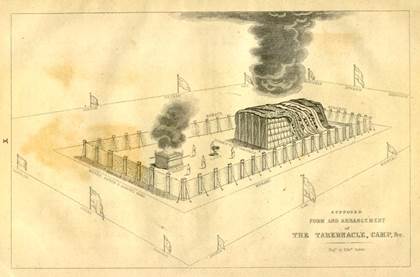
Many commentators have pointed out the unmistakable linguistic parallels between the description of the construction of the Mishkan and the description of the Creation of the world. Let us consider some of them:
1. At the end of the Creation, we read, "And God saw all that He had done, and behold, it was very good".[33] Correspondingly, with the conclusion of the construction of the Mishkan, we are told, "And Moshe saw all the work, and behold, they had done it – as God had commanded, so they had done".[34]
2. In the story of Creation, we find, "The heavens and the earth and all of their host were completed, and God completed on the seventh day His workmanship which He had done".[35] When the Mishkan is finished, we read, "All the labor of the Mishkan, the Tent of Meeting, was completed… and Moshe completed the workmanship".[36]
3. Both endeavors end with a blessing: "God blessed the seventh day";[37] "And Moshe blessed them".[38]
4. The verb “a-s-h” (to do, make) is used seven times in the Creation of the world: "God made (va-ya'as) the firmament";[39] "And God made (va-ya'as) the two lights",[40] etc. In the construction of the Mishkan, this verb recurs almost 200 times: "Let them make (va-asu) for Me a Sanctuary";[41] "Let them make (va-asu) an Ark";[42] "You shall make (vaasita) a Table",[43] etc.
5. In Sefer Mishle,[44] the Creation is described with the words: "The Lord founded the earth with wisdom; with understanding He established the heavens. By His knowledge the depths were broken up…" These adverbial descriptions are precisely the qualities that appear later on in the chief builder of the Mishkan, Betzalel ben Uri: "He willed him with a spirit of God, with wisdom, with understanding, and with knowledge, and with all manner of workmanship".[45]
But the question remains: for what purpose does the construction of the Mishkan recall the Creation of the world? For what reason are Bne Israel commanded to "repeat" the Creation as described in the first chapter of Bereshit?
The answer to this question lies in understanding man's purpose in light of the first chapter on Creation. In this chapter, the Torah emphasizes that man was created in the image of God and that his role is to rule over the world. In this way, man realizes his
potential similarity to God:
And God said: “Let us make man in our image, according to our likeness, and let them have dominion over the fish of the sea…” And God created man in His image, in the image of God He created him, male and female He created them. And God blessed them and He said to them, “Be fruitful and multiply and fill the earth and subdue it, and have dominion over the fish of the sea…"[46]
From the very start, man is called upon to act in a manner that imitates God, the faithful God with Whom there is no injustice.
“You shall follow the Lord your God”, Is it then possible for a person to follow the Divine Presence? … Rather, [it means] to follow God's qualities. Just as He clothes the naked… so you shall clothe the naked; God visited the sick… likewise you should visit the sick; the Holy One, blessed be He, comforted mourners… so you, too, should comfort mourners; God buried the dead… likewise you should bury the dead.[47]
The same idea underlies the construction of the Mishkan. Just as God created the world and caused man to dwell in it, so man is called upon to build a place for God: "Let them make Me a Sanctuary, that I may dwell in their midst".[48] Through this act, man becomes God's partner in the Creation of the world. "R. Tarfon said: God did not rest His Presence upon Israel until they performed workmanship, as it is written, 'Let them make Me a Sanctuary, that I may dwell in their midst'".[49]
However, in chapter 2 of Bereshit, in the description of man being placed in the Garden of Eden, the picture is different. Here, God goes about in the Garden, and man is entrusted only with the obligation to obey God's command and the role of, "to tend it and to guard it".[50]
Indeed, this description of the Creation, and man's role within it, also has a parallel in the Mishkan. Just as the process of building the Mishkan corresponds to man's role in the first chapter of Bereshit (Genesis), so the description of the Divine service in the Mishkan parallels man's role in the second chapter of Bereshit. There are several points of similarity between the Mishkan and Gan Eden, and thus between those serving in the Mishkan and those living in Gan Eden:
1. In Gan Eden, Adam is entrusted with the obligation "to tend it and to keep it" (le-ovda u-le-shomra). These are also the roles of the kohanim and
the levi’im in the Mishkan: "They shall keep (ve-shamru) all the vessels of the Tent of Meeting… to perform (la-avod) the service of the Mishkan".[51]
2. God's appearance in the Garden is described with the words,[52] "They heard the sound of the Lord God going about (mithalekh) in the Garden." Concerning the Mishkan, we read in Vayikra:[53] "I shall make My dwelling place in their midst… and I shall go about (ve-hithalakhti) in their midst and I shall be their God."
3. Keruvim were placed at the entrance to Gan Eden in order "to guard the path of the Tree of Life." In the Mikdash, two Keruvim were placed upon the Ark, which held the Tablets of Testimony, the essence of Torah, "a tree of life for those who grasp it."
4. God clothed Adam and Chava in Gan Eden: "And the Lord God made coats of skin (kutnot or) for Adam and for his wife, and He clothed them".[54] Correspondingly, Moshe performs a similar action during the Days of Inauguration: "And you shall make coats (kutnot) for the sons of Aharon… and you shall clothe Aharon your brother and his sons with them".[55]
This, then, is the other aspect of building the Mishkan. The first aspect viewed the essence of the Mishkan as the actual doing, the action itself, paralleling God's action in creating the world, while the other aspect focuses on the result, the resting of the Divine Presence within the Mishkan, which is a return to the idyllic world of the Garden of Eden, the world from which Adam was banished.
Thus, we learn that the building of the Mishkan was a tikkun for Adam's sin in the Garden of Eden. The Exodus from Egypt created, as it were, Am Israel. The building of the Mishkan facilitated a return to a state in which God goes about amongst Bne Israel. Adam was unable to bear this spiritual tension, and he sinned. Can Bne Israel now meet God's demands? Will they be able to avoid a return to sin?
Eventually, Bne Israel are destined to sink into the depths of sin, to be expelled once again – this time from the Gan Eden that is Eretz Israel. At the same time, the Divine Presence leaves the Sanctuary – the miniature Gan Eden: "He has stripped His dwelling like a garden, and has destroyed His meeting place".[56] However, the Divine Presence is destined to return to Israel, and the waters of Gan Eden will once again proceed from the Sanctuary:
And by the river, on its bank on this side and on that, there shall grow every tree for food; its leaves will not wither, nor will its fruit fail. It shall bring forth new fruit every month, for it is from the Sanctuary that its waters emerge.[57]
Rashi’s Commentary for: B’Midbar (Numbers) 7:1-59
1 And it was that on the day that Moses finished Heb. כַּלּוֹת . The text כַּלּוֹת on the day the Mishkan was erected, the Israelites were like a bride (כַּלּוֹת) entering the nuptial canopy.[58] [According to Tanchuma, the Drash is based on the spelling כַּלַּת , which differs from the spelling in all extant Sifrei Torah. Some believe that the Drash is based on the vowelization כַּלוֹת , instead כְּלוֹת , which would clearly mean “finishing.” Heidenheim believes that the choice of the word כַּלוֹת , the root of which is ambiguous, indicates the intention of the Torah to include both meanings: finishing and nuptials.[59]
Moses finished Bezalel, Oholiab, and all the wise-hearted [men] assembled the Mishkan, yet Scripture credits Moses with it, because he utterly devoted himself to it, overseeing that the design of each article conformed with what he was shown on the mount [Sinai], to instruct the craftsmen, and he did not err in any design. Similarly, we find with David, that since he devoted himself to the building of the Temple, as it says, “O Lord, remember for David all his affliction, that he swore to the Lord...”,[60] therefore, it [the Temple] was called by his name, as it says, “See your House, David”.[61]
[On the day] that Moses finished erecting It does not say: “On the day he erected.” This teaches us that throughout the seven days of investitures, Moses erected it and dismantled it, but on that day, he erected it but did not dismantle it. Therefore, it says, "Moses finished erecting"—that day marked the end of his erecting [the Mishkan]. It was the New Moon of Nisan. On the second [day], the red cow was burned; on the third [day], they sprinkled the first sprinkling;[62] and on the seventh [day], they [the Levites] were shaved.[63]
|
THE UNIVERSE (BERESHIT) |
THE MISHKAN (SHEMOT) |
|
"And G‑d made the sky" |
"They shall make Me a sanctuary" |
|
"And G‑d made the two large lights" |
"They shall make an ark" |
|
"And G‑d made the beasts of the earth" (1: 7, 16, 25) |
"Make a table" (25: 8, 9, 23) |
|
"And G‑d saw all that He had made, and behold it was very good." (1: 31) |
"Moses saw all the skilled work and behold they had done it; as G‑d commanded it, they had done it." (39:43) |
|
"The heavens and earth and all of their array were completed." (2:1) (1: 7, 16, 25) |
"All the work of the tabernacle of the tent of meeting was completed" (39:32) (25: 8, 9, 23) |
|
"And G‑d completed all the work that He had done" (2:2) |
"And Moses completed the work" (40:33) |
|
"And G‑d blessed" (2:3) |
"And Moses blessed" (39:43) |
|
"And sanctified it" (2:3) |
"And you shall sanctify it and all its vessels" (40:9) (39:43) |
|
Genesis 1:31 (31) And God saw all that He had made, and found it very good. And there was evening and there was morning, the sixth day. |
Exodus 39:43 (43) And when Moses saw that they had performed all the tasks—as the LORD had commanded, so they had done—Moses blessed them. |
|
|
|
|
Genesis 2:1-2 (1) The heaven and the earth were finished, and all their array. (2) On the seventh day God finished the work that He had been doing, and He ceased on the seventh day from all the work that He had done. |
Exodus 39:32 (32) Thus was completed all the work of the Tabernacle of the Tent of Meeting. The Israelites did so; just as the LORD had commanded Moses, so they did. |
|
|
Exodus 40:33 (33) And he set up the enclosure around the Tabernacle and the altar, and put up the screen for the gate of the enclosure. When Moses had finished the work, |
|
|
|
|
Genesis 2:3 (3) And God blessed the seventh day and declared it holy, because on it God ceased from all the work of creation that He had done. |
Exodus 39:43 (43) And when Moses saw that they had performed all the tasks—as the LORD had commanded, so they had done—Moses blessed them. |
|
|
|
|
Proverbs 3:19-20 (19) The LORD founded the earth by wisdom; He established the heavens by understanding; (20) By His knowledge the depths burst apart, And the skies distilled dew. |
Exodus 31:3 (3) I have endowed him with a divine spirit of skill, ability, and knowledge in every kind of craft; |
|
|
|
|
Genesis 2:15 (15) The LORD God took the man and placed him in the garden of Eden, to till it and tend it. |
Numbers 3:8 (8) They shall take charge of all the furnishings of the Tent of Meeting—a duty on behalf of the Israelites—doing the work of the Tabernacle. |
|
|
|
|
Genesis 3:8 (8) They heard the sound of the LORD God moving about in the garden at the breezy time of day; and the man and his wife hid from the LORD God among the trees of the garden. |
Leviticus 26:11-12 (11) I will establish My abode in your midst, and I will not spurn you. (12) I will be ever present in your midst: I will be your God, and you shall be My people. |
|
|
|
|
Genesis 3:24 (24) He drove the man out, and stationed east of the garden of Eden the cherubim and the fiery ever-turning sword, to guard the way to the tree of life. |
Exodus 25:19 (19) Make one cherub at one end and the other cherub at the other end; of one piece with the cover shall you make the cherubim at its two ends. |
|
|
|
|
Genesis 3:21 (21) And the LORD God made garments of skins for Adam and his wife, and clothed them. |
Exodus 28:40-41 (40) And for Aaron’s sons also you shall make tunics, and make sashes for them, and make turbans for them, for dignity and adornment. (41) Put these on your brother Aaron and on his sons as well; anoint them, and ordain them and consecrate them to serve Me as priests. |
|
|
|
|
|
Lamentations 2:6 (6) He has stripped His Booth like a garden, He has destroyed His Tabernacle; The LORD has ended in Zion Festival and sabbath; In His raging anger He has spurned King and priest. |
|
|
|
This is the meaning of “It came to pass on the day that Moses finished erecting the Tabernacle”—the source of Rabbi Shimon bar Yochai’s statement that “wherever it says ‘and it came to pass’ it refers to something that existed in the past, and was then interrupted, and then returned to its original situation.[64]
The Mishkan was started after Yom HaKippurim, Tishri 11, and was completed on Nisan 1.
The parashiot of the Mishkan are structured in the following way:
Chap 25-31
The command to build the Mishkan
31:12-17 Shabbat
Chap 32-34 Egel Hazahav (Golden Calf) and the subsequent renewal of the covenant
35:1-3 Shabbat
Chap 35-40
Moses's command and the construction of the Mishkan.
MISHKAN - CREATION
We know that Shabbat is linked to creation. As we mentioned in our opening lines, the first Shabbat WAS the Shabbat of creation, when God rested after six days. Shabbat is brought in the Torah with the explicit aim of reminding us of creation God says:
Shemot (Exodus) 31:17 It shall be a sign for all time between me and the people of Israel, that in six days the Lord made heaven and earth and on the seventh day, he ceased from work.
1. CHOCHMA, TEVUNA, DAAT: Pirke d'Rabbi Eliezer 3
"In ten sayings the world was created. and in three it was finalized. And these are they: Chochma, Tevuna and Daat; as it is stated: 'The Lord in Chochma founded the earth, by Tevuna established the heavens, by his Daat the depths were split asunder.' (Mishle / Proverbs 3:19-20) With the same three, the Mishkan was made, as it states (about Betzalel the craftsman for the Mishkan): 'I have filled him with the spirit of God, in Chachma, Tevuna and Daat.' (Shemot 31:3) With the same three qualities the Temple was built; 'His mother was from Naftali, his father from Tyre, and he was filled with Chochma, Tevuna and Daat.' (I Melachim 7:14)"
We learn from many tzaddikim that had Moshe Rabbeinu entered the Land and built the Bait HaMikdash, it would have never been destroyed, just as the Mishkan, Moshe’s handiwork, was never destroyed, only hidden until the End of Days.
* * *
This study was written by
Rabbi Dr. Hillel ben David (Greg Killian).
Comments may be submitted to:
Rabbi Dr. Greg Killian
12210 Luckey Summit
San Antonio, TX 78252
Internet address: gkilli@aol.com
Web page: http://www.betemunah.org/
(360) 918-2905
Return to The WATCHMAN home page
Send comments to Greg Killian at his email address: gkilli@aol.com
[1] Shemot (Exodus) 25:8
[2] Midrash Tanchuma (Pekudei 2)
[3] Tehillim (Psalms) 26:8
[4] Bereshit (Genesis) 1:1
[5] Tehillim (Psalms) 104:2
[6] Shemot (Exodus) 26:7
[7] Bereshit (Genesis) 1:6
[8] Shemot (Exodus) 26:33
[9] Bereshit (Genesis) 1:1
[10] Tehillim (Psalms) 104:2
[11] Shemot (Exodus) 26:7
[12] Bereshit (Genesis) 1:6
[13] Shemot (Exodus) 26:33
[14] Bereshit (Genesis) 1:9
[15] Shemot (Exodus) 30:18
[16] Bereshit (Genesis) 1:14
[17] Shemot (Exodus) 25:31
[18] Bereshit (Genesis) 1:20
[19] Shemot (Exodus) 25:20
[20] Bereshit (Genesis) 1:27
[21] Bereshit (Genesis) 2:1
[22] Shemot (Exodus) 39:32
[23] Bamidbar (Numbers) 2:3
[24] Shemot (Exodus) 39:43
[25] Bereshit (Genesis) 2:2
[26] Bamidbar (Numbers) 7:1
[27] Bereshit (Genesis) 2:2
[28] Bamidbar (Numbers) 7:1
[29] Debarim (Deuteronomy) 30:19
[30][30] Shemot (Exodus) 38:21
[31] Tehillim (Psalms) 26:8
[32] This section was written by Rav Amnon Bazak, and was edited by the author.
[33] Bereshit (Genesis) 1:31
[34] Shemot (Exodus) 39:43
[35] Bereshit (Genesis) 2:1-2
[36] Shemot (Exodus) 39:32; 40:33
[37] Bereshit (Genesis) 2:3
[38] Shemot (Exodus) 39:43
[39] Bereshit (Genesis) 1:7
[40] Bereshit (Genesis) 1:16
[41] Shemot (Exodus) 25:8
[42] Shemot (Exodus) 25:9
[43] Shemot (Exodus) 25:23
[44] Mishle (Proverbs) 3:19-20
[45] Shemot (Exodus) 31:3
[46] Bereshit (Genesis) 1:26-28
[47] Sotah 14a
[48] Shemot (Exodus) 25:8
[49] Avot de-Rabbi Nathan, chapter 11
[50] Bereshit (Genesis) 2:15
[51] Bamidbar 3:8; see also 8:26; 18:4
[52] Bereshit (Genesis) 3:8
[53] Vayikra (Leviticus) 26:11-12
[54] Bereshit (Genesis) 3:21
[55] Shemot (Exodus) 28:40-41
[56] Eicha (Lamentations) 2:6
[57] Yehezchel (Ezekiel) 47:12
[58] Tanchuma Naso 20, 26, Pesiqta Rabbati 5:5, Pesiqta deRab Kahana p. 6a, and other sources.
[59] See fn. 104, to Pesiqta deRab Kahana
[60] Tehillim (Psalms) 132:1-2
[61] See Midrash Tanchuma Naso 21; Melachim alef (I Kings) 12:16
[62] See below ch. 19
[63] see below 5:7; Sifrei 1:145
[64] Tanchuma, Naso 24.