The Order of the Tribes Of Israel
By Rabbi Dr. Hillel ben David (Greg Killian)
Synagogue, Study Hall and Marketplace
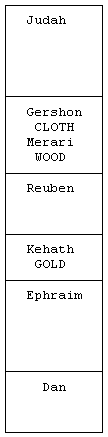
The Tribes of Israel while marching
Military Ensign (degel) Not ot
Yaakov’s Blessings in Genesis 49
Moshe’s Blessing in Debarim 33.

In this study I would like to see the tribes in the order that they are listed in the scriptures. I began this quest to understand the birth order, but I found so many interesting relationships, that I expanded my area of study. Look carefully at the lists to try to discern relationships and reasoning. I have put the appropriate scriptures underneath each of the lists. I also chose to number based on birth order as defined by Bereshit (Genesis) 49. Lets start by looking at several popular lists:
I Divrei Hayamim (Chronicles) 2:1-2 These were the sons of Israel: Reuben, Simeon, Levi, Judah, Issachar, Zebulon, Dan, Joseph, Benyamin, Naphtali, Gad, and Asher.
Revelation 7:5-8 From the tribe of Judah 12,000 were sealed, from the tribe of Reuben 12,000, from the tribe of Gad 12,000, From the tribe of Asher 12,000, from the tribe of Naphtali 12,000, from the tribe of Manasseh 12,000, From the tribe of Simeon 12,000, from the tribe of Levi 12,000, from the tribe of Issachar 12,000, From the tribe of Zebulun 12,000, from the tribe of Joseph 12,000, from the tribe of Benyamin 12,000.
Shemot (Exodus) 1:1-5 These are the names of the sons of Israel who went to Egypt with Jacob, each with his family: Reuben, Simeon, Levi, and Judah; Issachar, Zebulon and Benyamin; Dan and Naphtali; Gad and Asher. The descendants of Jacob numbered seventy in all; Joseph was already in Egypt.
A productive life requires an awareness of time’s inexorable flow and a system for time management. To this end, we consult a variety of paper or electronic grids in which the day’s expanse is segmented into hours and minutes and appropriately color-coded into time-allotments for work, meals, leisure and repose.
The reliance on calendar, clock and appointment book is one we share with all hour-conscious inhabitants of planet time. As Jews, however, we are also guided by a more subtle calendar, a more spiritual clock: the calendar and clock of history. As Jews, Abraham, Isaac, and Jacob are as central to our concept of morning, noon, and evening as the sun‘s arc across the sky; Adam, Moses and King David mark our year as prominently as the turning of the seasons; and the twelve sons of Jacob, progenitors of the twelve tribes of Israel, are as basic to our daily schedule as the twelve numerals etched on our clock-face or the twelve spiral-bound pages hanging on our wall.
|
Bereshit (Genesis) 30-31 order (Their birth) |
Bereshit (Genesis) 49 order (The blessings) |
I Chronicles 2 Order |
Shemot (Exodus) 1 Order (Going to Egypt) |
Revelation 7 Order (The sealing) |
|
|
|
|
|
|
|
1. Reuben - Leah |
1. Reuben - Leah |
1. Reuben – Leah |
1. Reuben - Leah |
4. Judah - Leah |
|
2. Simeon - Leah |
2. Simeon - Leah |
2. Simeon – Leah |
2. Simeon - Leah |
1. Reuben - Leah |
|
3. Levi - Leah |
3. Levi - Leah |
3. Levi – Leah |
3. Levi - Leah |
8. Gad - Zilpah |
|
4. Judah - Leah |
4. Judah - Leah |
4. Judah – Leah |
4. Judah - Leah |
9. Asher – Zilpah |
|
5. Dan - Bilhah |
5. Zebulon - Leah |
6. Issachar – Leah |
5. Issachar - Leah |
10. Naphtali - Bilhah |
|
6. Naphtali - Bilhah |
6. Issachar - Leah |
5. Zebulon – Leah |
6. Zebulon - Leah |
Manasseh - |
|
7. Gad - Zilpah |
7. Dan - Bilhah |
7. Dan – Bilhah |
12. Benyamin - Rachel |
2. Simeon - Leah |
|
8. Asher - Zilpah |
8. Gad - Zilpah |
11. Joseph – Rachel |
7. Dan - Bilhah |
3. Levi - Leah |
|
9. Issachar - Leah |
9. Asher - Zilpah |
12. Benyamin – Rachel |
10. Naphtali - Bilhah |
6. Issachar - Leah |
|
10. Zebulon - Leah |
10. Naphtali - Bilhah |
10. Naphtali – Bilhah |
8. Gad - Zilpah |
5. Zebulon - Leah |
|
11. Joseph - Rachel |
11. Joseph - Rachel |
8. Gad – Zilpah |
9. Asher - Zilpah |
11. Joseph - Rachel |
|
12. Benyamin - Rachel |
12. Benyamin - Rachel |
9. Asher - Zilpah |
11. Joseph - Rachel |
12. Benyamin - Rachel |
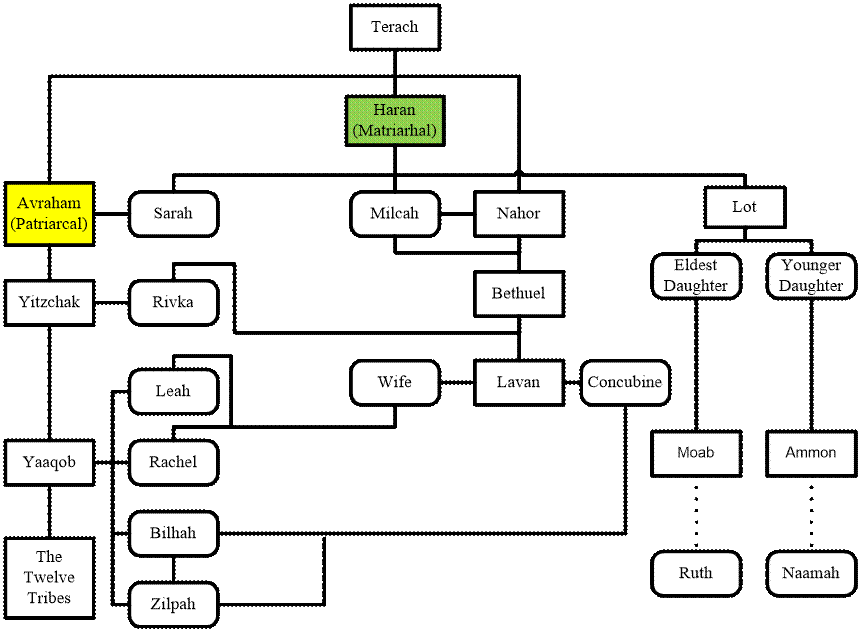
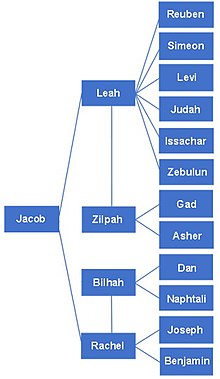
As related in the Book of Bereshit (Genesis),[2] the twelve sons of Jacob were born from four different wives and are divided into three general categories:
a) The six sons of Leah -- Reuben, Simeon, Levi, Judah, Issachar, and Zebulun.
b) The two sons of Rachel, Jacob‘s primary wife and “the mainstay of the house” of Israel[3] -- Joseph and Benyamin.
c) The four sons of the two “handmaidens,” Bilhah and Zilpah -- Dan, Naphtali, Gad, and Asher.
A similar division defines their roles as signposts in our daily lives:
the sons of Leah embody the activities on our daily schedule,
the sons of Rachel represent the primary modes of Jewish life, and
“the sons of the handmaidens” run as the auxiliary themes through our day that accompany our every action and endeavor.
Synagogue, Study Hall and Marketplace
A day in the life of a Jew begins with prayer, the “service of the heart.”[4] The first conscious thoughts of the day, and its first uttered words, are of our awareness of HaShem’s presence in our lives and our indebtedness to Him for our every living breath.[5] And though formal prayer must by necessity wait until one has gotten out of bed, washed, dressed, and rushed[6] to the synagogue, it is the very first item on our daily agenda. In the words of the Shulchan Aruch (Code of Jewish Law), “The time for reciting the morning prayers[7] begins at sunrise... From the onset of the time for prayer, a person is forbidden to visit one‘s friend ... to attend to one‘s personal affairs, or to embark on a journey, before praying the morning prayers.”[8]
After the morning prayers, the Jew proceeds “from the synagogue to the study hall” for a daily “set time for Torah learning.”[9] From there he ventures out into the “secular” world to attend to his material affairs and the business of earning a living.[10]
These three activities are chronicled by the sons of Leah: Reuben, Simeon, Levi and Judah represent the various phases of prayer and its “service of the heart“; Issachar represents the study of Torah; and Zebulun represents the Jew’s foray into the marketplace.
Prayer is a “ladder set upon the earth whose head touches the heavens.”[11] This ladder consists of four rungs -- Reuben, Simeon, Levi and Judah; or love, awe, integration and self-abnegation.
The heart of man is home to hundreds, if not thousands, of identifiable emotions. But in a most general sense, we recognize two primary drives: the impulse to approach and come near, and the impulse to recoil and withdraw. To the first category belong such emotions as love, yearning, and kindness; to the second category, feelings such as awe, fear, reverence, and humility.
The repertoire of the heart also includes emotions that combine both these motions of self. A mature emotional relationship will include feelings that are both loving and revering, feelings that integrate a striving for closeness with a restraining awe.
Indeed, such a synthesis of love and awe is the heart‘s highest form of emotional expression. But an even greater achievement of the heart is the negation of emotion. For all emotions, whether of the self-extending, self-contracting or “integrating” sort, are a form of self-expression; and to truly relate to someone or something that lies beyond the self, one must divest oneself of every vestige of self-interest and self-regard.
These are the four rungs in the ladder of prayer. In the first phase of the “service of the heart“ (which culminates in the first section of the Shema), the objective is to develop a feeling of love towards HaShem, a yearning and craving to draw close to Him. The second phase (coinciding with the second section of the Shema) is the development of feelings of reverence and awe toward HaShem. The third phase (associated with the blessing “True and Enduring,” recited between the Shema and the Amida) is the fusion of love and awe in our relationship with HaShem. In the fourth phase (attained during the silent recitation of the Amida) we transcend emotion itself, abnegating all feeling and desire to achieve an utter commitment and unequivocal devotion to HaShem.
In the terminology of Kabbalah and Chassidism, love and awe are the eyes and the ears of the heart. Sight is the most intimate of the senses; hearing, the most distant and detached.[12] Hence love -- the heart‘s yen to draw close -- is its faculty of “sight,” and awe -- the heart‘s impulse to retreat and withdraw -- is its sense of “hearing.”
Reuben, whose name derives from the Hebrew re’iyah, “sight,” and who was so named by his mother because “ HaShem has seen my suffering; now my husband shall love me,”[13] thus represents the first stage of prayer -- the element of “love” in our service of the heart. Simeon -- from shemi’ah, “hearing,” so named in response to the fact that “ HaShem has heard that I am rejected”[14] -- represents the second stage of prayer, the heart‘s recoil in reverence and awe. Levi, meaning “attachment” and “cleaving” (his birth prompted Leah to say, “Now my husband shall cleave to me, for I have borne him three sons”[15]) represents the union of love and awe in the third stage of prayer. And Judah, whose name means “he who concedes” (“This time I shall concede thanks to HaShem“,[16] proclaimed Leah upon Judah’s birth) represents the fourth rung in the ladder of prayer -- the self-abnegation to HaShem we express in the silent Amida.[17]
Before his passing, Jacob summoned his twelve sons and “spoke to them ... and blessed them, each according to his blessing.”[18] Two hundred and thirty-three years later, Moses did the same with the twelve tribes of Israel, who now each numbered several tens of thousands of souls. Jacob‘s and Moses’ blessings express the individual character of each tribe and its distinct role within the community of Israel.
Jacob‘s blessings to Zebulun and Issachar were:
Zebulun shall dwell at the shore of the sea; a harbor for ships shall he be... Issachar is a strong ass,[19] couching down between the fences...[20]
Moses’ parting words to the two tribes were:
Rejoice, Zebulun, in your excursions, and Issachar in your tents.[21]
Our sages explain: Zebulun and Issachar made a partnership between them. Zebulun dwelled at the seashore, and would go out in his ships to engage in trade and make a profit, and support Issachar, who sat and occupied himself with the study of Torah.[22]
Issachar and Zebulun thus represent the other two major items on the Jew‘s daily schedule. After climbing the four rungs of the heart to serve HaShem in prayer, the Jew moves “from the synagogue to the study hall” to bind his mind to HaShem through the study of the Torah, HaShem‘s communication of His wisdom and will to man. Following that, the Jew goes out into the world as a businessman or professional, to “know Him in all your ways”[23] and do “all your deeds for the sake of Heaven.”[24]
For every Jew, whether by vocation a “Zebulun” or an “Issachar,” includes both activities in his daily schedule. The most involved businessman or laborer is not free of the obligation to study at least “one chapter in the morning and one chapter in the evening.”[25] And even the most faithful occupant of the tents of Torah and its most ardent “beast of burden” is also a citizen of the material world: by necessity and design, he, too, participates in the give-and-take of economic life, and is told that this, too, must be made part and parcel of his life as a Jew and his relationship with HaShem.[26]
“All the prophets,” says the Talmudic sage Rabbi Yochanan, “prophesied only regarding [the rewards of] the Baal teshuva. But regarding the perfect tzaddik -- ‘No[27] eye has beheld it save Yours, HaShem.’”[28]
Rabbi Yochanan, remarks that the Talmud, is expressing an opposite opinion from that of another sage, Rabbi Abahu, who stated: “In the place that the Baal teshuva stands, the perfect tzaddik cannot stand.”[29]
Tzaddik means “righteous one“; Baal teshuva means “one who returns.” In the most literal sense, a tzaddik is a person who lives his entire life in complete conformity with the divine will, while a Baal teshuva is a penitent, a person who has digressed from the proper path but subsequently repents his failings and returns to a life of goodness and obedience to HaShem‘s will.
In a broader sense, tzaddik and Baal teshuva are two modes of existence, two approaches to everything one does in the course of one‘s day, from prayer and its “service of the heart”, to the study of Torah, to one‘s dealings in the marketplace.
In the tzaddik approach to life, a person focuses wholly upon the good in himself and his world. He sees his mission in life as the endeavor to cultivate his own positive traits; the goodness he sees in others, and all that is pure and holy in HaShem‘s world. Anything negative is to be suppressed and rejected, and utterly disdained. When evil must, by necessity, be combated, this is to be achieved not by engaging it, but by rising above it -- by increasing the goodness in oneself and in the world so that the evil simply dissipates as darkness melts away before a great light.
The teshuva approach is to deal with the negative in oneself and one‘s environment: to struggle with it rather than reject it, to transform it rather than transcend it; to uncover and extract the kernel of goodness implicit within every object and force in HaShem’s creation.
As the diverse opinions of Rabbi Yochanan and Rabbi Abahu convey, each approach has its advantages over the other: the approach of the tzaddik attains heights which “no eye has beheld save“ HaShem‘s, while the approach of teshuva achieves a place on which “the perfect tzaddik cannot stand.”
The tzaddik’s “service of the heart,” undisturbed by any negative emotions and drives, unleashes the heart‘s holy passions with a purity and perfection that the Baal teshuva cannot even hope to approximate. The Baal teshuva’s prayer, on the other hand, is a war -- a war between the good and evil strivings in his heart, between its G-dly and animal passions. But this war, this struggle, fires his love, awe, attachment, and self-abnegation to HaShem to an intensity unparalleled by that of the tzaddik. And the process of this struggle offers the opportunity to ultimately vanquish the enemy and transform it into an ally -- to strip the heart‘s profane strivings of their profanity and redirect them as holy strivings.
The tzaddik’s Torah study, unclouded by erroneous suppositions and false leads, assimilates the divine wisdom with a purity and perfection that the Baal teshuva cannot know. On the other hand, the teshuva mode of learning, which struggles through a maze of fallacies and misunderstandings in its pursuit of truth, attains a depth of knowledge and a degree of identification with its subject which cannot be achieved by a mind that follows an unobstructed path to the core of every idea. Indeed, in the teshuva approach to Torah, the refuted arguments and the dispelled falsehoods themselves reveal dimensions of the divine truth that cannot be accessed by the tranquil study of the tzaddik.[30]
When the tzaddik deals with the material world, he focuses directly and exclusively upon those resources which he enlists in his service of HaShem; everything else simply does not exist for him. Thus the tzaddik achieves a perfect sublimation of material aspects of his existence, and remains unsullied by his involvement in the give and take of material life. For the Baal teshuva, on the other hand, the marketplace is a minefield of negative influences and temptations, which invariably taint him and, at times, even overpower him. But his struggle with these alien elements, and his ultimate triumph over them, means that they, too, become part and parcel of his “knowing HaShem in all your ways.” Hence, the Baal teshuva achieves a broader, more comprehensive service of HaShem in his material life than the tzaddik, for his relationship with HaShem includes elements of HaShem‘s creation which remain outside the sphere of the tzaddik’s “perfect” service.
The name “Joseph“ means, “he shall add” -- upon Joseph‘s birth, his mother expressed the hope that “HaShem shall add to me another son.”[31] The deeper significance of these words is that Joseph represents the endeavor of teshuva to “add another son” -- to transform all that is “other” and alien in oneself and one‘s world into a “son,” thereby adding it to the positive and holy realm of one‘s existence.
“Benyamin“ means “son of the right” -- Jacob so named Rachel’s second child because this was the only one of his sons to be born in the Holy Land.[32] Benyamin thus represents the utter righteousness and pristine holiness of the tzaddik.
The four “sons of the handmaidens” -- Dan, Naphtali, Gad, and Asher -- are four motifs that accompany the daily life of the Jew; judiciousness, engagement, blessing, and saturation.
“HaShem gave me justice,” proclaimed Rachel upon the birth of Jacob’s first son by her handmaiden, Bilhah, and named him Dan, Hebrew for “judgment.”[33] “Dan shall be the judge of his people,” said Jacob in blessing him before his passing.[34] If you meet a person, says the Talmud, who is forever insisting on justice, this is a sure sign that he is from the tribe of Dan.[35]
“Naphtali” means “engagement” and “connection“ -- Bilhah’s second son was so named by Rachel to signify the fact that “I have engaged my sister, and I have prevailed.”[36]
Both Jacob and Moses blessed Asher with the blessing of oil. “His bread is saturated with oil,”[37] said Jacob; “He dips his feet in oil,”[38] blessed Moses. In Torah law and Chassidic teaching, “oil” signifies the quality of saturation: the nature of oil is that when it comes in contact with something, it “permeates it in its entirety.”[39]
Finally, “Gad” means “blessing” and “good fortune.” “Good fortune has come,”[40] said Leah upon giving this name to Zilpah’s elder son.
As the Jew prays (Reuben, Simeon, Levi and Judah), studies (Issachar) and deals (Zebulun), whether with the perfect holiness of the tzaddik (Benyamin) or the transforming struggles of teshuva (Joseph), the “four sons of the handmaidens” attend his every deed and endeavor: a judiciousness that measures everything against exacting standards of right and wrong (“Dan”); a sense of connectedness to HaShem and perpetual engagement with Him (“Naphtali”); a “holistic” approach to life, in which one is fully invested in what one is doing so that it saturates one‘s thoughts, feelings, and every nook and cranny of one‘s being (“Asher”); and the recognition that we cannot do it on our own -- that everything we achieve must be aided by HaShem‘s blessing our efforts with success (“Gad”).
Based on the Rebbe’s writings and talks, including a reshimah (journal entry) entitled: “The Daily Schedule”[41]
End of text - Week in Review - Kislev 8 5759 - Vayeitzei
© Copyright 1991-current
All Rights Reserved
Chabad Lubavitch in Cyberspace
|
Tribes by mother – Bereshit (Genesis) 35 |
|||
|
The sons of Leah |
The sons of Rachel |
The sons of Rachel’s Maidservant Bilhah |
The sons of Leah’s maidservant Zilpah |
|
1. Reuben |
11. Joseph |
7. Dan |
8. Gad |
|
2. Simeon |
12. Benyamin |
10. Naphtali |
9. Asher |
|
3. Levi |
|
|
|
|
4. Judah |
|
|
|
|
6. Issachar |
|
|
|
|
5. Zebulon |
|
|
|
The following dates are from “Meam Loez”, Genesis III 3a, page 77:
|
|
Mother |
Meaning |
Birth Date |
Lifespan |
Year of Death |
|
Reuven |
Leah |
reu ben - “See a son” |
Kislev 14, 2193 |
125 |
2318 |
|
Shimon |
Leah |
shama - “hear” |
Tevet 28, 2194 |
120 |
2314 |
|
Levi |
Leah |
lavah - “to be a companion” |
Nisan 16, 2195 |
137 |
2332 |
|
Yehudah |
Leah |
yadah - “thank” |
Sivan 15, 2196 |
119 |
2315 |
|
Dan |
Bilhah |
dan - “judge” |
Elul 9, 2196 |
125 |
2321 |
|
Naphtali |
Bilhah |
naphtuley - “twist” or “wrestle” |
Tishre 5, 2198 |
133 |
2331 |
|
Gad |
Zilpah |
gad - “success” |
Cheshvan 10, 2198 |
125 |
2323 |
|
Asher |
Zilpah |
asher - “fortune” |
Shevat 29, 2199 |
123 |
2322 |
|
Yissachar |
Leah |
sachar - “reward” |
Av 10, 2198 |
122 |
2320 |
|
Zebulon |
Leah |
zevul - “permanent home” |
Tishre 7, 2200 |
114 |
2314 |
|
Yosef |
Rachel |
yosef - “add” |
Tammuz 1, 2199 |
110 |
2309 |
|
Benyamin |
Rachel |
ben yamin - “son of my right hand“ |
Cheshvan 11, 2208 |
109 |
2317 |
Bereshit (Genesis) 35:22 While Israel was living in that region, Reuben went in and slept with his father’s concubine Bilhah, and Israel heard of it. Jacob had twelve sons: The sons of Leah: Reuben the firstborn of Jacob, Simeon, Levi, Judah, Issachar and Zebulun. The sons of Rachel: Joseph and Benyamin. The sons of Rachel’s maidservant Bilhah: Dan and Naphtali. The sons of Leah’s maidservant Zilpah: Gad and Asher. These were the sons of Jacob, who were born to him in Padan Aram.
Midrash Rabbah - Bereshit (Genesis) XCIII:7 ... And he washed his face... and they sat before him, the firstborn according to his birthright, etc. R. Samuel b. Nahman said: What did Joseph do? He prepared a great feast for them, and when they came to recline [at the meal] he took the cup, struck it, and declared,
Reuben,
Simeon,
Levi,
Judah,
Issachar, and
Zebulun are the sons of one mother; where are they? Bring them and let them sit together.
Dan and
Naftali are the sons of one mother: bring them and let them sit together.
Gad and
Asher are the sons of one mother: bring them and let them sit together. Thus
Benyamin was left. Said he: He is motherless and I am motherless, so he and I will sit together. And portions were taken... but Benyamin‘s portion was five times so much as any of theirs. Why five times? One portion given to him by Joseph, a second which he received among his brethren, a third given to him by his [Joseph‘s] wife, and two by his two sons [Manasseh and Ephraim].
Rabbi Zalman Sorotzkin, in his book “Insights In The Torah”, suggests that the camping order generally goes according to mother, according to strength. Thus Leah had six sons and thus had two camps, Reuben and Judah. Since one of her sons, Levi, was near the Mishkan, the firstborn of Zilpah (Gad), Leah’s handmaid, was substituted for Levi. Judah, with the greatest number of warriors, went first. Reuben, Leah’s firstborn took his position on the south.
Yosef, the firstborn of Rachel, had two sons: Menashe and Benyamin. Ephraim received the blessing of the firstborn, from Ya’aqov. Ephraim was therefore given the task of leading the west side of the camp.
Dan, the second strongest numerically, the firstborn of Bilhah, took guard over the backside of the camp.
Thus two camps were given to Leah, one to Rachel, and one to the sons of the handmaids.
Soncino Zohar, Bereshith, Section 1, Page 246b The truth is, however, that the whole body takes its description from the end of the body, which is male, although the beginning of the body is female. Here, however, both the beginning and end are female. Observe the recondite allusion in this matter. We see that Jacob blessed Joseph along with his brothers, but when God arranged the tribes under four standards He omitted Joseph and put Ephraim in his place. This cannot have been for any sin of Joseph’s, but the reason is this. Joseph was the impress of the male, and since all the adornments of the Shekinah are female, Joseph was removed from the standards and Ephraim was appointed in his place. On this account he was stationed on the west, the side where the female abides, and the impress which is male was removed from her adornments. We thus see that all the twelve tribes are the adornment of the Shekinah after the supernal pattern, save for the grade of the Zaddik, who makes all the limbs male.
The four flags to the four winds, at the head of the three tribes, were not tribal flags. Of the three tribes on each side, those three might have been called after the center tribe who might have been the flag bearer but that was not that tribe’s flag. Each center tribe had their own flag.
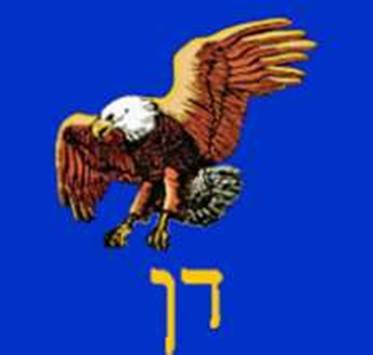
So Dan’s personal flag [so to speak] bore the snake. Their “North side” flag bore the eagle. [If I didn’t mix those up.]
Ibn Ezra[42] These were signs upon each and every standard. The Talmudic Sages said that the banner of Reuben had the form of a person on it.[43] Their statement is based on a Midrashic interpretation concerning the mandrakes found by Reuben.[44] The Talmudic Sages also tell us that there was an image of lion on the standard of Judah, for Jacob had compared Judah to a lion.[45] They also tell us that the banner of Ephraim (the son of Joseph) had the image of an ox upon it, in keeping with the verse “His firstling bullock”.[46] The flag of Dan had the image of an eagle. Thus the banners were similar to the cherubim which the prophet Ezekiel saw.[47]
The tribes camped around the sanctuary according to how Jacob had ordered them to carry his coffin from Egypt up to Israel. So, yes, by that with which Jacob blessed the tribes, that was their “personal” flag.
The reason for the flags was because when all Israel saw HaShem descend, so to speak, upon Mt. Sinai, He was accompanied by legions of angels and they appeared to Israel in that square formation with the angels, themselves, bearing flags and different colored fires. The four flags to the four winds, the twelve flags of the tribes, the colors of the flags, that was all to emulate what Israel saw by the angels.
Midrash Rabbah - The Song of Songs III:23 R. Berekiah and R. Bun in the name of R. Abbahu said: There are four lordly creatures. The lord among the birds is the eagle; the lord among cattle is the ox; the lord among beasts is the lion; and the lord over all of them is man. The Holy One, blessed be He, took them and engraved them the Throne of Glory, as it says, The Lord hath established His throne in the heavens, and His kingdom ruleth over all (Ps. CIII, 19). The fact that He has established His throne above the lordly ones proves that ‘His kingdom ruleth over all’.
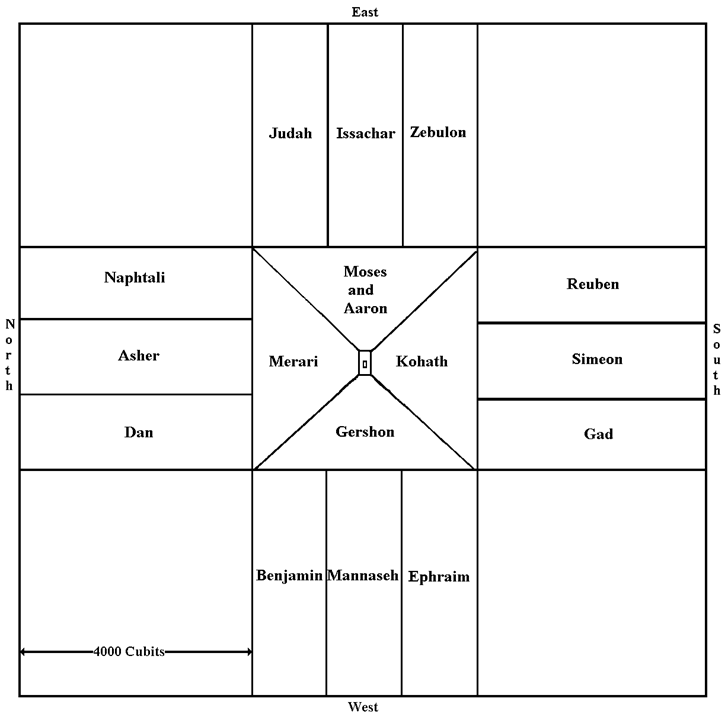
The next three pictures / diagrams are to depict the various opinions as to the arrangement of the tribes of Israel while they were camping:
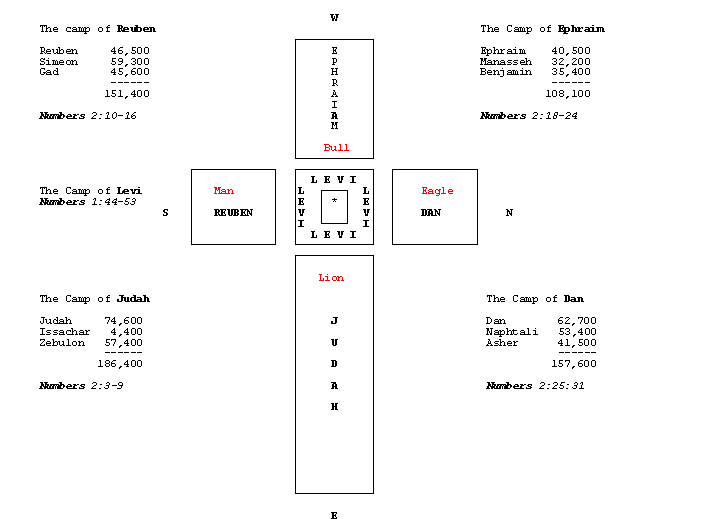
Numbers 2:2 “The Israelites are to camp around the Tent of Meeting some distance from it, each man under his standard with the banners of his family.”
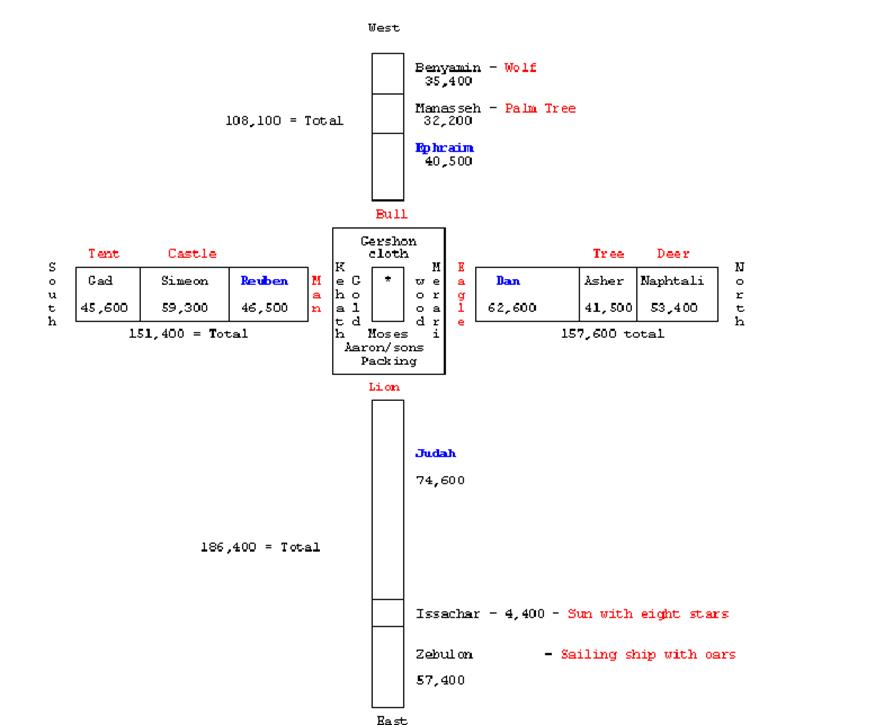
In Bamidbar (Numbers) 3:38 we read that “camping to the east; in front of the Tabernacle, shall be Moshe and Aharon and his sons.” This is in proximity--of Moshe-- to Judah-Yissachar-Zebulun. Further we read in the Torah that:
|
Moshe |
Numbers 5:4 |
Moses taught / gave Jews the Torah |
|
Yissachar |
1 Chronicles 12:32 |
From Yissachar were Sages to teach what to do |
|
Zebulun |
Judges 5:14 |
From Zebulun, those trained in scribal calligraphy |
|
Judah |
Bereshit (Genesis) 49:10 |
Leaders and statue makers won’t depart from Judah |
The importance of living physically close to a Nazarean Hakham (Rabbi) and/or a Nazarean Synagogue can never be over-emphasized. This we see in the case of the Levi’im who had their living arrangements around the tents of Moshe Rabbenu and Aharon. Moshe’s tent was prefiguring the tent of the King of Israel (i.e. Mashiach).[48]
This last picture was copied from The Living Torah by Aryeh Kaplan:
Bamidbar (Numbers) 2:2 “The Israelites are to camp around the Tent of Meeting some distance from it, each man under his standard with the banners of his family.”
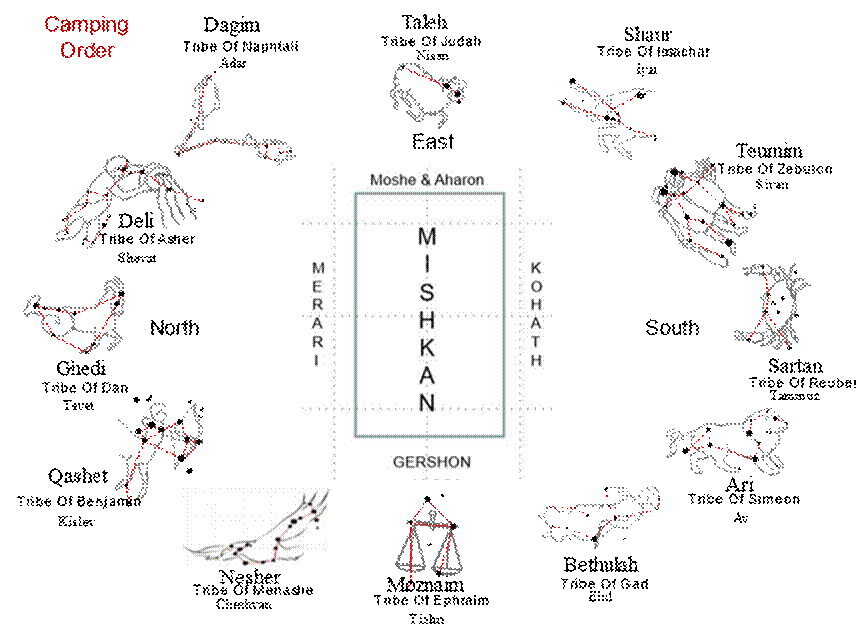
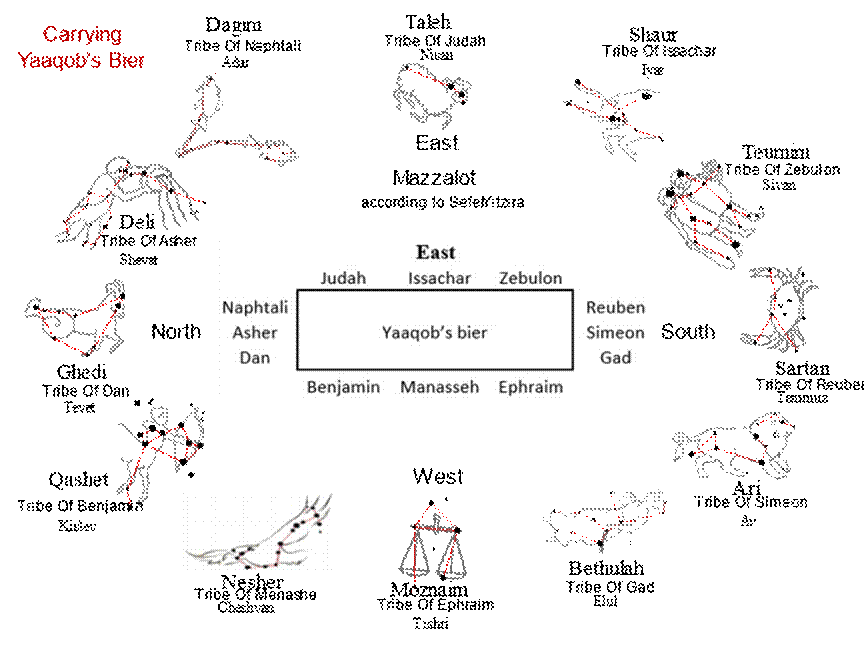
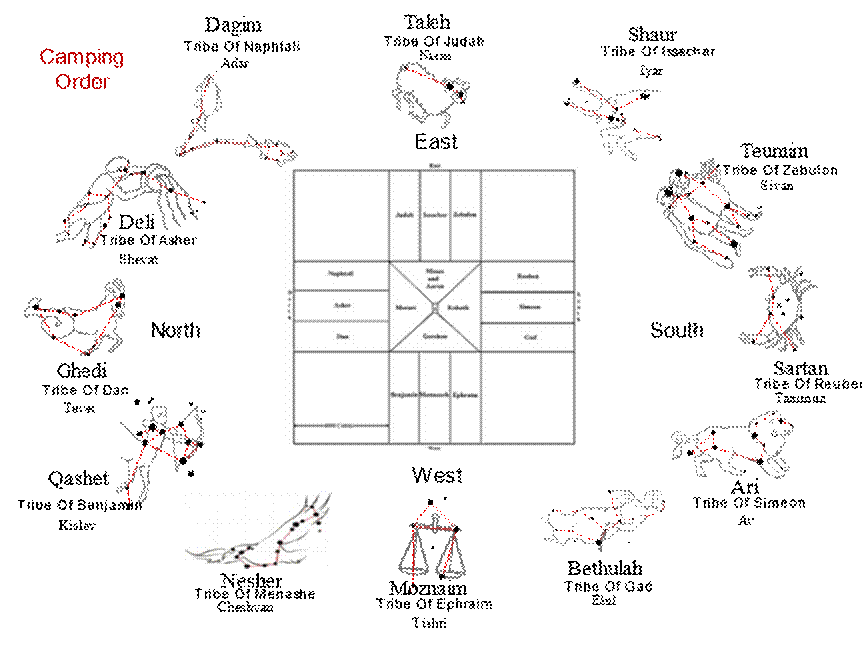
Rabbeinu Bachya[49] teaches that Dan’s flag had an eagle on it. This causes the mazzalot to correspond with Ezekiel’s vision:
Ezekiel 10:14 And every one had four faces: the first face was the face of a cherub, and the second face was the face of a man, and the third the face of a lion, and the fourth the face of an eagle.
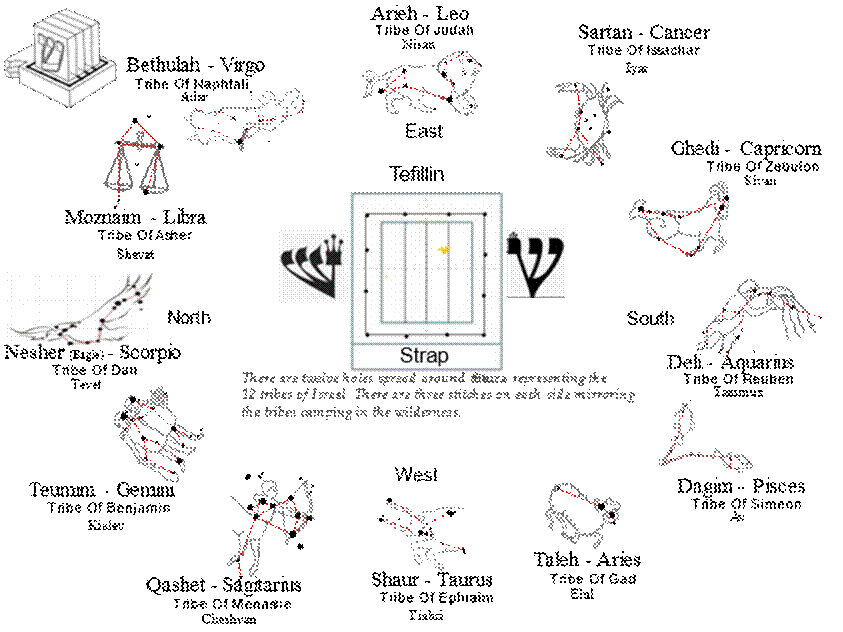
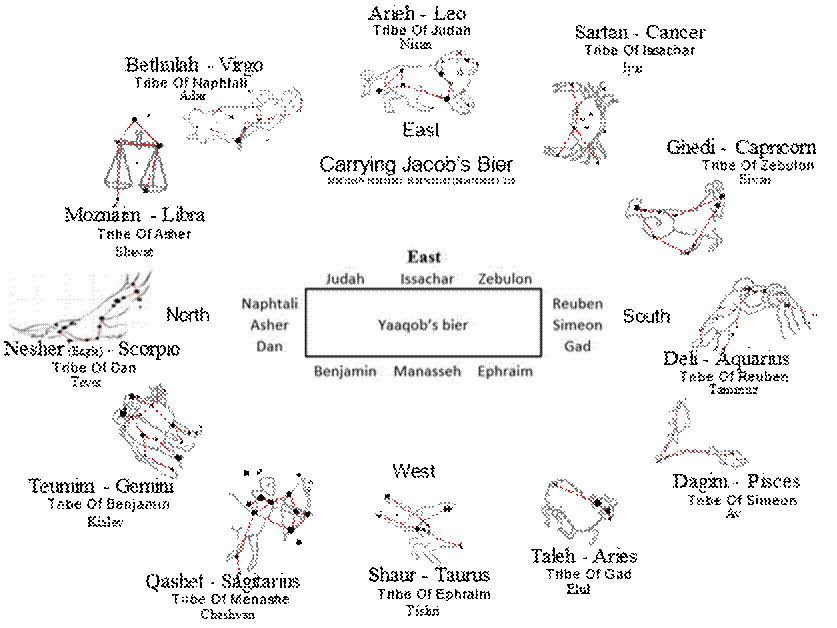
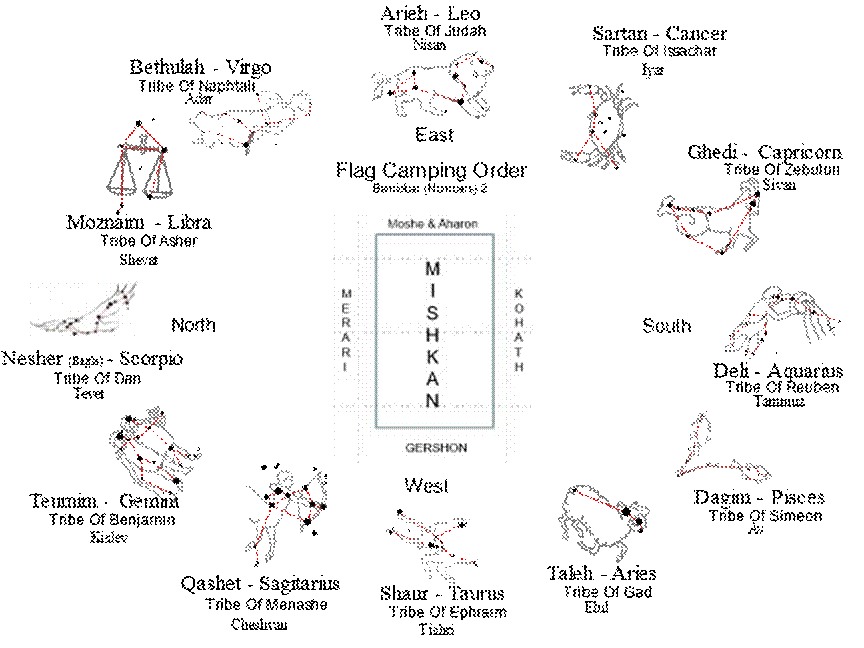
Sefer Yitzirah
|
Month |
Mazzalot Hebrew |
Mazzalot Latin |
Sign |
Tribe |
Faculty |
Gem |
|
Nisan |
Toleh |
Aries |
Ram |
Yehuda |
Speech |
Nofech / Carbuncle |
|
Iyar |
Shor |
Taurus |
Bull |
Issachar |
Thought |
Safir / Sapphire / Lapz Lazuli |
|
Sivan |
Teumim |
Gemini |
Twins |
Zebulun |
Motion |
Yahalom / Pearl / Diamond |
|
Tammuz |
Sartan |
Cancer |
Crab |
Reuven |
Sight |
Odem / Ruby |
|
Av |
Ari |
Leo |
Lion |
Shimon |
Hearing |
Pitdah / Emerald |
|
Elul |
Betula |
Virgo |
Virgin |
Gad |
Action |
Achlama / Crystal |
|
Tishri |
Moznaim |
Libra |
Scales |
Ephraim |
Coition |
Shoham / Onyx ?? |
|
Cheshvan |
Akrav |
Scorpio |
Scorpion |
Menashe |
Smell |
|
|
Kislev |
Kashet |
Sagittarius |
Archer |
Benyamin |
Sleep |
Yashpheh / Jasper |
|
Tevet |
Gedi |
Capricorn |
Kid |
Dan |
Anger |
Leshem / Topaz |
|
Shevat |
Dli |
Aquarius |
Water Drawer |
Asher |
Taste |
Tarshish |
|
Adar |
Dagim |
Pisces |
Fishes |
Naftali |
Laughter |
Shevo / Turquoise |
In the listing found in Bamidbar (Numbers) chapter 1, Reuven and his accompanying tribes come first, as he was the firstborn, followed by Yehuda, Ephraim and Dan.
However, in Bamidbar (Numbers) chapter 2, when the Torah describes the movement of the nation, the military preparations become most important. Yehuda, based on his strength and numerical superiority, comes first. Dan is still mentioned last, not because he represents the less-important maidservants, but because he serves to protect the nation from an attack from the rear.
Midrash Pesiqta DeRab Kahana: Pisqa 26 XXVI:VII It was taught on Tannaitic authority in the name of R. Eliezer: It is forbidden for a disciple to teach a Law in the presence of his master - until he will be twelve mils away from him, the breadth of the camp of Israel. That is in line with the following verse of Scripture: They encamped by the Jordan from Beth-Jeshimoth as far as Abet-shiuim [in the plains of Moab] (Num. 33:49). [And how long is that distance? It is twelve mils. (that is. the breadth of the camp of Israel)].
HaRav S.R. Hirsch, zl, explains the practical / symbolic meaning behind the formation of the tribes as they camped and traveled. In the front, to the east, under the banner of Yehudah, were the tribes of Yehudah, Yissachar, and Zebulun. To the right, in the south, under the banner of Reuben, were Reuben, Shimon, and Gad. To the left, in the north, under the banner of Dan, were the tribes of Dan, Asher, and Naftali. Last, in the back, opposite Shevet Yehudah, under the banner of Ephraim, were Ephraim, Menashe, and Benyamin. Each of the three tribes, which form the leading camp, is characterized for its material and spiritual attributes, thereby maintaining a balance of sorts.
Yaaqob Abinu visualized Yehudah as the most prominent tribe, symbolized by his scepter and leadership in Torah law. Yissachar was the tribe devoted to agriculture, who consequently had leisure time for study. Zebulun was devoted to commerce, but also seems to be a leader in cultivating literature. Hence, in the leading tribes, the areas in which the material and spiritual welfare of the nation were to depend, were united. The scepter and the law, agriculture and science, commerce and literature. These two factors, the spiritual and material, combined in the leading camp and separated right and left in the subordinate camps behind it. The camp to its right consisted of Reuben, the bechor, firstborn. He was endowed with the intelligence and sensitivity for what is right and just, yet with a softness of character which ultimately denied him the firmness necessary for leadership. In conjunction with him were Shimon, quick and impulsive, the avenger of honor, and Gad, who struck swift as an arrow to avenge any unjustified attack. In other words, on Yehuda’s right there was the courage and temperament to ward off humiliation and attack, but under the aegis of moderate and calm.
To his left, he was flanked by Dan, the tribe of deft cleverness, the consummate politician; Asher, representing refinement of taste; and Naftali, noted for his eloquence. While on the right, Reuben represented strength and force; Dan on the left symbolized a rich development in the area of culture.
On the side opposite to the eastern camp, to the west, were the tribes of Ephraim, Menashe, and Benyamin. Ephraim and Menashe essentially represented Shevet Yosef. Based upon Yaaqob Abinu’s blessing to his sons prior to his demise, HaRav Hirsch suggests that Ephraim and Menashe were to develop greatness and might. Bravery would be their primary attribute, which would be a wonderful supplement to Yehudah in the east in terms of national welfare. Regrettably, history indicates that instead of complementing Yehudah, the house of Yosef opposed their leadership, catalyzing a tragic rift in Klal Yisrael. Instead of planting their banner behind Yehudah, they chose to go to the forefront and claim leadership. When they broke the G-d-given formation, they brought ruin upon themselves and all the other tribes that had attached themselves to them.
Bamidbar (Numbers) 10:11-28 On the twentieth day of the second month of the second year, the cloud lifted from above the tabernacle of the Testimony. Then the Israelites set out from the Desert of Sinai and traveled from place to place until the cloud came to rest in the Desert of Paran. They set out, this first time, at HaShem’s command through Moses. The divisions of the camp of Judah went first, under their standard. Nachshon son of Amminadab was in command. Nethanel son of Zuar was over the division of the tribe of Issachar, And Eliab son of Helon was over the division of the tribe of Zebulun. Then the tabernacle was taken down, and the Gershonites and Merarites, who carried it, set out. The divisions of the camp of Reuben went next, under their standard. Elizur son of Shedeur was in command. Shelumiel son of Zurishaddai was over the division of the tribe of Simeon, And Eliasaph son of Deuel was over the division of the tribe of Gad. Then the Kohathites set out, carrying the holy things. The tabernacle was to be set up before they arrived. The divisions of the camp of Ephraim went next, under their standard. Elishama son of Ammihud was in command. Gamaliel son of Pedahzur was over the division of the tribe of Manasseh, And Abidan son of Gideoni was over the division of the tribe of Benyamin. Finally, as the rear guard for all the units, the divisions of the camp of Dan set out, under their standard. Ahiezer son of Ammishaddai was in command. Pagiel son of Ocran was over the division of the tribe of Asher, And Ahira son of Enan was over the division of the tribe of Naphtali. This was the marching order for the Israelite divisions as they set out.
The classic place, in the Torah, where we find the tribes in the ‘marching order’ is in Bamidbar chapter seven where the tribal princes bring their gifts at the dedication of the Mishkan. This is brought home by Rashi’s comment:
Rashi’s Commentary for: Bamidbar (Numbers) 7:19 He brought his offering - Why is the word הִקְרִב, “brought [his offering],” used in connection with the tribe of Issachar, but is not used in connection with any of the [other] tribes? Because [the tribe of] Reuben came and complained, “Is it not enough that my brother Judah has preceded me? Let me [at least] offer up after him.” Moses said to him, “I was told by the Almighty that they should offer up in the order in which they travel, according to their divisions.” This is why it says: הִקְרִב אֶת־קָרְבָּנוֹ, [in which the word הִקְרִב is] missing a “yod,” [thus] giving it the meaning of הַקְרִב, in the imperative—for he was commanded by the Almighty, “Bring the offering!” (Sifrei Naso 1: 158) What is the meaning of הִקְרִב... הִקְרִב, twice? For because of two reasons he [Issachar] merited to be the second of the tribes to offer their sacrifices: One, because they were [well] versed in the Torah, as it says, “And of the sons of Issachar, those who had understanding of the times” (I Chron. 12:32). Another, because they advised the chieftains to contribute these offerings (Sifrei). In the writings of Rabbi Moses Hadarshan ["the preacher"], I found [the following]: Rabbi Phinehas the son of Yair says [that] Nethaniel the son of Zu’ar gave them this idea.
When the Mishkan, the Tabernacle, was set up, the tribal chiefs each brough identical offerings for its inauguration:
Bamidbar (Numbers) 7:1 And it came to pass on the day that Moses had made an end of setting up the tabernacle, and had anointed it and sanctified it, and all the furniture thereof, and the altar and all the vessels thereof, and had anointed them and sanctified them; 2 that the princes of Israel, the heads of their fathers' houses, offered--these were the princes of the tribes, these are they that were over them that were numbered. 3 And they brought their offering before the LORD, six covered wagons, and twelve oxen: a wagon for every two of the princes, and for each one an ox; and they presented them before the tabernacle.
The Torah goes on to name the prince and his tribe in the order in which they presented their offering. The order of the offerings is the order the tribes marched in the wilderness, as Rashi tells us:
7:11 shall present his offering for the dedication of the altar But Moses still did not know how they should bring [the offerings], whether in the order of their births [namely, the order in which Jacob’s sons were born] or according to the order in which they traveled—until he was instructed by the Holy One, blessed is He, that they should bring the offerings according to the order in which they traveled, each one in his day.[51]
7:19 He brought his offering - Why is the word הִקְרִב, “brought [his offering],” used in connection with the tribe of Issachar, but is not used in connection with any of the [other] tribes? Because [the tribe of] Reuben came and complained, “Is it not enough that my brother Judah has preceded me? Let me [at least] offer up after him.” Moses said to him, “I was told by the Almighty that they should offer up in the order in which they travel, according to their divisions.” This is why it says: הִקְרִב אֶת־קָרְבָּנוֹ, [in which the word הִקְרִב is] missing a “yod,” [thus] giving it the meaning of הַקְרִב, in the imperative—for he was commanded by the Almighty, “Bring the offering!”[52] What is the meaning of הִקְרִב... הִקְרִב, twice? For because of two reasons he [Issachar] merited to be the second of the tribes to offer their sacrifices: One, because they were [well] versed in the Torah, as it says, “And of the sons of Issachar, those who had understanding of the times”.[53] Another, because they advised the chieftains to contribute these offerings (Sifrei). In the writings of Rabbi Moses Hadarshan ["the preacher"], I found [the following]: Rabbi Phinehas the son of Yair says [that] Nethaniel the son of Zu’ar gave them this idea.
To understand the various tribal orders, we need to examine the lives (life stories) of each of the twelve tribes.
Bamidbar (Numbers) 2:1-14 HaShem said to Moses and Aaron: “The Israelites are to camp around the Tent of Meeting some distance from it, each man under his standard with the banners of his family.”
On the east, toward the sunrise, the divisions of the camp of
Judah are to encamp under their standard. The leader of the people of Judah is Nachshon son of Aminadab. His division numbers 74,600. The tribe of
Issachar will camp next to them. The leader of the people of Issachar is Nethanel son of Zuar. His division numbers 54,400. The tribe of
Zebulun will be next. The leader of the people of Zebulun is Eliab son of Helon. His division numbers 57,400. All the men assigned to the camp of Judah, according to their divisions, number 186,400. They will set out first.
On the south will be the divisions of the camp of
Reuben under their standard. The leader of the people of Reuben is Elizur son of Shedeur. His division numbers 46,500. The tribe of
Simeon will camp next to them. The leader of the people of Simeon is Shelumiel son of Zurishaddai. His division numbers 59,300. The tribe of
Gad will be next. The leader of the people of Gad is Eliasaph son of Deuel. His division numbers 45,650. All the men assigned to the camp of Reuben, according to their divisions, number 151,450. They will set out second.
Then the Tent of Meeting and the camp of the Levites will set out in the middle of the camps. They will set out in the same order as they encamp, each in his own place under his standard.
On the west will be the divisions of the camp of Ephraim under their standard. The leader of the people of
Ephraim is Elishama son of Ammihud. His division numbers 40,500.Numbers 2:20 The tribe of Manasseh will be next to them. The leader of the people of
Manasseh is Gamaliel son of Pedahzur. His division numbers 32,200. The tribe of Benyamin will be next. The leader of the people of
Benyamin is Abidan son of Gideoni. His division numbers 35,400. All the men assigned to the camp of Ephraim, according to their divisions, number 108,100. They will set out third.
Benyamin (Saul was from this tribe.). The house of Joseph includes Benyamin since they were both from Rachel. Benyamin never sinned in his whole life. The one who comes at the end has to have absolute perfection. Ben oni = son of power (sorrow). Benyamin is from only the right hand side. Yadid (yad yad) HaShem – the very beloved friend of HaShem in Bereshit (Genesis) chapter 49, blessing. The Temple is in his territory
On the north will be the divisions of the camp of Dan, under their standard. The leader of the people of
Dan is Ahiezer son of Ammishaddai. His division numbers 62,700. The tribe of Asher will camp next to them. The leader of the people of
Asher is Pagiel son of Ocran. His division numbers 41,500. The tribe of Naphtali will be next. The leader of the people of
Naphtali is Ahira son of Enan. His division numbers 53,400. All the men assigned to the camp of Dan number 157,600. They will set out last, under their standards. These are the Israelites, counted according to their families. All those in the camps, by their divisions, number 603,550.
Constellation order, birth order, numerical order, and alephbet order:
|
Month |
-4k Years Greek |
Tribe |
-4K Years Hebrew |
Letter |
Gematria Letter Value |
|
|
|
|
|
|
|
|
Nisan |
Taurus |
Reuben |
Shaur |
Hay - ה |
5 |
|
Iyar |
Gemini |
Simeon |
Teomaim |
Vav - ו |
6 |
|
Sivan |
Cancer |
Levi |
Sartan |
Zayin - ז |
7 |
|
Tammuz |
Leo |
Judah |
Aryeh |
Chet - ח |
8 |
|
Av |
Virgo |
Zebulon |
Bethulah |
Tet - ט |
9 |
|
Elul |
Libra |
Issachar |
Moznaim |
Yod - י |
10 |
|
Tishre |
Scorpio |
Dan |
Aqurav |
Lamed - ל |
30 |
|
Cheshvan |
Sagittarius |
Gad |
Qashot |
Nun - נ |
50 |
|
Kislev |
Capricorn |
Asher |
Gedi |
Samech - ס |
60 |
|
Tevet |
Aquarius |
Naphtali |
Deli |
Ayin - ע |
70 |
|
Shevat |
Pisces |
Joseph |
Dagim |
Tzadi - צ |
90 |
|
Adar |
Aries |
Benyamin |
Toleh |
Koph - ק |
100 |
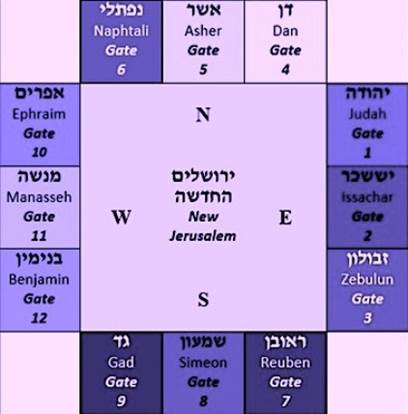
While the text of Revelation 21:12 does not tell us the names of the tribes for each gate, we can surmise, based on what we have learned, that the tribes must be arranged in the same manner that they were arranged around Yaaqob’s bier and around the Mishkan in the wilderness.
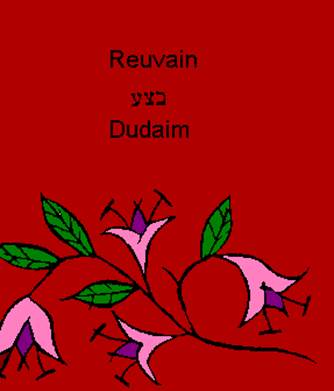
Midrash Rabbah - Numbers II:7 ACCORDING TO THE ENSIGNS (II, 2).[54] There were distinguishing signs for each prince; each had a flag and a different color for every flag, corresponding to the precious stones on the breast[55] of Aaron. It was from these that governments[56] learned to provide themselves with flags of various colors. Each tribe had its own prince and its flag whose color corresponded to the color of its stone. [In Aaron’s breastplate]
Reuben’s stone was ruby and the color of his flag was red; and embroidered thereon were mandrakes.[57]
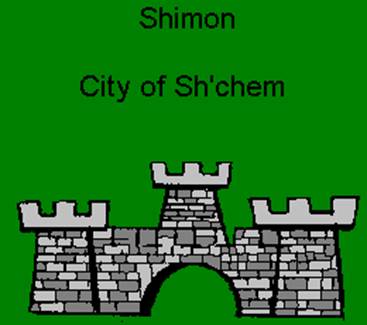
Simeon’s was topaz and his flag was of a green color; the town of Shechem was embroidered thereon.[58]
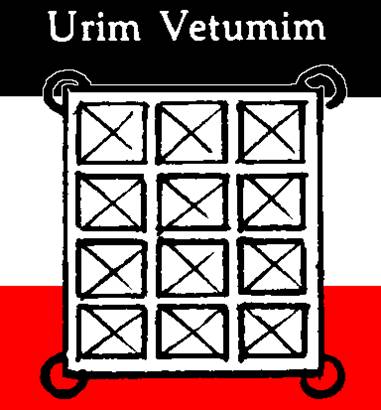
Levi’s[59] was smaragd (emarald) and the color of his flag was a third white, a third black, and a third red; embroidered thereon were the Urim and Thummim.[60]
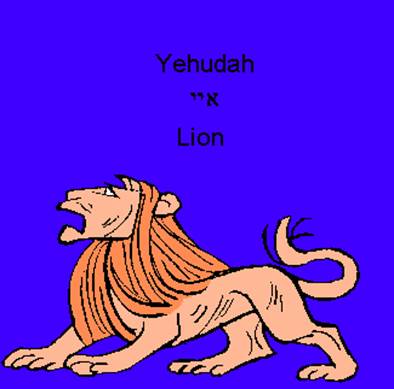
Judah’s was a carbuncle and the color of his flag was something like the heavens; embroidered on it was a lion.[61]
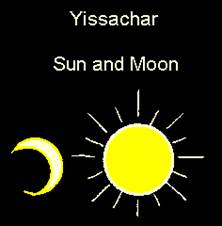
Issachar’s was a sapphire and the color of his flag was black like stibium (antimony), and embroidered thereon was the sun and moon, in allusion to the text, And of the children of Issachar, men that had understanding of the times[62] (I Chron. XII, 33).
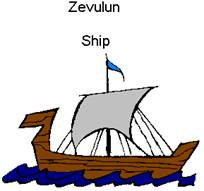
Zebulon’s was an emerald and the color of his flag was white,[63] with a ship embroidered thereon, in allusion to the text, Zebulun shall dwell at the shore of the sea (Gen. XLIX, 13).
Dan’s was jacinth and the color of his flag was similar to sapphire,[64] and embroidered on it was a serpent, in allusion to the text, Dan shall be a serpent in the way (Gen. XLIX, 17).
Note: Most depict the standard of Dan as having a snake or serpent on it. I am adopting the Abarbanel’s perspective that this standard depicted an eagle as intimated by the Midrash.
Yaaqob’s blessing to Dan, in Bereshit 49:17, symbolizes him by a type of snake called shefifon, which had wings in order to fly swiftly; Abarbanel explains that this is an eagle.
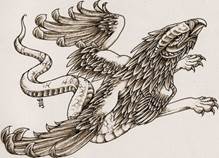
Each camp (i.e., each group of three tribes, located on one of the sides of the Mishkan) has a flag with a drawing symbolizing its tribes. According to the Midrash,66 these were the four images of the Merkava (Chariot) in Ezekiel’s vision (l:10): a lion, a man, an ox and an eagle. The camp of Israel is arranged into four forces, corresponding to the four creatures comprising the Chariot of the Shekhina.
Midrash Rabbah
- Exodus XXIII:13 I WILL SING UNTO THE LORD, FOR HE IS HIGHLY
EXALTED (XV, 1). It is written, Deck thyself now with majesty and excellency
(Job XL, 10). All things exalt themselves over something else; darkness exalts
itself over the deep, because it is above it, and the wind exalts itself over
the water because it is above it; fire exalts itself above the wind because it
is above it,1 and the heavens exalt themselves over the fire, because they are
above it, but God is exalted over everything--hence: FOR HE IS HIGHLY EXALTED.
R. Abin said: Four kinds of exalted beings have been created in the world. The
most exalted of all living creatures is man; of birds, the eagle; of cattle,
the ox; and of wild beasts, the lion. All of these received royalty and had
greatness bestowed upon them, and they are set under the chariot of God, as it
says, As for the likeness of their faces, they had the face of a man; and they four
had the face of a lion... and... also the face of an eagle (Ezek. I, 10). Why
was this? So that they should not exalt themselves in the world and they should
know that the Kingdom of Heaven is over them. For this reason does it say, For one
higher than the high watcheth, and there are higher than they (Eccl. V, 7).
This is the meaning of FOR HE IS HIGHLY EXALTED.
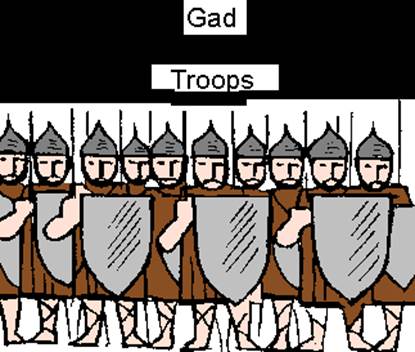
Gad’s[65] was an agate and the color of his flag was neither white nor black but a blend of black and white; on it was embroidered a camp, in allusion to the text, Gad[66], a troop shall troop upon him (ibid. 19).
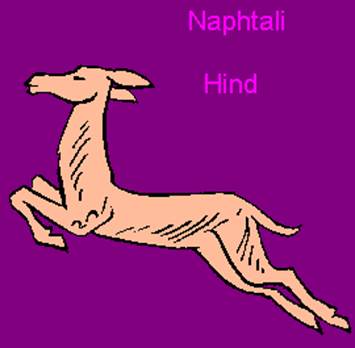
Napthali was an amethyst and the color of his flag was like clarified wine of a not very deep red; on it was embroidered a hind, in allusion to the text, Naphtali is a hind let loose (ibid. 21).
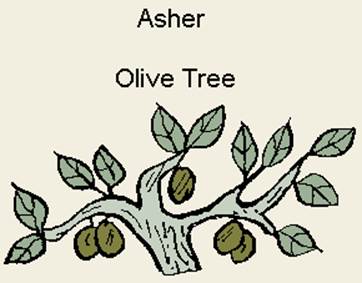
Asher’s was a beryl and the color of his flag was like the precious stone with which women adorn themselves; embroidered thereon was an olive-tree, in allusion to the text, As for Asher, his bread shall be fat (ibid. 20).
Joseph’s was an onyx and the color of his flag was jet black; the embroidered design thereon for both princes, Ephraim and Manasseh, was Egypt, because they were born in Egypt.
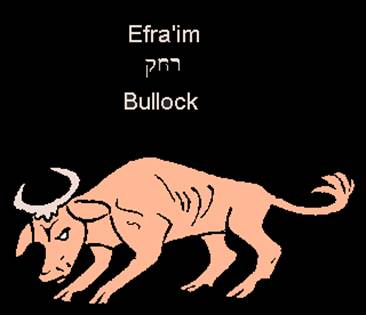
On the flag of Ephraim was embroidered a bullock, in allusion to the text, His firstling bullock (Deut. XXXIII, 17), which applies to Joshua[67] who came from the tribe of Ephraim.
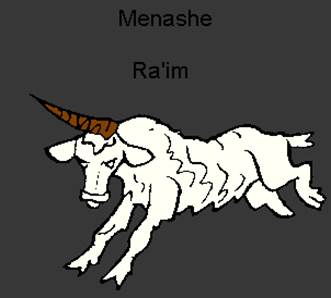
On the flag of the tribe of Manasseh was embroidered a wild ox, in allusion to the text, and his horns are the horns of the wild-ox (Deut. XXXIII, 17), which alludes to Gideon son of Joash who came from the tribe of Manasseh.[68]
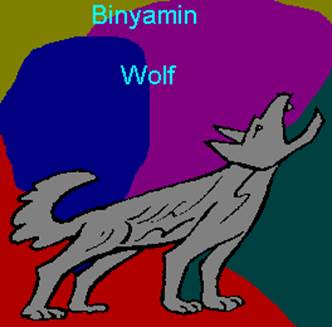
Benyamin’s was jasper and the color of his flag was a combination of all the twelve colors; embroidered thereon was a wolf, in allusion to the text, Benyamin is a wolf that raveneth (Gen. XLIX, 27). The reason, then, why it is said, ACCORDING TO THE ENSIGNS is because each prince had his own distinguishing sign.
When the camp is arranged, with three tribes on each side, flags play a central role:
And HaShem spoke to Moshe and to Aharon, saying,
Bamidbar (Numbers) 2:1-2 Everyone by his flag (diglo), with signs (b’otot) according to the house of their fathers shall the Children of Israel encamp. At a distance, around the Tent of Meeting shall they encamp.
R. Yaaqob Kamenetsky[69] points out that the purpose of these flags and the structure of the camp cannot be to impart independence or a military configuration to the Children of Israel. They possessed these from the moment of the Exodus:
• And it was on that selfsame day that HaShem took the Children of Israel out of the land of Egypt by their armies (al tzivotam).[70]
• …and armed did the Children of Israel ascend from the land of Egypt.[71]
Furthermore,[72] this configuration is part of the people’s legacy. As Rashi says, the twelve sons of Yaaqob were so positioned when they carried his body to Canaan:
With signs (b’otot) according to the house of their fathers, by the sign that their father Yaaqob transmitted to them when they bore him from Egypt, as it is said,
Bereshit (Genesis) 50:12 And his sons did so for him, as he charged them.
Yehudah, Yissachar, and Zebulon were to bear him from the east, and Reuven, Shimon, and Gad from the south, etc.[73]
The encampment remained in the nation‘s collective memory, ready to be actualized immediately upon their liberation. As R. Kamenetsky declares:
“Behold, they did not leave like slaves who flee from their masters, but as a free nation. So why did they wait a full year to organize the flags? I wonder!”
However, he says, each flag (degel) and sign (ot) connotes a quality distinct to each tribe.[74] In addition, each tribe is an army (tzava) unto itself. The existence of twelve different tribes, with their respective tribal symbols, could lead to disharmony[75] within the people.
Once the Mishkan[76] was erected and dedicated, however, the twelve tribes were unified by it. Only with the Mishkan at the geometrical and ideological center could the dozen disparate tribes become a united entity. Only with the Mishkan as a central purpose can the tribes’ dissimilar characteristics cooperate.
This idea is developed by the Maharal.[77] The number twelve signifies the limits of the three-dimensional world, like the twelve edges of a cube. Each of these has a distinct function and connection to HaShem. Even among the nations, there are twelve divisions:[78] Avraham‘s brother Nachor had 12 children,[79] as did Canaan[80] and Yishmael.[81] However, they lack a unifying force.
The tribes of Israel are like the branches of a tree, subdividing from their common root. To combine their varied strengths, they must remain focused on Yaaqob and the Torah. Thus the tribes encamp around the Mishkan, just as the twelve brothers encircled Yaaqob when they took his body back home.
Like the instruments in an orchestra, diversity within the Jewish People can produce either cacophony or symphony. We need to remember the Torah’s harmonizing power. When the Torah is our common mission, our music can fill the universe.
Military Ensign (degel) Not ot
In Bamidbar (Numbers) chapter 2 we see two words that are often defined as 'flag' / 'standard' / 'ensign', in English.
Bamidbar (Numbers) 2:2 'The children of Israel shall pitch by their fathers' houses; every man with his own standard (degel - דִּגְלוֹ), according to the ensigns (ot - בְאֹתֹת); a good way off shall they pitch round about the tent of meeting. 3 Now those that pitch on the east side toward the sunrising shall be they of the standard of the camp of Judah, according to their hosts; the prince of the children of Judah being Nahshon the son of Aminadab,
Let’s explore this word, degel. in greater depth through the targum of Pseudo Yonatan first:
Numbers 2:3. The length of the camp of Israel will be twelve miles, and its breadth twelve miles. And they who encamp eastward to the sunrise will be of the standard of the camp of Yehudah by their hosts, spreading over four miles. And his standard will be of silk, of three colors, corresponding with (those of) the precious stones which are in the breastplate,--sardius, topaz, and carbuncle; and upon it will be expressed and set forth the names of the three tribes of Yehudah, Issachar, and Zebulon; and in the midst will be written : Arise, O LORD, and let Your enemies be scattered, and Your adversaries be driven away before You; and upon it will be set forth the figure of a young lion. And the Rabbi of the Bene Yehudah will be Nachshon bar Aminadab.
The targum teaches us that there were four degelim, four ensigns, military ensigns, that led the Bne Israel in the wilderness. These ensigns contained the three colors for the tribes that marched and camped under this ensign.
Thus, in addition to the flags of each of the tribes, there were four special military ensigns which led the four tribes under this ensign.
A Divine Encampment, by Rabbi Ari Kahn
The Book of Bamidbar, and the Parsha which gives it its name, begins with a census. Apparently, this is in preparation for the march from Sinai to the Land of Israel, with an eye towards military preparedness.
Bamidbar (Numbers) 1:3 From twenty years old and upward, all Israelites who are fit for military service; you and Aharon shall count them by their troops.
The focus of these verses seems practical, secular, even mundane: an army is needed for the next chapter in Jewish history, the conquest of the Land of Israel. None of the nation’s failings in the desert, none of the causes of their forty-year delay, are foreseeable. Their vision of the Land of Israel is unimpeded at this juncture. They need only turn their sights away from Mount Sinai and begin their short trek to the borders of the Promised Land.[82]
And so, after the census is completed, the Torah turns its attention to the formation in which the people will travel, camp, and conquer:
Bamidbar (Numbers) 1:52 And when the Israelites camp, each individual shall be in his designated camp, and every person by his own degel (flag) according to their armies.
Three different words are used to instruct them as to the particular formation in which the people are to arrange themselves: mahane, degel and tzava. Mahane means “camp”, tzava - army. The word degel, which most people familiar with modern Hebrew would translate as “flag”, is in fact a division within the army: As the divisions are arranged in this book, three tribes to each division.[83]
The word degel is used again in the following chapter:
Bamidbar (Numbers) 2:2 Every individual of the People of Israel shall camp by his own degel (flag), according to the ot (insignia) of their father’s house. They shall camp at a specified distance around the Tent of Meeting.
Once again, multiple terms are used in the encampment instructions: degel and ot. This new word seems somehow familiar, yet its usage here differs slightly from the meaning with which we are familiar. In the past, Noah, Moshe, the Israelites, and even Paro were given otot, signs or symbols of HaShem’s power and His direct involvement in human history. Here, the otot remind us of a more familiar sort of symbol:
Each division should have an ot (a sign or insignia), a colored sheet hanging in its midst. The color of one should not be like the color of another. The color of each should be like the hue of the stone which represents that tribe in the breastplate, and thus every person will recognize his division.[84]
This description of the otot is unquestionably of flags; degel, used today in common parlance as “flag”, originally referred to a division of people for either military or civilian purposes. Thus, the otot, the variously colored flags, were symbols used to organize people into degelim, divisions or battalions.
While this type of symbol is more “familiar” than the heavenly signs that HaShem gave to human beings in Bereshit (Genesis) and Shemot (Exodus), it is far from “mundane”. Rashi’s comment gives us a new perspective on the division of the people that is being organized in these verses. Whereas we assumed that the military task at hand was the impetus for creating these divisions, Rashi points out that the flags that symbolized these divisions reflected a much loftier origin: the breastplate of the Kohen Gadol. In this light, the division of the camp takes on a different tone. These divisions, this formation, is not born simply out of military necessity.[85] The degelim, and the otot with which they are represented, reflect something much greater, much deeper.
Rashi offers a second interpretation of this verse that offers even greater insight into the otot:
‘With the otot (insignia or sign) of their father’s house’; with the sign that Yaaqob passed down to them, as it says “his sons did as he commanded:” Yehuda, Yissachar, and Zebulon from the east, Reuven, Shimon and Gad from the south, etc., as is found in the Midrash Tanchuma.[86]
This configuration was no simple concession to military expediency; this formation was an ot (sign) shared by our forefather Yaaqob with his twelve sons.
“... otot of their father’s house:” ...For R. Hama, son of R. Hanina, said: ‘When our father Yaaqob was about to depart from the world he summoned his sons - as it is written:
Bereshit (Genesis) 49:10 And Yaaqob called to his sons.
And he blessed them and commanded them concerning the ways of HaShem, and they accepted upon themselves Divine Sovereignty. Having concluded his address, he said to them, ‘When you carry me to my last resting-place you must escort me with proper reverence and respect. No other man shall touch my bier; neither an Egyptian nor any of your children, because you have taken wives from the daughters of Canaan.’ For this reason Scripture says, “And his sons did as he commanded them”;[87] his sons, but not his grandsons; “and his sons carried him”.[88] How did he command them to do it? He said to them: “My children, when my bier is being carried, Yehudah, Yissachar and Zebulon shall be on the east side; Reuven, Shimon and Gad shall be on the south side; Ephraim, Menashe and Binyamin shall be on the west side; Dan, Asher and Naftali shall be on the north side.[89]
Rashi 50:13 And his sons carried him But not his grandsons, for so he had commanded them: “Neither shall any Egyptian carry my coffin nor any of your sons, for they are born of the daughters of Canaan, but you [alone].” He designated a position for them [by his coffin], [so that] three [of them would carry] on the east, and so on for [all] four directions. [This was] similar to their arrangement in the traveling of the camp [in the desert] of the groupings [of the tribes as] they were designated here. [He also ordered,] “Levi shall not carry it because he (i. e., his tribe) is destined to carry the Ark. Joseph shall not carry it because he is a king. Manasseh and Ephraim shall carry it instead of them.” That is the meaning of “Each one according to his group with signs” (Num. 2:2), according to the sign that their father gave them to carry his coffin.-[From Tanchuma Bamidbar 12]
Midrash Rabbah - Numbers II:8 When our father Jacob was about to depart from the world he summoned his sons--as it is written, And Jacob called unto his sons (Gen. XLIX, X)--and he blessed them and commanded them concerning the ways of God, and they acknowledged the Divine sovereignty. Having concluded his address, he said to them, ‘When you carry me to my last resting-place you must escort me with proper reverence and respect. No other man shall touch my bier; neither an Egyptian nor any of your children, because you have taken wives from the daughters of Canaan’[90] For this reason Scripture says, And his sons did unto him according as he commanded them (Gen. L, 12); his ‘sons’ but not his ‘grandsons’. And his sons carried him (ib. 13). How did he command them to do it? He said to them: ‘My children, when my bier is being carried, Judah, Issachar, and Zebulun shall be on the east side; Reuben, Simeon, and Gad shall be on the south side; Ephraim, Manasseh, and Benjamin shall be on the west side; Dan, Asher, and Naphtali shall be on the north side; Joseph shall not carry at all, for he is a king and must be shown due honour; neither shall Levi carry because he will carry the ark, and he that is to carry the ark of Him who is the life of all worlds must not carry the coffin of the dead.[91] If you will comply with these orders and carry my bier as I have commanded you, God will in the future cause you to camp beneath standards.’ When he died, they bore him as he had commanded them, as it is said, ‘And his sons did unto him according as he commanded them.’ Thus we can explain the verse [quoted above], ’I will fetch my knowledge from afar, and will ascribe righteousness to my Maker’; for it was from Jacob that they had obtained the knowledge how they were to camp under their standards. ’And will ascribe righteousness to my Maker,’ that is, to the Holy One, blessed be He, Who acted beneficently with Israel, and Who, in order to give them good reward[92] for having fulfilled the command of their father, bade them camp under standards only in the manner in which their father had commanded them. Therein He acted with righteousness toward them, since He made no alteration, so as not to cause strife among them. This is the reason why it is said, ACCORDING TO THEIR FATHER'S HOUSE; in the same manner as they had disposed themselves around the bier of their father, so shall they camp. This explains the text, ACCORDING TO THEIR FATHER'S HOUSE SHALL THE CHILDREN OF ISRAEL CAMP.
According to this explanation, b’otot refers to the “signs” given by their patriarch Yaaqob; many years earlier, in his instructions to his sons for his burial, Yaaqob taught his children to leave Egypt in a particular formation.[93] Not only did Yaaqob instruct his sons on the place of his burial, he specified the manner in which his remains should be transported, dictated who the pallbearers should and should not be, and detailed the formation in which they should carry his remains from Egypt to Israel. Generations later, when the time came for his children’s children to travel, once again, from Egypt to Israel, these instructions were followed; the otot that Yaaqob transmitted to his sons were meant for all of his descendants.
Let us consider the fascinating imagery this creates: the entourage that carries Yaaqob out of Egypt and accompanies him to his final resting place in the Cave of Machpelah is arranged around Yaaqob’s Aron (coffin), in the precise formation in which his descendants will one day march and encamp: The Aron Kodesh, the Holy Ark, which housed the Tablets of Testimony within the Mishkan,[94] was the focal point for the entire camp. In both cases, the epicenter, the Aron that stood in the middle of the entire formation, defined the focus and purpose of the camp, imbuing it with holiness. The Aron at the center turned this formation, this camp, into something far more than a convenient arrangement of people. The focus was always on the center, and each member of the formation had a specific place, a specific role.
This new book, the Book of Bamidbar, immediately follows the completion and consecration of the Mishkan, which was built in order to provide a conduit to holiness, to turn the singular experience of Mount Sinai into an ongoing dialogue with HaShem.[95] Therefore it should come as no surprise[96] that Midrashic sources link the formation into degelim with the events at Sinai.[97]
Another exposition of the text, “He has brought me to the house of wine:” When the Holy One, blessed be He, revealed Himself upon Mount Sinai, twenty-two thousands angels[98] descended with Him, as it is said, “The chariots of HaShem are two myriads, two thousands; HaShem is among them at Sinai, in holiness”,[99] and they were all arrayed in separate degelim, as it is said, “Marked out by degelim from among myriads”.[100] When Israel saw them arrayed in degelim they began to long for degelim, and said, ‘O that we also could be arranged in degelim like them!’ Therefore it is said, ‘He has brought me into the house of wine,’ and this refers to Sinai, upon which the Torah, which has been likened to wine, was given: “And drink of the wine which I have mingled”.[101] Thus, “into the house of wine” is explained as referring to Sinai. “And his degel over me is love’ [is explained as follows]: They said, ‘O that He would show great love for me’; and this is also expressed in the text, ‘We will shout for joy in Your salvation, [and in the name of HaShem we will arrange our degelim].’ Said the Holy One, blessed be He, to them, ‘How eager you are to be arranged in degelim; as you live, I shall fulfill your desire!’ as we read, “ HaShem shall fulfill all your petitions”.[102] The Holy One, blessed be He, immediately informed Israel by telling Moshe, ‘Go, arrange them in degelim as they have desired’.[103]
The Israelites experienced and perceived something at Sinai that they wished to take with them; we may call this perception a vision, or some type of enlightenment. Either way, they described or symbolized this enlightenment in terms of angels assembled in degelim. They, too, wished to organize themselves in this way.[104] At the foot of Mount Sinai, the Jews experienced an enlightened moment of clarity, a moment of profound unity and love.[105] They understood that this was the existence of angels, an existence of unity, with no jealousy and no competition.[106] This was what they hoped to take with them, to build in to their encampment, to use as the foundation for their life as a nation. This was another aspect of the Sinai experience they hoped to make a permanent fixture of their lives. The outward manifestation of the angels’ harmonious existence as servants of God was their formation in degelim; this was what the Israelites sought to imitate. The Recanati explains this in terms of a larger kabbalistic idea: things which exist here on earth have a parallel in the heavenly spheres.[107] The degelim of the Jewish People are parallel to the degelim of the angels, precisely because the Jews achieved an unparalleled level of enlightenment and understanding at the foot of Mount Sinai which allowed them to glimpse the heavenly order and to fully grasp its significance. In this instance, earthly reality was inspired by a vision of the harmonious formation of the angels.
Yet the parallel goes even deeper: The angelic formation which the Israelites glimpsed at Sinai was arranged around a focal point of its own: the angels are, in a sense, the “army of God.” The degelim of angels are organized around the Throne of God, like sentries or bearers of the Divine Throne, the Seat of God in heaven. When the Israelites saw this heavenly vision as they stood at the foot of Sinai, perhaps they hoped to imitate not only the formation of the angels that expressed unity, but also the manifestation of God’s proximity and imminence. Perhaps this was what brought about the building of the Mishkan; perhaps this was another part of their Sinaitic enlightenment that the Jews hoped to recreate permanently.[108] They envied the angels’ clarity of purpose, their total dedication to their respective tasks; they knew that, being human, they would be unable to maintain that level of focus after leaving Mount Sinai. The Mishkan, they knew, would help keep them centered - literally and figuratively - like the angels.[109]
How far could their emulation of the angels take them? Clearly, the differences between human and angelic existence make it impossible for the symbols of angelic unity to overcome human nature. Each angel is unique, defined and created to fulfill its own unique task; therefore, for angels, competition and jealousy are impossible. Human experience is quite different; we need little convincing that competition and jealousy are deeply ingrained in our collective personality. And yet, the Talmud tells us that what is perceived as human frailty is in fact a blessing: in many realms competition is healthy. Jealousy can spur competition among sages, resulting in greater investment in learning, more carefully honed and precisely presented opinions, and, ultimately, increased wisdom. It would seem, then, that the Divine Plan was never to create “human angels”. While we may hope to emulate the angels, we are not like them in disposition or capabilities - for better and for worse. So it is with the degelim: The heavenly divisions are organized according to the manifestation of HaShem expressed by each angel’s task. For example, angels charged with missions of judgment or punishment are grouped together; angels charged with missions of mercy form another group. If, like each angel, every human being knew their precise place (degel), the exact role which they are meant to accomplish in this world, surely much of the angst of human experience would be resolved. However, man is ultimately unlike the angels. While angels are created for only one task, man is multifaceted. Woe to the person who after fulfilling one task, even if it is a Divinely mandated task, feels they have completed their role on earth. While it may be possible that out of a long life of physical and spiritual toil it was ultimately one gesture, one action, one tikkun that justified or merited an individual’s entire existence, such “spiritual calculus” is far removed from human comprehension, and is foreign to the life dictated by Torah values.
These differences notwithstanding, there are certain things we can learn from the angels. There are tasks that must be accomplished through human effort, and when the task at hand is of a spiritual nature, the Jewish People is called upon to take up the formation and the focus they learned from the angels. The conquest of the Land of Israel was such a task. It is a holy task, and the soldiers need to know that God is in their midst and they need to march forward with the same confidence with which angels set out to perform a divine mission. Although other realms of human endeavor require the creativity that results from competition, the task that the Children of Israel faced as they left Sinai required a type of unity, a singularity of purpose, a focus on the holiness of their camp and their destiny that was expressed by their new/old formation in degelim. Each member of the camp was uniquely positioned, fully aware of the unique role they were to play in the greater mission, each turning their focus away from their own ego and towards the Aron at the center of the camp.
Today, even though so many have lost sight of the camp, and are no longer aware of any degelim, when the unity of purpose and the focus and sanctity created by the degelim as they surrounded the Aron Kodesh are a distant dream, we may, at the very least, remind ourselves that these goals are achievable. We are, despite the time and the distance that separates us, still children of Yaaqob. We are still able to connect to the otot that Yaaqob gave to his children, and they to theirs; the enlightenment of Sinai is still ingrained in our collective memory. If we regain our focus, retrain our sights on the holiness that lies at our collective center, we will already be much closer to accomplishing our own Divine mission.[110]
If the Pirchei Nisan‘s postulation about the order of the curses is true, can we then show that each of the 11 curses was appropriate to the particular tribes towards which they were directed? Pirchei Nisan asserts that we indeed can! Although he only explains the first six of the curses, I found another work, “Techelet Mordechai”[111] who resolves the entire lot of them following the Pirchei Nisan‘s approach. Together with a friend of mine, Rav Gedaliah Press of Jerusalem, I think that I’ve managed to fill in any of the gaps left over by these two authors. In general, the assumption is that the Torah links a curse to a particular tribe either (a) in order to show that the sin mentioned in the curse cannot be attributed to that tribe, as mentioned above, or (b) because that tribe was outstanding in that respect, or (c) because that tribe was more liable than the others to sin in such a manner, and thus needed a more direct warning. Here is the way the list looks (I have initialed each explanation to show whose suggestion it is):
(1) LEVI - “Cursed be one who makes idols.” The tribe of Levi was the only one that did not serve the Golden Calf .[112] (PN)
(2) YEHUDA.H - “Cursed be one who shows disrespect to his parents.” Yehuda promised his father to return Benyamin unscathed, and then risked his life to fulfill his promise for the sake of his father (Bereshit 42:32) (PN)
(3) YISACHAR - “Cursed be one who tries to take for himself his neighbor’s property.” Yissachar was conceived when Leah claimed Yaaqob for herself even though it was Rachel’s night. However, she paid Rachel in full for the privilege (Bereshit 30:16) (PN). Secondly, Issachar’s leader brought his sacrifices (during the dedication ceremony of the Mishkan) before Reuben’s leader. Reuben’s leader complained that he rightfully ought to be first, since his tribal ancestor was older, but HaShem supported Issachar’s leader, saying that it was rightfully Issachar’s turn after all (Rashi to Bamidbar 7:19).[113] (TM)
(4) YOSEF - “Cursed be one who misleads the blind on the road.” When Yosef was on the road trying to locate his brothers, he “blindly” trusted that they would do him no harm. They, however, took advantage of him and did harm him. Thus, he was the only one of the brothers that did not mislead the blind (PN). Alternatively, when Yosef was viceroy of Egypt, his brothers “blindly” stumbled upon him. Although they did not know who he was, Yosef did not take advantage of that fact to take his revenge. (MK)
(5) BENYAMIN - “Cursed be one who does injustice to a proselyte, orphan or widow.” Benyamin was an orphan, and thus this curse protected him. (PN)
(6) REUVEN - (Explained above)
(7) GAD - “Cursed be he who cohabits with an animal” - Gad gave precedence to their animals even over their own children (Rashi Bamidbar 32:16). It was therefore necessary to warn them of this more than the other tribes. (MK)
(8) ASHER - “Cursed be he who cohabits with his sister.” The women of the tribe of Asher were particularly pretty (Rashi Debarim 33:24), so Asher had to be warned of this more than any other tribe (TM).
(9) ZEBULON - “Cursed be he who cohabits with his mother in law.” The members of the tribe of Zebulun were merchants who sailed long distances to trade goods with other nations (Rashi Debarim 33:18). Undoubtedly, their wives would often live together with their mothers so that they could help each other out while their husbands were away at sea. Special warning must be given to the man whose wife and mother-in-law are living under the same roof, since a man may become fond of his mother in law (Talmud: Bava Basra 98b; Pesachim 103a). (GP)
(10) DAN - “Cursed be the one who smites his friend secretly (i.e., who slanders his friend - Rashi).” Dan is compared to a “snake” that “bites his enemies horses’ hooves” (Bereshit 49:17). He must be warned to direct his energies against the enemy, and not to use the character of a snake (the snake is associated with slander in many Midrashim, such as in Tanchuma, Metzora #2) to slyly hurt others from his own nation. (MK)
(11) NAFTALI - “Cursed be the one who receives a bribe to kill the innocent.” Naftali was so named because he was born after Rachel “attempted by any and all means (“Naftulei... Niftalti”) to beg HaShem to grant her children through her maid-servant (Bereshit 30:8). Naftali was therefore liable to try to attain his will through any means, however illicit, so he in particular had to be warned not to be involved with bribes.
Beautiful Mount Gerizim - Blessings |
Ugly Mount Eval - Curses |
||||
|
|
|
|
|
|
|
|
Tribe |
Population |
Mother |
Tribe |
Population |
Mother |
|
Simeon |
22,200 |
Leah |
Reuben - eldest |
43,730 |
Leah |
|
Levi |
14,150 |
Leah |
Gad |
40,500 |
Zilpah |
|
Judah |
76,500 |
Leah |
Asher |
53,400 |
Zilpah |
|
Issachar |
64,300 |
Leah |
Zebulon - youngest |
60,500 |
Leah |
|
Joseph |
85,200 |
Rachel |
Dan |
64,400 |
Bilhah |
|
Benyamin |
45,600 |
Rachel |
Naphtali |
45,400 |
Bilhah |
Total=307,950 Total=307,930
Total population=615,880
Under this division, 50.001623% of the nation is on Mt. Gerizim and 49.998376% are on Mt. Eval.
Debarim (Deuteronomy) 27:11-13 On the same day Moses commanded the people: When you have crossed the Jordan, these tribes shall stand on Mount Gerizim to bless the people: Simeon, Levi, Judah, Issachar, Joseph and Benyamin. And these tribes shall stand on Mount Eval to pronounce curses: Reuben, Gad, Asher, Zebulon, Dan and Naphtali.
There are 462 different ways to divide twelve tribes into two groups of six. Why was the particular allocation described in these verses chosen and what really was the role of the Levites?
Rabbi David Frankel in his classic commentary on the Jerusalem Talmud hints at a very interesting point. He suggests that the tribes and the Levites were assigned to the two mountains and the valley in such a way as to come as close as possible to a numerically even split while still allowing for a designated group of Levites to have a unique role of calling out the blessings and curses in the valley. This mathematically optimal division occurs when the Levites are divided according to the Talmudic suggestion that “those Levites who were involved in working in the Tabernacle were in the valley and the rest were on the mountain”[114]. According to the commentator Rashi’s explanation of that opinion, “those who worked in the tabernacle“ refers to those aged 30 to 50.
In an earlier census this group comprised 38.48% of the total number of Levites counted. Assuming that the percentage of the Levites remained constant, there would be 8,850 Levites between the ages of 30 and 50 at the time of the ceremony on Mt. Gerizim and Mt. Eval. The group of Levites on the mountain would be all the remaining Levites, and their population would be 14,150.
By means of a computer program, all 462 possible allocations of the tribes into two groups of six were generated. The biblically prescribed allocation of the tribes, as delineated above, is the optimal division. Of the 462 different possibilities, this one divides the tribes into the two most equal camps of six tribes each. No better allocation is possible.
It is also worth noting that this division neatly divides the tribes by mother, with the handmaids on one side, and the sisters children on the other. Reuben and Zebulon are added to the maid’s side to balance the two populations. Reuben and Zebulon are Leah’s eldest and youngest sons.
The following summary includes some explanations suggested by Rabbis Gedalyah Press and M. Kornfeld.[115]
The working assumption is that the Torah links a curse to a particular tribe either (a) to show that the sin mentioned in the curse cannot be attributed to that tribe, as mentioned above with regard to Reuven, (b) because that tribe was outstanding in that respect, or (c) because that tribe was more susceptible than the others to sin in such a manner, and thus needed a more direct warning.
1. LEVI. “Cursed is the one who makes idols.” The tribe of Levi was the only tribe which did not serve the Egel ha’Zahav.[116] (Pirchei Nisan)
2. YEHUDAH. “Cursed is the one who shows disrespect to his parents.” Yehudah promised his father that he would return Binyamin unscathed, and then he risked his life to fulfill his promise for the sake of his father.[117] (Pirchei Nisan)
3. YISACHAR. “Cursed is the one who tries to take for himself his neighbor’s property.” Yissachar was conceived when Leah claimed Yaaqob for herself even though it was Rachel’s night. However, she paid Rachel in full for the privilege.[118] (Pirchei Nisan)
Moreover, Yissachar’s leader brought his sacrifices (during the dedication ceremony of the Mishkan) before Reuven’s leader. Reuven’s leader complained that he rightfully should be first, since his tribal forebear was older, but HaShem supported Yissachar’s leader, saying that it was rightfully Yissachar’s turn after all.[119] (Techelet Mordechai)
4. YOSEF. “Cursed is the one who misleads the blind on the road.” When Yosef was on the road trying to locate his brothers, he “blindly” trusted that they would do him no harm. They, however, took advantage of him and harmed him. Thus, he was the only one of the brothers who did not mislead the blind. (Pirchei Nisan)
Alternatively, when Yosef was viceroy of Mitzrayim, his brothers “blindly” stumbled upon him. Although they did not know who he was, Yosef did not take advantage of that fact to take revenge. (M. Kornfeld)
5. BINYAMIN. “Cursed is the one who does injustice to a proselyte, orphan or widow.” Binyamin was an orphan, and thus this curse protected him. (Pirchei Nisan)
6. REUVEN. “Cursed is the one who sleeps with his father’s wife.” As explained above, the Torah addressed this curse to the tribe of Reuven to make it clear beyond any doubt that Reuven was free of condemnation for that sin. Addressing this curse to the descendants of Reuven officially vindicated Reuven from having committed such a transgression. (Pirchei Nisan)
7. GAD. “Cursed is the who cohabits with an animal.” The people of Gad gave precedence to their animals even over their own children when they chose their portion of Eretz Yisrael based on where the best grazing grounds are located.[120] It was therefore necessary to warn them of this transgression more than the other tribes. (M. Kornfeld)
8. ASHER. “Cursed is the one who cohabits with his sister.” The women of the tribe of Asher were particularly beautiful,[121] and thus Asher needed to be warned of this transgression more than the other tribes. (Techelet Mordechai)
9. ZEBULON. “Cursed is the one who cohabits with his mother-in-law.” The members of the tribe of Zebulon were merchants who sailed long distances to trade their goods with other nations.[122] While they were away, their wives would move-in with their mothers so that the women could help each other while their husbands were away at sea. Special warning must be given to the man whose wife and mother-in-law live under the same roof, since a man might become fond of his mother-in-law.[123] (Rav G. Press)
10. DAN. “Cursed is the one who smites his friend secretly” (who slanders his friend; Rashi). Dan is compared to a “snake” who “bites the hooves of the horses” of his enemy.[124] He must be warned to direct his destructive energies against the enemy and not to use the character of a snake to slyly hurt others from his own nation. (M. Kornfeld)[125]
11. NAFTALI. “Cursed is the one who accepts a bribe to kill the innocent.” Naftali was so named because he was born after Rachel used every means at her disposal (“Naftulei... Niftalti”) to beg Hash-m to grant her children through her maidservant.[126] Naftali, therefore, had a tendency to attempt to attain his will through any means, however illicit, and thus he in particular needed to be warned not to be involved with bribes. (Rav G. Press)
Numbers 1:3 Order Counters of Israel |
Numbers 1:19 Order The Counted of Israel |
Numbers 7 Order Altar Dedication (marching order)[127] |
Numbers 13 Order Moses’ Spies |
|
This order pertains to an inheritance in the land. |
This order pertains to an inheritance in the land. |
This order pertains to an inheritance in the land. |
This order pertains to an inheritance in the land. |
|
1. Reuben – Leah |
1. Reuben – 46,500 Leah |
4. Judah – Leah |
1. Reuben – Leah |
|
2. Simeon – Leah |
2. Simeon – 59,300 Leah |
6. Issachar – Leah |
2. Simeon – Leah |
|
4. Judah – Leah |
8. Gad – 45,650 Zilpah |
5. Zebulon – Leah |
4. Judah – Leah |
|
6. Issachar – Leah |
4. Judah – 74,600 Leah |
1. Reuben – Leah |
6. Issachar - Leah |
|
5. Zebulon – Leah |
6. Issachar – 54, 400 Leah |
2. Simeon – Leah |
Ephraim |
|
Ephraim |
5. Zebulon – 57,400 Leah |
8. Gad – Zilpah |
12. Benyamin - Rachel |
|
Manasseh |
Ephraim – 40,500 |
Ephraim |
5. Zebulon - Leah |
|
12. Benyamin – Rachel |
Manasseh – 32,200 |
Manasseh |
Manasseh |
|
7. Dan - Bilhah |
12. Benyamin – 35,400 Rachel |
12. Benyamin – Rachel |
7. Dan - Bilhah |
|
9. Asher – Zilpah |
7. Dan – 62,700 Bilhah |
7. Dan – Bilhah |
9. Asher - Zilpah |
|
8. Gad - Zilpah |
9. Asher – 41,500 Zilpah |
9. Asher – Zilpah |
10. Naphtali - Bilhah |
|
10. Naphtali - Bilhah |
10. Naphtali – 53,400 Bilhah |
10. Naphtali - Bilhah |
8. Gad - Zilpah |
|
Numbers 26 Order The Census |
|
This order pertains to an inheritance in the land. |
|
1. Reuben – 43,730 Leah |
|
2. Simeon – 22,200 Leah |
|
5. Gad – 40,500 Zilpah |
|
4. Judah – 76,500 Leah |
|
6. Issachar – 64,300 Leah |
|
5. Zebulon – 60,500 Leah |
|
Manasseh (Menashe) 52,700 |
|
Ephraim 32,500 |
|
12. Benyamin – 45,600 Rachel |
|
7. Dan – 64,400 Bilhah |
|
9. Asher – 53,400 Zilpah |
|
10. Naphtali – 45,400Bilhah |
|
Total = 601,730 |
Since Ephraim and Menashe were included with the tribes in order to give Yosef a double portion in the land. This suggests that each tribal list that includes Ephraim and Menashe is in connection with the apportionment of the land of Israel. Further, it means that any tribal list that includes Ephraim and Menashe will not include either Yosef or Levi. Why Levi you ask? Because Levi was not given a portion of the land as an inheritance. As we read in the Torah:
Yehoshua (Joshua) 13:14 Only unto the tribe of Levi he gave none inheritance; the sacrifices of HaShem God of Israel made by fire are their inheritance, as he said unto them.
Thus we understand that if the tribal list pertains to an inheritance in the land, then we will not see Levi or Joseph, and we will see both Ephraim and Menashe.
Rashi, on Bereshit 48, says the following:
48:4 and I will make you into a congregation of peoples He announced to me that another congregation of peoples was to be descended from me. Although he said to me, “A nation and a congregation of nations [will come into existence from you]” (Gen 35:11) [meaning three nations], by “a nation,” He promised me [the birth of] Benjamin. “A congregation of nations“ means two in addition to Benjamin, but no other son was born to me. Thus I learned that one of my tribes was destined to be divided [in two]. So now, I am giving you that gift.-[from Pesiqta Rabbati ch. 3]
48:5 who were born to you…until I came to you Before I came to you, i.e., those who were born since you left me [and] I came to you.
they are mine They are counted with the rest of my sons, to take a share in the land, each one exactly as each [of my other sons].-[from Baba Bathra 122b-123a]
48:6 But your children If you have any more [children], they will not be counted among my sons, but will be included among the tribes of Ephraim and Manasseh, and they will not have a [separate] name like [each of] the [other] tribes as regards the inheritance. Now, although the land [of Israel] was divided according to their heads (the population of each tribe), as it is written: “To the large [tribe] you will increase its inheritance“ (Num. 26:54); and each man received an equal share, except for the firstborn. Nevertheless, only these (Ephraim and Manasseh) were called tribes [regarding the ability] [to cast a lot in the land according to the number of names of the tribes and [regarding having] a prince for each tribe, and groups [of tribes in the desert] for this one and for that one]. [Note that the bracketed material does not appear in early editions of Rashi.]
Thus we see that Rashi supports our understanding. In this next pasuk we see the tribes being numbered for the army. Now the army serves to defend the land. Thus we see Ephraim and Menashe:
Bamidbar (Numbers) 1:3-16 You and Aaron are to number by their divisions all the men in Israel twenty years old or more who are able to serve in the army. One man from each tribe, each the head of his family, is to help you. These are the names of the men who are to assist you: from Reuben, Elizur son of Shedeur; From Simeon, Shelumiel son of Zurishaddai; From Judah, Nachshon son of Amminadab; From Issachar, Nethanel son of Zuar; From Zebulon, Eliab son of Helon; From the sons of Joseph: from Ephraim, Elishama son of Ammihud; from Manasseh, Gamaliel son of Pedahzur; From Benyamin, Abidan son of Gideoni; From Dan, Ahiezer son of Ammishaddai; From Asher, Pagiel son of Ocran; From Gad, Eliasaph son of Deuel; From Naphtali, Ahira son of Enan.” These were the men appointed from the community, the leaders of their ancestral tribes. They were the heads of the clans of Israel.
Bamidbar (Numbers) 1:19-47 As HaShem commanded Moses. And so he counted them in the Desert of Sinai: From the descendants of Reuben the firstborn son of Israel: All the men twenty years old or more who were able to serve in the army were listed by name, one by one, according to the records of their clans and families. The number from the tribe of
Reuben was 46,500. From the descendants of Simeon: All the men twenty years old or more who were able to serve in the army were counted and listed by name, one by one, according to the records of their clans and families. The number from the tribe of
Simeon was 59,300. From the descendants of Gad: All the men twenty years old or more who were able to serve in the army were listed by name, according to the records of their clans and families. The number from the tribe of
Gad was 45,650. From the descendants of Judah: All the men twenty years old or more who were able to serve in the army were listed by name, according to the records of their clans and families. The number from the tribe of
Judah was 74,600. From the descendants of Issachar: All the men twenty years old or more who were able to serve in the army were listed by name, according to the records of their clans and families. The number from the tribe of
Issachar was 54,400. From the descendants of Zebulun: All the men twenty years old or more who were able to serve in the army were listed by name, according to the records of their clans and families. The number from the tribe of
Zebulun was 57,400. From the sons of Joseph: From the descendants of Ephraim: All the men twenty years old or more who were able to serve in the army were listed by name, according to the records of their clans and families. The number from the tribe of
Ephraim was 40,500. From the descendants of Manasseh: All the men twenty years old or more who were able to serve in the army were listed by name, according to the records of their clans and families. The number from the tribe of
Manasseh was 32,200. From the descendants of Benyamin: All the men twenty years old or more who were able to serve in the army were listed by name, according to the records of their clans and families. The number from the tribe of
Benyamin was 35,400. From the descendants of Dan: All the men twenty years old or more who were able to serve in the army were listed by name, according to the records of their clans and families. The number from the tribe of
Dan was 62,700. From the descendants of Asher: All the men twenty years old or more who were able to serve in the army were listed by name, according to the records of their clans and families. The number from the tribe of
Asher was 41,500. From the descendants of Naphtali: All the men twenty years old or more who were able to serve in the army were listed by name, according to the records of their clans and families. The number from the tribe of
Naphtali was 53,400. These were the men counted by Moses and Aaron and the twelve leaders of Israel, each one representing his family. All the Israelites twenty years old or more who were able to serve in Israel’s army were counted according to their families. The total number was 603,550. The families of the tribe of Levi, however, were not counted along with the others.
In this next pasuk we see Ephraim and Menashe because we are exploring the land. As we mentioned before, we expect to see these two in connectin with the land because they represent the double portion given to Yosef.
Bamidbar (Numbers) 13:1-16 HaShem said to Moses, “Send some men to explore the land of Canaan, which I am giving to the Israelites. From each ancestral tribe send one of its leaders.” So at HaShem’s command Moses sent them out from the Desert of Paran. All of them were leaders of the Israelites. These are their names: from the tribe of Reuben, Shammua son of Zaccur; From the tribe of Simeon, Shaphat son of Hori; From the tribe of Judah, Caleb son of Jephunneh; From the tribe of Issachar, Igal son of Joseph; From the tribe of Ephraim, Hoshea son of Nun; From the tribe of Benyamin, Palti son of Raphu; From the tribe of Zebulun, Gaddiel son of Sodi; From the tribe of Manasseh (a tribe of Joseph), Gaddi son of Susi; From the tribe of Dan, Ammiel son of Gemalli; From the tribe of Asher, Sethur son of Michael; From the tribe of Naphtali, Nahbi son of Vophsi; From the tribe of Gad, Geuel son of Maki. These are the names of the men Moses sent to explore the land. (Moses gave Hoshea son of Nun the name Joshua.)
In the following pasukim we again see Ephraim and Menashe when the tribal leaders brought their Chanukah/dedication gifts for the Mishkan. Ephraim and Menashe are included because the Mishkan serves as the appointed place (moed) for HaShem to meet with His people. This ‘place’ is connected to the land. Thus we expect to see Ephraim and Menashe and we expect that both Joseph and Levi will be missing.
The tribes present in their marching order according to Rashi to Bamidbar 7:11 shall present his offering for the dedication of the altar But Moses still did not know how they should bring [the offerings], whether in the order of their births [namely, the order in which Jacob’s sons were born] or according to the order in which they traveled—until he was instructed by the Holy One, blessed is He, that they should bring the offerings according to the order in which they traveled, each one in his day.[128]
Bamidbar (Numbers) 7:10-84 When the altar was anointed, the leaders brought their offerings for its dedication and presented them before the altar. For HaShem had said to Moses, “Each day one leader is to bring his offering for the dedication of the altar.” The one who brought his offering on the first day was Nachshon son of Amminadab of the tribe of
Judah. His offering was one silver plate weighing a hundred and thirty shekels, and one silver sprinkling bowl weighing seventy shekels, both according to the sanctuary shekel, each filled with fine flour mixed with oil as a grain offering; One gold dish weighing ten shekels, filled with incense; One young bull, one ram and one male lamb a year old, for a burnt offering; One male goat for a sin offering; And two oxen, five rams, five male goats and five male lambs a year old, to be sacrificed as a fellowship offering. This was the offering of Nachshon son of Amminadab. On the second day Nethanel son of Zuar, the leader of
Issachar brought his offering. The offering he brought was one silver plate weighing a hundred and thirty shekels, and one silver sprinkling bowl weighing seventy shekels, both according to the sanctuary shekel, each filled with fine flour mixed with oil as a grain offering; One gold dish weighing ten shekels, filled with incense; One young bull, one ram and one male lamb a year old, for a burnt offering; One male goat for a sin offering; And two oxen, five rams, five male goats and five male lambs a year old, to be sacrificed as a fellowship offering. This was the offering of Nethanel son of Zuar. On the third day, Eliab son of Helon, the leader of the people of
Zebulun, brought his offering. His offering was one silver plate weighing a hundred and thirty shekels, and one silver sprinkling bowl weighing seventy shekels, both according to the sanctuary shekel, each filled with fine flour mixed with oil as a grain offering; One gold dish weighing ten shekels, filled with incense; One young bull, one ram and one male lamb a year old, for a burnt offering; One male goat for a sin offering; And two oxen, five rams, five male goats and five male lambs a year old, to be sacrificed as a fellowship offering. This was the offering of Eliab son of Helon. On the fourth day Elizur son of Shedeur, the leader of the people of
Reuben, brought his offering. His offering was one silver plate weighing a hundred and thirty shekels, and one silver sprinkling bowl weighing seventy shekels, both according to the sanctuary shekel, each filled with fine flour mixed with oil as a grain offering; One gold dish weighing ten shekels, filled with incense; One young bull, one ram and one male lamb a year old, for a burnt offering; One male goat for a sin offering; And two oxen, five rams, five male goats and five male lambs a year old, to be sacrificed as a fellowship offering. This was the offering of Elizur son of Shedeur. On the fifth day Shelumiel son of Zurishaddai, the leader of the people of
Simeon, brought his offering. His offering was one silver plate weighing a hundred and thirty shekels, and one silver sprinkling bowl weighing seventy shekels, both according to the sanctuary shekel, each filled with fine flour mixed with oil as a grain offering; One gold dish weighing ten shekels, filled with incense; One young bull, one ram and one male lamb a year old, for a burnt offering; One male goat for a sin offering; And two oxen, five rams, five male goats and five male lambs a year old, to be sacrificed as a fellowship offering. This was the offering of Shelumiel son of Zurishaddai. On the sixth day Eliasaph son of Deuel, the leader of the people of
Gad, brought his offering. His offering was one silver plate weighing a hundred and thirty shekels, and one silver sprinkling bowl weighing seventy shekels, both according to the sanctuary shekel, each filled with fine flour mixed with oil as a grain offering; One gold dish weighing ten shekels, filled with incense; One young bull, one ram and one male lamb a year old, for a burnt offering; One male goat for a sin offering; And two oxen, five rams, five male goats and five male lambs a year old, to be sacrificed as a fellowship offering. This was the offering of Eliasaph son of Deuel. On the seventh day Elishama son of Ammihud, the leader of the people of
Ephraim, brought his offering. His offering was one silver plate weighing a hundred and thirty shekels, and one silver sprinkling bowl weighing seventy shekels, both according to the sanctuary shekel, each filled with fine flour mixed with oil as a grain offering; One gold dish weighing ten shekels, filled with incense; One young bull, one ram and one male lamb a year old, for a burnt offering; One male goat for a sin offering; And two oxen, five rams, five male goats and five male lambs a year old, to be sacrificed as a fellowship offering. This was the offering of Elishama son of Ammihud. On the eighth day Gamaliel son of Pedahzur, the leader of the people of
Manasseh, brought his offering. His offering was one silver plate weighing a hundred and thirty shekels, and one silver sprinkling bowl weighing seventy shekels, both according to the sanctuary shekel, each filled with fine flour mixed with oil as a grain offering; One gold dish weighing ten shekels, filled with incense; One young bull, one ram and one male lamb a year old, for a burnt offering; One male goat for a sin offering; And two oxen, five rams, five male goats and five male lambs a year old, to be sacrificed as a fellowship offering. This was the offering of Gamaliel son of Pedahzur. On the ninth day Abidan son of Gideoni, the leader of the people of
Benyamin, brought his offering. His offering was one silver plate weighing a hundred and thirty shekels, and one silver sprinkling bowl weighing seventy shekels, both according to the sanctuary shekel, each filled with fine flour mixed with oil as a grain offering; One gold dish weighing ten shekels, filled with incense; One young bull, one ram and one male lamb a year old, for a burnt offering; One male goat for a sin offering; And two oxen, five rams, five male goats and five male lambs a year old, to be sacrificed as a fellowship offering. This was the offering of Abidan son of Gideoni. On the tenth day Ahiezer son of Ammishaddai, the leader of the people of
Dan, brought his offering. His offering was one silver plate weighing a hundred and thirty shekels, and one silver sprinkling bowl weighing seventy shekels, both according to the sanctuary shekel, each filled with fine flour mixed with oil as a grain offering; One gold dish weighing ten shekels, filled with incense; One young bull, one ram and one male lamb a year old, for a burnt offering; One male goat for a sin offering; And two oxen, five rams, five male goats and five male lambs a year old, to be sacrificed as a fellowship offering. This was the offering of Ahiezer son of Ammishaddai. On the eleventh day Pagiel son of Ocran, the leader of the people of
Asher, brought his offering. His offering was one silver plate weighing a hundred and thirty shekels, and one silver sprinkling bowl weighing seventy shekels, both according to the sanctuary shekel, each filled with fine flour mixed with oil as a grain offering; One gold dish weighing ten shekels, filled with incense; One young bull, one ram and one male lamb a year old, for a burnt offering; One male goat for a sin offering; And two oxen, five rams, five male goats and five male lambs a year old, to be sacrificed as a fellowship offering. This was the offering of Pagiel son of Ocran. On the twelfth day Ahira son of Enan, the leader of the people of
Naphtali, brought his offering. His offering was one silver plate weighing a hundred and thirty shekels, and one silver sprinkling bowl weighing seventy shekels, both according to the sanctuary shekel, each filled with fine flour mixed with oil as a grain offering; One gold dish weighing ten shekels, filled with incense; One young bull, one ram and one male lamb a year old, for a burnt offering; One male goat for a sin offering; And two oxen, five rams, five male goats and five male lambs a year old, to be sacrificed as a fellowship offering. This was the offering of Ahira son of Enan. These were the offerings of the Israelite leaders for the dedication of the altar when it was anointed: twelve silver plates, twelve silver sprinkling bowls and twelve gold dishes.
In these next pesukim we see the tribes being numbered for the army. Now the army serves to defend the land. Thus we see Ephraim and Menashe:
Bamidbar (Numbers) 26:2-51 “Take a census of the whole Israelite community by families--all those twenty years old or more who are able to serve in the army of Israel.” So on the plains of Moab by the Jordan across from Jericho, Moses and Eleazar the priest spoke with them and said, “Take a census of the men twenty years old or more, as HaShem commanded Moses.” These were the Israelites who came out of Egypt: The descendants of Reuben, the firstborn son of Israel, were: through Hanoch, the Hanochite clan; through Pallu, the Palluite clan; Through Hezron, the Hezronite clan; through Carmi, the Carmite clan. These were the clans of
Reuben; those numbered were 43,730. The son of Pallu was Eliab, and the sons of Eliab were Nemuel, Dathan, and Abiram. The same Dathan and Abiram were the community officials who rebelled against Moses and Aaron and were among Korach‘s followers when they rebelled against HaShem. The earth opened its mouth and swallowed them along with Korach, whose followers died when the fire devoured the 250 men. And they served as a warning sign. The line of Korach, however, did not die out. The descendants of Simeon by their clans were: through Nemuel, the Nemuelite clan; through Jamin, the Jaminite clan; through Jakin, the Jakinite clan; Through Zerah, the Zerahite clan; through Shaul, the Shaulite clan. These were the clans of
Simeon; there were 22,200 men. The descendants of Gad by their clans were: through Zephon, the Zephonite clan; through Haggi, the Haggite clan; through Shuni, the Shunite clan; Through Ozni, the Oznite clan; through Eri, the Erite clan; Through Arodi, the Arodite clan; through Areli, the Arelite clan. These were the clans of
Gad; those numbered were 40,500. Er and Onan were sons of Judah, but they died in Canaan. The descendants of Judah by their clans were: through Shelah, the Shelanite clan; through Perez, the Perezite clan; through Zerah, the Zerahite clan. The descendants of Perez were: through Hezron, the Hezronite clan; through Hamul, the Hamulite clan. These were the clans of
Judah; those numbered were 76,500. The descendants of Issachar by their clans were: through Tola, the Tolaite clan; through Puah, the Puite clan; Through Jashub, the Jashubite clan; through Shimron, the Shimronite clan. These were the clans of
Issachar; those numbered were 64,300. The descendants of Zebulun by their clans were: through Sered, the Seredite clan; through Elon, the Elonite clan; through Jahleel, the Jahleelite clan. These were the clans of
Zebulun; those numbered were 60,500. The descendants of Joseph by their clans through Manasseh and Ephraim were: The descendants of Manasseh: through Makir, the Makirite clan (Makir was the father of Gilead); through Gilead, the Gileadite clan. These were the descendants of Gilead: through Iezer, the Iezerite clan; through Helek, the Helekite clan; Through Asriel, the Asrielite clan; through Shechem, the Shechemite clan; Through Shemida, the Shemidaite clan; through Hepher, the Hepherite clan. (Zelophehad son of Hepher had no sons; he had only daughters, whose names were Mahlah, Noah, Hoglah, Milcah, and Tirzah.) These were the clans of
Manasseh; those numbered were 52,700. These were the descendants of Ephraim by their clans: through Shuthelah, the Shuthelahite clan; through Beker, the Bekerite clan; through Tahan, the Tahanite clan. These were the descendants of Shuthelah: through Eran, the Eranite clan. These were the clans of
Ephraim; those numbered were 32,500. These were the descendants of Joseph by their clans. The descendants of Benyamin by their clans were: through Bela, the Belaite clan; through Ashbel, the Ashbelite clan; through Ahiram, the Ahiramite clan; Through Shupham, the Shuphamite clan; through Hupham, the Huphamite clan. The descendants of Bela through Ard and Naaman were: through Ard, the Ardite clan; through Naaman, the Naamite clan. These were the clans of
Benyamin; those numbered were 45,600. These were the descendants of Dan by their clans: through Shuham, the Shuhamite clan. These were the clans of
Dan: All of them were Shuhamite clans; and those numbered were 64,400. The descendants of Asher by their clans were: through Imnah, the Imnite clan; through Ishvi, the Ishvite clan; through Beriah, the Beriite clan; And through the descendants of Beriah: through Heber, the Heberite clan; through Malkiel, the Malkielite clan. (Asher had a daughter named Serah.) These were the clans of
Asher; those numbered were 53,400. The descendants of Naphtali by their clans were: through Jahzeel, the Jahzeelite clan; through Guni, the Gunite clan; Through Jezer, the Jezerite clan; through Shillem, the Shillemite clan. These were the clans of
Naphtali; those numbered were 45,400. The total number of the men of Israel was 601,730.
In this next pasuk we see the tribes being assigned a portion in the land. Thus we see Ephraim and Menashe:
Bamidbar (Numbers) 34:16-29 HaShem said to Moses, “These are the names of the men who are to assign the land for you as an inheritance: Eleazar the priest and Joshua son of Nun. And appoint one leader from each tribe to help assign the land. These are their names:
Caleb son of Jephunneh, from the tribe of Judah;
Shemuel son of Ammihud, from the tribe of Simeon;
Elidad son of Kislon, from the tribe of Benyamin;
Bukki son of Jogli, the leader from the tribe of Dan;
Hanniel son of Ephod, the leader from the tribe of Manasseh son of Joseph;
Kemuel son of Shiphtan, the leader from the tribe of Ephraim son of Joseph;
Elizaphan son of Parnach, the leader from the tribe of Zebulon;
Paltiel son of Azzan, the leader from the tribe of Issachar;
Ahihud son of Shelomi, the leader from the tribe of Asher;
Pedahel son of Ammihud, the leader from the tribe of Naphtali.” These are the men HaShem commanded to assign the inheritance to the Israelites in the land of Canaan.
The Mishkan is the nexus of our worship of HaShem. Even worship, which takes place outside of the Mishkan, is oriented around it (note what direction we face when saying Tefilla). Aharon’s job was to bring the Bnei Israel back into encounter with HaShem. on two almost opposing levels. He was to (help Moshe) lead them as a nation, as a community, as a group. He was also to lead each of them - in his or her own way. into a more sincere and honest encounter with HaShem. Thus, he had to carry their names as individuals (represented by the individual tribes), each in his own glory (represented by a different precious stone) - and as a group. Note that the two stones on the ephod shoulder-pieces were both onyx, and[129] the names were listed in birth order, alternating between the right and left shoulder-pieces. This is clearly a statement about the unification of the families into one unit.
This section was written by Rabbi Menachem Leibtag.
VeZot HaBracha is a classic example of a Parsha that almost everyone knows by heart (at least the first three aliyot), but almost no one understands. [That's because it is read numerous times in shul, but its words are very difficult to translate.]
In this week's shiur, we try to 'break ice' by undertaking a basic analysis of the Parsha's structure and theme.
Introduction
We begin our study with a short discussion of the two obvious problems that one encounters when studying the order of the tribes in these blessings.
First of all, one tribe, Shimon, appears to be missing, i.e. his tribe is not even mentioned within Moshe's blessings. Secondly, the order of these blessings, tribe by tribe, proceeds in what appears to be a rather random sequence.
To better appreciate these two problems, the following table lists the tribes according to their order in VeZot HaBracha. To accentuate the apparent lack of sequence in this list, next to each 'shevet' [tribe] we note their respective matriarch and relative position according to birth.
The Order of the Tribes
according to Moshe’s blessing
|
# |
Shevet |
Mother |
Birth Position |
|
1 |
Reuven |
Leah |
1 |
|
2 |
Yehuda |
Leah |
4 |
|
3 |
Levi |
Leah |
3 |
|
4 |
Binyamin |
Rachel |
12 |
|
5 |
Yosef |
Rachel |
11 (Ephraim and Menashe) |
|
6 |
Zebulun |
Leah |
6 |
|
7 |
Yissachar |
Leah |
5 |
|
8 |
Gad |
Zilpah |
9 |
|
9 |
Dan |
Bilhah |
7 |
|
10 |
Naftali |
Bilhah |
8 |
|
11 |
Asher |
Zilpah |
10 |
|
12 |
Shimon - missing |
Leah |
2 |
Carefully study this list. On the one hand, the order of the "shevatim" is certainly not random, as the children of the maidservants, Bilhah and Zilpah, are grouped at the end, while the children of Rachel and 'sandwiched' together between Leah's elder and younger children.
One the other hand, there doesn't seem to be an apparent reason for Rachel's children to be 'inserted' in this manner. And of course, as you noticed, Shimon is 'missing'!
Furthermore, although it's pretty clear why Reuven is first, as he is the oldest, why does Moshe skip from Reuven to Yehuda? Likewise, why does Binyamin precede his older brother Yosef, and why do the children of Rachel 'interrupt' Moshe's blessings to the children of Leah?
Finally, why does Zebulun precede Yissachar, why does Gad precede Dan, and why do the children of Bilhah 'interrupt' the children of Zilpah?
Even in Parshat Bamidbar, where we find the tribes listed in various orders as they prepare to organize the camp around the Mishkan,[130] we find no list that is even slightly resembles this order of the blessings in VeZot HaBracha.
In summary, although the list is not altogether random, it certainly doesn't follow any apparent logic. In our shiur, we attempt to identify its rationale. To that end, we must first consider the nature and purpose of these blessings.
From Yaaqob to Moshe
VeZot HaBracha is not the first time in Chumash where we find that each tribe receives a blessing. Recall that back in Parshat Vaye
chi, Yaaqob Abinu blesses each tribe before his death. Unlike Moshe, however, Yaaqob addresses his children in almost exact age order: Reuven, Shimon, Levi, Yehuda, Zebulun & Yissachar [note slight deviation], Dan (first born of Bilhah), Gad (first born of Zilpah), Asher, and Naftali.
[The only problem, of course, is that Zebulun precedes his older brother Yissachar (for an explanation, see Sforno Br. 49:13, based on Midrash Tanchuma Vayechi 11.). Although Gad & Asher precede Naftali, they may very well have been born first, depending on how one understands Bereshit 30:5-10.]
The reason why Yaaqob blesses his children in 'age order' is quite simple. As we explained in the shiur on Parshat Vayechi, Yaaqob (prior to his death) blesses each son according to his individual potential, as exhibited and manifest throughout each respective son's life. As those blessings related to the personal destiny of each son, it makes sense that they would follow (more or less) in the order or oldest to youngest.
Moshe, by contrast, is not the 'dying father' of twelve sons. He is rather the 'departing leader' of twelve tribes to whom he has given the Torah and who are about to conquer and occupy the Land of Israel. As we would expect, his blessings accurately reflect the setting and circumstances in which they are administered.
In the first part of our shiur, we will show how each of Moshe's blessings relates in one form or another to either the tribe's forthcoming military conquest of the land; or to their leadership potential; or to the quality of the specific 'nachala' (territory) that they are destined to inherit.
Afterward, we will show how these observations will enable us to answer our original questions concerning the strange order of the tribes in these blessings.
The 'Gist' of the Blessings
Let's quickly review the gist of each blessing, one tribe at a time, noting how each blessing relates to either the defining characteristic that tribe's inheritance [nachala], or to the tribe's role in the imminent conquest of the land.
Reuven
At first glance, Moshe Rabbenu’s opening remarks to the tribe of Reuven appears to be simply a blessing of 'life'.
Debarim (Deuteronomy) 33:6 Let Reuven live and not die, and let his numbers be counted.
Nonetheless, both Rashi and Seforno explain how these remarks actually relate to the forthcoming conquest of the land.
Rashi explains how this blessing addresses Moshe's concern that Reuven would not receive a nachala at all - as he may have lost that right when Yaaqob cursed him (on account of his sin with Bilhah / see Bereshit 49:3-4), just as he forfeited his claim to the 'bechora' (birthright). [See also Targum Onkelos.]
Furthermore, the fact that Reuven had already 'set up camp' outside the biblical borders of Eretz Canaan (in Transjordan) provided yet another reason to doubt whether Reuven would truly become an 'official' tribe of Israel. Hence, Rashi explains that the purpose of Moshe's blessing was to counter these fears, thus reassuring Reuven that he will remain 'alive,' i.e. a full fledged member of the tribes of Israel.
In contrast, Chizkuni offers a 'military' explanation for this blessing. Considering that the tribe of Reuven had recently promised to 'take the front line' in the forthcoming battles to conquer Eretz Canaan [i.e. to be the 'chalutz' - see Bamidbar 32:20-32], Moshe bestows upon them a blessing of 'life' to help them survive this most dangerous task, praying in their behalf that their 'number' ['mispar'] - population - should remain the same after battle as it was beforehand. [For a similar approach, see commentary of Rabbenu Yosef Bechor Shor.]
For the purpose of our shiur, note how both commentators make every effort to relate this blessing (and all the others) to the forthcoming events, as the twelve tribes now prepare to conquer the land.
Yehuda
"Hear HaShem the [battle] cry of Yehuda and help him lead his people. Make his hands strong for him, and help him against his enemies" (33:7). [See Rashi and Ibn Ezra]
Clearly, the bracha to Yehuda relates to his military leadership, as Moshe foresees that the soldiers of Yehuda will be particularly enthusiastic and diligent in the conquest of their portion in the Land.[131]
Levi
After a short reference to Aharon, the tribal leader of the tribe of Levi (and "kohen Gadol" / high priest), Moshe addresses Levi as follows:
"They shall teach Your laws to Yaaqob and Your instructions to Israel; they shall offer ketoret... and whole-offerings [olot] on the mizbeach. God should bless his chayil and favor his undertakings. Help him smite the loins of those who rise against him, and don't allow his enemies to succeed" (33:8-11).
This blessing to Levi focuses on this tribe's responsibility to provide spiritual leadership, i.e. to teach God's laws and officiate in His Temple. Interestingly, however, even this function is presented in 'military' jargon [e.g. the word 'cheilo' in 33:11].
[Note also 33:9, an apparent reference to Bne Levi's preparedness to prosecute and execute those who sinned at Chet ha-Egel (see Rashi 33:9 and Shemot 32:26-29). Indeed, their conduct at that point was of a 'military' nature.]
Whereas all other tribes earned their "nachala", a specific, designated portion of land, shevet Levi was scattered among the various tribes in order to serve as teachers throughout the country (note Debarim 18:1-2, "HaShem hu nachlatam"!). Understandably, then, their blessing relates to their leadership role, rather than their allocated portion in the land.
Binyamin
"Beloved to God, He shall allow His Shechinah to dwell securely within him. He constantly protects [surrounds] him, as He rests between his shoulders" (33:12).
This blessing (recently brought to fame by a popular Avraham Fried song 'U-le'Binyamin amar...') focuses on the special quality of Binyamin's nachala, its designation to house the Bet HaMikdash (God's Temple) in Yerushalayim.
Yosef [Efraim and Menashe]
"God's blessing is given to his land, with the bounty of dew from heaven... with the bounty of the earth in its fullness... His 'horns' are like those of a wild ox, with them he gores other nations... these are the 'tens of thousands' of Efraim and these are the 'thousands' of Menashe" (see 33:13-17).
The precise translation of this blessing is somewhat elusive, but it clearly speaks of the bountiful nature of the nachala apportioned to Yosef. It appears that Yosef will bear the responsibility of forming the backbone of Israel's agrarian economy (as was Yosef's job in Egypt - see Or HaChayim here).
The final verse alludes to Yosef's military competence that will grant him victory over enemy nations. Specifically, Rashi understands the final pasuk as a reference to the leadership of Yehoshua - a descendant of Efraim - who led Am Yisrael in their conquest of Eretz Canaan.
Zebulun & Yissachar
"Rejoice Zebulun as you go out [to war; compare with Bamidbar 27:17] and Yissachar in your tents. [Their prosperity will catalyze] a call to other nations to ascend God's mountain [see Ibn Ezra & Sforno] where they will offer proper sacrifices, for they draw from the riches of the sea and from the hidden hoards of the sand" (33:18).
The opening sentence may refer to Zebulun’s military prowess [see Ibn Ezra's interpretation, in contrast to Rashi's, and see Shoftim 5:18], but the conclusion of the pasuk clearly relates to the importance of his nachala. Their territory was situated along the sea [the coast from Caesarea to the Acco/Haifa bay area], thus forming Israel's gateway to foreign trade and, consequently, economic relations with other nations. Moshe anticipates that these business alliances will lead to the recognition on the part of those nations of the God of Israel - the primary long-term goal of Am Yisrael (see Debarim 4:5-8 & previous shiurim on Parshat Noach & Parshat Lech Lecha).
The nachala of Yissachar, too, facilitates international trade (and influence), as it lies in Emek Yisrael, at the heart of the via Maris - the ancient trade route connecting Egypt with Mesopotamia.[132]
Furthermore, Rashbam (Bereshit 49:14) understands the 'tents' of Yissachar as a reference to this tribe's involvement in agriculture, while Rabbenu Yosef Bechor Shor (here) associates Yissachar's tents with the cattle industry (compare with Bereshit 4:20). All this, too, relates directly to Yissachar's portion: the fertile soil of Emek Yisrael renders it an ideal location for both agriculture and livestock breeding.
Gad
"Blessed be He who enlarges [the nachala of] Gad. He is poised like a lion to tear off arm and scalp [i.e. military strength]. He chose for himself the best [nachala]..." (33:20-21). [The rest of the pasuk is very difficult, but most likely refers to his nachala as the chosen spot for Moshe's burial site - see Rashi.]
Once again, Moshe's bracha focuses on the unique nature of the given tribe's nachala, Gads initiative to widen his inheritance in Transjordan, as well as their military capabilities.
Dan
"Dan is like a lion's whelp that leaps from the Bashan" (see 33:22).
Dan's blessing obviously relates to their military might and the location of their nachala - at the western slopes of the Golan Heights [Bashan is the biblical name for the Golan - see Debarim 3:8-10], today the area of Tel Dan and Kiryat Shemona in the Chula valley of the Upper Galil. Anyone who has been on a tiyul to the Golan, and visited the old Syrian bunkers that overlooked the Chula valley and the area of Tel Dan and Kiryat Shemona, can easily understand how the phrase 'yezanek min ha-Bashan' describes the nachala of Dan.
[Even though Debarim 4:43 indicates that the Golan region itself was included in Menashe's nachala, not Dan's, the Targum here explains, our pasuk means that Dan lived near the Bashan, and the land in his region was watered by the streams flowing down from the Bashan. Note as well that Ibn Ezra (and others) explain Moshe's bracha as having nothing to do with Dan's actual portion, rather the tribe's military strength. He interprets 'yezanek min ha-Bashan' as modifying the lion to whom Dan is compared, rather than the tribe of Dan itself.]
Additionally, Rashi explains the lion metaphor as a reference to Dan's location on the border, standing guard against enemy intrusion. [Almost prophetic!]
Naftali
"Naftali should be satiated [for his nachala] is full of God's blessing, to the west and south (of his brother Dan) he shall/must conquer his land" (33:23). [See Ibn Ezra's comments regarding the word 'yarasha'.] [See also Ramban - note why he quotes the Midrash.]
Again, Moshe's bracha relates to the agricultural potential of this nachala and the conquest of that portion. [Parenthetically, Naftali's nachala is situated in the fertile and beautiful region of the Upper Galil, to the west and south of Tel Dan (including Zefat & Har Meron).]
Asher
"May Asher be the most blessed of sons, may he be the favorite of his brothers and may he dip his foot in oil. Iron and copper are your door-bolts, and your security should last for all your days" (33:24).
These pesukim require further elucidation, but what is clear is that they relate to two unique characteristics of Asher's nachala: its abundance of olive trees (and hence olive oil) and its location on Israel's northern border. [See Ramban's interpretation, that Asher's portion guards the country's northern border (and thus serves as an 'iron lock' securing the country). See also Sforno, who explains that the presence of iron & copper locks on their homes reflects the wealth of their land.]
Summary
As we review all these Brachot, it becomes clear that they all focus on the nature of each nachala and the conquest of the land. In fact, almost all the commentators, especially Ibn Ezra, Chizkuni, and Sforno (in addition to Rashi and Ramban), relate to this aspect of the nachalot throughout their interpretation of these pesukim.
These observations can help us understand the underlying intention of the blessings that Moshe Rabbenu bestows at this time. Aware of the military capabilities of each tribe and the anticipated geographic division of the land (note 34:1-4), Moshe blesses each tribe - encouraging them to achieve their fullest potential in the forthcoming conquest of Eretz Canaan.
[In essence, that is what 'blessings' are all about - i.e. the fulfillment of personal potential!]
Based on this understanding, we can return to our original question and make some sense out of the seemingly random order of their presentation.
'Inherit' Order
As these blessings relate to the "nachalot" - the upcoming inheritance of each tribe, we posit that the order of the blessings follow according to the order of the geographical location of those nachalot.
[To appreciate how this theory explains their order, it is recommended that you follow this section of the shiur while referring to a map of the nachalot of the tribes in the Land of Israel.]
Recall from the opening lines of the Parasha - how Reuven is the first tribe to receive Moshe's blessing. Reuven is first, not just because he is the oldest, but rather because Reuven was the first tribe to conquer his portion, as recorded in Bamidbar chapter 32 (& Debarim 3:16-19).
If this theory was correct, we would now expect Gad to receive the next blessing (who joined Reuven in their conquest of Transjordan). Instead, we find that the next blessing goes to Yehuda (see 33:6-8). However, one can suggest a very simple explanation - as there appears to be an 'overriding' rule that governs the order of these blessing - that Moshe first blesses the tribes from Yaaqob's wives (i.e. the children of Leah & Rachel) - and only afterward blesses the tribes from the maidservants (Bilhah and Zilpah).
This principle beautifully explains the order when Moshe finally blesses these four tribes (from the maidservants) towards the end of the Parasha. Note how he begins by blessing Gad (see 33:20), because they conquered their nachala first (in Transjordan) - even though Dan is the older brother (and the head of the camp in the desert - see Bamidbar chapter 2!).
These observations can also help clarify the content of Reuven's blessing. Moshe must emphasize that even though Reuven's nachala lies outside the borders of Eretz Canaan, they retain their status as an 'official' shevet (as we explained earlier).
Yehuda First
Once we skip Gad, Reuven is followed by Yehuda - the first of the tribes to successfully conquer their portion of land, as detailed both in Sefer Yehoshua (chapters 14->15) and in Sefer Shoftim (1:1-15). This also explains why Yehuda's blessing focuses on their military power.
Next, Moshe Rabbenu works his way 'up north', from Yehuda (in the south) through Binyamin to Efraim and Menashe. This principle (of geographical order) explains why Binyamin precedes Yosef, for his nachala is located north of Yehuda, but south of Efraim. We'll soon continue with the tribes located to the north of Efraim, but first, we must explain what happened to Shimon and Levi.
A 'Solution' for Shimon
Our approach thus far can also provide us with a clue as to why Shimon does not receive a blessing in VeZot HaBracha. Considering that Shimon's nachala is later included (almost 'swallowed up') within the borders of Yehuda (see Yehoshua 19:1 & 19:9!), one could conclude that Shimon basically never received their own nachala (a fulfillment of Yaaqob's 'blessing' to Shimon in Bereshit 48:5-7). Furthermore, in the aftermath of 'Chet bnot Moab' their numbers were severely reduced (see Bamidbar 26:14, compare 1:23!), hence we can conclude that their army may not have played a major role in the conquest of the land as well.
[Note Rashi on 33:7 (towards the end), where he quotes a Midrash Tehillim that the bracha to Shimon is actually 'included' within the bracha to Yehuda: 'Shema HaShem' contains the first letters of Shimon's name, 'shin mem ayin'. In fact, the same wording is used when Shimon is first named by his mother: 'ki shama HaShem ki snu'a anochi' (see Bereshit 29:33!).]
As Shimon's conquest and inheritance during the time period of Yehoshua will be almost negligible, his tribe is totally skipped.
Why Levi and Binyamin Come First
Now, we must explain why Levi follows immediately after Yehuda, before all the other shevatim.
To do so, we must first explain why according to our theory (that the blessings relate specifically to the nachalot) -Levi should not have received any blessing, for they were not destined to receive any portion in the land - as Moshe himself has stated earlier:
"The kohanim-Leviim - the entire tribe of Levi - shall not receive a nachala with the rest of Israel ... God is his nachala, as He spoke to him" (see Debarim 18:1-2).
However, a closer analysis of this pasuk can provide us with a very meaningful reason for not only the nature of Moshe's blessing to Levi, but also its position! Note how the tribe of Levi did, indeed receive a nachala - not a tract of land, but rather 'nachalat HaShem' - i.e. as a tribe, they are destined to serve the people as God's representatives.
Towards that purpose, God separated the entire shevet of Levi to serve in the Bet HaMikdash and to teach Torah to Bne Yisrael; and hence, this responsibility is considered their nachala.
Even though this special nachala does not carry a distinct geographical border, nonetheless the Bet HaMikdash ['makom asher yivchar HaShem' / see Debarim chapter 12] was to become the central location for the fulfillment of these responsibilities. Considering that the permanent Bet HaMikdash was destined to be built in Jerusalem [= Har ha-Moriah, see Divrei Hayamim II 3:1], Moshe Rabbenu treats the tribe of Levi as though its nachala will be that city.
As we all know, the city of Jerusalem is located precisely between the borders of the tribes of Yehuda (to the south) and Binyamin (to the north / see Yehoshua 15:8 & 18:16) - therefore his blessing follows that of Yehuda (and precedes the blessing to Binyamin) - and deals with their tribal responsibilities to teach Torah to Israel, and officiate in the Temple:
"...They shall teach Your laws to Yaaqob and Your Torah to Israel - they shall put incense and whole burnt-offering upon Your altar. God should bless his substance, and accept the work of his hands..." (see 33:8-11).
Even though the cities wherein the Levites will live are scattered among the tribes, Jerusalem will remain their center. Furthermore, in Sefer Yehoshua we learn how Yehuda becomes the first tribe to supply cities for the Leviim (see Yehoshua 21:1-4). [This may be an additional reason why Levi follows Yehuda in VeZot HaBracha.] And it only makes sense that their primary cities would be located nearby Jerusalem - within the tribes of Yehuda and Binyamin.
Binyamin
As the order proceeds from south to north, Binyamin receives the next blessing, i.e. following Levi. This 'juxtaposition' to Levi also explains why Moshe's blessing to Binyamin focuses first and foremost on this tribe's role as the territory wherein God will allow His Shechinah to dwell (see 33:12-13!) Recall how Jerusalem is located on its southern border, while the Mishkan was located in other cities within Binyamin, such as Gilgal, Nov, and Givon. Accordingly, Binyamin's bracha deals exclusively with God's promise that His Shechinah will dwell within this tribe's borders ['shoulders'].
Yosef & the Shomron
As we proceed northward from the territory of Binyamin, we enter the region settled by the children of Yosef, first Efraim and then Menashe (located farther to the north). Once again, our theory also explains why Moshe's blessing to Yosef focuses primarily on the land's vast agricultural potential and the tribe's military strength.
Yissachar and Zebulun
To explain why Yissachar and Zebulun follow Menashe, we must consider once again the geography of the land.
Thus far, we have seen how the blessings proceed from north to south, however, as the borders of Efraim and Menashe extend from the Mediterranean Sea to the Jordan River, we have not yet found an example of whether an eastern territory should precede a western one (or visa versa). We do encounter this problem in regard to Yissachar and Zebulon, as both occupy the area north of Yosef's border, Zebulon to the west (along the coast) and Yissachar to the east (in Emek Yisrael until the Jordan River).
As we explained earlier, this territory serves as the gateway to foreign trade, convoys and shipping, as reflected in Moshe's blessings to Yissachar and Zebulon.
Although no 'geographical' reason seems to warrant Zebulon's precedence over his older brother, Yissachar, Moshe Rabbenu follows the pattern set by Yaaqob Abinu, who also blessed Zebulun before Yissachar (see Bereshit 49:13-14). It should also be noted that Zebulun precedes Yissachar in Sefer Yehoshua chapter 19, as well, in the context of the apportionment of the land among the tribes.
[Rashi also provides an answer relating to the famous Yissachar/Zebulun 'work/study Torah' arrangement.]
Bne HaShefachot
As we explained above, Moshe blesses the children of Yaaqob's maidservants only after he completes the blessings to Leah and Rachel's children. However, consistent with his pattern heretofore, he presents his blessings in the order of their nachalot, rather than the order of their births.
Moshe begins this group of shevatim with Gad, who, together with Reuven, took their nachala first, in Transjordan, before the other tribes established their settlements. Dan & Naftali follow, as their nachalot are situated to the north of Yissachar & Zebulun. Finally he comes to Asher, whose nachala extends along the entire northern border of Israel (today southern Lebanon).
These geographic considerations explain the progression of Moshe's blessing, in what would otherwise have been considered a very strange internal order.
Furthermore, this analysis also provides us with a better appreciation of the content of these final four blessings, as they focus on the beauty of the land, each tribe's need for expansion, and how they protect Israel's northern and eastern borders. Moshe's blessings thus encourage these tribes, who reside far away from the center of the country, to rise to the challenges that their nachalot present. [Sefer Yehoshua and Sefer Shoftim provide us with numerous examples of how difficult this challenge truly was.]
The Opener & the Finale
Now that we have explained the individual Brachot and their sequence, we conclude our shiur by taking a quick look at Moshe Rabbenu’s opening and concluding comments, to see how they relate to our discussion thus far.
Moshe introduces his Brachot with a four-pasuk 'opener' (see 33:2-5) and a corresponding four-pasuk 'closer' (see 33:26-29). The introductory pesukim - the precise translation of which requires further discussion beyond the scope of this shiur - clearly point to Ma'amad Har Sinai and Moshe's role as the transmitter of the laws commanded at Har Sinai.
Moshe's closing remarks focus on God as the Protector of Israel, Who provides close supervision (see 33:26), assistance in battle (see 33:26,27,29), and agricultural and economic prosperity (see 33:26 & 28).
Not only do these opening and closing remarks form the appropriate framework for the individual blessings, they also directly relate to the primary theme of Sefer Debarim (and, for that matter, Chumash as a whole). God has chosen the Jewish nation to represent Him as His model nation to guide mankind in the proper direction. To that end, He gave them the Torah (see 33:2-5), which contains the specific laws whose observance in the Promised Land leads to the realization of that goal. Now, before his death, Moshe blesses Bne Yisrael that they fulfill that potential, that God assist them in their achievement of these goals, in the nachala they are about to conquer and occupy.
Certainly, a most appropriate way for Moshe Rabbenu to finish the Torah, and thus conclude his life's mission!
Pinah Masortit #115a (vol. 3) Tetzaveh
Rabbi Michael Graetz
Many times we discover that what seems to be a simple sentence becomes very complicated. Language can seem clear, but much is hidden. The glory of our heritage of Midrash and interpretation is the revelation of complexity in the seemingly simple. This week we read of the High Priest’s ephod, one of the special garments worn while performing the service of Israel before HaShem:
Shemot (Exodus) 28:6-12 “They shall make the ephod of gold, of blue, purple, and crimson yarns, and of fine twisted linen, worked into designs. It shall have two shoulder-pieces attached; they shall be attached at its two ends. And the decorated band that is upon it shall be made like it, of one piece with it: of gold, of blue, purple, and crimson yarns, and of fine twisted linen. Then take two lazuli stones and engrave on them the names of the sons of Israel: six of their names on the one stone, and the names of the remaining six on the other stone, in the order of their birth. On the two stones you shall make seal engravings-the work of a lapidary-of the names of the sons of Israel. Having bordered them with frames of gold, attach the two stones to the shoulder-pieces of the ephod, as stones for remembrance of the Israelite people, whose names Aaron shall carry upon his two shoulder-pieces for remembrance before HaShem.”[133]
It is clear from this passage that the two stones on the ephod are very important. They symbolize the fact that the High Priest IS all of Israel, that he carries with him, literally, the tribes when he comes before HaShem (See Mashiach). Thus, how the names appear on the stones is no trivial matter.
The ephod is distinguished by two stones upon which are engraved the names of the tribes of Israel. The JPS translation of verse ten smoothes over one of the great debates in Rabbinic literature “six of their names on the one stone, and the names of the remaining six on the other stone, in the order of their birth. (“ke-toldotam”)” While it is true that the simple meaning of the word “ke-toldotam” is “the order of birth“, it also can have OTHER meanings. Our tradition struggled with how to understand this word. In what order to write the names of the tribes? Which tribes are we talking about, those born to Jacob, or those to whom the land of Israel was divided? There are at least four approaches to this question (other approaches I consider merely variations of these four).
The first approach is, as the JPS translation, according to the story of the birth of the sons of Jacob[134]. This is Rashi’s approach, and it is based not only on the simple meaning of “ke-toldotam”, but also on another factor which the Talmud mentions, namely that the two stones have engraved on them a total of 50 letters, 25 on each stone. Thus, Rashi points out that this can occur if we follow the order of birth as in Bereshit (Genesis), but only if we write Benyamin in full, that is with two “yoddim”, as the name appears in his birth verse[135] The stones would look like this:
|
Reuben |
Gad |
|
Simon |
Asher |
|
Levi |
Issachar |
|
Judah |
Zebulon |
|
Dan |
Joseph |
|
Naftali |
Benyamin |
The message of this order is the historical remembrance of HaShem’s mercy to Jacob, and also it prevents conflict between the tribes. There is no “favoritism” in this order, merely the way nature worked.
In the Talmud there are two other approaches.
Sotah 36a-b SIX TRIBES ASCENDED THE SUMMIT OF MOUNT GERIZIM etc. What means and the half of them?[136] — R. Kahana said: As they were divided here [on the mounts][137] so were they divided on the stones of the ephod.[138] An objection was raised: The High priest had two precious stones on his shoulders, one on this side and one on the other side; upon them were inscribed the names of the twelve tribes, six on one stone and six on the other, as it is said: Six of their names on the one stone, [and the names of the six that remain on the other stone, according to their birth].[139] [This indicates that] the second six were to be according to their birth, but the first six were not to be according to their birth; because [the name of] Judah came first, and there were fifty letters, twenty-five on each stone. R. Hanina b. Gamaliel says: They were not apportioned upon the stones as they were apportioned in the Book of Numbers[140] but as they were apportioned in the second Book of the Pentateuch.[141] How then [were they arranged]? The sons of Leah in order of seniority [on one stone, and on the other] the sons of Rachel, one on top and the other at the bottom, with the sons of the handmaids in the center.[142] In that case, how am I to explain ‘according to their birth‘? [It means that the inscription was] according to the names which their father called them and not according to the names which Moses called them — Reuben and not Reubeni, Simeon and not Simeoni, Dan and not had-Dani, Gad and not hag-Gadi.[143] This is a refutation of R. Kahana![144] The refutation [is unanswered].
What, then, is the meaning of ‘and the half of them’? — It has been taught: ‘The half in front of mount Gerizim was larger than that in front of mount Eval, because [the tribe of] Levi was below [with the ark].’[145] On the contrary, for the reason that Levi was below it must have been smaller![146] — This is what he intends: Although Levi was below [the party on mount Gerizim was still larger] because the sons of Joseph were included with them [and they were very numerous]; as it is said: And the children of Joseph spake unto Joshua, saying: Why hast thou given me but one lot and one part for an inheritance, seeing I am a great people? . . . And Joshua said unto them; if thou be a great people, get thee up to the forest.[147] He said to them, ‘Go, hide yourselves in the forests that the evil eye[148] may not have sway over you’. They replied to him, ‘The evil eye can bear no sway over the seed of Joseph‘; for it is written: Joseph is a fruitful bough, a fruitful bough by a fountain,[149] and R. Abahu said: Read not ‘ale ‘ayin [by a fountain] but ‘ole ‘ayin [overcoming the eye]. R. Jose b. Hanina said: [It is derived] from this passage, And let them grow [we-yidgu] into a multitude in the midst of the earth[150] — as the water covers the fish [Dagim] in the sea so that the [evil] eye bears no sway over them, so the [evil] eye bears no sway over the seed of Joseph.
[It was stated above that on the stones of the ephod] were fifty letters; but there were fifty less one! — R. Isaac said: One letter was added to the name of Joseph, as it is said: He appointed it in Joseph for a testimony, when he went out over the land of Egypt.[151] R. Nahman b. Isaac objected: We require according to their birth![152] — But [the correct explanation is] that throughout the whole Torah Benyamin’s name is spelt without the letter yod [before the final letter], but here [on the ephod] it was spelt complete with yod; as it is written: But his father called him Benyamin.[153]
R. Hana[154] b. Bizna said in the name of R. Simeon the Pious: Because Joseph sanctified the heavenly Name in private one letter was added to him from the Name of the Holy One, blessed be He; but because Judah sanctified the heavenly Name in public, the whole of his name was called after the Name of the Holy One, blessed be He. How was it with Joseph [that he sanctified the Name]? — As it is written: And it came to pass about this time, that he went into the house to do his work.[155] R. Johanan said: This teaches that both [Joseph and Potiphar’s wife] had the intention of acting immorally. ‘He went into the house to do his work’ — Rab and Samuel [differ in their interpretation]. One said that it really means to do his work; but the other said that he went to satisfy his desires.[156] ‘And there was none of the men of the house etc. — is it possible that there was no man in a huge house like that of this wicked [Potiphar]! — It was taught in the School of R. Ishmael: That day was their feast-day, and they had all gone to their idolatrous temple; but she had pretended to be ill because she thought, I shall not have an opportunity like to-day for Joseph to associate with me. And she caught him by his garment, saying etc.[157] At that moment his father’s image came and appeared to him through the window and said: ‘Joseph, thy brothers will have their names inscribed upon the stones of the ephod and thine amongst theirs; is it thy wish to have thy name expunged from amongst theirs and be called an associate of harlots?’ (As it is written: He that keepeth company with harlots wasteth his substance.)[158] Immediately his bow abode in strength[159] — R. Johanan said in the name of R. Meir: [This means] that his passion subsided. And the arms of his hands were made active — he stuck his hands in the ground so that his lust came out from between his fingernails. ‘By the hands of the Mighty One of Jacob‘ — Who caused his name to be engraven upon the stones of the ephod but the Mighty One of Jacob? ‘From thence is the shepherd, the stone of Israel’[160] — from there was he worthy to be made a shepherd, as it is said: Give ear, O Shepherd of Israel, Thou that leadest like the flock of Joseph.[161]
The first is that of R. Kahana, who thinks that the names appear AS THEY DO AT THE COVENANT OF ERETZ ISRAEL, namely according to the six tribes who stood on Mt. Gerizim and the six who stood on Mt. Eval (cf. Debarim 27:12-13; cf. Joshua 8:30-35). In this case the stones would look like this:
|
Simon |
Reuben |
|
Levi |
Gad |
|
Judah |
Asher |
|
Issachar |
Zebulon |
|
Joseph |
Dan |
|
Benyamin |
Naftali |
Here the division is by deeds. Those who have been more loyal to the covenant on one side and those who have been less on the other. R. Kahana apparently understands the word “ke-toldotam” in the sense of “according to the history of their deeds”. But, he also adds complexity to the symbolism of what the priest carries with him. There is a reminder of covenant in this order, of the Land of Israel, and of the fact that the covenant with HaShem includes CHOICE. Israel must choose to be loyal, and is aware of the consequences of their choices. All of Israel stands with the priest before HaShem, even those who need forgiveness for wrong choices. Perhaps, the shape of the stones reminds one of the mountains, and there is a specification of division in the Torah itself.
The third approach (second in the Talmud) is that of R. Hanina b. Gamliel. He thinks that the division is according to the way the tribes are ordered when they went down to Egypt, in the very first chapter of Shemot (Exodus) (1:2-5), and that is ACCORDING TO THE MOTHERS. In Shemot (Exodus) 1, we have the order as follows: the sons of Leah (all 6 on one stone), one son of Rachel, the four sons of the handmaidens, and Joseph, the other son of Rachel. In this case the stones would look like this:
|
Reuben |
Benyamin |
|
Simon |
Dan |
|
Levi |
Naftali |
|
Judah |
Gad |
|
Issachar |
Asher |
|
Zebulon |
Joseph |
Here the word “ke-toldotam” seems to be interpreted as “their collective history”, namely the formative event of going down to Egypt, from which these twelve sons became a nation. This order makes the formative event of exile a constant reminder, and also alludes to HaShem‘s salvation in taking them out of Egypt. Perhaps, it also expresses what is a constant theme in Torah, namely the attempt to give status to Leah, for HaShem to support her. In this view, there is an implied favoritism to one side, as half of Israel are all of one mother. This division also stresses the idea that even though the tribes are known by their patriarch, Israel, the matriarchs are an inherent central part of their history, and they are the principle of organization around which the memory of the nation Israel is setup. Furthermore, all of the names ARE GIVEN BY THE MOTHERS, except Levi and Benyamin. The tribes owe their names to Rachel, Leah, and Jacob.
The fourth approach is that of the Rambam which is the only attempt at deciding the Halakha as to how to make the ephod![162]. In Rambam’s case the stones would look like this:
|
Reuben |
Simon |
|
Levi |
Judah |
|
Issachar |
Zebulon |
|
Naftali |
Dan |
|
Gad |
Asher |
|
Jehoseph (cf. Ps. 81:6) |
Benyamin |
Rambam accepts the idea that there must be 50 letters, but makes the 50th letter the additional “hey” in the name of Joseph[163]. No one knows where Rambam gets this order. Some of his explicators think that this is the order, which one can deduce from the discussion in the Talmud Sotah. However, they must stand on their heads to make this point[164]. It is a mystery, for it mixes up the tribes in a way, which has no clear logic, nor any clear Biblical basis, as do the other approaches. The word “ke-toldotam” is interpreted[165] as “as they were called when born”. That is, the names are the names given in the days of Jacob, and not as Moses called them later on, e.g. “ha-Dani”, nor in some other configuration, such as Menashe and Ephraim in place of Joseph etc.
The ephod symbolizes all of Israel, but what is in a name, or twelve names?
The Temple Institute, after extensive research, indicates that the breastplate looked like this:
|
Levi |
Shimon |
Reuben |
|
Zebulon |
Issachar |
Yehudah |
|
Gad |
Naphtali |
Dan |
|
Benyamin |
Yoseph |
Asher |
In this next pasuk we see the tribes dividing the land. Thus we see Ephraim and Menashe:
Bamidbar (Numbers) 34:16-29 HaShem said to Moses, “These are the names of the men who are to assign the land for you as an inheritance: Eleazar the priest and Joshua son of Nun. And appoint one leader from each tribe to help assign the land. These are their names: Caleb son of Jephunneh, from the tribe of
Judah; Shemuel son of Ammihud, from the tribe of
Simeon; Elidad son of Kislon, from the tribe of
Benyamin; Bukki son of Jogli, the leader from the tribe of
Dan; Hanniel son of Ephod, the leader from the tribe of
Manasseh son of Joseph; Kemuel son of Shiphtan, the leader from the tribe of
Ephraim son of Joseph; Elizaphan son of Parnach, the leader from the tribe of
Zebulon; Paltiel son of Azzan, the leader from the tribe of
Issachar; Ahihud son of Shelomi, the leader from the tribe of
Asher; Pedahel son of Ammihud, the leader from the tribe of
Naphtali.” These are the men HaShem commanded to assign the inheritance to the Israelites in the land of Canaan.
Levi
Joshua (Ephraim)
Judah
Simeon
Benyamin
Dan
Manasseh
Ephraim
Zebulon
Issachar
Asher
Naphtali
The Mishkan is the nexus of our worship of God. Even worship, which takes place outside of the Mishkan, is oriented around it (note what direction we face when saying Tefilla). Aharon’s job was to bring the Bne Israel back into encounter with God – on two almost opposing levels. He was to (help Moshe) lead them as a nation, as a community, as a group. He was also to lead each of them, in his or her own way, into a more sincere and honest encounter with HaShem. Thus, he had to carry their names as individuals (represented by the individual tribes), each in his own glory (represented by a different precious stone) - and as a group. Note that the two stones on the ephod shoulder-pieces were both onyx, and[166] the names were listed in birth order, alternating between the right and left shoulder-pieces. This is clearly a statement about the unification of the families into one unit.
Now, lets look at a map of the land to see what Rabbi Samson Raphael Hirsch says that Moses, before saw, before he died. This relates to both times that Moses describes the land. Once here in Numbers 34, and again in Deuteronomy 34:
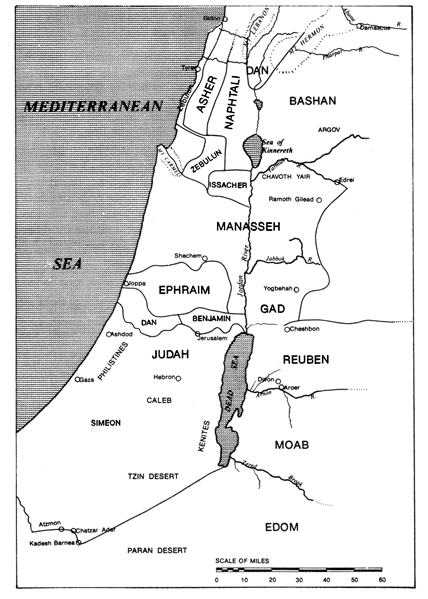
The division of the land from Numbers 34 and Deuteronomy 34, as Moses saw it.
Nisan through Elul
Rabbi Yitzchak Ginsburgh
According to Sefer Yetzirah, each month of the Jewish year has a letter of the Hebrew alphabet, a zodiac sign, one of the twelve tribes of Israel, a sense, and a controlling limb of the body that correspond to it.
Nisan Iyar Sivan Tammuz Av Elul Tishre through Adar
Nisan is the first of the twelve months of the Jewish calendar.
The first commandment given to the newly born nation of Israel before the Exodus from Egypt was: This month [the month of Nisan] shall be for you the first of the months Shemot (Exodus) 12:2.
The month of Nisan begins, in particular, the period (Tekufah) of the spring. The three months of this Tekufah--Nisan, Iyar, Sivan--correspond to the three tribes of the camp of Judah--Judah, Issachar, Zebulun--who were situated to the east). In the Torah, Nisan is referred to as the month of the spring (Chodesh ha Aviv).
In addition, Nisan begins the six summer months, which correspond to six levels of straight light (in Divine service, arousal from above). This is alluded to in the name Aviv which begins with the two letters Alef beit, in the direct or straight order of the Beit-beit.
Nisan is referred to as the month of the redemption. According to the accepted opinion of our sages: In Nisan our forefathers were redeemed from Egypt and in Nisan we will be redeemed[167].
Nisan is a month of miracles (Nissim). The fact that the name Nisan possesses two nuns implies, according to our sages, nissei Nissim -- miracles of miracles. Of the redemption of the future it is said: As the days of your Exodus from Egypt, I shall reveal to him wonders. In Chassidut this verse is explained to mean that the wonders of the redemption of the future will be wondrous and miraculous relative to the miracles of the Exodus from Egypt, miracles of miracles.
Letter: hei - ה. The letter hei is the phonetic origin of all the 22 letters of the Alef-beit.
Our sages teach us that with the letter hei HaShem created this world, as is said at the beginning of the second account of Creation (which corresponds to the Jewish calendar, beginning from Nisan): b hibaram--b hei bera am. Thus, the month of Nisan signifies the annual renewal of the creation of this world.
Mazal: Toleh (Aries--lamb). The Toleh symbolizes the Pesach sacrifice, the first sacrifice of the Jewish people to HaShem upon their redemption. The Jewish people itself are symbolized as a lamb (amongst seventy wolves). Of all of HaShem‘s creations, the lamb possesses the innate ability to arouse mercy by its voice (the origin of the sense of speech of the month of Nisan).
Tribe: Judah. Judah is the king (the first) of the tribes of Israel. His name means to give thanks, in speech (the sense of Nisan). The king rules his people by the power of his speech, as is said for the word of the king is his rule. The month of Nisan is the New Year for kings (Mishna Rosh Hashanah 1:1).
Sense: Speech. The sense of speech implies ones ability to express his deepest feelings and insights to an other. All forms of expression are referred to generically as speech.
This world (created by the letter hei of Nisan) is one that is founded upon (verbal) communication. Personifying the Sefirah of Malchut (kingdom), it is often referred to as the world of speech (or the revealed world).
The very root for speech means as well to lead. Thus the sense of speech is in essence the sense of leadership.
The central mitzva of the month of Nisan, on the Seder night, is the telling of the story of the Exodus, the more one tells of the Exodus from Egypt, the more is he praiseworthy. This is the foremost mitzva of speech of the entire year. Of the fifteen stages of the seder (15 = the sum of all numbers from one to five), Maggid--the telling of the story of the Exodus, is the 5th stage. 5 = hei. The stage of Maggid begins with the word hei (hei lachma anya, this is the poor-mans bread).
The redemption from Egypt (the existential state of confinement, the inability to truly express oneself-- all exiles are referred to as Egypt) symbolizes the freedom of speech.
Controller: right foot. Just as speaking means to lead, so does one‘s walking (with one‘s right foot, the foot of trust and confidence) direct and control one‘s sense of speech, as is said: walkers on the way, speak (Song of Deborah, Judges 5:10). Speaking words of Torah while walking on the way inspires new insights into the secrets of the Torah. And so do we find that many of the secrets of the holy Zohar were revealed in the context of walking on the way.
“Iyar“ is the second of the twelve months of the Jewish calendar. In the Bible, the month of Iyar is called the month of “Ziv” (radiance). Iyar is also cognate to light. The month of Iyar is commonly referred to as the month of (natural) healing, for its name is an acronym for “I am HaShem your Healer” Shemot (Exodus) 15:26.
Letter: “Vav.” “Vav” is a link. Iyar links together the two months of Nisan and Sivan (by the power of “Sefirat HaOmer,” which begins in Nisan, continues throughout Iyar, and concludes in Sivan), the month of redemption, and the month of the giving of the Torah. Only these three months are referred to in the Torah as the first, the second, and the third month of “the Exodus of Israel from Egypt.”
Mazal: “Shor” (Taurus-ox). The “Shor” (the left face of the Divine Chariot) represents the spiritual origin of the “animal soul“ of man. The month of Iyar is the month that man rectifies his animal soul, refines his innate character traits (each day of “Sefirat HaOmer”), as he prepares to receive the Torah in Sivan. In Hebrew, the root “Shor” also means to look or observe. Iyar is the month of introspection for the sake of self-improvement.
Tribe: Issachar. Issachar is the scholarly tribe of Israel. The Sanhedrin was mostly composed from the tribe of Issachar. In particular, Issachar was the master of the “secret“ of the Jewish calendar, as is said of him: “knowers of understanding the times.” His basic nature is contemplative and he serves as the “advisor” to his brethren, the tribes of Israel (in particular to the king, Judah).
Sense: Thought. Thought here implies contemplation and introspection. It also signifies the power of calculation (as in the calculation of the calendar). This is the month of counting (“Sefirat HaOmer”). The root “to think” in Hebrew “chashav” means “numerical calculation,” “ cheshbon.”
Controller: Right kidney. Our sages say, “The kidneys give advice.” In particular, the right kidney relates to spiritual advice or introspection. The kidneys act similarly to the “conscience,” as is said, “by night my kidneys chastise me.” This refers to the “cheshbon nefesh” (introspection) of the month of Iyar.
Sivan is the third of the twelve months of the Jewish calendar, the month of the giving of the Torah to Israel.
Letter: Zayin. Although Sivan is the third month of the year-- blessed be the Merciful-One [G-d’s attribute of mercy is the third of the Divine attributes; in the order of the eleven sefirot, it is the seventh] who gave a threefold Torah [Torah, Neviim, and Ketuvim] to a threefold people [Kohanim, Leviim and Yisraelim] in the third month [Sivan] by three [Moses, Aaron, and Miriam] -- the number that most prominently appears throughout the Torah is the number seven, the value of the letter Zayin.
The Torah was given on Shabbat, the seventh day of the week. According to Rabbi Yossi, the Torah was given on the seventh day of Sivan. Zebulun, the tribe of Sivan, begins with the letter Zayin.
Our sages identify the Zayin with the word zeh (this), signifying the unique level of prophesy of Moses (the transparent pane), the giver of the Torah (who himself was born and passed away on the seventh of Adar [the 12th month of the year; 12 = zeh]).
The Torah portions, of the annual cycle, of the month of Sivan are from the beginning of the Book of Numbers. In the third portion--Beha alotcha--there appears a section of two verses (And when the ark traveled...), which is separated, from the Torah text that precedes it and that follows it (by two upside-down nuns). Our sages teach us that this is order to divide the Torah into seven books, instead of the normal division of five. This phenomenon is alluded to in the verse: She carved her pillars seven. Together, Zayin (7) and hei (five, the normal division of the Torah) spell zeh, the unique level of the prophesy of Moses.
The shape of the letter Zayin is a vav with a crown on its head. This represents the crown that every Jewish soul received (which, in particular, consists of two levels, two crowns, as taught by our sages) upon the giving of the Torah. The Ten Commandments themselves contain 620 letters = Keter, crown.
Mazal: Teomaim (Gemini--twins). The twins symbolize the two identical tablets of the covenant given to Moses.
The giving of the Torah to Israel is referred to as a wedding (between HaShem and Israel). In the Song of Songs (5:2), the highest level of marriage is referred to as bride and groom being identical twins (tamati, which our sages read teomati).
The archetypal twins of the Torah are the two brothers, Jacob and Esau. These twins are not only non-identical but even opposites. Nonetheless, by the power of the giving of the Torah on the month of Sivan, both of the twins are rectified and become able to unite. In every Jew, Jacob represents the good inclination, while Esau represents the evil inclination. We are commanded to love HaShem with all of your heart, with both of your inclinations. In the two tablets of the covenant, the right tablet addresses primarily the side of Jacob while the left tablet addresses primarily the side of Esau (Thou shall not murder; Thou shall not commit adultery; Thou shall not steal.
Tribe: Zebulun. Zebulun is commonly pictured as the businessman, who supports the Torah study of his brother Issachar. In Kabbalah we are taught that there is always something higher inherent in a cause than in its result. In accordance with this principle, the Arizal explains that the origin of the soul of Zebulun is in Keter, above that of the soul of Issachar, in Chachmah.
The level of the Torah itself first revealed to us at Sinai is the level of the Keter (crown) of the Torah, as indicated by the fact that the Ten Commandments possess 620 letters = Keter (corresponding to the 613 mitzvot of the written Torah together with the seven mitzvot of the sages), as mentioned above. Zebulun himself is commanded to study Torah. His study of the Torah is at the level of Keter.
Sense: walking (progress, dynamic). Here, walking means the sense of continuous, ongoing progress. Each law of the Torah is called a Halacha, from the word to walk. Our sages interpret the verse: the walkings of the world are to Him (Habakkuk 3:6), that he who studies Halacha daily will surely merit the world to come.
The Torah gives us the power to walk ahead, to leave our initial premises in order to find and elevate fallen Divine sparks present throughout reality. And so is said of Zebulun: be happy Zebulun when you go out[168].
While the angels, who did not merit receiving the Torah, are called standers (for they do not possess the essential life dynamic) the souls of Israel (who received the Torah) are called walkers amongst the standers.
With regard to the strength of the Torah in general it is said: they [the souls of Israel that study the Torah and perform its commandments] shall proceed from strength to strength[169]. Our sages interpret this to mean that the righteous have no rest, neither in this world nor in the world to come. In Chassidut it is taught that in the absolute state of rest and tranquility of the world to come the soul of the righteous one experiences simultaneously the sense of infinite progress and walking ahead (the sense of tranquility is the sense of the month of Kislev [the third month from Tishre], the month that complements Sivan [the third month from Nisan] in the cycle of the year).
Controller: left foot. With regard to any pair of right and left, the right is relatively spiritual while the left is relatively physical. In the words of our sages: He stretched out His right hand and created the heavens and stretched out His left hand and created the earth.
As we saw above, speech, the sense of Nisan, is controlled by the right foot. Walking, the sense of Sivan, is controlled by the left foot. Speech resembles walking, as we find often in the Bible the idiom of the walking tongue. Nonetheless, speech is relatively more spiritual than walking (though both possess an inner spiritual dimension: speech--the sense of leadership; walking--the sense of progress).
We find in Proverbs (10:9) he who walks with sincerity shall walk with security. Sincerity (temimut) is the property of the left foot (the Sefirah of hod); security (bitachon) is the property of the right foot (the Sefirah of Netzach; confidence gives one the ability to speak clearly without stuttering [which in the mouth corresponds to stumbling in the feet]). Thus the verse implies that one should walk left, right... for it is the left foot that governs the general act of walking.
Tammuz is the fourth of the twelve months of the Jewish calendar.
The month of Tammuz begins the season (Tekufah) of the summer. The three months of this season, Tammuz, Av and Elul, correspond to the three tribes of the camp of Reuben--Reuben, Simeon and Gad--who were situated to the south).
Tammuz is the month of the sin of the golden calf, which resulted in the breaking of the Tablets. On that very day, the 17th of Tammuz begins the three-week period (ending on the 9th of Av), which commemorates the destruction of the Holy Temple in Jerusalem.
This is the month that the spies sent by Moses traveled through the land of Israel to see it and report to the people. (They returned on the eve of the 9th of Av).
Letter: Chet. The form of the letter Chet is composed of the two previous letters of the Hebrew Beit-beit, the vav and the Zayin (corresponding to the two previous months of Iyar and Sivan) connected from above by a thin bridge. In relation to the sense of sight, the form of the Chet represents the dynamic of spiritual light being emitted from the eyes (the vav) and physical light returning from the object observed, to the eyes (the Zayin).
The word Tammuz reads in Hebrew: tam -- connect together, consummate --vav Zayin the two letters that together form the Chet.
Mazal: Sartan (Cancer--crab). One of the meanings of the root of Sartan, seret, is a visual strip, in general, or (as in modern Hebrew) a filmstrip in particular.
The spiritual sense of sight of Tammuz is the ability to see through physical reality to behold its Divine source. In accordance with this thought, the word Sartan is understood as being composed of two words ‘sar’ and ‘tan’, which literally reads: remove the body (in order to reveal the soul), i.e. remove the outer shell of reality (by means of the power of concentrated sight) in order to reveal reality’s inner fruit and life-force.
Tribe: Reuben. The name Reuben comes from the root to see, the sense of Tammuz.
The precious stone of Reuben in the breastplate of the high priest is the Odem, the ruby (from Reuben), which due to its brilliant red color (Odem means red) is the most sensually visible of the stones.
Red is the most seductive of all colors, implying either the fall of man (in Hebrew Odem [red] has the same spelling as adam [man]), as in the sin of the golden calf, or the ultimate rise and rectification of man, with the coming of Mashiach.
Sense: sight. The summer (the period of Tammuz) is the holiday of the eyes. It is the time that one must guard his eyes to see only that which is good (in the world in general and in his fellow man in particular) and modest. The ability to guard and focus one‘s eyesight correctly is the rectified sense of sight.
At the end of Moses blessing Israel he said[170]: Yaacov sure, alone, is the eye of Jacob. The word betach, sure, is an acronym for three words: bracha tov Chayim, blessing good and life. These are the three focus-points of rectified eyesight, as is said[171]: See, I give before you today blessing and curse. The blessing... and subsequently[172]: See, I have given before you today life and good, and death and evil...and you shall chose life. In relation to these three one must train one‘s eyes (both spiritual and physical) to see only the inner positive dimension of reality and not to focus upon reality’s outer, negative shell.
This is the meaning of sure, alone, is the eye of Jacob. The sense of the Jewish eye (the eye of Jacob) is to only (alone) see that which is sure -- HaShem’s blessing, good and life.
Controller: right hand. The right hand, in general, and its index finger, in particular, serves to direct and focus one‘s eyesight.
When reading the Torah scroll, it is a custom to point at every word with a silver finger. It is also a custom to use the right hand to make signs to indicate the cantillation nuances for the reader of the Torah.
The wedding ring is placed by the groom on the index finger of the bride’s right hand. This elevates the couple to the level of my dove (Song of Songs 5:2), the intense expression of love transmitted by the never ceasing gaze of the eyes one to the other (turning the eyes as red as a ruby)-- your eyes are as doves, (Song of Songs 5:12)
The Hebrew month of Av (or Menachem-Av, the consoler of Av) is the fifth of the twelve months of the Jewish calendar.
The name Av literally means father. It derives from the root, which means to will, or to desire.
It is the month of the low point of the Jewish calendar (the 9th of Av, the day of the sin of the spies and the destruction of both the first and second Temples in Jerusalem) as well as the month of the high point of the Jewish calendar (the 15th of Av there are no happier days for Israel than the 15th of Av and Yom HaKippurim (Mishna Ta’anith 26:) the day of finding one‘s predestined soul-mate).
This accords with the teaching of our sages that the Mashiach is born on the 9th of Av. Relative to all other souls of Israel, the soul of Mashiach, who comes to redeem Israel from her state of (spiritual as well as physical) exile, is like a groom to his bride. After his birth on the 9th of Av he reveals himself to his bride and betroths her on the 15th of Av.
Letter: Tet. The letter Tet, which resembles a womb, equals nine, corresponding to the nine months of pregnancy. In the month of Av the nine months are condensed and concentrated into nine days, from Rosh Chodesh Av (the yahrtzeit of Aaron the high priest, whose name comes from the word pregnant) to the 9th of Av, the day, which as mentioned above is the birthday of Mashiach.
Mazal: Aryeh (Leo lion). The Aryeh symbolizes the power of Divine will (the meaning of the name Av, as mentioned above). The initial manifestations of HaShem’s will to destroy (the Temple) was in truth purely for the sake of reconstructing (the Temple with all of its spiritual meaning and significance for Israel and the entire world) for eternity.
In the words of our sages[173]: The lion [Nevudchanetzar, who is referred to in the Tanach as a lion Yirmiyahu 4:7] came on the month of the lion [Av] and destroyed the lion [the Temple, which is referred to in the Tanach, especially with regard to the alter, as a lion], in order that the lion [HaShem, of Whom is said the lion roars, who shall not fear Amos 3:8] come on the month of the lion and rebuild the lion.
This secret is also reflected in the numerical value of Aryeh. Aryeh in gematria = 216 = Gevurah (might). Gevurah is the Divine power responsible for tzimtzum (contraction and diminution of Divine light and energy, as is said with regard to the beginning of Av: When Av enters we diminish in joy [Mishna Taanit 26:]) and destruction. But 216 = 3 × 72. 72 = chesed (lovingkindness), the Divine power that builds all of reality, as is said (Psalms 89:3): the world is built with [by the power of] chesed. Three times chesed corresponds to the building of all three Temples, who are all contained and find their eternal consummation in the third Temple, to be built speedily in our days by Mashiach. For this reason the Aryeh appears to the right, in the place of chesed, in the Divine Chariot (Ezekiel 1:10).
Tribe: Shimon. The name Shimon comes from the word to hear. The sin of the spies on the 9th of Av entailed their speaking evil of the land of Israel and the people’s accepting hearing the evil tongue. Thus the general rectification of the month of Av is the rectification of hearing.
Shimon is the only tribe that Moses did not explicitly bless at the end of the Torah. This was due to his frustration with the tribe of Shimon because of their involvement (more than all the other tribes) in the sin of Peor (prostitution with foreign women, which resulted in idolatry). The name Shimon divides into two words which spell sham avon, there is iniquity.
In a certain sense, Moses (from the tribe of Levi) was most closely related (in spirit) to Shimon than to any other tribe. Shimon and Levi are brothers (Bereshit (Genesis) 49:5) said our father Jacob in blessing his sons. The two together (Shimon leading his younger brother Levi) took revenge for the rape of their sister Dinah, and destroyed the entire city of Shechem.
In Kabbalah we are taught that the primary reincarnation of Moses is in Rabbi Shimon Bar Yochai, he who more than any other of the sages revealed the inner dimension of the Torah of Moses (in the Holy Zohar).
The degeneration of the power of Shimon leads to the destruction of the Temple. The rectification and elevation of that very power brings about the eternal reconstruction of the Temple.
The rectification of Shimon (the rectification of the sins and iniquities of Israel which brought to the destruction of the Temple in the month of Av, the month of Shimon) is by his clinging to the most essential attribute of Moses humility. The word avon (sin) permutes to spell anav (humble) the unique term by which the Torah praises Moses (Numbers 12:3): And the man Moses was very humble [anav], more than any other man on the face of the earth. The name Shimon transforms (in the month of Av) from there is iniquity (sham avon) to there is the humble one (sham anav).
The ability of Shimon to so change depends upon his inner sense of hearing. Moses addresses Israel with the most all-inclusive statement of the Torah (Deuteronomy 6:4) : Hear [Shema] O Israel... Moses speaks to Israel through the soul-root of Shimon. Inner hearing comes with the deep sense of humility in the soul.
Even though Moses did not explicitly bless Shimon, our sages teach us that he alluded to him in the first word of his blessing to Judah (Deuteronomy 33:7): Hear [Shema] G-d the voice of Judah... (This phrase complements the verse Hear O Israel...; in gematria, Hear G-d the voice of Judah = 602 = 7 × 86 [Elokim, G-d], Hear O Israel... = 1118 = 13 × 86).
In the division of the land of Israel to the twelve tribes, Shimon inherited his portion within the larger portion of Judah (this is the only instance that one tribe inherited its portion within another). When the two names Shimon and Judah are added together: 466 + 30 = 496 = Malchut (kingdom) Thus we learn that the Malchut of Judah depends upon the presence and partnership of Shimon.
Judah corresponds to the month of Nisan and the sense of speech. Shimon corresponds to the month of Av (the first two letters and sub-root in Hebrew of the word Aviv, the name in Torah for the month of Nisan) and the sense of hearing. Av is the 5th month from Nisan, whose letter is hei = 5.
The two senses of speaking and hearing are obviously a pair, just as in the sin of the people’s hearing (accepting) the evil tongue spoken by the spies, the sin of the 9th of Av.
Thus we conclude that the power of the month of Av (the month of [apparent] destruction) is to hear the message spoken by the month of Nisan (the month of redemption), and integrate the first and foremost power of Israel leadership into the consciousness of the Jewish people.
This is the secret of the pregnancy and birth of Mashiach (the quintessential leader of Israel) from the 1st of Av (the beginning of his 9 day pregnancy) to the 9th of Av (his birth). He then fully unites with the consciousness of the people, in matrimony, on the 15th of Av.
Sense: hearing.
To hear in Hebrew means to understand, to fully integrate into one‘s consciousness (into one‘s heart, not only to understand intellectually in one‘s mind). To hear another is to fully understand his dilemma and emphasize with him. Hearing is receiving Kabbalah (first revealed by Rabbi Shimon Bar Yochai).
In the beginning of Isaiah (read on the Shabbat before the 9th of Av), it says: if you desire [tovu, from the word Av] and hear [the sense of Av], you shall partake of the goodness of the land.
The sense of hearing is the sense of inner balance, the foundation of rectified existence. (Imbalance is the source of all fall and destruction). A well-balanced ear, a well-oriented sense of hearing, possesses the ability to discern and distinguish in everything one hears truth from falseness, as is said (Job 12:11 and 34:3): the ear discerns words ozen malin tivchan (the initial letters of this phrase spell Emet truth).
Controlling limb: left kidney. The advice given by the left kidney is how to properly hear and integrate truth into one‘s consciousness.
In accordance with the general principle that right is always more spiritual than left, the sense of thought (of the month of Iyar), controlled by the right kidney, is relatively more spiritual than the sense of hearing, controlled by the left kidney.
The two kidneys are the male and female advisors of the soul. The right kidney advises how to rectify one‘s character traits through the process of careful introspection (the sense of thought of the month of Iyar). The left kidney advises how to absorb truth into one‘s consciousness (the sense of hearing of the month of Av)
The word for kidney, kulyah, comes from kol all. Kol = 50. Our sages teach us that at the age of 50 one is able to give advice. The two kidneys are two complementary sets of 50 (as the 50 parallel 50 loops of the two sets of the over-hang drapery of the Tabernacle). 50 + 50 = 100 = 10², the consummate state of rectification, 10 (powers of the soul) included in 10.
Elul is the sixth of the twelve months of the Jewish calendar. It is called the month of repentance, the month of mercy, and the month of forgiveness. Elul follows the two previous months of Tammuz and Av, the months of the two great sins of Israel, the sin of the golden calf and the sin of the spies.
The four letters of the name Elul are an acronym for the initial letters of the phrase in the Song of Songs (6:3): I am to my beloved and my beloved is to me. I am to my beloved in repentance and consummate desire to return to my soul-root in HaShem. And my beloved is to me with Divine expression of mercy of forgiveness.
This is the month that the King is in the field. All can approach Him, and He shines His countenance to all.
Elul is the month of preparation for the high holy days of Tishre. It is the month that Moses ascended to Mount Sinai a third time for a period of forty days from Rosh Chodesh Elul to Yom Kippur, when he descended with the second tablets of the covenant. These days were days when HaShem revealed to the Jewish people great mercy.
In small numbering, Elul = 13, alluding to the thirteen principles of Divine mercy that are revealed in the month of Elul.
Letter: yod. The yod is the first letter of the Tetragrammaton, G-d’s essential Name Havayah, the Name of mercy. It is also the final letter of the Name Adnut, the Name which enclothes the Name Havayah to reveal and express it to the world. Thus, the yod is the beginning (of the essence of Divine mercy, Havayah) and the yod is the end (of the manifestation of Divine mercy, Adnut).
All created form begins with an essential point, of energy and life force, the point of the letter yod. The end of the creative process is as well a point of consummation and satisfaction, a yod. In the beginning G-d created... is the initial point; and G-d concluded on the seventh day... is the final point.
The word ‘yad’ means hand. Our sages interpret the verse: Even My hand has founded the earth, and My right hand has developed the heavens, that G-d stretched out His right hand to create the heavens and stretched out His left hand to create the earth. The right hand is the point of beginning; the left hand is the point of end.
In the above quoted verse, the left hand (referred to as My hand without any definite designation of right or left) appears before the right hand. This accords with the opinion of Hillel that the earth preceded [the heavens]. The earth represents the consummation of Creation, the end of action is first in thought.
The yod of Elul is, in particular, the left hand, the controller of the month’s sense, the sense of action and rectification. This is the final point of Creation reaching its ultimate purpose and end, the yod of Adnut perfectly reflecting in created reality the yod of Havayah.
Mazal: Bethulah (Virgo--virgin). The Bethulah symbolizes G-d’s beloved bride, Israel, the bride of the Song of Songs who says to her groom I am to my beloved and my beloved is to me.
The word Bethulah appears for the first time in the Torah (and the only time in description of a specific women) in praise of our matriarch Rebecca, before her marriage to Isaac.
In Kabbalah the union of Isaac and Rebecca symbolizes the spiritual service of prayer and devotion to HaShem. Isaac ÷ ^ Rebecca = 208 ^ 307 = 515 = tefilla, prayer.
In Chassidut the verse I am to my beloved and my beloved is to me refers, in particular, to the service of prayer of the month of Elul.
The virgin of Elul (Rebecca) gives birth (retroactively, with respect to the order of the months of the year) to the twins of Sivan (Jacob and Esau, the sons of Rebecca, as explained above). The first tablets, given in Sivan, were broken (because of sin). The second tablets, given to Moses in Elul (the month of repentance) are whole. Repentance is identified in Kabbalah with mother (in general, and Rebecca in particular). Mother is binah = 67 = Elul.
In Kabbalah, the mother remains forever (on the spiritual plane) a virgin. In a continual state of teshuva and tefilla her ever-new union with father never ceases, two companions that never part. With the coming of Mashiach such will be the state of the lower groom and bride. (Father and mother correspond to the first two letters of Havayah, the higher union; groom and bride or son and daughter correspond to the second two letters of Havayah, the lower union).
The Bethulah symbolizes as well the virgin earth, the land of Israel destined to be married to the people of Israel, as the prophet declares: As a young man marries a virgin so will your children marry you [the land of Israel] (Isaiah 62:5). Here we see that the children marry mother earth who remains virgin earth.
The earth represents the rectification of action, the sense of the month of Elul, as described above.
Tribe: Gad. Gad means camp, as in the verse (the blessing of our father Jacob to his son Gad): Gad shall organize [lit. camp] camps [army camps], and he shall return with all his camps (Bereshit (Genesis) 49:19). The special talent of Gad is to organize a company.
The name Gad means as well good fortune. It is truly the good fortune of Israel to be G-d’s beloved bride, and this good fortune reveals itself through the means of our good deeds, especially those which are intended to rectify our blemishes and beautify ourselves, as a bride for her groom.
The good fortune of Gad relates, in Kabbalah, to the thirteen principles of mercy that are revealed in the month of Elul, in order to arouse the soul from its root (its good fortune) to return to HaShem.
Gad = 7. Gad was the 7th son to be born to Jacob. Mazal, the more common word for good fortune = 77. The middle letter of Mazal is Zayin = 7. When the two letters gimel dalet that form the name Gad (= 7) are substituted for the Zayin (= 7) of Mazal, the word Migdal, tower, is formed. The verse states: A tower [Migdal = 77] of might [oz = 77] is the Name of G-d, into it shall run the Tzadik and become exalted. In Kabbalah, the tower of might represents the bride, the Bethulah of Elul, the soul-root and Mazal of the Jewish people. The Tzadik, the groom, runs, with all of his might, to enter the tower of might.
Sense: action. The sense of action is the sense and inner knowledge that through devoted deeds of goodness one is always able rectify any blemished or broken state of the soul. This is the sense necessary for the spiritual service of Elul, the service of repentance and true teshuva to HaShem. The sense of action is thus the sense never to despair. This is the point, the yod (of Elul), of Divine service. Without it one can neither begin (an act) nor end.
The sense of action is the inclination to fix a broken object (to save a situation) rather than to throw it away.
In addition, the sense of action is the sense of organization and the sense of management of complex systems (as Gad, the tribe of Elul signifies camps and company).
Of the letter yod of Elul it is said: G-d with wisdom [the point of the yod] founded [rectified] the earth [the sense of action].
Controller: left hand. As mentioned above, G-d stretched out His left hand to create the earth (and, as quoted above: G-d with wisdom founded the earth [Proverbs 3:19]).
The right hand (the more spiritual of the two hands, which creates the heavens-- Lift up your eyes and see Who has created these --the inner, spiritual dimension of reality) controls the sense of sight, whereas the left (more physical) hand controls the sense of action.
The mitzva (commandment of action) of the tefillin shel yad is performed on the left hand (the right hand puts it on the left hand, i.e. sees to its being performed on the left hand).
It is the left hand, which touches the heart. This teaches us that all rectified action derives from the good emotions and intentions of the heart.
The Tribes in the Midrash:
Midrash Bamidbar Rabba to Numbers 2:1-34 AND THE LORD SPOKE UNTO MOSES AND UNTO AARON, SAYING (Num. II, 1). In eighteen passages you find Moses and Aaron placed on an equal footing (i.e. the divine communication was made to both alike); to this the Eighteen Benedictions correspond (the reason, was that Moses and Aaron were both instruments of Israel’s deliverance, which would not have been effected without their prayers, hence the daily Prayer was likewise divided into Eighteen Benedictions.). From the three Patriarchs you derive the fixed ritual of praying three times a day. Abraham instituted morning prayer, as it is said, And Abraham got up early in the morning to the place where he had stood, etc. (Gen. XIX, 27), and ‘standing‘ signifies prayer, as it is said, Then stood up Phinehas, and prayed [English Version: ‘wrought judgment’] (Ps. CVI, 30). Isaac instituted afternoon prayer, as it is said, And Isaac went out to meditate in the field at eventide (Gen. XXIV, 63), and ‘meditation’ signifies prayer; as it is said, A prayer of the afflicted, when he faints, and pours out his meditation (E.V.: complaint) before the Lord (Ps. CII, I). Jacob instituted evening prayer, as it is said, And he lighted (wayyifga’) upon the place, etc. (Gen. XXVIII, 11), and pegi’ah signifies prayer, as it is said, Therefore pray not you for this people ... neither make intercession (tifga’ - all three are from the root paga’) to Me (Jer. VII, 16). In eighteen passages Moses and Aaron are conjoined, thus giving a hint for the Eighteen Benedictions which correspond to the eighteen references to the Divine Name occurring in the shema‘ and in [the Psalm commencing,] A Psalm of David: Ascribe unto the Lord, O you sons of might (Ps. XXIX, 1). The three Patriarchs, then, introduced the custom of praying three times a day, while from Moses and Aaron and from the above-mentioned references to the Divine Name we infer that eighteen benedictions [must be said].
2. EVERY MAN WITH HIS OWN STANDARD, etc. (Num. II, 2). Thus it says, We will shout for joy in Your salvation, and in the name of our God we will set our standards, etc. (Ps. XX, 6). Israel said to the Holy One, blessed be He: ‘Behold, we are shouting for joy in Your salvation, for what You have wrought for us has been for Your name.’ Hence, ‘We will shout for joy in Your salvation,’ [even as it is written], the Lord saved (wayyosha’) Israel that day (Ex. XIV, 30), where the text has wayyiwwasha’ (and the Lord was saved): It was Israel that was being redeemed and, as it were, God Himself was being redeemed. [The idea is: we will shout for joy because You are saved; the second verse is similarly understood: And the Lord was saved with Israel that day. Through Israel’s redemption God’s name is exalted, and that is figuratively looked upon as though He Himself received salvation. It does not say, for Your salvation is near, but ‘for My salvation‘ is near: God said to Israel: ‘If you have no merit, I will do it for My own sake, as it were, for as long as you are in distress I am with you in this distress.’] ‘And in the name of our God we will set our standards,’ for the Holy One, blessed be He, fixed His name in our name [e.g. the word el ‘God’ in ‘Isra-el’] and organized us under standards; as it is said, EVERY MAN WITH HIS OWN STANDARD (Num. II, 2).
3. With great love did the Holy One, blessed be He, love them, forasmuch as He organized them under standards like the ministering angels, so that they might be easily distinguished. Whence do we know that this was a sign of love? Because Solomon says: He has brought me to the house of wine, and his standard over me is love (S.S. II, 4). R. Abbahu expounding said: What is taught by the text, ‘He has brought me to the house of wine,’ etc.? [What is the connection between ‘the house of wine’ and ‘his standard’?] Let me illustrate from the case of a rich man who possessed a storehouse full of wine. When he went in to examine it he found it all turned to vinegar. As he was about to leave the storehouse he lighted upon a solitary barrel of good wine, so he thought, ‘This is worth as much to me as the whole storehouse full.’ So the Holy One, blessed be He, created seventy nations, and in none of these did He find pleasure save in Israel, as it is said, ‘He has brought me to the house of wine (yayin) [alluding to the seventy nations] and the numerical value of yayin is seventy: yod, 10; yod, 10; nun, 50; total, 70; and out of all those, ‘His standard over me is love.’ R. Judah said, ‘He has brought me to the house of wine’ means ‘to the great wine-cellar’, that is, Sinai, where Moses taught us the Torah (which is compared to wine) which can be expounded in forty-nine different ways, [as indicated by the numerical value of] ‘wediglo (and his standard) over me is love’. R. Hanina said: In times past any one who pointed with his finger at the Emperor’s likeness was put to death; now, however, children go to the house of study and point to the Divine Names with the finger, yet God says, ‘wediglo (and his standard over me) is love’; that is, even his finger (wegodlo) [a play on words: the ‘house of wine’ will thus refer to the house of study] over Me is love.
R. Issachar, expounding the text, ‘And his standard (wediglo) over me is love,’ said: Even if a man, while sitting and studying the Torah rambles (medalleg) from law to law and from verse to verse, the Holy One, blessed be He, says, ‘He is dear to me, “wediglo (and his standard) over me is love”‘; that is, ‘his rambling (wedilugo) over Me is love.’ Another exposition: ‘And his standard over me is love.’ The Holy One, blessed be He, says: ‘The nations have standards, but I love none save the standard of Jacob‘; that is the meaning of the text, ‘And his standard over me is love.’
Another exposition of the text, ‘He has brought me to the house of wine.’ When the Holy One, blessed be He, revealed Himself upon Mount Sinai, twenty-two thousands angels descended with Him, as it is said, The chariots of God are two myriads, two thousands (E.V. ‘are myriads, even thousands upon thousands’); the Lord is among them at Sinai (E.V. ‘as in Sinai‘), in holiness (Ps. LXVIII, 18), and they were all arrayed under separate standards, as it is said, Marked out by standards from among myriads (S.S. V, 10). When Israel saw them arrayed under separate standards they began to long for standards, and said, ‘O that we also could be ranged under standards like them!’ Therefore it is said, ‘He has brought me into the house of wine,’ and this refers to Sinai, upon which was given the Torah which has been likened to wine: And drink of the wine which I have mingled [hese words are spoken by Wisdom, which the Sages hold to be synonymous with the Torah] (Prov. IX, 5). Thus, ‘into the house of wine’ is explained as referring to Sinai. ‘And his standard over me is love’ [is explained as follows]: They said, ‘O that He would show great love for me’; and this is also expressed in the text, ‘We will shout for joy in Your salvation, and in the name of our God we will set up our standards.’ Said the Holy One, blessed be He, to them, ‘How eager you are to be arranged under standards; as you live, I will fulfill your desire!’ as we read, The Lord will fulfill all your petitions (Ps. XX,6). The Holy One, blessed be He, immediately informed Israel by telling Moses, ‘Go, arrange them under standards as they have desired.’
4. EVERY MAN WITH HIS OWN STANDARD, ACCORDING TO THE ENSIGNS (Num. II, 2). It is in allusion to this that Scripture writes: Who is this that looks forth as the dawn, fair as the moon, clear as the sun, terrible as an army with standards (S.S. VI, 10). Holy and grand indeed were Israel beneath their standards! All the nations looked at them with rapt attention and wonder, thinking, ‘Who is this that looks forth,’ etc. These nations said to them, ‘Return, return, O Shulammite [regarded as referring to Israel] (S.S. VII, 1), cling to us, come unto us and we will make you governors, generals, commanders, lieutenants, commanders-in-chief; Return, return, that we may look upon you’ (ib.). ‘We may look’ can only mean, [for the purpose of bestowing] authority, for thus said Jethro to Moses, And you will look out from among all the people able men ... to be rulers, etc. (Ex. XVIII, 21). Hence, ‘Return, return, that we may look upon you.’ Israel, however, replied: What will you see in the Shulammite? (S.S. ib.). What greatness would you confer upon us? Perchance, as it were, a dance of camps (ib.)? Can you, peradventure, confer upon us anything like the greatness which God conferred upon us in the wilderness by giving us the standard of the camp of Judah, the standard of the camp of Reuben, the standard of the camp of Dan, the standard of the camp of Ephraim? Can you give us any such thing? “What will you see in the Shulammite?” What other greatness could you possibly confer upon us? Perchance, “as it were, a dance of camps”? Can you, peradventure, confer upon us anything like the greatness which God conferred upon us in the wilderness, for though we repeatedly sinned He pardoned [This exposition is obtained by a play on the word meholath ‘dance of’, which is here derived from mahal ‘to pardon’. The passage reflects the many attempts made from time to time to seduce Israel from their faith, and Israel’s loyalty in spite of them.] us again and again, and assured us, ‘And you camp shall be holy’ (Deut. XXIII,15)? Balaam also looked at them and his eye came out [as he gazed] upon them, for he could not touch them; as it is said, And Balaam lifted up his eyes, and he saw Israel dwelling tribe by tribe (Num. XXIV, 2); this refers to the standards. So he began to say, ‘Who can touch these people? They know their ancestry and their families,’ as it is said, ‘dwelling tribe by tribe’ [An inordinate importance is apparently attached in the whole of this passage to the fact that the Israelites were organized under standards. This phrase, however, ‘they know their ancestry and their families,’ may provide a clue to what the Rabbis were really insisting upon, viz. loyalty to the past and purity of family life, and this they saw symbolized in the standards.] (ib.). From here we learn that the standards gave both greatness and protection [from immorality, since the standards were a means of enabling them to recognize their ancestry and family relationships] to Israel. So it says, EVERY MAN WITH HIS OWN STANDARD.
5. Another exposition of the text, EVERY MAN WITH HIS OWN STANDARD. This bears on what the Scripture says: You are beautiful, O my love, as Tirzah (S.S. VI, 4) which means[The comparison with Tirzah which is but the name of a city]: ‘I, [says God to Israel], am easily reconciled [even though you may have temporarily incurred My displeasure through sin] (mithrazeh) to you’; or, ‘You are acceptable (mithrazim) to Me’ [by reason of your learning, noble deeds, and repentance]; or, ‘You obtain favor (mithrazim) by virtue of sacrifice,’ as it is said, And favor will be obtained (wenirzeh) for him to make atonement for him (Lev. I, 4). [Scripture continues:] Comely as Jerusalem (S.S. ib.), meaning: Like those bands of ministering angels who fear Me and are whole-heartedly devoted to Me (Jerusalem is read as two words: Jeru (yeru), fearing, and shalem, whole-hearted. This exposition like the preceding is based on the apparent inaptness of comparing a people to a city). [Then it concludes:] ‘Terrible as an army with standards’ (ib.). In what way, [asks God of Israel], are you ‘like an army with standards’? By reason of the standards which I have given you. David saw this and said, He has not dealt so with any nation (Ps. CXLVII, 20), only with His own people. This explains, EVERY MAN WITH HIS OWN STANDARD, etc.
6. Another exposition of the text, EVERY MAN WITH HIS OWN STANDARD. Consider the verse, He found him in a desert land, etc. (Deut. XXXII, 10). It was a great find that the Holy One, blessed be He, came across in Israel, as it is said, I found Israel like grapes in the wilderness [i.e. they afforded God as much delight as grapes to a hungry man traveling in the wilderness] (Hos. IX, 10). Hence, ‘He found him in a desert land’; for the world was a desert before Israel came out of Egypt (barren and devoid of the knowledge of a true God and His worship). And in the waste, a howling wilderness (Deut. ib.); waste and howling was the world before Israel came out of Egypt and before they received the Torah. He did not tarry, but as soon as Israel departed from Egypt and received the Torah, what does Scripture say? He compassed him about, He gave him understanding (i.e. ‘cared for him’), He kept him as the apple of His eye (ib.). ‘He compassed him about’ means that He set clouds of glory around them. ‘He gave him understanding’ means that He made them comprehend the words of the Torah. ‘He kept him’: Happy the ears that heard this! To what extent did He love them, to what extent did He guard them, to what extent did He keep them? As it were, even as much ‘as the apple of His eye’. See how He guarded them, yea to what extent He guarded them, and how He kept them! For God said to Moses: ‘O Moses, tell them that they will make a Tabernacle [the Tabernacle was, as it were, ‘the apple of His eye’] in their midst, and I will, as it were, abandon the heavens and come down and dwell among them.’ Moreover, He even organized them under separate standards [which were stationed about the Tabernacle] in His name. The Holy One, blessed be He, said to Moses: ‘Organize them under standards in My name. Why? Because they are My children,’ as it is said, You are the children of the Lord your God (Deut. XIV, 1). And they are My hosts [like the very angels]; for so it is said, And I will bring forth My hosts, My people the children of Israel, out of the land of Egypt (Ex. VII, 4). And thus it says, The standard of the camp of Judah, according to their hosts (Num. II, 3). And because they are My hosts I will organize them under standards in My name. This is the implication of the text, EVERY MAN WITH HIS OWN STANDARD.
7. ACCORDING TO THE ENSIGNS (II, 2). There were distinguishing signs for each prince; each had a flag and a different color for every flag, corresponding to the precious stones on the breast (Hebrew: ‘heart‘) of Aaron. It was from these that governments [the Vilna ed. has the singular and ‘the state’, which might refer to Rome] learned to provide themselves with flags of various colors. Each tribe had its own prince and its flag whose color corresponded to the color of its stone. [In Aaron’s breast-plate] Reuben’s stone was ruby and the color of his flag was red; and embroidered thereon were mandrakes (See: Gen. XXX, 14: And Reuben went in the days of wheat harvest, and found mandrakes in the field). Simeon’s was topaz and his flag was of a green color; the town of Shechem was embroidered thereon (his prowess and his self-sacrifice in the interest of morality were demonstrated at Shechem - cf. Gen. XXXIV, 25 f.). Levi’s was smaragd and the color of his flag was a third white, a third black, and a third red; embroidered thereon were the Urim and Thummim (cf. Deut. XXXIII, 9). Judah’s was a carbuncle and the color of his flag was something like the heavens; embroidered on it was a lion (to which he was likened by Jacob in his final blessings - cf. Gen. XLIX, 9). Issachar’s was a sapphire and the color of his flag was black like stibium, and embroidered thereon was the sun and moon, in allusion to the text, And of the children of Issachar, men that had understanding of the times [they were the astronomers and calendar experts] (I Chron. XII, 33). Zebulun’s was an emerald and the color of his flag was white (like silver, symbolical, according to R. Bechaye, of their great wealth), with a ship embroidered thereon, in allusion to the text, Zebulun will dwell at the shore of the sea (Gen. XLIX, 13). Dan’s was jacinth and the color of his flag was similar to sapphire (they were the great merchants and seafaring traders), and embroidered on it was a serpent, in allusion to the text, Dan will be a serpent in the way (Gen. XLIX, 17). Gad’s was an agate and the color of his flag was neither white nor black but a blend of black and white; on it was embroidered a camp, in allusion to the text, Gad, a troop will troop upon him (ib. 19). Naphtali’s was an amethyst and the color of his flag was like clarified wine of a not very deep red; on it was embroidered a hind, in allusion to the text, Naphtali is a hind let loose (ib. 21). Asher’s was a beryl and the color of his flag was like the precious stone with which women adorn themselves; embroidered thereon was an olive-tree, in allusion to the text, As for Asher, his bread will be fat (ib. 20). Joseph‘s was an onyx and the color of his flag was jet black; the embroidered design thereon for both princes, Ephraim and Manasseh, was Egypt, because they were born in Egypt. On the flag of Ephraim was embroidered a bullock, in allusion to the text, His firstling bullock (Deut. XXXIII, 17), which applies to Joshua [firstling bullock is taken to mean ‘first in rank and power’] who came from the tribe of Ephraim. On the flag of the tribe of Manasseh was embroidered a wild ox, in allusion to the text, And his horns are the horns of the wild-ox (Deut. XXXIII, 17), which alludes to Gideon son of Joash who came from the tribe of Manasseh. [This passage on Joseph is not quite clear. Reference is made to Joseph‘s flag, though, in fact, there was no separate tribe of Joseph; nor is the meaning of the phrase ‘the embroidered design thereon for both princes, Ephraim and Manasseh, was Egypt’ quite certain. It apparently means that Ephraim and Manasseh were both included in one twin flag. Egypt was depicted across the whole of it, the background of which was entirely black, yet the flag was divided into two (perhaps by a vertical or horizontal line), and each part bore a device representing its particular tribe. Another explanation might be that they each had a separate flag, placed side by side, while a third flag represented Joseph as a whole. This seems rather less likely.] Benyamin’s was jasper and the color of his flag was a combination of all the twelve colors; embroidered thereon was a wolf, in allusion to the text, Benyamin is a wolf that ravens (Gen. XLIX, 27). The reason, then, why it is said, ACCORDING TO THE ENSIGNS is because each prince had his own distinguishing sign.
8. ACCORDING TO THEIR FATHER’S HOUSE [E.V. BY THEIR FATHERS HOUSES. The reason for the change will become evident in the course of the passage]. The text need simply have read, ‘Every man with his own standard, according to the ensigns will the children of Israel pitch.’ What, then, is the purpose of the statement ACCORDING TO THEIR FATHER’S HOUSE? [FATHER’S HOUSE is apparently superfluous, since the chapter distinctly enumerates each tribe separately. Hence it must be explained differently.] The following Scriptural verse has a bearing on this: I will fetch my knowledge from afar [i.e. from a distant past], and will ascribe righteousness/generosity to my Maker (Job XXXVI, 3). When the Holy One, blessed be He, told Moses, ‘Organize them [Israel] under standards in accordance with their desire,’ Moses began to feel distressed. He thought, ‘Now strife will arise among the tribes; for if I bid the tribe of Judah camp on the east side of the Tabernacle and he says, “I will accept only the south,” and the same applies to Reuben and the same to Ephraim and to each of the other tribes, what am I to do?’ The Holy One, blessed be He, therefore said to him, ‘Moses, why should that trouble you? They have no need of you. They know their places full well themselves. They are in possession of a testament left them by Jacob their father, which tells them how to camp under their standards. I am not going to make any changes. They already have a traditional order from Jacob their father: in the same way that they disposed themselves round his bier, when they carried him, so shall they dispose themselves round the Tabernacle.’ For R. Hama, son of R. Hanina, said: When our father Jacob was about to depart from the world he summoned his sons--as it is written, And Jacob called unto his sons (Gen. XLIX, X)--and he blessed them and commanded them concerning the ways of God, and they acknowledged the Divine sovereignty. Having concluded his address, he said to them, ‘When you carry me to my last resting-place you must escort me with proper reverence and respect. No other man will touch my bier; neither an Egyptian nor any of your children, because you have taken wives from the daughters of Canaan ‘For this reason Scripture says, And his sons did unto him according as he commanded them (Gen. L, 12); his ‘sons’ but not his ‘grandsons’. And his sons carried him (ib. 13). How did he command them to do it? He said to them: ‘My children, when my bier is being carried, Judah, Issachar, and Zebulun will be on the east side; Reuben, Simeon, and Gad will be on the south side; Ephraim, Manasseh, and Benyamin will be on the west side; Dan, Asher, and Naphtali will be on the north side; Joseph will not carry at all, for he is a king and must be shown due honor; neither will Levi carry because he will carry the ark, and he that is to carry the ark of Him who is the life of all worlds must not carry the coffin of the dead. If you will comply with these orders and carry my bier as I have commanded you, God will in the future cause you to camp beneath standards.’ When he died, they bore him as he had commanded them, as it is said, ‘And his sons did unto him according as he commanded them.’ Thus we can explain the verse [quoted above], ‘I will fetch my knowledge from afar, and will ascribe righteousness to my Maker’; for it was from Jacob that they had obtained the knowledge how they were to camp under their standards. ‘And will ascribe righteousness to my Maker,’ that is, to the Holy One, blessed be He, Who acted beneficently with Israel, and Who, in order to give them good reward for having fulfilled the command of their father, bade them camp under standards only in the manner in which their father had commanded them. Therein He acted with righteousness toward them, since He made no alteration, so as not to cause strife among them. This is the reason why it is said, ACCORDING TO THEIR FATHER’S HOUSE; in the same manner as they had disposed themselves around the bier of their father, so will they camp. This explains the text, ACCORDING TO THEIR FATHER’S HOUSE WILL THE CHILDREN OF ISRAEL CAMP.
9. A GOOD WAY OFF WILL THEY PITCH ROUND ABOUT THE TENT OF MEETING (Num. II, 2). We have learned elsewhere [Er. IV, (49b); v. Tan. II, 9]: ‘One who wishes to observe the Sabbath rest while on a journey should make his abode within [an imaginary] circle with himself as the center and having a radius of four cubits.’ These are the words of R. Hanina. He is then permitted to move objects on the Sabbath within the four cubits. He may declare, ‘Let my abode for the Sabbath be on this spot where I am,’ and he acquires, by virtue of the spot, the right to walk within 2,O00 cubits in all directions. How much is four cubits? R. Judah says: Sufficient room to enable him [to lie prostrate] and to take an object lying at his feet and place it near his head [this is based on Ex. XVI, 29: Abide every man in his place. R. Judah defines ‘his place’ as in the text]. One who observes the Sabbath rest in an inhabited place, even though it be as large as Antioch, may walk about in all parts of it and within 2,000 cubits outside it. One who observes the Sabbath in a cave, even though it be like the cave of Zedekiah, which was eighteen miles long, may walk through the whole of it and within 2,000 cubits outside it in any direction he pleases. Whence did they [the Sages] find support for the regulations regarding the Sabbath walking-limit in the Torah [i.e. for this distance of 2,000 cubits]? From what is said, And you will measure without the city for the east side two thousand cubits, and for the south side two thousand cubits, and for the west side two thousand cubits, and for the north side two thousand cubits, etc. (Num. XXXV, 5). So also you will find in the case of Joshua who, when he went to destroy Jericho, said to them [Israel], ‘It will be necessary for you to observe the Sabbath rest there. Do not move away from the ark further than 2,000 cubits on any side, so that you may be permitted to come and pray before the ark on the Sabbath day.’ So it likewise says, Yet there will be a space between you and it, about 2,000 cubits by measure (Josh. III, 4). You will also find that when the Holy One, blessed be He, informed Moses that he would cause Israel to camp under standards, He told him, ‘Cause them to camp at a distance, in every direction, of 2,000 cubits,’ as it is said, A GOOD WAY OFF WILL THEY PITCH ROUND ABOUT THE TENT OF MEETING. What is meant by A GOOD WAY OFF? R. Isaac said: At a distance of a mile, which is 2,000 cubits. And how do we know that the expression A GOOD WAY OFF denotes a distance of a mile? We derive it from an analogous use of the phrase ‘A good way off’. It is written here, A GOOD WAY OFF WILL THEY PITCH ROUND ABOUT THE TENT OF MEETING, and it is written elsewhere, And she went, and sat her down ... a good way off, at a distance of about a bowshot; for she said: Let me not look upon the death of the child. And she sat a good way off, and lifted up her voice, and wept (Gen. XXI, 16). As in the latter case it denotes a mile, so here also it denotes a mile. And whence is it inferred that the expression, ‘A good way off,’ used in the case of Hagar denotes a mile? [By the analogy of expressions.] It is written in her case ‘at a distance’ and it is written elsewhere a distance. ‘But there will be a distance between you and it, about 2,000 cubits by measure’ (Josh. III, 4). As in the latter case it denotes a mile, so also in the former case it denotes a mile.
Yaakov’s Blessings in Genesis 49
Did Yaaqob reveal the end of days (i.e., the time of Mashiach’s arrival) to his sons?
I think that Yaaqob did reveal the end of days, but not in a straight-forward way. I think he revealed it in a way wher we have to assemble the pieces.
Yaakov’s desire to reveal the time of Moshiach ’s arrival empowered us at all times to instantaneously bring about the complete and true Redemption through our righteous Mashiach.
Why do our Sages use the expression “but the Shechinah departed from him”? Their intent is to explain why Yaaqob did not reveal the time of Mashiach’s arrival, going on to speak of other things instead. This being so, they should have used the term “but the knowledge departed from him”, or some similar expression. Particularly so, since Yaaqob then went on to relate many prophecies — a sure sign that the Shechinah had not at all left him!
Gad is associated with Eliyahu HaNavi.
Dan is associated with Samson - Mashiach.
Why is Zebulun blessed before Issachar?
Business before Torah?
Ultimately, Yaaqob was prophesying about the end of days, the Mashiach. The shifts in the sequence of the tribes surround Yehuda and the concept of Mashiach, the major focus of the End of Days.
We know that Chazal and our tradition speak of two ideal models of leadership: "Mashiach ben Yosef" and "Mashiach ben David." There are two models of leadership because Mashiach, after all, is a king, i.e., a leader, and there are two classic forms of such leadership. "Mashiach ben Yosef" deals with the material problems, while "Mashiach ben David" is responsible for spiritual leadership. In other words, Chazal noted that Yosef and Yehuda represent two forms of leadership, which will find expression in lofty manifestations of humanity.
Yosef, the eventual Mashiach ben Yosef, will come. He will be preceded by Eliyahu from the tribe of Gad. His coming will be mired in impurity and will be the last place that one would expect to find such holiness.
Yehuda, the eventual Mashiach via the line of David, will come. He will be preceded by Eliyahu from the tribe of Gad. His coming will be mired in impurity and will be the last place that one would expect to find such holiness.
Yehuda will be flanked by the scrupulously honest businesspeople represented by Zevulun. He will be empowered by men and women of Torah represented by Yissachar. He will be aided in the building of the Beit Hamikdash by spiritual descendents of Dan. And as we wait for that great day, we can only echo those words, be they the words of Yaaqob, Dan, Shimshon or Gad:
I have waited for your salvation, O Lord!
The following ATBaSH (chiasm) demonstrates that Yaaqob is indeed speaking of the end of days:
|
Gather for the end of days. 49:1-2 |
|
||||
|
|
3 tribes that are criticized – Reuben 1 see a son, Simeon 2 hear, Levi 3 companion. (Leah) 49:3-7 |
|
|||
|
|
|
The chosen tribe – Yehuda 4 thanks. (Leah) 49:8-12 |
|
||
|
|
|
Material abundance –Zebulun 10 permanent home and Yissakhar 9 reward. (Leah) 49:13-15 |
|
||
|
|
|
Military valor – Dan 5 judge. (Bilha) 49:16-17 |
|
||
|
|
|
Yaaqob's prayer for HaShem’s salvation. 49:18 |
|||
|
|
|
Military valor – Gad 7 success. (Zilpa) 49:19 |
|
||
|
|
|
Material abundance – Asher 8 fortune and Nephtali 6 twist. (Bilha and zilpa) 49:20-21 |
|
||
|
|
|
The chosen tribe – Yosef 11 add. (Rachel) 49:22-26 |
|
||
|
|
Tribe that is noted – Benyamin 12 son of my right hand. (Rachel) 49:27 |
|
|||
|
Yaaqob Gathers his feet and dies. 49:33 |
|
||||
Moshe’s Blessing in Debarim 33.
Moshe’s blessing according to tribal order.
There is no clear, single criterion for the order of their appearance; the choice seems to be based on a combination of the order of their birth and the order of their geographical settlement.
|
Debarim 33 Blessings |
Bereshit 49 Blessings |
|
|
|
|
Reuven |
Reuven |
|
Yehuda |
Shimon |
|
Levi |
Levi |
|
Benyamin |
Yehuda |
|
Yosef |
Zebulun |
|
Zebulun |
Issachar |
|
Issachar |
Dan |
|
Gad |
Gad |
|
Dan |
Asher |
|
Naphtali |
Naphtali |
|
Asher |
Yosef |
|
(Simeon is missing) |
Benyamin |
Reuven's place at the beginning of the list is obvious, since he is the firstborn of both Yaaqob and Leah. Shimon, as mentioned, is omitted – a fact that is undoubtedly related to Yaaqob's blessing.[174] What remains to be explained, then, is the order of the blessing of the four other tribes: Yehuda, the leader destined for royalty, who is blessed after Reuven, followed by Levi and Binyamin, and finally Yosef.
The blessing here appears to have a symmetrical structure. At the two ends we find the central forces in Am Yisrael – both at that time and for future generations: Yehuda, destined for royalty from among the children of Leah, and Yosef, the firstborn of Rachel, second-in-command to the king of Egypt, who merited a double inheritance in the land of Israel (the portions of Ephraim and Menashe). In the middle, between Yehuda and Yosef, blessings are given to Levi and Binyamin. Indeed, geographically, the portion of Binyamin is located between the portion of Yosef (more precisely, of Ephraim) to the north, and the portion of Yehuda to the south, while Levi has no portion of his own in the land: God is his portion, because he serves in the Mishkan.[175]
At the same time, we are still left with a difficulty. Why is Binyamin – the younger son of Rachel – blessed immediately after Levi, thereby preceding Yosef, who is Rachel's firstborn? The commentaries address this question; Rashi comments as follows:
"Because the blessing of Levi concerns the sacrificial service, and of Binyamin – the Temple being built in his portion, therefore [Moshe] uttered them consecutively, with Yosef immediately thereafter – for he, too, had the Mishkan of Shiloh built in his portion, as it is written: 'He forsook the Tabernacle of Yosef' (Tehillim 78:67). Since the Temple was more beloved than Shiloh was, therefore Binyamin is mentioned before Yosef."
According to Rashi, the juxtaposition of Yosef and Binyamin is a result not of their both being sons of Rachel, but rather of the common denominator between all three tribes here – the resting of the Divine Presence, according to which their order is likewise established. First blessings are given, consecutively, to Levi – who performs the Divine service in the Sanctuary, then Binyamin, in whose portion the Temple is built,[176] and only afterwards to Yosef, in whose portion the Mishkan of Shiloh rested, since the Mishkan was less beloved to God than the Temple.
The Ibn Ezra[177] explains that Levi and Binyamin are juxtaposed "because the Levites dwell in Jerusalem, which was between Yehuda and Binyamin." According to this view they are mentioned consecutively as a result of their geographical proximity, too, and not only because of their common connection to the Divine Presence.
* * *
This study was written by
Rabbi Dr. Hillel ben David
(Greg Killian).
Comments may be submitted to:
Rabbi Dr. Greg Killian
12210 Luckey Summit
San Antonio, TX 78252
Internet address: gkilli@aol.com
Web page: https://www.betemunah.org/
(360) 918-2905
Return to The WATCHMAN home page
Send comments to Greg Killian at his email address: gkilli@aol.com
[1] Based on the teachings of the Lubavitcher Rebbe.
[2] Bereshit (Genesis) 29:31-30:25; 35:16-26; 33:1-2, 6-7.
[3] Midrash Rabbah, Bereshit 71:2.
[4] Deuteronomy 11:12, as per Talmud, Ta’anith 2a.
[5] Shulchan Aruch HaRav (earlier version), Orach Chaim 1:4-6; Kitzur Shulchan Aruch 1:2.
[6] Shulchan Aruch, Orach Chaim 90:12.
[7] Specifically the Shema.
[8] Ibid.6, 89:1-3.
[9] Ibid., 155:1, after Talmud, Berachoth 64a and Shabbat 31a.
[10] Shulchan Aruch, ibid., 156:1.
[11] Bereshit (Genesis) 28:12; cf. Zohar, part I, 266b; Midrash Rabbah, Bereshit 68:12.
[12] In sight, thousands if not millions of details are “grasped” as a single imprint upon the retina; the mind then proceeds to process all this information, drawing from the all-embracing image imparted by the eye. The faculty of hearing functions in the opposite manner: the ear hears an idea word-by-word, syllable-by-syllable; or it hears a musical composition note by note. From these sounds, each of which is meaningless on its own, the listener “recreates” the idea or the composition in his mind, piecing it together bit by bit.
It is for this reason that sight is the most “convincing” of our faculties -- once we have seen something “with our own eyes,” nothing will dissuade us from the truth of this intimately-held truth -- while something heard is a more “objective” and impersonal reality.
[13] Bereshit (Genesis) 29:32.
[14] Ibid., v. 33.
[15] Ibid., v. 34.
[16] Ibid., v. 35.
[17] For a detailed discussion of the four stages of prayer and their connection to the first four sons of Jacob, see Torah Ohr, Vayechi 45a-d.
The four stages of prayer are preceded by three preparations, alluded to by the three ancestors of Reuben, Simeon, Levi and Judah: 1) the giving of charity, alluded to by their great-grandfather, Abraham, the exemplar of lovingkindness; 2) immersion in a mikveh, alluded to by their grandfather Isaac, who is described by the Torah as a digger of wells; and 3) the study of Mussar (inspirational and moralistic teachings), alluded to by Jacob, who embodies Torah and “truth.”
[18] Bereshit (Genesis) 49:28.
[19] “Persevering in the burden of Torah, like strong ass who is burdened with a heavy load” -- Rashi, on verse.
[20] Bereshit (Genesis), ibid., vv. 13-14.
[21] Deuteronomy 33:18.
[22] Rashi on Deuteronomy ibid.; Midrash Tanchuma, Vayechi 11; et al.
[23] Proverbs 3:6.
[24] Ethics of the Fathers 2:12.
[25] Talmud, Menachoth 99b.
[26] There are two basic ways in which this is achieved, corresponding to the two maxims quoted above: “All your deeds should be for the sake of Heaven“ means that everything one does is done as a means to the end of serving G-d (e.g., one engages in business in order to earn money to give to charity); “Know Him in all your ways” means that one‘s everyday activities are not only a means to a G-dly end, but are themselves ways of experiencing G-d (e.g., observing the hand of G-d in the dozens of “lucky coincidences” that add up to a single business deal, thereby gaining a deeper appreciation of His providence).
[27] Isaiah 64:3.
[28] Talmud, Berachoth 34b.
[29] Ibid.
[30] These two modes of Torah study are exemplified by the different methodologies followed by the Babylonian and Jerusalem Talmuds -- see The Inside Story (VHH, 1997), pp. 275-278.
[31] Bereshit (Genesis) 30:24.
[32] Ibid. 35:18; Rashi on verse.
[33] Ibid. 30:6.
[34] Ibid. 49:16.
[35] Talmud, Pesachim 4a.
[36] Bereshit (Genesis) 30:8; see Rashi on verse.
[37] Bereshit (Genesis) 49:20.
[38] Deuteronomy 33:24.
[39] See Shulchan Aruch, Yoreh De’ah 105:5; Likutei Sichot, vol. I, pp. 102ff.
[40] Bereshit (Genesis) 30:11; Rashi on verse.
[41] Reshimot #20.
[42] It should be noted that one of the differences between the Ibn Ezra and the version in the Midrash concerns the picture on the flag of Dan. According to the midrash, the picture featured a snake, while Ibn Ezra writes “the form of an eagle” – in accordance with the description of the Divine Chariot.
[43] Bamidbar Rabba 2:6
[44] i.e. the mandrakes have the appearance of a person – cf. Genesis 30:14
[45] cf. Genesis 49:9
[46] Deut. 33:17
[47] The Ibn Ezra offers no explanation for the connection between Dan and an eagle. See, however Rashi to Shemot 19:4, DH Al, and Rashi to Bamidbar 10:25, DH Me’asef. cf. Ezekiel 1:10
[48] I learned this from my teacher, His Eminence Hakham Dr. Joseph ben Haggai.
[49] Midrash Rabbeinu Bachya, Torah commentary by Rabbi Bachya ben Asher, volume 6, page 1891
[50] Bamidbar (Numbers) 10:11-33
[51] Sifrei Naso 1:152
[52] Sifrei Naso 1:158
[53] Diverei Hayamin (I Chronicles) 12:32
[54] Like the very angels.
[55] Lit. ‘by signs‘.
[56] So Warsaw ed. The Vilna ed. has the singular and ‘the state’, which might refer to Rome.
[57] V. Gen. XXX, 14: And Reuben went in the days of wheat harvest, and found mandrakes in the field; and cf. Gen. R.LXXII, 5.
[58] His prowess and his self-sacrifice in the interest of morality were demonstrated at Shechem (cf. Gen. XXXIV, 25 f.).
[59] Perhaps the reference to Levi should, with R. Bachya, be deleted, since he was not included among the twelve tribes (Rad.).
[60] Cf. Deut. XXXIII, 9.
[61] To which he was likened by Jacob in his final blessings (cf. Gen. XLIX, 9).
[62] They were the astronomers and calendar experts.
[63] Like silver, symbolical, according to R. Bachya, of their great wealth;
[64] Rad.; they were the great merchants and seafaring traders; v. Rashi on Gen. XLIX, 13.
[65] Rad. prefers the reading ‘black’, adopted by R. Bachya.
[66] Though Naphtali’s birth is recorded before Gad’s (v. Gen. XXX, 8-1l), Gad precedes Naphtali in the present enumeration of the tribes (see vv. 14, 29) and also in the blessings of both Jacob and Moses (v. Gen. XLIX, 19, 21; Deut. XXXIII, 20, 23). There is consequently no need to assume with Rashi, that we have a printer’s error here.
[67] Firstling bullock is taken to mean ‘first in rank and power’.
[68] This passage on Joseph is not quite clear. Reference is made to Joseph‘s flag, though, in fact, there was no separate tribe of Joseph; nor is the meaning of the phrase ‘the embroidered design thereon for both princes, Ephraim and Manasseh, was Egypt’ quite certain. It apparently means that Ephraim and Manasseh were both included in one twin flag. Egypt was depicted across the whole of it, the background of which was entirely black; yet the flag was divided into two (perhaps by a vertical or horizontal line), and each part bore a device representing its particular tribe. Another explanation might be that they each had a separate flag, placed side by side, while a third flag represented Joseph as a whole. This seems rather less likely.
[69] 1896-1981, “Emet L’Yaaqob”
[70] Shemot (Exodus) 12:51
[71] Shemot (Exodus) 13:18
[72] If we may be permitted to add to R. Kamenetsky’s question.
[73] Bamidbar (Numbers) 2:2
[74] See Ibn Ezra.
[75] peirud levavot, “division of hearts”
[76] The Tabernacle which was constructed in the wilderness.
[77] R. Yehudah Loew ben Betzalel, c. 1525-1609; Baer Hagolah 6:8; Gevurot HaShem 13; Chiddushei Aggadot Yevamot 16b, Sanhedrin 21a; see also Sefer HaYetzira 5:2.
[78] see Debarim (Deuteronomy) 32:8
[79] Bereshit (Genesis) 22:20-24
[80] Bereshit (Genesis) 10:15-19
[81] Bereshit (Genesis) 17:20, 25:16
[82] See Sforno, Bamidbar 1:2, who agrees that the time had indeed come for them to enter the Land of Israel, but they would have faced no resistance: the occupants of the land would vacate the land, and the Israelites would inherit it peacefully. Rather, the census was intended to organize them for purposes of inheritance.
[83] Rashi, Bamidbar (Numbers) 1:52
[84] Rashi, Bamidbar (Numbers) 2:2
[85] The Ibn Ezra (Bamidbar 1:52) suggests that the purpose of the divisions was to avoid confusion.
[86] Rashi, Bamidbar (Numbers) 2:2
[87] Bereshit (Genesis) 50:12
[88] Bereshit (Genesis) 50:13
[89] Midrash Rabbah Bamidbar (Numbers) 2:8
[90] A contradiction of the statement in Pir. R. El. XXXIX ab init., which asserts that in order to avoid inter-marriage with the Canaanites all Jacob's sons had married their sisters and kinswomen (Mah.). Tan. reads: ‘because there are some among them (i.e. among their children) who have married daughters of Canaan.’
[91] ‘Coffin’ and ‘ark’ are expressed by the same word in Hebrew.
[92] The inference is drawn from the use of the expression פועלי rather than יוצרי, the former denoting ‘reward’ or ‘recompense’; cf. Lev. 19, and Isa. 40:10.
[93] The Chizkuni (Bamidbar 2:2) says that the sign contained on all four flags spelled out the names of all the patriarchs.
[94] Tabernacle
[95] See Ramban’s introduction to Shemot; Ramban, Shemot 25:1; Ramban, Shemot 40:34.
[96] See Rabbenu Bachya, Bamidbar 7:87.
[97] See Sefer Shnei Luchot Habrit, Parshat Naso, Or Torah note 6, who suggests that the four divisions represent the four-lettered name of HaShem.
[98] Below there would be 22,000 Levites who carry and protect the Mishkan in its travels; apparently this number of angels is directly parallel to the Levites. See Rabbenu Bachya, Bamidbar (Numbers) 1:1.
[99] Tehillim (Psalms) 68:18
[100] Shir HaShirim (Song of Songs) 5:10
[101] Mishle (Proverbs) 9:5
[102] Tehillim (Psalms) 20:6
[103] Midrash Rabbah - Bamidbar (Numbers) 2:3
[104] The Midrash states that the Jews “desired” this arrangement. This is yet another translation of the word otot: rather than “insignia” or “sign”, here the Midrash suggests that this word is derived from the root ovot connoting desire (as in ta’avah). See Rabbenu Bachya, Bamidbar 2:2, and Sefer Shnei Luchot Habrit, Parshat Naso, Torah Ohr note 8.
[105] See Noam Elimelech Parshat Tetzaveh.
[106] See Talmud Bavli Chagigah 15a, and the text in the Ein Yaaqob.
[107] Recanati, Bamidbar (Numbers) 2:2.
[108] See Shem MiShmuel Bamidbar 5672.
[109] See Shem miShmuel, Bamidbar 5673.
[110] The Arizal (Rav Yitzchak Luria) in the Shaar haKavanot, Drushei Aleinu Leshabeah, drush 1) taught that each tribe had their own special way to pray, and each person’s prayers are facilitated by the method of his or her tribe. In this context, the Ariz”al discusses our present situation: we no longer know what tribe each of us belongs to, and the unique prayers of each of each of the tribes is lost. Additionally, there are various traditions of prayer current today, and people may be confused as to what tradition to follow.
[111] HaRav Mordechai Drucker of Strya, Hungary, Parashat Ki Tavo.
[112] see Rashi to Debarim 33:9
[113] Rashi indicates that the leaders presented their offerings for the dedication of the altar in the Mishkan, according to the order in which they marched in the wilderness.
[114] Sotah 32a, 37a
[115] See also Mei ha’Shilo’ach (Izhbitz), vol. II, Parshat Ki Tavo.
[116] see Rashi to Debarim 33:9
[117] Bereshit 42:32
[118] Bereshit 30:16
[119] Rashi to Bamidbar 7:19
[120] Rashi, Bamidbar 32:16
[121] Rashi, Debarim 33:24
[122] Rashi, Debarim 33:18
[123] Bava Basra 98b; Pesachim 103a
[124] Bereshit 49:17
[125] The Midrash associates the snake with slander. See, for example, Tanchuma, Metzora #2.
[126] Bereshit 30:8
[127] Rashi to Bamidbar 7:11 shall present his offering for the dedication of the altar But Moses still did not know how they should bring [the offerings], whether in the order of their births [namely, the order in which Jacob’s sons were born] or according to the order in which they traveled—until he was instructed by the Holy One, blessed is He, that they should bring the offerings according to the order in which they traveled, each one in his day.-[Sifrei Naso 1:152]
[128] Sifrei Naso 1:152
[129] following Rambam’s approach, see MT K’lei Mikdash 9:9
[130] see TSC shiur on Bamidbar
[131] see Yehoshua chapter 14 and Sefer Shoftim chapter 1
[132] See Seforno 33:19, who alludes to Yissachar's role in international trade.
[133] JPS translation
[134] cf. Gen. 29-30, and 35
[135] Gen. 35:18
[136] Josh. VIII, 33. The Hebrew has the definite article which seems superfluous.
[137] Simeon, Levi, Judah, Issachar, Joseph and Benjamin on Mount Gerizim, and Reuben, Gad, Asher, Zebulun, Dan and Naphtali on Mount Ebal, v. Deut. XXVII, 12-13.
[138] Six tribes in the same order on each stone; v. Ex. XXVIII, 9ff.
[139] Ibid. 10.
[140] V. I, 5ff.
[141] V. Ex. I, 2ff.
[142] On the one stone were Reuben, Simeon, Levi, Judah, Issachar and Zebulun; on the other Benjamin, Dan, Naphtali, Gad, Asher and Joseph.
[143] The latter are the tribal as distinct from the personal names.
[144] Who said that the tribes were divided on the stones of the ephod as on the two mounts; and this has been shown to be incorrect
[145] [The article ‘the’ denotes that those who stood on Ebal represented the full contingent of half the tribes. Whereas on Gerizim one of the tribes — Levi — was missing (Maharsha)].
[146] Since Levi should have been among the first six tribes.
[147] Josh. XVII, 14f.
[148] The personification of envy which causes harm to those who enjoy good fortune. Their numerical strength would excite envy.
[149] Gen. XLIX, 22.
[150] Ibid. XLVIII, 16, referring to Joseph‘s sons.
[151] Ps. LXXXI, 6. In this verse Joseph‘s name is spelt with five letters instead of the usual four, v, supra p. 50, n. 2.
[152] As explained above, viz., the name as given by Jacob; consequently we cannot use the exceptional form of his name as it occurs here.
[153] Gen. XXXV, 28; here it is spelt with the yod.
[154] In the parallel passage, supra 10b the name is Hanin.
[155] Ibid. XXXIX, 11
[156] I.e., for an immoral purpose.
[157] Ibid. 12.
[158] Prov. XXIX. 3.
[159] Gen. XLIX, 24.
[160] Gen. XLIX, 24.
[161] Ps. LXXX, 2, E.V. 1., sic. Hence Israel is called Joseph‘s flock and he is the shepherd.
[162] Hilchot kelai ha-Mikdash, 9:9
[163] cf. Talmud Sotah
[164] Cf. Meiri, and Tosafot there
[165] as it is in one of the comments in Sotah there
[166] following Rambam’s approach, see MT K’lei Mikdash 9:9
[167] Rosh Hashanah 11a
[168] Deuteronomy 33:18
[169] Psalms 84:8
[170] Deuteronomy 33:28
[171] Deuteronomy 11:26
[172] Deuteronomy 30:15-19
[173] Yalkut Shimoni, Yirmiyahu, 259
[174] "Shimon and Levi are brothers; instruments of cruelty are their swords. Let my soul not enter their counsel; let my honor not be united with their assembly. For in their anger they killed a man, and willfully lamed an ox. Cursed is their anger, for it is fierce, and their fury, for it is cruel; I shall divide them amongst Yaaqob and scatter them amongst Israel" (Bereshit 49:5-7). The Tribe of Levi corrected its behavior through its actions following the Sin of the Golden Calf, therefore this tribe was scattered for the purposes of sanctity, in the cities of the Levites – as opposed to Shimon, who was swallowed up within the Tribe of Yehuda.
[175] see Debarim 10:9; 18:2
[176] Rabbi Y. Bekhor-Shor comments as follows (ad loc.): "Because the children of Levi served in the Temple, which stood in the portion of Binyamin, therefore [Moshe] gave Binyamin's blessing immediately after that of Levi." Chizkuni (ad loc.) similarly explains, "Because the occupation of Levi is in the Temple, which is in the portion of Binyamin."
[177] We shall quote here briefly the commentary of the Ibn Ezra (Debarim 33:6) (which is worthy of more extensive treatment) on the order of the tribes: "[The blessing] starts with the elders, for so it is proper. Shimon is not mentioned because of Ba'al Pe'or…. Following Reuven, [Moshe] mentions Yehuda, the flag-bearer… and then Levi and thereafter Binyamin, because the Levites live in Jerusalem, which was in between Yehuda and Binyamin… And thereafter the Tribe of Yosef, so as not to leave him for the end, since his younger brother had already been mentioned. And then Zevulun… and then Yissakhar… and when the sons of the wives were finished, he began from Gad, who was the standard-bearer of the children of the handmaids…."
Rabbeinu Behaye (ibid.) likewise addresses the matter of the order: "Reuven… because he was the eldest, therefore [Moshe] treats him with the birthright in his blessing. Then Yehuda is brought forward after him, for he was the first tribe to inherit in the land… and after Yehuda he blessed Levi, for they dwell in Jerusalem, together with the children of Yehuda. After the children of Levi he blessed Binyamin, whose portion was with the children of Yehuda, and the city of Jerusalem and the Temple were between Yehuda and Binyamin, and the Levites dwelled with both of them, and after Binyamin – Yosef, so as not to leave him to the end…."