|
Esnoga Bet Emunah 12210 Luckey Summit San Antonio, TX 78252 United States of America © 2026 E-Mail: gkilli@aol.com |
|
Esnoga Bet El 102 Broken Arrow Dr. Paris TN 38242 United States of America © 2026 E-Mail: waltoakley@charter.net |
Triennial Cycle (Triennial Torah Cycle) / Septennial Cycle (Septennial Torah Cycle)
|
Three and 1/2 year Lectionary Readings |
First Year of the Triennial Reading Cycle |
|
Tishri 29, 5787 – Oct 10, 2026 |
Fifth Year of the Shmita Cycle |
Candle Lighting and Habdalah Times: https://www.chabad.org/calendar/candlelighting.htm
Roll of Honor:
This Commentary comes out weekly and on the festivals thanks to the great generosity of:
His Eminence Rabbi Dr. Hillel ben David and beloved wife HH Giberet Batsheva bat Sarah
His Eminence Rabbi Dr. Eliyahu ben Abraham and beloved wife HH Giberet Dr. Elisheba bat Sarah
His Honor Paqid Adon David ben Abraham
His Honor Paqid Adon Ezra ben Abraham and beloved wife HH Giberet Karmela bat Sarah,
His Honor Paqid Adon Tzuriel ben Abraham and beloved wife HH Giberet Gibora bat Sarah
Her Excellency Giberet Sarai bat Sarah & beloved family
His Excellency Adon Barth Lindemann & beloved family
His Excellency Adon John Batchelor & beloved wife
His Excellency Adon Yehoshua ben Abraham and beloved wife HE Giberet Rut bat Sarah
His Excellency Adon Michael ben Yosef and beloved wife HE Giberet Sheba bat Sarah
Her Excellency Giberet Prof. Dr. Emunah bat Sarah & beloved family
His Excellency Adon Robert Dick & beloved wife HE Giberet Cobena Dick
His Excellency Adon Ovadya ben Abraham and beloved wife HE Giberet Mirit bat Sarah
His Excellency Adon Shlomoh ben Abraham
His Excellency Adon Ya’aqob ben David
His Excellency Adon Bill Haynes and beloved wife HE Giberet Diane Haynes
Her Excellency Giberet Krysta Wallrauch & beloved family
Also, a great thank you and great blessings be upon all who send comments to the list about the contents and commentary of the weekly Torah Seder and allied topics.
If you want to subscribe to our list and ensure that you never lose any of our commentaries, or would like your friends also to receive this commentary, please do send me an E-Mail to gkilli@aol.com with your E-Mail or the E-Mail addresses of your friends. Toda Rabba!
Shabbat: “Vayiten L’kha” - “And give you”
&
Shabbat Mevarchim
Proclamation of the New Moon of Heshvan
(Sunday Evening, October 11 – Monday Evening October 12, 2026)
|
Shabbat |
Torah Reading: |
Weekday Torah Reading: |
|
וְיִתֶּן-לְךָ |
|
Saturday Afternoon |
|
“Vayiten L’kha” |
Reader 1 – Bereshit 27:28-31 |
Reader 1 – Bereshit 28:10-12 |
|
“And give you” |
Reader 2 – Bereshit 27:32-34 |
Reader 2 – Bereshit 28:13-15 |
|
“Y te dé” |
Reader 3 – Bereshit 27:35-37 |
Reader 3 – Bereshit 28:16-19 |
|
Bereshit (Genesis) 27:28 – 28:9 |
Reader 4 – Bereshit 27:38-41 |
|
|
Ashlamatah: Hosea 14:6-10 + Joel 1:1-3 + 2:12-13 |
Reader 5 – Bereshit 27:42-46 |
Monday and Thursday Mornings |
|
Special Ashlamata: Shmuel alef (1 Samuel) 20:18-42 |
Reader 6 – Bereshit 28:1-5 |
Reader 1 – Bereshit 28:10-12 |
|
Tehillim (Psalms) 23:1-6 + 24:1-10 |
Reader 7 – Bereshit 28:6-9 |
Reader 2 – Bereshit 28:13-15 |
|
N.C. Mk. 3:11-12 Luke 6:19 |
Maftir – Bereshit 28:6-9 |
Reader 3 – Bereshit 16-19 |
Contents of the Torah Seder
· The Blessing of Isaac – Gen. 27:28 - 28:9
A Prayer for Israel
Our Father in Heaven, Rock, and Redeemer of Israel, bless the State of Israel, the first manifestation of the approach of our redemption. Shield it with Your lovingkindness, envelop it in Your peace, and bestow Your light and truth upon its leaders, ministers, and advisors, and grace them with Your good counsel. Strengthen the hands of those who defend our holy land, grant them deliverance, and adorn them in a mantle of victory. Ordain peace in the land and grant its inhabitants eternal happiness.
Lead them, swiftly and upright, to Your city Zion and to Jerusalem, the abode of Your Name, as is written in the Torah of Your servant Moses: “Even if your outcasts are at the ends of the world, from there the Lord your God will gather you, from there He will fetch you. And the Lord your God will bring you to the land that your fathers possessed, and you shall possess it, and He will make you more prosperous and more numerous than your fathers.” Draw our hearts together to revere and venerate Your name and to observe all the precepts of Your Torah, and send us quickly the Messiah son of David, agent of Your vindication, to redeem those who await Your deliverance.
We pray for his Eminence Hillel ben David. Mi Sheberach…He who blessed our forefathers Abraham, Isaac and Jacob, Moses and Aaron, David and Solomon, may He bless and heal his Eminence Hillel ben David, May the Holy One, Blessed is He, be filled with compassion for him to restore his health, to heal him, to strengthen him, and to revivify him. And may He send him speedily a complete recovery from heaven, among the other sick people of Yisrael, a recovery of the body and a recovery of the spirit, swiftly and soon, and we will say amen ve amen!
Blessings Before Torah Study
Blessed are You, Ha-Shem our GOD, King of the universe, Who has sanctified us through Your commandments, and commanded us to actively study Torah. Amen!
Please Ha-Shem, our GOD, sweeten the words of Your Torah in our mouths and in the mouths of all Your people Israel. May we and our offspring, and our offspring's offspring, and all the offspring of Your people, the House of Israel, may we all, together, know Your Name and study Your Torah for the sake of fulfilling Your delight. Blessed are You, Ha-Shem, Who teaches Torah to His people Israel. Amen!
Blessed are You, Ha-Shem our GOD, King of the universe, Who chose us from all the nations, and gave us the Torah. Blessed are You, Ha-Shem, Giver of the Torah. Amen!
Ha-Shem spoke to Moses, explaining a Commandment. "Speak to Aaron and his sons, and teach them the following Commandment: This is how you should bless the Children of Israel. Say to the Children of Israel:
May Ha-Shem bless you and keep watch over you; - Amen!
May Ha-Shem make His Presence enlighten you, and may He be kind to you; - Amen!
May Ha-Shem bestow favor on you, and grant you peace. – Amen!
This way, the priests will link My Name with the Israelites, and I will bless them."
These are the Laws for which the Torah did not mandate specific amounts: How much growing produce must be left in the corner of the field for the poor; how much of the first fruits must be offered at the Holy Temple; how much one must bring as an offering when one visits the Holy Temple three times a year; how much one must do when performing acts of kindness; and there is no maximum amount of Torah that a person must study.
These are the Laws whose benefits a person can often enjoy even in this world, even though the primary reward is in the Next World: They are: Honoring one's father and mother; doing acts of kindness; early attendance at the place of Torah study -- morning and night; showing hospitality to guests; visiting the sick; providing for the financial needs of a bride; escorting the dead; being very engrossed in prayer; bringing peace between two people, and between husband and wife; but the study of Torah is as great as all of them together. Amen!
JPS & Targum Pseudo Jonathan for: Bereshit (Genesis) 27:28-28:9
|
JPS |
Targum Pseudo Jonathan |
|
27:28. And may the Lord give you of the dew of the heavens and [of] the fatness of the earth and an abundance of corn and wine. |
28. Therefore the Word of the LORD give you of the good dews which descend from the heavens, and of the good fountains that spring up, and make the herbage of the earth to grow from beneath, and plenty of provision and wine. |
|
29. Nations shall serve you and kingdoms shall bow down to you; you shall be a master over your brothers, and your mother's sons shall bow down to you. Those who curse you shall be cursed, and those who bless you shall be blessed." |
29. Let peoples be subject to you, all the sons of Esau, and kingdoms bend before you, all the sons of Keturah; a chief and a ruler be you over your brethren, and let the sons of your mother salute you. Let them who curse you, my son, be accursed as Bileam bar Beor; and them who bless you be blessed as Mosheh the prophet, the scribe of Israel. JERUSALEM: Let peoples serve before you, all the sons of Esau: all kings be subject to you, all the sons of Ishmael: be you a chief and a ruler over the sons of Keturah: all the sons of Laban the brother of your mother will come before you and salute you. Who soever curses you, Ya’aqob, my son, will be accursed as Bileam ben Beor; and whosoever blesses you will be blessed as Mosheh the prophet and scribe of Israel. |
|
30. And it came to pass, when Isaac had finished blessing Jacob, and it came to pass Jacob had just left his father Isaac's presence, that his brother Esau came from his hunt. |
30. And it was when Yitschaq had finished blessing Ya’aqob, and Ya’aqob had only gone out about two handbreadths from Yitschaq his father, that Esau his brother came in from his hunting. |
|
31. And he too had made tasty foods, and he brought [them] to his father, and he said to his father, "Let my father arise and eat of the game of his son, so that your soul will bless me." |
31. And the Word of the LORD had impeded him from taking clean venison; but he had found a certain dog, and killed him, and made food of him, and brought to his father, and said to his father, Arise, my father, and eat of my venison, that your soul may bless me. |
|
32. And his father Isaac said to him, "Who are you?" And he said, "I am your son, your firstborn, Esau." |
32. And Yitschaq his father said to him, Who are you? And he said, I am your firstborn, Esau. |
|
33. And Isaac shuddered a great shudder, and he said, "Who then is the one who hunted game and brought it to me, and I ate of everything while you had not yet come, and I blessed him? He, too, shall be blessed." |
33. And Yitschaq was moved with great agitation when he heard the voice of Esau, and the smell of his food rose in his nostrils as the smell of the burning of Gehinnom; and he said, Who is he who has got venison, and come to me, and I have eaten of all which he brought me before you came, and I have blessed him, and he will, too, be blessed? |
|
34. When Esau heard his father's words, he cried out a great and bitter cry, and he said to his father, "Bless me too, O my father!" |
34. When Esau heard the words of his father, he cried with a cry exceeding great and bitter, and said to his father, Bless me, me also, my father! And he said, |
|
35. And he said, "Your brother came with cunning and took your blessing." |
35. Your brother has come with subtlety, and has received from me your blessing. |
|
36. And he said, "Is it for this reason that he was named Jacob? For he has deceived me twice; he took my birthright, and behold, now he has taken my blessing." And he said, "Have you not reserved a blessing for me?" |
36. And he said, His name is truly called Ya’aqob; for he has dealt treacherously with me these two times: my birthright he took, and, behold, now he has received my blessing! And he said, Have you not reserved a blessing for me? |
|
37. And Isaac answered and said to Esau, "Behold, I made him a master over you, and I gave him all his brothers as servants, and I have sustained him with corn and wine; so for you then, what shall I do, my son?" |
37. And Yitschaq answered and said to Esau, Behold, I have appointed him a ruler over you, and all his brethren have I made to be his servants, and with provision and wine have I sustained him: and now go, leave me; for what can I do for you, my son? |
|
38. And Esau said to his father, "Have you [but] one blessing, my father? Bless me too, my father." And Esau raised his voice and wept. |
38. And Esau answered his father, Have you but one blessing, my father? Bless me, me also, my father. And Esau lifted up his voice and wept. |
|
39. And his father Isaac answered and said to him, "Behold, your dwelling place shall be the fat places of the earth and of the dew of the heaven from above. |
39. And Yitschaq answered and said to Esau, Behold, among the good fruits of the earth will be your habitation, and with the dews of the heavens from above. |
|
40. And you shall live by your sword, and you shall serve your brother, and it will be, when you grieve, that you will break his yoke off your neck." |
40. And upon your sword will you depend, entering at every place: yet you will be supple and credulous, and be in subjection to your brother; but it will be that when his sons become evil, and fall from keeping the commandments of the Law, you will break his yoke of servitude from off your neck. JERUSALEM: And by your weapons you will live, and before your brother be subject. And it will be when the sons of Ya’aqob labour in the Law, and keep the commandments, they will set the yoke of subjection on your neck; but when the sons of Ya’aqob withdraw themselves and study not the Law, nor keep the commandments, behold, then will you break their yoke of subjection from off your neck. |
|
41. And Esau hated Jacob because of the blessing that his father had blessed him, and Esau said to himself, "Let the days of mourning for my father draw near, I will then kill my brother Jacob." |
41. And Esau kept hatred in his heart against Ya’aqob his brother, on account of the order of blessing with which his father had blessed him. And Esau said in his heart, I will not do as Kayin did, who slew Chebel in the life (time) of his father, for which his father begat Shet, but will wait till the time when the days of mourning for the death of my father come, and then will I kill Ya’aqob my brother, and will be found the killer and the heir. |
|
42. And Rebecca was told of the words of Esau, her elder son, and she sent and called Jacob, her younger son, and she said to him, "Behold, your brother Esau regrets [his relationship] to you [and wishes] to kill you. |
42. And the words of Esau her elder son, who thought in his heart to kill Ya’aqob, were shown by the Holy Spirit to Rivqah, and she sent, and called Ya’aqob her younger son, and said to him, Behold, Esau your brother lies in wait for you, and plots against you to kill you. |
|
43. And now, my son, hearken to my voice, and arise, flee to my brother Laban, to Haran. |
43. And now, my son, hearken to me: arise, escape for your life, and go unto Laban my brother, at Haran, |
|
44. And you shall dwell with him for a few days until your brother's wrath has subsided. |
44. and dwell with him a few days, until the wrath of your brother be abated, |
|
45. Until your brother's rage subsides from you, and he forgets what you did to him, and I will send and bring you from there. Why should I be bereft of both of you on one day?" |
45. until your brother's anger have quieted from you, and he have forgotten what you have done to him; and I will send and take you from thence. Why should I be bereaved of you both in one day: you being slain, and he driven forth, as Hava was bereaved of Habel, whom Kain slew, and both were removed from before Adam and Hava all the days of the life of Adam and Hava? JERUSALEM: Until the time when the bitterness of your brother will be turned away from you. |
|
46. And Rebecca said to Isaac, "I am disgusted with my life because of the daughters of Heth. If Jacob takes a wife of the daughters of Heth like these, from the daughters of the land, of what use is life to me?" |
46. And Rivqah said to Yitschaq, I am afflicted in my life on account of the indignity of the daughters of Heth. If Ya’aqob take a wicked wife from the daughters of Heth, such as these of the daughters of the people of the land, what will life be to me? |
|
|
|
|
28:1. And Isaac called Jacob and blessed him, and he commanded him and said to him, "You shall not take a wife of the daughters of Canaan. |
1. And Yitschaq called Ya’aqob, and blessed him, and commanded him, and said to him, You will not take a wife from the daughters of the Kena’an |
|
2. Arise, go to Padan aram, to the house of Bethuel, your mother's father, and take yourself from there a wife of the daughters of Laban, your mother's brother. |
2. Arise, go to Padan of Aram, to the house of Bethuel your mother's father, and take you from thence a wife from the daughters of Laban mother's brother. |
|
3. And may the Almighty God bless you and make you fruitful and multiply you, and you shall become an assembly of peoples. |
3. And El Shadai will bless you with many possessions, and increase you and multiply you into twelve tribes, and you will be worthy of the congregation of the sons of the Sanhedrin, the sum of which is seventy, according to the number of the [Gentile] nations. |
|
4. And may He give you the blessing of Abraham, to you and to your seed with you, that you may inherit the land of your sojournings, which God gave to Abraham." |
4. And He will give the blessing of Abraham to you, and to your sons with you, and cause you to inherit the land of your sojourning, which he gave unto Abraham. |
|
5. And Isaac sent Jacob, and he went to Padan aram, to Laban the son of Bethuel the Aramean, the brother of Rebecca, the mother of Jacob and Esau. |
5. And Yitschaq sent Ya’aqob away, and he went to Padan Aram unto Laban bar Bethuel the Aramaite, the brother of Rivekah the mother of Jakob and Esau. |
|
6. And Esau saw that Isaac had blessed Jacob and sent him away to Padan aram, to take himself a wife from there, and that when he blessed him, he commanded him, saying, "You shall not take a wife of the daughters of Canaan." |
6. And Esau considered that Yitschaq had blessed Ya’aqob, and had sent him to Padan Aram to take to him from thence a wife, when he blessed him, and commanded him, saying, You will not take a wife of the daughters of the Kenaanites; |
|
7. And Jacob listened to his father and his mother, and he went to Padan aram. |
7. and that Ya’aqob obeyed the word of his father, and the word of his mother, and was gone to Padan Aram: |
|
8. And Esau saw that the daughters of Canaan were displeasing to his father Isaac. |
8. and Esau considered that the daughters of Kenaan were evil before Yitschaq his father, |
|
9. So Esau went to Ishmael, and he took Mahalath, the daughter of Ishmael, the son of Abraham, the sister of Nebaioth, in addition to his other wives as a wife. |
9. and Esau went unto Ishmael, and took to wife Mahalath, who is Besemath the daughter of Ishmael bar Abraham, the sister of Nebaioth from his mother, besides his other wives. |
Rashi’s Commentary for: Bereshit (Genesis) 27:28-28:9
28 And may the Lord give you-May He give and repeatedly give (Gen. Rabbah 66:3). According to its simple meaning, it refers back to the previous topic: “Look, the fragrance of my son” which God has given him, “is like the fragrance of a field, etc.,” and furthermore, “May He give you of the dew of the heavens, etc.”
of the dew of the heavens [It is to be interpreted] according to its simple meaning, and there are Midrashic interpretations of many kinds. (Another explanation: What is the meaning of? הָאֱלֽהִים [I.e., why is the Divine Name which signifies God’s attribute of Justice used here? To teach that He will treat you] with justice. If you deserve it, He will give to you, and if not, He will not give to you. But to Esau he said, “The fat places of the earth shall be your dwelling place.” Whether righteous or wicked, He will give to you. And from him [Isaac], Solomon learned; when he built the Temple, he arranged his prayer, [saying that] an Israelite, who has faith and justifies the Divine decree upon himself, will not complain about You; therefore (I Kings 8:39): “and give to every man [Israelite] according to his ways,” for You know what is in his heart. But a gentile lacks faith; therefore [Solomon] said (ibid. verse 43): “You shall hear in heaven, etc., and do according to all that the stranger calls upon You for,” i.e., whether he is deserving or undeserving, give to him, so that he should not complain about You. [This is found] in an old and correct edition of Rashi.) [From Tanchuma Buber, Toledoth 14]
29 your mother’s sons But Jacob said to Judah, “your father’s sons” because he [Jacob] had sons from many mothers, but here, since he [Isaac] had married only one wife, he said, “your mother’s sons” (Gen. Rabbah 66:4).
Those who curse you shall be cursed, and those who bless you shall be blessed But concerning Balaam, Scripture says (Num. 24:9): “Those who bless you shall be blessed, and those who curse you shall be cursed” (Gen. Rabbah ibid.). [The reason for this is that, for] the righteous—their beginning is suffering and their end is tranquillity; and thus, those who curse them and cause them pain precede those who bless them. Isaac therefore mentioned the curse of those who curse before the blessing of those who bless. As for the wicked, however, their beginning is tranquility, and their end is suffering; Balaam, therefore, mentioned the blessing before the curse. [From Gen. Rabbah 66:4]
30 had just left Heb. יָצֽא יָצָא , [lit., going out, had gone out.] This one was leaving, and that one was coming in. [From Gen. Rabbah 66:5]
33 And Isaac shuddered [ וַיֶּחֱרָד is to be explained] as the Targum, וּתְוָה , an expression of bewilderment. According to the Midrash, however, he [actually shuddered because] he saw Gehinnom open beneath him. [From Tanchuma, Vezoth Haberachah 1]
Who then [the word] אֵפוֹא is an expression by itself, which has many usages. Another explanation: אֵפוֹא is a combination of אַיּה [where] and פּֽה [here], [so that מִי אֵפוֹא means]: Who is he and where is he, who hunted game?
and I ate of everything Any flavors I wished to taste, I tasted in it (Gen. Rabbah 67:2).
He, too, shall be blessed That you should not say that had Jacob not deceived his father, he would not have received the blessings. Therefore, he concurred and blessed him intentionally (Gen. Rabbah 67:2).
35 with cunning with cleverness. [From Targumim]
36 And he said, “Is it for this reason that he was named Jacob - הֲכִי is an expression denoting the interrogative, as in (below 29:15): “Is it because (הֲכִי) you are my kinsman…?” Was he named Jacob (יַעֲקֽב) because of the future, because he was destined to deceive me (לְעָקְבֵנִי) ? Midrash Tanchuma (Buber, Toledoth 23) [asks]: Why did Isaac shudder? He said, “Perhaps I am guilty of an iniquity, for I have blessed the younger son before the older one, and thus altered the order of the relationship.” [Thereupon], Esau started crying, “He has already deceived me twice!” His father said to him, “What did he do to you?” He replied, “He took my birthright.” He [Isaac] said, “That is why I was troubled and shuddered, for [I was afraid that] perhaps I [had] transgressed the line of strict justice, [but] now [that I know that] I actually blessed the firstborn, ‘he too shall be blessed’.”
for he has deceived me Heb. וַיַעְקְבֵנִי . [To be explained] according to the Targum וּכַמַנִי [meaning]: and he lay in wait for me. [The word] וְאָרַב [(Deut. 19:11): “and he lies in wait,”] is translated by the Targum as וּכְמַן Others read in the Targum [not וּכַמַנִי , but] וְחַכְּמַנִי [meaning]: he outwitted me.
reserved [ אָצַלְתּ ] an expression of separation, as in וַיָּאצֶל (“and he separated”) (Num. 11:25). (Other editions read: וַיַַּצֵּל (below 31:9). [From Targum Onkelos]
37 Behold...a master This is the seventh blessing [given to Jacob] and yet he puts it first? Rather, he said to him, “What use will a blessing be to you? If you acquire property, it will be his, for I have made him a master over you, and whatever a slave acquires, belongs to his master.” [From Gen. 67:5]
so for you then, what shall I do Where will I seek for something to do for you?
38 Have you [but] one blessing The “hey” [in הַבֲרָכָה ] indicates an interrogative expression, as in (Num. 13:19): “are they in open cities (הַבְּמַחֲנַיִם) ?”; “is it fat (הַשְּׁמֵנָה) ?”; (II Sam. 3:33): “[Should Abner die] like the death of (הַכְּמוֹת) a wicked man?”
39 Behold...the fat places of the earth This is the part of Italy belonging to Greece (from Gen. Rabbah 67:6).
40 And...by your sword - וְעַל חַרְבְּךָ is the same as בְּחַרְבְּךָ [by your sword]. Sometimes עַל takes the place of the letter “beth,” as in (Ezek. 33:26); “You stood by your sword (עַל חַרְבְּכֶם) ,” [which is the same as]בְּחַרְבְּכֶם (Exod. 6:26); “by their hosts (עַל צִבְאוֹתָם) ” [is the same as] בְּצִבְאוֹתָם .
and it will be, when you grieve [ תָּרִיד ] is an expression of pain, as in (Ps. 55:3): “I will lament (אָרִיד) in my speech”; i.e., when the Israelites will transgress the Torah, and you will have cause to grieve about the blessings that he took, “you will break his yoke,” etc. [From Targum Onkelos]
41 Let the days of mourning for my father draw near As its apparent meaning, “that I should not grieve my father,” and there are various Midrashic explanations.
42 And Rebecca was told of She was told by Divine Inspiration what Esau was thinking in his heart. [From Gen. Rabbah 67:9]
regrets [his relationship] to you Heb. מִתְנַחֵם . He regrets the brotherly relationship, to consider other [than brotherly] thoughts, to behave towards you as a stranger and to kill you. The Midrash Aggadah (Gen. Rabbah 67:9), however, explains [it as an expression of consolation]: In his eyes, you are already dead, and he has drunk a cup of consolation [a cup of wine customarily drunk in the house of mourning] over you. But according to its simple meaning, it is an expression of consolation. By killing you he consoles himself about [losing] the blessings (Tanchuam Buber, Vayetzei 1).
44 a few days Heb. אֲחָדִים , few.
45 Why should I be bereft Heb. אֶשְׁכַּל . I will be bereft of both of you. [This teaches that] one who buries his children is called שָׁכוּל , bereft. And so, concerning Jacob, it is said (below 43:14): “As I am bereft (שָׁכֽלְתִּי) , I shall be bereft (שָׁכָלְתּי) .”
of both of you If he rises up against you and you kill him, his sons will rise up and kill you. And the Divine Spirit poured itself upon her and she prophesied that they would die on the same day, as is delineated in the chapter entitled הַמְּקַנֵּא לְאִשְׁתּוֹ (Sotah 13a).
46 I am disgusted with my life Heb. קַצְתִּי , I am disgusted with my life.
Chapter 28
2 to Padan Heb. פַּדֶּנָה like לְפַדָּן . [From Targum Onkelos]
to the house of Bethuel Heb. בֵּיתָה to the house of (לְבֵית) Bethuel [Targum Onkelos]. Any word that requires a “lamed” at the beginning may take a “hey” at the end instead. [From Yev. 13b]
3. And...the Almighty God Heb. שַׁדַּי . May He Who has enough (שֶׁדַָּי) blessings for those who are blessed from His mouth, bless you.
4 the blessing of Abraham that He said to him (above 12:2): “And I will make you into a great nation”; (above 22:18): “[And all the nations of the world] will bless themselves with your seed.” May those aforementioned blessings be for you. May that nation and that blessed seed emanate from you. [From Tanchuma, Vezoth Haberachah 1]
5 the mother of Jacob and Esau I do not know what this teaches us. [I. e., We already know from the narrative that Rebecca was their mother.]
7 And Jacob listened This is connected to the aforementioned topic: When Esau saw that Isaac had blessed [Jacob] and that he had sent him off to Padan-aram, and that Jacob listened to his father and went to Padan-aram, and that the daughters of Canaan were displeasing [to his father], then he, too, went to Ishmael.
9 the sister of Nebaioth Since it says, “the daughter of Ishmael,” do I not know that she was the sister of Nebaioth? But this teaches us that Ishmael died after he had betrothed her to Esau, before her marriage, and her brother Nebaioth gave her hand in marriage. This also teaches us that Jacob was sixty- three years old at that time, for Ishmael was seventy-four years old when Jacob was born. Ishmael was fourteen years older than Isaac, and Isaac was sixty years old when they were born, hence [Ishmael was] seventy-four. He lived one hundred and thirty seven years, as it is stated (above 25:17): “and these are the years of the life of Ishmael,” etc. Consequently, Jacob was sixty-three at Ishmael’s death. We learn from here that he hid for fourteen years in the house of Eber and afterwards went to Haran. [This can be deduced from the fact that] he stayed in Laban’s house before Joseph’s birth only fourteen years, as it is said (below 31:41): “I worked for you fourteen years for your two daughters and six years for your sheep,” and the payment for the sheep took place after Joseph was born, as it is said (below 30:25): “And it came to pass when Rachel had given birth to Joseph, etc.,” and Joseph was thirty years old when he became ruler, and from then until Jacob descended to Egypt were nine years: seven of plenty and two of famine. And Jacob said to Pharaoh (below 47:9): “The days of the years of my sojournings are one hundred and thirty years.” Go forth and figure 14 years before Joseph was born, plus the 30 years of Joseph’s age, plus the 9 years from the time he became ruler until Jacob came. The total is 53. And when he [Jacob] left his father, he was 63, totaling 116. Yet he said [to Pharaoh, “I am] one hundred and thirty years old.” Hence, there are fourteen years missing. Thus, you learn that after he had received the blessings, he hid in the house of Eber for fourteen years. [From Meg. 17:1] (However, he was not punished [for these fourteen years] because of the merit [of having studied] Torah, for Joseph was separated from his father only twenty-two years, i.e., from age seventeen until age thirty-nine, corresponding to the twenty-two years that Jacob was separated from his father [when] he did not honor him. These are the twenty years in Laban’s house, plus the two years that he spent traveling [home], as it is written (below 33:17): “And he built himself a house, and for his cattle he made booths.” Our Rabbis of Blessed Memory inferred from this verse that he spent eighteen months on the road, for the house was for the rainy season, and the booths were for the summer. And, according to the calculation of the verses, which we calculated above, from the time he left his father until he went down to Egypt, at the age of one hundred and thirty, we find an additional fourteen years, therefore, it is certain that he hid in the house of Eber to learn Torah while on his way to the house of Laban. And because of the merit of the Torah, he was not punished for them [those fourteen years], and Joseph was separated from him for only twenty-two years-measure for measure. The above is from an old Rashi text).
to his other wives He added wickedness upon his wickedness, for he did not divorce the first ones. [From Gen. Rabbah 67:13]
Reading Assignment:
|
The Torah Anthology: Yalkut Me’Am Lo’Ez By: Rabbi Yaaqov Culi, Translated by: Rabbi Aryeh Kaplan Published by: Moznaim Publishing Corp. (New York, 1989) Vol. 2 – “The Patriarchs,” pp. 506-523
|
Ramban: Genesis Commentary on the Torah
Translated and Annotated by Rabbi Dr. Charles Chavel Published by Shilo Publishing House, Inc. (New York, 1971) pp. 340 - 348 |
Ketubim: Tehillim (Psalms) 23:1 - 6
|
JPS |
Targum |
|
23:1. A song of David. The LORD is my shepherd; I will not want. |
1. A psalm of David. It is the LORD who fed His people in the wilderness; they did not lack anything. |
|
2. He causes me to lie down in green pastures; He leads me beside still waters. |
2. In a place of thirst He will settle me in pleasant grass; He led me to the waters of rest. |
|
3. He restores my soul; He leads me in paths of righteousness/generosity for His name's sake. |
3. He will restore my soul with manna; He led me in the paths of righteousness/generosity for the sake of His name. |
|
4. Even when I walk in the valley of darkness, I will fear no evil for You are with me; Your rod and Your staff-they comfort me. |
4. Indeed, when I go into exile by the plain of the shadow of death, I will fear no evil; for Your Word is my help, Your straight staff and Your Torah, they will comfort me. |
|
5. You set a table before me in the presence of my adversaries; You anointed my head with oil; my cup overflows. |
5. You have set before me a high table of manna in front of my oppressors; You have fattened my body with stuffed fowl, and with anointing oil [You have fattened] the heads of my priests; my goblet is wide. |
|
6. May only goodness and kindness pursue me all the days of my life, and I will dwell in the house of the LORD for length of days. |
6. Indeed grace and favour will follow me all the days of my life, while I sit in the sanctuary of the LORD for length of days. |
Rashi’s Commentary on Tehillim (Psalms) 23:1 - 6
1 A song of David The Rabbis said: Wherever it says: “A song of David,” he would play [his musical instrument] and afterwards the Shechinah would rest on him. It is a song to bring the holy spirit upon David. And, wherever it says: “Of David, a song,” the Shechinah rested on him [first] and then he recited a song.
The Lord is my shepherd In this desert where I am going, [therefore] I am confident that I will lack nothing.
2 in green pasture In grassy pastures. Since he commences to compare his sustenance to the pasture of an animal by saying, “The Lord is my shepherd,” “green pastures” is appropriate for the expression, “the Lord is my shepherd.” David recited this psalm in the forest of Hereth (I Sam. 22:5). Why was it called Hereth? Because it was as dry as a potsherd and the Holy One, blessed be He, moistened it with the good of the world to come (Mid. Ps. 23:6).
3 He restores my soul My spirit, which has been weakened by troubles and haste, He will restore to its previous status.
in paths of righteousness In straight paths, so that I should not fall into the hands of my enemies.
4 in the valley of darkness Heb. צַלְמָוֶת, in a land of darkness. He alludes to the desert of Ziph (I Sam. 23:13 28). Every [mention of] צַלְמָוֶת is an expression of darkness. Dunash ben Labrat defined it [in this manner].
Your rod and Your staff The pains that came upon me, and the support, that I rely upon Your loving kindness both of them will comfort me, for they will serve to expiate my iniquity/Lawlessness, and I am confident that You will set a table before me. That is the throne.
5 You anointed my head with oil I have already been anointed king by Your orders.
my cup overflows Heb. רְוָיָה, an expression of fullness.
Meditation from the Psalms
Tehillim (Psalms) 23:1-6
By: H.Em. Rabbi Dr. Hillel ben David
David composed this famed psalm during one of the most dangerous and discouraging periods of his life. He was a forlorn fugitive, fleeing from King Saul and his army. In desperation, David hid himself in a barren, desolate forest called ‘forest of Hereth’ - חרת יער,[1] so named because it was parched and dry, like חרס, ‘baked earthenware.’ But God did not forsake David. He soaked this dry forest with a moisture which had the flavor of the World to Come, making even the grass and leaves of the forest succulent and edible.[2] This showed David that God supports and nourishes at all times even when their chances of survival seem to be non-existent.
This pictures Gan Eden and suggests that the end is like the beginning. The Midrash, however, sees the entire psalm as speaking to how HaShem treated the Bne Israel in the wilderness on their way to the Promised Land.
David does not confine his inspiration to himself; he utilizes it to sing for all of Israel, recalling how God provided for the entire nation throughout its forty-year sojourn in the wilderness.
Mishnah Berurah[3] cites a custom to recite this psalm between נטילת ידים, the washing of the hands before the meal, and the recital of the blessing over bread.[4]
Arizal explains the connection between Psalms chapter 23 and the meal. The psalm contains fifty-seven words, the numerical equivalent of the word זן ‘nourishes’. Furthermore, it contains 227 letters, the numerical equivalent of ‘blessing’ - ברכה. Arizal concludes that those who recite this psalm and live by its message will always be blessed with ample provisions.[5]
“He restores my soul”, in v.3, is referring to Torah study, as David also wrote: “The Torah of HaShem is whole, restoring the soul”.[6] According to the Midrash, the words, “He restores my soul”, are alluding to the Torah that HaShem taught us when we were journeying through the wilderness.
The Midrash teaches us that Psalm 23 speaks about the journeys of the Bne Israel in the Wilderness. The wilderness journeys are concisely detailed in a parasha called Masei – מַסְעֵי.
The whole trip the Bne of Israel take from Mitzrayim (Egypt) to the Promised Land is understood spiritually as a metaphor for the journey that we all take from leaving the straits of the birth canal, to the many years of our life that we spend trying to do the right thing (traveling in the desert and messing up for forty years), to the moment of our own death (The Promised Land). The forty-two journeys, therefore, relate to forty-two states of leaving Mitzrayim (personal or national restrictions and confinements), before we reach the true and ultimate freedom of Jericho, the Messianic redemption. These stages are not only a record of the past, but also an allusion to the future exiles and the ultimate redemption through Mashiach. This seems to be David’s vision as he penned this psalm. Now this begs the question: If David is commenting on our Torah portion, then how are Yaaqov’s journeys related to the journeys mentioned in Parashat Masei – מַסְעֵי?[7] One answer might be that Yaaqov is beginning his journeys with this parasha. He is going out without wealth of any kind because Eliphaz, the father of Amalek and the son of Esav, stole his wealth.[8] It is this journey that reminded David of the journeys in Bamidbar 33.
Our chapter of Psalms has many points of congruency with the Torah portion. In our Torah portion we see Yaaqov going to Haran to shepherd sheep for Laban. Our psalm opens with David declaring that HaShem is his shepherd.
Our Torah portion speaks of Yaaqov getting wives and becoming complete. David speaks, then, about HaShem restoring his soul. Additionally, David speaks of goodness and mercy following him. We see from Proverbs that Yaaqov’s wives are a good thing:
Mishlei (Proverbs) 18:22 Whoso findeth a wife findeth a good thing, and obtaineth favour of HaShem.
Our Torah portion speaks of Yaaqov dwelling, and eating at his table, with Laban who deceives him in our Torah portion. We will see, next week, that Laban repeatedly demonstrates that he is Yaaqov’s enemy and is out to defraud him as often as possible. David then speaks of a table prepared in the midst of his enemies.
David speaks of his head being anointed while Yaaqov anoints his pillow and sets it up as a pillar.[9]
Finally, David speaks of dwelling in the House of HaShem forever, while Yaaqov sleeps in the awesome place, which was none other than the House of G-d. Thus we can clearly see that King David is giving us a commentary on the Torah portion in front of him. Now that we have had this introduction, lets look more closely at Gan Eden, the Garden of Eden.
Adam and Eve were created and then placed in the Garden of Eden - גַּן עֵדֶן. They lived in Eden until they ate of the tree of the knowledge of good and evil. I believe the scriptures indicate that the righteous / generous will, one day, return to the Garden of Eden. We will literally go “back to the future”.
Solomon said:
Kohelet (Ecclesiastes) 1:9 What has been will be again, what has been done will be done again; there is nothing new under the sun.
This prophetic statement seems to indicate that, in the end, righteous / generous men will return to Eden to walk with HaShem. This coincides with the statement of Sefer Yetzirah, “the end is enwedged in the beginning”.
Sefer Yetzirah 3:1 Ten Sefirot out of nothing. Stop your mouth from speaking, stop your heart from thinking, and if your heart runs (to think) return to a place of which it is said “they ran and returned”; and concerning this thing the covenant was made; and they are ten in extent beyond limit. Their end is infused with their beginning, and their beginning with their end like a flame attached to a glowing ember. Know, think [reflect, meditate] and imagine that the Creator is One and there is nothing apart from Him, and before One what do you count?
Yeshayahu (Isaiah) 46:10 Declaring the end from the beginning, and from ancient times the things that are not yet done, saying, My counsel shall stand, and I will do all my pleasure:
The first use of a Hebrew word in the Torah is the place where that concept is created. The first time the word Eden is used in the Torah, is in:
Beresheet (Genesis) 2:8-10 Now HaShem God had planted a garden in the east, in Eden; and there he put the man he had formed. And HaShem God made all kinds of trees grow out of the ground--trees that were pleasing to the eye and good for food. In the middle of the garden were the tree of life and the tree of the knowledge of good and evil. A river watering the garden flowed from Eden; from there it was separated into four headwaters.
From this passage we learn that the garden was planted by HaShem in Eden. The implications are that Eden is bigger than the garden. We also see that HaShem’s place for man was Eden. That was the place He put them first. The garden was watered by a river which flowed from Eden. The Talmud indicates that all of the water in the world originated in Eden.[10] I believe that this earthly Eden is a copy of the heavenly Eden even as the Tabernacle was a copy of the heavenly tabernacle.
Eden is a very mysterious place: [11]
Daniel 2:21-22 He changes the times and appointed moments... He reveals the deep and mysterious things...
Beresheet Rabba 1:6 mysterious things... this means Gan Eden.
Shir HaShirim (Song of Songs) 6:11 I went down to the garden of nuts...
Why did the Holy One call Gan Eden (above), “the garden of nuts”?
Midrash HaNe’elam, Beresheet Just as the nut has one shell within the other with the core in the center, so too is Eden: there is world within world, and it is the core.
The Tree of Life, in the middle of the garden, is more than just an ordinary tree. HaShem said that the one who eats from this tree will live forever:
Beresheet (Genesis) 3:22 And HaShem God said, “The man has now become like one of us, knowing good and evil. He must not be allowed to reach out his hand and take also from the tree of life and eat, and live forever.”
HaShem wanted to prevent fallen man from eating from this tree (until man had completed his tikkun, his correction) and preserve it for the righteous / generous when they are ready, so He put a special guard at the tree:
Beresheet (Genesis) 3:24 After he drove the man out, he placed on the east side of the Garden of Eden cherubim and a flaming sword flashing back and forth to guard the way to the tree of life.
The Midrash Rabbah also indicates that the Tree of Life is Torah:
Midrash Rabbah - Vayikra (Leviticus) IX:3 For R. Shmuel (Samuel) b. Nahman said: [The duty of] derek-eretz preceded the Torah by twenty-six generations.[12] This is [implied in] what is written, To keep the way to the tree of life (Gen. III, 24). [First Scripture mentions] the way (derek) which means derek-eretz, and afterwards [does it mention] ‘ The tree of life’, which means the Torah.
Midrash Rabbah - Devarim (Deuteronomy) I:1 The Holy One, blessed be He, said: ‘See how beloved is the language of the Torah; it is healing for the tongue.’[13] Whence do we know this? For so Scripture says: A soothing [lit. ‘healing’] tongue is a tree of life (Prov. XV, 4); and ‘tree of life’ is but another term for Torah, as it is written, She is a tree of life to them that lay hold upon her (Prov. III, 18). That the language of the Torah lends fluency to the tongue you can learn from the fact that in the time to come God will bring from the Garden of Eden excellent trees. And wherein consists their excellence-In that they are soothing to the tongue. As it is said, And by the river upon the bank thereof, on this side and on that side, shall grow
One day the righteous / generous will have the right to eat from this tree:
Revelation 2:7 He who has an ear, let him hear what the Spirit says to the churches. To him who overcomes, I will give the right to eat from the tree of life, which is in the paradise of God.
Paradise is the English transliteration of the Greek “παράδεισος - paradiso”, which is how the Septuagint translates the “Garden of Eden”. So, Revelation 2:7 indicates that we will one day be able to eat from the tree of life in the Garden of Eden! We find later on, in the book of Revelation, that the tree of life is in the new Jerusalem:
Revelation 22:1-2 Then the angel showed me the river of the water of life, as clear as crystal, flowing from the throne of God and of the Lamb Down the middle of the great street of the city. On each side of the river stood the tree of life, bearing twelve crops of fruit, yielding its fruit every month. And the leaves of the tree are for the healing of the nations.
We have now traveled full circle back to the tree of life and the river which are in the Garden of Eden. Remember that the river provided our only link with Eden after we were evicted for sinning. This connection provides the reason for the mikveh (baptism). It is also noteworthy to notice that the meaning of the “Jordan” river is: “that which descends from Eden or the Judge”. “What has been before will be again, there is nothing new under the sun”. The ideal that HaShem created for man has been preserved for the day that we can enter without sin.
The flood, in Noah’s day removed all traces of the rivers associated with Eden, in Beresheet (Genesis). There is no reason to believe that the Tigris and Euphrates rivers are the same as the post diluvian rivers by those same names. This, I believe, ended the existence of the earthly garden of Eden. This would account for the fact that we can not find it, or the cherubim, today.
Pesikta Rabbati, 23:1 As the Holy One created Adam HaRishon, He first left him still unformed, stretching from one end of the world to the other. And the Holy One passed before him each generation and its righteous / generous, each generation and its wicked, each generation and its expounders, each generation and its leaders...
Gan Eden was a womb for the world, determining the essence and potential of each thing yet to exist, but it was also much more. It was a true garden: a garden of eden—a garden of time. A botanical garden gathers to one site all manner of flora, a zoological garden provides easy access to animals from widely different places, and a garden of time is a locus cultivating all times, displaying them before the eyes-to-be of Man. This Is why those who live in Gan Eden, such as Eliyahu HaNavi,[15] have access to all times, appearing throughout the centuries at will. What is even more startling, is that the display is open in both directions, allowing a connection of all existence to the garden in all times! In fact, the garden continues to perennially provide life through the portals of time:
Ta’anit 10a All the world drinks from the surplus of Gan Eden…
This means that not only was the potential of all life and history assigned in Gan Eden, but there is an ongoing attachment of our lives to the womb which brought us life. We are not something apart from ma’aseh Beresheet, we exist only as direct expressions of the singular, original, act of Creation as it continues through what we see as our times: He renews every day, continuously, the act of Creation? The Garden of Time Is the environment within which all shattered time exists. Even our experiences share some element of the primal experiences in the microcosm called Gan Eden, marking our lives with the freshness and import of the first day. Still today, we bless our own beginnings of love and life with the original!
What blessings are said [at a wedding]?
Ketuvot 8a ...Be happy, make happy, beloved friends, just as your Creator made you happy in Can Eden from before...
It Is fascinating that Chazal find the same Edenic character in the human womb, completing the correlation of garden to womb, and touching on an important pattern in the cycle of our lives.
There are four famous parallels linking God’s Garden of Eden with the desert Tabernacle and its successor, the Jerusalem Temple, both constructed by humans.
1. God walks in both the Garden of Eden and the Tabernacle.
Beresheet (Genesis) 3:8 And they heard the voice of the Lord God walking in the garden...
Vayikra (Leviticus) 26:11-12 And I will set my tabernacle among you...And I will walk among you...
2. Water flowed out of the Garden of Eden and also out of the Temple.
Beresheet (Genesis) 2:10 And a river went out from Eden...
Yoel (Joel) 4:18 ...and a fountain shall issue from the house of the Lord...
3. Cherubs appear in both places to guard and protect.
Beresheet (Genesis) 3:24 ...and he placed cherubs at the east of the garden of Eden...to guard the way to the tree of life.
Shemot (Exodus) 25:20 And the cherubs shall stretch out their wings on high to cover the covering with their wings...
4. Special garments [ketonet[17]] are required in both places
Beresheet (Genesis) 3:21 For Adam and for his wife the Lord God made leather coats [ketonet]...
Shemot (Exodus) 28:4 And these are the garments which they shall make...an embroidered coat [ketonet]
Recounting the four parallels, we see:
1. God walks in His garden and in the places we create.
2. Water flows out of His garden and out of the places we create.
3. Spiritual forces protect the way to the Tree of Life and to the Tablets of the Covenant.
4. God made clothing for humans in His garden; we emulate Him in our holy places.
Today, in our current conditions, we are obviously unable to locate the Garden of Eden let alone enter it. However, God did provide us with blueprints to create our own substitute. Moses and the Israelites used them to build the Tabernacle and later Solomon used them to create the Temple.
Thus both the Tabernacle and the Temple were human replicas of the Garden of Eden.
Rabbi Chaim Volozhin[18] teaches us that the Mishkan was a miniature model of reality, every element of creation was represented in it.[19] Given this idea, I propose that the tree of life was and will be planted where the Ark of the Covenant was and will be placed, in the Holy of Holies. Remember that the only thing in the Ark were the tablets of stone with the summation of Torah. These tablets represented the Torah which is the tree of life. Now, since we know that everlasting life is only found in Yeshua from:
I Yochanan (John) 5:11-12 And this is the testimony: HaShem has given us eternal life, and this life is in his Son. He who has the Son has life; he who does not have the Son of God does not have life.
There is yet one more connection between the Garden of Eden and the Temple mount. In this passage we will see HaSatan (the Satan) in both places:
Yehezekel (Ezekiel) 28:12-15 “Son of man, take up a lament concerning the king of Tyre and say to him: ‘This is what the Sovereign HaShem says: “‘You were the model of perfection, full of wisdom and perfect in beauty. You were in Eden, the garden of God; every precious stone adorned you: ruby, topaz and emerald, chrysolite, onyx and jasper, sapphire, turquoise and beryl. Your settings and mountings were made of gold; on the day you were created they were prepared. You were anointed as a guardian cherub, for so I ordained you. You were on the holy mount of God; you walked among the fiery stones. You were blameless in your ways from the day you were created till wickedness was found in you.
We can see that Yeshua is the Living Torah and the tree of life! Both of these symbols accurately describe Yeshua. But wait, there is more! Notice:
Luqas (Luke) 23:39-43 One of the criminals who hung there hurled insults at him: “Aren’t you the Mashiach? Save yourself and us!” But the other criminal rebuked him. “Don’t you fear God,” he said, “since you are under the same sentence? We are punished justly, for we are getting what our deeds deserve. But this man has done nothing wrong.” Then he said, “Yeshua, remember me when you come into your kingdom.” Yeshua answered him, “I tell you the truth, today you will be with me in paradise.”
Wherever the earthly Garden of Eden (paradise) was, Yeshua and the thief went to the garden of Eden on the day of their death.
According to R. Isaac Nappaha the fact that the Temple was built on the site of the Akeida[20] is the basis of the saying that “whoever is buried in the land of Israel is as if he were buried beneath the altar”.[21] This, I believe, is where the saints are in:
Revelation 6:9 When he opened the fifth seal, I saw under the altar the souls of those who had been slain because of the word of God and the testimony they had maintained. They called out in a loud voice, “How long, Sovereign Lord, holy and true, until you judge the inhabitants of the earth and avenge our blood?” Then each of them was given a white robe, and they were told to wait a little longer, until the number of their fellow servants and brothers who were to be killed as they had been was completed.
But, I digress. Paul indicates that the heavenly Garden of Eden (paradise) is “up”:
II Corinthians 12:2-4 I know a man in Mashiach who fourteen years ago was caught up to the third heaven. Whether it was in the body or out of the body I do not know—HaShem knows. And I know that this man--whether in the body or apart from the body I do not know, but HaShem knows-- Was caught up to paradise. He heard inexpressible things, things that man is not permitted to tell.
If the heavenly garden of Eden is “up”, then it makes sense that it will come ‘down’ with the New Jerusalem. I believe that HaShem will show us the heavenly Garden of Eden (paradise) after He renews the earth at the end of the seventh millennium.
In this next passage we see Zion and its current wilderness as they will be transformed:
Yeshayahu (Isaiah) 51:3 HaShem will surely comfort Zion and will look with compassion on all her ruins; he will make her deserts like Eden, her wastelands like the garden of HaShem. Joy and gladness will be found in her, thanksgiving and the sound of singing.
Since this has not yet happened, we can look forward to this day!
Now, lets look at a comparison between Gan Eden and the New Jerusalem.
Eden was a sanctuary, without sin, where HaShem dwelt with men. This is a copy of the heavenly Eden. After the fall, the Temple was the sanctuary, without sin, where HaShem dwelt with men. The new Jerusalem, in Eden, will be a sanctuary, without sin, where HaShem will dwell with men, on earth.
|
The Garden of Eden |
The New Jerusalem (heavenly Eden) |
|
Planted eastward in Eden. Gen. 2:8 |
Planted in Abraham’s land. Gen 13:15 |
|
In the garden was the tree of life. Gen. 2:9 |
The tree of life, bearing twelve crops. Rev. 22:2 |
|
A river watering the garden flowed from Eden. Gen.2:10 |
The river of the water of life. Rev 22:1 |
|
HaShem walked in the garden. Gen.3:8 |
The dwelling of God is with men. Rev 21:3 |
|
The ground is cursed. Gen. 3:17 |
No more curse. Rev. 22:3 |
|
He may not eat from the tree of Life. Gen. 3:22 |
They may eat of the tree of life. Rev. 22:14 |
|
Cherubim guard the tree of life. Gen. 3:24 |
Cherubim guard the Ark. Exo.25:20, 1Ki.6:23 |
Interesting Connections[22]
How was the world created? When HaShem created the world, He didn’t create it as a vast expanse of existence all at once. Rather, He created a single point, and from there, He drew out the entire universe. We know where that place, that first point, is. It’s about a mile from where I’m writing this. Behind the Kotel, the “Western Wall,” on a hill where now sits a Mosque, there is a stone. That stone is called the Even Shetiya, literally the Foundation Stone.[23] From that stone the entire Universe was drawn out. In other words, when HaShem created the world, there was a single point of contact between the world above and this world. The site of that stone was the place where HaShem tested Abraham by commanding him to bring up his son Isaac as a sacrifice; that stone is the site where Yaakov dreamed of a ladder connecting Heaven and Earth and angels going up and down on it. Around that stone stood the two Holy Temples. In the first Temple, the Holy Ark – with the Torah tablets - sat on top of that Foundation Stone, and around it was the Holy of Holies; around the Holy of Holies was the Sanctuary; around the Sanctuary was the Courtyard of the Temple; around that was Jerusalem; and around Jerusalem -- the universe. Thus the tablets represent the Tree of Life, and the Garden of Eden was recreated in the Temple. And it is around that stone that we long to see the Third and final Temple inaugurated in the month of Cheshvan.
In The Synagogue
The rollers that hold a Torah scroll are known by Jews, as the “Tree of Life”. The tree of life is also known as Torah:
Mishlei (Proverbs) 3:13-20 Blessed is the man who finds wisdom (Torah), the man who gains understanding, For she is more profitable than silver and yields better returns than gold. She is more precious than rubies; nothing you desire can compare with her. Long life is in her right hand; in her left hand are riches and honor. Her ways are pleasant ways, and all her paths are peace. She is a tree of life to those who embrace her; those who lay hold of her will be blessed. By wisdom HaShem laid the earth’s foundations, by understanding he set the heavens in place; By his knowledge the deeps were divided, and the clouds let drop the dew.
We can now understand why the following is recited when the Torah scroll is returned to the ark:
“Return O HaShem, to the myriads of Israel’s families. Arise HaShem to Your resting place, You and Your mighty ark. Clothe Your priests with righteous / generousness. May those who have experienced Your faithful love shout for joy. For the sake of Your servant David, don’t delay the return of Your Messiah.”
“I give you good instruction; do not forsake My Torah. A tree of life it is for those who take hold of it, and blessed are the ones who support it. It’s ways are ways of pleasantness, and all it’s paths are peace. Long life is in it’s right hand, in it’s left are riches and honor. HaShem was pleased for the sake of His righteous / generousness, to render the Torah great and glorious.”
This prayer clearly portrays the Torah as the “tree of life”. This tree is mentioned a couple of times in the book of Mishlei (Proverbs) as pertaining to Torah.[24] This tree still exists!
We see Gan Eden recreated a third time when looking at the synagogue and it’s arrangement.
The following diagram depicts the synagogue AND it also depicts the Garden of Eden. The synagogue walls around Gan Eden. The Tebah, or Bimah for the Ashkenazi, is an elevated platform in the center of the synagogue, just as the Tree of Life was in the center of the garden, so also is the grasping and the reading of the Torah done in the center of the synagogue. The wooden rollers for a Torah scroll are called “the Tree of Life”. The book of Mishlei (Proverbs) calls the Torah the Tree of Life.
Mishlei (Proverbs) 3:13 Happy is the man that findeth wisdom, and the man that getteth understanding. 14 For the merchandise of it is better than the merchandise of silver, and the gain thereof than fine gold. 15 She is more precious than rubies: and all the things thou canst desire are not to be compared unto her. 16 Length of days is in her right hand; and in her left hand riches and honour. 17 Her ways are ways of pleasantness, and all her paths are peace. 18 She is a tree of life to them that lay hold upon her: and happy is every one that retaineth her.
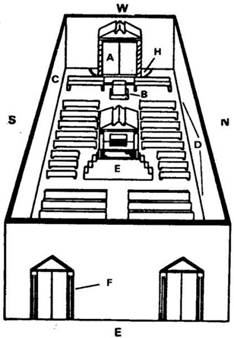 Here
is the layout of the synagogue:
A = Hechal (the Permanent Ark) – storage for the Torah scroll.
B = Small Tebah (Lectern) from where the Chazzan leads the services.
C = Seats for the Officers of the Congregation (most synagogues have the seating either horizontally with some inclination or vertically).
D = Seats for men who sit on the first floor and women in the second floor or atrium.
E = The greater Tebah, or Bimah, (raised platform) on which the Torah is read and the Hakham delivers his Sermon. Here is where we grasp the Tree of Life and read the Torah!
Behind the greater Tebah usually there are seats reserved for the Hakhamim and this seating is also known as the seat of Moshe.
Machpelah (מערת המכפלה), The Entrance to Gan Eden
If the center of the Garden contained the Tree of the Knowledge of Good and Evil, as well as the Tree of Life, then the entrance to Gan Eden is the cave at Machpelah (in Hebron[25] - חֶבְרוֹן), as we can see from the Zohar:
Soncino Zohar, Beresheet, Section 1, Page 57b God also decreed that he should die. Taking pity on him, however, God allowed him when he died to be buried near the Garden of Eden. For Adam had made a cave near the Garden, and had hidden himself there with his wife. He knew it was near the Garden, because he saw a faint ray of light enter it from there, and therefore he desired to be buried in it; and there he was buried, close to the gate of the Garden of Eden.
Soncino Zohar, Beresheet, Section 1, Page 127a R. Judah said: ‘Abraham recognized the cave of Machpelah by a certain mark, and he had long set his mind and heart on it. For he had once entered that cave and seen Adam and Eve buried there. He knew that they were Adam and Eve because he saw the form of a man, and whilst he was gazing a door opened into the Garden of Eden, and he perceived the same form standing near it. Now, whoever looks at the form of Adam cannot escape death. For when a man is about to pass out of the world he catches sight of Adam and at that moment he dies. Abraham, however, did look at him, and saw his form and yet survived. He saw, moreover, a shining light that illumined the cave, and a lamp burning. Abraham then coveted that cave for his burial place, and his mind and heart were set upon it.
The Cave of the Patriarchs, Machpelah (literally the cave of doubling), contains the graves (Hebrew: kever[26]) of four couples (eight people), husbands and wives who connected: Adam and Chava, Avraham and Sarah, Yitzchak and Rivka, Yaaqov and Leah. The term kever (which typically means grave), may also signify uterus or womb. From this we learn that a kever is a portal, or connection, to the higher world. We come through this portal when we are put in the womb and we go through this portal when we are put in the grave. Thus we learn that the kever at Machpelah is a portal to Gan Eden.
It is interesting to note that this was the first place in Israel acquired by Avraham. It represents the beginning of HaShem’s promise to give Avraham, and his descendants, the land of Israel. In the same way, Gan Eden is the ultimate beginning, and we know that “all things go after the beginning”, as it is the most potent moment. All beginning starts from beyond! Our understanding commences only from after that beginning point and onwards. But that first point, the beginning of knowledge itself, is beyond, beyond our understanding, beyond our grasp. That first point is the basis of all understanding; without it we have nothing on which to build knowledge, but it itself cannot be understood. It is hidden. It is something that HaShem gives.
First in Creation, First in Importance[27]
Ta’anit 10a Eretz Yisrael[28] was created first and afterwards the rest of the world, as the passage states (Mishlei 8:26): “Before He made Eretz (land) and Chutzot (outlying areas).”
The term “Eretz” applies to Eretz Israel which was the main purpose of creation and therefore created first. All the other lands are considered secondary in importance as they were in the sequence of creation and are therefore referred to as “Chutzot.”
Even today we refer to the land we love simply as “Eretz”[29] while the rest of the world is “Chutz”[30], outlying areas of secondary importance.
Special Ashlamatah for Shabbat Mevarchim
Ashlamatah: Hoshea (Hosea) 14:6-10 + Yoel (Joel) 1:1-3 + 2:12-13
|
Rashi |
Targum |
|
2. Return, O Israel, to the LORD your GOD, for you have stumbled in your iniquity. |
2. Return, O Israel, to the fear of the LORD your GOD, for you have fallen because of your sin. |
|
3. Take words with yourselves and return to the LORD. Say, "You shall forgive all iniquity and teach us [the] good [way], and let us render [for] bulls [the offering of] our lips. |
3. Bring with you words of confession and return to the worship of the LORD. Say before Him, “It is near for You to forgive iniquities,” then we will be accepted as good. Let the words of our lips be accepted before You with favor like bullocks on Your altar! |
|
4. Assyria shall not save us; we will not ride on horses, nor will we say any longer, our gods, to the work of our hands, for in You, by Whom the orphan is granted mercy." |
4. The kings of Assyria will not save us, We will not put our trust in horsemen, and no more will we say, “Our god” to the works of our hands. For it was from before You that mercy was shown to our forefathers when they were like orphans in Egypt. |
|
5. I will remedy their backsliding; I will love them freely, for My wrath has turned away from them. |
5. I will accept them in their repentance. I will forgive their sins. I will have compassion on them when they freely repent, for My anger has turned away from them. |
|
14:6. I will be like dew to Israel, they shall blossom like a rose, and it shall strike its roots like the Lebanon. |
6. My Memra will be like dew to Israel; they will bloom like the lily, and they will dwell in their fortified land like the tree of Lebanon that puts forth its branches. |
|
7. Its branches shall go forth, and its beauty shall be like the olive tree, and its fragrance like the Lebanon. |
7. Sons and daughters will multiply, and their light will be like the light of the candelabrum, and their fragrance like the fragrance of incense. |
|
8. Those who dwelt in its shade shall return; they shall revive [like] corn and blossom like the vine; its fragrance shall be like the wine of Lebanon. |
8. They will be gathered from among their exiles, they will dwell in the shade of the Anointed One. The dead will be resurrected and goodness will increase in the land. The mention of their goodness will go in and not cease, like the memorial of the blast of the trumpets made over the matured wine when it was poured out in the Sanctuary. |
|
9. Ephraim; What more do I need the images? I will answer him and I will look upon him: I am like a leafy cypress tree; from Me your fruit is found. |
9. The House of Israel will say, “Why should we worship idols anymore?” I, by My Memra will hear the prayer of Israel and have compassion on them. I, by My Memra, will make them like a beautiful cypress tree, because forgiveness for their waywardness is found before Me. |
|
10. Who is wise and will understand these, discerning and will know them; for the ways of the LORD are straight, and the righteous/generous shall walk in them, and the rebellious shall stumble on them. |
10. Who is wise and will consider these things? Who is prudent and will take note of them? For the ways of the LORD are right, and the righteous/generous who walk in them will live in everlasting life through them, bu the wicked (lawless) will be delivered to Gehinnom because they have not walked in them. |
|
Joel 1:1-3 + 2:12-13 |
|
|
1. The word of the LORD, which came to Joel son of Pethuel. |
1. The word of prophecy from the LORD which was with Joel son of Pethuel. |
|
2. Hear this, you elders, and hearken, all you inhabitants of the land. Did this come about in your days or in the days of your forefathers? |
2. Hear this, O elders; listen, all you inhabitants of the land! Has the like of this happened in your days or in the days of your fathers? |
|
3. Tell your children about it, and your children to their children, and their children to another generation. |
3. Tell your children about it, and let your children tell their children, and their children the next generation. |
|
|
|
|
11. And the LORD gave forth His voice before His army, for His camp is great, for he who performs His word is mighty, for the day of the LORD is great and very awesome; who can abide it? |
11. The LORD has raised His Memra before His army, for His army is immense indeed; for those who carry out His Memra are mighty. For great is the day which will come from the LORD, and exceedingly terrible, who can bear it? |
|
12. And even now, says the LORD, return to Me with all your heart, and with fasting and with weeping and with lamentation. |
12. “Even now”, says the LORD, “return to My worship with your whole heart, with fasting, and weeping, and mourning.” |
|
13. And rend your hearts and not your garments, and return to the LORD your GOD, for He is gracious and merciful, slow to anger, and of great kindness, and He repents of the evil. |
13. Remove the wickedness (lawlessness) of your heart, but not with tearing of your garments, and return to the worship of the LORD your GOD, for He is gracious and merciful. He removes anger, and multiplies blessings, and He draws back His Memra from bringing evil. |
Rashi’s Commentary on Hoshea (Hosea) 14:6-10 + Yoel (Joel) 1:1-3 + 2:12-13
14:2 Return, O Israel You, who are in the land of Judah, lest what happens to Samaria happens to you. Therefore, the topics are juxtaposed. This can be compared to a king against whom a province rebelled. The king sent a general and commanded him to destroy it. That general was expert and deliberate. He said to them, “Take for yourselves days (sic); otherwise, I will do to you as I have done to such-and-such a province and to its allies, and to such-and-such a prefecture and to its allies.” Therefore it says, “Samaria shall be accounted guilty,” and then Scripture says: “Return, O Israel.” As is found in Sifrei in the section commencing. (Num. 25:1), “And Israel abode in Shittim.”
to the Lord your God One taught in the name of Rabbi Meir: Return, O Israel, while He is still יהוה, with the Divine Attribute of Mercy; otherwise, He is אֶלֹהֶיךָ with the Divine Attribute of Justice, before the defense becomes the prosecution. [from Pesikta d’Rav Kahana, p. 164a]
for you have stumbled in your iniquity Obstacles have come to you because of your iniquity.
3 You shall forgive all iniquity Heb. כָּל-תִּשָׂא עָוֹן. Forgive all our iniquities.
and teach [us the] good [way] Heb. וְקַח-טוֹב. And teach us the good way. Another explanation: The few good deeds in our hands take in Your hand and judge us accordingly. And so does David say (Psalms 17:2): “Let my sentence come forth from before You, may Your eyes behold the right.” Another explanation: And accept good And accept confession from us, as it is said (Psalms 92:2): “It is good to confess to the Lord.”
and let us render [for] bulls that we should have sacrificed before you, let us render them with the placation of the words of our lips.
4 Assyria shall not save us Say this also before Him, “We no longer seek the aid of man, neither from Assyria nor from Egypt.”
we will not ride on horses This is the aid from Egypt, who would send them horses, as they said to Isaiah (30: 16), “No, but on horses will we flee... And on swift steeds will we ride.”
nor will we say any longer to the work of our hands that they are our gods.
for in You alone shall our hope be, You Who grant mercy to the orphans.
5 I will remedy their backsliding Said the prophet: So has the Holy Spirit said to me. After they say this before Me, I will remedy their backsliding, and I will love them with My charitable spirit. Although they do not deserve the love, I will love them charitably since My wrath has turned away from them.
6 and it shall strike I.e. the dew shall strike its roots and cause them to prosper.
like the Lebanon like the roots of the trees of the Lebanon, which are large.
7 Its branches shall go forth Sons and daughters shall increase.
and it shall be Their beauty shall be like the beauty of the menorah of the Temple, and their fragrance like the fragrance of the incense.
like the Lebanon Like the Temple.
8 Those who dwelt in its shade shall return Those who already dwelt in the shade of the Lebanon, to which He compared Israel and the Temple, and now were exiled there from, shall return to it.
its fragrance shall be like the wine of Lebanon Jonathan renders: Like the remembrance of the blasts of the trumpets over the old wine poured for libations in the Temple. For they would blow the trumpets over the libations when the Levites would recite the song.
9 Ephraim will say, “What more do I need to follow the images?” And they will turn away from idolatry.
I will answer him I will answer him from his trouble.
and I will look upon him I will look upon his affliction.
I am like a leafy cypress tree I will bend down for him to hold his hand on Me as the leafy cypress which is bent down to the ground, which a man holds by its branches; i.e., I will be accessible to him.
from Me your fruit is found Am I not He? For all your good emanates from Me.
10 Who is wise and will understand these Who among you is wise and will ponder to put his heart to all these and return to Me?
and the rebellious shall stumble on them i.e., because of them, because they did not walk in them. Jonathan renders in this manner.
Joel Chapter 1
1 to Joel son of Pethuel -The son of Samuel the prophet who persuaded God with his prayer (פִתָּה לְאֵל). Some say that this prophecy was said in those seven years in which Elisha said: “For the Lord has decreed a famine etc.” and they took place during the days of Jehoram son of Ahab.
2 Did this come about -I.e., what is mentioned below.
Chapter 2
13 and not your garments -for I do not pay heed to the rending of your garments. Another explanation: Rend your hearts and you will not need to rend your garments because of mourning.
and He repents of the evil -I.e., He turns to another thought.
Commentary and Ashlamatah of (הוֹשֵׁעַ) Hosea 14:6-10, (יוֹאֵל) Joel 1:1-3, 2:12-13
By: H.Ex. Adon Shlomoh Ben Abraham
The last chapter of Hosea is a fascinating combination of language about Israel's repentance and the desire of God to “heal” (Hos 14:4-8) wayward Israel. In (14:2-4), Israel is admonished to repent and return to HaShem (v.5-6), and it is HaShem who says He will take them back in love and heal their afflictions. Hosea begins (1:9) with God declaring that the Israelites [Lo-ammi] are not His people, and things have changed completely by this last chapter. The last verse of Hosea 14:10 tells us, “Those who are wise understand these things and those who are discerning know them. For the ways of the LORD are right and the upright walk in them, but transgressors stumble in them.”
Note the comparison of God's renewing blessings to natural phenomena such as “dew.” Revived Israel is compared to a beautiful lily, deep-rooted like the cedars of Lebanon, and like the beautiful olive tree, and a fruitful vine. HaShem Himself will be like a green cypress tree that provides protective shade. The long-range weather forecast for Israel shows a dry weather pattern presently. The Israel Meteorological Service’s multi‑model climate projection shows a clear drying trend: 10 out of 14 climate models (71%) predict below‑average rainfall for 2025–2028. The greatest rainfall deficits are expected in Mount Hermon, Golan Heights, and the Upper Galilee. However, in the long-range forecast, we see “Israel shall blossom like the lily” (v.6), “his beauty shall be like the olive tree’s” (v.7), “he shall bring to life new grain, and shall blossom like the vine” (v.8). In a literal sense, Israel must have an increase in water for the above to transpire. In a spiritual sense, what if Israel's climate remained dry, but spiritually Israel began to blossom as a well-watered vine? What would the nations do if Israel began to excel and be blessed to the extent that it was unexplainable? If everything Israel placed its hand on, it turned to gold. Using a sports metaphor, what if every time Israel came to the batter's plate, they knocked it out of the arena, with every batter, every time making a home run and scoring a point. The nations would take notice, and many would become jealous and act out in a negative manner. Some scholars have understood (v.6) as speaking of the Messiah, and his roots spreading out into the world; this brings an abundance of blessings and “dew” to Israel, and what if the present-day debate of winning the Ai race was given to Israel? And what if, hands down, Israel excels miles ahead of all the other nations?
The doctrine of retributive justice is here “transcended by Hosea’s conception of God’s holiness as redemptive love,” [31] and for Abraham Heschel, a Jewish theologian, the “divine pathos” so powerfully communicated in Hosea 11 teaches that not only is HaShem a God who demands justice, but “He is also a God who is in love with His people.”[32] The first two lines of verse (v.8) may be rendered, “They who dwell in his shadow shall again make grain to live.” The antecedent of “his” is the tree (representing Israel nationally), and the antecedent of “they” is individual Israelites. A promise that the people of Israel in the future will flourish and blossom like a vine, with their fame (ziḵrô, “his remembrance”) spreading abroad like the fame of Lebanese wine.[33]
Our torah reading tells us that Isaac’s blessing— “dew of heaven, fatness of the earth, plenty of grain and wine”—is classic covenant abundance. The Ashlamatah reading gives us Hosea’s image of Israel as a flourishing tree, with shade and fruit, and Rashi and Radak read it as restored Israel whose prosperity comes from God alone. And the prophet Joel informs us that the locust devastation presupposes a once‑fertile land now under judgment, awaiting renewal after teshuvah. And the central message is that “I will heal their affliction; generously will I take them back in love.” (v.5) If God heals Israel, his action, what is their action and part to do?
Israel must return to God, and in their returning, ‘he will heal their apostasy, and then I will love them freely’ (v.4). In this returning, ‘they shall dwell beneath my shadow, and they shall flourish like the grain’ (v. 7). Imagine planting a garden, and at a short distance away from it, it looks beautiful and healthy. Every plant was thriving and looked loaded with food. Yet upon closer inspection, there were no fruits and vegetables, only beautiful plants. Two forms of produce are mentioned: grain and the fruit of the vine. But then not only will Israel have an abundance of grain, but they shall blossom like a vine loaded with fruit. Israel shall also have a fragrance or fame that will be as the wine of Lebanon. When Israel repents and returns to HaShem and returns to the land, then ‘I [HaShem] will heal their apostasy; I will love them freely’ and be able to shower generous blessing upon his child, whom he loves. (v.4, Hosea 11:1) Do we currently see this being worked out in Israel today, all around the world?
A thematic link with our torah portion is that Jacob is sent away from home, yet under blessing and the “blessing of Abraham”—a journey under promise. Israel, the children of Jacob, seem to be living a life mirroring the life of their father. Jacob receives the blessing of land, fertility, and dominion (27:28–29). Esau is displaced; Jacob is sent to Paddan‑Aram to find a wife and continue the chosen line (28:1–5). Paddan-Aram is Abraham's family's place of origin. At the end of our story, eschatologically, it seems to be the place where Abraham's family is located and from where they return to the land, just as Jacob had done. Abraham, Isaac, and Jacob all take a wife from this area of Paddan-Aram, and when they leave to [return] to the land of promise, they take much wealth and possessions with them, which they had acquired. We can see this very thing being played out in our world today as Israel, the mirror of Jacob, returns to the land.
Hosea and Joel assume that a people who have strayed must be led back into God’s ways through a prophetic call and repentance. Esau sees the blessing his brother received, and he “harbored a grudge against Jacob because of the blessing his father had given him” (27:41). Genesis 28:6–9 stresses that Jacob must not marry Canaanite women; the covenant line is set apart, and we are told Esau goes out and, to spite his father, takes a wife of the daughters of Ishmael. (28:8) This torah portion is the blueprint for world history: Jacob goes and takes a wife from his father's family, and Esau, the other half, the twin brother of Jacob, takes a wife from the Canaanites.
We are witnessing this play out: Jacob takes a wife who is not of the Canaanites while on his journey away from home, and Esau deliberately takes a daughter of Ishmael, the Canaanite. We see a mirror of this in our day: Jacob is gathering his non-Canaanite wife and returning home, and Esau is taking a Canaanite wife and merging two different families together. Hosea’s says there must be a renunciation of idols, and Joel’s “return to Me with all your heart” (2:12) insists on exclusive loyalty to God—Israel’s election is being lived out. Current-day reports from the land of Israel speak of a return, a religious awakening with the younger generations of Israelites. What is on the eschatological horizon? Hosea 14 and Joel 2 are classic Jewish texts for a repentant Israel, an Israel healed of her afflictions, and a fruitful Israel in the end of days. Hosea and Joel tell us that because of your sin and iniquity, you are rejected and shunned, and the locust and the destroying enemy overtake you, but in your repentance and return, the blessing of HaShem is extended to Israel and the wrath and devouring destruction from the Almighty is turned against the wicked and unrighteous people of the world.
It is in Paddan-Aram that most of Jacob’s sons are born (Gen 29:31–30:24, Gen 35:26; 46:15)
What is this place the sons of Abraham all took their wives from? Is it a literal place or a special place where the women are better than anywhere else? Scholars generally see it as an alternate name for ARAM-NAHARAIM, a substantial region of upper Mesopotamia located around the great bend of the Euphrates River. On the other hand, some have argued that Paddan-Aram was an Aramaic rendering of the city name, nothing else.[34] Yes, it was a literal place within the geography of the world. Could it also represent a place of spiritual geography, a field from which these brides were chosen? And let us not forget that these brides were not kidnapped and hauled away in the night; each one chose to go with their respective grooms.
Those who argue that the name designates a large geographical area generally translate it as “field,” thus making Paddan-Aram mean “Field of Aram.” This has been based largely on two arguments (referred to in Rashi’s commentary on Gen 25:20): (1) the noun paddān has a cognate in Arabic which means “field,” and thus Aramaic may also have had a similar meaning for the word; and (2) Hosea 12:13 (Eng. 12:12) refers to this area as śĕdēh ʾărām, “Field of Aram,” in a reference to Jacob’s sojourn there, and this is deemed to be a Hebrew translation of paddan-ʾărām.[35] Ibn Ezra on Genesis 25:20 says, in agreement with Rashi, that Paddan means a field in Hebrew, and it has the same meaning in Arabic. According to the field of Aram, as it is said, "And Yaakov fled to the field of Aram" (Hoshea 12:13), and for a wife he had to guard sheep.
Midrashic commentary often uses the “field” to represent the world or the people’s inner life. For example, the Midrash Rabbah on (Deut. 32:32) teaches that just as a field must be plowed and cared for, so too must the heart be cultivated through Torah and mitzvot. This aligns with the rabbinic ideal that the “field” is a metaphor for the soul’s potential, which must be prepared through ethical and spiritual work.[36] This Midrash interprets the “fields of Gomorrah” as a symbol of land that, although fertile, is corrupted by sin and moral failure. (32:32) The Talmudic tradition emphasizes that the land’s productivity is tied to the righteousness of its inhabitants, echoing the biblical principle in (Lev. 26:3–5) and (Deut.11:13–17) that the land responds to the spiritual condition of its people. This is understood as a covenantal ideal: the “field” is a metaphor for the community’s moral and spiritual state. This ideal, I believe, is in the theology and thinking of the prophet Hosea. In (2 Kings 23:4), King Josiah burns idolatrous objects in the “fields of Kidron.” This is seen as an act of national repentance, where the land itself must be cleansed of sin before it can yield its acceptable fruit. In this instance, the “field” is idealized as a place of cleansing and renewal, not just for agricultural land.
In rabbinic thought, the “field” in the Hebrew Bible is not merely physical land but a symbol of covenantal relationship, moral responsibility, and spiritual potential. It is idealized as a place that must be cultivated through righteousness, purified through repentance, and nurtured and increased through Torah learning and the performance of mitzvot. I believe this ideal helps us understand how those of the nation’s respond who come in contact with Israel or one from Israel. Some are drawn to Israel; others act against their own best interests in how they respond to Israel. Rebekah is the perfect example: raised in the right family, raised by a wicked man and the sister of wickedness, yet she did not learn from their deeds.[37] Rahab was not raised in the right family; she lived in a wicked environment, but she chose to attach herself to Israel and become part of this family of Israel. (Josh.2) – Go figure!
Hosea ends his book telling us, “The ways of HaShem are upright and the righteous walk in them.” They prosper because their souls are healthy, but the souls of the wicked are sick, and so “they stumble in them.” The way of HaShem is upright; both people are responsible: the righteous walk therein and the unrighteous stumble. “Compare the teaching of the Talmud; If one has merit, the Torah becomes for him an elixir of life. But if he lacks merit, it becomes for him a deadly poison.” [38] Both the upright[39] and the transgressors[40] walk in the ways of the Lord, yet the outcome is different for each. (14:9-10) The journey of life's path, or the Derek of the LORD, is right (Yasar).[41] We learn from this that humanity has been given a way, a Derek, a path to walk and journey in, which we travel in this life, and we must obey the rules if we want to receive the blessing HaShem has in store for those who love and fear him.
In the Torah (Gen.27), Jacob receives a blessing of land, fertility, and dominion. Midrash places Jacob as king, with the nations serving him and the brothers bowing before him. Esau was given his place, displaced from the land and separated from his brother Jacob. Jacob goes to Paddan-Aram to find a wife, and there continues the chosen line. (Gen.28:1-5) Esau, out of stubbornness and rebellion against his father, takes a Canaanite wife, which highlights the need for these two brothers to be separate to protect the purity of the covenant given to Abraham's descendants through Jacob. We can safely state it's all pointing to the eschatological horizon coming into view, and we are on track to arrive in the near future.
The prophetic core of this reading in Hosea 14 informs of Israel returning to the land and to its God. Israel is healed of her affliction and becomes a flourishing tree. All idolatry is renounced, and God is recognized as the sole source of its fruit and all blessings. Joel chapter one emphasizes that the unprecedented devastation must be remembered across generations, lest the same mistakes are repeated. Joel chapter 2 says that with this remembering there must be heartfelt teshuvah (repentance/return) with “the rending of your hearts, not your garments,” and HaShem is shown to be gracious and compassionate, slow to anger, which echoes the thirteen attributes of (Exo.34:6-7).[42]
Our reading shows the seed of the chosen line- through Jacob, chosen and set apart. The fruit of that line in history is the nation of Israel, which has been called back to the land and restored and made fruitful. What begins in Isaac’s tent with Jacob ends in Israel's national story being played out for all the world to see. Israel's full blessings will be realized when Israel returns to God with their whole heart. Teshuvah is said to be the gateway to geulah,[43] and the messianic kingdom revealed in this world is the state or point in time when Jacob’s blessing meets Israel’s repentance. This meeting is what dominates the theme of the prophets. A repentant, healed, restored Israel fruitfully living in their land. An Israel living under God’s shepherd-like rule. The verbal links of dew, fruit, paths, and land carry this message and move us closer to our near-future and ultimate destination horizon.
The blessing of Jacob is larger than Jacob's life; it foresees a future in which his descendants hold a central, honored, and leading place among the nations- this new messianic order. This messianic kingdom is morally and spiritually distinct from the nations, just as Jacob was called to be a morally separate and distinct people, and here Israel's heart and mission align and bring to completion their mission of teaching the nations. The tree of Israel is Israel's collective soul, with its roots reaching deep in its union with the divine nature and its “tender shoots” (14:6-7) reaching out to the nations. Those who dwell under Israel’s shade will return and “will flourish like grain and blossom like a vine.” (14:7-8)
Prophecy is rooted in concrete history and lineage and literally plays out on the world's stage. Israel's return brings blessings to others, those who chose to live in the shade of Israel's tree. Ephraim rejects her idols and returns to her God. In this test of history- those who read God's dealings rightly will align with his ways, and those who embrace God’s ways and his people Israel will share in his restored Kingdom. (14:9-10) The prophet Joel tells us nothing like this has happened in your day or in your fathers' day; this will be a unique, history-shaping event, “the day of the LORD.” This retelling of the story from generation to generation is a hint of a generational process. This pattern of judgment and mercy in the history of torah and the people of Israel is teaching us and building a spiritual memory that binds generations into one collective soul before God. (1:1-3)
Whoever is wise, let him understand these things and consider them; whoever is discerning and prudent, let him take note, let him know them; for the ways and paths of the Lord are right and smooth, and the upright and righteous walk in them, but transgressors and sinners stumble in them. (14:10) In Joel (2:12-13): “Return to me with all your heart, with fasting, weeping and mourning.” The heart's turning is an inner revolution, and the fasting and weeping are outward signs of a hidden reorientation. God wants our inner transformation. (Exo.34:6-7)
Verbal Tallies
H.H. Ezra ben Abraham/SI
Bereshit (Genesis) 28:28-28:9
Tehillim (Psalms) 23:1-6
Ashlamatah: Hos 14:6-10 + Joel 1:1-3+2:12-13
The structural blueprint traces a specific liturgical and exegetical framework aligned with the historical Triennial Torah Reading Cycle [1]. This specific sequence shifts from the previous section to focus on Bereshit (Genesis) 27:28–28:9, the profound transition where Isaac passes the physical and spiritual Abrahamic blessings to Jacob before sending him out to Padan-aram.
The verbal tallies (gezerah shavah) and overriding thematic arcs bind this Torah reading, Tehillim (Psalms) 23:1–6, and the prophetic Ashlamatah (Hosea 14:6–10 + Joel 1:1–3, 2:12–13) into a unified theological progression of dew, divine nourishment, and structural restoration.
1. Verbal Tallies (Gezerah Shavah / Catchword Connections)
The ancient triennial layout relies heavily on matching linguistic hooks across the Law, the Psalms, and the Prophets to tie the Shabbat service together:
- The Dew of Heaven (טַל הַשָּׁמַיִם - Tal HaShamayim):
- In Bereshit 27:28, Isaac begins his climatic blessing to Jacob with: "May God give you of the dew of heaven (mi-tal ha-shamayim) and of the fatness of the earth."
- In Hosea 14:6, God answers this primal blessing with a structural fulfillment: "I will be like the dew (tal) to Israel; he shall blossom like the lily."
- Abundance of Grain and Wine (דָּגָן וְתִירֹשׁ - Dagan v'Tirosh):
- In Bereshit 27:28, Isaac promises an abundance of "corn/grain (dagan) and wine (tirosh)."
- In Hosea 14:8, the restored remnant "shall revive as the corn (dagan) and blossom as the vine (gefen)."
- In Joel 1:10, the tragedy of exile is marked by the reversal of this exact blessing: "The field is wasted... the corn (dagan) is wasted; the new wine (tirosh) is dried up."
- The Fatness and the Table (מִשְׁמַנֵּי - Mishmanei / שֶׁמֶן - Shemen):
- In Bereshit 27:28, the physical blessing guarantees the "fatness (mishmannim) of the earth."
- In Tehillim 23:5, David honors this precise divine catering: "You prepare a table before me... you anoint my head with oil (shemen); my cup runs over."
- The Generational Command (בָּנִים - Banim):
- In Bereshit 28:1, Isaac calls Jacob, blesses him, and commands him (vaytzavehu): "You shall not take a wife of the daughters of Canaan."
- In Joel 1:3, the community is ordered to transmit the memory of God's sovereign hand across generations: "Tell your children (vneichem) of it, and let your children tell their children..."
2. Thematic Deep Dive
|
Seder Layer |
Primary Text |
Core Theological Focus |
|
Torah Seder |
Bereshit 27:28–28:9 |
The material and spiritual transmission of the Abrahamic legacy, highlighting the dew of heaven, planetary dominion, and keeping the family lineage pure. |
|
Tehillim |
Psalms 23:1–6 |
The absolute trust in the Divine Provider who ensures that even in times of transition or danger, "goodness and mercy" track the believer. |
|
Ashlamatah |
Hosea 14:6–10 + Joel 1:1–3, 2:12–13 |
The movement from national devastation (withered grain/wine via locusts) to holistic revival through intense repentance (Teshuvah) and divine watering. |
A. The Cosmic Dew and Sovereign Sustenance
The overarching theme centers on how divine favor manifests as ecological and spatial abundance. Isaac’s blessing is not merely a wish for good weather; it is a cosmic decree linking structural righteousness to the fertility of the earth. When David writes in Psalms 23 that the Lord "makes me lie down in green pastures," he is personalizing the realization of Isaac's blessing of "fatness of the earth." The Shepherd's table is a direct material extension of the covenantal fatness passed from Abraham to Isaac, and finally down to Jacob.
B. The Broken Harvest and the Path of Return
The Ashlamatah provides the necessary prophetic tension. In Joel 1, the ideal state of Isaac's blessing is entirely shattered. The locust swarm strips the fields, drying up the dagan (grain) and tirosh (wine)—leaving the ministers of the altar mourning because the material tokens of God's favor have vanished due to spiritual decay.
The remedy offered in Joel 2:13 ("Rend your heart, and not your garments") establishes that physical abundance requires internal alignment. When this deep internal turning happens, Hosea 14 illustrates an explosive botanical resurrection. Israel is no longer a dry root; watered by God's personal tal (dew), they bloom with the fragrance of Lebanon.
3. Synthesis: The Triennial Architecture
This liturgical suite masterfully navigates the movement from Inheritance to Trial, and ultimately to Full Restoration. Jacob receives a monumental blessing but must immediately flee his home due to Esau's fury. Psalms 23 functions as Jacob's companion on the road, affirming that even when wandering through the valley of deep shadows or facing adversarial threats, the table remains set.
The Prophets finalize this architectural loop by reminding the diaspora that even if the land's blessings are temporarily choked out by historic disasters, a return to the source of the Covenant reactivates the dew of Isaac and guarantees a permanent dwelling place in the House of the Lord.
Nazarean Talmud
Sidra Of Bereshit (Genesis) 27:1 – 27
“Vayiten L’kha” “And give you”
By: H. Em. Rabbi Dr. Eliyahu
Hakham Tsefet’s School of Peshat
(Mark 3:11-12)
¶ And the spirits (shedim) of uncleanness, when they saw him, would fall down before him, giving him[44] honor, saying — “You are a Ben Elohim (a Son of GOD = a Torah Judge)”; but he charged them not to make his identity (as Messiah) known.
Hakham Shaul’s School of Tosefta
¶ And everyone in the congregation was trying to touch him (Yeshua), because healing virtue came from him and he healed everyone.
Commentary to Hakham Tsefet’s School of Peshat
A Son of G-d
It should be evident now to our readers that Yeshua was first of all “Jewish.”[45] Secondly, as Messiah, his title is the “King of Yisrael.” Thus, we note that EVERY King of Yisrael was titled the (a) “Son of G-d.” Furthermore, we must remember that Kings were often anointed as an act of consecration to their position as “King of Yisrael. Therefore, the King, like the Kohanim, was seen as a Messianic figure. Consequently, Yeshua does not have to be Deity in order to be Messiah and King of Yisrael. Another key point that we must assert here is that we do NOT accept shedim as any type of authority on any subject matter. In other words, just because a shadé says something does not mean that he has admitted the truth. WE do not believe that the shedim were wrong in this particular account. Our point is that the shedim are not a source of authority on any subject. This bears a great deal of commentary, but we will abbreviate our thoughts here.
1 Pe. 1:12 It was not revealed to them, but to us, they for whom they ministered the things, which are now reported to you by those who have handed down the Mesorah to you in the Ruach HaKodesh, breathings of the Oral Torah sent from the Heavens; which things the holy messengers (angels) desired to understand.
Angels – the heavenly messengers are entrusted with a mission and a message. That is the sum of their duties per se. Therefore, the shedim are no different. They may well see the spiritual dimension from a different perspective, but we cannot take their words to be “theologically” sound.
He charged them not to make his identity (as Messiah) known - The Messianic Secret
The above passage deals with the “messianic secret.”[46] Scholars have tried to make heads or tails of the enigma for ages. They are no closer to understanding this great “secret” today than they were yesterday. Why is it that they are unable to discern simple Peshat? They call it a mystery or an enigma. These are not the words of Peshat. As we have learned, they “see men as trees.” When you label a Peshat pericope with the title “Mystery,” you have already lost the battle of interpretation. This is tantamount to reading the “Revelation” in Peshat. Furthermore, if it was such a great “secret,” why do we know about it? Yes, we perfectly understand that Yeshua expelled shedim (demons/spirits) from those who were miraculously healed, and even his talmidim were warned not to tell the “secret.” In every case where Yeshua commands someone not to tell the secret, they have come in close personal contact with the Master and are perfectly aware of his spiritual identity. Whenever the Master’s identity as Messiah, “G-d’s Anointed King,” is revealed, he silences the revelation.
Scholars erroneously believe that Yeshua told them to be silent as reverse psychology. We cannot accept the thought that the Master would need to stoop to such aberrant means. If we resort to making the Master play mind games with his talmidim and others, we have berated him. Furthermore, we would fall into the trap of not being able to discern his words and true intent.
Firstly, the Master was not a petty pseudo-prophet who needed to resort to these devious methods. His commands are sincere. Do not tell anyone in Peshat terms means, “do not tell anyone,” not the reverse. As a true Tsaddiq – Hakham, his true piety was in his study of the Torah and the traditions passed down by his ancestors. As “Ben HaElohim” (Son of the Judges), his life and mission were the “Sum of the Judges.” In other words, Yeshua could only be what the Sages of blessed memory made of him. His personification of the Torah, specifically the Oral Torah, governed every moment of his life. When Hakham Tsefet records that he arose a great while before day[47] to seclude himself in prayer, it was because the Hakhamim ordered him (and all our Jewish brethren) to recite the Shema early in the morning.
Mk 1:35-37And early in the morning, long before daylight[48] he (Yeshua) got up[49] and went out to an isolated place and prayed there. And Shim’on (Hakham Tsefet) and those (talmidim) who were with him (Hakham Tsefet) followed[50] him (Yeshua). And having discovered[51] from him [the true halakhic practice concerning the recital morning Shema and Amidah], they said to him, “everyone is searching[52] for you.”
m. Ber 1:2 From what time do they recite the Shema in the morning? From the hour that one can distinguish between [the colors] blue and white. R. Eliezer says, “Between blue and green.” And one must complete it before sunrise. R. Joshua says, “Before the third hour. “For it is the practice of royalty to rise [at] the third hour. [Thus we deem the third hour still to be ‘morning.’]” One who recites later than this [i.e., the third hour] has not transgressed [by reciting a blessing at the wrong time, for he is viewed simply] as one who recites from the Torah.[53]
b. Ber 2b It has been taught on Tannaite authority along these same lines: The old-timers would complete the recitation of Shema exactly at dawn so as to place the prayer for redemption[54] [with which the Shema closes] right next to the Prayer [of supplication], and one will turn out to say the Prayer in daylight.”[55]
Consequently, we can see that the Master was the sum of the Hakhamim. To qualify as “Messiah” he must be a walking Torah Scroll. Hakham Tsefet reveals the true crux of the dilemma in saying “everyone is searching[56] for you.” The question is then raised, what or who were they looking for? It was not a man that they were looking for. They were looking for the quintessential expression of the Torah. What does the talmid of the Master want to know the most? What we desire the most is how to fulfill the expectations of G-d as expressed in the Torah. How do we learn to be a living expression of the Torah? By following a Hakham who is a living Torah.
We have been reading in the Torah Seder repetitive accounts of the Mishkan’s (Tabernacle) construction. Why does the Torah devote some 50 chapters to tell us about the construction and operation of the Mishkan? T
he Mishkanis a detailed description of:
1. Communion with G-d
2. Abodah – worship and service
3. Halakhah – how we are to walk
While we will offer only a partial list of what it means to be in “service” (abodah) to HaShem we will note that these aspects speak of a greater whole.
1. Berakhot
2. Birkat Ha-Mazon (Bendigamos)
3. K’riat Shema
We have selected these specific items because they represent an organic whole, furthermore they are the beginning point for service as described in the Mishnah. Our fascination is with the K’riat Shema. This because the recital of the Shema is not the simple recital of a few verses of the Torah associated with D’barim (Deut) 6:4. The Shema as an organic whole stands for commitment to the whole of the Torah, Oral and Written and subjection to the Malkuth HaShamayim.[57] Therefore, “K’riat Shema” represents complete commitment to talmud Torah (Torah Study). As an act of worship, K’riat Shema stands for prayer. Therefore, the Shema represents a life that is devoted to talmud Torah and Prayer. Through K’riat Shema and talmud Torah we rectify the damage we have committed against the earth.
Arriving at the conclusion that Yeshua is the Messiah is not a great revelation. Those who Yeshua silenced were those who either saw him as a Messianic King, who would overthrow the Roman regime, put an end to the angelic rage and rebellion or be the quintessential Torah Scholar that would bring Y’mot HaMashiach, (the days of Messiah). Interestingly Yeshua was none of the above. He was a Hakham, a living Torah. His Mesorah/message was to emulate his life of Mesorah observance. Through this lifestyle, the world would find healing that would indeed produce the Messianic Age. Yeshua demonstrates a powerful truth. The truth that the Messianic figure we have conjured will not be a “Messiah” to usher in the “Days of Messiah” as we would expect is daunting. While we have oversimplified the whole idea, the title of Rabbi Levine’s books says it all: “There is no Messiah, and you’re it.” We are not promoting his work; we are simply stating a powerful truth. Each of us has a seed of Messiah. If we have to cry Messiah with every breath, again we have missed the point. What we need to learn from this thought is that collectively we are Messiah.
So what lesson do we learn from Yeshua silencing those who seem to know who he is? The wrong Messianic picture needs to be hushed. If this wrong message is not terminated, we will be left with a “false Messiah.”
Blessing After Torah Study
Barúch Atáh Adonai, Elohénu Meléch HaOlám,
Ashér Natán Lánu Torát Emét, V'Chayéi Olám Natá B'Tochénu.
Barúch Atáh Adonái, Notén HaToráh. Amen!
Blessed is Ha-Shem our GOD, King of the universe,
Who has given us a teaching of truth, implanting within us eternal life.
Blessed is Ha-Shem, Giver of the Torah. Amen!
“Now unto Him who is able to preserve you faultless, and spotless, and to establish you without a blemish,
before His majesty, with joy, [namely,] the only one GOD, our Deliverer, by means of Yeshua the Messiah our Master, be praise, and dominion, and honor, and majesty, both now and in all ages. Amen!”
Some Questions to Ponder:
1. From all the readings for this week, which particular verse or passage caught your attention and fired your heart and imagination?
2. In your opinion, and taking into consideration all of the above readings for this Sabbath, what is the prophetic message (the idea that encapsulates all the Scripture passages read) for this week
Next Shabbat: “VaYetse Ya’aqob” “And left Jacob”
|
Shabbat |
Torah Reading: |
Weekday Torah Reading: |
|
וַיֵּצֵא יַעֲקֹב |
|
Saturday Afternoon |
|
“VaYetse Ya’aqob” |
Reader 1 – Bereshit 28:10-15 |
Reader 1 – Bereshit 29:31-33 |
|
“And left Jacob” |
Reader 2 – Bereshit 28:16-22 |
Reader 2 – Bereshit 29:34-30:1 |
|
“Y salió Jacob” |
Reader 3 – Bereshit 29:1-3 |
Reader 3 – Bereshit 30:2-5 |
|
Bereshit (Genesis) 28:10 – 29:30 |
Reader 4 – Bereshit 29:4-9 |
|
|
Ashlamata Hoshea (Hosea) 12:13 – 13:5 + 14:9-10 |
Reader 5 – Bereshit 29:10-12 |
Monday and Thursday Mornings |
|
Reader 6 – Bereshit 29:13-17 |
Reader 1 – Bereshit 29:31-33 |
|
|
Tehillim (Psalms) 24:1-10 |
Reader 7 – Bereshit 29:18-30 |
Reader 2 – Bereshit 29:34-30:1 |
|
N.C.: Mk 3:13-19a, Lk 6:12-16 |
Maftir – Bereshit 29:27-30 |
Reader 3 – Bereshit 30:2-5 |
Contents of the Torah Seder
· Jacob’s Dream – Genesis 28:10-22
· Jacob & Laban – Genesis 29:1-30
Reading Assignment:
|
The Torah Anthology: Yalkut Me’Am Lo’Ez By: Rabbi Yaaqov Culi, Translated by: Rabbi Aryeh Kaplan Published by: Moznaim Publishing Corp. (New York, 1990) Vol. 3a – “The Twelve Tribes,” pp. 3-62 |
Ramban: Genesis Commentary on the Torah
Translated and Annotated by Rabbi Dr. Charles Chavel Published by Shilo Publishing House, Inc. (New York, 1971) pp. 349 - 365 |

Rabbi Dr. Hillel ben David
Rabbi Dr. Eliyahu ben Abraham
Edited by His Honor Paqid Adon Ezra ben Abraham
A special thank you to HH Giberet Giborah bat Sarah and Giberet Sarai bat Sarah for their diligence in proof-reading