
Remember and Do Not Forget
By Rabbi Dr. Hillel ben David (Greg Killian)
Remember and Do Not Forget
By Rabbi Dr. Hillel ben David (Greg Killian)
The Meaning of the name “Amalek”
King è War against Amalek è Temple
Rabbi Akiva Tatz’s Perspective

In this study I would like to look at Amalek[1] and the reasons why we are commanded to blot out his name. I also want to examine the messianic implications of this command.
On the Shabbat before Purim, two Torah scrolls are taken from the ark; one for the regular Parasha and one for the Maftir. The Maftir commands us to ‘Remember what Amalek (עמלק) did to you’.[2] Because of this reading, it is called, Shabbat Zachor (Remember). The Haftarah also deals with Amalek.
Shabbat Zachor’s proximity to Purim demands that there be a connection between the two, and the detailing of that connection is one of the purposes of this paper.
On Shabbat Zachor we perform the mitzvot (commands) to remember and not forget what Amalek did. The imperative to remember the deeds of Amalek was given permanence by Moshe at the command of HaShem:
Shemot (Exodus) 17:14 HaShem said to Moshe, “Write this as a remembrance in the Book and recite it in the ears of Yehoshua, that I shall surely erase the memory of Amalek from under the heavens.
Whenever something is “written in a book”, it is done so with the idea that the issue needs to be remembered.
The readings, relative to Amalek, for Shabbat Zachor are:
Annual Torah:
Debarim (Deuteronomy) 25:17-19
Triennial Torah:
Debarim (Deuteronomy) 24:19 25:19
Haftarah:
Shmuel alef (1 Samuel) 15:1-34
Rambam in his Sefer HaMitzvot tells us that there are three specific mitzvot related to Amalek:
1. Positive mitzva number 188: “The extinction of the seed of Amalek”:
Debarim (Deuteronomy) 25:19 Therefore it shall be, when HaShem thy God hath given thee rest from all thine enemies round about, in the land which HaShem thy God giveth thee [for] an inheritance to possess it, [that] thou shalt blot out the remembrance of Amalek from under heaven; thou shalt not forget [it].
2. Positive mitzva number 189: “Remembering the nefarious deeds of Amalek”:
Debarim (Deuteronomy) 25:17 Remember what Amalek did unto thee by the way, when ye were come forth out of Egypt;
3. Negative mitzva number 59: “Not forgetting what Amalek did to us”:
Debarim (Deuteronomy) 25:19 Therefore it shall be, when HaShem thy God hath given thee rest from all thine enemies round about, in the land which HaShem thy God giveth thee [for] an inheritance to possess it, [that] thou shalt blot out the remembrance of Amalek from under heaven; thou shalt not forget [it].
(The Rambam also discusses the above mitzvot in Sefer HaChinuch mitzvah 603, 604, 608.)
Rashi’s Commentary on Tehillim (Psalm) 119:152 From before, I knew from Your testimonies Before the thing came about, I knew it from Your testimonies. Before they inherited the land, You commanded them about the first fruits, heave offerings, and tithes, and before You gave them rest from their enemies, You commanded them (Deut. 25:19): “And it will be, when the Lord Your God gives you rest, etc.” to appoint a king, to annihilate Amalek, and to build the Temple.
Since we have three mitzvot relative to the destruction of Amalek, it is important that we have a good understanding of our opponent and of his nefarious deeds. Armed with this knowledge we will be positioned to fulfill these mitzvot at the appropriate times.
Once a year on the Shabbat before Purim, we have the only Torah reading in which everyone is obligated to hear:[3]
Debarim (Deuteronomy) 25:17-19 Remember what Amalek did unto thee by the way, when ye were come forth out of Egypt; How he encountered you by the way, and smote the hindmost of thee, [even] all [that were] feeble behind thee, when thou [wast] faint and weary; and he feared not God. Therefore it shall be, when HaShem thy God hath given thee rest from all thine enemies round about, in the land which HaShem thy God giveth thee [for] an inheritance to possess it, [that] thou shalt blot out the remembrance of Amalek from under heaven; thou shalt not forget [it].
On Shabbat Zachor we can perform two mitzvot: We “Remember the nefarious deeds of Amalek” and we “do not forget what Amalek did to us”.
The Torah shows us that עמלק, Amalek, is intimately associated with evil in this world. We will see that Amalek really does represent evil. When Amalek is eliminated, so too is evil.
Amalek, and therefore evil, will be with us until Mashiach finally destroys it. Our Sages teach us that “In every generation Amalek rises to destroy us, and each time he clothes himself in a different nation”.[4]
The ways of Amalek, in every generation, are always the same and they provide the clue that we are fighting Amalek. The Midrash provides an intriguing insight into the methodology of Amalek, which helps us to understand the mitzvot to remember and not forget. The Hebrew word Karcha, encountered you, also translates cooled you off. Thus, the Midrash says:
Midrash Tanchuma What is the incident (of Amalek) comparable to? To a boiling tub of water which no creature was able to enter. Along came one evil-doer and jumped into it. Although he was burned, he cooled it for the others. So, too, when Israel came out of Egypt, and HaShem rent the sea before them and drowned the Egyptians within it, the fear of them fell upon all the nations. But when Amalek came and challenged them, although he received his due from them, he cooled the awe of them for the nations of the world.
Abarbanel[5] finds four signs that we are fighting Amalek, which are disclosed by the Torah in Parashat Zachor:
1. Conventional war is fought in order to protect one’s territory from a belligerent nation. Amalek’s territorial integrity was not being threatened by the exodus of the Jews from Egypt. Why then did they have to initiate a war against them?
2. When winds of war loom on the horizon of any society, it is most common that the aggressor will announce his intentions to go to war. Here, Amalek didn’t at all announce its intentions to attack.
3. Amalek’s ambush was directed towards the weak and feeble in the Jewish camp; those who were least able to defend themselves were killed.
4. For some absurd reason Amalek feared the Jews. Remember, though, that these were tired slaves, awed by their sudden reversal of fate, but weary nonetheless. These Jews cast fear over the camp of Amalekites. But HaShem, the great warrior on behalf of the Jews, they did not fear. How come? Abarbanel accordingly concludes: The utter absurdity of this attack when measured against conventional war for all times marked Amalek as the target of annihilation by the Jewish people. Indeed, this is HaShem’s personal war also.
The Rambam, in Sefer HaChinuch, teaches us that the penalty for theft is greater if we steal when the owner is not around. This greater penalty is levied because it shows that we do not fear HaShem, but we do fear the owner. Thus, we must conclude that Amalek’s penalty will be greater than those enemies who fear HaShem.
Amalek was the illegitimate[6] son of Eliphaz, and the grandson of Esav, whose guardian angel is none other than HaSatan himself.[7] The first appearance of the word “Amalek” in the Torah, is:
Bereshit (Genesis) 36:8-16 Thus dwelt Esav in mount Seir: Esav [is] Edom. And these [are] the generations of Esav the father of the Edomites in mount Seir: These [are] the names of Esav’s sons; Eliphaz the son of Adah the wife of Esav, Reuel the son of Bashemath the wife of Esav. And the sons of Eliphaz were Teman, Omar, Zepho, and Gatam, and Kenaz. And Timna was concubine to Eliphaz Esav’s son; and she bare to Eliphaz Amalek: these [were] the sons of Adah Esav’s wife. And these [are] the sons of Reuel; Nahath, and Zerah, Shammah, and Mizzah: these were the sons of Bashemath Esav’s wife. And these were the sons of Aholibamah, the daughter of Anah the daughter of Zibeon, Esav’s wife: and she bare to Esav Jeush, and Jaalam, and Korah. These [were] dukes of the sons of Esav: the sons of Eliphaz the firstborn [son] of Esav; duke Teman, duke Omar, duke Zepho, duke Kenaz, Duke Korah, duke Gatam, [and] duke Amalek: these [are] the dukes [that came] of Eliphaz in the land of Edom; these [were] the sons of Adah.
The progeny of Amalek are the archetypal enemy of the Jewish People. Their very existence is diametrically opposed to the Torah. The Sages describe the people of Amalek as being the essence of all the evil in the world.
Esav, we know as the brother of Yaaqob, the son of Isaac. The Torah tells us that Esav wanted to kill his brother Yaaqob, who was also called Israel:
Bereshit (Genesis) 27:41-42 And Esav hated Yaaqob because of the blessing wherewith his father blessed him: and Esav said in his heart, The days of mourning for my father are at hand; then will I slay my brother Yaaqob. And these words of Esav her elder son were told to Rebekah: and she sent and called Yaaqob her younger son, and said unto him, Behold, thy brother Esav, as touching thee, doth comfort himself, [purposing] to kill thee.
Eliphaz we know as one of the so called “friends” of Iyov (Job):
Iyov (Job) 42:7 And it was [so], that after HaShem had spoken these words unto Job, HaShem said to Eliphaz the Temanite, My wrath is kindled against thee, and against thy two friends: for ye have not spoken of me [the thing that is] right, as my servant Job [hath].
Eliphaz was Esav’s son.[8] According to the Midrash (quoted by Rashi in Bereshit 29:11) he was bidden by his father to pursue Yaaqob and slay him. Owing, however, to the influence of the teachings of Isaac, which he had imbibed, he forbore to do this, and as a compromise, in order not to disobey his father wholly, he deprived Yaaqob of all his possessions, because a man without possessions is reckoned as dead.
Thus, we see that Esav, Eliphaz, and Amalek all want to kill Yaaqob. Amalek is following in his father’s footsteps. Amalek comes from an infamous family line. This family also had some royal blood, as we see from the Talmud:
Sanhedrin 99b A propos, what is the purpose of [writing], And Lotan’s sister was Timna? — Timna was a royal princess, as it is written, alluf [duke] Lotan, alluf [duke] Timna; and by ‘alluf’ an uncrowned ruler is meant. Desiring to become a proselyte, she went to Abraham, Isaac and Yaaqob, but they did not accept her. So she went and became a concubine to Eliphaz the son of Esav, saying, ‘I had rather be a servant to this people than a mistress of another nation.’ From her Amalek was descended who afflicted Israel. Why so? — Because they should not have repulsed her.
The Midrash also gives us some insight into the genealogy of Amalek:
Midrash Rabbah - Genesis LXXXII:14 AND TIMNA WAS CONCUBINE TO ELIPHAZ ESAV’S SON (XXXVI, 14). R. Simeon b. Yohai taught: What purpose is served by the verse, AND TIMNA WAS CONCUBINE TO ELIPHAZ?-It is to inform us of the greatness of the house of our father Abraham and how royalty wished to become allied [through marriage] to him. For what was Lotan? He was a son of one of the chiefs, as it says, The chief of Lotan, etc. (ibid 29). Now it is written, And Lotan’s sister was Timna (ibid 22), and yet, AND TIMNA WAS CONCUBINE, etc.! She said: Since I am not worthy of being his wife, let me be his handmaid. Now may we not here draw a conclusion a fortiori: If kings ran to cleave to the wicked Esav, who had to his credit but the one pious deed of honoring his father, how much more will they run to cleave to Yaaqob, who fulfilled the whole Torah!
The child of Timna was Amalek, the archenemy of the Jewish people. This was not accidental. When a potential convert, with genuine intentions, is distanced from the Jewish people by being made to feel unfit, the consequences for the Jewish people can be disastrous. The same occurred to Orpah. When she was discouraged from joining the ranks of the Jews, her children were given vast powers over the Jewish people. One of these children was Goliath,[9] another was Yishbi;[10] both of them were massive warriors who focused their efforts on fighting against the Jewish people.
Though the name Amalek refers to a nation that actually existed, it also describes a character trait within ourselves. Just as Amalek stood in direct opposition to the Jewish people, the trait symbolized by Amalek defies the very foundations of our divine service.
The Midrash[11] describes the nature of this trait in its commentary on the verse:
Debarim (Deuteronomy) 25:17-18 “Remember what Amalek did to you...as you came forth from Egypt, how he encountered you on the way and cut down all the weak who straggled behind you.”
The Midrash explains that the Hebrew word “Karcha” (“he encountered you”) can also be rendered as “he cooled you off”. Amalek represents the cold rationality, which makes us question everything we do or experience.[12]
The Targum Pseudo Yonatan add some insights to the above passage:
Targum Pseudo Yonatan to Debarim 25:17-19 Keep in mind what the house of Amalek did unto you in the way, on your coming up out of Mitzrayim; 18. how they overtook you in the way, and slew every one of those among you who were thinking to go aside from My Word; the men of the tribe of the house of Dan, in whose hands were idols (or things. of strange worship), and the clouds overcast them, and they of the house of Amalek took them and mutilated them, and they were cast up: but you, O house of Israel, were faint and weary from great servitude of the Mizraee, and the terrors of the waves of the sea through the midst of which you had passed. Nor were the house of Amalek afraid before the Lord. [JERUSALEM. Who overtook you in the way, and slew among you those who were thinking to desist from My Word, the cloud overcast him, and they of the house of Amalek took him and slew him. But you, people of the sons of Israel, were weary and faint; nor were they of the house of Amalek afraid before the Lord.] 19. Therefore, when the Lord has given you rest from all your enemies round about in the land that the Lord Your God gives you to inherit for a possession, you will blot out the memory of Amalek from under the heavens; but of the days of the King Messiah you will not be unmindful.
Rashi also lends some insights to this passage:
17 You shall remember what [Amalek] did to you [The juxtaposition of these passages teaches us that] if you use fraudulent measures and weights, you should be worried about provocation from the enemy, as it is said: “Deceitful scales are an abomination of the Lord”,[13] after which the [next] verse continues, “When willful wickedness comes, then comes disgrace.” [That is, after you intentionally sin by using deceitful scales, the enemy will come to provoke you into war, and this will be a disgraceful matter to you].[14]
18 how he happened upon you on the way Hebrew קָרְךָ , an expression denoting a chance occurrence (מִקְרֶה).[15] Alternatively, an expression denoting seminal emission (קֶרִי) and defilement, because Amalek defiled the Jews by [committing] homosexual acts [with them].[16] Yet another explanation: an expression denoting heat and cold (קוֹר) . He cooled you off and made you [appear] tepid, after you were boiling hot, for the nations were afraid to fight with you, [just as people are afraid to touch something boiling hot]. But this one, [i.e., Amalek] came forward and started and showed the way to others. This can be compared to a bathtub of boiling water into which no living creature could descend. Along came an irresponsible man and jumped headlong into it! Although he scalded himself, he [succeeded to] make others think that it was cooler [than it really was].[17]
and cut off [The word וַיְזַנֵּב is derived from the word זָנָב, meaning “tail”. Thus, the verse means: Amalek] “cut off the tail”. This refers to the fact that Amalek cut off the members [of the male Jews,] where they had been circumcised, and cast them up [provocatively] towards Heaven [exclaiming to God: “You see! What good has Your commandment of circumcision done for them?”][18]
all the stragglers at your rear Those who lacked strength on account of their transgression. [And because these Jews had sinned,] the cloud [of glory] had expelled them [thereby leaving them vulnerable to Amalek’s further attack].[19]
you were faint and weary faint from thirst, as it is written, “The people thirsted there for water”,[20] and [immediately] afterwards it says, “Amalek came [and fought with Israel]”.[21]
and weary from the journey.[22]
He did not fear [God] i.e., Amalek did not fear God [so as to refrain] from doing you harm.[23]
19 you shall obliterate the remembrance of Amalek Both man and woman, infant and suckling, ox and sheep [camel and donkey] (God’s command to King Saul: see I Sam. 15: 3), so that the name of Amalek should never again be mentioned (נִזְכָּר) , from the word (זֵכֶר), even regarding an animal, to say: “This animal was from Amalek”.[24]
Amalek, in terms of our spiritual service of HaShem, is symbolic of coldness and apathy for all that is holy. Of Amalek it is said, “He cooled you off”, i.e., the physical Amalek dampened Israel’s eagerness and enthusiasm for the Torah they were about to receive at Sinai following the exodus from Egypt; the spiritual Amalek lurks in the recesses of our hearts. The tikkun (correction) for this trait is Torah study.
Yalkut Shimoni 1:264 “According to our traditions, Esav will fall, in the hands of Rachel’s children”.
Chazal[25] teach that Amalek, the descendant of Esav, will fall by the hand of Rachel’s children. Yehoshua from Ephraim was the first to fight and succeed (partially). King Saul, the descendant of Benyamin, took up the challenge, and Mordechai, the descendant of Benyamin, succeeded against Haman.
The Haftarah for Shabbat Zachor recalls the war with Amalek during the time of the prophet Shmuel and King Saul. The leader of the Amalekites[26] at that time was King Agag,[27] an ancestor of Haman, who is one of the central characters in the story of Purim.
Saul, the first king in Israel, was a Benjamite, one of Rachel’s children. His main task as king was the destruction of Amalek:
Shmuel Alef (1 Samuel) 15:1-33 Samuel also said unto Saul, HaShem sent me to anoint thee [to be] king over his people, over Israel: now therefore hearken thou unto the voice of the words of HaShem. Thus saith HaShem of hosts, I remember [that] which Amalek did to Israel, how he laid [wait] for him in the way, when he came up from Egypt. Now go and smite Amalek, and utterly destroy all that they have, and spare them not; but slay both man and woman, infant and suckling, ox and sheep, camel and ass. And Saul gathered the people together, and numbered them in Telaim, two hundred thousand footmen, and ten thousand men of Judah. And Saul came to a city of Amalek, and laid wait in the valley. And Saul said unto the Kenites, Go, depart, get you down from among the Amalekites, lest I destroy you with them: for ye showed kindness to all the children of Israel, when they came up out of Egypt. So the Kenites departed from among the Amalekites. And Saul smote the Amalekites from Havilah [until] thou comest to Shur, that [is] over against Egypt. And he took Agag the king of the Amalekites alive, and utterly destroyed all the people with the edge of the sword. But Saul and the people spared Agag, and the best of the sheep, and of the oxen, and of the fatlings, and the lambs, and all [that was] good, and would not utterly destroy them: but everything [that was] vile and refuse, that they destroyed utterly. Then came the word of HaShem unto Samuel, saying, It repenteth me that I have set up Saul [to be] king: for he is turned back from following me, and hath not performed my commandments. And it grieved Samuel; and he cried unto HaShem all night. And when Samuel rose early to meet Saul in the morning, it was told Samuel, saying, Saul came to Carmel, and, behold, he set him up a place, and is gone about, and passed on, and gone down to Gilgal. And Samuel came to Saul: and Saul said unto him, Blessed [be] thou of HaShem: I have performed the commandment of HaShem. And Samuel said, What [meaneth] then this bleating of the sheep in mine ears, and the lowing of the oxen which I hear? And Saul said, They have brought them from the Amalekites: for the people spared the best of the sheep and of the oxen, to sacrifice unto HaShem thy God; and the rest we have utterly destroyed. Then Samuel said unto Saul, Stay, and I will tell thee what HaShem hath said to me this night. And he said unto him, Say on. And Samuel said, When thou [wast] little in thine own sight, [wast] thou not [made] the head of the tribes of Israel, and HaShem anointed thee king over Israel? And HaShem sent thee on a journey, and said, Go and utterly destroy the sinners the Amalekites, and fight against them until they be consumed. Wherefore then didst thou not obey the voice of HaShem, but didst fly upon the spoil, and didst evil in the sight of HaShem? And Saul said unto Samuel, Yea, I have obeyed the voice of HaShem, and have gone the way which HaShem sent me, and have brought Agag the king of Amalek, and have utterly destroyed the Amalekites. But the people took of the spoil, sheep and oxen, the chief of the things which should have been utterly destroyed, to sacrifice unto HaShem thy God in Gilgal. And Samuel said, Hath HaShem [as great] delight in burnt offerings and sacrifices, as in obeying the voice of HaShem? Behold, to obey [is] better than sacrifice, [and] to hearken than the fat of rams. For rebellion [is as] the sin of witchcraft, and stubbornness [is as] iniquity and idolatry. Because thou hast rejected the word of HaShem, he hath also rejected thee from [being] king. And Saul said unto Samuel, I have sinned: for I have transgressed the commandment of HaShem, and thy words: because I feared the people, and obeyed their voice. Now therefore, I pray thee, pardon my sin, and turn again with me, that I may worship HaShem. And Samuel said unto Saul, I will not return with thee: for thou hast rejected the word of HaShem, and HaShem hath rejected thee from being king over Israel. And as Samuel turned about to go away, he laid hold upon the skirt of his mantle, and it rent. And Samuel said unto him, HaShem hath rent the kingdom of Israel from thee this day, and hath given it to a neighbour of thine, [that is] better than thou. And also the Strength of Israel will not lie nor repent: for he [is] not a man, that he should repent. Then he said, I have sinned: [yet] honour me now, I pray thee, before the elders of my people, and before Israel, and turn again with me, that I may worship HaShem thy God. So Samuel turned again after Saul; and Saul worshipped HaShem. Then said Samuel, Bring ye hither to me Agag the king of the Amalekites. And Agag came unto him delicately. And Agag said, Surely the bitterness of death is past. And Samuel said, As thy sword hath made women childless, so shall thy mother be childless among women. And Samuel hewed Agag in pieces before HaShem in Gilgal.
Mordechai, the hero of Megillat Esther, was a descendant of King Saul and of the same royal house. No wonder he was given the task of destroying Haman, the descendant of Amalek! This incredibly close connection suggests that the reason why Shabbat Zachor is the Shabbat before Purim, is to drive home that the descendants of Rachel will destroy the descendants of Esav.
By the way, Hakham Shaul was also a Benjamite:
Romans 11:1 I say then, Hath God cast away his people? God forbid. For I also am an Israelite, of the seed of Abraham, [of] the tribe of Benjamin.
I believe that Hakham’s Shaul and his namesake, His Majesty King Saul (Shaul), had many things in common. King Saul battled physically against Amalek whilst Hakham Shaul used Torah as his weapon to eradicate the evil that is Amalek.
When we are confronted with an enemy who hates us and wants our destruction because we are different, because we remain faithful to HaShem and His Torah no matter what, because we won’t compromise our beliefs, this is when we confront Amalek, no less than did Yehoshua or King Saul or Mordechai.
Amalek: The term may be divided into amal - to toil, and the letter kuf, with the meaning ‘ejection of the life-spirit’ e.g. katal - to kill with removal of life-spirit. So, Amalek means ‘becoming dispirited through loss of spirit as a result of hard labour and continuous toil’. Such detachment is negative in nature.
Amalek represents intellectual doubt, the kind that erodes one’s sense of belief that HaShem is running world. This is why the Hebrew word Amalek (in Gematria) has the numeric value of 240, which is equal to the Hebrew word safek, which means doubt.
The Feast of Purim gets its name from the lots that Haman, the Amalekite, used to choose the day of destruction for the Jews. Pur is the Persian word for lots. The Hebrew word for lots is Goral. This is an amazing thing! Haman, like all Amalekites, does not believe that there is a G-d in the world. He thinks that everything occurs by happenstance. Yet we know that the truth is quite different:
Mishle (Proverbs) 16:33 The lot is cast into the lap; but the whole disposing thereof [is] of HaShem.
It is the Goral, the Pur, that demonstrates most powerfully this Hashgacha Pratis,[28] this providence, of HaShem in every detail of the world’s existence. When a Goral is conducted, one has no input or influence on the outcome of the Goral. Thus, Haman’s device to prove there is only happenstance, and that there is no G-d, was in fact proving just the opposite!
The Tikunei Zohar calls Yom HaKippurim a “day which is like Purim“ (Yom KiPurim). On Yom Kippurim our atonement is guided by the Goral in much the same way that HaShem directed Haman’s pur.
Why do we celebrate Purim and Shushan Purim?
To answer this question, we need to review the first two encounters that the Bne Israel had with Amalek.
In the first encounter we find Amalek attacking the Bne Israel without provocation:
Shemot (Exodus) 17:8 Then came Amalek, and fought with Israel in Rephidim.
In the second encounter we find the Bne Israel attacking Amalek at the command of HaShem:
1 Shmuel (Samuel) 15:2 Thus saith HaShem of hosts, I remember that which Amalek did to Israel, how he laid wait for him in the way, when he came up from Egypt. 3 Now go and smite Amalek, and utterly destroy all that they have, and spare them not; but slay both man and woman, infant and suckling, ox and sheep, camel and ass.
From these two encounters we can establish a pattern:
Now, if we examine the attack of Haman the Agagite, in Megillat Esther, we find the same pattern:
Purim is celebrated on Adar 14 because we dispatched our enemies, the Amalekites, on Adar 13.
Shushan Purim is celebrated on Adar 15 because we completed our attack on our enemies, on Adar 14, after they attacked us.
Now we can understand why we have a celebration for Purim and for Shushan Purim. Each of these festivals commemorates one aspect of our previous encounters with Amalek. Purim commemorates Amalek’s unprovoked attack on the Bne Israel. Shushan Purim commemorates the attack of the Amalekites, by the Bne Israel, because of their unprovoked attack.
The first time that the Torah tells us about the cowardly wicked deeds of Amalek is in:
Shemot (Exodus) 17:7-16 And he called the name of the place Massah, and Meribah, because of the chiding of the children of Israel, and because they tempted HaShem, saying, Is HaShem among us, or not? Then came Amalek, and fought with Israel in Rephidim. And Moses said unto Joshua, Choose us out men, and go out, fight with Amalek: tomorrow I will stand on the top of the hill with the rod of G-d in mine hand. So, Joshua did as Moses had said to him, and fought with Amalek: and Moses, Aaron, and Hur went up to the top of the hill. And it came to pass, when Moses held up his hand, that Israel prevailed: and when he let down his hand, Amalek prevailed. But Moses’ hands [were] heavy; and they took a stone, and put [it] under him, and he sat thereon; and Aaron and Hur stayed up his hands, the one on the one side, and the other on the other side; and his hands were steady[30] until the going down of the sun. And Joshua discomfited Amalek and his people with the edge of the sword. And HaShem said unto Moses, Write this [for] a memorial in a book, and rehearse [it] in the ears of Joshua: for I will utterly put out the remembrance of Amalek from under heaven. And Moses built an altar, and called the name of it HaShem-nissi: For he said, Because HaShem hath sworn [that] HaShem [will have] war with Amalek from generation to generation.
After the Jewish people defeated Amalek in war, the verse states, “HaShem will be at war with Amalek for all generations”.[31] We have seen many times throughout history the nation of Amalek rise to power and assault the Jewish people. We saw them at war again with the Jewish people in the book of Shmuel. We saw them in the form of the wicked Haman in the Purim story. We saw them in the various tragic pogroms throughout history. We saw them in the deeds of Stalin, may his name be blotted out, who died on Purim. More recently we saw them in the form of Nazi Germany in the 1930’s and 40’s. We also saw Amalek in Iraq during the Gulf war.
King Saul failed to utterly destroy Amalek as he had been commanded, and as a consequence lost his kingship, and was slain by an Amalekite. Ever since, each generation of the Jewish people has had war with an Amalek: Haman, Stalin, Hitler, Nasser, Sadam Hussein, the Palestinian (Philistine) entity, and now Mahmoud Ahmadinejad.
Now, we know that King Saul killed all of the Amalekites except Agag, and the Prophet Shmuel killed Agag the following day. Thus, it appears that all of the Amalekites have been killed. This presents a small problem:
Shmuel Alef (1 Samuel) 27:8 And David and his men went up, and invaded the Geshurites, and the Gezrites, and the Amalekites: for those of old the inhabitants of the land, as thou goest to Shur, even unto the land of Egypt.
If all of the Amalekites were killed by King Saul and Shmuel the Prophet, where did the Amalekites come from, who battled against King David later in history?
Rashi,[32] in Shmuel Alef, comments on the command to kill every living being, including all of the animals. He asks why the oxen and sheep must be killed, and answers that the Amalekites knew magical arts and could transform themselves into animals, and thus, might disguise themselves and escape.
Rashi to Shmuel alef (I Samuel) 15:3 - ox and sheep: for they were sorcerers, and they would change themselves to resemble animals.
Thus, a possible answer to our question is that some Amalekites escaped, disguised as animals.[33] It could also be, however, that the story of David took place before the story of Saul. Never the less, one of the things we learn from the fact that the Amalekites could disguise themselves, is that this use of a disguise is a trait of the Amalekites that will help us identify them. Rashi shows us that they have used disguises many times and points to the following pasuk:
Bamidbar 21:1 “And the Canaanite heard... And he fought against Israel.”
The Canaanite was Amalek. Upon hearing that Aharon had died and that the Clouds of Glory had departed, he thought that permission was granted to battle with Israel[34].
The Nazarean Codicil also addresses an enemy of the noble people:
Romans 16:17-20 Now I beseech you, brethren, mark them which cause divisions and offences contrary to the doctrine which ye have learned; and avoid them. For they that are such serve not our Lord Yeshua HaMashiach, but their own belly; and by good words and fair speeches deceive the hearts of the simple. For your obedience is come abroad unto all [men]. I am glad therefore on your behalf: but yet I would have you wise unto that which is good, and simple concerning evil. And the G-d of peace shall bruise Satan under your feet shortly.
The enemy that is being addressed is the one who causes divisions. The one who destroys our unity is just like Amalek. As Amalek creates doubt so too does the one who causes division within the congregation.
* * *
Bereshit (Genesis) 21:1 The Canaanites heard ...
He heard that Aharon had died and that the Clouds of Glory had lifted ... Amalek is a “punishing strap” for Israel always ready for punishment.[35]
Every time there’s a redemption coming, Amalek has to show up.
“We went out of Mitzrayim (Egypt), Amalek shows up.
In the story of Purim (Book of Esther), Haman is a descendent of Amalek.
Every time, before the redemption comes, before there’s a geula (redemption), comes problems from the descendants of Amalek.
Hitler yemach shemo (may his name be erased). [He is] another one from descendants of Amalek.
Amalek came and fought with Yisrael at Rephidim. Exodus 17:8
Our Sages have taught that the Torah arranged three commands to be dependent on a particular order as it pertains to Amalek. Let us look at these B’Seder – in order:
The Talmud[36] speaks of the process of rebuilding of the Beit HaMikdash.[37] The Talmud conditions that rebuilding on the destruction of Amalek.
Sanhedrin 20b And thus R. Judah said: Three commandments were given to Israel when they entered the land: [i] to appoint a king,[38] to cut off the seed of Amalek,[39] and to build themselves the chosen house.[40] While R. Nehorai[41] said: This section[42] was spoken only in anticipation of their future murmurings,[43] as it is written, And shalt say, I will set a king over me etc.[44]
The Midrash speaks of these same three requirements:
Pesiqta deRab Kahana, Midrashic Homilies for Shabbat Zachor, Pisqa III, III:XIV “...When the Lord your God gives you peace from your enemies on every side, in the land which he is giving you to occupy as your patrimony, you shall not fail to blot out the memory of the Amalekites from under heaven” (Deut. 25:17-19): R. Azariah, R. Judah bar Simon in the name of R. Judah bar Ilai: When the Israelites entered the Land, they were commanded in three matters: to appoint a king, to build the chosen house, “And they shall make me a sanctuary” (Ex. 25:8), and to wipe out the memory of Amalek.
It states that the nation of Israel is commanded to perform three commandments sequentially after they occupy the land of Israel:
The Ramban comments on Shemot (Exodus) 17:16: "By saying, The hand upon the throne of the Eternal: the Eternal will have war with Amalek from generation to generation, Scripture intimates that the Israelites must first appoint a king over themselves [before they are to annihilate the offspring of Amalek], for the throne of the Eternal refers only to the king, as it is said, Then Solomon sat on the throne of the Eternal.[45] In line with the plain meaning of Scripture, this is correct.
The eradication of Amalek comes after we have a King who is a descendant of Rachel (Either from the tribe of Yosef or from the tribe of Benyamin). I have dealt with this topic extensively in the study titled “Esther“. Only AFTER Amalek is destroyed can the Mashiach ben David restore the Beit HaMikdash.
Haman will forever be remembered as the first person in history who would plot to kill all of the Bne Israel: men, women and children, from young to old. Haman was a descendant of Amalek, the first nation to ever wage war against the Jews.
Where, asks Rashi, is there a reference to Haman’s deeds? Not to Haman the person, but to his actions. "Hamin ha’etz", "from the tree",[46] where the word for ‘from’, ‘hamin’ is spelt the same and sounds similar to the name Haman. Rashi further elucidates "he [Haman] will be hanged on a tree". Not only do the two words look and sound similar, but there is a conceptual link between them, in that the tree was the method of hanging Haman.[47]
The first time that a word appears in the Torah, the Torah explains the essence of that word or concept. The Gemara here is asking what is the essence of the of Haman deeds?
What was the essence of Haman? In the book of Esther, we read;
"After these things Achashverosh promoted Haman and placed his chair above the other ministers. All the king’s servants at the palace gates bowed down to Haman, as the king ordered, but Mordechai refused to bow. Haman became very angry".[48]
All the servants bowed down to Haman. The whole capital was subservient to him and he had the nation in the palm of his hand. But one thing bothered him; that Mordechai, the Jew, would not bow down to him.
What would have happened if Haman had ignored Mordechai’s defiant attitude? We can only speculate, but it would appear that Haman would have remained the Prime Minister of the Persian Empire and would have retained this strong and powerful position with little opposition. What actually happened was very different.
Haman was incapable of overcoming his pride and had to be have ultimate control. Not satisfied with all the ministers bowing to him, he wanted the Jew to bow to him as well. His wife, Zeresh, warned him "If Mordechai is of Jewish blood, you will be unable to overpower him, but you will undoubtedly fall before him".[49] This was Haman’s downfall. He constructed a gallows to hang Mordechai, but in the end "They hanged Haman on the tree that he had prepared for Mordechai".[50]
The tree was his downfall. The gallows that he prepared to hang the one person who stood between him and total authority, were eventually utilized to hang Haman himself. "The Agagite [Haman] sought to cut down the cypress [Mordechai], but, instead, it became an obstacle for him, and his pride was broken".[51]
How similar this is to the situation in the Garden of Eden. God told Adam "You must eat from all the trees of the garden. But from the tree of knowledge you shall not eat, because on that day you shall die".[52] Adam and Chava were given free range of the garden, they were commanded to eat of the fruit. But they were given one restriction, namely, not to eat the fruit of a specific tree.
What would have happened if they had not eaten the fruit of the Tree of Knowledge? Again, pure speculation, but let us suppose. Adam and Chava would have remained in the Garden of Eden, an idyllic location. They would have been able to feast on the trees to their hearts’ desire and would have lacked nothing.
But Adam and Chava were hungry for just one thing. The fruit of the only tree that God withheld. Look at the very pessimistic way that Chava describes their prohibition to the snake. "We can eat from the fruit of the garden. But the fruit of the tree in the middle of the garden we cannot eat".[53] She states that they were allowed to eat from the fruit, but not from the fruit in the center of the garden. She equates the prohibition with the fruit that was permissible, but when God related the prohibition, He said that they could eat from "all the fruit of the garden", implying that they could eat from most of the fruit. The large majority was permitted for consumption, one tree was forbidden. In Chava’s eyes some was permitted some was banned, as though the one tree made all the difference.
This was the downfall of the first couple. They were incapable of overcoming their curiosity, of adhering to one simple commandment. They sacrificed all for the little that they did not have, rather than preserving the great gifts that they could enjoy and cherish.
Haman did not learn from the mistakes of Adam and Chava. He could not ‘let go’. He could not enjoy the benefits of his position, because not everything was totally in his power and control. "All is worth nothing to me the whole time that I see Mordechai the Jew sitting at the king’s gate".[54]
So, we understand the allusion that the Gemara makes in finding a connection between Haman and the events surrounding Adam’s sin of eating from the tree of knowledge.[55]
* * *
Shabbat Zachor is the name of the Shabbat before Purim so that the destruction of Amalek will be adjacent to the destruction of Haman, the latter being an Agagite, a descendant of Amalek.
Haman, one of the central characters of the Megillat Esther, was descended from Amalek. The Prophets says in Yeshayahu[56] that in spite of Bne Israel’s suffering, they will prevail. The reason given is that we are HaShem’s crowning jewels and chosen nation. In contrast, HaShem’s throne will not be complete until the destruction of Amalek. This underscores the fundamental difference between Bne Israel and Amalek. Our existence is defined by HaShem’s Divine intervention, whereas Amalek defined his destiny through denying HaShem’s Presence. Naturally, this places us at impassable odds with Amalek and his children.
Amalek’s goal is the total destruction of Israel. He attempted to destroy Israel in the desert in the days of Moshe. He attempted to destroy Israel in Haman’s day. He Attempted to destroy Israel (Mashiach) in the days of Judas. He attempted to destroy them in the days of Hitler, Stalin, and Saddam Hussein. As our Sages teach, there is an Amalek who arises in every generation to destroy Israel.
The Zohar, in Bereshit, teaches us that Amalek is the Nachash (serpent) and that the verse “Amalek dwells in the Negev (South)”[57] means “the evil inclination (yetzer hara), the seducer of man, is always in his body (since the expulsion from the Garden of Eden)”. Now, we can begin to understand why we find Haman’s name in the question, “Hamin HaEtz”, Did you eat from the tree?
Alshich HaKadosh in Parshat Beshalach (Shemot 17, 8). He explains that the ministering angel of Amalek is the “samech-mem”— the yetzer hara. This fact is expressed by the Gemara as he follows “Satan”; he is the yetzer hara; he is the “malach hamavet”.
So just like Joshua, we do battle with our own Amalek, our yetzer hara every day to weaken it just enough to do our neshama’s will. This battle continues in every generation, until humanity achieves its potential, and God decides it is time to entirely “wipe out Amalek (the yetzer hara from our bodies)” so that we can all enter into the World to Come to receive our eternal reward.
A Baraita of the Academy of Rabbi Yishmael taught the following: If this despicable character engages you, draw him into the Beit Midrash; if he is like a stone, he will dissolve; if he is like iron, he will shatter. If he is a stone, he will dissolve, as it is written: “Ho! All who are thirsty, get you to water.” And it is written: “Water wears down stones.” If he is iron, he will shatter, as it is written: “Are not my words like fire, says Hashem, and like a hammer that shatters a rock?!”[58]
Haman’s treacherous buyout of the Jews has a parallel in the Nazarean Codicil:
Matityahu (Matthew) 26:14-16 Then one of the twelve, called Judas Iscariot, went unto the chief priests, And said [unto them], What will ye give me, and I will deliver him unto you? And they covenanted with him for thirty pieces of silver. And from that time he sought opportunity to betray him.
Judas, a convert, was an image of Haman, the Amalekite.
Mashiach was sold for silver, by Judas.
Israel was sold for silver by Haman.
Both Judas and Haman had to leave their wine feast.
Both Judas and Haman were hung by gallows of their own making.
Both Judas and Haman were traitors of the Jewish people.
Both Judas and Haman were born Gentiles.
Both Judas and Haman sold out to those who were glad about their enemy’s impending destruction.
Both Judas and Haman gave their lives to destroy the Jewish people.
Both Judas and Haman had their plans come to nothing on Nisan 17.
Haman was thought to be Esther’s friend and Judas was thought to be Yeshua’s friend.
Both Judas and Haman were Amalekites!
Because the righteous are the body of Mashiach; if the head is killed, so is the body. Amalek is only interested in the destruction of all of the Bne Israel.
Adar marks the fall and defeat of Haman the Agagite, a descendant of Amalek.
Shabbat similarly marks the connection between HaShem and His people - “Between Me and Bne Israel it is a sign forever”[59]. Therefore, the Gemara draws a connection between desecration of Shabbat and the attack of Amalek:
Shabbat 118 “Had Bne Yisrael observed the first Shabbat after the giving of the manna, no other nation would have been able to have dominion over them. The verse states: ‘And it was on the seventh day that some of the people went out to gather [the manna],’ and afterwards the Torah states: ‘And Amalek came and fought.’“
When the Bne Yisrael desecrate the Shabbat, they also damage their connection to HaShem, thereby exposing an opening for Amalek to attempt to challenge the entire relationship between HaShem and His nation.
The Midrash[60] states that the word Zachor (remember) appears with regard to both Amalek and Shabbat because the two are equal. One symbolizes HaShem’s Hashgacha Pratis, His providence, and one its denial. Remembering and keeping the Shabbat strengthens the holy covenant between HaShem and His nation Israel, and this counteracts the effects of Amalek.
Our Sages decreed that Parashat Zachor was to be read on the Shabbat before Purim and not on Purim itself. Shabbat symbolizes our return out of love.
Debarim (Deuteronomy 25:17-18 Remember what Amalek did to you as you were leaving Egypt. He happened upon you, and struck the weakest people trailing behind, when you were exhausted. And he did not fear G-d.
Parashat Ki-Teitzei is known as the Parsha with the most amount of mitzvot, so it may not be surprising to find the mitzva to recall Amalek’s hatred of the Jewish people at the end of the Parsha, seemingly disconnected from what came before it and what comes after it.
However, the mitzva that preceded this one of remembering Amalek was that of keeping properly balanced weights and measures, so that no one will ever end up paying more than they should have for what he purchased. However, the weighing of items is a symbol for far more than the give-and-take of the business world; it also represents the idea of being deliberate in judgment. Thus, Chazal have taught:
Pirke Avot 1:1 Moshe received Torah from Sinai, and handed it over to Yehoshua; Yehoshua to the Elders; the Elders to the Prophets; and the Prophets handed it over to the Men of the Great Assembly. They said three things: Be deliberate in judgment; develop many students; and make a fence for Torah.
First the Mishnah discusses the Mesorah, the line of Torah tradition without which Torah Judaism cannot survive. Right after that, however, the first teaching to emerge is to be deliberate in judgment, to weigh issues and assess their importance.
It is as if our Hakhamim are admonishing that the Mesorah itself survives only when those responsible for it act level headed, are well-balanced, and are only interested in the pursuit of justice, HaShem’s justice. If not, then the teachings become flawed, severed from their Divine Source. The result of not properly weighing ideas: doubt, confusion, and war with Amalek!
Wait, the lesson is not over yet!
Following the command to remember Amalek comes Bikkurim, the mitzva to bring up the First-Fruits to the Temple in an elaborate ceremony. The underlying premise of this mitzvah is that HaShem has been good to the Jewish people, taking us out from the depths of spiritual oblivion to the heights of a holy life on the holy land of Eretz Israel. It is a mitzva of recognizing the good.
This is the other half of the sandwich that encloses the story of Amalek. Disgruntled people are rebellious people who tend to turn against the authorities governing their lives. If the economy is good and the standard of living is reasonably high, then leaders can get away with just about anything. But if the quality of life drops, and you’re a leader, watch out!
The Targum of Yonatan ben Uziel[61] explains that the war against Amalek will end only when Mashiach comes and ushers in the Messianic age.
We expect that the battle against Amalek will begin around Pesach because we saw that Yehoshua battled Amalek on Iyar 28, and Esther and Mordechai began to fight Haman the Agagite just shortly before Pesach. We also expect that the battle against Amalek will conclude shortly before Purim because that was the time that Esther, Mordechai, and the Bne Israel triumphed over Amalek.
Since Purim and Shushan Purim are the feasts where we celebrate the demise of the Amalekites. Thus, we can understand that they will all be destroyed shortly before these two feasts.
Shortly after leaving Mitzrayim, the Jewish people began to waver is their belief and in their Torah studies. This wavering led directly to a physical battle. The physical battle with Amalek began as a result of a spiritual problem:
Shemot (Exodus) 17:1-2 And all the congregation of the children of Israel journeyed from the wilderness of Sin, after their journeys, according to the commandment of HaShem, and pitched in Rephidim: and [there was] no water for the people to drink. Wherefore the people did chide with Moses, and said, “Give us water that we may drink”. And Moses said unto them, “Why chide ye with me? Wherefore do ye tempt HaShem?”
Baba Kama 82a The [following] ten enactments were ordained by Ezra: That the law be read [publicly] in the Mincha service on Sabbath; that the law be read [publicly] on Mondays and Thursdays; that Courts be held on Mondays and Thursdays; that clothes be washed on Thursdays; that garlic be eaten on Fridays; that the housewife rise early to bake bread; that a woman must wear a sinnar; that a woman must comb her hair before performing immersion; that peddlers [selling spicery] be allowed to travel about in the towns, He also decreed immersion to be required by those to whom pollution has happened.
‘That the law be read [publicly] in the Mincha service on Sabbath:’ on account of shopkeepers [who during the weekdays have no time to hear the reading of the Law].
‘That the law be read [publicly] on Mondays and Thursdays.’ But was this ordained by Ezra? Was this not ordained even before him? For it was taught: ‘And they went three days in the wilderness and found no water, upon which those who expound verses metaphorically said: water means nothing but Torah, as it says: Ho, everyone that thirsteth come ye for water. It thus means that as they went three days without Torah, they immediately became exhausted. The prophets among them thereupon rose and enacted that they should publicly read the law on Shabbat, make a break on Sunday, read again on Monday, make a break again on Tuesday and Wednesday, read again on Thursday and then make a break on Friday so that they should not be kept for three days without Torah.’ Originally it was ordained that one man should read three verses or that three men should together read three verses, corresponding to priests, Levites and Israelites. Then Ezra came and ordained that three men should be called up to read, and that ten verses should be read, corresponding to ten batlanim.
After this spiritual problem, Amalek “just happens” to come upon the Children of Israel:
Shemot (Exodus) 17:8 Then came Amalek, and fought with Israel in Rephidim.
After leaving the land of Egypt, the nation of Amalek attacked the Jewish people in a place named Rephidim The Talmud interprets Rephidim (which comes from the root word ripu meaning to weaken) as “the Jews allowing themselves to weaken in their study of the words of Torah.”
Sanhedrin 106a What is the meaning of Rephidim? — R. Eliezer said: Rephidim was its name. R. Joshua said: [It was so called] because there they slackened in [their loyalty to] the Torah, as it is written, The fathers shall not look back to their children for feebleness of hands.
The Mishna illustrates the situation:
Rosh Hashanah 29a MISHNAH. [IT IS WRITTEN] AND IT CAME TO PASS, WHEN MOSES HELD UP HIS HAND THAT ISRAEL PREVAILED, ETC. NOW DID THE HANDS OF MOSES WAGE WAR OR CRUSH THE ENEMY? NOT SO; ONLY THE TEXT SIGNIFIES THAT SO LONG AS ISRAEL TURNED THEIR THOUGHTS ABOVE AND SUBJECTED THEIR HEARTS TO THEIR FATHER IN HEAVEN THEY PREVAILED, BUT OTHERWISE THEY FELL. THE SAME LESSON MAY BE TAUGHT THUS. [IT IS WRITTEN], MAKE THEE A FIERY SERPENT AND SET IT UP ON A POLE, AND IT SHALL COME TO PASS THAT EVERYONE THAT IS BITTEN, WHEN HE SEETH IT, SHALL LIVE. NOW DID THE SERPENT KILL OR DID THE SERPENT KEEP A LIVE? NO; [WHAT IT INDICATES IS THAT] WHEN ISRAEL TURNED THEIR THOUGHTS ABOVE AND SUBJECTED THEIR HEARTS TO THEIR FATHER IN HEAVEN, THEY WERE HEALED, BUT OTHERWISE THEY PINED AWAY.
It states that when Moshe raised his hands in the air during the war with Amalek, the Jewish people prevailed. Also, when his hands would be down at his side, the nation of Amalek prevailed[62]. The Mishna explains that the Torah is teaching us, that, “as long as Israel looked heavenward and subjected their heart to their Father in heaven, they would prevail. However, when they did not, they would be defeated”.
It says: And Amalek came.
The Gur Aryeh points out an interesting consistency in the Torah. In all other instances of war described in the Torah the word used is “went out” and not “came.” See “When you go out to war”[63]. Other examples can be found in Bereshit 14:8; Bamidbar 20:20; 21:23; Debarim 1:44; 3:1 and 29:6.
So here, when the Torah says that Amalek CAME and made war, it has the sound of an unprovoked incitement. Or we could say, it has the sound of his being invited to come! HaShem invited him to make war with Israel as punishment for Israel’s disregard of HaShem’s presence.
If the Jews would have been fully engaged in Torah study, then Amalek could have not attack them. It is interesting to note that Amalek is a descendent of Edom (which is our current exile). As the verse states, “The voice is the voice of Yaaqob, the hands are the hands of Esav.” Chazal explain that as long as we use our “voice” as the “voice” of Yaaqob (symbolic of Torah study) then the Jews will not fall into the hands of Esav (who is the forefather of Edom and Amalek). Amalek only has the upper hand when we are not engaged in Torah study. Thus, we can understand the Ohr HaChaim’s explanation that the ultimate redemption will come only when the Jews will be fully engaged in studying Torah for its own sake (l’shmah).
What Brings Amalek?
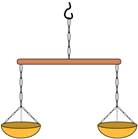 Debarim (Deuteronomy) 25:17ff describes the mitzva to remember
Amalek. This portion ends with the command to remember and eradicate Amalek. Immediately
prior to the mitzva of eradicating Amalek is the portion of honest weights and measures.
Debarim (Deuteronomy) 25:17ff describes the mitzva to remember
Amalek. This portion ends with the command to remember and eradicate Amalek. Immediately
prior to the mitzva of eradicating Amalek is the portion of honest weights and measures.
Rashi, commenting on the juxtaposition of the two portions says, the connection is to teach us that if a person is dishonest with weights and measures, he is going to be attacked by Amalek. According to this Rashi, the reason why we suffer at the hands of Amalek is because of dishonesty.
Debarim (Deuteronomy) 25 is actually the second time Amalek is mentioned in the Torah. Parshat Beshalach contains the first mention of the attack of Amalek. In the portion that precedes the section of Amalek, the Children of Israel ask the question:
Shemot (Exodus) 17:7 “Is HaShem in our midst or not?”
In this portion we see that the faith of the Children of Israel people was lax. What happened? Amalek attacked. Why did Amalek attach us at precisely this time? Chazal teach that this attack occurred at this time because Amalek represents that force in the world that does not believe in HaShem. We see from this portion that Amalek comes as a result of a lack of Emunah, faithful obedience.
The question arises: Which is it? What brings Amalek? Does Amalek come because of a lack of faith or does Amalek come because of dishonesty and theft?
Rav Moshe Feinstein, z”tl, says that Amalek comes when there is a lack of faith. The portion of dishonest weights and measures is not a portion that merely deals with theft and dishonesty. Failure to maintain honest weights and measures only occurs when people are lacking in faith in HaShem!
Those who believes in HaShem, believes that it is HaShem who gives them their livelihood. Ultimately, no matter how hard we work and how hard we try, a person’s sustenance is determined for him on Rosh Hashanah. If one believes in that, why should he have crooked weights and measures? Why is he cheating? What good will an extra dollar do for a person, if his annual income is already pre-determined?
The problem is that this person does not believe that it is HaShem who gives livelihood. This is not a crime of passion; this is not a sin of dishonesty. This is a “theological issue”. This person believes he has to steal to make money! Those who do not maintain integrity in the marketplace, and cheats others, should concern himself with the reprisal of Amalek.
Therefore, both the portion in Shemot and the portion in Debarim are teaching the same lesson. Amalek comes when we say, “Is HaShem in our midst?” When one’s belief is weak, Amalek comes. And if one thinks he has to cut corners and cheat to earn a livelihood, then his belief is weak!
In our time, the major killers belonging to Amalek: Hitler, Stalin, Mao, Pol Pot, Saddam Hussein, Arafat, and Mahmoud Ahmadinejad all were allowed or even encouraged, to continue to practice their barbarities because of the tolerance, the “appeasement” extended to them by well-meaning good people. If honest people do nothing, simply because they mistakenly believe that it does not affect them directly, then Amalek will come and attack.
Chazal, Our Sages, teach us that Moshe’s hands raised towards heaven, in Shemot 17, were not the cause of the Children of Israel’s triumph. Rather, the people’s ability to subjugate their minds and heart to the service of HaShem was the determining factor in their success. Thus, Amalek’s war against the Children of Israel symbolizes our ability to withstand outside pressures in order to focus upon the real source of our sustenance, HaShem. Amalek came to extinguish our fire of belief in HaShem. He did not succeed!
* * *
The arrival of Yitro, in Shemot 18, is juxtaposed with the battle against Amalek, in Shemot 17. The connection of these two portions lends further insight into Amalek.
Ibn Ezra indicates that these two portions are adjacent to show us that Amalek attacks the Children of Israel who had just left Egypt, and does them a disservice whilst Yitro came and did the Children of Israel a huge favor by suggesting, to Moshe, a hierarchy of judges rather than a system where only Moshe could settle disputes between people. Later in history, Amalek and Yitro appear together again. HaShem tells Shmuel, the prophet, to have King Saul destroy Amalek in its entirety. King Saul first contacts a small nation, the Kenites, and asks them to move away from their home, which is in proximity of Amalek and in danger of being destroyed by the Children of Israel in a war. There is a tradition that the Kenites are descendants of Yitro, and King Saul goes out of his way to warn them out of appreciation for the favor Yitro had done for the Jewish people in the desert. The Torah put these stories of Yitro and Amalek back to back to remind King Saul that, even when avenging Amalek, he, and every person who fights a battle, must remember to show gratitude to those who have helped them along the way.
Yitro came to Moshe right after the first battle with Amalek. Both of them were Gentiles. Amalek represents the essence of the Gentiles, the evil in its worse expression, evil per se. Yitro was also a Gentile. The first one raised his hand to destroy the holy people and the second came out to offer good advice.
We still can hear the echo of the words in the last sentences of Shemot 17: “I will utterly blot out ... War with Amalek from generation to generation”, and right after that: “Yitro, the priest of Midian, Moshe’s father in law, heard of all that HaShem had done for Moshe and for Israel, His people.” Two Gentiles standing at opposite extremes, yet the Torah puts them back-to-back. From Amalek we learn that you do not deal with the evil. You blot out him! From Yitro we learn, that an individual Gentile may be good to the Israelites, but not Midian, as a nation.
Rabbenu Bachya, a classic 14th century Torah commentator, explains that the juxtaposition, of Amalek and Yitro, highlighted the stark contrast between the responses of Amalek and Yitro to the miraculous events that surrounded the Children of Israel’s exodus from Egypt. Amalek chose to ignore all the signs that HaShem had chosen the Children of Israel as His people; and to disregard all the spectacular, supernatural occurrences performed for the Children of Israel.
The nation of Amalek chose, to not only close their eyes to the truth, but to attack those who carried its message. Yitro, on the other hand, took heed, paying very close attention to the events as they unfolded, and after witnessing one act of Divine providence after another, came to the conclusion that this nation must be very special. Yitro realized that he could not hide from the truth.
* * *
The Torah puts three things next to each other:
What is the connection between these three events?
At a very basic level we see that that the bread from heaven was a miraculous event. Why then, were the people worried about water? If HaShem can supply bread from heaven, which had never been seen before, why didn’t the people suspect that HaShem could bring water from heaven, like He had been doing for a very long time?
We can begin to understand answers to these questions when we consider that the word manna, is spelled: המן = HaMan.
This is very interesting considering that the Amalekite protagonist in the Megillat Esther is spelled: המן = Haman.
This suggests that the allusion to Haman, in the incident of the manna, is a warning of the spiritual nature of this event, not the physical nature. It is as though we can see that if we fail to learn the lesson of the manna, then we will have trouble with the Amalekites.
So, do we learn our lesson? No, we go ahead and complain about the lack of water. The Sages then see this lack of Torah and its wisdom, as the cause of the Amalekite attack.
This lesson was obscured for the generation in the wilderness. This lesson is apparent to the Torah student today. This suggests that this event will occur again and that the lesson is very appropriate to us today, as the prophet said:
Micah 7:15 According to the days of thy coming out of the land of Egypt will I shew unto him marvelous [things].
By Hakham Dr. Yosef ben Haggai
So, having learned this, we may well ask, who can we identify today as being “AMALEK”? We read in:
Amos 1:11 “Thus says HaShem; For three transgressions of Edom (I have looked away), but for four, I will not pardon them – for their pursuing his brother with the sword, and suppressing his mercy; his anger has slaughtered perpetually, and he has kept his fury for ever.”
Jewish tradition identifies Amalek as being part of EDOM, and EDOM is in turn identified with the two illegitimate religions that have sprung forth from Judaism (Christianity and Islam). Their birth was illegitimate as was that of Timna. These two religions and peoples under their banner share in the four sins, which G-d says through the mouth of Amos, the Prophet, that “He will never pardon them.” These four sins are listed to be:
Note that no other two religions and civilizations in this world since the Romans have so mercilessly persecuted the Jewish people as these. When it was the turn for Christianity to persecute us, Islam tolerated us, and when it was the turn for Islam to persecute us, then Christianity started to tolerate us in the hope of causing our death by assimilation. Nevertheless, with globalization, and in the pursuit of “peace” United Nations style, the time will come when both the Christian and Islamic world will cease their alternate mode of persecution of the Jewish people, and will join hands on this evil enterprise in unison. Already we are seeing this at various levels, for example, the meeting of minds from the Islamic world through to the Christian nations siding many a time unjustly with the criminal organization known as the PLO and exerting an enormous amount of pressure on Israel to conform to their wishes. All because of their strategic “oil” and commercial interests.
However, there is a basic Jewish principle that all wars are basically spiritual, and when the battle is lost at the spiritual level, then war at the physical level follows. Again, the great Sephardi Hakham Yaaqov Culi of blessed memory, correctly identifies this phenomenon when he states:
But a nation cannot fall until its spiritual genius (SAR) falls first. There is however, a great difference between the genius of Amalek and those of other nations. The genius of Amalek is Samael, the angel of evil. This is identical with Satan, the evil urge that causes man to sin. Thus, whenever a person sins (breaks the Law of G-d), he gives strength to Samael, and this strengthens Amalek.
Thus, while G-d breaks the power of other geniuses, it is our responsibility to undermine the power of the genius of Amalek. As long as we sin, he becomes stronger and stronger.
In his blessing to Yaaqob, Isaac said, “The voice is Yaaqob’s voice, but the hands are Esav’s hands” (Genesis 27:22). As discussed earlier, this indicates that when Yaaqob is lax in Torah study, prayer and good deeds, Esav’s hand becomes stronger. The reason is because when we are lax in our service to G-d, Samael, who is the genius of Amalek (Esav), becomes all the stronger. As long as its genius is strong, there is no way that Amalek can be obliterated from the world. A nation cannot fall unless its genius falls first!
This resolves an important contradiction. Here, in Shemot 17:16, we see that G-d Himself swore that He would destroy Amalek. Later, however, He gave us a commandment to do so.[65] If G-d promised to destroy Amalek why did He have to give us a commandment to do so? In the case of all other nations, G-d first destroys the genius, and then lets us take care of the people. Here, it is the exact opposite. We must destroy Amalek’s genius by ceasing to sin and by repenting. This is our responsibility. Then as G-d ha sworn, he will take of the physical peoples of Esav.
Interesting here to note is that principality of Esav / Amalek is none other than Samael, which is another name for HaSatan. Please bear this in mind when reading Revelation 2:9 and 3:9 -
Revelation 2:9 “I know thy works, and tribulation, and poverty, (but thou art rich) and I know the blasphemy of them which say they are Jews, and are not, but are the synagogue of Satan.” –
Revelation 3:9 “Behold, I will make them of the synagogue of Satan, which say they are Jews, and are not, but do lie; behold, I will make them to come and worship before thy feet, and to know that I have loved thee.” –
Thus, the Synagogues of Satan are also the Synagogues of Amalek which claim to be Jews and Israelites, but they are liars who have no physical Jewish or Israelite mother nor do they observe the Halacha of the people of Israel, the Jews. In other words, the main tactic of the Synagogues of Satan is to say that they have displaced or replaced the Jewish people, and therefore they are the children of Avraham and Israel par excellence and no one else.
The battle against Amalek starts in the realm of ideas, in the mind. The evil of the Inquisition came as a consequence of Christian Replacement or Displacement Theology whereby Christianity had replaced / displaced Israel. The Nazi evil came as a consequence of Luther’s anti-Semitic diatribes teaching the Jewish people, their books and their religion needed to be eliminated. In more modern times, Christianity has resorted to a different tactic. In the early 60’s at Fuller Christian Theological Seminary, a new approach to world evangelism was in a state of gestation. Its name was “Cross Cultural Evangelism” by which the Christian message needed to be firmly embedded in the culture of the target country or province, and make abundant use of its cultural trappings and signs of identification. This new tactic was unleashed upon the Jewish people under the name of Messianic Judaism, which is nothing more and nothing else than Christianity with a varnish of Jewish music and cultural signs of identification, which at times are given even a newer meaning. Most Christian denominations vigorously support morally and financially most of these Messianic so called “Synagogues.” The lion share coming from the Southern Baptist Convention and the Pentecostal denominations.
One of the characteristic traits of these groups is their total rejection of Jewish Halacha and absolute rebellion and disregard for the authority of Jewish Hakhamim, their teachings, and their legitimate courts of law. Since the nature of these groups stemming from Protestant Fundamentalist sects is to be a law unto themselves, the so called Messianic Jewish movement has fractured into a multitude of sub-sects and organizations.
Like Amalek their target audience are those Jewish stragglers who for whatever circumstance are ignorant of their Torah, traditions and Laws. Their methods are as cruel as those employed by Amalek. Jewish Orthodoxy and its teachings are to be eliminated from amongst the Jewish people and replaced by their Christian Theology. Their teachers reject the teaching of the Shulchan Aruch and have replaced them by their Christian Theologies dressed with Tzitzit.
Not content with this, some in the Messianic Jewish movement have revived recently old anti-Semitic and racist theological dogmas that were used at one time by British protestants, then the Nazis, and then a number of far-right extremist organizations and adopted by a number of Christian fundamentalists. The sadness of this deceptive tool of Amalek is that their “new” merchants ignorant of the history of ideas and the history of Christian teachings believe in their heart that they are the discoverers of this “new” doctrine.
Consider for a moment the following published in the Internet:
HaShem commanded Israel to establish courts of justice and Halakhic authority for all Israel.[66]
Referred to as “Oral Torah“ or Mesorah (tradition), it was received by Moshe Rabbenu … Later the Mesorah of the Bne Israel was taken up by the Second Temple rabbis and sages and referred to as “Rabbinical authority.”
However, by the time of Yeshua HaMashiach Israel’s courts of justice and its Mesorah had become corrupted due to numerous political pressures and religious hypocrisy, resulting in the transfer of Halakhic authority (referred to as the “keys of the Kingdom”) to the Talmidim of Yeshua HaMashiach. This is recorded in Matityahu Chapters 16, 18, 21, and Acts 15 (among other places). With their new Divine authority, the Netzarim were then given the job of overseeing the Halacha of His “Kingdom.”
The problem with this replacement / displacement statement is that it suffers of intellectual myopia or and lacks any historical foundation. It is absurd to think that G-d transferred the Halakhic authority to the sect of the Nazarean Pharisees and of whom at best if we trust the unreliable accounts of the Catholic Fathers there existed up to the 13th century some small pockets in the Middle East of Nazarean Communities who were totally Torah observant, and then mysteriously disappeared leaving no trace of their Halacha and thereby since the destruction of the Temple condemning all Israel in Diaspora through almost 2,000 years without the Halacha of this “Kingdom”! This is not the G-d of the Nazareans! This is the god of Amalek! May I venture to say that the reason we do not have any Halakhic extant codes from the Nazareans is because they were Jews, and Jews are forbidden to separate themselves from the Jewish community,[67] and therefore they were active in the midst of their Jewish communities fully involved in the Rabbinical Halakhic enterprise!
Let us look at another example also published in the Internet by a, so called, Messianic Jewish organisation:
How will the two houses of Israel (house of Israel / Christianity and house of Judah / Judaism) become one house? When will the prophecy of Ezekiel 37:15-28 be fulfilled and Ephraim (house of Israel) and Judah (house of Judah) become one in the hand of the G-d of Israel? In this chapter, we will discuss how and when the two houses of Israel will be redeemed and restored to the G-d of Israel and reconciled to each other.
In order to understand how and when the two houses of Israel will be reunited, you need to understand how the restoration and unification of the two houses of Israel is related and associated with the covenant that the G-d of Israel made with Abraham. This covenant is also paramount in understanding the prophetic significance of the nation of Israel making peace with her Arab neighbors in the end of days. By being willing to trade “land for peace” based upon UN Resolutions 242 and 338, the leadership of the nation of Israel and all Jews (house of Judah) who approve of trading “land for peace” are rejecting the covenant that the G-d of Israel made with Abraham.
The covenant that the G-d of Israel made with Abraham is an everlasting covenant.[68] In Genesis 15:18-21, the G-d of Israel promised the descendants of Abraham a land forever. In Leviticus 25:23, the G-d of Israel commanded that the land is not to be sold forever.
By rejecting the covenant that the G-d of Israel made with Abraham and by being willing to trade part of the eternal Promised Land for “peace,” the nation of Israel will experience the greatest time of trouble that she has ever experienced since she has been a nation.[69] This period of time is also known as Yaaqob’s trouble.[70] However, during the time of Yaaqob’s trouble, the two houses of Israel (Ephraim and Judah) will be reunited in the land of Israel[71] through a great outpouring of the Holy Spirit (Ruach HaKodesh) upon the remnant in the house of Israel (Christianity) and the house of Judah (Judaism) who believe the covenant that the G-d of Israel made with Abraham.
The restoration of both houses of Israel and a return to the land of Israel will be done by the G-d of Israel with a mighty hand and an outstretched arm in the sight of all the nations. The G-d of Israel will gather His people as a shepherd who gathers His lost sheep and bring them to the land of Israel[72] from all the nations of the earth where they have been scattered (Deuteronomy [Debarim] 30:1-5). The restoration of both houses of Israel and their return upon the “mountains of Israel” (West Bank)[73] will be the end of the exile of both houses of Israel into all the nations of the earth. After returning to the land of Israel following this “Messianic redemption” and the ending of the exile of both houses of Israel from all the nations of the earth, the Jewish Messiah (Mashiach) Yeshua / Jesus will set His feet down upon the mount of Olives[74] and be King over all the earth[75] and rule and reign from Jerusalem (Yerushalayim) teaching the Torah to the nations during the Messianic Age[76] for 1,000 years.[77]
Oy Vey! When has the House of Israel of old, ever been equated with Christianity? The first to propound this heresy in the history of ideas were the so called “British Israel” proponents prior to the Nazis, the Nazis adopted it as their official platform of beliefs to justify that superiority of the Nordic races and in particular the supreme superiority of the Arian race as the descendants of Ephraim. Later on, it has been taken by some sectors of the Pentecostal churches and popularized again by Herbert Armstrong and his cult, and subsequent splinter groups after his death. In Australia as in the U.K. most of the literature on British Israel is published by an organization called “The League of Rights” and closely allied to the Australian and British Nazi parties, as well as Herbert Armstrong’s splinter groups, all of the seed of Amalek!
In fact, in Australia during the 1950’s the bulk of the Pentecostal movement represented by the Assemblies of God, was painfully split on this issue, resulting in the extirpation to their credit of this doctrinal cancer. Other Christian denominations for fear in part of being branded in the media as supporters of the Nazi party have stayed well away from this British Israel doctrine. In the United States, there is a considerable amount of literature published by the KKK and organizations of like ilk such as the “Aryan Nation” who also teach most firmly that they are the descendants of ten lost tribes of Israel.
Judaism has never equated Christianity with the ten Tribes of Israel, and all of our Sages speak with one voice in identifying Christianity with Edom / Esav / Amalek. However, in all fairness we need to ask, how exactly have our Sages interpreted the passage of Ezekiel (Yehezchel) 37:15-28 be fulfilled and Ephraim (house of Israel) and Judah (house of Judah) become one in the hand of the G-d of Israel?
Let us look at some of the critical verses in this passage. In Ezekiel 37:21, if we follow the logical sequence of events in the chapter, the reunion of the two kingdoms is to be preceded by the gathering together of the dispersed of the ten tribes of Israel in foreign countries and their return to Zion. In v.23 we read that those Israelites who were living among the pagan nations and had adopted their idolatries, G-d will restore them to their land, but will also purge them from their heathenism and idolatrous theologies. Further in v. 24 the Messiah, a descendent of David from the tribe of Judah, who has preserved the Halacha will be king and shepherd over them. Malbim here identifies the Messiah as occupying two offices: one as king and two as a shepherd (spiritual / Halakhic leader).
In other words, Mashiach is of the House of David, and he rules by the Halacha being developed by the Sages of the Jews (Judah, Benjamin and Levi) since Moshe Rabbenu. Failure to accept and live by Jewish Halacha will therefore incur eternal damnation. Malbim in his commentary on Ezekiel explains that in v.25, though Avraham and Yitzchak were also promised the land, only Yaaqob is mentioned in this connection because he was the ancestor of Israel alone, whereas the other two patriarchs were also the ancestors of Ishmael and Esav respectively, who were not included in the promise. Note that our Sages clearly explain that Christianity is Esav / Edom / Amalek and Ishmael represents Islam. So, the Israelites we are speaking here are neither Christianity nor Islam, and the claim that Christianity = the House of Israel is therefore untrue and out of the question according to Ezekiel 37:25.
However, these false teachers who proclaim that they are Ephraim and Israel, want to do so because they want to claim for themselves the prerogatives listed by Hakham Shaul in Romans 9:4-5 as belonging to Israel, in true replacement / displacement fashion of the Jewish people. However, Romans 9:4 does not start the sentence, but v.3 does. And Hakham Shaul claims in Romans 9:3 that his “brethren and kinsmen according to the flesh are the Israelites.” Trouble is that Hakham Shaul was of the tribe of Benjamin who joined itself to the tribe of Judah, so that the Israel he is speaking here about are at least the Jews and not the ten Northern Tribes of Israel! In a similar vein, when Hakham Yaaqov HaTzadik writes in his Epistle, he addresses it to: “the twelve tribes which are in the Diaspora” and thereby implying that what we call Jews today or at that time contain in them elements of all the twelve tribes of Israel!
It has been my experience though, that although some of the teachers sport Doctorates in Divinity or Theology, the truth of the matter is that academic qualifications do not stand as do any other qualification from a reputable University. My experience as a Post-Graduate research supervisor in dealing with these teachers is that they utterly lack the academic rigor, intellectual discipline and honesty required from such advanced degree holders. Take for example, one of the fundamental premises of a well-disciplined mind, and polished academic thinker is that such person is consistent in his didactic methodology and expose.
Now, most Evangelical Christians, Messianic Jews, and all Orthodox Zionist Jews, believe that the first part of Ezekiel 37 dealing with the valley of the dry bones is a metaphorical description of the establishment of the Modern State of Israel. Now these teachers who proclaim themselves, to be part of the ten Northern Tribes of Israel, also believe that the first part of Ezekiel 37 must be interpreted metaphorically and not literally, yet, when we come to vv. 15-28, they switch without reason and breaking the rule of consistency to a literal mode of interpretation. The trouble is that these Amalekite teachers fail to realize that they are dealing with an Apocalyptic book which only admits interpretation based upon the Sod (secret) level of Rabbinic / Jewish Hermeneutics and not the Pshat (simple / literal) mode of interpretation. Consistency demands that if we are to read Ezekiel 37:1-14 metaphorically, then we must continue to do so from vv.15-28! Any Post Graduate supervisor or examiner would have failed any candidate for violating such elementary rule of logic and intellectual discipline, and yet we have people sporting Doctorates breaking all rules of logic, not to mention the hermeneutic Laws of Sod literature. Such is the mind and the sin of those “acting presumptuously”.[78]
Further, if these people believe that they are Ephraimites, then the same text says that before G-d brings them to the land of Israel these have to be cleansed from their heathenism first.[79] Further, they will need to walk in the Mishpatim (civil and criminal laws of the Jews according to Jewish Halacha) and the Chuqot (Laws for which there is no logical explanation but have been given by G-d and interpreted by Jewish Batei Din as for example Jewish Halacha regarding dietary laws). Therefore, if we were to adopt the literal interpretation of Ezekiel 37:15-28, anyone who claims to be of the Northern ten Tribes of Israel is de facto claiming that they have not been yet cleansed by G-d from their heathenism, and that they have not yet accepted the Mishpatim and the Chuqot of the Jewish people as per Jewish Orthodox Halacha. Oy! Such is the nature of deception, for as Hakham Shaul said, “But malicious men and impostors shall advance worse upon worse, misleading, and being (themselves) misled”.[80]
Lastly as noted by Gesenius, “the Mount of the Amalekites” (i.e. the seat of government of the Amalekites) was part of the land of the tribe of Ephraim,[81] this was the town of Pirathon, which is not far from the present-day city of Nablus (Shechem), under PLO control. After King Solomon’s death Jeroboam I, an Ephraimite, led a secession from the rule of Judah to become the king of the Northern Kingdom, and consequently also led an apostasy from normative Judaism. Jeroboam was the first man in history to establish an “iron curtain” (a la Soviet Union style) preventing anyone from the Northern ten tribes to travel to Jerusalem or to worship G-d at the Temple in Jerusalem. It seems that Jeroboam I inherited all the traits of Amalek. The title and surname of the King of the Amalekites was Agag, this is the same title and surname, which Haman had.[82] According to Gesenius this name comes from an Arabic Root meaning “to burn” or “to blaze.” Some philologists like M. Astour point out that the Greek name Ogygos is a Semitic name derived from Agag and meaning, “to flame.” We also know that one of the divinities of the peoples inhabiting Canaan was Moloch, which required either the sacrifices of children by throwing them into a raging fire, or given to be trained in the temple of this idol as prostitutes. The Amalekites are identified as the first among the nations in the region and it is greatly possible that their cultic practices included the worship of Moloch. Further the word Amalek can be divided into ע (Ayin) and the word מלך, which in Hebrew are the same consonants for Moloch. Thus ע -Melech can also mean Ayin (the eye) of Moloch. How fitting that the fire of Gehinnom (Hell) is reserved for the genius of Amalek, which is Ha-Satan, as well as for all Amalekites.
In summary, this doctrine that Christian or Messianics = Ephraim is but a new form of British Israel doctrine revived at this time by neo-Amalekites who are bent in the destruction of Judaism by bringing in the pollutions of their idolatry which prevents the ignorant of being cleansed from their idolatry and being taught by His Majesty King Yeshua the Messiah the Halacha of Judaism as recorded by His faithful servant the Spanish Hakham Yosef Karo in the whole of the Shulchan Aruch. These neo-Amalekites teach that Mashiach will heal the rift between the literal ten Northern tribes (supposedly them) and the literal tribes of Judah, Benjamin and Levi. However these miserably fail to observe that according to Ezekiel 37:24 this rift can only be healed when these (supposedly Ephraimites) hear the voice of Mashiach and start accepting and subjecting themselves to Mishpat Ivri and the Chuqot as spelled out by Mashiach’s servants His Jewish Orthodox Hakhamim and written down in such codes of Jewish Law as the Shulchan Aruch,[83] otherwise the light of His Majesty King Yeshua our Mashiach has not yet dawned in the inner recesses of their minds and souls.[84]
Relating to these deeds of the Amalekites we read from Hakham Shaul in Romans 16:17-20 –
1. Now I exhort you, brethren, to watch for those which are making divisions and offences contrary to the (oral) teaching which you learned; and turn away from them.
2. For such ones serve not our Master Yeshua the Messiah, but their own belly; and through smooth speech and flattering deceive the hearts of the simple.
3. For your obedience (to the Oral Torah) has reached unto all. I rejoice therefore over you: but I wish you to be wise unto that which is good, and simple concerning evil.
4. And the G-d of Shalom shall crush Satan (the genius / principality over Esav / Amalek) under your feet shortly. The gift of our Master Yeshua Ha-Mashiach be with you. Amen.
In verses 19-20, Hakham Shaul makes the same statement that Hakham Yaaqov Culi, of blessed memory makes, that is, that we overpower the genius of Esav / Amalek by our study and observance of the Torah, and in doing so, G-d erases the memory of Esav / Amalek and his cohorts. As the Psalmist concludes in Psalm 147 – “He relates His (oral) word unto Yaaqob, his statutes (Chuqot) and his judgments (Mishpatim) unto Israel. He did not do so for any other nation: and as for His judgments (Mishpatim), they know them not. Halleluiah!”
Amalek is that nation which has attempted to destroy the Jewish people throughout history. In physical terms, Amalek is a nation of people who hate Jews with a violent and mortal hatred. But every physical phenomenon has a spiritual root, every physical phenomenon is none other than a spiritual force manifesting in the world; Amalek represents that force which would destroy the Jewish people and their destiny. And what is it that manifests as the Jewish people and their destiny in the world? What spiritual force do we represent? The Jewish people are those who must reveal Hashem’s Presence in the world. That is our function. “Atem eidai – You are My witnesses.” Witnesses testify to that which cannot be seen; if a thing is present and self-evident, witnesses are unnecessary. It is only when the thing or event cannot be directly seen that witnesses are called. Hashem’s Presence is not directly seen in the world; the Jewish people are those witnesses who are charged with testifying that behind the scenes there is that Presence.
We must testify to this fact with our lives and with all of our history as a people. And Amalek is eternally dedicated to blot out that testimony at any cost. Amalek is ready to sacrifice himself to wipe out any evidence of Hashem’s immanent Presence in the world, ready to do anything to maintain the gap as wide as possible. Ready to sacrifice all for that end: and the reason for this extreme behavior is because he depends on that gap for his survival, for his very existence; he is that gap. If that gap were to close, Amalek would cease to exist. Amalek is the distance between physical and spiritual, and therefore he lives in that space and will give his life to defend it.
The cosmic and eternal battle between Amalek and the Jewish people is this battle. They seek to destroy us and we must battle for our lives; in depth the meaning of this battle is that they fight Hashem and his Presence in the world, and we fight to maintain that very Presence. This is the root of all battles and of all war. Amalek means darkness and the flourishing of evil; Amalek’s end means the destruction of the gap between Hashem and the world, the restoring of that closeness which reveals that all is One.
Who are the erev rav? This question has several answers that are all related. We will start our answers by examining the Vilna Gaon’s perspective.
All arrogant and wicked Jews in every generation are the transmigrated souls of the Erev Rav, the sons of Cain.
Another sense of the word Rav is "Leader." This is because the Erev Rav act as the leaders of the nation while it is in exile. The public at large, who are good, are subjugated under these men... They are the Chametz (leaven) in the bread [i.e. the evil inclination]. The reason that the Torah requires the removal of Chametz from the 6th hour after sunrise on the day before Passover is because the Erev Rav constructed the Golden Calf exactly at this time. They are considered worse than idolaters, for the people of Israel are fooled by their apparent success. In reality, they are the cause for the length of our exile.[86]
Kol HaTor 1:9d The purpose of gathering in the exiles is to wage God’s war against Amalek, which was the main mission of Joshua, in line with Mashiach ben Yosef. The war against Amalek includes every aspect, against all the enemies of Israel, including Armilus, the prince of the mixed multitude. It is also intended to remove the spirit of impurity from the Land, and to bring " Knesset Israel and Shechina from below, from the earth.
Kol HaTor 6:6. waging war against Amalek. The war against Amalek is from generation to generation. The war against Amalek is against three types of foes:
a). Amalek of the heart, that is, the evil inclination and vices;
b). the spirit of Amalek, the general one, the Satan who destroys, the adversary of Israel. This is Samael and his hosts. His main power is in the gates of Jerusalem, when its lands are desolate;
c). the material Amalek, that comprises Esau and Ismael and the Erev Rav, the mixed multitude. As explained by the Gaon: we are commanded to inherit it [the land] by force.
End of the Gaon’s perspective
It has been pointed out by a number of Torah masters and accepted as religious truth for many decades in certain Orthodox Torah circles that the contemporary manifestation of the Erev Rav is none other than the secular Zionist leadership. According to this school of thought, it is to the phenomenon of secular Zionism that the sages referred when they prophesied, "In the Ikveta D'Meshicha [i.e. prior to Mashiach ben David] Chutzpah-Arrogance will increase".[87] It was the leaders of the "New Erev Rav" who consciously led an entire generation of Jewish youth away from a life of Torah and away from the deeper meaning and purpose of the Jewish People. They rallied around the idolatry of a new Golden Calf, a secular state fueled exclusively from secular aspirations and secular knowledge. They struggled hard to remove and uproot traditional Torah values and, in 1948, when the incarnated Erev Rav gained political control over the Land of Israel they hopefully predicted that Orthodox Judaism would all but disappear within a generation.
Yet it was these very men and women whose blood, sweat and tears powered by a mighty spirit paved the way for a whole generation of Jews to enter into a new era and into a new land - Palestine. With their statesmanship, scholarship, artistic vision, literary talent and technical knowledge they led and continue to lead and influence much of the Jewish world.
There is an opinion that the Erev Rav are among the leaders of Jewish secularism. The Erev Zeir are among the leaders of Jewish orthodoxy.
The Zohar teaches that the Erev Rav are a combination of Esav and Yishmael just as Yaaqob is a combination of Avraham and Yitzchak.
The entire 974 generations[88] which are Erev Rav which are the souls from the world of chaos, G-d transplants them every generation, and they are the bold-faced of the generation. Our Sages said that in the period of "messiah's footsteps" impudence will become great... and the `erev rav will return to be the shepherds of Israel.[89]
"You should know that there are five kinds of `erev rav. The first kind are argumentative and libelous people; the second kind are those who pursue passion and fornication; the third kind are those who are deceitful, who pretend to be righteous but whose hearts are not whole. The fourth kind are those who pursue honor in order to make a name for themselves; the fifth kind are those who pursue money... and the argumentative kind are the equivalent of all of them: they are called `Amalekim, and the son of David will not come until they have passed out of this world, for it is of them that we recite, "You shall erase the memory of Amalek".[90]
Gog, according to the Septuagint, is Agag, a generic term used for kings of Amalek. Any war against the Children of Israel, meant to annihilate them, has to involve Amalek.
Bamidbar (Numbers) 24.7 Water will flow from their buckets; their seed will have abundant water. “Their king will be greater than Agag; their kingdom will be exalted.
LXX version Bamidbar (Numbers) 24.7: There shall come a man out of his seed, and he shall rule over many nations; and the kingdom of Gog shall be exalted, and his kingdom shall be increased.(!)
The word Gog uses not only the same consonants but has the same meaning as Agag; namely roof, or that which covers.
Chazal have taught us that the battle with Gog and Magog will take place during Succoth, on the eve of the Messianic era. The mitzvot of Succoth are the survival mechanism for this great war. The Succah and the waving of the lulav and etrog are essential to our survival during this war. Complete trust is the critical requirement against a foe who trusts only in his own might.
The Haftarah on Shabbat Chol HaMoed is taken from Ezekiel 38, which contains a prophecy of the terrible war of Gog and Magog. This will be the last war ever to be fought, but it will engulf the whole world. Then will come a new era of peace, when HaShem will be recognized by all the nations of the world. The prophecy is very similar to that of Zechariah 14, read on the first day of Succoth.
Shabbat Chol HaMoed Pesach and Succoth:
Shemot 33:12 – 34:26
Shabbat Chol HaMoed Pesach:
Yehezchel 37:1-14
Shabbat Chol HaMoed Succoth:
Yehezchel 38:18 – 29:16
Every Shabbat Chol HaMoed Succoth we read the Haftarah[91] about the final confrontation at the end of days between Gog / Magog and the Children of Israel. How does Succoth connect with Gog and Magog and the end of days? Every year, when the Jew leaves his home for a week to eat, sleep and live in a Succah; a flimsy structure with a roof made of bits of wood, reed, bamboo, etc., he actualizes the idea that his ultimate care and protection come only from HaShem. The word “Gog” in Hebrew means roof.
The ADMOR of Zejichov, who lived some 200 years ago, wrote in his book a commentary about Exodus 4,13. The Hakham asks, how come the word “נא” (which is translated in English to ‘please’) is written in the verse. And he writes:
Know this: Gog and Magog war will start at Hoshana Raba
Yehoshua fought Amalek shortly after Pesach, on Iyar 28.
Mordechai and Esther had Haman the Agagite hanged on Nisan 17, during Pesach.
King Saul’s seven sons were killed on Nisan 16.[92]
According to the Jewish Encyclopedia[93] it is stated:
“Amalek—the first foe to attack the people of Israel after they had come out of Egypt as a free nation; twice designated in the Pentateuch[94] as the one against whom war should be waged until his memory be blotted out forever—became in rabbinical literature the type of Israel's arch-enemy. In the tannaitic Haggada of the first century Amalek stands for Rome;[95] and so does Edom (Esav), from whom Amalek descended.[96] A kinsman of the Israelites, Amalek nevertheless displayed the most intense hatred toward them: he inherited Esav's hostility to his brother Yaaqob. When other nations hesitated to harm God's chosen ones, his evil example induced them to join him in the fray. "Like a robber he waylaid Israel"; "like a swarm of locusts"; "like a leech eager for blood"; "like a fly looking for sores to feed on"; Amalek ('am laḳ = the people which licketh) hurried over hundreds of miles to intercept Israel's march.”[97]
Sanhedrin 96b “The grandchildren [descendants] of Cicero studied Torah in Jerusalem, the grandchildren of Sanncherib taught Torah in public, the grandchildren of Haman studied Torah in Bne Brak”
There were noteworthy descendants of Agag: Sages of the Oral Law who learned and taught Torah in Bne Brak! What is the meaning of this dual lineage – Haman on the one hand, and Torah sages on the other? The idea is this: when Amalek lives, there is a gap between the world and the Creator, there is darkness in the world. But because there is darkness there is the opportunity to generate light. Amalek is the darkness, and Torah is the light. If the world is dark, Torah can bring light: because of the darkness there are Sages of the Oral Law who teach Torah, who bring HaShem into the world, as it were. The very same act which creates the gap, which allows an Agag to live and a Haman to be born creates the opportunity for Torah to light the world.[98]
That was Adam’s aim, that was at the root of his calculation to increase his free will, to widen the gap of the world. He was not without justification; he was not without a very compelling logic. Surely, it was wrong. It was not the wish of the Creator, and we are still paying the price; but we can at least glimpse the enormity of the ordeal which he faced. He disobeyed and failed; Hashem wants obedience rather than the greatest of sacrifices, as Shmuel put it: “Are offerings and sacrifices as desirable to HaShem as listening to HaShem’s voice? Behold, hearing is better than a sacrifice, to listen (better) than the fat of lambs.” But from that failure emerged the possibility of correction, from the downfall emerged the possibility of arising.[99]
Amalek’s defeat at the time of Moshe and Yehoshua was great, but Haman’s defeat at the time of Esther was greater. To see the light when it is overpowering is not difficult; to cause the light to shine when darkness seems overpowering is heroic. Purim is the time of masks; HaShem has gone into hiding in Jewish history, He has donned a mask. But He is not distant; if one is distant, he does not need a mask to avoid being identified, the distance achieves that. No, a mask is necessary when one is very close and yet wishes to remain hidden.[100]
The world is His mask; nature hides His Presence. But this same world, this same nature, needs only to be peeled back to reveal its Source. The ordeal is doubt; all may appear coincidental, and the Amalek ideology may be found in the culture of today – nothing has absolute meaning or value, all is accident. The mask is heavy and convincing. But that should not deter us from our function, the function of revealing the Reality behind the mask.[101]
Amalek’s bitterness was due to the loss of the becorah which he desired. He, therefore, comes upon Israel whenever they are getting ready to exercise the becorah.
Four time we see Amalek:
1. With Yehoshua in the wilderness just after leaving Egypt with only 11 days till we should have arrived in Eretz Israel. Tomorrow is in Shemot (Exodus) 17:9
2. In King Shaul’s day just after we have our first king and we are going to have our land.[102]
3. David HaMelech is described as having "defeated Amalek on the morrow".[103]
4. In Esther’s time when we had permission to return to Eretz Israel. Tomorrow is in Esther 5:8. "Tomorrow I shall do as the king has said" – why did Esther say "tomorrow"? Because all descendants of Amalek are destined to fall "on the morrow," as it is written, "Tomorrow I shall stand atop the hill."[104]
5. Esther requests from Achashverosh to kill the Amalekites in Shushan, tomorrow.[105]
6. During the holocaust shortly before we were to return to Eretz Israel.
In each of these four events, ‘tomorrow’ plays a prominent role.
The Maharal explains that the word "tomorrow" expresses existential, moral duality: today we do that which is appropriate today, and “tomorrow” we do what is appropriate “tomorrow”. This expresses constant flux, a lack of fixed priorities and values: that which is good today will not necessarily be good tomorrow; everything changes depending on the circumstances. Esther understood that she faced an Amalekite worldview, and therefore she used the word "tomorrow".
The question arises in this context, why did the Torah view Amalek as the eternal enemy of the Jewish people? After all, we find throughout the Torah many other nations that also waged war against Am Yisrael, peoples who sought to destroy us and deny us our existence.
In order to answer this question, we must, in my humble opinion, carefully examine two terms that appear in virtually every instance in Tanach where we find mention of Amalek. I refer to the term “mikreh” (happenstance, coincidence), which comes up repeatedly in the context of Amalek, and the word “Machar” (tomorrow), which we often find in reference to the Jewish people.
At the end of our parasha, Hashem commands us never to forget what Amalek did: “… that they chanced upon you along the way” (Rashi explains the word “Karcha” as a derivative of the word “mikreh”).
We thus find numerous sources related to Amalek, and they all make reference to one of these concepts – “Machar” or “mikreh.” I believe that these two concepts can help us answer the question with which we began.
King David battled against the Amalekites who plundered his city of Tziklag: “David smote them from morning until evening on the following day“.[106]
The Torah affords great importance to the perpetuation of the memory of Amalek’s attack because Amalek, by its very essence, expresses the notion of “mikreh” – happenstance. “Mikreh” in effect means the absence of Hashem’s providence in the world. Amalek represents coincidence – the lack of faith in Hashgacha peratit – divine providence, the belief that no being oversees world affairs, everything happens here purely by coincidence. Of this the Torah wishes to remind us every year; it is forbidden for us to allow “Amalekism”, the theology of “mikreh,” to take hold.
In contradistinction to the Amalekite “mikreh” is the Jewish “Machar.” “Tomorrow” expresses the hope, the Hashgacha, the idea that there is Someone in the heavens who looks after each and every one of His creatures on earth. “Machar” is the notion that there is something for which to wake up in the morning, the world does not progress at random, without a guiding hand. Everything is foreseen from the outset, and we are granted the power to act as we wish. “Machar” is about our free will to decide what to achieve, what to make of our lives.
* * *
Haman = The man (manna).
Just before Amalek attacked in the wilderness, they were given the manna. Shemot (Exodus) 16:13-15
Binyamin was lost in Egypt gives birth to the same words that Shmuel uttered as he slew Agag.
Yehoshua battles Amalek and conquers the land, and he is of the tribe of Ephraim.
Look at Yaaqob’s blessing of Ephraim.
The Torah is very explicit about the ‘memory’ of Amalek.
Shemot (Exodus) 17:14 HaShem said to Moshe, “Write this as a remembrance in the Book and recite it in the ears of Yehoshua, that I shall surely erase the memory of Amalek from under the heavens.
Why are we to erase the memory of Amalek rather that just erasing Amalek? What is the Torah trying to communicate?
Rabbi Fohrman suggests that Amalek seems to ‘remember’ certain events and to NOT ‘remember’ other events.
Amalek, Esav’s grandson remembers that Yaaqob bought the becorah from Esav, but he sees it as theft.
Bereshit (Genesis) 25:29-34 And Yaaqob sod pottage; and Esav came in from the field, and he was faint. 30 And Esav said to Yaaqob: 'Let me swallow, I pray thee, some of this red, red pottage; for I am faint.' Therefore was his name called Edom. 31 And Yaaqob said: 'Sell me first thy birthright.' 32 And Esav said: 'Behold, I am at the point to die; and what profit shall the birthright do to me?' 33 And Yaaqob said: 'Swear to me first'; and he swore unto him; and he sold his birthright unto Yaaqob. 34 And Yaaqob gave Esav bread and pottage of lentils; and he did eat and drink, and rose up, and went his way. So Esav despised his birthright.
Amalek remembers that Yaaqob received Yitzchak’s blessing, while believing that the blessing rightfully belonged to Esav.
Bereshit (Genesis) 27:32-35 And Isaac his father said unto him: 'Who art thou?' And he said: 'I am thy son, thy first-born, Esav.' 33 And Isaac trembled very exceedingly, and said: 'Who then is he that hath taken venison, and brought it me, and I have eaten of all before thou camest, and have blessed him? yea, and he shall be blessed.' 34 When Esav heard the words of his father, he cried with an exceeding great and bitter cry, and said unto his father: 'Bless me, even me also, O my father.' 35 And he said: 'Thy brother came with guile, and hath taken away thy blessing.'
What Amalek does NOT remember is that Yaaqob reconciled with Esav.
Bereshit (Genesis) 33:4 And Esav ran to meet him, and embraced him, and fell on his neck, and kissed him; and they wept.
Why does Amalek seem to have such a selective and malevolent memory? One idea is that it stems from the way Timna was NOT received by Abraham, Yitzchak, and Yaaqob.
Bereshit (Genesis) 36:12 And Timna was concubine to Eliphaz Esav's son; and she bore to Eliphaz Amalek. These are the sons of Adah Esav's wife.
Sanhedrin 99b A propos, what is the purpose of [writing], And Lotan’s sister was Timna? — Timna was a royal princess, as it is written, alluf [duke] Lotan, alluf [duke] Timna; and by ‘alluf’ an uncrowned ruler is meant. Desiring to become a proselyte, she went to Abraham, Isaac and Yaaqob, but they did not accept her. So she went and became a concubine to Eliphaz the son of Esav, saying, ‘I had rather be a servant to this people than a mistress of another nation.’ From her Amalek was descended who afflicted Israel. Why so? — Because they should not have repulsed her.
Timna had a very strong desire to be a part of Abraham’s family. Her son, Amalek, was dispossessed by Eliphaz and was not considered his proper offspring. Notice how Amalek is NOT listed as one of the sons of Eliphaz:
Bereshit (Genesis) 36:11-12 And the sons of Eliphaz were Teman, Omar, Zepho, and Gatam, and Kenaz. 12 And Timna was concubine to Eliphaz Esav's son; and she bore to Eliphaz Amalek. These are the sons of Adah Esav's wife.
One might understand Amalek’s anger at not being counted as a son of Eliphaz given his mother’s strong desire to be a part of Abraham’s family. However, it seems normal to understand that Amalek would be angry at his father, Eliphaz, for not considering him as his father’s son. Children who have been mistreated by their parents often defend them and will never say anything bad about the abusive parents. This does not make the anger go away. Often, such anger is ‘redirected’ towards someone else and this person becomes the target of the angry actions. Such was the case for Amalek. Amalek is upset with Eliphaz and yet he redirects his anger towards Yaaqob and his descendants.
Amalek’s redirected anger is first seen in Rephidim.
Shemot (Exodus) 17:8 Then came Amalek, and fought with Israel in Rephidim.
This anger is seen at each of our six encounters with Amalek:
1. With Yehoshua in the wilderness just after leaving Egypt with only 11 days till we should have arrived in Eretz Israel. Tomorrow is in Shemot (Exodus) 17:9
2. In King Shaul’s day just after we have our first king and we are going to have our land.[107]
3. David HaMelech is described as having "defeated Amalek on the morrow".[108]
4. In Esther’s time when we had permission to return to Eretz Israel. Tomorrow is in Esther 5:8. "Tomorrow I shall do as the king has said" – why did Esther say "tomorrow"? Because all descendants of Amalek are destined to fall "on the morrow," as it is written, "Tomorrow I shall stand atop the hill."[109]
5. Esther requests from Achashverosh to kill the Amalekites in Shushan, tomorrow.[110]
6. During the holocaust shortly before we were to return to Eretz Israel.
Amalek is angry because of what happened to his grandfather Esav. He is angry at Yaaqob for making Esav’s family line deprecated by Yaaqob. He then comes to destroy Yaaqob and to finish what Esav never finished (because Esav reconciled with Yaaqob.) He is willing to die in the process. His life means nothing if he cannot destroy Yaaqob and his descendants. Amalek remembers the events of his Grandfather’s diminishment at the hands of Yaaqob, but he does not remember the reconciliation. Therefore, we are commanded to erase the memory of Amalek, who only remembers what he wants to remember.
Yaaqob’s sojourn at Laban’s house parallels the Egyptian exile.
On his way to exile in Laban’s house, Yaaqob encounters Esav vis his son Eliphaz.
Eliphaz was Esav’s son.[111] According to the Midrash[112] he was bidden by his father, Eliphaz, to pursue Yaaqob and slay him. Owing, however, to the influence of the teachings of Isaac, which he had imbibed, he forbore to do this, and as a compromise, in order not to disobey his father wholly, he deprived Yaaqob of all his possessions, because a man without possessions is reckoned as dead.
Rashi to Bereshit (Genesis) 29:11 Since he foresaw with the holy spirit that she (Rachel) would not enter the grave with him. Another explanation: Since he came empty-handed, he said, “Eliezer, my grandfather’s servant, had nose rings, and bracelets and sweet fruits in his possession, and I am coming with nothing in my hands. [He had nothing] because Eliphaz the son of Esav had pursued him to kill him at his father’s orders; he (Eliphaz) overtook him, but since he had grown up in Isaac’s lap, he held back his hand. He said to him (Yaaqob), ”What shall I do about my father’s orders?“ Yaaqob replied, “Take what I have, for a poor man is counted as dead." - [from Bereshit Rabbati by Rabbi Moshe Hadarshan]
There are three meetings between Yaaqob and Esav.
1. The first meeting is when Esav sells the becorah for a pot of lentils.
2. The second meeting is when Yaaqob receives the blessing of the becorah and Esav vows to kill him.
3. The third meeting is when Yaaqob returns from Laban’s house and reconciles with Esav by sending him gifts.
Wherever you find someone with a fanatical, implacable and illogical enmity to the Jewish People, you have found Amalek. His very existence is founded on his antipathy and hatred for the offspring of Yaaqob.
Amalek is called Reshit (the first), “Amalek was the first of nations”; he was the first of the nations to attack Israel:
Bamidbar (Numbers) 24:20 And when he looked on Amalek, he took up his parable, and said, Amalek [was] the first of the nations; but his latter end [shall be] that he perish forever.
The Torah states, “Amalek is the ‘Rosh’ of the nations”.[113] Rashi explains “Rosh” to mean the “first”, as Amalek was the first nation to do battle with the Jews after they went out of Egypt. But Kabbalah explains “Rosh” literally, as “head”; Amalek is the “head” of the evil nations in the world and supplanted the Primordial Snake, which first brought death and impurity into the world.[114] It is this negative force which implants doubt and indecision in the minds of those who would serve HaShem faithfully and without question. In fact, the Baal Shem Tov points out the numerical value of “Amalek” is “safek”, Hebrew for “doubt”.
The power of Reshit derives from the vacant space that precedes creation altogether. Analogously, Esav was born before his twin brother, Yaaqob, and was considered to be the firstborn son.
Everything that is Reshit, first, contains the blueprint of all that is to follow. The seed comes first. Contained in the seed is the tree. Amalek is the bitter seed of anti-Semitism. Amalek Beware!
Tehillim (Psalm) 121:4 Behold, he that keepeth Israel shall neither slumber nor sleep.
Bamidbar (Numbers) 24:20 And when he looked on Amalek, he took up his parable, and said, Amalek [was] the first of the nations; but his latter end [shall be] that he perish forever.
Shemot (Exodus) 17:14 And HaShem said unto Moses, Write this [for] a memorial in a book, and rehearse [it] in the ears of Joshua: for I will utterly put out the remembrance of Amalek from under heaven.
However, Israel is called the “firstborn”, as the verse states:
Shemot (Exodus) 4:22 “My child, my firstborn, Israel”
Additionally, Yaaqob took the right of the firstborn from his brother, Esav, from whom Amalek descends.
The way Yaaqob, and Israel, blot out Amalek[115] is through whole-hearted devotion to the study of Torah we must have such a passion for Torah that we cannot be cooled down, even by Amalekites. Amalek, the essence of evil, is nullified by a love for HaShem and His Torah. This is the only way to eradicate evil, Amalek is the essence of evil!
Our Sages state that the war with Amalek was one of the necessary preparations for the Giving of the Torah. Similarly, our Sages[116] state that the Jews did not fully accept the Torah until the time of Purim. This suggests that Torah is the tikkun (correction) for Amalek and, indeed, all evil.
“If one reads the Megillah in the wrong order (literally, ‘backwards’), he has not fulfilled his obligation.”
The Baal Shem Tov explained that this refers to a person who reads the Megillah believing that the story it tells occurred only in the past (that is, he reads it “backwards,” as a retrospective account) and that the miracle of Purim does not endure into the present. Such a man has not fulfilled his obligation, for the purpose of the reading of the Megillah is to learn how a Jew should behave in the present.
* * *
Within Shechem itself is an allusion to the disturbingly divisive power of Amalek, alluded to by the pasuk:
Shemot (Exodus) 17:16 For he said, Because God (yod hay) hath sworn [that] HaShem [will have] war with Amalek from generation to generation.
Why is “Throne” written “kais” and not “kisei”? And why is HaShem’s Name divided in half [yod-heh]? The Holy One, Blessed is He, swears that His Name will not be whole nor His Throne whole until the name of Amalek is completely eradicated. (Rashi)
The existence of Amalek is analogous to the division of HaShem’s Holy Ineffable Name (the Tetragrammaton Name that is not said the way it is written), or, at least, our perception of it. The doubt that Amalek causes, either directly or indirectly, results in the appearance of a separation between the “yod-heh” and the “vav-heh” of HaShem’s Name. Therefore, when we recite the following tefilla before doing a mitzva:
I hereby do this mitzva to unify the Holy One and His Presence, in fear and in love, in order to unify and make whole the name “yod-heh“ with “vav-heh” in the name of all of Israel.
We are not just focusing our attention on the mitzva, but we are actually going to war against Amalek, and rectifying what went wrong in Shechem.
Purim belongs to a future time, to the morrow, the time of our final reckoning with Amalek and our victory over both the Four Kingdoms and the Seven Nations.
Our whole history is a journey towards the future. And that is precisely what Amalek opposes, a purpose, a mission which is obligating. The pleasures of the present become secondary. The ideal takes precedence over all momentary experience. Amalek vehemently opposes being obligated to anything other than his own selfish interests. In order to be truly victorious over Amalek, Moshe and Esther needed to focus on the tomorrow. The very word for tomorrow, מחר, contains an important message. The letters of the word רחם are also the letters of the word רחם, as in Rachamim, mercy. Middat HaRachamim, the Divine attribute of Mercy, sustains existence, as the Ramchal explains,[117] that the Middat HaRachamim gives time to the sinner. Strict judgement would have dictated that the sinner be eliminated instantly when he goes against the Divine Will. Rachamim gives the sinner time to correct and rectify what he did. Middat HaRachamim gives us the future within which we can correct the past; otherwise existence would be impossible. It is not coincidental that the letters of the word מחר (tomorrow) spell רחם (compassion).The Machar grows out of the rachem; without Rachamim there is no Machar. The continuum of time is the basis of our existence. And the source of the future is in the womb and, in Lashon Kodesh, is called רחם The history of our People is a journey towards our promised future. The obstacle to a smooth journey is our nemesis, Amalek. We are victorious over Amalek through tomorrow, מחר.
Likewise, Amalek, as a people, existed long before the Jewish people ever asked the question, “Is God among us or not”? (Shemot 17:4). He was already around for some time before Moshe Rabbeinu even went down to Egypt to free his enslaved people. But they were not sitting and planning for the day that the Jewish people would pass their way so that they could attack them.
The Torah places this section immediately after this verse (when they asked, “Is God among us or not?”) to imply, “I am always amongst you and ready at hand for everything you need, and yet you say, ‘Is God among us or not?’ By your lives, that dog will come and bite you, and you will cry for Me and then you will know where I am!” (Rashi, Shemot 17:8)
Amalek is a punishing strap. (Rashi, Bamidbar 21:1)
Talmud states, God works measure-for-measure (Sanhedrin 90a). So, it stands to reason that if we are doing something to anger God that “something” will come back to haunt us at a future time. How else are we to learn from our mistakes?
When Mashiach comes the yetzer hara goes. (Succah 52a)
* * *
This study was written by
Rabbi Dr. Hillel ben David (Greg Killian).
Comments may be submitted to:
Rabbi Dr. Greg Killian
12210 Luckey Summit
San Antonio, TX 78252
Internet address: gkilli@aol.com
Web page: https://www.betemunah.org/
(360) 918-2905
Return to The WATCHMAN home page
Send comments to Greg Killian at his email address: gkilli@aol.com
[1] A number of Hasidic writers interpret Amalek as the yetzer hara, the evil inclination.
[2] Debarim (Deuteronomy) 25
[3] Mishnah Berurah OC 685
[4] Me’am Loez; Debarim vol.3 p. 977
[5] At the end of Parashat Ki Tsetse
[6] Amalek’s mother was the illegitimate daughter of Amalek’s father
[7] “Samael” -- Rashi, Succah 29a and Sotah 10b, from Tanchuma, Vayishlach 8 -- Midrash Rabba at the end of Debarim identifies Samael with the Satan and the Angel of Death
[8] Bereshit (Genesis) 36:4
[9] I Samuel 17:4
[10] II Samuel 21:16
[11] Midrash Tanchuma, Parshat Ki Teitzei, sec. 9.
[12] Cf. Sefer HaMaamarim 5679, p. 294.
[13] Mishle (Proverbs) 11:1
[14] Tanchuma 8
[15] Sifrei 25:167
[16] Tanchuma 9
[17] Tanchuma 9
[18] Tanchuma 9
[19] Tanchuma 10
[20] Shemot (Exodus) 17:3
[21] Tanchuma 10; Shemot (Exodus) 17:8
[22] Tanchuma 10
[23] Sifrei 25:167
[24] Midrash Lekach Tov
[25] Our Sages
[26] see Rabbenu Bachya Shemot 16:17
[27] Gog
[28] Divine Providence
[29] I learned this insight from: Purim In A New Light, as revealed through the writings of Rabbi Yitzchak Hutner, interpreted and adapted by Rabbi Pinchas Stolper.
[30] Emunah – faithfully obedient
[31] Shemot (Exodus) 17:16
[32] Rashi’s source can be found in Sifrei (Parshat Ki-Teitzei), Mechilta (Parshat Beshalach), Pesiqta Zutr’si (Parshat Ki-Teitzei). See Rashi’s coments to I Samuel 15:3.
[33] The Amalekites were great sorcerers and used to transform themselves into animals to escape the attacks of their enemies in war.; See Ketab Tamin 61 and R. Bachya in Ki-Teitzei in regards to the text of Pirke D’Rabbi Eleazar 39.
[34] Rashi, 21:1. and 33:40
[35] Rashi
[36] Sanhedrin 20b
[37] The holy Temple
[38] I Samuel 8.
[39] Ibid. 25:19
[40] Ibid. 12:10. The three were to be in that order.
[41] [Ms. M. ‘R. Nehemiah.’]
[42] Ibid. 17:14.
[43] It was not a command to appoint a king, but a prophecy that Israel would demand one; then, a king having been appointed, he would be subject to the laws stated in the section.
[44] Ibid.
[45] I Chronicles 29:23. Ramban thus brought proof to the opinion of those scholars mentioned above, who interpret this verse as containing a hint that the reckoning with Amalek is to be deferred until there will be a king in Israel.
[46] Bereshit (Genesis) 3:11; Heb. הםן The first word can be read as Haman, and the second can refer to the tree or gallows upon which Haman was hanged; cf. Esther 7:10.
[47] Chullin 139b
[48] Esther 3:1,2,5
[49] Esther 6:13
[50] Esther 7:10
[51] Ma’oz Tzur
[52] Bereshit (Genesis) 2:16-17
[53] Bereshit (Genesis) 3:2-3
[54] Esther 5:13
[55] This section was written by Rabbi Gideon Weitzman 5765
[56] Yeshayahu (Isaiah) chapter 43
[57] Bamidbar (Numbers) 13:29
[58] Kiddushin 30b
[59] Shemot 31:17
[60] Tanchuma, Ki Teitzei 7
[61] A translation of the Tanach into Aramaic
[62] Shemot 17:11
[63] Debarim 21:10
[64] Many of the ideas in this section were provided by Rabbi Frand’s comments on Parshat Ki Teitzei
[65] Debarim (Deuteronomy) 25:19
[66] According to Tehillim (Psalm) 82, Debarim (Deuteronomy) 16:18-20 and 17:8-13 (and echoed in the Chapters of the Fathers – Pirke Avot 1:1)
[67] Pirke Avot 2:5
[68] Bereshit (Genesis) 17:7
[69] Daniel 12:1-2
[70] Jeremiah (Yirmiyahu) 30:7 or the birth pangs of the Messiah (Chevlei shel Mashiach).
[71] Jeremiah (Yirmiyahu) 30:1-7
[72] Ezekiel (Yehezchel) 34:11-13
[73] Ezekiel (Yehezchel) 37:18-22
[74] Zechariah 14:4
[75] Zechariah 14:9
[76] Athid Lavo; Isaiah (Yeshayahu) 2:2-3
[77] Revelation 20:4,6
[78] cf. Bamidbar (Numbers) 15:30,31 and Debarim (Deuteronomy) 17:12,13
[79] v.23
[80] 2 Timothy 3:13
[81] Shoftim (Judges) 12:15; compare Shoftim (Judges) 5:14
[82] Esther 3:1
[83] Yeshayahu (Isaiah) 8:16
[84] Yeshayahu (Isaiah) 8:20
[85] From “Worldmask”, by Akiva Tatz
[86] This is the Vilna Gaon’s perspective.
[87] Sotah 9:16
[88] Chagigah 14a
[89] Safra ditz'ni`utha, chapter 1, beginning with the words "They were not watching".
[90] Adderet Eliyahu, commentary on Deut. 1:1 (325), his words being based on Zohar 1:25, 27; 3:125: and see the Gaon's commentary on Tikunei Zohar 97, pp. 86,91.
[91] Yehezchel (Ezekiel) Chapter 38
[92] Midrash Rabbah, Naso, ch.8
[94] Shemot (Exodus) 17:14-16, Debarim (Deuteronomy) 25:19/
[95] Bacher, "Ag. Tan." i. 146 et seq., 211 et seq.
[96] Bereshit (Genesis) 36.
[97] Tan. Ki Teẓe, ix., and Pesiḳ. iii. 26b
[98] World Mask, Rabbi Akiva Tatz.
[99] Ibid. 97
[100] Ibid. 97
[101] Ibid. 97
[102] Shmuel alef (I Samuel) 9:19 And Samuel answered Saul, and said, I am the seer: go up before me unto the high place; for ye shall eat with me today, and tomorrow I will let thee go, and will tell thee all that is in thine heart.
[103] Shmuel alef (I Samuel) 30:17
[104] Yalkut Shimoni Esther, 1056
[105] Esther 9:13
[106] Shmuel alef (I Samuel) 30:17
[107] Shmuel alef (I Samuel) 9:19 And Samuel answered Saul, and said, I am the seer: go up before me unto the high place; for ye shall eat with me today, and tomorrow I will let thee go, and will tell thee all that is in thine heart.
[108] Shmuel alef (I Samuel) 30:17
[109] Yalkut Shimoni Esther, 1056
[110] Esther 9:13
[111] Bereshit (Genesis) 36:4 & 36:12
[112] quoted by Rashi in Bereshit 29:11
[113] Bamidbar (Numbers) 24:20
[114] Sharei Ora
[115] The Bne Israel, today, boo, hiss, stamp feet and rattle gragers (noisemakers) whenever the name of Haman is mentioned in the service. The purpose of this custom is to “blot out the name of Amalek.” (see Deut. 25:19; and Esther 3:1 and I Sam. 15:8–9 for Haman was a descendant of Amalek). It is the practice for the reader to recite the names of the 10 sons of Haman (Esther 9:7–9) in one breath (Meg. 16b) to show that they were executed simultaneously.
[116] Shabbat 88a
[117] HaRav Moshe Chaim Luzatto, ל"זצ ,1707-1746, in the fourth chapter of Mesillat Yesharim