
Lag BaOmer - בעומר ל׳׳ג
By Rabbi Dr. Hillel ben David (Greg Killian)

Friday, July 5, 2024
Readings from the Triennial Cycle
In the life of Mashiach ben Yosef
In The Life of Yosef HaTzaddik

This Torah study owes its genesis to my beloved teacher, Hakham Dr. Yosef ben Haggai. One of the great Nazarean scholars of our time, he taught us, his students, that Torah study demands the highest intellectual and moral courage. He did this in the best way possible: by personal example. The following thoughts, many of which are his, are a small indication of what I learned from him, not least that Torah is, among other things, a refusal to give easy answers to difficult questions.
I am dedicating this study to my beloved teacher on the occasion of his birthday: Lag BaOmer 5766. May HaShem give His Eminence many more insights and bring him much prosperity in this world and the next for His many kindnesses to me and my family, Amen v’Amen!
Let’s begin this study with a little background information. In our study on the Omer, we examined the Torah requirement to count the days between Pesach (Passover) and Shavuot. This study will focus on day thirty-three of the counting of the Omer.
Thirty-three days following the first day of Passover, Jews celebrate a "minor" holiday called Lag BaOmer, the thirty-third day of the Omer. Lag BaOmer בעומר ל׳׳ג, is a Hebrew phrase that means the thirty-third day of the Omer. Lag - ל׳׳ג, is how we say “thirty-three” in Hebrew (ל=30, ג=3). BaOmer - בעומר is how we say “In the Omer”. The counting of the Omer links Pesach and Shavuot (Feast of Weeks).
The omer count reaches thirty-three on Iyar (אייר) eighteen, the eighteenth day of the second month. Lag B’Omer is therefore related to Iyar 18. The gematria of eighteen is יח which, when rearranged, is חי the Hebrew word for “Life”.
The month of Iyar is known by the name "Ziv" in the Tanakh, (Torah, Neviim, and Ketuvim – AKA the Old Testament), a word which means brilliant. Only during the era of the second Temple was the name Iyar adopted. Iyar, related to the words for light and for air, also means brightness. In fact, every day of Iyar has its own mitzva because we count the Omer during every day of Iyar. It’s where the Jews spend all their time working on self-improvement. And so all of the events of Iyar, including Lag BaOmer, should be brought in this month of Iyar.
Iyar 18 is three days after the full moon of Iyar. Therefore, the moon has begun to visibly wane. The moon is no longer at peak brightness.
Some Sephardim have the minhag (custom) to call this holiday לעמר ל״ג - Lag LaOmer. It is more accurate according to the rules of Hebrew grammar. Lag LaOmer means the thirty-third day "of the Omer", as opposed to BaOmer - "in the Omer."
Why do Ashkenazim and some Sephardim say Lag BaOmer? Because Hakham Shimon Bar Yochai was a gilgul of the neshama of Moshe Rabeinu. The words "Lag BaOmer" have the numerical value of 345, which is also the numerical value of "Moshe". The Mashiach will have the neshama of Moshe Rabeinu.
Hakham Nachman Bulman, shlita, explains that "everyone" calls the day "Lag BaOmer" because the main proponents of saying "BaOmer" are Hakham Yitzchak Luria, the Arizal, and the Sephardi Kabbalists.
The minor holiday of Lag BaOmer commemorates three historical events:
1. The end of a period of mourning for thousands of students of Hakham Akiva who died in a plague, the great plague Askera, during the counting of the omer. This respiratory plague is the worst of all 913 known fatal diseases and is often a punishment for slander and malicious gossip.
It should be noted that there is an alternate, more mystical reason for mourning (or at least, for avoiding festivities) during the Omer: the Mishnah brings an opinion that the wicked in Gehinnom are judged specifically between Pesach and Shavuot.[1] In truth, this is only a singular opinion of one Sage, contrasting an earlier statement that judgement in Gehinnom lasts a full 12 months. It is possible to reconcile the two opinions by saying that following a person’s passing, their soul is judged for up to 12 months, and then if the verdict is for the person to remain in Gehinnom, they are subsequently rejudged each year between Pesach and Shavuot. Since we know that the deaths of Rabbi Akiva’s students actually ended on Lag b’Omer and did not extend all the way to Shavuot (hence the mourning stops on Lag b’Omer), we might apply that same rule to the judgement in Gehinnom as well. In this case, we have yet another mystical reason for lighting bonfires on Lag b’Omer, as these would be appropriately symbolic of the “flames” of Gehinnom.
2. The anniversary of the death of the author of the Zohar, Hakham Shimon Bar Yochai. On this day he revealed the deepest secrets of the Torah, as found in the Zohar, and it was the day his soul ascended to it’s source.
3. Bar Kochba’s revolt against the Romans. This was an attempt at ushering in the Messianic era.
Lag BaOmer is an oasis of joy in the midst of the sad Sephirah period which is almost unnoticed by most contemporary Jews. Yet it contains historic lessons of such great severity that this generation must not only unravel the mystery of Lag BaOmer but will discover that its own fate is wrapped in the crevices of its secrets. Lag BaOmer, according to our Sages, deals with the deepest secrets of the future Messianic Age. These are the inner secrets of the Torah which are revealed on Lag BaOmer, to the diligent talmid. Because it contains these secrets, we cannot discuss it openly or directly, but rather we must hint towards these answers and the talmid must “fall in” on his own.
Y Y Y
Of the 49 days of the omer, how many do we not say tachanun?
7 days of Pesach
2 + 1 days of Rosh Chodesh
7 shabatot
Rabbi Akiva’s 12,000 pairs of students did not die on days of simcha. This means that they died for 32 days during the counting of the Omer.
There are 17 days when we don’t say tachanun, during the counting of the omer.
There are 17 days after Lag BaOmer when we count the omer. This is why Rabbi Akiva’s students are said to have stopped dying on Lag BaOmer.
This is why Lag BaOmer is a day of simcha.
On Lag BaOmer, Rabbi Akiva began teaching 5 new students. One was Rabbi Shimon bar Yochai.
Y Y Y
Hakham Ginsburgh pointed out the following interesting concept:
When lag (ל׳׳ג) is spelled backwards (גל) it spells gal, which means reveal or revelation as in the verse in:
Tehillim (Psalms) 119:18 [Gal einai v'abitah nifla'ot mitoratecha.] "Open (reveal to) my eyes that I may see the wonders of Your Torah."
The latent potential of Lag BaOmer is the opportunity to connect to the inner, wondrous dimension of the Torah (The Living Torah – Mashiach) and to reveal it in our lives.
During the Middle Ages, Lag BaOmer became a special holiday for Hakhamim and Rabinical students and was called the Scholar's festival - Chag HaTalmidim.[2] This name is surely related to the fact that only the most diligent talmid can understand the secrets of the Torah as revealed in the Zohar, the esoteric part of the oral law. Another reason for this name comes from the fact that the Torah scholar students of Rabbi Akiva stopped dying on this day and could continue their study of the Torah. Obviously, the reason the plague ended was because the cause of the plague ended. Beginning on Lag B'Omer, the students began to respect each other as befitted students of Rabbi Akiva. On Lag B'Omer the students of Rabbi Akiva had a fresh start. Before that day, the world was empty of Torah. But on Lag B'Omer, Rabbi Akiva established a new kind of student. These new students built a new world, a Jewish world and a good world.
The Talmud viewed Torah study as a foundation which supports the entire world.[3] The study of scholars was considered similarly essential to maintain the good and welfare of all mankind;[4] Scholars [bonayikh, or “thy Builders”] increase peace throughout the world; Example 2. Amar rabbi Elazar: Rabbi elazar taught in the name of rabbi haninah: “scholars bring peace to the world. As it is written: ‘when all your children are taught the word of God, your children shall enjoy abundant peace’.[5] The second mention of ‘your children’ [banayikh] should be read as bonayikh (‘those of great understanding’). The book of psalms states: ‘lovers of God’s Torah enjoy abundant peace, they stumble not’.[6] ‘let there be peace within your walls, safety within your gates. May peace be ever yours, for the sake of God’s house I seek your welfare’.[7] ‘may God grant strength to the people of israel, and bless them with peace’.[8]
The mission to change the world, together with the power to do so, were given to the students of Rabbi Akiva and Rabbi Shimon. Once they opened the door, they gave this mission over to all students in all generations. Every student, boy or girl, who follows in the footsteps of Rabbi Akiva and Rabbi Shimon has the power to build the world. And they can build the world in such a way that there will be blessings and eternal life.
Thus it is understandable why Lag B’Omer was called the Scholar's festival.[9]
Lag BaOmer is also called the holiday of the Torah Shebalpeh, the oral law, according to the Pri Tzadik[10]. Hakham Akiva[11] and Aaron the High Priest were the masters of the Torah Shebalpeh. Why were they masters of Torah Shebalpeh? They were masters of Torah Shebalpeh because they brought people together. Aaron was Moshe’s mouth to Paro, and he was the first to give Moshe’s Torah to the leaders of Israel. Aaron HaKohen was also noted for his ability to bring peace between people, according to the Talmud.
Sanhedrin 6b R. Eliezer the son of R. Jose the Galilean says: It is forbidden to arbitrate in a settlement, and he who arbitrates thus offends, and whoever praises such an arbitrator [bozea’] contemneth the Lord, for it is written, He that blesseth an arbiter [bozea’], contemneth the Lord. But let the law cut through the mountain, for it is written, For the judgment is HaShem’s. And so Moshe's motto was: Let the law cut through the mountain. Aaron, however, loved peace and pursued peace and made peace between man and man, as it is written, The law of truth was in his mouth, unrighteousness was not found in his lips, he walked with Me in peace and uprightness and did turn many away from iniquity.
Yeshua was called “The Word of God” in Yochanan (John) 1:1. This secret of Mashiach testifies that He is the Living Torah, both oral and written. Further, this explains why Yeshua’s ascension occurred on Lag B’Omer, the festival of the Oral Torah.
Torah Shebalpeh requires good character. It requires someone who can learn from a teacher and with a study partner. Torah Shebalpeh requires us to get along because we must learn from another.
Hakham Akiva's students each had different opinions about the meaning of what they were learning. Each one wanted his friends to understand everything the way he thought was right. They argued with each other, each one only trying to prove that he was right. They thought that they were being nice to their friends by doing this; they really wanted their friends to know the right way. What they did not realize was that more than one person could be right, and you have to respect different opinions (as long as they are based on the Torah).
Hakham Akiva’s students were stingy with each other in the transmission of Torah in order to avoid giving respect. If we cannot get along, if we do not have respect for one another, then we cannot learn Torah Shebalpeh. Lag BaOmer is therefore a time when we get along with each other in order that we should build our character and in order to make Israel what it is supposed to be.
The Zohar records that on the day on which Rashbi (Rabbi Shimon bar Yochai) died, he revealed the secrets of the Torah, and the house became filled with light and fire to the point that the students could not approach or even look at Rashbi. Rashbi not only died on Lag B’Omer, but he was also born on the same day. It is quoted in the name of the Ari that Hakham Akiva ordained Rashbi and his colleagues on Lag BaOmer, thus ensuring the continuity of the Torah Shebalpeh after the death of his earlier students.
Zohar 3:291b Until now, I have held the secrets close to my heart. But now, before I die, I wish to reveal all. Hakham Abba reports: "I couldn't even lift my head due to the intense light emanating from Hakham Shimon. The entire day the house was filled with fire, and nobody could get close due to the wall of fire and light. At the end of the day, the fire finally subsided, and I was able to look at the face of Hakham Shimon: He was dead, wrapped in his Talit, lying on his right side, and smiling."
It is now the almost universal practice among traditional Jews to observe the season of counting the "Omer" as a time of sadness, by refraining from activities that are associated with gaiety and celebration. The mourning period lasts from Pesach (Passover) until Lag BaOmer.
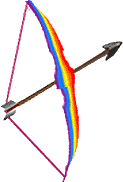 Lag BaOmer
is a festive day on the Jewish calendar, celebrated with outings on which children
traditionally play with bow and arrows[12]
(commemorating the Bar Kochba revolt), bonfires, and other joyous events.
Lag BaOmer
is a festive day on the Jewish calendar, celebrated with outings on which children
traditionally play with bow and arrows[12]
(commemorating the Bar Kochba revolt), bonfires, and other joyous events.
These Lag B Omer practices are an enigma to many scholars. When we realize that the Triennial Torah reading cycle places the present Torah Seder, “Tol’dot Noach” and “Vayzkhor Elohim Et Noach” in the temporal purlieu of Lag BaOmer, we can readily understand why the bow and arrow is an ancient game for children to play at Lag BaOmer. The rainbow, a token of peace fits well with these materials as G-d makes a covenant with the earth.
What is the inner connection between Lag B'Omer and outings to parks? Let us understand more about this connection. Lag B'Omer, as you know, is Rabbi Shimon Bar Yochai's day of rejoicing. In the very beginning of his book, the Zohar, Rabbi Shimon writes about children and about flowers growing in a field. First, Rabbi Shimon explains that when Jewish children learn Torah they uphold the world. Then he quotes the verse "The buds were seen in the land”. This section is about the creation of the world, for, "When were the buds seen in the land”? On the third day of creation, when the earth began to grow grass and trees. When do Jewish children see the earth growing grass and trees? When they go on outings to parks and fields on Lag B'Omer, of course!
Many visit the resting place, in Miron in Northern Israel, of the great sage and mystic Hakham Shimon bar Yochai (commonly known by the acronym of his name, Rashbi).
Lag BaOmer is a day of rejoicing on which Jews celebrate their unity by gathering together and celebrating. Significantly, it is the yahrzeit (the anniversary of the passing) of the great Talmudic sage, Hakham Shimon bar Yochai, whose teachings highlighted the concept of unity by drawing attention to the verse:
Tehillim (Psalms) 133:1 "How good and how pleasant it is for brothers to sit together."
Soncino Zohar, Vayikra, Section 3, Page 59b It has been taught in the name of R. Jose: Once the people were short of rain and they sent a deputation to R. Simeon, R. Jesse, R. Hizkiah and the rest of the Companions. R. Simeon was on the point of going to visit R. Pinchas ben Jair, along with his son R. Eleazar. When he saw them he exclaimed: ‘“A song of ascents; Behold how good and how pleasant it is for brethren to dwell together in unity” (Ps. CXXXIII, 1). The expression “in unity”,’ he said, ‘refers to the Cherubim. When their faces were turned to one another, it was well with the world-”how good and how pleasant”, but when the male turned his face from the female, it was ill with the world.
Chazal teach that Lag BaOmer’s significance lies with Hakham Akiva. Who is Hakham Akiva? Hakham Akiva was either a convert or the son of a convert who began to study Torah when he was forty years old. Chazal understand that Hakham Akiva was one of the greatest Sages that ever lived.
Maimonides describes Rabbi Akiva as an "arms bearer of Bar Koziba".[13] The source of Maimonides's assertion is a passage in the Jerusalem Talmud:
Jerusalem Talmud, Taanit chapter 4:5 page 68d Rav Shimon Ben Yochai taught: "Akiva my master would expound the verse a star will come from Jacob as 'Koziba will come from Jacob.' When Rabbi Akiva would see Bar Koziba he would say, 'There is the King Messiah.'"
Rav Yochanan ben Torta said: "Akiva, grass will grow from your cheeks and still the son of David will not come".
Hakham Akiva was the armor bearer of Bar Kochba whom Hakham Akiva declared Mashiach (Messiah). This is our first connection of the Mashiach with Lag BaOmer. It is also well known that most of Bar Kochba’s army was populated by Hakham Akiva’s Talmidim.
Hakham Akiva’s most famous talmid was Rashbi, Hakham Shimon bar Yochai, author of the Zohar, is also closely associated with Lag BaOmer. Every year on Lag BaOmer thousands of people journey to his grave on his yahrtzeit which was also the day that he revealed the secret (sod) Kabbalistic side of the Torah, the Zohar. We have a tradition that Rashbi was married and received his smikha (ordination) on Lag BaOmer.
Several contemporary Hakhamin have written of the Lag BaOmer-Bar Kochba connection, including Hakham Adin Steinzaltz in his commentary to the Talmud[14]. Dr. Nachum Wahrman, in his work Chagei Yisrael U'Moadav, writes:
"[The cessation of Hakham Akiva's students' deaths on Lag BaOmer] is connected with Bar Kochba’s war with the Romans, because according to a tradition that took root in the nation from ancient days, Hakham Akiva's students were the main force of Bar Kochba’s army. Similarly, it is accepted in the nation that on the 18th day of Iyar (Lag BaOmer), an important turnabout took place in the battles in favor of Bar Kochba’s rebels. Coins found from those days, on one side of which was written 'Shimon' and on the other, 'For the Freedom of Jerusalem,' are witness to the fact that Bar Kochba apparently succeeded in conquering Jerusalem, for a time, and there are those who estimate that this victory took place on Lag BaOmer."
This day commemorates the beginning of the Great Revolt against the Romans, in the year 66C.E., just prior to the destruction of the Second Temple. According to Josephus, on the seventeenth of Iyar “many stood upon the roofs of the houses and threw down stones upon the heads of the Romans…”[15]. On the same night (the eve of Lag BaOmer) torches were lit on the tops of the mountains in order to announce the beginning of the revolt. Some sources trace the custom of lighting bonfires on Lag BaOmer to this historical event
Another reason we celebrate Lag BaOmer is that the epidemic which caused the death of Hakham Akiva's 24,000 disciples (12,000 pairs) ceased on that day[16] according to the Shulchan Aruch HaRav 493:5. The Askera[17] plague lasted thirty-three days. The Talmud speaks of the reason for the death of these 24,000 Talmidim:
Yevamoth 62b It was said that R. Akiva had twelve thousand pairs of disciples, from Gabbatha to Antipatris; and all of them died at the same time because they did not treat each other with respect. The world remained desolate until R. Akiva came to our Masters in the South and taught the Torah to them. These were R. Meir, R. Judah, R. Jose, R. Simeon and R. Eleazar b. Shammua; and it was they who revived the Torah at that time. A Tanna taught: All of them died between Passover and Pentecost. R. Hama b. Abba or, it might be said, R. Hiyya b. Abin said: All of them died a cruel death. What was it?-R. Nahman replied: Croup (Askera).
It is known that we mourn during this period for the 24,000 Talmidim (students) of Hakham Akiva who died because they did not treat one another respectfully[18].
The Levush states that the Talmidim of R. Akiva who died during the days of the Omer, did not die on any of the days on which Tachanun is not said, incorporating the seven days of Pesach, the two days of Rosh Chodesh Iyar, one of Rosh Chodesh Sivan and the seven intervening Shabbatot. This totals seventeen days, leaving thirty-two days on which the Talmidim did die. Hence the Minhag to observe thirty-two days of semi-mourning during the Omer.
And the Maharal gives this as the reason for the rejoicing on Lag BaOmer. He seems to maintain that R. Akiva's Talmidim died from the beginning of the Omer until Erev Lag BaOmer. This is also the opinion of the Nofes Tzufim, who maintains that R. Shimon bar Yochai was the last of R. Akiva's Talmidim to die, on Lag BaOmer, at which point the Dinim (judgment) became sweet, which is why it became a day of rejoicing.
When we study Parashat Balak, we see that Bilaam failed time and again to curse Israel, but rather blessed them. At the very end, before he departed, however, he gave Balak advice on how to really undermine the Jewish people by enticing them to sin with the Midianite women, and incur HaShem's wrath. Balak took Bilaam's advice and the result was a plague in which 24,000 people died. It was these same 24,000 souls who, as gilgulim, were known as Hakham Akiva's talmidim and these talmidim died from Pesach until the thirty-second day of the Omer, a total of thirty-three days.
Aaron the High Priest was distinguished by his ability to unite all the people. When Aaron passed away, the Torah states that the ‘entire nation cried’ and mourned after him, a statement that is reserved for Aaron alone, distinguishing him even from Moshe Rabeinu. Rashi explains that Aaron was a pursuer of peace, he fostered love between all the people and as such was beloved and remembered by the entire nation.
Hakham Akiva taught that “love your fellow as yourself” is a cardinal principle in Torah, indeed, this is the most famous of his teachings. This was also one of the cardinal principles taught by Yeshua as well:
Matityahu (Matthew) 5:43 Ye have heard that it hath been said, Thou shalt love thy neighbour, and hate thine enemy. 44 But I say unto you, Love your enemies, bless them that curse you, do good to them that hate you, and pray for them which despitefully use you, and persecute you; 45 That ye may be the children of your Father which is in heaven: for he maketh his sun to rise on the evil and on the good, and sendeth rain on the just and on the unjust. 46 For if ye love them which love you, what reward have ye? do not even the publicans the same? 47 And if ye salute your brethren only, what do ye more than others? do not even the publicans so? 48 Be ye therefore perfect, even as your Father which is in heaven is perfect.
Thus Lag BaOmer also carries the theme of Ahavat Israel, the imperative to love and respect one’s fellow. This theme, Ahavat Israel, was also a major theme of Yeshua, Mashiach ben Yosef:
Luqas (Luke) 6:27 But I say unto you which hear, Love your enemies, do good to them which hate you, 28 Bless them that curse you, and pray for them which despitefully use you. 29 And unto him that smiteth thee on the one cheek offer also the other; and him that taketh away thy cloke forbid not to take thy coat also. 30 Give to every man that asketh of thee; and of him that taketh away thy goods ask them not again. 31 And as ye would that men should do to you, do ye also to them likewise. 32 For if ye love them which love you, what thank have ye? for sinners also love those that love them. 33 And if ye do good to them which do good to you, what thank have ye? for sinners also do even the same. 34 And if ye lend to them of whom ye hope to receive, what thank have ye? for sinners also lend to sinners, to receive as much again. 35 But love ye your enemies, and do good, and lend, hoping for nothing again; and your reward shall be great, and ye shall be the children of the Highest: for he is kind unto the unthankful and to the evil.
Hakham Yochanan ben Torta is the author of the well-accepted view that the cause of the destruction of the Second Temple was groundless hatred.[19] We have heard that the talmidim of Hakham Akiva died because they did not treat one another with respect. Therefore Rav Yochanan is adamant that the cause for the destruction of the Second Temple must be healed before one can speak of a new messianic movement. Further, he postulated that the King Mashiach must come with world changing miracles.
Mashiach ben Yosef (Yeshua) was one of four men whose names were given before they were born. This characteristic is intimately connected with those who are intimately connected with the Temple, as I have attempted to show in my paper on the Temple. This suggests that Mashiach is The Temple as Yeshua succinctly stated:
Yochanan (John) 2:12 After this he went down to Capernaum, he, and his mother, and his brethren, and his disciples: and they continued there not many days. 13 And the Jews’ Passover was at hand, and Yeshua went up to Jerusalem, 14 And found in the temple those that sold oxen and sheep and doves, and the changers of money sitting: 15 And when he had made a scourge of small cords, he drove them all out of the temple, and the sheep, and the oxen; and poured out the changers’ money, and overthrew the tables; 16 And said unto them that sold doves, Take these things hence; make not my Father’s house an house of merchandise. 17 And his disciples remembered that it was written, The zeal of thine house hath eaten me up. 18 Then answered the Jews and said unto him, What sign shewest thou unto us, seeing that thou doest these things? 19 Yeshua answered and said unto them, Destroy this temple, and in three days I will raise it up. 20 Then said the Jews, Forty and six years was this temple in building, and wilt thou rear it up in three days? 21 But he spake of the temple of his body. 22 When therefore he was risen from the dead, his disciples remembered that he had said this unto them; and they believed the scripture, and the word which Yeshua had said.
The King Mashiach will come when the Jewish people can be forged into one cohesive body. In the same way that Moshe Rabeinu as the redeemer of the Jewish people led them out of Egypt in total unity. This was seen when they stood at Mt Sinai and declared as a single man:
Shemot (Exodus) 24:7 … All that HaShem hath said will we do, and we will hear.
Mashiach will come at a time when the unity of the Jewish people is so complete that there will never be baseless hatred. When He comes the students will all treat each other with respect. King Mashiach will be the head of the unified body of Israel:
Colossians 1:12 Giving thanks unto the Father, which hath made us meet to be partakers of the inheritance of the saints in light: 13 Who hath delivered us from the power of darkness, and hath translated us into the kingdom of his dear Son: 14 In whom we have redemption through his blood, even the forgiveness of sins: 15 Who is the image of the invisible God, the firstborn of every creature: 16 For by him were all things created, that are in heaven, and that are in earth, visible and invisible, whether they be thrones, or dominions, or principalities, or powers: all things were created by him, and for him: 17 And he is before all things, and by him all things consist. 18 And he is the head of the body, the congregation: who is the beginning, the firstborn from the dead; that in all things he might have the preeminence.
The passage which tells us about the death of Hakham Akiva's students seems to vindicate at least part of Rav Yochanan ben Torta's observation: A generation which is no better than the generation which suffered the destruction cannot expect to witness the rebuilding of the Temple.
The mourning of Sefirah is not for the talmidim alone, but for the failure of the Jewish people to be worthy of the messianic age, for the fall of the curtain on Jewish independence, Jewish hopes and Jewish Messianic ambitions.
The days between Passover and Lag BaOmer mark the redemption that did not happen. We mourn that failure. Thus, during the first thirty-three days the light that governed the redemption from Egypt dominates, only to be replaced by the light that was involved in the reception of Torah for the last seventeen days. The final seventeen days, the Supernal Light of Torah was called upon in its revelation in creation, is for acquiring a taste for spirituality.
While ultimately Hakham Akiva and his generation failed, we must recognize that Hakham Akiva was completely correct in his understanding of the process, and the capability of man. Too many Jews are followers of Rav Yochanan Ben Torta, awaiting the miraculous as a prerequisite for redemption. These nay-sayers wait passively for the sign from heaven that the time for redemption has come.
We must follow Hakham Akiva, and take proactive steps, accepting our partnership with the Almighty. Drop after drop after drop adds up to a tidal wave of activity. When we succeed, the days between Passover and Shavuot will reacquire their original identity and become a time of joy. When we succeed, The King Mashiach will return on Lag BaOmer even as He left on Lag BaOmer:
II Luqas (Acts) 1:6 When they therefore were come together, they asked of him, saying, Lord, wilt thou at this time restore again the kingdom to Israel? 7 And he said unto them, It is not for you to know the times or the seasons, which the Father hath put in his own power. 8 But ye shall receive power, after that the Holy Ghost is come upon you: and ye shall be witnesses unto me both in Jerusalem, and in all Judaea, and in Samaria, and unto the uttermost part of the earth. 9 And when he had spoken these things, while they beheld, he was taken up; and a cloud received him out of their sight. 10 And while they looked stedfastly toward heaven as he went up, behold, two men stood by them in white apparel; 11 Which also said, Ye men of Galilee, why stand ye gazing up into heaven? this same Yeshua, which is taken up from you into heaven, shall so come in like manner as ye have seen him go into heaven.
Hakham Elazer ben Aruch tells us that a good heart, a Lev Tov, is a prerequisite for Torah. The two Hebrew words of “Lev Tov” have a gematria of 32 + 17 = 49, the levels of progress, starting from the Omer offering. The first 32 days we mourn ever-present evil, for our Temple is still not rebuilt. Tov (good, 17) reflects the last 17 days, after Lag BaOmer, when glimmerings of goodness and good news break thru.
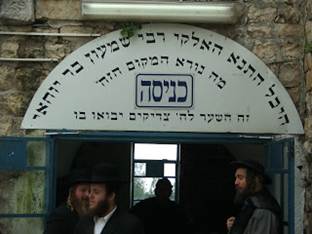
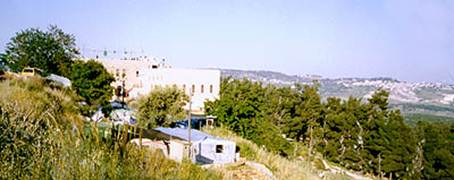
The Tomb of Hakham Shimon bar Yochai,
with the Town of Safed in the Background
In this section I would like to explore the facinating connection that Hakham Shimor Bar Yochai, known by the acronym Rashbi, has with Lag BaOmer. I would also like to explore Safed (also spelled: Zefat, Tsfat, Zfat, Safad, Safes, Safet, Tzfat, Tzefiya) and it’s connection to this holiday.
Let’s start by getting a glimpse of the greatness of this great sage:
Succah 45b Rabbi Shimon said, "I have the power to correct the entire world; I can exempt the whole world from judgment.".
Shabbat 33b; Succah 45b Rabbi Shimon was leaving the cave where he and his son Rabbi Elazar had been in hiding from the Romans for thirteen years. They were talking about the righteousness which exists in the world when Rabbi Shimon said "It's enough that you and I are in the world." Another time he said, "I myself have sufficient merit for the entire world."
Lag B'Omer is the day of the passing of Rashbi. The day on which he left this world, Rashbi revealed many of the hidden secrets of the Torah, the hidden light. The revelation of the hidden light is like the revelation of the colors in the rainbow.
It has been noted that the story of Rashbi’s stay in the cave is related in the Gemara[20], on folio page number thirty-three and that it is the thirty-third time that he is mentioned in the Talmud:
Shabbath 33b Now, why is he [R. Judah son of R. Ila'i] called the first speaker on all occasions?-For R. Judah, R. Jose, and R. Simeon were sitting, and Judah, a son of proselytes, was sitting near them. R. Judah commenced [the discussion] by observing, ‘How fine are the works of this people! They have made streets, they have built bridges, they have erected baths.’ R. Jose was silent. R. Simeon b. Yohai answered and said, ‘All that they made they made for themselves; they built market-places, to set harlots in them; baths, to rejuvenate themselves; bridges, to levy tolls for them.’ Now, Judah the son of proselytes went and related their talk, which reached the government. They decreed: Judah, who exalted [us], shall be exalted, Jose, who was silent, shall be exiled to Sepphoris; Simeon, who censured, let him be executed.
He and his son went and hid themselves in the Beth HaMidrash,[and] his wife brought him bread and a mug of water and they dined. [But] when the decree became more severe be said to his son, Women are of unstable temperament: she may be put to the torture and expose us.’ So they went and hid in a cave. A miracle occurred and a carob-tree and a water well were created for them. They would strip their garments and sit up to their necks in sand. The whole day they studied; when it was time for prayers they robed, covered themselves, prayed, and then put off their garments again, so that they should not wear out. Thus they dwelt twelve years in the cave. Then Elijah came and stood at the entrance to the cave and exclaimed, Who will inform the son of Yohai that the emperor is dead and his decree annulled? So they emerged. Seeing a man ploughing and sowing, they exclaimed, ‘They forsake life eternal and engage in life temporal!’ Whatever they cast their eyes upon was immediately burnt up.[21] Thereupon a Heavenly Echo came forth and cried out, ‘Have ye emerged to destroy My world: Return to your cave!’ So they returned and dwelt there twelve months, saying, ‘The punishment of the wicked in Gehenna is [limited to] twelve months.’ A Heavenly Echo then came forth and said, ‘Go forth from your cave!’ Thus.’; they issued: wherever R. Eleazar wounded, R. Simeon healed. Said he to him, ‘My son! You and I are sufficient for the world.’ On the eve of the Sabbath before sunset they saw an old man holding two bundles of myrtle and running at twilight. What are these for?’ they asked him. ‘They are in honour of the Sabbath,’ he replied. ‘But one should suffice you’?-One is for ‘Remember-’ and one for ‘Observe.’ Said he to his son, ‘See how precious are the commandments to Israel.’ Thereat their minds were tranquilized. R. Phinchas b. Ya'ir his son-in-law heard [thereof] and went out to meet him. He took him into the baths and massaged his flesh. Seeing the clefts in his body he wept and the tears streamed from his eyes. ‘Woe to me that I see you in such a state!’ he cried out. ‘Happy are you that you see me thus,’ he retorted, ‘for if you did not see me in such a state you would not find me thus [learned]. For originally, when R. Simeon b. Yohai raised a difficulty, R. Phinehas b. Ya'ir would give him thirteen answers, whereas subsequently when R. Phinehas b. Ya'ir raised a difficulty, R. Simeon b. Yohai would give him twenty-four answers.
This interesting Gemara needs to be unpacked a bit so that we can understand what is going on. Remember that Gemara is remez literature. This means that the various items are hints to something far deeper. Before I begin to unpack this, let me note that there are some who say that Hakham Shimon ben Yochai and his son exited the cave on Lag B’Omer.[22]
Okay, lets examine some of the items mentioned in this Gemara.
The Gemara indicates that Hakham Yochai and his son were buried up to their necks. The neck is what the Torah uses when it is hinting to the connection between heaven and earth, between the upper world of the head and the lower world of the body. Thus the picture presented is that of two humans who are a part of the earth (buried in the sand as it will be buried in death) and at the same time they are connected to the upper world in their total focus. Additionally, the burial means that there is no more movement. There is no more doing and no more going. This is what happened at Matan Torah when HaShem spoke, there was no movement anywhere on earth.[23] The meaning of this is clear. We move because we have needs. When all of our needs are met, there is no more movement. Being buried up to the neck effectively buried the body and negated it. Hakham Yochai and his son no longer had bodies. This is an allusion to the Olam HaBa, the World To Come.
What is the meaning of the carob tree? We know that a carob tree takes seventy years to bear fruit. [24] So, not only was the sprouting of this tree miraculous, but the time to produce fruit was equally miraculous. Chazal teach that the years of a man are seventy years.[25] This teaches us that the carob tree fruit is something which is beyond the lifetime of a man. Further, seventy years is the years of the Babylonian exile.[26] This suggests that this tree is suggesting that we are looking at the age beyond the current exile. As the carob is sweet, so we would expect that the end of the exile will be a time of sweetness. Finally, we can also view the fruiting of the carob tree as a return to the state we had in Gan Eden. In Gan Eden when one planted a tree he ate of it’s fruit the same day! This carob tree suggests that Hakham Yochai and his son had returned to Gan Eden as it was before the sin of Adam HaRishon. This “return to the future” is what is spoken of in Kohelet:
Kohelet (Ecclesiastes) 1:9 The thing that hath been, it is that which shall be; and that which is done is that which shall be done: and there is no new thing under the sun.
Just as an aside, the Ben Ish Chai tells us that the carobs tasted like the manna. This makes another connection that we need to note: As the manna was miraculous and helped the people to receive Torah on Shavuot, so also was the carob miraculous and helped Hakham Yochai and his son receive Torah secrets. Thus we learn that the Torah is only given to those who eat manna, to those who become a part of Mashiach.
The cave, during second Temple days, was a place where people were buried. A cave also has the connotation of a connection. So, for example, the cave at Machpela was said to be the connection to Gan Eden. Thus a cave is a portal to the next world. In some way we would say that Hakham Shimon ben Yochai was in Olam HaBa even while he was still in this world. Hakham Shimon ben Yochai and his son exited the cave on Lag B’Omer. To suggest that this portal is related to Lag B’Omer.
Why does the Gemara tell us that Hakham Yochai was commanded to go back to his cave? As a hiding place, he surely didn’t own it. We can see by what happened that his cave was quite unique. While most go into their cave and never come back out in this world, Hakham Shimon went to his cave and came back out. Because he could come and go, this cave was called his cave. It was as though death had no power over him.
The well of water is another interesting symbol. Throughout the Torah we see that whenever we see water we always are speaking of Torah. A well is dug by human effort. It is not a naturally occurring phenomenon. The water on the other hand, is entirely up to HaShem. No amount of human effort will create or produce water. Taken together, these two indicate significant human effort combined with the blessing of HaShem is required to derive the secrets of the Torah.
The Midrash relates[27] that three of the greatest men of the Torah encountered their future wives at wells of water. Their names were Yitzchak, Yaaqob, and Moses. This suggests that the well of water in the cave is a place where Hakham Yochai and his son meet Mashiach, their future spouse.
This teaches us that Hakham Yochai and his son have Torah at their fingertips, but this did not come except through their great labor.
The twelve years, plus one, are a clear allusion to the tribes of Israel which are always listed as twelve, yet there are thirteen if one were to list them all.
Hakham Shimon ben Yochai took off his clothes to study Torah in order to show that he had stepped out of his body (which is like a suit of clothes) to a higher level. When he would pray for the physical, he would put on his clothes (he would step back into his body). In the same way, when we burn clothes, on Lag B’Omer, we are connecting with the idea that this body is like a set of clothes which we can shed at will to achieve a higher world. The burning is an allusion to the conversion of the physical (clothes) into the spiritual (fire). Another way to understand their lack of clothes is to view them like Adam HaRishon before the sin. The Torah teaches that Adam and Chava were naked and unashamed.[28] This suggests that Hakham Yochai and his son had returned to Gan Eden as it was before Adam’s sin.
The sand effectively negates the needs of the body. Our Gemara has nothing to say about excretion. The lack of excretion was also seen in the wilderness when we came out of Egypt. Thus our closeness with HaShem and our supernatural food (manna in the wilderness and carob in the cave) combine to show that there is no more evil to be separated from the good. There is only the good. The manna fell at ones feet if he were righteous and involved in the study of Torah. It was ready-to-eat without any preparation. In the same way, the carobs were at their fingertips and they required no preparation.
The end of this Gemara shows how those in the mundane world still have a taste of the Olam HaBa through their honoring and guarding of Shabbat. They use their labor of the six days to connect to the Shabbat. They picture the six thousand years of labor followed by the Messianic age when all will be Shabbat. This seventh millenium is itself a prelude to the Olam HaBa. In this seventh millenium, we will still have going and doing as pictured by the old man. Never the less, in the messianic age we will be connecting with Shabbat through all of our actions.
When Hakham Yochai and his son caused things to burn up, this is the reminder of the bonfires and of the renewal of the earth at the end of the age. HaShem stopped this fire because it was not yet time for this renewal. Thus Hakham Yochai and his son go back to the cave for twelve months. The Gemara indicates that this is analagous to the wicked spending twelve months in Gehenna. So the cave symbolizes death and then the cave symbolizes the dead in Gehenna.
When Hakham Yochai encounters the old man on erev Shabbat, we learn another significant thing about time. This time, just before Shabbat starts, is the time when this world ‘kisses’ the next world. This time speaks to the messianic age when we nned to hurry to make last minute preparations for the messianic age and the Olam HaBa. The sweetness of the myrtle (taken by Sephardim for Shabbat evening) is given to remind of the two Shabbat commands to guard and to remember. We recall that the sweet smell of the myrtle is to give pleasure to the additional soul that we receive on Shabbat. The sense of smell is the sense of the soul. At this time we give precedence to the soul rather than to the body. After all, it is how the righteous judge. This time just before Shabbat is the time when Adam HaRishon was created. This teaches us that man was not made for work, but rather he was made for the messianic age and the Olam Haba. This time when man was created is ripe for redemption, it is ripe for the mitzvot of Shabbat and of the messianic age. As we have mentioned before, Hakham Shimon ben Yochai and his son exited the cave on Lag B’Omer. They exited at this time just before Shabbat. They exited when this world kisses the next world. This time of ‘kissing’ is the time of Lag B’Omer.
The Gemara tells us that Elija came to announce to Hakham Yochai that he and his son could leave the cave. Why Elijah? When we hear Elijah coming, we hear the echos of the prophet Malachi who is sent before Mashiach to prepare the way for the messianic era.[29] Thus we have a hint to the fact that this Gemara is speaking of the time just before the messianic era, an era where we begin our return to Gan Eden. This is the beginning that starts on Lag B’Omer.
Now, why does our Gemara include both Hakham Yochai and Hakham Eleazar, his son? If we go back to our observation that the focus of Lag B’Omer is Hakham Yochai in order to deflect the Romans from focusing on Hakham Akiba who is the teacher and the greater of the two. Remembering this observation suggests that the cave contains the teacher (Hakham Akiba) and his talmid (Hakham Yochai) with Hakham Yochai and his son as stand-ins for Hakham Akiba and Hakham Yochai. This also explains why Hakham Yochai does all the talking. This explanation is reinforced when we understand that the relationship of a teacher and his talmid is a remez to the relationship of a father to his son.
Taken together, this Gemara is showing us the nature of the the Olam HaBa. This is a world without movement. A world where Israel can study Torah without the cares of this world interrupting us. It is a world when Mashiach is the head and Israel is in a marriage covenant with HaShem. It is a world without sin, hunger, thirst, or any worry.
The Gemara[30] narrates how Rashbi and his son hid in a cave for twelve years after fleeing from the Roman decree of death. There, covered in sand, fed by a carob tree and drinking from a spring, the greatest secrets of the Torah were composed. Emerging from the cave, Rashbi perceived Jewish farmers working. Dismayed by their lack of Torah study, he "burned them up!" His shock is understandable in light of his position that Jews should only study Torah and not work. He is considered to be the only person whose Torah study is so great that he need not pray (although he did pray in the cave). Nonetheless, Rashbi and his son were ordered to return to the cave for another year, after which a mellower Rashbi emerged, whose love for every simple Jew was all too apparent. This too[31] was on Lag BaOmer.
There is a recorded tradition in the writings of the HiDA (Hakham Haim David Azulai), that Rashbi, author of the Zohar, received the sacred traditions of the Kabbalah from Hakham Akiva specifically on the thirty-third day of the Omer, Lag BaOmer. This suggests a tradition of the revelation of the sod, or secret, level Torah on this day.
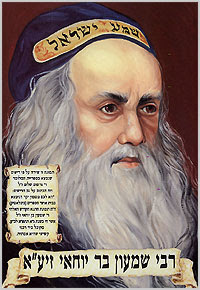 Throughout
the Talmud we find that Rashbi had unique attributes which made him stand out among
all his colleagues. Rashbi was a unifying force, his yahrzeit on Lag BaOmer is celebrated
by Jews of all backgrounds. His is the only yahrzeit that has become a holiday among
all the people.
Throughout
the Talmud we find that Rashbi had unique attributes which made him stand out among
all his colleagues. Rashbi was a unifying force, his yahrzeit on Lag BaOmer is celebrated
by Jews of all backgrounds. His is the only yahrzeit that has become a holiday among
all the people.
What was the uniqueness of the Rashbi? He openly united and integrated both dimensions of Torah: The esoteric and the exoteric, the Talmudic and the mystical, the body and soul of Torah. Rashbi is both one of the greatest Talmudic scholars and the author of the Zohar, the classical work of Kabbalah.
The Rashbi united the ‘body and soul’ of Torah, so he also united the body and soul of people, and thus united all people, regardless of background and school of thought. We can see this unity every year, on Lag BaOmer, at his grave. At his grave we see Jews of every flavor and color, all united in their joy.
The Kaf-Hachaim[32] remarks that Lag BaOmer is the day celebrated in Rashbi’s honor, and it was his will that we should rejoice on that day.
Yeshayahu (Isaiah) 57:1 The Tzaddik is lost; yet nobody bothers to note what has happened. People of kindness are taken away; yet no one understands. It because of the evil that approaches, the Tzaddik is lost.
This is the explanation of the verse, "The Tzaddik is lost...because of the evil that approaches..." The Tzaddik's entire being is devoted to destroying and combating evil. However, his ability to do this is limited by his physical body. Therefore, HaShem removes this Tzaddik from the world prior to the evil's coming. This is so that the Tzaddik's body will no longer restrict his efforts to help Israel. In heaven, he is free to mitigate the harsh decree.
This pasuk in Yeshayahu can now help us understand that Yeshua’s ascension and departure from this world, was for our benefit, as we read:
Yeshayahu (Isaiah) 53:10-12 Yet it pleased HaShem to bruise him; he hath put him to grief: when thou shalt make his soul an offering for sin, he shall see his seed, he shall prolong his days, and the pleasure of HaShem shall prosper in his hand. 11 He shall see of the travail of his soul, and shall be satisfied: by his knowledge shall my righteous servant justify many; for he shall bear their iniquities. 12 Therefore will I divide him a portion with the great, and he shall divide the spoil with the strong; because he hath poured out his soul unto death: and he was numbered with the transgressors; and he bare the sin of many, and made intercession for the transgressors.
Romans 8:31-34 What shall we then say to these things? If God be for us, who can be against us? 32 He that spared not his own Son, but delivered him up for us all, how shall he not with him also freely give us all things? 33 Who shall lay any thing to the charge of God’s elect? It is God that justifieth. 34 Who is he that condemneth? It is Mashiach that died, yea rather, that is risen again, who is even at the right hand of God, who also maketh intercession for us.
This is the true reason for the great celebration on Lag BaOmer. On the 33rd Day of the Omer many, many years ago, Rashbi’s powers to bring help and salvation to all of Am Israel increased manifold.[33]
![[ Route down from Tzfat ]](lgbomer.files/image008.jpg)
View from Safed
Safed is a city on a hill. It is 900 meters (3200 feet) above sea level. Safed is Israel's highest town. The city is most closely associated with Jewish mysticism, the kabbalah, whose foremost exponent, Hakham Isaac Luria, The Ari, lived and taught there. The Zohar (meaning splendor or radiance) was written by Rashbi, near Safed. Besides the kabbalists, Safad also attracted numerous other Jewish scholars and spirtualists, including Joseph Caro, the author of the Shulchan Aruch, Rabbi Moshe Cordovero and Solomon Alkabetz, composer of the Sabbath hymn Lecha Dodi. This calls to mind what the Master of Nazareth said:
Matityahu (Matthew) 15:13 Ye are the salt of the earth: but if the salt have lost his savour, wherewith shall it be salted? it is thenceforth good for nothing, but to be cast out, and to be trodden under foot of men. 14 Ye are the light of the world. A city that is set on an hill cannot be hid. 15 Neither do men light a candle, and put it under a bushel, but on a candlestick; and it giveth light unto all that are in the house. 16 Let your light so shine before men, that they may see your good works, and glorify your Father which is in heaven.
Thus we understand that Safed was the city on a hill with a great light (Zohar).
Meron, where Rashbi is buried, is a village just outside of Safed.
Safed is also to play an important role in the final redemption. The Meam Loez, in the name of Rabbi Shimon bar Yochai, says that the Mashiach will come from Safed on his way to Jerusalem. The Ari HaKodesh said that until the third Temple is built, the Shechinah rests above Safed.
Safed is the fulcrum where the spiritual meets the physical. The Ari explained that the mystical dimensions of the Torah are a "kabbala", literally "something that is received". It is not a knowledge that can be attained through studying a text, but an understanding that must be "received" from a a teacher who himself received from one before him. Thus the mystical dimension of the Torah is hidden, but it was revealed by Rashbi.
In our generation we are close to the completion of the sixth millennium. This dark generation desperately needs the revelation of Torah and Mashiach, therefore, we have been permitted to have the teachings of the Ari and those of the Zohar revealed in a most significant way. From our generation onwards, the words of the Zohar will begin to be revealed more and more until their whole measure is revealed according to the will of HaShem.
In the light of this we can now understand the words of Rabbi Kook (Orot ha-Kodesh, I, p. 141):
Revealing the mystical in "the last generations" to purify the hearts and occupy the minds with sublime thoughts whose origins are in the secrets of the Torah, will become, in the last generation, utterly essential to the preservation of Judaism. The descent of the generation, which led to the necessity of employing this lofty means, is itself the ascent.

Lag B’Omer takes place of the 18th day of the second month. However, in the beginning the second month was not Iyar, rather the second month was Heshvan, according to the Gemara.[34] The Torah teaches us that the flood began on the seventeenth day of the second month:
Bereshit (Genesis) 7:11 In the six hundredth year of Noah’s life, in the second month, the seventeenth day of the month, the same day were all the fountains of the great deep broken up, and the windows of heaven were opened. 12 And the rain was upon the earth forty days and forty nights.
This means that the first full day of the flood was the eighteenth day of the second month!
From this we understand that Lag B’Omer is the bimodal equivalent of the mabul, the flood. As we examine the customs of Lag B’Omer you will constantly see the flood motifs coming through.
The biblical calendar of agriculturally-based religious holidays divides the year neatly into two halves (the early and the latter rains). On the 15th of Tishri, we celebrate the fall harvest with Succoth and six months later, the spring harvest coincides with our celebration of Pesach. Each of these festivals lasts for seven days and then is followed by an extra gathering, an atzeret, at its conclusion. However, the atzeret celebrations of Succoth and Pesach differ in their timing. The concluding festival of Succoth, now called Shemini Atzeret, happens immediately at the conclusion of the holiday, giving Succoth the feeling of being an eight day celebration, whereas the atzeret of Pesach arrives a full seven weeks later with the arrival of Shavuot. I am calling this bifurcation of the calendar the bimodality of the year. In the following paragraphs, I will try to explain how this bimodality connects the flood and Lag B’Omer.
On the 27th day of the second month, Noach, his family, and all the animals that were with them left the ark.[35] Exactly one lunar year and ten days before, one complete solar year, the flood began on the 17th of the second month, the day before Lag B’Omer. When Noach, the animals and his family went out from the ark, God made a covenant,[36] with all the animals and the people, that there would never be again be a flood of water to destroy life on Earth.
The rainbow covenant was given with a rainbow as a sign of the covenant on Iyar 27,[37] which is always the 42nd day of the Omer,[38] the day before Yom Yerushalayim. Other days connected the Rainbow Covenant include Shabbat Noach and Shabbat Behar.
The septennial Torah reading lectionary[39] is divided into two 3 ½ year cycles, which follows the standard Sabbatical cycle (shmita). Every time we read about the mabul in Bereshit (Genesis) chapters 7 – 9, it will juxtapose Iyar 18 with Heshvan 18, 3 ½ years later – When the mabul took place. Now, Iyar 18 and Heshvan 18 are normally juxtaposed bimodally[40] EVERY YEAR of the septennial cycle.
In Rosh Hashana 11b, Rabbi Yehoshua said that the ‘second month’ when the flood began, in Genesis 7:11, was Iyar. Thus, we would understand that the first full day of the flood was Iyar 18 since the flood began during the day on Iyar 17. This solidifies our connection of the bows and arrows of Lag B’Omer with Noach’s flood.
Rosh Hashana 11b R. Joshua and R. Eliezer are herein consistent [with views expressed by them elsewhere], as it has been taught: ‘In the sixth hundredth year of Noah's life, in the second month, on the seventeenth day of the month.[41] R. Joshua said: That day was the seventeenth day of Iyar, when the constellation of Pleiades sets at daybreak and the fountains begin to dry up, and because they [mankind] perverted their ways, the Holy One, blessed be He, changed for them the work of creation and made the constellation of Pleiades rise at daybreak and took two stars from the Pleiades and brought a flood on the world. R. Eliezer said: That day was the seventeenth of Marheshvan, a day on which the constellation of Pleiades rises at daybreak, and [the season] when the fountains begin to fill
At the same time, we read about the rainbow covenant (Bereshit (Genesis) 9:9-17), which took place on the 27th day of the second month (Heshvan 27), will also line up with the 27th day of the second month (Iyar 27). The triennial cycle puts events very close to their proper time slot!
|
005 – Gen. 8:1-22 = 22 v, וַיִּזְכֹּר אֱלֹהִים, אֶת-נֹח |
Heshvan 11, 5783 |
Iyar 15, 5786 Second Pesach |
|
006 – Gen. 8:15 – 9:17 = 25v. צֵא, מִן-הַתֵּבָה |
Heshvan 18, 5783 |
Iyar 22, 5786 |
This juxtaposition of Lag B’omer with the reading of the mabul, is another reason for associating the rainbow with Lag B’Omer.
On Lag BaOmer it is customary to take the children to picnics to play with bows and arrows. One of the explanations given for this custom is that we are told that in the course of Hakham Shimon’s lifetime, no rainbow appeared in the sky. The rainbow is a sign of human failing: as related in the ninth chapter of Genesis, HaShem promised that whenever mankind shall be as undeserving as it was in the generation of the flood, the rainbow will remind Him of His vow to never again destroy His world. But as long as Hakham Shimon was alive, his merit alone was enough to ensure that HaShem would not regret His creation. Hence the connection of the bow (keshet - הַקֶּשֶׁת)[42] to Lag BaOmer. One of the most complete expressions of unity is the establishment of oneness between adults and children, two opposites. For this reason, Lag BaOmer is celebrated by activities with Jewish children. Additionally, the rainbow is intimately connected with Mashiach, according to the Zohar:
Zohar, Bereshit, 1:72b R. Judah said, ‘This is assuredly so, but the rainbow that appears in the sky has a profound mystic significance, and when Israel will go forth from exile that rainbow is destined to be decked out in all the finery of its colours, like a bride who adorns herself for her husband.’ The Judean said to him, ‘This is what my father said to me when he was on the point of departing this world: “Do not expect the coming of the Messiah until the rainbow will appear decked out in resplendent colours which will illumine the world. Only then expect the Messiah.”
A rainbow reveals the hidden secrets of white light. White light seems indivisible, yet with a prism we can reveal it’s hidden colors. No color can be discerned in its pure whiteness. The rainbow reveals the secret of the white light. It shows us how the white light is really composed of all the colors.
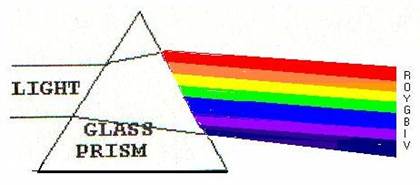
Lag B'Omer is the day of the passing of Rabbi Shimon Bar Yochai. The day on which he left this world, Rabbi Shimon revealed many of the hidden secrets of the Torah, the hidden light.
The revelation of the hidden light of the Torah and Mashiach is like the revelation of the colors in the rainbow.
Tachanun (penitential prayers) and "nefilat apayim" are not recited on Lag BaOmer, neither at shacharit (morning prayers) nor at mincha (afternoon prayers). They are not recited at mincha of the previous day, either. We do not fast on Lag BaOmer, yet nowhere does one find a source to support its being made into a festival. Moreover, if the intention is to mark the death of Hakham Shimon bar Yochai, why the celebration? The accepted way of marking the death of a righteous person is by fasting. How then is it that Hakham Shimon bar Yochai's expiration has become occasion for joy and festivity? I believe that these questions are all rightfully answered when we understand that this was the day of Yeshua’s (Mashiach ben Yosef) ascension. So, we find that the essence of our joy on Lag BaOmer centers on the talmidim of Yeshua, and Hakham Akiva, who took it upon themselves to hand down the great Master's tradition.
For Sephardic Jews, the Omer period mourning continues until the thirty-fourth day of the Counting of the Omer and until then weddings and haircuts are forbidden. Only in the case of singing, dancing, and playing musical instruments are they lenient, permitting them on the thirty-third day of the Omer. At nightfall, with the commencement of the thirty-fourth day of the Omer, they return to observing all of the customs of mourning until the following morning. On the morning of the thirty-fourth day of the Omer, all mourning practices are lifted. Moreover, if Lag BaOmer falls on Friday the Sephardic Jews too permit the cutting of hair. There are also, among the Sephardic Jews, some who end their mourning on the thirty-third day of the Omer like the Ashkenazic Jews.
Hakham Yoseph Hayyim (author of Ben Ish Hai), states that weddings are permitted from the thirty-third day. It should be noted that Sephardim may perform marriages on any day from Lag BaOmer on and not on Lag BaOmer itself.
On the eve of Lag BaOmer, it is our custom to have a festive meal during which many special songs, especially those connected with Hakham Shimon Bar Yohai, are sung. No musical instruments are used. In addition, Hakham Yoseph Hayyim, wrote the "Hillula Rabba" (“The Great Ascent”) which is appropriate to read during this auspicious night.[43]
Ashkenazic tradition permits weddings and haircuts on the day of Lag BaOmer, and there are those who are lenient, permitting weddings and haircuts already from nightfall on Lag BaOmer eve. There are differing practices among Ashkenazic Jews concerning how to behave after Lag BaOmer has passed. Some are accustomed to ending all mourning practices on Lag BaOmer, while others continue to observe these customs even afterwards. Only on Lag BaOmer itself do they suspend their mourning customs.
Many have the custom not to cut a boy's hair until he is three years old, the age at which he first begins to learn Torah. Because this idea is tied into Kabalistic thought concerning hair, many put off the ceremony, called an chalakah, until Lag BaOmer.
Some people eat carob to commemorate the miracle[44] of the carob tree that sustained R. Shimon Bar Yochai and his son for twelve years while they hid from Roman authorities.
For hundreds of years now there has been a custom to light a large bonfire in Meron in honor of Hakham Shimon bar Yochai's Hillula (ascent - Yahrzeit celebration). The Hillula of Hakham Shimon Bar Yochai is considered to be the Matan Torah (Giving of the Torah) of Torat HaNistar, (the Hidden or Mystical aspects of the Torah). A Hillula is a celebration of the life and deeds of a Tzadik. The day is celebrated with illuminations, because, according to the narrative, at the death of R. Simeon the world was filled with light, since the revelations which he had received were then put in writing in the Zohar.
Imagine that you have a bonfire burning brightly in front of you. What are you doing? If you are like most folks, you are mezmerized by the flames and you find your eyes following the flames up into the sky. You follow the burning embers as they fly ever further up. This is the effect of a bonfire. Curiously, this is the same thing that the desciples did at Yeshua’s ascension:
II luqas (Acts) 1:9-11 And when he had spoken these things, while they beheld, he was taken up; and a cloud received him out of their sight. 10 And while they looked stedfastly toward heaven as he went up, behold, two men stood by them in white apparel; 11 Which also said, Ye men of Galilee, why stand ye gazing up into heaven? this same Yeshua, which is taken up from you into heaven, shall so come in like manner as ye have seen him go into heaven.
Judaism teaches that the souls of righteous men ascend to heaven upon liberation from their bodies. Thus Hakham Shimon Bar Yochai and Yeshua both ascended on Lag BaOmer. The difference is that Yeshua ascended bodily.
At Hakham Shimon bar Yochai's Hillula there is such fellowship between Jews. We offer each other food and drink, we say Tehillim together.
Tehillim (Psalms) 122:7-9 “May there be peace within your walls and serenity within your palaces. For the sake of my brothers and friends, I shall speak peace amongst you…”
This were precisely the same things that Yeshua’s desciples did after the ascension:
Luqas (luke) 24:51 And it came to pass, while he blessed them, he was parted from them, and carried up into heaven. 52 And they bowed to him, and returned to Jerusalem with great joy: 53 And were continually in the temple, praising and blessing God. Amen.
Even in places other than Meron, Hassidic Jews make a practice of lighting bonfires on Lag BaOmer. Some also light candles in the synagogue in honor of Hakham Shimon bar Yochai's Hillula. The bonfires and candles, with their light, symbolize Torah and mitzvot, as it says:
Mishlei (Proverbs) 6:23 For the commandment is a candle, and the Torah, light.
This connection between the bonfires and the light of Torah also provides an additional connection to Mashiach who is called the “Light of the World”:
Yochanan (John) 8:12 Then spake Yeshua again unto them, saying, I am the light of the world: he that followeth me shall not walk in darkness, but shall have the light of life.
The customs of lighting candles and bonfires as an allusion to the Torah and mitzvot also provided the perfect illustration that points to Yeshua, The Living Torah. As fire only ascends, so too did Yeshua, ascend on Lag BaOmer. We have previously learned in our study of Mashiach that Mashiach = Israel. This suggests that when Mashiach ascended, Israel also ascended. As it says in the Nazarean Codicil:
Colosians 1:18 And he is the head of the body, the church: who is the beginning, the firstborn from the dead; that in all things he might have the preeminence.
Yochanan (John) 15:5 I am the vine, ye are the branches: He that abideth in me, and I in him, the same bringeth forth much fruit: for without me ye can do nothing.
Hassidic Jews make a practice of lighting bonfires on Lag BaOmer in order to hint at the great light of the secrets of the Torah which were revealed by Hakham Shimon bar Yochai. The Zohar records that on the day on which Hakham Shimon bar Yochai died, he revealed the secrets of the Torah, and the house became filled with light and fire to the point that the students could not approach or even look at Hakham Shimon. The revelation of the secrets of the Torah is also the mission of Yeshua, Mashiach ben Yosef:
Matityahu (Matthew) 13:34 All these things spake Yeshua unto the multitude in parables; and without a parable spake he not unto them: 35 That it might be fulfilled which was spoken by the prophet, saying, I will open my mouth in parables; I will utter things which have been kept secret from the foundation of the world.
Thus we can clearly see that the messianic aspirations of Bar Kochba that were so adamantly supported by Hakham Akiva were misplaced only in Bar Kochba. The messianic longing that was so fervently displayed by Hakham Akiva, and his Talmidim, is intimately bound up with Lag BaOmer and it’s association with Yeshua, Mashiach ben Yosef.
In a previous study I learned that the triennial cycle (Shmita) of Torah readings will put the Torah in an order that relates to the events of the week in which it is read. In the following table, I will attempt to show the relationship of Lag BaOmer to the triennial cycle sedarim for fourteen (14) years.
|
5765
5th reading |
Bereshit (Genesis) 6:9 – 7:24 Building the ark and the flood. Rashi indicates that the first full day of the flood was on Iyar 18 which is Lag BaOmer. Thus this reading from the triennial cycle clearly relates to Lag BaOmer. Noach and his family exhibited the unity of HaShem’s people with Noach being a remez for HaMashiach.
The eighteenth (18th) and the thirty-third (33rd) word of this seder is את – ET, The first and the last letters of the Hebrew Alefbet. |
|
5765
6th reading |
Bereshit (Genesis) 8:1 – 9:17 End of the flood and the rainbow. In addition to the fact that Rashi says that the flood started on Lag BaOmer, we have a tradition that during the life of Hakham Shimon Bar Yochai no rainbow appeared because of his merit. This fact gives rise to the tradition that the children play with bows (a backwards rainbow) and arrows on Lag BaOmer. |
|
5766
53rd reading |
Shemot (Exodus) 10:1-29 Plagues of Locusts and Darkness. The seder speaks of the darkness of the Egyptians. Our Sages teach that the Jews had light during this plague. On Lag BaOmer the Zohar was revealed. Yet this great light is unusable by the goyim. Thus we see that this is a fitting reading for Lag BaOmer. |
|
5766
54th reading |
Shemot (Exodus) 11:1 – 12:28 Plundering the Egyptians, Passover. In this reading the Jews are commanded to borrow gold and silver. Our Sages have taught that this was the treasure that was revealed to the Jews during the plague of darkness. Further, this is the seder that foretells the death of the firstborn of the wicked. This is a repeat of the death of the firstborn of the wicked that occurred during the flood which started on Lag BaOmer. This seder also contains the command of the Passover lamb which is the sacrifice which preserved the firstborn of the righteous, just as they were preserved in the days of Noach. Thus we have another reading fit for Lag BaOmer. |
|
5767
94th reading |
Vayikra (Leviticus) 19:1-22 Peace offerings – no robbing or hating. The Passover offering, if disqualified, is to be used as a Peace offering. Now Lag BaOmer is the third day after the second Passover, the second Passover. The Peace offering becomes can not be eaten on the third day and must be burnt. Hakham Akiva’s 24,000 students died during a plague. It was Hakham Akiva's contention that the plague was a warning to cease any further Lashon hara (evil speech) or that something worse would happen.
What were the root causes of the Flood, that began in earnest on Lag BaOmer? Rashi cites sexual immorality and idolatry. Following the Gemara in Sanhedrin, Rashi adds that "Hamas" or theft sealed the generation's fate. This seder also warns us against immorality, idolatry, and theft. Thus we see, again, that we have several strong connections with Lag BaOmer. |
|
5767
95th reading |
Vayikra (Leviticus) 19:23 – 20:27 Fear HaShem, sanctify yourself. What were the root causes of the Flood, that began in earnest on Lag BaOmer? Rashi cites sexual immorality and idolatry. Following the Gemara in Sanhedrin, Rashi adds that "Hamas" or theft sealed the generation's fate. This seder also warns us against immorality and idolatry. Thus we see, again, that we have a strong connection with Lag BaOmer. |
|
5768
143rd reading |
Devarim (Deuteronomy) 6:4 – 7:11 Shema, a special people. The Shema refers to HaShem, eighteen (18) times. Lag BaOmer occurs on Iyar 18. The goal of the Shema is in 6:24 – that he might preserve us alive. A theme of Lag BaOmer is the unity of HaShem’s people as indicated by the lack of fighting on the ark.
In the Shema, we pray: "if you listen to My commandments ... I will give the rain in its correct time ... and you will gather your corn your wine and your oil ... Be careful in case you turn away and serve other gods ... then the L-rd will be angry with you and stop up the sky and there will be no rain and the earth will not give its produce ... " |
|
5768
144th reading |
Devarim (Deuteronomy) 7:12 – 8:20 Keep the commandments, ridding the land of evil inhabitants. The focus of this pasuk is the destruction of the wicked who inhabit Eretz Israel, by HaShem. This is the theme of the flood and the theme of Lag BaOmer. |
|
5769
27th reading |
Bereshit (Genesis) 29:31 – 30:21 Leah, Bilhah, and Zilpah’s children. This seder deals with the birth of Yaaqov’s children from Leah, Bilhah, and Zilpah. Children are a blessing from HaShem like the Manna and like rain, which are themes of Lag BaOmer. |
|
5769
28th reading |
Bereshit (Genesis) 30:22 – 31:2 Rachel is remembered, Yaaqov’s wages. This seder again speaks of the blessings of children and of special sheep from HaShem, themes of Lag BaOmer. |
|
5770
72nd reading |
Shemot (Exodus) 32:15 – 33:23 The golden calf, Moshe pleads for the People. The laws of the Torah which we receive on Shavuot are not enough to protect us from the Golden Calf. So HaShem in His infinite mercy gives us broken tablets the deepest secret of the Torah, the Torah of Hakham Akiva and Reb Shimon Bar Yochai. He gives them to us before Shavuot, on Lag BaOmer. And then on Shavuot what we receive is even deeper than the secrets of the Torah, the utmost heavenliness and HaShem’s holiness of the Torah.
The Gemara says that HaShem always gives the medication before the disease. So every Shavuot there is always a possibility of making another golden calf. Maybe last year we did it, maybe we are still doing it. So Lag BaOmer is the day that HaShem gave us the secrets of the Torah. |
|
5770
73rd reading |
Shemot (Exodus) 34:1-26 Thirteen attributes, pilgrimage festivals. The beard is seen in Kabbala as the seat of mercy (rachamim). Kabbalistic works identify thirteen components of the beard (either tufts or parts of the face that are devoid of hair and thus outline the beard), corresponding to G-d’s thirteen attributes of mercy (Exodus 34:6-7). Indeed, Arich Anpin connotes ‘patience’ a concept closely allied to that of mercy. The thirteen components of the beard of Arich Anpin are called mazzalot (sing. Mazal), which means a ‘source of flow’ or influence.
The “corners” of the beard are denoted in the forming of peyotes when a child receives his haircut on Lag BaOmer. |
|
5771
118th reading |
Bamidbar (Numbers) 15:1-41 Fire offerings, gathering wood on Shabbat. Fire only rises and those who violate Shabbat, lower themselves. As the Zohar causes us to rise, which is associated with the ascension of Yeshua, so we see another theme of Lag BaOmer. |
|
5771
119th reading |
Bamidbar (Numbers) 16:1 – 17:15 Qorach’s rebellion. The Talmud relates that Hakham Akiva’s students all died between the holidays of Pesach and Shavuot because they did not treat each other respectfully[45]. The day they stopped dying was Lag BaOmer (the 33rd day of Counting the Omer[46]. Clearly the lack of respect that Qorach had for Moshe is associated with the lack of respect found in Akiva’s disciples. So Qorach died as did Akiva’s disciples.
The prophet Elisha was also called a bald man. As he was going to Bet-El, youths came out and called after him, “Go, you bald man, go, you bald man!” Elisha cursed them, and two bears came out of the forest and attacked forty-two children” (II Kings 2:23-24). He created “a bald spot” among the children that day. Qorach does the same, when he causes the death of so many people who joined his revolt[47]. Since we see that the hair on our heads is associated with Lag BaOmer, we again have a connection. |
|
5772
4th reading |
Bereshit (Genesis) 5:1 – 6:8 Generations of Adam, Noach’s generation. This seder contains the reason for the flood after ten generations. |
|
5772
5th reading |
Bereshit (Genesis) 6:9 – 7:24 Building the ark and the flood. Rashi indicates that the first full day of the flood was on Iyar eighteen, which is Lag BaOmer. Thus this reading from the triennial cycle clearly relates to Lag BaOmer. |
|
5773
55th reading |
Shemot (Exodus) 12:29-51 Death of the firstborn, leaving Egypt. There are two firstborns: Those that belong to HaShem and those that do not. The purpose of the flood was to destroy the firstborn who did not belong to HaShem. Thus this is a very appropriate reading for Lag BaOmer. |
|
5773
56th reading |
Shemot (Exodus) 13:1 – 14:14 Leaving Egypt, Paro follows. They left during the counting of the omer. HaShem protected them even as He protected Noach. |
|
5774
98th reading |
Vayikra (Leviticus) 23:15-44 The Omer and the fall festivals. The counting of the Omer is an integral part of understanding the thirty-third day of this count. Thus we see that this reading tallies with Lag BaOmer. |
|
5774
99th reading |
Lev. 24:1 – 25:13 Menorah oil, blasphemer, Sabbatical and Yovel years Rashi tells us, was the son of a Jewish woman and the Egyptian whom Moshe killed in Egypt[48]. What is unusual is the fact that the mother's name is mentioned in the Torah (Shelomit bat Divri), which usually constitutes Lashon hara, evil talk.
However, Rashi is quick to explain why. Singling out Shelomit bat Divri is an indirect way of telling us that, in spite of the Egyptians' best efforts, the Jewish women stayed loyal to their husbands throughout their long servitude, that is, with the exception of Shelomit bat Divri. Furthermore, Rashi explains, the Torah mentions her name to emphasize what led to her unfaithfulness: she was always talking and saying "Shalom" to everyone. In other words, Shelomit's lack of modesty is the basis of a loss of holiness.
They say that the problem with talking too fast is that you might say something that you haven't thought of yet; you can add to this that the problem of talking too much is that you can say things that can lead to the unthinkable! Perhaps this is why we couple with the mitzva of the Omer-Offering, the mitzva to verbally count the omer as well. This reminds us that "there is nothing better for the body than silence," and nothing better for the soul than holy speech. This is true acCOUNTability. |
|
5775
143rd reading |
Devarim (Deuteronomy) 6:4 – 7:11 Shema, a special people. The Shema refers to HaShem eighteen times. Lag BaOmer occurs on Iyar 18. The goal of the Shema is in 6:24 – that he might preserve us alive. A theme of Lag BaOmer is the unity of HaShem’s people as indicated by the lack of fighting on Noach’s ark. |
|
5775
144th reading |
Devarim (Deuteronomy) 7:12 – 8:20 Keep the commandments, ridding the land of evil inhabitants. The focus of this pasuk is the destruction of the wicked who inhabit Eretz Israel, by HaShem. This is the theme of the flood and the theme of Lag BaOmer. |
|
5776
28th reading |
Bereshit (Genesis) 30:22 – 31:2 Rachel is remembered, Yaaqov’s wages. This seder again speaks of the blessings of children and of special sheep from HaShem, themes of Lag BaOmer. |
|
5776
29th reading |
Bereshit (Genesis) 31:3 – 32:3 Yaaqov leaves Laban. HaShem takes care of the righteous and thwarts the plans of the wicked. The monument Yaaqov sets up is called Galeed. If you reverse the letters of “Lag” you get “Gal” which means revelation. Galeed is a “witness heap”. |
|
5777
30th reading |
Shemot (Exodus) 32:15 – 33:23 The golden calf, Moshe pleads for the People. The laws of the Torah which we receive on Shavuot are not enough to protect us from the Golden Calf. So HaShem in His infinite mercy gives us broken tablets the deepest secret of the Torah, the Torah of Hakham Akiva and Reb Shimon Bar Yochai. He gives them to us before Shavuot, on Lag BaOmer. And then on Shavuot what we receive is even deeper than the secrets of the Torah, the utmost heavenliness and HaShem’s holiness of the Torah.
The Gemara says that HaShem always gives the medication before the disease. So every Shavuot there is always a possibility of making another golden calf. Maybe last year we did it, maybe we are still doing it. So Lag BaOmer is the day that HaShem gave us the secrets of the Torah. |
|
5777
73rd reading |
Shemot (Exodus) 34:1-26 Thirteen attributes, pilgrimage festivals. The beard is seen in Kabbala as the seat of mercy (rachamim). Kabbalistic works identify thirteen components of the beard (either tufts or parts of the face that are devoid of hair and thus outline the beard), corresponding to G-d’s thirteen attributes of mercy (Exodus 34:6-7). Indeed, Arich Anpin connotes ‘patience’ a concept closely allied to that of mercy. The thirteen components of the beard of Arich Anpin are called mazzalot (sing. Mazal), which means a ‘source of flow’ or influence.
The “corners” of the beard are denoted in the forming of peyotes when a child receives his haircut on Lag BaOmer. |
|
5778
117th reading |
Bamidbar (Numbers) 14:11-45 The sin of the spies. As HaShem destroyed the sinners in the flood, so he destroyed those who believed the report of the spies. |
|
5778
118th reading |
Bamidbar (Numbers) 15:1-41 Fire offerings, gathering wood on Shabbat. One of the traditions of Lag BaOmer is to light bonfires. Now, there is no sense in gathering wood if not to make a fire (which was forbidden on Shabbat). Thus we see that this is an appropriate reading for Lag BaOmer. |
Y Y Y
In the Triennial Torah reading cycle, the thirty-third reading in Bereshit (Genesis) 37:1-37. This seder speaks about the betrayal of Yosef ben Yaaqov, which was the first step in his ascension! Further, we know that Yosef ben Yaaqov before he became second to Paro, was a remez of Mashiach ben Yosef. The thirty-third word of this seder is את – ET, The first and the last letters of the Hebrew Alefbet. This reminds us of Yeshua’s words:
Revelation 1:8 I am Alpha and Omega, the beginning and the ending, saith the Lord, which is, and which was, and which is to come, the Almighty.
Alpha and Omega are the first and last letters of the Hebrew alphabet.
The eighteenth (18th) seder in the triennial cycle is Bereshit (Genesis) 22:1-19. This seder is the story of the Akeida, the binding of Isaac! The thirty-third (33rd) word of this portion, following the introduction, is also את – ET, The first and the last letters of the Hebrew Alefbet.
My teacher, Hakham Dr. Yosef ben Haggai has taught that the following are events of Lag BaOmer:
1) Israel was forty years in the Sinai Wilderness. HaShem has shown Moshe the Heavenly Tabernacle, or Temple, and had instructed Moshe to make a Tabernacle in the wilderness alike the order of the one shown to him at the mountain. It took one year to build the Tabernacle of Israel, which Israel used as the meeting place of HaShem with them for the remaining thirty-nine years. During those thirty-nine years, Israel spent six years moving about with the Tabernacle dismantled and unused. This brings us to the point that the Tabernacle of Israel was in use as the meeting place for HaShem and His people for exactly thirty-three years of the forty years of the wilderness experience.
2) When His Majesty King Yeshua was Lag BaOmer in age (thirty-three years of age) his body (temple) was put to death by the Roman execution of the cross.
3) When His Majesty King Yeshua was risen from the dead for Lag BaOmer days, He ascended to heaven.
On Lag BaOmer, Yeshua ascended into heaven[49]. As is well known, Lag BaOmer was instituted as a day of rejoicing because Hakham Shimon bar Yochai died on that day. On the day of a person's passing, his entire lifework and all his labor in Torah and mitzvot are gathered together and ascend to the spiritual realms. Thus it is understood why Yeshua ascended on this day.
Y Y Y
Chazal teach that there is an intimate connection between the flood and Lag BaOmer. In this section we will explore some of these connections.
Rashi indicates that the first full day of the mabul, the flood, was Iyar 18.
Bereshit (Genesis) 7:11 In the six hundredth year of Noah’s life, in the second month, the seventeenth day of the month, the same day were all the fountains of the great deep broken up, and the windows of heaven were opened.
Rosh HaShana 11b R. Joshua and R. Eliezer are herein consistent [with views expressed by them elsewhere], as it has been taught: ‘In the sixth hundredth year of Noah's life, in the second month, on the seventeenth day of the month. R. Joshua said: That day was the seventeenth day of Iyar, when the constellation of Pleiades sets at daybreak and the fountains begin to dry up, and because they [mankind] perverted their ways, the Holy One, blessed be He, changed for them the work of creation and made the constellation of Pleiades rise at daybreak and took two stars from the Pleiades and brought a flood on the world.
According to tradition, rainbows, were not seen while Hakham Shimon Bar Yochai was alive because his merit alone was enough to protect the world against the calamity of a flood. Since "rainbow" and "bow" are both called keshet in Hebrew, the custom developed for children to play with bows and arrows.
Another interpretation is given of this custom, in accordance with a saying in the Zohar that a bow of many colors will appear in the sky immediately before the coming of the Mashiach. The bow with which the children play on that day thus symbolizes the prayer of the Jews that the promised bow shall appear.
On Lag BaOmer, HaShem sent The Bread from Heaven (manna).[50] The Chatam Sofer says that it was on the 18th of Iyar (Lag BaOmer) that the Manna began to fall. This is based on the idea that the food supply (matza) that we brought out of Egypt lasted until the 14th of Iyar (which marks the 14th of Iyar as the end of the Pesach time frame, hence its choice by HaShem for the second Passover). Then the people went hungry for three days on the 15th, 16th, and 17th of Iyar, and complained to Moses before they received the Manna on the 18th.
Shemot (Exodus) 16:1 And they took their journey from Elim, and all the congregation of the children of Israel came unto the wilderness of Sin, which is between Elim and Sinai, on the fifteenth day of the second month after their departing out of the land of Egypt. 2 And the whole congregation of the children of Israel murmured against Moses and Aaron in the wilderness: 3 And the children of Israel said unto them, Would to God we had died by the hand of HaShem in the land of Egypt, when we sat by the flesh pots, and when we did eat bread to the full; for ye have brought us forth into this wilderness, to kill this whole assembly with hunger. 4 Then said HaShem unto Moses, Behold, I will rain bread from heaven for you; and the people shall go out and gather a certain rate every day, that I may prove them, whether they will walk in my law, or no.
What is the connection between The manna starting on Iyar 18 and the rejoicing at Rabbi Shimon bar Yochai’s hillula? – Rabbi Shimon bar Yochai’s teaching of the secrets of the Zohar was also bread from heaven (manna)! His teaching of the Torah come down from heaven was also manna! No wonder te manna began falling on Lag B’Omer, the hillula of Rabbi Shimon bar Yopchai who also gave manna to the people until he died. Further, only the generation that ate the manna could absorbe the secrets of the Torah.
Two generations were called the greatest generations that ever lived: The Dor HaDeah,[51] the generation of the wildreness and the generation of Rabbi Shimon bar Yochai.
Another connection between manna and the omer, besides the date, has to do with the use of the word omer. In connection with the manna, Moshe Rabeinu indicates that everyone received an omer of manna every day. The use of the word omer should automatically connect us to the counting of the omer, just by the use of the word itself!
Shemot (Exodus) 16:15-18 And when the children of Israel saw it, they said one to another, It is manna: for they wist not what it was. And Moses said unto them, This is the bread which HaShem hath given you to eat. 16 This is the thing which HaShem hath commanded, Gather of it every man according to his eating, an omer for every man, according to the number of your persons; take ye every man for them which are in his tents. 17 And the children of Israel did so, and gathered, some more, some less. 18 And when they did mete it with an omer, he that gathered much had nothing over, and he that gathered little had no lack; they gathered every man according to his eating.
The manna is also associated with dew as the dew provided protection for the manna both above and below:
Bamidbar (Numbers) 11:9 And when the dew fell upon the camp in the night, the manna fell upon it.
This same dew will be used in the future to resurrect the dead:
Chagigah 12b ‘Araboth is that in which there are Right and Judgment and Righteousness, the treasures of life and the treasures of peace and the treasures of blessing, the souls of the righteous and the spirits and the souls which are yet to be born, and dew wherewith the Holy One, blessed be He, will hereafter revive the dead. Right and Judgment, for it is written: Right and judgment are the foundations of Thy throne.
Rambam writes that during the era of the resurrection of the dead, man will exist in a physical form, but he will not eat or drink. Such an existence parallels the existence of the Israelites in the desert, where although sustained by the manna, were “pained and starved” since they had to trust in HaShem that it would arrive the next day. Thus, in a sense, although they ate, it was if they did not eat, paralleling the era of the resurrection of the dead as described by Rambam.
“Man does not live by bread alone” meaning that the study of
Torah, which is compared to bread, cannot by itself
give life. It must be accompanied by an awareness that that “it is the word of
HaShem”, that the Torah is HaShem’s wisdom and
a means to connect with Him. And with this recognition the soul receives its resuscitation.
The manna was a delicate food, a diet suited for the teaching of wisdom to the Jewish people[52]. Additionally, the Talmud tells us that the manna had the power to cleanse the sins of Israel:
Yoma 75a Now the manna was like gad [coriander] seed. R. Assi said [it was] round like a seed [of coriander] and white like a pearl.
Our Hakhams taught: ‘Gad’ i.e., the manna resembled the seed of flax in its capsules. Others say: ‘Gad’ i.e., it was like a tale, which draws the heart of man, even like water. Another [Baraitha] taught: ‘Gad’, because it revealed to Israel whether the child was one of nine months’ pregnancy from the first husband, or of seven months’ [pregnancy] from the second. ‘White’, because it makes white [cleanses] the sins of Israel.
Mashiach ben Yosef is also associated with the cleansing of the sins of Israel:
Marqos (Mark) 2:5-12 When Yeshua saw their faith, he said unto the sick of the palsy, Son, thy sins be forgiven thee. 6 But there were certain of the scribes sitting there, and reasoning in their hearts, 7 Why doth this man thus speak blasphemies? who can forgive sins but God only? 8 And immediately when Yeshua perceived in his spirit that they so reasoned within themselves, he said unto them, Why reason ye these things in your hearts? 9 Whether is it easier to say to the sick of the palsy, Thy sins be forgiven thee; or to say, Arise, and take up thy bed, and walk? 10 But that ye may know that the Son of man hath power on earth to forgive sins, (he saith to the sick of the palsy,) 11 I say unto thee, Arise, and take up thy bed, and go thy way into thine house. 12 And immediately he arose, took up the bed, and went forth before them all; insomuch that they were all amazed, and glorified God, saying, We never saw it on this fashion.
Our Sages note[53] that the Torah was given only to those who ate manna. This suggests that manna is a necessary component to receive the Torah. In fact, Yeshua indicated that this bread from heaven gives life. Yeshua was the epitome of the oral Torah. He was the bread that came down from heaven:
Yochanan (John) 6:31 Our fathers did eat manna in the desert; as it is written, He gave them bread from heaven to eat. 32 Then Yeshua said unto them, Verily, verily, I say unto you, Moses gave you not that bread from heaven; but my Father giveth you the true bread from heaven. 33 For the bread of God is he which cometh down from heaven, and giveth life unto the world. 34 Then said they unto him, Lord, evermore give us this bread. 35 And Yeshua said unto them, I am the bread of life: he that cometh to me shall never hunger; and he that believeth on me shall never thirst.
The beginning of the flood and the beginning of the manna share the characteristic that the heavens miraculously opened.
It is brought down[54] that Lag BaOmer is also a day of salvation for everything, just as Noach and his family were saved, were saved on this day.
The Mechaber[56] notes that Lag BaOmer always falls out on the same weekday as Purim. Further, he notes that the word palag, translated “part” serves a mnemonic for this phenomena. This Hebrew word is comprised of three letters pei, lamed and gimmel. The mnemonic is interpreted to mean that the weekday of pei which represents Purim will be the same for lamed-gimmel which stands for thirty-three or Lag BaOmer as we know it.
We may ask what symbolic relationship is there between Purim and Lag BaOmer in that they both share the same day of the week?
When studying the commentaries we discover that many important events occurred on Lag BaOmer. Let us present two such events. The first is the mabul. The pasuk records that “on the seventeenth day of the second month all the fountains of the great depth were opened and the windows of the heaven were opened. There was rain on the earth for forty days and forty nights” (Bereshit 7:11,12). Rashi here notes that the forty days of rain do not include the first day. This is because the rainfall of the first day was incomplete due to the fact that it did not rain the prior evening. Thus, according to Rashi although the windows of the heaven along with the fountains of the great depths were opened on the seventeenth, the mabul did not begin until the eighteenth day of the second month. The seventeenth day of the month was just the warm up period. There is a dispute in the Gemara if the months of the Torah are calculated from Tishri or from Nisan. If we follow the opinion that they are calculated from Nisan, it emerges that the mabul stared on the eighteenth day of Iyar, which is the same day as Lag BaOmer.
The commentators explain that this is one reason for the custom that children play with bows and arrows on Lag BaOmer. The Hebrew word for bow is keshet. This is the same word used for rainbow. The rainbow was designated by HaShem to serve as a sign that He would never again bring a mabul, a flood, to the world, though the rainbow only appears when we deserve to be flooded again. We remind ourselves of this sign on the anniversary of the mabul.
The Torah records that the Jewish people came to rest in the desert of Sin on the fifteenth day of the second month. On the sixteenth day of the month the Jewish people complained to Moshe that they had nothing to eat. The next day on the seventeenth of the month, HaShem told Moshe that on the following day, the eighteenth, the manna would begin to fall (Shemot 16). As mentioned above, the eighteenth day of the second month is Lag BaOmer.
Both of the above events share the characteristic that the heavens miraculously opened. However there is a major difference between the two. The first event was the beginning of forty days of complete destruction whereas the second event was the beginning of forty years of great blessing. We may derive that the eighteenth day of Iyar is an auspicious time for HaShem’s revelation. However, this revelation may come in the form of blessing or punishment. In preparation of this day it is incumbent upon us in to pray and repent so that HaShem’s revelation manifest itself in the form of blessing and not destruction.
We find this also to be true of Purim. Purim day was originally designated for the annihilation of the Jewish people. However, due to the prayer and repentance of the Jewish People this day was transformed to one of great joy and salvation for all time.
On both Purim and Lag BaOmer the stakes are high. HaShem will make Himself known in one way or another. We must prepare ourselves so that we deserve that this revelation come in the form of blessing.
Alternatively, we may note that Lag BaOmer is the day that Hakham Shimon bar Yochai revealed the secret kabalistic teaching of the Torah. Indeed, many have the custom to celebrate this day by visiting his grave in Meron.
Both Purim and Lag BaOmer represent the revelation of what is hidden. The miracle of Purim enabled us to discover in retrospect HaShem’s hidden guidance of the world. Similarly, Lag BaOmer is the time when we discovered the hidden secrets of the Torah. Both Purim and Lag BaOmer are associated with great rejoicing for there is great enjoyment in the revelation of what is hidden.
In parshat Emor the Torah lists all the Biblical holidays. The commentators note that the Hakhamnic holidays are alluded to as well. For example, after Torah concludes the laws of Shemini Atzeret it proceeds to discuss the Menorah. This section alludes to the holiday of Chanukah when we celebrate the miraculous lighting of the menorah that occurred in the time of the Chashmanayim. The next section in the Torah is the Shulchan (table of showbreads) and Lechem Hapanin (Bread of the Presence). This alludes to the holiday of Purim. Purim is time of great celebration and demands a lavish feast. This is symbolic of the Shulchan (table of showbread), which also represents festivity.
We may now ask where do we find a hint of the holiday of Lag BaOmer in the list of festivals?
With the above idea in mind we may suggest that Lag BaOmer is part of Purim and included in Shulchan and Lechem Hapanim (Bread of the Presence). We may further suggest that this is why the showbread of the Shulchan was divided into two parts with six breads in each arrangement. The holiday of revelation is divided into two parts. The first part is celebrated as the holiday of Purim and the second part as the holiday of Lag BaOmer. Indeed the mnemonic mentioned above is “palag” which is translated as “part.” This indicated that each holiday is one part of a whole.
We may further note that there are exactly sixty-four days between Purim and Lag BaOmer. Sixty-four days is equivalent to eight multiplied by eight.
Between Pesach and Shavuot we are obligated to count seven times seven. Seven represents the physical world, which was created in seven days. The multiplication of seven by seven represents the totality of the physical world. In the days between Pesach and Shavuot we master our ability to infuse the physical world with spirituality.
Similarly we may suggest that there is another counting of eight multiplied by eight. The number eight represents the spiritual world. The multiplication of eight by eight represents the totality of the spiritual world. As mentioned above Purim and Lag BaOmer are one holiday that is broken up into two parts. The holiness of this single holiday begins on Purim. On this day HaShem reveals his hidden guidance of this world. We then spiritually refine ourselves in sequences of eight until we reach the eighth of the eighth, which is Lag BaOmer. We then merit to discover the secrets of Torah. The period between Purim and Lag BaOmer is the time we master our spiritual understanding of HaShem and his Torah.
Y Y Y
Iyar 18, Lag BaOmer, was the beginning of Haman's downfall and the beginning of the end for Haman’s decree for the destruction of the Jews:
Esther 6:13 And Haman told Zeresh his wife and all his friends every thing that had befallen him. Then said his wise men and Zeresh his wife unto him, If Mordecai be of the seed of the Jews, before whom thou hast begun to fall, thou shalt not prevail against him, but shalt surely fall before him.
Rashi: Zeresh said: "This nation is compared to the stars and the sand. When they fall, they fall all the way to the sand. And when they rise, they rise all the way to the sky and the stars."
The Messianic redemption is also connected to the month of Adar (Purim is the 14th of Adar). Adar is a month of celebration as our Sages commented, 'When Adar commences, happiness should be increased. This happiness, in contrast to the happiness of the other months of the year, is unlimited in nature. Thus, we find that though the festivals of Pesach, Shavuot, and Succoth are described as 'festivals of rejoicing', the court would send emissaries to ensure that the celebrations were kept within certain limits. In contrast, the celebrations of Purim are unlimited in nature. This relates to the Messianic redemption, for the ultimate expression of happiness will come in the Messianic age.
Y Y Y
On the 15th of Iyar the moon is always full. Therefore, on Lag BaOmer, the 18th of Iyar, the moon has just begun waning.
For forty days, after His passion, Yeshua taught his Talmidim[57], and then Mashiach ascends finally to the heavens[58], awaiting his return at the time appointed by HaShem, Most Blessed be He! On Lag BaOmer, Yeshua ascended into heaven.[59] These forty days are often interpreted as being after His death, yet the text teaches us that it was forty days after His “passion”, His suffering, as Hakham Luqas teaches us:
II Luqas (Acts) 1:1-5 The former treatise have I made, O Theophilus, of all that Yeshua began both to do and teach, 2 Until the day in which he was taken up, after that he through the Holy Ghost had given commandments unto the apostles whom he had chosen: 3 To whom also he shewed himself alive after his passion by many infallible proofs, being seen of them forty days, and speaking of the things pertaining to the kingdom of God: 4 And, being assembled together with them, commanded them that they should not depart from Jerusalem, but wait for the promise of the Father, which, saith he, ye have heard of me. 5 For John truly baptized with water; but ye shall be baptized with the Holy Ghost not many days hence.
Strong’s concordance gives this definition:
3958 πασχω pascho pas’-kho including the forms παθω (patho path’-o) and πενθω (pentho pen’-tho), used only in certain tenses for it
apparently a root word; TDNT-5:904,798; v
AV-suffer 39, be vexed 1, passion + 3588 1, feel 1; 42
1) to be affected or have been affected, to feel, have a sensible experience, to undergo
1a) in a good sense, to be well off, in good case
1b) in a bad sense, to suffer sadly, be in a bad plight
1b1) of a sick person
My hypothesis is that Mashiach’s “passion”, His suffering, began six days before His death. Four days before He died, on the 10th of Nisan, He was selected as the Pasover lamband examined by the people for any imperfections.
Shemot (Exodus) 12:1-6 And HaShem spake unto Moses and Aaron in the land of Egypt, saying, 2 This month shall be unto you the beginning of months: it shall be the first month of the year to you. 3 Speak ye unto all the congregation of Israel, saying, In the tenth day of this month they shall take to them every man a lamb, according to the house of their fathers, a lamb for an house: 4 And if the household be too little for the lamb, let him and his neighbour next unto his house take it according to the number of the souls; every man according to his eating shall make your count for the lamb. 5 Your lamb shall be without blemish, a male of the first year: ye shall take it out from the sheep, or from the goats: 6 And ye shall keep it up until the fourteenth day of the same month: and the whole assembly of the congregation of Israel shall kill it in the evening.
Yeshua’s passion began before Nisan 10 as can be seen by carefully reading the narrative in Luqas 20:1ff. It begins on “one of the days”, that is understood to be the tenth day of the first month. During these days, Yeshua is examined by various groups. This examination starts with the chief priests and the scribes (Luqas 20:1). We can see that this was the beginning of Yeshua’s passion by noting:
Luqas (Luke) 20:19 And the scribes and the chief priests tried to lay hands on Him that very hour, and they feared the people; for they understood that He spoke this parable against them.
We also see his passion a few days before Passover in:
Mordechai (Mark) 14:1 After two days was the feast of the passover, and of unleavened bread: and the chief priests and the scribes sought how they might take him by craft, and put him to death.
Clearly when people are trying to take your life, you begin to be tortured; your passion has begun.
Now, if we do the math we can see that there are six days from Nisan 10, the day they brought the lamb into their homes, till Nisan 16, the day of the Omer. Counting thirty-three days of the Omer, from Nisan 16 till Lag B’Omer (Iyar 18), we find forty, less 1, days. It is my opinion that the lamb was actually chosen on Nisan 9 and then brought into the house on Nisan 10. Thus we have the forty days spoken of in II Luqas, from the time of Mashiach’s passion till His ascension on Lag B’Omer.
Since Lag BaOmer was a day for the heavens to be opened, we can understand why Yeshua ascended on this day. Further, it is apparent that He will return the same way:
II Luqas (Acts) 1:9 And when he had spoken these things, while they beheld, he was taken up; and a cloud received him out of their sight. 10 And while they looked stedfastly toward heaven as he went up, behold, two men stood by them in white apparel; 11 Which also said, Ye men of Galilee, why stand ye gazing up into heaven? this same Yeshua, which is taken up from you into heaven, shall so come in like manner as ye have seen him go into heaven. 12 Then returned they unto Jerusalem from the mount called Olivet, which is from Jerusalem a sabbath day’s journey.
The Chatam Sofer says that it was on the 18th of Iyar (Lag BaOmer) that the Manna began to fall. Yochanan (John) also brought together the ascension and the Bread from Heaven (manna) in the following sod level passage:
Yochanan (John) 6:53 Then Yeshua said unto them, Verily, verily, I say unto you, Except ye eat the flesh of the Son of man, and drink his blood, ye have no life in you. 54 Whoso eateth my flesh, and drinketh my blood, hath eternal life; and I will raise him up at the last day. 55 For my flesh is meat indeed, and my blood is drink indeed. 56 He that eateth my flesh, and drinketh my blood, dwelleth in me, and I in him. 57 As the living Father hath sent me, and I live by the Father: so he that eateth me, even he shall live by me. 58 This is that bread which came down from heaven: not as your fathers did eat manna, and are dead: he that eateth of this bread shall live for ever. 59 These things said he in the synagogue, as he taught in Capernaum. 60 Many therefore of his disciples, when they had heard this, said, This is an hard saying; who can hear it? 61 When Yeshua knew in himself that his disciples murmured at it, he said unto them, Doth this offend you? 62 What and if ye shall see the Son of man ascend up where he was before?
It is also apparent that His ascension was also necessary for another gift to be sent to us from heaven:
II Luqas (Acts) 1:4-5 4 And, being assembled together with them, commanded them that they should not depart from Jerusalem, but wait for the promise of the Father, which, saith he, ye have heard of me. 5 For John truly baptized with water; but ye shall be baptized with the Holy Ghost not many days hence.
Ephesians 4:1 I therefore, the prisoner of the Lord, beseech you that ye walk worthy of the vocation wherewith ye are called, 2 With all lowliness and meekness, with longsuffering, forbearing one another in love; 3 Endeavouring to keep the unity of the Spirit in the bond of peace. 4 one body, and one Spirit, even as ye are called in one hope of your calling; 5 One Lord, one faith, one baptism, 6 One God and Father of all, who is above all, and through all, and in you all. 7 But unto every one of us is given grace according to the measure of the gift of Mashiach. 8 Wherefore he saith, When he ascended up on high, he led captivity captive, and gave gifts unto men. 9 (Now that he ascended, what is it but that he also descended first into the lower parts of the earth? 10 He that descended is the same also that ascended up far above all heavens, that he might fill all things.) 11 And he gave some, apostles; and some, prophets; and some, evangelists; and some, pastors and teachers; 12 For the perfecting of the saints, for the work of the ministry, for the edifying of the body of Mashiach: 13 Till we all come in the unity of the faith, and of the knowledge of the Son of God, unto a perfect man, unto the measure of the stature of the fullness of Mashiach:
We may derive, then, that the eighteenth day of Iyar is an auspicious time for King Mashiach’s revelation. However, this revelation may come in the form of blessing, as we had with the manna, or punishment, as we had with the flood. In preparation of this day it is incumbent upon us in to pray and repent so that HaShem’s revelation manifest itself in the form of blessing and not destruction (note that on the 18th of Heshvan, six months earlier, Noach’s flood began.)
When His Majesty King Yeshua was Lag BaOmer in age (thirty-three years of age) his body (temple) was put to death by the Roman execution of the cross.
I believe that when Yeshua ascended, He was fulfilling His obligation to send us a Comforter to instruct us in all wisdom and therefore triumph over Nebuchadnezzar and Pilate! This suggests that the wisdom of the Zohar being given to Hakham Shimon Bar Yochai, was fittingly given on Lag BaOmer.
Many commentaries note that Hakham Akiva’s student’s stopped dying on Lag BaOmer. Clearly the twelve Apostles did not die on Lag BaOmer, but instead continue to change the world. Their message of love continues to resonate to this very day. They were the antithesis of the disciples of Hakham Akiva. This loving cohesiveness is the key to the Messianic hope.
Finally, note the following words that a Hakham, who wishes to remain anonymous, spoke about the author of the Zohar:
When we call this day the “Hillula” (Ascent) of Hakham Shimon, the ascent spoken of is not necessarily his death (i.e., the ascent of his soul), but rather the Hillula is his ascent in the learning of Torah. Lag BaOmer celebrates the day when the sacred traditions of the Kabbalah were saved from being lost forever. Lag BaOmer, therefore, has always been considered the “Kabbalist’s holiday.” For on this day Hakham Shimon became possibly the most important link in the chain of Kabbalistic succession.
Does this not sound like a remez, a hint regarding the ascension of Mashiach?
Lets now take a look at what the Nazarean Codicil has to say about the ascension of Mashiach ben Yosef:
II Luqas (Acts) 1:1-4 The former treatise have I made, O Theophilus, of all that Yeshua began both to do and teach, Until the day in which he was taken up, after that he through the Holy Ghost had given commandments unto the apostles whom he had chosen: To whom also he shewed himself alive after his passion by many infallible proofs, being seen of them forty days, and speaking of the things pertaining to the kingdom of God: And, being assembled together with [them], commanded them that they should not depart from Jerusalem, but wait for the promise of the Father, which, [saith he], ye have heard of me.
Many struggle with the thought that Mashiach could not have ascended on Lag BaOmer because the above passage clearly says that the ascension happened forty days after His “Passion”, not His death!
These forty days are often interpreted as being after His death, yet the text teaches us that it was forty days after His “passion”, His suffering, as Hakham Luqas wrote.
Further, even if I am wrong, it is important to understand that II Luqas (Acts) is written at the remez level of understanding. At this level we do not interpret things literally, we interpret them according to hints. In this level we ask the question: What does forty represent? We find that forty is associated with a “new birth” type experience. It also represents a change in mission. It is the time period which is used when there is a dramatic change in life. For example: A fetus becomes a baby in forty weeks. Moses changed from a prince to a shepherd after forty years. And after another forty years he changed from a shepherd into a king!
Mashiach’s life was transformed on Lag BaOmer. His Majesty made the change from Mashiach ben Yosef to Mashiach ben David. This change was also understood to be the change of the Bnei Israel, because when Mashiach changes, we change. Remember what we have taught previously, in our study on Mashiach, that:
Mashiach = Israel.
Thus we understand that this forty day period is a hint to the change that Mashiach, and therefore the Jewish people, are undergoing.
Some thoughts:
Mashiach rose from the dead on the third day of Passover, Nisan 17.
Mashiach ascended on the third day after the second Passover, Iyar 18.
So, Mashiach was unclean because He had come in contact with the dead - Himself:
Bamidbar (Numbers) 9:6 And there were certain men, who were defiled by the dead body of a man, that they could not keep the Passover on that day: and they came before Moses and before Aaron on that day: 7 And those men said unto him, We are defiled by the dead body of a man: wherefore are we kept back, that we may not offer an offering of the HaShem in his appointed season among the children of Israel? 8 And Moses said unto them, Stand still, and I will hear what the HaShem will command concerning you. 9 And the HaShem spake unto Moses, saying, 10 Speak unto the children of Israel, saying, If any man of you or of your posterity shall be unclean by reason of a dead body, or be in a journey afar off, yet he shall keep the Passover unto the HaShem. 11 The fourteenth day of the second month at even they shall keep it, and eat it with unleavened bread and bitter herbs. 12 They shall leave none of it unto the morning, nor break any bone of it: according to all the ordinances of the Passover they shall keep it. 13 But the man that is clean, and is not in a journey, and forbeareth to keep the Passover, even the same soul shall be cut off from among his people: because he brought not the offering of the HaShem in his appointed season, that man shall bear his sin.
Thus Mashiach could not offer the Pesach sacrifice on Nisan 14 and had to wait for Iyar 14. What makes this very interesting is that Mashiach could not rebuild His Temple until He was clean, and He could not ascend to His Father until He has celebrated The second Passover because of the penalty of being cut off. Thus we see that three days after The second Passover was His ascension on Lag BaOmer. His ascension took place on the third day after He was clean, after He brought His Pesach sacrifice on the second Passover, and on the third day when His Temple was rebuilt!
The bonfires we light are intrinsically connected to fire which has as it’s principle attribute the fact that it always ascends just as water always descends.
Many people have a custom to spend Lag B’Omer on Mount Meiron, where R. Shimon bar Yochai and his son, Rabbi Elazar, are buried. There, they rejoice greatly, light bonfires, sing, and dance. Among those who participate in these celebrations are tzaddikim (righteous individuals) and Torah scholars. Some great Torah authorities, [however], doubted the legitimacy of this practice. After all, how can we establish a festival on a day when no miracle happened and that our Sages z”l did not institute as a holiday? Granted, we do not recite Tachanun or fast on Lag B’Omer, as is well known, but we find no source indicating that it is a holiday.[60] And if it is in honor of the anniversary of Rashbi’s death, it would be more fitting to fast, as is generally done on the day a tzaddik died. Therefore, how do people rejoice and make a hillula on the day R. Shimon bar Yochai died?[61] This suggests that Lag B’Ome has an origin that is very different from what most people expect.
As Bar Kochba was proclaimed the Mashiach by Hakham Akiva, so Yeshua will be declared the Mashiach by Elijah. As Hakham Akiva’s Talmidim (Bar Kochba’s soldiers) die because of their sin, so Yeshua’s Talmidim will not die.
There is a theory that during his years in Jerusalem, Bar Kochba rebuilt the Temple; beginning to rebuild on Lag B’Omer. The Rashash[62] attributes such an opinion to a non-Jewish historian. Hakham Leibel Resnick,[63] in "The Mystery of Bar Kochba", believes that he completed the building of the Third Temple. We have learned elsewhere that Yeshua’s body is the Temple that was to be rebuilt three days after it was destroyed:
Yochanan (John) 2:19 Yeshua answered and said unto them, Destroy this temple, and in three days I will raise it up. 20 Then said the Jews, Forty and six years was this temple in building, and wilt thou rear it up in three days? 21 But he spake of the temple of his body. 22 When therefore he was risen from the dead, his disciples remembered that he had said this unto them; and they believed the scripture, and the word which Yeshua had said
Thus we would expect that Yeshua would raise up His Temple three days after it was destroyed.
Lag BaOmer is the yahrtzeit[64], or the hillul the public celebration of the yahrtzeit, of Rabbi Shimon Bar Yochai[65], who was, according to tradition, the author of the holy Zohar. In Jewish tradition, the yahrtzeit is actually not a day of sadness, but is actually one of joy and celebration, because the soul is said to ascend up to a higher level on that day. This ascension to a higher level, after death, is what II Luqas (Acts) is trying to hint to with the ascension of Yeshua.
Yeshua ascended from the Mount of Olives, from a place called Bethany:
Marqos (Mark) 11:1 And when they came nigh to Jerusalem, unto Bethphage and Bethany, at the mount of Olives …
Luqas (Luke) 24:50 And he led them out as far as to Bethany, and he lifted up his hands, and blessed them. 51 And it came to pass, while he blessed them, he was parted from them, and carried up into heaven. 52 And they worshipped him, and returned to Jerusalem with great joy: 53 And were continually in the temple, praising and blessing HaShem. Amen.
We have written before about the significance of Bethany. Bethany is the place where Lazarus was resurrected and the place where Mary anointed Yeshua.
Mashiach completed His role as Kohen Gadole after the order of Malki-Tzedek, on Lag BaOmer:
Bereans (Hebrews) 9:8-14 The Holy Ghost this signifying, that the way into the holiest of all was not yet made manifest, while as the first tabernacle was yet standing: 9 Which was a figure for the time then present, in which were offered both gifts and sacrifices, that could not make him that did the service perfect, as pertaining to the conscience; 10 Which stood only in meats and drinks, and divers washings, and carnal ordinances, imposed on them until the time of reformation. 11 But Mashiach being come an high priest of good things to come, by a greater and more perfect tabernacle, not made with hands, that is to say, not of this building; 12 Neither by the blood of goats and calves, but by his own blood he entered in once into the holy place, having obtained eternal redemption for us. 13 For if the blood of bulls and of goats, and the ashes of an heifer sprinkling the unclean, sanctifieth to the purifying of the flesh: 14 How much more shall the blood of Mashiach, who through the eternal Spirit offered himself without spot to HaShem, purge your conscience from dead works to serve the living God?
Bereans (Hebrews) 10:19 Having therefore, brethren, boldness to enter into the holiest by the blood of Yeshua, 20 By a new and living way, which he hath consecrated for us, through the veil, that is to say, his flesh; 21 And having an high priest over the house of HaShem; 22 Let us draw near with a true heart in full assurance of faith, having our hearts sprinkled from an evil conscience, and our bodies washed with pure water. 23 Let us hold fast the profession of our faith without wavering; (for he is faithful that promised;) 24 And let us consider one another to provoke unto love and to good works: 25 Not forsaking the assembling of ourselves together, as the manner of some is; but exhorting one another: and so much the more, as ye see the day approaching. 26 For if we sin willfully after that we have received the knowledge of the truth, there remaineth no more sacrifice for sins, 27 But a certain fearful looking for of judgment and fiery indignation, which shall devour the adversaries.
Lag BaOmer is associated with the Sefirah of Hod. On Lag BaOmer we count thirty-three days which is associated with the Sefira of Hod Sh'B'Hod (Humility in Humility) in the Kabbalistic schematic of the Omer counting This Sefirah is associated with Aharon the Kohen Gadole (High Priest). Thus we would expect to find Lag BaOmer associated with Mashiach in His role as Kohen Gadole.
The change in Mashiach’s role as Mashiach ben Yosef and the beginning of His role as Mashiach ben David is signified by His ascension after forty days.
Lag BaOmer is the time to receive. It is a day of ascent. For Mashiach and our own souls ascend on this day in joy and singing:
Luqas (Luke) 24:50 And he led them out as far as to Bethany, and he lifted up his hands, and blessed them. 51 And it came to pass, while he blessed them, he was parted from them, and carried up into heaven. 52 And they worshipped him, and returned to Jerusalem with great joy: 53 And were continually in the temple, praising and blessing God. Amen.
In the following passage we see that the purpose of the ascension is the unity of the body with Mashiach as the head. These are the themes of Lag BaOmer:
Ephesians 4:1 I therefore, the prisoner of the Lord, beseech you that ye walk worthy of the vocation wherewith ye are called, 2 With all lowliness and meekness, with longsuffering, forbearing one another in love; 3 Endeavouring to keep the unity of the Spirit in the bond of peace. 4 one body, and one Spirit, even as ye are called in one hope of your calling; 5 One Lord, one faith, one baptism, 6 One God and Father of all, who is above all, and through all, and in you all. 7 But unto every one of us is given grace according to the measure of the gift of Mashiach. 8 Wherefore he saith, When he ascended up on high, he led captivity captive, and gave gifts unto men. 9 (Now that he ascended, what is it but that he also descended first into the lower parts of the earth? 10 He that descended is the same also that ascended up far above all heavens, that he might fill all things.) 11 And he gave some, apostles; and some, prophets; and some, evangelists; and some, pastors and teachers; 12 For the perfecting of the saints, for the work of the ministry, for the edifying of the body of Mashiach: 13 Till we all come in the unity of the faith, and of the knowledge of the Son of God, unto a perfect man, unto the measure of the stature of the fullness of Mashiach: 14 That we be no more children, tossed to and fro, and carried about with every wind of doctrine, by the sleight of men, cunning craftiness, whereby they lie in wait to deceive; 15 But speaking the truth in love, may grow up into him in all things, which is the head, Mashiach: 16 From whom the whole body fitly joined together and compacted by that which every joint supplieth, according to the effectual working in the measure of every part, maketh increase of the body unto the edifying of itself in love.
Those who read the book of Ephesians with the lessons of Lag BaOmer will be immediately struck by the fact that the entire epistle speaks to the themes of Lag BaOmer. The book of Ephesians seems to be the explanation for this inexplicable semi-holiday! (See also the study titled: Ephesians.)
In this Epistle we can see the “armor bearer” (Akiva) in chapter 6. We can see that the focus is on one body with many members and Mashiach as the head. The recurring theme of unity is hammered home repeatedly with many examples.
I have heard a suggestion that Yeshua took an oath to be a nazir in:
Marqos (Mark) 4:23 And he took the cup, and when he had given thanks, he gave it to them: and they all drank of it. 24 And he said unto them, This is my blood of the new testament, which is shed for many. 25 Verily I say unto you, I will drink no more of the fruit of the vine, until that day that I drink it new in the kingdom of God. 26 And when they had sung an hymn, they went out into the mount of Olives.
If this constitutes a Nazirite vow, then it would have begun after Yeshua’s resurrection as a nazir does not count days in which he’s in contact with the dead or a grave. This suggests that the Nazirite vow ended on Lag BaOmer (three days in the grave + thirty days for the vow).
Nazir 16a C H A P T E R I I I MISHNAH. IF A MAN SAYS, ‘I INTEND TO BE A NAZIRITE’, HE POLLS ON THE THIRTY-FIRST DAY, BUT SHOULD HE POLL ON THE THIRTIETH DAY, HIS OBLIGATION IS FULFILLED. [IF, HOWEVER, HE SAYS] ‘I INTEND TO BE A NAZIRITE FOR THIRTY DAYS,’ AND POLLS ON THE THIRTIETH DAY, HIS OBLIGATION IS NOT FULFILLED. IF A MAN UNDERTAKES TWO NAZIRITESHIPS, HE POLLS FOR THE FIRST ONE ON THE THIRTY-FIRST DAY, AND FOR THE SECOND ON THE SIXTY-FIRST DAY. IF, HOWEVER, HE SHOULD POLL FOR THE FIRST ON THE THIRTIETH DAY, HE CAN POLL FOR THE SECOND ON THE SIXTIETH DAY, WHILST SHOULD HE POLL ON THE DAY PRIOR TO THE SIXTIETH, HE HAS FULFILLED HIS OBLIGATION; FOR THIS WAS THE TESTIMONY THAT R. PAPAIAS BORE CONCERNING ONE WHO UNDERTAKES TWO NAZIRITESHIPS, VIZ., THAT IF HE SHOULD POLL FOR THE FIRST ON THE THIRTIETH DAY, HE IS TO POLL FOR THE SECOND ON THE SIXTIETH DAY, WHILST SHOULD HE POLL ON THE DAY PRIOR TO THE SIXTIETH DAY, HE HAS FULFILLED HIS OBLIGATION, THE THIRTIETH DAY COUNTING TOWARDS THE REQUIRED NUMBER. IF A MAN SAYS, ‘I INTEND TO BE A NAZIRITE,’ AND CONTRACTS RITUAL DEFILEMENT ON THE THIRTIETH DAY, HE RENDERS VOID THE WHOLE PERIOD. R. ELIEZER SAYS: ONLY THE SEVEN DAYS ARE VOID. [IF HE SAYS,] ‘I INTEND TO BE A NAZIRITE FOR THIRTY DAYS, AND CONTRACTS RITUAL DEFILEMENT ON THE THIRTIETH DAY, THE WHOLE PERIOD IS VOID. [IF HE SAYS,] ‘I INTEND TO BE A NAZIRITE FOR ONE HUNDRED DAYS,’ AND CONTRACTS RITUAL DEFILEMENT ON THE HUNDREDTH DAY, HE RENDERS VOID THE WHOLE PERIOD. R. ELIEZER SAYS4 : ONLY THIRTY DAYS ARE VOID. IF HE CONTRACTS DEFILEMENT ON THE HUNDRED AND FIRST DAY, THIRTY DAYS ARE VOID. R. ELIEZER SAYS: ONLY SEVEN DAYS ARE VOID.
Thus we see that the Nazirite vow normally lasts 30 days unless declared otherwise. What makes this idea of a Nazirite vow so interesting is the fact that at the end of thirty days, the nazir cuts his hair and burns it in a fire on the altar. This is very similar to what we do with the first hair cut on Lag BaOmer where the cut hair is burned. Thus we see another connection between Lag BaOmer and the ascension on Mashiach.
Sefirat HaOmer, the counting of the Omer, begins on the day after Pesach, Nisan 16. Lag BaOmer corresponds to the fifth day of the fifth week of the Omer.
Lag BaOmer is the time to receive. It is a day of ascent. For our souls ascend on this day in joy and singing. The forces of severity are thereby broken. On this day we not only celebrate a most important event of the past, we celebrate what we have today, a living and vibrant Kabbalah. We rejoice with Hakham Shimon, for on this day did he receive the Kabbalah from Hakham Akiva. We also rejoice on this day because, if our souls are open to it through our observance of Torah and mitzvot, then we too become links in the chain of the Kabbalistic transmission.
By Iyar 18 we have reached the count of thirty-three. After we say the blessing, we say the following words:
Today is 33 days of the Omer, which are four weeks and five days of the Omer.
The Sefirah of Lag BaOmer is: Hod of Hod means Humility in Humility, the splendor of splendor, or Glory that is in Glory.
Nothing is ever by coincidence. The particular character trait associated with that week of the counting as of the 29th day of the Omer is that of Hod (Glory), the trait of the Aharon the Kohen Gadol, the symbol of holiness. And, just as each of the seven weeks of the Omer count has its own particular trait, Chesed, Gevurah, Tiferet, Netzach, Hod, Yesod, and Malchut, so does each of the seven days of a particular week, which in the case of the thirty-third day, also happens to be Hod.
Thus, Lag BaOmer is the trait of Hod sh'b'Hod "Glory that is in Glory", the essence of the Kohen Gadol, the basis of all holiness. "Glory that is in Glory", this is the ultimate sanctification of HaShem's Name: the cause of redemption, and, the reason for it[66].
Let me introduce this Sefirah by positing the following thoughts from my teacher Hakham Dr. Yosef ben Haggai:
What does WAY #33 – FULFIL YOUR OBLIGATIONS, have to do with Lag BaOmer? After all, we are on the 33rd day of the counting of the Omer in this study and the theme for this day must be related to the day itself! So, what say ye? I believe that when Yeshua ascended, He was fulfilling His obligation to send us a Comforter to instruct us in all wisdom, and therefore triumph over Nebuchadnezzar and Titus, and show that His Temple is still alive and well. It is important that we see Mashiach as a Hakham fulfilling his obligations to his Talmidim no matter what and also fulfilling his obligations towards His people.
An example for us to follow. He who does not take care first of the family of HaShem has no right to be a disciple of His Majesty King Yeshua the Mashiach. Yes, first the brotherhood, then Israel, and then the world.
Here is an illustrative incident from the Nazarean Codicil (New Testament) which, in a veiled way, illumines the connection between Lag BaOmer and the attribute that we are to work on ourselves during this day: Fulfill your obligations:
Matityahu (Matthew) 8:5-10 And when Yeshua was entered into Capernaum, there came unto him a centurion, beseeching him, 6. And saying, Master, my servant lies at home sick of the palsy, grievously tormented. 7. And Yeshua says unto him, I will come and heal him. 8. The centurion answered and said, Lord, I am not worthy that you should come under my roof: but speak the word only, and my servant shall be healed. 9. For I am a man under authority, having soldiers under me: and I say to this man, Go, and he goes; and to another, Come, and he comes; and to my servant, Do this, and he does it. 10. When Yeshua heard it, he marveled, and said to them that followed, Verily I say unto you, I have not found so great faith, no, not in Israel.
One of the chief lessons that we can draw from all of this is that we have no rights, but we do have obligations.
Duties vs. Rights
Yochanan (John) 4:34 "Yeshua said unto them, My food is to do the will of him that sent me, and to finish his work."
Mashiach is saying that he did not even have the right to eat whilst his Father's commandments and will was left undone. Note duties not rights!
Yochanan (John) 6:38 "For I came down from heaven, not to do mine own will, but the will of him that sent me."
Yochanan (John) 14:15,21 "If ye love me, keep my commandments. … He that has my commandments, and keeps them, he it is that loves me: and he that loves me shall be loved of my Father, and I will love him, and will manifest myself to him."
Yochanan (John) 15:14 "Ye are my friends, if ye do whatsoever I command you."
What is the connection between Lag BaOmer and fulfilling our obligations? We have an obligation to love one another. Baseless hatred came to an end on Lag BaOmer. And it is not an option but a most solemn duty to do so. On the day of Mashiach's ascension all baseless hatred came to an end to those who love Torah! For on that day Mashiach became appointed King in the Heavens. And thereby dispatching the Shechinah! But this means that on Lag BaOmer of all days we recognize that each other was made in the image of HaShem, and they could see the Shechinah dwelling in each other.
The notion of time being like a spiral, with events of a like nature occurring every year at the appointed time is what connects the ascension and the end of the death of R. Akiva's students. Remember please in Torah nothing happens for no reason and all is interconnected with each other!
Please remember that we are working towards Shavuot, the festival of Smikha (Rabbinical ordination)!
How do we grow spiritually by the simple act of counting?
Perhaps we can begin by analyzing a different mitzva, one that is likewise performed by counting.
The Torah commands man to tithe his animals, and one of each ten is sanctified as “Holy to HaShem”.
Vayikra (Leviticus) 27:32 And concerning the tithe of the herd, or of the flock, even of whatsoever passeth under the rod, the tenth (HaAsiri) shall be holy unto HaShem.
We are ordered specifically to count till ten. Our Sages derive from the word: ‘HaAsiri’, that the count must be certain, and an animal cannot be sanctified if there is any doubt as to which animal was tenth.
Bechoroth 58b GEMARA. Our Rabbis taught: How does he tithe animals? He brings them into a shed and makes for them a small opening so that two may not go out at the same time. He also places their mothers outside [the shed] while the offspring are inside, so that [the mothers] low and [the offspring] go out to meet their mothers. But let him bring them out himself? — Scripture Says: Shall pass,[67] intimating that he must not cause them to pass. But let him throw them some green herb [outside][68] so as to induce them to go out? — Said R. Huna: This was prohibited[69] on account of an animal bought or orphaned.[70] Our Rabbis taught, Scripture says: Even of whatsoever passeth under the rod: this excludes a trefah which is unable [physically] to pass under the rod.[71] It is a duty to count them with the rod. If, however, he did not count them with the rod, or if he counted them while they were crouching or standing, whence do we infer that the tithing is valid? The text states: The tenth shall be holy, in any case.[72] I have here mentioned only that the tenth animal is holy when he calls it the tenth. Whence is it derived that it is holy even if he did not call it the tenth? Scripture says: ‘It shall be holy’, intimating that [it is holy] in any case. You might think that if he had a hundred [lambs] and he took ten [at the same time as the tithe], or if he had ten lambs and he took one [as the tithe], they are redeemed? The text states: ‘The tenth’, and this is not the tenth.[73]
The basis of the ruling is this: Counting.
Counting is not merely the coincidental lumping together of varied elements. Rather, every act of counting is definitive and clarifying. The Hebrew word for counting, “LiSpor”, is the same as “L’Saper”, to relate. Both concepts entail the connecting of varied elements into one integrated unit. Similarly, the word “S’Par” is defined as a boundary, for a border clarifies and encapsules one integrated unit, highlighting its separate and distinct countours.
This is the purpose of Sefirat HaOmer, counting the Omer. The Jewish people undergo a process of clarification. We cleanse ourselves of the impurities of Mitzrayim.[74] They take with them the bread of Mitzrayim, sustenance for thirty days, until the fifteenth of Iyar. Only subsequently, when all trace of Egypt is gone, are they ready for manna from Heaven.
Like every Chazakah (חזקה),[75] three days of a manna diet are necessary in order to cement their change of status. And hence, on the eighteenth day of Iyar, the thirty-third day of the Omer, they were separated forever from the material world, and are ready to turn towards Kabbalat HaTorah, the receiving of the Torah.
What is Chachma?[76] The Torah describes Betzalel, the architect of the Mishkan, as being blessed with those qualities that enable man to build a Divine sanctuary on earth:
Shemot (Exodus) 31:1-5 And HaShem spake unto Moses, saying, 2 See, I have called by name Bezaleel the son of Uri, the son of Hur, of the tribe of Judah: 3 And I have filled him with the spirit of God, in wisdom, and in understanding, and in knowledge, and in all manner of workmanship, 4 To devise cunning works, to work in gold, and in silver, and in brass, 5 And in cutting of stones, to set them, and in carving of timber, to work in all manner of workmanship.
Rashi[77] defines Chachma as "what a man receives from others". This definition is essential, not circumstantial. Meaning to say: all wisdom, true Chachma, is beyond man's grasp. He MUST acquire it from others, for it stems from a different world:
Iyov (Job) 28:12 But where shall wisdom be found? and where is the place of understanding?
On a deeper level he is saying, “Wisdom, from ayin does it come!” Ayin as in yeish mayayin, creation ex-nihilo. We’re back to creation already. Wisdom came from creation. Since everything obviously came post nihil, something more is being said here.
We start with, Yeish mayayin, something from nothing. Add in Iyov’s “chachma from ayin does it come” and the result is; Yeish maychachma mayayin, that which is came from chachma which came from ayin. In layman’s terms, First G-d created wisdom and from that He brought forth the universe.
Chachma is mayayin. Just as all of creation is likewise: Yesh mayayin.[78] For these reasons, man is forewarned: "Know that you come mayayin, from nothing",[79] and hence, attach yourself to the world above.
Counting thirty-two days connects us to that world of Chachma, one that is above and beyond our own. It brings us to Lag B'Omer, a day that reveals a hidden light to the world. It is this day that separates us from the world we left behind.
Lag BaOmer, according to Jewish mystical tradition, is a wedding between heaven and earth.
Lag BaOmer is about linking: heaven to earth, human to Divine, one person to another. Like the rain, the water that comes from heaven,[80] Lag BaOmer reminds us of the unseen cycle of which we are all a part. The 18th of Iyar is a moment of union par excellence, signifying the knowledge that all of us are leaves on one tree of life.
How did Lag BaOmer get to be a wedding between heaven and earth? Perhaps because of the following story:
Shimon bar Yochai and his son criticized the Roman authorities for the government’s self-serving actions and as a result, became fugitives. They ran away and hid in a cave. A miracle occurred and a carob tree and a well of water were created for them. They would strip their garments and sit buried up to their necks in sand, and studied the whole day. When it was time for prayers, they robed, prayed, and then put off their garments again so that they should not wear out. Thus they dwelt twelve years in the cave. Then Elijah came and stood at the entrance to the cave and said: ‘Who will tell the son of Yochai that the emperor is dead and his decree annulled?’
So they emerged. Seeing a man plowing and sowing, they cried: “They forsake eternal life and engage in the worldly life of here and now!" Whatever they looked at was immediately burned up. A heavenly voice came forth and cried. ‘Have you emerged in order to destroy my world? Go back into your cave.’ So they returned and dwelt there twelve months. A heavenly voice then came forth and said: "Go forth from your cave.”
“On the eve of the Sabbath, before sunset, they saw an old man holding two bundles of myrtle and running at twilight. “What are these for?'
“They are in honor of the Sabbath," he replied.
“But isn’t one enough?’
“One is for remembering the Sabbath, and one for keeping the Sabbath [in honor of the two sacred phrases, 'honor the Sabbath' and 'keep the Sabbath.”'
Said Hakham Shimon to his son, ‘See how precious the commandments are to Israel.’ And their minds became peaceful.”
Hakham Shimon bar Yochai and his son are zealots—they only want the life of the spirit, and ignore the life of the body, burying their bodies in sand while they study sacred text. When they emerge from the cave, their spiritual extremism causes them to reject the life of the world—the sowing and reaping humans must do in order to live. They spread fire, destructive spiritual energy, all around them. The heavenly voice, literally the “daughter-voice”, orders them to go back into the cave and stop destroying the world. When they emerge again, they are faced with a man who combines the physical, the sweet-smelling leaves of the myrtle, with a deep respect for the spiritual realm of the Sabbath. The two men see how nature can be wound together with spirit, and they become peaceful. This story too is about the union of heaven and earth. Shimon bar Yochai and his son reject Roman excess, and with it, the natural world. In the womb-like cave of God, they learn once again to respect both body and spirit. The man with two twigs of myrtle (commonly a plant used when dancing at weddings) reminds them of the sacred marriage of the eternal with the here and now. So too, the mystics celebrate this day as a time of union between the Holy One and the Shechinah. On Nisan one, the Divine emerges into the world, and on Lag BaOmer we meet the Divine in sacred dance.[81]
Lag BaOmer is bound up in the meaning of the numbers “thirty” and “three”. In this section we will be exploring the meaning of the number “thirty-three”.
As we have said before, בעומר ל׳׳ג, is a Hebrew phrase that means the thirty-third day of the Omer. d’’k – Lag, is how we say “33” in Hebrew (k=30, d=3).
The number three is used in the Torah to mediate between two opposing or contradictory values. The third value connects, mediates, and reconciles the two. Thus Lag BaOmer is is the ultimate day of unity because it connects, mediates, and reconciles!
Chazal say, that the primary part of Sefira is from the second day of Pesach until Lag BaOmer. (Although the actual sefira is 49 days, if we count from the first day of Pesach all the way to Shavuot there are a total of fifty-one days, or three segments of seventeen days each.) Lag Baomer marks the end of the second of these three segments. We know from the Maharal that the number three represents a transition of states. The first of the three is connected to what was previously. The middle is an bridge, not touching either what came before the beginning of the transition or what is to come afterward. The third segment is already touching on, and connected to that which is being transitioned into.
This mediating or connecting aspect can be readily seen in the numerical value of the Hebrew letters when divided into groups of three:
|
ן-700 |
ת-400 |
ק-100 |
ע-70 |
ם-40 |
י-10 |
ז-7 |
ד-4 |
א-1 |
|
ף-800 |
ך-500 |
ר-200 |
פ-80 |
נ-50 |
כ-20 |
ח-8 |
ה-5 |
ב-2 |
|
ץ-900 |
ם-600 |
ש-300 |
צ-90 |
ס-60 |
ל-30 |
ט-9 |
ו-6 |
ג-3 |
From the above chart we can see that the average of the values of א and ג is ב. Thus we can see that the third mediates between the two. This same pattern holds true for the entire alefbet, as can be seen from the above chart.
The letters of the Hebrew alefbet are also naturally divided into three:
The Torah says[82], that a woman who has just given birth to a child, must separate from her husband, as a niddah, for seven days if it was a male child, and fourteen days for a female child. Following that separation period, the woman waits another thirty-three days if she gave birth to a boy, or sixty-six days if she gave birth to a girl, and then she brings two sacrifices to HaShem: An olah, a burnt offering, and a chatat, a sin offering.
Birth represents the penultimate revelation of that which is hidden.
The death of Yeshua was also a birth, but without the niddah period because there was no blood from the “mother”. How can we equate a death with a birth? Are these not polar opposites? In Hebrew, the word for a womb is kever. The Hebrew word for a grave is also kever. Thus we see that a womb and a grave are the same thing to the Hebrew mind. If we think about the connection between a womb and a grave, we realize that they are both portals to another world. Thus we can understand that the death of the righteous is like a caterpillar which spins a cocoon and then dissolves in it, much as a body dissolves in a grave. Yet in the end we will see that the cocoon will open and the resulting butterfly is revealed. As a caterpillar, he was slow, earth-bound, and ugly. As a butterfly he is light, diaphanous, and beautiful. Thus we see that the creature which emerges from a grave is a beautiful recreation of the creature which went down to the grave.
Re-birth (resurrection) represents the ultimate revelation of that which is hidden.
After the thirty-three days, the purified woman ascends to the temple to bring her offering. Thus thirty-three days after the Mashiach’s death, we have Lag BaOmer, the ascension of a purified Yeshua into the heavenly temple.
This also helps us to understand why Hakham Luqas can call this forty days, when it is only thirty-three. If the niddah period had been needed, then His ascension would indeed have taken place on the fortieth day.
Y Y Y
The thirty-third word in the Torah is TOV, GOOD, indicating that Lag BaOmer is a good day for us.
King David reigned in Jerusalem for thirty-three years. This suggests that there is a connection between Lag BaOmer and the reign of King David.
Y Y Y
Kiddushin 38a On the seventh of Adar Moses died, and on the seventh of Adar he was born. How do we know that he died on the seventh of Adar? For it is written: [i] So Moses the servant of the Lord died there; [ii] And the children of Israel wept for Moses in the plains of Moab thirty days; [iii] Moses thy servant is dead; now therefore arise, go over [this Jordan]; [iv] Pass through the midst of the camp, and command the people, saying: Prepare you victuals; for within three days ye are to pass over this Jordan; and [v] and the people came up out of Jordan on the tenth day of the first month; deduct the preceding thirty three days, thus you learn that Moses died on the seventh of Adar[83].
Y Y Y
Midrash Rabbah - Genesis XCV AND JACOB SAID UNTO PHARAOH: THE DAYS OF THE YEARS OF MY SOJOURNINGS ARE A HUNDRED AND THIRTY YEARS; FEW AND EVIL HAVE BEEN THE DAYS OF THE YEARS OF MY LIFE (XLVII, 9). R. Abba b. Kahana observed: [Jacob said:] ‘Between me and Thee [God], I am not worthy (Gen. XXXII,11); between me and others, FEW AND EVIL,’ etc. R. Simeon b. Yohai said: Because he complained in thirty-three words, therefore thirty-three years were withheld from his life[84].
Y Y Y
Yocheved was the only survivor of the entire 210 year period of Egyptian captivity. She was conceived in Canaan and born as her family passed through the gates of Egypt. Yocheved thus connects the galut of Egypt to the period of the Patriarchs and the period of the nation of the Children of Israel. She was the child who in Jewish tradition is known as being born “between the walls.”
Bereshit (Genesis) 46:8-15 And these are the names of the children of Israel, which came into Egypt, Jacob and his sons: Reuben, Jacob’s firstborn. 9 And the sons of Reuben; Hanoch, and Phallu, and Hezron, and Carmi. 10 And the sons of Simeon; Jemuel, and Jamin, and Ohad, and Jachin, and Zohar, and Shaul the son of a Canaanitish woman. 11 And the sons of Levi; Gershon, Kohath, and Merari. 12 And the sons of Judah; Er, and Onan, and Shelah, and Pharez, and Zerah: but Er and Onan died in the land of Canaan. And the sons of Pharez were Hezron and Hamul. 13 And the sons of Issachar; Tola, and Phuvah, and Job, and Shimron. 14 And the sons of Zebulun; Sered, and Elon, and Jahleel. 15 These be the sons of Leah, which she bare unto Jacob in Padanaram, with his daughter Dinah: all the souls of his sons and his daughters were thirty and three.
Y Y Y
Divrei Hayamim (1 Chronicles) 29:27 Thus David, the son of Jesse, reigned over all Israel. And the time that he reigned over Israel was forty years; seven years reigned he in Hebron, and thirty and three years reigned he in Jerusalem.
Y Y Y
The "Tree of the Sephiroth", of the Kabbalah, has thirty-three elements, including the whole of it and it’s constituent parts.
Soncino Zohar, Vayikra, Section 3, Page 43b ‘Many myriads are brought forth at every hour, but they are not called souls until they are settled in a body, and this is only after thirty-three days.
Bereshit (Genesis) 46:15 These be the sons of Leah, which she bare unto Jacob in Padanaram, with his daughter Dinah: all the souls of his sons and his daughters were thirty and three.
Leviticus 12:1-4 And HaShem spake unto Moses, saying, 2 Speak unto the children of Israel, saying, If a woman have conceived seed, and born a man child: then she shall be unclean seven days; according to the days of the separation for her infirmity shall she be unclean. 3 And in the eighth day the flesh of his foreskin shall be circumcised. 4 And she shall then continue in the blood of her purifying three and thirty days; she shall touch no hallowed thing, nor come into the sanctuary, until the days of her purifying be fulfilled.
Lag BaOmer is bound up in the meaning of the numbers “thirty” and “three”. In this section we will be exploring the meaning of the number “three”.
The human body is also divided into sets of three: The head which is not clothed, the upper body connects the head to the lower body and is clothed, and the lower body which is also clothed but is divided from the upper body by a belt or a different kind of cloth.
The head is then subdivided into three parts: The right brain, the left brain, and the mid-brain which connects the left and right brains to the body.
The upper body, like the head, is also subdivided into three parts: The right arm, the left arm, and the torso which connects the left and the right arms.
Finally, the lower body is subdivided into three parts: The right leg, the left leg, and the organ of procreation which Kabbala calls the third leg.
We see that the arm is further divided into composed of three parts: The upper arm, the lower arm and the hand.
Finally, each of the fingers is divided into three parts: The part which is connected to the hand, the part used for touching, and the mediating part which connects them.
This pattern of three repeats itself throughout the body.
Shavuot, on day fifty (50) of the omer count, is seventeen (17) days after Lag BaOmer (33+17 =50).
Yosef HaTzaddik was seventeen years old when he descended into Egypt:
Bereshit (Genesis) 37:2 These are the generations of Jacob. Joseph, being seventeen years old, was feeding the flock with his brethren; and the lad was with the sons of Bilhah, and with the sons of Zilpah, his father’s wives: and Joseph brought unto his father their evil report.
Yaaqov spent the last seventeen years of his life in Egypt:
Bereshit (Genesis) 47:28 And Jacob lived in the land of Egypt seventeen years: so the whole age of Jacob was an hundred forty and seven years.
In Egypt the sons of Israel became a nation. They forged the unity that changed them from a family into a nation.
Lag BaOmer is bound up in the meaning of the numbers “thirty” and “three”. In this section we will be exploring the meaning of the number “thirty”.
The famous 12th century commentator Rashbam explains that at age thirty one is "worthy of leadership." What is so significant about being thirty and being ready to lead?
The Code of Jewish Law[85] instructs congregations to seek certain qualities when choosing a cantor to lead the services on the High Holidays. One of these qualities is that he should be at least thirty years old. Why? The Mishna Brura explains that it is because a thirty year-old is humble and broken hearted, and can thus sincerely "pray from the heart."
Thirty is for strength. It the age at which a man's strength is at its peak, both physically and emotionally. At that age, we see our lives ahead of us, and we feel up to its challenges. Thirty is an age where it is said in the Midrash that when reached, a person can begin influencing the world. Before that age, a person is preparing by building knowledge and character.
The number thirty is significant, for as Pirkei Avot states, "Kingship is acquired through thirty attributes."
Y Y Y
From this brief introduction, I learned that Lag BaOmer is intimately associated with the Mashiach and His mission. His mission is to be a mission of bringing the light to the world and bringing love between His Talmidim. Because Lag BaOmer deals with the secrets of the future messianic age, it is not discussed openly or understood as clearly as the descent to Egypt or other Torah events of the past.
Hakham Shimon Bar Yochai, one of the five remaining students of Hakham Akiva, revealed the secrets of the Zohar on Lag BaOmer. And in the mysteries of the Zohar lie the mystical secrets that will bring about the Messianic age.
So what we celebrate is our rescue from despair, our faith that the Messianic dream of peace for all did not die, but was only postponed, that it was still possible, there was still enough spirituality left, to eventually bring the Mashiach. And why flames? Why all the bonfires? The word ‘Zohar’ means brilliant light. According to tradition, fire symbolizes a passionate striving to reach for HaShem. The Mishna tells us,
Avot 2:15 Warm yourself by the fire of the Sages.
And on Lag BaOmer, as we sing songs of Shimon bar Yochai and celebrate the fact that the Messianic dream is still alive and possible, we prove that the Messianic hope is still alive in us. Thus we see that the Messianic age truly begins on Lag BaOmer!
Y Y Y
For Further Study:
Nitei Gavriel - Chinuch Yeladim, Halachot & Minhagim (Upsherins). By: Rabbi Gavriel Zinner | Publisher: Hotzaat Shemesh | Language: Hebrew
* * *
This study was written by
Rabbi Dr. Hillel ben David
(Greg Killian).
Comments may be submitted to:
Rabbi Dr. Greg Killian
12210 Luckey Summit
San Antonio, TX 78252
Internet address: gkilli@aol.com
Web page: https://www.betemunah.org/
(360) 918-2905
Return to The WATCHMAN home page
Send comments to Greg Killian at his email address: gkilli@aol.com
[1] Eduyot 2:10
[2] Lag B’Omer is sometimes called the scholars’ holiday in honor of the sages who braved harsh Roman punishment to teach Torah. Stories tell us that eager students pretended to go on outings or go hunting in order to find hidden learning places. Bows and arrows are therefore part of many celebrations.
[3] Shabbat 119b
[4] Berachot 64a
[5] Yeshayahu (Isaiah) 54:13
[6] Tehillim (Psalms) 119:165
[7] Tehillim (Psalms) 102:7-9
[8] Tehillim (Psalms) 29:11
[9] The Romans became more opressive. They sought out the leaders of the revolt. One of Akiba’s students, Simeon Ben Yoni, was sentanced to death. He took his son, Eleazar, and hid in a cave in Galilee at Meron. They took Torahs and other scrolls and he continued to study and teach. His students would dress as hunters with bows and arrows to fool the Romans when they brought food and studied at the cave. When the Romans were defeated it was on the 33rd day of the Omer. Thirteen years they had studied and taught in the cave. This is the reason that Lag B’Omer is called the scholar’s festival.
[10] R' Tzadok HaKohn in Pri Tzadik, page 177.
[11] Rabbi Akiva is the essence of the Oral Law. Moses brings the written Law down to the world; Rabbi Akiva is the nucleus around which the Oral Law is transmitted and generated within the world.
There are many parallels between Moses and Rabbi Akiva (Sifrei, Devarim 357; both lived 120 years...); but Moses comes from within, Rabbi Akiva from without (he is the offspring of converts; Moses descends from Jacob, Rabbi Akiva from Esau). Jacob is the root of the Written Law, Esau is the root of the Oral Law (Genesis 25:28 ki tzayid b'piv). Jacob and Esau are twins; at one level Esau is the firstborn, at another Jacob fulfils that destiny. (This is also the root of Moses’ apparent inability to understand the Torah of Rabbi Akiva and his suggestion that the Torah be given through Rabbi Akiva; in fact, in a very deep way, it was.)
[12] Thomson Gale. (n.d.). Encyclopedia Judaica, (2 ed., Vol. 12). (F. Skolnik, Ed.) 2007: Keter Publishing House Ltd. p. 438
[13] The real name of the supposed Messiah was Bar Kosba, see below, after the failure he was known as Bar Koziba, this is how the Maimonides refers to him in Melachim 11:3. The name Bar Kochba as such is not found in Talmudic literature, cf. Buber edition of Midrash Eicha Rabba.
[14] Yevamoth 62b
[15] Wars of the Jews II, 15, 5
[16] The reason for Lag B'Omer is that there are 24 days including Lag B'Omer where one doesnt say tachanun in the omer. Each day 1000 talmidim died. On the 24th day Lag B'Omer R Akiva was also supposed to die. But because of him not dying the gezairo stopped and no more died. That is why we keep Lag B’Omer.
[17] Berachot 8a, Pesachim 105a
[18] Midrash Kohelet Rabbah 11:10 quotes the words of Hakham Akiva who said, "'I had 12,000 disciples from Geves to Antiperes, all of whom died during my lifetime [between Pesach and Shavuot]. In the end, I had seven disciples, Hakham Yehuda Bar Ilai, Hakham Nechemiah, Hakham Meir, Hakham Yosi Ben Chalafta, Hakham Shimon Bar Yochai, Hakham Eliezer the son of Hakham Yosi HaGalili and Hakham Yochanan HaSandlar. The earlier [disciples] died because they envied the Torah accomplishments of their colleagues. You [the later disciples] must not repeat their error.' Immediately, they succeeded in filling all of Eretz Yisrael with Torah."
[19] This teaching is also found in Yoma 9a, but the Talmudic discussion clouds the authorship of Rav Yochanan ben Torta. A careful reading of that source will yield the same conclusion.
[20] Shabbat 33b
[21] The bonfires on this day are intended to recall Rabbi Shimon Bar Yochai’s gaze, which was said to be as powerful as fire and would vaporize anything that earned his disfavor.
[22] Shir Rappaport, the well-known historian of the 19th Century. Orah Haim 493,7
[23] Midrash Rabbah - Shemot 29:9
[24] Ta’anith 23a
[25] HaTikkun HaKlali
[26] Yeremiyahu (Jeremiah) 25:11-12
[27] Midrash Rabbah Shemot 1:32
[28] Bereshit (Genesis) 2:25
[29] Malachi 2:25
[30] Shabbat 33b
[31] Aruch HaShulchan
[32] Hebrew: כף החיים; translation: "the palm of life") is the title of two widely cited codes of Jewish law. A work by Rabbi Yaakov Chaim Sofer, and a work by Rabbi Hayim Palaggi.
[33] Likutey Halahkot, Hekhsher Keilim 4
[34] HaShem changed it in Shemot 2:12.
[35] Bereshit (Genesis) 8
[36] Bereshit (Genesis) 8:14, and 9:12-13
[37] This day falls close to Shabbat Behar-Bechukotai, the day we read about the Shmita or Sabbatical year. Both the Rainbow covenant and Shmita teach us about our relationship with the Earth.
[38] The 42nd day of the Omer on which to say, “Today is Forty-Two Days, that is Six Weeks for the Omer” (Malchut within Yesod ~ Majesty within Foundation).
[40] If you line op the first cycle of 3 ½ years with the second cycle of 3 ½ years. This is based on having the first cycle of readings, line up month by month with the readings for the second cycle. Because each cycle is 3 ½ yeards, this will naturally line the readings up in a bimodal fashion. https://www.betemunah.org/rains.html
[41] Bereshit (Genesis) 7:11
[42] The word, keshet, in Hebrew means both “bow” and “rainbow. The rainbow is the sign that G-d will not destroy the world again (Gen. 9.11-13).
[43] Taken from the writings of Hakham Rebbe Ya'aqob Menashe
[44] Shabbat 33b
[45] Yevamoth 62b
[46] Shulchan Aruch Orach Chaim 493:1
[47] Sanhedrin 109b
[48] Shemot 2:12
[49] Marqos 16:19, II Luqas 1:3
[50] Shemot 16:1-5, Seder Olam 5; Kiddushin 38a, Rashi. Chatam Sofer, Y.D. 233
[51] ‘Dor HaDeah’, the generation of understanding.
[52] Saadia Gaon’s Emunot Ve-De'ot, tenth section, Kafih ed., p. 315
[53] Mechilta, Shemot 16:4
[54] Shaar Yisaschar
[55] Torah Insights on the Weekly Parsha, by Efraim Levine, The Reisha Rav, HaGoan R' Aaron Levine zt"l
[56] Orach Chaim 428
[57] 2 Luqas (Acts) 1:3
[58] 2 Luqas 1:6-11
[59] Marqos 16:19, II Luqas 1:3
[60] Chatam Sofer, Y.D. 233
[61] Sho’el U’Meishiv, fifth edition, 39
[62] Pesachim 74a
[63] Jason Aaronson, 1996
[64] Yahrtzeit, יאָרצײַט, means "Time (of) Year" in Yiddish. The word is also used by non-Yiddish-speaking Ashkenazi Jews, and refers to the annual anniversary of the day of death of a relative. Yahrtzeit literally means "time of [one] year".
[65] Rashbi
[66] By Hakham Pinchas Winston
[67] Vayikra (Leviticus) 27:32.
[68] What need therefore is there to place the mothers outside?
[69] No other device being adopted except that of placing the mothers outside the shed.
[70] Because an animal bought or orphaned is exempted from tithing, and the placing of the mothers outside is a reminder that an animal bought and not born to him, or one whose mother died during or soon after confinement, is exempt from tithing; whereas if some other plan were adopted of inducing the young to go out, orphans and animals bought might enter the shed and thus cause the rest to be exempted.
[71] Where, for example, its leg from the knee and upwards is broken.
[72] Even in the instances just mentioned.
[73] Not having been counted.
[74] Mitzrayim = Egypt
[75] legal acquisition by right of possession) is a Midrashic and Talmudic concept, the presumption of ownership of a personal status (such as being of kohen or levite status) or of land, or tangible property. The word is the Hebrew word חזקה, a feminine version of חזק, which can be translated as “strong holding”.
[76] Chachma = Wisdom
[77] Ad Loc.
[78] ex nihilo-out of nothing.
[79] Avot 3:1
[80] This ‘rain’ is reminiscent of the Mabul, the flood. The first full day of rain was Iyar 18, Lag B’Omer. On Iyar 18 there was a complete union of the upper waters and the lower waters which God had separated at creation.
[81] This section was primarily composed by Jill Hammer.
[82] Vayikra 12:2-4
[83] From Adar 7th to Nisan 10th are 33 days.
[84] He lived 147 years, 33 years less than Isaac.
[85] O.C. 581:1