
The Significance of The Number Forty-Two (42)
By Rabbi Dr. Hillel ben David (Greg Killian)


In this study I would like to understand the significance of the number forty-two (42). The meaning of the number forty-two is very profound. This number is at the root of creation and affects our lives directly. Each particular number has a unique meaning that speaks to it’s significance, and forty-two is no different. Whenever we speak of the significance of numbers, we are speaking of a mystical meaning which must be explained in the physical world, yet it requires a teacher to lead us to understand its significance.
As we begin this fascinating study of the number forty-two, please keep in mind that Chazal[1] have taught that every occurrence of the number forty-two, and indeed every other number, is related to every other occurrence, whether in the Tanach[2] or within the natural world. Thus a great deal of insight can be gained by comparing and analyzing different sets of forty-two.
We find the number forty-two in many places, sometimes this number is revealed by being mentioned explicitly, and sometimes this number is concealed in a list of forty-two items which are not enumerated. This revelation and concealment hints to a man who is revealed to the world when he goes out, and to a woman who is concealed within the home, and becomes the home, that she builds for her family. Penultimately the mission of these two is to become one. Ultimately, the mission of the entire world is to become one with HaShem.
To help us begin to understand this number, lets start with a working definition that we shall expand as we study. Forty-two signifies a new, unified creation that is a process with components.
Forty-two is expressed in Hebrew as: Mem Bet - מב. To understand this number, we must first understand its components: Mem - מ and Bet ב, forty and two.
בם is also an allusion to the Written and the Oral Torah. The ב represents the Written Torah which begins with a ב. The מ represents the Oral Torah which begins with a מ.
בם is used repetitiously in Bamidbar (Numbers) 33 to indicate they left one place and arrived at the next place. They traveled to 42 different places!
Every time one finds the number forty in Torah, its inner meaning is the ascent from one level to the next higher one. For example: We get a new mission at forty. But the attainment of a higher level can come only after first reaching and fulfilling all aspects of the previous level, and then making an emptiness in the middle to allow for the emergence of something entirely new.
Forty finds perfection in mikveh[3] which has forty seahs of water and water (mayim) is spelled with two mems: מם. The immersion in the mikveh is a return to the state we had in Gan Eden, a state where a man (Adam) composed of male and female parts could walk with HaShem in the garden.
Forty is composed of 4 X 10, of י X ד.
The fact that forty is four times ten means that we need to understand a bit about these two numbers, in order to complete our understanding of the number forty-two.
Ten is a unity made up of parts. The nature of the parts is subsumed into the nature of the unity. This explains how a minyan of ten men in the synagogue becomes a spiritual entity at prayer time. A minyan is an entity capable a saying kaddish and other special prayers that can only be said when a congregation of at least ten men is present.
The Kaddish sanctifies the great name of HaShem, that is the great name of forty-two letters. The Kaddish is composed of units of four and ten and twenty-eight words or letters; 4+10+28 = 42. The Kaddish is the means for the elevation of the Bne Israel from one stage to the next in their journey of life, leading ultimately to Olam Haba, the world to come.
We learned in our study of the Temple that the body of Mashiach is a body composed of the righteous of Israel. This body is a unity composed of parts. The body is composed of Israel and the head is Mashiach. This is the ultimate expression of ten: A unity made of parts.
The number four signifies completion or fullness.
Now four times ten equals forty; so a complete category of being, or world, has forty aspects. In other words, forty represents the completion of a whole mode or way of being, and when one passes the number forty, One leaves that mode of being behind and enters an entirely different level, he enters another world. One gets an entirely new mission when he turns forty.
Forty thus hints to the completion of a messianic mission that results in a man who has been born again.
At this point we should have a reasonable understanding of the number forty. Now lets examine the last component of the number forty-two.
The second letter of the Hebrew alef-bet, bet - ב, mirrors the symbolism of the number two. It is called Bet. The letter bet ב is the picture of a house with an open door. This letter is the first letter of the Torah and of the book of Bereshit (Genesis). Like the number two, bet stands for the beginning of man’s journey. If we look at the number two in a positive sense, it stands for man, his realm and all that was created by HaShem for man’s benefit. If we look at it in a negative light, two stands for all that is separate or opposed to HaShem.
The number one implies that there exists but a single reality. It suggests absolute conformity. The number two represents separation, division, and disunity (the two items have undone that unity that existed when there was only one item). Two represents right and left, giving versus restraint. The number three, however, finds an underlying unity between disparate entities. Thus the thirteenth hermeneutic rule of Ishmael expresses this resolution as: When two Biblical passages contradict each other the contradiction in question must be solved by reference to a third passage.
The number two is expressed as the female dimension (she can double herself – Thus the duplicated organs of the body are expressed in Hebrew by a feminine gender).
Why did the Torah start with the second letter of the Hebrew alphabet and not the first? In his masterwork “The Wisdom in the Hebrew Alphabet”, Hakham M. L. Munk explains that the Hebrew letter “bet” with its numerical value of two: Symbolizes our world, since everything earthly is embedded in plurality. All that was created for man’s use came in pairs:
The Torah – WRITTEN and ORAL;
The Commandments – ‘Mitzvot‘ – POSITIVE and NEGATIVE precepts;
The Intermediaries – MOSHE and AHRON;
The World – HEAVEN and Earth;
The Luminaries – SUN and MOON;
Human – MALE: ADAM and FEMALE: EVE;
Two Tablets – BETWEEN MAN and GOD and BETWEEN MAN and his NEIGHBOR;
Two Drives and Two Hearts – The EVIL Inclination and the GOOD Inclination;
Two Worlds – THIS WORLD – ‘OLAM HAZEH’ and THE WORLD TO COME – ‘OLAM HABAH’
Torah teaches us that everything, at all levels, comprises pairs: A giver and a receiver.
At this point we understand the basic meaning of forty-two as expressed by the Hebrew letters. Now, lets look to see where we find the number forty-two to see how this definition is expressed in this world.
There were forty-two camping places, or stages, to our journey in the wilderness, as detailed in Bamidbar (Numbers) chapter 33. You can read the details by referring to a previous study titled: Stages.
Leaving Egypt to reach Eretz Israel was a process of elevation (Aliyah) and the forty-two letter name helped the Jews in this endeavor.
Y Y Y
Notice the following verses from Bamidbar (Numbers) chapter 33:
“They journeyed from Rameses in the first month, on the fifteenth day of the month of the first month, on the day after the Pesach; Bne Israel left with a high hand in the sight of all of Egypt. And the Egyptians were burying those whom God had smitten - all the firstborn; and God had also executed judgments upon their gods” (3-4).
“They journeyed from Succoth and encamped at Eitam, which is on the edge of the wilderness” (6).
“They journeyed from Eitam and turned back to Pi ha-Chirot, which faces Ba’al Tzefon, and they encamped in front of Midgal” (7).
“They journeyed from before [Pi] ha-Hirot and passed through in the midst of the sea into the wilderness, and they walked a distance of three days in the wilderness of Eitam, and encamped at Mara” (8).
“They journeyed from Mara and came to Eilim, and in Eilim there were twelve fountains of water and seventy palm trees, and they encamped there” (9).
“They journeyed from Alush and encamped at Refidim, and there was no water there for the nation to drink” (14).
Middle Section verses 15 through 35
“They journeyed from Etzion Gever and encamped in the wilderness of Tzin, which is Kadesh” (36).
“They journeyed from Kadesh and encamped at Hor ha-Har, on the border of the land of Edom“ (37).
“Aharon the Kohen ascended to Hor ha-Har, according to God’s word, and he died there in the fortieth year after Benei Yisrael came out of the land of Egypt, in the fifth month, on the first of the month“ (38).
“And Aharon was a hundred and twenty-three years old when he died at Hor ha-Har” (39)
“The Canaanite king of Arad, who dwelled in the Negev, in the land of Canaan, heard that Benei Yisrael were coming” (40).
“They journeyed from Ovot and encamped at Iyei ha-Avarim, on the border of Moav” (44)
“They journeyed from Almon-Divlataima and encamped in the mountains of Avarim, before Nevo” (47)
“They journeyed from the mountains of Avarim and encamped on the plains of Moav on the Yarden, near Yeriho” (48).
“They encamped on the Yarden, from Beit ha-Yeshimot to Avel-ha-Shittim, on the plains of Moav” (49)
Even a cursory glance at the above, reveals that the entire middle section, verses 15-35, follows the standard format. All the deviations are concentrated in the first fourteen verses and in the fourteen verses at the end. The deviations - additions, elaborations - emphasize the departure from Egypt and entering the uninhabited desert, on one hand, and then finally, after a lengthy stay in the desert, once again returning to civilization, specifically eretz Israel.
Thus the forty-two stops are divided into three sets. Each set contains fourteen verses.
|
Verses 1-14
14 total verses. |
Verses are non-standard in that they contain more details. |
|
Verses 15-35
14 total verses. |
Verses in standard format with no extra details. |
|
Verses 36-49
14 total verses. |
Verses are non-standard in that they contain more details. |
From the above table we see forty-two comprised of three sets of fourteen. Thus we see the same pattern we will see in the genealogy of Mashiach, the korbanot of Balak, the Midrash of the Egyptian famine, and in the forty-two letter name of HaShem.
These were the journeys of the Bne Israel as they moved from this world of constriction[4] to the world of Gan Eden.[5] These journeys are also the same stages that every Jew experiences as he moves through life. These are journeys where the Bne Israel, and every Jew, were to work on themselves to prepare to be born again. That is why they were in the wilderness for forty years[6].
How do we know that they were to be born again? As we learned in our study of the number forty, when one is immersed in the mikveh, one is returning to the state of his creation in Gan Eden. This was a state of sinlessness that allowed man (Adam) to walk with HaShem in Gan Eden.
Bamidbar chapter 33 contains within it a summary of the entire forty years that the Bne Israel were in the desert, including all the locations the Bne Israel camped at, forty-two in all, starting with Ramses.
At first thought, the number forty-two may not be significant, but the Pri Tzadik points out that forty-two is the number of letters found in the special and holy Name of HaShem that prophets used to pronounce and meditate on when going into a state of prophecy. Therefore, the Pri Tzadik teaches, these forty-two stops correspond to this forty-two letter Name.
What is the significance of this correspondence?
We know that each camp the Bne Israel established throughout their forty years in the desert was not merely a place to become rejuvenated; they were places to become reJEWvenated. In other words, each journey represented a new path to an even higher level of spiritual growth and connection to Torah, and each camp was the time and place to integrate that new level. This way, when it came time to leave, the Bne Israel were a new people, or, rather, the same people on a higher level. This was a process of growth that was to continue until the Bne Israel, simultaneously, reached perfection and the Land of Israel. The goal of the growth was to enable us to return to Gan Eden, The Promised Land!
This, the Pri Tzadik points out, is also an analogy for life. Everyone has forty-two “stops” to make on his way to personal spiritual completion, for which he was put here on the earth. What that forty-second level will look like for each person will be different, but it means the same thing for all of us: Spiritual completion. The completion that comes from the two becoming one, the completion of a mission of creation.
The Zohar understands the recounting of these forty-two stations on a mystical level.
Soncino Zohar, Bereshit, Section 1, Page 30a - AND THE EARTH WAS VOID AND WITHOUT FORM. This describes the original state-as it were, the dregs of ink clinging to the point of the pen-in which there was no subsistence, until the world was graven with forty-two letters, all of which are the ornamentation of the Holy Name.
According to the Kabbalah, HaShem brought the world into being by virtue of the first forty-two letters of the Torah, the forty-two building blocks or stages of creation. The forty-two stages of travel, in Bamidbar chapter 33, echo the genesis of the world and reflect a second process of creation, one that lasted forty years. In recounting the forty-two journeys, Moses now tells the Bne Israel that, in fact, a new creation has occurred. The creation of the nation has paralleled the creation of the world.[7]
|
Owned by |
HaShem |
|
Previously owned by |
Egyptians |
|
Between |
Egypt and Israel |
|
Chased by |
Egyptians |
|
Taught by |
HaShem |
|
Type of |
Exile |
This leads us to The Name that contains forty-two letters.
Forty-two is the number with which HaShem creates the Universe in Kabbalistic tradition. This is based on an understanding that the first forty-two letters of the Torah contain one of HaShem’s names. The divine name consisting of forty-two letters was thought by Abulafia[9] to be derived from the first forty-two letters of Bereshit, which starts with the letter bet and ends with the letter mem. Mem bet being the way we represent forty-two when using Hebrew letters, as we saw previously.[10]
The forty-two letter Name is the force behind the mitzva for a man to marry and have children, because children are created by marital union.
The Talmud also speaks of this forty-two letter name:
Kiddushin 71a Rab Judah said in Rab’s name: The forty-two lettered Name is entrusted only to him who is pious, meek, middle-aged, free from bad temper, sober, and not insistent on his rights. And he who knows it, is heedful thereof, and observes it in purity, is beloved above and popular below, feared by man, and inherits two worlds, this world and the future world.
The early commentators say that the forty-two letters are simply derived from the first forty-two letters of the Torah. You may find other possibilities if you count letters of the beginning of the creation story in different ways. The Name is either a particular combination of forty-two letters, known to the Kabbalists from traditional writings, or the name “I Am that I Am”, which comes out to 42 in gematria. In any case, the letters of the creation story have become moments of sexual union within the divine life.
The forty-two letter name is written as fourteen sets of three letters, as in the following example[11]:
אב”ג ית”ץ קר”ע שט”ן נג”ד יכ”ש בט”ר צת”ג חק”ב טנ”ע יג”ל פז”ק שק”ו צי”ת
So again we see this association of the numbers three and fourteen with the number forty-two.
The forty-two letter name is also found in a permutation of the first forty-two letters of the Torah. Thus the forty-two letter name is associated with creation.
Torah is the blueprint for creation. As such, it should come as no surprise to learn that there are forty-two lines in each column of Torah text[12]. Our Hakhamim mandated this number based on the number of camps found in Bamidbar chapter 33. Thus every page hints to its role in creation, in the forty-two journeys, and with man’s reconciliation.
The Pri Tzaddik explains[13] that Shabbat plays a similar role to the 42 camps at which the Jewish people stopped throughout their 40 years in the desert. Each stop corresponded to a letter from God’s 42-letter Name used by prophets to go into a state of prophecy. When a person “acquires” all 42 letters, they have completed their purpose in life, and are ready to go to the World-to-Come.
The journeys, the Pri Tzaddik explains, were far from random. Each section of the journey was designated to acquire the next letter of the 42-letter Name. The camp that followed was meant to help the Jewish people integrate the lessons and level, achieved from the previous journey. If they were successful, then they would have been ready to acquire the next possible letter through the next leg of their journey.
The Midrash also speaks of forty-two years made up of three sets of fourteen years:
Midrash Rabbah - Genesis LXXXIX:9 THE SEVEN GOOD KINE ARE SEVEN YEARS, etc. (XLI, 26). R. Judah said: [The dreams] betokened fourteen years [of famine and plenty respectively], since Pharaoh saw it thus.[14] R. Nehemiah said: Twenty-eight years of each, since Pharaoh dreamt thus and narrated thus to Joseph.[15] The Rabbis said: Forty-two years were intended, since Pharaoh dreamed, recounted his dreams to Joseph, and Joseph repeated them to Pharaoh.[16]
The prayers found in the siddur contain several profound uses of the number forty-two. Whether in the number of words or letters, forty-two is an integral building block used by the prayers to achieve results.
In the verse Shema Israel,[17] HaShem Elohenu, HaShem echad there are six words, and in the paragraph of Ve’ahavta (You shall love) till uvisharecha (and upon your gates) there are a total of forty-two words.
The Shema is recited twice a day, by observant Jews, to obey the Torah command, as found in the Shema itself. The goal of the Shema is not just to declare that HaShem is one, but rather to declare that HaShem is one and there is nothing in existence besides Him. The world and everything around us, is just an extension of HaShem. We are an extension of the oneness of HaShem.
To help us understand the making of many into one, HaShem gave us the sense of hearing. As an aside, HaShem gave us the human body, with all of its responses, in order to give us intimate insights into HaShem and His creation. If we understand what it means to hear, we can understand what it means to declare HaShem’s oneness.
Hearing is a sense which requires us to assemble the sounds from another person, into a cohesive picture. Thus we would say that hearing is the forming of disparate parts into a single idea or picture. Literally we make many (sounds) into one (idea).
The Shema, which is uttered twice a day by every observant Jew, is an interesting perspective into hearing. Shema is normally translated as “hear”. Our Sages teach us that shema literally means the gathering of many and making them into one. The appropriateness of this definition is brought into sharp distinction when we see that the goal of the shema is that HaShem should be one and His name One.
This “oneness” was our state in Gan Eden. Thus we would say that we find forty-two words in the Ve’ahavta in order to facilitate our return to the state that we enjoyed in Gan Eden.
The goal of the Shema is oneness, but the goal of the Ve’ahavta is to create a new reality where Klal Israel are bonded together in love for HaShem.
The verse of “Shema Israel” (Hear O Israel) accentuates “accepting the yoke of heaven”, and the paragraph of “Ve’ahavta” (and you shall love) deals with absolute love of HaShem.
The six cities of refuge correspond to the six words “Shema Yisrael Adonai Elohenu Adonai Ehad,” “Hear O Israel, the Lord is our God, the Lord is One.” Add the names of the forty-two other cities, and you have forty-eight words, corresponding to the total of forty-eight Hebrew words in the passage beginning with “Hear, O Israel...” (Deut. 6:4) and ending with “...and upon thy gates” (Deut. 6:9).
The foregoing implies that the words of the declaration of faith beginning with “Hear O Israel” (Deut. 6:4-9) constitutes those “cities of refuge“ where any Jews, no matter what his sin, can find shelter and protection. If he accepts the yoke of the Kingdom of Heaven and loves the Lord, he will be saved from the accusers who pursue him.[18]
|
Owned by |
HaShem |
|
Previously owned by |
Self |
|
Between |
Night and day |
|
Chased by |
Own desires |
|
Taught by |
HaShem |
|
Type of |
Exile |
The first blessing of the Amida contains forty-two Hebrew words.
Hakham Nechunya Ben Hakanah[19] wrote a special prayer with forty-two words, the initials of which comprise the forty-two letter Divine name. The first line is: Ana Bekoach Gedulat Y’mincha Tatir Tz’rurah:
“We beg You! With the strength of Your Right Hand’s greatness, untie the bundled sins. Accept the prayer of Your nation; strengthen us, purify us, O awesome One. Please, O Strong One, those who foster Your Oneness, guard them as the apple of Your eye. Bless them, purify them, show them mercy. May Your righteousness always recompense them. Powerful Holy One, with Your abundant goodness guide Your congregation. One and only Exalted One, turn to Your nation, which proclaims Your holiness. Accept our requests and hear our cry, O Knower of all mysteries.”
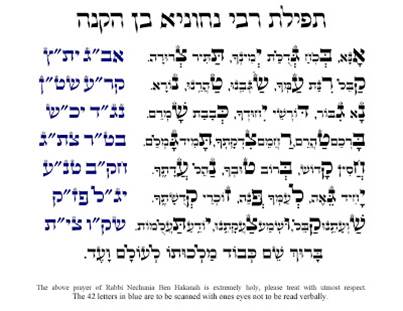
Hakham Nechunya wanted to be able to pronounce the unpronounceable, to call out and call forth the reality of the whole, in order to deal with the stubborn sins that keep us stuck.
One of the Kabbalistic explanations of the prayer, Ana B’Koach - בכח אנא, suggests that the number forty-two is associated with the process of ascent, whereby we elevate the material context in which we live. Ana B’Koach corresponds to the forty-two letter Name of HaShem that prophets used to meditate on in order to go into a state of prophecy.
Hakham Nechunya specifically asserted that if you properly understand how to use the forty-two lettered name as a key to seasons and time[20], that this key reveals a lengthy period of time between the origin of the universe and the creation of man. In his view, the universe is thus not a mere few thousand years old as the text seems to claim on the surface, but is 15.3 billion years old, the very age arrived at only recently by the estimates of modern astrophysical theories of the big bang.
Whenever the concept of forty-two comes up, it usually alludes to an opportunity to become more spiritually elevated, to return to what we were before the fall. This is why the prayer Ana Bekoach is found in all siddurim before Pesukei D’Zimrei (Introductory Psalms), and Lecha Dodi erev Shabbat, and at other times that promote our spiritual elevation. And, as the Kabbalists point out, Ana Bekoach is made up of seven stanzas each with six words, whose forty-two letter acrostic alludes to the forty-two letter Name.
HaShem created the world with this forty-two lettered name,[21] and it facilitates a Jew’s endeavors to ascend spiritually from level to level. For this reason, every morning as we prepare to ascend spiritually, through prayer, we recite “Ana Bekoach” before “Eizehu mekoman.” Likewise for the ascent through the Mincha prayers, before “Ashrei” we say korbanot (portions dealing with sacrifices) and conclude with “Ana Bekoach.” Before going to sleep we recite “Ana Bekoach” in Kriat Shema al Hamitah, since the neshamah prepares itself to be rejuvenated and to rise to a higher spiritual sphere. And on Friday night, after reciting six Psalms corresponding to the six days of the week,[22] as we prepare to enter the holiness of Shabbat, “Ana Bekoach” is also recited.
* * *
The initials of the Ana Bekoach prayer spell a Kabbalistic holy Name, known as the Name of 42 Letters. 42 is the value of the word “mother” (אִמָּא). It is a segula (a spiritual remedy) for bringing about a state of, “the mother of children is joyous”.[23]
When the Israelites encircled Jericho seven times in order to conquer it, they blew the shofars and recited the Ana Bekoach prayer. (Until this very day, Chassidim and devout people have a custom to encircle places that need to be “conquered” while reciting the Ana Bekoach prayer – particularly with a melody that repeats each word of the prayer seven times).
Just as the Name of 42 Letters has the power to open Jericho, which is considered the lock of the Land of Israel, so it has the power to open the womb (the womb is described in the Song of Songs as, “a locked garden… a locked spring, a sealed fountain”)[24] when the time has come for the baby to be born.
Rebbe Dudel instructed his Chassid not to recite the prayer too quickly or too slowly. This is the middle road, which is accepted and finds favor in the eyes of God and man. (The Alter Rebbe of Chabad also instructed his followers to do the same when leading communal prayers—not too quickly, not too slowly). This was also the prayer of Channah, when she asked for, “offspring of men”.[25] The sages explain that she meant that they should be neither too tall nor too short; neither too small nor too fat; neither too white nor too red; neither too smart nor too stupid.[26]
* * *
When the correct vowels are to the Shem Mem-Bet, the 42 letter name of G-d, and the Name is
|
יתץ |
אבג |
|
שטן |
קרע |
|
יכש |
נגד |
|
צתג |
בטר |
|
טנע |
חקב |
|
פזק |
יגל |
|
צית |
שקו |
split into two halves, 7 triplets on one side, and 7 on the other,
the vowels on the right side of the Name have the collective value of 378, that
of Chashmal, the electric field of the angels and spirit of the tzaddikim.
The left side’s total vowel valuation is 210 as in the 210 years in Exile in Egypt.
Each triplet of the right side has a valuation of 56, which is 2 x 28 (koach/power)except
the middle triplet, which is 42, and the vertical sum of the first letters
of each line is also 56, or twice 28. And 28 is the number of letters
in the Torah’s first verse, the one connected to the Shem Mem-Bet.
If we add all the vowels in the Name, plus the kolel of 28 we get
378 + 210 + 28 = 616, the value of H’Torah, “The Torah.”
If we add the value of all the vowels to all the letters and subtract the kolel
of 42, we get 3701 + 588 – 42 = 4247, with 424 being the value
of Mashiach Ben David. And the sum of the letters and vowels of the first
line, that associated with Abraham, total 612, the value of Brit (covenant), as
in the Covenant of Abraham.
Forty-two words make up this Psalm which represent a connection to the 42-letter name of the Creator, also known as the Ana B’choach. This prayer is meant to arouse within us thankfulness and appreciation for the unseen miracles that occur in our lives.
A song of thanksgiving,
Shout in triumph to HaShem, all the earth.
Serve HaShem with joy,
come before the Eternal with happiness.
Know that HaShem is the Eternal One,
the One who made us, and to whom we belong,
the people, the flock of the Eternal’s pasture.
Enter the Eternal’s gates with thanksgiving,
the Eternal’s courts with praise.
Thank the Eternal, praise the Name.
For HaShem is good, mercy everlasting,
faithfulness, enduring through all generations.
The scholars of Kabbala have identified a number of different mystical allusions in the Kaddish prayer. For example, the phrase “Ve’yishtabach Ve’yitpa’ar Ve’yitromam Ve’yitnasei Ve’yit’hadar Ve’yit’aleh Ve’yit’halal” consists of seven words, each of which begins with the letter “Vav,” which has the numerical value of six. The product of seven and six is forty-two, and thus this phrase alludes to the forty-two letter Name of God. By the same token, each of these seven words consists of six letters.[27]
The Kaddish sanctifies the great name of HaShem, that is the great name of forty-two letters.
The Kaddish is the means for the elevation of the People of Israel from one stage to the next in their journey of life, leading ultimately to Olam Haba.
In Judaism, by some traditions, the Torah scroll is written with no fewer than 42 lines per column, based on the journeys of Israel.[28] In the present day, 42 lines is the most common standard,[25] but various traditions remain in use (see Sefer Torah).
The first six words of the Shema followed by the forty-two words of the Ve’ahavta are a picture of the cities which were given to the Levites in Yehoshua (Joshua) 21.[29] The Levites were given forty-two cities in addition to the six cities of refuge.[30] This suggests an intrinsic connection between the Shema and the Levitical cities.
Bamidbar (Numbers)35:6 And among the cities which ye shall give unto the Levites there shall be six cities for refuge, which ye shall appoint for the manslayer, that he may flee thither: and to them ye shall add forty and two cities.
When it is proven that a person killed unintentionally, he is banished to one of the six cities of refuge or one of the forty-two Levitical cities, to protect him from the vengeance of the slain man’s relatives. He must stay there and not leave the city or its city limits for any reason whatsoever, until the death of the Kohen Gadol[31] who served at the time that he was sentenced to exile.
Bamidbar (Numbers) 35:6 And the cities which ye shall give unto the Levites, they shall be the six cities of refuge, which ye shall give for the manslayer to flee thither; and beside them ye shall give forty and two cities.
The cities of refuge are closely connected to the cities of the Levites. They appear in the same chapter in the Torah. In fact, the forty-two Levite cities function as cities of refuge.[32] The cities of refuge are under the jurisdiction of the Levites, and more specifically, the High Priest. When an unintentional killer dwells within the city of refuge he becomes the “property” of the High Priest. He lives within his city and therefore belongs to him. Although by no means a slave, he still lives under the dominion of the High Priest. The same law governing the release of a permanent Jewish slave upon the death of his master[33] applies here. The unintentional killer may leave only upon the death of his “master”, the High Priest.
What was the point of having the manslayer flee to a city of refuge? A manslayer was one who had killed someone unintentionally. Chazal teach that this accident occurred because the manslayer did not take special precautions to insure that it could not happen. In other words, he did not have love for his fellow. To correct this lack of love, this failure to be cautious, HaShem sends the manslayer and his teacher to a city of refuge. These cities are populated by the Levites and priests who primary job was to teach Torah. Further, the priests were the descendants of Aharon who had a special knack for bringing peace between a man and his neighbor. Thus the Levitical cities were the ideal environment to rehabilitate the manslayer. The manslayer could learn Torah by observing it in the actions of those who were trained and called to teach Torah.
The forty-two cities which were given to the Levites are going to be inhabited by those who are close to HaShem because of their service in the Beit HaMikdash and because their primary job is to teach Torah. The primary way of teaching Torah is by modeling a life of Torah. This suggests that the Levites are re-creating Gan Eden and teaching Torah to the Bne Israel in such a way that they, too, are ascending back to the state that they had at Gan Eden. Both entities are part of the process of recreation. Forty-two is the perfect number to describe this process.
|
Owned by |
High Priest |
|
Previously owned by |
Self |
|
Between |
Home and Refuge city |
|
Chased by |
Avenger of blood |
|
Taught by |
Priests |
|
Type of |
Exile |
Finally, Rashi, on Bereshit 4:16, offer the following insight into the cities of refuge:
to the east of Eden --There his father was exiled when he was driven out of the Garden of Eden, as it is said (3:24) “and He stationed at the east of the Garden of Eden, etc., to guard” the way of approach to the Garden, from which we can learn that Adam was there. And we find that the easterly direction always offers asylum for murderers, as it is said (Deut. 4:41): “Then Moses separated, etc.” [three cities of refuge]in the direction of the sunrise”-.[34] Another explanation: בְּאֶרֶץנוֹד means that wherever he went, the earth would quake beneath him, and the people would say, “Go away from him; this is the one who killed his brother”.[35]
There are forty-two days between the end of Pesach and Shavuot. During this time we are counting the Omer and working on ourselves to be able to stand before HaShem and receive the Torah. Since the revelation at Mt. Sinai is a recreation of Gan Eden, we can begin to understand that the work of the omer period is to change ourselves back to the state we had in the Garden. At Sinai, we again stood in the presence of The Creator for the revelation of the Torah, which is the blueprint for creation. HaShem looked into His Torah and used it to create the world.
The forty-two days between Pesach and Shavuot are connected by Sefirat HaOmer, the counting of the omer. They are also connected in that Shavuot is the completion of Pesach; this is why Shavuot is also called Atzeret.
Thus we see that the number forty-two is concealed within our omer count; and its meaning and significance is bound up in unifying these two festivals. Finally, the result of counting forty-two, at Sinai, is a new man who again walks with HaShem in the Garden.
|
Owned by |
HaShem |
|
Previously owned by |
World |
|
Between |
Sin and Torah |
|
Chased by |
Time |
|
Taught by |
Teacher |
|
Type of |
|
The Zohar understands the recounting of these forty-two stations on a mystical level. According to the Kabbalah, God brought the world into being by virtue of the first forty-two letters of the Torah, the forty-two building blocks or stages of creation. The forty-two stations of travel in Masei echo the genesis of the world and reflect a second process of creation, one that lasted forty-two years. In recounting the forty-two journeys, Moses now tells B’nai Israel that in fact, a new creation has occurred. The creation of the nation has paralleled the world.[36]
Zohar Hadash, Ma’amar 42 Journeys When G-d brought the Jews out from Egypt, He brought them out with the mystery of the 42-letter name, just as He created heaven and earth…
Rabbi Avraham Sabba (d. 1508) explains the connection:
These journeys were something remarkable: the conclusion of the entire Torah… Just as the Torah begins with the story of creation, which alludes to the 42-letter name, so too, it ends (Masei is the end of the main part of the Torah, as Devarim is treated differently) with the record of the 42 journeys, which correspond to the 42-letter name. This hints to the fact that the Torah is all-inclusive, bound and sealed in a single entity… There is no division in it at all; for its start is bound to its end and its end to its beginning.[37]
We have a several times that the number forty-two is found at the beginning and end of Shabbat.
As the women are lighting the two Shabbat candles eighteen minutes before sundown, the men are in the synagogue reciting the prayer Ana b’koach just before Lecha Dodi. This prayer contains the forty-two letter name of HaShem. The men will pray this prayer again during Shacharit services just before Pesukei D’Zimrei.
The purpose of prayer is for a person to change himself into what he needs to be to cause HaShem to heed his prayer. The hard work of prayer is to change yourself, as we have learned in a previous study. As they ascend in their prayers towards a union with HaShem, they reach a point where they are in the process of becoming a new creation, bonded with HaShem. This process reaches a significant peak at the Ve’ahavta, which we have already studied.
At the end of Shabbat, we again find the number forty-two. The havdallah candle is lit forty-two minutes after sundown. This seems like a peculiar place to find forty-two. After all, Shabbat is ending. The most beloved of days is ending. How can this be a time of ascent?
Shabbat is the plan and the result. It is the life of the week, the spark of kedusha[38] which animates time.
Shabbat rest is an opportunity for introspection. What have I achieved this week? How am I better, more aware, more sensitive? Where do I need to develop in particular? Stock taking; facing up to oneself honestly. This itself is a faint reflection of the eternal facing up to oneself which is of the essence of the next world. The meditation of Shabbat is the meditation of being, not becoming. But from that awareness the next week’s becoming is generated.
Shabbat ends with havdallah, the ceremony of “distinguishing” the holy from the mundane. A profound lesson can be learned from havdallah which is part of the theme we have been studying.
Shabbat exits, the week begins. There is a natural sense of let-down, holiness has left, the lower state is experienced. This is why we smell spices at havdallah, to revive the wilting neshama.
But a deep secret is revealed when we take wine for havdallah! Wine is used when elevation occurs. What is the meaning of this paradox?
The idea is as follows. Certainly the week begins with the sadness of sensing Shabbat fade. The relinquishing of kedusha is palpable. We smell spices. But the week’s beginning means a new opportunity to build, to elevate our present status towards another Shabbat which will be higher than the last, which will reflect another week of work and growth added to all the previous ones! We take wine! This is called “a descent for the purpose of elevation”, a higher and greater elevation than before.
Shabbat is closely related to the idea of teshuva[39]. The letters of Shabbat are also those of tashev the root of teshuva. Shabbat is the celebration of the remembrance of Creation, a return to the primal, perfect state, a return to the source. Teshuva is a return to the pure state, the state which existed before sin caused its damage. But more than this: just as each Shabbat is built by a descent from the previous one into the work of the week, so too the state of teshuva is in one way higher than the original unblemished state which preceded sin.
Teshuva, when motivated and performed correctly, transforms sin into merit! The mechanism of this seeming paradox is this: before a person sinned, the potential for that sin was latent in the personality. It was an undiscovered, unexpressed weakness waiting to break through. The act of sin revealed it and made it actual in the personality. Before the sin there was a serious deficiency in the personality, that person carried a flaw; the opportunity to sin proved that, the flaw was revealed.
The definition of teshuva is that when it has been sincerely performed the person has reached a state in which, if presented with the opportunity and temptation to sin again, he would not do so. The flaw has been removed! Sin revealed the weakness, teshuva corrected it. Amazingly, the sin was an integral part of the process of reaching a new level where the personality defect which led to that sin, has been eradicated; the sin itself has been uses as a tool for growth, it has been transformed into a merit!
Of course, one may not sin deliberately in order to utilize this process, in fact, sinning deliberately for this purpose blocks that path to teshuva. The ideal pathway is to recognize a character flaw before it manifests as sin and to eliminate it immediately. In this way development of the personality can take place without the damage of sin. But the fact remains that if a flaw is unrecognized and uncorrected and leads to sin, teshuva can redeem and even improve.
Our pathway again, a state unblemished by sin, a descent into the state of sin , and ascent to a new level of growth, stronger and clearer. The descent has turned out to be “a descent for the purpose of elevation”.
So we see our overall theme reflected most seminally in the cycle of Shabbat and the week; a high beginning, a descent, a loss of that high level of kedusha, but only for the purpose of being able to work, to achieve. And then the result of that work: a return to the dimension of the beginning, higher, more inspired, more sensitive; closer to that final Shabbat and better prepared. We have joined with the Shabbat and become a new, more elevated creation, bonded to HaShem. Thus we signify this by lighting the havdallah candle forty-two minutes after sundown.
|
Owned by |
HaShem (covenant) |
|
Previously owned by |
Self |
|
Between |
six work days and Shabbat |
|
Chased by |
Time |
|
Taught by |
Man of the house |
|
Type of |
Rest |
When we count the omer, we work on each of seven traits as found in the sefirot. On the forty-second day of our count, we encounter the sefirah of Malchut she’be’Yesod.
Malchut is the attribute of nobility and sovereignty.
Yesod is bonding and unity.
Yesod is the place of the brit mila and is the organ of the conception of a new creation. Thus we can see that the forty-second day of Sefirat HaOmer would be for the creation of a noble man, an Ish.
Nechunya (1st century AD) and DeMin Acco (13th century AD) used the 42-letter name at the start of Genesis to calculate that the Age of Our Universe should be:
42 x 1,000 Divine Years,
and that a Divine Year should be:
365 x 1,000 years,
so that the Age of Our Universe should be:
42 x 1,000 x 365 x 1,000 = 15,330,000,000 years.
A figure that is consistent with present-day astronomical observations and calculations.
Rambam (Maimonides), who lived about 1200 AD,
commented on the synodic Lunar month of the Jewish calendar as being 29 days, 12 hours, and 793/1080 of the next hour, for a total of 29 + 12/24 + 793/(1080x24) = 29.530594 days.
Bachya (13th century AD) used an ELS with spacing 42
that started with the first letter of Genesis - D
then went to the 42nd letter following that D - R
then went to the 42nd letter following that R - H
then went to the 42nd letter following that H - B
to produce the sequence DRHB, which he showed to produce the 29.530594 day synodic Lunar month.
Bachya did not claim to have discovered the Torah-coding of the Jewish Lunar month, but gave credit to Nechunya (1st century AD).
Bachya (13th century AD) used an ELS[40] with spacing of forty-two, that started with the
first letter of Bereshit[41] - ב
then went to the
42nd letter following that ב - ה
then went to the
42nd letter following that ה - ר
then went to the
42nd letter following that ר - ד
to produce the sequence בהרד, which he showed to produce the 29.530594 day synodic Lunar month.
Bachya did not claim to have discovered the Torah-coding of the Jewish Lunar month, but gave credit to Nechunya (1st century AD).
The 42nd day of the Omer is Yom Yerushalayim - Jerusalem Day.
* * *
The crossing of the Red Sea took place on Nisan twenty-one, on the last day of Passover. Again we see HaShem giving His people laws and decrees before the giving of the Torah on Mount Sinai. This event took place forty-two days before the Torah was given on Mount Sinai. On this day the Bne Israel will be immersed in the Yam Suf[42] and be baptized into Moses.
1 Corinthians 10:2 And were all baptized unto Moses in the cloud and in the sea
Baptism, as we learned when we studied the number forty, is a return to the state we had at Eden. Further, Moshe is the first redeemer, so being baptized into Moshe is the bonding of Bne Israel with The Redeemer. Being baptized into Moshe means being bonded with the ultimate Redeemer, Mashiach.
When the Bne Israel emerged on the side of the Yam Suf, they were ready to begin the forty-two days of growth that would allow them to receive the Torah, which was a recreation of Gan Eden.
There is another way of looking at the sefirah. Since there are forty-two days between Pesach and Shavuot, we could present the sefirot which form our Omer count as beginning on the day after the last day of Pesach. The Sfat Emet points out that in addition to these forty-two journeys, there are an additional seven where the nation actually retreats to a previous encampment.
The following chart illustrates the connection between the sefirat HaOmer and the wilderness camps in Bamidbar 33:
|
Sefirah |
Meaning |
Camp |
Meaning |
|
Chesed of Gevurah |
Kindness of Strength |
Succoth - סכת |
Temporary Shelters |
|
Gevurah of Gevurah |
Strength of Strength |
Etham - אתם |
Contemplation |
|
Tiferet of Gevurah |
Beauty of Strength |
Pi Hahiroth - החירת פי |
Mouth of Freedom |
|
Netzach of Gevurah |
Splendor of Strength |
Marah - מרה |
Bitterness |
|
Hod of Gevurah |
Praise of Strength |
Elim - אילם |
Mighty men, Trees, Rams |
|
Yesod of Gevurah |
Foundation of Strength |
Reed Sea - סוף ים |
Reed Sea |
|
Malchut of Gevurah |
Kingdom of Strength |
Sin - סין |
Desert of Clay |
|
Chesed of Tiferet |
Kindness of Beauty |
Dophkah - דפקה |
Attack |
|
Gevurah of Tiferet |
Strength of Beauty |
Alush - אלוש |
Wild |
|
Tiferet of Tiferet |
Beauty of Beauty |
Rephidim - רפידם |
Weakness |
|
Netzach of Tiferet |
Splendor of Beauty |
Desert of Sinai - סיני מדבר |
Hatred |
|
Hod of Tiferet |
Praise of of Beauty |
Kibroth Hattaavah - התאוה קברת |
Graves of Craving |
|
Yesod of Tiferet |
Foundation of Beauty |
Chazeroth - חצרת |
Courtyard |
|
Malchut of Tiferet |
Kingdom of Beauty |
Rithmah - רתמה |
Smoldering |
|
Chesed of Netzach |
Kindness of Splendor |
Rimmon Perez - פרץ רמן |
Spreading Pomegranate Tree |
|
Gevurah of Netzach |
Strength of Splendor |
Livnah - לבנה |
White Brick |
|
Tiferet of Netzach |
Beauty of Splendor |
Rissah - רסה |
Well Stpped Up With Stones |
|
Netzach of Netzach |
Splendor of Splendor |
Kehelathah - קהלתה |
Assembly |
|
Hod of Netzach |
Praise of Splendor |
Shapher - שפר |
Beautiful |
|
Yesod of Netzach |
Foundation of Splendor |
Haradah - חרדה |
Terror |
|
Malchut of Netzach |
Kingdom of Splendor |
Makheloth - מקהלת |
Assemblies |
|
Chesed of Hod |
Kindness of Praise |
Tahath - תחת |
Bottom |
|
Gevurah of Hod |
Strength of Praise |
Terah - תרח |
Ibex |
|
Tiferet of Hod |
Beauty of Praise |
Mithcah - מתקה |
Sweet Delight |
|
Netzach of Hod |
Splendor of Praise |
Chashmonah - חשמנה |
Fruitfulness |
|
Hod of Hod |
Praise of Praise |
Moseroth - מסרות |
Correction |
|
Yesod of of Hod |
Foundation of Praise |
Bene Jaakan - יעקן בני |
Wise Son |
|
Malchut of Hod |
Kingdom of Praise |
Char Haggidgad - הגדגד חר |
Hole of the Cleft |
|
Chesed of Yesod |
Kindness of Foundation |
Yotvathah - יטבתה |
Pleasantness |
|
Gevurah of Yesod |
Strength of Foundation |
Avronah - עברנה |
Transitional |
|
Tiferet of Yesod |
Beauty of Foundation |
Etzion Geber - גבר עצין |
Giant’s Backbone |
|
Netzach of Yesod |
Splendor of Foundation |
Kadesh (Rekem) - קדש |
Sanctuary |
|
Hod of Yesod |
Praise of Foundation |
Hor - הר |
Mountain |
|
Yesod of Yesod |
Foundation of Foundation |
Tzalmonah - צלמנה |
Shadiness |
|
Malchut of Yesod |
Kingdom of Foundation |
Punon - פונן |
Perplexity |
|
Chesed of Malchut |
Kindness of Kingdom |
Oboth - אבת |
Necromancer |
|
Gevurah of Malchut |
Strength of Kingdom |
Iye Abarim - העברים עיי |
Ruins of the Passes |
|
Tiferet of Malchut |
Beauty of Kingdom |
Divon Gad - גד דיבן |
Sorrowing Overcomers |
|
Netzach of Malchut |
Splendor of Kingdom |
Almon Diblathaim - דבלתימה עלמן |
Cake of Pressed Figs |
|
Hod of Malchut |
Praise of Kingdom |
M’Hari Abarim - מֵהָרֵי הָעֲבָרִים |
Mountains of the Passes |
|
Yesod of Malchut |
Foundation of Kingdom |
Moab - מואב |
Mother’s Father |
|
Malchut of Malchut |
Kingdom of Kingdom |
Beth Yeshimoth - הישמת בית |
House of The Desolaton |
Finally, the Sefer Ha-Temunah establishes the age of the world, at least according to some classical interpretations, at forty-two thousand years. That is, the world was created forty-two thousand years old when Adam was created. This teaching was subject to a highly significant interpretation by Rabbi Isaac of Akko. According to Rabbi Akko and some Midrashic sources, the 42,000 years, translates the age of the Earth as 15,340,500,000 years old.[43]
* * *
If one were to dig a tunnel between any two points on earth, one would find that it would take forty-two minutes to traverse the distance within the tunnel, using gravity. No matter how long or short the tunnel is, as long as the tunnel is straight, it will take exactly forty-two minutes to traverse the tunnel when we use gravity alone for our motive force.
There were 42 total kings:
The United Kingdom (3);
Judah or the 2 Southern Tribes (20); and of
Israel’s 10 Tribes of the North, 19 = 42 total kings.
Forty-two is associated with the building of the Beit HaMikdash, as can be seen from:
Divre HaYamim (2 Chronicles) 1:18 - 2:1 Now Solomon purposed to build a house for the name of HaShem, and a house for his kingdom. And Solomon counted out seventy thousand men to bear burdens, and eighty thousand men that were hewers in the mountains, and three thousand and six hundred to oversee them.
In the above pasuk, king Shlomo appointed 3,600 to oversee 150,000. We can see, therefore that forty-two (150,000 divided by 3,600 = 42) is the maximum number of workers that one person can oversee. Chazal comment on this by examining the following pasuk:
Ruth 2:5-6 5 Then said Boaz unto his servant that was set over the reapers: ‘Whose damsel is this?’6 And the servant that was set over the reapers answered and said: ‘It is a Moabitish damsel that came back with Naomi out of the field of Moab;
The overseer whom Boaz addressed was “standing over the reapers” in a high, prominent place so that his voice would carry far. Chazal point out that he was supervising forty-two harvesters:
Midrash Rabbah Ruth IV:6 THEN BOAZ SAID TO HIS SERVANT THAT WAS SET OVER THE REAPERS (II,5). Over how many was he appointed? R. Eliezer, the son of Miriam, said: He was set over forty-two, as we see from the verse, And Solomon numbered all the strangers that were in the land of Israel... and he set three score and ten thousand of them to bear burdens, and fourscore thousands to be hewers in the mountains, and three thousand and six hundred overseers to set the people at work (II Chron. II, 16 f.). One who adopts this plan is able to go on, and knows what he is about.
We know that as king Shlomo built the Beit HaMikdash by combining many stones, so HaShem will send His angels to gather the elect from the four corners of the earth and form them into the body of Mashiach:
Colossians 1:18 And he (Mashiach) is the head of the body, the assembly: who is the beginning, the firstborn from the dead; that in all he might have the preeminence.
From this we can understand that the forming of many stones into a Beit HaMikdash and the forming of many tzaddikim into the body of Mashiach is associated with the number forty-two. Man, as a microcosm of the universe[44], is the ultimate act of creation. Further, only in Gan Eden did we have a royal man (Adam) who had in his loins the souls of everyone who would ever live. Adam pictures many parts joined into one.
The process of building and supervising this construction project, is the process of forty-two. So, again we see that creation is associated with forty-two.
It comes out that the menorah had a total of twenty-two cups. There were eighteen on the six branches, three on each branch, and an additional four on the stem of the menorah. The menorah also had eleven spheres, six on the six branches, three on the shaft where the branches extend, one near the bottom, and one in the upper three handbreadths of the shaft. The last sphere was together with the three upper cups. The menorah also had nine flowers. There were six, one on each of the six branches, and three on the shaft. All these were absolutely necessary if the menorah was to be valid. If one of the above forty-two cups, spheres, or flowers were missing, the menorah was invalid. The same is true if any of the seven branches or seven lamps were missing.
The forty-two of the menorah points to it’s function of providing the light of the world which leads us back to HaShem and a turning from our wicked ways.
Balak prepared seven altars, with two sacrifices on each altar, three times:
Bamidbar (Numbers) 23:1 And Bilaam said unto Balak, Build me here seven altars, and prepare me here seven oxen and seven rams.
Bamidbar (Numbers) 23:14 And he brought him into the field of Zophim, to the top of Pisgah, and built seven altars, and offered a bullock and a ram on every altar.
Bamidbar (Numbers) 23:29 And Bilaam said unto Balak, Build me here seven altars, and prepare me here seven bullocks and seven rams.
Thus we have three sets of fourteen sacrifices, for a total of forty-two sacrifices.
Before each attempt to curse Bne Israel, Bilaam has Balak erect seven altars and offer two sacrifices upon each, such that in total he brought forty-two sacrifices.
Sanhedrin 105b Rab Judah said in Rab’s name: One should always occupy himself with Torah and good deeds, though it be not for their own sake, for out of good work misapplied in purpose there comes [the desire to do it] for its own sake. For as a reward for the forty-two sacrifices offered up by Balak, he was privileged that Ruth should be his descendant; [as] R. Jose b. Huna said: Ruth was the daughter of Eglon, the grandson of Balak, king of Moab.
The Gemara takes this incident with Balak and connects it to an incident in Sefer Melachim:
Sotah 47a - R. Hanina said: On account of the forty-two sacrifices which Balak, king of Moab, offered, were forty-two children cut off from Israel.
The Gemara here refers to a somewhat obscure incident told towards the beginning of Sefer Melachim II, at the end of chapter 2. Shortly after Eliyahu’s death, his disciple and successor as prophet, Elisha, comes to the city of Bet El and is greeted by a group of youngsters who hurl insults at him. Elisha curses them with HaShem’s Name, at which point two bears come out of the forest and tear apart forty-two of them.
Melachim (II Kings) 2:22-25 And the waters were healed until this day, according to the saying of Elisha which he spoke. 23. And he went up from there to Beth-El; and as he was going up by the way, there came out little children from the city, and mocked him, and said to him, Go up, you bald head; go up, you bald head. 24. And he turned back, and looked on them, and cursed them in the name of the Lord. And there came out two female bears from the wood, and tore forty two children of them. 25. And he went from there to Mount Carmel, and from there he returned to Samaria.
The Zohar then comes to connect these two incidents:
Soncino Zohar, Shemoth, Section 2, Page 224a - R. Simeon said: ‘Observe that the forty-two offerings brought by Balaam and Balak were offerings diverted from the “other side” towards the Holy One, blessed be He, and so the “other side”, which is called “curse”, had to be repaid these offerings from Israel. This is the inner implication of the verse, “And he looked behind him and saw them”. That is to say, “behind him”, meaning the “other side”, which stands behind the Shechinah. He turned “and saw them”, as being meet for punishment; “and cursed them in the name of the Lord”, inducing the Divine Name, as it were, to discharge the debt owing to the “other side”, for the latter’s offerings which had been diverted to Him. Thus all is made right before the Holy One, blessed be He, and not a single act is lost, whether for good or for evil.
Soncino Zohar, Shemoth, Section 2, Page 224b - Straightway “he [Elisha] cursed them in the name of the Lord”. “And there came forth two bears”-she bears, as indicated by the feminine numeral sh’tayim, big with offspring, “and tare forty and two children of them”, in correspondence, as has been explained, to the number of offerings brought by Balak.
This is a very perplexing incident. How can the taunts of children make them worthy of death? After all, HaShem is clearly with Elisha and He is clearly the one controlling the two bears. Thus we must conclude that HaShem is executing the death penalty on these forty-two, because of their words.
Since the youth’s taunt involves the head and the lack of hair, we can begin to understand that the sin that they commit is idolatry. After all, demeaning a prophet and implying that he has no connection with HaShem, is tantamount to idolatry; and we know that idolatry does carry the death penalty. Further, the Zohar has also connected these children with the idolatry and rebellion of Balak and Bilaam.
The death of these young people is ridding the land of that which is impure. At the same time, it is sanctifying the name of HaShem by exacting the Torah punishment for idolatry. The land of Israel, then, is being recreated to become what it was in the beginning: Gan Eden.
* * *
Chazal also teach us that in the merit of Balak’s forty-two sacrifices, he was privileged to be the progenitor of Ruth, who was the mother of royalty. Even the mitzvot of the wicked must have a reward. And, as we learned in a previous study, the wicked do not exist in the Olam HaBa and their reward must be paid out in this world. The story of Ruth is thus associated with recreation and a return to Gan Eden.
|
Owned by |
HaShem |
|
Previously owned by |
Self |
|
Between |
Curses and praises |
|
Chased by |
Midianites |
|
Taught by |
Priests and Pinchas |
|
Type of |
Tribulation |
Balak built three sets of seven altars where he offered three sets of fourteen sacrifices for a total of forty-two sacrifices. We have a similar numbering idea in Sefer Matityahu, where we have three sets of fourteen generations for a total of forty-two generations:
Matityahu 1:17 So all the generations from Abraham to David are fourteen generations; and from David until the carrying away into Babylon are fourteen generations; and from the carrying away into Babylon unto Mashiach are fourteen generations.
This genealogy starts with Avraham. Why start with Avraham? After all, the genealogy in Luqas goes all the way back to Adam.[45]
Avraham was the first king of the whole world. Avraham defeated the king of Assyria, the king of Babylon, and two additional kings. He defeated these kings after they had already defeated five other great kings[46]. The area that these kings ruled would have been nearly all of the known world. This suggests that the genealogy of Mashiach was specifically traced through kings and princes, all the way back to the first of the Patriarchs and the progenitor of Israel. This genealogy went back to the beginning of the covenant people, to the very seed of the Bne Israel.[47]
Matityahu enumerates the lineage of Mashiach ben David to forty-two names, in three sets of fourteen. It is no coincidence that the name David, in Hebrew, has three letters (דוד), whose total numerical value is fourteen. (each letter of the Hebrew alphabet represents a number; ד = 4, ו = 6, ד = 4). Further, David HaMelech was king of Israel for a total of 42 years!
However, if one counts the names carefully, he will find two discrepancies: 1. In the third set there are only thirteen names and 2. The last one is not a name, but rather a title (Christ). Since Matthew is written at the drash level we can discern that the title was used to apply to two people: Mashiach ben Yosef and Mashiach ben David, both of whom are called Christ. Thus we see that the one title has two names which complete the third set of fourteen names.
Thus we see that the number fourteen alludes to King David. Interestingly, when we go back to the beginning, we are going back to when all the Bne Israel were contained in the loins of Avraham. We were one people in Avraham, even as we were one in Adam HaRishon.
I believe that the following midrash speaks to the genealogy of Mashiach (The Bread from Heaven):
Midrash Rabbah - Exodus XXV:5 - and God said, BEHOLD, I WILL CAUSE TO RAIN BREAD FROM HEAVEN FOR YOU. R. Judah b. Shalom the Levite said in the name of R. Jonah, and also R. Levi in the name of R. Hama b. R. Hanina said: The manna descended after [they had travelled] forty-two stages.
Finally, the Zohar also points us to Mashiach and uses very graphic terminology to do so.
Soncino Zohar, Bereshith, Section 1, Page 1a Rabbi Hizkiah opened his discourse with the text: As a lily among thorns, etc. (S.S. II, 2). ‘What’, he said, ‘does the lily symbolise? It symbolises the Community of Israel. As the lily among thorns is tinged with red and white, so the Community of Israel is visited now with justice and now with mercy; as the lily possesses thirteen leaves, so the Community of Israel is vouchsafed thirteen categories of mercy which surround it on every side. For this reason, the term Elohim (God) mentioned here (in the first verse of Genesis) is separated by thirteen words from the next mention of Elohim, symbolising the thirteen categories of mercy which surround the Community of Israel to protect it. The second mention of Elohim is separated from the third by five words, representing the five strong leaves that surround the lily, symbolic of the five ways of salvation which are the “five gates”. This is alluded to in the verse “I will lift up the cup of salvation” (Ps. CXVI, 13). This is the “cup of benediction”,which has to be raised by five fingers and no more, after the model of the lily, which rests on five strong leaves in the shape of five fingers. Thus the lily is a symbol of the cup of benediction. Immediately after the third mention of Elohim appears the light which, so soon as created, was treasured up and enclosed in that b’rith (covenant) which entered the lily and fructified it, and this is what is called “tree bearing fruit wherein is the seed thereof”: and this seed is preserved in the very sign of the covenant. And as the ideal covenant was formed through forty-two copulations, so the engraven ineffable name is formed of the forty-two letters of the work of creation.’
These forty-two copulations are a clear allusion to the forty-two sets of ‘parents’ who are the ancestors of Mashiach (remember that the covenant equals Torah Equals Mashiach) in Matityahu chapter 1.
Midrash Rabbah - Ruth IV:6 THEN BOAZ SAID TO HIS SERVANT THAT WAS SET OVER THE REAPERS (II,5). Over how many was he appointed? R. Eliezer, the son of Miriam, said: He was set over forty-two, as we see from the verse, And Solomon numbered all the strangers that were in the land of Israel... and he set three score and ten thousand of them to bear burdens, and fourscore thousands to be hewers in the mountains, and three thousand and six hundred overseers to set the people at work.[48] One who adopts this plan is able to go on, and knows what he is about.
In sefer Revelation we have two occurrences of the number forty-two. This sod level sefer is revealing a great deal by using the number forty-two.
|
Owned by |
|
|
Previously owned by |
|
|
Between |
2 times forty-two |
|
Chased by |
Time |
|
Taught by |
Plagues |
|
Type of |
Tribulation |
Revelation 11:2 And there was given me a reed like unto a rod: and the angel stood, saying, Rise, and measure the temple of God, and the altar, and them that worship therein. But the court which is without the temple leave out, and measure it not; for it is given unto the Gentiles: and the holy city shall they tread under foot forty and two months.
In this first passage we see that the Bne Israel are about to be judged. We know that they are being judged because that is always the purpose of a tape measure, or measuring stick. Consider that when a builder uses a tape measure, that he is evaluating an item for a particular purpose. If the item is too small for this purpose, it is rejected. If it is too big for this purpose, then it is corrected. Thus when Yochanan is told to measure the Temple, the altar, and them that worship therein, he is being to told to judge them for their fitness to the purpose of creation.
The Temple is a symbol of Adam in Gan Eden. It is a picture of the lively stones[49] that make up the body of Mashiach. The judgment of the Temple and its worshippers is a necessary precondition for their return to HaShem. Some may be corrected and some may be rejected. This process of judgment is to take forty-two months.
In addition to being a time of judgment for the Bne Israel, this also seems to be a time of judgment for the Gentiles. The ultimate goal of all judgment is to correct those that are correctable and to reject those that can not be corrected. This process of judgment is the process of the forty-two camps of the Bne Israel. During the forty year journey, some were rejected, some were corrected, and the rest were prepared for the return to the Land of Israel, Gan Eden.
Revelation 13:3-5 And I saw one of his heads as it were wounded to death; and his deadly wound was healed: and all the world[50] wondered after the beast. 4 And they worshipped the dragon which gave power unto the beast: and they worshipped the beast, saying, Who is like unto the beast? who is able to make war with him? And there was given unto him a mouth speaking great things and blasphemies; and power was given unto him to continue forty and two months. And he opened his mouth in blasphemy against God, to blaspheme his name, and his tabernacle, and them that dwell in heaven. 7 And it was given unto him to make war with the saints, and to overcome them: and power was given him over all kindreds, and tongues, and nations. 8 And all that dwell upon the earth shall worship him, whose names are not written in the book of life of the Lamb slain from the foundation of the world. 9 If any man have an ear, let him hear.
In this second use of forty-two, in sefer Revelation, we see another judgment that reminds us a bit of the incident with the forty-two young people who used their mouth’s to commit idolatry and rebellion. In sefer Revelation we see a beast with a mouth who blasphemes and thereby rejects HaShem. HaShem’s goal for this beast is the removal of all those not written in Sefer HaChaim, the Book of Life – The Torah. This judgment of the Gentiles and the Bne Israel is used to prepare the land for its elevations and to prepare those who are written in the Book of Life, to dwell therein with HaShem. Thus we would expect forty-two to be associated with this process that “re-creates” man for Gan Eden.
42 months is prominent in the Revelation and elsewhere or the 3½ years or 42 months or 1,260 days or “time, times and half a time” and connotes THE TESTIMONY OF JESUS who ministered on the earth for 42 months.
These 1,260 days align with numerical configurations given in Daniel 9:24-27 regarding the prophecy of the “Seventy Weeks” which in turn is connected to Daniel 12’s “time, times, and half a time” (3 1/2 years or 3½ days–Daniel 12:7 and Rev. 12:14)
There are forty-two laws used to properly understand the Zohar.
Y Y Y
The angle rounded to whole degrees for which a rainbow appears (the critical angle).
When sunlight encounters a raindrop, part of the light is reflected and the rest enters the raindrop. The light is refracted at the surface of the raindrop. When this light hits the back of the raindrop, some of it is reflected off the back. When the internally reflected light reaches the surface again, once more some is internally reflected and some is refracted as it exits the drop. (The light that reflects off the drop, exits from the back, or continues to bounce around inside the drop after the second encounter with the surface, is not relevant to the formation of the primary rainbow.) The overall effect is that part of the incoming light is reflected back over the range of 0° to 42°, with the most intense light at 42°. This angle is independent of the size of the drop, but does depend on its refractive index.
Y Y Y
Yeshua and James in the Nazarean Codicil when both alluded to Elijah’s shutting up of the heavens whereupon it did not rain for 3½ years or 3 years and 6 months:
Luqas (Luke) 4:25-26 But I tell you of a truth, many widows were in Israel in the days of Elias, when the heaven was shut up three years and six months, when great famine was throughout all the land; 26 But unto none of them was Elias sent, save unto Sarepta, a city of Sidon, unto a woman that was a widow.
Yaaqob (James) 5:17 Elias was a man subject to like passions as we are, and he prayed earnestly that it might not rain: and it rained not on the earth by the space of three years and six months.
Melachim Alef (I Kings) 17:1 And Elijah the Tishbite, who was of the settlers of Gilead, said unto Ahab: 'As HaShem, the God of Israel, liveth, before whom I stand, there shall not be dew nor rain these years, but according to my word.'
The “testimony of Yeshua” is in view with the 3 1/2 years or 3 years and 6 months.
Y Y Y
Megillat Esther records that two years after Koresh (Cyrus) gave the order to rebuild Jerusalem, Achashverosh became King. Out of the millions of Jews who were taken captive to Babylon, forty-two thousand returned to Israel.
Y Y Y
Hakham Schach proves the value of Torah as the self-sufficient repository of all knowledge by asking, rhetorically: “Whence did Chazal know that the earth was forty-two times larger than the moon, and that the sun was approximately one-hundred-and-seventy times larger than the earth[51], if not from the power of the Torah?
Y Y Y
Forty-two men of Beth-azmaveth were counted in the census of men of Israel upon return from exile.[52]
Y Y Y
Moshe went up on Sinai for 42 days (including the day he went up and the day he returned)[53].
Y Y Y
The script in Rabbenu Tam Tefillin contains forty-two references to the Name of HaShem. In the Tefillin shel yad alone there are twenty-one mentions of HaShem, and together with the shel rosh there are forty-two.
Y Y Y
Midrash Rabbah - Genesis LXXXIX:9 THE SEVEN GOOD KINE ARE SEVEN YEARS, etc. (XLI, 26). R. Judah said: [The dreams] betokened fourteen years [of famine and plenty respectively], since Pharaoh saw it thus. R. Nehemiah said: Twenty-eight years of each, since Pharaoh dreamt thus and narrated thus to Joseph. The Rabbis said: Forty-two years were intended, since Pharaoh dreamed, recounted his dreams to Joseph, and Joseph repeated them to Pharaoh. R. Jose b. R. Hanina said: The famine lasted two years, for as soon as Jacob went down thither it came to an end. And when did [the remaining years] return? In the days of Ezekiel, as it says, And I will make the land of Egypt desolate (Ezek. XXIX, 12).
Rabbenu Bachya writes that the seven healthy cows and the seven emaciated cows in Pharaohs dream equals fourteen; he then recalled the dream to Yosef, another fourteen; Yosef repeated the dream over the course of his interpretation, for a total of forty-two. Now two years into the famine, Yaakov came down to Egypt and the famine ended as a result of the blessing which accompanied him. However, the promise of the forty-two years was still to be fulfilled, as over a thousand years later the pasuk states, “Egypt will be desolate, it will not be settled for forty years”[54] - thus completing the total of forty-two years of famine.
Y Y Y
a) Forty-two stations mentioned in Parshat Masai.
b) Forty-two Letters in the Divine name of Mem-Beit;[55] generally defined as the acronym of the forty-two words in Ana Beko’ach, the prayer of R. Nechunyah ben Hakanah; to subdue the forces of evil and impurity.[56]
c) Ma’aseh Bereishit (the Work of Creation) refers to the name which emerges from the 28 letters of the first verse and the first 14 letters in the second verse.[57]
Y Y Y
The angle at which light rays produce a rainbow through drops of water is 42 degrees.


The following chart details the corellations between the places in Bamidbar (Numbers) 33 and the Shema:
|
Camp |
Meaning |
Shema |
Shema (English) |
|
|
|
שמע |
Hear |
|
|
|
ישראל |
Israel |
|
|
|
יהוה |
HaShem |
|
|
|
אלהינו |
Our G-d |
|
|
|
יהוה |
HaShem |
|
|
|
אחד |
one |
|
Succoth - סכת |
Temporary Shelters |
וְאָהַבְתָּ |
And you shall love |
|
Etham - אתם |
Contemplation |
אֵת |
|
|
Pi Hahiroth - החירת פי |
Mouth of Freedom |
יְהוָה |
HaShem |
|
Marah - מרה |
Bitterness |
אֱלֹהֶיךָ |
your G-d |
|
Elim - אילם |
Mighty men, Trees, Rams |
בְּכָל |
with all |
|
Reed Sea - סוף ים |
Reed Sea |
לְבָבְךָ |
your heart |
|
Sin - סין |
Desert of Clay |
וּבְכָל |
and with all |
|
Dophkah - דפקה |
Attack |
נַפְשְׁךָ |
your soul |
|
Alush - אלוש |
Wild |
וּבְכָל |
and with all |
|
Rephidim - רפידם |
Weakness |
מְאֹדֶךָ |
your might |
|
Desert of Sinai - סיני מדבר |
Hatred |
וְהָיוּ |
and they shall be |
|
Kibroth Hattaavah - התאוה קברת |
Graves of Craving |
הַדְּבָרִים |
the words |
|
Chazeroth - חצרת |
Courtyard |
הָאֵלֶּה |
these |
|
Rithmah - רתמה |
Smoldering |
אֲשֶׁר |
which |
|
Rimmon Perez - פרץ רמן |
Spreading Pomegranate Tree |
אָנֹכִי |
I |
|
Livnah - לבנה |
White Brick |
מְצַוְּךָ |
command |
|
Rissah - רסה |
Well Stpped Up With Stones |
הַיּוֹם |
this day |
|
Kehelathah - קהלתה |
Assembly |
עַל |
shall be on |
|
Shapher - שפר |
Beautiful |
לְבָבֶךָ |
your heart |
|
Haradah - חרדה |
Terror |
וְשִׁנַּנְתָּם |
and diligently |
|
Makheloth - מקהלת |
Assemblies |
לְבָנֶיךָ |
you shall teach |
|
Tahath - תחת |
Bottom |
וְדִבַּרְתָּ |
and you shall speak |
|
Terah - תרח |
Ibex |
בָּם |
of them |
|
Mithcah - מתקה |
Sweet Delight |
בְּשִׁבְתְּךָ |
when you sit |
|
Chashmonah - חשמנה |
Fruitfulness |
בְּבֵיתֶךָ |
in your house |
|
Moseroth - מסרות |
Correction |
וּבְלֶכְתְּךָ |
and when you walk |
|
Bene Jaakan - יעקן בני |
Wise Son |
בַדֶּרֶךְ |
by the way |
|
Char Haggidgad - הגדגד חר |
Hole of the Cleft |
וּבְשָׁכְבְּךָ |
and when you lie down |
|
Yotvathah - יטבתה |
Pleasantness |
וּבְקוּמֶךָ |
and when you rise up |
|
Avronah - עברנה |
Transitional |
וּקְשַׁרְתָּם |
and you shall bind them |
|
Etzion Geber - גבר עצין |
Giant’s Backbone |
לְאוֹת |
for a sign |
|
Kadesh (Rekem) - קדש |
Sanctuary |
עַל |
upon |
|
Hor - הר |
Mountain |
יָדֶךָ |
your hand |
|
Tzalmonah - צלמנה |
Shadiness |
וְהָיוּ |
and they shall be |
|
Punon - פונן |
Perplexity |
לְטֹטָפֹת |
for frontlets |
|
Oboth - אבת |
Necromancer |
בֵּין |
between |
|
Iye Abarim - העברים עיי |
Ruins of the Passes |
עֵינֶיךָ |
your eyes |
|
Divon Gad - גד דיבן |
Sorrowing Overcomers |
וּכְתַבְתָּם |
and you shall write them |
|
Almon Diblathaim - דבלתימה עלמן |
Cake of Pressed Figs |
עַל |
on |
|
M’Hari Abarim - מֵהָרֵי הָעֲבָרִים |
Mountains of the Passes |
מְזֻזוֹת |
the door-posts of |
|
Moab - מואב |
Mother’s Father |
בֵּיתֶךָ |
your house |
|
Beth Yeshimoth - הישמת בית |
House of The Desolaton |
וּבִשְׁעָרֶיךָ |
and on your gates. |
The following chart details the corellations between the places in Bamidbar (Numbers) 33, the Shema, Matthew’s genealogy, and the cities of Refuge (arei miklat):
|
Camp |
Meaning |
Shema Hebrew |
Shema English |
Matthew Genealogy |
Cities of Refuge / 42 cities of the Leviim[58] |
|
|
|
שמע |
Hear |
|
Golan - Passage |
|
|
|
ישראל |
Israel |
|
Ramoth - Eminences |
|
|
|
יהוה |
HaShem |
|
Bosor - Burning |
|
|
|
אלהינו |
Our G-d |
|
Kedesh - Sanctuary |
|
|
|
יהוה |
HaShem |
|
Shechem – Back, Shoulder |
|
|
|
אחד |
one |
|
Hebron - Society |
|
Succoth - סכת |
Temporary Shelters |
וְאָהַבְתָּ |
And you shall love |
Abraham |
Yattir – A remnant |
|
Etham - אתם |
Contemplation |
אֵת |
|
Isaac |
Eshtemoa – Woman’s Bosom |
|
Pi Hahiroth - החירת פי |
Mouth of Freedom |
יְהוָה |
HaShem |
Jacob |
Cholon - Sandy |
|
Marah - מרה |
Bitterness |
אֱלֹהֶיךָ |
your G-d |
Judah |
Debir - word |
|
Elim - אילם |
Mighty men, Trees, Rams |
בְּכָל |
with all |
Perez |
Ayin - eye |
|
Reed Sea - סוף ים |
Reed Sea |
לְבָבְךָ |
your heart |
Hezron |
Yuttah – Turning away |
|
Sin - סין |
Desert of Clay |
וּבְכָל |
and with all |
Ram |
Beth-shemesh – House of the Sun |
|
Dophkah - דפקה |
Attack |
נַפְשְׁךָ |
your soul |
Amminadab |
Gibeon - Hill |
|
Alush - אלוש |
Wild |
וּבְכָל |
and with all |
Nahshon |
Geba - Cup |
|
Rephidim - רפידם |
Weakness |
מְאֹדֶךָ |
your might |
Salmon |
Anathoth - Poverty |
|
Desert of Sinai - סיני מדבר |
Hatred |
וְהָיוּ |
and they shall be |
Boaz |
Almon - Hidden |
|
Kibroth Hattaavah - התאוה קברת |
Graves of Craving |
הַדְּבָרִים |
the words |
Obed |
Gezer - Dividing |
|
Chazeroth - חצרת |
Courtyard |
הָאֵלֶּה |
these |
Jesse |
Kibzaim - Congregation |
|
Rithmah - רתמה |
Smoldering |
אֲשֶׁר |
which |
David |
Beth-horon – House of Wrath |
|
Rimmon Perez - פרץ רמן |
Spreading Pomegranate Tree |
אָנֹכִי |
I |
Solomon |
Elteke – Of grace |
|
Livnah - לבנה |
White Brick |
מְצַוְּךָ |
command |
Rehoboam |
Gibbethon – High House |
|
Rissah - רסה |
Well Stpped Up With Stones |
הַיּוֹם |
this day |
Abijah |
Aiyalon – Deer Field |
|
Kehelathah - קהלתה |
Assembly |
עַל |
shall be on |
Asa |
Gath-rimmon (Dan) – High wine-press |
|
Shapher - שפר |
Beautiful |
לְבָבֶךָ |
your heart |
Jehoshaphat |
Taanach – Who humbles thee |
|
Haradah - חרדה |
Terror |
וְשִׁנַּנְתָּם |
and diligently |
Jehoram |
Gath-rimmon (Mannashe) - High wine-press |
|
Makheloth - מקהלת |
Assemblies |
לְבָנֶיךָ |
you shall teach |
Uzziah |
Beeshterah – With Increase |
|
Tahath - תחת |
Bottom |
וְדִבַּרְתָּ |
and you shall speak |
Jotham |
Kishion - Hardness |
|
Terah - תרח |
Ibex |
בָּם |
of them |
Ahaz |
Dobrath - Words |
|
Mithcah - מתקה |
Sweet Delight |
בְּשִׁבְתְּךָ |
when you sit |
Hezekiah |
Yarmuth – Throwing Down |
|
Chashmonah - חשמנה |
Fruitfulness |
בְּבֵיתֶךָ |
in your house |
Manasseh |
En-gannim – Of Gardens |
|
Moseroth - מסרות |
Correction |
וּבְלֶכְתְּךָ |
and when you walk |
Amon |
Mishal – Parables, governing |
|
Bene Jaakan - יעקן בני |
Wise Son |
בַדֶּרֶךְ |
by the way |
Josiah |
Abdon - Servant |
|
Char Haggidgad - הגדגד חר |
Hole of the Cleft |
וּבְשָׁכְבְּךָ |
and when you lie down |
Jeconiah |
Helkath - Field |
|
Yotvathah - יטבתה |
Pleasantness |
וּבְקוּמֶךָ |
and when you rise up |
Shealtiel |
Rehob – Breadth, Space |
|
Avronah - עברנה |
Transitional |
וּקְשַׁרְתָּם |
and you shall bind them |
Zerubbabel |
Hammoth-dor – Hot springs generation |
|
Etzion Geber - גבר עצין |
Giant’s Backbone |
לְאוֹת |
for a sign |
Abihud |
Kartan – Two Cities |
|
Kadesh (Rekem) - קדש |
Sanctuary |
עַל |
upon |
Eliakim |
Yokneam – Building up, Possessing |
|
Hor - הר |
Mountain |
יָדֶךָ |
your hand |
Azor |
Kartah – Meeting, Calling |
|
Tzalmonah - צלמנה |
Shadiness |
וְהָיוּ |
and they shall be |
Zadok |
Dimnah - Dunghill |
|
Punon - פונן |
Perplexity |
לְטֹטָפֹת |
for frontlets |
Akim |
Nahalal - Pasture |
|
Oboth - אבת |
Necromancer |
בֵּין |
between |
Elihud |
Betzer – Remote Fortress |
|
Iye Abarim - העברים עיי |
Ruins of the Passes |
עֵינֶיךָ |
your eyes |
Eleazar |
Yachtzah – Trodden down |
|
Divon Gad - גד דיבן |
Sorrowing Overcomers |
וּכְתַבְתָּם |
and you shall write them |
Matthan |
Kedemot – Antiquity, Old Age |
|
Almon Diblathaim - דבלתימה עלמן |
Cake of Pressed Figs |
עַל |
on |
Jacob |
Mephaat – Appearance, or force, of waters |
|
M’Hari Abarim - מֵהָרֵי הָעֲבָרִים |
Mountains of the Passes |
מְזֻזוֹת |
the door-posts of |
Joseph |
Mahanaim – Two fields, Two Armies |
|
Moab - מואב |
Mother’s Father |
בֵּיתֶךָ |
your house |
Mashiach ben Joseph |
Cheshbon - Reckoning |
|
Beth Yeshimoth - הישמת בית |
House of The Desolaton |
וּבִשְׁעָרֶיךָ |
and on your gates. |
Mashiach ben David |
Yazer – Assistance, Helper |
In this next chart, I look at the shema as a tikkun, a correction, to the journeys we took. This means that the shema is in reverse order.
|
Camp |
Meaning |
Shema Hebrew |
Shema English |
Matthew Genealogy |
Cities of Refuge / 42 cities of the Leviim[59] |
|
|
|
שמע |
Hear |
|
Golan - Passage |
|
|
|
ישראל |
Israel |
|
Ramoth - Eminences |
|
|
|
יהוה |
HaShem |
|
Bosor - Burning |
|
|
|
אלהינו |
Our G-d |
|
Kedesh - Sanctuary |
|
|
|
יהוה |
HaShem |
|
Shechem – Back, Shoulder |
|
|
|
אחד |
one |
|
Hebron - Society |
|
Succoth - סכת |
Temporary Shelters |
וּבִשְׁעָרֶיךָ |
and on your gates. |
Abraham |
Yattir – A remnant |
|
Etham - אתם |
Contemplation |
בֵּיתֶךָ |
your house |
Isaac |
Eshtemoa – Woman’s Bosom |
|
Pi Hahiroth - החירת פי |
Mouth of Freedom |
מְזֻזוֹת |
the door-posts of |
Jacob |
Cholon - Sandy |
|
Marah - מרה |
Bitterness |
עַל |
on |
Judah |
Debir - word |
|
Elim - אילם |
Mighty men, Trees, Rams |
וּכְתַבְתָּם |
and you shall write them |
Perez |
Ayin - eye |
|
Reed Sea - סוף ים |
Reed Sea |
עֵינֶיךָ |
your eyes |
Hezron |
Yuttah – Turning away |
|
Sin - סין |
Desert of Clay |
בֵּין |
between |
Ram |
Beth-shemesh – House of the Sun |
|
Dophkah - דפקה |
Attack |
לְטֹטָפֹת |
for frontlets |
Amminadab |
Gibeon - Hill |
|
Alush - אלוש |
Wild |
וְהָיוּ |
and they shall be |
Nahshon |
Geba - Cup |
|
Rephidim - רפידם |
Weakness |
יָדֶךָ |
your hand |
Salmon |
Anathoth - Poverty |
|
Desert of Sinai - סיני מדבר |
Hatred |
עַל |
upon |
Boaz |
Almon - Hidden |
|
Kibroth Hattaavah - התאוה קברת |
Graves of Craving |
לְאוֹת |
for a sign |
Obed |
Gezer - Dividing |
|
Chazeroth - חצרת |
Courtyard |
וּקְשַׁרְתָּם |
and you shall bind them |
Jesse |
Kibzaim - Congregation |
|
Rithmah - רתמה |
Smoldering |
וּבְקוּמֶךָ |
and when you rise up |
David |
Beth-horon – House of Wrath |
|
Rimmon Perez - פרץ רמן |
Spreading Pomegranate Tree |
וּבְשָׁכְבְּךָ |
and when you lie down |
Solomon |
Elteke – Of grace |
|
Livnah - לבנה |
White Brick |
בַדֶּרֶךְ |
by the way |
Rehoboam |
Gibbethon – High House |
|
Rissah - רסה |
Well Stpped Up With Stones |
וּבְלֶכְתְּךָ |
and when you walk |
Abijah |
Aiyalon – Deer Field |
|
Kehelathah - קהלתה |
Assembly |
בְּבֵיתֶךָ |
in your house |
Asa |
Gath-rimmon (Dan) – High wine-press |
|
Shapher - שפר |
Beautiful |
בְּשִׁבְתְּךָ |
when you sit |
Jehoshaphat |
Taanach – Who humbles thee |
|
Haradah - חרדה |
Terror |
בָּם |
of them |
Jehoram |
Gath-rimmon (Mannashe) - High wine-press |
|
Makheloth - מקהלת |
Assemblies |
וְדִבַּרְתָּ |
and you shall speak |
Uzziah |
Beeshterah – With Increase |
|
Tahath - תחת |
Bottom |
לְבָנֶיךָ |
you shall teach |
Jotham |
Kishion - Hardness |
|
Terah - תרח |
Ibex |
וְשִׁנַּנְתָּם |
and diligently |
Ahaz |
Dobrath - Words |
|
Mithcah - מתקה |
Sweet Delight |
לְבָבֶךָ |
your heart |
Hezekiah |
Yarmuth – Throwing Down |
|
Chashmonah - חשמנה |
Fruitfulness |
עַל |
shall be on |
Manasseh |
En-gannim – Of Gardens |
|
Moseroth - מסרות |
Correction |
הַיּוֹם |
this day |
Amon |
Mishal – Parables, governing |
|
Bene Jaakan - יעקן בני |
Wise Son |
מְצַוְּךָ |
command |
Josiah |
Abdon - Servant |
|
Char Haggidgad - הגדגד חר |
Hole of the Cleft |
אָנֹכִי |
I |
Jeconiah |
Helkath - Field |
|
Yotvathah - יטבתה |
Pleasantness |
אֲשֶׁר |
which |
Shealtiel |
Rehob – Breadth, Space |
|
Avronah - עברנה |
Transitional |
הָאֵלֶּה |
these |
Zerubbabel |
Hammoth-dor – Hot springs generation |
|
Etzion Geber - גבר עצין |
Giant’s Backbone |
הַדְּבָרִים |
the words |
Abihud |
Kartan – Two Cities |
|
Kadesh (Rekem) - קדש |
Sanctuary |
וְהָיוּ |
and they shall be |
Eliakim |
Yokneam – Building up, Possessing |
|
Hor - הר |
Mountain |
מְאֹדֶךָ |
your might |
Azor |
Kartah – Meeting, Calling |
|
Tzalmonah - צלמנה |
Shadiness |
וּבְכָל |
and with all |
Zadok |
Dimnah - Dunghill |
|
Punon - פונן |
Perplexity |
נַפְשְׁךָ |
your soul |
Akim |
Nahalal - Pasture |
|
Oboth - אבת |
Necromancer |
וּבְכָל |
and with all |
Elihud |
Betzer – Remote Fortress |
|
Iye Abarim - העברים עיי |
Ruins of the Passes |
לְבָבְךָ |
your heart |
Eleazar |
Yachtzah – Trodden down |
|
Divon Gad - גד דיבן |
Sorrowing Overcomers |
בְּכָל |
with all |
Matthan |
Kedemot – Antiquity, Old Age |
|
Almon Diblathaim - דבלתימה עלמן |
Cake of Pressed Figs |
אֱלֹהֶיךָ |
your G-d |
Jacob |
Mephaat – Appearance, or force, of waters |
|
M’Hari Abarim - מֵהָרֵי הָעֲבָרִים |
Mountains of the Passes |
יְהוָה |
HaShem |
Joseph |
Mahanaim – Two fields, Two Armies |
|
Moab - מואב |
Mother’s Father |
אֵת |
|
Mashiach ben Joseph |
Cheshbon - Reckoning |
|
Beth Yeshimoth - הישמת בית |
House of The Desolaton |
וְאָהַבְתָּ |
And you shall love |
Mashiach ben David |
Yazer – Assistance, Helper |
|
|
|
אחד |
one |
|
Golan - Passage |
|
|
|
יהוה |
HaShem |
|
Ramoth - Eminences |
|
|
|
אלהינו |
Our G-d |
|
Bosor - Burning |
|
|
|
יהוה |
HaShem |
|
Kedesh - Sanctuary |
|
|
|
ישראל |
Israel |
|
Shechem – Back, Shoulder |
|
|
|
שמע |
Hear |
|
Hebron - Society |
* * *
This study was written by
Rabbi Dr. Hillel ben David
(Greg Killian).
Comments may be submitted to:
Rabbi Dr. Greg Killian
12210 Luckey Summit
San Antonio, TX 78252
Internet address: gkilli@aol.com
Web page: https://www.betemunah.org/
(360) 918-2905
Return to The WATCHMAN home page
Send comments to Greg Killian at his email address: gkilli@aol.com
[1] Our Sages
[2] Tanach (Hebrew: תנ׳ך) is an acronym that identifies the Hebrew Bible. The acronym is formed from the initial Hebrew letters of the Tanakh’s three traditional subdivisions:
Torah (תורה), meaning “teaching” or “law,” includes the Five Books of Moses. The Torah is also known by its Greek name, “the Pentateuch,” which similarly means “five scrolls.”
Nevi’im (נביאים), meaning “Prophets.” The Nevi’im are often divided into the Earlier Prophets, which are generally historical, and the Later Prophets, which contain more exhortational prophecies.
Ketuvim (כתובים), meaning “Writings,” are sometimes also known by the Greek title “Hagiographa.” These encompass all the remaining books, and include the Five Scrolls.
[3] A mikveh is a pool where one is immersed or baptized.
[4] The Hebrew word for Egypt is Mitzrayim which means a place of constriction.
[5] The land of Israel is Gan Eden, the Garden of Eden, as we explored in a previous study.
[6] We explored this concept in a previous study.
[7] Aryeh Ben David, Around the Shabbat Table: A Guide to Fulfilling and Meaningful Shabbat Table Conversations [Northvale, NJ: Jason Aronson, 2000], p. 294
[8] Kiddushin 71a
[10] See the interpretation of Ba’alei Ha-Tosafot on Chagigah 11b.
[11] According to R. Hai Gaon, the letters were well known, but not the way in which they were pronounced.
[12] Soferim 2:6
[13] Parashat Massey
[15] And the repetition indicated the doubling of the years.
[16] Nevertheless on all views they were reduced to seven because Joseph declared, They shall be seven years of famine (v. 27).
[17] Devarim (Deuteronomy) 6:4-9, 11:13-21, Bamidbar (Numbers) 15:37-41
[18] Ohev Yisrael
[19] Author of Sefer HaBahir. He was a talmid of Hakham Shimon bar Yochai, who was the author of the Zohar.
[20] Bereshit (Genesis) 1:14
[21] Zohar II, 234b
[22] see Siddur Otzar Hatefilot
[23] Tehillim (Psalms) 113:9
[24] Shir HaShirim (Song of Songs) 4;13
[25] Shmuel alef (1 Samuel) 1:11
[26] Berachot 31b
[27] Rabbi Eli Mansour
[28] Bamidbar (Numbers) 33
[29] Oheiv Yisrael from Apt.
[30] See the chart at the end of this paper for a complete list of the cities.
[31] High Priest
[32] Rambam, Mishneh Torah, Laws of the Murderer, 8:9
[33] Mishna, Tractate Kiddushin, 1:2
[34] Mid. Devarim Rabbah, Lieberman, p.60; Tan. Buber ad loc.
[35] Mid. Tan., Bereishith 9
[36] Aryeh Ben David, Around the Shabbat Table: A Guide to Fulfilling and Meaningful Shabbat Table Conversations [Northvale, NJ: Jason Aronson, 2000], p. 294
[37] Tzror Hamor, Bamidbar 33:1
[38] Holiness
[39] Repentance, the mitzva of correcting past mistakes.
[40] Equidistant Letter Sequence
[41] Genesis
[42] Reed Sea
[43] 42,000 * 365,250 earthly years.
[44] Avot D’R. Nosson, ch. 31
[45] Luqas (Luke) 3:38
[46] Bereshit (Genesis) chapter 14.
[48] II Chron. II, 16 f
[49] 1 Tzefet (Peter) 2:5
[50] The Gentiles
[51] Hilchot Yesodei HaTorah 3:8
[52] Ezra 2:24
[53] Pesikta Zutresa
[54] Yehezkel (Ezekiel) chapter 29
[55] Kidushin 71a
[56] Likkutei Torah 88d
[57] Tosafot on Chagigah 11b
[58] Yehoshua (Joshua) chapter 21
[59] Yehoshua (Joshua) chapter 21