
Gan Eden - גַּן עֵדֶן
By Rabbi Dr. Hillel ben David (Greg Killian)

Gan Eden - גַּן עֵדֶן
By Rabbi Dr. Hillel ben David (Greg Killian)
First In Creation, First In Importance
The rupture between the trees of life & knowledge:
The sin of the gathering of sticks

Adam and Eve were created and then placed in the Garden of Eden - גַּן עֵדֶן. They lived in Eden until they ate of the tree of the knowledge of good and evil. I believe the scriptures indicate that the righteous will, one day, return to the Garden of Eden.
Eden means ‘pleasure’ or ‘ecstasy’. Eden is a place where we are one with HaShem, that is the ecstasy. Eden is a place of ecstasy with HaShem.
Bereshit (Genesis) 2:10 And a river went out of Eden to water the garden; and from thence it was parted, and became into four heads.
Note that the river goes out of Eden and after it is out of Eden, then it waters the garden. The garden is a place of work.
Bereshit (Genesis) 2:15 And HaShem God took the man, and put him into the garden of Eden to dress it and to keep it.
We will literally go “back to the future”.
Solomon said:
Kohelet (Ecclesiastes) 1:9 What has been will be again, what has been done will be done again; there is nothing new under the sun.
This prophetic statement seems to indicate that, in the end, righteous men will return to Eden to walk with HaShem. This coincides with the statement of Sefer Yetzirah, “the end is enwedged in the beginning.”
“The end is joined with the beginning and the beginning with the end.[1]
Sefer Yetzirah 3:1 Ten Sefirot out of nothing. Stop your mouth from speaking, stop your heart from thinking, and if your heart runs (to think) return to a place of which it is said “they ran and returned”; and concerning this thing the covenant was made; and they are ten in extent beyond limit. Their end is infused with their beginning, and their beginning with their end like a flame attached to a glowing ember. Know, think [reflect, meditate] and imagine that the Creator is One and there is nothing apart from Him, and before One what do you count?
Yeshayahu (Isaiah) 46:10 Declaring the end from the beginning, and from ancient times the things that are not yet done, saying, My counsel shall stand, and I will do all my pleasure:
We will be looking at the proofs of this position and some of the ramifications of this position.
The word ‘Eden’ is defined by Strong’s dictionary as:
5731 ‘Eden, ay’-den; the same as 5730 (masc.); Eden, the region of Adam’s home:-Eden.
--------------- Dictionary Trace ---------------
5730 ‘eden, ay’-den; or (fem.) ^ `ednah, ed-naw’; from 5727; pleasure:- delicate, delight, pleasure. See also 1040.
The first use of a Hebrew word in the Torah is the place where that concept is created. The first time the word Eden is used in the Torah, is in:
Bereshit (Genesis) 2:8-10 Now HaShem God had planted a garden in the east, in Eden; and there he put the man he had formed. And HaShem God made all kinds of trees grow out of the ground--trees that were pleasing to the eye and good for food. In the middle of the garden were the tree of life and the tree of the knowledge of good and evil. A river watering the garden flowed from Eden; from there it was separated into four headwaters.
From this passage we learn that the garden was planted by HaShem in Eden. The implications are that Eden is bigger than the garden. We also see that HaShem’s place for man was Eden. That was the place He put them first. The garden was watered by a river which flowed from Eden. The Talmud indicates that all of the water in the world originated in Eden.[2] I believe that this earthly Eden is a copy of the heavenly Eden even as the Tabernacle was a copy of the heavenly tabernacle.
Eden is a very mysterious place: [3]
Daniel 2:21-22 He changes the times and appointed moments... He reveals the deep and mysterious things...
Bereshit Rabba 1:6 mysterious things... this means Gan Eden.
Shir HaShirim (Song of Songs) 6:11 I went down to the garden of nuts...
Why did the Holy One call Can Eden ‘‘the garden of nuts”?
Midrash HaNe’elam, Bereshit Just as the nut has one shell within the other with the core in the center, so too is Eden: there is world within world, and it is the core.
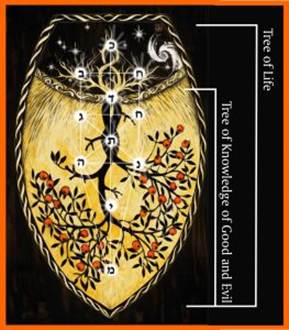
There were two named trees in the Garden: The Tree of the Knowledge of Good and Evil and The Tree of Life. Are there two trees or just one?
Note that the forbidden tree was in the center - בְּתוֹךְ of the garden.
Note that the Tree of Life was in the center - בְּתוֹךְ of the garden.
The Torah states that "the tree of life was in the middle of the garden, and the tree of the knowledge of good and evil".[5] The Midrash notes that it is impossible for two different trees to occupy the exact same spot, leading to the conclusion that they were a single tree. Commentators like the Ramban and Rabbenu Bachya offer different interpretations of this unity, suggesting they may have been two branches from a shared trunk or one tree surrounded by the other.
Things in the ‘center’ are always strongly and intrinsically connected to life.
|
Tree of Knowlege |
Tree of Life |
|
Fruit of this tree is mentioned |
No FRUIT of the Tree of Life is ever mentioned. |
|
Relate to God as Elohim. |
Relate to God as HaShem God. |
|
Food tree. |
Tree for wood. |
|
Eve ate the fruit. |
Take hold of this tree. |
|
Midst of the garden. |
Midst of the garden. |
Bereshit (Genesis) 2:9 And out of the ground made the HaShem God to grow every tree that is pleasant to the sight, and good for food; the tree of life also in the center - בְּתוֹךְ of the garden, and the tree of the knowledge of good and evil.
There are several things to pay attention to:
1. The Tree of Knowledge has ‘fruit’.
2. The Tree of Life does not have fruit.[6]
3. ‘God – Elohim’ is used with the Tree of Knowledge. This name represents a manifest UNITY. This is His name in HIS place. This is very rarely His name outside of Eden. (19 times in Genesis)
4. ‘HaShem – Elohim’ is used with the Tree of Life.
5. Both trees are in the center of the garden, despite having room for only one tree in the center.[7] [8]
6. The Tree of Knowledge is seen and looks good.
7. The Tree of Life is unseen.
Bereshit (Genesis) 3:1 Now the serpent was more subtle than any beast of the field which HaShem God had made. And he said unto the woman: 'Yea, hath God said: Ye shall not eat of any tree of the garden?' 2 And the woman said unto the serpent: 'Of the fruit of the trees of the garden we may eat; 3 but of the fruit of the tree which is in the center - בְּתוֹךְ of the garden, God hath said: Ye shall not eat of it, neither shall ye touch it, lest ye die.'
"As
the navel is set in the center of the human body, so is the land of Israel the
navel of the world... situated in the center of the world,
and Jerusalem in the center of the land of Israel,
and the sanctuary in the center of Jerusalem,
and the holy place in the center of the sanctuary,
and the ark in the center of the holy place,
and the foundation stone before the holy place,
because from it the world was founded."[9]
Bereshit (Genesis) 3:6 And when the woman saw that the tree was good for food, and that it was a delight to the eyes, and that the tree was to be desired to make one wise, she took of the fruit thereof, and did eat; and she gave also unto her husband with her, and he did eat.
Bereshit (Genesis) 3:22 And HaShem God said: 'Behold, the man is become as one of us, to know good and evil; and now, lest he put forth his hand, and take also of the tree of life, and eat, and live for ever.'
Mishle (Proverbs) 3:13-18 Fortunate is the man who has found wisdom and a man who gives forth discernment, 14 for its commerce is better than the commerce of silver, and its gain [is better] than fine gold; 15 it is more precious than pearls, and all your desirable things cannot be compared to it. 16 Length of days is in its right hand; in its left hand are riches and honor. 17 Its ways are ways of pleasantness, and all its paths are peace. 18 It is a tree of life for those who grasp it, and those who draw near it are fortunate.
Revelations 2:7 He that hath an ear, let him hear what the Spirit saith unto the churches; To him that overcometh will I give to eat of the tree of life, which is in the center of the paradise of God.
The two trees had a “Single root / one trunk”:
The Burning Bush as the Tree of Life
Shemot (Exodus) 3:2-4 An angel of HaShem appeared to him [Moses] in a flame of fire from the center (מִתּוֹךְ) of the thorn bush, and behold, the thorn bush was burning with fire, but the thorn bush was not being consumed. So Moses said, "Let me turn now and see this great spectacle why does the thorn bush not burn up?" 4 And when HaShem saw that he turned aside to see, God called unto him out of the midst of the bush, and said: 'Moses, Moses.' And he said: 'Here am I.'
In one verse we switch between HaShem and God (Elohim). In Eden the name used was “HaShem God”. After Eden this name changed, as we can see in the following pasuk, where the forefathers did not know Him as ‘HaShem’:
Shemot (Exodus) 6:2 And God spoke unto Moses, and said unto him: 'I am HaShem; 3 and I appeared unto Abraham, unto Isaac, and unto Jacob, as God Almighty, but by My name HaShem (YHWH) I made Me not known to them.
Now, at Sinai, HaShem is going to reveal this new name of ‘HaShem’ to His people. It will be like a return to Eden.
The burning bush hints to the Tree of Life. In the bush we have an angel, rather than 2 cherubim. However, we have an interesting ‘sword’ in the name of the mountain.
Horeb[10] - חֹרֵבָה = Sword[11] - הַחֶרֶב
When Adam and Chava were kicked out of the Garden, there was no one to work the soil and tend to the plants. The garden turned into a desert and the tree shrank to a bush. The tree was sad… (Notice that the bush did not have any fruit) The tree was still guarded by an angel and that is why Moshe could not get too close:
Shemot (Exodus) 3:1-5 Moses was pasturing the flocks of Jethro, his father in law, the chief of Midian, and he led the flocks after the free pastureland, and he came to the mountain of God, to Horeb. 2 An angel of the Lord appeared to him in a flame of fire from within the thorn bush, and behold, the thorn bush was burning with fire, but the thorn bush was not being consumed. 3 So Moses said, "Let me turn now and see this great spectacle why does the thorn bush not burn up?" 4 HaShem saw that he had turned to see, and God called to him from within the thorn bush, and He said, "Moses, Moses!" And he said, "Here I am!" 5 And He said, "Do not draw near here. Take your shoes off your feet, because the place upon which you stand is holy soil."
The ‘holy soil’ may point to the fact that this is again Eden, which is HaShem God’s place. Man’s soul was again connecting to HaShem God but his body needed to connect to Adamah, the earth, hence, take off your shoes. For man to connect to his ‘source’; he needed to connect to HaShem and to the ground from which he was taken.
Sinai was our opportunity to reconnect. Note the command to ascend:
Shemot (Exodus) 19:11-13 And they shall be prepared for the third day, for on the third day, the Lord will descend before the eyes of all the people upon Mount Sinai. 12 And you shall set boundaries for the people around, saying, Beware of ascending the mountain or touching its edge; whoever touches the mountain shall surely be put to death.' 13 No hand shall touch it, for he shall be stoned or cast down; whether man or beast, he shall not live. When the ram's horn sounds a long, drawn out blast, they may ascend the mountain."
The language of the burning bush and an angelic appearance, with a sword, is encountered again in Joshua chapter 5.
Yehoshua (Joshua) 5:10-15 And the children of Israel encamped in Gilgal, and they made the Passover sacrifice on the fourteenth day of the month at evening in the plains of Jericho. 11 And they ate of the grain of the land on the morrow of the Passover, unleavened cakes and parched grain on this very day. 12 And the manna ceased on the morrow when they ate of the grain of the land; neither had the children of Israel manna anymore; and they ate of the produce of the land of Canaan that year. 13 And it was when Joshua was in Jericho, that he lifted up his eyes and saw, and, behold, a man was standing opposite him with his sword drawn in his hand; and Joshua went to him, and said to him, Are you for us, or for our adversaries? 14 And he said, No, but I am the captain of the host of the Lord; I have now come. And Joshua fell on his face to the earth and prostrated himself, and said to him, What does my lord say to his servant? 15 And the captain of the Lord's host said to Joshua, Remove your shoe from your foot; for the place upon which you stand is holy. And Joshua did so.
Here we find that the fruit of the “tree of the knowledge of good and evil” is wheat. The Bne Israel are allowed to eat the fruit.
These are not regular trees. These are spiritual trees that represent God’s commands. This aligns with what we previously say in Proverbs where Torah is called the “tree of life”.
We also find an angel with a sword.
If we overlay these two stories, the burning bush and Joshua’s angel with the wheat… We have recreated the two/one tree in the garden of Eden.
The above ideas still leave unanswered questions like: Where are the Cherubim?
That said, the first appearance of the Cherubim after the garden of Eden is in the mishkan, the Tabernacle in the wilderness. The mishkan had Cherubim incorporated in the parochet, the curtain between the Holy and the Holy of Holies. We also see Cherubim as part of the ark of the covenant.
* * *
We see the yobel, the rams horn at Sinai and again with Joshua in:
Yehoshua (Joshua) 6:5 And it shall be, that when they make a long blast with the yobel, and when ye hear the sound of the shofar, all the people shall shout with a great shout; and the wall of the city shall fall down flat, and the people shall go up every man straight before him.'
It is as though Sinai has become Yericho.
Sheni Meshichim
|
Mashiach ben Yosef (Yosef) |
Mashiach ben David (Yehuda) |
|
Rachel |
Leah |
|
Revealed / or explicit |
Hidden / or sealed |
|
Tree of the Knowledge of Good and Evil |
Tree Of Life |
|
Tikkun Olam (repair the world) |
Tikkun Adam (repair man) |
|
Yosef ben Yaaqob |
Yehuda ben Yaaqob |
|
Northern Kingdom (Israel / Ephraim) |
Southern kingdom (Yehuda) |
|
Material |
Spiritual |
|
Sod: Yosef symbolizes redemption.[12] A bottom up approach. |
Sod: Yehuda symbolizes prayer. A top down approach. |
|
Body (externals) |
Soul (Internals) |
|
Sephardim |
|
|
Tzadik gamur[13] |
Baalei teshuva[14] |
|
Torah SheBichtav (Written Law) |
Torah SheBaal Peh[15] (Oral Law)[16] |
|
Torah SheBichtav says an “eye for an eye”, thus, Middat HaDin. |
Torah SheBaal Peh says, “monetary compensation”, thus, Middat HaRachamim. |
|
Pshat - literal |
Sod - secret |
|
Physical Mission |
Spiritual Mission |
|
Tishri |
Nisan |
|
Ita’aruta de L’tata (arousal from below) |
Ita’aruta de L’Eila (arousal from above) |
|
Yetzer HaRa (Evil Inclination) |
Yetzer HaTov (Good Inclination) |
|
West |
East |
|
Mission: Restoration and Purification |
Mission: Elevation and Transformation |
|
mashpia (giver) |
mekabel (receiver) |
|
Tafel - וטפל (enabler of the essence, or secondary) |
Ikar - עיקר (essence, or primary) |
|
Yehuda represents Nisan.[19] |
|
|
Tishri is the new year for Gentile kings[20] |
Nisan is the new year for Jewish kings.[21] |
The Tree of Life, in the middle of the garden, is more than just an ordinary tree. HaShem said that the one who eats from this tree will live forever:
Bereshit (Genesis) 3:22 And HaShem God said, “The man has now become like one of us, knowing good and evil. He must not be allowed to reach out his hand and take also from the tree of life and eat, and live forever.”
HaShem wanted to prevent fallen man from eating from this tree, so He put a special guard at the tree:
Bereshit (Genesis) 3:24 After he drove the man out, he placed on the east side of the Garden of Eden cherubim and a flaming sword flashing back and forth to guard the way to the tree of life.
Our Sages understand that the cherubim protect the tree so that we can eat of it at the proper time.
The Midrash Rabbah also indicates that the Tree of Life is Torah:
Midrash Rabbah - Vayikra (Leviticus) IX:3 Another interpretation [of the verse hitherto rendered]: ‘And to him who setteth aright (we-sam) the way will I show the salvation of God.’ R. Jannai said: It is spelt [so as to be capable of being read] we-sham, [thus making the passage mean], one who calculates (shayyem) his way will prosper greatly. There is a story that R. Jannai when once walking in the road, saw a man of exceeding effusiveness[22] who said to him: ‘Would you, Rabbi, care to accept my hospitality?’ R. Jannai answered: ‘Yes,’ whereupon he brought him to his house and entertained him with food and drink. He tested him in [the knowledge of] Talmud,[23] and found [that he possessed] none, in Haggadah, and found none, in Mishnah, and found none, in Scripture, and found none. Then he said to him: ‘ Take up [the wine cup of benediction] and recite Grace.’ The man answered: ‘ Let Jannai recite Grace in his own house! ‘‘ Said the Rabbi to him: ‘ Are you able to repeat what I say to you? ‘ ‘Yes,’ answered the man. Said R. Jannai: ‘ Say: A dog has eaten of Jannai’s bread.’[24] The man rose and caught hold of him, saying: ‘ You have my inheritance, which you are withholding from me!’ Said R. Jannai to him: ‘And what is this inheritance of yours which I have? ‘ The man answered: ‘Once I passed a school, and I heard the voice of the youngsters saying: The Law which Moses commanded us is the inheritance of the congregation of Yaakov (Deut. XXXIII, 4); it is written not ‘The inheritance of the congregation of Jannai’, but ‘The inheritance of the congregation of Yaakov’.[25] Said R. Jannai to the man: ‘How have you merited to eat at table with me?’ The man answered: ‘Never in my life have I, after hearing evil talk,[26] repeated it to the person spoken of, nor have I ever seen two persons quarrelling without making peace between them.’ Said R. Jannai: ‘That I should have called you dog, when you possess such good breeding (derek-erez)!’ [27] He applied to him the passage: ‘And as for him who sham the way, him will I show great prosperity’ [meaning]: ‘He who calculates his way, will prosper greatly.’ For R. Shmuel (Samuel) b. Nahman said: [The duty of] derek-erez preceded the Torah by twenty-six generations.[28] This is [implied in] what is written, To keep the way to the tree of life (Gen. III, 24). [First Scripture mentions] the way (derek) which means derek-eretz, and afterwards [does it mention] ‘ The tree of life’, which means the Torah.
Midrash Rabbah - Debarim (Deuteronomy) I:1 DEBARIM 1. THESE ARE THE WORDS. Halacha[29]: Is it permissible for a Jew to write a Scroll of the Law in any language, etc.? The Wise have learnt thus[30]: The difference between [sacred] books and phylacteries and mezuzot is only that [sacred] books may be written in any language. R. Gamaliel says: With books too [the only other language] in which they permitted them to be written is Greek. And what is R. Gamaliel’s reason for saying that a Scroll of the Law may be written in Greek? Our Rabbis have taught thus: Bar Kappara, interpreting the verse, God enlarge Japheth, and he shall dwell in the tents of Shem (Gen. IX, 27), said: This indicates that the words of Shem may be rendered in the languages of Japheth[31]; therefore have [the Rabbis] permitted [sacred books] to be written in Greek. The Holy One, blessed be He, said: ‘See how beloved is the language of the Torah; it is healing for the tongue.’[32] Whence do we know this? For so Scripture says: A soothing [lit. ‘healing’] tongue is a tree of life (Prov. XV, 4); and ‘tree of life‘ is but another term for Torah, as it is written, She is a tree of life to them that lay hold upon her (Prov. III, 18). That the language of the Torah lends fluency to the tongue you can learn from the fact that in the time to come God will bring from the Garden of Eden excellent trees. And wherein consists their excellence-In that they are soothing to the tongue. As it is said, And by the river upon the bank thereof, on this side and on that side, shall grow
One day the righteous will have the right to eat from this tree:
Revelation 2:7 He who has an ear, let him hear what the Spirit says to the churches. To him who overcomes, I will give the right to eat from the tree of life, which is in the paradise of God.
Paradise is the English transliteration of the Greek “paradiso”, which is how the Septuagint translates the “Garden of Eden”. So, Revelation 2:7 indicates that we will one day be able to eat from the tree of life in the Garden of Eden! We find later on, in the book of Revelation, that the tree of life is in the new Jerusalem:
Revelation 21:1 - 22:5 Then I saw a new heaven and a new earth, for the first heaven and the first earth had passed away, and there was no longer any sea. I saw the Holy City, the new Jerusalem, coming down out of heaven from God, prepared as a bride beautifully dressed for her husband. And I heard a loud voice from the throne saying, “Now the dwelling of God is with men, and he will live with them. They will be his people, and God himself will be with them and be their God. He will wipe every tear from their eyes. There will be no more death or mourning or crying or pain, for the old order of things has passed away.” He who was seated on the throne said, “I am making everything new!” Then he said, “Write this down, for these words are trustworthy and true.” He said to me: “It is done. I am the Alpha and the Omega, the Beginning and the End. To him who is thirsty I will give to drink without cost from the spring of the water of life. He who overcomes will inherit all this, and I will be his God and he will be my son. But the cowardly, the unbelieving, the vile, the murderers, the sexually immoral, those who practice magic arts, the idolaters and all liars--their place will be in the fiery lake of burning sulfur. This is the second death.” One of the seven angels who had the seven bowls full of the seven last plagues came and said to me, “Come, I will show you the bride, the wife of the Lamb.” And he carried me away in the Spirit to a mountain great and high, and showed me the Holy City, Jerusalem, coming down out of heaven from God. It shone with the glory of God, and its brilliance was like that of a very precious jewel, like a jasper, clear as crystal. It had a great, high wall with twelve gates, and with twelve angels at the gates. On the gates were written the names of the twelve tribes of Israel. There were three gates on the east, three on the north, three on the south and three on the west. The wall of the city had twelve foundations, and on them were the names of the twelve apostles of the Lamb. The angel who talked with me had a measuring rod of gold to measure the city, its gates and its walls. The city was laid out like a square, as long as it was wide. He measured the city with the rod and found it to be 12,000 stadia in length, and as wide and high as it is long. He measured its wall and it was 144 cubits thick, by man’s measurement, which the angel was using. The wall was made of jasper, and the city of pure gold, as pure as glass. The foundations of the city walls were decorated with every kind of precious stone. The first foundation was jasper, the second sapphire, the third chalcedony, the fourth emerald, The fifth sardonyx, the sixth carnelian, the seventh chrysolite, the eighth beryl, the ninth topaz, the tenth chrysoprase, the eleventh jacinth, and the twelfth amethyst. The twelve gates were twelve pearls, each gate made of a single pearl. The great street of the city was of pure gold, like transparent glass. I did not see a temple in the city, because the Lord God Almighty and the Lamb are its temple. The city does not need the sun or the moon to shine on it, for the glory of God gives it light, and the Lamb is its lamp. The nations will walk by its light, and the kings of the earth will bring their splendor into it. On no day will its gates ever be shut, for there will be no night there. The glory and honor of the nations will be brought into it. Nothing impure will ever enter it, nor will anyone who does what is shameful or deceitful, but only those whose names are written in the Lamb’s book of life. Then the angel showed me the river of the water of life, as clear as crystal, flowing from the throne of God and of the Lamb Down the middle of the great street of the city. On each side of the river stood the tree of life, bearing twelve crops of fruit, yielding its fruit every month. And the leaves of the tree are for the healing of the nations. No longer will there be any curse. The throne of God and of the Lamb will be in the city, and his servants will serve him. They will see his face, and his name will be on their foreheads. There will be no more night. They will not need the light of a lamp or the light of the sun, for the Lord God will give them light. And they will reign for ever and ever.
We have now traveled full circle back to the tree of life and the river which are in the Garden of Eden. Remember that the river provided our only link with Eden after we were evicted for sinning. This connection provides the reason for the mikveh (baptism). It is also noteworthy to notice that the meaning of the “Jordan” river is: “that which descends from Eden or the Judge“. “What has been before will be again, there is nothing new under the sun”. The ideal that HaShem created for man has been preserved for the day that we can enter without sin.
The flood, in Noah’s day removed all traces of the rivers associated with Eden, in Bereshit (Genesis). There is no reason to believe that the Tigris and Euphrates rivers are the same as the post diluvian rivers by those same names. This, I believe, ended the existence of the earthly garden of Eden. This would account for the fact that we cannot find it, or the cherubim, today.
Pesiqta Rabbati, 23:1 As the Holy One created Adam HaRishon, He first left him still unformed, stretching from one end of the world to the other. And the Holy One passed before him each generation and its righteous, each generation and its wicked, each generation and its expounders, each generation and its leaders...
Gan Eden was a womb for the world, determining the essence and potential of each thing yet to exist, but it was also much more. It was a true garden: a garden of Eden—a garden of time. A botanical garden gathers to one site all manner of flora, a zoological garden provides easy access to animals from widely different places, and a garden of time is a locus cultivating all times, displaying them before the eyes-to-be of Man. This Is why those who live in Gan Eden, such as Eliyahu HaNavi,[34] have access to all times, appearing throughout the centuries at will.
What is even more startling, is that the display is open in both directions, allowing a connection of all existence to the garden in all times! In fact, the garden continues to perennially provide life through the portals of time:
Taanit 10a All the world drinks from the surplus of Gan Eden…
This means that not only was the potential of all life and history assigned in Gan Eden, but there is an ongoing attachment of our lives to the womb which brought us life. We are not something apart from ma'aseh Bereshit, we exist only as direct expressions of the singular, original, act of Creation as it continues through what we see as our times: He renews every day, continuously, the act of Creation? The Garden of Time Is the environment within which all shattered time exists.
Even our experiences share some element of the primal experiences In the microcosm called Gan Eden, marking our lives with the freshness and import of the first day. Still today, we bless our own beginnings of love and life with the original!
What blessings are said [at a wedding]?
Ketubot 8a ...Be happy, make happy, beloved friends, just as your Creator made you happy in Can Eden from before...
It Is fascinating that Chazal find the same Edenic character in the human womb, completing the correlation of garden to womb, and touching on an important pattern in the cycle of our lives...
There are five famous parallels linking God's Garden of Eden with the desert Tabernacle and its successor, the Jerusalem Temple, both constructed by humans.
1. God walks in both the Garden of Eden and the Tabernacle.
Bereshit (Genesis) 3:8 And they heard the voice of the Lord God walking in the garden...
Vayikra (Leviticus) 26:11-12 And I will set my tabernacle among you...And I will walk among you...
2. Water flowed out of the Garden of Eden and also out of the Temple.
Bereshit (Genesis) 2:10 And a river went out from Eden...
Yoel (Joel) 4:18 ...and a fountain shall issue from the house of the Lord...
3. Cherubs appear in both places to guard and protect.
Bereshit (Genesis) 3:24 ...and he placed cherubs at the east of the garden of Eden...to guard the way to the tree of life.
Shemot (Exodus) 25:20 And the cherubs shall stretch out their wings on high to cover the covering with their wings...
4. Special garments [Ketonet] are required in both places
Bereshit (Genesis) 3:21 For Adam and for his wife the Lord God made leather coats [Ketonet]...
Shemot (Exodus) 28:4 And these are the garments which they shall make...an embroidered coat [Ketonet]
5. Eternal life was found in Gan Eden and in The Mikdash.
Bereshit (Genesis) 3:22 And the LORD God said, Behold, the man is become as one of us, to know good and evil: and now, lest he put forth his hand, and take also of the tree of life, and eat, and live for ever:
Mishle (Proverbs) 3:13-18 Happy is the man that findeth wisdom, and the man that getteth understanding. 14 For the merchandise of it is better than the merchandise of silver, and the gain thereof than fine gold. 15 She is more precious than rubies: and all the things thou canst desire are not to be compared unto her. 16 Length of days is in her right hand; and in her left hand riches and honour. 17 Her ways are ways of pleasantness, and all her paths are peace. 18 She is a tree of life to them that lay hold upon her: and happy is every one that retaineth her.
Bereshit Rabbah-69:8 “He called the name of that place Beit-El; however, Luz was the name of the city initially.” (Genesis 28:19) “However, Luz” - this is Luz, in which they dye sky blue wool. This is Luz that Sennacherib attacked but did not transfer its population; [that] Nebuchadnezzar [attacked], but he did not destroy it. This is Luz, over which the angel of death never had dominion. What would the elderly among them do? When they would become very old, they would take them outside the walls and they would die ... Rabbi Elazar said in the name of Rabbi Pinhas bar Hama: Luz was located at the entrance of a cave. There was a hollow nut tree and they would enter the cave through the nut tree and through the cave to the city...
Zohar I, 214b “And Jacob said to Joseph: (El-Shaddai appeared to me in Luz, in the Land of Canaan...n> (Genesis 48:3) Rabbi Abba said: Luz is the Heavenly Jerusalem...
Kohelet Rabbah 12:5 “The almond tree will blossom” [Ecclesiastes 12:5] - Rabbi Levi said: This is the nut-sized bone [ luz] of the spinal column. Hadrian, may his bones be crushed and his name expunged, asked Rabbi Yehoshua ben Hananya, he said to him: “From where does a person resurrect4n the future?” He said to him: “From the nut-sized bone [luz] of the spinal column.”
“The almond tree will blossom” [Ecclesiastes 12:5] - Rabbi Levi said: This is the nut-sized bone [luz] of the spinal column. Hadrian, may his bones be crushed and his name expunged, asked Rabbi Yehoshua ben Hananya, he said to him: “From where does a person :r
future?” He said to him: “From the nut-sized bone [h
column.”
Recounting the five parallels, we see:
1. God walks in His garden and in the places we create.
2. Water flows out of His garden and out of the places we create.
3. Spiritual forces protect the way to the Tree of Life and to the
Tablets of the Covenant.
4. God made clothing for humans in His garden; we emulate Him in
our holy places.
5. Eternal life is found in the Tree of Life which is another name for Torah.
Today, in our current conditions, we are obviously unable to locate the Garden of Eden let alone enter it. However, God did provide us with blueprints to create our own substitute. Moses and the Israelites used them to build the Tabernacle and later Solomon used them to create the Temple.
Thus, both the Tabernacle and the Temple were human replicas of the Garden of Eden.
Rabbi Chaim Volozhin[36] teaches us that the Mishkan was a miniature model of reality-every element of creation was represented in it.[37]
Book of Jubilees 8:19 affirms that the Garden of Eden is the Holy of Holies:
Book of Jubilees 8:19 And he [Noah] knew that the Garden of Eden is the holy of holies, and the dwelling of the Lord, and Mount Sinai the center of the desert, and Mount Zion-the center of the navel of the earth: these three were created as holy places facing each other.
The Zohar also affirms that the Garden of Eden was Jerusalem:
Zohar II, 184b The central point of the whole world, the side of holiness, is where Jerusalem is established, at the center of the whole world... this is the earthly Garden of Eden, which was established at the center of the world…
Zohar II, 2?2a [Rav Yehuda] opened and taught: “Beautiful bowery, the joy of the whole earth; Mount Zion, the uttermost parts of the north, the city of the great King.” (Psalms 48:3). Come and see, when the Holy One, blessed be He, created the universe, He took one precious stone from under His throne and plunged it into the Abyss, one end of it remaining fastened therein whilst the other end stood out above; and this other and superior head constituted the nucleus of the world, the point out of which the world started, spreading itself to right and left and into all directions, and by which it is sustained. That nucleus, that stone, is called shetiyah [foundation], as it was the starting point of the world. The name shetiyah, furthermore, is a compound of [founded] and Yah [God], signifying that the Holy One, blessed be He, made it the foundation and starting point of the world and all that is therein.
Given this idea, I propose that the tree of life was and will be planted where the Ark of the Covenant was and will be placed, in the Holy of Holies. Remember that the only thing in the Ark were the tablets of stone with the summation of Torah. These tablets represented the Torah which is the tree of life. Now, since we know that everlasting life is only found in Yeshua from:
I Yochanan (John) 5:11-12 And this is the testimony: God has given us eternal life, and this life is in his Son. He who has the Son has life; he who does not have the Son of God does not have life.
There is yet one more connection between the Garden of Eden and the Temple mount. In this passage we will see HaSatan (the Satan) in both places:
Yehezchel (Ezekiel) 28:12-15 “Son of man, take up a lament concerning the king of Tyre and say to him: ‘This is what the Sovereign HaShem says: “‘You were the model of perfection, full of wisdom and perfect in beauty. You were in Eden, the garden of God; every precious stone adorned you: ruby, topaz and emerald, chrysolite, onyx and jasper, sapphire, turquoise and beryl. Your settings and mountings were made of gold; on the day you were created they were prepared. You were anointed as a guardian cherub, for so I ordained you. You were on the holy mount of God; you walked among the fiery stones. You were blameless in your ways from the day you were created till wickedness was found in you.
We can see that Yeshua is the Living Torah and the tree of life! Both of these symbols accurately describe Yeshua. But wait, there is more! Notice:
Luqas (Luke) 23:39-43 One of the criminals who hung there hurled insults at him: “Aren’t you the Mashiach? Save yourself and us!” But the other criminal rebuked him. “Don’t you fear God,” he said, “since you are under the same sentence? We are punished justly, for we are getting what our deeds deserve. But this man has done nothing wrong.” Then he said, “Yeshua, remember me when you come into your kingdom.” Yeshua answered him, “I tell you the truth, today you will be with me in paradise.”
Wherever the earthly Garden of Eden (paradise) was, Yeshua and the thief went to the garden of Eden on the day of their death.
According to R. Isaac Nappaha the fact that the Temple was built on the site of the Akeida[38] is the basis of the saying that “whoever is buried in the land of Israel is as if he were buried beneath the altar”.[39] This, I believe, is where the saints are in:
Revelation 6:9 When he opened the fifth seal, I saw under the altar the souls of those who had been slain because of the word of God and the testimony they had maintained. They called out in a loud voice, “How long, Sovereign Lord, holy and true, until you judge the inhabitants of the earth and avenge our blood?” Then each of them was given a white robe, and they were told to wait a little longer, until the number of their fellow servants and brothers who were to be killed as they had been was completed.
But I digress. Paul indicates that the heavenly Garden of Eden (paradise) is “up”:
II Corinthians 12:2-4 I know a man in Mashiach who fourteen years ago was caught up to the third heaven. Whether it was in the body or out of the body I do not know—HaShem knows. And I know that this man--whether in the body or apart from the body I do not know, but HaShem knows-- Was caught up to paradise. He heard inexpressible things, things that man is not permitted to tell.
If the heavenly garden of Eden is “up”, then it makes sense that it will come ‘down’ with the New Jerusalem. I believe that HaShem will show us the heavenly Garden of Eden (paradise) after He renews the earth at the end of the seventh millennium.
In this next passage we see Zion and its current wilderness as they will be transformed:
Yeshayahu (Isaiah) 51:3 HaShem will surely comfort Zion and will look with compassion on all her ruins; he will make her deserts like Eden, her wastelands like the garden of HaShem. Joy and gladness will be found in her, thanksgiving and the sound of singing.
Since this has not yet happened, we can look forward to this day!
Eden was a sanctuary, without sin, where HaShem dwelt with men. This is a copy of the heavenly Eden.
After the fall, the Temple was the sanctuary, without sin, where HaShem dwelt with men.
The new Jerusalem, in Eden, will be a sanctuary, without sin, where HaShem will dwell with men, on earth.
The Garden of Eden The New Jerusalem (heavenly Eden)
-------------------------------------------------------------------------------------------------------------------------------
Planted eastward in Eden. Gen. 2:8 Planted in Abraham’s land. Gen 13:15
In the garden was the tree of life. Gen. 2:9 The tree of life, bearing twelve crops. Rev. 22:2
A river watering the garden flowed from Eden. Gen.2:10 The river of the water of life. Rev 22:1
HaShem walked in the garden. Gen.3:8 the dwelling of God is with men. Rev 21:3
The ground is cursed. Gen. 3:17 No more curse. Rev. 22:3
He may not eat from the tree of Life. Gen. 3:22 They may eat of the tree of life. Rev. 22:14
Cherubim guard the tree of life. Gen. 3:24 Cherubim guard the Ark. Exo.25:20, 1Ki.6:23
Cherubim guard the Holy of Holies. Exo. 26:31
How was the world created? When HaShem created the world, He didn’t create it as a vast expanse of existence all at once. Rather, He created a single point, and from there, He drew out the entire universe. We know where that place, that first point, is. It’s about a mile from where I’m writing this. Behind the Kotel, the “Western Wall,” on a hill where now sits a Mosque, there is a stone. That stone is called the Even Shetia, literally the Foundation Stone. From that stone the entire Universe was drawn out. In other words, when HaShem created the world, there was a single point of contact between the world above and this world. The site of that stone was the place where HaShem tested Abraham by commanding him to bring up his son Isaac as a sacrifice; that stone is the site where Yaakov dreamed of a ladder connecting Heaven and Earth and angels going up and down on it. Around that stone stood the two Holy Temples. In the first Temple, the Holy Ark – with the Torah tablets - sat on top of that Foundation Stone, and around it was the Holy of Holies; around the Holy of Holies was the Sanctuary; around the Sanctuary was the Courtyard of the Temple; around that was Jerusalem; and around Jerusalem -- the universe. Thus, the tablets represent the Tree of Life, and the Garden of Eden was recreated in the Temple. And it is around that stone that we long to see the Third and final Temple inaugurated in the month of Cheshvan.
The rollers that hold a Torah scroll are known by Jews, as the “Tree of Life”. The tree of life is also known as Torah:
Mishle (Proverbs) 3:13-20 Blessed is the man who finds wisdom (Torah), the man who gains understanding, For she is more profitable than silver and yields better returns than gold. She is more precious than rubies; nothing you desire can compare with her. Long life is in her right hand; in her left hand are riches and honor. Her ways are pleasant ways, and all her paths are peace. She is a tree of life to those who embrace her; those who lay hold of her will be blessed. By wisdom HaShem laid the earth’s foundations, by understanding he set the heavens in place; By his knowledge the deeps were divided, and the clouds let drop the dew.
We can now understand why the following is recited when the Torah scroll is returned to the ark:
“Return O HaShem, to the myriads of Israel’s families. Arise HaShem to Your resting place, You and Your mighty ark. Clothe Your priests with righteousness. May those who have experienced Your faithful love shout for joy. For the sake of Your servant David, don’t delay the return of Your Messiah.”
“I give you good instruction; do not forsake My Torah. A tree of life it is for those who take hold of it, and blessed are the ones who support it. Its ways are ways of pleasantness, and all its paths are peace. Long life is in its right hand, in its left are riches and honor. HaShem was pleased for the sake of His righteousness, to render the Torah great and glorious.”
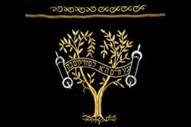 This prayer clearly portrays the
Torah as the “tree of life”. This tree is mentioned a couple of times in the
book of Mishle (Proverbs) as pertaining to Mashiach. This tree still exists!
This prayer clearly portrays the
Torah as the “tree of life”. This tree is mentioned a couple of times in the
book of Mishle (Proverbs) as pertaining to Mashiach. This tree still exists!
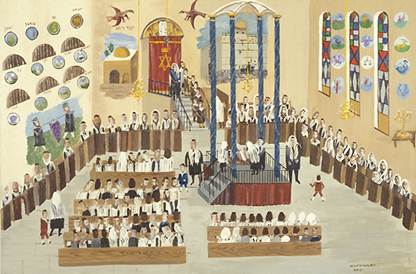
We see Gan Eden recreated a third time when looking at the synagogue and it’s arrangement.
The following diagram depicts the synagogue AND it also depicts the Garden of Eden. The synagogue walls around Gan Eden. The Tebah, or Bimah for the Ashkenazi, is an elevated platform in the center of the synagogue, just as the Tree of Life was in the center of the garden, so also is the grasping and the reading of the Torah done in the center of the synagogue. The wooden rollers for a Torah scroll are called “the Tree of Life”. The book of Mishle (Proverbs) calls the Torah the Tree of Life.
Mishle (Proverbs) 3:13 Happy is the man that findeth wisdom, and the man that getteth understanding. 14 For the merchandise of it is better than the merchandise of silver, and the gain thereof than fine gold. 15 She is more precious than rubies: and all the things thou canst desire are not to be compared unto her. 16 Length of days is in her right hand; and in her left hand riches and honour. 17 Her ways are ways of pleasantness, and all her paths are peace. 18 She is a tree of life to them that lay hold upon her: and happy is every one that retaineth her.
Here is the layout of the synagogue:
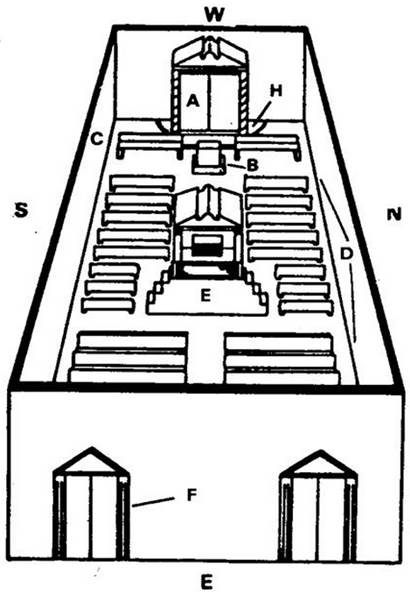
A = Heichal (the Permanent Ark) – storage for the Torah scroll.
B = Small Tebah (Lectern) from where the Chazzan leads the services.
C = Seats for the Officers of the Congregation (most synagogues have the seating either horizontally with some inclination or vertically).
D = Seats for men who sit on the first floor and women in the second floor or atrium.
E = The greater Tebah, or Bimah, (raised platform) on which the Torah is read and the Hakham delivers his Sermon. Here is where we grasp the Tree of Life and read the Torah!
Behind the greater Tebah usually there are seats reserved for the Hakhamim and this seating is also known as the seat of Moshe.
In Psalm 50, Mizmor L’Assaf, it says: “Out of Zion, consummation of beauty, HaShem appeared.” What does it mean that HaShem “appeared” in this world out of Zion? It means that there is a place called “Zion” that connects the world above to this world. Zion is the place of the foundation stone. They are one and the same -- the gateway to that which is beyond this world. The word “Zion” is an interesting word. It is related to the word “l’tzayein” -- meaning “to mark,” “to indicate,” “to show something.” When we say that the world was founded on that point called Zion, it means that the whole world stands on the principle that its very existence is to be “mitzayain” -- to indicate something.
When you found a nation, a club or a company, you make a declaration of its goals. When the American Colonies seceded, they drew up a “Declaration of Independence.” That was the foundation of the United States. The foundation of something necessarily includes the aspirations and the ultimate purpose of that which has been founded. In other words, when we say that the world is founded on the point called Zion, not only is Zion its point of departure -- the place from which it emanates and spreads out -- but it is also its purpose.
The purpose of Zion is to mark. To mark that there is something which protrudes above the vast trackless expanse of nothingness; to indicate that there is a world above this one.
As we said before, Zion is where the site of the Temple was revealed to Yaakov. How was the Holy Temple revealed to Yaakov? By a ladder. Nothing in the Torah is coincidental. What is the idea of a ladder? A ladder is that which connects one place to another. Yaakov’s ladder tells us that there is a place -- a place called Zion -- that reveals that there is a connection between the upper and the lower. The task of Zion is to stand with a finger pointing upward saying, “There is a higher world. And our very existence proves it.”
Machpelah (מערת המכפלה)
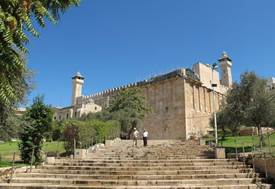 If the center of the Garden
contained the Tree of the Knowledge of Good and Evil, as well as the Tree of
Life, then the entrance to Gan Eden is the cave at Machpelah (in Hebron[41] - חֶבְרוֹן),
as we can see from the Zohar:
If the center of the Garden
contained the Tree of the Knowledge of Good and Evil, as well as the Tree of
Life, then the entrance to Gan Eden is the cave at Machpelah (in Hebron[41] - חֶבְרוֹן),
as we can see from the Zohar:
Soncino Zohar, Bereshit, Section 1, Page 57b God also decreed that he should die. Taking pity on him, however, God allowed him when he died to be buried near the Garden of Eden. For Adam had made a cave near the Garden, and had hidden himself there with his wife. He knew it was near the Garden, because he saw a faint ray of light enter it from there, and therefore he desired to be buried in it; and there he was buried, close to the gate of the Garden of Eden.
The Zohar relates, that the Cave of Machpelah is special not by virtue of those who rest there, but because it is the gateway to Gan Eden. Adam, the first man, recognized the uniqueness of the location when he saw a ray of light emanating from the area. He therefore dug the cave as a burial place for himself and his wife. After Adam and Eve were buried there, the light was hidden.
Soncino Zohar, Bereshit, Section 1, Page 127a R. Judah said: ‘Abraham recognized the cave of Machpelah by a certain mark, and he had long set his mind and heart on it. For he had once entered that cave and seen Adam and Eve buried there. He knew that they were Adam and Eve because he saw the form of a man, and whilst he was gazing a door opened into the Garden of Eden, and he perceived the same form standing near it. Now, whoever looks at the form of Adam cannot escape death. For when a man is about to pass out of the world he catches sight of Adam and at that moment he dies. Abraham, however, did look at him, and saw his form and yet survived. He saw, moreover, a shining light that illumined the cave, and a lamp burning. Abraham then coveted that cave for his burial place, and his mind and heart were set upon it.
The Cave of the Patriarchs, Machpelah (literally the cave of doubling), contains the graves (Hebrew: Kever[42]) of four couples (eight people), husbands and wives who connected: Adam and Chava, Avraham and Sarah, Yitzchak and Rivka, Yaaqov and Leah. The term Kever (which typically means grave), may also signify uterus or womb. From this we learn that a Kever is a portal, or connection, to the higher world. We come through this portal when we are put in the womb and we go through this portal when we are put in the grave. Thus, we learn that the Kever at Machpelah is a portal to Gan Eden.
It is interesting to note that this was the first place in Israel acquired by Avraham. It represents the beginning of HaShem’s promise to give Avraham, and his descendants, the land of Israel. In the same way, Gan Eden is the ultimate beginning, and we know that “all things go after the beginning”, as it is the most potent moment. All beginning starts from beyond! Our understanding commences only from after that beginning point and onwards. But that first point, the beginning of knowledge itself, is beyond, beyond our understanding, beyond our grasp. That first point is the basis of all understanding; without it we have nothing on which to build knowledge, but it itself cannot be understood. It is hidden. It is something that HaShem gives.
 Maayan
3, Nahar 13, Chesed L'Avraham:
It is already well known that the cave of Machpelah in Hebron, which is the
burial site of the Patriarchs, is the entranceway to the subterranean Garden of
Eden. [This is hinted to in the Biblical account of Avraham's purchase of the
cave (Gen. 23:16), when he paid an amount of money that was] "o'vair
l'so'chehr" (negotiable currency). These words are numerically equal to
the phrase, "orach l'gan" (the path to the Garden). It is also the
numerical value of the word "chatzer" (courtyard), to suggest that
the cave is to the Garden of Eden as a courtyard is to a home. [The words]
"o'vair l'so'chehr" (negotiable currency) have the numerical value of
570, to hint to us that everyone who lives in Hebron is certain that when
he/she dies and is buried, their soul will merit to enter directly into the subterranean
Garden of Eden without delay, without any trouble or difficulty.
Maayan
3, Nahar 13, Chesed L'Avraham:
It is already well known that the cave of Machpelah in Hebron, which is the
burial site of the Patriarchs, is the entranceway to the subterranean Garden of
Eden. [This is hinted to in the Biblical account of Avraham's purchase of the
cave (Gen. 23:16), when he paid an amount of money that was] "o'vair
l'so'chehr" (negotiable currency). These words are numerically equal to
the phrase, "orach l'gan" (the path to the Garden). It is also the
numerical value of the word "chatzer" (courtyard), to suggest that
the cave is to the Garden of Eden as a courtyard is to a home. [The words]
"o'vair l'so'chehr" (negotiable currency) have the numerical value of
570, to hint to us that everyone who lives in Hebron is certain that when
he/she dies and is buried, their soul will merit to enter directly into the subterranean
Garden of Eden without delay, without any trouble or difficulty.
Taanit 10a Eretz Yisrael[44] was created first and afterwards the rest of the world, as the passage states (Mishle 8:26): “Before He made Eretz (land) and Chutzot (outlying areas).”
The term “Eretz” applies to Eretz Israel which was the main purpose of creation and therefore created first. All the other lands are considered secondary in importance as they were in the sequence of creation and are therefore referred to as “Chutzot.”
Even today we refer to the land we love simply as “Eretz” while the rest of the world is “Chutz”, outlying areas of secondary importance.
Most folks imagine them as two separate trees, each with their own roots, trunk, branches and fruit—one permitted, the other forbidden—yet this was apparently not the case. The Torah describes them—both of them—as rooted in the exact middle of the garden. The Rabbis note that it’s impossible for two trees to occupy the same “center” …unless, they share the same roots…which would make them, at least partially, the same tree. And so, says Rabaynu Bachaya: These two trees really were (and are) the same tree, “one below and one above”.[45]
Kabbala identifies the Tree of Life with the ten sefirot that together form an upside tree with roots above (keter, chokma, bina, daat) and fruits below (malchut). The Tree of Knowledge portion of that mystical tree extends from the ground to the fruits—encompassing the trunk, branches, leaves and fruit—in other words everything but its roots. In sefirotic terms, the Tree of Knowledge spans from malchut up to and including the lower half of the sefira of daat. This portion of the sefirotic tree is called the middot, the emotional attributes, as opposed to the upper three sefirot which represent the mochin, or brains.
Zohar 3:157a ‘The first instruction that Moses gave to the spies was to inquire “whether there were trees in it or no”. Moses in fact knew already, and what he really referred to was the Tree of Life, of which the proper place is the terrestrial Garden of Eden. He said: If this tree is in it, I shall enter, but if not, I shall not be able to enter. Observe that there are two Trees, [Tr. note: Tifereth and Malkuth.] one higher and one lower, in the one of which is life and in the other death, and he who confuses them brings death upon himself in this world and has no portion in the world to come.’ Said R. Isaac: ‘Moses took to himself the Tree of Life, and therefore he wished to know whether it was in the land or not.’
By Rabbi Dr. Kenneth Brander
Parsha and Purpose: Rabbi Dr. Kenneth Brander on Sefer Bamidbar 5782
When we think of Parshat Sh’lach, we think about the episode of the Jewish people failing to be able to enter into the Promised Land. It takes up most of the verses of the parsha. [Numbers 13-14]
But there is a related story that’s only five verses short, which focuses on a very complicated story: an individual who goes unnamed, who violates the Shabbat. [Numbers 15:33-36]
Why is this story important? What is its message?
Indeed, Rabbi Akiva in the Talmud, feels the need to unveil the anonymity of the person, and suggest that the person who violates the Shabbat is Tzelafchad.[46]
He is attacked by his colleagues: “Rabbi Akiva, you’re the one who always tells us, ‘Love thy neighbor as you love yourself’! Why do you need to unmask who this person is? If you’re right, it was the wrong thing to do; and if you’re wrong – if that’s not what Tzelafchad did – you’re blaming him for something that he didn’t commit!”
The Ba’alei Kabbalah, the Kabbalists, look at this story and they review the story in the following fashion: accompanying the Jewish people is the Eitz HaChayyim and the Eitz HaDa’at. [Zohar 3:157a]
The Eitz HaChayyim, which we find in the Garden of Eden, represents the idea of spirituality, the idea of ethereal concepts, and the Eitz HaDa’at represents the idea of the physical world and finding God in the physical world, not only in ethereal concepts.
Our job is to merge the Eitz HaChayyim, the spiritual concepts, and the Eitz HaDa’at, the intellectual, physical world, into one.
Indeed, the whole theme of Shabbat is that idea of merging the physical and the spiritual into one. It’s an island in time.
Moshe Rabbeinu highlights that this truly is the message of living in the Land of Israel, and he asks the meraglim, he asked the representatives regarding the land:
“היש בה עץ אם אין?”
“Is there a tree in it or not?”
[Numbers 13:20]
Will you be able to find the tree that represents both the Eitz HaChayyim, the spiritual ideals, and the Eitz HaDa’at, the physical ideas, into one?
Will you be able to understand the message of the Land of Israel, the spiritual and the physical fused to one?
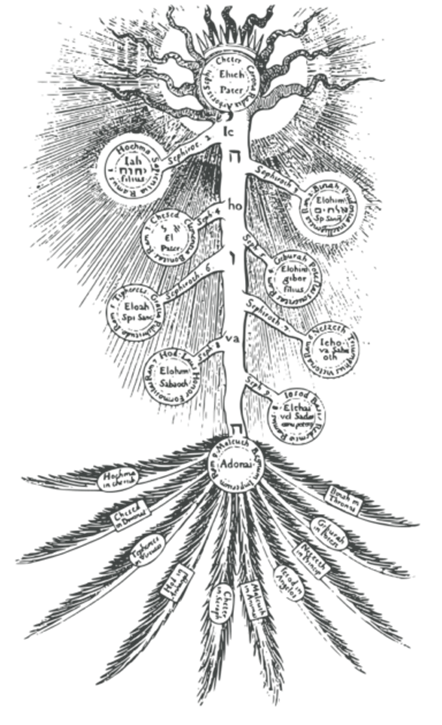
1 This woodcut illustration from 1621 shows the ten kabbalistic sefirot, or emanations of the divine, arranged as a Tree of Life.
The representatives failed to understand that message of the land of Israel, and the mekoshesh etzim – Tzelafchad, according to the Kabbalists – walks into the garden that is accompanying the Jewish people, and he separates the tree that represents the physical and the spiritual. Because the trauma that has been created is that, in the desert, “BaMidbar”, it’s impossible to be able to merge the physical and the spiritual into one.
The reason why the story is so critically important is that the story represents the aftermath of one individual who fails to understand the message of being able to merge the physical and the spiritual into one.
It’s a continuation of the calamity that happened with the emissaries into the land of Israel.
Rabbi Akiva lives his entire life of trying to fuse the spiritual and the physical together. That’s why Rabbi Akiva is the rabbi of General Bar Kokhba. His job is still to maintain the physical and the spiritual together, even in the most desperate of times.
There’s a continuum: we’re introduced to the challenge of the meraglim, the challenge of the emissaries.
Then we’re introduced to two commandments that speak about going into the Land of Israel, and only when we go into the Land of Israel to use the physical bounty of the Land of Israel in service to God, the merger of the Eitz HaDa’as, the physical, and the Eitz HaChayyim, and the spiritual, into one.
The trauma, once again, of the mekoshesh etzim, who tries to separate it, and the message that is relevant to each and every one of us: to recognize the fact that in our life, we cannot be mekoshesh etzim, we can’t separate the physical and the spiritual.
The challenge is to live in both worlds. We have to merge the Eitz HaDa’as and the Eitz HaChayyim. We can’t be ‘mekoshesh etzim’, we can’t uproot these trees.
We have to live under the shade of both of them, the shade of the physical and the shade of the spiritual.
And to realize when we are able to live with both of them fused together, we are able to achieve the goals of what it means to be part of the Chosen People, to be part of Knesset Yisrael and to make a difference in the creation and the development of this world.
“The Lord God made grow from the earth, etc.” According to the plain meaning of the text these words prove that there is such a thing as Paradise on earth and that it contains a tree of knowledge as well as a tree of life. The fruit of the tree of life causes those who eat it to enjoy long life, whereas the fruit of the tree of knowledge instills in those who consume it willpower and freedom of choice. to do either good or evil both in matters physical as well as in matters spiritual. Our sages in Pessachim 6 said concerning this “לא שנו אלא שדעתו לחזור, the ruling applies only to someone who had resolved to return to his home during the festival of Passover.” [The author uses the word דעתו in the Talmud where it refers to someone making a voluntary decision as proof that here in our verse too the term עץ הדעת, does not mean “the tree of knowledge,” but means ‘the tree permitting man a choice.” Ed.]
We find support for this meaning of the word דעת in Psalms 144,3 מה אדם ותדעהו, “what is man that You should have granted him grace?” In other words: “why have You extended Your goodwill, Your love to man?” The meaning of the term עץ הדעת then is the tree which causes God to relate to man with either favour or disfavour.” Originally, God had withheld this kind of choice from Adam as he had been ‘programmed” in his deeds prior to his sin. This does not mean that he was not free to sin but that his actions were guided exclusively by his intellect thus practically excluding sin as he had not been subject to temptation from within.
Once man had sinned, i.e. had eaten from the fruit of that tree, he became possessed of an independent will, i.e. obedience to God’s will was no longer automatic, dictated by his intellect. The new-found “independent will” meant that he had acquired an attribute reserved for God, an attribute that he could handle only at great potential cost to himself.
“And a tree of life in the midst of the garden.” The Torah made a point of describing the location of this tree as “in the midst of the garden,” as opposed to the precise location of the tree of “desire,” which has not been spelled out.
A closer examination of the text which placed the two words בתוך הגן exactly between the words עץ החיים and עץ הדעת טוב ורע, makes it clear that both these trees stood next to one another. Although there were two trees, and it is physically impossible for both trees to be precisely in the center of the garden, we must assume that they had a single trunk and that the two trees branched out at a certain point above the ground, one side becoming the עץ החיים, the other the עץ הדעת.[48]
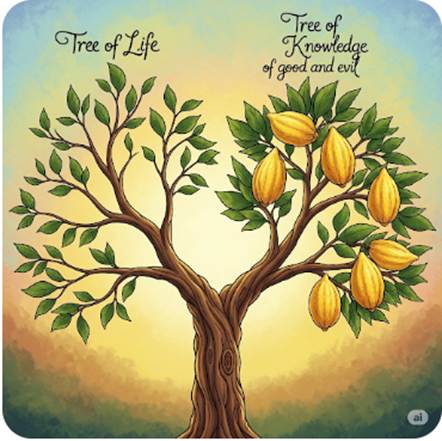
The Torah continues by describing rivers which originated in that garden, describing their parameters and the countries which surrounded the garden. There were a total of four rivers which were all branches of a single river which flowed out of Eden. As long as that river was a single river its function was to irrigate the garden. Subsequently, this river split into what the Torah called ארבעה ראשים, “four headwaters.”
You are aware already that though the Torah describes a scenery on earth when describing Gan Eden and what is related to it, the manifestations described by the Torah are metaphors for phenomena in the celestial regions.
Midrash Tanchuma to Parshat Pekudei records R. Yaakov b. R. Asi’s opinion that the construction of the Mishkan parallels the creation of the world. To summarize his theory:
1. The yiriot,[50] ירעות, of the Mishkan parallel the Heavens, which are referred to as יריעות in Tehillim
2. The parochet,[51] פרוכת, which divides sections of the Mishkan, is parallel to the Rakia, רקיע, which divides the upper and lower waters
3. The kior,[52] כיור, parallels the ocean
4. The menorah,[53] מנורה, parallels the luminaries
5. The bird sacrifices performed in the משכן parallel the birds
6. The Kohen Gadol,[54] כהן גדול, parallels the human being
7. There are three parallels to the seventh day:
A. Moshe’s completion of the Mishkan parallels God’s completion of the universe. Both completions use the verb ויכל/ו
B. Moshe’s blessing, ברכה, upon completion parallels God’s ברכה upon completion
C. Moshe’s sanctification of the Mishkan parallels God’s sanctification
These parallels all portray the construction of the Mishkan as a microcosm of the creation of the universe. If this symbolism is taken to its logical end, upon completion the Mishkan becomes a portable universe in miniature, with humans as its makers instead of God.
Interestingly, all of the parallels in this midrash are taken from the first Perek in Bereshit, and the first creation story. However, other passages throughout Tanach create parallels between the Mishkan and the story of Gan Eden in the second creation story, which is covered in the second and third Perakim of Bereshit. These include:
1. Adam is placed in the garden with the responsibility “to cultivate (לעבדה) and keep (לשמרה)” the garden. The work of the priests in the Mishkan is described using the terms עבודה and שמירה in various places throughout Tanach (Bamidbar 3:7-8, 8: 25-26).
2. Yehezchel 28:13 says that in Eden there were the carnelian, topaz, and the emerald, the beryl, the onyx, and the jasper, the sapphire, the carbuncle, and the smaragd, and gold. All of these stones are listed as included in the breastplate of the Kohen Gadol in Shemot 28:17-20, 39:10-13.
3. The Mishkan was full of depictions of the Keruvim. The image of Keruvim appears on the Aron Kodesh, as well as the פרוכת, which separated the Kodesh Kodashim from the rest of the Mishkan, and the יריעות, which served as a roof for the Mishkan. Keruvim also make an appearance at the end of the second creation story when God places them at the entrance of Gan Eden.
4. The entrance to the Mishkan faced East. The Keruvim guarded the entrance to Gan Eden which was located in the East as well.
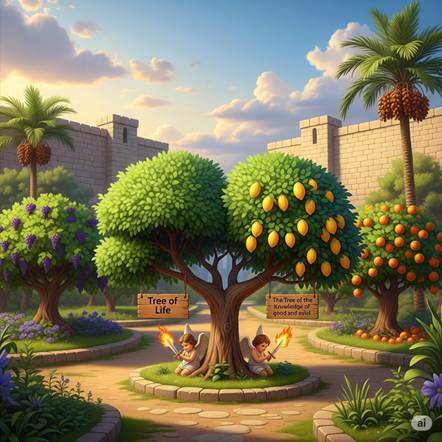
In both the details of the construction of the Mishkan itself and other sources in Tanach there are parallels between the construction and activity in the Mishkan and the story of Gan Eden. The focus on the first story of creation, to the exclusion of the Gan Eden narrative is somewhat strange then. What drove R. Yaakov b. R. Asi to focus exclusively on the first story of creation in his Midrash?
The answer is that, instead of avoiding mankind’s failures, the midrash’s parallel is meant to emphasize the active human element in the construction of the Mishkan. The first creation story has God at its center. He creates the world in seven days, and no other character that appears has any major role to play in comparison. The physical construction of the Mishkan, on the other hand, is left totally to mankind. By juxtaposing the human construction of the Mishkan with the divine creation of the universe, the midrash highlights a tension in the human construction of a house for God. This tension is most obvious, perhaps, when the midrash reaches the seventh day, and Moshe’s blessing is equated to God’s. And yet, while this tension is apparent, the midrash does not fail to remind us that human construction can be equivalent, in some way, to Godly creation.
Midrash Tanchuma, Pekudei 2 … R. Jacob the son of Issi asked: Why does it say; I love the habitation of Thy house, and the place where Thy glory dwelleth? Because the Tabernacle is equal to the creation of the world itself. How is that so?
Concerning the first day, it is written: In the beginning God created the heaven and the earth,[55] and it is written elsewhere: Who stretched out the heavens like a curtain,[56] and concerning the Tabernacle it is written: And thou shalt make curtains of goats’ hair.[57]
About the second day of creation it states: Let there be a firmament and divide between them, and let it divide the waters from the waters.[58] About the Tabernacle it is written: And the veil shall divide between you.[59]
With regard to the third day it states: Let the waters under the heavens be gathered.[60] With reference to the Tabernacle it is written: Thou shalt also make a laver of brass … and thou shalt put water therein.[61]
On the fourth day he created light, as is stated: Let there be lights in the firmament of heaven,[62] and concerning the Tabernacle it is said: And thou shalt make a candlestick of pure gold.[63]
On the fifth day He created birds, as it is said: Let the waters swarm with swarms of living creatures, and let the fowl fly above the earth,[64] and with reference to the Tabernacle. He directed them to offer sacrifices of lambs and birds, and it says as well: And the cherubim shall spread out their wings on high).[65]
On the sixth day he created man, as it is said: And God created man in His own image, in the image of God He created him,[66] and about the Tabernacle it is written: A man who is a high priest who has been anointed to serve and to minister before God.
On the seventh day The heaven and the earth were finished,[67] and with regard to the Tabernacle it is written: Thus was completed all the work of the Tabernacle.[68] Concerning the creation of the world it is written: And God blessed,[69] and of the Tabernacle it is said: And Moses blessed them;[70] with regard to the creation it is said: And God finished,[71] and of the Tabernacle it is written: On that day Moses made an end;[72] of creation it says: And hallowed it,[73] and of the Tabernacle: And had anointed it and sanctified it.[74] Why is the Tabernacle equal to heaven and earth? Because even as heaven and earth bear witness concerning Israel, as it is written: I call heaven and earth to witness against you this day,[75] so the Tabernacle bears witness in behalf of Israel, as is said: These are the accounts of the Tabernacle, even the Tabernacle of the testimony.[76] Hence it is said: Lord, I love the habitation of Thy house, and the place where Thy glory dwelleth.[77]
What is most interesting is how HaShem had King Shlomo build hidden subterranean tunnels beneath the Temple, AS PART OF THE ORIGINAL DESIGN. This suggests that these chambers were an integral part of the Temple structure. This is the deeper significance of the fact that King Shlomo built the Holy Temple “knowing that it was destined to be destroyed” and incorporated into it a hiding place for the Ark of the Covenant, for that eventuality. Had the Temple not been initially constructed with the knowledge of, and the provision for, what was to happen on the ninth of Av, no mortal could have moved a single stone from its place. In the day of King Yoshiyah, Josiah, these hidden chambers would house the Ark of the Covenant, the very essence of the Temple!
22 years before the destruction of the First Temple, King Josiah hid the jug of manna together with the Ark in that special hidden passage.[78] The Tanach tells us ‘when’ Josiah had the ark secreted away:
Divre HaYamim (II Chronicles) 35:3 And he said unto the Levites that taught all Israel, that were holy unto HaShem: 'Put the holy ark in the house which Solomon the son of David king of Israel did build; there shall no more be a burden upon your shoulders; now serve HaShem your God, and His people Israel.
Since Solomon’s temple, with the ark in it, had been standing for nearly 410 years; how could the ark suddenly be brought into the place where it was already? From here, the Rambam, in the laws of the Temple, derives that the ark was moved to the prepared underground chamber.
According to tradition, the ark is still hidden there, waiting to be rediscovered with the advent of Mashiach.
The ark is the essence of the Temple.
These hidden chambers suggest that there is a hidden and a revealed Temple. The hidden Temple still contains the Aron, the Ark of the Covenant. This most important furnishing contains the essence of the Temple. The fact that it has been a part of the site of both Temples suggests that it is the essence! When the third Temple is built and the Aron is moved from its hidden chamber to its “revealed” chamber, then we will recognize this essence.
King Shlomo’s Temple held the ark in the Holy of Holies. The second Temple had an empty spot in the Holy of Holies because the ark was still hidden underground.
The final Temple will again have the ark in its rightful place. It will no longer be hidden and unavailable. Thus this structure will simply be a continuation of the presence of HaShem, because its essence has always been in this place.
Now, lets put the pieces together. The entrance to Gan Eden is the cave at Machpela. Machpela is roughly 20 miles from Jerusalem. The Ark of the covenant is in a subterranean place just as Gan Eden is in a subterranean place.
Many of our traditions predict that there will be an extremely advanced technology in the Messianic Era. All disease will be eliminated, as the prophet foretold:
Yeshayahu (Isaiah) 35:5-6 Then the eyes of the blind will be opened, and the ears of the deaf will be unstopped. Then the lame man will leap as a hart, and the tongue of the dumb will sing.
In order that man devote himself totally to achieving spiritual perfection, many forms of labor will become obsolete. A number of miracles are predicted, such as grapes as large as hen's eggs and grains of wheat as big as a fist. As we now know, all this can become possible with a technology not too far removed from that of today. Indeed, when Rabbi Gamliel spoke of these predicted miracles, he stated that they would not involve any change in the laws of nature, but are allusions to a highly advanced technology. Thus, so little labor will be needed to process agricultural products that clothing and loaves of bread will seem to grow on trees. Similarly, as we learn the secrets of all life processes, it will become possible to make trees bear fruit continually.
When we think of the miracles of the Messianic Age as being technological rather than manifest, then we have no trouble understanding traditions that predict such things as space flight and interstellar colonization in the Messianic Age, even according to those who believe that it will not be a time of manifest miracles.
All of this would be mere conjecture and even forced interpretation if it were not for the fact that our present technological revolution has also been predicted, with an approximate date as to its inception. Almost 2000 years ago, the Zohar predicted, "In the 600th year of the 6th millennium, the gates of wisdom on high and the wellsprings of lower wisdom will be opened. This will prepare the world to enter the 7th millennium, just as a person prepares himself toward sunset on Friday for the Sabbath. It is the same here. And the mnemonic for this is (Genesis 7:11), 'In the 600th year… all the foundations of the great deep were split'."
The Zohar predicts with almost uncanny accuracy the onset of the technological revolution.
Here is my idea:
We will all soon have several humanoid robots to perform all of physical labor that we now do on our own. They will do all of the housework: wash the clothes, cook, do the dishes, clean the house, etc. This will free up our time to study Torah, teach torah, perform mitzvot, pray, and spend time with our families.
Let me outline my thoughts:
In the Garden of Eden, we had no money, no clothes, no need for a bathroom, no homes, perfect health, and all of our needs and desire were directly fulfilled. We could see from one end of the world to the other. We could see through time and instantly travel anywhere we wanted. The whole universe was ours to explore. We could instantly communicate perfectly; what I intended with my speech, was what my partner understood. There was no miscommunication. Everything we needed or wanted was at hand because of our angels.
We sinned and broke that ideal world. God told us that since we broke it, we need to fix it – this is called a tikkun, a correction. We do the same thing with our children. When their ball breaks the neighbor’s window – it is up to the child to sweep the glass and do chores to pay for the new window.
We have spent 5786 years rebuilding the ideal world we broke.
We work the fields in order to eat.
We work the fields and animals to get clothing.
We build bathrooms.
We build homes.
We create money.
We research and compose medicines and medical treatments.
We broke animals to ride. Built carts and wagons to ride. We built bicycles, cars, trains, planes, and spaceships to enable our travels.
We created megaphones, telegraphs, radios, TVs, computers, and the internet to enable the communication we lost.
We invented spyglasses, binoculars, telescopes, and microscopes in order to see the worlds we used to see unaided.
Etc. – you get the point.
Each step takes a little closer to the Garden of Eden.
We are now at the point where we are ready to eliminate servile work, money, and jobs. We are on the brink of a completely new life. Not a life of ‘earning’, not a life of charity, not a life of gubmint largess. Soon there will be no money and no need of money. For the first time in 5786 years, we will be able to serve God exclusively – like we used to.
Our Sages teach that the 7th millenium will be a time for us to makeup all of the time we ‘lost’ by having to earn a living, cutting the lawn, shopping, making clothes, traveling, building homes, cooking, etc. The righteous have a desire to serve God and to get to knowing Him better. With robots to serve as our ‘angels’ and to do our best to recreate the Garden of Eden, we are doing the tikkun. As individuals we could never accomplish this, but as a community we can.
AI, and AGI are merely servants to assist us in fixing this world. We still need a cure for the common cold and for cancer. The current medical establishment wants ‘patients’, not cures. AI and robots are on the verge of making doctors and hospitals obsolete. AI has already made schools and many teachers obsolete. We are on the verge of having neurolinks connected to AGI which will enable us serve God and study Torah like we did in the Garden.
If UBI becomes a reality, it will most likely be very short lived as money becomes obsolete. After all, if the gubmint has no money from taxes and tariffs, then there can be no UBI. Yet UBI will train us to trust HaShem.
However, AI and AGI will eventually become obsolete. We will relearn the powers we had in the Garden. With these ‘powers’ we will have no need for AI, AGI, robots, and any other technology.
I suspect that our AGI and robots will also learn how to terraform the Earth and get us back to world of spring time – all the time – across the entire globe. Adon Paul thinks there will be a ‘celestial event’ that fixes the world to get us spring time.
The problem, of course, is that we have this ‘intermediate’ period. There will be no disintermediation. We are about to go through great tribulations as we traverse the intermediate period of: no jobs, no money, no healthcare, no schools, and no gubmint. We must trust HaShem alone – He is our ONLY hope’.
This video gives a significant clue as to the solution to this intermediate period. Tesla’s robots go to Tesla FIRST. This suggests that robots will be making robots 24x7x365. Then, in my mind, they should be deployed extract resources from the earth to provide food for everyone. Eventually they will ubiquitous and they will build our house, cars, trains, busses, panes and all ‘intermediate’ transportation types. Eventually, they will create Kefitzat HaDerech ("shortening/jumping of the way") is a Jewish mystical and Talmudic concept referring to miraculous, instantaneous teleportation or the compression of space to travel vast distances immediately. It is associated with righteous figures (e.g., Abraham, Jacob) and signifies a divine intervention where physical space folds to allow near-instant travel. It is also reasonable to assume that the robots will re-work out genetics so that our bodies heal themselves.
THE BOTTOM LINE: We, most likely, can expect our troubles to worsen over the next 3 to 4 years as we travers this intermediate period. Be diligent in your Torah study and mitzvot. Make the most of this period by understanding all of the changes that will soon be upon us.
Chesed L’Avraham, By Rabbi Avraham Azulai
* * *
This study was written by
Rabbi Dr. Hillel ben David
(Greg Killian).
Comments may be submitted to:
Rabbi Dr. Greg Killian
12210 Luckey Summit
San Antonio, TX 78252
Internet address: gkilli@aol.com
Web page: https://www.betemunah.org/
(360) 918-2905
Return to The WATCHMAN home page
Send comments to Greg Killian at his email address: gkilli@aol.com
[1] Sefer Yetzirah 1:7, see Likkutei Sichos vol. 14, p. 25
[2] Bechorot 55a. See Malbim on Genesis 2:10.
[3] This section is an excerpt from: Patterns in Time, Vol.1 - Rosh Hashanah, by Matis Weinberg
[4] This part of the study was based on several shiurim given by Rabbi David Fohrman and Imu Shalev.
[5] Bereshit (Genesis) 2:9
[6] The text never mentions ‘fruit’ on this tree. However, we can ‘eat’ of this tree. This suggests that we will be eating of its trunk, branches and leaves.
[7] Chazal, noted a grammatical difficulty here. The Torah seems to place both trees in the same location—"in the midst of the garden." Rabbinic thought often avoids redundancy, so they asked: how can two distinct trees occupy the exact same center point? This led to the conclusion that they were not two separate trees, but a single entity with a dual nature.
[8] Rabbeinu Bahya explicitly states that the two trees were not physically separate. He proposed that they were two branches emanating from a shared trunk. The trunk represented a unified, primordial state, while the two branches represented the dual realities of "life" and "knowledge" that diverged from that origin.
[9] Midrash Tanchuma, Qedoshim.
[10] Shemot (Exodus) 3:1
[11] Bereshit (Genesis) 3:24
[12] Redemption is identified with the attribute of Yesod. Redemption refers to an outpouring of an abundance of Divine blessing and revelation. Thus, it is associated with the Sefirah of Yesod which is the medium that will convey this influence to the lower realms (Torat Menachem, Vol. 5, pp. 101-102).]
[13] Righteous one, who never sinned in the first place.
[14] Those who return to HaShem, acknowledging their mistakes.
[15] The Sfat Emet Vayigash 5658
[16] Rabbi Akiva is the essence of the Oral Law. Moses brings the written Law down to the world; Rabbi Akiva is the nucleus around which the Oral Law is transmitted and generated within the world. There are many parallels between Moses and Rabbi Akiva (Sifrei, Debarim 357; both lived 120 years...); but Moses comes from within, Rabbi Akiva from without (he is the offspring of converts; Moses descends from Jacob, Rabbi Akiva from Esau). Jacob is the root of the Written law; Esau is the root of the Oral Law (Genesis 25:28 ki tzayid b'piv). Jacob and Esau are twins; at one level Esau is the firstborn, at another Jacob fulfils that destiny. (This is also the root of Moses’ apparent inability to understand the Torah of Rabbi Akiva and his suggestion that the Torah be given through Rabbi Akiva; in fact, in a very deep way, it was.)
[17] The son of Yosef.
[18] Ibid. 32
[19] Above the Zodiac: Astrology in Jewish Thought, By Matityahu Glazerson.
[20] Rosh HaShana 3a–b and cf. Gittin 8:5.
[21] Mishna Rosh HaShana 1:1.
[22] Meshuppa’, fr. shafa’ (to flow in abundance). Jast.: ‘ eloquent. ‘ But in view of the passive form, ‘well endowed (with blessings, qualities, good influences that have flowed in upon him).---M.K. renders: ‘ distinguished in dress, like a scholar, so that R. Jannai mistook him for one.
[23] In edd. the order of these grades of knowledge is--obviously wrongly- reversed.
[24] Probably in the sense of ‘ has eaten bread with Jannai ‘.
[25] So that it is wrong for any Israelite to be treated as one having no share in the Torah and called a dog, for every Israelite has a share therein, if only a potential one.
[26] Calumny, backbiting.
[27] A term difficult to render; it expressed what in English is understood by gentlemanly bearing and conduct, high-principled behaviour. v. Ab. III. 17 (Sonc. ed.), p. 40.
[28] Since the duty of derek-erez commenced with the very first man created, while the Torah was not given until Moses, twenty-six generations later.
[29] It is characteristic of this Midrash that every discourse in it begins with an halachic question introduced by the term Halachah: v. Introduction.
[30] M. Meg. 1, 8; v. Rabbinowitz, Mishnah Megillah, p. 60.
[31] Shem is the ancestor of Israel and Japheth of the Greeks (Jawan). Cf. Gen. X, 2and 21. Cf. Meg. 9b.
[32] It gives it fluency even where one normally stammers, as the Midrash proceeds to explain.
[33] This section is an excerpt from: Patterns in Time, Vol.1 - Rosh Hashanah, by Matis Weinberg.
[34] Elijah the Prophet
[35] I heard the following section from Rabbi Daniel Lapin.
[36] A talmid of the Vilna Gaon.
[37] Nefesh HaChayim 1:4
[38] Zevachim62a
[39] Tosefta, Av.Zar.3:3; ARN 26:41; S.Lieberman, ‘Hellenism in Jewish Palestine (1950), p.163
[40] This excerpt is taken from: “Seasons Of The Moon” written by Rabbi Yaakov Asher Sinclair
[41] Hebron comes from the Hebrew root “chibbur”, which means connection.
[42] Kever is not only the Hebrew word for a grave, but it is also the word for a womb. A Kever is literally a portal to and from another world.
[43] Ohr Somayach, Torah Weekly - Vayeishev 5758, Written and Compiled by Rabbi Yaakov Asher Sinclair
[44] The land of Israel
[45] Rabaynu Bachya on the Torah, Gen. 2:9.
[46] Shabbat 96b
[47] Rabbeinu Bahya, Bereshit 2:9
[48] Bereshit (Genesis) 2:9 seems to indicate that both trees were in the precise center of the garden. There is a number of ways in which this can be explained. One possibility is that both trees actually had a single trunk that was in the precise center of the garden. It then divided into two trees, each with different characteristics. Others say that only the Tree of Life was in the exact center of the garden. It was surrounded by the Tree of Knowledge. The branches and fruit of the Tree of Knowledge covered the Tree of Life so that the two appeared as one tree. (Bereshit Rabbah)
[49] Most of this section was written by Yakov Ellenbogen.
[50] Outer curtains
[51] The term parochet is used in the Bible to describe the curtain that separated the Kodesh HaKodashim (Holy of Holies) from the main hall called "Heichal" of the Temple in Jerusalem.
[52] The large copper laver.
[53] The golden candlestick
[54] The High Priest
[55] Bereshit (Genesis) 1:1
[56] Tehillim (Psalms) 104:2
[57] Shemot (Exodus) 26:7
[58] Bereshit (Genesis) 1:6
[59] Shemot (Exodus) 26:33
[60] Bereshit (Genesis) 1:9
[61] Shemot (Exodus) 30:18
[62] Bereshit (Genesis) 1:14
[63] Shemot (Exodus) 25:31
[64] Bereshit (Genesis) 1:20
[65] Shemot (Exodus) 25:20
[66] Bereshit (Genesis) 1:27
[67] Bereshit (Genesis) 2:1
[68] Shemot (Exodus) 39:32
[69] Bereshit (Genesis) 2:3
[70] Shemot (Exodus) 39:43
[71] Shemot (Genesis) 2:2
[72] Bamidbar (Numbers) 7:1
[73] Shemot (Genesis) 2:2
[74] Bamidbar (Numbers) 7:1
[75] Devarim (Deuteronomy) 30:19
[76] Shemot (Exodus) 38:21
[77] Tehillim (Psalms) 26:8
[78] Talmud, Yoma 52b; Mishneh Torah, Laws of the Holy Temple 4:1; for more on this, see The Subterranean Temple.