
By Rabbi Dr. Hillel ben David (Greg Killian)
The Mishkan (not the Temple) as a Body:

In this study I would like to examine the connections between the human body and the Temple. This edifice is commonly referred to by our sages as the Beit HaMikdash, the house of holiness.
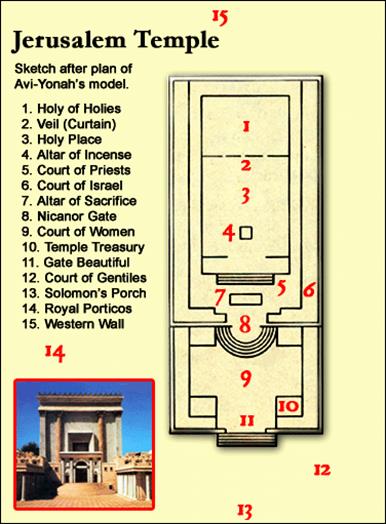
Mikdash is a combination of two Hebrew words: MAKOM KODESH. Makom = Place and Kodesh = Holy. Thus the Mikdash is the holy place. The place where HaShem put his name.
Rabbi Dessler[1] tells us a bit about this edifice:
The Desert Tabernacle, the details of whose construction take up the whole of parashat Terumah and much of the succeeding parshiyot, is sometimes called "sanctuary" [mikdash] ("And they shall make Me a mikdash"[2]). More frequently, however, it is called Mishkan, which means "dwelling place".
The meaning of Mishkan, the dwelling place (so to speak) of HaShem, is clearly expressed in the verse: "And so shall he (the Kohen Gadol) do to the Tent of Meeting which dwells with them in the midst of their defilement".[3] HaShem rests His presence amongst us even in the midst of our defilement because He knows that we have the ability to raise and extricate ourselves from defilement. How? Through the Torah. The Tent of Meeting is so called because it is the meeting place of HaShem and Israel, the place where Torah is transmitted. In parashat Tetzaveh, the Tent of Meeting is described as the place, "Where I shall meet with you [plural, i.e. Israel], where I will speak to you [singular, i.e. Moshe]".[4] "To speak to you" means to transmit Torah, and Torah learning creates a closeness between us and HaShem, a sense of joy and satisfaction. "The commands of HaShem are straightforward and rejoice the heart".[5] All this is included in the term Mishkan.
Mikdash, on the other hand, means a place of holiness. Holiness means transcendence. We feel the absolute gulf which separates the Creator from His creatures. Our response must be service, offerings and prayer, by which we recognize our lowliness before the grandeur of the Almighty. "My house shall be called a house of prayer for all nations."[6]
But nevertheless, we find that Mishkan is sometimes called mikdash and mikdash is sometimes called Mishkan.[7] How they are called reflects what they are in reality, for their meaning and existence are really one. If Mishkan represents the joy in the presence of HaShem, and mikdash represents the awe one feels in the transcendence of HaShem, then together they form one whole. We have to "rejoice in trembling".[8] And the Rabbis say: "I experience fear in the midst of my joy and joy in the midst of my fear".[9]
This is the end of Rabbi Dessler’s comments.
Go and stand before a mirror. What do you see? A head, two eyes, a nose and a mouth. Look down and you will see a neck which leads to the internal areas of the heart, stomach, etc.
You are looking at a human being. But if you look closer you will see one of the most profound creations in HaShem’s world, a miniature
Beit HaMikdash, a miniature Temple, and a
miniature world!
This study was precipitated by the following pasuk:
Shemot (Exodus) 25:8 And you shall make a sanctuary for me; that I may dwell among them.
The Or Hachayim asks why the Torah states “and you shall make a mikdash (Sanctuary) for me”, and then in the next verse it says “the form of the Tabernacle…so shall you do”. Are we talking about the mikdash (Sanctuary) or the Mishkan[10] (Tabernacle)? The Or Hachayim writes that the commandment to make a Mikdash for HaShem is not only referring to the time when Bne Israel were in the desert, but includes all of Jewish history from the time that we were in the desert to the time that we entered eretz Israel. He writes that when the Jewish people are in eretz Israel, and even in a time of Galut (exile), the mitzva to build the mikdash still applies.
The Malbim answers this question, in his work entitled Remazey HaMishkan (Illusions of the Sanctuary),[11] he explains that we each have to build inside of ourselves a mikdash, that each one of us must provide a residence for HaShem’s presence.
Rabbi Chaim of Volozhin, the renowned student of the Gaon of Vilna, said that the commandment to construct a Tabernacle is primarily a personal commandment; every Jew is “a living tabernacle in miniature.” HaShem rests the Shechinah, His Divine Presence, primarily in the human heart.
Excerpt from Sefer Charedim – The Book of the Awestruck (R. Eliezer Azkari, c. 1550) 66:27 – You are a Temple for the presence of the Holy King! As such, it is extremely important that you sanctify your heart and your soul, as well as all 248 limbs (bones[12]) of your body.[13] It is written, “The Holy One is in your midst [be’kir’becha]” (Hoshea 11:9), and “They [the people] are HaShem’s Temple“ (Yirmiyahu 7:4), and “Be holy, for I, HaShem, am holy” (Vayikra 19:2), and “I will place My Mishkan [Tabernacle] in your midst [be’tochechem]” (Vayikra 26:11). HaShem means what He says: “I dwell in you!”
Rabbi Chaim explains: The Zohar compares every Jew to the Temple (i.e. the permanent Tabernacle). Just like the center of the Temple is the Holy of Holies, the center of the human being is his heart. His head is above him, his feet are beneath him, so the heart which is at the midpoint of his trunk, is the actual center of his being. Just as the holiness that is the source of all that is good in the world emanates from the Holy of Holies, the life force of the human emanates from the heart.
In his commentary on Chumash, the Malbim explains that the Beit HaMikdash is a macrocosm of the human body: If you look at a plan of the Heichel (Sanctuary) in the Beit HaMikdash, you will notice that the placement of the various vessels, the altar, the table, and the Menorah all corresponds to the location of the vital organs in the human body. In other words, each of the Temple’s vessels represents a human organ.
The Zohar and the Midrash Ne’elam both state that the 613 parts of the Mishkan directly correlate to the 613 parts of the human body.
Thus we have in our tradition:
613 Mitzvot - 248 positive Mitzvot and 365 injunctions.
613 Human body parts - 248 limbs[14] and 365 sinews. The Mishna speaks of these 248 members:
Oholoth Chapter 1 MISHNA 8. THERE ARE TWO HUNDRED AND FORTY-EIGHT MEMBERS IN A HUMAN BODY: THIRTY IN THE FOOT, [THAT IS] SIX TO EVERY TOE,[15] TEN IN THE ANKLE, TWO IN THE SHIN, FIVE IN THE KNEE, ONE IN THE THIGH, THREE IN THE HIP,[16] ELEVEN RIBS, THIRTY IN THE HAND, [THAT IS] SIX TO EVERY FINGER, TWO IN THE FORE-ARM, TWO IN THE ELBOW, ONE IN THE UPPER ARM AND FOUR IN THE SHOULDER, [THUS MAKING] ONE HUNDRED AND ONE ON THE ONE SIDE [OF THE BODY] AND ONE HUNDRED AND ONE ON THE OTHER; THEN EIGHTEEN VERTEBRAE IN THE SPINE, NINE [MEMBERS] IN THE HEAD, EIGHT IN THE NECK, SIX IN THE KEY OF THE HEART,[17] AND FIVE IN THE GENITALS. EACH ONE [OF THESE MEMBERS] CAN DEFILE BY CONTACT, CARRIAGE OR OVERSHADOWING. WHEN IS THIS SO? WHEN THEY HAVE UPON THEM [THEIR] APPROPRIATE FLESH,[18] BUT IF THEY HAVE NOT [THEIR] APPROPRIATE FLESH UPON THEM, THEY CAN DEFILE BY CONTACT AND CARRIAGE BUT CANNOT DEFILE BY OVERSHADOWING.[19]
613 Different parts and vessels in the Mishkan.
[The Midrash compares the Mishkan as a whole to the human body, and each of its implements and components to various human organs and body parts. The beams supporting the Mishkan symbolize the ribs, the curtains of goats’ hide correspond to a person’s skin, and the Shulchan represents the stomach. The Kiyor suggests the liquid element of the human body. The Menorah, provider of light in the Mishkan, represents the human mind, which provides us with the light of comprehension and understanding. The Keruvim, which spread their wings over the Aron, correspond to the lungs, which are positioned over the heart, and the Aron corresponds to the human heart. ]
This picture of the Beit HaMikdash representing a man, as a place where HaShem resides, is also explicitly stated in the Nazarean Codicil:[20]
I Corinthians 3:16 Know ye not that ye are the temple of God, and the Spirit of God dwelleth in you?
Finally, we can understand that the Temple was not only the picture of a man, but it was the picture of the perfect man, the Mashiach:
Yochanan (John) 2:18 Then answered the Jews and said unto him, What sign shewest thou unto us, seeing that thou doest these things? 19 Yeshua answered and said unto them, Destroy this temple, and in three days I will raise it up. 20 Then said the Jews, Forty and six years was this temple in building, and wilt thou rear it up in three days? 21 But he spake of the temple of his body.
Ephesians 2:19-22 So then ye are no more strangers and sojourners, but ye are fellow–citizens with the saints, and of the household of God, 20 being built upon the foundation of the apostles and prophets, Mashiach Yeshua himself being the chief corner stone; 21 in whom each several building, fitly framed together, groweth into a holy temple in the Lord; 22 in whom ye also are builded together for a habitation of God in the Spirit.
Revelation 21:22 And I saw no temple therein: for the Lord God Almighty and the Lamb are the temple of it.
A
Critical Connection
When the men of the Great Assembly removed the yetzer hara (evil inclination) of avoda zara (idolatry) from the inner sanctum of the Beit HaMikdash, the effect was its removal from all our “work stations” connected to the “mainframe” in the Kodesh HaKadashim (Holy of Holies) in Jerusalem:
Yoma 69b He answered: One does not pronounce the Ineffable Name outside [the limits of the Temple]. But may one not? Is it not written: And Ezra the scribe stood upon a pulpit of wood, which they had made for the purpose. [. . . and Ezra praised the great God]. And R. Giddal [commenting thereupon] said: He magnified Him by [pronouncing] the Ineffable Name?-That was a decision in an emergency. And [they] cried with a great [loud] voice unto the Lord, their God. What did they cry? — Woe, woe, it is he who has destroyed the Sanctuary, burnt the Temple, killed all the righteous, driven all Israel into exile, and is still dancing around among us! Thou hast surely given him to us so that we may receive reward through him. We want neither him, nor reward through him! Thereupon a tablet fell down from heaven for them, whereupon the word ‘truth’ was inscribed. (R. Hanina said: One may learn therefrom that the seal of the Holy One, blessed be He, is truth). They ordered a fast of three days and three nights, whereupon he was surrendered to them. He came forth from the Holy of Holies like a young fiery lion.
From this Gemara we see that every one in the entire world is connected to the Beit HaMikdash. In some way we ARE the Beit HaMikdash!
When Idolatry was excised from the world, it was visibly manifesting as flame from the Kodesh Kodashin. But, the effects were felt in every human being from that time forward. From that time forward, human beings no longer had a craving for idolatry that was as strong as the craving for food or sex. We now possess only a shadow of that craving.
Thus we see that while idolatry lived in the hearts of men until that fateful days, once it was removed from the hearts of men, it was also removed from the Beit HaMikdash. This shows that the Beit HaMikdash pictures men and is meant to be seen as a picture of a man (i.e. Mashiach).
The Temple as a Body[21]
“Gold” is the soul;
“silver,” the body;
“copper,” the voice;
“blue,” the veins;
“purple,” the flesh;
“red,” the blood;
“flax,” the intestines;
“ram skins dyed red,” the skin of the face;
“tachash skins,” the scalp;
“shittim wood,” the bones;
“oil for lighting,” the eyes;
“spices for the anointing oil and for the sweet incense,” the nose, mouth, and palate;
“shoham stones and gemstones for setting,” the kidneys and the heart.
THE ANALOG OF THE IBN EZRA
The analog first boldly drawn by the Ibn Ezra (12th century, Spain) in his commentary to Bereshit 1:26 now returns with unusual force:
…God forbid that the Creator should have any corporeal qualities or tangible form. Behold the text proclaims “‘to whom shall you compare Me that I might be similar?’ says the Holy One” (Yeshayahu 40:25). Rather, because the supernal soul of man is eternal, it therefore shares an affinity with God. So too the soul is incorporeal and it also fills the whole body with life. The human body is thus like a miniature world. Blessed be God who began by fashioning the great cosmos and concluded by fashioning man, the microcosm!
For Ibn Ezra, there was a parallel to be drawn between HaShem the Creator and the soul of the human being. HaShem is utterly without body or form, but His eternal spirit of “glory” fills the material cosmos and inspires it with life and meaning. Similarly, though we must regard Ibn Ezra’s words with caution as a provocative analog that can convey only part of the matter, the human soul, ethereal and eternal, grants life to the human body, filling it with potential and purpose after the manner of the Creator. And the Mishkan as well, representing the proverbial link between heaven and earth, is thus constructed according to a similar dynamic. We return once again to the laden words of the Ibn Ezra, this time in his discussion of the meaning of the Mishkan, where he advances the explanation of Rav Sa’adia Gaon:[22]
The Gaon explained that there are in fact three worlds. This terrestrial world is the macrocosm, the Mishkan is intermediate, and the human body is the microcosm…[23]
While the Gaon goes on to draw specific comparisons between heavenly elements, the items of the Mishkan, and the organs of the human body, who could deny the overall persuasiveness of his linkage?
Head = Heichal
The Ohel Moed (the Tent of Meeting) was divided into two rooms. The back room was called the Kodesh HaKadashim, the Holy of Holies. Placed in this room was the Aron, Holy Ark, the most sacred of the articles in the Sanctuary. The Holy Ark consisted of three boxes, one inside the other. The innermost box contained the two tablets upon which the Ten Commandments were engraved. These Commandments were the outline of all the mitzvot in the Torah. It represented the brain of the perfect man. Just as a brain has two hemispheres, the right and the left, so too there were two tablets. Just as man contemplates only Torah ideas and ideals, so too the Ark contained the essence of Torah. Just as the brain is triply encased in a skull with two membranes, the tablets were also encased in three boxes.
We can also view the brain in a second way: The brain is enclosed in a double membrane, and the entrance to the Holy of Holies was through a double curtain.
The brain has two major portions, the left and right hemispheres of the brain. These two correspond with the two Luchot, the tablets on which were inscribed the ten commandments.
The Holy of Holies houses the Ark of the Covenant topped by the two winged Kruvim (cherubim), one of which represents HaShem, while the other represents Israel. The Divine voice heard by man emerges from between these two Kruvim.
When Moses arrived at the Ohel Moed, the Tent of Meeting, to speak with HaShem, he heard the voice speaking to him from atop the cover that was upon the Ark of the Testimony, from between the two Kruvim, and He spoke to him.[24]
Additionally, as Torah is wisdom and is stored in the ark, so, too, does wisdom come from the brain of man.
Cranial Membrane = Curtain.
Chazal teach that the curtain moved rhythmically in and out as though moved by the breath of a man.
Rashi’s Commentary for: Shemot (Exod.) 26:9 and you shall fold the sixth curtain [I.e.,] of these upper curtains, which exceeds [overhangs] the lower ones. before the front of the tent Half its width [of the sixth curtain] was hanging and folded over the screen on the east[ern side of the Mishkan], before the entrance, resembling a modest bride whose face is covered with a veil.
Eyes = Menorah + Shulchan.
The eyes are used for two purposes. One is used for intellectual pursuits, enlightenment, symbolized by the light of the Menorah. Just as the Menorah’s fuel was the purest of oil, so too should man strive for the purity of enlightenment. According to the Kabbalists, there are seven areas of spiritual wisdom and the seven branches of the Menorah represent them. The second function of the eyes is for survival: to see and avoid pitfalls, to search out food in order to live; this is symbolized by the showbread (Shulchan).
Ears = Chamber of Hewn Stone
As the ears are partly internal and partly external to the body, so, too, the Sanhedrin met in the chamber of hewn stone which was partly inside the Temple and partly outside.
The Sanhedrin “heard” cases.
Nose = Golden Altar of Incense
Just as the nose is the organ of smell and is located in the center of the face, the Golden Altar was located in the center of the room and upon it the fragrant smelling incense was offered. The incense had great mystical meaning and represented the spreading of pleasantness among men. This offering brought atonement for gossip and tale bearing.
Mouth = Door to the Heichal[25].
The opening of the Kodesh (the Holy place), which led to the Azara (Courtyard), was at the bottom of the room. It represented the mouth of man. Here the kohanim (Priests) stood when they uttered the priestly benediction every morning.
Why did HaShem communicate to Moshe through the child-like Kruvim? Are the Kruvim the mouth?
Salivary glands = Laver.
As the salivary glands provide water at the entrance to the mouth, so too does the laver provide water at the “mouth” of the Heichel (the sanctuary building).
Breasts = Poles of the ark poking the curtain
Rashi’s Commentary on 1 Kings 8:8 8 The ends of the staves were seen In the curtain which was against the entrance [of the sanctuary in the אמה טרקסין . You might think they tore through the curtain and protruded [on the other side]. The text, therefore, states “and they were not seen without.” How is this possible? They were pushing and bulging similar to two breasts of a woman, as it says, “he lies between my breasts” (Song of Songs 1:13).
Heart = The base of the altar
The sacrificial blood was dashed against the altar and then poured out at the base of the altar. As the altar has four corners, so too does the heart have four chambers. As the heart has a higher and lower part, so too does the altar have a red line that marks the upper and lower parts (some offerings had their blood dashed above and some had the blood dashed below).
Stomach = Altar
Outside the Ohel Moed / Heichel, in the center of the courtyard, was the main Altar upon which the sacrifices were offered and consumed. This represents the stomach and internal organs of man.
The sacrifices were also called food:
Vayikra (Leviticus) 3:11 And the priest shall burn it upon the altar: it is the food of the offering made by fire unto HaShem.
As the stomach is slightly off-center, so, too, is the altar slightly off-center.
Notice that we speak of the stomach as having “heart-burn”, just as the altar burns, so our stomach burns.
Umbilical cord = The smoke from the altar
As the smoke originated on the altar and exited the Beit HaMikdash from the altar, so too does the umbilical cord connect to the stomach and exit from the stomach.
Esophagus = Altar Ramp.
The sacrifices were carried up the ramp and laid on the altar. Even so, the food is carried by the esophagus to the stomach.
Sex organs = Fifteen steps between the men’s and women’s courtyards.
The Levitical choir would sing the fifteen Psalms / Songs of Ascent while standing on these fifteen steps, during Succoth. Succoth is, of course, the quintessential picture of the marital chamber. The words of the Levites represent the sperm and the music represents the semen. The movements of the Levitical choir represents the thrusts of the organ.
Next to these semi-circular steps were two rooms used to store the musical instruments. These seem to represent the testes. They are the instruments from which the music originates. The music gives force to the lyrics.
Skin = Wall
Ashes = Waste Product.
The ashes were stored in the center of the brazen altar until carried outside the camp. Even so, the waste product of a man is connected to the stomach and exits at the center of the body.
Fetus = Giant lampstands In the Courtyard
Another ceremony of Succoth, the illumination of the Temple, also had it’s source in Jewish tradition. According to the Mishna, at the end of the first day of Tabernacles, the priests and Levites went down to the court of the women. Four enormous golden candlesticks were set up in the court (fifty cubits high) with four golden bowls placed upon them and four ladders resting against each. Four youths of priestly descent stood at the top of the ladders holding ten-gallon pitchers filled with pure oil, which they poured into each bowl.[26]
The priests and Levites used their own worn-out liturgical clothing for wicks. The light emanating from the four candelabra was so bright that the Mishna says:
Succah 5:3 There was not a courtyard in Jerusalem that was not illuminated by the light of the Beit HaSho’eivah (libation water-well ceremony).
Mishlei (Proverbs) 20:27 A man’s soul is the lamp of HaShem.
A lamp is contrived of two parts: the oil, which corresponds to the soul, and the wick, which corresponds to the body. Together, they sustain the flame, which is the Torah. The more the oil is clean and pure, the more beautiful the flame will light. The finer the wick, the more a person’s body will readily accept purity, the more the light will continue to shine.
These “candles” are a good picture of a human baby. They have oil, wick, and flame, which is like a human being. These lamps are also an allusion to Mashiach:
Yochanan (John) 8:12 When Yeshua spoke again to the people, he said, “I am the light of the world. Whoever follows me will never walk in darkness, but will have the light of life.”
Chazal teach that the arms and legs are exterior to our bodies and are only used to “go” and to “do”. This helps us to understand why the Beit HaMikdash does not have appendages to represent legs or arms.
The Mishkan, unlike the Temple, was represented by Adam and Chava (Eve) before HaShem separated them. Thus there was no women’s courtyard in the Mishkan.
The
Human Soul In The Temple[27]
Tradition teaches that the human soul has five levels, of which the lower three are connected to our physical selves. And it is these three that concern us here. At the core of our being we are a neshama, which is always connected to HaShem to such a great extent that it is difficult to tell where the Divine Presence ends and the person begins. Although our neshama is the core of our being, we are not self-conscious on the level of neshama; we are only self-conscious on the bottom two levels of our souls, the Ruach and the nefesh.
The neshama is connected to our ruach, our spiritual self. We are all self aware as spiritual beings; we can all imagine ourselves as living without our bodies, and we all have a sense of morality and right and wrong that we know is above all materialistic considerations. The ruach is connected to our nefesh,the life force that burns within us and is the engine that drives us, the materialistic part of our beings.
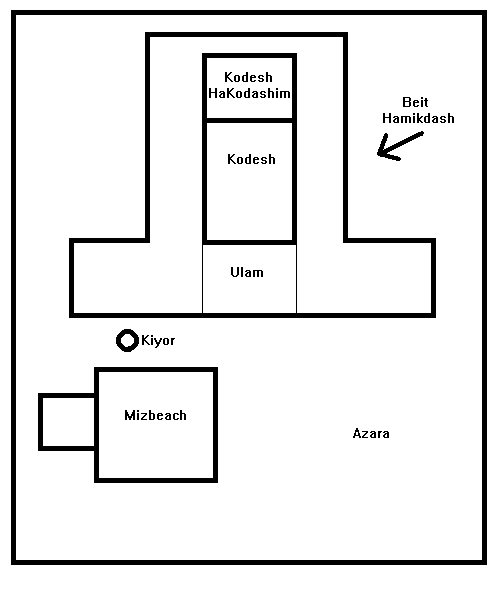
The Temple is put together in the same way. The outermost level is called the Azara, and that is where the animal sacrifices are all brought. This level parallels the nefesh. It is connected to the Heichal, a much more spiritual place. No animal sacrifices are ever offered there. The incense is offered in the Heichal, that is where the Menorah is to be found; the Holy bread that stays warm and fresh from Shabbat to Shabbat is there. It is clearly a more spiritual part of the Temple, but we still have daily access to it just as we do to our own spirituality. This level parallels the ruach.
Finally within the innermost recesses of the Heichal is the Holy of Holies; a separate alcove that is curtained off; the Holy Ark is kept there and this is the place that the Shechinah inhabits; we do not have daily access to this part of the Temple at all. The only person who ever enters it is the High Priest, and even he is only allowed to enter once a year. This lack of access is clearly an existential expression of our lack of access to our own neshamot.
The symbolism is clear; the High priest who enters the Holy of Holies on Yom Kippur must enter it on the level of neshama.
Life is problematic only because we are not really sure about how to define ourselves. Were we able to see ourselves clearly as neshamot and were we therefore conscious of our unbreakable attachment to God, the point of our lives would be quite clear to us; we wouldn't be at all confused as to why we exist and what we are supposed to do with our lives. But God decreed that we must live with free will, and therefore the awareness of how our life depends on our attachment to God at the source of our beings is withheld from our self-consciousness.
Instead we are placed in a situation of existential conflict; our raging life force, the nefesh, and our spiritual side, the ruach, are always contending with each other pulling us in different directions. The ceaseless conflict confuses us; none of us are sure of who and what we are. No one wants to deny their real selves and live the wrong life; our confusion about who we are is the source of our sins. The eternal confusion is the dilemma that forms the backdrop against which we must exercise our free will.
Our state of oblivion regarding the existence of our neshama, the highest level of our soul that is always attached to God renders us incapable of reaching clarity about who we are and clearing up our confusion.
Stepping into the Holy of Holies means becoming self-conscious as neshamot. The fog of confusion is instantly dissipated and replaced by total clarity of vision. To enjoy such clarity runs contrary to the purpose of living in this world. To enter the Holy of Holies is to step out of life as God decreed that it must be lived here in this world of difficult choices. When Nadav and Avihu took this step, they terminated the point of their continued existence in the world of choice and therefore left it; they died.
But they sanctified the Temple in the process. They demonstrated the existence of the Temple on the level of neshama, they demonstrated the existence of their own Neshamot, the state of the attachment of the neshamato God, and how this relationship is mirrored by the Holy of Holies in the Temple. To us plain folks the cause of their death would perhaps have remained a total mystery; but to the 'generation of the wise' who stood at the foot of Mt. Sinai the lesson taught by their deaths was obvious, and revealed the power of the heretofore missing dimension of the Temple, the Holy of Holies.
The Luz Connection
The Beit HaMikdash is the “neck” of the world.
Berachoth 30a Our Rabbis taught: A blind man or one who cannot tell the cardinal points should direct his heart towards his Father in Heaven, as it says, And they pray unto the Lord. If one is standing outside Palestine, he should turn mentally towards Eretz Israel, as it says, And pray unto Thee towards their land. If he stands in Eretz Israel he should turn mentally towards Jerusalem, as it says, And they pray unto the Lord toward the city which Thou hast chosen. If he is standing in Jerusalem he should turn mentally towards the Sanctuary, as it says, If they pray toward this house. If he is standing in the Sanctuary, he should turn mentally towards the Holy of Holies, as it says, If they pray toward this place. If he was standing in the Holy of Holies he should turn mentally towards the mercy-seat. If he was standing behind the mercy-seat he should imagine himself to be in front of the mercy-seat. Consequently, if he is in the east he should turn his face to the west; if in the west he should turn his face to the east; if in the south he should turn his face to the north; if in the north he should turn his face to the south. In this way all Israel will be turning their hearts towards one place. R. Abin — or as some say R. Abina — said: What text confirms this? — Thy neck is like the tower of David builded with turrets [talpioth], the elevation [tel][28] towards which all mouths (piyyoth) turn.
Megilah 16b And he fell upon his brother Benjamin’s neck.[29] How many necks[30] had Benjamin? — R. Eleazar said: He wept for the two Temples which were destined to be in the territory of Benjamin[31] and to be destroyed. And Benjamin wept upon his neck: he wept for the tabernacle of Shiloh which was destined to be in the territory of Joseph and to be destroyed.
Midrash Rabbah - The Song of Songs IV:12 THY NECK IS LIKE THE TOWER OF DAVID: this refers to the Temple. Why is it compared to a neck? Because so long as the Temple was standing, Israel’s neck was stretched out among the nations of the world, but when the Temple was destroyed, then, if one may say so, Israel’s neck was bowed; and so it is written, And I will break the pride of your power (Lev. XXII, 19), namely, the Temple. Another explanation: Just as a man’s neck is in the highest part of him, so the Temple was in the highest part of the world. And just as most ornaments are hung round the neck, so the priests were attached to the Temple, the Levites were attached to the Temple. And just as, if the neck is removed, a man cannot live, so since the Temple was destroyed there has been no life for the enemies of Israel.
The Midrash has this to say about the luz bone:
Midrash Rabbah - Leviticus XVIII:1 And the almond shall blossom refers to the luz (nut) of the spinal column. Hadrian, may his bones be crushed, asked R. Joshua b. Hananiah, saying: ‘From which part of the body will the Holy One, blessed be He, in the Time to Come, cause man to sprout forth? ‘ He answered: ‘ From the nut of the spinal column.’ Said he: ‘How can you convince me?’ He thereupon brought one before him; he put it in water, but it was not dissolved; he let it pass through millstones, but it was not ground; he put it in fire, but it was not burnt; he put it on an anvil and began beating it with a hammer, but the anvil was flattened out, and the hammer was split, but all this had no effect.
The
Mishkan (not the Temple) as a Body:
The Mishkan (the Tabernacle in the wilderness) alludes to the human body. Rambam thus wrote the following to his son:
My son Avraham, you must realize that the Mishkan alludes to the human body.
The Holy Ark, the innermost part, alludes to the human heart, which is the innermost part of the body. The Ark was the main part of the Mishkan because it contained the Tablets of the Covenant. So, too, is the human heart the main part of the body. It is the source of his life, his knowledge and his understanding. The wings of the keruvim, which spread over the Ark, allude to the lungs. The lungs are over the heart like wings and they provide it with air. The Table in the Mishkan alludes to the human stomach. Just as food and drink are placed on the table, so the stomach is filled with food and drink that a person consumes and from there it is distributed to the other parts of the body.
The Menorah (candlestick) in the Mishkan alludes to the human mind. Just as the Menorah gives forth light, so the intellect enlightens the entire body. Three stems went out from the Menorah on each side. These allude to the three limbs that extend from each side of the human body, the eye, the ear, and the hand. The intellect directs these three parts of the body. The incense altar alludes to the sense of smell. The sacrificial altar alludes to the intestines, which digest the food that enters the body. The veil covering the Mishkan alludes to the diaphragm, which is like a barrier between the parts of the body. The washstand alludes to the moisture and other liquids in the body. The goats’ wool hangings allude to the skin that covers the human body. The beams of the Mishkan allude to the ribs.[32]
The Beit
HaMikdash is Female
The parts of the Beit HaMikdash all are in the feminine gender, in Hebrew. This suggests that the structure and it’s utensils are part of a female body. This aspect is further emphasized when we note that the Torah calls a man’s wife his “house”.[33] A wife is a house. Thus, the Beit HaMikdash, “The House of the Holy One”, would also be female.
If one looks at the form of the Beit HaMikdash as emphasized by the courtyards, we can see that the Woman’s courtyard is the largest courtyard, and it is at the “bottom” of the structure. This mirrors the female body which has the largest part at the bottom of the structure. Please remember that the arms and legs are not part of the structure, only the head and torso.
Creation
and the Mikdash
By Rav Yitzchak Levi
The Mikdash as the completion of creation.
An aspect of the connection between the creation of the world and the Mikdash is the idea that the Mishkan and the Mikdash are the goal of creation, and it was only with their construction that creation was completed. For example:
Another explanation: “So was ended all the work” (I Melakhim 7:51; II Divrei Ha-yamim 5:1) – it does not say here “the work,” but rather “all the work:” the work of the six days of creation. “From all His work that God had created and formed (la-asot, lit. ‘to form’)” (Bereshit 2:3) – it does not say here “and formed,” but rather “to form:” there is still another work. When Shlomo came and built the Temple, the Holy One, blessed be He, said: Now the work of heaven and earth is complete – “So was ended all the work.” Therefore he was called Shlomo, for the Holy One, blessed be He, completed (hishlim) the work of the six days of creation through his handiwork.[34]
Another explanation: “Who has established all the ends of the earth” (Mishlei 30:4) – this refers to Moshe, who established the Tent of Meeting, with which the world was established. It does not say “to set up the Mishkan,” but rather “to set up with the Mishkan” (le-hakim et ha-Mishkan” (Bamidbar 7:1) – the world was set up with it. For until the Mishkan was erected, the world was unstable; but after it was erected, the world became firm. Therefore it says: “And it came to pass on the day that Moshe had finished setting up (with) the Mishkan.”[35]
(Rashi’s Commentary for: B’Midbar (Numbers) 7:1 And it was that on the day that Moses finished Heb. כַּלּוֹת . The text כַּלּוֹת on the day the Mishkan was erected, the Israelites were like a bride (כַּלּוֹת) entering the nuptial canopy.-[Tanchuma Naso 20, 26, Pesikta Rabbathi 5:5, Pesikta d’Rav Kahana p. 6a, and other sources] [According to Tanchuma, the derash is based on the spelling כַּלַּת , which differs from the spelling in all extant sifrei Torah. Some believe that the derash is based on the vowelization כַּלוֹת , instead כְּלוֹת , which would clearly mean “finishing.” Heidenheim believes that the choice of the word כַּלוֹת , the root of which is ambiguous, indicates the intention of the Torah to include both meanings: finishing and nuptials.[36])
“To set up the Mishkan”… There we have learned (Avot 1:2): The world stands on three things – on the Torah, on the Divine service, and on acts of loving-kindness. And Moshe mentioned all three of them in one verse: “You in Your loving-kindness have led forth Your people whom you have redeemed” (Shemot 15:13) – this is loving-kindness; “You have guided them in Your strength” – this is the Torah…; “To Your holy habitation” – this is the service in the Mishkan and in the Mikdash… He guided them by virtue of the Torah which they had received before the erection of the Mishkan. What was the world like at that time? It was like a stool with two legs, which cannot stand and is unstable. When a third leg was made for it, it became firm and it stood. So, too, when the Mishkan was made… immediately, it became firm and stood. For at first the world had only two legs, loving-kindness and the Torah, and it was unstable. When a third leg was made for it, namely, the Mishkan, it immediately stood. (Bamidbar Rabba, parasha 12)[37]
According to the midrashim, the Mishkan and the Mikdash are essentially a continuation of the creation and its completion. Before they were built, the world was lacking, and the goal of creation had not been attained. Moreover, before the Mikdash was built, the existence of the world was not absolute and stable, for the world rests, among other things, upon the Divine service, the heart of which is in the Temple.
Parallels between the creation of the world and the construction of the Mishkan.
This connection finds expression in Scripture in a number of stylistic parallels between the Mishkan and creation:
1) Both are called melakha, “work” (Bereshit 2:2-3; Shemot 31:3, 5; and many other places).
2) The root, ayin-sin-heh, repeats itself many times in both contexts.
3) Wisdom, understanding and knowledge:
The Lord by wisdom founded the earth; by understanding He established the heavens. By knowledge the depths were broken up. (Mishlei 3:19-20)
See, I have called by name Betzalel… And I have filled him with the spirit of God, in wisdom, and in understanding, and in knowledge, and in all manner of workmanship (Shemot 31:2-3)[38]
4) ”Seeing” at the completion of the work:
And God saw everything that He had made, and, behold, it was good. (Bereshit 1:31)
And Moshe saw all the work, and, behold, they had done it as the Lord had commanded, even so they had done it. (Shemot 39:43)
5) Completion of the work:
Then the heavens and the earth were finished, and all their host. And by the seventh day God ended the work which He had done. (Bereshit 2:1-2)
Thus was the work of the tabernacle of the Tent of Meeting finished: and the children of Israel did according to all that the Lord commanded Moshe, so they did… So Moshe finished the work. (Shemot 39:32; 40:33)
6) A blessing at the completion of the work:
And God blessed the seventh day, and sanctified it: because in it He rested from all His work which God had created and performed. (Bereshit 2:3)
And Moshe saw all the work, and, behold, they had done it as the Lord had commanded, even so they had done it: and Moshe blessed them. (Shemot 39:43)
7) Ending with the sanctity of Shabbat (Bereshit 2:1-3; Shemot 31:12-17).
Chazal noted these parallels in several places. The Tanchuma draws a parallel between the order of creation and the order of the building of the Mishkan:
Rav Yaakov be-Rav Asi said: Why does it say: “Lord, I love the habitation of Your house, and the place where Your glory dwells” (Tehillim 26:8)? Because it is equivalent to the creation of the world. How so?
On the first day it says: “In the beginning God created the heaven and the earth” (Bereshit 1:1); and it says: “Who stretches out the heavens like a curtain” (Tehillim 104:2). And regarding the Mishkan, what does it say - “And you shall make curtains of goats’ hair” (Shemot 26:7).
On the second day, “Let there be a firmament” (Bereshit 1:6), and it mentions division, as it is stated: “And let it divide water from water.” And regarding the Mishkan, it says: “And the veil shall be for you as a division” (Shemot 26:33).
On the third day, it mentions water, as it says: “Let the waters be gathered” (Bereshit 1:9). And regarding the Mishkan, it says: “You shall also make a laver of brass, and its pedestal also of brass… and you shall put water in it” (Shemot 30:18).
On the fourth day, He created the lights, as it says: “Let there be lights in the firmament of heaven” (Bereshit 1:14). And regarding the Mishkan, it says: “And you shall make a candlestick of pure gold” (Shemot 25:31).
On the fifth day, He created the birds, as it is stated: “Let the waters swarm abundantly with moving creatures that have life, and let birds fly above” (Bereshit 1:20). And corresponding to them in the Mikdash – offering sacrifices from sheep and birds.
On the sixth day, man was created, as it says: “So God created man in his own image” (Bereshit 1:27) – He formed him with dignity. And regarding the Mishkan it says “man,” namely, the High Priest who was anointed to serve and attend before God.
On the seventh day: “Thus the heavens and the earth were finished” (Bereshit 2:1). And regarding the Mishkan, it says: “And all the work was finished.”
Regarding the creation of the world, it says: “And God blessed” (Bereshit 1:28). And regarding the Mishkan, it says: “And Moshe blessed them” (Shemot 39:43). Regarding the creation of the world, it says: “And God ended” (Bereshit 2:2), and regarding the Mishkan, it says: “And it happened on the day that it was finished.” Regarding the creation of the world, it says: “And He sanctified it” (Bereshit 2:3), and regarding the Mishkan, it says: “And Moshe anointed it and sanctified it.”
Why is the Mishkan equivalent to the heavens and the earth? Just as the heavens and the earth testify about Israel, as it says: “I call heaven and earth to witness this day against you” (Devarim 30:19), so the Mishkan is testimony to Israel, as it is stated: “These are the accounts of the Mishkan, the Mishkan of the testimony” (Shemot 38:21).
Therefore, it says: “Lord, I love the habitation of Your house, and the place where Your glory dwells”[39]
The Midrash Ha-Gadol at the end of Parashat Pekudei explains how the Mishkan completes the creation:
“Then a cloud covered the Tent of Meeting” (Shemot 40:34) – this is what it means when it says: “The righteous shall inherit the land, and dwell in it for ever” (Tehillim 37:29). Rav Yitzchak said: “The righteous shall inherit the land” – and where are the wicked? Hanging in the air? Rather what is “and dwell in it for ever” – they will cause the Shechinah to dwell in it.
The Shechinah was originally in the lower world. When the first man sinned, it retreated to the first firmament. The generation of Enosh arose and sinned, and it retreated from the first to the second firmament. The generation of the flood arose and sinned, and it retreated from the second to the third firmament. The generation of the dispersion arose and sinned, and it retreated from the third to the fourth firmament. The Egyptians in the days of Avraham sinned, and it retreated from the fourth to the fifth firmament. The Sodomites sinned, and it retreated from the fifth to the sixth [firmament].The Egyptians in the days of Moshe sinned, and it retreated from the sixth to the seventh [firmament].
And corresponding to them, seven righteous men arose and brought [the Shechinah] down to earth. Avraham arose and acted virtuously, and brought it down from the seventh to the sixth [firmament]. Yitzchak arose and acted virtuously, and brought it down from the sixth to the fifth [firmament]. Yaakov arose and acted virtuously, and brought it down from the fifth to the fourth [firmament]. Levi arose and acted virtuously, and brought it down from the fourth to the third [firmament]. Kehat arose and acted virtuously, and brought it down from the third to the second [firmament]. Amram arose and acted virtuously, and brought it down from the second to the first [firmament]. Moshe arose and acted virtuously, and brought it down to the earth, as it is stated: “And the Glory of the Lord filled the Mishkan” (Shemot 40:34).
The midrash in Shemot Rabba (35, 1) states that certain things were created solely for the sake of the Mishkan:
Rabbi Shimon ben Lakish said: The world was not worthy of using gold; why then was it created? For the Mishkan and for the Mikdash, as it is stated: “And the gold of that land is good” (Bereshit 2:12), and as it is stated: “That goodly mountain and the Levanon” (Devarim 3:25)… Rav Chanina said: The world was not worthy of using cedars. They were created solely for the Mishkan and for the Mikdash, as it is stated: “The trees of the Lord have their fill; the cedars of Levanon, which He has planted” (Tehillim 104:16), and Levanon refers to the Mikdash, as it is stated: “This goodly mountain and the Levanon.”
The Maharal, in his Gur Arye on the commentary of Rashi regarding the offering brought by Netanel the son of Tzo’ar, brings an interesting allusion to this matter. The Torah states:
On the second day, Netanel, the son of Tzo’ar, prince of Yissakhar, did offer: he offered for his offering one silver dish, the weight of which was a hundred and thirty shekels, one silver bowl of seventy shekels, after the shekel of the sanctuary, both of them full of fine flour mingled with oil for a meal offering, one spoon of gold of ten shekels, full of incense, one young bullock, one ram, one lamb of the first year, for a burnt offering, one kid of the goats for a sin offering, and for a sacrifice of peace offerings, two oxen, five rams, five he goats, five lambs of the first year. This was the offering of Netanel the son of Tzo’ar. (Bamidbar 7:18-23)
On this Rashi comments (ad loc.):
One silver dish (ke’arat kesef) – The numerical value of its letters [= of the letters of these two words] is 930, corresponding to the years of the first man [= Adam].
The weight of which was a hundred and thirty shekels – In allusion to the fact that when he [Adam] first raised children to maintain the world in existence he was 130 years old, for it is said: “And Adam lived a hundred and thirty years and then begat a son” (Bereshit 5:3).
One silver bowl (mizrak echad kesef) – The numerical value of these words is 520, being an allusion to Noach who begot children at the age of 500 and also an allusion to the twenty years before his offspring were born when the decree regarding the flood was made, just as I have set forth in my comment upon the verse: “Yet his days shall be 120 years” (Bereshit 6:3)…
Seventy shekels – Corresponding to the seventy nations that descended from his [= Noach’s] sons.
One spoon (kaf achat; the word kaf also denotes “hand”) – in allusion to the Torah that was given from the hand of the Holy One, blessed be He.
Of gold of ten shekels – Corresponding to the Ten Commandments.
Full of incense – The total of the word ketoret according to the numerical value of its letters is 613, the number of the biblical commandments, except you must exchange the kof by dalet, according to the “method of permutations” known as a”t b”sh g”r d”k [by which the first letter of the alphabet may take the place of the last, the second that of the one before the last, etc.].
One young bullock – In allusion to Avraham, of whom it states: “And he took a young bullock” (Bereshit 18:7).
One ram – In allusion to Yitzchak, with reference to whom Scripture states: “And he took the ram, etc.” (Bereshit 22:13).
One lamb – In allusion to Yaakov, of whom Scripture states: “And Yaakov separated the lambs” (Bereshit 30:40).
One kid of the goats – In order to make expiation for the selling of Yosef, with reference to whom it states: “And they slaughtered a kid of the goats” (Bereshit 37:31).
And for a sacrifice of peace offerings, two oxen – In allusion to Moshe and Aharon, who made peace between Israel and their Father in heaven.
Five rams, five he goats, five lambs – Three species in allusion to the three divisions of the nation: priests, Levites and ordinary Israelites, and also in allusion to the Torah, the Prophets and the Hagiographa. There are three times five, in allusion to the five books of the Torah, the five commandments written on one of the Tablets, and to the five written on the other. Thus far I found in the work of Rabbi Moshe ha-Darshan.
The Maharal in his Gur Arye (ad loc.) comments as follows:
If you ask, what is the connection here to the years of Adam and Noach – it might be suggested that the building of the Mishkan is equivalent to the creation of the world, and everything that was in the creation of the world was in the building of the Mishkan. There were curtains in the Mishkan, as in the whole world: “Who stretches out the heavens like a curtain” (Tehillim 104:2). And just as the stars appeared, so the clasps appeared in the Mishkan… And therefore all the foundations of the world, namely, Adam, Noach, the seventy nations, the Torah, and the Ten Commandments, upon which the entire world stands, are alluded to in the Mishkan, so that the Mishkan be like the entire world.
Expressions of the creation of the world in the Mikdash.
Halacha offers two examples of daily mentioning of the creation of the world in the Temple. First, during the week of each ma’amad, its members would read the story of the creation, corresponding to the days of the week:
On the first day: “In the beginning” and “Let there be a firmament.” On the second day: “Let there be a firmament” and “Let the waters be gathered together.” On the third day: “Let the waters be gathered together” and “Let there be lights.” On the fourth day: “Let there be lights” and “Let the waters swarm abundantly.” On the fifth day: “Let the waters swarm abundantly” and “Let the earth bring forth. On the sixth day: “Let the earth bring forth” and “Thus the heavens and the earth were finished.”
The second example is the song that the Levites would sing in the Temple each day, which would bring to mind the creation of the world:
It was taught: Rabbi Yehuda said in the name of Rabbi Akiva: On the first day [of the week] what did they say? “The earth and its entire contents belong to the Lord” (Tehillim 24:1), because He acquired and transferred possession and ruled over His world.
On the second day what did they say? “Great is the Lord, and highly to be praised” (ibid. 48:2), because He divided up His works and ruled as king over them.
On the third day they would say: “God stands in the Divine assembly” (ibid. 82:1), because He revealed the land with His wisdom and prepared the world for His assembly.
On the fourth day they would say: “God of retribution, Lord” (ibid. 94:1), because He created the sun and the moon and in the future will punish those who worshipped them.
On the fifth day they would say: “Sing aloud to God our strength” (ibid. 81:2), because He created the birds and the fish to praise His name.
On the sixth day they would say: “The Lord is King; He is robed in majesty” (ibid. 93:1), because he finished His work and ruled as king over them.
On the seventh day they would say: “A song for the Sabbath day” (ibid. 92:1), for the day which will be all Sabbath. (Rosh ha-Shana 31a)
(Translated by David Strauss)
The following table comes from the Midrash Rabbah on Bamidbar 12:13. It shows that for each day of creation we have a corresponding part of the Mishkan that reflects that creation:
|
In Creation |
In the Mikdash |
|
In the beginning God created the heaven (Bereshit 1:1)
Who stretchest out the heaven like a curtain (Tehillim 56:2) |
And thou shalt make curtains of goat’s hair for a tent over the Tabernacle, etc. (Shemot 26:7) |
|
Let there be a firmament... and let it divide, etc. (Bereshit 1:6) |
The veil shall divide unto you (Shemot 26:33) |
|
Let the waters under the heaven be gathered together (Bereshit 1:9) |
Thou shalt also make a laver of brass, and the base thereof of brass, whereat to wash, etc. (Shemot 30:18) |
|
Let there be lights in the firmament of the heaven (Bereshit 1:14) |
Thou shalt make a candlestick of pure gold, etc. (Shemot 25:31) |
|
Let fowl fly above the earth, etc. (Bereshit 1:20) |
The cherubim shall spread out their wings (Shemot 25:20) |
|
On the sixth day man was created. (Bereshit 1:26) |
Bring thou near unto thee Aaron thy brother (Shemot 28:1) |
|
And the heaven and the earth were finished (Bereshit 2:1) |
Thus was finished all the work of the Tabernacle, etc. (Shemot 39:32) |
Conclusion
1 Peter 2:1 Wherefore laying aside all malice, and all guile, and hypocrisies, and envies, and all evil speakings, 2 As newborn babes, desire the sincere milk of the word, that ye may grow thereby: 3 If so be ye have tasted that the Lord is gracious. 4 To whom coming, as unto a living stone, disallowed indeed of men, but chosen of God, and precious, 5 Ye also, as lively stones, are built up a spiritual house, an holy priesthood, to offer up spiritual sacrifices, acceptable to God by Yeshua Mashiach. 6 Wherefore also it is contained in the scripture, Behold, I lay in Zion a chief corner stone, elect, precious: and he that believeth on him shall not be confounded. 7 Unto you therefore which believe he is precious: but unto them which be disobedient, the stone which the builders disallowed, the same is made the head of the corner, 8 And a stone of stumbling, and a rock of offence, even to them which stumble at the word, being disobedient: whereunto also they were appointed. 9 But ye are a chosen generation, a royal priesthood, an holy nation, a peculiar people; that ye should shew forth the praises of him who hath called you out of darkness into his marvellous light: 10 Which in time past were not a people, but are now the people of God: which had not obtained mercy, but now have obtained mercy.
Consider that if the Beit HaMikdash has the parts and organs of the body, then it must also have some places that are more sensitive than other parts. In the same way that we can not feel our liver or pancreas and we can feel even dust in our eyes.

A SONG OF INAUGURATION
Chanukah is the celebration of the re-dedication of the altar of the Temple in the days of the Maccabees. Sephardim recite Tehillim (Psalms) 30 after we kindle the Chanukah lamps. Tehillim 30 is titled: Mizmor Shir Chanukat HaBayit L’David, A Psalm, a Song for the Inauguration of the Temple by David. Chazal[40] calls this Psalm the Shir Shel Yom for Chanukah, The song for the Day of Chanukah.
In reviewing this Chapter, it is fascinating to note that it begins as A Song for the inauguration of the Temple, yet it thereafter makes no mention of the Beit HaMikdash whatsoever! Additionally, it is curious that we recite this Chapter of Temple inauguration at the outset of each day of Chanukah, notwithstanding that we are not present in a new or rededicated Beit HaMikdash at that moment.
We may gain some insight into this Chapter of Mizmor Shir from the fact that David HaMelech (King) is its author. We all know that David HaMelech did not build the Beit HaMikdash, but that instead his son, Shlomo HaMelech did, four years after David’s passing. How then, could David sing the song of its inauguration?
HaRav Avraham Chaim Feuer, Shlita, in his masterful work on Tehillim[41], brings the Malbim to explain these questions. The Malbim suggests that the HaBayit (The House) referred to at the beginning of the Chapter, is not, in fact, the Beit HaMikdash. Rather, it refers to the human body which houses its soul. HaRav Mordechai Gifter, z”tl, adds that the Torah considers the human body, if it has been sanctified, to be a miniature Temple as the Pasuk states:
Shemot (Exodus) 25:8 And they shall make for me a sanctuary, and I shall dwell within them” i.e., not within it [the Sanctuary] but within them [the people themselves].
With this principle we can now understand how David HaMelech could recite this Psalm never having seen the Beit HaMikdash; why no further reference to the Beit HaMikdash at all is made in this Psalm; and why this Psalm inaugurates our prayers every single day. It is not the Beit HaMikdash that we are inaugurating, but by recitation of this Chapter, it is ourselves that we are dedicating and rededicating.
This suggests that the reason that the Beit HaMikdash was designed to mimic the human body, is to remind us that HaShem wants to dwell in us. Further we can understand in a larger sense that HaShem want to dwell in Mashiach who embodies all Israel. This takes us back to Gan Eden when HaShem walked with Adam in the garden. In this final scenario, HaShem will walk with the second Adam in Gan Eden.
Pictures
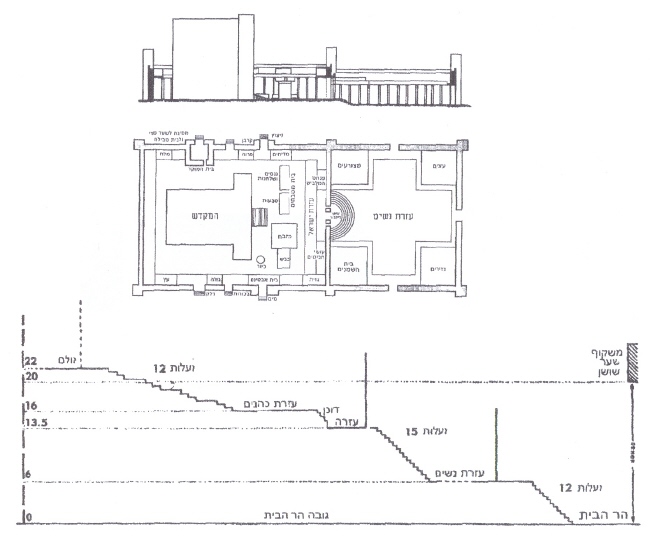
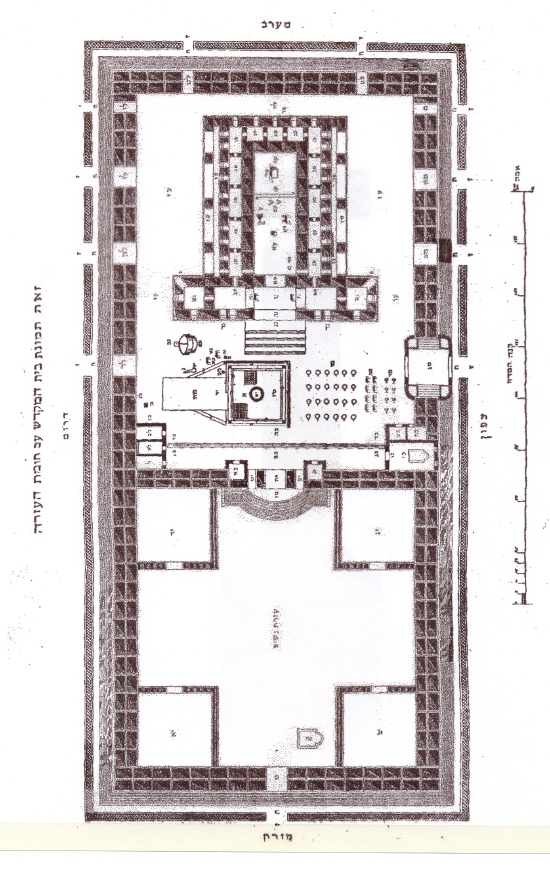
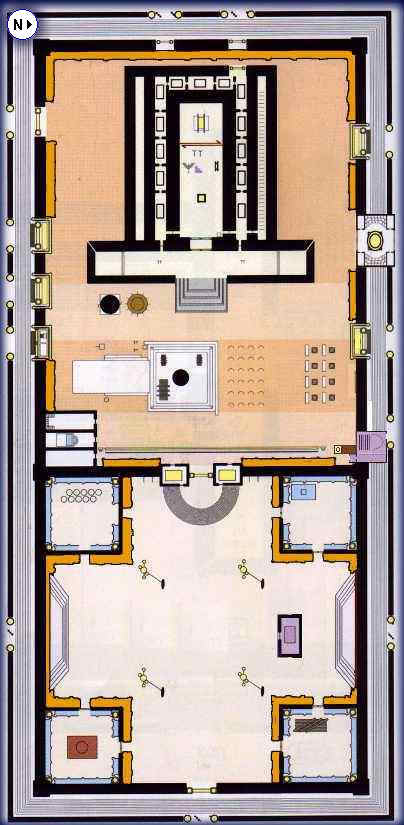
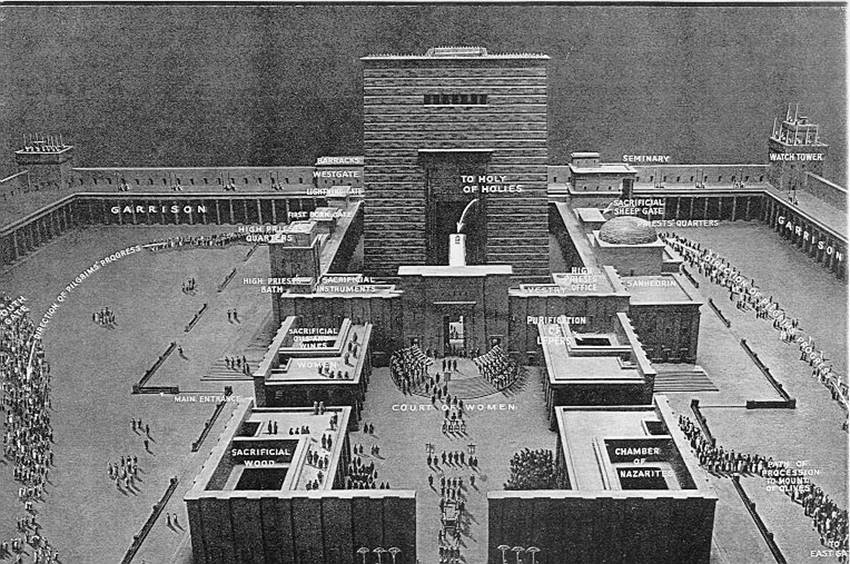
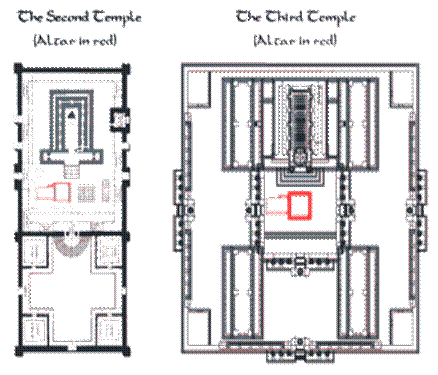
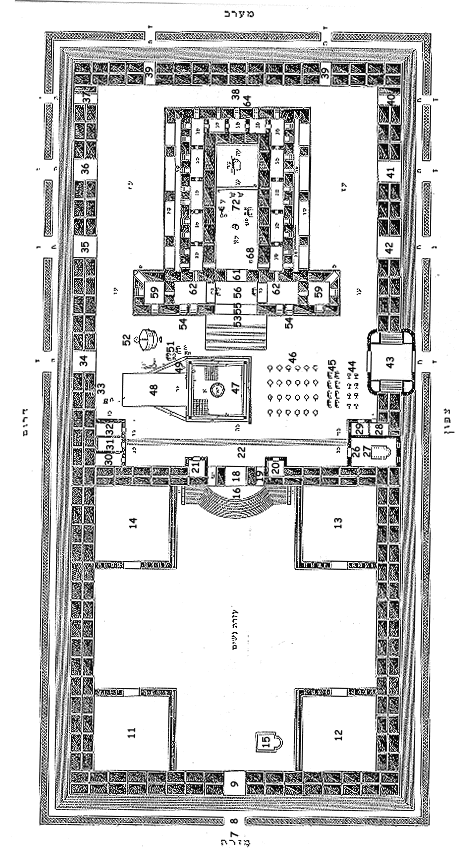
Masechet Midot
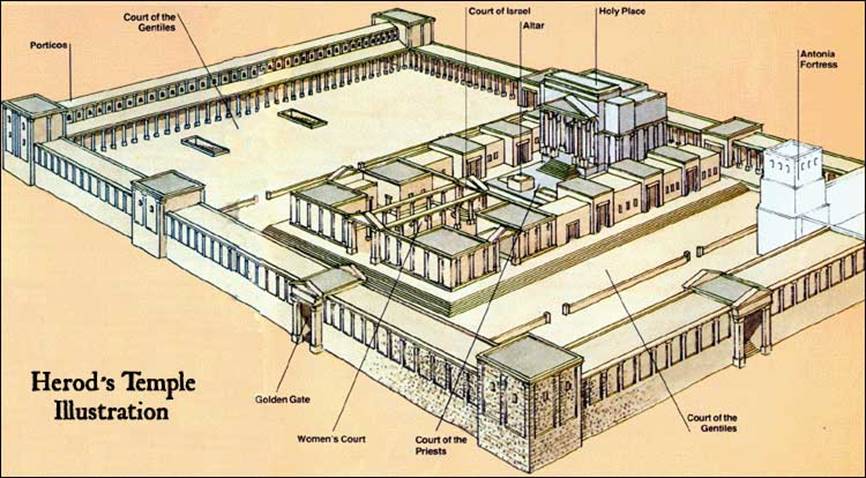
AN ALPHABETICAL LISTING OF THE PLACES MENTIONED IN MASECHET MIDOT, WITH THE NUMBER THAT CORRESPONDS TO THAT PLACE IN THE TIFERET YISRAEL’S DIAGRAM.
- Achorei
Beit ha’Kaporet #38
- Amah
Teraksin #73
- Amudim
Nanasin #44
- Aron
#75
- Bein
ha’Ulam vela’Mizbe’ach #53
- Beit
Avtinas #34
- Beit
ha’Chalifot #59
- Beit
ha’Mitbechayim #44
- Beit
ha’Moked #43
- Beit
ha’Moked ha’Katan #43(NW)
- Beit
ha’Nitzotz #40
- Beit Horadas
ha’Mayim #66
- Chamesh
Esrei Ma’alot #16
- Cheil
#8
- Duchan
#25
- Ezras
ha’Nashim #10
- Ezrat
Yisrael #22
- Har
ha’Bayit #1
- Heichal
#67
- Kanei
Zahav #72
- Kevesh
#48
- Kifonot
#6
- Kiyor
#52
- Kodesh
ha’Kodashim #74
- Koslot
Shel Ulam #54
- Leshachot
Hayu Tachas Ezrat Yisrael #17
- Lishkah
of the Avnei Mizbe’ach #43(NE)
- Lishkat
Beis Shemanyah #14
- Lishkat
ha’Eitzim #12
- Lishkat
ha’Etz #28
- Lishkat
ha’Gazis #27
- Lishkat
ha’Golah #29
- Lishkat
ha’Korban #43(SW)
- Lishkat
ha’Medichim #32
- Lishkat
ha’Melach #30
- Lishkat
ha’Metzora’im #13
- Lishkat
ha’Nezirim #11
- Lishkat
ha’Parochet (location not known)
- Lishkat
ha’Parvah #31
- Lishkat
Osei Chavitin #21
- Lishkat
Osei Lechem ha’Panim #43(SE)
- Lishkat
Parhedrin #28
- Lishkat
Pinchas ha’Malbish #20
- Lishkat
Sanhedrei Ketanah (of Har ha’Bayit) #4
- Lishkat
Sanhedrei Ketanah (of the Ezrat Nashim) #15
- Lishkat
Tela’ei Korban #43(SW)
- Lul #64
- Machtah
#50
- Menorah
#70
- Mesibah
#65
- Mizbach
ha’Zahav #71
- Mizbe’ach
#47
- Nanasin
#44
- Pischo
Shel Heichal #61
- Pischo
Shel Ulam #55
- Pishpeshim
(of the Beis ha’Chalifos) #60
- Roshei
Pispesin #23
- Sha’ar
Beit ha’Moked #43
- Sha’ar
ha’Bechorot #35
- Sha’ar
ha’Delek #36
- Sha’ar
ha’Elyon #37
- Sha’ar
ha’Korban #41
- Sha’ar
ha’Mayim #33
- Sha’ar
ha’Mizrach (of Ezrat Nashim) #9
- Sha’ar
ha’Mizrachi #3
- Sha’ar
ha’Nashim #42
- Sha’ar
ha’Nitzotz #40
- Sha’ar
ha’Shir #43
- Sha’ar Nikanor
#18
- Sha’ar
Tadi #5
- Sha’ar
Yechanyah #40
- Sha’arei
Chuldah #2
- Shnei
Pishpeshim (of Sha’ar Nikanor) #19
- Shnei
Pishpeshim ba’Ma’arav #39
- Shnei
Pishpeshin (shel Sha’ar ha’Heichal) #62
- Shnei
Shulchanot (in the Ulam) #57, 58
- Shnei
Shulchanot (near the Mizbe’ach) #51
- Shulchan
#69
- Shulchanot
Shel Shayish #45
- Soreg
#7
- Ta’im
#63
- Taba’ot
#46
- Tadi #5
- Tavlah
shel Shayish (of the Shisin) #49
- Tavlah
Shel Shayish (for Mei Sotah) #68
- Ulam
#56
Bibliography
Rabbi Moshe Hayym Luzzato on the mystical anthropomorphism of the Temple. His book is called Mishkaney Elyon (“Dwellings of the Supreme”) [Secrets of the Future Temple] and a commentary by Rabbi Mordechay Shriqi of Jerusalem even takes the analysis further in terms of research.
Commentaries of the Gaon of Vilna and the Malbim on the Mishkan.
* * *
This study was written by
Rabbi Dr. Hillel ben David
(Greg Killian).
Comments may be submitted to:
Rabbi Dr. Greg Killian
12210 Luckey Summit
San Antonio, TX 78252
Internet address: gkilli@aol.com
Web page: http://www.betemunah.org/
(360) 918-2905
Return to The WATCHMAN home page
Send comments to Greg Killian at his email address: gkilli@aol.com
[1] Strive for Truth, vol. III, by Rabbi Eliyahu E. Dessler, rendered into English by Aryeh Carmell.
[2] Shemot (Exodus) 25:8
[3] Vayikra (Leviticus) 16:16
[4] Shemot (Exodus) 29:42
[5] Tehillim (Psalms) 2:11
[6] Yeshayahu (Isaiah) 56:7
[7] Eruvim 2a
[8] Tehillim (Psalms) 2:11
[9] Tanna de-Be Eliyahu Rabba #3.
[10] MISHKAN = MAKOM + SHEKHINAH. Makom = Place and Shekhinah = The Presence of HaShem.
[11] Malbim’s R’mazai Hamishkan and The Holy Temple Revisited, Rabbi L. Reznick.
[12] According to the Journal of the American Medical Association, Vol. LXVII, Issue 14, 1037-1038, September 30, 1916 – there are 248 bones in the body.
[13] Makkoth 23b
[14] see Ohaloth 1:8 for the list of the 248 bones counted by Chazal.
[15] Reckoning from the ankle to the tip of the toe and in the case of the hand, from the wrist to the finger tips.
[16] Socket of the hip bone.
[17] The chest, so called according to Maim, because by its movements it causes the lungs to breathe upon the heart, opening the way for fresh air.
[18] Defined (Kel. 1.5) as sufficient to form the basis of a growth of healing flesh if the member were part of a living organism.
[19] For a detailed account of the criticism to which this Mishna has been subjected from a medical point of view and for an anatomical commentary on the terminology v. Katzenelsohn, I. L. Talmud und Medizin (Berlin 1928) pp. 234-303. On p. 257 he states, ‘The Rabbinical numeration accords exactly with the number of bones in a seventeen year old male’. That the anatomical knowledge of the Rabbis was based on practical experiments by dissection is known from Bek. 45a.’ ‘The disciples of R. Ishmael dissected the body of a prostitute who had been condemned to death by the government. By examination they found two hundred and fifty-two members’. Four were deducted as being found in the female but not in the male body, thus obtaining the figure 248. V. also J.E. VIII, p. 410 and Preuss, Biblische u. Talmudische Medizin, pp. 66f., who criticizes Katzenelsohn’s views.
[20] New Testament
[21] Based on the Malbim’s R’mazai Hamishkan and The Holy Temple Revisited, Rabbi L. Reznick
[23] Commentary to Shemot 25:7
[24] Bamidbar 7:88
[25] The building containing the Holy Place and the Holy of Holies.
[26] Succah 5:2
[27] This section was written by Rabbi Noson Weisz.
[28] Taken as an expression for the Temple.
[29] Bereshit (Genesis) 45:14.
[30] The Heb. צוארי can also be taken as a plural. [Rashi omits this question. He did not regard the exposition that follows as being based upon the supposed difference in the grammatical form. the neck is simply taken as allusion to the Temple.]
[31] On the Temple Mount in Jerusalem.
[32] The Torah Anthology (Volume 10) – Meam Loez, by Yaakov Culi.
[33] Consider that a man’s favorite place is inside his wife while making love. Their children will begin life inside the wife. Therefore the wife is a house for her husband and a house for their children. The wife is a house.
[34] Pesikta Rabbati, parasha 6
[35] Midrash Mishlei, parasha 30, letter 4
[36] See fn. 104, to Pesikta d’Rav Kahana.
[37] See also Pesikta Rabbati 5; Midrash Ha-gadol, Shemot 40:18; Tanchuma, Naso 19.
[38] This parallel was noted by the midrash, Shemot Rabba 48, 4.
[39] Tanchuma Pekudei 2
[40] Sofrim 18:2
[41] Artscroll, Volume 1, p. 357-359