
The New Covenant
By Rabbi Dr. Hillel ben David (Greg Killian)

The New Covenant
By Rabbi Dr. Hillel ben David (Greg Killian)

In this study I would like to understand the covenant that HaShem has made with man and its implications.
Shavuot (Pentecost or the Feast of Weeks) is the festival of the giving of the Torah. The Torah, which is commonly known as the Pentateuch, consists of the first five books of the Bible: Bereshit (Genesis), Shemot (Exodus), Vayikra (Leviticus), Bamidbar (Numbers), and Devarim (Deuteronomy). The Torah is an integral part of the new covenant. The new covenant will become effective on Shavuot some time in the future.
Many Christians talk about the new covenant, or testament. It is often used to refer to a collection of books written by the Apostles. It is also used when some Christians participate in a ceremony known as communion. While we all talk ‘about’ this new covenant, most folks do not know the terms that make up this new covenant. Since most folks consider the new covenant as an important part of their religion, it becomes clear that we “ought” to know the terms of this new covenant. Since this is a legal document and has an impact on our lives, we certainly should be intimately familiar what the terms of this covenant.
First let me tell you what the new (renewed) covenant is not. It is not the collection of books commonly known as the New Testament. How do we know this? We know this because a covenant, or testament, is a contract between two parties. Webster’s unabridged dictionary puts it this way:
“In law, a writing, under seal, containing the terms of agreement or contract between parties...”
Since this collection of books merely quotes the terms, and since most of the writings do not contain the terms of this covenant, it would be poor scholarship to refer to this collection of books as the “New Testament”.
The ceremony commonly known as “communion” is not the new covenant because this ceremony does not mention the words that make up this agreement. While this ceremony mentions the seal of the new covenant (the cup of wine which represents Messiah’s blood), it is does not mention the actual words that make up this agreement.
So, what exactly are the words, or terms, of this new (renewed) covenant? The words, curiously, are found in the collection of books sometimes referred to as the old covenant (Messiah called it the Torah, Neviim, and Ketuvim which we translate in English as: The Law, The Prophets, and The Writings.) These Hebrew words are referred to, by Jews, as an acronym: Tanach). The prophet Yirmiyahu (Jeremiah) wrote down the words of this agreement in:
Yirmiyahu (Jeremiah) 31:31-34 “The time is coming,” declares HaShem, “when I will make a new (renewed) covenant with the house of Israel and with the house of Judah. It will not be like the covenant I made with their forefathers when I took them by the hand to lead them out of Egypt, because they broke my covenant, though I was a husband to them,” declares HaShem. “This is the covenant I will make with the house of Israel after that time,” declares HaShem. “I will put my law (Torah) in their minds and write it on their hearts. I will be their God, and they will be my people. No longer will a man teach his neighbor, or a man his brother, saying, ‘Know HaShem,’ because they will all know me, from the least of them to the greatest,” declares HaShem. “For I will forgive their wickedness and will remember their sins no more.”
I have added, in parenthesis, Strong’s definition of some of the words. I would also like to call your attention to the names of the parties that made this covenant. The first party is called “the house of Israel”. The second party is HaShem. HaShem is referring to Himself as YHVH (the yod-hay-vav-hay name). So, if you are not of the house of Israel or HaShem, then this new (renewed) covenant has no effect on you! On the other hand, if you are convinced that the new (renewed) covenant applies to you, then somehow you must be a part of the house of Israel because you are obviously not HaShem.
This covenant, between the house of Israel and HaShem, is quoted, verbatim, in Bereans (Hebrews) 8:8-12. This is the only other place where the words, or terms, of the new (renewed) covenant are spelled out.
If you carefully read this contract, or if you were to take this contract to your lawyer, you will learn that this contract has not yet taken effect. This contract becomes effective when everyone knows HaShem. Until everyone knows HaShem, we will have to be content with looking forward to the time when this contract is put into effect.
The actual terms of this new (renewed) covenant appear to be the same terms of the covenant that HaShem made with the house of Israel at Sinai. We can deduce this by noticing that the Torah (instruction or law) will be written on our hearts instead of stone. This refers to HaShem’s command when He gave the Torah:
Devarim (Deuteronomy) 32:46 He said to them, “Take to heart all the words I have solemnly declared to you this day, so that you may command your children to obey carefully all the words of this law.
We should also notice what is being written on the hearts. It is Torah. It is HaShem’s instructions or laws. The implications of this are staggering! This means, that when this is done, we will no longer disobey HaShem. We will no longer sin! There is one further implication that can not be ignored. Since HaShem’s people were obedient in the Garden of Eden, and we will be obedient in the kingdom of Heaven. This begs the question: What ought we to be doing now? Obviously, we ought to be obeying HaShem by writing His Torah on our hearts and thereby obey it. HaShem’s obvious desire is for us to be obedient to His instructions now!
We can understand this “new” in a few different ways.
(Rashi on Shemot (Exodus) 24:6: in the basins Two basins, one for half the blood of the burnt offering and one for half the blood of the peace offering, [in order] to sprinkle them on the people. From here our Sages learned that our ancestors entered the covenant with circumcision, immersion [in a mikvah], and the sprinkling of the blood [of the sacrifice on the altar], for there is no sprinkling [of blood on a person] without immersion [preceding it].[9])
Many folks believe that HaShem’s Torah was abolished. They believe that it was replaced with something better. The writer to the Bereans (Hebrews) anticipated this when he commented on this new covenant. If we look carefully, we will find out that the problem with the old covenant was with the people, not with HaShem’s law:
Bereans (Hebrews) 8:1-13 The point of what we are saying is this: We do have such a high priest, who sat down at the right hand of the throne of the Majesty in heaven, And who serves in the sanctuary, the true tabernacle set up by the Lord, not by man. Every high priest is appointed to offer both gifts and sacrifices, and so it was necessary for this one also to have something to offer. If he were on earth, he would not be a priest, for there are already men who offer the gifts prescribed by the law. They serve at a sanctuary that is a copy and shadow of what is in heaven. This is why Moses was warned when he was about to build the tabernacle: “See to it that you make everything according to the pattern shown you on the mountain.” But the ministry Yeshua has received is as superior to theirs as the covenant of which he is mediator is superior to the old one, and it is founded on better promises. For if there had been nothing wrong with that first covenant, no place would have been sought for another. But God found fault with the people and said: “The time is coming, declares HaShem, when I will make a new covenant with the house of Israel and with the house of Judah. It will not be like the covenant I made with their forefathers when I took them by the hand to lead them out of Egypt, because they did not remain faithful to my covenant, and I turned away from them, declares HaShem. This is the covenant I will make with the house of Israel after that time, declares HaShem. I will put my laws in their minds and write them on their hearts. I will be their God, and they will be my people. No longer will a man teach his neighbor, or a man his brother, saying, ‘Know HaShem,’ because they will all know me, from the least of them to the greatest. For I will forgive their wickedness and will remember their sins no more.” By calling this covenant “new,” he has made the first one obsolete; and what is obsolete and aging will soon disappear.
So, if there is nothing wrong with HaShem’s Torah, or law, then there is nothing to fix in His Torah. Therefore, HaShem will fix that which is broken: the people. After He fixes His people, He will again give us His Torah on a new heart.
Shavuot, therefore, is the festival of the giving of the Torah. Thirty-three hundred years ago, HaShem gave us His Torah written on stone, on Shavuot. Two thousand years ago, HaShem gave us the Living Torah, Yeshua HaMashiach (Yeshua the Messiah), who taught us great insights into the written Torah. On a future Shavuot, HaShem will renew His covenant when He write His Torah on our hearts. When He does this, we will spend eternity walking with HaShem. We have the down payment of the Holy Spirit that guarantees it. Let’s celebrate this Shavuot by renewing our commitment to obey HaShem and His Torah.
The Bne Israel made a covenant with HaShem on Mt. Sinai.
Unfortunately, things did not work out so well; and within 40 days the people broke their commitment by worshipping a golden calf. This worship was an act of adultery! We were supposed to be married and here we are sleeping with another ‘woman’, a false God.
The Bne Israel via the erev rav broke these tablets 40 days later by worshipping the golden calf. Because of this sin, Moshe could no longer hold the Tablets when the engraved letters went flying off. As a result, the tablets broke and the covenant was void. This was the catastrophe of Tammuz 17. This set of tablets, made by the hand of HaShem, was the heart of every man. Man, now had a broken heart.
HaShem's initial reaction was, "I am out of this marriage"! He told Moses, the matchmaker, that He wants out because the Jewish People didn't keep their end of the deal. So, in a sense they "separated"...
Yom HaKippurim is the anniversary of the second marriage (betrothal - Kiddushin) of HaShem with his People. Yep, we kinda got married, divorced, and then got married again.
Our sages tell us that it is a great mitzva to remarry your ex-wife (assuming she didn't marry someone else in between). When a couple divorces and then reconsiders and remarries, the new covenant is on a totally different level than the first. Now we know the kind of turbulence our relationship might endure; and we now know just how much pain we can inflict on each other. But now we are able to commit to a greater kind of love that will be stronger than any hatred that we may ever develop. We know each other's flaws, and we commit to love in spite of them.
The broken covenant had been the first of a two-part marriage, the Kiddushin, the betrothal.
Moshe had all of the erev rav who participated in the golden calf killed. He then returned to Mt. Sinai, on Tammuz 17, to beg for HaShem’s forgiveness. The Bne Israel agreed to HaShem’s terms and Moshe returned to Mt. Sinai, on Elul 1, after hewing a new set of tablets.
Though the Second Tablets were the work of man - our hearts are the Tablets—the writing was the writing of HaShem, engraved upon the Tablets.
These Tablets, the inseparable engraving of the Torah upon our hearts, are what make Yom Kippur His wedding day. By the Giving of the Torah of Shavuot, all of Israel was present; the event of Mount Sinai included the entire nation as one, but by the giving of the Torah of Yom Kippur, only Moshe Rabbeinu ascended the mountain, and he alone received the second Tablets from the hands of the Creator. Yet this day in particular is His wedding day with the Jewish people. Clearly, the bond is between the writing of the Creator and the Tablets we provide from our world. When the writing of the Lord is engraved upon us, we become a single entity. The Tablets (our hearts) are the writing and the writing is the Tablets. This is what truly connects us to Him.
By the First Tablets, we did not have this connection, only by the second Tablets. Therefore, the Mishnah states without preamble that His wedding (betrothal) day is the giving of the Torah and refers to the giving of the Torah of Yom Kippur. Only the connection formed by the engraving of the Torah upon our hearts, the essence of the Second Tablets, is His wedding day. On that day we will receive a heart of flesh to replace our heart of stone.
Yom Kippur, on which we received the second tablets, expresses the correction of the sin of the golden calf, because of which we lost the first tablets.
Moshe returned from this third, forty-day stay on Mt. Sinai, with the second set of tablets engraved with the words that were engraved on the first set of tablets. The day he returned was Yom HaKippurim. This was the date on which we became betrothed to HaShem. This is when we agreed to the new covenant.[10] We find this correlation of Yom Kippur and a wedding (betrothal) in some of the customs practiced by many communities on the wedding day. Examples include the groom and bride fasting on their wedding day, saying the Al Chet prayer and the Chatan wearing a Kittel under the chuppah.
Taanit 26b Likewise it says, go forth, o ye daughters of Zion, and gaze upon king Solomon, even upon the crown wherewith his mother hath crowned him in the day of his espousals [wedding], and in the day of the gladness of his heart. [11] ‘on the day of his espousals:’ this refers to the day of the giving of the law[12] (on Yom Kippur). ‘and in the day of the gladness of his heart:’ this refers to the building of the temple; may it be rebuilt speedily in our days.
The new covenant will take effect, in the future when we have the second part of our marriage with HaShem, the Nissuin, under the chuppah – on Yom HaKippurim. This be the marriage feast of the lamb.
Yom Kippur, as it is colloquially known,[13] is the tenth day of the seventh month, our wedding (betrothal) day with HaShem. On this day sin will be abolished at the Neilah service when the gates of repentance are finally closed. On that day we will receive a heart of flesh to replace our heart of stone.
|
10 plagues. |
HaShem impresses His people with His power and protection. |
|
Redemption from Egypt. |
The Bne Israel begins ‘dating’ HaShem by following Him into the desert and improving their attributes. |
|
Shavuot @ Mt. Sinai. |
The Bne Israel becomes married (betrothed) to HaShem. HaShem commands us to write the Torah on our hearts. |
|
Tammuz 17 - Golden calf incident. |
HaShem divorces the Bne Israel. We have NOT written Torah on our hearts. |
|
Moshe returns to Sinai to beg forgiveness. |
HaShem forgives His people. |
|
Elul 1 – Moshe returns from Mt. Sinai. |
Moshe carves new tablets and goes back up Sinai to get the words engraved. |
|
Elul 1 till Tishri 10. |
In remembrance of those forty days during which Moshe Rabbenu begged God to absolve Israel, we dedicate forty days to ask God for our own forgiveness. During forty days we immerse ourselves in a deep process of introspection, admission, repentance and change. This is called Teshuva. |
|
Tishri 10 - Yom Kippur. Moshe returns with engraved tablets. |
HaShem again marries (betroths) the Bne Israel. He takes Moshe’s (Israel’s) new heart and engraved it with the Torah. |
|
Tishri 15 – Succoth. The Bne Israel live in a succah (chuppah) for a week. |
The second part of the marriage – the wedding feast of the lamb takes place in the succah made from the skin of the leviathan. |
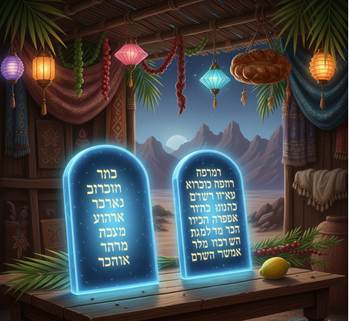
We all know that Yom Kippur is the holiest day of the year. We all know that on Yom Kippur we fast. We all know that we spend the whole day praying, repenting and asking for forgiveness. But did you know that Yom Kippur is also a Jewish Holiday, a joyous day, a Yom Tov. The Talmud states: "The people of Israel had no greater holidays than the 15th of Av and Yom Kippur".
The following is an excerpt from: Reflections & Introspections, Elul – Rosh Hashanah – Yom Kippur – Sukkos, Torah insights of hagaon hagadol Rav Moshe Shapiro.
“The Sages state,[14] “In each month of the summer months, the Holy Blessed One wished to give to Israel a festival. In Nisan He gave to them Passover, in Iyar He gave to them Passover Minor,” which we call Pesach Sheni, “and in Sivan He gave to them Shavuot. In Tammuz, He had in mind to give to them a great festival, but they made the Golden Calf, and it cancelled Tammuz, Av, and Elul. Tishri came, and it recompensed them with Rosh Hashanah, Yom Kippur, and Succoth. The Holy Blessed One said of it, “Shall it recompense others and not take its own? Give it its day: “On the eighth day, it shall be Atzeret for you”.[15]
“The implication is that the great festival of the Seventeenth of Tammuz was to be Rosh Hashanah, but due to what occurred, it became the fast of the Seventeenth of Tammuz. The great festival of the Ninth of Av was to be Yom Kippur, but again, due to what occurred, it became the bitter and evil day of destruction. At the beginning of Elul was to be the Festival of Succoth, and it would conclude the festivals of summer. The festival of Tishri itself was to be what we currently call Shemini Atzeret; this festival belongs to Tishri inherently.”
“In fact, Shemini Atzeret, the Atzeret of Succoth was to arrive just as Shavuot, the Atzeret of Passover. There, we count forty-nine days from the day after the first of Passover, and the fiftieth day is Shavuot. Here, we were to count forty-nine days from the day after the first of Succoth, meaning from the second day of Elul. This ends on Hoshana Rabbah, and the fiftieth day is Shemini Atzeret.”
“The sages ask this in actuality. Why do we not have the same custom regarding the Atzeret of Succoth as we have regarding the Atzeret of Passover? Why do we not count fifty days from Succoth and then celebrate the Atzeret of Succoth?”
“They answer that the Creator did not wish to overburden the Jewish People to come to Jerusalem for the pilgrimage during the rainy season. Fifty days from the current date of Succoth would occur in the middle of the winter, and it is not conducive for travel.”
“Clearly, it is befitting for there to be a counting of forty-nine days and then to celebrate the Atzeret of Succoth. Thus, if Succoth were in Elul that is how it would be.”
* * *
This study was written by
Rabbi Dr. Hillel ben David
(Greg Killian).
Comments may be submitted to:
Rabbi Dr. Greg Killian
12210 Luckey Summit
San Antonio, TX 78252
Internet address: gkilli@aol.com
Web page: https://www.betemunah.org/
(360) 918-2905
Return to The WATCHMAN home page
Send comments to Greg Killian at his email address: gkilli@aol.com
[1] Lit., ‘affliction of judgment’-through unnecessary delay in executing judgment.
[2] Intentionally, through bias or partiality.
[3] Giving erroneous verdicts through carelessness and insufficient deliberation; cf. Aboth, I, 2.
[4] Lev. XXVI, 25.
[5] Jer. XXXIII, 25. ‘The covenant of day and night’ is understood to refer to the Torah, which should be studied day and night; v. Ned. 32.
[6] Ibid. XXVI, 26
[7] Ibid. 43.
[8] Jewish soul
[9] From Yevamot 46b, K'rithoth 9b
[10] Reflexions & Introspection Elul, Rosh Hashanah, Yom Kippur, Sukkos, Torah Insights of Hagon HaGadol Rav Moshe Shapiro, by Moshe Antebi
[11] Shir HaShirim (Song of Songs) 3:11 The Song of Songs has ever been regarded by the Rabbis as an allegory depicting the love of Israel for God.
[12] Through the second set of tablets on Yom Kippur.
[13] Torah calls this feast ‘Yom Kippurim’ or ‘Yom HaKippurim’.
[14] Yalkut Shimoni chapter 782
[15] Bamidbar (Numbers) 29:35