
By Rabbi Dr. Hillel ben David (Greg Killian)
I. Introduction - HaShem‘s ideal
II. Hebrew - The original language

In the beginning HaShem created the heavens and the Earth. HaShem‘s narrative goes on to describe the idyllic world which He created for the benefit of man. After this ideal world was created, HaShem placed man in His Garden which was planted eastward in Eden. The text goes to say that HaShem walked with Adam and Eve in the Garden of Eden. This was HaShem‘s ideal:
Bereshit (Genesis) 2:4-15 This is the account of the heavens and the earth when they were created. When HaShem God made the earth and the heavens-- And no shrub of the field had yet appeared on the earth and no plant of the field had yet sprung up, for HaShem God had not sent rain on the earth and there was no man to work the ground, But streams came up from the earth and watered the whole surface of the ground-- HaShem God formed the man from the dust of the ground and breathed into his nostrils the breath of life, and the man became a living being. Now HaShem God had planted a garden in the east, in Eden; and there he put the man he had formed. And HaShem God made all kinds of trees grow out of the ground--trees that were pleasing to the eye and good for food. In the middle of the garden were the tree of life and the tree of the knowledge of good and evil. A river watering the garden flowed from Eden; from there it was separated into four headwaters. The name of the first is the Pishon; it winds through the entire land of Havilah, where there is gold. (The gold of that land is good; aromatic resin and onyx are also there.) The name of the second river is the Gihon; it winds through the entire land of Cush. The name of the third river is the Tigris; it runs along the east side of Asshur. And the fourth river is the Euphrates. HaShem God took the man and put him in the Garden of Eden to work it and take care of it.
How did HaShem create the world?
Rashi teaches us that the world was created using words of the Hebrew language.
Rashi’s Commentary for: Bereshit (Genesis) 2:23 - This one shall be called ishah because, from ish One expression coincides with the other [i.e., the words אִישׁ and words אִשָּׁה have the same root]. From here is derived that the world was created with the Holy Tongue.[1]
Rashi understood the world was created with the holy tongue, i.e. Hebrew, from the following midrash:
Midrash Rabbah - Genesis XVIII:4 BONE OF MY BONES, AND FLESH OF MY FLESH. R. Tanhuma said: When a man takes one of his relations to wife, of him it is said, BONE OF MY BONES, AND FLESH OF MY FLESH. SHE SHALL BE CALLED, WOMAN (ISHAH), BECAUSE SHE WAS TAKEN OUT OF MAN (ISH). From this you learn that the Torah was given in the Holy Tongue.[2] R. Phinehas and R. Helkiah in R. Simon's name said: Just as it was given in the Holy Tongue, so was the world created with the Holy Tongues.[3] Have you ever heard one say, gini, ginia; itha, ittha; antropi, antropia; gabra, gabretha?[4] But ish and ishah [are used]: why? because one form corresponds to the other.[5]
This was the perfect world made exactly the way that HaShem wanted. At this point man sinned and changed the ideal, perfect world into something less. The Torah then goes on to describe the process and the people that HaShem will use to restore the ideal and to end the suffering of His creation. The suffering of HaShem‘s creation is described in:
Romans 8:18-2 I consider that our present sufferings are not worth comparing with the glory that will be revealed in us. The creation waits in eager expectation for the sons of God to be revealed. For the creation was subjected to frustration, not by its own choice, but by the will of the one who subjected it, in hope that the creation itself will be liberated from its bondage to decay and brought into the glorious freedom of the children of God. We know that the whole creation has been groaning as in the pains of childbirth right up to the present time. Not only so, but we ourselves, who have the firstfruits of the Spirit, groan inwardly as we wait eagerly for our adoption as sons, the redemption of our bodies.
This state of decay is the result of sin. The Tanach (the so called Old Testament) records HaShem’s plan to bring His people and creation back to the ideal state in which they were created. Lets explore some of the aspects of HaShem‘s ideal. Let’s start by looking at the language that Adam and Eve spoke:
Our Sages teach that the Hebrew Alef Bet was used to create the world:
Berachoth 55a Rab Judah said in the name of Rab: Bezalel knew how to combine the letters by which the heavens and earth were created.[6] It is written here, And He hath filled him with the spirit of God, in wisdom and in understanding, and in knowledge,[7] and it is written elsewhere, The Lord by wisdom founded the earth; by understanding He established the heavens,[8] and it is also written, By His knowledge the depths were broken up.
Because Hebrew was used to create the world, we know that Adam and Eve both spoke Hebrew.
Since they both spoke Hebrew, then Hebrew was the mother tongue until the Tower of Babel. At the tower of Babel, HaShem indicates that there was only one language:[9]
Bereshit (Genesis) 11:1-9 Now the whole world had one language and a common speech. As men moved eastward, they found a plain in Shinar and settled there. They said to each other, “Come, let’s make bricks and bake them thoroughly.” They used brick instead of stone, and tar for mortar. Then they said, “Come, let us build ourselves a city, with a tower that reaches to the heavens, so that we may make a name for ourselves and not be scattered over the face of the whole earth.” But HaShem came down to see the city and the tower that the men were building. HaShem said, “If as one people speaking the same language they have begun to do this, then nothing they plan to do will be impossible for them. Come, let us go down and confuse their language so they will not understand each other.” So HaShem scattered them from there over all the earth, and they stopped building the city. That is why it was called Babel--because there HaShem confused the language of the whole world. From here HaShem scattered them over the face of the whole earth.
This is confirmed by Rashi who tells us that this universal language was Hebrew!
The Targum confirms this understanding:
Targum Pseudo Jonathan for: Bereshit (Genesis) 11:1-32 1. And all the earth was (of) one language, and one speech, and one counsel. In the holy language spoke they, that by which the world had been created at the beginning.
[JERUSALEM. And all the inhabitants of the earth were (of) one language, and of one speech, and one counsel: for they spoke the holy language by which the world was created at the beginning:]
To understand where Hebrew originated, lets look at the definition of “Hebrew”. The first use of the word “Hebrew” is found in:
Bereshit (Genesis) 14:13 One who had escaped came and reported this to Abram the Hebrew. Now Abram was living near the great trees of Mamre the Amorite, a brother of Eshcol and Aner, all of whom were allied with Abram.
“Hebrew”, here, is defined by Strong’s as:
5680 `Ibriy, ib-ree’; patron. from 5677; an Eberite (i.e. Hebrew) or desc. of Eber:-Hebrew (-ess, woman).
At this point we need to see who “Eber” is:
Bereshit (Genesis) 11:14-26 When Shelah had lived thirty years, he became the father of Eber. And after he became the father of Eber, Shelah lived 403 years and had other sons and daughters. When Eber had lived 34 years, he became the father of Peleg. And after he became the father of Peleg, Eber lived 430 years and had other sons and daughters. When Peleg had lived 30 years, he became the father of Reu. And after he became the father of Reu, Peleg lived 209 years and had other sons and daughters. When Reu had lived 32 years, he became the father of Serug. And after he became the father of Serug, Reu lived 207 years and had other sons and daughters. When Serug had lived thirty years, he became the father of Nahor. And after he became the father of Nahor, Serug lived 200 years and had other sons and daughters. When Nahor had lived 29 years, he became the father of Terah. And after he became the father of Terah, Nahor lived 119 years and had other sons and daughters. After Terah had lived 70 years, he became the father of Abram, Nahor and Haran.
Eber is a distant ancestor of Abram. If the language of Eber was Hebrew, as evidenced by it’s etymology, then it is reasonable to understand that Abram would speak the language of his family. The tower of Babel will take place long after Eber, in the days of Abram. This would indicate that Hebrew was the language of Adam and Eve. We can nail this point by pointing out that Avraham was the first person called a Hebrew. This passage is also where we find the first use of the word Hebrew, hence the creation of the concept of a Hebrew:
Bereshit (Genesis) 14:13 And there came one that had escaped, and told Abram the Hebrew; for he dwelt in the plain of Mamre the Amorite, brother of Eshcol, and brother of Aner: and these were confederate with Abram.
The first person to be called a Hebrew was Avraham, and the name commonly refers to his descendants, known as the Jewish people. The word for Hebrew used in the Bible is עברי (pronounced “Ivri”), meaning “of or pertaining to עבר-eber”. So what does “eber” mean?
The Midrash[10] quotes three opinions as to where this name comes from:
Midrash Rabbah - Genesis XLII:8 AND TOLD ABRAM THE HEBREW (HA -’ IBRI). R. Judah said: [HA – ‘ IBRI signifies that] the whole world was on one side (’eber) while he was on the other side (’eber).[11] R. Nehemiah said: [It denotes] that he was descended from Eber. The Rabbis said: It means that he came from across the river[12]; further, that he spoke in the language of the dwellers across the river.
1. Rabbi Yehuda taught that the word “eber” means “opposite side”. Avraham believed in one G‑d, and the rest of the world worshipped man-made gods. Thus, “Abraham stood on one side, and the entire world stood on the other side”.
2. Rabbi Nechemiah opined that it is a reference to Ever, great-great-grandson of Noah (usually Anglicized as “Eber”), ancestor of Abraham. Eber was one of the bearers of the monotheistic tradition which he had learned from his ancestors Shem and Noah and passed on to his grandson Avraham. Since Avraham was a descendant and disciple of his, he is called an Ivri.
3. Our Rabbis held that the word is a reference to the fact that Avraham came from the other side of the river and was not a native Canaanite. “Ivri” also refers to the fact that Avraham spoke the Hebrew language, thus named because of its ancient origins, preceding the development of the other languages current at that time.
So, if Hebrew was in the beginning, then we would expect that it will be the language of the future. There is a reference to this in:
Zephaniah 3:8-10 Therefore wait ye upon me, saith HaShem, until the day that I rise up to the prey: for my determination [is] to gather the nations, that I may assemble the kingdoms, to pour upon them mine indignation, [even] all my fierce anger: for all the earth shall be devoured with the fire of my jealousy. For then will I turn to the people a pure language, that they may all call upon the name of HaShem, to serve him with one consent. From beyond the rivers of Ethiopia my suppliants, [even] the daughter of my dispersed, shall bring mine offering.
Since Abram was forty-eight years old at the time of the Tower of Babel; and since Abram did not participate in the sin of Babel, it is reasonable to conclude that Abram‘s language was not as confused. We find this conclusion also, in the Talmud:
Avodah Zarah 19a R. Simeon b. Pazi expounded [that verse as follows]: ‘Happy is the man that hath not walked‘ — i.e., to theatres and circuses of idolaters ‘nor stood in the way of sinners’ — that is he who does not attend contests of wild beasts;[13] ‘nor sat in the seat of the scornful’ — that is he who does not participate in [evil] plannings. And lest one say, ‘Since I do not go to theatres or circuses nor attend contests of wild animals, I will go and indulge in sleep.’ Scripture therefore continues, ‘And in His Law doth He meditate day and night.’ Said R. Samuel b. Nahmani in the name of R. Jonathan: Happy is the man that hath not walked in the counsel of the wicked — that is our father Abraham who did not follow the counsel of the men of the Generation of the Division[14] who were wicked, as it is said, Come, let us build us a city, and a tower, with its top in heaven,’[15] nor stood in the way of sinners — for he did not take up the stand of the Sodomites, who were sinful, as it is said, Now the men of Sodom were wicked and sinful against the Lord exceedingly;[16] nor sat in the seat of the scornful — for he did not sit in the company of the Philistines, because they were scoffers; as it is said, And it came to pass, when their hearts were merry, that they said: Call for Samson that he may make us sport.[17]
Therefore, the language of Eden had now been passed to Abram and his family on an exclusive basis. This explains how Hebrew could, seemingly, originate with Abram. Hebrew, by definition, means “beyond the river”, referring to Abram who was beyond the Euphrates river.
According to the Midrash, Abram was 48 when the Tower of Babel was built. He was an adult who consciously chose not to participate in the endeavor. And as a reward, when the other clans were given their own languages, causing them to spread out and become separate nations, Abram was not so punished, and still spoke and thought in Hebrew. It is worth noting that the primary confusion of the languages was that even those who spoke Hebrew could no longer accurately communicate with words. The thoughts in the speaker’s head were not the thoughts in the listener’s head. Prior to Babel, the speaker and the listener had exactly the same thoughts.
The gift of speaking Hebrew, then, is no small thing. It’s not just exposure to a holier mode of speech. Hebrew gives us the tools to organize our concepts in the way HaShem intended. Instead of asking whether Judaism is a race or a religion, with the connotation of those words, we can look at the Children of Israel, and the meaning given those terms by the Torah.
Since the knowledge of HaShem was given exclusively in Hebrew, it stands to reason that those who know Hebrew, know HaShem better than those who do not speak Hebrew. Since the wicked of Babel were conspiring against HaShem, therefore HaShem took away their Hebrew. The Gemara[18] and the Zohar teach that this was just one of many punishments which HaShem meted out to the tower-builders. Why then does the Torah single this out?
Rav Yoel Teitelbaum (the Satmar Rav) zatz’l explains that taking away these people’s ability to speak Hebrew was not a punishment; it was HaShem‘s mechanism for stopping their plans. He explains: When people cooperate and work out their plans in the Hebrew language, miracles will occur for them. For that very reason, sinners cannot be permitted to conspire in Hebrew.[19]
How do words from foreign languages crop up in the Torah which is written in the Holy Tongue? The answer lies in the Torah account of the Tower of Babel which begins with the passage:
Bereshit (Genesis) 11:1 “The whole earth was of one language”
Which our Sages tell was the Holy Tongue of Hebrew. Even when HaShem confounded their language by introducing so many different tongues in order to disperse them, some traces of Hebrew remained in the new languages. We therefore find our Sages turning to foreign languages (an example is the word “hadar” used by the Torah for the etrog because it requires so much “hydra” - Greek for water - to nourish its growth) to reveal the meaning of an unusual word. The similarity of a foreign word to the mysterious Hebrew word is an indication that it is a survivor of that nation‘s original use of Hebrew.[20]
Ok, at this point we see that the one language, Hebrew, became many languages at the Tower of Babel. I believe that this incident took place on the sixth day of the third month, Sivan 6, which is the feast of Weeks, Hag Shavuot.
The sages understood that the Torah was delivered, at Mount Sinai, in seventy languages to all of the nations. They understood that the Spirit of HaShem appeared as a tongue of fire which went out from the stone tablets to each of the children of Israel and asked if they would accept this covenant. When the answer was “yes” the tongue went back and helped carve the ten words. In Exodus Rabbah we read:
Exodus Rabbah 5:9 When HaShem gave the Torah on Sinai, He displayed untold marvels to Israel with His voice. What happened? HaShem spoke and the Voice reverberated throughout the world. ....it says, And all the people witnessed the thunderings (Exodus 18:15). Note that it does not say “the thunder”, but “the thunderings”, wherefore, R. Johanan said that HaShem‘s voice, as it was uttered, split up into seventy voices, in seventy languages, so that all the nations should understand. When each nation heard the Voice in their own vernacular, their souls departed, save Israel, who heard but were not hurt.
The Midrash also records something similar:
On the occasion of matan (the giving of the) Torah, the Bnai Israel (the children of Israel) not only heard HaShem‘s Voice but actually saw the sound waves as they emerged from HaShem’s mouth. They visualized them as a fiery substance. Each commandment that left HaShem‘s mouth traveled around the entire camp and then came back to every Jew individually, asking him, “Do you accept upon yourself this commandment with all halachot pertaining to it?” Every Jew answered, “Yes”, after each commandment. Finally, the fiery substance which they saw, engraved itself on the luchot (stone tablets).[21]
Does this remind you of II Luqas (Acts) chapter 2?
II Luqas (Acts) 2:1-11 When the day of Pentecost came, they were all together in one place. Suddenly a sound like the blowing of a violent wind came from heaven and filled the whole house where they were sitting. They saw what seemed to be tongues of fire that separated and came to rest on each of them. All of them were filled with the Holy Spirit and began to speak in other tongues as the Spirit enabled them. Now there were staying in Jerusalem God-fearing Jews from every nation under heaven. When they heard this sound, a crowd came together in bewilderment, because each one heard them speaking in his own language. Utterly amazed, they asked: “Are not all these men who are speaking Galileans? Then how is it that each of us hears them in his own native language? Parthians, Medes and Elamites; residents of Mesopotamia, Judea and Cappadocia, Pontus and Asia, Phrygia and Pamphylia, Egypt and the parts of Libya near Cyrene; visitors from Rome (Both Jews and converts to Judaism); Cretans and Arabs--we hear them declaring the wonders of God in our own tongues!”
They say seventy languages because:
Bereshit (Genesis) 46:26-27 All those who went to Egypt with Jacob--those who were his direct descendants, not counting his sons’ wives--numbered sixty-six persons. With the two sons who had been born to Joseph in Egypt, the members of Jacob‘s family, which went to Egypt, were seventy in all.
and:
Devarim (Deuteronomy) 32:7-9 Remember the days of old; consider the generations long past. Ask your father and he will tell you, your elders, and they will explain to you. When the Most High gave the nations their inheritance, when he divided all mankind, he set up boundaries for the peoples according to the number of the sons of Israel. For HaShem’s portion is his people, Jacob his allotted inheritance.
It appears that HaShem‘s plan is to, one day, return to having all of His people speak one language, Hebrew. We will be returning to the language of the Garden of Eden. We will be going back to the future!
Shlain[22] makes a compelling argument that Hebrew was the very first alphabet ever used. He indicated that an alphabet is different from pictographs and hieroglyphs. He suggests that the Hebrew alphabet was invented at Sinai in the days of Moses. This is an extremely intriguing thought because this indicates that Hebrew dramatically changed the whole world! With Hebrew, we have the ability to store words, thoughts, and communications. We have never had this ability previously. And what was the first thing stored? The first thing stored was The Word of HaShem, in Hebrew! This is an extremely profound thought.
Thus we understand that Hebrew was the first spoken language and the first written language.
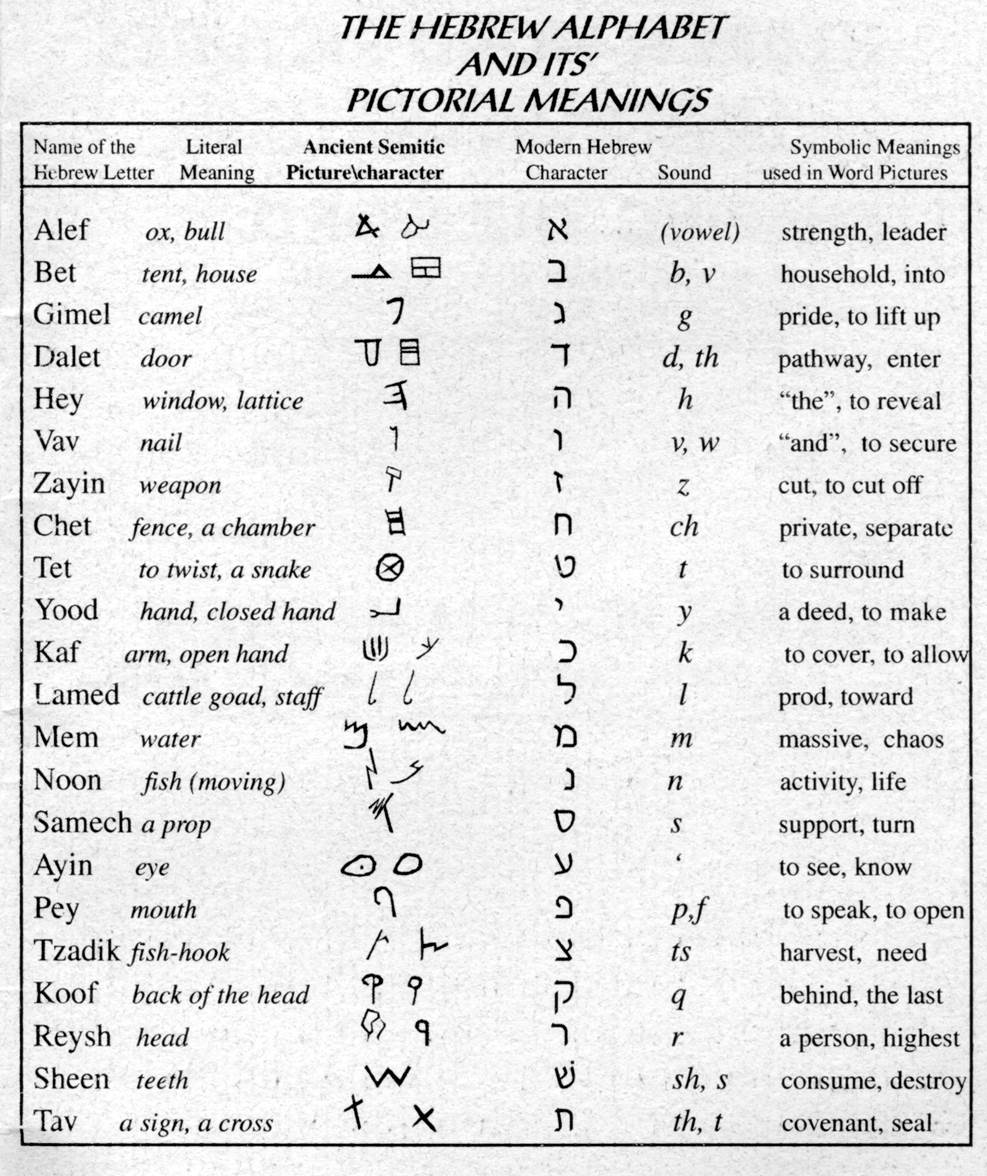
The Hebrew alphabet, detailed below, consists of twenty-two letters. All of these letters are consonants. Vowels are indicated by small dots and marks surrounding the individual letters. Four of the letters have a different form when they fall at the end of the word.
Each letter has a meaning and a numeric value associated with it. The letters are considered to be the building blocks of creation (see Sefer Yetzira for more information on this subject).
Traditional kabbalists take the view that the Hebrew language is divinely inspired and that this was the only language existing prior to the Biblical story of the destruction of the Tower of Babel.
The Hebrew letters can be considered as expressions in a mathematical formula. Each letter has a meaning and the combination of letters used in a word can be seen as the embodiment of the component individual letter meanings.
In many, if not all, mystical systems the importance of knowing an entity’s correct name is stressed. Knowledge of a name confers power over the entity concerned.
It is worth noting that Hebrew allows us to understand unknown words by simply adding up the meaning of each individual letter, taking into account its order in the word.
א – The letter alef is a pointer to G-d. Chazal teach that the alef is composed of two yods separated by a vav. Thus the alef has a numerical value of twenty-six, which is also the gematria of HaShem (יהוה). This letter is so sublime that it does not have a sound. The alef appears as the first letter of a word in the word Elohim (אֱלהִים), which is normally translated as G-d.
ה – The letter hei has the meaning of fertility or pregnancy. Pregnancy is the power to bring the potential to actualization. Adding this letter to the end of many words will change the word from masculine to feminine.
Abraham saw in the stars that he would have no children, but that changed after HaShem promised him that a son would be born to him and Sarah. At that time he also changed his name from Abram to Abraham, and Sarai to Sarah, by adding the letter hei to their names. The number five and the letter hei are therefore connected to change of mazal and fertility. And not only that, but it is said regarding the letter hei: “Then Joseph said to the people, ‘Behold I have bought you this day and your land for Pharaoh; lo, here [in Hebrew, “hei”] is seed for you”, and you shall plant the land.” (Gen. 47:23) This means that it through the letter hei that you will have seed.
פ – This letter is also the word for mouth – pey.
The word for coin [in Hebrew, “perutah”] to be made up of two letter-groups: pei-reish-tet and vav-hei. Pey represents segregation, division, partition, disarray, loss of meaning. Metaphorically, pey represents the outward expression, through the mouth, of the thoughts or feelings of the head, as a stream of separate syllables, words, and sentences, which may be chaotic.
ר – This letter sounds nearly like rosh (head)[23] and is found as the first letter of a word in the Torah, in the word reshit. Although the letter reish is situated close to the end of the alef-beit, its primary meaning is head or beginning.[24] Reish is associated with features of wholeness, completeness, order, existence of meaning. Metaphorically, reish stands for products of the head, like a thought or a feeling, which are experienced as a whole (as single indivisible units).
When פ and ר are combined with a third letter to form a root, we have the idea of an entity that was whole and has disintegrated into many parts. Something that was in order that was transformed into disarray. It has become part of a whole that has become separate. The following examples of Hebrew roots should demonstrate this:
פרא – Generates an adjective that implies wild, savage, out of order.
פרד – Generates words that mean to separate or to depart.
פרה – Is the source of words meaning to become fruitful or pregnant (one made into two that eventually separate).
פרז – Generates words that mean excessive and over-flowing, as well as adjectives that describe a city with no boundaries (no dividing wall).
פרת – Means to give details but also to change a bank note into small coins.
פרם – Means to take apart (a cloth).
פרש – Means to slice into many parts (like slicing bread). It also means to separate from (as from a company or group).
פרע – Means to inflict disorder or chaos.
פרץ – Means to break into (like in a burglary) and also to make a dent or a hole (in a wall).
פרכ – This root means to dismantle.
רפא – Has the meaning of putting something which was out of order, into order – to cure. (This is the reverse of words that begin with פר).
Bibliography:
Coincidences in the Bible and in Biblical Hebrew, by Haim Shore
Recommended Reading:
· The Wisdom in the Hebrew Alphabet - Rabbi Michael L. Munk - Mesorah Publications, ltd
· Letters of Fire - Matityahu Glazerson - Feldheim Publishers
· Power of Aleph Beth (Vols I and 2) - Dr.Philip S Berg - The Research Centre of Kabbalah
|
Sound |
Numeric Value |
||
|
א |
aleph |
No sound |
1 |
|
ב |
beth |
b |
2 |
|
ג |
gimel |
g |
3 |
|
ד |
daleth |
d |
4 |
|
ה |
hey |
h |
5 |
|
ו |
vau |
v |
6 |
|
ז |
zayin |
z |
7 |
|
ח |
cheth |
ch |
8 |
|
ט |
teth |
t |
9 |
|
י |
yod |
y |
10 |
|
כ |
kaph |
k |
20 |
|
ל |
lamed |
l |
30 |
|
מ |
mem |
m |
40 |
|
נ |
nun |
n |
50 |
|
ס |
samekh |
s |
60 |
|
ע |
ayin |
o |
70 |
|
פ |
pe |
p |
80 |
|
צ |
tzaddi |
tz |
90 |
|
ק |
qof |
q |
100 |
|
ר |
resh |
r |
200 |
|
ש |
shin |
sh |
300 |
|
ת |
tau |
th |
400 |
|
ך |
kaph (final) |
k |
500 |
|
ם |
mem (final) |
m |
600 |
|
ן |
nun (final) |
n |
700 |
|
ף |
pe (final) |
p |
800 |
|
ץ |
tzaddi (final) |
tz |
900 |
|
Symbol |
Sefardi |
Ashkenazi |
Meaning |
Expanded Meaning |
Value |
Cursive |
|
|
א |
alef |
alef |
oxen |
Elohim, HaShem |
1 |
א |
|
|
ב |
bet, vet |
beis, veis |
house |
|
2 |
ב |
|
|
ג |
gimel |
gimmel |
camel |
|
3 |
ג |
|
|
ד |
dalet |
doles |
door |
|
4 |
ד |
|
|
ה |
he |
hei |
window |
Fertility, pregnancy |
5 |
ה |
|
|
ו |
vav |
vov/vof |
hook |
|
6 |
ו |
|
|
ז |
zayin |
zayin |
sword |
|
7 |
ז |
|
|
ח |
khet |
ches |
Fence, hedge, chamber |
|
8 |
ח |
|
|
ט |
tet |
tes |
serpent |
|
9 |
ט |
|
|
י |
yod |
yud |
|
10 |
י |
|
|
|
ך כ |
kaf, khaf |
kof, chof |
palm |
|
20 |
ך כ |
|
|
ל |
lamed |
lomed |
cattle goad |
|
30 |
ל |
|
|
ם מ |
mem |
mem |
water |
|
40 |
םמ |
|
|
ן נ |
nun |
nun |
fish |
|
50 |
ןנ |
|
|
ס |
samekh |
somech |
A prop |
|
60 |
ס |
|
|
ע |
ayin |
ayin/oyin |
eye |
|
70 |
פ |
|
|
ף פ |
pe, fe |
pei, fei |
Mouth – segregation, division, partition, disarray, loss of meaning |
80 |
ץפ |
|
|
|
ץ צ |
tsadi |
tsodi/tsodik |
fish hook |
|
90 |
צץ |
|
|
ק |
kuf |
kuf |
|
100 |
ק |
|
|
|
ר |
resh |
reish |
Head, beginning – wholeness, completeness, order, existence of meaning |
200 |
ר |
|
|
|
ש |
shin, sin |
shin, sin |
tooth |
|
300 |
ש |
|
|
ת |
tav |
tov/tof, sov/sof |
|
400 |
ת |
|
This study was written by
Rabbi Dr. Hillel ben David
(Greg Killian).
Comments may be submitted to:
Rabbi Dr. Greg Killian
12210 Luckey Summit
San Antonio, TX 78252
Internet address: gkilli@aol.com
Web page: http://www.betemunah.org/
(360) 918-2905
Return to The WATCHMAN home page
Send comments to Greg Killian at his email address: gkilli@aol.com
[1] from Gen. Rabbah 18:4
[2] Sc. Heb. ishah is grammatically the fem. of ish, and Adam's remark is unintelligible unless he spoke in Hebrew.
[3] I.e. Hebrew was the first language to be used.
[4] Gini (<Gr.>) and antropi (an assumed form for <Gr.>) are woman and man respectively in Greek; ittha and gabra are the same in Aramaic. It is pointed out that these words lack the corresponding feminine or masculine forms, such as are seen in ish and ishah.
[5][5] Pa'am is given a twofold significance: (i) a bell, connecting it with pa'amon; and (ii) trouble, connecting it with the verb pa'am, to trouble. disquiet.-The translation and interpretation follow Th.
[7] Ibid. XXXV, 31.
[8] prov. III, 19.
[9] According to “The Jewish Encyclopedia”, volume 2, page 396, under “Babel”
[10] Bereshit Rabbah 42:8
[11] He alone of all mankind believed in the true God.
[12] Yehoshua (Joshua) 24:3
[13] Contest of wild beasts with beasts or with men; hunt of animals.
[14] The builders of the Tower of Babel. Abraham was a younger contemporary of Peleg in whose days was the earth divided. (Gen. X, 25.)
[15] Ibid. XI, 4.
[16] Ibid. XIII, 13.
[17] Judges XVI, 25.
[18] Sanhedrin 109
[19] VaYoel Moshe p.433
[20] Zevachim 37b
[22] The Alphabet Versus the Goddess: The Conflict Between Word and Image, by Leonard Shlain.
[23] Sefer HaArachim Chabad, Osios, letter reish, p. 376.
[24] Rabbi Yitzchak Ginsburgh