
By Rabbi Dr. Hillel ben David (Greg Killian)

The Sages teach us that what Shabbat, Sabbath, is to time, so Eretz Israel, the land of Israel, is to space.[1] The Shmita, or Sabbatical, year connects these two. Space and time come together in a Shmita year. The next Shmita year will be 5768. It follows that we should study Eretz Israel as we would study Shabbat. Let’s look at Eretz Israel and its ownership.
The Shape of the Land: Even though Yaaqob’s Ladder has linear dimensions, Eretz Israel's boundaries are neither linear nor spherical, rather they are in the form of a man lying face-up on the ground with his head towards the East. His two arms are stretched out, one to the north the other to the south. His two legs are open. The one big toe is facing towards Hor HaHar - which is in the northwest area. The other is facing the river of Egypt, which is the southwest area. Between his two legs enter the Mediterranean Sea, which is its western border. In this fashion we find that the dimensions of Eretz Yisrael are an array of strips large and small. Surrounding all these strips is the Ladder. The internal level of the Ladder is the side touching Eretz Israel, whereas the external level is the side facing Chutz LaAretz.
Let’s see what Rashi has to say about Eretz Israel:
R. Yitzchak says: The Torah should have begun with, “This month shall be for you”,[2] which is the first mitzva that Israel was commanded. Why, then, did it begin with, “In the beginning”? Because of, “The strength of His deeds He declared to His people, to give them the heritage of the nations“.[3] If the nations of the world should say to Israel, “You are thieves, because you captured the land of the seven nations“, they say to them, “The entire world is G-d’s! He created it and gave it to those that He wants. He desired to give it to them, and He desired to take it from them and give it to us.” [4]
Rashi tells us that HaShem gave His people the land of Israel. It is their inheritance along with the Torah. The Torah also shows HaShem clearly giving the land to the Children of Israel:
Bamidbar (Numbers) 33:50-54 And HaShem spake unto Moses in the plains of Moab by Jordan [near] Jericho, saying, Speak unto the children of Israel, and say unto them, When ye are passed over Jordan into the land of Canaan; Then ye shall drive out all the inhabitants of the land from before you, and destroy all their pictures, and destroy all their molten images, and quite pluck down all their high places: And ye shall dispossess [the inhabitants of] the land, and dwell therein: for I have given you the land to possess it. And ye shall divide the land by lot for an inheritance among your families: [and] to the more ye shall give the more inheritance, and to the fewer ye shall give the less inheritance: every man’s [inheritance] shall be in the place where his lot falleth; according to the tribes of your fathers ye shall inherit.
Bamidbar (Numbers) 34:2 Command the children of Israel, and say unto them, When ye come into the land of Canaan; (this [is] the land that shall fall unto you for an inheritance, [even] the land of Canaan with the coasts thereof:)
Since HaShem gave us this land, we must take possession of it. Even if today is not the right time to return to the land, we must have it in the forefront of our mind. “Wherever we are going, we are going to Israel”. The land of Israel is our ultimate destination!
“Returning” is what we do when we go up to Israel. “Returning” is what we do when we repent from our sins.
The parallel between Teshuva (or “return to HaShem“) and entering the Land of Israel is supported by the fact that Teshuva, from the root word meaning “return”, occurs in the Tanach[5] most frequently in relation to the Jewish peoples’ return to the Land of Israel. This teaches that entering the Land of Israel (aliyah) in its deepest sense is the ultimate manifestation of return to HaShem (Teshuva), it being the physical and spiritual entry into an entirely new state of being. With this perspective we can begin to appreciate what our Sages in the Talmud have told us:
Ketuvot 110b Anyone who lives outside of Eretz Israel, it is as if they worship idols.
The Sages have thereby told us that there is a connection between returning to HaShem, through repentance, and returning to the land of Israel. This connection began “in the beginning…”
The Torah begins with the account of creation in order to prove that the earth belongs to HaShem and He can give it to anyone He wishes. When HaShem makes a covenant with Avraham, He gives Avraham AND HIS SEED Eretz Israel. Now we know that his seed was not through Ishmael, but through Yitzchak:
Bereshit (Genesis) 21:12 And G-d said unto Abraham, Let it not be grievous in thy sight because of the lad, and because of thy bondwoman; in all that Sarah hath said unto thee, hearken unto her voice; for in Isaac shall thy seed be called.
HaShem said to Avraham: “To your descendants I will give this Land”.[6] However, it is not clear who the descendants of Avraham are, Yitzchak or Ishmael? So the Torah comes to tell us that Ishmael is excluded from all that Avraham had, he received gifts instead:
Bereshit (Genesis) 25:5-6 And Avraham gave all (“kol”) that he had to Yitzchak. And to the sons of the concubines he gave presents.
The Zohar does indicate that Ishmael has some connection to the land:
Soncino Zohar, Shemot, Section 2, Page 32a Abram prayed to G-d: “O that Ishmael might live before thee!” Now, although the Holy One, blessed be He, promised Abraham that he would beget Isaac, yet Abraham was so attached to Ishmael, that the Holy One had to promise him: “As for Ishmael, I have heard thee: behold, I have blessed him... and I will make him a great nation“. Through his circumcision Ishmael entered into the holy covenant before Isaac was born. Now, for four hundred years the supramundane representative of Ishmael stood before the Holy One, blessed be He, and pleaded thus with him: “He who is circumcised, has he a portion in Thy Name? “ “Yes.” “But what then of Ishmael? Is he not circumcised? Why then has he no portion in Thy Name, like Isaac?” The Holy One answered: “Isaac was circumcised according to rule, [Tr. Note: i.e. with the peri’ah, or exposure of the flesh.] not so Ishmael; moreover the Israelites attach themselves to me from the eighth day of their birth, but the Ishmaelites for a long time are far from me.” Said he: “Yet, as Ishmael has been circumcised, he ought to have a reward!’, Woe, woe, that Ishmael was born into the world and was circumcised! What did the Holy One do? He banished the children of Ishmael from the heavenly communion and gave them instead a portion here below in the Holy Land, because of their circumcision. And they are destined to rule over the land a long time, so long as it is empty, just as their form of circumcision is empty and imperfect; and they will prevent Israel from returning to their own land until the merit of the children of Ishmael shall have become exhausted. And the sons of Ishmael will fight mighty battles in the world, and the sons of Edom will gather against them, and make war against them, some on land, others on sea, and some close to Jerusalem, and one shall prevail over the other, but the Holy Land will not be delivered to the sons of Edom. Then a nation from the furthest ends of the earth will rise against wicked Rome and fight against her for three months, and many nations will gather there and fall into the hands of that people, until all the sons of Edom will congregate against her from all the ends of the earth. Then the Holy One will rise against them, as it says: “A slaughter of the Lord in Bazrah and a great slaughter in the land of Edom“ (Isa. XXXIV, 6). He will “take hold of the ends of the earth that the wicked might be shaken out of it” (Job XXXVIII, I3). He will wipe out the children of Ishmael from the Holy Land, and crush all the powers and principalities of the nations in the supramundane world, and only one power will remain above to rule over the nations of the world, namely the power representing Israel, as it is written: “The Lord is thy shadow at thy right hand“ (Ps. CXXI, 5). For the Holy Name is at the Right, and the Torah is at the Right, and therefore all depends on the Right, and likewise the future salvation is at the Right, as it says: “Save with thy right hand“ (Ps. LX, 7). Concerning that time it is written: “Then I will turn to the peoples a pure language that they may all call upon the name of the Lord to serve him with one consent” (Haggai III, 9), and on that day “will the Lord be one and his name one “ (Zech. XIV, 9). Blessed be the Lord for ever and ever. Amen and amen.’
Galatians 4:29-31 But as then he that was born after the flesh persecuted him [that was born] after the Spirit, even so [it is] now. Nevertheless what saith the scripture? Cast out the bondwoman and her son: for the son of the bondwoman shall not be heir with the son of the freewoman. So then, brethren, we are not children of the bondwoman, but of the free.
Ishmael’s rights in Eretz Israel can be exercised when the Jews do not exercise their blessing of “kol”, clinging to HaShem. Thus, our struggle with Ishmael for the rights to Eretz Israel is not simply a physical struggle, but a spiritual one as well. It will be successful when we realize the blessing of spiritual connectedness that HaShem gave to Avraham, and that was transmitted to us through our father Yitzchak.
So we know that the promise is to Yitzchak and not Ishmael, but how do we choose between Yaaqov and Esav? And while it is possible to exclude Ishmael, since he is the son of the maid, Esav is different, as Malachi states:
Malachi 1:2 “Was not Esav the brother of Yaaqov, the word of HaShem, yet I loved Yaaqov.”
Why was Esav excluded and the promise fulfilled only with Yaakov? This is because in the brit bein habetarim (covenant of the pieces), it says:
Bereshit (Genesis) 15:13-18 Your descendants shall be aliens in a land not their own, and they will serve them, and they will oppress them, four hundred years ... The fourth generation shall return here ... On that day HaShem made a covenant with Avram saying, “To your descendants I have given this land.”
Thus, it is clear that the same descendants who will be aliens, and will descend to Egypt -- they are the very same descendants to whom the Land will be given.
Regarding Esav it says: “Esav took his wives, his sons, his daughters ... and went to a land because of his brother Yaaqov”.[7] Rashi cites a Midrash:
“Because of his brother Yaaqov”. Because of the debt of the decree, “Your descendants shall be aliens”, which was placed on the descendants of Yitzchak. [Esav] said, “I will leave here, and I will share neither in the gift, that this land is given to him, nor in the payment of the debt”.
Therefore, it says in the end of Parshat Vayishlach: “These are the chiefs of Edom by their settlements, in the land of their possession, he is Esav, father of Edom“[8], and immediately afterwards it says: “Yaakov settled in the land of his father’s sojourning”[9], and the story of the descent to Egypt begins. The account of the exile was fulfilled only through Yaaqov, whereas Esav settled in his possessed land.
Only through Yaakov was the decree of brit bein habetarim, the covenant between the parts, fulfilled, and only through him was the promise of the land fulfilled.
Even though HaShem gave Avraham Eretz Israel, He did required Avraham to do his part in taking possession. In the war that Avraham fought with the kings of the world[10] in order to free Lot, Avraham became the owner of Eretz Israel because he defeated the kings who had previously owned it. Avraham defeated the kings of the known world. Avraham was the victor in this first world war and because of that victory he became the owner of the land of Israel. This manner of possession will be repeated by Avraham‘s descendants in the days of Yehoshua.
In all of HaShem’s promises, we see an element of human effort. HaShem requires that we do our part.
Those who follow events in Israel have noticed that the main protagonists have been waging war against each other in an effort to take possession of Eretz Israel. The descendants of Ishmael have been warring against the descendants of Isaac. It is a war between those who think they are the seed of Avraham and those who are the true seed of Avraham. It is / was between the children of the bond woman and the children of the free woman:
Bereshit (Genesis) 21:9-13 And Sarah saw the son of Hagar the Egyptian, which she had born unto Abraham, mocking. Wherefore she said unto Abraham, Cast out this bondwoman and her son: for the son of this bondwoman shall not be heir with my son, [even] with Isaac. And the thing was very grievous in Abraham‘s sight because of his son. And G-d said unto Abraham, Let it not be grievous in thy sight because of the lad, and because of thy bondwoman; in all that Sarah hath said unto thee, hearken unto her voice; for in Isaac shall thy seed be called. And also of the son of the bondwoman will I make a nation, because he [is] thy seed.
I.
“Firsts”
Why is “First” more important than the “Best”?
Bikkurim [first fruits], Bechor [the first born], the separation of the Priestly gift of challah, the first shearings of the wool, the first of the dough, the firstborn of man and animal, all have something in common. They all represent beginnings; they are all “Firsts”.
The Torah asks us to bring the first fruits to the Beit HaMikdash, the Temple. The Torah does not specify that we should “bring the best”; rather the Torah specifies that we should “bring the first”. Likewise, we are not commanded to pick the best or the brightest son to be dedicated to the Divine Service in the Beit HaMikdash. We are commanded to devote the first son to that Service.
Why does the Torah insist on “firsts” and not “bests”? The reason for the preference for “firsts” is because the “first” sets the tone. “First” is the beginning, the foundation. It might not be so bad if a building has a flaw on the fourth or fifth floor, but a flaw in the foundation is very serious. The foundation sets the tone.[11]
Each of the cities that we are about to examine is notable as a “First”. This suggests that they are foundational to the use of the land. Keep this in mind as we study.
There are three cities at the heart of our conflict with the goyim (nations – Gentiles). I would like to look at these cities that are at the center of this conflict. As we shall see, the fight over these three cities is a fight over existence. Somehow the Goyim, the seed of the bondwoman, realize that possession of these three key cities is intrinsically connected with their existence.
II.
The Three Cities
Now I would like to take note that there were three parcels of land, in Eretz Israel, that were purchased by the Patriarchs:
- The Cave of Machpelah
near Hebron where the Patriarchs and their wives are buried. This site was
purchased by Avraham Avinu.
- The field near Shechem
where Yosef HaTsadiq is buried. This site was purchased
by Yaaqov Avinu.
- Har HaBayit, the Temple mount, in Jerusalem. This site was purchased
by David HaMelech.
The Torah documents the purchase of the land for the tombs of the Patriarchs and the land that contains the tomb of Yosef HaTsadiq . The only other parcel whose purchase is documented, in perpetuity, by Scripture itself is the site of the Beit HaMikdash, the Temple, in Jerusalem. These three special places, in Eretz Israel, are mentioned explicitly in the Midrash:
Midrash Rabbah - Genesis LXXIX:7 AND HE BOUGHT THE PARCEL OF GROUND, etc. (XXXIII, 19). R. Judan b. R. Simon said: This is one of the three places regarding which the nations of the world cannot taunt Israel and say, ‘ Ye have stolen them.’ These are they: The cave of Machpelah, the [site of the] Temple, and the sepulcher of Yosef HaTsadiq . The cave of Machpelah: And Abraham weighed to Ephron the silver (Gen. XXIII, 16). The Temple: So David gave to Ornan for the place six hundred shekels of gold (I Chron. XXI, 25). And Yosef HaTzaddik’s sepulcher: AND HE BOUGHT THE PARCEL OF GROUND.
R. Aharon Soloveitchik[12] calls this kind of acquisition “chazakah”, holding. It comes from HaShem’s commandment to Adam “to guard the garden and keep it”. (Bereshit 2:13) This is the gift of reaching unto things through cultivation, work and dedication.
How tragically ironic it is that it is in regard to these very areas: Hebron, Shechem, and the Temple Mount, we are forced to stand up against the world to defend our rights of ownership.
“The entire war is based on who’s in charge of the holy sites. The Arabs sense that their life force comes from the Jews’ holy sites. That’s why their battles have always been focused on the tombs of the righteous, because these places nourish their life force. It’s no wonder that they hold fast to Kever (the tomb of) Yosef, Kever Rachel Imeinu, Machpelah, and most importantly, The Temple mount.”[13]
Now these three cities Shechem, Hebron, and Jerusalem all share certain common features:
- The three
cities are located in the hill country.
- The three
cities lie in the center (east to west) of Israel.
Additionally, Jerusalem lies in the center, north to south, of Eretz
Israel.[14]
- The three
cities are situated in places of high temperature.[15]
- Each is associated with
a “double”. Shechem is also called Dothan which means “dual wells”,
Machpelah is a double cave, and Jerusalem is the double of the heavenly
Jerusalem.[16]
- They are all related to
the Levites as two were cities
of refuge and the Beit HaMikdash was built
in the third city.
- They are border cities
between adjacent tribes. Shechem is between
Manasseh and Ephraim, Hebron is between Judah and Dan, and the Beit HaMikdash is between Benjamin
and Judah.
- They were the only
cities purchased for money.
- All three
had something precious from Mitzrayim (Egypt): Jerusalem had the Ark, Hebron had Yaaqov
Avinu, and Shechem had Yosef HaTsadiq.
- All three
cities were on the same trade route. “The Way of the Patriarchs” also
called the “Ridge Route”.
- Each of these cities is
distinctly associated with Avraham Avinu:
Moriah with the Akeida, Shechem with his entrance
to Eretz Israel, and Machpelah with his burial.
- Each of these cities is
distinctly associated with Yaaqov Avinu:
Shechem is where Yaaqov entered the land when
returning from Laban and where he purchased the area of Yosef’s tomb, Jerusalem AKA Beit El with the ladder
vision, and Machpelah as his burial place.
- Each of these is the
city of a king. Shechem from whence Avraham
Avinu defeated the kings of the world and where
Rehoboam was crowned king, Hebron where David HaMelech was crowned King,
and Jerusalem where David reigned as king over all Israel.
- Each of these cities is
associated with redemption because each was
purchased, for money, after they were promised to Avraham
and after Avraham defeated the five kings.
- Each of these places is
associated with an altar. This indicates that each of these places was a
place of worship and a place where our fathers
expressed their gratefulness to HaShem.
Curiously, each of these three is also associated
with an altar built by Avraham.
As Jews, we believe that legally and morally according to our laws and history these places are part of our Jewish nation. However, this is not just an historical and religious claim, it also represents a value of “Shayichut Eretz Israel”; the connection to the Land of Israel.
When Avraham first came to the land, the Torah tells us where Avraham went:
Bereshit (Genesis) 12:6-9 And Abram passed through the land unto the place of Sichem, unto the plain of Moreh. And the Canaanite [was] then in the land. And HaShem appeared unto Abram, and said, Unto thy seed will I give this land: and there builded he an altar unto HaShem, who appeared unto him. And he removed from thence unto a mountain on the east of Beth-el, and pitched his tent, [having] Beth-el on the west, and Hai on the east: and there he builded an altar unto HaShem, and called upon the name of HaShem. And Abram journeyed, going on still toward the south.
It appears that Avraham went first to Shechem, then to Jerusalem, and finally he went south to the area of Hebron. These three places seem to contain the essence of the land as promised to Avraham.
The three cities were purchased with money and provide a proof that they belong to the Jewish people. The purchase of land by Jeremiah[17], serves as a proof that the purchase of the land is inviolate and constitutes a firm link to the land for the purchaser and his offspring.
Each of these cities also symbolizes an eternal contact point that must be maintained or else we will have the appropriate problem:
Shechem - שכם
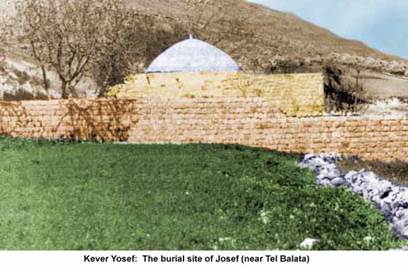
Kever Yosef (Shechem) – The eternal contact point to the land, of the Jewish soul. This area of Shechem was purchased by Yaaqov Avinu, for a hundred kesitah’,[18] and Yosef was carried up from Mitzrayim[19] to be buried here.
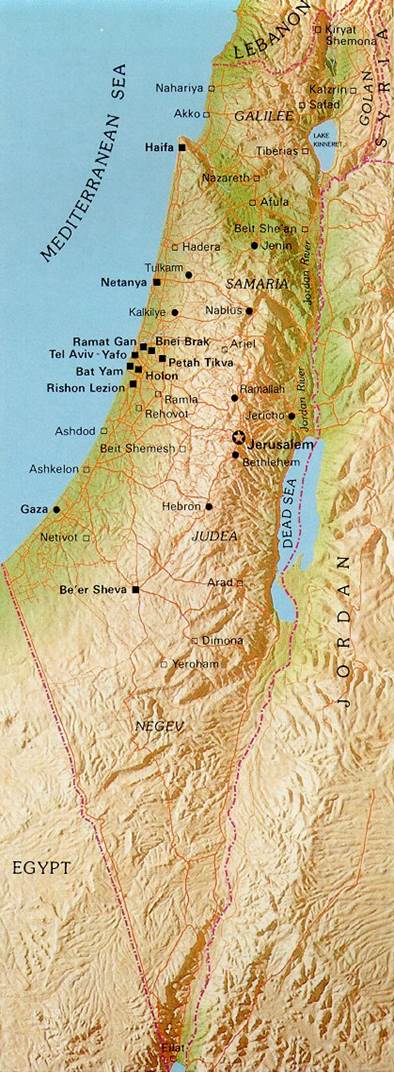
Shechem is a city of central Israel; called Sichem in Bereshit 12:6, Shalem, according to some commentators;[20] Sychem in II Luqas 7:16; and Sychar in Yochanan 4:5. Its situation is indicated as in Mount Ephraim in Yehoshua 20:7 and I Melachim 12:25:
1 Kings 12:25-29 Then Jeroboam built Sh’chem in Mount Ephraim, and lived there; and went out from there, and built Penuel. And Jeroboam said in his heart, ‘Now shall the kingdom return to the House of David. If this people go up to do sacrifice in the House of the Lord at Jerusalem, then shall the heart of this people turn back to their Lord, to Rehoboam King of Yehudah, and they shall kill me, and go back to Rehoboam King of Yehudah.
And the king took counsel, and made two calves of gold, and said to them, “It is too much for you to go up to Jerusalem; behold your G-ds, O Israel, which brought you out of the land of Egypt.” And he set one in Beit-El, and the other he placed in Dan.
But from Shoftim (Judges) 9:7 it seems to have been immediately below Mount Gerizim, and it is therefore placed by Yosef HaTsadiq us[21] between Gerizim and Ebal. Shechem is elsewhere stated to have been in the neighborhood of Dothan[22], north of Shiloh[23]. [24]
Shechem means “shoulder” or “ridge”.
The word Shechem means “Shoulder“. A “shoulder” represents the power to connect the back state of knowledge (secular science) and wisdom to the front state of knowledge and wisdom (Torah). Shechem is the bridge.
Anatomically, Shechem represents the head[25] and specifically the brain, which is composed of three main parts (left hemisphere, right hemisphere, and midbrain), as we can see in the following illustration:
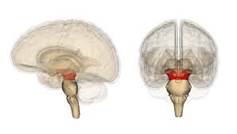
Mount Ebal and Mount Gerizim are the left and right hemispheres. Shechem is the midbrain, the center of the head, the place of connection. It is centered left to right, top to bottom, and front to back in the very center of the head. This the place of connection between the body and the head. It is the point of origin for the creation of a talmid, a soul destined for the next world.
Midrash Rabbah - Genesis C:9 R. Simlai said: [He assured them]: Ye are the body and I am the head, as it says, Let the blessing come upon the head, [viz.] Joseph:[26] if the body is removed, of what use is the head?
The Zohar on Kohelet 2:13, says that the “folly” in the following pasuk, is science and the knowledge of the sciences:
Kohelet (Ecclesiastes) 2:13 Then I saw that wisdom excelleth folly, as far as light excelleth darkness.
Shlomo HaMelech, King Solomon, was saying that when astronomy and mathematics are used to explain the laws of the new moon, this scientific knowledge ceases to be secular. It becomes part of Torah. The darkness is transformed into light, a greater light than that derived directly from the Torah. This is the “advantage” that Shlomo HaMelech is talking about. The light resulting from transformed darkness has an advantage over the light derived directly from the Torah.
The greatness of Shlomo HaMelech’s[27] wisdom was due in part to his having transformed the sciences. This transformation of “non-sense” into wisdom is a major part of the refinement of the physical world that prepares it for and actually brings about the highest revelations in the Torah to be revealed by Mashiach. It is a process which actually began with Yosef, who was the master over ancient Egypt and its wisdom, reached a very high level with Shlomo HaMelech, and will be completed by Mashiach himself.[28]
Rashi says that the Hebrew word shechem, means “portion,” or “division”[29]; inherent in the name Shechem is the idea of divisiveness.[30]
The gematria of Shechem is 360, or, 36 x 10.
Shechem is a place designed for trouble[31]: Here Dina was profaned, here Yosef was sold, here Avimelech killed his brothers and here the kingship was split. But Shechem was also given as a present to Yosef: “And I have given thee one shoulder (=Shechem) over thy brothers)”. It therefore signifies the complete connection of the tribes to Yosef and his unique way of elevating everything secular to holiness.[32]
Shechem is written: shin, chof, mem שכם. If the shin and the mem are joined together, they spell the word shem which means “name”, a common pseudo name for HaShem Himself. Unfortunately, in the word shechem, the “Name” is divided: the shin and the mem are separated by the letter chof.
This might not have seemed significant, had the letter chof not represented the number twenty, and had the number twenty not been so closely related to vision, or rather, the lack of it. And as we will soon see, the problem with Shechem, and all that occurred there had everything to do with a lack of vision.
The three letters of “Shechem” (shin-chof-mem) are also within the word “Mishkan (the sanctuary in the wilderness)” (mem-shin-chof-nun), with the addition of the letter “nun”, which always symbolizes the “Nun Shaarei Binah”, the “Fifty Gates of Understanding.” The extra “nun” makes the total numerical value of the word “Mishkan” equal 410, precisely the number of years the First Temple stood (2928 - 3338) before being destroyed by Nubuchadnetzar’s army.
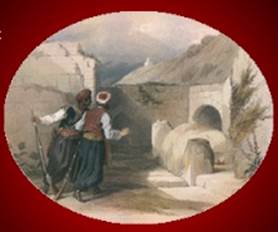
Kever Yosef
Avraham Avinu
The first mention of Shechem occurs in connection with Avraham, who, on his first sojourn to the land of Canaan, built an altar under the oak of Moreh on the site where later Shechem was built (Bereshit 12:6). In this pasuk, HaShem promises to give this land to Avraham and his seed. The Sages teach us that the first appearance of a word defines the word and its intrinsic meaning. This tells us that the land of Israel, and its possession by Avraham and his seed, is bound up in the word Shechem.
Shechem was situated on the north-south ancient highway through Samaria. As such, it was the first stop of Avraham when he came into the Land of Canaan. Shechem is the first arrival point. Shechem is also the first place in the Land of Canaan in which HaShem appeared to Avraham, promising that the land would be given to his descendants, as we read in this pasuk from Lech Lecha:
Bereshit (Genesis) 12:6-7 And Abram passed through the land unto the place of Sichem, unto the plain of Moreh. And the Canaanite [was] then in the land. And HaShem appeared unto Abram, and said, Unto thy seed will I give this land: and there builded he an altar unto HaShem, who appeared unto him.
Shechem is Avraham‘s first step in forming a connection with the land. Rashi notes that Avraham builds this first altar in recognition and gratitude for receiving the news that he would have offspring and that they would be given the Land of Israel. Ramban adds that Avraham builds the altar in gratitude for receiving a clearer form of prophecy, a vision, now that he is in the Land, than he had received when he was in Haran, where HaShem had appeared in a dream or through Divine inspiration. Clearly, Israel is the place where Abram’s contact with HaShem will be intensified.
This juxtaposition of the promise of the land with the giving of seed,[33] forms the basis for Avraham‘s faith:
Bereans (Hebrews) 11:8-12 By faith Abraham, when he was called to go out into a place which he should after receive for an inheritance, obeyed; and he went out, not knowing whither he went. By faith he sojourned in the land of promise, as [in] a strange country, dwelling in tabernacles with Isaac and Yaaqov, the heirs with him of the same promise: For he looked for a city which hath foundations, whose builder and maker [is] G-d. Through faith also Sara herself received strength to conceive seed, and was delivered of a child when she was past age, because she judged him faithful who had promised. Therefore sprang there even of one, and him as good as dead, [so many] as the stars of the sky in multitude, and as the sand which is by the sea shore innumerable.
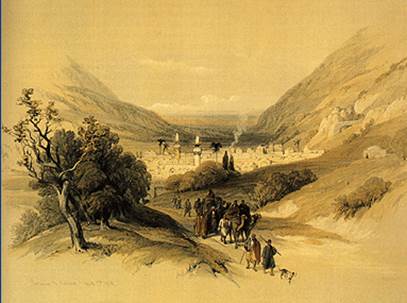
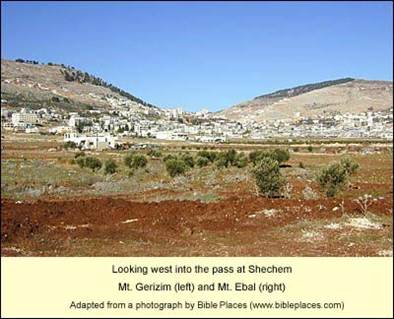
Mount Ebal (right), Mount Gerizim (left) and between them the town of Shechem. By David Roberts, 1842
The Arizal taught that the brit bein habetarim, the covenant between the parts, took place at Shechem, between Mt. Ebal and Mt. Gerizim. This covenant was a “Covenant of Fire“. Shechem is thus associated with fire:
Bereshit (Genesis) 15:1-21 After these things the word of HaShem came unto Abram in a vision, saying, Fear not, Abram: I [am] thy shield, [and] thy exceeding great reward. And Abram said, Lord HaShem, what wilt thou give me, seeing I go childless, and the steward of my house [is] this Eliezer of Damascus? And Abram said, Behold, to me thou hast given no seed: and, lo, one born in my house is mine heir. And, behold, the word of HaShem [came] unto him, saying, This shall not be thine heir; but he that shall come forth out of thine own bowels shall be thine heir. And he brought him forth abroad, and said, Look now toward heaven, and tell the stars, if thou be able to number them: and he said unto him, So shall thy seed be. And he believed in HaShem; and he counted it to him for righteousness. And he said unto him, I [am] HaShem that brought thee out of Ur of the Chaldees, to give thee this land to inherit it. And he said, Lord HaShem, whereby shall I know that I shall inherit it? And he said unto him, Take me an heifer of three years old, and a she goat of three years old, and a ram of three years old, and a turtledove, and a young pigeon. And he took unto him all these, and divided them in the midst, and laid each piece one against another: but the birds divided he not. And when the fowls came down upon the carcasses, Abram drove them away. And when the sun was going down, a deep sleep fell upon Abram; and, lo, an horror of great darkness fell upon him. And he said unto Abram, Know of a surety that thy seed shall be a stranger in a land [that is] not theirs, and shall serve them; and they shall afflict them four hundred years; And also that nation, whom they shall serve, will I judge: and afterward shall they come out with great substance. And thou shalt go to thy fathers in peace; thou shalt be buried in a good old age. But in the fourth generation they shall come hither again: for the iniquity of the Amorites [is] not yet full. And it came to pass, that, when the sun went down, and it was dark, behold a smoking furnace, and a burning lamp that passed between those pieces. In the same day HaShem made a covenant with Abram, saying, Unto thy seed have I given this land, from the river of Egypt unto the great river, the river Euphrates: The Kenites, and the Kenizzites, and the Kadmonites, And the Hittites, and the Perizzites, and the Rephaims, And the Amorites, and the Canaanites, and the Girgashites, and the Jebusites.
This “Covenant of Fire“, the brit bein habetarim, which HaShem made with Avraham was the same place where Yehoshua led the Children of Israel when they came out of Egypt. It is the same place where the Children of Israel uttered the blessings and the curses in the days of Yehoshua.
This pasuk shows HaShem, represented by the fire, passing between the parts of animals in the cutting of a covenant. The most powerful image, in Torah, is the image of HaShem as fire:
Devarim (Deuteronomy) 4:24 For HaShem thy G-d [is] a consuming fire, [even] a jealous G-d.
The Ramban states that: “Whatever happened to the Patriarchs is a portent for their [future] children.” He believed that all events mentioned in the Torah would affect future generations. We can’t always understand the relationships, but the relations exist. For instance, since Avraham first came to the city of Shechem when he arrived in Canaan, the first destination of the Jews upon their entering Israel would also be Shechem. Remember this, that the actions of the Patriarchs are a potent prophecy for future events.
Yaaqov Avinu[34] (renamed “Israel”) also encamped at Shechem 184 years later. He purchased the land in Shechem and built an altar and named it “El-elohe-israel,” meaning “G-d, the G-d of Israel”. Here also Yaaqov dug a well for his many herds. This well is still there today.
Bereshit (Genesis) 33:18-20 And Yaaqov came to Shalem, a city of Shechem, which [is] in the land of Canaan, when he came from Padan-aram; and encamped in view of the city. And he bought a parcel of a field, where he had spread his tent, at the hand of the children of Chamor, Shechem’s father, for an hundred pieces of money. And he erected there an altar, and called it El-elohe-Israel.
 Upon
Yaaqov‘s return to the land of Israel from the
house of Laban, the pasuk tells us that he, “encamped in view of the city” of
Shechem[35].
The sages derive from the “encamping” of Yaakov
that he performed the mitzva of “eruv techumim” (He
arrived on Friday afternoon). This activity involves setting boundaries within
which one may walk on Shabbat. Establishing boundaries implies that one is making an effort to separate oneself from something
that exists around him, a way of life that exemplifies Yaaqov.
Upon
Yaaqov‘s return to the land of Israel from the
house of Laban, the pasuk tells us that he, “encamped in view of the city” of
Shechem[35].
The sages derive from the “encamping” of Yaakov
that he performed the mitzva of “eruv techumim” (He
arrived on Friday afternoon). This activity involves setting boundaries within
which one may walk on Shabbat. Establishing boundaries implies that one is making an effort to separate oneself from something
that exists around him, a way of life that exemplifies Yaaqov.
Shechem is also the Biblical site at which Dina the daughter of Yaaqov was raped. Dina bore a daughter from the rape who was named Asenath. The righteous spark that was within Shechem ben Chamor, was transferred to Asenath. Asenath subsequently became the wife of Yosef HaTsadiq.
After Dina was raped, the sons of Yaaqov schemed to have all the men of Shechem circumcised.[36]
Years later, Yaaqov sent his seventeen year-old son, Yosef, from Hebron to check on his brothers as they kept the flocks in Shechem[37]. After Yosef HaTsadiq arrived he discovered his brothers had moved on to the lush area of Dothan; so he went to find them[38]. His brothers, filled with hatred, sold Yosef HaTsadiq to some Ishmaelite traders who, coming through the Dothan pass, were headed for Egypt:
Bereshit (Genesis) 37:12-17 And his brethren went to feed their father’s flock in Shechem. And Israel said unto Yosef HaTsadiq , Do not thy brethren feed [the flock] in Shechem? Come, and I will send thee unto them. And he said to him, Here [am I]. And he said to him, Go, I pray thee, see whether it be well with thy brethren, and well with the flocks; and bring me word again. So he sent him out of the vale of Hebron, and he came to Shechem. And a certain man found him, and, behold, [he was] wandering in the field: and the man asked him, saying, What seekest thou? And he said, I seek my brethren: tell me, I pray thee, where they feed [their flocks]. And the man said, They are departed hence; for I heard them say, Let us go to Dothan. And Yosef HaTsadiq went after his brethren, and found them in Dothan.
Yosef also had the men of Egypt circumcised and Yosef ultimately was buried in Shechem.
Yosef is associated with the Sefirah of Yesod, the place of the Brit Mila. Thus Yosef and circumcision are intimately connected with Shechem.
As Yosef conquered sexual temptation in Egypt, so he is buried in Shechem to act as barrier to the promiscuity of Shechem ben Chamor (Chamor means donkey). Shechem is thus strategically positioned for a showdown in the end of days.
Why did Shimon and Levi totally destroy Shechem? They felt that one of their own flesh and blood, their sister Dinah, was debased in a terrible manner. This violation could not go unpunished. They forgot one issue, however. While they were expressing their concern for their sister, they completely disregarded the fact that, in that same place, the individual they were persecuting, the one they were selling to a life of slavery and pain, was none other than their brother Yosef! If they had been so concerned for heir own flesh and blood, why did they ignore Yosef‘s pleas? Where was their compassion and sense of justice when they were persecuting their own brother?
In Bereshit 35, Yaaqov has his family get rid of all their idols. The presence of these idols accounts for the ability of Shechem ben Chamor to attack the family of Yaaqov which was weakened by these idols.
After Yaaqov got rid of the idols, his protection returned:
Bereshit (Genesis) 35:1-5 And G-d said unto Yaaqov, Arise, go up to Beth-el, and dwell there: and make there an altar unto G-d, that appeared unto thee when thou fleddest from the face of Esau thy brother. Then Yaaqov said unto his household, and to all that [were] with him, Put away the strange G-ds that [are] among you, and be clean, and change your garments: And let us arise, and go up to Beth-el; and I will make there an altar unto G-d, who answered me in the day of my distress, and was with me in the way which I went. And they gave unto Yaaqov all the strange G-ds which [were] in their hand, and [all their] earrings which [were] in their ears; and Yaaqov hid them under the oak which [was] by Shechem. And they journeyed: and the terror of G-d was upon the cities that [were] round about them, and they did not pursue after the sons of Yaaqov.
Thus the idols were a source of disaster to the family of Yaaqov at Shechem.
Rashi writes that “idols” refers to the spoils from the city of Shechem. Did Yaaqov‘s sons actually have idols from Shechem in their possession? Surely not, said R’ David Soloveitchik shlita. However, whenever one meets evil, even if he meets it in battle and destroys it (as Yaaqov‘s sons did to Shechem), he is tainted by it. Thus Yaaqov said, “Discard the taint of the evil of Shechem which is in your midst”.[39]
When Yaaqov Avinu died he handed Shechem down to his son Yosef:
Bereshit (Genesis) 48:21-22 And Israel said unto Yosef HaTsadiq, Behold, I die: but G-d shall be with you, and bring you again unto the land of your fathers. Moreover I have given to thee one portion above thy brethren, which I took out of the hand of the Amorite with my sword and with my bow.
Yosef requested that his body not be buried in Egypt, so his body was taken to Shechem for burial:
Yehoshua (Joshua) 24:32 And the bones of Yosef HaTsadiq, which the children of Israel brought up out of Egypt, buried they in Shechem, in a parcel of ground which Yaaqov bought of the sons of Hamor the father of Shechem for an hundred pieces of silver: and it became the inheritance of the children of Yosef HaTsadiq.
Yosef HaTsadiq
Had Yosef‘s brothers seen the miracle that had happened for Yosef in the pit, then perhaps they would have reconsidered their judgment. After all, miracles do not happen for evil people, and it was an important sign that Heaven did not share their view of their younger brother.
However, they had not noticed the miracle, and the Talmud does not say why. Nevertheless, perhaps, the Talmud alludes to the answer since the above citation follows this halachah:
Shabbat 22a Rav Kahana said: Rav Nachman bar Munyumi elucidated in the name of Rebi Tanchum: A Chanukah light placed higher than twenty amot is unfit, just like [the roof of a] succah and [an eruv in] an alleyway.
The eye does not see well higher than twenty amot and therefore there is no proclamation of the miracle.[40]
The point of the thirty-six candles that we light throughout the eight days of Chanukah, explains Rashi, is to proclaim the miracle that happened for the Chashmoniam when they conquered the Greek army (in the thirty-sixth century from creation) against all odds. As well, it reminds us of how the miracle extended to the Temple Menorah, which burned for eight days using oil that should have become consumed after only one day. To remember this, one has to see the Chanukah lights burning, which is difficult to do from a distance of twenty amot or more.
The question is, why not just use a larger flame? Or, what happens for a person whose vision is not good past ten amot?
For this reason and others, the number twenty represents more than just a physical limitation. In fact, it refers to a spiritual limitation, perhaps the same kind that prevented Yosef’s brothers from recognizing the Divine hand in Yosef‘s redemption. For, the miracles did not stop once Yosef was drawn from the pit:
Bereshit (Genesis) 37:25 They (the brothers) sat down to eat bread when they saw a caravan of Ishmaelites coming from Gilead. Their camels were carrying spices, balsam and lotus on their way down to Egypt.
Why did the pasuk make known what they (the Arabs) were transporting? To show you the reward of the righteous; for, normally the Arabs transported tar and naphtha whose smells are bad; for this one (Yosef), spices were arranged, to save him from the bad smell.[41]
Another miracle, albeit a subtle one, but a miracle nevertheless, and another indication that Heaven was on Yosef‘s side. Nevertheless, the brothers did not see it that way, and even imposed an oath on HaShem, so to speak, to prevent Him from revealing to Yaaqov what they had done to his favorite son.[42]
Fascinatingly enough, the verse says:
Bereshit 37:28 Midianite traders passed by; they pulled Yosef out from the pit. They sold Yosef to the Ishmaelites for twenty [pieces of] silver.
Seemingly, this provided yet another allusion to the intellectual and spiritual blindness that prevented Yosef‘s brothers from seeing his true greatness, and the depth of the mistake they were making in selling him. And, rather than reveal the hand of HaShem in history, the brothers hid it.
Sotah 13b ‘This one [Yosef HaTsadiq ] fulfilled all that was written in the other’. But if Moses had not occupied himself with him, would not the Israelites have occupied themselves with him? Behold, it is written: And the bones of Yosef HaTsadiq which the children of Israel brought up out of Egypt buried they in Shechem! Furthermore, if the Israelites had not occupied themselves with him, would not his own sons have done so? And, behold, it is written: And they became the inheritance of the children of Yosef HaTsadiq ! — They said [to one another], ‘Leave him; his honour will be greater [when the burial is performed] by many rather than by few’; and they also said: ‘Leave him; his honour will be greater [when the burial is performed] by the great rather than by the small’.
Buried they in Shechem. Why just in Shechem? — R. Hama son of R. Hanina said: From Shechem they stole him, and to Shechem we will restore what is lost. The following verses are contradictory: it is written: And Moses took the bones of Yosef HaTsadiq with him, and it is written: And the bones of Yosef HaTsadiq which the children of Israel brought up etc.! — R. Hama son of R. Hanina said: Whoever performs a task without finishing it and another comes and completes it, Scripture ascribes it to the one who completed it as though he had performed it.
An Astonishing Midrash
By Shlomo Katz
The students asked the Rabbi Yehuda Hanassi,[43] “Why was Yosef buried in Shechem”?
Rebbi responded, “Since he was kidnapped from Shechem, they returned him to Shechem”.
The students refused to accept this answer until Rebbi showed them the verse in which Yosef said, “You must bring my bones up with you”.
R’ Yehonatan Eyebschutz z”l explains: The halachah is that a thief must return the object which he stole. If the object no longer exists or no longer exists in its original form, the thief cannot return it and he cannot achieve full atonement. This was the objection raised by Rebbi’s students: Since Yosef was taken from Shechem as a living person and was returned as a corpse, how can that be considered to be a true return?
The answer is as follows: The halachah also provides that even if the stolen object is changed, so long as it has the same name in its original and present forms, the thief can return it for full atonement. Thus Rebbi answered, “Even in Yosef‘s lifetime he referred to himself (in the quoted verse) as ‘bones’. Therefore, when his body was returned to Shechem, it is as if the stolen object was returned”.[44]
Yehoshua
After forty years of encampments in a barren wilderness, Yehoshua led the Children of Israel into a land flowing with milk and honey. A land where a single cluster of grapes required eight men to carry it.
The people were making a transition from idolatry to holiness that was as dramatic as their transition from the wilderness to the land flowing with milk and honey. The Children of Israel were retracing the steps of their father Avraham. As Avraham had grown up in a household steeped in idolatry, so the children of Israel had grown up in Egypt, a place of intense idolatry. As Avraham wandered, not knowing his ultimate destination, so the Children of Israel wandered without knowing their ultimate destination.
The innate holiness of the land was reflected in its extraordinary productivity. Because of this holiness, HaShem sent the people first to Shechem to appreciate the dramatic border that they had just crossed.
The people knew of the ancient “Covenant of Fire” that HaShem had made with their father Avraham in this very spot. They knew that this was the place where their exile had begun and where Avraham‘s exile had ended. They also knew that their father Yaaqov had ended his exile at this very place. This poignancy was not lost on the Children of Israel.
Now that their exile had ended, at the place where it began, HaShem wanted to make them aware of the tremendous journey that they had been through. HaShem wanted them to appreciate the fact that their lives in this land were dependent on their holiness. Thus HaShem took them to this powerful place and reminded them that their very lives depended on holiness.
The “Blessings and Curses” on Mt. Ebal and Mt. Gerizim, were spoken with Shechem directly between the two mountains. This pasuk clearly states that Shechem is the place where the Children of Israel received their connection to the Promised Land:
Yehoshua (Joshua) 24:25 So Joshua made a covenant with the people that day, and set them a statute and an ordinance in Shechem.
Shortly after stepping foot on the soil of the Holy Land, the Children of Israel miraculously found themselves standing before mount Gerizim and mount Ebal, a pair of mountains bordering on the city of Shechem to the west and the east, respectively. There, they were commanded to perform a unique “swearing-in ceremony” in which they accepted upon themselves all of the mitzvot of the Torah. Although the Torah only provides a broad description of what was to transpire, the Mishna describes it in full detail:
Sotah 32a HOW WERE THE BLESSINGS AND CURSES [PRONOUNCED]? WHEN ISRAEL CROSSED THE JORDAN AND CAME TO MOUNT GERIZIM AND MOUNT EBAL WHICH ARE BY SAMARIA, (THIS IS IN THE VICINITY OF SHECHEM WHICH IS IN THE VICINITY OF THE TEREBINTHS OF MOREH, AND IT IS SAID, ARE THEY NOT BEYOND JORDAN ETC. AND ELSEWHERE IT STATES, AND ABRAM PASSED THROUGH THE LAND UNTO THE PLACE OF SHECHEM UNTO THE TEREBINTH OF MOREH; AS THE TEREBINTH OF MOREH MENTIONED IN THIS LATTER VERSE IS SHECHEM, SO THE TEREBINTH OF MOREH MENTIONED IN THE FORMER VERSE IS SHECHEM.)
When The Children of Israel went up to mount Ebal and mount Gerizim,[45] they were separated by the city of Shechem in the valley below.
The blessings and curses uttered upon our entrance into Eretz Israel at mount Ebal and mount Gerizim, emphasize the fact that our first encounter with Eretz Israel must set the foundation for our future settlement of the land. This required an intense awareness of our duties and responsibilities.
The Gemara[46] tells us that the covenant on Mt. Gerizim and Mt. Ebal was made in a miraculous fashion on the day of entering the Land: “Come and see how many miracles were done on that day, they crossed the Jordan and came to Mt. Gerizim and Mt. Ebal, more than sixty miles, and no-one could stand on their way. Anyone who tried to interrupt them was seized with panic, and then they brought the stones and built the altar, and wrote the Torah in seventy tongues on them... and praised and cursed and took the stones and came to sleep in the Gilgal”.
Shechem clearly and decisively signifies the fact that the Torah is an absolute covenant, not only between HaShem and His people but an eternal covenant between the nation and its land with the Torah carved in it and spread over the whole span of life.
Here, on top of Mt. Gerizim and Mt. Ebal, we accepted the fact that the blessing of the land is realized just as much as we are worthy of living on it and use it according to its unique spiritual nature: The land of Life and the place of Devine Presence.
Joshua designate Shechem as a city of refuge:
Yehoshua (Joshua) 20:7 And they appointed Kedesh in Galilee in mount Naphtali, and Shechem in mount Ephraim, and Kirjath-arba, which [is] Hebron, in the mountain of Judah.
Later Events
During the time of the judges, Avimelech, a son of Gideon, conspired with his maternal family to kill all other sons of Gideon and have himself proclaimed king of Shechem:
Shoftim (Judges) 9:6 And all the men of Shechem gathered together, and all the house of Millo, and went, and made Avimelech king, by the plain of the pillar that [was] in Shechem.
But Jotham, the youngest son of Gideon, escaped by hiding. And at Avimelech coronation, Jotham climbed Mount Gerizim and shouted a curse on Shechem for Avimelech sin. This curse proved true, for the citizens of Shechem formed a conspiracy against Avimelech, and he completely destroyed the city. But when Avimelech went to Thebez and stormed the tower, a woman dropped an upper millstone on his head and cracked his skull.
After the reigns of Saul, David, and Solomon, Rehoboam, the son of Solomon, “went to Shechem, for all Israel had come to Shechem to make him king”:
I Melachim (Kings) 12:1 And Rehoboam went to Shechem: for all Israel were come to Shechem to make him king.
But because Rehoboam followed the foolish and harsh advice of the youths with whom he grew up, the nation divided at Shechem. Jeroboam, the leader of those who wanted Rehoboam to show mercy, decided to separate from Rehoboam and form a separate nation. King Jeroboam selected Shechem for his capital:
2 Divrei HaYamim (Chronicles) 10:1 And Rehoboam went to Shechem: for to Shechem were all Israel come to make him king.
In the end, this was the beginning of a terrible split between Israel and Judah. Jeroboam shouted: “To your tents, O Israel” and separated the ten northern tribes from the two tribes of the southern kingdom of Judah (1 Melachim 12:1-16).
Sotah 11a Shechem is a place set aside for punishment; the Tribes were “damaged” there; Dinah was violated there, and there the Kingdom of David divided.
Now lets look at Mashiach ben Yosef as He went to the Galil and to Shechem:
Zohar, VaYakhel 220a Rebi Shimon said ... The land of Galil is where Melech Mashiach will be revealed, because it is in the territory of Yosef. It was destroyed first, and it is the place where he will first be revealed from all the places, before spreading to the nations ... as it says:
Yehoshua 24:32 “And the bones of Yosef which they brought up from Egypt for burial in Shechem.”
The Zohar indicates that the meaning of the pasuk in Yehoshua pertains to Mashiach. So when we see the sod level (the same as the Zohar) gospel showing His Majesty in the Galil, it is what we would expect:
Yochanan (John) 4:5-7 Then cometh he to a city of Samaria, which is called Sychar, near to the parcel of ground that Yaaqov gave to his son Yosef HaTsadiq. Now Yaaqov‘s well was there. Yeshua therefore, being wearied with [his] journey, sat thus on the well: [and] it was about the sixth hour. There cometh a woman of Samaria to draw water: Yeshua saith unto her, Give me to drink.
Because, when you think about it, all that Mashiach boils down to, in the end, is helping Yaaqov leave behind all connections to Esav once and for all, so that he can finally take his right place in history as Israel. Obliteration of evil, identified only with the Days of Mashiach is synonymous with the cleansing of all traces of Esav within the heart of every Jew. It is also what the Talmud refers to as the “slaughtering of the yetzer hara” in Mashiach‘s day.[47]
Then, when this finally happens, there will be no curses, only blessings to be enjoyed forever. Then, Shechem will no longer be a place set aside for punishment, but as a place for reward. However, not for Yaaqov the twin brother of Esav, but for Israel, and it will be a well-deserved reward for every Jew who will have “fought with a divine being and with man” and will have won.
The Sages have indicated that there is a connection between the Sefirot, the days of creation (and its associated millennium), and our Patriarchs. The following chart illustrates these connections and shows that we live in Yosef’s millennium (October 2007 A.D. is Tishri 5768 A.M.):
|
English |
Year |
Ish |
|
|
Chesed |
“kindness” |
0 to 1000 |
|
|
Gevurah |
“power/ strength” |
1001 to 2000 |
|
|
Tiferet |
“beauty/ harmony” |
2001 to 3000 |
|
|
Netzach |
“dominance/ victory” |
3001 to 4000 |
Moses |
|
Hod |
“glory” |
4001 to 5000 |
Aaron |
|
Yesod |
“foundation” |
5001 to 6000 |
Yosef HaTsadiq |
We are now in the year 5768 (from creation); therefore we are also in the sixth millennium, the one that is spiritually “powered” by the Sefirah called Yesod, the one that corresponds to Yosef HaTsadiq .
* * *
On Sunday, Oct. 8, 2000 / Tishre 9, 5761, a gang of Arabs ransacked, burned, and took possession of Kever Yosef. This connection point is no longer in Jewish hands.
Providentially, Shechem was turned over to Palestinian rule December 12, 1995, Parashat Vayaishev, the Parasha in which Yosef was sold in Shechem. In fact, the Sunday of that week, Israeli soldiers fought with students attending the Yeshiva located at Yosef‘s burial tomb, the same Yeshiva that was destroyed by Palestinians in their most recent uprising when they also destroyed the tomb of Yosef as well.
Shechem is such a bad place for Jews that it has been called a “place ready for punishment”.[48]
Finally, since Shechem was the first city for Avraham, so it will be the first city in the days of Mashiach:
Soncino Zohar, Shemot, Section 2, Page 220a Said R. Simeon: ‘At the time when the dead will be awakened and be in readiness for the resurrection in the Holy Land, legions upon legions will arise on the soil of Galilee, as it is there that the Messiah is destined to reveal himself. For that is the portion of Yosef HaTsadiq, and it was the first part of the Holy Land to be destroyed, and it was thence that the exile of Israel and their dispersion among the nations began, as Scripture says, “but they are not grieved for the hurt of Yosef HaTsadiq “ (Amos VI, 6). Thus there they will rise up first, for the reason that it is the portion of him who was put in an ark, as it says, “and he was put in an ark in Egypt”(Gen. L, 26), and subsequently was buried in the Holy Land, as it says “And the bones of Yosef HaTsadiq, which the children of Israel brought up out of Egypt, buried they in Shechem” (Jos. XXIV, 32); and he it was who kept the purity of the holy covenant symbol in a special degree. As soon as they will rise from the dead all those hosts will march, each man to the portion of his ancestors, as Scripture says, “and ye shall return every man unto his possession” (Lev. xxv, 10).
CONCLUSION:
Shechem = A promise by HaShem to give Avraham and his seed the land of Israel.
This infers that our possession of Shechem is an indication of our possession of the entire Land of Israel as promised to Avraham.
Hebron -
חברון
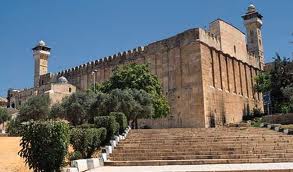
Ma’arat HaMachpelah
Machpelah (Hebron) – The eternal contact point of our people to our fathers, our people, of the Jewish soul. Machpelah means “The Doubled One“ and was understood to be a double cave. Some say it was a cave within a cave, while others say it was a cave above a cave.
Anatomically, Machpelah is situated at the place of yesod, foundation, vis-à-vis the land of Israel. The following illustration should help us understand this strange cave:
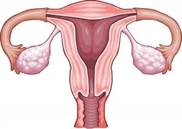
This portion of the female anatomy illustrates the idea of cave within a cave and also a cave above a cave. When a woman is lying down, it is a cave within a cave. When she is standing up, then it is a cave above a cave. Curiously, a womb and a grave are both called a ‘kever’, because they are both a portal to another world.
In the area between the bottom of the torso and the belt, the womb is precisely in the center. The womb is the point of origin for all new life. It is the point of connection between this world and the next world.
Kiryat Arba = Hebron (from hibur = connection, because there the spirit connects with the body, the upper world with the lower.). Some say that the name Hebron means friendship. Hebron is the first location in Eretz Israel to be purchased.
Hebron is located approximately twenty miles southwest of Yerushalayim and lies about 3,000 feet above sea level.
The Gemara[49] writes that Hebron is the rockiest place in Eretz Israel, which is the reason it was singled out as a place fit for burial. On the simplest level we can understand that as a place that could not be used agriculturally, Hebron was an ideal cemetery. However, the Gemara‘s comment can also explain how the body and soul, the lower and upper worlds, are joined in Hebron. Hebron is a place that does not support life, in a sense, removed from the material. As such, the body and soul of one who identifies with Hebron are closer together, serving a single purpose and leading a single life, the life of the spirit. In a place were material goals cannot be met, only those with spiritual goals will dwell, making Hebron a spiritual place, a joining of the lower world with the upper. Hebron is therefore a place of burial, a place to come to when the four elements re-separate, for even in life, it is a place close to death.
Sotah 34b Now Hebron was built seven years — what means ‘was built’? If I say that it means actually built, is it possible that a man constructs a house for his younger son before his elder son; as it is written: And the sons of Ham: Cush and Mitzrayim? But [the intention is], it was seven times more productive than Zoan. There is no worse stony ground in all the land of Israel than Hebron, and that is why they bury the dead there; and there is none among all the countries superior to the land of Egypt, as it is said: Like the garden of the Lord, like the land of Egypt; and there is no place superior to Zoan In all the land Egypt, as it is written: For his princes are at Zoan. Nevertheless Hebron was seven times more productive than Zoan. But was Hebron stony ground; behold it is written: And it came to pass at the end of forty years, that Absalom said unto the king, I pray thee, let me go [and pay my vow . . . in Hebron]; and R. Iwya — another version is, Rabbah b. Bar Hanan-said: He went to fetch lambs from Hebron; and there is also a teaching: [The best] rams are from Moab and lambs from Hebron! — From that very fact [it is proved that the land was stony]; because the soil is thin it produces pastures and the cattle grow fat there.
The name Hebron speaks of a connection. Burial in Hebron represents a connection to the living even in death. The essence of an ancestor is the fact that he has children. Everything a child is finds its basis in his parent. The link continues from generation to generation, such that every descendent owes his entire being to all those who came before. The Jewish people as they are today, and will be tomorrow, stand on the foundation laid by Avraham and Sarah, Isaac and Rivka, Yaaqov and Leah.
Hebron is also a place of life according to the Zohar it is the entrance to the Garden of Eden:
Soncino Zohar, Bereshit, Section 1, Page 127a R. Judah said: ‘Abraham recognized the cave of Machpelah by a certain mark, and he had long set his mind and heart on it. For he had once entered that cave and seen Adam and Eve buried there. He knew that they were Adam and Eve because he saw the form of a man, and whilst he was gazing a door opened into the Garden of Eden, and he perceived the same form standing near it. Now, whoever looks at the form of Adam cannot escape death. For when a man is about to pass out of the world he catches sight of Adam and at that moment he dies. Abraham, however, did look at him, and saw his form and yet survived. He saw, moreover, a shining light that illumined the cave, and a lamp burning. Abraham then coveted that cave for his burial place, and his mind and heart were set upon it. Observe now with what tact Abraham made his request for a burial place for Sarah. He did not ask at first for the cave, neither did he indicate any desire to separate himself from the people of the land, but simply said: GIVE ME A POSSESSION OF A BURYING PLACE WITH YOU, THAT I MAY BURY MY DEAD OUT OF SIGHT. Although he addressed himself to the sons of Heth, we cannot suppose that Ephron was not present then, since it says: Now EPHRON WAS SITTING IN THE MIDST OF THE CHILDREN OF HETH. Abraham, however, did not at first say anything to him, but spoke only to them, as it says: AND HE SPOKE TO THE CHILDREN OF HETH, ETC. Now it cannot be imagined that Abraham wished to be buried among them, among the impure, or that he desired to mix with them. But Abraham acted tactfully, giving a lesson to the world. Though his whole desire was centered on that cave, he did not ask for it forthwith, but asked for something else of which he had no need, and he addressed his request to the others, not to Ephron himself. It was only after they said to him in the presence of Ephron: “Hear us, my lord; thou art a mighty prince among us, etc.” that he said, “hear me, and entreat for me to Ephron the son of Zohar, that he may give me the cave of Machpelah, which he hath, etc.” Abraham as much as said: Do not think that I wish to separate from you as being superior to you. No, in the midst of you I desire to be buried, for as I am fond of you I do not wish to keep aloof from you.’
R. Eleazar said: ‘Abraham came to enter the cave in this way. He was running after that calf of which we read, “and Abraham ran unto the herd, and fetched a calf” (Gen. XVIII, 7), and the calf ran until it entered a cave, and then Abraham entered after it and saw what we have described. Further, Abraham used to offer up his prayer daily, and in so doing used to proceed as far as that field, which emitted heavenly odors. Whilst there he saw a light issuing from the cave, so that he prayed on that spot, and on that spot the Holy One communed with him. On that account Abraham now asked for it, having always longed for it since then. Why did not he ask for it before that time? Because the people would not have listened to him, as he had no obvious need for it. Now that he needed it, he thought it was time to demand it. Observe that had Ephron seen inside the cave what Abraham saw, he would never have sold it to him. But he never saw there anything, since such things are never revealed except to their rightful owner. It was thus revealed to Abraham and not to Ephron: to Abraham, who was its rightful owner, but not to Ephron, his wife, to wit, after Abraham had taken upon himself this obligation. Adam then returned to his place, but not Eve, until Abraham came and placed her beside Adam, who received her for his sake. Hence the text says, AND AFTER THIS, ABRAHAM BURIED (eth) SARAH HIS WIFE: the augmenting particle eth indicates that the burial included, as it were, Eve. Thus they were all settled in their proper places. Hence the Scripture says, “These are the generations of heaven and earth when they were created (b’hibar’am)” (Gen. II, 4), which according to tradition, means “on account of Abraham“ (b’Abraham). Now “the generations of the heaven and the earth” can only be Adam and Eve, they having been the direct issue of the heaven and earth and not of human parents, and it was they who became established through Abraham: before Abraham, Adam and Eve were not established in their places in the other world.’
R. Eleazar asked his father, R. Simeon, for an explanation of the term Machpelah (lit. “twofold”, or “folded”). ‘How is it,’ he said, ‘that first it is written “the cave of Machpelah”, and subsequently “the cave of the field of Machpelah”, implying that the field and not the cave was “Machpelah” (doubled)?’ R. Simeon replied: ‘The term Machpelah belongs properly neither to the cave nor to the field, but to something else with which both were connected. The cave belongs to the field, and the field to something else. For the whole of the Land of Israel and of Jerusalem is folded up beneath it, since it exists both above and below, in the same way as there is a Jerusalem both above and below, both of the same pattern. The Jerusalem above has a twofold attachment, above and below; similarly the Jerusalem below is linked to two sides, higher and lower. Hence it is folded in two; and that field partakes of the same character, seeing that it is therein situated. The same reference is contained in the passage, “as the smell of a field which the Lord hath blessed” (Gen. XXVII, 27), to wit, both above and below. Hence its name, “field of folding”, but not “folded field”. Further, the esoteric implication of the term Machpelah relates it to the Divine Name, in which the letter He is doubled, though both are as one. It is, indeed, true that the cave was a twofold one, a cave within a cave, yet the name “cave of the field of Machpelah” has a different connotation, as already explained. Abraham, on his part, who knew its true character, in speaking to the children of Heth called it simply “cave of Machpelah”, as if to imply merely “double cave”, which it also was in fact. Scripture, however, describes it as “the cave of the field of Machpelah”, this being its true description. For the Holy One has disposed all things in such a way that everything in this world should be a replica of something in the world above, and that the two should be united so that His glory should be spread above and below. Happy the portion of the righteous in whom the Holy One finds pleasure both in this world and in the world to come!’
Thus Hebron replaced Gan Eden. In place of individual immortality came the immortality of a connection with the future, an immortality of the whole. Hebron is the place where the body and spirit join. Though the body dies, as long as the spirit, the ideas and values passed on to the next generation, endures, the man is still alive.
Hebron is the place where the lower and upper worlds join; the infusion of holy purpose into future generations unites them. The creation of life in the lower world, and the living of life in the lower world with an eye to both past and future, are together our means of spiritual fulfillment. They are the guarantee of our ultimate purpose.
It is for this reason that Hebron is considered the spiritual entry point into Eretz Israel.[50]
The first use of the word Hebron in the Torah is found in Bereshit 13. This first use of Hebron juxtaposes the giving of seed with the possession of the land of Israel. The difference is that this passage specifically promises the land to Avraham – not his seed!
Bereshit (Genesis) 13:14-18 And HaShem said unto Abram, after that Lot was separated from him, Lift up now thine eyes, and look from the place where thou art northward, and southward, and eastward, and westward: For all the land which thou seest, to thee will I give it, and to thy seed for ever. And I will make thy seed as the dust of the earth: so that if a man can number the dust of the earth, [then] shall thy seed also be numbered. Arise, walk through the land in the length of it and in the breadth of it; for I will give it unto thee. Then Abram removed [his] tent, and came and dwelt in the plain of Mamre, which [is] in Hebron, and built there an altar unto HaShem.
From this we derive that Hebron is our connection to Avraham and by extension, to the patriarchs and to Adam. Hebron is our connection to our forefathers.
Shortly after Avraham reached the Promised Land, before he bought Machpelah, whilst Sarah is still alive. He built an altar in Hebron.
Later the Torah describes in painstaking detail how Avraham requests to buy the grave site at Machpelah, how the Hittites wish him to take it for free, and. when Ephron the Hittite finally agrees to make it a purchase, he charges Avraham the inflated and outlandish sum of four hundred silver shekels.
(In an extraordinary piece of arithmetic computation, the Arugat Ha-bosem proves that 400 shekel, the price of this grave site, was enough to buy 2.4 million square amot, based on the price of land given in Vayikra 27:16. In other words, there is four cubits, “daled amot” for 600,000 Jews.)
Why expend so much ink and parchment, the entire chapter 23 of the Book of Bereshit, over a Middle-Eastern souk sale? Moreover, what is the significance in the fact that the very first parcel of land in Israel acquired by a Jew happens to be a grave-site?
This cave was purchased by Avraham Avinu as a grave for Sarah. Eventually, Avraham and Sarah, Yitzchak and Rivka, and Yaaqov and Leah were buried in this doubled cave.
Bereshit (Genesis) 49:28-33 And he charged them, and said unto them, I am to be gathered unto my people: bury me with my fathers in the cave that [is] in the field of Ephron the Hittite, In the cave that [is] in the field of Machpelah, which [is] before Mamre, in the land of Canaan, which Abraham bought with the field of Ephron the Hittite for a possession of a burying place. There they buried Abraham and Sarah his wife; there they buried Isaac and Rebekah his wife; and there I buried Leah. The purchase of the field and of the cave that [is] therein [was] from the children of Heth. And when Yaaqov had made an end of commanding his sons, he gathered up his feet into the bed, and yielded up the ghost, and was gathered unto his people.
Why did Avraham have to purchase Sarah’s gravesite? Why had he not purchased land during the nearly sixty years that he and Sarah had sojourned in the land?
Avraham and Sarah are semi-nomadic herdsmen because, notwithstanding Divine promises to the contrary, there is as of yet no Hebrew nation to settle the land. While associated with Canaan, their direct connection to the land is tenuous and fragile, because Avraham and Sarah personify the earliest stages of a new nation being born. Only one thing anchors them to this place, and that is the word of HaShem. Actual possession and settlement, the true possibility of a national destiny being realized, is for them far off in the future. For now, the land is firmly in the hands of the indigenous inhabitants, the Canaanites.
This trial is indeed a difficult trial. Avraham must wait till the death of Sarah before he acquires his first piece of the land.
Bereshit (Genesis) 23:4 I [am] a stranger and a sojourner with you: give me a possession of a burying place with you, that I may bury my dead out of my sight.
A piece of land that serves as a family crypt is perhaps the strongest notion of being linked to a place that human beings recognize.
The family sepulcher expresses in very tangible form the intense connection to a land, a clan, and even a way of life. To be buried in a place is to be part of that place. What Avraham seeks to establish is not simply a cemetery, but rather an undisputed and irreversible foothold in the land of Canaan.
There is an interesting mystical aspect to the purchase of this fantastic cave. The Sages teach us that the Aishet Chayil, the woman of valor in Mishlei (Proverbs) 31, was Sarah! They say that the “field” she considered and purchased was Ma’arat HaMachpelah! Of course this presents a massive problem in that the Torah spends most of a chapter showing us that Avraham bought Ma’arat HaMachpelah. So how can the Sages attribute this to Sarah Imeinu? The Sages understood that Sarah was alive even whilst she was dead. Somehow she and Avraham had become so united that she was still with him when he acted as her vehicle to purchase the cave. Thus it is called Ma’arat HaMachpelah, the cave of doubles. One of the pairs, one of the doubles was Avraham and Sarah.
According to our Sages, Adam and Chava are also buried at Machpelah, which was excavated by Adam:
Eiruvin 53a The cave of Machpelah. Rab and Samuel differ as to its meaning. One holds that the cave consisted of two chambers one within the other; and the other holds that it consisted of a lower and upper chamber. According to him who holds that the chambers were one above the other the term Machpelah is well justified but according to him who holds that it consisted of two chambers one within the other, what could be the meaning of Machpelah? That it had multiples of couples.
Mamre the city of Arba. R. Isaac explained: The city of the four couples: Adam and Eve, Abraham and Sarah, Isaac and Rivka, Yaaqov and Leah.
Sotah 13a And there they lamented with a very great and sore lamentation. It has been taught: Even the horses and asses [joined in the lamentation]. When [the cortege] arrived at the Cave of Machpelah, Esau came and wished to prevent [the interment there], saying to them, Mamre, Kiriath-arba, the same is Hebron — now R. Isaac has said: Kiriath-arba [is so called] because four couples [were buried there], viz. Adam and Eve, Abraham and Sarah, Isaac and Rivka, and Yaaqov and Leah — [Yaaqov] had buried Leah in his portion and what remains belongs to me’. They replied to him, ‘Thou didst sell it’. He said to them, ‘Granted that I sold my birth-right, but did I sell my plain heir’s right!’ They replied: ‘Yes, for it is written: In my grave which I [Yaaqov] have digged for me’, and R. Johanan has said in the name of R. Simeon b. Jehozadak: The word kirah [dig] means nothing else than ‘sale’ [mekirah], and thus in the coast-towns they use kirah as a term for ‘sale’. — He said to them, ‘Produce a document [of sale] for me’. They replied to him, ‘The document is in the land of Egypt. Who will go for it? Let Naphtali go, because he is swift as a hind’; for it is written: Naphtali is a hind let loose, he giveth goodly words — R. Abbahu said: Read not ‘goodly words’ [imre shefer] but imre sefer [words of a document]. Among those present was Hushim, a son of Dan, who was hard of hearing; so he asked them, ‘What is happening?’ They said to him, ‘[Esau] is preventing [the burial] until Naphtali returns from the land of Egypt’. He retorted: ‘Is my grandfather to lie there in contempt until Naphtali returns from the land of Egypt!’ He took a club and struck [Esau] on the head so that his eyes fell out and rolled to the feet of Yaaqov. Yaaqov opened his eyes and laughed; and that is what is written: The righteous shall rejoice when he seeth the vengeance; he shall wash his feet in the blood of the wicked. At that time was the prophecy of Rivka fulfilled, as it is written: Why should I be bereaved of you both in one day? Although the death of the two of them did not occur on the one day, still their burial took place on the same day. — But if Yosef HaTsadiq had not occupied himself with [Yaaqov‘s burial], would not his brethren have occupied themselves with it? Behold it is written: For his sons carried him into the land of Canaan! — They said [among themselves], ‘Leave him [to conduct the interment]; for the honour [of our father] will be greater [when it is conducted] by kings than by commoners’.
Baba Bathra 58a R. Bana’ah used to mark out caves [where there were dead bodies]. When he came to the cave of Abraham, he found Eliezer the servant of Abraham standing at the entrance. He said to him: What is Abraham doing? He replied: He is sleeping in the arms of Sarah, and she is looking fondly at his head. He said: Go and tell him that Bana’ah is standing at the entrance. Said Abraham to him: Let him enter; it is well known that there is no passion in this world. So he went in, surveyed the cave, and came out again. When he came to the cave of Adam, a voice came forth from heaven saying Thou hast beholden the likeness of my likeness, my likeness itself thou mayest not behold. But, he said, I want to mark out the cave. The measurement of the inner one is the same as that of the outer one [came the answer]. (Those who hold that there was one chamber above another [say that the answer was], the measurement of the lower one is the same as that of the upper one.) R. Bana’ah said: I discerned his [Adam‘s] two heels, and they were like two orbs of the sun. Compared with Sarah, all other people are like a monkey to a human being, and compared with Eve Sarah was like a monkey to a human being, and compared with Adam Eve was like a monkey to a human being, and compared with the Shechinah Adam was like a monkey to a human being. The beauty of R. Kahana was a reflection of [the beauty of Rab; the beauty of Rab was a reflection of] the beauty of R. Abbahu; the beauty of R. Abbahu was a reflection of the beauty of our father Yaaqov, and the beauty of Yaaqov was a reflection of the beauty of Adam.
Since Adam and Eve were the first pair buried there, and therefore Hebron, where the cave was situated, bore the additional name of “Kiriath-arba”, “the city of four“; i.e., of the tombs of Adam and Eve, Abraham and Sarah, Isaac and Rivka, Yaaqov and Leah.[51]
Midrash Rabbah - Genesis LVIII:8 SO THE FIELD OF EPHRON... AROSE (XXIII, 17): it had been held in low esteem, and now it rose, for whereas it had belonged to a man of humble rank, it was now the property of a great man. WHICH WAS IN MACHPELAH: this teaches that its value was doubled in the eyes of every person, for whoever was buried therein was assured that his reward was doubled and even trebled. R. Abbahu said: The name signifies that the Holy One, blessed be He, bent Adam double and buried him within it.
After Lot separated from Avraham, the second stage of Avraham‘s connection to the Land is established (the altar at Shechem was the first stage), again embodied in the erecting of an altar:
Bereshit (Genesis) 13:14-18 And HaShem had said to Avram, after Lot separated from him, “Now lift up your eyes and look from the place where you are, northward and southward, and eastward and westward. For all the land that you see, to you will I give it, and to your offspring forever. I will make your offspring as the dust of the earth, so that if one can count the dust of the earth, then your offspring shall also be counted. Arise, therefore, go about in the land, through the length of it and the breadth of it, for to you will I give it.” And Avram pitched his tents and came and dwelt in the groves of Mamre, which are in Chevron, and there he built an altar to HaShem.
Melech David
King David was anointed in Hebron, where he reigned for seven years.
2 Shmuel (Samuel) 2:11 And the time that David was king in Hebron over the house of Judah was seven years and six months.
The Zohar also speaks of this special cave at Machpelah:
Soncino Zohar, Shemot, Section 2, Page 3Ia (Num. XIV, 24). “Another spirit” signifies that Caleb separated himself from the other spies and went alone to Hebron in order to prostrate himself at the cave of Machpelah before the graves of the patriarchs; and Hebron was allotted to him as his inheritance, as it is written: “To him will I give the land that he hath trodden upon” (Deut. I, 36). And why was Hebron given to him? There is an esoteric reason for this, the same which also underlies David’s connection with Hebron. For we find that when Saul died and David enquired of the Lord, “Shall I go up into any of the cities of Judah?”, the answer was that he should go up into Hebron (2 Sam. II, 1). Now, since Saul was dead and David already the rightful king, why did he not at once proclaim his rule over the whole land? Why was it necessary for him to go to Hebron and there become anointed as king over Judah only for seven years, not being declared monarch over the whole of Israel till after the death of Ish-Bosheth? Truly, the Holy One, blessed be His Name, had a deep purpose in this. The holy kingdom could not be fully established without first attaching itself to the patriarchs in Hebron. When that contact was established the kingdom was firmly erected with support from the world above, whose symbol, in David’s case, was “seven years”. Seven being the number of perfection (connection), because it contains all. So when it is said of the Temple, “And he built it seven years”, the same perfection is suggested. Now, David desired to build the perfect kingdom here below as a counterpart of the Kingdom above; but before he could achieve his desire he had to acquire power for the task by attaching himself to the patriarchs for “seven“ years. Thus only was he enabled to establish his kingdom in perfection, in the fashion of the Kingdom of supernal light: a kingdom never to be shaken. And, guided by a similar inspiration, Caleb also went to Hebron.’
Soncino Zohar, Shemot, Section 2, Page 39b As they thus sat listening to the master’s expositions, they suddenly beheld smoke ascending and descending at a little distance, where there was a clearing in the wood. Said R. Simeon: ‘The ground has been heated by the light from above, and now this field emits an aroma of all spices, passing sweet. Let us remain here, for the Shechinah is present with us. It is “the smell of the field which the Lord hath blessed” (Gen. XXVII, 27).’ Presently he began to comment on this verse and referred to the tradition (cf. Midrash, Rab., Gen., LXV, I8; Zohar, Gen. 142b) that the “precious garments” which emitted a sweet odor when Yaaqov appeared before Isaac originally belonged to Adam, and in time came into the hands of Nimrod, “the mighty hunter”, and finally to Esau, who was also a hunter. ‘It has been remarked’, he said, ‘that these garments were made by the Holy One Himself (Gen. III, 21), by the agency of both Divine Names, TETRAGRAMMATON and Elohim, which is more than can be said for heaven and earth, which were created only by Elohim (Gen. I, 1). It is rather difficult to understand how they came to Esau. For in the first place we are told that G-d made garments for Eve also (Ibid.), and what became of these? And surely Adam and Eve would have been buried in them and not abandoned such a precious gift. The truth is, however, that no other human being ever wore those garments, which placed Adam and Eve on a par with supernal beings. And as for the “goodly raiment” which Rivka put upon Yaaqov (Gen. XXVII, I5), this was royal apparel of silk and gold, which it is usual to keep in perfumes, and this is what Isaac smelt, and he said, “See the smell of my son” (Ibid. 27), because he knew that the smell was so sweet on account of him. How, it may be asked, did Isaac know of “the smell of the field which the Lord hath blessed” (Ibid.)? From two sources, which are essentially the same. It says, “and Isaac went out to meditate in the field” (Gen. XXIV, 63). Why in the field? Did he not have a house or any other place in which to pray? The truth is that that field was actually the very one which Abraham bought from the sons of Heth, that field which was near the cave of Machpelah; and when Isaac passed it the Shechinah was present there and the field emitted holy heavenly aromas, and Isaac, recognizing the Presence, made it a regular place for his prayer. The second fact was that Isaac smelled the myrrh ascending from Mount Moriah. Thus, when Yaaqov approached him, the paradisiacal saviors brought back to him the recollection of the sweet odor he smelled in that field.
Rabbi Shlomo Riskin summed up the enigma of a grave in the best words I have heard:
“The nation which chooses to forget its past has abdicated its future, because it has erased the tradition of continuity which it ought to have transmitted to the future; the nation which does not properly respect the grave-sites of its founding parents will not have the privilege of hosting the lives of their children and grandchildren. Is it then any wonder that the first parcel of land in Israel purchased by the first Hebrew was a grave-site, and that the fiercest battles over ownership of the land of Israel surround the graves of our founding fathers and mothers?”
The first use of “dust” defines what dust is:
Bereshit (Genesis) 2:7 And HaShem G-d formed man [of] the dust of the ground, and breathed into his nostrils the breath of life; and man became a living soul.
Man began as dust and man will return to dust:
Bereshit (Genesis) 3:19 In the sweat of thy face shalt thou eat bread, till thou return unto the ground; for out of it wast thou taken: for dust thou [art], and unto dust shalt thou return.
Kohelet (Ecclesiastes) 3:20 All go unto one place; all are of the dust, and all turn to dust again.
The burial place of Sarah was purchased from Ephron, whose name means the spiritual power of fear, dust. The metal of dust is lead. The vav nun on the end of Ephron’s name indicates the diminutive. Ephron, therefore, means “Little Dust”.
Avraham epitomized Efar, dust, because he identified himself with dust:
Bereshit (Genesis) 18:27 And Abraham answered and said, Behold now, I have taken upon me to speak unto the Lord, which [am but] dust and ashes:
Avraham is associated with one of the climaxes of creation; the Akeida, the binding of Yitzchak. Avraham was also associated with the subsequent crash; the death of Sarah Imeinu. To understand this, lets look at the other climaxes and subsequent crashes. Adam was the first climax and the first crash.
“Adam was the high point of creation. If he had been able to resist sinning, he would have become Mashiach.”[52]
The climaxes of creation:
|
HIGH POINT |
CRASH |
|
The sin |
|
|
The Akeida |
The death of Sarah |
|
I am Yosef |
The Egyptian exile |
|
The giving of the Torah |
Golden calf |
|
Building of the Mishkan |
Spies despise the land |
“Ani Yosef” is equivalent to HaShem saying “Ani HaShem”. This is the preview of the revelation of Torah.
* * *
Rachel was not to be buried in the Ma’arat HaMachpelah was because she was born from the revealed and there she returned. Her place is road side for all to come and visit, to pray. Leah’s burial place, like her source, is hidden in the hidden. Where else is this idea of revealed and hidden? This is the relationship between Yerushalayim and Hebron.
Hebron is from the root, ‘hibur’- connection. It is the hidden connection between Heaven and earth.
The actions of the fathers are not just a sign but also an indication of events for the children. Avraham was not just looking to get ‘hold’ of a gravesite. He wanted to make an eternal connection and not just between him and HaShem! He wanted to make a connection between HaShem and the Jewish people that was a marriage between Husband and wife.
Avraham and Sarah were the first Jews to ever get married. Every action of man creates an action in heaven. The greater the man the greater the counterpart action. When Avraham married Sarah, HaShem decided, so to speak, He would marry the Jewish people. HaShem as the groom and Israel as the bride. A match made in heaven! Avraham was insuring by his actions that a spouse is not just a spouse in this temporal world but with the same indestructible eternity as the Ma’arat HaMachpelah. This relationship he instituted with his wife is the relationship he instituted for HaShem and us.
It is very fitting that the Gemara, in Kiddushin, opens with the purchase of the gravesite of Sarah. When a Jew gives a wife a ring it’s to buy into the Ma’arat HaMachpelah. It’s to be with her in this world and the next. We want the relationship to be as Avraham established it, like the relationship between HaShem and us. And right after the Torah defines for us what a Jewish marriage is, by the actions of Avraham, it then went right into the story of a Jewish marriage, Yitzchak and Rivka.
Jerusalem - ירושלים
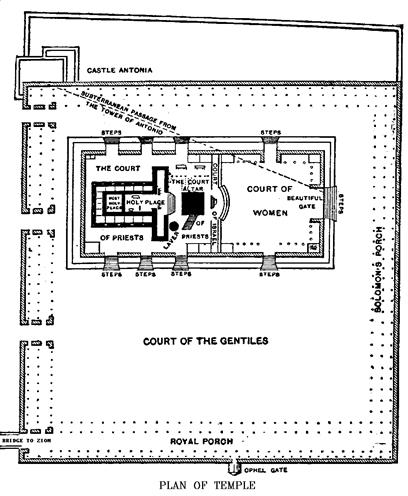
Har HaBayit (Jerusalem) – The eternal contact point to the Torah, of the Jewish soul.
Jerusalem represents the center of the center, the focal point of Eretz Israel: “All roads lead to Jerusalem”.
Anatomically, Jerusalem represents the heart.
The heart is in the center of the body that is between the belt and the shoulders. It is centered left to right, top to bottom, and front to back in the area normally covered by the shirt or blouse.
The heart has two basics pumps. One pumps blood through the lungs, and one pumps to the rest of the body. This pictures the ‘pumping’ of life from the Jerusalem above (to the lungs) and the circulating of that life to the Jerusalem below.
 Torah
is also the heart of the world
and the quintessential depiction of the Torah is the Luchot which are depicted
as a heart.
Torah
is also the heart of the world
and the quintessential depiction of the Torah is the Luchot which are depicted
as a heart.
The word “Jerusalem” is a combination of two Hebrew words: Yireh and Salem. Yireh is what Avraham called this place when he was binding Isaac. Salem is what Melchizedek called this place when he met Avraham after the first major war:
Bereshit (Genesis) 22:14 And Abraham called the name of that place HaShem-Yireh: as it is said [to] this day, in the mount of HaShem it shall be seen.
Bereshit (Genesis) 14:18-20 And Melchizedek king of Salem brought forth bread and wine: and he [was] the priest of the most high G-d. And he blessed him, and said, Blessed [be] Abram of the most high G-d, possessor of heaven and earth: And blessed be the most high G-d, which hath delivered thine enemies into thy hand. And he gave him tithes of all.
This first use of the “Jerusalem” then suggests that Jerusalem is our contact with HaShem and His Word. Jerusalem is thus the eternal contact point of the Jewish soul with the Torah.
The prophet confirmed this understanding:
Micah 4:2 And many nations shall come, and say, Come, and let us go up to the mountain of HaShem, and to the house of the G-d of Yaaqov; and he will teach us of his ways, and we will walk in his paths: for the law shall go forth of Zion, and the word of HaShem from Jerusalem.
King David faced a modern decision: Where to put Israel’s capital?
He had ruled the tribe of Judah for seven years, from Hebron, when finally the ten northern tribes came down and anointed David king over all Israel. With sacred oil yet clinging inside his beard, King David led the people straight from Hebron to Jerusalem. Why leave the tomb of Avraham for the fortress of the Jebusites? David had geographical reasons for singing, “Beautiful for situation, the joy of the whole earth, is mount Zion.” First, Jerusalem unites Israel. Second, Jerusalem controls the Judean Plateau. Third, Jerusalem depends on the Judean Plateau for support.
While Hebron could unite only Judah, Jerusalem could unite all the tribes. Notice that Jerusalem sits smack on the Israeli Mason-Dixon Line: With Judah to her south and the Ten Northern Tribes to her north, she commands a neutral center. So all Israel went up with King David to Jerusalem, a city none of them owned.
King David invited everyone along to watch, but who attacked? Only the king’s men. The king did the job with his own crew. David set up a royal city no tribe had owned, no tribe had conquered, and where every tribe was the king’s guest:
2 Shmuel (Samuel) 5:6-10 And the king and his men went to Jerusalem unto the Jebusites, the inhabitants of the land: which spake unto David, saying, Except thou take away the blind and the lame, thou shalt not come in hither: thinking, David cannot come in hither. 7 Nevertheless David took the strong hold of Zion: the same is the city of David. 8 And David said on that day, Whosoever getteth up to the gutter, and smiteth the Jebusites, and the lame and the blind, that are hated of David’s soul, he shall be chief and captain. Wherefore they said, The blind and the lame shall not come into the house. 9 So David dwelt in the fort, and called it the city of David. And David built round about from Millo and inward. 10 And David went on, and grew great, and HaShem G-d of hosts was with him.
Years later, King David brought a plague on Israel by counting his soldiers. The plague was halted with a sacrifice on the threshing floor that would become the Temple. The Temple mount was purchased by David HaMelech, for fifty shekels, to stay the judgment of his census.
II Shmuel (Samuel) 24:18-24 And Gad came that day to David, and said unto him, Go up, rear an altar unto HaShem in the threshing floor of Araunah the Jebusite. And David, according to the saying of Gad, went up as HaShem commanded. And Araunah looked, and saw the king and his servants coming on toward him: and Araunah went out, and bowed himself before the king on his face upon the ground. And Araunah said, Wherefore is my lord the king come to his servant? And David said, To buy the threshing floor of thee, to build an altar unto HaShem, that the plague may be stayed from the people. And Araunah said unto David, Let my lord the king take and offer up what [seemeth] good unto him: behold, [here be] oxen for burnt sacrifice, and threshing instruments and [other] instruments of the oxen for wood. All these [things] did Araunah, [as] a king, give unto the king. And Araunah said unto the king, HaShem thy G-d accept thee. And the king said unto Araunah, Nay; but I will surely buy [it] of thee at a price: neither will I offer burnt offerings unto HaShem my G-d of that which doth cost me nothing. So David bought the threshing floor and the oxen for fifty shekels of silver.
David’s first act, after purchasing the threshing floor, is to build an altar. This is the site where King Solomon would build the Temple.
In the Oral Torah we also find various names for the Temple. In the Midrash Rabbah the Temple is called a “neck“:
Midrash Rabbah - Genesis XCIII:12 AND HE FELL UPON HIS BROTHER BENJAMIN’S NECKS (XLV, 14). Did Benjamin then have two necks? In fact, said R. Eleazar, he foresaw through the Holy Spirit that two Temples would be built in Benjamin‘s portion, and both would be destroyed. AND BENJAMIN WEPT UPON HIS NECK: he saw that the Tabernacle of Shiloh would be built in Yosef HaTzaddik’s portion and would be destroyed.
Bereshit (Genesis) 45:14 And he fell upon his brother Benjamin‘s necks, and wept; and Benjamin wept upon his neck.
(As a side note, Rambam suggests that the 3 phrases in Bereshit 33:12 refer to HaShem’s relationship to the three Temples.)
The Midrash also explains the Torah when it tells us that the Temple is equated to the neck:
Midrash Rabbah - Genesis XCIII:6 Here that it is on account of a man, the beloved of the eyes, the one who gives hospitality to the Holy One, blessed be He-as it says, Of Benjamin he said: The beloved of the Lord shall dwell in safety by Him; He covereth him all the day, and He dwelleth between his shoulders (Deut. XXXIII, 12) --how much the more so!’
Devarim (Deuteronomy) 33:12 Of Benjamin he said, The beloved of HaShem shall dwell in safety by him; shall cover him all the day long, and he shall dwell between his shoulders.
The Temple was built within the portion of land allocated to Benjamin. The neck, which is between the shoulders, alludes, therefore, to the Temple.
Strategic
One of the major trade routes, the route from Beersheba to Damascus, went through Hebron, Jerusalem, and Shechem, and, crossing the Jordan at Bethshean, followed the river to the Sea of Galilee, thence running northeastward to Damascus. This trade route suggests that the center of Israel was a major connection between trading centers. Thus Jerusalem was strategic for trade.
* * *
The Land and Torah of Israel are both called by the Torah marasha[53] a word which literally means “heritage“ but which the Sages of the Talmud link to “me’orasa” (eros, love), or “fiancée”. A successful marriage, a proper conquest of and living in the Land of Israel, knowledge and performance of Torah, are each fraught with problems along the way.
III.
The Conquest
When Moses sent scouts to scout the land, they looked at the length and breadth of the land, but they only looked at one city: Hebron (Bamidbar 13:22).
When Joshua sent the two spies to spy out the land, they only went to one city: Jericho.
These two leaders, Moses and Joshua, both intended to conquer the land. Moses intended to conquer the land from the south and he therefore started with Hebron. When the sin of the spies cut short that plan, HaShem changed tactics.
Joshua entered the land from the east and began his conquest with Jericho. This route roughly parallels the route taken by Avraham when he entered the land and by Yaaqov when he returned from Laban. Joshua thus followed a tried and true route that had great significance.
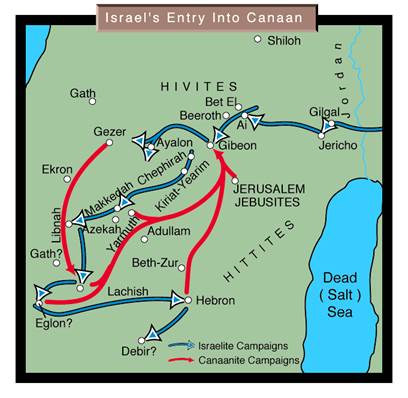
Joshua traveled to Shechem for the blessings and the curses: From Ebal and Gerizim. His campaign then proceeded south.
The significance of this route must not be lost. Avraham‘s route led to a temporary exile in Egypt. Yaaqov‘s route led to a much longer exile in Egypt.
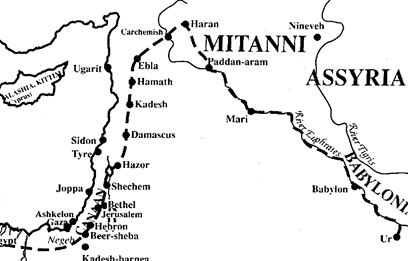
Avraham‘s route
Moses intended to reverse this pattern in order to eliminate the exile. Because of the sin of the spies, this pattern was abandoned and the road to exile was paved again. We know that the conquest of the land led to the Assyrian and Babylonian exiles. After that exile we restored to the land only to be sent into the longest exile, the exile we are currently experiencing.
IV.
Contact Points
Each of these three locations is a contact point of Jewish value for Jewish souls.
The entire war, with the PLO, is based on who’s in charge of the holy sites. The Arabs sense that their life-force comes from the Jews’ holy sites. That’s why their battles have always been focused on the graves of our righteous ancestors, because these places nourish their life-force. It’s no wonder that they hold fast to Kever Yosef, Kever Rachel Imeinu, Ma’arat HaMachpelah, and most importantly, Har HaBayit.
These three locations have become the MOST problematic area of Eretz Israel. Somehow the goyim know that their survival in the land depends on holding these three places. The Arabs have built a pagan mosque on the Temple mount, they have destroyed kever Yosef, and they have taken over Machpelah and now prevent Jews from worshipping there most of the time.
The following communal actions must be taken if we are to survive. We can NOT do these things on an individual basis. There are four / five things that will tear up the sealed decree against us, as we can see from the Gemara:
Rosh HaShana 16b R. Isaac further said: Four things cancel the doom of a man, namely, charity, supplication, change of name and change of conduct. Charity, as it is written, And charity delivereth from death. Supplication, as it is written, then they cried unto the Lord in their trouble, and he delivered them out of their distresses. Change of name, as it is written, As for Sarai thy wife, thou shalt not call her name Sarai, but Sarah shall her name be; and it continues, And I will bless her and moreover I will give thee a son of her. Change of conduct, as it is written, And G-d saw their works, and it continues, and G-d repented of the evil which he said he would do unto them and he did it not. Some say that a change of place [also avails], as it is written, now the Lord said unto Abram, Get thee out of thy country, and it proceeds, and I will make of thee a great nation. And the other [why does he not reckon this]? — In that case it was the merit of the land of Israel, which availed him.
1. Tzedaka (charity)
Mishlei (Proverbs) 10:2 Treasures of wickedness profit nothing: but righteousness delivereth from death.
Tehillim (Psalm) 107:19 Then they cry unto HaShem in their trouble, [and] he saveth them out of their distresses.
3. Changing your name – Now she can have a son:
Bereshit (Genesis) 17:15 And G-d said unto Abraham, As for Sarai thy wife, thou shalt not call her name Sarai, but Sarah [shall] her name [be].
4. Changing your deeds - Teshuva
Yonah 3:10-4:2 And G-d saw their works, that they turned from their evil way; and G-d repented of the evil, that he had said that he would do unto them; and he did [it] not. But it displeased Jonah exceedingly, and he was very angry. And he prayed unto HaShem, and said, I pray thee, O HaShem, [was] not this my saying, when I was yet in my country? Therefore I fled before unto Tarshish: for I knew that thou [art] a gracious G-d, and merciful, slow to anger, and of great kindness, and repentest thee of the evil.
5. Changing your place -
Bereshit (Genesis) 12:1-4 Now HaShem had said unto Abram, Get thee out of thy country, and from thy kindred, and from thy father’s house, unto a land that I will shew thee: And I will make of thee a great nation, and I will bless thee, and make thy name great; and thou shalt be a blessing: And I will bless them that bless thee, and curse him that curseth thee: and in thee shall all families of the earth be blessed. So Abram departed, as HaShem had spoken unto him; and Lot went with him: and Abram [was] seventy and five years old when he departed out of Haran.
There are four cities that characterize our attachment to the land:
|
CITY |
ELEMENT |
ERETZ ISRAEL FIRST |
PERSONIFIED |
|
The fiery torch in the covenant between the parts.
The city of the covenant. Between Ebal and Gerizim. Fire is an idiom for HaShem Himself.[54]
HaShem and Eretz Israel |
Fire – Aish
Fire goes from place to place. |
Yosef HaTsadiq
Ovadia 1:18 And the house of Yaaqov shall be a fire, and the house of Yosef HaTsadiq a flame, and the house of Esau for stubble, and they shall kindle in them, and devour them; and there shall not be [any] remaining of the house of Esau; for HaShem hath spoken [it]. |
|
|
Hebron –
The unity of the Jewish people
Klal Israel |
Dust – Efar
Man comes from dust
|
The first purchased location. |
Ephron |
|
The key to Eretz Israel
|
Air – Ruach
Spirituality
|
The first conquered location. |
The origin of Mashiach. Mashiach judges by smell.
Bereshit 1:2 And the earth was without form, and void; and darkness [was] upon the face of the deep. And the Spirit of G-d moved upon the face of the waters. |
|
Jerusalem – Covenant of Torah
Torah |
Water – Mayim
People go to the water. Water comes from the heights and flows to the depths. |
The first city of David |
Mashiach ben David |
Jericho
Yericho was the first place in Eretz Israel, which was conquered.
According to the Midrash, at the same time as the scouts entered Jericho, representatives of all seven nations, which lived in the land gathered in Jericho. These people are called “the owners of Jericho”[56]. Asking whether all the seven nations were joint owners of the city, the Midrash replies: “Jericho is the key to the land, once it has been captured, the rest of the land can be immediately conquered.”
Midrash Rabbah - Numbers XV:15 R. Samuel b. Nahmani explained: Jericho was the bulwark of the Land of Israel. If Jericho was taken the whole country would instantly be conquered. Consequently the seven nations assembled therein.
The town of Jericho is one of only two to be referred to as Kikkar.[57] Sodom is the other city called Kikkar. This seems to indicate that the reason Jericho was conquered first was to eliminate the problem that Lot had with Eretz Israel. He wanted a place that was lush and had lots of water. In order to purge this tendency, Joshua started with Jericho. This was, as it were, a second destruction of Sodom.
It took the return of a daughter of Lot (Ruth), who was nearly a female version of Avraham to bring the child into the world who would finally complete that task. David, indeed, was the antidote to the problem that Lot introduced, but the cycles of mourning were already planted into our national destiny, such that even that great building which he helped to found would not stand forever.
It remains for the Mashiach ben David to reverse the route and lead us in a conquest from the south. A conquest that will start with Hebron!
May we merit this tikkun speedily in our days!
In the future Redemption, Yericho will also occupy a major place. In Sifrei at the end of Devarim, it is written: And he showed him the Negev and the plain, the valley of Yericho, this teaches that HaShem showed Moshe, Gog and the multitudes that are destined to fall in the valley of Yericho.
V. Brit
Mila
As I was studying about Eretz Israel, the land of Israel, I discovered that there is an intrinsic link between Brit Mila (literally “covenant of the word”), the covenant of circumcision, and HaShem’s gift of Eretz Israel to the Jewish people.
Brit mila is known by our Sages as a “covenant of Fire“. Most men will immediately understand the association of the procreative organ, to fire.
To begin our understanding, lets look at the origin of Brit Mila:
Bereshit (Genesis) 17:3-12 And Abram fell on his face: and G-d talked with him, saying, As for me, behold, my covenant [is] with thee, and thou shalt be a father of many nations. Neither shall thy name any more be called Abram, but thy name shall be Abraham; for a father of many nations have I made thee. And I will make thee exceeding fruitful, and I will make nations of thee, and kings shall come out of thee. And I will establish my covenant between me and thee and thy seed after thee in their generations for an everlasting covenant, to be a G-d unto thee, and to thy seed after thee. And I will give unto thee, and to thy seed after thee, the land wherein thou art a stranger, all the land of Canaan, for an everlasting possession; and I will be their G-d. And G-d said unto Abraham, Thou shalt keep my covenant therefore, thou, and thy seed after thee in their generations. This [is] my covenant, which ye shall keep, between me and you and thy seed after thee; Every man child among you shall be circumcised. And ye shall circumcise the flesh of your foreskin; and it shall be a token of the covenant betwixt me and you. And he that is eight days old shall be circumcised among you, every man child in your generations, he that is born in the house, or bought with money of any stranger, which [is] not of thy seed.
All covenants include the responsibilities and privileges of both parties. This Brit is no exception.
Note that HaShem has indicated that His part of the Brit, the covenant, includes the giving of Eretz Israel to Avraham and his seed:
Bereshit (Genesis) 17:8 And I will give unto thee, and to thy seed after thee, the land wherein thou art a stranger, all the land of Canaan, for an everlasting possession; and I will be their G-d.
So, HaShem was responsible for giving Avraham and his seed, Eretz Israel. What was Avraham‘s responsibility?
Bereshit (Genesis) 17:9-10 And G-d said unto Abraham, Thou shalt keep my covenant therefore, thou, and thy seed after thee in their generations. This [is] my covenant, which ye shall keep, between me and you and thy seed after thee; Every man child among you shall be circumcised.
Avraham and his seed were required to be circumcised. This was Avraham‘s and his seed‘s responsibility according to this Brit. The giving of Eretz Israel and the brit mila are therefore closely linked.
Now that we understand the connection of Brit Mila and Eretz Israel, lets see how this manifests later in the interactions between HaShem and His people.
The next time circumcision is an issue, after Avraham circumcised himself and his household, is after the birth of Isaac:
Bereshit (Genesis) 20:15 – 21:5 And Avimelech said, Behold, my land [is] before thee: dwell where it pleaseth thee. And unto Sarah he said, Behold, I have given thy brother a thousand [pieces] of silver: behold, he [is] to thee a covering of the eyes, unto all that [are] with thee, and with all [other]: thus she was reproved. So Abraham prayed unto G-d: and G-d healed Avimelech, and his wife, and his maidservants; and they bare [children]. For HaShem had fast closed up all the wombs of the house of Avimelech, because of Sarah Abraham‘s wife. And HaShem visited Sarah as he had said, and HaShem did unto Sarah as he had spoken. For Sarah conceived, and bare Abraham a son in his old age, at the set time of which G-d had spoken to him. And Abraham called the name of his son that was born unto him, whom Sarah bare to him, Isaac. And Abraham circumcised his son Isaac being eight days old, as G-d had commanded him. And Abraham was an hundred years old, when his son Isaac was born unto him.
In the above pasuk, we see that the Torah closely associates the permission of Avimelech to allow Avraham to settle in Eretz Israel, with the circumcision of Isaac.
In Bereshit 34, we again see the issue of circumcision and dwelling in Eretz Israel, closely linked. In this pasuk, Shechem rapes Dinah and then the sons of Yaaqov agree to give Dinah in marriage to Shechem, if all the men of Shechem will be circumcised. In turn, Shechem agrees to let Yaaqov and his family settle in Eretz Israel.
Most Jews understand that a man must be circumcised in order to eat the Pesach lamb. It is also well known that all males were circumcised before the Pesach in Egypt:
Shemot (Exodus) 12:48 And when a stranger shall sojourn with thee, and will keep the Passover to HaShem, let all his males be circumcised, and then let him come near and keep it; and he shall be as one that is born in the land: for no uncircumcised person shall eat thereof.
This pasuk also clearly associates Eretz Israel and circumcision.
At this chronological point, something strange happens. The Children of Israel are circumcised in preparation for the Passover, which in turn is the preparation for leaving Egypt and entering Eretz Israel. The Children of Israel will be in the wilderness for forty years, yet no “new borns” will be circumcised in that entire forty-year period. Why?
The answer to this puzzling question can be understood by looking at the next time that the Children of Israel are circumcised:
Yehoshua (Joshua) 5:2-8 At that time HaShem said unto Joshua, Make thee sharp knives, and circumcise again the children of Israel the second time. And Joshua made him sharp knives, and circumcised the children of Israel at the hill of the foreskins. And this [is] the cause why Joshua did circumcise: All the people that came out of Egypt, [that were] males, [even] all the men of war, died in the wilderness by the way, after they came out of Egypt. Now all the people that came out were circumcised: but all the people [that were] born in the wilderness by the way as they came forth out of Egypt, [them] they had not circumcised. For the children of Israel walked forty years in the wilderness, till all the people [that were] men of war, which came out of Egypt, were consumed, because they obeyed not the voice of HaShem: unto whom HaShem sware that he would not shew them the land, which HaShem sware unto their fathers that he would give us, a land that floweth with milk and honey. And their children, [whom] he raised up in their stead, them Joshua circumcised: for they were uncircumcised, because they had not circumcised them by the way. And it came to pass, when they had done circumcising all the people, that they abode in their places in the camp, till they were whole.
Yehoshua and the Children of Israel have just crossed the Jordan river. They have entered Eretz Israel. All those who were born in the wilderness are to be circumcised in preparation for inheriting Eretz Israel. However, the pasuk also tells us that the generation that died in the wilderness, the circumcised ones, were NOT permitted to enter Eretz Israel because they had not obeyed HaShem’s voice. This suggests that those who are circumcised have a chance of entering Eretz Israel, but those who are not circumcised, can NOT enter Eretz Israel. We are explicitly told that the sin of the spies caused the people to sin and not obey the voice of HaShem:
Bamidbar (Numbers) 14:20-24 And HaShem said, I have pardoned according to thy word: But [as] truly [as] I live, all the earth shall be filled with the glory of HaShem. Because all those men which have seen my glory, and my miracles, which I did in Egypt and in the wilderness, and have tempted me now these ten times, and have not hearkened to my voice; Surely they shall not see the land which I sware unto their fathers, neither shall any of them that provoked me see it: But my servant Caleb, because he had another spirit with him, and hath followed me fully, him will I bring into the land whereinto he went; and his seed shall possess it.
So, this still does not explain why those born in the wilderness were not circumcised?
The Sages teach us that the new generation, those who were under twenty years of age at the time of the sin of the spies, was exempt from the mitzva because of their unpredictable travel plan and its dangers[58]. Rashi, in particular, talks about a north wind that HaShem caused to blow during the entire forty years in the wilderness. The dust stirred up by this wind made it hazardous to circumcise.
So why did HaShem cause this north wind? Rashi gives us a concise explanation:
“If your offspring will observe the commandment of circumcision they will enter the Holy Land; if not, they will not enter.” (Rashi on Joshua 5:4).
Because the spies slandered Eretz Israel, HaShem understood that the people did not want Eretz Israel. Because they did not want His part, HaShem did not want the people to be able to fulfill the mitzva of circumcision. Therefore, HaShem sent a north wind to prevent the people from being circumcised.
In the days of Moshe, HaShem made explicit another implication of this Brit Mila that may be missed by some folks. This connection shows that there is an intrinsic implication that circumcision of the heart happen along with the circumcision of the foreskin:
Devarim (Deuteronomy) 10:16 Circumcise therefore the foreskin of your heart, and be no more stiff-necked.
First HaShem commands that Avraham’s seed circumcise their hearts, then HaShem ties that command to Eretz Israel:
Devarim (Deuteronomy) 11:8-9 Therefore shall ye keep all the commandments which I command you this day, that ye may be strong, and go in and possess the land, whither ye go to possess it; And that ye may prolong [your] days in the land, which HaShem sware unto your fathers to give unto them and to their seed, a land that floweth with milk and honey.
Thus we see that Brit Mila (physical circumcision), circumcision of the heart, and Eretz Israel, are all tied intrinsically into the same covenant.
The ideas for this section were originally presented in a shiur by Hakham Yitzchak Ginsburgh.
To begin with, the whole land of Eretz Israel must be annexed and made a whole land. After the ‘67 war, we had the whole land in our hands, yet for some mysterious reason we let it slip away from us. Until we recognize that the WHOLE land is ours, we can never achieve peace in the land. As I heard from one wise man: The “Land for Peace” formula is most excellent! We have found that the more land Israel has, of that which was promised, the more peace we found in the land. This is the exact opposite of the current plan, which takes the land out of Jewish control.
The Jewish leaders in Eretz Israel have explicitly stated that they do not see a solution to the land problems. As we shall see, it is because they have a fundamental bias towards a secular state which is assimilated into the nations. This bias guarantees failure. For this reason, we must replace these secular leaders with leaders that are Torah oriented and understand how the land must be unified.
The plan of action is based on the seven days of creation. This process correspond to the seven processes of the heart which are encapsulated within the Sefirot HaOmer.
The solution to our problems, with Eretz Israel, can be found in the qualities of the sefirot. The following steps must be executed in order in order to properly align the land:
These first five are based on havdalah, on separation
|
Chesed (Kindness) |
This kindness is giving the land to ourselves, to all Jews. |
|
Gevurah (Strength) |
We must do good before we can use our might in action. We must eradicate terrorism. |
|
Tiferet (Beauty) |
Torah law must replace civil law. As long as the law is not Jewish we can not have a Jewish state. We now have a goyish law and a goyish state. |
|
Netzach (Victory) |
After we have Torah law we can really promote aliya. This will attract even those who are well off. |
|
Hod (Glory) |
Expel evil from the land. Not just terrorists, but anyone who is hostile to Torah. The good goyim can remain, but the bad goyim must leave. |
The havdalah state must NOT be skipped over. Havdalah MUST be first!
These next are based on merging
|
Yesod (Foundation) |
This is the union, the marriage, is peace between the Torah religious and the secular religion, which is science. In short this is the unification of Torah and science. This is related to the coming of Mashiach ben Yosef. |
|
Shechinah (Presence) |
Shabbat and Mashiach ben David. This is when all the Jewish people are related and the Beit HaMikdash is restored. |
The Supreme Court and the University professors of Israel are not Yiddish, they are anti-Semitic. The civil law should be based on Torah law. This would make Israel a Jewish state. The ruling body must become Torah based.
The road that needs to be followed is the road of Teshuva. We must return to HaShem. However, the primary use of shuva, to return, is to return to Eretz Israel, to return to the land.
The removal of “the kingdom of violence” must precede the establishment of G-d’s kingdom.
It then becomes significant that Yosef HaTsadiq is also buried in a border city, the city of Shechem, which forms the boundary between Ephraim and Manasseh. Border cities leave us with the idea of connecting something. Rachel’s tomb connects Judah and Benjamin; and Yosef HaTzaddik’s tomb connects Ephraim and Manasseh. Even so, ALL of Israel is made to pass between the Mount of cursing and blessing in the valley below at Shechem, immediately before the bones of Yosef HaTsadiq, which are buried there! It is as though HaShem also connected these two events for some reason.
* * *
Based on the Imrei Shaul, Parshat Shlach:
“V’hischazaktem U’lekachtem Mipri Haaretz... Be courageous, and take from the Fruit of the Land”...[59]
The Imrei Shaul, who was known for his intense love for Eretz Israel, is intrigued by the phraseology of this pasuk. Its almost as if he is asking: What kind of courage is needed to take the fruit? Surely, this word “V’hischazaktem” must refer to something other than courage.
The Imrei Shaul finds some direction in the Targum / translation of Yonatan Ben Uziel. V’hischazaktem - rather than relating it to courage or strength, he translates it to mean - “make a kinyan chazakah on the Land. (Note: Chazakah is one of three halachic methods of acquiring land by demonstrating possession of it. Examples are: locking it up, putting up or taking down a fence, and walking around the property.)
But now we ask - why?
As mentioned, there are three methods to acquire land: by monetary payment, by deed, and by the chazakah process mentioned above. To make Eretz Israel inalienably become the property of Klal Israel, it would be most appropriate that all three of these methods be accomplished, and that is exactly what the Imrei Shaul shows us.
Our Forefathers carried out the financial acquisition. Avraham Avinu purchased with money, when he bought Ma’arat HaMachpelah (the Cave of Machpelah) to be the gravesite for his wife, Sarah Imeinu. Yaakov Avinu bought the city and area of Shechem.
As a national entity, we carried out the documentary acquisition, with the Torah being the deed that gives us ownership. The Imrei Shaul points out that from here, we see that Eretz Israel is designated specifically for learning Torah.
However, the chazakah process was still lacking, and this was the unique mission that the Meraglim (Spies) could have carried out. Moshe Rabbenu commands them to go out, and according to the Targum Yonatan Ben Uziel, to make a kinyan chazakah to culminate the process.
The Imrei Shaul then shares with us an astounding Gematria, the sum of the introductory words of the Parsha “Sh’lach Lecho Anoshim” is exactly the same as the three words “kesef, shtar, chazakah”, 789. This is the real reason that Moshe Rabbenu sent the Meraglim (Spies) into Eretz Israel, to finish this three-tiered acquisition process.[60]
Kol
HaTor
Rabbi Hillel Shklover
The general mission of Mashiach ben Yosef is three-fold: revelation of the mysteries in the Torah, ingathering of the exiles, and removal of the unclean spirit from the land. The ingathering of exiles encompasses three tasks: building Jerusalem, gathering in the exiles, and fulfilling the commandments dependent on the Land. All these are hinted at in the following sentences: [Ps. 24:3] “who will ascend the mountain of the Lord, “ referring to the ingathering of exiles [initial letters — hcn-- are initials of Mashiach ben Yosef]. [Ps. 24:3] “who will stand up in the place of his sanctuary” referring to the building [initial letters, are initials of Mashiach ben Yosef]. Wherever the word “to stand up” is mentioned, it refers to the line of Mashiach ben Yosef, as in the phrase [Gen. 37:7] “my sheaf rose” [Ps. 24:5] “he will receive a blessing from the Lord” refers to something that carries with it a blessing, such as planting [the initial letters are the initials of Mashiach ben Yosef, though in reverse order — hcn. And in the sentences [Jer 31:20] “return to your cities, “ “build Jerusalem, “ [Ps. 102:14] “it is the time to favor her.” ‘To favor’ refers to planting as it states, “he will favor its dirt.” Each one of them accords with the gematria of “testimony in Yosef“ that refers to Mashiach ben Yosef. Also, these three tasks were given to Cyrus as it states: “I am the Lord Who confirms the word of His servant, and fulfills the counsel of his messengers; Who says of Jerusalem: ‘It will be settled’... Who says to the depths, ‘Dry up, and I will dry out your rivers’. Who says of Cyrus, ‘my shepherd’; he will fulfill all my desire, “ etc. [Isa. 44:24-28]. According to the explanation of the Gaon, the word, in Gematria, equals 131 because the purpose of building Eretz Israel is to drive out from the gates of Jerusalem. And therefore this is the mission of Cyrus as part of the mission of Mashiach ben Yosef from the left side, which means the quality of Din. The might of Mashiach ben Yosef lies in the miraculous assistance he can offer in connection with the ingathering of exiles that will come about when the awakening comes from below.
A Jewish National Strategy
By Prof. Paul Eidelberg
Israel is on the verge of a revolution, inevitable as the rising sun. Within three years Israel will either become an authentic Jewish State or a blood-drenched Lebanon. Whether it becomes one or the other will depend very much on the ascendancy of a few clear-minded and dauntless Jews. These Jews will possess the courage to see that merely reacting to Israel’s incessant crises accomplishes very little. Instead, they will be guided by a clearly articulated Jewish agenda. Going beyond the vague idea of Jewish leadership and the equally vague goal of a Jewish State, they will publicize and pursue the axiomatic requirements of a Jewish national strategy.
Before discussing these requirements, consider the results of a recent study. During the last six years, more than 200,000 Israelis have become observant. Another 130,000, formerly secularists, now identify themselves as “traditionalists.” From this and other demographic data one may reasonably conclude that Israel can at last become an authentic Jewish State. But Israel cannot possibly become an authentic Jewish State so long as its advocates and their financial supporters fail to address the demonstrable fact that the principle of one adult / one vote operative in Israel makes an authentic Jewish State impossible. Even now that culturally neutral principle can give Israel’s burgeoning Arab citizens twenty seats in the next Knesset. Indeed, in two or three decades, that dogmatic principle of democracy will transform Israel into an Arab-Islamic dictatorship. Long before that, however, Israel will succumb to a Lebanese-type civil war.
It requires no great wisdom to enumerate the axiomatic requirements of a Jewish national strategy. Only needed is candor and courage, without which no Jewish leadership movement is worthy of moral and financial support. The axiomatic requirements of a Jewish national strategy are simply these:
1. Public affirmation that Israel is the State of the Jews.
2. Public affirmation that a Jewish State must be based on Jewish principles and values.
3. Public affirmation that the primary source of Jewish principles and values is the Torah.
4. Public affirmation that only Jews, whether religious or not, can formulate a Jewish national strategy.
5. Public affirmation that the previous axiomatic requirements preclude complete equality of Jewish and non-Jewish residents of Israel. (As the late Prime Minister Yitzhak Rabin explained on May 6, 1976: “There is room [in Israel] for a non-Jewish minority on condition that it accept the destiny of the State vis-à-vis the Jewish people, culture, tradition, and belief. The minority is entitled to equal rights as individuals with respect to their distinct religion and culture, but not more than that.”)
6. Public affirmation that Israel’s system of government, its laws and institutions, must be consistent with the foregoing axiomatic requirements.
Authentic Jewish leaders and their financial supporters must acknowledge these axioms, meaning these self-evident truths. Having done so, they must then go on to expose those basic flaws in Israel’s system of government which makes an authentic Jewish State impossible. These flaws -- they are largely responsible for Israel’s disasters and humiliations, should be publicized throughout the country:
1. The dictatorial concentration of power in the Executive Branch. An Israeli prime minister can (a) make agreements with foreign states and even criminal organizations without serious Knesset or public debate; (b) dispose of the land and holy places of the Jewish People; (c) release Arab terrorists who have murdered Jewish men, women, and children; (d) ignore the convictions of those who elected him to office.
2. The impotence of the Legislative Branch. Lacking constituency elections, Knesset Members are subservient to party leaders, hence incapable of exercising independent judgment vis-à-vis government policies. Conversely, citizens lack power to influence government policies via their own elected representatives.
3. An unrestrained Judicial Branch. The absence of a Knesset accountable to the people augments the power and “judicial activism” of the Supreme Court, many of whose decisions violate fundamental Jewish principles and values.
4. A grotesque Electoral System. Proportional representation with a low threshold multiplies parties, fragments the Government and renders the latter incapable of developing coherent and comprehensive national policies.
5. The lack of a clear and concise and coherent body of fundamental laws -- say a basic document with which to educate youth and thereby promote civic virtue and national unity. These flaws point to only one remedy: a Constitution. Furthermore, anyone who thinks Israel can be or become a Jewish State without a Jewish Constitution, meaning a Constitution that institutionalizes the primacy of Judaism, is suffering from ignorance or intimidated by the bogeyman of “racism.” And if he is a philanthropist supporting Israeli “causes,” he is probably squandering, or not putting to best use, a great deal of his money.
Fear of the racist canard dominates Israel’s political and intellectual leaders and their financial backers in the Diaspora. Even among Jews who want a Jewish State, most are afraid to draw the logical consequences of such a state, namely, that its laws and policies must be determined exclusively by Jews as prescribed in a Constitution. I have written lengthy moral and philosophical justifications of such a Constitution and have elaborated on its necessity and practicality. Although more and more Jews in Israel and in the United States are rallying to the idea of a Constitution, the time is short and the need is great.
Summing up: Authentic Jewish leadership is impossible given the flaws in Israel’s political institutions, which flaws can only be remedied by a Jewish Constitution. A fragmented Cabinet will undermine any decent prime minister and make it impossible for him to pursue a Jewish national strategy. He will be undermined by a faction-ridden Knesset whose Arab members will hold the balance of power on many issues affecting foreign and domestic affairs.
The Jews of Israel have only two alternatives: preserve the existing political system, which can only lead to disaster, or promote a Constitutional Party that advocates a Jewish Constitution. Without such a Constitution there can be no authentic Jewish State. Hence the present writer will make himself available to any Jewish organization or philanthropist that has the vision and courage to support such a Constitution.
* * *
TO MERIT ISRAEL IS TO MARRY THE LAND
[copyright (c) 2003] by Rabbi Dr. Natan T. Lopes Cardozo [nlc@internet-zahav.net]
LIBERATED YERUSHALIYIM, D.C. (David’s Capital), Yom Revi’i (Fourth Day -- “Wednesday”), 18 Sivan, 5763 (Gregorian Date: June 18, 2003) (Hijri Date: 17 Rabi Thani, 1424), Root & Branch [mailto:rb@rb.org.il] [www.rb.org.il]: Marriage and the merit of living in the Land of Israel have much in common. After the death of Sara, Avraham buys a part of the land of Israel, which includes the cave of Machpelah for the purpose of burying Sarah.
Speaking to the owner (Efron), Avraham says:
“I will give you the price of the field, kach mimeni (take it from me) and I will bury my dead therein”.[61]
Efron takes the money. Avraham becomes the official owner of this field and, hence, the legal owner of a part of the Land of Israel.
The Babylonian Talmud[62] connects this incident with the institution of marriage. Devarim (Deuteronomy) 22:13 states: “When a man yikach takes a woman to be his wife...” Due to the fact that the same phrase, kach (take), is used as in the case where Avraham buys the cave of Machpelah, the Talmudic sages draw the conclusion that in the same way one buys the land of Israel, so one should marry one‘s wife, i.e. with money or with an object of value such as a ring.
This is an application of an interpretative rule called a gezerah shava which states that when two words are identical, even when they are stated in completely different contexts, both passages are subject to the same laws.
This Talmudic ruling has drawn much criticism. How can one compare both cases? Is marrying one‘s wife similar to buying a piece of land? This seems to be offensive and in complete opposition to what Jewish marriage is all about.
Nowhere does Jewish law allow a man to deal with his wife as if she is his possession. If he does, the woman is allowed to demand an immediate divorce. It is Jewish law itself which objects to any such comparison. So why make it?
Many excellent explanations have been given. Without denying their importance and truth, we would like to suggest a different approach.
It may quite well be that the sages wanted to emphasize the holiness of the Land of Israel by comparing it to a marriage.
One does not buy a piece of the Land of Israel as one buys a piece of land anywhere else in the world. In the case of the Holy Land, one marries the land! The land becomes a loving partner. One‘s love for this land is of a completely different nature from buying a piece of land or living anywhere else!
Jews treat the Land of Israel like a living personality with whom one has deep and emotional affiliation. We do not relate to the Land of Israel as a possession to use. We relate to the Land of Israel as a living personality with a neshama (soul).
Our love for the Land of Israel is not like the love for a country of which the average native speaks. Like a marriage, it is a Covenant. A covenant is built on the basis of duties, not rights. It is a pledge which one does not betray.
Just as at the time of the marriage ceremony a man gives a woman an object of value as a symbolic expression of his willingness to make sacrifices for her sake, so one “pays” for the Land of Israel by making a financial offering.
Just as in human matrimony where one marries for higher and noble goals, so one betroths the Land of Israel to achieve kedusha (holiness), to transform oneself into a more dignified person and to make the world into a better place. The many laws related to the Land of Israel show that one must care for the Land as one cares for one‘s wife.
The Jewish relationship to the Land of Israel is a love story. That is the reason why Jews were not able to divorce ourselves from this land even when we found themselves for thousands of years in exile. One does not abandon one‘s wife!
For other nations this may be difficult to fathom, for the Jew it is the air he breathes.
It was Rabbi Moshe Avigdor Amiel (1883-1946), Chief Rabbi of Tel Aviv, who gave this thought still another important dimension in Drashot El Ami (Commentaries to My People). Just as the giving of a valued object at the time of the marriage ceremony to one‘s wife is only the first payment, so is the buying of the land only a first payment.
No one should ever believe that the Land of Israel is an intrinsic inheritance because the Jewish people once bought it piecemeal. One needs to merit it every moment. Just as no marriage will endure unless one continues to toil for its success all the time, so the Land of Israel demands one‘s constant spiritual labor to merit living in it.
Anything else will lead to a divorce.
Shavua Tov (Have A Good Week) from Liberated Yerushalayim,
Rabbi Dr. Nathan T. Lopes Cardozo
* * *
The lesson learned from our mistakes is that one cannot rend that which is inherently bound. One cannot separate the Land from the Torah. Without eretz Israel there is no Torah, and without the Torah there is no eretz Israel. All attempts to separate the two can only end in failure. The nation, armed with the wisdom of such experiences, clings to its Torah and continues on its way. In the first case, that of the metei midbar,[63] the nation continued on its way in the direction of the promised land; in the second case, after Betar, wandering stick in hand, into the exile. And the mistake, once it takes the form of a lesson to be learned from, is no longer frightening; the mourning itself contains something encouraging. Yes, Israel knows no day so glorious as Tu B'Av.
Berachoth 5a It has been taught: R. Simeon b. Yohai says: The Holy One, blessed be He, gave Israel three precious gifts, and all of them were given only through sufferings. These are: The Torah, the Land of Israel and the world to come. Whence do we know this of the Torah? Because it is said: Happy is the man whom Thou chastenest, O Lord, and teachest him out of Thy law. Whence of the Land of Israel? Because it is written: As a man chasteneth his son, so the Lord thy G-d chasteneth thee, and after that it is written: For the Lord thy G-d bringeth thee into a good land. Whence of the world to come? Because it is written: For the commandment is a lamp, and the teaching is light, and reproofs of sufferings are the way of life.
* * *
“The I.D.F. should utterly destroy the enemy!” the text reads. “This is what David Melech Israel said and fulfilled: ‘I will chase after my enemy and reach them and not return until they are destroyed.’” Rabbi Ginsburgh continues, “We should know that the Arab’s war against us is a religious war. The only way to be victorious is to strengthen our religion, das Moshe v’Yisrael – the true religion! Truth will prevail!”
Rabbi Yitzchak Ginsburgh
L’shana Haba’a b’Yerushalayim!
* * *
IN THE DESERT
=============
DAN
|
EFRAIM - [MISHKAN] - YEHUDA
|
REUVEN
IN ERETZ ISRAEL
================
EFRAIM
|
DAN - [BINYAMIN] - REUVEN
|
YEHUDA
* * *
The Midrash tells us that the three most sacred places for Judaism in Israel are Machpelah in Hebron (that was bought by Avraham), “Kever Yosef“ in Shechem (that was bought by Yaaqov) and the “Temple Mount” area (which was bought by King David - from the Jebusites). Today these sacred places are in the middle of the battle between the Jews and the Palestinians who both believe that they should own them.
Let us be found worthy of the land. Let us not be vomited out!
* * *
This study was written by
Rabbi Dr. Hillel ben David
(Greg Killian).
Comments may be submitted to:
Rabbi Dr. Greg Killian
12210 Luckey Summit
San Antonio, TX 78252
Internet address: gkilli@aol.com
Web page: https://www.betemunah.org/
(360) 918-2905
Return to The WATCHMAN home page
Send comments to Greg Killian at his email address: gkilli@aol.com
[1] Most of this study I
learned from Rabbi Yitzchak Ginsburgh.
[2] Shemot 12:1
[3] Tehillim 111:6
[5] Tanach (Hebrew: תנ׳ך) (also Tanach, IPA: [ta’nax] or [tə’nax], Tenakh or
Tenak) is an acronym that identifies the Hebrew Bible. The acronym is formed
from the initial Hebrew letters of the Tanach’s three traditional subdivisions:
Torah (תורה), meaning “teaching” or “law,” includes the Five Books
of Moses. The Torah is also known by its Greek name, “the Pentateuch”, which
similarly means “five scrolls”.
Neviim (נביאים), meaning “Prophets”. The Neviim
are often divided into the Earlier Prophets, which are generally historical,
and the Later Prophets, which contain more exhortational prophecies.
Ketuvim (כתובים), meaning “Writings”, are sometimes
also known by the Greek title “Hagiographa.” These encompass all the remaining
books, and include the Five Scrolls.
[6] Bereshit (Genesis) 15:18.
[7] Bereshit 36:6
[8] Bereshit 36:43
[9] Bereshit 37:1
[10] Bereshit 14
[11] By the way, this suggests,
as our Sages teach, that our thoughts when we make love will be foundational to the child we are
creating.
[12] Logic of the Mind, Logic
of the Heart
[13] Rabbi Yitzchak Ginsburgh
[14] Anatomically, the midbrain
(Shechem), the heart (Jerusalem), and the womb (Hebron) are all in the center
(from left to right and from front to back. They are also dead center of their
respective areas.
[15] Seen anatomically, the brain,
heart, and womb are the warm areas of the body which always stay warm.
[16] If we look anatomically,
Shechem is the midbrain between the two hemispheres, Jerusalem is the heart
which is between two lungs, and Hebron is the womb between two ovaries.
[17] Yirmeyahu chapter 36
[18] Bereshit (Genesis) 33:19
[19] Egypt
[20] Bereshit (Genesis)
33:18
[21] “Ant.”
iv. 8, § 48
[22] Bereshit
37:12 et seq.
[23] Shoftim
21:19
[24] This paragraph was excerpted
from The Jewish Encyclopedia.
[25] The sheaves of corn [a
symbol of the mind] that bowed to the sheaf of Joseph. – Bereshit
(Genesis) 37:7
[26] Devarim (Deuteronomy) 33:16
[27] King Solomon
[28] Sefer HaMaamarim Meluket
vol. 3, pp. 58-60. Maamarie Admur HaEmtza’I, Devarim vol. 1, p. 9-10
[29] see Rashi on Bereshit 48:22
[30] See the Pri Tzadik,
Parashat VaYishlach,
9
[32] “The Lamentation in Jerusalem”,
The Articles of HaRav Kook
[33] This promise of ‘seed’ is
fitting for Machpelah which is the womb of Israel.
[34] The Patriarch - Jacob
[35] Bereshit 33:18
[36] Bereshit 34
[37] Gen 37:12-14
[38] Gen 37:15-17
[39] Quoted in Shai Latorah
[40] Rashi
[41] Rashi
[42] Rashi, Bereshit 37:33
[43] Known simply as “Rebbi”
[45] Yehoshua chapter 8
[46] Sotah 36
[47] Succah 52a
[49] Sotah 34b
[50] Hakham Ovadia Yosef shlita
[51] ‘Er. 53a; Sotah 13a; comp.
Gen. R. lviii. 4
[52] Yitzchak Ginsburg
[53] Shemot (Exodus) 6:8,
Devarim (Deuteronomy) 33:4)
[54] Devarim 4:24
[55] Yochanan 4:24
[56] Yehoshua 24:11
[57] plain - see Devarim 34:3
[58] Yevamot 73a
[59] Bamidbar 13:20
[60] Translated by Reb Eliezer
Weger of Rechovot, a Modzitzer Chasid.
[61] Bereshit/Genesis 23:13
[62] Tractate Kiddushin 2a
[63] "Dead of the
Desert"