
By Rabbi Dr. Hillel ben David (Greg Killian)

In this study I would like to examine the festival of Chanukah.[1] This is a most interesting festival because the primary mitzva is Hoda’ah – thanksgiving.[2]
It is important to understand that Chanukah took place 200 years after the Men of the Great Assembly had excised idolatry, and therefore prophecy, from the world. Men no longer perceived HaShem as they once had. They no longer felt His presence. Worship came only with difficulty. We needed to have blessings for the first time, because we no longer perceived that HaShem’s word created food, smells, or guided our actions. For the first time, everyone who once heard prophecy, or felt the presence of HaShem, were all dead. No one alive remembered or knew anyone who remembered prophecy and the overwhelming attraction of idolatry. The world had changed. HaShem had hidden His face and the world had gone dark.
When the events of Chanukah occurred, everyone wanted to know if they were doing what HaShem wanted them to do. The world was so dark that we wondered if we succeeded because of our own power or because of HaShem’s helping hand. These were VERY dark days. These were the darkest days that the world had ever seen. They were dark because we could no longer perceive the presence of HaShem.
On top of this, the events of Chanukah took place at the deepest part of winter where the days were very short and the nights were very long. This amplified the general darkness we felt because of HaShem’s hiding. We felt totally alone and abandoned.
Now, let’s learn about Chanukah with this background. Let’s start by understanding what our Sages have written concerning this special festival.
Shabbat 21b “What is Chanukah? Our Rabbis taught: On the twenty-fifth of Kislev begin the eight days of Chanukah; we may not eulogize on these days nor may we fast on them. When the Greeks entered the Temple, they defiled all the oil in the Temple. And when the royal house of the Chashmonaim prevailed and were victorious over them, they searched and found only one vial of oil which still had the stamp of the Kohen Gadol (High Priest) intact, and it contained enough to light for only one day. A miracle occurred and they used this oil to light for eight days. The next year, they fixed this date and made it a festival, celebrated with praise and thanks.”
The above highlighted Hebrew phrase is used only one other time in the whole Talmud. It is used in:
Avodah Zarah 8a In the following year he appointed both as festivals. Now, he fixed them for the sake of Heaven, but the [heathens] appointed them for the sake of idolatry.
The miracle of the oil was completely hidden from most of Israel. Only a few priests even noticed it. After all, the menorah’s lights were supposed to be burning when you entered, during the day, to do your work. It would take a very perceptive person to notice that the oil was not being consumed because it takes place so slowly. The one most likely to notice would be the priest in charge of cleaning the menorah and re-lighting the lamps.
The same difficulty of perception was found at the burning bush. Moshe ‘noticed’ that the bush was not consumed. This took extraordinary perception. It is not something that most would even notice.
Chanukah, the Festival of Light, is among the most widely celebrated of the Jewish holidays. It is a time for happy family gatherings around the menorah, for children’s songs and sizzling potato latkes and games of “dreidel”. For many of us, it brings back fond memories of childhood, or serves to renew our sense of Jewish identity.
Chanukah celebrates the victory of the Maccabee family (a family of Kohanim who served in the Beit HaMikdash) against the Syrian Greeks. It was a physical as well as spiritual war fought against a perverse culture which had four main targets in mind. The first target was the Beit HaMikdash -- to change it from the House of HaShem into a Greek temple, complete with total idolatry and the worst kind of immorality. The three other targets were:
One may ask: do the last three have any connection with the Beit HaMikdash itself? The answer is: definitely yes! Let us start with Shabbat. The verse “My Shabbatot (Sabbaths) you shall observe and My Sanctuary you shall revere” which appears twice in the Torah[3] shows the very strong connection between the Mikdash and Shabbat. As far as the covenant of circumcision is concerned, only a Kohen who was ritually circumcised could perform the various sacrifices and other services of the Mikdash. Someone who was not a Kohen would only be allowed to eat of such sacrifices if he was circumcised:
Shemot (Exodus) 12:43-48 And the HaShem said unto Moses and Aaron, This [is] the ordinance of the Passover: There shall no stranger eat thereof: But every man’s servant that is bought for money, when thou hast circumcised him, then shall he eat thereof. A foreigner and an hired servant shall not eat thereof. In one house shall it be eaten; thou shalt not carry forth ought of the flesh abroad out of the house; neither shall ye break a bone thereof. All the congregation of Israel shall keep it. And when a stranger shall sojourn with thee, and will keep the Passover to the HaShem, let all his males be circumcised, and then let him come near and keep it; and he shall be as one that is born in the land: for no uncircumcised person shall eat thereof.
Concerning the proclaiming of the new moon, it was done by the Sanhedrin of 71 sages who sat in a special chamber, the chamber of hewn stone, half in and half out of the Beit HaMikdash, the Temple. The proclaiming of the new moon was necessary for knowing when each of the three pilgrim festivals would take place, on which all the males of Israel were required to go to Jerusalem and stand inside the Temple. Thus we see that the purpose of the Greek attack on these four major targets was in order to completely remove from the nation of Israel, both mentally and in practice, the concept of holiness, since the root of Mikdash is the word Kodesh, which means holiness.
Now consider that observing these mitzvot was predicated on the fact that you were not an atheist and that you ‘knew’ that HaShem exists. At this time in history there were many atheists, for the first time in the history of the world. Since HaShem was hiding His face, the perception that HaShem was running the world was the same kind of perception that one would need to notice the miracle of the oil. This was NOT an easy task!
Our Sages teach that the Jewish People will experience four exiles. The second verse of creation says, “And the land was desolate and void and darkness was on the face of the deep.” The Midrash says these four expressions, desolate, void, darkness and deep, correspond to the four kingdoms which exiled Israel. “And the Land was formless (Babylon) and void (Persia/Media) and darkness (Greece) on the face of the deep (Rome).” The Chanukah lights defeat the darkness of the Grecian exile.
The opening verse of Bamidbar (Numbers) 33 (see also the study titled: STAGES) alludes to all of the major exiles that Bne Israel were destined to undergo in their history: The initial letters of “Eleh Masei Bne Israel” / “These are the journeys of Bne Israel” allude to the four exiles of the Jewish people: alef-Edom (Rome - our current exile); mem-Madai (Persia); beit-Bavel (Babylon); and yod-Yavan (Greece).
Four Chanukahs
The festival that we call Chanukah is really the fourth Chanukah. The word Chanukah means dedication.
The first of the three previous dedications was in the desert when Moshe dedicated the Mishkan, the Tent of Meeting. The components of the Mishkan were really completed by the 25th of Kislev, which is Chanukah. However the Mishkan was not to be set up until the month of Nisan. Since the month of Nisan was the month that Yitzchak Avinu was born. For he was the greatest role model in history of someone willing to sacrifice himself to HaShem. The Bet HaMikdash, which was a place of sacrifice from abroad, needed to be put up in his month. To show that ultimately a human being should sacrifice his whole life to HaShem, not just the sacrifice of animals and birds. In honor of the almost human sacrifice, his month was the perfect time to set up the Bet HaMikdash.
The second Chanukah was the dedication of the First Beit HaMikdash.
The third Chanukah is the subject of the Haftorah for the first Shabbat during Chanukah, Zechariah 2:14 - 4:7. It refers to the times of the Second Beit HaMikdash and the inauguration of the Menorah at the time of Yehoshua the Kohen Gadol, the High Priest, and the nation‘s leader, Zerubavel, who is referred to in “Maoz Tzur,” the traditional Chanukah song. (we will look at this song later in this study.)
Chanukah celebrates two miracles: The victory of the Jews over their Syrian-Greek persecutors and the ability of one small flask of oil to remain lit in the Menorah in the Temple for eight days.
Chanukah is the only feast, which runs for over a week; the only other feast, which comes close, is Succoth, the Feast of Tabernacles. In fact, the celebration of Chanukah was a belated celebration of Succoth, the Feast of Tabernacles, which the Maccabees had missed due to their fight with the Syrians. It is also the only feast to span two different months. It seems to need to draw influence from two zodiac signs to make itself happen. These anomalies serve to highlight a basic distinction between Chanukah and all other holidays. On Pesach, the Feast of Passover, we are not celebrating miracles, even as we relate them; the holiday commemorates freedom. Shavuot, the Feast of Weeks, commemorates the giving of the Torah, Yom Teruah, the Feast of Trumpets, is the Day of Judgment and HaShem‘s kingship, Yom Kippur, the Day of Atonement, and Succoth celebrates the presence of HaShem and His providence. The miracles associated with those events served as means to achieve a goal, but the holiday celebrates the goal itself, the spiritual state, which is a permanent and necessary component of the existence of HaShem’s people. The Torah defines for us the crucial stages of HaShem‘s people: you must experience freedom, you must experience Torah, you must experience majesty, judgment and repentance, and you must experience HaShem‘s presence.
Chanukah, as the Sages define it, celebrates the event of the miracle itself, the bare fact that a small cruse of oil kept burning. As various commentators have pointed out, the net result of this miracle was not particularly significant, the menorah could have been lit with impure oil if no pure oil were available, and, in any event, after eight days, the menorah would have been lit, one way or another. In other words, this holiday celebrates the process, the means, the fact that HaShem performs miracles and that that is the background to the existence of HaShem‘s people, rather than a particular state or result. The eighth day forces us to concentrate on that point, forces us to continue Chanukah beyond a natural cycle.
There is a month of freedom, Nisan, which is defined by Pesach; there is a month of High Holy days. There is no month of Chanukah.
There is, however, a connection to agricultural cycle as there is with the other festivals. One of the special laws of the shmita (the seventh year) year is the prohibition of grains and vegetables which were not planted in the seventh year but rather grew by themselves after the sixth year. For most produce, the prohibition of grains and vegetables extends until Chanukah.[4] In the time of the Beit HaMikdash, Chanukah was also the latest date for bringing bikkurim, the firstfruits.[5]
So, as you light all eight candles on Chanukah, remember one more theme of Chanukah. As we practice it, each day, the miracle is measured in the relative increase compared to the previous day, more light, brighter light, in the continued process of learning and its deepening. The eighth day, the extra day, when every candle is lit, carries over to the entire year.[6] This reflects the difference between the bulls offered during the festival of Succoth, which parallel the seventy nations of the world,[7] which are reduced in number each day,[8] and the approach of holiness, which as reflected in the number of Chanukah candles we light every night, follows a pattern of continual increase.[9]
Chanukah begins on Kislev 25 and ends on Tevet 2 or 3 depending on whether Kislev has 29 or 30 days. Chanukah always lasts for exactly eight days.
Dates for Chanukah:
5774: Begins sundown on November 27, 2013
5775: Begins sundown on December 16, 2014
5776: Begins sundown on December 6, 2015
Chanukah is celebrated for eight days because that was how long it took to rebuild and recreate the altar. Additionally, this is how long it took to prepare the oil.
Now, what is interesting is that the dedication of the altar in the Mishkan[10] and the dedication of the altar in the Beit HaMikdash both took seven days! This suggests that there is something very unique about the Chanukah altar that alludes to a time beyond all time, a time that transcends this world.
* * *
There seems to be a “missing festival“ at the time of Chanukah. After all, the other three tekufot[11] have festivals – why not the winter solstice? And the other demarcators of the agricultural year have holidays: beginning and end of the crop harvest, Pesach and Succoth, and beginning of fruit harvest, Shavuot; why not the end of the fruit harvest, Chanukah, when the last olives are gathered and can be brought as bikkurim?
The word Chanukah means dedication (referring either to the rededication of the altar and the Temple by the Chashmonaim or to the dedication of the Temple on the same date years earlier, by Haggai the prophet, or to the date the Mishkan in the desert had been completed) and comes from a root word which means to educate.[12] Note that all three events took place on Kislev 25.
Chanukah can also mean: Chanu - They rested, kah - on the twenty-fifth, according to the Abudraham in Seder Tefillot Chanukah. In addition, the Abudraham says, the word Chanukah stands for “eight lights, and the ruling is according to the opinion of Beit Hillel”, that we increase the number of chanukiah each night).
Chanukah is also called:
1. Feast of Dedication
2. The Feast of Lights (Hag HaNeroth)
3. The Feast of the Maccabees
Hannukah, Hanukkah, Chanukah
One of the great Jewish arguments of all times is - “How do you spell “Chanukah” in English?” Chanukah is a Hebrew word spelled: vfbj. This is the correct spelling! The English spelling is derived from the sounds that the Hebrew letters make. So, how we spell it, in English, depends on what English characters we think should be used to represent the Hebrew sound of the word. But all of the variant spellings listed above have eight letters, and we need eight letters, one for each of the eight days. There are several other variants that do not use eight characters:
Hanuka
Hannuka
Hanukah
The Talmud begins to answers this question with these words:
Shabbat 21b “What is Chanukah? Our Rabbis taught: On the twenty-fifth of Kislev begin the eight days of Chanukah; we may not eulogize on these days nor may we fast on them.
We don’t fast or mourn[13] because Adam said, ‘Woe is me, perhaps because I have sinned, the world around me is being darkened and returning to its state of chaos and confusion; this then is the kind of death to which I have been sentenced from Heaven!’ So he began keeping an eight days’ fast. When he realized that this was the way of the world, he stopped fasting and praying and began celebrating the next year.
Chanukah is an observance commemorating the rededication[14] of the Second Temple of Jerusalem after its desecration three years earlier by order of Antiochus IV Epiphanes; the Syrian king was thus frustrated in his attempt to extirpate the Jewish faith. Though modern Israel tends to emphasize the military victory of Judas Maccabeus, the distinctive rite of lighting the menorah also recalls the Talmud story of how the small supply of non-desecrated oil, enough for one day, miraculously burned in the Temple for eight full days until new oil could be obtained. Beginning on Kislev 25,[15] Chanukah is celebrated for eight days. During this time, in addition to the lighting of the candles, gifts are exchanged and children play holiday games[16]
The Talmud[17] emphasizes primarily the spiritual aspect of the Chanukah miracles.
When we speak of Chanukah as a Yom Tov we know that it is not analogous to other days that are called Yom Tov since Chanukah is called Yom Tov for one reason alone, its power as regards the wisdom of Torah. Chanukah is called a Yom Tov only as regards to its serving as an event par excellence which demonstrates the reigning system of “a scholar is of greater weight than a prophet.” For such a day’s festivity to be regarded as a festive meal it must be bolstered by a discussion of the wisdom of Torah.
Baba Batra 12a R. Abdimi from Haifa said: From the time the Temple was destroyed, prophecy was taken away from the prophets and given to sages. Is it really true that no sage [prior to the Destruction] was a prophet? This is what he [R. Abdimi] meant: Although prophecy was taken from the prophets [at the time of the Destruction], it was not taken from the sages. Amemar said: A sage is even greater than a prophet, as it says, And a prophet has a heart of wisdom [the word “wisdom” is from the same root as “sage”] (Psalm 90:12). Which do we compare with which? I would say [that we compare] the lesser to the greater [i.e. prophet to sage]. Abaye said: Know that one great man will state something and [the same thing] will be stated in the name of another great man. Rava said: What is the difficulty? Perhaps both of them were of one destiny? Rather, Rava said: Know that one great man will state something and then the same statement will be made in the name of R. Akiba b. Yosef. Rav Ashi said: What is the difficulty? Perhaps concerning this matter, he [the first sage] had the same destiny [as R. Akiba]. Rather, know that a great man can state something and [sometime later] it will be stated as halakhah to Moses from Sinai. But perhaps [the sage came to this statement] like a blind man [finds his way] through a window. But did he not provide a reasoned explanation [for his opinion]?
Our Sages ask: What is Chanukah? Meaning, for which miracle was the holiday instituted?[18]
Their answer recounts the episode of the Menorah without elaborating on the military victory over the Greeks. Although the miracle of the Menorah could not have taken place without the military victory, the victory itself does not define Chanukah.
Chanukah is a holiday of spiritual light; even the war against the Greeks was essentially spiritual, since it was a struggle to preserve the Torah heritage from the taint of secular influence. This is why the prayer beginning VeAl HaNissim, which expresses thanks to HaShem for the military victory, does not mention the spiritual miracle of the Menorah, for the latter eclipses it and is deserving of separate mention.[19]
There is thus a separate means of commemoration for each of these two miracles. The Rambam describes the Chanukah miracle as follows:[20]
1. In [the era of] the Second Beit HaMikdash (Literally House of The Holy One, the second Temple), the Greek kingdom issued decrees against the Jewish people, attempting to nullify their faith and refusing to allow them to observe the Torah and its commandments. The Greeks extended their hands against the property of the Jews and their daughters. The Jews suffered great difficulties, for the Greeks oppressed them severely until HaShem had mercy upon them, delivered them from the hands of the Greeks and saved them. The sons of the Hasmoneans, the High Priests, overcame them, slew them, and saved the Jews from their hand....
2. When the Jews overcame their enemies and destroyed them, they entered the Sanctuary. They could not find any pure oil in the Sanctuary, except for a single cruse. It contained enough oil to burn for only one day. They lit the lamps with it for eight days until they could crush olives and produce pure oil.
As may be seen from the wording of the Rambam, there are two miracles: the military victory in which HaShem delivered the mighty into the hands of the weak, and the many into the hands of the few,[21] and the miracle through which the oil in Menorah burned for eight days, rather than one.
Relating to the Material and the Spiritual
The Rambam concludes[22] that, in commemoration of these miracles, our Sages instituted the observance of the eight days of Chanukah as “days of happiness and praise [to HaShem],” on which “lights should be kindled in the evening”. The commentaries on the Rambam[23] infer that “happiness and praise” represent two different modes of commemorating the miracles: “happiness” refers to the custom of holding celebratory feasts[24] during Chanukah, and “praise” refers to the recitation of the Hallel.[25]
Since the military victory was material, it is celebrated physically, through eating and drinking; the miracle of the Menorah was spiritual and therefore, it is commemorated through spiritual activities, kindling lights and reciting the Hallel.[26] Light is the most spiritual element in our material world; though visible, it is not governed by the conventional laws of physical matter.[27] The spiritual aspect of the victory over the Greeks therefore found expression in the miracle of the lights of the Menorah of the Beit HaMikdash, and we commemorate this miracle by lighting Chanukah candles every year.
Throughout the ages, Chanukah has signified the miraculous triumph of the weak over the strong, the pure over the impure, the righteous over the wicked. Whenever the integrity of the Jewish people is under siege, no matter how dark the night, the Chanukah lights proclaim with confidence that the dawn of deliverance is near.
Eight is a significant number. Since seven represents the days of the week and, thus, the natural order, eight represents the supernatural or metaphysical. Accordingly, the mila (the covenant of circumcision), whose significance is the metaphysical modification of our physical nature, occurs on the eighth day. The Torah is given after completion of seven weeks following the exodus from Egypt, because it represents the metaphysical covenant with Israel. The High Priest changes garments eight times on Yom HaKippurim in his attempt to transcend the physical.
Not surprisingly, therefore, the oil which should have lasted one day in the Chanukah miracle lasted for eight. HaShem‘s message was that the military victory should not be explained in material, political or in other physical terms. The number eight points to the intervention of the supernatural. It reminds us that the invisible hand of HaShem is at work in all human enterprises, no matter how mundane.
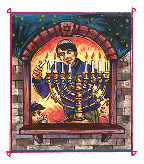
The Chanukiah is a nine-branched candelabrum used by Jews during the eight-day festival of Chanukah. It has taken many forms throughout the ages, but its essential feature has always been eight receptacles for oil or candles (one lit the first day, two the second, etc.) and a further receptacle for the shamash (“servant”) light, which is set apart and used for kindling the other lights in Ashkenazim households. The shamash is not used in Sephardi households.
Bereshit (Genesis) 32:22-31 And he rose up that night, and took his two wives, and his two women servants, and his eleven sons, and passed over the ford Jabbok. And he took them, and sent them over the brook, and sent over that he had. And Yaaqob was left alone; and there wrestled a man with him until the breaking of the day. And when he saw that he prevailed not against him, he touched the hollow of his thigh; and the hollow of Yaaqob‘s thigh was out of joint, as he wrestled with him. And he said, Let me go, for the day breaketh. And he said, I will not let thee go, except thou bless me. And he said unto him, What [is] thy name? And he said, Yaaqob. And he said, Thy name shall be called no more Yaaqob, but Israel: for as a prince hast thou power with God and with men, and hast prevailed. And Yaaqob asked [him], and said, Tell [me], I pray thee, thy name. And he said, Wherefore [is] it [that] thou dost ask after my name? And he blessed him there. And Yaaqob called the name of the place Peniel: for I have seen God face to face, and my life is preserved. And as he passed over Penuel the sun rose upon him, and he halted upon his thigh.
After Yaaqob and his family had crossed the river Yabok, Yaaqob returned alone to see if he had forgotten anything. He found that he had left some small containers of oil. Why did he bother to risk his life (he was by himself) for such seemingly insignificant pots of oil? We are told that a tzaddik values the smallest of his possessions and would not let anything go to waste, as each of his belongings has been acquired honestly. Indeed, there is an opinion that these containers were the pots of oil that lasted for eight days, that comprised the miracle of Chanukah in the Temple.
THE HISTORY OF CHANUKAH
Under Syrian Rule[29]
It was in the time of the Second Temple in Jerusalem, nearly twenty-two centuries ago, that the events took place which we commemorate each year at Chanukah time.
The Jewish people had returned to the Land of Israel from the Babylonian Exile, and had rebuilt the Holy Temple. But they remained subject to the domination of imperial powers, first, the Persian Empire, then later, the conquering armies of Alexander the Great. Upon the death of Alexander, his vast kingdom was divided among his generals. After a power struggle which engulfed all the nations of the Middle East, Israel found itself under the sway of the Seleucid Dynasty, Greek kings who reigned from Syria.
The Talmud relates that when Alexander the Great and his conquering legions advanced upon Jerusalem, they were met by a delegation of elders, led by the High Priest Shimon HaTzaddik. When Alexander saw Shimon approaching, he dismounted and prostrated himself before the Jewish Sage.
To his astonished men, Alexander explained that each time he went into battle, he would see a vision in the likeness of this High Priest leading the Greek troops to victory.
In gratitude, and out of profound respect for the spiritual power of the Jews, Alexander was a kind and generous ruler. He canceled the Jewish taxes during Sabbatical years, and even offered animals to be sacrificed on his behalf in the Temple.
Unfortunately, history would show that Alexander’s heirs failed to sustain his benevolence.
Though at first, the rule of the Seleucids was rather benign, there soon arose a new king, Antiochus IV, who was to wage a bloody war upon the Jews, a war which would threaten not just their physical lives, but also their very spiritual existence.
Over the years of Greek domination, many Jews had begun to embrace the Greek culture and its hedonistic, pagan way of life. These Jewish Hellenists became willing pawns in Antiochus’s scheme to obliterate every trace of the Jewish religion. The Temple was invaded, desecrated, and looted of all its treasures. Vast numbers of innocent people were massacred, and the survivors were heavily taxed. Antiochus placed an idol of Zeus on the holy altar, and forced the Jews to bow before it under penalty of death. And he forbade the Jewish people to observe their most sacred traditions, such as the Sabbath and the rite of circumcision.
Antiochus went so far as to proclaim himself HaShem, taking the name “Antiochus Epiphanies” - the Divine. But even his own followers mocked him as “Antiochus Epimanes” - the madman.
Jason and Menelaus
His Hebrew name was Joshua. But he changed his name, as did many among the Hellenists, to Jason. And he offered King Antiochus a generous bribe to depose the High Priest and appoint him to the coveted position. It was the beginning of the end to the integrity of the Temple Priesthood.
The “High Priest“ Jason erected a gymnasium near the Temple, and proceeded to corrupt his fellow Jews with pagan customs and licentious behavior. But before long, another Hellenized Jew, Menelaus, beat Jason at his own game and bought the High Priesthood with an even bigger bribe, financed with the golden vessels pilfered from the Temple.
Jason then amassed an army and attacked Menelaus in the Holy City, massacring many of his own countrymen. Antiochus interpreted this civil squabble as a revolt against his throne, and sent his armies into Jerusalem, plundering the Temple and murdering tens of thousands of Jews. It was neither the first time, nor the last, that assimilation and strife brought calamity upon the Jewish people.
In every city and town, altars were erected with statues of the Greek gods and goddesses. Soldiers rounded up the Jews and forcibly compelled them to make offerings, and to engage in other immoral acts customary to the Greeks. As Antiochus’s troops tightened their grip on the nation, the Jews seemed incapable of resistance.
It was in the small village of Modin, a few miles east of Jerusalem, that a single act of heroism turned the tide of Israel’s struggle, and altered her destiny for all time. Mattiyahu, patriarch of the priestly Hasmonean clan, stepped forward to challenge the Greek soldiers and those who acquiesced to their demands. Backed by his five sons, he attacked the troops, slew the idolaters, and destroyed the idols. With a cry of “All that are with HaShem, follow me!” he and a courageous circle of partisans retreated to the hills, where they gathered forces to overthrow the oppression of Antiochus and his collaborators.
The army of Mattiyahu, now under the command of his son Yehuda Maccabee, grew daily in numbers and in strength. With the Biblical slogan, “Who is like You among the mighty ones, O HaShem?” emblazoned on their shields, they would swoop down upon the Syrian troops under cover of darkness and scatter the oppressors, then return to their encampments in the hills. Only six thousand strong, they defeated a heavily armed battalion of forty-seven thousand Syrians.
Enraged, Antiochus sent an even larger army against them, and in the miraculous, decisive battle at Bet Tzur, the Jewish forces emerged victorious. From there, they proceeded on to Jerusalem, where they liberated the city and reclaimed the Temple. They cleared the Sanctuary of the idols, rebuilt the altar, and prepared to resume the Divine Service.
A central part of the daily service in the Temple was the kindling of the brilliant lights of the menorah. Now, with the Temple about to be rededicated, only one small cruse of the pure, olive oil was found. It was only one day’s supply, and they knew it would take more than a week for the special process required to prepare more oil.
Undaunted, in joy and thanksgiving, the Maccabees lit the lamps of the menorah with the small amount of oil, and dedicated the Temple anew. And miraculously, as if in confirmation of the power of their faith, the oil did not burn out, and the flames shone brightly for eight full days. The following year, our Sages officially proclaimed the festival of Chanukah as a celebration lasting eight days, in perpetual commemoration of this victory over religious persecution.
The essentials of Chanukah are given to us in the books of the Maccabees:
1 Maccabees 4:36-59 But Judah and his brothers said, “Now that our enemies have been crushed, let us go up to Jerusalem to cleanse the Temple and rededicate it.” So the whole army was assembled and went up to Mount Zion. There they found the Temple laid waste, the altar profaned, the gates burnt down, the courts overgrown like a thicket or wooded hillside, and the priest‘s rooms in ruin. They tore their garments, wailed loudly, put ashes on their heads, and fell on their faces to the ground. They sounded the ceremonial trumpets, and cried aloud to Heaven.
Then Judah detailed troops to engage the garrison of the citadel while he cleansed the Temple. He selected priests without blemish, devoted to the law, and they purified the Temple, removing to an unclean place the stones which defiled it. They discussed what to do with the altar of burnt-offering which was profaned, and rightly decided to demolish it, for fear it might become a standing reproach to them because it had been defiled by the Gentiles. They therefore pulled down the altar, and stored away the stones in a fitting place on the Temple hill, until a prophet should arise who could be consulted about them. They took unhewn stones, as the law commands, and built a new altar on the model of the previous one. They rebuilt the Temple and restored it’s interior, and consecrated the Temple courts. They renewed the sacred vessels and the lamp-stand, and brought the altar of incense and the table into the Temple. They burnt incense on the altar and lit the lamps on the lamp-stand to shine within the Temple. When they had put the Bread of the Presence on the table and hung the curtains, all their work was completed.
Then early on the twenty-fifth day of the ninth month, the month Kislev, in the year 164 BCE, sacrifice was offered as the law commands on the newly made altar of burnt-offering. On the anniversary of the day when the Gentiles had profaned it, on that very day, it was rededicated, with hymns of thanksgiving, to the music of harps and lutes and cymbals. All the people prostrated themselves, worshipping and praising Heaven that their cause had prospered.
They celebrated the rededication of the altar for eight days. There was great rejoicing as they brought burnt offerings and sacrificed peace offerings and thank offerings. They decorated the front of the Temple with golden wreaths and ornamental shields. They renewed the gates and the priest’s rooms, and fitted them with doors. There was great merry-making among the people, and the disgrace brought on them by the Gentiles was removed.
Then Judah, his brothers, and the whole congregation of Israel decreed that the rededication of the altar should be observed with joy and gladness at the same season each year, for eight days, beginning on the twenty-fifth of Kislev.
II Maccabees 10:1-8 Maccabaeus with his men, led by the Lord, recovered the Temple and city of Jerusalem. He demolished the altars erected by the heathen in the public square, and their sacred precincts as well. When they had purified the sanctuary, they consecrated another altar; then striking fire from flints, they offered a sacrifice for the first time for two whole years, and restored the incense, the lights, and the Bread of the Presence. This done, they prostrated themselves and prayed the Lord not to let them fall any more into such disasters, but, should they ever happen to sin, to discipline them Himself with clemency and not hand them over to blasphemous and barbarous Gentiles. The sanctuary was purified on the twenty-fifth of Kislev, the same day of the same month as that on which foreigners had profaned it. The joyful celebration lasted for eight days; it was like Succoth, the Feast of Tabernacles, for they recalled how, only a short time before, they had kept that feast while they were living like wild animals in the mountains and caves; and so they carried garlanded wands and branches with their fruits, as well as palm fronds, and they chanted hymns to the One who had so triumphantly achieved the purification of His own Temple. A measure was passed by the public assembly to the effect that the entire Jewish race should keep these days every year.
The following passage is from the work of Josephus, a Jewish general of the 1st century CE, who deserted to the Romans and wrote the definitive history of the Jewish people:
Josephus, Antiquities of the Jews, Book 12, 6:7 Now Judas celebrated the festival of the restoration of the sacrifices of the temple for eight days; and omitted no sort of pleasures hereon; but he feasted them upon very rich and splendid sacrificed; and he honored HaShem, and delighted them, by hymns and psalms. Nay, they were so very glad at the revival of their customs when after a long time of intermission, they unexpectedly had regained the freedom of their worship, that they made it law for their posterity, that they should keep a festival on account of the restoration of their temple worship for eight days. And from that time to this we celebrate this festival and call it Lights. I suppose the reason was, because this liberty beyond our hopes appeared to us; and that thence was the name given to that festival. Judas also rebuilt the wall round about the city, and reared towers of great height against the incursions of enemies, and set guards therein. He also fortified the city of Bethsura, that it might serve as a citadel against any distresses that might come from our enemies.
Dates:
To help understand a bit of the time frame for these Chanukah events, it is useful to look at the essential events that led up to this time of great miracles:
333 BCE Alexander the Great conquers Eretz Israel.
175 BCE Antiochus Epiphanes comes to power.
168 BCE Antiochus Epiphanes in Jerusalem; desecration of the Temple; Antiochus’ edicts Mattiyahu the Hasmonean leads the revolt against the Greeks.
164 BCE Judah Maccabee enters the Temple and reinstitutes the sacrifices and reconsecrates the Temple.
160 BCE Death of Judah Maccabee.
152 BCE Jonathan the Hasmonean leads the people.
142 BCE Shimon the Hasmonean becomes ruler and High Priest.
135 BCE Jonathan Hyrcanus (son of Shimon) - ruler and High Priest.
103 BCE Alexander Yannai is king and High Priest.
76 BCE Salome Alexandra (Shlomzion - Yannai’s wife) comes to the throne.
67 BCE Civil war for control of Judea; Pompey, the Roman commander, conquers Jerusalem
37 BCE Death of Antigonus, last of the Hasmonean kings
Daniel the Prophet spoke of the desecration of the Beit HaMikdash in a way that suggests the events of Chanukah:
Daniel 11:29-32 “At the appointed time he will invade the South again, but this time the outcome will be different from what it was before. Ships of the western coastlands will oppose him, and he will lose heart. Then he will turn back and vent his fury against the holy covenant. He will return and show favor to those who forsake the holy covenant. “His armed forces will rise up to desecrate the temple fortress and will abolish the daily sacrifice. Then they will set up the abomination that causes desolation. With flattery he will corrupt those who have violated the covenant, but the people who know HaShem will firmly resist him.
This sounds a lot like what Antiochus Epiphanies did. Although it is obvious that Antiochus did not completely fulfill this prophecy. Perhaps he was a ‘type‘ of the coming anti-Mashiach. We know that the events of Chanukah did not the fulfill Daniel’s prophesy because of what His Majesty King Yeshua said:
Matityahu (Matthew) 24:15-25 “So when you see standing in the holy place ‘the abomination that causes desolation,’ spoken of through the prophet Daniel--let the reader understand-- Then let those who are in Judea flee to the mountains. Let no one on the roof of his house go down to take anything out of the house. Let no one in the field go back to get his cloak. How dreadful it will be in those days for pregnant women and nursing mothers! Pray that your flight will not take place in winter or on the Sabbath. For then there will be great distress, unequaled from the beginning of the world until now--and never to be equaled again. If those days had not been cut short, no one would survive, but for the sake of the elect those days will be shortened. At that time if anyone says to you, ‘Look, here is the Mashiach!’ or, ‘There he is!’ do not believe it. For false Mashiachs and false prophets will appear and perform great signs and miracles to deceive even the elect--if that were possible. See, I have told you ahead of time.
I have noticed that HaShem has ‘appointed‘ days for certain events. I wonder if the above passage will be fulfilled on Chanukah:
The second Temple was desecrated by Antiochus Epiphanies on Kislev 25, on the date when Chanukah begins, according to the historical record in Maccabees. I would also bet that the anti-Mashiach will desecrate the future Temple on Chanukah.
* * *
In Bereshit Rabbah the expression “Miketz Yamim”, at the end of some days, which describes when Cain murdered Abel is understood to refer specifically to Chanukah![30] So this terminology also hints at a festival-like status for Chanukah.
* * *
One of its outstanding features of Chanukah is that it was the last holiday to be established in the Jewish calendar. As such, it completed the cycle of dates and times that would last until the end of days (“at the end of days“ meaning just prior to the messianic era.). As we say in Maoz Tzur - “az egmor b’shir mizmor chanukat ha-mizbeiach” - thus I will conclude with a song about the dedication of the altar. In other words, the dedication done by the Hasmoneans would be the final piece in the bridge that would connect Jewish history to the end of days. With Chanukah, the path connecting the past to the future was completed.
* * *
The days of Chanukah, with its root chinuch are days of education of messianic times. A time of redemption and restoration.
The word Miketz, the annual Torah portion read during Chanukah, hints to the Keitz (end) of Galut (the exile), and to the end of days, the Keitz (ultimate time) of the Redemption!
* * *
The Persian dream of succeeding where others failed will recur at the great trial at the end of days, as described by our Sages.[31]
* * *
There are several versions of the meaning of the name “Maccabee”. When spelled:
MA-KAW-BEE
it means MALLET or HAMMER and refers to the hammer-like blows that Judah levied against the Syrian forces in his march to victory. When read:
MAC-BEE
it means EXTINGUISHED or VANQUISHED. It was also an acrostic for the first letters of the verse in Exodus 15:11, which read:
MI CHAMOCHA BAELIM ADONAI -
WHO IS LIKE UNTO THEE, HaShem, AMONG THE MIGHTY?
These words were also used as Israel’s battle cry and were interpreted to mean, “Whosoever is on the side of the Lord follow me”.
This phrase is part of the synagogue service today.
Another prophetic allusion to Chanukah is found in Psalms chapter 30. This Mizmor is designated as Shir Shel Yom, the song of the day, for Chanukah. This chapter of Psalms is David’s prophetic commentary on the Torah portion.
Where in the Tanach is the miracle of Chanukah alluded? Actually, why ask such a question? The Midrashic Sages, Kabbalists, and Rabbinic Authorities have dealt extensively with this question. We know that nothing in Jewish history happens haphazardly, there must be a connection in the Torah. Every letter of the Torah represents a number as well as the letter and by using associations even vague or obscure references can be derived. The following is the result of investigations into the Miracle of Chanukah and Post Chanukah in the Tanach:
In Vayikra (Leviticus) 23 the Torah mentions all the festivals of the year;
Rosh HaShanah (Feast of Trumpets),
Yom HaKippurim (Day of Atonement), and
Succoth (Feast of Tabernacles).
This section concludes with “thus Moshe declared to the children of Israel the set times of HaShem“. The very next verse, Vayikra 24:1, gives the mitzva (command) of maintaining the menorah, the Eternal Light, in the Temple with pure olive oil. Since the Torah is not a collection of haphazard events we must learn from here that the Torah was hinting at a future when the lighting of the Menorah will become an annual festival, Chanukah, directly following Succoth:
Vayikra (Leviticus) 24:1-4 HaShem said to Moses, “Command the Israelites to bring you clear oil of pressed olives for the light so that the lamps may be kept burning continually. Outside the curtain of the Testimony in the Tent of Meeting, Aaron is to tend the lamps before HaShem from evening till morning, continually. This is to be a lasting ordinance for the generations to come. The lamps on the pure gold lampstand before HaShem must be tended continually.
Here we have an allusion to Chanukah, hundreds of years before the Maccabees! Also notice that Succoth is EIGHT days long (with Shemini Atzeret), so too is Chanukah. Why don’t we add an extra day in the Diaspora? Because the festival is of Rabbinic ordinance the Authorities did not want to add an extra day. Furthermore, in Vayikra 24:4, we encounter the phrase “.. to cause the light to burn”, followed by the phrase “... he shall prepare the lights”. The singular followed by the plural teaches us that we light one light on the first day and on subsequent days we light one more.
The twelfth rule of Ishmael tells us that we can understand one passage by understanding the passages that come before it and after it. Thus we understand that Vayikra 24 is related, and explains Vayikra 23.
Rav Yitzchak Goldwasser,[33] among others, suggests that it is indeed appropriate for HaShem to have demonstrated His presence in the Jewish salvation through a miracle that involved the incessant burning of the Menorah. The Gemara tells us that when HaShem was pleased with the actions of His nation, one of the seven lamps of the Menorah would miraculously burn for twenty-four hours, instead of the normal twelve hours, in order to demonstrate that HaShem‘s Divine Presence dwelled among His people. The fire of the Menorah would make clear to all that the figurative “fire of HaShem“
Debarim (Deuteronomy) 4:24 HaShem your G-d is a burning fire.[34]
rested with His people. Similarly, the incessant burning of the Menorah after the victory against the Greeks was meant to demonstrate that HaShem‘s presence, that dwelled with the Jews, brought about the victory.
We may add our own insight to that observation. When Moshe was sent to free the Jews from their Egyptian bondage, HaShem appeared to him in a fire that was seen to burn without using up its supply of fuel (i.e., without devouring the bush in which it raged). According to the Midrash,[35] this was meant to symbolize that “the wicked will not extinguish the flames of the righteous, which are their fear of heaven and their good deeds.” Similarly, the flame of the burning Menorah demonstrated that HaShem did not let the righteous, who defied the Greek idolaters’ evil decrees, succumb to the evildoers in battle.
It is interesting to note that, as pointed out in “Nifla’os mi’Toratecha”,[36] in the incident of the burning bush the Torah tells us, “HaShem saw that Moshe turned to see [the marvel of the bush], and He called out to him from the bush: and said Ki Sar Lir’ot, Vayikra.[37] These four words provide the only incidence in the Torah of consecutive words which spell, by acronym, the word, “Kislev,” or the name of the month in which the Chanukah miracle took place!
The twenty-fifth word of the Torah is:
Bereshit (Genesis) 1:1-3 In the beginning God created the heavens and the earth. Now the earth was formless and empty, darkness was over the surface of the deep, and the Spirit of God was hovering over the waters. And God said, “Let there be light,” and there was light.
Light, the Hebrew word Ohr, is the 25th word in the Torah. Further, this light was created on the twenty-fifth of Elul (Adam HaRishon) was created on the sixth day – Tishri one).
This alludes to Kislev 25 when the events of Chanukah took place. In fact, in the beginning of creation, when HaShem first shone the holy, supernal light onto creation, He said, “Yehi Ohr,” which translates as, “Let there be light.” However, the word “Yehi” can be understand literally “let there be,” or as a gematria (i.e., it can be translated into its numerical value: yod, heh, yod, or 10+5+10), which is exactly! Twenty-five! Every number possesses a specific significance in ancient Jewish wisdom. The number twenty-five always alludes to the Festival of Light. In fact the final syllable of the word Chanukah actually means twenty-five. It is no coincidence that Chanukah is the only festival in the Hebrew calendar that falls on the 25th day of the month.
The light created by HaShem on the first day of Creation was not the light of the sun, moon or stars; those heavenly bodies were not created until the fourth day.
The light of the first day was a spiritual light, hidden when Adam and Eve sinned and which will be revealed for eternity in the Messianic Era. Within each Jew is a spark of this holy and eternal light, which will ultimately be fully revealed within each of us, with the imminent revelation of Mashiach.
We find yet another allusion to Chanukah in the Torah:
Bereshit (Genesis) 46:29 Joseph had his chariot made ready and went to Goshen to meet his father Israel. As soon as Joseph appeared before him, he threw his arms around his father and wept for a long time.
This place, Goshen, was used to demonstrate HaShem’s might over the Egyptians when he brought three days of TOTAL darkness to all of Egypt, except Goshen for the ninth plague. The number nine is also the number of Kislev, the ninth month.
Now, let’s look at an insight from Rabbi Daniel Lapin:
... The Talmud says the following: HaShem made this light - a certain type of light. It was too penetrating. So He only let it last for thirty-six hours. And after thirty-six hours He took it away and hid it for some time in the future that has not yet come. And He replaced it with a weaker merely physical aspect of that light. But that as long as that light was there, for those thirty-six hours, Adam by means of that light was able to see from one end of the world to the other, and from the beginning of time to the end of time. So that light was the light of total understanding. Isn’t that what light signifies? The Talmud says anytime that the word “light” is used anyway in the Torah or Rabbinic text, that “light” always means knowledge and wisdom and understanding.
Here is another allusion, regarding copper as an allusion to Chanukah, from Rabbi Daniel Lapin:
“Years before the Greek invasion of Israel, Daniel provided King Nebuchadnezzar with a prophecy about several subsequent empires. Each was represented by a different metallic element such as iron, gold, silver and copper. (Some translations mistakenly render NeCHaSHa - נְחָשָׁא, as bronze or brass.) “
Daniel 2:39 But another kingdom will arise after you, inferior to yours; then yet a third kingdom, of copper - נְחָשָׁא, which will rule over the whole earth.
“The empire referred to as copper is Greece, the antagonist of Jerusalem in the Chanukah account. Each time copper is mentioned in Scripture, an aspect of Greek domination is being referenced.”
“With this in mind, we can look at these words having to do with vessels in the Tabernacle: . “…shall be of copper”.[38] The very next verse reads: “You shall instruct the Israelites to bring you clear oil of beaten olives for lighting, for kindling the lamps regularly”.[39] Again we see lighting olive oil referring to the yet-to-be events of Chanukah, when the light will overwhelm the darkness brought on by Greece.”
* * *
Parshas Vayaishev
The Page Of Enlightenment
By Rabbi Pinchas Winston
Yaakov settled in the land of the sojournings of his fathers in the Land of Canaan. These are the generations of Yaakov: Yosef was seventeen years old (Bereshit 37:1)
This year, 5761, has already been a special year as far as the holidays are concerned, with many falling on Shabbos (double-holiness), and, now, with Chanukah spanning two Shabbatot. That’s a lot of extra holiness and light to be gained for the spiritual opportunist.
These parashiot are full of hints to the holiday of Chanukah, though they occurred long before there was even a Jewish people to leave a Greek exile. However, even history yet to be lived out, including Mashiach’s arrival, is in the Torah as well, for, as the Midrash explains, the Torah is the blueprint for creation, and therefore, all of history, every last detail of it, by definition, must be there on some level.
For example, Yosef “goes out” from Yaakov at the age of seventeen years of age, just like a flame is supposed to do, as Rashi re-quotes again in parshah Vayeishev. Now, seventeen is a special number in Kabbalah, because, it is the gematria of the word “tov,” which, of course means “good.”
But, more importantly, it is the word used to describe the creation of light on the first day of creation, the First Light, the Primordial Light -- the Ohr HaGanuz -- the “Hidden Light” of creation. This light, says the Talmud Yerushalmi (Berachot 8:5), shone for Adam HaRishon, erev Shabbat on Day Six and Shabbat itself, at total of thirty-six hours altogether -- the number of candles we light over the course of the eight days of Chanukah (not including the Shamashim, which are not really part of the mitzvah). The word “light” appears in the Torah thirty-six times (Rokeach).
Even in “Mispar Katan,” a form of gematria that pursues the “root” of an idea by reducing a gematria to a number less than ten, for example, 17 = 1 + 7 = 8. Eight, as we have already said is the number of days it takes to light all thirty-six candles, and, as is well known, is a number that symbolizes the supernatural, and, the day of Bris Mila -- which Yosef symbolized. As well, it is pointed out, the “Tet” of “tov” has four tagim (crowns) upon it (in a Sefer Torah), and when multiplied by the numerical value of the Tet itself (nine) yields the number thirty-six.
Yosef is a flame alright -- a Chanukah flame!
Then there is this unusually long Rashi on the first pasuk of the parshah:
AND YA’AKOV SETTLED: A certain flax-seller brought camels laden with flax (into the city), and, a blacksmith wondered (out loud), “Where will he put all that flax?” A wise guy answered, “One spark from your bellow will burn all of it up!” Thus, Yaaqob saw all the chieftains (of Esav) mentioned previously (in Chapter THIRTY-SIX), and wondered, “Who can conquer all of them?” What is written after? “There are the generations of Yaaqob: Yosef,” and it is written, “The House of Yaaqob will be fire, the House of Yosef will be a flame, and, the House of Esav will be straw”.[40] A spark will go out from Yosef and burn them all up! (Rashi)
Is Rashi’s parable original? Perhaps not completely, for, we find a similar case in a Mishnah:
Bava Kamma 62b If a camel laden with flax pushed into the doorway of a store and caught fire from the storekeeper’s candle, burning down the entire building, the camel owner is responsible. However, if the storekeeper left his candle outside, the storekeeper is culpable. Rav Yehuda says: If it was a Chanukah Candle, he is not responsible.
Why such a strong connection between these parashiot, and Chanukah specifically? And, what is it about Yosef that makes him a living example of the light of the Chanukiah, which, in itself, is an expression of the Hidden Light of creation, as it says:
The Original Light of creation was hidden in the thirty-six candles of Chanukah.[41]
Because, Yosef HaTzaddik, as his name implies, was about Jewish identity, and so is the story of Chanukah. It was only one parshah ago that Yaaqob entered the “darkness” of exile and fought with the Angel of Esav, who embodied all the ideals of an Esavian way of life. After a long, bitter struggle, Yaaqob emerged as “Israel,” the namesake of the truly fulfilled and completed Jew.
Israel is not merely a name, it is a title, and a blessing, something to be achieved, and therefore, something that can be lost as well. This is why unlike Avraham, Yaaqob can be called either Yaaqob or Israel. When a descendant of Yaaqob acts like the twin brother of Esav -- mimicking his behavior and idolizing his ideals -- then he is, at best, a Yaaqob, and, at worst, an Esav.
However, when a Jew maintains his Torah integrity and godly-identity, then, he is, at least, a Yisroel, and at most whatever spiritually-elevated level of greatness he is able to achieve. The sky’s the limit for such a Jew, and even higher for that matter. Then a person emanates the Divinely-cherished light of creation, which burns from within our Ner Chanukah.
That is the light of the tzaddik, of Yosef HaTzaddik, which went out in this week’s parshah, via the city of Shechem, and burned so brilliantly within the darkness of Egyptian exile.
* * *
On Chanukah we light one candle the first night, two the second night, etc., thus:
Candles:
1
12
123
1234
12345
123456
1234567
12345678
A total of thirty-six candles!
Remember that we do not “use” the Chanukah light. This is a reminder that this is not physical light.
Current mazal (frozen at about the time the Temple was destroyed) for the third month of a new year, the month of Kislev, is Keshet, Sagittarius in the Greek. In Hebrew they called it Keshet:
7198 qesheth, keh’-sheth; from 7185 in the orig. sense (of 6983) of bending; a bow, for shooting (hence fig. strength) or the iris:-X arch (-er), + arrow, bow ([-man, -shot]).
The Torah translates it as:
Bereshit (Genesis) 9:13 I have set my rainbow in the clouds, and it will be the sign of the covenant between me and the earth.
Water and light are both metaphors for wisdom. So, the rainbow fits well with Chanukah.
The tribe associated with the third month was Levi from:
Bereshit (Genesis) 49:1-7 Then Yaaqob called for his sons and said: “Gather around so I can tell you what will happen to you in days to come. “Assemble and listen, sons of Yaaqob; listen to your father Israel. “Reuben, you are my firstborn, my might, the first sign of my strength, excelling in honor, excelling in power. Turbulent as the waters, you will no longer excel, for you went up onto your father’s bed, onto my couch and defiled it. “Simeon and Levi are brothers--their swords are weapons of violence. Let me not enter their council, let me not join their assembly, for they have killed men in their anger and hamstrung oxen as they pleased. Cursed be their anger, so fierce, and their fury, so cruel! I will scatter them in Yaaqob and disperse them in Israel.
Levi was the third born and the third to be blessed by Yaacov.
So, which tribe is associated with the events of Chanukah? (hint: Maccabees). The Maccabean kings were all descended from Levi. Some have speculated that the reason that they did not endure is due to the fact that the Torah indicates that the descendants of Judah are supposed to rule in Israel. They were also known as Hasmoneans because they came from the city of Chashmonah.
Notice the name of the twenty-fifth camp of the Israelites after leaving Egypt:
Bamidbar (Numbers) 33:1 Here are the stages in the journey of the children of the one who will rule as God (Israelites) when they came out of Egypt by divisions under the leadership of the one who was drawn out of the water (Moses) and the enlightened one (Aaron). At HaShem’s command the one who was drawn out of water (Moses) recorded the stages in their journey. This is their journey by stages:
Bamidbar (Numbers) 33:29 They left the place of sweetness (Mithcah) and camped at the fruitfulness place (Hashmonah camp #25).
The 25th place where they encamped was Hashmonah. Mattiyahu, the head of the Hasmonean family which led the revolt against the Greeks, was from Hashmonah, therefore, he was called the Hasmonean.
The Sanctuary in the desert was completed on the 25th of Kislev, eight months after the Exodus from Egypt. But it was not dedicated until three months later. Jewish teachings explain that the 25th of Kislev was set aside for the future rededication of the Holy Temple by the Maccabees.
Chanukah is called the Festival of Lights, ‘Hag Urim’ by the great historian Josephus:
Antiquities of the Jews - Book XII 7:7. Now Judas celebrated the festival of the restoration of the sacrifices of the temple for eight days, and omitted no sort of pleasures thereon; but he feasted them upon very rich and splendid sacrifices; and he honored God, and delighted them by hymns and psalms. Nay, they were so very glad at the revival of their customs, when, after a long time of intermission, they unexpectedly had regained the freedom of their worship, that they made it a law for their posterity, that they should keep a festival, on account of the restoration of their temple worship, for eight days. And from that time to this we celebrate this festival, and call it Lights. I suppose the reason was, because this liberty beyond our hopes appeared to us; and that thence was the name given to that festival. Judas also rebuilt the walls round about the city, and reared towers of great height against the incursions of enemies, and set guards therein. He also fortified the city Bethsura, that it might serve as a citadel against any distresses that might come from our enemies.
One of the most fundamental reasons for this appellation is a Talmudic passage about Adam, the very first human being:
Avodah Zarah 8a Said R. Hanan b. Raba: KALENDA is kept on the eight days following the [winter] equinox. SATURNALIA on the eight days preceding the equinox. As a mnemonic take the verse, Thou hast beset me behind and before.
Our Rabbis taught: When primitive Adam saw the day getting gradually shorter, he said, ‘Woe is me, perhaps because I have sinned, the world around me is being darkened and returning to its state of chaos and confusion; this then is the kind of death to which I have been sentenced from Heaven!’ So he began keeping an eight days’ fast. But as he observed the winter equinox and noted the day getting increasingly longer, he said, ‘This is the world’s course’, and he set forth to keep an eight days’ festivity. In the following year he appointed both as festivals. Now, he fixed them for the sake of Heaven, but the [heathens] appointed them for the sake of idolatry.
On Tebet 25, thirty days after the beginning of Chanukah, we celebrate an event that looks a lot like Chanukah.
Yoma 69a Come and hear: As to priestly garments, it is forbidden to go out in them in the province,[42] but in the Sanctuary whether during or outside the time of the service, it is permitted to wear them, because priestly garments are permitted for private use. This is conclusive. But in the province [it is] not [permitted]? Surely it was taught: The twenty-fifth of Tebet is the day of Mount Gerizim,[43] on which no mourning is permitted. It is the day on which the Cutheans demanded the House of our God from Alexander the Macedonian so as to destroy it, and he had given them the permission, whereupon some people came and informed Simeon the Just.[44] What did the latter do? He put on his priestly garments, robed himself in priestly garments, some of the noblemen of Israel went with him carrying fiery torches in their hands, they walked all the night, some walking on one side and others on the other side, until the dawn rose. When the dawn rose he [Alexander] said to them: Who are these [the Samaritans]? They answered: The Jews who rebelled against you. As he reached Antipatris,[45] the sun having shone forth, they met. When he saw Simeon the Just, he descended from his carriage and bowed down before him. They said to him: A great king like yourself should bow down before this Jew? He answered: His image it is which wins for me in all my battles. He said to them: What have you come for? They said: Is it possible that star-worshippers should mislead you to destroy the House wherein prayers are said for you and your kingdom that it be never destroyed! He said to them: Who are these? They said to him: These are Cutheans who stand before you. He said: They are delivered into your hand. At once they perforated their heels, tied them to the tails of their horses and dragged them over thorns and thistles, until they came to Mount Gerizim, which they ploughed and planted with vetch, even as they had planned to do with the House of God. And that day they made a festive day.[46] If you like say: They were fit to be priestly garments, or, if you like, say: It is time to work for the Lord: they have made void Thy law.[47]
The noblemen formed a menorah with the Kohen Gadol as the center light.
The Talmud relates that five miracles occurred in the Beit HaMikdash during his tenure. First, the red string that was hung in the Beit HaMikdash during the Yom Kippur services turned white, symbolizing Israel's purity. Second, on Yom Kippur two sacrificial goats were designated, one to be offered in the Kodesh HaKodashim, one to be cast off a cliff. The Kohen Gadol drew lots in each hand to determine which goat should be used for which purpose. During Shimon HaTzadik's forty year-tenure, the lot indicating the goat to be offered in the Kodesh HaKodashim always turned up in his right hand, a sign of Divine favor. Third, every evening a full night's supply of oil was put into each lamp of the Menorah. Miraculously, the oil put into the western lamp burned for 24 hours, demonstrating the constant presence of HaShem in the Beit HaMikdash. Fourth, although each Kohen received only a small portion of the Lechem Hapanim (the showbread), he felt satiated as if he had eaten a full meal. Fifth, the fire on the Altar burned steadily without constant addition of wood. Sadly, after Shimon HaTzadik's death miracles of such magnitude were no longer manifest in the Beit HaMikdash.
Let us re-examine the month of Tevet. This month has the shortest days and the longest nights of the year. As we began the month, the days got shorter, darkness descending upon us. Only an artificial light, our Chanukah candles, brightens our circumstance. However. This light lasts only for two days, but in reality, we live in a very dark Galut.
It is no coincidence that at the darkest point of the year the first stage of our Temple’s destruction occurs. Chazal established a fast on this day for it represents our entire Galut and not merely the destruction of the Beit HaMikdash.
On the other hand, Tevet is the month in which the days begin to get longer, a sign of redemption. The first sign of redemption is certainly the reinstitution of Torah Law, both written and oral. Chazal, when overturning a law which had been imposed by the Sadducees, understood that this was the first stage of redemption, and made the 25th of Tevet a day of celebration.
And, finally, the story of Shimon HaTzadik: It is quite obvious that the final stage of redemption is the rebuilding of the Beit HaMikdash. The 25th of Tevet celebrated the preservation of the Beit HaMikdash in the Second Temple period, but symbolizes its final rebuilding. Rightfully it is done with lit torches, the brightest of lights. However, it is a long trek until we get there, through the dark night of Galut.
The first lights – the Chanukah candles – and the last lights – Shimon HaTzadik’s torches – are related. Both represent the menorah of the Beit HaMikdash. This is an example of “the final outcome has been conceived of at the outset”. The final lights of redemption has its seeds in the brightest lights of Chanukah, our redemption from Galut Yavan.
In our bitter exile, our light is Torah, for a mitzvah is a candle and Torah is light. Our only escape from exile is the study of Torah, as Chazal tell us, the only free man is the one who involves himself with Torah.
May we merit a complete redemption soon!
On the Shabbat during Chanukah, in the annual cycle, we usually read the Torah portion of Miketz.
The Torah portion Miketz almost always falls during the week of Chanukah. In some years it is read after the end of the festival.
For Miketz to fall after Chanukah, three events have to coincide: Yom Teruah must fall on a Shabbat, and both the months of Cheshvan and Kislev must have only 29 days instead of 30.
There is obviously a very strong link between the portion of Miketz and Chanukah.
In Miketz, Yosef rises to power in Egypt after correctly interpreting the dreams of two of King Pharaoh’s servants. In one of the dreams, Pharaoh’s chief butler saw a vine. The Torah (Bereshit 41:10) relates the butler’s description: “And in the vine were three branches; and it was as though it budded, and its blossoms shot forth; and its clusters brought forth ripe grapes.” The Ben Ish Chai writes that this vision carries with it a message which specifically relates to Chanukah.
Our Sages have often compared the Jewish people, the Ben Ish Chai writes, to grape vines. One reason for this is that the people, as vines, are weak and delicate. However, just as the weak vines produce sumptuous fruit, so too does the Israelite nation bear fruit, in their performance of mitzvot (commandments) and study of the Torah. The three vine branches described in the butler’s dream represent the three ingredients necessary to properly carry out HaShem’s dictates contained in the Torah. One must have his thought, his speech, and his actions dedicated to the service of HaShem. If any one of these three elements is lacking, so too will a person’s devotion to HaShem.
This theme is reiterated in:
Yochanan (John) 15:1-8 “I am the true vine, and my Father is the gardener. He cuts off every branch in me that bears no fruit, while every branch that does bear fruit he prunes so that it will be even more fruitful. You are already clean because of the word I have spoken to you. Remain in me, and I will remain in you. No branch can bear fruit by itself; it must remain in the vine. Neither can you bear fruit unless you remain in me. “I am the vine; you are the branches. If a man remains in me and I in him, he will bear much fruit; apart from me you can do nothing. If anyone does not remain in me, he is like a branch that is thrown away and withers; such branches are picked up, thrown into the fire and burned. If you remain in me and my words remain in you, ask whatever you wish, and it will be given you. This is to my Father’s glory, that you bear much fruit, showing yourselves to be my disciples.
The threefold significance of the vine holds true for another item as well. Our Sages compare the performance of mitzvot to a lamp. Why a lamp? In order for a lamp to function properly, it needs three components: the lamp itself, fuel, and a wick. Similarly, as we said, to perform a mitzva properly, one‘s thoughts, speech, and actions all have to be directed toward this goal. Our lighting of the menorah on Chanukah serves to remind us of this lesson. When we light the menorah, we recall the miracle that happened in the Temple: only one small flask of pure oil was found, and it miraculously sufficed to keep the menorah lit for eight days. Why did a miracle occur through the menorah? HaShem was sending the people of the time a message. HaShem was telling them that they merited the miracle because their service of HaShem was complete. They dedicated every fiber of their being to the proper service of HaShem. The menorah, a lamp, signified this total dedication.
In order to appreciate the nature of the Chanukah miracle, we should examine other, similar miracles. Let us begin with the first Temple, the Mishkan.
The parasha of the Mishkan (the Tabernacle in the wilderness) does not conclude with the finishing touches to the construction of the edifice and its vessels, nor even with the commencement of the sacrifices during the seven days of dedication. The whole enterprise peaks on the eighth day,
Vayikra (Leviticus) 9:4 “for today God is revealed to you”.
Without this eighth day, the entire construction of the Mishkan is meaningless:
“For all seven days of dedication ... the Shechinah did not rest there, and Bne Israel (Sons of Israel) were saddened and said to Moshe, ‘Moshe Rabbenu, all the labor that we performed [was] in order that the Shechinah should dwell amongst us...” (Rashi).
Even after Bne Yisrael had completed all the preparations as commanded, the Mishkan remained an empty shell until the moment of revelation:
Vayikra (Leviticus) 9:22 “And a fire came out from before God and consumed the burnt offering and the fats, and the entire nation saw and they rejoiced, and they fell upon their faces”.
Correspondingly, we find in the case of the first Temple:
II Divrei Hayamim (Chronicles) 7:1-3 “And when Shlomo had finished his prayer, the fire descended from heaven and consumed the burnt offering and the sacrifices, and the glory of God filled the House ... and all of Bne Israel saw the descent of the fire and the glory of God upon the House, and they prostrated themselves upon the floor, and bowed and thanked God for He is good, for His mercy is forever”.
So long as HaShem’s glory is revealed in the Temple, it is not permissible to enter the Holy of Holies at will. It is instructive that immediately following the divine revelation in the Mishkan, at the moment Nadav and Abihu sacrificed their ‘strange fire,’ “a fire came out from before HaShem and consumed them” (Vayikra 10:2). However, after the destruction of the first Temple, when HaShem‘s glory is no longer apparent:
Eicha (Lamentations) 5:18 “for Mount Zion which is desolate; foxes walk there”
Strangers enter the Temple without suffering any harm:
Eicha (Lamentations) 1:10 “For she has seen Gentiles coming into the Temple - those concerning whom You commanded ‘They shall not come into your congregation’”.
How remote is the era of the destruction from that eighth day when Aaron’s sons were punished! HaShem‘s glory, which was once manifest so clearly, is perceptible no longer. For this reason, when the nation returned from Babylon to build the second Temple, once again some sign was required to indicate that the Shechinah, as it were, had returned.
In the book of Maccabees we read as follows:
II Maccabees 2:1 “And now that our hearts desire to celebrate the day of the rededication of the altar ... you shall celebrate it, like the day upon which Nehemiah found the holy fire when he returned to build the Temple ... For when our fathers were exiled, the holy Kohanim secretly took the fire and hid it ... and it came to pass after many days that the king sent Nehemiah to Jerusalem ... they could not find the fire, and found only freezing water instead ... and it happened that when they offered God’s sacrifice, he commanded them to sprinkle some of the water on the wood and on the sacrifice which was upon the altar, and they did so. When they had finished, and the sun shone upon the earth and the clouds were scattered, behold a heavenly fire ignited the sacrifice, and the entire nation surrounding it was astonished, and the Kohanim and all the nation fell upon their faces ... and the Kohanim sang praise and thanks to God.”
Aside from this miracle which took place at the time of the rededication of the Temple, the Gemara describes another miracle which occurred daily in the Temple and which was similar to the miracle of the cruse of oil both in terms of form as well as character:
Shabbat 22b “It was testimony to the entire world that the Shechinah rested with Israel. What was this testimony? Rav said: This refers to the western lamp (the western-most light of the menorah in the Temple), which received the same amount of oil as all the other lamps, and from which the kohen would light the others, and it lasted the longest.”
According to the Gemara, in Yoma 39a, this miracle occurred even during the period of the Second Temple, up until the death of Shimon Ha-Tzaddik (and of His Majesty King Yeshua HaMashiach).
In all of the above cases, the significance of the miracle is that it bears testimony to the fact that the Shechinah dwells amongst Israel. The necessity of the sign comes about as a result of the nature of the Divine Presence in general. In order to clarify this issue, let us turn our attention to the sphere of prophecy.
Thus the miracle, which follows the construction of the Temple, expresses the same Divine will, which stands at the foundation of:
“and I shall dwell amongst them.”
It is only through this miracle which testifies that the Shechinah dwells amongst Israel that there is any significance to the command:
“Let them make Me a Temple.”
At the beginning of the period of the second Temple, the ‘western light’ bore faithful testimony that the Shechinah dwelt amongst Israel. But once Yeshua, and Shimon Ha-Tzaddik, died, the light no longer remained lit.
When HaShem took pity on His nation and the Chashmonaim prevailed, they purified the Temple and rededicated the altar. But where was the testimony? Where was the Shechinah? If there were no heavenly sign, what would all the efforts of the Maccabees be worth? In this context, the significance of the miracle of the cruse of oil becomes apparent. After the Temple had been defiled, this tiny cruse bore witness that the Shechinah dwelt amongst Israel.
In light of the above it becomes clear that although the actual event which was celebrated was the rededication of the altar, our Sages understood that the significance of this rededication rested on the miracle of the cruse of oil. This miracle returned the glory of the nation to its stature from the days of Shimon Ha-Tzaddik. In the words of the Penei Yehoshua:
Shabbat 21b “Therefore it would seem that the crux of the miracle was that it was performed only to show God’s love for them ... For this reason this miracle, too, was performed for them concerning the lights, which was testimony for Israel that the Shechinah dwelt amongst them, as we have explained with regard to the western light. But after the death of Shimon Ha-Tzaddik, even the western light sometimes was extinguished. Therefore a miracle was performed regarding this exact matter, at that time which was a time of Divine favor, in order to show that they had returned to their original status of being beloved in God’s eyes. This appears to me the correct interpretation.”
Hence, it is not surprising that the story of the miracle of the cruse of oil is absent from the books of the Maccabees. For it was not for this miracle that Chanukah was established, but rather for the rededication of the actual altar. But following the desecration of the Temple by the wicked Antiochus, the miracle of the oil represented the awaited signal from HaShem, which imbued the dedication of the altar with its significance. A close inspection of the books of the Maccabees reveals an emphasis of these motifs, the desecration of the Temple by the Hellenists and its purification by the Chashmonaim.
During the time of Antiochus, HaShem‘s glory is absent from the Temple:
II Maccabees 5 “And Antiochus destroyed all the holy vessels with a wicked hand ... and were it not for God’s anger against His nation because of their many sins, the hand of God would have struck him as it did Heliodoros when he went, by order of Silikus, to rob the treasury of the Temple. But because God did not choose His nation because of His city, but rather chose His city because of His nation, and because He watched over His nation, therefore He watched also over the Temple.”
And with the victory of the Chashmonaim, they returned and purified the Temple and rededicated the altar, and for this reason Chanukah was established:
II Maccabees 10 “From God this thing came about, to purify the Temple on the very day upon which the gentiles had defiled it, which was the twenty-fifth day of the month of Kislev. And they celebrated a festival of eight days to God ... and sang songs of praise and thanks to God Who gave them salvation, to purify His Temple. And a decree was sounded throughout the cities of Judea, to celebrate this festival each year.”
Chanukah celebrates not merely the rededication of the altar, but also the glory of HaShem, which once again became manifest in the Temple. This is why the book of Second Maccabees (ch. 1) compares it to the day of the dedication of the Temple in the time of Nehemiah, when the miracle of the hidden fire occurred. On Chanukah the Chashmonaim regained the same level of HaShem‘s love as they had enjoyed at the beginning of the period of the second Temple.
The conclusion, which arises from the above discussion, is that there is no contradiction between the Book of Maccabees and the version recorded by the Sages.
The book of Maccabees makes reference to the historical event upon which Chanukah was established. From this perspective, Chanukah was indeed in honor of the rededication of the altar by the Chashmonaim, but our Sages perceived the profound significance of the moment. After the defilement of the Temple by Antiochus, this rededication would have been hollow without that essential heavenly signal, the miracle of the cruse of oil, which bore testimony to HaShem‘s Presence amongst Israel.
In the Nazarean Codicil we have another association of the Shechinah with the eighth day:
Luqas (Luke) 9:27:36 I tell you the truth, some who are standing here will not taste death before they see the kingdom of God.” About eight days after Yeshua said this, he took Peter, John and James with him and went up onto a mountain to pray. As he was praying, the appearance of his face changed, and his clothes became as bright as a flash of lightning. Two men, Moses and Elijah, Appeared in glorious splendor, talking with Yeshua. They spoke about his departure, which he was about to bring to fulfillment at Jerusalem. Peter and his companions were very sleepy, but when they became fully awake, they saw his glory and the two men standing with him. As the men were leaving Yeshua, Peter said to him, “Master, it is good for us to be here. Let us put up three shelters--one for you, one for Moses and one for Elijah.” (He did not know what he was saying.) While he was speaking, a cloud appeared and enveloped them, and they were afraid as they entered the cloud. A voice came from the cloud, saying, “This is my Son, whom I have chosen; listen to him.” When the voice had spoken, they found that Yeshua was alone. The disciples kept this to themselves, and told no one at that time what they had seen.
Notice again, that we have the Shekhinah, the glory of HaShem, associated with the eighth day. From Peter’s desire to build three succoth, tabernacles, we can surmise that this is the eighth day of Succoth which is called Shemini Atzeret.
Keep in mind that HaShem and Yeshua are to be in place of the Temple:
Revelation 21:22 I did not see a temple in the city, because the Lord God Almighty and the Lamb are its temple.
In this pasuk the male (HaShem) and the female (Yeshua – the body of Mashiach composed of Israel and Mashiach) have joined together to become one. In this sod level picture we have the soul (HaShem) and the body (Yeshua) joined together. So, this transfiguration could be seen as the Shechinah filling the Temple.
Bava Kama 60b May our eyes merit seeing the return of God to Zion with mercy, and the fulfillment of God’s promise: “And I shall build it with fire, as it is written, ‘And I shall be unto her (Jerusalem) a wall of fire round about, and My glory shall be within her’”.
So on the eighth day of the Mishkan’s dedication, fire from HaShem appeared.
On the eighth day of the Temple‘s dedication, fire from HaShem appeared.
The one day supply of oil in the Menorah lit by the Maccabees, burned for eight days, the eight days of Chanukah.
Thus the miracle of fire was seen in the dedication and the re-dedication of the Mishkan, the first Temple, and the second Temple.
It is noteworthy that Mashiach ben Yosef, the “light of the world“, was conceived on the festival of lights (Chanukah)!
Luqas (Luke) 1:26-38 In the sixth month, HaShem sent the angel Gabriel to Nazareth, a town in Galilee, To a virgin pledged to be married to a man named Joseph, a descendant of David. The virgin‘s name was Mary. The angel went to her and said, “Greetings, you who are highly favored! The Lord is with you.” Mary was greatly troubled at his words and wondered what kind of greeting this might be. But the angel said to her, “Do not be afraid, Mary, you have found favor with HaShem. You will be with child and give birth to a son, and you are to give him the name Yeshua. He will be great and will be called the Son of the Most High. HaShem will give him the throne of his father David, And he will reign over the house of Yaaqob forever; his kingdom will never end.” “How will this be,” Mary asked the angel, “since I am a virgin?” The angel answered, “The Holy Spirit will come upon you, and the power of the Most High will overshadow you. So the holy one to be born will be called the Son of G-d. Even Elizabeth your relative is going to have a child in her old age, and she who was said to be barren is in her sixth month. For nothing is impossible with HaShem.” “I am the Lord’s servant,” Mary answered. “May it be to me as you have said.” Then the angel left her.
In this next scripture we can see that Yeshua was called the Light of the World:
Yochanan (John) 9:1-7 As he went along, he saw a man blind from birth. His disciples asked him, “Rabbi, who sinned, this man or his parents, that he was born blind?” “Neither this man nor his parents sinned,” said Yeshua, “but this happened so that the work of HaShem might be displayed in his life. As long as it is day, we must do the work of him who sent me. Night is coming, when no one can work. While I am in the world, I am the light of the world.” Having said this, he spit on the ground, made some mud with the saliva, and put it on the man’s eyes. “Go,” he told him, “wash in the Pool of Siloam” (this word means Sent). So the man went and washed, and came home seeing.
So, on the “Feast of Lights“ Yeshua brings literal light to the blind. This event precedes this biblical statement:
Yochanan (John) 10:22 Then came the Feast of Dedication at Jerusalem. It was winter, and Yeshua was in the temple area walking in Solomon’s Colonnade.
We can see the relationship of Chanukah to Succoth by the statements of Yeshua. In the previous verses He was the “Light of the world“ at Chanukah, In this next verse we see Him as the “Light of the World“ at the end of Succoth:
Yochanan (John) 7:37-38 On the last and greatest day of the Feast, Yeshua stood and said in a loud voice, “If anyone is thirsty, let him come to me and drink. Whoever believes in me, as the Scripture has said, streams of living water will flow from within him.”...
Then:
Yochanan (John) 8:12 When Yeshua spoke again to the people, he said, “I am the light of the world. Whoever follows me will never walk in darkness, but will have the light of life.”
So, The “Light of the World“ gives “light” (sight) to man, on the festival of Lights.
Yeshua also taught near the altar that was desecrated in:
Yochanan (John) 8:12-20 When Yeshua spoke again to the people, he said, “I am the light of the world. Whoever follows me will never walk in darkness, but will have the light of life.” The Pharisees challenged him, “Here you are, appearing as your own witness; your testimony is not valid.” Yeshua answered, “Even if I testify on my own behalf, my testimony is valid, for I know where I came from and where I am going. But you have no idea where I come from or where I am going. You judge by human standards; I pass judgment on no one. But if I do judge, my decisions are right, because I am not alone. I stand with the Father, who sent me. In your own Law it is written that the testimony of two men is valid. I am one who testifies for myself; my other witness is the Father, who sent me.” Then they asked him, “Where is your father?” “You do not know me or my Father,” Yeshua replied. “If you knew me, you would know my Father also.” He spoke these words while teaching in the temple area near the place where the offerings were put. Yet no one seized him, because his time had not yet come.
He also removes the light for judgment:
Yochanan (John) 9:39-41 Yeshua said, “For judgment I have come into this world, so that the blind will see and those who see will become blind.” Some Pharisees who were with him heard him say this and asked, “What? Are we blind too?” Yeshua said, “If you were blind, you would not be guilty of sin; but now that you claim you can see, your guilt remains.
There is a certainty that if we do not listen to His voice, we are NOT His sheep:
Yochanan (John) 10:24-30 The Jews gathered around him, saying, “How long will you keep us in suspense? If you are the Mashiach, tell us plainly.” Yeshua answered, “I did tell you, but you do not believe. The miracles I do in my Father’s name speak for me, but you do not believe because you are not my sheep. My sheep listen to my voice; I know them, and they follow me. I give them eternal life, and they shall never perish; no one can snatch them out of my hand. My Father, who has given them to me, is greater than all; no one can snatch them out of my Father’s hand. I and the Father are one.”
This story of sheep in a pen seems consistent with winter. Then our story ends with water as Yeshua returns to the Jordan where many believe in him:
Yochanan (John) 10:40-42 Then Yeshua went back across the Jordan to the place where John had been baptizing in the early days. Here he stayed and many people came to him. They said, “Though John never performed a miraculous sign, all that John said about this man was true.” And in that place many believed in Yeshua.
We also have a verse, which indicates that we, too, are to be the light of the world:
Matityahu (Matthew) 5:13-19 “You are the salt of the earth. But if the salt loses its saltiness, how can it be made salty again? It is no longer good for anything, except to be thrown out and trampled by men. “You are the light of the world. A city on a hill cannot be hidden. Neither do people light a lamp and put it under a bowl. Instead they put it on its stand, and it gives light to everyone in the house. In the same way, let your light shine before men, that they may see your good deeds and praise your Father in heaven. “Do not think that I have come to abolish the Law or the Prophets; I have not come to abolish them but to fulfill them. I tell you the truth, until heaven and earth disappear, not the smallest letter, not the least stroke of a pen, will by any means disappear from the Law until everything is accomplished. Anyone who breaks one of the least of these commandments and teaches others to do the same will be called least in the kingdom of heaven, but whoever practices and teaches these commands will be called great in the kingdom of heaven.
Here it is very plain that even as the Chanukah light does not represent light in the plain sense, but, rather light is the sense of wisdom, knowledge, and truth, so too is our light! This is also illustrated in one other place:
Ephesians 5:1-14 Be imitators of God, therefore, as dearly loved children And live a life of love, just as Mashiach loved us and gave himself up for us as a fragrant offering and sacrifice to God. But among you there must not be even a hint of sexual immorality, or of any kind of impurity, or of greed, because these are improper for God’s holy people. Nor should there be obscenity, foolish talk or coarse joking, which are out of place, but rather thanksgiving. For of this you can be sure: No immoral, impure or greedy person--such a man is an idolater--has any inheritance in the kingdom of Mashiach and of God. Let no one deceive you with empty words, for because of such things God’s wrath comes on those who are disobedient. Therefore do not be partners with them. For you were once darkness, but now you are light in the Lord. Live as children of light (For the fruit of the light consists in all goodness, righteousness and truth) And find out what pleases the Lord. Have nothing to do with the fruitless deeds of darkness, but rather expose them. For it is shameful even to mention what the disobedient do in secret. But everything exposed by the light becomes visible, For it is light that makes everything visible. This is why it is said: “Wake up, O sleeper, rise from the dead, and Mashiach will shine on you.”
This may explain why there is more wickedness at night, for we remember that the “lesser” light governs the night:
Bereshit (Genesis) 1:16 God made two great lights--the greater light to govern the day and the lesser light to govern the night. He also made the stars.
Here we have another link between Chanukah and Succoth. The Temple that Solomon built was dedicated on Succoth. Remember that the Maccabees re-dedicated the altar on Chanukah:
II Divre Hayamim (Chronicles) 7:8-10 So Solomon observed the festival at that time for seven days, and all Israel with him--a vast assembly, people from Lebo Hamath to the Wadi of Egypt. On the eighth day they held an assembly, for they had celebrated the dedication of the altar for seven days and the festival for seven days more. On the twenty-third day of the seventh month he sent the people to their homes, joyful and glad in heart for the good things HaShem had done for David and Solomon and for his people Israel.
The Tur, in Shulchan Aruch O.Ch. #684, brings in the name of the P’sikto that the reason we read the chapters of Bamidbar 7:1 - 8:4 during Chanukah is because the creation of all items needed for the Mishkan, the Tabernacle, were completed on the 25th day of Kislev, the first day of Chanukah.
Today, the Chanukah lights have special relevance. Many among us despair of ever witnessing the dawn of redemption. After nearly two thousand years, it may seem that the cold, hard realities of exile have all but erased our age-old faith in the coming of Mashiach, who will lead us toward a perfect world. But Chanukah reminds us that HaShem grants redemption in the blink of an eye, that the light of Godliness can brighten even the darkest night.
With every lamp we kindle, with each good deed we do, we shed more light upon the world, and the darkness has already begun to disperse. Who could have imagined, a few short years ago, that communism would crumble, that entrenched totalitarian regimes would turn toward democracy, that hundreds of thousands of oppressed Jews would suddenly be free to emigrate to the Promised Land? Isaiah’s messianic prophecy was that the nations of the world will “beat swords into plowshares.” It’s been our dream for centuries; it may well be tomorrow’s headline.
* * *
The Torah records that the flood in the days of Noah began in Cheshvan (Marcheshvan):
Bereshit (Genesis) 7:10-12 And after the seven days the floodwaters came on the earth. In the six hundredth year of Noah‘s life, on the seventeenth day of the second month--on that day all the springs of the great deep burst forth, and the floodgates of the heavens were opened. And rain fell on the earth forty days and forty nights.
It rained for forty days and forty nights, stopping on Kislev 28, the fourth day of Chanukah.
* * *
December 23 (24 kislev, 3241) 519 BCE
Supported by Haggai and Zechariah, the Second Temple foundations are laid during the second year of Darius’ reign. The building would take four years.
December 24 (25 kislev 3595) 165 BCE
This is the first of the eight days of Hanukkah, celebrating the victory of the Chashmonaim under Mattiyahu against the Seleucid Greeks. The victory was both physical in terms or regaining independence and spiritual against the Hellenization of Judaism.
* * *
The following chart lists all of the Biblical events, that I am aware of (see my paper at FEASTS for more on different events), that occurred during Chanukah:
25th Moon is in Bethulah.
Death of Abel - Bereshit Rabbah (chap. 22) (might have been Sivan 6)
The construction of the Tabernacle is complete. Numbers Rabbah 13
Antiochus Epiphanes offers a pig to Zeus on the altar of Temple in 168 BCE.
Chanukah (Feast of Dedication / Light) First day. (25th - Tevet 3).
Day 38 of HaShem‘s rain in Noah‘s day. Genesis 7:4
Issachar is conceived. Bne Issachar
Mary gets pregnant with Yeshua. Luke 1:26
Mary visits Elizabeth. Luke 1:36-40
Yeshua gives sight to the blind. John chapters 8-10
Yeshua is the light of the world. John 8:12
Yeshua celebrates while Pharisees try to kill Him. John 10:22-33
Maccabees light the Ner Tamid.
Torah section is Numbers 7:1-17. There is no Haftorah .
26th
Chanukah Second day.
Day 39 of HaShem’s rain in Noah‘s day. Genesis 7:4
Torah section is Numbers 7:18-23. There is no Haftorah .
27th
Chanukah Third day.
Day 40 of HaShem‘s rain in Noah‘s day. Genesis 7:11-12
Torah section is Numbers 7:24-29. There is no Haftorah .
28th
Chanukah Fourth day.
The rain ends in Noah‘s day. Rashi Genesis 7:11-12
Torah section is Numbers 7:30-35. There is no Haftorah .
29th
Chanukah Fifth day.
Water swells on the earth in the days of Noah. Day 1. Genesis 7:24
Torah section is Numbers 7:36-41. There is no Haftorah .
30th
Chanukah Sixth day.
Water swells on the earth in the days of Noah. Day 2. Genesis 7:24
Torah section is Numbers 7:42-47. There is no Haftorah .
Tevet - Always has 29 days. Mazal is Gedi (Goat). Tribe is Asher.
1rst
Chanukah Seventh day.
Water swells on the earth in the days of Noah. Day 3. Genesis 7:24
Plague of hail and fire falls on Egypt. Exodus 9:24, ZYO
Nebuchadnezzar sends King Jehoiachin and 10,000 Jews into captivity in 597 BCE. 2 Kings 24:11-14; ZYO
Ezra and the people begin to investigate foreign wives. Ezra 10:16
The appointed time for the family of Parosh (tribe of Judah), a second time, to bring firewood for the Temple.
Nehemiah 10:34, Taanit 26a
Esther is taken to Xerxes residence. Esther 2:16
Torah section is Numbers 7:48-53, Numbers 28:1-15. Haftorah is Isaiah 66:1-24.
2nd
Chanukah Eighth day.
Water swells on the earth in the days of Noah. Day 4. Genesis 7:24
Torah section is Numbers 7:54 - 8:4. There is no Haftorah .
These lights we kindle to recall the miracles and the wonders and the deliverance and the victories that our ancestors accomplished in those days, at this season, through the hands of Your holy priests. And throughout all eight days of Chanukah these lights are sanctified and we may not use them in order to thank and praise Your great name for Your miracle and for Your wonders and for Your deliverance.
the message of the Chanukah lights affects the entire scope of our service of HaShem throughout the year, for:
Mishle (Proverbs) 6:23 For these commands (mitzvot) are a lamp, this teaching (Torah) is a light, and the corrections of discipline are the way to life,
Tehillim (Psalms) 119:105 {Nun} Your word is a lamp to my feet and a light for my path.
Though every mitzva is a lamp, which lights up the darkness of our material world, this illumination is more manifest in those mitzvot which are associated with visible light.
The spiritual implications of the Chanukah lights are reflected in the halachic details that regulate the performance of the mitzva.
Rav Moshe Harari, in Sefer Mikraei Kodesh, states that the accepted practice is that the head of the household and each member of the family in an Ashkenazim home will light with a blessing, while in Sephardim homes only the head of the household will light with a blessing. the rest of the family generally do not light, and if they do, they do so without a blessing. However, if a Sephardi student is in Israel and his parents are elsewhere (or any situation where there is a difference in time), there are those who claim that he should light for himself with a blessing, as his parents are not lighting for him at the moment when he is supposed to light (and may not do so for many hours).
His Eminence Hakham Ovadia Yosef[49] rules that at home one recites Havdalah and subsequently they kindle Chanukah lights.
1. It is a mitzva to observe Chanukah for eight days. The Hakhamim taught: “Commencing with the 25th of Kislev, there are eight days upon which there shall be neither mourning nor fasting”.[50] The Talmud[51] further says that shiva (the seven day mourning period for a close relative) is not suspended but the eulogy is omitted.
Each night of Chanukah, we add another light to the menorah, until all eight lamps shine on the eighth night. This signifies that in matters of holiness, we must always be on the increase. With every added flame, we go from strength to strength in deepening our commitment to the values and traditions of our Biblical way of life.
2. It is a mitzvah to kindle the Chanukah lights in one‘s home with the appropriate blessing.[52]
3. It is customary to place the chanukiah (Chanukah menorah) where its lights will be visible from the outside.[53]
4. The custom in all Jewish homes is to add one candle every night[54] to the number of candles lit the previous night. This custom is universal, even though technically, the minimum halachic requirement may be satisfied by lighting only one candle on each of the nights of Chanukah.[55] Our practice thus follows the style of the mehadrin (“those who are lovingly punctilious”) and who embellish the mitzva by sparing neither expense nor effort in observing it. There is, moreover, a higher level of fulfilling the mitzva, the manner of those who are mehadrin min hamehadrin (“the most punctilious of all”), who display a level of hidur which surpasses the above-mentioned level of the mehadrin. Performing the mitzva on the superior level of mehadrin min hamehadrin involves adding a new candle every night for each member of the household.[56] Significantly, it is common practice today for everyone to kindle the Chanukah lights in this fashion.[57] Throughout the world, even in circles where the observance of many other mitzvot leaves room for improvement, this mitzva is commonly observed on the level of mehadrin min hamehadrin.
It is permitted to work during Chanukah but women are of the custom not to work for the first half hour that the menorah is alight, since women were an integral part of the miracle[58] (Yehudit killed the Greek general). In some Sephardic communities women do not work at all during the first and last days of Chanukah[59].
Our ability to fulfill the mitzva of lighting in this manner was bequeathed to us by the Maccabees. When they rededicated the Beit HaMikdash, Torah law would have permitted them to light the golden Menorah with ritually impure oil. For the obligation to kindle the Menorah in a state of ritual purity is, as we also find with regard to the communal offerings, waived when there is no alternative.[60] The Maccabees, however, refused to be satisfied with the minimum fulfillment of the mitzva. Determined to kindle the Menorah as perfectly as possible, as befits “mehadrin min hamehadrin”, they decided to use only pure oil. To make this possible, since preparing fresh oil took eight days, HaShem intervened in the natural order and performed the Chanukah miracle: a single cruse with enough pure olive oil to last one day remained burning for eight days.
We commemorate this miracle by following the Maccabees’ example and kindling our Chanukah lights in the manner of mehadrin min hamehadrin.
Adding a new Chanukah candle every night teaches us that every day we must increase our endeavors to spread light throughout the world. Though we lit up our environment on the previous night, even at the level of mehadrin min hamehadrin, we cannot rest content. As our Sages explain,[61] lighting the Chanukah candles exemplifies the principle, “Always advance higher in holy matters.” Beginning with the second night of Chanukah (the first time we add a candle), we express this principle for an entire week, increasing the number of candles every night. A week is a complete time cycle[62], which contains in potential form all the possible situations a person might encounter. Adding a new light on every night of Chanukah demonstrates, and reinforces, a commitment to progress continuously, come what may.
The lessons we learn from the Chanukah lights should be applied in every aspect of our lives. Every day should lead us to further growth and create new opportunities for spreading Godly light in our homes and in the world. Thus understood, the kindling of the Chanukah lights will serve as a catalyst to bring about the ultimate light that will illuminate the world in the Era of the Redemption. Chanukah is bound to the Era of Redemption by the number eight, which is both the number of nights on which we light Chanukah candles and a number intimately associated with that ultimate age.[63] Our kindling of Chanukah candles both anticipates and precipitates the Era when “a priest will appear in Zion”[64] and light the Menorah in the Beit HaMikdash.
5. One‘s chanukiah should be prepared in advance of candle lighting. This has the practical benefit of not delaying candle lighting, and the symbolic reason of simulating the procedures of preparation of the Menorah in the Beit HaMikdash known as Hatavat HaNerot. Many people have the custom of ritually washing their hands before candle lighting (without a bracha) to honor the mitzva (and possibly as a further simulation of Temple service).
According to Maimonides, the mitzvot to light the chanukiah is extremely important:
“One should carefully fulfill it in order to publicize the miracle and to offer additional praise and thanksgiving to HaShem for the wonders which He did for us”
“Even if a person has no food to eat, he should beg or sell his garments in order to buy oil and lamps and light them.”[65]
The oil:
Most early chanukiyot burned olive oil and were made from either stone or metal. Back walls were added during the 13th century to facilitate the hanging of the chanukiah on a wall or door post.
Oil, upon which the miracle of Chanukah is based, is an interesting substance. It is not required for our day-to-day existence and is never served alone as a food. It is used to add flavor and is thus associated with pleasure.
Oil has the potential to illuminate. When we light a candle in a room, the contents of the room are revealed.
The Syrian-Greek desecration of the Holy Temple was another example of their determination to destroy the sanctity of Jewish life. The worship of one invisible, omnipotent HaShem was replaced with the worship of pagan deities made in the image of man.
The Torah tells us that “the soul of man is the lamp of HaShem.” Just as oil permeates the olive, the Divine soul permeates the Jew; and just as the oil burning in the menorah spreads light, the Jewish soul illuminates the world in the performance of good deeds. In defiling the sacred oil of the menorah, the Greeks tried to destroy the Jewish soul.
But the soul cannot be extinguished. Miraculously, despite the best efforts of the oppressors, one cruse of pure oil remained in the Temple, and one cruse was enough to rededicate the Temple and renew the holy task of spreading light throughout the world.
While eight lights are required on the chanukiah, one lit each night of Chanukah, it is customary for the chanukiah to have a place for nine flames. The ninth flame is called the shamash or servant flame. It’s sole purpose is to light the others, in Ashkenazim households, (Sephardim do not even use the shamash to light the other lights) in order to avoid the possibility that the others might be used...they are NOT to be used, even for light, this is the halacha!
This law reflects the unique nature of this mitzvah. Though every mitzva earns a reward, in certain cases the reward is spiritual, while in others it is also manifest in the material world. The visible light of the Chanukah candles indicates that the positive effects generated by this mitzva are apparent in our material world as well as in the spiritual realm. However, just as we do not make use of the light of the Chanukah lights for mundane purposes, our goal in performing this mitzva is not material reward. We fulfill it only because “You have sanctified us with Your commandments and commanded us,”[66] without thought of reward or any other ulterior motive. This level of performance, avodah lishmah (“divine service for its own sake”), is the highest that can be attained through our own spiritual endeavors.[67] Like many human behaviors, even our divine service may be motivated by a desire for spiritual, if not physical, rewards. The Chanukah lights teach us to transcend our tendencies toward self-interest and dedicate ourselves to serving HaShem for His sake alone. The Chanukah lights, which burn in the darkness of the night, demonstrate moreover that we can reach this advanced level of divine service, not only during daylight (which symbolizes manifest Godliness), but also in times when effort is necessary to transform the darkness around us.
Chanukah Gelt:
On Chanukah, it is traditional to give all children Chanukah gelt (money). Of course, this beautiful custom adds to the children’s happiness and festive spirit. In addition, it affords us an opportunity to give them positive reinforcement for exemplary behavior, such as diligence in their studies, and acts of charity.
IT’S A MATTER OF TIMING[68]
“Pirsumei nisa”, publicizing the miracles, helps determine the location of the Chanukiah, the timing of the lighting, and other halachic details.
Since the light of a candle is not readily visible during the daytime, the mitzva is to light at nightfall. There is a dispute among authorities as to when this occurs, at sunset or stars-out. Jews around the world and in many places in Israel, light Chanukah candles beginning at stars-out, in which case lighting follows Arbit (evening prayers). Minhag Yerushalayim (based on the Vilna Gaon, followed by many - but not all) is to light at sunset (even though it is considerably light outside at that time). In this case, lighting precedes Arbit.
The common opinion as to when stars-out occurs are 20 and 35 minutes after sunset. Candles may be lit anytime thereafter, but the closer to the aforementioned times, the better.
The Gemara teaches us that candles were to be lit until “the last footfall leaves the marketplace”. This means that as long as people are outdoors, there is a mitzva to light candles “announcing” to them the Chanukah miracles. During the time of the Gemara, people were still in the streets for a half-hour after dark. Beyond that time, there would be no mitzva to light. Today, people are around much later. Consequently, we have permission to light Chanukah candles later into the night, but one should try to light during the “prime time“ of the Gemara. The “half hour after dark rule” still applies today, even with changed nightlife habits. This means that candles (or oil) must last at least a half hour after dark, but need not last longer even though “pirsumei nisa”, in our time, would continue much later.
Candles lit anytime from about an hour before sundown (this being plag-mincha, the earliest allowable time for lighting Chanukah candles - also, BTW, the earliest time for Shabbat candles and Arbit) sundown, must burn at least a half hour after dark. Candles lit after sundown must burn for a minimum of one half-hour. In our time, it is praiseworthy to surpass the half-hour limit (a bit) in order to extend “pirsumei nisa”.
The chanukiah should not be moved after it is lit. Normally one candle is kindled the first night, two for the second night, three for the third night, and so on.
Chanukah candles on Friday should be lit right before Shabbat candles (even if different people are lighting). Since Chanukah candles are lit significantly earlier on Friday-Chanukah, care must be taken to use bigger candles or sufficient oil to last until approximately a half-hour after sundown. It is preferable to pray Mincha before lighting Chanukah candles, if a minyan is available. There is a custom of saving Maoz Tzur for the Shabbat table.
There is a dispute as to which goes first, Havdalah or Chanukah candles. Logic dictates that one would finish with Shabbat before lighting Chanukah candles. This is also consistent with the general rule that when two mitzvot are to be performed, the more frequent mitzvah goes first, tadir v’she’eino tadir, tadir kodem. Accordingly, those who say Havdalah first should light Chanukah candles as soon as possible thereafter. Some light the Shamash from the Havdalah candle before extinguishing the latter so that one mitzva leads to another.
Minhag Yerushalayim (followed by many Jerusalemites, but not all, and by some Jews elsewhere) is to light Chanukah candles first. (In which case one can light the Havdalah candle from the Shamash, but NOT from the Chanukah candles.) If this practice seems strange, remember that Shabbat is over when one says the “Havdalah passage” in Arbit or “baruch hamavdil bein kodesh l’chol”. By lighting Chanukah candles immediately upon the conclusion of Shabbat, without even delaying to say Havdalah, one has maximized the “prime time“ for Chanukah candles (namely, the half-hour after dark).
Sephardim say Havdalah and then light the Chanukah candles.
The Shulchan Aruch states that one may follow either opinion. In either case, the custom in Jerusalem is to pray Arbit 10-12 minutes before Shabbat-out time so that one can hurry home for Chanukah candle lighting. Individuals who end Shabbat according to Rabbenu Tam should consult a Posek as to the proper procedure for Motzei Shabbat Chanukah.
It is noteworthy that we sing Maoz Tzur on Chanukah and also read about the crossing of the Yam Suf (Reed Sea) in the septennial cycle Torah reading for the first triennial cycle. The reading on the Shabbat closest to Chanukah is: Shemot (Exodus) 14:15 – 16:3. In this reading we read of Pharaoh’s army sinking in the Yam Suf. From this we understand that the triennial cycle contains links to the time of the year and the events that take place during that time.
On Erev Shabbat Chanukah one must be particularly careful to pray Mincha before lighting the Chanukah lights. And these, in turn, must be kindled before those of Shabbat.
Kindle the Chanukah menorah on each of the eight nights of Chanukah. Use olive oil with cotton wicks (the preferred way) or paraffin candles, large enough to burn until half an hour after nightfall, for the lights of the menorah. Wicks may be reused and leftover oil from a previous day may also be used.
Ashkenazim use a “Shamash” (service candle) to kindle the lights, and place it in its special place on the menorah.
For the blessings and number of lights and the order of kindling, see below.
Before kindling, recite the appropriate blessings, and after kindling recite, “We kindle these lights...”
All members of the family should be present at the kindling of the Chanukah lights. Ashkenazim should have all young boys kindle their own Chanukah menorahs and all young girls light their own Shabbat candles. Students and singles, who live in a dormitory or in their own apartments, should kindle menorahs in their own rooms.
The Chanukah lights are kindled either in the front window or by a doorway.
On Friday afternoon the Chanukah lights, which will burn until 1/2 hour after nightfall, are kindled before the Shabbat candles are lit.
NOTE: From the time the Shabbat candles are lit until Shabbat ends and the Havdalah (separation between Shabbat and weekday) prayer is recited, the Chanukah menorah should not be relit, moved or prepared. After Shabbat ends, the Chanukah lights for Saturday night are kindled.
The ritual of lighting the chanukiyah is simple if you remember the following two rules:
Set the candles to the left.
Light to the right.
The basic pattern of placing the candles is:
1. Set the shamash in its holder.
2. Place the candle(s), for the appropriate night, starting on the far right.
The procedure for kindling the lights is:
1. Rabbenu Moshe Isserles, z”l, (the Rama) whom the Ashkenazim follow when he disagrees with Maran Yosef Karo, says that in [Ashkenazi] lands, they do not add one more candle as Maran mentioned, but use the Shammash to light all the other candles and then put it in the place reserved for the additional light. Light the shamash.
Maran Yosef Karo, z”l, whom the Sephardim follow, writes in the Shulhan ‘Arukh (the Code of Jewish Law) that this additional light is lit LAST and should be placed slightly further away from all the other candles.
2. Chant the candle blessing for Chanukah followed by the Sheh’asah nissim la’avoteinu, followed by the Shehekiyanu on the first night. On each subsequent night chant just the candle blessing and the sheh’asah nissim la’avoteinu.
3. Ashkenazim use the shamash to light the newest candle first. Sephardim light the shamash last and do not use it to kindle the other lights.
Light the candle(s). Say the following thought while kindling.
These lights we kindle upon the miracles, the wonders, the salvations, and the battles which You performed for our forefathers in those days at this season through Your holy priests. During all eight days of Chanukah these lights are sacred, and we are not permitted to make ordinary use of them, but only to look at them in order to express thanks and praise to Your great Name for Your miracles, Your wonders and Your salvations.
4. When all the lights are kindled, Ashkenazim replace the shamash in its holder. Sefardim now light the shamash in its place.
5. After this, the Minhag of Ashkenazim is to sing Maoz Tzur. The Sefardim recite Tehilim 30 ( Mizmor Shir Chanukas..) and Tehilim 67 (Lamnatzayach Binginot)
|
Blessing over Candles |
|
|
|
|
|
|
|
Blessing for Chanukkah |
|
|
|
|
|
Shehecheyanu (first night only) |
|
|
|
|
After reciting the blessings, use the shammus to light the Chanukkah candles from left to right (newest to oldest). See animation at top.
After lighting the candles, it is traditional, for Ashkenazim, to sing Maoz Tsur. This poem, composed approximately 700 years ago by a person named Mordechai (whose name appears as the initial letters of the first five stanzas), traces a series of redemptions from villains that have threatened us throughout Jewish history, including Paro, Nevuchadnetzar, Haman, and of course, Antiochus and the Y’vanim. The final stanza, of more recent vintage, expressed the hope and prayer for the coming of Mashiach and the Final Redemption.
During the eight days of Chanukah, we recite the “V’Al HaNissim” liturgy in the Amidah (Silent Prayer) for morning, afternoon, and evening, as well as in the Grace After Meals. In the morning service, we also say Hallel,[69] songs of praise taken from the Psalms of David. In addition, there is a special reading from the Torah Scroll each morning in the synagogue.
Sephardi Checklist
Every night, when lighting the Chanukah lights, I recite:
1) Lehadiq Ner Hanukkah. (Not Ner Shel Hanukkah. (Ashkenazim [most] say Ner Shel Hanukkah.)
2) Hanneroth Halalu.
3) Mizmor Chanukah Habbayith.
4) Wihi No’am (7 times).
5) Yosheb Besether ‘Elyon.
Q. When are the Chanukah lights lit?
A. The Talmud says the proper time for kindling the Chanukah lights is “from the time the sun sets.” Defining what is meant by this time varies according to whom one asks. Some authorities prefer lighting immediately at the beginning of sunset. Others prescribe 13 to 40 minutes after sunset. Since there is no prohibition against kindling lights on the holiday itself, the exact minute of candle lighting is not especially important. If one is not able to kindle lights after sunset, it is permissible to light before sunset, but only if the lights themselves will last the half-hour after sunset. If one forgets to light at the proper time, lights may be kindled any time during the evening.
Q. May I light one Chanukah candle with another?
A. No, this is the reason d’etre for the shamash in Ashkenazim households. Sephardim use matches or another candle (not the shamash) to light.
Q. If we are lighting more than one chanukiah, does each one have to have a shamash?
A. Yes, in order to ensure that the Chanukah candles are not used for lighting each other.
Q. What do I do if the shamash goes out?
A. Relight it with a match. Don’t use one of the Chanukah candles.
Q. What do I do if one of the Chanukah candles goes out?
A. Since the primary mitzvah is the lighting itself, if a light should go out after the blessings are said, it is not necessary to rekindle the flame.
Q. May I blow the candles out?
A. No. The lights are to be left alone to burn out. Each night new candles should be used. If, however, there is more oil than needed for the minimum half-hour of burning, you may extinguish the wicks in an oil burning chanukiah after the required half-hour and relight them the next evening.
Q. May longer candles than the standard Chanukah candles be used?
A. Yes, the candles are to last a minimum of one half-hour.
Q. Do the colors of the candles have any significance at all?
A. No, they just add to the joy of the holiday.
Q. Why is the Shehecheyanu recited only on the first night of Chanukah while the Sheh’asah nissim is said each night of the festival?
A. The Shehecheyanu prayer thanks HaShem for enabling us to reach this special time, and thus is said only on the first night. The Sheh’asah nissim is said every night because a “miracle” occurred each day of the holiday.
Q. When Shabbat candles are lit, the custom is to block one‘s view of the lights while saying the blessings. Why don’t we do the same when lighting the chanukiah?
A. The usual practice of Jewish ritual is to say the blessings first, followed by the act itself. For example, we recite the Ha-Motzi and then eat bread. Recall that on Shabbat, once we say the blessing, it is Shabbat and we cannot light a fire. That is why the Hakhamim developed the strategy of preparing the lights before saying the blessing on Shabbat. But, on Chanukah, this is unnecessary and thus, we say the blessings and then kindle the lights.
Q. Speaking of Shabbat, when are the Chanukah lights lit on Friday evening?
A. With the prohibition against lighting fire on Shabbat, Chanukah lights are kindled immediately before the Shabbat candles on Friday evening. So, the procedure would be to first, set up the Chanukah candles, recite the Chanukah blessings, and then light the Chanukah candles. Next kindle the Shabbat candles and recite the blessing for the Shabbat lights. Since we light Shabbat candles at least 18 minutes before sunset, some use extra long candles for the chanukiyah on Shabbat Chanukah so that they last at least thirty minutes after sunset.
Q. What about lighting the chanukiyah on Saturday night? Which comes first, Chanukah lights or Havdalah?
A. Most Rabbinic authorities hold that Chanukah lights are lit after Havdalah. This guards against the possibility of violating the Shabbat by lighting a fire. Havdalah marks the separation between the sacred time of the Sabbath and the “ordinary” time of the work week, physically demonstrated by the lighting of the Havdalah candle. Chanukah candles are lit immediately after the conclusion of the Havdalah service. In the synagogue the Chanukah lights are lit before the recitation of Havdalah.
Q. Are there any other adaptations of home rituals during the Chanukah celebration?
A. Yes, during the Birkat ha-Mazon, the prayer Al ha-Nissim is added before the section V’al ha-Kol. Also, since the Rosh Chodesh Tevet (the first of the Hebrew month of Tevet) always occurs during Chanukah, we add the paragraph for Rosh Chodesh in Bircat ha-Mazon as well on those days. Al ha-Nissim is also added to the Amidah in the daily prayers.
Q. Must I light the chanukiah if I see it lit in the synagogue?
A. It is true that most synagogues light a chanukiah during the eight days of the holiday. However, this does not release one from lighting at home.
Q. How long must the Chanukah lights burn?
A. The legal requirement is that the candles burn “until the time that people cease to walk about in the street” (Shabbat 21a). Before the advent of street lighting, people did not usually walk about at night long after nightfall. In fact, it was somewhat dangerous to do so. Since the practice of the people was to be in their homes within one-half hour after nightfall, and the primary mitzvah was “publicizing the miracle of Chanukah”, the practice of displaying the Chanukah lights was designed for pedestrian traffic. Therefore, the rabbis decided that the Chanukah lights should last one-half hour after three stars appear.
Q. Where is the chanukiah placed?
A. The Talmud specifies where the Chanukah menorah is to be located:
“One should place the Chanukah lamp by the door of the house, on the outside, within a handbreadth of the door, so that it is on the left side (The Rabbis ordained that the Chanukah lights be lit at the left side of the entrance to our homes in order to correct the “left side,” the source of the potential for evil in the world. By placing the Chanukah menorah opposite the public domain, we refine and spiritualize even the material domain - the natural domain of multiplicity which conceals the Unity of G-dliness.) of a person entering the house, the mezuzah on the right and the Chanukah lamp on the left. If one resides in an upper story, the lamp should be placed in a window overlooking the public domain... In times of danger, one may place the Chanukah lamp inside the house, on the table...”[71]
Today many people place the chanukiah in a window facing the street to comply with the requirement to “publicize the miracle”. Other families interpret the need to “publicize the miracle” to refer to one‘s own family and create a Chanukah candle lighting center somewhere within the home, often on a low counter or table where children can reach the chanukiah.
It is significant that the original formulation of the mitzvah of Chanukah lights included lighting out-of-doors, facing the public domain. Generations and centuries of exile, most often among hostile peoples, drove the chanukiah into the privacy of the home. But this is contrary to the original idea and purpose. We are privileged to be able to once again bring the lights of the chanukiah back outdoors and into the public eye.
The practice of some groups to make a public spectacle of candle lighting (often on public and government sites) is derived from this mitzva “to publicize the miracle”.
Q. Who is obligated to light the chanukiah?
A. The Talmud specifies three options. At the very least, each household is to light a single candle on each of the eight nights. In the home of the “zealous” each member of the family lights one candle on the first night and one additional candle is added each subsequent night.
Our practice is that of the most zealous, that is, we add a light each night of the holiday until we reach the required eight. Many families acquire a chanukiah for each person to light, although others light only one chanukiah according to this practice.
Q. Is there any requirement that a woman or a man is to light the chanukiah?
A. Women and men are equally obligated to kindle Chanukah lights. In fact, men and women who are single or single parents are required to light a chanukiah.
Q. May children light their own chanukiah?
A. Yes, in fact if children have made a chanukiah at religious school, encourage them to use it. However, the adults in the family may not transfer their obligation to light a chanukiah for themselves. Some authorities would say that the obligation for children to light the chanukiah begins with their becoming a Bar or Bat Mitzvah.
Q. What if I’m visiting another family? Should I bring our family chanukiah to light?
A. According to Jewish law, you could join in the lighting and the blessings of the chanukiah in someone else’s home. But, most families would consider the addition of your Chanukah menorah(s) an enhancement of their celebration.
Q. Can an electric menorah be used as a chanukiah?
A. According to nearly all authorities, an electrified menorah may not be used to fulfill the mitzva of kindling the Chanukah lights. While electric bulbs undoubtedly five off light, the filaments are not considered a “flame”. Moreover, a requisite amount of fuel must be available when the lights are kindled. An electric menorah depends on continuous generation of power to remain lit. Thus, the act of kindling in itself is insufficient to cause the lamp to burn for the prescribed period of time. Since the halachic principle governing the chanukiah is “kindling constitutes the performance of the mitzvah,” turning on an electric light would not fulfill the commandment.
Q. Some oil chanukiyot have one reservoir for oil and separate wicks. Is this permitted?
A. Yes, as long as the wicks are separated so they appear as separate lights and not like a torch.
Q. May I read by the light of the chanukiah?
A. No, unlike the Shabbat candles, the Chanukah lights are not used for any purpose other than to publicize the miracle of Chanukah. So, do not eat your Chanukah dinner by the candlelight of the chanukiah. If you would enjoy a candlelit home, light separate tapers in addition to the chanukiah.
Q. Is it true that I should not do any work while the Chanukah lights are burning?
A. Yes, Our attention should be focused on the lights during the half-hour they burn.
One of the most commonly asked questions about this is: Why did our sages make the Holiday for eight days rather than for seven days. Since we DID have enough oil for the first day out of the 8 days, so there seems not to have been any miracle for the first day but only for the following seven days AFTER the first but as for the first day it could have burned naturally without any miracle.
Our sages have given MANY answers to this question and this question is still being asked and answered with many NEW insights from generation to generation even to this very day.
One answer given is that the limited “one day supply of oil” was divided into eight parts and each day only 1/8th of the needed quantity was poured into the Menorah and although it was only 1/8th, it burned a full day and the same thing took place on each and every one of the eight days so the miracle took place one the first day exactly the same way as on all other seven days.
The following are some of the answers our sages have given as to how the miracle of oil was visible even on the first day of Chanukah, although there WAS enough oil to light the Menorah for the first day. One answer is:
On the first day they poured in all the oil they had into the Menorah but the oil was not used up. Although the fire was burning all day, the quantity of oil did not diminish and the Menorah remained completely full all the time so the miracle was clearly visible even on the first day.
Another answer given is that oil was being consumed normally all night but when they looked again in the morning the Menorah was miraculously found full again. Another answer given is that each day the oil burned up ALMOST all the way down but not completely to the bottom, as was usually the case. This small amount that was left received HaShem’s blessing to be able to burn also each one of the next seven days. Our sages explain that this was so because HaShem‘s blessing is to INCREASE something that is there already but not to create it from scratch.
Shabbat 21b Rab said that, “If the Chanukah lights go out, they do NOT require attention, and one may not make use of its light.”
“The Chanukah light must be lit, and should remain lit until there is no wayfarer in the street. Until when [is that]? Until the Palmyreans have departed.”
“Our Rabbis taught: The precept of Chanukah [demands] one light for a man and his household; the zealous [kindle] a light for each member [of the household]; and the extremely zealous...”
“Beth Hillel says: On the first day one is lit and thereafter they are progressively increased (up to eight).”
“Our Rabbis taught: It is incumbent to place the Chanukah lamp by the door of one‘s house on the outside; if one dwells in an upper chamber, he places it at the window nearest the street. But in times of danger it is sufficient to place it on the table.”
“What is [the reason of] Chanukah? For our Rabbis taught: On the twenty-fifth of Kislev [commence] the days of Chanukah, which are eight, on which a lamentation for the dead and fasting are forbidden (this is an extract of the Megillat Ta’anith, literally ‘the scroll of fasting’.). For when the Greeks entered the Temple, they defiled all the oils therein, and when the Hasmonean dynasty prevailed against and defeated them, they made search and found only one cruse of oil which lay with the seal of the High Priest, but which contained sufficient for one day’s lighting only; yet a miracle was wrought therein and they lit [the lamp] therewith for eight days. The following year these [days] were appointed a Festival with [the recital of] Hallel[72] and thanksgiving.”
“This lighting took place in 165 BCE Exactly three years before, on the same day, Antiochus Epiphanies had a pagan altar erected in the Temple, upon which sacrifices were offered. Apart from the Talmudic reason stated here, Judas Maccabeus chose the 25th of Kislev as the anniversary of the Temple‘s defilement, and the dedication of the new altar was celebrated with lights for eight days, similarly to the Feast of Tabernacles, which lasted eight days and was celebrated with illuminations.”
“We learnt elsewhere: If a spark which flies from the anvil goes forth and causes damage, he [the smith] is liable. If a camel laden with flax passes through a street, and the flax overflows into a shop, catches fire at the shopkeeper’s lamp, and sets the building alight, the camel owner is liable; but if the shopkeeper placed the light outside, the shopkeeper is liable. R. Judah said: In the case of a Chanukah lamp he is exempt. Rabina said in Rabbah’s name: This proves that the Chanukah lamp should [in the first instance] be placed within ten (handbreadths from the ground). For should you think, above ten, let him say to him, ‘You ought to have placed it higher than a camel and his rider.’ Yet perhaps if he is put to too much trouble, he may refrain altogether from the [observance of the] precept.”
Shabbat 22a “R.Kahana said, R Nathan b.Minyomi expounded in R.Tanhum’s name: If a Chanukah lamp is placed above twenty cubits [from the ground] it is unfit, like Sukkah and a cross-beam over [the entrance of] an alley.”
“Rabbah said: The Chanukah lamp should be placed within the handbreadth nearest the door (if it was placed further away, there is nothing to show that it was set there by the owner of the house). And where is it placed?... R.Samuel of Difti said: On the left hand side. And the law is, on the left, so that the Chanukah lamp shall be on the left and the mezuzah on the right.”
“It was stated: Rab said: One must not light from lamp to lamp.” (One Chanukah lamp must not be lit from another. Or, when a lamp with several branches is used, in accordance with the practice of the ‘most zealous’, one branch must not be lit from another.”
(The essence of the Chanukah lamp is to advertise the miracle.) If one lights it within and then takes it outside, he does nothing. Now, it is well if you say that the kindling constitutes the precept; [for this reason] we require the kindling to be [done] in its proper place, [and] therefore he does nothing. But if you say that the placing constitutes the precept, why has he done nothing? There too an observer may think that he lit it for his own purposes.... Moreover since we pronounce a benediction, ‘Who sanctified us by His commandments and commanded us to kindle the lamp of Chanukah,’ it proves that the kindling constitutes the precept. This proves it.”
“And now that we say that the kindling constitutes the precept, if a deaf-mute, idiot, or minor lights it, he does nothing. But a woman may certainly light [it], for R.Joshuab.Levi said: The [precept of the] Chanukah lamp is obligatory upon women, for they too were concerned in that miracle.”
“R.Joshuab.Levi said: All oils are fit for the Chanukah lamp, but olive oil is the best....”“R.Hiyya b.Ashi said: He who lights the Chanukah lamp must pronounce a blessing; while R.Jeremiah said: On the first day, he who sees must pronounce two, and he who lights must pronounce three blessings; thereafter, he who lights pronounces two, and he who sees pronounces one. What is omitted? The miracle holds good for every day.”
“What benediction is uttered: This: Who sanctified us by His commandments and commanded us to kindle the light of Chanukah. And where did He command us? R.Awia said: [it follows] from, thou shall not turn aside [from the sentence which they shall shew thee (Deuteronomy 17:11)]. R.Nehemiah quoted: Ask thy father, and he will shew thee; Thine elders, and they will tell thee (Deuteronomy 32:7). (Both verses teach that a Rabbinical observance has biblical sanction, and thus roots subsequent tradition in the Bible itself.)”
Baba Kama 62b MISHNAH. IF A SPARK ESCAPES FROM UNDERNEATH A HAMMER AND DOES DAMAGE, THERE WOULD BE LIABILITY. IF WHILE A CAMEL LADEN WITH FLAX WAS PASSING THROUGH A PUBLIC THOROUGHFARE THE FLAX GOT INTO A SHOP AND CAUGHT FIRE BY COMING IN CONTACT WITH THE SHOPKEEPER’S CANDLE, AND SET ALIGHT THE WHOLE BUILDING, THE OWNER OF THE CAMEL WOULD BE LIABLE.[73] IF, HOWEVER, THE SHOPKEEPER LEFT HIS CANDLE OUTSIDE [HIS SHOP], HE WOULD BE LIABLE.[74] R. JUDAH SAYS: IF IT WAS A CHANUKAH[75] CANDLE THE SHOPKEEPER WOULD NOT BE LIABLE.[76]
GEMARA. Rabina said in the name of Raba: From the statement of R. Judah we can learn that it is ordained to place the Chanukah candle within ten handbreadths [from the ground]. For if you assume [that it can be placed even] above ten handbreadths, why did R. Judah say that in the case of a Chanukah candle there would be exemption? Why should the plaintiff not plead against him: ‘You should have placed it above the reach of the camel and its rider?’ Does this therefore not prove that it is ordained to place it within the [first] ten handbreadths? — It can, however, be argued that this is not so. For it could still be said that it might be placed even above the height of ten handbreadths, and as for your argument ‘You ought to have placed it above the reach of the camel and its rider’, [it might be answered that] since he was occupied with the performance of a religious act, the Rabbis could not [rightly] make it so troublesome to him.[77] R. Kahana said that R. Nathan b. Minyomi expounded in the name of R. Tanhum:[78] ‘If the Chanukah candle is placed above [the height of] twenty cubits it is disqualified [for the purpose of the religious performance],[79] like a Sukkah[80] and an alley-entry.[81]
Sotah 41a THE PASSAGE ‘ON THE TENTH DAY’, WHICH IS IN THE BOOK OF NUMBERS, HE READS BY HEART. Let him roll up the Scroll and recite [the passage]![82] — R. Huna b. Judah said in the name of R. Shesheth: Because we do not roll up a Torah-scroll in the presence of a congregation.[83] Then let another Torah-scroll be brought and read [it therein]! — R. Huna b. Judah said: [No], because it would discredit the first.[84] R. Simeon b. Lakish said: Because we may not pronounce an unnecessary benediction.[85] Do we, then, pay attention to [the reason that it would] discredit [the first Scroll]? Behold, R. Isaac the smith said: When the new moon of Tebeth[86] falls on the Sabbath, three Scrolls are brought: the first for the lection of the [Sabbath] day, the second for [the portion of] the new moon, and the third for [the portion of] Chanukah![87] — When three men [read] in three Scrolls, there is no fear about [a Scroll] being discredited, but when one man [reads] in two Scrolls there is this fear.
Rosh HaShana 18a MISHNAH. THERE ARE SIX NEW MOONS TO REPORT WHICH[88] MESSENGERS GO FORTH [FROM JERUSALEM[89] TO THE DIASPORA]. [THE NEW MOON] OF NISAN ON ACCOUNT OF PASSOVER,[90] OF AB[91] ON ACCOUNT OF THE FAST,[92] OF ELUL ON ACCOUNT OF NEW YEAR,[93] OF TISHRI FOR THE ADJUSTMENT OF THE FESTIVALS,[94] OF KISLEV ON ACCOUNT OF HANUKAH,[95] AND OF ADAR ON ACCOUNT OF PURIM.[96] WHEN THE TEMPLE STOOD, THEY USED ALSO TO GO FORTH TO REPORT IYAR ON ACCOUNT OF THE LESSER PASSOVER.[97]
On the Sabbath after Shemini Atzeret we read Vayikra (Leviticus) 15:25 – 16:34. This pasuk details the Yom Kippur service performed by the Kohen Gadol (High Priest). His Eminence, Hakham Dr. Yosef ben Haggai asks the following question: Since we recently celebrated Yom Kippur why does the triennial lectionary make us revisit again the day of Yom HaKippurim? What is the purpose?
His Eminence suggests that we read this, at this time, because the atonement of Yom Kippur extends to Chanukah which is a second chance to celebrate Succoth. Those who are near (Jews) celebrate Succoth. Those who are far off (Gentiles) celebrate at Chanukah. Hakham Shaul made this idea, of the Gentiles being far off, clear in his letter to the Ephesians:
Ephesians 2:11-13 Wherefore remember, that ye being in time past Gentiles in the flesh, who are called Uncircumcision by that which is called the Circumcision in the flesh made by hands; 12 That at that time ye were without Mashiach, being aliens from the commonwealth of Israel, and strangers from the covenants of promise, having no hope, and without God in the world: 13 But now in Mashiach Yeshua ye who sometimes were far off are made near by the blood of Mashiach. 11 Wherefore remember, that ye being in time past Gentiles in the flesh, who are called Uncircumcision by that which is called the Circumcision in the flesh made by hands; 12 That at that time ye were without Mashiach, being aliens from the commonwealth of Israel, and strangers from the covenants of promise, having no hope, and without God in the world: 13 But now in Mashiach Yeshua you who sometimes were far off are made near by the blood of Mashiach.
The chanukiah (the eight branch candlestick) is on the front of the house opposite the mezuzah to invite the Gentiles in. Just as the Book of Yonah is read at Yom Kippur to speak to the Gentiles. There is a time of Atonement on Yom Kippur with an appeal process that ends on Hoshana Rabba, during Succoth. Thus Chanukah, which is a second chance to celebrate Succoth, also contains an element of atonement that is available for the Gentile.
Since Erev Rosh Chodesh is called Erev Yom Kippur Katan[98] it is understandable that the service of this day must resemble that of Yom Kippur. Yom Kippur is “a time of Teshuva... the appointed time for forgiveness and atonement“.[99] From this we can understand that erev Rosh Chodesh Tevet, during Chanukah, is a time for atonement. Chanukah is the only festival that occurs during an erev Rosh Chodesh.
If one understands that Chanukah is a second chance to celebrate Succoth, and it is, then one can understand that Rosh Chodesh Tevet, in some years,[100] corresponds to Hoshana Rabba[101] as the last and greatest day of the feast.
Yochanan (John) 7:37 In the last day, that great day of the feast, Yeshua stood and cried, saying, If any man thirst, let him come unto me, and drink. 38 He that believeth on me, as the scripture hath said, out of his belly shall flow rivers of living water.
Yeshua called Chanukah a feast and celebrated this festival.
Yochanan (John) 10:22 And it was at Jerusalem the feast of the dedication, and it was winter. 23 And Jesus walked in the temple in Solomon’s porch. 24 Then came the Jews round about him, and said unto him, How long dost thou make us to doubt? If thou be the Christ, tell us plainly.
The plaintiveness of the Jew’s question reverberates in the darkness that the world experienced after idolatry, and its flip side - prophecy, were excised from the world. The people keep wanting to know: God are You there?
The following are the prayers normally said during the time when the chanukiah is lit:
For the sake of the unification of the Holy One, Blessed is He, and his Presence, in fear and in love to unify the Name Yod-Kei with Vav-Kei in perfect unity, in the name of all Israel. Behold, I come to fulfill the commandment of kindling the Chanukah light, to perfect its root on High.
May it be your will, HaShem, my Lord and the Lord of my ancestors, that this be a favorable time before you for the observance of the Chanukah lamp lighting, as if I had fathomed all the awesome secrets that are sealed into it. May it ascend before You with the intent of the commandment as it is performed by the children of Your beloved ones, who concentrate on all Your sacred Names that are recalled by this lighting, who elevate the unification and pairing of the holy, supreme Attributes, and illuminate through Your powerful Presence the Great Luminaries. From there may an emanation be directed to me, Your servant (Hebrew name) son/daughter of (mother’s Hebrew name) to illuminate through the Lights of Life. ‘For it is You Who will light my lamp, HaShem, my Lord, Who will illuminate my darkness.’
Dispatch Your light and truth - they shall guide me to fear and love of Your Name, to study and to teach Your holy Torah, the Written Torah, and the Oral Torah, with great diligence to give honor to Your blessed, exalted Name. By virtue of the Chanukah lights’ inherent power, make us wise through the lights of Your Torah, us our children and grandchildren. May this verse be fulfilled, as it is written: ‘“It shall not depart from your mouth, from the mouth of your children and from the mouth of your children’s children”, says HaShem, “from now to eternity”.’ May my children and grandchildren be Torah scholars and devout people, beloved above and cherished below, and may You strengthen their resolve in Torah and service, all according to Your good desire. May I deserve to see children and grandchildren engaging in the Torah and commandments with sincerity.
Uncover our eyes that we may perceive the wonders of Your holy Torah to define the truth of the Torah and its mysteries. In the merit of Mattityahu, the great Kohen, and his sons, show us wonders and through Your light may we see light. Purify our hearts for Your service, distance us from evil traits and foreign thoughts, may our eyes see Your return to Zion with mercy when You will rekindle the lights. There we shall serve You as in days of old and as in former years.
I.
O mighty stronghold of my salvation,
to praise You is a delight.
Restore my House of Prayer
and there we will bring a thanksgiving offering.
When You will have prepared the slaughter
for the blaspheming foe,
Then I shall complete with a song of hymn
the dedication of the altar.
II.
My soul had been sated with troubles,
my strength has been consumed with grief.
They had embittered my life with hardship,
with the calf-like kingdom’s bondage.
But with His great power
He brought forth the treasured ones,
Pharaoh’s army and all his offspring
went down like a stone into the deep.
III.
To the holy abode of His Word He brought me.
But there, too, I had no rest
And an oppressor came and exiled me.
For I had served Aliens,
And had drunk benumbing wine.
Scarcely had I departed
At Babylon‘s end Zerubbabel came.
At the end of seventy years I was saved.
IV.
To sever the towering cypress
sought the Agagite, son of Hammedatha,
But it became [a snare and] a stumbling block to him
and his arrogance was stilled.
The head of the Benjaminite You lifted
and the enemy, his name You obliterated
His numerous progeny - his possessions -
on the gallows You Hanged.
V.
Greeks gathered against me
then in Hasmonean days.
They breached the walls of my towers
and they defiled all the oils;
And from the one remnant of the flasks
a miracle was wrought for the roses.
established for song and jubilation.
VI.
Bare Your holy arm
and hasten the End for salvation -
Avenge the vengeance of Your servants’ blood
For the triumph is too long delayed for us,
and there is no end to days of evil,
Repel the Red One in the nethermost shadow
and establish for us the seven shepherds.
(It is noteworthy that we sing Maoz Tzur on Chanukah and also read about the crossing of the Yam Suf (Reed Sea) in the septennial cycle Torah reading for the first triennial cycle. The reading on the Shabbat closest to Chanukah is: Shemot (Exodus) 14:15 – 16:3. In this reading we read of Pharaoh’s army sinking in the Yam Suf. From this we understand that the triennial cycle contains links to the time of the year and the events that take place during that time.)
Tehillim (Psalms) 90:17 May the favor of the Lord our HaShem rest upon us; establish the work of our hands for us--yes, establish the work of our hands.
Tehillim (Psalms) 91:1-16 He who dwells in the shelter of the Most High will rest in the shadow of the Almighty. I will say of HaShem, “He is my refuge and my fortress, my God, in whom I trust.” Surely he will save you from the fowler’s snare and from the deadly pestilence. He will cover you with his feathers, and under his wings you will find refuge; his faithfulness will be your shield and rampart. You will not fear the terror of night, nor the arrow that flies by day, Nor the pestilence that stalks in the darkness, nor the plague that destroys at midday. A thousand may fall at your side, ten thousand at your right hand, but it will not come near you. You will only observe with your eyes and see the punishment of the wicked. If you make the Most High your dwelling--even HaShem, who is my refuge-- Then no harm will befall you, no disaster will come near your tent. For he will command his angels concerning you to guard you in all your ways; They will lift you up in their hands, so that you will not strike your foot against a stone. You will tread upon the lion and the cobra; you will trample the great lion and the serpent. “Because he loves me,” says HaShem, “I will rescue him; I will protect him, for he acknowledges my name. He will call upon me, and I will answer him; I will be with him in trouble, I will deliver him and honor him. With long life will I satisfy him and show him my salvation.”
Tehillim (Psalms) 67:1-8 {For the director of music. With stringed instruments. A psalm. A song.} May HaShem be gracious to us and bless us and make his face shine upon us, <Selah> That your ways may be known on earth, your salvation among all nations. May the peoples praise you, O HaShem; may all the peoples praise you. May the nations be glad and sing for joy, for you rule the peoples justly and guide the nations of the earth. <Selah> May the peoples praise you, O God; may all the peoples praise you. Then the land will yield its harvest, and God, our God, will bless us. HaShem will bless us, and all the ends of the earth will fear him.
We beg You! With the strength of Your right hand‘s greatness, untie the bundled sins. Accept the prayer of Your nation; strengthen us, purify us, O Awesome One. Please O Strong One - those who foster Your Oneness, guard them like the apple of an eye. Bless them, purify them, show them pity, may Your righteousness always recompense them. Powerful Holy One, with Your abundant goodness guide Your congregation. One and only Exalted One, turn to Your nation, which proclaims Your holiness. Accept our entreaty and hear our cry, O Knower of mysteries.
Blessed be the Name of His glorious Kingdom forever and ever.
Tehillim (Psalms) 30:1-13 {A psalm. A song. For the dedication of the temple. Of David.} I will exalt you, HaShem, for you lifted me out of the depths and did not let my enemies gloat over me. HaShem my God, I called to you for help and you healed me. HaShem, you brought me up from the grave; you spared me from going down into the pit. Sing to HaShem, you saints of his; praise his holy name. For his anger lasts only a moment, but his favor lasts a lifetime; weeping may remain for a night, but rejoicing comes in the morning. When I felt secure, I said, “I will never be shaken.” HaShem, when you favored me, you made my mountain stand firm; but when you hid your face, I was dismayed. To you, HaShem, I called; to the Lord I cried for mercy: “What gain is there in my destruction, in my going down into the pit? Will the dust praise you? Will it proclaim your faithfulness? Hear, HaShem, and be merciful to me; HaShem, be my help.” You turned my wailing into dancing; you removed my sackcloth and clothed me with joy, That my heart may sing to you and not be silent. HaShem my God, I will give you thanks forever.
Tehillim (Psalms) 133:1-3 {A song of ascents. Of David.} How good and pleasant it is when brothers live together in unity! It is like precious oil poured on the head, running down on the beard, running down on Aaron’s beard, down upon the collar of his robes. It is as if the dew of Hermon were falling on Mount Zion. For there HaShem bestows his blessing, even life forevermore.
Tehillim (Psalms) 33:1-22 Sing joyfully to HaShem, you righteous; it is fitting for the upright to praise him. Praise HaShem with the harp; make music to him on the ten-stringed lyre. Sing to him a new song; play skillfully, and shout for joy. For the word of HaShem is right and true; he is faithful in all he does. HaShem loves righteousness and justice; the earth is full of his unfailing love. By the word of God were the heavens made, their starry host by the breath of his mouth. He gathers the waters of the sea into jars; he puts the deep into storehouses. Let all the earth fear HaShem; let all the people of the world revere him. For he spoke, and it came to be; he commanded, and it stood firm. HaShem foils the plans of the nations; he thwarts the purposes of the peoples. But the plans of HaShem stand firm forever, the purposes of his heart through all generations. Blessed is the nation whose HaShem is God, the people he chose for his inheritance. From heaven HaShem looks down and sees all mankind; From his dwelling place he watches all who live on earth-- He who forms the hearts of all, who considers everything they do. No king is saved by the size of his army; no warrior escapes by his great strength. A horse is a vain hope for deliverance; despite all its great strength it cannot save. But the eyes of HaShem are on those who fear him, on those whose hope is in his unfailing love, To deliver them from death and keep them alive in famine. We wait in hope for HaShem; he is our help and our shield. In him our hearts rejoice, for we trust in his holy name. May your unfailing love rest upon us, HaShem, even as we put our hope in you.
Scripture readings for Chanukah:
FIRST DAY:
Bamidbar (Numbers) 7:1-17 When Moses finished setting up the tabernacle, he anointed it and consecrated it and all its furnishings. He also anointed and consecrated the altar and all its utensils. Then the leaders of Israel, the heads of families who were the tribal leaders in charge of those who were counted, made offerings. They brought as their gifts before HaShem six covered carts and twelve oxen--an ox from each leader and a cart from every two. These they presented before the tabernacle. HaShem said to Moses, “Accept these from them, that they may be used in the work at the Tent of Meeting. Give them to the Levites as each man’s work requires.” So Moses took the carts and oxen and gave them to the Levites. He gave two carts and four oxen to the Gershonites, as their work required, And he gave four carts and eight oxen to the Merarites, as their work required. They were all under the direction of Ithamar son of Aaron, the priest. But Moses did not give any to the Kohathites, because they were to carry on their shoulders the holy things, for which they were responsible. When the altar was anointed, the leaders brought their offerings for its dedication and presented them before the altar. For HaShem had said to Moses, “Each day one leader is to bring his offering for the dedication of the altar.” The one who brought his offering on the first day was Nahshon son of Aminadab of the tribe of Judah. His offering was one silver plate weighing a hundred and thirty shekels, and one silver sprinkling bowl weighing seventy shekels, both according to the sanctuary shekel, each filled with fine flour mixed with oil as a grain offering; One gold dish weighing ten shekels, filled with incense; One young bull, one ram and one male lamb a year old, for a burnt offering; One male goat for a sin offering; And two oxen, five rams, five male goats and five male lambs a year old, to be sacrificed as a fellowship offering. This was the offering of Nahshon son of Aminadab.
Bereshit (Genesis) 1:2-5 Now the earth was formless and empty, darkness was over the surface of the deep, and the Spirit of God was hovering over the waters. And God said, “Let there be light,” and there was light. God saw that the light was good, and he separated the light from the darkness. God called the light “day,” and the darkness he called “night.” And there was evening, and there was morning-- one day.
Bereshit (Genesis) 1:14-18 And God said, “Let there be lights in the expanse of the sky to separate the day from the night, and let them serve as signs to mark seasons and days and years, And let them be lights in the expanse of the sky to give light on the earth.” And it was so. God made two great lights--the greater light to govern the day and the lesser light to govern the night. He also made the stars. God set them in the expanse of the sky to give light on the earth, To govern the day and the night, and to separate light from darkness. And God saw that it was good.
Yochanan (John) 1:1-13 In the beginning was the Word, and the Word was with God, and the Word was God. He was with God in the beginning. Through him all things were made; without him nothing was made that has been made. In him was life, and that life was the light of men. The light shines in the darkness, but the darkness has not understood it. There came a man who was sent from God; his name was John. He came as a witness to testify concerning that light, so that through him all men might believe. He himself was not the light; he came only as a witness to the light. The true light that gives light to every man was coming into the world. He was in the world, and though the world was made through him, the world did not recognize him. He came to that which was his own, but his own did not receive him. Yet to all who received him, to those who believed in his name, he gave the right to become children of God-- Children born not of natural descent, nor of human decision or a husband’s will, but born of God.
SECOND DAY:
Bamidbar (Numbers) 7:18-23 On the second day Nethanel son of Zuar, the leader of Issachar, brought his offering. The offering he brought was one silver plate weighing a hundred and thirty shekels, and one silver sprinkling bowl weighing seventy shekels, both according to the sanctuary shekel, each filled with fine flour mixed with oil as a grain offering; One gold dish weighing ten shekels, filled with incense; One young bull, one ram and one male lamb a year old, for a burnt offering; One male goat for a sin offering; And two oxen, five rams, five male goats and five male lambs a year old, to be sacrificed as a fellowship offering. This was the offering of Nethanel son of Zuar.
Yeshayahu (Isaiah) 5:20-24 Woe to those who call evil good and good evil, who put darkness for light and light for darkness, who put bitter for sweet and sweet for bitter. Woe to those who are wise in their own eyes and clever in their own sight. Woe to those who are heroes at drinking wine and champions at mixing drinks, Who acquit the guilty for a bribe, but deny justice to the innocent. Therefore, as tongues of fire lick up straw and as dry grass sinks down in the flames, so their roots will decay and their flowers blow away like dust; for they have rejected the law of HaShem Almighty and spurned the word of the Holy One of Israel.
Matityahu (Matthew) 6:22-23 “The eye is the lamp of the body. If your eyes are good, your whole body will be full of light. But if your eyes are bad, your whole body will be full of darkness. If then the light within you is darkness, how great is that darkness!
THIRD DAY:
Bamidbar (Numbers) 7:24-29 On the third day, Eliab son of Helon, the leader of the people of Zebulun, brought his offering. His offering was one silver plate weighing a hundred and thirty shekels, and one silver sprinkling bowl weighing seventy shekels, both according to the sanctuary shekel, each filled with fine flour mixed with oil as a grain offering; One gold dish weighing ten shekels, filled with incense; One young bull, one ram and one male lamb a year old, for a burnt offering; One male goat for a sin offering; And two oxen, five rams, five male goats and five male lambs a year old, to be sacrificed as a fellowship offering. This was the offering of Eliab son of Helon.
Tehillim (Psalms) 115:5-7 They have mouths, but cannot speak, eyes, but they cannot see; They have ears, but cannot hear, noses, but they cannot smell; They have hands, but cannot feel, feet, but they cannot walk; nor can they utter a sound with their throats.
Iyov (Job) 24:13 “There are those who rebel against the light, who do not know its ways or stay in its paths.
Iyov (Job) 24:17 For all of them, deep darkness is their morning; they make friends with the terrors of darkness.
Iyov (Job) 18:5-6 “The lamp of the wicked is snuffed out; the flame of his fire stops burning. The light in his tent becomes dark; the lamp beside him goes out.
Iyov (Job) 12:25 They grope in darkness with no light; he makes them stagger like drunkards.
Yirmiyahu (Jeremiah) 25:10 I will banish from them the sounds of joy and gladness, the voices of bride and bridegroom, the sound of millstones and the light of the lamp.
Yehezchel (Ezekiel) 32:8 All the shining lights in the heavens I will darken over you; I will bring darkness over your land, declares the Sovereign HaShem.
Yeshayahu (Isaiah) 42:18 “Hear, you deaf; look, you blind, and see!
Marqos (Mark) 8:14-21 The disciples had forgotten to bring bread, except for one loaf they had with them in the boat. “Be careful,” Yeshua warned them. “Watch out for the yeast of the Pharisees and that of Herod.” They discussed this with one another and said, “It is because we have no bread.” Aware of their discussion, Yeshua asked them: “Why are you talking about having no bread? Do you still not see or understand? Are your hearts hardened? Do you have eyes but fail to see, and ears but fail to hear? And don’t you remember? When I broke the five loaves for the five thousand, how many basketfuls of pieces did you pick up?” “Twelve,” they replied. “And when I broke the seven loaves for the four thousand, how many basketfuls of pieces did you pick up?” They answered, “Seven.” He said to them, “Do you still not understand?”
FOURTH DAY:
Bamidbar (Numbers) 7:30-35 On the fourth day Elizur son of Shedeur, the leader of the people of Reuben, brought his offering. His offering was one silver plate weighing a hundred and thirty shekels, and one silver sprinkling bowl weighing seventy shekels, both according to the sanctuary shekel, each filled with fine flour mixed with oil as a grain offering; One gold dish weighing ten shekels, filled with incense; One young bull, one ram and one male lamb a year old, for a burnt offering; One male goat for a sin offering; And two oxen, five rams, five male goats and five male lambs a year old, to be sacrificed as a fellowship offering. This was the offering of Elizur son of Shedeur.
Yeshayahu (Isaiah) 42:5-7 This is what HaShem God says--he who created the heavens and stretched them out, who spread out the earth and all that comes out of it, who gives breath to its people, and life to those who walk on it: “I, HaShem, have called you in righteousness; I will take hold of your hand. I will keep you and will make you to be a covenant for the people and a light for the Gentiles, To open eyes that are blind, to free captives from prison and to release from the dungeon those who sit in darkness.
Yeshayahu (Isaiah) 45:7 I form the light and create darkness, I bring prosperity and create disaster; I, HaShem, do all these things.
Yeshayahu (Isaiah) 42:16 I will lead the blind by ways they have not known, along unfamiliar paths I will guide them; I will turn the darkness into light before them and make the rough places smooth. These are the things I will do; I will not forsake them.
Luqas (Luke) 2:25-35 Now there was a man in Jerusalem called Simeon, who was righteous and devout. He was waiting for the consolation of Israel, and the Holy Spirit was upon him. It had been revealed to him by the Holy Spirit that he would not die before he had seen the Lord’s Mashiach. Moved by the Spirit, he went into the temple courts. When the parents brought in the child Yeshua to do for him what the custom of the Law required, Simeon took him in his arms and praised God, saying: “Sovereign Lord, as you have promised, you now dismiss your servant in peace. For my eyes have seen your salvation, Which you have prepared in the sight of all people, A light for revelation to the Gentiles and for glory to your people Israel.” The child’s father and mother marveled at what was said about him. Then Simeon blessed them and said to Mary, his mother: “This child is destined to cause the falling and rising of many in Israel, and to be a sign that will be spoken against, So that the thoughts of many hearts will be revealed. And a sword will pierce your own soul too.”
FIFTH DAY:
Bamidbar (Numbers) 7:36-41 On the fifth day Shelumiel son of Zurishaddai, the leader of the people of Simeon, brought his offering. His offering was one silver plate weighing a hundred and thirty shekels, and one silver sprinkling bowl weighing seventy shekels, both according to the sanctuary shekel, each filled with fine flour mixed with oil as a grain offering; One gold dish weighing ten shekels, filled with incense; One young bull, one ram and one male lamb a year old, for a burnt offering; One male goat for a sin offering; And two oxen, five rams, five male goats and five male lambs a year old, to be sacrificed as a fellowship offering. This was the offering of Shelumiel son of Zurishaddai.
Tehillim (Psalms) 13:4 My enemy will say, “I have overcome him,” and my foes will rejoice when I fall.
Tehillim (Psalms) 139:12 Even the darkness will not be dark to you; the night will shine like the day, for darkness is as light to you.
Daniel 9:17 “Now, HaShem, hear the prayers and petitions of your servant. For your sake, O Lord, look with favor on your desolate sanctuary.
Tehillim (Psalms) 43:3 Send forth your light and your truth, let them guide me; let them bring me to your holy mountain, to the place where you dwell.
Tehillim (Psalms) 36:10 Continue your love to those who know you, your righteousness to the upright in heart.
Tehillim (Psalms) 18:29 With your help I can advance against a troop; with my HaShem I can scale a wall.
Proverbs 20:27 The lamp of HaShem searches the spirit of a man; it searches out his inmost being.
Tehillim (Psalms) 56:13 For you have delivered me from death and my feet from stumbling, that I may walk before HaShem in the light of life.
Iyov (Job) 33:29-30 “HaShem does all these things to a man--twice, even three times-- To turn back his soul from the pit, that the light of life may shine on him.
SIXTH DAY:
Bamidbar (Numbers) 7:42-47 On the sixth day Eliasaph son of Deuel, the leader of the people of Gad, brought his offering. His offering was one silver plate weighing a hundred and thirty shekels, and one silver sprinkling bowl weighing seventy shekels, both according to the sanctuary shekel, each filled with fine flour mixed with oil as a grain offering; One gold dish weighing ten shekels, filled with incense; One young bull, one ram and one male lamb a year old, for a burnt offering; One male goat for a sin offering; And two oxen, five rams, five male goats and five male lambs a year old, to be sacrificed as a fellowship offering. This was the offering of Eliasaph son of Deuel.
Tehillim (Psalms) 27:1 {Of David.} HaShem is my light and my salvation--whom shall I fear? HaShem is the stronghold of my life--of whom shall I be afraid?
Tehillim (Psalms) 104:1-2 Praise HaShem, O my soul. HaShem my HaShem, you are very great; you are clothed with splendor and majesty. He wraps himself in light as with a garment; he stretches out the heavens like a tent
Tehillim (Psalms) 119:105 {Nun} Your word is a lamp to my feet and a light for my path.
Tehillim (Psalms) 19:9 The fear of HaShem is pure, enduring forever. The ordinances of HaShem are sure and altogether righteous.
Mishle (Proverbs) 6:23-24 For these commands are a lamp, this teaching is a light, and the corrections of discipline are the way to life, Keeping you from the immoral woman, from the smooth tongue of the wayward wife.
Yochanan (John) 9:1-7 As he went along, he saw a man blind from birth. His disciples asked him, “Rabbi, who sinned, this man or his parents, that he was born blind?” “Neither this man nor his parents sinned,” said Yeshua, “but this happened so that the work of God might be displayed in his life. As long as it is day, we must do the work of him who sent me. Night is coming, when no one can work. While I am in the world, I am the light of the world.” Having said this, he spit on the ground, made some mud with the saliva, and put it on the man’s eyes. “Go,” he told him, “wash in the Pool of Siloam” (this word means Sent). So the man went and washed, and came home seeing.
SEVENTH DAY:
Bamidbar (Numbers) 7:48-53 On the seventh day Elishama son of Ammihud, the leader of the people of Ephraim, brought his offering. His offering was one silver plate weighing a hundred and thirty shekels, and one silver sprinkling bowl weighing seventy shekels, both according to the sanctuary shekel, each filled with fine flour mixed with oil as a grain offering; One gold dish weighing ten shekels, filled with incense; One young bull, one ram and one male lamb a year old, for a burnt offering; One male goat for a sin offering; And two oxen, five rams, five male goats and five male lambs a year old, to be sacrificed as a fellowship offering. This was the offering of Elishama son of Ammihud.
Mishle (Proverbs) 4:18 The path of the righteous is like the first gleam of dawn, shining ever brighter till the full light of day.
Tehillim (Psalms) 97:11-12 Light is shed upon the righteous and joy on the upright in heart. Rejoice in HaShem, you who are righteous, and praise his holy name.
Yeshayahu (Isaiah) 9:1-2 Nevertheless, there will be no more gloom for those who were in distress. In the past he humbled the land of Zebulun and the land of Naphtali, but in the future he will honor Galilee of the Gentiles, by the way of the sea, along the Jordan-- The people walking in darkness have seen a great light; on those living in the land of the shadow of death a light has dawned.
Shemot (Exodus) 10:23 No one could see anyone else or leave his place for three days. Yet all the Israelites had light in the places where they lived.
Yeshayahu (Isaiah) 60:1 “Arise, shine, for your light has come, and the glory of HaShem rises upon you.
Yeshayahu (Isaiah) 2:5 Come, O house of Yaaqob, let us walk in the light of HaShem.
Matityahu (Matthew) 4:12-17 When Yeshua heard that John had been put in prison, he returned to Galilee. Leaving Nazareth, he went and lived in Capernaum, which was by the lake in the area of Zebulun and Naphtali-- To fulfill what was said through the prophet Isaiah: “Land of Zebulun and land of Naphtali, the way to the sea, along the Jordan, Galilee of the Gentiles-- The people living in darkness have seen a great light; on those living in the land of the shadow of death a light has dawned.” From that time on Yeshua began to preach, “Repent, for the kingdom of heaven is near.”
EIGHTH DAY:
Bamidbar (Numbers) 7:54 - 8:4 On the eighth day Gamaliel son of Pedahzur, the leader of the people of Manasseh, brought his offering. His offering was one silver plate weighing a hundred and thirty shekels, and one silver sprinkling bowl weighing seventy shekels, both according to the sanctuary shekel, each filled with fine flour mixed with oil as a grain offering; One gold dish weighing ten shekels, filled with incense; One young bull, one ram and one male lamb a year old, for a burnt offering; One male goat for a sin offering; And two oxen, five rams, five male goats and five male lambs a year old, to be sacrificed as a fellowship offering. This was the offering of Gamaliel son of Pedahzur. On the ninth day Abidan son of Gideoni, the leader of the people of Benjamin, brought his offering. His offering was one silver plate weighing a hundred and thirty shekels, and one silver sprinkling bowl weighing seventy shekels, both according to the sanctuary shekel, each filled with fine flour mixed with oil as a grain offering; One gold dish weighing ten shekels, filled with incense; One young bull, one ram and one male lamb a year old, for a burnt offering; One male goat for a sin offering; And two oxen, five rams, five male goats and five male lambs a year old, to be sacrificed as a fellowship offering. This was the offering of Abidan son of Gideoni. On the tenth day Ahiezer son of Ammishaddai, the leader of the people of Dan, brought his offering. His offering was one silver plate weighing a hundred and thirty shekels, and one silver sprinkling bowl weighing seventy shekels, both according to the sanctuary shekel, each filled with fine flour mixed with oil as a grain offering; One gold dish weighing ten shekels, filled with incense; One young bull, one ram and one male lamb a year old, for a burnt offering; One male goat for a sin offering; And two oxen, five rams, five male goats and five male lambs a year old, to be sacrificed as a fellowship offering. This was the offering of Ahiezer son of Ammishaddai. On the eleventh day Pagiel son of Ocran, the leader of the people of Asher, brought his offering. His offering was one silver plate weighing a hundred and thirty shekels, and one silver sprinkling bowl weighing seventy shekels, both according to the sanctuary shekel, each filled with fine flour mixed with oil as a grain offering; One gold dish weighing ten shekels, filled with incense; One young bull, one ram and one male lamb a year old, for a burnt offering; One male goat for a sin offering; And two oxen, five rams, five male goats and five male lambs a year old, to be sacrificed as a fellowship offering. This was the offering of Pagiel son of Ocran. On the twelfth day Ahira son of Enan, the leader of the people of Naphtali, brought his offering. His offering was one silver plate weighing a hundred and thirty shekels, and one silver sprinkling bowl weighing seventy shekels, both according to the sanctuary shekel, each filled with fine flour mixed with oil as a grain offering; One gold dish weighing ten shekels, filled with incense; One young bull, one ram and one male lamb a year old, for a burnt offering; One male goat for a sin offering; And two oxen, five rams, five male goats and five male lambs a year old, to be sacrificed as a fellowship offering. This was the offering of Ahira son of Enan. These were the offerings of the Israelite leaders for the dedication of the altar when it was anointed: twelve silver plates, twelve silver sprinkling bowls and twelve gold dishes. Each silver plate weighed a hundred and thirty shekels, and each sprinkling bowl seventy shekels. Altogether, the silver dishes weighed two thousand four hundred shekels, according to the sanctuary shekel. The twelve gold dishes filled with incense weighed ten shekels each, according to the sanctuary shekel. Altogether, the gold dishes weighed a hundred and twenty shekels. The total number of animals for the burnt offering came to twelve young bulls, twelve rams and twelve male lambs a year old, together with their grain offering. Twelve male goats were used for the sin offering. The total number of animals for the sacrifice of the fellowship offering came to twenty-four oxen, sixty rams, sixty male goats and sixty male lambs a year old. These were the offerings for the dedication of the altar after it was anointed. When Moses entered the Tent of Meeting to speak with HaShem, he heard the voice speaking to him from between the two cherubim above the atonement cover on the ark of the Testimony. And he spoke with him. HaShem said to Moses, “Speak to Aaron and say to him, ‘When you set up the seven lamps, they are to light the area in front of the lampstand.’” Aaron did so; he set up the lamps so that they faced forward on the lampstand, just as HaShem commanded Moses. This is how the lampstand was made: It was made of hammered gold--from its base to its blossoms. The lampstand was made exactly like the pattern HaShem had shown Moses.
Yeshayahu (Isaiah) 30:26 The moon will shine like the sun, and the sunlight will be seven times brighter, like the light of seven full days, when HaShem binds up the bruises of his people and heals the wounds he inflicted.
Zechariah 14:6-7 On that day there will be no light, no cold or frost. It will be a unique day, without daytime or nighttime--a day known to HaShem. When evening comes, there will be light.
Yeshayahu (Isaiah) 60:19-20 The sun will no more be your light by day, nor will the brightness of the moon shine on you, for HaShem will be your everlasting light, and your HaShem will be your glory. Your sun will never set again, and your moon will wane no more; HaShem will be your everlasting light, and your days of sorrow will end.
Luqas (Luke) 1:67-79 His father Zechariah was filled with the Holy Spirit and prophesied: “Praise be to the Lord, the God of Israel, because he has come and has redeemed his people. He has raised up a horn of salvation for us in the house of his servant David (As he said through his holy prophets of long ago), Salvation from our enemies and from the hand of all who hate us-- To show mercy to our fathers and to remember his holy covenant, The oath he swore to our father Abraham: To rescue us from the hand of our enemies, and to enable us to serve him without fear In holiness and righteousness before him all our days. And you, my child, will be called a prophet of the Most High; for you will go on before the Lord to prepare the way for him, To give his people the knowledge of salvation through the forgiveness of their sins, Because of the tender mercy of our God, by which the rising sun will come to us from heaven To shine on those living in darkness and in the shadow of death, to guide our feet into the path of peace.”
* * *
There are two Sabbaths during Chanukah. There are special readings for each of these two days. On the first Sabbath we read the regular weekly Torah portion, Bamidbar (Numbers) 7:1-11 plus the verses relating to the prince (nasi) of the day corresponding to the day of Chanukah, from Bamidbar (Numbers) 7. The Ashlamata / Haftorah is Zechariah 2:14 - 4:7.
Bamidbar (Numbers) 7:1-11 When Moses finished setting up the tabernacle, he anointed it and consecrated it and all its furnishings. He also anointed and consecrated the altar and all its utensils. Then the leaders of Israel, the heads of families who were the tribal leaders in charge of those who were counted, made offerings. They brought as their gifts before HaShem six covered carts and twelve oxen--an ox from each leader and a cart from every two. These they presented before the tabernacle. HaShem said to Moses, “Accept these from them, that they may be used in the work at the Tent of Meeting. Give them to the Levites as each man’s work requires.” So Moses took the carts and oxen and gave them to the Levites. He gave two carts and four oxen to the Gershonites, as their work required, And he gave four carts and eight oxen to the Merarites, as their work required. They were all under the direction of Ithamar son of Aaron, the priest. But Moses did not give any to the Kohathites, because they were to carry on their shoulders the holy things, for which they were responsible. When the altar was anointed, the leaders brought their offerings for its dedication and presented them before the altar. For HaShem had said to Moses, “Each day one leader is to bring his offering for the dedication of the altar.”
Bamidbar (Numbers) 7:12-59 The one who brought his offering on the first day was Nahshon son of Aminadab of the tribe of Judah. His offering was one silver plate weighing a hundred and thirty shekels, and one silver sprinkling bowl weighing seventy shekels, both according to the sanctuary shekel, each filled with fine flour mixed with oil as a grain offering; One gold dish weighing ten shekels, filled with incense; One young bull, one ram and one male lamb a year old, for a burnt offering; One male goat for a sin offering; And two oxen, five rams, five male goats and five male lambs a year old, to be sacrificed as a fellowship offering. This was the offering of Nahshon son of Aminadab. On the second day Nethanel son of Zuar, the leader of Issachar, brought his offering. The offering he brought was one silver plate weighing a hundred and thirty shekels, and one silver sprinkling bowl weighing seventy shekels, both according to the sanctuary shekel, each filled with fine flour mixed with oil as a grain offering; One gold dish weighing ten shekels, filled with incense; One young bull, one ram and one male lamb a year old, for a burnt offering; One male goat for a sin offering; And two oxen, five rams, five male goats and five male lambs a year old, to be sacrificed as a fellowship offering. This was the offering of Nethanel son of Zuar. On the third day, Eliab son of Helon, the leader of the people of Zebulun, brought his offering. His offering was one silver plate weighing a hundred and thirty shekels, and one silver sprinkling bowl weighing seventy shekels, both according to sanctuary shekel, each filled with fine flour mixed with oil as a grain offering; One gold dish weighing ten shekels, filled with incense; One young bull, one ram and one male lamb a year old, for a burnt offering; One male goat for a sin offering; And two oxen, five rams, five male goats and five male lambs a year old, to be sacrificed as a fellowship offering. This was the offering of Eliab son of Helon. On the fourth day Elizur son of Shedeur, the leader of the people of Reuben, brought his offering. His offering was one silver plate weighing a hundred and thirty shekels, and one silver sprinkling bowl weighing seventy shekels, both according to the sanctuary shekel, each filled with fine flour mixed with oil as a grain offering; One gold dish weighing ten shekels, filled with incense; One young bull, one ram and one male lamb a year old, for a burnt offering; One male goat for a sin offering; And two oxen, five rams, five male goats and five male lambs a year old, to be sacrificed as a fellowship offering. This was the offering of Elizur son of Shedeur. On the fifth day Shelumiel son of Zurishaddai, the leader of the people of Simeon, brought his offering. His offering was one silver plate weighing a hundred and thirty shekels, and one silver sprinkling bowl weighing seventy shekels, both according to the sanctuary shekel, each filled with fine flour mixed with oil as a grain offering; One gold dish weighing ten shekels, filled with incense; One young bull, one ram and one male lamb a year old, for a burnt offering; One male goat for a sin offering; And two oxen, five rams, five male goats and five male lambs a year old, to be sacrificed as a fellowship offering. This was the offering of Shelumiel son of Zurishaddai. On the sixth day Eliasaph son of Deuel, the leader of the people of Gad, brought his offering. His offering was one silver plate weighing a hundred and thirty shekels, and one silver sprinkling bowl weighing seventy shekels, both according to the sanctuary shekel, each filled with fine flour mixed with oil as a grain offering; One gold dish weighing ten shekels, filled with incense; One young bull, one ram and one male lamb a year old, for a burnt offering; One male goat for a sin offering; And two oxen, five rams, five male goats and five male lambs a year old, to be sacrificed as a fellowship offering. This was the offering of Eliasaph son of Deuel. On the seventh day Elishama son of Ammihud, the leader of the people of Ephraim, brought his offering. His offering was one silver plate weighing a hundred and thirty shekels, and one silver sprinkling bowl weighing seventy shekels, both according to the sanctuary shekel, each filled with fine flour mixed with oil as a grain offering; One gold dish weighing ten shekels, filled with incense; One young bull, one ram and one male lamb a year old, for a burnt offering; One male goat for a sin offering; And two oxen, five rams, five male goats and five male lambs a year old, to be sacrificed as a fellowship offering. This was the offering of Elishama son of Ammihud. On the eighth day Gamaliel son of Pedahzur, the leader of the people of Manasseh, brought his offering. His offering was one silver plate weighing a hundred and thirty shekels, and one silver sprinkling bowl weighing seventy shekels, both according to the sanctuary shekel, each filled with fine flour mixed with oil as a grain offering; One gold dish weighing ten shekels, filled with incense; One young bull, one ram and one male lamb a year old, for a burnt offering; One male goat for a sin offering; And two oxen, five rams, five male goats and five male lambs a year old, to be sacrificed as a fellowship offering. This was the offering of Gamaliel son of Pedahzur.
Zechariah 2:13 - 4:7 Be still before HaShem, all mankind, because he has roused himself from his holy dwelling.” Then he showed me Joshua the high priest standing before the angel of HaShem, and Satan standing at his right side to accuse him. HaShem said to Satan, “HaShem rebuke you, Satan! HaShem, who has chosen Jerusalem, rebuke you! Is not this man a burning stick snatched from the fire?” Now Joshua was dressed in filthy clothes as he stood before the angel. The angel said to those who were standing before him, “Take off his filthy clothes.” Then he said to Joshua, “See, I have taken away your sin, and I will put rich garments on you.” Then I said, “Put a clean turban on his head.” So they put a clean turban on his head and clothed him, while the angel of HaShem stood by. The angel of HaShem gave this charge to Joshua: “This is what God Almighty says: ‘If you will walk in my ways and keep my requirements, then you will govern my house and have charge of my courts, and I will give you a place among these standing here. “‘Listen, O high priest Joshua and your associates seated before you, who are men symbolic of things to come: I am going to bring my servant, the Branch. See, the stone I have set in front of Joshua! There are seven eyes on that one stone, and I will engrave an inscription on it,’ says God Almighty, ‘and I will remove the sin of this land in a single day. “‘In that day each of you will invite his neighbor to sit under his vine and fig tree,’ declares God Almighty.” Then the angel who talked with me returned and wakened me, as a man is wakened from his sleep. He asked me, “What do you see?” I answered, “I see a solid gold lampstand with a bowl at the top and seven lights on it, with seven channels to the lights. Also there are two olive trees by it, one on the right of the bowl and the other on its left.” I asked the angel who talked with me, “What are these, my lord?” He answered, “Do you not know what these are?” “No, my lord,” I replied. So he said to me, “This is the word of HaShem to Zerubbabel: ‘Not by might nor by power, but by my Spirit,’ says God Almighty. “What are you, O mighty mountain? Before Zerubbabel you will become level ground. Then he will bring out the capstone to shouts of ‘HaShem bless it! HaShem bless it!’”
There is a marked similarity between Purim and Chanukah. It has been mentioned that on Purim we rotate a groger, a noisemaker, by holding it up, and on Chanukah, we rotate a dreidel which we hold down. Certainly this is true, but more important, perhaps, is the mystical allusions that the two bring out, since it is known that nothing in Judaism is done with out a connection to the highest of mystical reasons.
First let us look a bit deeper in the two holidays. Both Purim and Chanukah have two similar elements, physical warfare and spiritual values. In Purim, the spiritual aspect was invoked to help in the salvation of the Jews. Esther and the Jews fasted and prayed to G-d that the evil decree of Haman should be over turned, and it was. Subsequently, King Achasverous permitted the Jews to enter into warfare with their enemies, resulting in the killing of thousands of these enemies.
In Chanukah, we find that Mattityahu and his sons began warfare and were successful in their fight resulting in the regaining of our spiritual center, the Holy Temple.
In Purim, the spiritual aspect (prayer and fasting) preceded the physical (warfare), but in Chanukah, the physical aspect (warfare) preceded the spiritual (the Holy Temple).
Obviously this provokes the question that which is really more important, the physical aspect of fighting for our rights and liberties, or the spiritual aspects of life?? In addition, we can reinstate our original question of what connection is this to the spin of a dreidel or groger?
As we analyze the two holidays we can see a major difference between them. Chanukah was fought on Jewish land; Purim was in Persia, in a foreign country. Clearly it seems that when we are in foreign lands, our first recourse is to be through prayer, since we do not possess armies and armaments, we are at the mercy of HaShem. However, when we are in our own land, that the Good L-rd has graced us with, we must show him that we are willing to physically fight for His Holy Presence here on earth, the Holy Temple.
Purim which was out side of our land was initiated with our spiritual powers, our prayer and fasting, and concluded with the heavenly gift granting us the use of physical warfare therefore, the groger makes its noise as we raise it up to the heavens and draws down its prowess to the earth below. Chanukah began with our rebellion as we lived on our land and concluded with HaShem giving us back our spiritual center, the Holy Temple, so the spinning of the dreidel is started down below on the floor and draws its power to us from the earthly aspect of our efforts.
So, too, may it be in our times, that the Jews, who are today divided between the Land of Israel and the Galut, (amongst the nations of the world), should use their powers properly, each group in accordance to where they may be to bring the final redemption from the long Galut and the final rebuilding of the Holy Temple.[103]
When the Maccabees fought the Syrians, they fought physically with no hint of repentance. This physical fight was their reaction to a spiritual battle being waged against them by the Syrians. The Syrians were not trying to physically destroy the Jews. They merely said that the Jews could not keep the time related mitzvot of circumcision, new moon, etc. This spiritual attack is what warranted a physical reaction. So, the rules are:
If HaShem‘s people are attacked spiritually, they should react physically.
If HaShem‘s people are attacked physically, they should respond spiritually (repentance).
At Purim time, Haman tried to destroy the Jewish people physically. Mordechai led the people in a total act of repentance. Of course, after this repentance they were called upon to defend themselves, but, this was a secondary rather than a primary response. This, by the way, was the same response the Jewish people took to the Gulf War, and the same raction they should have had to WW II.
The Dreidle:
Although normally frowned upon, games of chance emerged as the most popular of the games of Chanukah. The best known of these involves a spinning top, called a “dreidle” (Yiddish) or “s’vivon” (Hebrew). On each of the four sides of the dreidle is one of the four Hebrew letters: nun, gimmel, hey, and shin. The letters are the initials of the words: “Nes gadole hayah sham” literally, “A great miracle happened there.” In Israel the shin is replaced by a pey so that the words meant: “A great miracle happened here.”
The rules of dreidle are:
1. Every player puts an equal share of something - nuts, raisins, pennies, or chocolate coins - into the “pot”.
2. The first player takes a turn spinning the dreidle. Depending on which letter is showing on the dreidle when it lands, the player does the following:
נ Nun - Do nothing.
ג Gimmel - Get everything in the pot.
ה Hey - Get half the pot.
ש Shin - Shell out - put more in the pot - whatever number was agreed to at the beginning of play.
[ In Israel the dreidle’s shin is a replaced with a pey - פ Pey – for the word poh, which means “here”.]
3. Play proceeds clockwise around the circle of players, each person taking a turn. When gimmel lands and the pot is taken, each player puts another share into the pot.
4. The winner is determined when one player has won all the goodies from the other players. Or, the game is called when the latkes are ready!
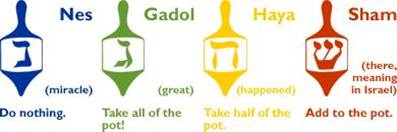
GEMATRIA:
When stodgy folks objected to the playing of dreidle, the ever resourceful pointed to a favorite exercise known as gematria to show the importance of the dreidle. In gematria, each Hebrew letter has a numeric equivalent. For example: alef=1, bet=2, and so on. The numerical equivalents of the letters on the dreidle are:
Nun = 50
Gimmel = 3
Hey = 5
Shin = 300
------------------
358
Remarkably, this is equivalent to the exact numerical value for the word “Mashiach“ (Messiah).
Mem = 40
Shin = 300
Yud = 10
Chet = 8
------------------
358
Thus, playing dreidle was permitted because it allowed concentration on bringing the Messiah!
The Secret of the Dreidel
By Rabbi Yaakov Asher Sinclair ====================================
The dreidel: A children’s game, played in the firelight of a cold winter night, the Chanukah Menorah silently glowing in the window... The dreidel, Its four sides spinning around the still point in the turning circle; spinning so fast that its sides blur into nothingness... The dreidel, So seemingly insignificant - and yet this little dreidel contains the story of the Jewish People; the history of the whole world... Our story starts not with the miracle of Chanukah, but 1,437 years earlier with Yaaqob‘s ladder. Yaaqob had a prophetic dream of angels ascending and descending a ladder that reached from the ground to the heavens. These angels weren’t Hollywood extras with fluorescent tubes over their heads, they were, in fact, incorporeal spiritual messengers, the protecting forces of four great kingdoms. Four kingdoms that would in the future dominate and exile the Jewish People: Babylon, Persia, Greece and Rome. At first, Yaakov saw the angel of Babylon ascend the ladder seventy steps and then he came down: The Jewish People were in the Babylonian exile for seventy years. The protecting angel of the Empire of Persia and Media then climbed up the ladder 52 steps before he descended: The Jewish People were in exile in Persia 52 years. Then the angel of the Empire of Greece climbed 180 rungs - the domination of Greece lasted 180 years. Finally, the protecting angel of the Roman Empire climbed up the ladder, but he didn’t come down. Yaakov feared that this final exile would never end, until HaShem promised Yaakov, If he will rise up like an eagle and make his nest among the stars, even from there I will bring him down. We are still in that final exile, in the softly asphyxiating embrace of Rome’s spiritual heirs....
THE FOUR KINGDOMS
BABYLON In the year 3338 (587/6 BCE), the first of our Holy Temples was razed to the ground, and the majority of the Jewish People led into exile by the Babylonian Emperor Sancheriv. Why was it such a tragedy that the Beit HaMikdash was destroyed? The Beit HaMikdash represents a unique pipeline between HaShem and Man. When it was destroyed, this flow of spiritual energy was severed. The level of this connection is linked to the word “nefesh” - soul.[104] Nefesh begins with the letter Nun, and Nun represents the kingdom of Babylon.
PERSIA As we know from the story of Esther, Haman was interested in finding the final solution of the Jewish problem, genocide. The exile of Persia and Media represents the threat to the body of the Jewish People, the physical threat of annihilation. The threat (guf) begins with Gimmel, which stands for the kingdom of Persia and Media.
GREECE on the other hand, represents the attack on the Torah itself, the Sechele, the wisdom of Israel. The Greeks weren’t interested in the physical destruction of the Jewish People; rather they wanted to destroy the spiritual core of Judaism, the Torah, and leave a Hellenized hulk that would conform to the Greek norms of aesthetics, drama and the superficial wisdom. Sechele begins with the letter Sin, that’s the letter of the kingdom of Greece.
ROME The fourth kingdom, Rome, is a summation of all the other exiles. At the beginning of their domination, the Romans, like the Babylonians, stopped the bringing of offerings in the Temple. Then, they destroyed the second Temple and inflicted unthinkable carnage on the “guf”, the body of Jewish People: After the massacre of Betar, they used Jewish blood as fertilizer for seven years. At first, Rome was the intellectual scion of Greece, but with the conversion of the emperor Constantine to Christianity in 313 CE, the Catholic Church became the spiritual heir of the Roman Empire. After the demise of the influence of the Church, the mantle of Rome was subsequently worn by secularism and materialism, the spiritual incarnation of Rome in our own times. Rome is all the exiles rolled into one and thus it is represented by the Hebrew word “HaKol,” meaning “all”. Its first letter is the letter Heh.
Where is the point at the center of a circle? Can you define it? And yet it exists. Just like the letter ‘yod’ in the Hebrew alphabet, a single dot - י from which the whole universe was created, the threshold of existence. The still point in the turning circle, and around that dot turns the whole world. The Jewish People are that little dot, so infinitesimally small, and yet around this dot, the world turns. What is the opposite of that little dot? What is the opposite of the central point that occupies no space? Direction, North, South, East and West. Expansion in four directions. Four is the antithesis of the One. Four is the number of the Kingdoms who stand eternally opposed to the
the Jewish People. Eternally opposed to He who is One. And to His reflection in this world, the Jewish People. Take another look at our dreidel spinning. What do you see? Four sides. Spinning around a central point that occupies no space. And when those sides spin, they themselves cease to have direction anymore. Now, in the blur of their whirling, they are a circle, a reflection of the still small point at its center. What is it that is carved on the sides of our dreidel? Nun, Gimmel, Shin, Heh... On the surface, those letters stand for “Nes Gadol Hayah Sham, A great miracle happened there”, The commemoration of a miraculous victory of a faithful few over the might of the Greek Empire. But on a deeper level, the dreidel is a microcosmic representation of the four kingdoms, Babylon, Persia, Greece and Rome spinning around the center, the Jewish People. And The Hand that spins the dreidel comes from above... Every empire thinks that it will last forever, but The Hand that spins only spins the dreidel of history for predetermined time and then, each Empire, despite its vainglorious boasting, falters on its axis...and finally crashes. The dreidel: A child’s game, played in the firelight of a cold winter night, the Chanukah Menorah silently glowing in the window... The dreidel: Its four sides spinning around the still point in the turning circle; spinning so fast that its sides blur into nothingness... The dreidel: So seemingly insignificant, and yet this little dreidel contains the story of the Jewish People; the history of the whole world...
Sources:
o Ramban Bereshit 28:12
o Pirke D’Rebbi Eliezer 35
o Maharal Ner Mitzvah
o Bne Yissachar, Kislev/Tevet, Essay 2:25
o ibid. Commentary on Bne Yissachar; Rav Nachman Bulman.
* * *
This study was written by
Rabbi Dr. Hillel ben David
(Greg Killian).
Comments may be submitted to:
Rabbi Dr. Greg Killian
12210 Luckey Summit
San Antonio, TX 78252
Internet address: gkilli@aol.com
Web page: http://www.betemunah.org/
(360) 918-2905
Return to The WATCHMAN home page
Send comments to Greg Killian at his email address: gkilli@aol.com
[1] Chanukah means ‘dedication’, or ‘inauguration’.
[2] Curiously, in 2013 (5774) The American holiday of Thanksgiving and Christmas roughly coincide with the Jewish Holyday of Thanksgiving, i.e. Chanukah, which is also called the festival of lights.
[3] Vayikra (Leviticus) 19:30 and 26:2
[4] Yerushalmi Demai 2:1, Rambam Shemitta 4:6
[6] Ezra Bick
[7] Sukkah 55b; cited by Rashi in his commentary to Bamidbar 29:18
[8] See Sukkah 47a, and Rashi’s commentary.
[9] See Beacons on the Talmud’s Sea - Lights in Transition where the connection between Chanukah and the Korbanot is discussed.
[10] The Tabernacle
[11] equinoxes and solstices
[12] Or Zorua 2:351, Mor U’Ktzia Ch.670
[13] Avodah Zarah 8a
[14] 164 BC
[16] Encyclopedia Brittanica
[17] Shabbat 21b.
[18] Rashi, loc. cit.
[19] According to this interpretation, the phrase (in VeAl HaNissim) “and they kindled lights in Your holy courtyards” does not refer to the lighting of the Menorah (for that was kindled in the Sanctuary building), but rather other lights kindled in celebration of the military victory. [The Derashot of the Chasam Sofer (p.67a) offer a different interpretation.]
[20] Rambam, Hilchot Megillah VeChanukah 3:1.
[22] Rambam, loc. cit. 3:3.
[23] Yam Shel Shlomo on Bava Kama, ch. 7, sec. 37; Bayit, Orach Chayim, sec. 670.
[24] From the wording of the Rambam it appears that he maintains that it is a mitzvah to hold such feasts. The Shulchan Aruch (Orach Chayim 670:2, based on statements of Rabbenu Asher and Rabbenu Yitzchak Alfasi) differs, maintaining that no mitzvah is involved. The Rama cites other authorities who share the view of the Rambam, but for different reasons.
[25] This is recited throughout all eight days of Chanukah (Rambam, loc. cit. 3:5; Shulchan Aruch, loc. cit. 683:1).
[26] The recitation of Hallel also connects to the military victory as reflected in the prayer beginning VeAl HaNissim.
[27] This concept is reflected in the realm of Halacha. Pesachim 26a states that an image (which is transmitted through light rays) “has no substance.”
[28] By Rabbi Abner Weiss
[29] From Chabad-Lubavitch
[30] Bereshit Rabbah on Bereshit 4:3
[31] Avodah Zarah 2b
[32] “Gateway To Judaism” page 389
[33] in his “Shir u’Renanim,” Bnei Brak 1997
[34] Ketubot 111b
[35] Pirkei d’Rebbi Eliezer #40
[36] Rav Mordechai Aran, 1997
[37] Shemot (Exodus) 3:4
[38] Shemot (Exodus) 27:19
[39] Shemot (Exodus) 27:20.
[40] Obadiah 1:18
[41] B’nei Yissachar
[42] I.e., outside the Temple.
[43] On which the Samaritans (Cutheans) had their Temple.
[44] One of the surviving members of the Great Synod, v. Aboth, Sonc. ed., p. 2, n. 1.
[45] Antipatris, in Judah, on the way from Jerusalem to Caesarea, was built by King Herod and called after his father, Antipater.
[46] Prohibiting every public mourning. This shews that Simeon wore the priestly garments outside Jerusalem.
[47] Ps. 119:126. [In Megillath Ta'anith the day of the destruction of the Temple on Mount Gerizim is 21st Kislev. According to Josephus it was destroyed by Hyrcanus in the year 128 B.C.E. For the literature on the subject v. Lichtenstein, H., HUCA, vol. VIII-IX, p. 288].
[48] “Gates of the Seasons”
[50] We don’t fast or mourn (Avodah Zarah 8a) because Adam said, ‘Woe is me, perhaps because I have sinned, the world around me is being darkened and returning to its state of chaos and confusion; this then is the kind of death to which I have been sentenced from Heaven!’ So he began keeping an eight days’ fast. When he realized that this was the way of the world, he stopped fasting and praying and began celebrating the next year.
[52] Sukkah 46a
[54] In keeping with Adam’s recognition that the days were getting longer, i.e. more light each day in Avodah Zarah 8a But as he observed the winter equinox and noted the day getting increasingly longer…
[55] Shabbat 21b; Rambam, Mishneh Torah, Hilchos Chanukah 4:1; Tur Shulchan Aruch, Orach Chayim 671:2.
[56] Op. cit.
[57] Rama, Orach Chayim 671:2.
[58] see Tur Orach Chayim 670, Mogen Avrohom 670:3, Mishna Brura 670:4
[59] see Minhogei Eretz Yisroel p.205
[60] Zevachim 22b; Rambam, Hilchos Bias HaMikdash 4:9.
[61] Shabbat, loc. cit.
[62] See Sefer HaMaamarim 5678, p. 269ff.; 5704, p. 192 ff.
[63] Arachin 13b; Or HaTorah on Chanukah, 326b ff.
[64] A traditional blessing used throughout the ages.
[65] Hilkhot Chanukah 4:12
[66] The wording of the blessing recited before the performance of a mitzva.
[67] Rambam, Mishneh Torah, Hilchot Teshuva 10:4-5.
[68] Phil Chernofsky, associate director, OU/NCSY Israel Center, Jerusalem
[70] “The Art of Jewish Living - Chanukahh”
[73] V. supra 22a.
[74] As he is to blame for placing his candle outside his shop.
[75] Feast of Dedication.
[76] As he was entitled to place the Chanukah candle outside.
[77] As to make him place his Chanukah candle on a higher level.
[78] V. Shab. 21a.
[79] As when placed at such a high level it will not be noticed by passersby and publicity will not be given to the miracle.
[80] V. Glos. Cf. Suk. I, 1.
[81] V. ‘Er, I, 1. An alley where a post or a stake would be required to be placed at the entrance for the purpose of enabling the inmates of that area to carry their domestic objects on the Sabbath day.
[82] Since he does not read it from the Scroll, why is it left open?
[83] In modern practice this is done.
[84] People would conclude that it had some defect, and for that reason another was brought
[85] Over the use of the second Scroll.
[86] The tenth month.
[87] The Feast of Dedication which occurs at the end of Kislev and the beginning of Tebet. Why are not all three portions read from one Scroll?
[88] I.e., to report whether the Beth din in Jerusalem have made the New Moon on the thirtieth or the thirty-first day after the preceding New Moon. Lit., ‘for six months’.
[89] As soon as the New Moon has been declared, on the twenty-ninth or the thirtieth day as the case may be.
[90] So that before Passover arrives the Jews in the Diaspora will know which day is the fifteenth.
[91] There is no need for them to go on Sivan, because the date of Pentecost is known from the counting of the ‘Omer.
[92] The ninth of Ab.
[93] Knowing the New Moon of Elul, the Jews of the Diaspora will fix New Year thirty days later, Elul usually having twenty-nine days, though there is still a risk that the Beth din may in any particular year declare Elul to have thirty.
[94] Viz., the Day of Atonement and Tabernacles, about which they could not be any surer than about New Year.
[95] Which commences on Kislev 25.
[96] Adar the 14th.
[97] The Passover for the unclean, kept on the fourteenth of Iyar. V. Num. IX, 1-14.
[98] Yom Kippur katan means, “a little Day of Atonement”.
[99] Rambam Laws of Teshuva Ch. 2, Hal. 7
[100] Because Kislev can have either 29 or 30 days, in some years the last day of Chanukah is Tevet 2, rather than Tevet 1 – Rosh Chodesh.
[101] Hoshana Rabba is the seventh and last day of the Feast of Tabernacles. The eighth day is called Shemini Atzeret and is a separate festival that is attached to the Feast of Tabernacles.
[102] This section is taken from: “Chanukah”, The Artscroll Mesorah Series, Mesorah publications.
[103] By Nachum Mohl




