
HaShem Dwelling In Us
By Rabbi Dr. Hillel ben David (Greg Killian)
In this study I would like to understand where HaShem dwells and I would like to understand the implications of this dwelling. Lets start by looking at the torah portion that provoked this study:
Shemot (Exodus) 25:8 “They shall make for Me a sanctuary and I will dwell in them.”
The Mishkan and the Temple were not merely places of prayer and service, but were actually the dwelling place of HaShem. It was a stunning declaration of the principle that HaShem’s interest is in man alone.
The commentaries point out that the verse does not say, “I will dwell inside it,” but rather “inside them”. What is the meaning of this unusual phrasing? To answer this question will require a bit of background. Lets start by examining the act of marriage.
The act of marriage causes the man and the woman to become one flesh, as we see in the Torah:
Bereshit (Genesis) 4:1 And Adam knew Eve his wife; and she conceived, and bare Cain, and said, I have gotten a man from HaShem.
And Adam knew Eve. This means that they were united on every possible level until they became “as one flesh”.
The Torah describes the mitzva of marital intimacy as onah, “a response to her”, implying that a man must attune himself to his wife and her desire for holiness in the marriage.
Adam HaRishon, before he sinned, had skin that was translucent like our finger nails, which incidentally, we remind ourselves of at Havdallah on Motzei Shabbat when we use the light of the fire to view our fingernails. Physical food and physical digestion were unnecessary, for Adam HaRishon, on his pre-sin level, received his life-sustaining Holy Sparks directly from HaShem through creation. Just like Moshe after he came down the mountain with his “glowing”.
Furthermore, on such a level, becoming “one flesh” with one’s wife was not physically impossible, but easy to do since the skin resembled light more than it did physical and obstructing flesh. Rashi’s pshat of such human unification taking place only through the children is a post-sin consequence, and obviously has many shortcomings.
Moreover, we see that the Jewish mystical tradition describes the union of a couple in marriage as the coming together of two half-souls. The physical union completes the expression of their total bond.
This act of becoming “one flesh”, or “knowing” creates, on a small but physical scale, what will be in the end of days. One could say, crudely, that in the act of marriage, Adam was the delivery system for his seed, his memories. What we understand from this is that the essential part of Adam, of man, is that which is inside the woman. She is the house and he is the dweller in the house!
When Jews marry, the woman walks seven times around the man in order to make herself into his house.
Hakham Shimshon Raphael Hirsh states that the Hebrew word for bride - kallah - means completion as in: “beyom kallot hamishkan - the day the tabernacle was completed.” Thus we see that the Mishkan (The Tabernacle, the Sanctuary) is a representation of the body of Mashiach. It is feminine and it is, and we are, the kallah, the bride.
Additionally it is well known that the woman is the undisputed ruler over her house. She determines the colors of the fabrics and the wall coverings. She arranges the furniture, and she chooses where her family is to live. In this she proves that she IS the house.
The man dwells in the house in the same way he dwells in the woman during the act of marriage. In fact, if you ask a man where is his favorite place, he will tell you that his favorite place is inside his wife while engaged in the act of marriage. Sex gives him his place. During sex, a man is in his house.
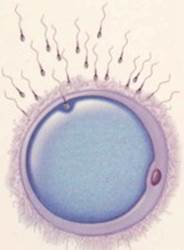
In the same way, the sprem dwells in the egg. The egg, from the woman, is the “house” and the sperm, from the man, is the dweller in the house.
This explanation is all well and good, but what does it mean? The meaning is as profound as you can possibly imagine! Consider the following pasukim:
Bereshit (Genesis) 3:16 Unto the woman he said, I will greatly multiply thy sorrow and thy conception; in sorrow thou shalt bring forth children; and thy desire shall be to thy husband, and he shall rule over thee.
Romans 8:1-8 There is therefore now no condemnation to them which are in Mashiach Yeshua, who walk not after the flesh, but after the Spirit. 2 For the law of the Spirit of life in Mashiach Yeshua hath made me free from the law of sin and death. 3 For what the law could not do, in that it was weak through the flesh, G-d sending his own Son in the likeness of sinful flesh, and for sin, condemned sin in the flesh: 4 That the righteousness of the law might be fulfilled in us, who walk not after the flesh, but after the Spirit. 5 For they that are after the flesh do mind the things of the flesh; but they that are after the Spirit the things of the Spirit. 6 For to be carnally minded is death; but to be spiritually minded is life and peace. 7 Because the carnal mind is enmity against G-d: for it is not subject to the law of G-d, neither indeed can be. 8 So then they that are in the flesh cannot please G-d.
This leads us to the following understanding: Adam as an androgynous[1] being had a feminine body and a masculine soul. I say that he was androgynous in both body and soul, but, the male dominated the soul and the female dominated the body. In the act of marriage, man becomes the soul and woman becomes the body. This has profound implications!
Midrash Rabbah - Leviticus XIV:1 Rabbi Shemuel bar Nachman said: When the Holy One, blessed be He, created the first man, he created him an hermaphrodite. Rabbi Levi said: When man was created, he was created with two body fronts, and He sawed him in two, so that two backs resulted, one back for the male and another for the female. An objection was raised: “And He took one of his ribs” (Bereishit 2:21). He answered: The word should be rendered “of his sides,” as it is written: “And for the second side of the tabernacle” (Shemot 26:20)
We find that many mitzvot are commanded solely to the man, while others are the domain of the woman: a husband and wife, our sages explain, embody the two halves of a single soul; the deeds of each contribute to their common soul’s fulfillment of both the “masculine” and “feminine” elements of its mission in life.
Consider also that the body of Mashiach is feminine and will be the bride of HaShem. Now we know that Mashiach has a bride too. This means that Mashiach ben David will become the second Adam when he mates with Israel his bride:
I Corinthians 15:45 And so it is written, The first man Adam was made a living soul; the last Adam was made a quickening spirit.
As the first man was androgynous, so the last Adam will be androgynous. This androgynous Adam will then become the bride of HaShem:
Yehezekel (Ezekiel) 16:3-13 And say, Thus saith the Lord HaShem unto Jerusalem; Thy birth and thy nativity is of the land of Canaan; thy father was an Amorite, and thy mother an Hittite. 4 And as for thy nativity, in the day thou wast born thy navel was not cut, neither wast thou washed in water to supple thee; thou wast not salted at all, nor swaddled at all. 5 None eye pitied thee, to do any of these unto thee, to have compassion upon thee; but thou wast cast out in the open field, to the lothing of thy person, in the day that thou wast born. 6 ¶ And when I passed by thee, and saw thee polluted in thine own blood, I said unto thee when thou wast in thy blood, Live; yea, I said unto thee when thou wast in thy blood, Live. 7 I have caused thee to multiply as the bud of the field, and thou hast increased and waxen great, and thou art come to excellent ornaments: thy breasts are fashioned, and thine hair is grown, whereas thou wast naked and bare. 8 Now when I passed by thee, and looked upon thee, behold, thy time was the time of love; and I spread my skirt over thee, and covered thy nakedness: yea, I sware unto thee, and entered into a covenant with thee, saith the Lord HaShem, and thou becamest mine. 9 Then washed I thee with water; yea, I throughly washed away thy blood from thee, and I anointed thee with oil. 10 I clothed thee also with broidered work, and shod thee with badgers’ skin, and I girded thee about with fine linen, and I covered thee with silk. 11 I decked thee also with ornaments, and I put bracelets upon thy hands, and a chain on thy neck. 12 And I put a jewel on thy forehead, and earrings in thine ears, and a beautiful crown upon thine head. 13 Thus wast thou decked with gold and silver; and thy raiment was of fine linen, and silk, and broidered work; thou didst eat fine flour, and honey, and oil: and thou wast exceeding beautiful, and thou didst prosper into a kingdom.
When HaShem marries His bride, she will be His House and He will dwell in her. He will be the soul and she will be the body, so to speak.
On Tisha B’Ab, when we mourn the destruction of the Temple, let us remember that the Temple was a physical representation of reality. It was NOT the reality! The reality is the body of Mashiach with HaShem dwelling in His people, as it says:
Shemot (Exodus) 25:8 “They shall make for Me a sanctuary and I will dwell in them.”
Matityahu (Matthew) 12:6 But I say unto you, That in this place is one (Mashiach) greater than the temple.
Yochanan (John) 2:19 Yeshua answered and said unto them, Destroy this temple, and in three days I will raise it up.
HaShem has asked us to bring what is needed to build His dwelling place. We are not looking to create a building made of inanimate stones, but rather a Temple of living stones (the body of Mashiach).
1 Tsefet (Peter) 2:5 Ye also, as lively stones, are built up a spiritual house, an holy priesthood, to offer up spiritual sacrifices, acceptable to God by Yeshua HaMashiach.
We are commanded to form a living structure in which HaShem will dwell. How do we do this?
To answer this question we must take a look at what was required of the physical components that made up the sanctuary. Those things which were used as the building blocks for the sanctuary were required to be new stones. Stones that had not been used for altars to other gods. Additionally, these stones needed to be fashioned without using metal implements. Since metal was used for war and killng, it was not suitable for forming the building blocks used in HaShem’s house.
From a close examination of what went into forming the stones, we can see that the people who make up the lively stones, must also be formed properly. What does it mean to be formed?
To answer this question involves a bit of self-examination. First we must ask: What is a natural stone, a natural man? Surely we must say that the natural man is described in detail as:
I Corinthians 2:13-14 Which things also we speak, not in the words which man’s wisdom teacheth, but which the Holy Ghost teacheth; comparing spiritual things with spiritual. 14 But the natural man receiveth not the things of the Spirit of God: for they are foolishness unto him: neither can he know them, because they are spiritually discerned.
A natural man is a man who can not receive the things of HaShem. It follows that a man who is properly formed, and is no longer “natural”, is a man who discerns the wisdom of HaShem. Wisdom is the word used through out the Tanakh[2] as the epitome of Torah. Thus we would say that a properly formed man is a man of Torah study and Torah deeds.
Now a man of Torah deeds will be properly formed. To the extent that he avoids bloodshed, to that extent he is a stone formed without metal implements.
Shemot (Exodus) 25:8 “They shall make for Me a sanctuary and I will dwell in them.”
Let us pursue Torah and it’s deeds in order that we might build the lively stones, the stones of the final sanctuary, the body of Mashiach. Let us prepare now for intimacy with HaShem
Please remember that our Sages have taught that the Temple was destroyed because Jew hated Jew without cause. This hatred pulled the lively stones apart. When the lively stones were broken this was reflected in the stones of the physical Temple being pulled apart and destroyed. The goal of the Torah is the building up of the lively stones into the body of Mashiach in order that we we might be a fitting place for HaShem to dwell.
Without Torah and it’s deeds, the Sanctuary of living stones can never be built. Let us focus on this goal on Tisha B’Ab.
* * *
This study was written by
Rabbi Dr. Hillel ben David
(Greg Killian).
Comments may be submitted to:
Rabbi Dr. Greg Killian
12210 Luckey Summit
San Antonio, TX 78252
Internet address: gkilli@aol.com
Web page: http://www.betemunah.org/
(360) 918-2905
Return to The WATCHMAN home page
Send comments to Greg Killian at his email address: gkilli@aol.com
[1] An hermaphrodite like
creature.
[2] Tanakh (Hebrew: תנ׳ך) (also Tanach, IPA: [ta’nax] or [tə’nax], Tenakh or Tenak) is an acronym that identifies the Hebrew Bible. The acronym is formed from the initial Hebrew letters of the Tanakh's three traditional subdivisions:
Torah (תורה), meaning "teaching" or "law," includes the Five Books of Moses. The Torah is also known by its Greek name, "the Pentateuch," which similarly means "five scrolls."
Nevi'im (נביאים), meaning "Prophets." The Nevi'im are often divided into the Earlier Prophets, which are generally historical, and the Later Prophets, which contain more exhortational prophecies.
Ketuvim (כתובים), meaning "Writings," are sometimes also known by the Greek title "Hagiographa." These encompass all the remaining books, and include the Five Scrolls.