
HaShem - יהוה
By Rabbi Dr. Hillel ben David (Greg Killian)
HaShem is the Hebrew word which many pious Jews use instead of the yod-hey-vav-hey (יהוה– YHVH[1]) name, in casual conversations, and literally means The Name. When they encounter this name during prayers or when reading from the Torah, they visualize יהוה and say Adonai. HaShem is used 7484 times in the Tanach[2]. Neither HaShem, nor it’s Greek equivalent[3] is ever used in the Nazarean Codicil.[4]
The first use, of HaShem, is in:
Bereshit (Genesis) 2:4 This is the account of the heavens and the earth when they were created. When HaShem God made the earth and the heavens--
The yod-hay-vav-hay name means “self existent” or “eternal”, according to Strong’s (3068).
When HaShem revealed His name to Moses, He added “this is my name forever (leolam)”. The word leolam is written in the Torah without a “vav - ו”, and can be read lealeim which means to hide. The Gemara learns from this that the name of HaShem is not to be read the way it is written.
Pesachim 50a And the Lord shall be King over all the earth; in that day shall the Lord be One, and His name one:[5] is He then not One now? — Said R. Aha b. Hanina: Not like this world is the future world. In this world, for good tidings one says, ‘He is good, and He doeth good’, while for evil tidings he says, ‘Blessed be the true Judge’; [whereas] in the future world it shall be only ‘He is good and He doeth good’. ‘And His name one‘: what does ‘one‘ mean? Is then now His name not one? — Said R. Nahman b. Isaac; Not like this world is the future world. [In] this world [His name] is written with a yod he[6] and read as alef dalet;[7] but in the future world it shall all be one: it shall be written with yod he and read as yod he. Now, Raba thought of lecturing it at the session, [whereupon] a certain old man said to him, It is written, lealeim.[8] R. Abina pointed out a contradiction: It is written, this is my name, to be hidden; [and it is also written], and this is my memorial unto all generations?[9] The Holy One, blessed be He, said: Not as I [i.e., My name] and written am I read: I am written with a yod he, while I am read as alef dalet.
Why don’t Jews use HaShem’s name?
Answer: Because they are trying not to misuse His name according to:
Shemot (Exodus) 20:7 “You shall not misuse the name of HaShem your God, for HaShem will not hold anyone guiltless who misuses his name.
And:
Devarim (Deuteronomy) 5:11 “You shall not misuse the name of HaShem your God, for HaShem will not hold anyone guiltless who misuses his name.
Further, the name of יהוה, properly pronounced, was normally used only by the High Priest on Yom HaKippurim after atonement had been achieved. Chazal (our Sages) understood that to say this name while in a state of impurity was to put one in danger of death as we brought The Holy One close to ourselves in an impure state. Purity and impurity can not exist together.
(Rashi’s Commentary for: Shemot (Exodus) 20:21 Wherever I allow My name to be mentioned, I will come to you and bless you Heb. אַזְכִּיר , lit., I will mention. [This should apparently read תַּזְכִּיר , you will mention. Therefore, Rashi explains that it means: whenever] I will permit you to mention My Explicit Name, there I will come to you and bless you. I will cause My Shechinah to rest upon you. From here you learn that permission was given to mention the Explicit Name only in the place to which the Shechinah comes, and that is in the Temple in Jerusalem. There permission was given to the priests to mention the Explicit Name when they raise their hands to bless the people.[10])
The following Gemara shows how seriously we Jews take this matter.
Avodah Zarah 18a They then brought up R. Hanina b. Teradion and asked him, ‘Why hast thou occupied thyself with the Torah?’ He replied, ‘Thus the Lord my God commanded me.’ At once they sentenced him to be burnt, his wife to be slain, and his daughter to be consigned to a brothel. (The punishment of being burnt came upon him because he pronounced the Name in its full spelling. But how could he do so? Have we not learnt: The following have no portion in the world to come: He who says that the Torah is not from Heaven, or that the resurrection of the dead is not taught in the Torah. Abba Saul says: Also he who pronounces the Name in its full spelling? — He did it in the course of practicing, as we have learnt: Thou shalt not learn to do after the abominations of those nations, but thou mayest learn [about them] in order to understand and to teach. Why then was he punished? — Because he was pronouncing the Name in public. His wife was punished by being slain, because she did not prevent him [from doing it]. From this it was deduced: Any one who has the power to prevent [one from doing wrong] and does not prevent, is punished for him. His daughter was consigned to a brothel, for R. Johanan related that once that daughter of his was walking in front of some great men of Rome who remarked, ‘How beautiful are the steps of this maiden!’ Whereupon she took particular care of her step. Which confirms the following words of R. Simeon b. Lakish: What is the meaning of the verse, The iniquity of my heel compasseth me about? — Sins which one treads under heel in this world compass him about on the Day of Judgment.)
Rashi, on Shemot 20:21, gives us a tremendous insight into the restricted use of this special name:
Wherever I allow My name to be mentioned, I will come to you and bless you Heb. אַזְכִּיר, lit., I will mention. [This should apparently read תַּזְכִּיר, you will mention. Therefore, Rashi explains that it means: whenever] I will permit you to mention My Explicit Name, there I will come to you and bless you. I will cause My Shechinah to rest upon you. From here you learn that permission was given to mention the Explicit Name only in the place to which the Shechinah comes, and that is in the Temple in Jerusalem. There permission was given to the priests to mention the Explicit Name when they raise their hands to bless the people.[11]
What are the attributes of this name?
The Midrash comes to us with this response:
Midrash Rabbah - Exodus III:6 AND GOD SAID UNTO MOSES (III, 14). R. Abba b. Mammel said: God said to Moses: ‘ Thou wishest to know My name. Well, I am called according to My work; sometimes I am called “Almighty God”, “Lord of Hosts”, “God”, “Lord”. When I am judging created beings, I am called “ God”,’ and when I am waging war against the wicked, I am called “Lord of Hosts”. When I suspend judgment for a man’s sins, I am called “El Shadday “ (Almighty God), and when I am merciful towards My world, I am called “Adonai”, for “Adonai” refers to the Attribute of Mercy, as it is said: The Lord, the Lord (Adonai, Adonai), God, merciful and gracious (ib. XXXIV, 6).
The Vilna Gaon answers that the various names of HaShem represent different attributes that he reveals to the Jewish people. The name יהוה represents the attribute of mercy (chesed), as we learn from the above Midrash.
What is the penalty for pronouncing this name?
Sanhedrin 90a MISHNAH. ALL ISRAEL HAVE A PORTION IN THE WORLD TO COME, FOR IT IS WRITTEN, THY PEOPLE ARE ALL RIGHTEOUS; THEY SHALL INHERIT THE LAND FOR EVER, THE BRANCH OF MY PLANTING, THE WORK OF MY HANDS, THAT I MAY BE GLORIFIED.’ BUT THE FOLLOWING HAVE NO PORTION THEREIN: HE WHO MAINTAINS THAT RESURRECTION IS NOT A BIBLICAL DOCTRINE, THE TORAH WAS NOT DIVINELY REVEALED, AND AN EPIKOROS. R. AKIBA ADDED: ONE WHO READS UNCANONICAL BOOKS. ALSO ONE WHO WHISPERS [A CHARM] OVER A WOUND AND SAYS, I WILL BRING NONE OF THESE DISEASES UPON THEE WHICH I BROUGHT UPON THE EGYPTIANS: FOR I AM THE LORD THAT HEALETH THEE.’ ABBA SAUL SAYS: ALSO ONE WHO PRONOUNCES THE DIVINE NAME AS IT IS SPELT.
Having no share in the world to come is a severe consequence that we bring on ourselves by trying to draw near to HaShem in a state of impurity.
Why don’t Christians use HaShem’s name?
Answer: I suspect most of them rely on their Bibles to give them the words to use. Since most Bibles do not use the name “HaShem”, I suspect that most folks are ignorant of His name or the importance of His name. In the NIV, KJV, and the Jerusalem Bibles they use “LORD” instead of HaShem. The NASB uses “Lord” instead of HaShem.
Anything that we need to know about HaShem, He’ll tell us. He has told us that knowing His name, HaShem, is important. We read this in:
Tehillim (Psalms) 9:9-10 HaShem is a refuge for the oppressed, a stronghold in times of trouble. Those who know your name will trust in you, for you, HaShem, have never forsaken those who seek you.
So, those who know His name will trust in Him. This “knowing” was really the knowledge of His authority and power as we learned in our study on name.
He emphasizes His name in:
Tehillim (Psalms) 83:18 Let them know that you, whose name is HaShem--that you alone are the Most High over all the earth.
Yeshayahu (Isaiah) 43:1-3 But now, this is what HaShem says--he who created you, O Jacob, he who formed you, O Israel: “Fear not, for I have redeemed you; I have summoned you by name; you are mine. When you pass through the waters, I will be with you; and when you pass through the rivers, they will not sweep over you. When you walk through the fire, you will not be burned; the flames will not set you ablaze. For I am HaShem, your God, the Holy One of Israel, your Savior; I give Egypt for your ransom, Cush and Seba in your stead.
If you don’t think these are good enough reasons, consider that salvation requires that we call on the name of HaShem (on His authority):
Yoel (Joel) 2:32 And everyone who calls on the name of HaShem will be saved; for on Mount Zion and in Jerusalem there will be deliverance, as HaShem has said, among the survivors whom HaShem calls.
II Luqas (Acts) 2:17-21 “‘In the last days, God says, I will pour out my Spirit on all people. Your sons and daughters will prophesy, your young men will see visions, your old men will dream dreams. Even on my servants, both men and women, I will pour out my Spirit in those days, and they will prophesy. I will show wonders in the heaven above and signs on the earth below, blood and fire and billows of smoke. The sun will be turned to darkness and the moon to blood before the coming of the great and glorious day of HaShem. And everyone who calls on the name of HaShem will be saved.’
So, what does it mean to call upon the name of HaShem? To call upon the name of HaShem = to proclaim His Name = To confess His Name = to hold a Jewish Prayer service on Shabbat and weekdays which includes the reading of the Torah and a sermon. So attending Synagogue for a Jewish service is, in itself, making confession with the mouth since there in the presence of the community we recite Shema. Which means that we publicly take upon ourselves the yoke of the Kingdom of Heaven.[12]
So, in the verses below, we can see that Abram started a public prayer service; he established a synagogue and invited all to come and join him in the service of HaShem:
Bereshit (Genesis) 12:6-9 And Abram passed through the land unto the place of Sichem, unto the plain of Moreh. And the Canaanite [was] then in the land. And the HaShem appeared unto Abram, and said, Unto thy seed will I give this land: and there builded he an altar unto the HaShem, who appeared unto him. And he removed from thence unto a mountain on the east of Beth-el, and pitched his tent, [having] Beth-el on the west, and Hai on the east: and there he builded an altar unto the HaShem, and called upon the name of the HaShem. And Abram journeyed, going on still toward the south.
Bereshit (Genesis) 13:2-4 And Abram [was] very rich in cattle, in silver, and in gold. And he went on his journeys from the south even to Beth-el, unto the place where his tent had been at the beginning, between Beth-el and Hai; Unto the place of the altar, which he had made there at the first: and there Abram called on the name of HaShem.
Bereshit (Genesis) 21:33 And [Abraham] planted a grove in Beer-sheba, and called there on the name of HaShem, the everlasting God.
HaShem also emphasized that those who cause us to “forget” His name will also have lots of trouble:
Yiremeyahu (Jeremiah) 23:25-27 “I have heard what the prophets say who prophesy lies in my name. They say, ‘I had a dream! I had a dream!’ How long will this continue in the hearts of these lying prophets, who prophesy the delusions of their own minds? They think the dreams they tell one another will make my people forget my name, just as their fathers forgot my name through Baal worship.
One of the main reasons for the exodus was to proclaim HaShem’s name:
Shemot (Exodus) 9:13-16 Then HaShem said to Moses, “Get up early in the morning, confront Pharaoh and say to him, ‘This is what HaShem, the God of the Hebrews, says: Let my people go, so that they may worship me, Or this time I will send the full force of my plagues against you and against your officials and your people, so you may know that there is no one like me in all the earth. For by now I could have stretched out my hand and struck you and your people with a plague that would have wiped you off the earth. But I have raised you up for this very purpose, that I might show you my power and that my name might be proclaimed in all the earth.
I would like to belabor the importance of HaShem’s name by reading the following scriptures:
Shemot (Exodus) 23:19-21 “Bring the best of the firstfruits of your soil to the house of HaShem your God. “Do not cook a young goat in its mother’s milk. “See, I am sending an angel ahead of you to guard you along the way and to bring you to the place I have prepared. Pay attention to him and listen to what he says. Do not rebel against him; he will not forgive your rebellion, since my Name is in him.
Iyov (Job) 1:20-21 At this, Job got up and tore his robe and shaved his head. Then he fell to the ground in worship And said: “Naked I came from my mother’s womb, and naked I will depart. HaShem gave and HaShem has taken away; may the name of HaShem be praised.”
Tehillim (Psalms) 25:11 For the sake of your name, HaShem, forgive my iniquity, though it is great.
Tehillim (Psalms) 31:1-3 {For the director of music. A psalms of David.} In you, HaShem, I have taken refuge; let me never be put to shame; deliver me in your righteousness. Turn your ear to me, come quickly to my rescue; be my rock of refuge, a strong fortress to save me. Since you are my rock and my fortress, for the sake of your name lead and guide me.
Tehillim (Psalms) 86:12 I will praise you, HaShem my God, with all my heart; I will glorify your name forever.
Tehillim (Psalms) 91:14 “Because he loves me,” says HaShem, “I will rescue him; I will protect him, for he acknowledges my name.
Tehillim (Psalms) 103:1 {Of David.} Praise HaShem, O my soul; all my inmost being, praise his holy name.
Tehillim (Psalms) 145:21 My mouth will speak in praise of HaShem. Let every creature praise his holy name for ever and ever.
Yeshayahu (Isaiah) 25:1 HaShem, you are my God; I will exalt you and praise your name, for in perfect faithfulness you have done marvelous things, things planned long ago.
Yeshayahu (Isaiah) 42:8 “I am HaShem; that is my name! I will not give my glory to another or my praise to idols.
Yeshayahu (Isaiah) 52:4-7 For this is what the Sovereign HaShem says: “At first my people went down to Egypt to live; lately, Assyria has oppressed them. “And now what do I have here?” declares HaShem. “For my people have been taken away for nothing, and those who rule them mock,” declares HaShem. “And all day long my name is constantly blasphemed. Therefore my people will know my name; therefore in that day they will know that it is I who foretold it. Yes, it is I.” How beautiful on the mountains are the feet of those who bring good news, who proclaim peace, who bring good tidings, who proclaim salvation, who say to Zion, “Your God reigns!”
Yeshayahu (Isaiah) 56:4-7 For this is what HaShem says: “To the eunuchs who keep my Sabbaths, who choose what pleases me and hold fast to my covenant-- To them I will give within my temple and its walls a memorial and a name better than sons and daughters; I will give them an everlasting name that will not be cut off. And foreigners who bind themselves to HaShem to serve him, to love the name of HaShem, and to worship him, all who keep the Sabbath without desecrating it and who hold fast to my covenant These I will bring to my holy mountain and give them joy in my house of prayer. Their burnt offerings and sacrifices will be accepted on my altar; for my house will be called a house of prayer for all nations.”
Yechezkel (Ezekiel) 39:7 “‘I will make known my holy name among my people Israel. I will no longer let my holy name be profaned, and the nations will know that I, HaShem, am the Holy One in Israel.
Yoel (Joel) 2:26 You will have plenty to eat, until you are full, and you will praise the name of HaShem your God, who has worked wonders for you; never again will my people be shamed.
Zechariah 13:7-9 “Awake, O sword, against my shepherd, against the man who is close to me!” declares HaShem Almighty. “Strike the shepherd, and the sheep will be scattered, and I will turn my hand against the little ones. In the whole land,” declares HaShem, “two-thirds will be struck down and perish; yet one-third will be left in it. This third I will bring into the fire; I will refine them like silver and test them like gold. They will call on my name and I will answer them; I will say, ‘They are my people,’ and they will say, ‘HaShem is our God.’”
Malachi 4:1-2 “Surely the day is coming; it will burn like a furnace. All the arrogant and every evildoer will be stubble, and that day that is coming will set them on fire,” says HaShem Almighty. “Not a root or a branch will be left to them. But for you who revere my name, the sun of righteousness will rise with healing in its wings. And you will go out and leap like calves released from the stall.
Revelation 3:11-13 I am coming soon. Hold on to what you have, so that no one will take your crown. Him who overcomes I will make a pillar in the temple of my God. Never again will he leave it. I will write on him the name of my God and the name of the city of my God, the new Jerusalem, which is coming down out of heaven from my God; and I will also write on him my new name. He who has an ear, let him hear what the Spirit says to the churches.
Calling on the name (having a prayer service[13]) of HaShem began with Seth:
Bereshit (Genesis) 4:26 Seth also had a son, and he named him Enosh. At that time men began to call on the name of HaShem.
David commanded us to call on the name of HaShem:
I Divrei HaYamim (Chronicles) 16:8 Give thanks to HaShem, call on his name; make known among the nations what he has done.
Tehillim (Psalms) 116:13 I will lift up the cup of salvation and call on the name of HaShem.
Tehillim (Psalms) 116:17 I will sacrifice a thank offering to you and call on the name of HaShem.
We will be calling on the name of HaShem in the future:
Yeshayahu (Isaiah) 12:4 In that day you will say: “Give thanks to HaShem, call on his name; make known among the nations what he has done, and proclaim that his name is exalted.
Yiremeyahu (Jeremiah) 3:17 At that time they will call Jerusalem The Throne of HaShem, and all nations will gather in Jerusalem to honor the name of HaShem. No longer will they follow the stubbornness of their evil hearts.
Tzefaniah (Zephaniah) 3:9 “Then will I purify the lips of the peoples, that all of them may call on the name of HaShem and serve him shoulder to shoulder.
Zechariah 13:9 This third I will bring into the fire; I will refine them like silver and test them like gold. They will call on my name and I will answer them; I will say, ‘They are my people,’ and they will say, ‘HaShem is our God.’”
Yiremeyahu (Jeremiah) 23:6 In his days Judah will be saved and Israel will live in safety. This is the name by which he will be called: HaShem Our Righteousness.
We are commanded to worship HaShem by name:
Shemot (Exodus) 20:1-3 And God spoke all these words: “I am HaShem your God, who brought you out of Egypt, out of the land of slavery. “You shall have no other gods before me.
Shemot (Exodus) 23:25 Worship HaShem your God, and his blessing will be on your food and water. I will take away sickness from among you,
Shemot (Exodus) 34:14 Do not worship any other god, for HaShem, whose name is Jealous, is a jealous God.
Devarim (Deuteronomy) 8:19 If you ever forget HaShem your God and follow other gods and worship and bow down to them, I testify against you today that you will surely be destroyed.
I Divrei HaYamim (Chronicles) 16:29 Ascribe to HaShem the glory due his name. Bring an offering and come before him; worship HaShem in the splendor of his holiness.
Revelation 15:4 Who will not fear you, the Lord, and bring glory to your name? For you alone are holy. All nations will come and worship before you, for your righteous acts have been revealed.”
We have all seen the freeway signs that say: Jesus Saves. This is contrary to scripture. Jesus (Yeshua) means “HaShem Saves“. This means that HaShem saves us, not Yeshua. Let’s look at some Scriptures to see who saves:
Shemot (Exodus) 14:30 That day HaShem saved Israel from the hands of the Egyptians, and Israel saw the Egyptians lying dead on the shore.
Shemot (Exodus) 18:8 Moses told his father-in-law about everything HaShem had done to Pharaoh and the Egyptians for Israel’s sake and about all the hardships they had met along the way and how HaShem had saved them.
Devarim (Deuteronomy) 33:29 Blessed are you, O Israel! Who is like you, a people saved by HaShem? He is your shield and helper and your glorious sword. Your enemies will cower before you, and you will trample down their high places.”
Shoftim (Judges) 2:18 Whenever HaShem raised up a judge for them, he was with the judge and saved them out of the hands of their enemies as long as the judge lived; for HaShem had compassion on them as they groaned under those who oppressed and afflicted them.
II Shmuel (Samuel) 22:4 I call to HaShem, who is worthy of praise, and I am saved from my enemies.
Yeshayahu (Isaiah) 25:9 In that day they will say, “Surely this is our God; we trusted in him, and he saved us. This is HaShem, we trusted in him; let us rejoice and be glad in His salvation.”
Yeshayahu (Isaiah) 43:11 I, even I, am HaShem; and beside Me there is no saviour. I have revealed and saved and proclaimed--I, and not some foreign god among you. You are my witnesses,” declares HaShem, “that I am God.
Yeshayahu (Isaiah) 45:17 But Israel will be saved by HaShem with an everlasting salvation; you will never be put to shame or disgraced, to ages everlasting.
Yiremeyahu (Jeremiah) 17:14 Heal me, HaShem, and I will be healed; save me and I will be saved, for you are the one I praise.
Yoel (Joel) 2:28-32 ‘And afterward, I will pour out my Spirit on all people. Your sons and daughters will prophesy, your old men will dream dreams, your young men will see visions. Even on my servants, both men and women, I will pour out my Spirit in those days. I will show wonders in the heavens and on the earth, blood and fire and billows of smoke. The sun will be turned to darkness and the moon to blood before the coming of the great and dreadful day of HaShem. And everyone who calls on the name of HaShem will be saved; for on Mount Zion and in Jerusalem there will be deliverance, as HaShem has said, among the survivors whom HaShem calls.
We have Yoel (Joel) quoted again in the Nazarean Codicil:
II Luqas (Acts) 2:16-21 No, this is what was spoken by the prophet Yoel (Joel): “‘In the last days, God says, I will pour out my Spirit on all people. Your sons and daughters will prophesy, your young men will see visions, your old men will dream dreams. Even on my servants, both men and women, I will pour out my Spirit in those days, and they will prophesy. I will show wonders in the heaven above and signs on the earth below, blood and fire and billows of smoke. The sun will be turned to darkness and the moon to blood before the coming of the great and glorious day of Lord. And everyone who calls on the name of Lord will be saved.’
In the above passage it is noteworthy that the title “Lord” has been substituted for HaShem. HaShem, or it’s Greek equivalent is NEVER used in the Nazarean Codicil.[14] The proper name of God, HaShem, was not used outside of the Temple, during the days of the second Temple. Jews (all of Yeshua’s apostles and disciples), in the first and second centuries, honored His Name, HaShem, in the same way that Jews honor HaShem today.
Remember what the name of Yeshua means. (Yeshua[15] means: HaShem Saves) as you read this next scripture:
II Luqas (Acts) 4:8-12 Then Peter, filled with the Holy Spirit, said to them: “Rulers and elders of the people! If we are being called to account today for an act of kindness shown to a cripple and are asked how he was healed, Then know this, you and all the people of Israel: It is by the name of Yeshua The Anointed one of Nazareth, whom you crucified but whom God raised from the dead, that this man stands before you healed. He is “‘the stone you builders rejected, which has become the capstone.’ Salvation is found in no one else, for there is no other name under heaven given to men by which we must be saved.”
II Luqas (Acts) 15:7-11 After much discussion, Peter got up and addressed them: “Brothers, you know that some time ago God made a choice among you that the Gentiles might hear from my lips the message of the gospel and believe. God, who knows the heart, showed that he accepted them by giving the Holy Spirit to them, just as he did to us. He made no distinction between us and them, for he purified their hearts by faith. Now then, why do you try to test God by putting on the necks of the disciples a yoke that neither we nor our fathers have been able to bear? No! We believe it is through the grace of the Lord Yeshua that we are saved, just as they are.”
II Luqas (Acts) 16:31 They replied, “Believe in the Lord Yeshua The Anointed One, and you will be saved--you and your household.”
Romans 10:5-13 Moses describes in this way the righteousness that is by the law: “The man who does these things will live by them.” But the righteousness that is by faith says: “Do not say in your heart, ‘Who will ascend into heaven?’” (that is, to bring The Anointed One down) “Or ‘Who will descend into the deep?’” (that is, to bring The Anointed One up from the dead). But what does it say? “The word is near you; it is in your mouth and in your heart,” that is, the word of faith we are proclaiming: That if you confess with your mouth, “Yeshua is Lord,” and believe in your heart that God raised him from the dead, you will be saved. For it is with your heart that you believe and are justified, and it is with your mouth that you confess and are saved. As the Scripture says, “Anyone who trusts in him will never be put to shame.” For there is no difference between Jew and Gentile--the same Lord of all and richly blesses all who call on him, For, “Everyone who calls on the name of the Lord will be saved.”
Tehillim (Psalms) 96:2 Sing to HaShem, praise His name; proclaim His salvation day after day.
Tehillim (Psalms) 116:13 I will lift up the cup of salvation and call on the name of HaShem.
Yeshua is NOT HaShem. Let me detail them: ****
1. HaShem (YHVH) is called "The Father" in the NT. The Father and the Son are two separate entities (HaShem is One). ****
2. No man has seen The Father - Joh 6:46. ****
3. The Greek word for God is ambiguous and applies to HaShem and to men, and to false gods. ****
4. Hebrew has multiple words for God e.g. Elohim, YHVH, Adonai, El, YAH, etc. The word translated as 'God', in English translations, is Elohim. This word is also ambiguous and applies to HaShem and to men - e.g. Moses was Elohim to Paro. However, YHVH ONLY applies to HaShem and NEVER to men. Thus, most Christian theology DEPENDS on Elohim / God for its understanding that Yeshua is God. (Elohim means "Judge" or one exercizing the attribute of judgment.) ****
5. There are 2 words translated as "worship" in English translations in the NT. One is applied to many men and also Yeshua. This word means "to bow down". The other word is applied ONLY to "The Father" and menas "worship". This means that NO ONE EVER worships Yeshua. They ONLY worship "The Father". ****
6. The shema teaches us that HaShem is ONE.
Now, I would like to examine the meaning of “calling on a name“ (having a prayer service) or “making a name“, and the distinction between the two. Lets start by seeing who called on the name of HaShem:
Bereshit (Genesis) 4:25-26 Adam lay with his wife again, and she gave birth to a son and named him Seth, saying, “God has granted me another child in place of Abel, since Cain killed him.” Seth also had a son, and he named him Enosh. At that time men began to call on the name of HaShem.
The first person to call upon the name of HaShem, was Seth. Seth began to call on the Name when his first child was born.
Bereshit (Genesis) 12:7-8 HaShem appeared to Abram and said, “To your offspring I will give this land.” So he built an altar there to HaShem, who had appeared to him. From there he went on toward the hills east of Bethel and pitched his tent, with Bethel on the west and Ai on the east. There he built an altar to HaShem and called on the name of HaShem.
Here we see that Abram (Avraham) called on the name of HaShem. Abram did this when HaShem promised him offspring and land.
Bereshit (Genesis) 13:1-4 So Abram went up from Egypt to the Negev, with his wife and everything he had, and Lot went with him. Abram had become very wealthy in livestock and in silver and gold. From the Negev he went from place to place until he came to Bethel, to the place between Bethel and Ai where his tent had been earlier And where he had first built an altar. There Abram called on the name of HaShem.
Here we see that Abram called on the name of HaShem again. Abram did this at the same place where HaShem promised him offspring and land.
Bereshit (Genesis) 21:28-34 Abraham set apart seven ewe lambs from the flock, And Abimelech asked Abraham, “What is the meaning of these seven ewe lambs you have set apart by themselves?” He replied, “Accept these seven lambs from my hand as a witness that I dug this well.” So that place was called Beersheba, because the two men swore an oath there. After the treaty had been made at Beersheba, Abimelech and Phicol the commander of his forces returned to the land of the Philistines. Abraham planted a tamarisk tree in Beersheba, and there he called upon the name of HaShem, the Eternal God. And Abraham stayed in the land of the Philistines for a long time.
HaShem has changed Abram‘s name to Abraham. Abraham calls on the name of HaShem after he made a covenant with Abimelech and planted a tamarisk tree. What is the connection?
Bereshit (Genesis) 26:19-25 Isaac’s servants dug in the valley and discovered a well of fresh water there. But the herdsmen of Gerar quarreled with Isaac‘s herdsmen and said, “The water is ours!” So he named the well Esek, because they disputed with him. Then they dug another well, but they quarreled over that one also; so he named it Sitnah. He moved on from there and dug another well, and no one quarreled over it. He named it Rehoboth, saying, “Now HaShem has given us room and we will flourish in the land.” From there he went up to Beersheba. That night HaShem appeared to him and said, “I am the God of your father Abraham. Do not be afraid, for I am with you; I will bless you and will increase the number of your descendants for the sake of my servant Abraham.” Isaac built an altar there and called on the name of HaShem. There he pitched his tent, and there his servants dug a well.
In this passage, Isaac calls on the name of HaShem after he has been promised an increased number of descendants.
Vayikra (Leviticus) 18:21 “‘Do not give any of your children to be sacrificed to Molech, for you must not profane the name of your God. I am HaShem.
In this passage, HaShem commands His people not to profane His name by sacrificing their children to Molech. Again the name is associated with descendants.
Devarim (Deuteronomy) 18:1-7 The priests, who are Levites--indeed the whole tribe of Levi--are to have no allotment or inheritance with Israel. They shall live on the offerings made to HaShem by fire, for that is their inheritance. They shall have no inheritance among their brothers; HaShem is their inheritance, as he promised them. This is the share due the priests from the people who sacrifice a bull or a sheep: the shoulder, the jowls and the inner parts. You are to give them the firstfruits of your grain, new wine and oil, and the first wool from the shearing of your sheep, For HaShem your God has chosen them and their descendants out of all your tribes to stand and minister in HaShem’s name always. If a Levite moves from one of your towns anywhere in Israel where he is living, and comes in all earnestness to the place HaShem will choose, He may minister in the name of HaShem his God like all his fellow Levites who serve there in the presence of HaShem.
Here we see the Levites ministering “in the name of HaShem” and it is related to their inheritance.
Devarim (Deuteronomy) 28:58-59 If you do not carefully follow all the words of this law, which are written in this book, and do not revere this glorious and awesome name--HaShem your God-- HaShem will send fearful plagues on you and your descendants, harsh and prolonged disasters, and severe and lingering illnesses.
Once again we see that revering the name of HaShem is related to our descendants.
I Melachim (Kings) 18:18-39 “I have not made trouble for Israel,” Elijah replied. “But you and your father’s family have. You have abandoned HaShem’s commands and have followed the Baals. Now summon the people from all over Israel to meet me on Mount Carmel. And bring the four hundred and fifty prophets of Baal and the four hundred prophets of Asherah, who eat at Jezebel’s table.” So Ahab sent word throughout all Israel and assembled the prophets on Mount Carmel. Elijah went before the people and said, “How long will you waver between two opinions? If HaShem is God, follow him; but if Baal is God, follow him.” But the people said nothing. Then Elijah said to them, “I am the only one of HaShem’s prophets left, but Baal has four hundred and fifty prophets. Get two bulls for us. Let them choose one for themselves, and let them cut it into pieces and put it on the wood but not set fire to it. I will prepare the other bull and put it on the wood but not set fire to it. Then you call on the name of your god, and I will call on the name of HaShem. The god who answers by fire--he is God.” Then all the people said, “What you say is good.” Elijah said to the prophets of Baal, “Choose one of the bulls and prepare it first, since there are so many of you. Call on the name of your god, but do not light the fire.” So they took the bull given them and prepared it. Then they called on the name of Baal from morning till noon. “O Baal, answer us!” they shouted. But there was no response; no one answered. And they danced around the altar they had made. At noon Elijah began to taunt them. “Shout louder!” he said. “Surely he is a god! Perhaps he is deep in thought, or busy, or traveling. Maybe he is sleeping and must be awakened.” So they shouted louder and slashed themselves with swords and spears, as was their custom, until their blood flowed. Midday passed, and they continued their frantic prophesying until the time for the evening sacrifice. But there was no response, no one answered, no one paid attention. Then Elijah said to all the people, “Come here to me.” They came to him, and he repaired the altar of HaShem, which was in ruins. Elijah took twelve stones, one for each of the tribes descended from Jacob, to whom the word of HaShem had come, saying, “Your name shall be Israel.” With the stones he built an altar in the name of HaShem, and he dug a trench around it large enough to hold two seahs of seed. He arranged the wood, cut the bull into pieces and laid it on the wood. Then he said to them, “Fill four large jars with water and pour it on the offering and on the wood.” “Do it again,” he said, and they did it again. “Do it a third time,” he ordered, and they did it the third time. The water ran down around the altar and even filled the trench. At the time of sacrifice, the prophet Elijah stepped forward and prayed: “HaShem, God of Abraham, Isaac, and Israel, let it be known today that you are God in Israel and that I am your servant and have done all these things at your command. Answer me, HaShem, answer me, so these people will know that you, HaShem, are God, and that you are turning their hearts back again.” Then the fire of HaShem fell and burned up the sacrifice, the wood, the stones and the soil, and also licked up the water in the trench. When all the people saw this, they fell prostrate and cried, “HaShem--he is God! HaShem--he is God!”
When Elijah called on the name of HaShem, fire came down from heaven to perform what Elijah had requested.
Tehillim (Psalms)s 116:1-19 I love HaShem, for he heard my voice; he heard my cry for mercy. Because he turned his ear to me, I will call on him as long as I live. The cords of death entangled me, the anguish of the grave came upon me; I was overcome by trouble and sorrow. Then I called on the name of HaShem: “HaShem, save me!” HaShem is gracious and righteous; our God is full of compassion. HaShem protects the simple hearted; when I was in great need, he saved me. Be at rest once more, O my soul, for HaShem has been good to you. For you, HaShem, have delivered my soul from death, my eyes from tears, my feet from stumbling, That I may walk before HaShem in the land of the living. I believed; therefore I said, “I am greatly afflicted.” And in my dismay I said, “All men are liars.” How can I repay HaShem for all his goodness to me? I will lift up the cup of salvation and call on the name of HaShem. I will fulfill my vows to HaShem in the presence of all his people. Precious in the sight of HaShem is the death of his saints. HaShem, truly I am your servant; I am your servant, the son of your maidservant; you have freed me from my chains. I will sacrifice a thank offering to you and call on the name of HaShem. I will fulfill my vows to HaShem in the presence of all his people, In the courts of the house of HaShem--in your midst, O Jerusalem. Praise HaShem.
Here we see that the fulfillment of vows seems to be the reason for calling on the name of HaShem.
The statement: “I will lift up the cup of salvation“ seems to be related to havdallah.[16] This is the name of the cup that is lifted during the havdallah ceremony.[17]
Yiremeyahu (Jeremiah) 3:14-18 “Return, faithless people,” declares HaShem, “for I am your husband. I will choose you--one from a town and two from a clan--and bring you to Zion. Then I will give you shepherds after my own heart, who will lead you with knowledge and understanding. In those days, when your numbers have increased greatly in the land,” declares HaShem, “men will no longer say, ‘The ark of the covenant of HaShem.’ It will never enter their minds or be remembered; it will not be missed, nor will another one be made. At that time they will call Jerusalem The Throne of HaShem, and all nations will gather in Jerusalem to honor the name of HaShem. No longer will they follow the stubbornness of their evil hearts. In those days the house of Judah will join the house of Israel, and together they will come from a northern land to the land I gave your forefathers as an inheritance.
This time, when HaShem’s people honor the name of HaShem, it is related to their inheritance in the land, and to their relationship as the bride.
Tzefaniah (Zephaniah) 3:8-20 Therefore wait for me,” declares HaShem, “for the day I will stand up to testify. I have decided to assemble the nations, to gather the kingdoms and to pour out my wrath on them--all my fierce anger. The whole world will be consumed by the fire of my jealous anger. “Then will I purify the lips of the peoples, that all of them may call on the name of HaShem and serve him shoulder to shoulder. From beyond the rivers of Cush my worshipers, my scattered people, will bring me offerings. On that day you will not be put to shame for all the wrongs you have done to me, because I will remove from this city those who rejoice in their pride. Never again will you be haughty on my holy hill. But I will leave within you the meek and humble, who trust in the name of HaShem. The remnant of Israel will do no wrong; they will speak no lies, nor will deceit be found in their mouths. They will eat and lie down and no one will make them afraid.” Sing, O Daughter of Zion; shout aloud, O Israel! Be glad and rejoice with all your heart, O Daughter of Jerusalem! HaShem has taken away your punishment, he has turned back your enemy. HaShem, the King of Israel, is with you; never again will you fear any harm. On that day they will say to Jerusalem, “Do not fear, O Zion; do not let your hands hang limp. HaShem your God is with you, he is mighty to save. He will take great delight in you, he will quiet you with his love, he will rejoice over you with singing.” “The sorrows for the appointed feasts I will remove from you; they are a burden and a reproach to you. At that time I will deal with all who oppressed you; I will rescue the lame and gather those who have been scattered. I will give them praise and honor in every land where they were put to shame. At that time I will gather you; at that time I will bring you home. I will give you honor and praise among all the peoples of the earth when I restore your fortunes before your very eyes,” says HaShem.
Calling on the name of HaShem, here, is related to their home (the land) and a restoration of their fortunes.
* * *
Now, lets see what happens when we look to our own “name“ rather than to call upon HaShem’s name:
Bereshit (Genesis) 11:1-9 Now the whole world had one language and a common speech. As men moved eastward, they found a plain in Shinar and settled there. They said to each other, “Come, let’s make bricks and bake them thoroughly.” They used brick instead of stone, and tar for mortar. Then they said, “Come, let us build ourselves a city, with a tower that reaches to the heavens, so that we may make a name for ourselves and not be scattered over the face of the whole earth.” But HaShem came down to see the city and the tower that the men were building. HaShem said, “If as one people speaking the same language they have begun to do this, then nothing they plan to do will be impossible for them. Come, let us go down and confuse their language so they will not understand each other.” So HaShem scattered them from there over all the earth, and they stopped building the city. That is why it was called Babel--because there HaShem confused the language of the whole world. From there HaShem scattered them over the face of the whole earth.
Ok, so the end result of making a name for ourselves is confusion! This is what the wicked do: They try to make a name FOR THEMSELVES. The righteous call upon the name of HaShem to praise Him. When we acknowledge Him, instead of ourselves, we acknowledge His preeminence. I think that I would rather call upon the name of HaShem!!
* * *
Much confusion comes from the lack of a teacher. The Torah is clear: Jews are to be a light to the nations.
Many Christians study the Bible and come to conclusions that are not practiced by the Orthodox Jews. They, therefore, conclude that the Jews are wrong and that they are right. Often they start new movements to propagate these revelations. In the end, there is much confusion in the body.
Jew study the oral as well as the written law. They are so concerned that they follow EXACTLY what HaShem wants, that they actually memorize the law. This law is communicated to them by teachers who memorized what was handed over to them by their teacher. This teacher / student chain stretches all the way back to Mount Sinai when Moses, the teacher, taught Aaron and Yehoshua. The incredible accuracy with which the written word has been handed down to us, is a direct result of this student / teacher chain. Without this chain there would be no written Bible or oral Torah. In order to achieve this incredible accuracy, the teacher would convey the proper copying methods and laws to his student. This oral tradition allowed the student to make each letter exactly the same as Moses made it. Each made the strokes in exactly the same direction and exactly the same size. Each counted the letters. Each computed the numerical value of the letters, words, and sentences. By counting these values, they insured that their copy was exactly the same as the copy Moses made.
The tradition also told them why certain letters had crowns and why certain letters were made in an abnormal manner. The teacher taught the student why certain letters had to be very tall, very wide, very narrow, or very small. Contained within the shapes of the letters was the cosmic blueprint of the world. So important was the copying of the Torah, that if a single letter were defective, the whole scroll became invalid. It became invalid because it would destroy the world. The copying had cosmic significance.
This same teacher / student chain also preserved the pronunciation[18] of the words and the proper times to pronounce them. It also determined whether any particular student would learn everything or only the hints, so that only those capable of grasping and passing on certain aspects, were entrusted with those aspects. Since the yod-hay-vav-hay (יהוה) name had such cosmic significance and was pronounced only by the Kohen Gadole, and only on the day when the Jewish people could stand the incredible spiritual power that it produced. To have pronounced the name on any other day would have “fried” the people.
The Name of HaShem is one of the Names which is linked only to the higher world. To drag it into the lower world would be a total desecration of what this Name is. This concept of the Names of HaShem and the appropriate times to use them, was passed on from teacher to student. By the proper use of the Names, the pious ones could create miracles. The Sefer Yetzirah contains various permutations of His Names and how they were to be used. The teacher would expose the student to this book, then explain the background and tradition that went with it. Armed with the written and the oral, the student could accurately reproduce.
No one wants to accurately fulfill the Torah more than the pious Jews, NO ONE! This means that the Jews themselves are the most convincing argument that they have the proper understanding. For someone to come along, without a proper teacher, and suggest that they are more pious than the Orthodox Jew is arrogance and ignorance. The use of the Divine names can not be properly understood without a teacher and the oral tradition.
So, go to the Orthodox Jew if you would like to learn about The Name.
Conclusion
The times we live in are times of imperfection and thus we are in need of Divine Mercy. When we pray with the name of HaShem we pronounce it with the expression of Adonai in order to invoke the attribute of Divine Mercy. Chazal teach us that with the rebuilding of the Beit HaMikdash and the coming of Mashiach we will achieve a state of perfection and be ready for the attribute of Divine Justice. At that time we will pronounce the Name of HaShem as it is spelled. This idea is intimated in the well know pasuk that we recite at the end of aleinu. The pasuk says, “And HaShem will be (at the “end of the day”) One and His Name will be One“.[19] Today it appears that HaShem’s has two names, one, the name we write, i.e. יהוה, and the other the name we pronounce, i.e., Adonai. However with the coming of Mashiach and the rebuilding of the Beit HaMikdash, HaShem’s name will be One. We will then pronounce His Name the same way it is written. We will no longer need to invoke the attribute of Divine Mercy.
* * *
Every intelligent student knows that entreaty (a form of prayer) is addressed to the attribute of Justice and that it represents God’s “left hand”. We have an explicit verse distinguishing between different kinds of prayers [and the addresses to which they are directed in the first instance, Ed.] In Tehillim (Psalms) 30:9 David says: “to You HaShem I called, and to my God I made appeal”. Another verse describing an entreaty being addressed to the attribute of Justice is found in Devarim (Deuteronomy) 3:24: At that time Moses* prayer had been described as a tachna in the preceding verse, [the concept with which we are all familiar is that God employs the right hand to attract, to draw near to Him, whereas when He has occasion to reject, to push away, He uses His left hand, i.e. the “weaker” hand to do so. Ed.] Our sages also make a distinction between prayers offered and described as ה׳ לפני, and those addressed as לה׳, the former being addressed to the attribute of Justice.
* * *
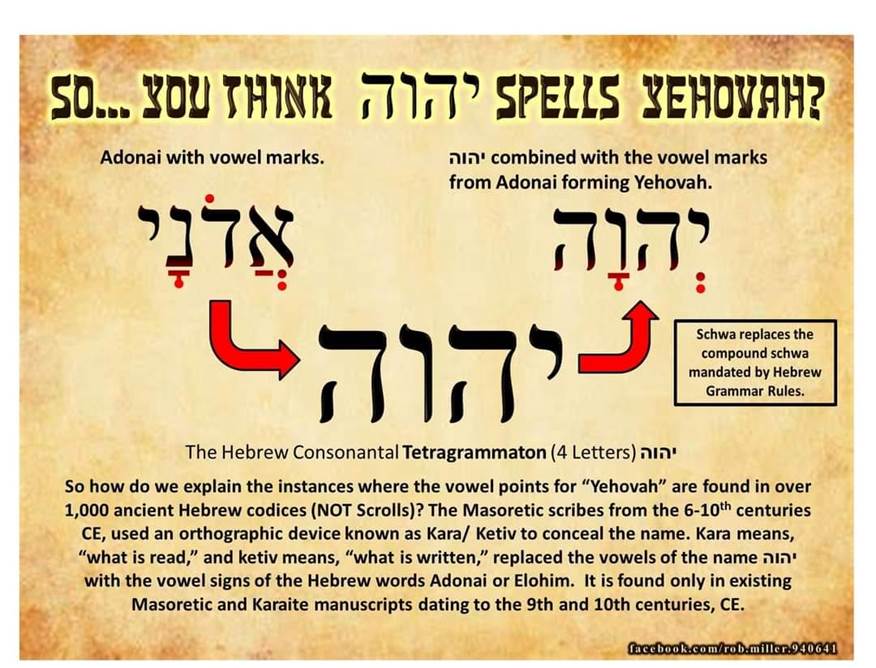
Final word: Those Christians who claim to know how to pronounce The Name (יהוה) are deluded. For example, those who say it should be pronounced Jehovah do not realize that there is no “J” sound in Hebrew (Surely The Name is a Hebrew name!). Further, the vowel points used to obtain the “o” and the “a” sounds, in Jehovah, are actually a memory device to cause us to say “Adonai” rather than the vowel points used for pronunciation.
* * *
This study was written by
Rabbi Dr. Hillel ben David
(Greg Killian).
Comments may be submitted to:
Rabbi Dr. Greg Killian
12210 Luckey Summit
San Antonio, TX 78252
Internet address: gkilli@aol.com
Web page: http://www.betemunah.org/
(360) 918-2905
Return to The WATCHMAN home page
Send comments to Greg Killian at his email address: gkilli@aol.com
[1] Tetragrammaton
[2] The so called old testament.
[3] There is no Greek equivalent. The Greek word ‘Theos’ is an ambiguous word which translates both HaShem and Elohim.
[4] The so called new testament.
[5] Zechariah 14:9
[6] YHWH = yod he vav he - יהוה, the letters of the Tetragrammaton.
[7] Adonai =alef dalet nun yod.
[8] To hide it. This is explained anon.
[9] Ex. III, 15. The actual reading is: this is my name for ever. (leolam, לעולם); but it is written, to be hidden (lealeim, לעלם) – without the vav - ו. Thus this indicates that God’s name must be kept secret; whereas ‘this is my memorial’ etc. implies that He is to be known by this name. Another version, accepting the reading Leolam (for ever) explains the difficulty thus: since G-d states this is my name, it is obvious that He is to be known by it: why then add, ‘and this is my memorial’ etc.?
[10] From Mechilta, Sifrei, Num. 6:23, Sotah 38a
[11] from Mechilta, Sifrei, Num. 6:23, Sotah 38a
[12] I learned this from Hakham Dr. Yosef ben Haggai.
[13] Hakham Dr. Yosef ben Haggai
[14] A better name for the so called “New Testament” which is neither new nor a testament.
[15] Yeshua is the diminutive of Yehoshua which means “HaShem saves’.
[16] Havdallah is the ceremony that ends the Sabbath.
[17] “The Complete Artscroll Siddur”, page 619, ashkenaz edition, by Rabbi Nosson Scherman, Mesorah publications Ltd.
[18] The pronunciation determined the meaning of a word. In Hebrew, vowel sounds are not written. Without this oral tradition it would be impossible to know what the words of the Torah mean because we would not know how to pronounce them.
[19] Zechariah 14:9