
By Rabbi Dr. Hillel ben David (Greg Killian)

דרשן - The “Darshan” (Expounder)
The Temple => The Esnoga => Human Body

Introduction[1]
In this study I would like to explore the structure of the synagogue and its importance to the community.
Lets start by examining the concept of a community. A community, qahal in Hebrew, is a Jewish community of any size. The qahal was a well established concept and was called an ekklesia in the Nazarean Codicil.[2] In English we translate the Greek ekklesia as church. So, whenever we see the word church in our Nazarean Codicil’s, we should have in mind the concept of a qahal, a community or congregation. A community does not happen because folks happen to live together. A qahal requires much work and the support of HaShem:
Tehillim (Psalm) 127:1 “Except HaShem builds the house, they labour in vain that build it; except HaShem watches over a city [community] the watchman keeps watch in vain.”
The Midrash on this Psalm gives us some insight as to what kind of work is required to establish and prosper a qahal:
Midrash to Tehillim 127:1 “R. Judah the Prince sent R. Hiyya, R. Jose, and R. Ammi to visit cities in the land of Israel, and to set up in them teachers of Scripture and instructors of Oral Law. They came to one city in which they found no teacher of Scripture and no instructor of Oral Law, and they said to the people: ‘Fetch us the chief watchmen of the city.’ The people brought the watchmen of the city to the Rabbis, and the Rabbis said: ‘Are these the watchmen of the city? In truth, they are the destroyers of the city.” And when the people asked the Rabbis: ‘Who then, are the watchmen of the city?’ the Rabbis answered: ‘The watchmen of the city are the teachers of Scripture and instructors of Oral Law.” Hence it is written: “Except HaShem watches over a city, the watchman keeps watch in vain.”
From this midrash we learn that the study and application of the scriptures and the oral law, are the work that a group of people put in to establish a qahal. However, without a structure to impart this wisdom, the qahal will not prosper. The structure that establishes and prospers a qahal is the synagogue.
Church[3]. The Greek Ecclesia means simply an Assembly: any assembly of people who are called out (for that is the etymological meaning of the word) from other people. Hence, it is used of the whole nation of Israel as distinct from other nations. The Septuagint uses the word Ecclesia seventy times when it translates the Hebrew word: kve (qahal could also be spelled Cahal), from which we get our English word call. It means to call together, to assemble, or gather together.
Since I have explored the concept of a qahal in greater depth in my paper on Church, I will not elaborate here.
Let me repeat:
“The synagogue is the structure
that HaShem established
to regulate
and establish a qahal (community)
and to cause it to prosper.”
Once a community is established with the structure of the synagogue, then HaShem establishes and prospers the qahal. This notion will help us to understand the second verse of Tehillim 127:
Tehillim (Psalm) 127:2 “It is in vain for you that you rise up early, and sit up late. You that eat the bread of toil, so He (G-d) gives unto His beloved in sleep.”
The synagogue provides the structure whereby a qahal, a community, becomes rooted in HaShem. The synagogue is an extension of the Bet HaMikdash, the Temple. The Bet HaMikdash served the community in the same way that the synagogue serves the community. Attending services in the Bet HaMikdash is like attending the services in the synagogue. The synagogue serves the same purpose for a community that the Temple served for the nation. The fortunes of the Jew and the Jewish families are intimately tied to the proper functioning of the synagogue and it’s officers. Without the Bet HaMikdash and the synagogue, the qahal will languish and will not prosper as the Prophet declares:
Chagai (Haggai) 1:4-10 “Is this a time for yourselves to sit in your paneled houses, whilst the House (of G-d) is in ruins? So now, thus said HaShem, Master of Legions: Set your heart to (consider) your ways! You have sown much but bring in little, eating without being satisfied, drinking without quenching thirst; dressing, yet no one is warmed; and whoever earns money earns it for a purse with a hole. Thus said HaShem, Master of Legions: Set your heart to your ways! Go up to the mountain and bring wood and build the Temple; I will be pleased with it and I will be honoured – said HaShem. You looked for much (produce) but, behold, it is little; you bring it home and I blow upon it. Why is this? – The Word of HaShem, Master of Legions – because of My Temple which is ruined, whilst you run, each to his own house. Therefore, because of you, the heavens withhold from giving (dew), and the land withholds its produce.”
The synagogue,
together with the Temple,
is the most important institution
in Judaism.
The well-being of the individual, the family, and the community depends on the structure and officers of the synagogue.
The synagogue, traditionally, was the name of the building where Jews and Gentiles gathered to pray. But, in a classical sense, a synagogue is to a Chaburah (fellowship) what a cathedral is to a parish church. That is, a synagogue and its officers is the structure of a very large and well established community, while a Chaburah (fellowship) is a gathering of a smaller community for fellowship, prayer, and learning.
Chaburah members create the structure of their group. They decide when, where, and how often they are to meet, how their meetings will be conducted, and what they will do together. Some chaburot are composed solely of adults, while others include entire families. Itself a surrogate extended family, the Chaburah broadens the network of people available to provide support to its members, and affords husbands, wives, and children a sense of belonging. Both during periods of crisis and at times of celebration, families can turn to one another for support.[4]
The structure and purpose of the synagogue is very different from the Chaburah, as we shall see.
Terms
Synagogue: [Middle English, from Old French sinagoge, from Late Latin synagoga, from Greek sunagoge, assembly, synagogue, from sunagein, to bring together : sun-, syn- + agein, to lead]
Sephardi: Esnoga,
Yiddish: Shul
Ukrainian: kloyz
Polish: shtibl
In Judea and Babylon the synagogue was called "Bet HaKnesset".[5]
Ezekiel called the synagogue a “Little Sanctuary”.[6]
In the Greek versions of the Apocrypha they reference “proseuche” or “House of Prayer”.1
A Beit Noach (a gathering of those who follow the seven Noachide laws) is called Kenesiyah (a small and feminine word to denote that it is a receptor from the Bet Knesset).
The
Origin of the Synagogue
There is some debate as to when the synagogue first came into existence. There are some that say Moses instituted it, others say that it began when Judah was carried into captivity in Babylon. There are papyri that show that Egyptian Jews had synagogues as early as the fifth century BCE.[7] I believe that Moses instituted the synagogue because of the following verses:
Yeshayahu (Isaiah) 8:13-16 HaShem Almighty is the one you are to regard as holy, he is the one you are to fear, he is the one you are to dread, And he will be a sanctuary; but for both houses of Israel he will be a stone that causes men to stumble and a rock that makes them fall. And for the people of Jerusalem he will be a trap and a snare. Many of them will stumble; they will fall and be broken, they will be snared and captured." Bind up the testimony and seal up the law among my disciples.
Tehillim (Psalms) 74:1-8 {A <maskil> of Asaph.} Why have you rejected us forever, O God? Why does your anger smolder against the sheep of your pasture? Remember the people you purchased of old, the tribe of your inheritance, whom you redeemed--Mount Zion, where you dwelt. Turn your steps toward these everlasting ruins, all this destruction the enemy has brought on the sanctuary. Your foes roared in the place where you met with us; they set up their standards as signs. They behaved like men wielding axes to cut through a thicket of trees. They smashed all the carved paneling with their axes and hatchets. They burned your sanctuary to the ground; they defiled the dwelling place of your Name. They said in their hearts, "We will crush them completely!" They burned every place where God was worshiped in the land.
Further, Yitro advised Moshe to set up leaders of ten in:
Shemot (Exodus) 18:13-22 And it came to pass on the morrow, that Moses sat to judge the people: and the people stood by Moses from the morning unto the evening. 14 And when Moses’ father in law saw all that he did to the people, he said, What is this thing that thou doest to the people? why sittest thou thyself alone, and all the people stand by thee from morning unto even? 15 And Moses said unto his father in law, Because the people come unto me to enquire of God: 16 When they have a matter, they come unto me; and I judge between one and another, and I do make them know the statutes of God, and his laws. 17 And Moses’ father in law said unto him, The thing that thou doest is not good. 18 Thou wilt surely wear away, both thou, and this people that is with thee: for this thing is too heavy for thee; thou art not able to perform it thyself alone. 19 Hearken now unto my voice, I will give thee counsel, and God shall be with thee: Be thou for the people to God-ward, that thou mayest bring the causes unto God: 20 And thou shalt teach them ordinances and laws, and shalt shew them the way wherein they must walk, and the work that they must do. 21 Moreover thou shalt provide out of all the people able men, such as fear God, men of truth, hating covetousness; and place such over them, to be rulers of thousands, and rulers of hundreds, rulers of fifties, and rulers of tens: 22 And let them judge the people at all seasons: and it shall be, that every great matter they shall bring unto thee, but every small matter they shall judge: so shall it be easier for thyself, and they shall bear the burden with thee.
Now if ten men form a minyan, a congregation, then surely they would form a synagogue and study together. When one looks at the arrangement of the camp in the wilderness, they can see that the camp was ten miles across. Those at the extreme ends would have some difficulty getting to the Tabernacle. For these folks it would make sense to have a synagogue in their neck of the woods, so to speak.
Those who see the synagogue as formed during the captivity use the book of Yehezechel (Ezekiel) to prove their point. The term used is a “little sanctuary” found in:[8]
Yehezechel (Ezekiel) 11:16 "Therefore say: 'This is what the Sovereign HaShem says: Although I sent them far away among the nations and scattered them among the countries, yet for a while I have been a little sanctuary for them in the countries where they have gone.'
The phrase "little sanctuary" faithfully indicates the role of the synagogue in the thoughts and lives of the people.
Strong’s dictionary defines a ‘sanctuary’ as:
4720 miqdash, mik-dawsh'; or miqqedash (Exod. 15:17), mik-ked-awsh'; from 6942; a consecrated thing or place, espec. a palace, sanctuary (whether of Jehovah or of idols) or asylum:-chapel, hallowed part, holy place, sanctuary.
----------------- Dictionary Trace --------------
6942 qadash, kaw-dash'; a prim. root; to be (causat. make, pronounce or observe as) clean (ceremonially or morally):-appoint, bid, consecrate, dedicate, defile, hallow, (be, keep) holy (-er, place), keep, prepare, proclaim, purify, sanctify (-ied one, self), x wholly.
The Targum,[9] the Jerusalem Talmud,[10] the Midrash,[11] and Josephus,[12] the tradition of the Alexandrian Jews, according to the witness of Philo, "De Vita Mosis",[13] as well as the Nazarean Codicil all ascribe the synagogue’s origin to Moses:
II Luqas (Acts) 15:21 For Moses of old time hath in every city them that preach him, being read in the synagogues every sabbath day.
Another term used to prove that Moses gave us the synagogue is the term: “Assembly of Elders”. This term is found in:
Yehezechel (Ezekiel) 14:1 Some of the elders of Israel came to me and sat down in front of me.
Yehezechel (Ezekiel) 20:1 In the seventh year, in the fifth month on the tenth day, some of the elders of Israel came to inquire of HaShem, and they sat down in front of me.
An elder, zaken, as we shall see, is one of the officers of the synagogue.
Requirements
A synagogue could be formed in any town large enough to have a congregation capable of supporting ten Torah scholars, who were men of leisure.[14] These men were not lazy or idle men, but, were at leisure only to take care of the synagogue, and to give themselves to Torah study.
Megillah 5a MISHNAH. WHAT IS RECKONED A LARGE TOWN? ONE WHICH HAS IN IT TEN MEN OF LElSURE.[15] ONE THAT HAS FEWER IS RECKONED A VILLAGE. IN RESPECT OF THESE[16] IT WAS LAID DOWN THAT THEY SHOULD BE PUSHED FORWARD BUT NOT POSTPONED. THE TIME, HOWEVER, OF BRINGING THE WOOD FOR THE PRIESTS,[17] OF KEEPING THE [FAST OF] THE NINTH OF AB,[18] OF OFFERING THE FESTIVAL SACRIFICE,[19] AND OF ASSEMBLING THE PEOPLE[20] IS TO BE POSTPONED[21] [TILL AFTER SABBATH] BUT NOT PUSHED FORWARD. ALTHOUGH IT WAS LAID DOWN THAT THE TIMES [OF READING THE MEGILLAH] ARE TO BE PUSHED FORWARD BUT NOT POSTPONED, IT IS PERMISSIBLE ON THESE [ALTERNATIVE] DAYS[22] TO MOURN, TO FAST, AND TO DISTRIBUTE GIFTS TO THE POOR. R. JUDAH SAID: WHEN IS THIS?[23] IN PLACES WHERE PEOPLE COME TO TOWN ON MONDAYS AND THURSDAYS. IN PLACES, HOWEVER, WHERE THEY DO NOT COME TO TOWN EITHER ON MONDAYS OR THURSDAYS, THE MEGILLAH IS READ ONLY ON ITS PROPER DAY.
GEMARA. [TEN MEN OF LEISURE]: A Tanna taught: The ten unoccupied men who attend synagogue.[24]
Every community large enough to have a significant Jewish population which could support the three Hakhamim (Rabbis) who make up the bench of three, and the other seven officers, would have a synagogue. If a city was not big enough to have and support these ten officers, then it was not called a city, it was called a village.
Megillah 3b R. Joshua b. Levi also said: A city in which there are not ten men of leisure[25] is reckoned as a village. What does he tell us? We have already learnt this: ‘What is a large town? One in which there are ten men of leisure. If there are less than this, it is reckoned as a village’. — He had to point out that the rule applies to a city,[26] even though [leisured] people come there from outside.[27] R. Joshua b. Levi also said: A city which has been laid waste and afterwards settled is reckoned as a city. What is meant by ‘laid waste’? Shall I say, that its walls have been destroyed, in which case if it became settled[28] it is reckoned as a city but otherwise not? [How can this be], seeing that it has been taught: R. Eleazar son of R. Jose says: [The text says], which has a wall;[29] [which implies that it is to be reckoned as a city] even though it has not a wall now, provided it had one previously?[30] What then is meant by ‘laid waste’? Laid waste of its ten men of leisure.
The reason for ten Torah scholars[31] can be deduced from:
Bamidbar (Numbers) 14:27 How long shall this evil congregation exist, complaining about Me?[32] I have heard how the Israelites are complaining about Me.
If we take away Joshua and Caleb, and there remains only ten; namely the spies of the land. The idea of a “minyan” (“number”) is also inferred from this passage. Now, these “spies” were not ordinary men, but rulers, i.e. Judges or Hakhamim, as we can see in:
Bamidbar (Numbers) 13:1-16 And HaShem spake unto Moses, saying, Send thou men, that they may search the land of Canaan, which I give unto the children of Israel: of every tribe of their fathers shall ye send a man, every one a ruler among them. And Moses by the commandment of HaShem sent them from the wilderness of Paran: all those men [were] heads of the children of Israel. And these [were] their names:
Of the tribe of Reuben, Shammua the son of Zaccur.
Of the tribe of Simeon, Shaphat the son of Hori.
Of the tribe of Judah, Caleb the son of Jephunneh.
Of the tribe of Issachar, Igal the son of Joseph.
Of the tribe of Ephraim, Oshea the son of Nun.
Of the tribe of Benjamin, Palti the son of Raphu.
Of the tribe of Zebulun, Gaddiel the son of Sodi.
Of the tribe of Joseph, [namely], of the tribe of Manasseh, Gaddi the son of Susi.
Of the tribe of Dan, Ammiel the son of Gemalli.
Of the tribe of Asher, Sethur the son of Michael.
Of the tribe of Naphtali, Nahbi the son of Vophsi.
Of the tribe of Gad, Geuel the son of Machi.
These [are] the names of the men which Moses sent to spy out the land. And Moses called Oshea the son of Nun Jehoshua.
A “ruler”, in the Torah, is a Hakham, a Judge on the Bet Din. We can see again that the ten are Tsadiqim, righteous ones, from Avraham’s plea:
Bereshit (Genesis) 18:23-33 And Abraham drew near, and said, Will You consume the righteous with the wicked? Peradventure there are fifty righteous within the city: will You consume and not spare the place for the fifty righteous that are therein? That be far from You to do after this manner, to slay the righteous with the wicked, that so the righteous should be as the wicked; that be far from You: shall not the Judge of all the earth do right? And HaShem said, If I find in Sodom fifty righteous within the city, then I will spare all the place for their sake. And Abraham answered and said, Behold now, I have taken upon me to speak unto HaShem, who am but dust and ashes: peradventure there shall lack five of the fifty righteous: wilt You destroy all the city for lack of five? And he said, I will not destroy it, if I find there forty and five. And he spoke unto Him yet again, and said, Peradventure there shall be forty found there. And He said, I will not do it for the forty’s sake. And he said, Oh let not HaShem be angry, and I will speak: peradventure there shall thirty be found there. And he said, I will not do it, if I find thirty there. And he said, Behold now, I have taken upon me to speak unto HaShem: peradventure there shall be twenty found there. And he said, I will not destroy it for the twenty’s sake. And he said, Oh let not HaShem be angry, and I will speak yet but this once: peradventure ten shall be found there. And He said, I will not destroy it for the ten’s sake. And HaShem went his way, as soon as He had left off communing with Abraham: and Abraham returned unto his place.”
Note that Abraham was looking not for ordinary men, but for “righteous men”. He was looking for men who knew Torah and Halakha and followed it as a pattern in their lives. This is what makes one righteous. Keep in mind that a quorum of ten Jewish men can form a minyan, these same ten can NOT form a synagogue. To form a synagogue we need to have Tsadiqim (righteous men) or rulers (judges or Hakhamim). These ten Tsadiqim[33] could also form a minyan.
Some say that the ten men of the synagogue is derived from the smallest group that Moses created in:1
Shemot (Exodus) 18:13-21 The next day Moses took his seat to serve as judge for the people, and they stood around him from morning till evening. When his father-in-law saw all that Moses was doing for the people, he said, "What is this you are doing for the people? Why do you alone sit as judge, while all these people stand around you from morning till evening?" Moses answered him, "Because the people come to me to seek God's will. Whenever they have a dispute, it is brought to me, and I decide between the parties and inform them of God's decrees and laws." Moses' father-in-law replied, "What you are doing is not good. You and these people who come to you will only wear yourselves out. The work is too heavy for you; you cannot handle it alone. Listen now to me and I will give you some advice, and may God be with you. You must be the people's representative before God and bring their disputes to him. Teach them the decrees and laws, and show them the way to live and the duties they are to perform. But select capable men from all the people--men who fear God, trustworthy men who hate dishonest gain--and appoint them as officials over thousands, hundreds, fifties and tens.
Notice that the ten men are spoken of in regard to the dispensation of justice. This was the primary purpose of the bench of three and a major purpose of the officers of the synagogue. This is why they had to be Tsadiqim, Judges on the Bet Din.
The primary purpose of the synagogue was the dispensation of justice, which was primarily achieved through the study, teaching, and the application of the Torah, The Prophets, the Writings,[34] and the Oral Law. This means that these ten Tsadiqim had to be well learned in the Torah and Halakhah. They had to be trained as Judges. Today we would call these men Rabbis or Hakhamim. This can be seen in:
II Luqas (Acts) 17:1 When they had passed through Amphipolis and Apollonia, they came to Thessalonica, where there was a Jewish synagogue. As his custom was, Paul went into the synagogue, and on three Sabbath days he reasoned with them from the Scriptures,
II Luqas (Acts) 15:19-21 "It is my judgment, therefore, that we should not make it difficult for the Gentiles who are turning to God. Instead we should write to them, telling them to abstain from food polluted by idols, from sexual immorality, from the meat of strangled animals and from blood. For Moses has been preached in every city from the earliest times and is read in the synagogues on every Sabbath."
II Luqas (Acts) 19:8 Paul entered the synagogue and spoke boldly there for three months, arguing persuasively about the kingdom of God.
Luqas (Luke) 13:10 On a Sabbath Yeshua was teaching in one of the synagogues,
So, a synagogue is a structure where Yeshua and all the Apostles and disciples went to learn, teach, and apply justice.
The principle service of the synagogue was held on Sabbath morning, and included, according to the Mishna, the recitation of the Shema,[35] prayer, Reading from the Torah and Haftarah with translation, a sermon (derashah - ‘searching’) based on the Torah reading, and finally the Aaronic benediction. The sages often interchanged the word ‘synagogue’ with the phrase ‘house of prayer’, though they everywhere agree that the assemblage was primarily one for instruction in the Torah.[36]
The
Officers
The following are the officers in an ideal synagogue, in a large city. These are not found in every village synagogue. These are the ideal, not the normal found in all synagogues, but rather only in the larger synagogues. Consider the size a town might have to be in order to support three Rabbis just for the Bench of three, for example.

The “ten Tsadiqim”, the “righteous men”, or officers of the synagogue are:
Hakhamim – bench of three – Bet Din 3
Sheliach Bet Din/ Sheliach Tsibur 1
Darshan or Maggid 1
The Masoret 1
Parnassim or Shamashim 3
Moreh/Meturgeman 1
Total . . . . . . . . . . 10
Now that we see office of these ten men, let’s look at each individual officer:
בית דין - Bet Din
בד של שלשה The bench of three Judges
ראש הכנסת Rulers of the synagogue - Archisynagogue
The community was governed by the Bet Din, the house of justice; or sunédrion transliterated סנהדרין, Sanhedrin. The members of the Bet Din were called “rulers”. The Bet Din had it in their power to dispense justice to the community.
These men (minimum of three) were the Judges. These were the Hakhamim,[37] the Rabbis, who were well schooled in the law – the Torah. It was this office that decided any differences that arose in the community. They judged matters concerning money, thefts, losses, restitutions, ravishing a virgin, of a man enticing a virgin, of the admission of proselytes, laying on of hands, and other matters spoken about in tractate Sanhedrin. These were also called the Rulers of the Synagogue, because they were responsible for caring for the synagogue and they exercised the chief power.
The other seven officers, of the synagogue, in their various areas of ministry must at all times be subordinate to, and faithful in carrying out the directions and judgements of the Bet Din, the bench of three.
Strong’s dictionary defines the ‘Ruler of the synagogue’ as:
752 archisunagogos, ar-khee-soon-ag'-o-gos; from 746 and 4864; director of the synagogue services:-(chief) ruler of the synagogue.
--------------- Dictionary Trace ----------------
746 arche, ar-khay'; from 756; (prop. abstr.) a commencement, or (concr.) chief (in various applications of order, time, place or rank):- beginning, corner, (at the, the) first (estate), magistrate, power, principality, principle, rule.
4864 sunagoge, soon-ag-o-gay'; from (the redupl. form of) 4863; an assemblage of persons; spec. a Jewish "synagogue" (the meeting or the place); by anal. a Christian church:-assembly, congregation, synagogue.
Under Moses, four grades of judges were appointed:
Shemot (Exodus) 18:20-22 And thou shalt teach them ordinances and laws, and shalt shew them the way wherein they must walk, and the work that they must do. Moreover thou shalt provide out of all the people able men, such as fear God, men of truth, hating covetousness; and place [such] over them, [to be]
rulers of thousands, [and]
rulers of hundreds,
rulers of fifties, and
rulers of tens:
And let them judge the people at all seasons: and it shall be, [that] every great matter they shall bring unto thee, but every small matter they shall judge: so shall it be easier for thyself, and they shall bear [the burden] with thee.
So later, in the Jewish state, there were four grades of courts of justice under the supreme Sanhedrin which took the place of Moses. A court of three judges in every city, one of twenty-three in every large city, two of twenty-three at the foot of the Temple Mount and, at the entrance to the Temple, and as the supreme tribunal, the court of seventy-one which sat in the Chamber of Hewn Stone of the Temple itself. Just as the first Jewish judges, in Shemot (Exodus) 18, were elected from the people and by the people, so later on, one of the qualifications demanded for a judgeship was to be tested by the people. There could always be an appeal from a lower court to the one above it, right up to the full Sanhedrin. But it was not the litigants who appealed, but in cases where it was in any doubt, the lower court itself went up to the one above it.. The judges themselves are to bring cases in which they are not confident of giving correct decisions, up to you, and this can very well imply that they were first to submit their case to the court immediately superior to them before they brought it to Moses.[38]
The Talmud, in many places, speaks of this court of three. The minimum is mentioned in:
Kethuboth 22a If three sit to confirm a document and one of them dies,[39] they must write, ‘We were In a session of three, and one is no more.’[40] R. Nahman b. Isaac said: And if it is written in it: This document has been produced[41] before us [as] a court of law, more is not necessary.[42]
We find this office repeatedly in the Nazarean Codicil:[43]
Matthew 9:18 While he spake these things unto them, behold, there came a certain ruler, and worshipped him, saying, My daughter is even now dead: but come and lay thy hand upon her, and she shall live.
Luqas (Luke) 13:10-16 On a Sabbath Yeshua was teaching in one of the synagogues, And a woman was there who had been crippled by a spirit for eighteen years. She was bent over and could not straighten up at all. When Yeshua saw her, he called her forward and said to her, "Woman, you are set free from your infirmity." Then he put his hands on her, and immediately she straightened up and praised God. Indignant because Yeshua had healed on the Sabbath, the synagogue ruler said to the people, "There are six days for work. So come and be healed on those days, not on the Sabbath." The Lord answered him, "You hypocrites! Doesn't each of you on the Sabbath untie his ox or donkey from the stall and lead it out to give it water? Then should not this woman, a daughter of Abraham, whom Satan has kept bound for eighteen long years, be set free on the Sabbath day from what bound her?"
An Insight
Now, I would like to take a small diversion to give some insight into a special synagogue passage: This next passage will be explained by the teaching I received from my teacher, Hakham Dr. Yosef ben Haggai:
Marqos (Mark) 5:22-24 Then one of the synagogue rulers, named Jairus, came there. Seeing Yeshua, he fell at his feet And pleaded earnestly with him, "My little daughter is dying. Please come and put your hands on her so that she will be healed and live." So Yeshua went with him. A large crowd followed and pressed around him...
Keep in mind that Yair, Jarius, is a prominent Rabbi on the bet din of a large synagogue in a large city. He is a very prominent man who is held in high esteem by many people. Yet, notice that he acknowledges the superiority of the Torah wisdom of His Majesty King Yeshua.
Now His Majesty is being asked to lay hands – that is, to take the source of blessing, the hands sanctified by washing, and use them to bring the blessing of healing to the daughter of this Torah Sage. Suddenly, we have an interruption to our story:
Marqos (Mark) 5:25-34 And a certain woman, which had an issue of blood twelve years, And had suffered many things of many physicians, and had spent all that she had, and was nothing bettered, but rather grew worse, When she had heard of Yeshua, came in the press behind, and touched his tzitzith. For she said, If I may touch but his clothes, I shall be whole. And straightway the fountain of her blood was dried up; and she felt in [her] body that she was healed of that plague. And Yeshua, immediately knowing in himself that virtue had gone out of him, turned him about in the press, and said, Who touched my tzitzith? And his disciples said unto him, Thou seest the multitude thronging thee, and sayest thou, Who touched me? And he looked round about to see her that had done this thing. But the woman fearing and trembling, knowing what was done in her, came and fell down before him, and told him all the truth. And he said unto her, Daughter, thy faith hath made thee whole; go in peace, and be whole of thy plague.
This woman who had been with a flow of blood (from malfunctioning ovaries – the source of life with the medium of life, the blood) for twelve (12) years, signifying a problem related to justice (twelve relates to government – the twelve tribes – which exists solely to dispense the justice of HaShem.
This anonymous woman touches the tzitzith, the symbol of Torah, on His Majesty the Living Torah. The tzitzith, as an extension of the very body of His Majesty, when touched can be felt just as we can feel the touching of any of our bodies.
The woman who’s life, the blood the symbol of life even as Torah is the symbol of life, has been ebbing out of her, is healed when she comes under the tallit, under the authority of the Torah. The Torah that she grasps, now gives her life and the outflow of her life fluid now ceases.
She placed herself under the discipline of the Master and of the Torah. Mida kneged mida (measure for measure), She had some minor sin that needed to be rooted out. It could be a very minor problem, yet to get correction we must go back under the authority of the Torah. Her sin was in not being under Torah authority.
Her faithful obedience to place herself under authority of the Torah had healed her.
However, because she has touched Yeshua, he has become unclean. He will no longer be able to lay hands on the daughter of Yair because He has become unclean. So, the story picks up where it left off before the interruption:
Marqos (Mark) 5:35-43 While Yeshua was still speaking, some men came from the house of Jairus, the synagogue ruler. "Your daughter is dead," they said. "O Why bother the teacher any more?" Ignoring what they said, Yeshua told the synagogue ruler, "Don't be afraid; just believe." He did not let anyone follow him except Peter, James and John the brother of James. When they came to the home of the synagogue ruler, Yeshua saw a commotion, with people crying and wailing loudly. He went in and said to them, "Why all this commotion and wailing? The child is not dead but asleep." But they laughed at him. After he put them all out, he took the child's father and mother and the disciples who were with him, and went in where the child was. He took her by the hand and said to her, <"Talitha koum!"> (which means, "Little girl, I say to you, get up!"). Immediately the girl stood up and walked around (she was twelve years old). At this they were completely astonished. He gave strict orders not to let anyone know about this, and told them to give her something to eat.
Note the juxtaposition of the key phrases between these two stories:
Your faith has healed you – fear not only believe.
Note also that the three greatest (in Torah learning) disciples (Tsefet, Yaaqob, and Yochanan the brother of Yaaqob) are forming a Bet Din. These Rabbis in training are learning on the job.
It is also necessary that we understand that a child under twelve normally takes refuge under the tallit of the Rabbi when he does the Aaronic benediction, in the synagogue. This teaches us that those under twelve are under the authority of their fathers and Rabbis who are their teachers. They grasp his tzitzith whilst he gives the blessing.
Children under the age of twelve are called to come under the tallit of the rabbi when he does the Aaronic benediction. A menstruating woman, over the age twelve, is no longer under the tallit of the father or Rabbi.
Why does he tie her hands with the tallit and lay the tallit over the girl? A tallit does not become unclean because it is touched by something unclean. A tallit always maintains it’s purity as long as the tzitzith are intact. We must not worry about becoming unclean, because our cleanliness is ONLY for the benefit of others. We are clean for a purpose. We must not worry about performing a mitzva because it makes us unclean. Mashiach hands were unclean, therefore he could not touch the little girl. Therefore, He tied her hands without touching her. This tying was the same as the binding in:
Yeshayahu (Isaiah) 8:16-20 Bind up the testimony, seal the law among my disciples. And I will wait upon HaShem, that hideth his face from the house of Jacob, and I will look for him. Behold, I and the children whom HaShem hath given me [are] for signs and for wonders in Israel from HaShem of hosts, which dwelleth in mount Zion. And when they shall say unto you, Seek unto them that have familiar spirits, and unto wizards that peep, and that mutter: should not a people seek unto their God? for the living to the dead? To the law and to the testimony: if they speak not according to this word, [it is] because [there is] no light in them.
Binding the tzitzith to the hands means that the person comes under the authority of the Torah, and the Torah always brings life!!! Laying the tallit, further, over the girl’s head is the same as the little children coming under the tallit of the Rabbi giving the Aaronic benediction.
The Peshitta[44] does not contain this ending: ‘Damsel (I say to thee), arise.’ My teacher translates this verse as:
41 (YbH) and, having tied the hands of the child (with his tsitsit), said to her: ‘Talita Qumi;’ [which is, being interpreted, ‘She that is under the Talith arise’].
The greatest form of teaching is to bind the Torah on his talmidim. Sickness is just death by degrees. The root cause is a misalignment between the life of the individual and the exactness of Torah.
He charged them not to spread the word that He was a miracle worker, rather He wanted to be known as a Torah teacher. The ministry of Mashiach ben Yoseph is to bring people closer to the Torah.
Yeshayahu (Isaiah) 61:1 The spirit of the Lord HaShem [is] upon me; because HaShem hath anointed me to preach good tidings unto the meek; he hath sent me to bind up the brokenhearted, to proclaim liberty to the captives, and the opening of the prison to [them that are] bound;
Herein ends my Beloved Teacher’s insights. Now we return to the synagogue study where we were examining passages regarding the Rulers of the Synagogue:
Luqas (Luke) 8:41-42 Then a man named Jairus, a ruler of the synagogue, came and fell at Yeshua's feet, pleading with him to come to his house Because his only daughter, a girl of about twelve, was dying. As Yeshua was on his way, the crowds almost crushed him...
Luqas (Luke) 8:49-56 While Yeshua was still speaking, someone came from the house of Jairus, the synagogue ruler. "Your daughter is dead," he said. "Don't bother the teacher any more." Hearing this, Yeshua said to Jairus, "Don't be afraid; just believe, and she will be healed." When he arrived at the house of Jairus, he did not let anyone go in with him except Peter, John, and James, and the child's father and mother. Meanwhile, all the people were wailing and mourning for her. "Stop wailing," Yeshua said. "She is not dead but asleep." They laughed at him, knowing that she was dead. But he took her by the hand and said, "My child, get up!" Her spirit returned, and at once she stood up. Then Yeshua told them to give her something to eat. Her parents were astonished, but he ordered them not to tell anyone what had happened.
Luqas (Luke) 13:10-17 On a Sabbath Yeshua was teaching in one of the synagogues, And a woman was there who had been crippled by a spirit for eighteen years. She was bent over and could not straighten up at all. When Yeshua saw her, he called her forward and said to her, “Woman, you are set free from your infirmity. “Then he put his hands on her, and immediately she straightened up and praised God. Indignant because Yeshua had healed on the Sabbath, the synagogue ruler said to the people, "There are six days for work. So come and be healed on those days, not on the Sabbath." The Lord answered him, "You hypocrites! Doesn't each of you on the Sabbath untie his ox or donkey from the stall and lead it out to give it water? Then should not this woman, a daughter of Abraham, whom Satan has kept bound for eighteen long years, be set free on the Sabbath day from what bound her?" When he said this, all his opponents were humiliated, but the people were delighted with all the wonderful things he was doing.
II Luqas (Acts) 13:13-16 From Paphos, Paul and his companions sailed to Perga in Pamphylia, where John left them to return to Jerusalem. From Perga they went on to Pisidian Antioch. On the Sabbath they entered the synagogue and sat down. After the reading from the Law and the Prophets, the synagogue rulers sent word to them, saying, "Brothers, if you have a message of encouragement for the people, please speak." Standing up, Paul motioned with his hand and said: "Men of Israel and you Gentiles who worship God, listen to me!
II Luqas (Acts) 18:7-8 Then Paul left the synagogue and went next door to the house of Titius Justus, a worshiper of God. Crispus, the synagogue ruler, and his entire household believed in the Lord; and many of the Corinthians who heard him believed and were baptized.
II Luqas (Acts) 18:12-17 While Gallio was proconsul of Achaia, the Jews made a united attack on Paul and brought him into court. "This man," they charged, "is persuading the people to worship God in ways contrary to the law." Just as Paul was about to speak, Gallio said to the Jews, "If you Jews were making a complaint about some misdemeanor or serious crime, it would be reasonable for me to listen to you. But since it involves questions about words and names and your own law--settle the matter yourselves. I will not be a judge of such things." So he had them ejected from the court. Then they all turned on Sosthenes the synagogue ruler and beat him in front of the court. But Gallio showed no concern whatever.
The Bench of three sat in the seat of Moses:
Matityahu 23:1-3 Then spake Yeshua to the multitude, and to his disciples, Saying, The scribes and the Pharisees sit in Moses' seat: All therefore whatsoever they bid you observe, [that] observe and do; but do not ye after their works: for they say, and do
In the synagogue, Moshe’s seat is behind the tebah[45] (the bima) to monitor what is going on and to ensure that the service is kosher.
שליח צבור Sheliach Tzibbur
(Angel of the Assembly or Angel of the Church)
שליח בית דין - Sheliach Bet Din
(Angel of the Court)
Bishop of the congregation
Baal Teffilah (Master of Prayer)[46]
Chazzan
Overseer
This officer is known today as the Chazzan, Chazzan HaKnesset, or the Beadle.
The qualifications for this office, according to Shulchan Aruch,[47] were:
1. Humility
2. Acceptability to the congregation.
3. Knowledge of the rules of prayer and the proper
pronunciation of the Hebrew text.
4. An agreeable voice.
5. Proper dress.
This office is also known in the Nazarean Codicil as the Bishop.
The Sheliach Tzibbur and the Sheliach Bet Din were known as Apostles (which is a transliteration of the Greek “Apostolos”).
The Sheliach Bet Din was also known as the messenger, or emissary, of the Bet Din. This officer administered the judicial decisions of the Bet Din (bailiff), faithfully transmitted Halakhah, supervised the conversion procedure under the authority of the Bet Din, and the laying of hands on behalf of the Bet Din of leaders of small Jewish congregations/fellowships (Hebrew: “Chaburot”) or Batei Noach (Houses of Noach) under its jurisdiction. These officers are normally Hakhamim. This is the office that Hakham Shaul held.
Romans 1:1 Paul, a servant of Yeshua HaMashiach, called [to be] an apostle (Sheliach Bet Din), separated unto the gospel (Masorah=oral Torah) of God.
II Luqas (Acts) 9:1-2 And Saul, yet breathing out threatenings and slaughter against the disciples of the Lord, went unto the high priest, And desired of him letters to Damascus to the synagogues, that if he found any of this way, whether they were men or women, he might bring them bound unto Jerusalem.
This man is appointed by the Bet Din and is approved by the congregation. While there may be many in the community that hold this office, there is only one office. Under the authority of the Sheliach bet Din are the Paqidim (clerks) and also the Soferim (Scribes).
The holders of the second office, the Sheliach Tzibbur, are the Masters of Prayer or Cantors in the synagogue, and as such are called in the Nazarean Codicil the “angels of the congregation” since they represent the community before HaShem in prayer.
This man was the public minister of the synagogue. He was responsible for public prayer, or appointing those who read from the Torah, and he sometimes preached if there were no others to discharge this office. This man did not read the Torah publicly, but, every Shabbat he called out seven of the synagogue (on other days fewer) whom he judged fit to read. He stood by those that read and carefully made sure that they read correctly. He would correct them if they made an error. It is for this reason that he was also called an ‘Overseer’.[49]
Formerly, in the Temple service in Jerusalem, the Angel of the Church was the Priest (Kohen) who acted as the leader of prayer in intercession with HaShem for the worshippers.[50]
This office is found in the Talmud:
Eiruvin 92b If a congregation was in the larger one and the Reader[51] in the lesser one, they have dully performed their duty,[52] but if the congregation was in the lesser one and the Reader in the larger one they have not performed their duty.[53]
Chullin 24b Our Rabbis taught: He whose beard is fully grown is qualified to act as the representative of a community,[54] to descend before the Ark[55] and to pronounce the priestly benediction.[56] When does he [the priest] become qualified for Temple service? When he produces two hairs. Rabbi says: I say, only when he is twenty years old. R. Hisda asked: What is Rabbi's reason? — Because it is written: And they appointed the Levites from twenty years old and upward to have oversight of the work of the house of the Lord.[57] And the other Tanna? He maintains that ‘to have oversight’ is quite a different matter.[58] But is not this verse stated in connection with the Levites?[59] — One must accept the statement of R. Joshua b. Levi. For R. Joshua b. Levi said: In twenty-four passages the priests are referred to as Levites, and the following is an example: And the priests the Levites the sons of Zadok.[60]
Arachin 11b Rather, said Rami the son of R. Yeba: The question was with reference to the lamb offered up with the ‘Omer,[61] [namely]: Was the new month decreed in its right time or not so that the lamb may be offered? — R. Avya demurred to this: They should have seen when the paschal lamb had been sacrificed, when the leavened bread had been eaten![62] Rather, said R. Ashi: It is the same as with the messenger of the congregation, who consults [formally asks for permission to start the prayer].[63] Now that you have come to this answer, say: Even if it was the case of the [daily] obligatory burnt-offering, [yet there is no difficulty]: It is the same as with any messenger of a community, who consults [his congregation].
This office is found several times in the Nazarean Codicil:
Luqas (Luke) 4:14-21 Yeshua returned to Galilee in the power of the Spirit, and news about him spread through the whole countryside. He taught in their synagogues, and everyone praised him. He went to Nazareth, where he had been brought up, and on the Sabbath day he went into the synagogue, as was his custom. And he stood up to read. The scroll of the prophet Isaiah was handed to him. Unrolling it, he found the place where it is written: "The Spirit of the Lord is on me, because he has anointed me to preach good news to the poor. He has sent me to proclaim freedom for the prisoners and recovery of sight for the blind, to release the oppressed To proclaim the year of the Lord's favor." Then he rolled up the scroll, gave it back to the attendant and sat down. The eyes of everyone in the synagogue were fastened on him, And he began by saying to them, "Today this scripture is fulfilled in your hearing."
Matityahu (Matthew) 5:25 "Settle matters quickly with your adversary who is taking you to court. Do it while you are still with him on the way, or he may hand you over to the judge, and the judge may hand you over to the officer, and you may be thrown into prison.
Matityahu (Matthew) 10:16-20 I am sending you out like sheep among wolves. Therefore be as shrewd as snakes and as innocent as doves. "Be on your guard against men; they will hand you over to the local councils and flog you in their synagogues. On my account you will be brought before governors and kings as witnesses to them and to the Gentiles. But when they arrest you, do not worry about what to say or how to say it. At that time you will be given what to say, For it will not be you speaking, but the Spirit of your Father speaking through you.
Revelation 2:1 "To the angel of the church in Ephesus write: These are the words of him who holds the seven stars in his right hand and walks among the seven golden lampstands:
Revelation 2:8 "To the angel of the church in Smyrna write: These are the words of him who is the First and the Last, who died and came to life again.
Revelation 2:12 "To the angel of the church in Pergamum write: These are the words of him who has the sharp, double-edged sword.
Revelation 2:18 "To the angel of the church in Thyatira write: These are the words of the Son of God, whose eyes are like blazing fire and whose feet are like burnished bronze.
Revelation 3:1 "To the angel of the church in Sardis write: These are the words of him who holds the seven spirits of God and the seven stars. I know your deeds; you have a reputation of being alive, but you are dead.
Revelation 3:7 "To the angel of the church in Philadelphia write: These are the words of him who is holy and true, who holds the key of David. What he opens no one can shut, and what he shuts no one can open.
Revelation 3:14 "To the angel of the church in Laodicea write: These are the words of the Amen, the faithful and true witness, the ruler of God's creation.
Strong’s dictionary defines a bishop as:
1984 episkope, ep-is-kop-ay'; from 1980; inspection (for relief); by impl. superintendence; spec. the Chr. "episcopate":-the office of a "bishop", bishoprick, visitation.
----------------- Dictionary Trace ------------------
1980 episkeptomai, ep-ee-skep'-tom-ahee; mid. from 1909 and the base of 4649; to inspect, i.e. (by impl.) to elect; by extens. to go see, relieve:- look out, visit.
1985 episkopos, ep-is'-kop-os; from 1909 and 4649 (in the sense of 1983); a superintendent, i.e. Chr. officer in gen. charge of a (or the) church (lit. or fig.):-bishop, overseer.
The office of the overseer is found several times in the Nazarean Codicil:
I Timothy 3:1-7 Here is a trustworthy saying: If anyone sets his heart on being an overseer, he desires a noble task. Now the overseer must be above reproach, the husband of but one wife, temperate, self-controlled, respectable, hospitable, able to teach, Not given to drunkenness, not violent but gentle, not quarrelsome, not a lover of money. He must manage his own family well and see that his children obey him with proper respect. (If anyone does not know how to manage his own family, how can he take care of God's church?) He must not be a recent convert, or he may become conceited and fall under the same judgment as the devil. He must also have a good reputation with outsiders, so that he will not fall into disgrace and into the devil's trap.
Titus 1:7-9 Since an overseer is entrusted with God's work, he must be blameless--not overbearing, not quick-tempered, not given to drunkenness, not violent, not pursuing dishonest gain. Rather he must be hospitable, one who loves what is good, who is self-controlled, upright, holy and disciplined. He must hold firmly to the trustworthy message as it has been taught, so that he can encourage others by sound doctrine and refute those who oppose it.
II Luqas (Acts) 20:26-29 Therefore, I declare to you today that I am innocent of the blood of all men. For I have not hesitated to proclaim to you the whole will of God. Keep watch over yourselves and all the flock of which the Holy Spirit has made you overseers. Be shepherds of the church of God, which he bought with his own blood. I know that after I leave, savage wolves will come in among you and will not spare the flock.
Philippians 1:1-2 Paul and Timothy, servants of Mashiach Yeshua, To all the saints in Mashiach Yeshua at Philippi, together with the overseers and deacons: Grace and peace to you from God our Father and the Lord Yeshua Mashiach.
I Tsefet (Peter) 2:21-25 To this you were called, because Mashiach suffered for you, leaving you an example, that you should follow in his steps. "He committed no sin, and no deceit was found in his mouth." When they hurled their insults at him, he did not retaliate; when he suffered, he made no threats. Instead, he entrusted himself to him who judges justly. He himself bore our sins in his body on the tree, so that we might die to sins and live for righteousness; by his wounds you have been healed. For you were like sheep going astray, but now you have returned to the Shepherd and Overseer of your souls.
The chazzan is to the left and slightly in front of the Aron Qodesh with a podium. He moves to the bimah when reading the Torah.
The Meturgeman is in the center of the synagogue between the Aron and the Bima.
פרנסים - (Parnassim) Pastors
שמשים - Shamashim
Deacons / Deaconess
The deacons[64] (minimum of three) consist of two males and one female, and were responsible for the care of the poor. These were the social workers, Jewish style. They are in charge of the Mikveh, administration of funds, the buildings and equipment of the synagogue, visiting of the sick, attending of the orphans and widows, and of the “Burial Society”.
The Shamash also had the duty of announcing the arrival of the Sabbath by blowing six blasts on the shofar.[65]
These three were also the administrators of the synagogue, and performed the duties of the president, secretary, and treasurer. In general, they were mature or older men and women unless they were educated as social workers. These officers worked under the authority and direction of the Bet Din. Hakham Shaul speaks of this office:
1 Timothy 3:13 “They that have performed the office of a deacon well have obtained to themselves a good degree:”
That is, since they have taken good care of bodily needs they are also able to take care of spiritual needs.
Strong’s dictionary defines a ‘pastor’ as:
4166 poimen, poy-mane'; of uncert. affin.; a shepherd (lit. or fig.):-shepherd, pastor.
I Timothy 3:12-13 A deacon must be the husband of but one wife and must manage his children and his household well. Those who have served well gain an excellent standing and great assurance in their faith in Mashiach Yeshua.
Ephesians 4:7-13 But to each one of us grace has been given as Mashiach apportioned it. This is why it says: "When he ascended on high, he led captives in his train and gave gifts to men." (What does "he ascended" mean except that he also descended to the lower, earthly regions? He who descended is the very one who ascended higher than all the heavens, in order to fill the whole universe.) It was he who gave some to be apostles, some to be prophets, some to be evangelists, and some to be pastors and teachers, To prepare God's people for works of service, so that the body of Mashiach may be built up Until we all reach unity in the faith and in the knowledge of the Son of God and become mature, attaining to the whole measure of the fullness of Mashiach.
I Tsefet (Peter) 2:22-25 "He committed no sin, and no deceit was found in his mouth." When they hurled their insults at him, he did not retaliate; when he suffered, he made no threats. Instead, he entrusted himself to him who judges justly. He himself bore our sins in his body on the tree, so that we might die to sins and live for righteousness; by his wounds you have been healed. For you were like sheep going astray, but now you have returned to the Shepherd and Overseer of your souls.
מתרגמן - The Meturgeman
(The interpreter or Translator)
תורגמן - Targumim
(To explain or translate)
The “Moreh” (Amora)
(Teacher)
זקנים - Zaken - Presbyters
The one who expounded the Torah was called Meturgeman or translator. The Meturgeman translates (explains) the reading of the Torah and Haftarah, almost simultaneously. The Yemenites still do it.
The Meturgeman was the one who repeats in a loud voice the words of the Hakham, who whispers the Shiur[66] in a low voice[67]; he was also the one who translated the words of the Hakham, who delivers the Shiur in a low voice in Hebrew[68].
This man (minimum of one) was skilled in languages (tongues) and stood by those that read, to translate the Hebrew reading into the vernacular language of the synagogue.
At the synagogue, the meturgeman is in the middle of the congregation.
Strong’s dictionary defines the ‘interpreter’ as:
1328 diermeneutes, dee-er-main-yoo-tace'; from 1329; an explainer:-interpreter.
------------------- Dictionary Trace ----------------
1329 diermeneuo, dee-er-main-yoo'-o; from 1223 and 2059; to explain thoroughly; by impl. to translate:-expound, interpret (-ation).
I Corinthians 14:26-28 What then shall we say, brothers? When you come together, everyone has a hymn, or a word of instruction, a revelation, a tongue or an interpretation. All of these must be done for the strengthening of the church. If anyone speaks in a tongue, two--or at the most three--should speak, one at a time, and someone must interpret. If there is no interpreter, the speaker should keep quiet in the church and speak to himself and God.
The Talmud speaks of this man:
Pesachim 117a Our Rabbis taught: As for all the songs and praises to which David gave utterance in the Book of Psalms, R. Joshua said: He spoke them in reference to himself; R. Joshua said: He spoke them with reference to the [Jewish] community; while the Sages maintain: Some of them refer to the community, while others refer to himself. [Thus:] those which are couched in the singular bear upon himself, while those which are couched in the plural allude to the community. Nizzuah and niggun [introduce psalms] relating to the future; maskil [indicates that it was spoken] through a meturgeman [interpreter]; [the superscription] To David, a psalm’ intimates that the Shechinah rested upon him and then he uttered [that] song; ‘a psalm of David’ intimates that he [first] uttered [that particular] psalm and then the Shechinah rested upon him.
Kethuboth 8b A child [of R. Hiyya, the son of Abba] died, The first day he [Resh Lakish] did not go to him. The next day he [Resh Lakish] took with him Judah the son of Nahmani, his meturgeman. [and] said to him: Rise [and] say something with regard to [the death of] the child.
T'murah 14b To say that he should not delete the case of drink-offerings [from the above Baraitha], and yet there is no contradiction. Here, we are dealing with drink-offerings which accompany a sacrifice, while there we are dealing with drink-offerings which are brought by themselves. And if he had found [someone] could he have written the letter? Did not R. Abba the son of R. Hiyya b. Abba report in the name of R. Johanan: Those who write the traditional teachings [are punished] like those who burn the Torah, and he who learns from them [the writings] receives no reward. And R. Judah b. Nahman the Meturgeman of Resh Lakish gave the following [as exposition]: The verse says: Write thou these words and then says: For after the tenor of these words, thus teaching you that matters received as oral traditions you are not permitted to recite from writing and that written things [Biblical passages] you are not permitted to recite from memory. And the Tanna of the School of R. Ishmael taught: Scripture says, ‘Write thou these words’, implying that ‘these’ words you may write but you may not write traditional laws! — The answer was given: Perhaps the case is different in regard to a new interpretation. For R. Johanan and Resh Lakish used to peruse the book of Aggadah on Sabbaths and explained [their attitude] in this manner: [Scripture says:] It is time for the Lord to work, they have made void thy law, explaining this as follows: It is better that one letter of the Torah should be uprooted than that the whole Torah should be forgotten.
These officers are also called Zaqenim (Elders) or Presbyters in the Nazarean Codicil.
Strong’s defines a Presbyter as:
4245 presbuteros, pres-boo'-ter-os; compar. of presbus (elderly); older; as noun, a senior; spec. an Isr. Sanhedrist (also fig. member of the celestial council) or Chr. "presbyter":-elder (-est), old.
The following verses from the Nazarean Codicil talk about this officer:
Matityahu (Matthew) 15:2 Why do thy disciples transgress the tradition of the elders? for they wash not their hands when they eat bread.
Matityahu (Matthew) 16:21 From that time forth began Yeshua to shew unto his disciples, how that he must go unto Jerusalem, and suffer many things of the elders and chief priests and scribes, and be killed, and be raised again the third day.
Matityahu (Matthew) 21:23 And when he was come into the temple, the chief priests and the elders of the people came unto him as he was teaching, and said, By what authority doest thou these things? and who gave thee this authority?
Matityahu (Matthew) 26:3 Then assembled together the chief priests, and the scribes, and the elders of the people, unto the palace of the high priest, who was called Caiaphas,
Matityahu (Matthew) 26:47 And while he yet spake, lo, Judas, one of the twelve, came, and with him a great multitude with swords and staves, from the chief priests and elders of the people.
Matityahu (Matthew) 26:57 And they that had laid hold on Yeshua led [him] away to Caiaphas the high priest, where the scribes and the elders were assembled.
Matityahu (Matthew) 26:59 Now the chief priests, and elders, and all the council, sought false witness against Yeshua, to put him to death;
Matityahu (Matthew) 27:1 When the morning was come, all the chief priests and elders of the people took counsel against Yeshua to put him to death:
Matityahu (Matthew) 27:3 Then Judas, which had betrayed him, when he saw that he was condemned, repented himself, and brought again the thirty pieces of silver to the chief priests and elders,
Matityahu (Matthew) 27:12 And when he was accused of the chief priests and elders, he answered nothing.
Matityahu (Matthew) 27:20 But the chief priests and elders persuaded the multitude that they should ask Barabbas, and destroy Yeshua.
Matityahu (Matthew) 27:41 Likewise also the chief priests mocking [him], with the scribes and elders, said,
Matityahu (Matthew) 28:12 And when they were assembled with the elders, and had taken counsel, they gave large money unto the soldiers,
Marqos (Mark) 7:3 For the Pharisees, and all the Jews, except they wash [their] hands oft, eat not, holding the tradition of the elders.
Marqos (Mark) 7:5 Then the Pharisees and scribes asked him, Why walk not thy disciples according to the tradition of the elders, but eat bread with unwashen hands?
Marqos (Mark) 8:31 And he began to teach them, that the Son of man must suffer many things, and be rejected of the elders, and [of] the chief priests, and scribes, and be killed, and after three days rise again.
Marqos (Mark) 11:27 And they come again to Jerusalem: and as he was walking in the temple, there come to him the chief priests, and the scribes, and the elders,
Marqos (Mark) 14:43 And immediately, while he yet spake, cometh Judas, one of the twelve, and with him a great multitude with swords and staves, from the chief priests and the scribes and the elders.
Marqos (Mark) 14:53 And they led Yeshua away to the high priest: and with him were assembled all the chief priests and the elders and the scribes.
Marqos (Mark) 15:1 And straightway in the morning the chief priests held a consultation with the elders and scribes and the whole council, and bound Yeshua, and carried [him] away, and delivered [him] to Pilate.
Luqas (Luke) 7:2-5 And a certain centurion's servant, who was dear unto him, was sick, and ready to die. And when he heard of Yeshua, he sent unto him the elders of the Jews, beseeching him that he would come and heal his servant. And when they came to Yeshua, they besought him instantly, saying, That he was worthy for whom he should do this: For he loveth our nation, and he hath built us a synagogue.
Luqas (Luke) 9:22 Saying, {The Son of man must suffer many things, and be rejected of the elders and chief priests and scribes, and be slain, and be raised the third day.}
Luqas (Luke) 20:1 And it came to pass, [that] on one of those days, as he taught the people in the temple, and preached the gospel, the chief priests and the scribes came upon [him] with the elders,
Luqas (Luke) 22:52 Then Yeshua said unto the chief priests, and captains of the temple, and the elders, which were come to him, {Be ye come out, as against a thief, with swords and staves?}
Yochanan (John) 8:9 And they which heard [it], being convicted by [their own] conscience, went out one by one, beginning at the eldest, [even] unto the last: and Yeshua was left alone, and the woman standing in the midst.
II Luqas (Acts) 2:17 And it shall come to pass in the last days, saith God, I will pour out of my Spirit upon all flesh: and your sons and your daughters shall prophesy, and your young men shall see visions, and your old men (elders) shall dream dreams:
II Luqas (Acts) 4:5 And it came to pass on the morrow, that their rulers, and elders, and scribes,
II Luqas (Acts) 4:8 Then Peter, filled with the Holy Ghost, said unto them, Ye rulers of the people, and elders of Israel,
II Luqas (Acts) 4:23 And being let go, they went to their own company, and reported all that the chief priests and elders had said unto them.
II Luqas (Acts) 6:12 And they stirred up the people, and the elders, and the scribes, and came upon [him], and caught him, and brought [him] to the council,
II Luqas (Acts) 11:30 Which also they did, and sent it to the elders by the hands of Barnabas and Saul.
II Luqas (Acts) 14:23 And when they had ordained them elders in every church, and had prayed with fasting, they commended them to the Lord, on whom they believed.
II Luqas (Acts) 15:2 When therefore Paul and Barnabas had no small dissension and disputation with them, they determined that Paul and Barnabas, and certain other of them, should go up to Jerusalem unto the apostles and elders about this question.
II Luqas (Acts) 15:4 And when they were come to Jerusalem, they were received of the church, and [of] the apostles and elders, and they declared all things that God had done with them.
II Luqas (Acts) 15:6 And the apostles and elders came together for to consider of this matter.
II Luqas (Acts) 15:22 Then pleased it the apostles and elders, with the whole church, to send chosen men of their own company to Antioch with Paul and Barnabas; [namely], Judas surnamed Barsabas, and Silas, chief men among the brethren:
II Luqas (Acts) 15:23 And they wrote [letters] by them after this manner; The apostles and elders and brethren [send] greeting unto the brethren which are of the Gentiles in Antioch and Syria and Cilicia:
II Luqas (Acts) 16:4 And as they went through the cities, they delivered them the decrees for to keep, that were ordained of the apostles and elders which were at Jerusalem.
II Luqas (Acts) 20:17 And from Miletus he sent to Ephesus, and called the elders of the church.
II Luqas (Acts) 21:18 And the [day] following Paul went in with us unto James; and all the elders were present.
II Luqas (Acts) 23:14 And they came to the chief priests and elders, and said, We have bound ourselves under a great curse, that we will eat nothing until we have slain Paul.
II Luqas (Acts) 24:1 And after five days Ananias the high priest descended with the elders, and [with] a certain orator [named] Tertullus, who informed the governor against Paul.
II Luqas (Acts) 25:15 About whom, when I was at Jerusalem, the chief priests and the elders of the Jews informed [me], desiring [to have] judgment against him.
1 Timothy 5:1 Rebuke not an elder, but entreat [him] as a father; [and] the younger men as brethren;
1 Timothy 5:2 The elder women as mothers; the younger as sisters, with all purity.
1 Timothy 5:17 Let the elders that rule well be counted worthy of double honour, especially they who labour in the word and doctrine.
1 Timothy 5:19 Against an elder receive not an accusation, but before two or three witnesses.
Titus 1:5 For this cause left I thee in Crete, that thou shouldest set in order the things that are wanting, and ordain elders in every city, as I had appointed thee:
Bereans (Hebrews) 11:2 For by it the elders obtained a good report.
Yaaqob (James) 5:14 Is any sick among you? let him call for the elders of the church; and let them pray over him, anointing him with oil in the name of the Lord:
1 Tsefet (Peter) 5:1 The elders which are among you I exhort, who am also an elder, and a witness of the sufferings of Mashiach, and also a partaker of the glory that shall be revealed:
1 Tsefet (Peter) 5:5 Likewise, ye younger, submit yourselves unto the elder. Yea, all [of you] be subject one to another, and be clothed with humility: for God resisteth the proud, and giveth grace to the humble.
2 Yochanan (John) 1:1 The elder unto the elect lady and her children, whom I love in the truth; and not I only, but also all they that have known the truth;
3 Yochanan (John) 1:1 The elder unto the wellbeloved Gaius, whom I love in the truth.
Revelation 4:4 And round about the throne [were] four and twenty seats: and upon the seats I saw four and twenty elders sitting, clothed in white raiment; and they had on their heads crowns of gold.
Revelation 4:10 The four and twenty elders fall down before him that sat on the throne, and worship him that liveth for ever and ever, and cast their crowns before the throne, saying,
Revelation 5:5 And one of the elders saith unto me, Weep not: behold, the Lion of the tribe of Judah, the Root of David, hath prevailed to open the book, and to loose the seven seals thereof.
Revelation 5:6 And I beheld, and, lo, in the midst of the throne and of the four beasts, and in the midst of the elders, stood a Lamb as it had been slain, having seven horns and seven eyes, which are the seven Spirits of God sent forth into all the earth.
Revelation 5:8 And when he had taken the book, the four beasts and four [and] twenty elders fell down before the Lamb, having every one of them harps, and golden vials full of odors, which are the prayers of saints.
Revelation 5:11 And I beheld, and I heard the voice of many angels round about the throne and the beasts and the elders: and the number of them was ten thousand times ten thousand, and thousands of thousands;
Revelation 5:14 And the four beasts said, Amen. And the four [and] twenty elders fell down and worshipped him that liveth for ever and ever.
Revelation 7:11 And all the angels stood round about the throne, and [about] the elders and the four beasts, and fell before the throne on their faces, and worshipped God,
Revelation 7:13 And one of the elders answered, saying unto me, What are these which are arrayed in white robes? and whence came they?
Revelation 11:16 And the four and twenty elders, which sat before God on their seats, fell upon their faces, and worshipped God,
Revelation 14:3 And they sung as it were a new song before the throne, and before the four beasts, and the elders: and no man could learn that song but the hundred [and] forty [and] four thousand, which were redeemed from the earth.
Revelation 19:4 And the four and twenty elders and the four beasts fell down and worshipped God that sat on the throne, saying, Amen; Alleluia.
Zaken
Strong’s dictionary defines an elder as:
2205 zaqen, zaw-kane'; from 2204; old:-aged, ancient (man), elder (-est), old (man, men and... women), senator.
---------------- Dictionary Trace ---------------
2204 zaqen, zaw-kane'; a prim. root; to be old:-aged man, be (wax) old (man).
Yehezechel (Ezekiel) 7:26 Mischief shall come upon mischief, and rumour shall be upon rumour; then shall they seek a vision of the prophet; but the law shall perish from the priest, and counsel from the ancients (zaken).
Ezra 3:12 But many of the priests and Levites and chief of the fathers, [who were] ancient (zaken) men, that had seen the first house, when the foundation of this house was laid before their eyes, wept with a loud voice; and many shouted aloud for joy:
Yeshayahu (Isaiah) 3:2 The mighty man, and the man of war, the judge, and the prophet, and the prudent, and the ancient (zaken),
Yeshayahu (Isaiah) 3:14 HaShem will enter into judgment with the ancients (zaken) of his people, and the princes thereof: for ye have eaten up the vineyard; the spoil of the poor [is] in your houses.
Yeshayahu (Isaiah) 24:23 Then the moon shall be confounded, and the sun ashamed, when HaShem of hosts shall reign in mount Zion, and in Jerusalem, and before his ancients (zaken) gloriously.
This officer is in charge, under the supervision of the Bet Din, of the primary and secondary schools in the community, and the training of children for Bar/Bat Mitzva. The exceptional literacy among Jews is directly attributable to this office and the effort that was expended in education. During the dark ages when even kings could not read, Jewish children could read.
This officer, also translates the reading of the Torah into the vernacular in the synagogue, and if the sermon is said in Ivrit (Hebrew), they also translate that sermon into the vernacular. These can also be Hakhamim.
Additionally, a school teacher is needed because we are bringing in young Gentiles and they need to learn Torah too.
דרשן - The
“Darshan” (Expounder)
“Maggid” (Preacher)
Prophet
The Darshan was the officer who expounded the Torah in a sermon, delivered after the reading of the "Haphtarah," or section from the prophets. Because of this they were also called Prophets and were called as such in the Nazarean Codicil. They also delivered sermons whenever the occasion demanded it.
This is similar to the classical British and European universities, where the “lecture” (or the outline of the lecture and associated materials) is prepared by a Professor and delivered by another person (frequently an advanced post-graduate student) called a “reader” or “lecturer.”
In the synagogue, one or all of the Bet Din were responsible for preparing of the outlines for all sermons which were taught to the Darshan. The Darshan, in turn, would deliver the full sermon to the community in the synagogue, or to the associated fellowships called Chaburot.
This office is also in charge of helping anyone plead their cases before the Bet Din (much as attorneys are used in the secular justice system), and as such function as counselors or in a consolatory capacity on behalf of the Bet Din.
Traveling Preachers
Smaller communities, however, were not able to employ even one Darshan on a regular basis; and some of the Darshanim seem to have been traveling preachers:
Matityahu (Matthew) 4:23 And Yeshua went about all Galilee, teaching in their synagogues, and preaching the gospel of the kingdom, and healing all manner of sickness and all manner of disease among the people.
II Luqas (Acts) 13:4-5 So they, being sent forth by the Holy Ghost, departed unto Seleucia; and from thence they sailed to Cyprus. And when they were at Salamis, they preached the word of God in the synagogues of the Jews: and they had also John to [their] minister.
Chullin 27a A Galilean traveling lecturer expounded: Cattle were created out of the dry earth and are rendered fit by the cutting of both organs; fish were created out of the water and are rendered fit without any ritual slaughtering; birds were created out of the alluvial mud and are therefore rendered fit by the cutting of one organ. R. Samuel of Cappadocia said: You can prove this from the fact that birds have scales on their legs like the scales of fishes.
Sanhedrin 70a ‘Ubar the Galilean gave the following exposition: The letter waw [and] occurs thirteen times in the passage dealing with wine: And Noah began to be an husbandman, and he planted a vineyard: And he drank of the wine and was drunken; and he was uncovered within his tent. And Ham the father of Canaan, saw the nakedness of his father, and told his two brethren without. And Shem and Japheth took a garment, and laid it upon their shoulders, and went backward and covered the nakedness of their father, and their faces were backward, and they saw not their father's nakedness. And Noah awoke from his wine, and knew what his younger son had done unto him. [With respect to the last verse] Rab and Samuel [differ,] one maintaining that he castrated him, whilst the other says that he sexually abused him. He who maintains that he castrated him, [reasons thus;] Since he cursed him by his fourth son, he must have injured him with respect to a fourth son. But he who says that he sexually abused him, draws an analogy between ‘and he saw’ written twice. Here it is written, And Ham the father of Canaan saw the nakedness of his father; whilst elsewhere it is written, And when Shechem the son of Hamor saw her [he took her and lay with her and defiled her]. Now, on the view that he emasculated him, it is right that he cursed him by his fourth son; but on the view that he abused him, why did he curse his fourth son; he should have cursed him himself? — Both indignities were perpetrated.
Sanhedrin 88a Come and hear! R. Josiah said: Three things did Ze'ira, an inhabitant of Jerusalem, tell me: [i] If the husband renounced his warnings, they are null; [ii] if the father and mother wished to pardon a ‘stubborn and rebellious son’, they may do so, and [iii] the [local] Beth din may pardon a rebellious elder, if they desire it. But when I went to my colleagues of the South, they agreed to the [first] two but not to the rebellious elder, that contention might not increase in Israel. This is all [unanswerable] refutation.
A Darshan arriving in such a community knew ahead of time on what the Torah and Haftarah readings would be, because the custom in Israel during Temple times was to read through the Torah in three and a half years according to a fixed lectionary, the triennial cycle (also known as the septennial cycle since it was completed according to the shmita cycle.). Thus, he was always prepared.
The Darshan normally was seated behind the bima, when he delivered his sermon. This practice is clear from the fact that in Talmud, Midrash, and the Nazarean Codicil, the expression used to introduce what happened or was said by a particular Darshan during a public sermon is "He sat and expounded":
Shabbath 30b On another occasion R. Gamaliel sat and expounded, Palestine is destined to bring forth cakes and wool robes, for it is said, There shall be an handful of corn in the land. But a certain disciple scoffed at him, quoting, ‘there is no new thing under the sun!’ ‘Come, and I will show you their equal in this world,’ replied he. He went forth and showed him morels and truffles; and for silk robes [he showed him] the bark of a young palm-shoot.
Luqas (Luke) 4:20-21 And he closed the book, and he gave [it] again to the minister, and sat down. And the eyes of all them that were in the synagogue were fastened on him. And he began to say unto them, This day is this scripture fulfilled in your ears.
Midrash Rabbah - The Song of Songs I:53 Once as Ben ‘Azzai sat and expounded, the fire played round him. They went and told R. Akiba, saying, ' Sir, as Benn ‘Azzai sits and expounds, the fire is flashing round him.’ He went to him and said to him: ' I hear that as you were expounding the fire flashed round you.’ He replied: ‘That is so.’ He said to him: ‘Were you perhaps treating of the secrets of the Divine Chariot?’ ‘No,’ he replied. ‘I was only linking up the words of the Torah with one another and then with the words of the prophets, and the prophets with the Writings, and the words rejoiced as when they were delivered from Sinai, and they were sweet as at their original utterance. And were they not originally delivered from Sinai in fire, as it says, "And the mountain burned with fire"?’ As R. Abbahu sat and expounded, the fire flashed around him. He said: ‘Am I perhaps not linking together the words of the Torah in the proper way?’ For R. Levi said: ' Some are able to link together but not to penetrate, and some are able to penetrate but not to link together.
So, the Darshan sat and expounded from a special chair behind the bima, or Tebah (Sephardic). This was the seat of Moshe.
Midrash Rabbah - Exodus VIII:3 And Aaron thy brother shall be thy prophet (VII, 1). ‘Just as the preacher sits and preaches whilst the interpreter sits before him, so shalt thou speak all that I shall command thee, [to Aaron] and Aaron thy brother will speak unto Pharaoh.’ By means of both of them were all these things performed, as it is said: And Moses and Aaron did all these wonders before Pharaoh (XI, 10).
בעל מסרה - “Ba’al Masorah”
(Master of the Tradition)
Masoret
Evangelist
This officer is either an itinerant or resident “catechist” whose function is to help/teach proselytes in their process of conversion and integration into the Jewish community (He also acts as a “cult buster” a “defender of the faith”), help in the preventing of assimilation or deviation from Halakhah as taught by the Bet Din, as well as responsible for the preparation of instruction materials in the achievement of their areas of responsibility before and under the direction of the Bet Din. He can be a Hakham and is certainly a Rabbinical student.
Strong’s definition of “synagogue”:
4864 sunagoge, soon-ag-o-gay'; from (the redupl. form of) 4863; an assemblage of persons; spec. a Jewish "synagogue" (the meeting or the place); by anal. a Mashiachian church:-assembly, congregation, synagogue.
------------------- Dictionary Trace ----------------
4863 sunago, soon-ag'-o; from 4862 and 71; to lead together, i.e. collect or convene; spec. to entertain hospitably):-+ accompany, assemble (selves, together), bestow, come together, gather (selves together, up, together), lead into, resort, take in.
Nazarean Codicil references to "synagogue":
Matityahu (Matthew) 4:23 Yeshua went throughout Galilee, teaching in their synagogues, preaching the good news of the kingdom, and healing every disease and sickness among the people.
Matityahu (Matthew) 6:2 "So when you give to the needy, do not announce it with trumpets, as the hypocrites do in the synagogues and on the streets, to be honored by men. I tell you the truth, they have received their reward in full.
Matityahu (Matthew) 6:5 "And when you pray, do not be like the hypocrites, for they love to pray standing in the synagogues and on the street corners to be seen by men. I tell you the truth, they have received their reward in full.
Matityahu (Matthew) 9:35 Yeshua went through all the towns and villages, teaching in their synagogues, preaching the good news of the kingdom and healing every disease and sickness.
Matityahu (Matthew) 10:17 "Be on your guard against men; they will hand you over to the local councils and flog you in their synagogues.
Matityahu (Matthew) 12:9 Going on from that place, he went into their synagogue,
Matityahu (Matthew) 13:54 Coming to his hometown, he began teaching the people in their synagogue, and they were amazed. "Where did this man get this wisdom and these miraculous powers?" they asked.
Matityahu (Matthew) 23:6 They love the place of honor at banquets and the most important seats in the synagogues;
Matityahu (Matthew) 23:34 Therefore I am sending you prophets and wise men and teachers. Some of them you will kill and crucify; others you will flog in your synagogues and pursue from town to town.
Marqos (Mark) 1:21 They went to Capernaum, and when the Sabbath came, Yeshua went into the synagogue and began to teach.
Marqos (Mark) 1:23 Just then a man in their synagogue who was possessed by an evil spirit cried out,
Marqos (Mark) 1:29 As soon as they left the synagogue, they went with James and John to the home of Simon and Andrew.
Marqos (Mark) 1:39 So he traveled throughout Galilee, preaching in their synagogues and driving out demons.
Marqos (Mark) 3:1 Another time he went into the synagogue, and a man with a shriveled hand was there.
Marqos (Mark) 5:22 Then one of the synagogue rulers, named Jairus, came there. Seeing Yeshua, he fell at his feet
Marqos (Mark) 5:35 While Yeshua was still speaking, some men came from the house of Jairus, the synagogue ruler. "Your daughter is dead," they said. "O Why bother the teacher any more?" Ignoring what they said, Yeshua told the synagogue ruler, "Don't be afraid; just believe."
Marqos (Mark) 5:38 When they came to the home of the synagogue ruler, Yeshua saw a commotion, with people crying and wailing loudly.
Marqos (Mark) 6:2 When the Sabbath came, he began to teach in the synagogue, and many who heard him were amazed. "Where did this man get these things?" they asked. "What's this wisdom that has been given him, that he even does miracles!
Marqos (Mark) 12:39 And have the most important seats in the synagogues and the places of honor at banquets.
Marqos (Mark) 13:9 "You must be on your guard. You will be handed over to the local councils and flogged in the synagogues. On account of me you will stand before governors and kings as witnesses to them.
Luqas (Luke) 4:15-16 He taught in their synagogues, and everyone praised him. He went to Nazareth, where he had been brought up, and on the Sabbath day he went into the synagogue, as was his custom. And he stood up to read.
Luqas (Luke) 4:20 Then he rolled up the scroll, gave it back to the attendant and sat down. The eyes of everyone in the synagogue were fastened on him,
Luqas (Luke) 4:28 All the people in the synagogue were furious when they heard this.
Luqas (Luke) 4:33 In the synagogue there was a man possessed by a demon, an evil spirit. He cried out at the top of his voice,
Luqas (Luke) 4:38 Yeshua left the synagogue and went to the home of Simon. Now Simon's mother-in-law was suffering from a high fever, and they asked Yeshua to help her.
Luqas (Luke) 4:44 And he kept on preaching in the synagogues of Judea.
Luqas (Luke) 6:6 On another Sabbath he went into the synagogue and was teaching, and a man was there whose right hand was shriveled.
Luqas (Luke) 7:5 Because he loves our nation and has built our synagogue."
Luqas (Luke) 8:41 Then a man named Jairus, a ruler of the synagogue, came and fell at Yeshua' feet, pleading with him to come to his house
Luqas (Luke) 8:49 While Yeshua was still speaking, someone came from the house of Jairus, the synagogue ruler. "Your daughter is dead," he said. "Don't bother the teacher any more."
Luqas (Luke) 11:43 "Woe to you Pharisees, because you love the most important seats in the synagogues and greetings in the marketplaces.
Luqas (Luke) 12:11 "When you are brought before synagogues, rulers and authorities, do not worry about how you will defend yourselves or what you will say,
Luqas (Luke) 13:14 Indignant because Yeshua had healed on the Sabbath, the synagogue ruler said to the people, "There are six days for work. So come and be healed on those days, not on the Sabbath."
Luqas (Luke) 20:46 "Beware of the teachers of the law. They like to walk around in flowing robes and love to be greeted in the marketplaces and have the most important seats in the synagogues and the places of honor at banquets.
Luqas (Luke) 21:12 "But before all this, they will lay hands on you and persecute you. They will deliver you to synagogues and prisons, and you will be brought before kings and governors, and all on account of my name.
Yochanan (John) 6:59 He said this while teaching in the synagogue in Capernaum.
Yochanan (John) 9:22 His parents said this because they were afraid of the Jews, for already the Jews had decided that anyone who acknowledged that Yeshua was the Mashiach would be put out of the synagogue.
Yochanan (John) 12:42 Yet at the same time many even among the leaders believed in him. But because of the Pharisees they would not confess their faith for fear they would be put out of the synagogue;
Yochanan (John) 16:2 They will put you out of the synagogue; in fact, a time is coming when anyone who kills you will think he is offering a service to God.
Yochanan (John) 18:20 "I have spoken openly to the world," Yeshua replied. "I always taught in synagogues or at the temple, where all the Jews come together. I said nothing in secret.
II Luqas (Acts) 6:9 Opposition arose, however, from members of the Synagogue of the Freedmen (as it was called)--Jews of Cyrene and Alexandria as well as the provinces of Cilicia and Asia. These men began to argue with Stephen,
II Luqas (Acts) 9:2 And asked him for letters to the synagogues in Damascus, so that if he found any there who belonged to the Way, whether men or women, he might take them as prisoners to Jerusalem.
II Luqas (Acts) 9:20 At once he began to preach in the synagogues that Yeshua is the Son of God.
II Luqas (Acts) 13:5 When they arrived at Salamis, they proclaimed the word of God in the Jewish synagogues. Yochanan (John) was with them as their helper.
II Luqas (Acts) 13:14 From Perga they went on to Pisidian Antioch. On the Sabbath they entered the synagogue and sat down. After the reading from the Law and the Prophets, the synagogue rulers sent word to them, saying, "Brothers, if you have a message of encouragement for the people, please speak."
II Luqas (Acts) 13:42-43 As Paul and Barnabas were leaving the synagogue, the people invited them to speak further about these things on the next Sabbath. When the synagogue was dismissed, many of the Jews and devout converts to Judaism followed Paul and Barnabas, who talked with them and urged them to continue in the grace of God.
II Luqas (Acts) 14:1 At Iconium Paul and Barnabas went as usual into the Jewish synagogue. There they spoke so effectively that a great number of Jews and Gentiles believed.
II Luqas (Acts) 17:10 As soon as it was night, the brothers sent Paul and Silas away to Berea. On arriving there, they went to the Jewish synagogue.
II Luqas (Acts) 17:17 So he reasoned in the synagogue with the Jews and the God-fearing Greeks, as well as in the marketplace day by day with those who happened to be there.
II Luqas (Acts) 18:4 Every Sabbath he reasoned in the synagogue, trying to persuade Jews and Greeks.
II Luqas (Acts) 18:7 Then Paul left the synagogue and went next door to the house of Titius Justus, a worshiper of God. Crispus, the synagogue ruler, and his entire household believed in the Lord; and many of the Corinthians who heard him believed and were baptized.
II Luqas (Acts) 18:17 Then they all turned on Sosthenes the synagogue ruler and beat him in front of the court. But Gallio showed no concern whatever.
II Luqas (Acts) 18:19 They arrived at Ephesus, where Paul left Priscilla and Aquila. He himself went into the synagogue and reasoned with the Jews.
II Luqas (Acts) 18:26 He began to speak boldly in the synagogue. When Priscilla and Aquila heard him, they invited him to their home and explained to him the way of God more adequately.
II Luqas (Acts) 22:19 "'Lord,' I replied, 'these men know that I went from one synagogue to another to imprison and beat those who believe in you.
II Luqas (Acts) 24:12 My accusers did not find me arguing with anyone at the temple, or stirring up a crowd in the synagogues or anywhere else in the city.
II Luqas (Acts) 26:11 Many a time I went from one synagogue to another to have them punished, and I tried to force them to blaspheme. In my obsession against them, I even went to foreign cities to persecute them.
Yaaqov (James) 2:1-4 My brothers, as believers in our glorious Lord Yeshua Mashiach, don't show favoritism. Suppose a man comes into your synagogue wearing a gold ring and fine clothes, and a poor man in shabby clothes also comes in. If you show special attention to the man wearing fine clothes and say, "Here's a good seat for you," but say to the poor man, "You stand there" or "Sit on the floor by my feet," Have you not discriminated among yourselves and become judges with evil thoughts?
Revelation 2:9 I know your afflictions and your poverty--yet you are rich! I know the slander of those who say they are Jews and are not, but are a synagogue of Satan.
Revelation 3:9 I will make those who are of the synagogue of Satan, who claim to be Jews though they are not, but are liars--I will make them come and fall down at your feet and acknowledge that I have loved you.
References to "episunagoge", a complete synagogue:
Bereans (Hebrews) 10:25 Let us not give up meeting together, as some are in the habit of doing, but let us encourage one another--and all the more as you see the Day approaching.
2 Thessalonians 2:1-2 Concerning the coming of our Lord Yeshua Mashiach and our being gathered to him, we ask you, brothers, Not to become easily unsettled or alarmed by some prophecy, report or letter supposed to have come from us, saying that the day of the Lord has already come.
Matityahu (Matthew) 24:31 And he will send his angels with a loud trumpet call, and they will gather his elect from the four winds, from one end of the heavens to the other.
Marqos (Mark) 13:27 And he will send his angels and gather his elect from the four winds, from the ends of the earth to the ends of the heavens.
Matityahu (Matthew) 23:37 "O Jerusalem, Jerusalem, you who kill the prophets and stone those sent to you, how often I have longed to gather your children together, as a hen gathers her chicks under her wings, but you were not willing.
Summary
The “ten Tsadiqim”, the “righteous men”, or officers of the synagogue are:
Hakhamim – bench of three – Bet Din 3
The following are the menorah, the seven.
These next seven men were also called the seven good men of the city. They are frequently referred to, by this name, in the Talmud.[69]
Sheliach Bet Din/ Sheliach Tzibbur 1
Darshan or Maggid 1
The Masoret 1
Parnassim or Shamashim 3
Moreh/Meturgeman 1
Total . . . . . . . . . . 10
These ten officers as a team, and under the wise direction and supervision of the Bet Din, these are the basic officers an synagogue.
The
Gifted Men
The so called “five fold gifts”, of Ephesians 4:11, are in reality seven officers, and as a team are said to act as the menorah, or Chanukiah, of the community. It is in this context that we can understand such texts as:
Revelation 1:12-13 And I turned to see the voice that spake with me. And being turned, I saw seven golden candlesticks; And in the midst of the seven candlesticks [one] like unto the Son of man, clothed with a garment down to the foot, and girt about the paps with a golden girdle.
Revelation 1:19-20 Write the things which thou hast seen, and the things which are, and the things which shall be hereafter; The mystery of the seven stars which thou sawest in my right hand, and the seven golden candlesticks. The seven stars are the angels of the seven churches: and the seven candlesticks which thou sawest are the seven churches.
Revelation 2:1-5 Unto the angel of the church of Ephesus write; These things saith he that holdeth the seven stars in his right hand, who walketh in the midst of the seven golden candlesticks; I know thy works, and thy labour, and thy patience, and how thou canst not bear them which are evil: and thou hast tried them which say they are apostles, and are not, and hast found them liars: And hast borne, and hast patience, and for my name's sake hast laboured, and hast not fainted. Nevertheless I have [somewhat] against thee, because thou hast left thy first love. Remember therefore from whence thou art fallen, and repent, and do the first works; or else I will come unto thee quickly, and will remove thy candlestick out of his place, except thou repent.
Hakham Shaul writes about the officers of the synagogue when he lists the gifts that Mashiach bestowed:
Ephesians 4:11 And he gave some, apostles; and some, prophets; and some, evangelists; and some, pastors and teachers; For the perfecting of the saints, for the work of the ministry, for the edifying of the body of Mashiach:
These five offices are a summary representation of the officers of the synagogue. The ten officers of the synagogue act together as a mechanism to reach the Gentiles with the message of Torah:
The rulers of the synagogue, were so named because they were responsible for caring for the synagogue and they exercised the chief power.
The other seven officers, of the synagogue, in their various areas of ministry must at all times be subordinate to, and faithful in expressing the directions and judgements of the Bet Din, the bench of three.
The Bet Din is like the Mashiach – hidden. Where two or three are gathered in My name, there I am in their midst.
The Bet Din represents Mashiach and was amidst the menorah, the other seven officers:
Revelation 1:12-13 And I turned to see the voice that spake with me. And being turned, I saw seven golden candlesticks; And in the midst of the seven candlesticks [one] like unto the Son of man, clothed with a garment down to the foot, and girt about the paps with a golden girdle.
The other seven officers represent the menorah and are the “table”, the officers who were very visible:
I Luqas (Luke) 6:1-6 And in those days, when the number of the disciples was multiplied, there arose a murmuring of the Grecians against the Hebrews, because their widows were neglected in the daily ministration. Then the twelve called the multitude of the disciples [unto them], and said, It is not reason that we should leave the word of God, and serve tables. Wherefore, brethren, look ye out among you seven men of honest report, full of the Holy Ghost and wisdom, whom we may appoint over this business. But we will give ourselves continually to prayer, and to the ministry of the word. And the saying pleased the whole multitude: and they chose Stephen, a man full of faith and of the Holy Ghost, and Philip, and Prochorus, and Nicanor, and Timon, and Parmenas, and Nicolas a proselyte of Antioch: Whom they set before the apostles: and when they had prayed, they laid [their] hands on them.
In the above pasuk, Tables = scriptoriums in the synagogue, these were the officers of the synagogue who were very public.
A menorah is not put under a bushel basket. Instead it is put on a hill. These public officers are the menorah spoken of in Revelation 1 and 2.
And all of the gifts can rotate among these men.
Watering
Holes
The synagogue was near a body of water for a mikveh and for the Tashlich ceremony on Rosh HaShanah. Often synagogues were constructed near bodies of water. Josephus speaks of a custom of Hellenistic Jewish communities "who make their places of worship near the sea.":
Antiquities 14:258 The decree of those of Halicarnassus. "When Memnon, the son of Orestidas by descent, but by adoption of Euonymus, was priest, on the day of the month Aristerion, the decree of the people, upon the representation of Marcus Alexander, was this: Since we have ever a great regard to piety towards God, and to holiness; and since we aim to follow the people of the Romans, who are the benefactors of all men, and what they have written to us about a league of friendship and mutual assistance between the Jews and our city, and that their sacred offices and accustomed festivals and assemblies may be observed by them; we have decreed, that as many men and women of the Jews as are willing so to do, may celebrate their Sabbaths, and perform their holy offices, according to Jewish laws; and may make their proseuchae at the sea-side, according to the customs of their forefathers; and if any one, whether he be a magistrate or private person, hindereth them from so doing, he shall be liable to a fine, to be applied to the uses of the city."
Paul refers to a synagogue when he speaks of services held by a river where "prayer was usually made":
II Luqas (Acts) 16:13 And on the sabbath we went out of the city by a river side, where prayer was wont to be made; and we sat down, and spake unto the women which resorted [thither].
Perhaps the same idea which motivated the institution of the Tashlich ceremony on Rosh HaShanah also lay behind this custom, although the site was been chosen to obviate the need for a mikveh.
If there was no water (unpolluted water) the synagogue was placed on the highest point of the city.
 A
= Hechal (the Permanent Ark)
A
= Hechal (the Permanent Ark)
B = Small Tebah (Lectern) from where the Chazzan leads the services.
C = Seats for the Officers of the Congregation (most Esnogas have the seating either horizontally with some inclination or vertically).
D = Seats for men who sit on the first floor and women in the second floor or atrium
E = The greater Tebah (raised platform) on which the Torah is read and the Hakham delivers his Sermon. Behind the greater Tebah usually there are seats reserved for the Hakhamim and this seating is also known as the seat of Moshe.
The
Ten Sephirot
The Tree of Life of Mashiach
The ten of the synagogue are related to the ten of the Sephirot, the days of creation,[70] the seven visible planetary bodies, and to Mashiach.
The rational element comprised of the sefirot that plan the implementation of HaShem's will: Chachmah, binah, daat, or wisdom, understanding and knowledge.
The active element comprised of the sefirot that are the main thrusts of HaShem's relationship with man: chesed, gevurah, Tiferet, or kindness, strength and beauty.
The tactical element comprised of those sefirot whose main task is to properly implement HaShem's various activities: Netzach, hod, yesod. Malchut, or kingship, stands by itself.
Bet Knesset
|
|
Keter (Crown) – Colourless Ministry: Invisible Divine Will in the Messiah Neptune |
|
|
Binah (Understanding) - Gray Virtue: Simcha (Joy) Ministry: 2nd of the bench of three APOSTLE Saturn |
|
Chachmah (Wisdom) - Black Virtue: Emunah (Faithful Obedience) Ministry: Chief Hakham 1st of the bench of three APOSTLE Uranus |
|
|
Daat (Knowledge) - White Virtue: Yichud (Unity) Ministry: 3rd of the bench of three APOSTLE Pluto |
|
|
Gevurah (Strength/Might) – Scarlet Red Virtue: Yir’ah (Fear of G-d) Second day – Separated waters Ministry: Sheliach [Chazan/Bishop] Mars |
|
G’dolah / Chessed (Greatness/Mercy) – Royal Blue Virtue: Ahavah (love) Day one - Light Ministry: Masoret [Catechist/Evangelist] Jupiter |
|
|
Tiferet (Beauty) - Yellow Virtue: Rachamim (Compassion) Third day – dry land & plants Ministry: Darshan or Maggid [Prophet] |
|
|
Hod (Glory) - Orange Virtue: Temimut (Sincerity) Fifth day – birds & fish Ministry: Parnas [Pastor] Mercury |
|
Netzach (Victory) – Emerald Green Virtue: Bitachon (Confidence) Fourth day – sun, moon, & stars Ministry: Parnas [Pastor] Venus |
|
|
Yesod (Foundation) - Violet Virtue: Emet (Truth/Honesty) Sixth day – animals & man Ministry: Parnas [Pastor] (Female – hidden) |
|
|
|
Shechinah / Malkhut (Presence) – Purple Virtue: Humility Seventh day - rest Ministry: Meturgeman/Moreh/Zaqen [Teacher/Elder] Earth |
|
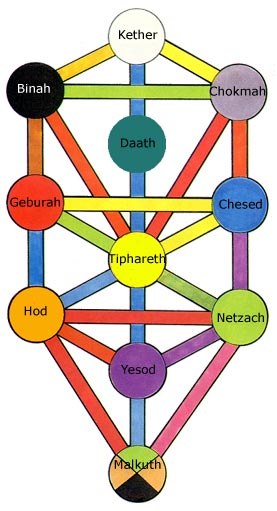
What the Torah wants to impress upon us is that the synagogue is basically an instrument by which the righteous can bring order into their lives, and order in to the chaos in which they live. This point is perfectly brought out in Bereshit 1:1-3, where we read of HaShem creating the heavens and the earth and these turning into “tohu vabohu” (chaos) and then HaShem implementing the Torah through a series of ten words to bring order and refinement into His creation.
The Temple
=> The Esnoga => Human Body
By Rabbi Dr. Akiva Tatz
The Bet HaMikdash is a macrocosm of the human body. If you look at a plan of the sanctuary in the Bet HaMikdash, you will notice that the placement of the various vessels - the altar, the table, the menorah - corresponds to the location of the vital organs in the human body. Each of the Temple's vessels represents a human organ.
The menorah is the vessel that corresponds to the heart.
Why is it that so many young people today are choosing to return to the beliefs and practices that their parents had forgotten, and their grandparents despaired of seeing continued? It is as though some mystical force is transmitted in the spiritual genes of every Jew. A light burning on the menorah of the Jewish heart across the millennia. A light which can never be extinguished, which burns miraculously, even without replenishment of the oil or wicks of mitzva observance.
So, in a mystical sense, the light Titus tried to put out continues to burn in the menorah of the Jewish heart. But there's more.
It would come as a great disappointment to Titus, but the menorah that is collecting dust in the Vatican is not the original Menorah. It is a copy. The original menorah was hidden away (together with the other vessels) in the caves and tunnels under the Temple Mount.
If while the Temple was standing the western lamp of the menorah burned miraculously without human assistance, so why shouldn't it go on burning even after it was buried?
That western lamp continues to "burn" under the Temple Mount throughout the long dark night of exile. It continues to "burn" to this day. And it will continue to "burn" until Mashiach comes. Then, the light of the menorah of the Jewish heart will be revealed as identical to the light of the menorah in the Holy Bet HaMikdash.
* * *
Thus the Mishkan also resembles HaShem's other microcosmos, Man-- it too has outer "skin" (the outer curtains of goat and tachash skins), an intellectual center (the menorah, corresponding to the light of understanding), a food processing mechanism, without which the intellect cannot function (the copper altar at the entrance to the Mishkan, and the table within, with its supply of weekly bread, consumed by the kohen), and at its heart, the tablets in the ark in the Holy of Holies (compare the two tablets of the Decalogue with the heart's ventricles). Each space inside the Mishkan is separated and defined by membranes (curtains). The entire structure is supported by wooden acacia beams, its ribs and skeletal framework. Over this are stretched the curtains and animal skins. Close to the place of the heart is the altar of incense. associated with the sense of smell, and the soul. The cherubs spread their wings over the ark, tightly bound to its cover, the kaporet, corresponding to the lungs and their close and vital connection to the heart. The kiyor (laver) represents the function of water in the body. Each of the holy utensils may represent an inner organ of the human body.
Chayim exposition expands, and differs with, that of the Rambam, cited in Chidushei Hagaonim on Menachoth 29, quoted in The Midrash Says; in The Guide, 3:45, Rambam gives a simple explanation of the Mishkan; but he dwells upon its "secret", nistar, implications in his grand letter of life wisdom and instructions to his son, Avraham, a manual of intimate personal morality; there he claims that the table represent the liver, the menorah the spleen; the sacrificial altar represents our natural heat, the altar of incense man's intuitive illumination. The holy scrolls, in the ark, symbolize human wisdom, the cherubim, protecting them, the safeguarding of our health. it is translated into English and expounded in Letters of Maimonides, by Leon D. Stitskin. He claims that it was also meant for his spiritual son, Ibn Aknin (whom Rambam calls his "dear son" in a letter), and the children of his brother David, whom he adopted, for he addresses his "children", but had only one son (but I recall a letter from Rambam, wherein he portrays difficulties and tension with his daughters). His first wife must have died early (see Meor Enayim, de Rossi, Ch. 25) and a daughter, perhaps David's, died young (mentioned by Rambam, in that letter to Ibn Aknin, where he urges Aknin not to mourn or grieve at the demise of any individual, male or female, the survival of the species being the focus of the notion of goodness).
In Egypt, Rambam married the sister of Abin-Almali, one of the royal secretaries; they were long childless, per Stitskin. In 1185, at 51, he fathered his first and only son, Avraham. In his letter to Chasdai, Rambam indicates that Avraham was sickly; so he educated him himself, in Talmudic, philosophic and medical studies. Avraham succeeded his father as head of Egyptian Jewry and served as physician to a brother of Saladin. He combined Aggada with Rambam's philosophy.
One of the many subliminal messages suggested by the above exposition is that, just as the sanctuary structure resembles a human body, so the human body should become a sanctuary, treated and respected as such. Then it can become an abode of the Shechinah, the concentrated manifest essence of HaShem -- They shall make me a sanctuary, and I shall dwell within them (Ex. 25:8, Sifse Cohen). The Mishkan thus provides the children of Israel with a tangible model of the connection between their bodies, the microcosmos, and the structure and plan of HaShem's cosmos, the universe. It henceforward becomes the meeting place (ohel mo'ed) of heaven and earth. The leaders and the people try repeatedly and unsuccessfully to erect the Mishkan. Moses, undaunted, exerts himself in the seemingly impossible task, and the Mishkan basically erects itself, a hint perhaps to the eventual resolution of the seemingly insoluble conflicts of modern Israel, torn between heaven and earth, body and soul, the moment and eternity.
|
The officers of the synagogue are |
Creation Words |
Sefirot |
|
Ba’al Masorah / Masoret [Evangelist] This officer is either an itinerant or resident “catechist” whose function is to help/teach proselytes in their process of conversion and integration into the Jewish community (He also acts as a “cult buster” a “defender of the faith”), help in the preventing of assimilation or deviation from Halakhah as taught by the Bet Din, as well as responsible for the preparation of instruction materials in the achievement of their areas of responsibility before and under the direction of the Bet Din. |
Separate light from darkness |
G’dolah (Greatness/Mercy)
|
|
Sheliach Bet Din / Sheliach Tzibbur [Apostle/Bishop] The Sheliach Bet Din was also known as the messenger, or emissary, of the Bet Din. This officer administered the judicial decisions of the Bet Din (bailiff), faithfully transmitted Halakhah, supervised the conversion procedure under the authority of the Bet Din, and the laying of hands on behalf of the Bet Din of leaders of small Jewish congregations/fellowships (Hebrew: “Chaburot”) or Batei Noach (Houses of Noach) under its jurisdiction. |
Separate waters above from waters below |
Gevurah (Strength) |
|
Darshan / Maggid [Prophet] In the synagogue, one or all of the Bet Din were responsible for preparing of the outlines for all sermons which were taught to the Darshan. The Darshan, in turn, would deliver the full sermon to the community in the synagogue, or to the associated fellowships called Chaburot.
This office is also in charge of helping anyone plead their cases before the Bet Din (much as attorneys are used in the secular justice system), and as such function as counselors or in a consolatory capacity on behalf of the Bet Din. |
Make dry land and plants |
Tiferet (Beauty) The Torah itself emanates from Tiferet |
|
Parnas / Shamash [Pastor] The deacons (minimum of 3) consist of two males and one female, and were responsible for the care of the poor. These were the social workers, Jewish style. They are in charge of the Mikveh, administration of funds, buildings and equipment of the synagogue, visiting of the sick, attending of the orphans and widows, and of the “Burial Society”. |
Netzach (Victory) |
|
|
Parnas / Shamash [Pastor] |
Birds and Fishes |
Hod (Glory) |
|
Parnas / Shamash [Pastor] The Shamash also had the duty of announcing the arrival of Shabbat by blowing six blasts on the shofar. |
Animals and Man |
Yesod (Foundation) |
|
Moreh / Meturgeman [Teacher/Elder] The one who expounded the Torah was called Meturgeman or translator. The Meturgeman translates (explains) the reading of the Torah and Haftarah, almost simultaneously. The Yemenites still do it.
The Meturgeman was the one who repeats in a loud voice the words of the Hakham, who whispers the Shiur in a low voice (Rashi to Berachoth 56a); he was also the one who translated the words of the Hakham, who delivers the Shiur in a low voice in Hebrew (Rashi to Yoma 20b). |
Shekinah (Presence) |
THE MENORAH YEAR
The sun swings across the horizon as a pendulum through twelve gates and seven annual doors
|
|
|
|
|
|
|
|
|
ג - Camel |
ב - House |
א -BBull |
ז - Weapon |
ו - Nail |
ה - Window |
ד - Door |
|
ד - Door |
ג - Camel |
C ב - House |
ת - Seal |
ר - Highest |
פ - Speak |
כ - Cover |
|
Tuesday 3rd day - Green |
Monday 2nd day - Orange |
Sunday 1st day - Indig |
7th day - Violet |
Friday 6th day - Blue |
Thursday 5th day - Red |
Wednesday 4th day - Yellow |
|
|
||||||
|
F - FA |
G - SO |
A - LA |
B - TI |
C - DO |
D - RE |
E - MI |
|
Summer Solstice
Sartan – crab Judah (Reuben)
|
Teomaim – twins Levi (Zebulon)
Aryeh – lion Issachar (Simeon) |
Shaur – bull Simeon (Issachar)
Gate 6 Bethulah – virgin Zebulon (Gad) |
Spring Equinox Toleh – ram Reuben (Judah)
Fall Equinox Meoznaim – scales Tishrei Benjamin (Ephraim) |
Dagim – fishes Joseph (Naftali)
Gate 8 Aqurav – scorpion Cheshvan Dan (Manasseh) |
Deli – water bearer Asher (Asher)
Gate 9 Keshet – rainbow Naftali (Benjamin) |
Winter Solstice
Ghedi – goat Tevet - a Gad (Dan)
|
|
Mars Madim |
Lavanah |
Chamah |
Saturn Shabbtai |
Venus Nogah |
Jupiter Zedek |
Mercury Kokah |
|
God created dry land
God created plants. |
God separated waters above from waters below. |
God created the heavens and earth and separated light from darkness. |
God Rested. |
God created animals.
God created men. |
God created birds and fishes. |
|
|
The brass laver |
The Mishkan’s veil. |
The Mishkan’s covering. |
Aaron. |
The cherubim. |
The Menorah. |
|
|
Year 3 The tithe of the THIRD YEAR went to charity for the poor, Levite, stranger, widows, fatherless, sojourners in Israel. |
Year 2 The tithe of the SECOND YEAR went entirely to the priests. |
Year 1 The tithe of the FIRST YEAR went to the Levites, who distributed to themselves, the priests, and the poor. |
Year 7 The tithe was not collected from agricultural products on the SEVENTH YEAR because the land was to lay fallow |
Year 6 The tithe of the SIXTH YEAR was set aside by the tither for his own pilgrimages to Jerusalem. |
Year 5 The tithe of the FIFTH YEAR went to the Levites, who made distribution to themselves, the priests, and the poor. |
Year 4 The tithe of the FOURTH YEAR went to the Levites, who made distribution to themselves, the priest’s portion and the poor. |
|
Darshan / Maggid |
Sheliach Bet Din / Sheliach Tzibbur |
Ba’al Masorah / Masoret |
Moreh / Meturgeman |
Parnas / Shamash |
Parnas / Shamash |
Parnas / Shamash |
|
Netzach (Victory) |
Hod (Glory) |
Yesod (Foundation) |
Malchut (Kingship) |
Chesed (Kindness) |
Gevurah (Strength) |
Tiferet (Beauty) |
|
Theft |
Murder |
Adultery |
Establish a legal system |
Eating limbs from a live animal |
Blasphemy |
Idol worship |


It all hinges on the number seven.
The tribes and their months are taken from the Sefer Yetzirah, by Aryeh Kaplan. Tribes without parenthesis are according to Exodus. Those tribe with parenthesis are from Numbers.
|
Sefirah |
|
|
Chesed (Kindness) |
gamma waves |
|
Gevurah (Strength) |
x-rays |
|
Tiferet (Beauty) |
ultraviolet waves |
|
Netzach (Victory) |
visible light |
|
Hod (Glory) |
infrared waves |
|
Yesod (Foundation) |
micro waves |
|
Malchut (Kingship) |
radio waves |
This study was written by
Rabbi Dr. Hillel ben David
(Greg Killian).
Comments may be submitted to:
Rabbi Dr. Greg Killian
12210 Luckey Summit
San Antonio, TX 78252
Internet address: gkilli@aol.com
Web page: https://www.betemunah.org/
(360) 918-2905
Return to The WATCHMAN home page
Send comments to Greg Killian at his email address: gkilli@aol.com
[1] Much of the information here was found in Bullinger’s Commentary on Revelation and Lightfoot’s Commentary on the New Testament from the Talmud and Hebraica (Hendrickson Publishers). I am also deeply indebted to my teacher. His Eminence Hakham Dr. Yoseph ben Haggai, for his insights on the synagogue.
[2] The so called New Testament which is neither new nor a testament.
[3] See Jenning’s Jewish Antiquities ; and Article Synagogue in Kitto’s Biblical Cyclopedia, vol, iii, 903.
[4] The Encyclopedia Judaica
[6] Yehezechel 11:16, Megillah 29a
[7] The Encyclopedia Britannica, under the “synagogue” heading, page 291.
[8] Megillah 29a, Megillah 1:3
[9] Pseudo-Jonathan to Shemot 18:20
[10] in Shemot (Exodus) 18:20
[11] Yalkut, Exodus 408
[12] Apion, 2:175
[13] III, 27
[14] Megill. cap.I. Hal.3.
[15] Heb. batlanim (idle men), v. supra, p. 14, n. 5.
[16] The times when the Megillah is to be read.
[17] It was usual for certain families to undertake to bring to Jerusalem on a certain day of the year a certain quantity of wood for the fire on the altar. V. Ta'an. 28a.
[19] The hagigah, an optional peace-offering brought by individuals in honour of the festival, usually on the first day of the festival.
[20] On the Feast of Tabernacles in the first year of the Septenate, to hear the Law read. V. Debarim (Deuteronomy) 31:10-13.
[21] If it happens to fall on Sabbath.
[22] On which the Megillah is actually read.
[23] That a concession is made to villagers to read on the alternate days.
[24] Lit. , ‘Who are in the synagogue’. I.e., who are always available to attend synagogue if required. Cf. supra. [According to Rashi: These were men specially maintained for the purpose from the communal fund. Aliter: men of ample means who freely devoted their time to the service of the community. V. Aruch s.v. kyc
[26] [A lrf which is distinguished from a vkusd rhg in that it is a marketing centre to which are drawn people from all parts.]
[27] Lit., ‘from the world’. These are only a floating population, and we require ten men who are always available.
[28] l.e., its walls were raised anew.
[29] Lev. XXV, 30.
[30] The lesson is derived from the curious spelling of the word in the Hebrew text, which may imply either that it has or has not a wall.
[31] Sanhedrin cap.4 hal.6.
[34] Tanach
[35] Deuteronomy 6:4-9, 11:13-21; Numbers 15:37-41
[36] The Encyclopedia Britannica, under the “synagogue” heading, page 291.
[37] Lit. “wise men”. This is the term used by Sephardim to address their Rabbis.
[38] “The Pentateuch”, by Rabbi Samson Rafael Hirsch, on Exodus 18.
[39] Before they signed it.
[40] So that it should be known that the document was confirmed in the presence of three judges.
[41] Lit., ‘has gone out’. This term also implies that the document has been found valid.
[42] It is then evident that they were three, as a court of law cannot consist of less than three judges.
[43] The “so called” New Testament which is neither new nor a testament.
[44] The Peshitta (“simple, common, straight, vulgate”) is the standard version of the Syriac Bible.
[45] A bimah (among Ashkenazim, derived from Greek βῆμα), or tebah (among Sephardim) is the elevated area or platform in a Jewish synagogue which is intended to serve the place where the person reading aloud from the Torah stands during the Torah reading service.
[47] OH 53:4-9
[48] Magen Avraham to Shulchan Arukh OH. 53:6
[49] See also TJ, Ber. 9:1, 12d. Tosef., Suk. 4:12. Sotah 7:7-8. TJ, Ber. 5:3, 9c.
[51] Sheliah zibbur, lit., ‘the messenger of the congregation’, who reads the prayers for, and on behalf of those who are themselves unable to read them.
[52] Of prayer. The Reader in the lesser courtyard which is regarded as a part of the larger one is deemed to be in the same place as the congregation.
[53] since the Reader in the larger courtyard, which (as explained supra) is independent of the’ lesser one, cannot be regarded as present with them in the lesser one, while a whole congregation cannot be deemed to be transferred from their position and shifted towards the position of an individual.
[54] Heb. שליח ציבור, lit., ‘messenger of the congregation’. This usually connotes the person who acts as the reader of the congregation in conducting the prayers. Since, however, the subsequent words, ‘descend before the Ark’, clearly refer to the function of the reader, the representative of the community would mean, therefore, the warden or person appointed to attend to the affairs of the community. Cf. R. Gershom and Rashi.
[55] V. preceding note.
[56] Lit., ‘to lift up his hands’. Of course, provided he is a priest. V. Num. VI, 22-27.
[57] Ezra III, 8.
[58] It is conceded that a Levite under the age of twenty years would not be appointed to supervise the work.
[59] How, then, can this verse be adduced in support of the rule concerning the priests?
[60] Ezek. XLIV, 15. The term ‘Levites’ in this verse means descendants of the tribe of Levi, or it might mean ‘attendants’ (Rashi).
[61] V. Lev. XXIII, 12. The lamb was an obligatory burnt-offering.
[62] Aliter: How could they have offered up if the date was not clear to them?
[63] Similarly with the case of Hezekiah, formal permission was first obtained from him before sacrificing the lamb offered in connection with the omer, though it was an obligatory one.
[64] Hieros. Peah, fol. 21.I.
[65] “The Jewish Encyclopedia”, under the heading: Community, page 195.
[66] Shiur (Hebrew: שעור, pronounced "shee-ur", pl. shiurim, שעורים) is a lesson on any Torah topic, such as Gemara, Mishnah, halakha, etc.
[67] Rashi to Berachoth 56a
[68] Rashi to Yoma 20b
[69] See also Megillah 26a, 27a and Josephus’ Antiquities 4:214-4
[70] The seven sephirot are called in Kabbala "the Seven Days of Creation", for it is essentially through them that constitution of each of the planes of reality is built.