
The Meaning of The Number Thirteen (13)
By Rabbi Dr. Hillel ben David (Greg Killian)
Thirteen in the Nazarean Codicil
An Article By R. Mordechai Kornfeld
An Article By R. Solomon D. Sassoon

The spiritual significance of the number thirteen (13), which as reflected by the thirteen attributes of Mercy (we will look at these attributes later), relates to a transcendent dimension of G-dliness. This transcendence enables one to infuse spirituality within our material world[1].
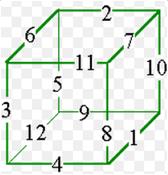 Twelve is the number of maximal
differentiation. It is the number of lines that
border a cube, and according to Chazal,[2]
all of reality.
Twelve is the number of maximal
differentiation. It is the number of lines that
border a cube, and according to Chazal,[2]
all of reality.
The fact that the twelve are all connected in the center is the thirteenth. Thirteen is the number that bonds multiplicity into oneness. For example: There are twelve tribes that are bonded into their father Israel (Yaaqov). Israel is the thirteenth. The meaning of the number thirteen is the bonding of many into one.
Jews look to make many into one whilst the Gentiles look to make one into many. This is exemplified with the preeminent prayer of the Jews, the Shema[3], which speaks of HaShem[4] being one; while the Gentile’s preeminent theology is the trinity, in which they make HaShem into three gods. Thus the Goyim have a superstition that the number thirteen is bad, whilst the Jews see the number thirteen as very good.
The number thirteen is among the holiest of the numbers because it is closely associated with HaShem.
Devarim (Deuteronomy) 6:4 Hear, O Israel: HaShem our God, HaShem is one:
The above verse, from the Shema, tells us a very important relationship:
The Shema - שמע is recited twice a day, by observant Jews, to obey the Torah command as found in the Shema itself. The goal of the Shema is not just to declare that HaShem is one, but rather to declare that HaShem is one and there is nothing in existence besides Him. The world and everything around us, is just an extension of HaShem.
To help us understand the making of many into one, HaShem gave us the sense of hearing. As an aside, HaShem gave us the human body, with all of its responses, in order to give us intimate insights into HaShem and His creation. If we understand what it means to hear, we can understand what it means to declare HaShem’s oneness.
Hearing is a sense which requires us to assemble the sounds from another person, into a cohesive picture. Thus we would say that hearing is the forming of disparate parts into a single idea or picture. Literally we make many (sounds) into one (idea).
The Shema, which is uttered twice a day by every observant Jew, is an interesting perspective into hearing. Shema is normally translated as “hear”. Our Sages teach us that shema literally means the gathering of many and making them into one. The appropriateness of this definition is brought into sharp distinction when we see that the goal of the shema is that HaShem should be one and His name One.
To help us understand the relationship between HaShem and His oneness, HaShem gave us the Hebrew language. Part of this language is the fact that each letter not only has intrinsic meaning, but each letter also has a numeric value, as we learned in our study of the Hebrew letters. In the following chart, we can see that the numerical value of the Hebrew letters that form echad, whose meaning is one, is thirteen.
|
The gematria of echad - אחד is thirteen: |
א = 1 ח = 8 ד = 4 ---------- Total: 13 |
Not only does echad=13, but the Hebrew word ahava (love) also has a numerical value of thirteen, as expressed verbally in the Nazarean Codicil:
1 Yochanan (John) 4:8 He that loveth not knoweth not HaShem; for HaShem is love.
Chazal[6] teach that if two words have the same numeric value, then the essential meaning of the two words is the same. The above verse from the Nazarean Codicil[7] gives us another very important relationship:
HaShem is Ahavah (Love)
|
The gematria of ahavah - אהבה is thirteen: |
א = 1 ה = 5 ב = 2 ה = 5 ---------- Total: 13 |
Thus we learn that:
Echad (one) is ahavah (love)
HaShem is ahavah (love)
It follows, therefore, that we become one with HaShem, when we love Him and we love what He has created. Love means unification with the object of our love, and unification with HaShem means a unified heart in belief and devotion.
Thus we see that HaShem equals thirteen. Therefore the meaning of thirteen is the oneness and love of HaShem.
The yod-י hay-ה vav-ו hay-ה (HaShem) name has a gematria of 2 X 13 = 26.
The word echad is spelled: אחד aleph-chet-dalet. In Kabbalah, the letter aleph (א) corresponds to the highest sefirah, Keter. The chet (ח) [with a numerical value of eight], in this case, represents the eight sefirot below Keter (Chachmah, Binah, Chesed, Gevurah, Tiferet, Netzach, Hod, and Yesod), until the last sefirah, Malchut. The letter dalet (ד), in Kabbalah, always represents Malchut. The following chart illustrates the sefirot, which represents creation:
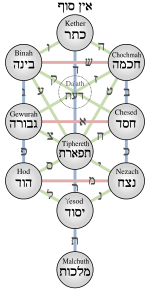
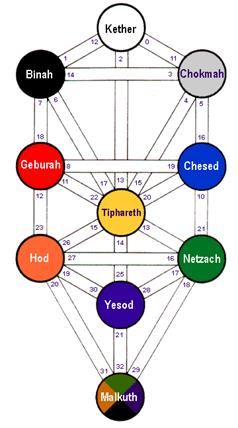 Hence, the message of the Shema is: From the very top of creation
until the very bottom of creation, even in the darkest,
most physical parts of existence, you must know and be real with HaShem's Oneness. There is never a place that HaShem isn't, just places where it is not proper to
think about Him. There is never a time when HaShem isn't, just times when He doesn't seem apparent
to us.
Hence, the message of the Shema is: From the very top of creation
until the very bottom of creation, even in the darkest,
most physical parts of existence, you must know and be real with HaShem's Oneness. There is never a place that HaShem isn't, just places where it is not proper to
think about Him. There is never a time when HaShem isn't, just times when He doesn't seem apparent
to us.
So, thirteen is another way of expressing the unity of HaShem.
Throughout the siddur (prayer book), and Jewish thought, thirteen is used to express HaShem and His oneness. This is made emphatic by the thirteen principles which express the essentials of Jewish belief, which allow us to have an attachment to HaShem and His eternal world. The following list contains Rambam's thirteen principles of faith, which we understand are the minimum requirements of Jewish belief:
1. HaShem exists.
3. HaShem is incorporeal.
4. HaShem is eternal.
5. Prayer is to be directed to HaShem alone and to no other.
6. The words of the prophets are true.
7. Moses' prophecies are true, and Moses was the greatest of the prophets.
8. The Written Torah (first five books of the Bible) and Oral Torah (teachings now contained in the Talmud and other writings) were given to Moses.
9. There will be no other Torah.
10. HaShem knows the thoughts and deeds of men.
11. HaShem will reward the good and punish the wicked.
12. The Mashiach will come.
13. The dead will be resurrected.
The consistent theme throughout the Shacharit (morning) prayers, is the unification of ourselves with HaShem. We do this with words and with the counting of thirteen. The following lists names some of those prayers with their relationship to thirteen:
In Leshem yichud – We unify the Yod Hay with the Vav Hay.
In Ribono shel olam: We count out the thirteen attributes of Mercy.
In Ellu Devarim: We speak of those things which have no set measure, then we conclude with “the study of Torah is equivalent to them all. With this we join ourselves to Mashiach and to HaShem.
In Le’olam Ye’he Adam: We extol HaShem and negate ourselves. Then, we speak the first sentence of the Shema. Finally, we conclude with multiple statements on HaShem’s unity and with our summation into His Name.
In Ketoret: We speak of the eleven spices and the absolute requirement that none of them be omitted. We speak of Yom HaKippurim when the incense is used to join Klal Israel to HaShem in the ultimate marital act.
In Anna Bechowach: We speak of HaShem as the “Single and Exalted One”.
In Ezehu Mekoman: We speak at length about the korbanot (sacrifices) which are meant to draw us near to HaShem.
In the Baraita of Rabbi Ishmael: We speak of the thirteen principles to Torah exegesis for the remez level.
In HaShem Melech: We speak of HaShem’s reign and we look forward to the day when “HaShem will be One and His Name will be One”.
In Yishtabbach: We count out the thirteen praises of HaShem.
In the Shema: We speak of the Oneness of HaShem.
In fact, nearly every prayer addresses our unity in HaShem. The counting of thirteen is done to emphasize His love and His Oneness with His people.
It is desirable to have ten men of bar-mitzva age,[8] before we pray. The meaning of thirteen is mentioned in Mishna Avot 5:26, where we find the source of the well-known Bar-Mitzva concept: A Jewish male is not responsible for mitzva (Torah commands) observance until the age of thirteen. Thus prayer and praying depends on having ten men who are thirteen years or older.
As a major part of the prayers of Yom Kippur,[9] we repeatedly mention the thirteen attributes of HaShem’s divine mercy. These thirteen attributes are found in:
Shemot (Exodus) 34:6-7 And HaShem passed by before him, and proclaimed, HaShem, HaShem God, merciful and gracious, longsuffering, and abundant in goodness and truth, 7 Keeping mercy for thousands, forgiving iniquity and transgression and sin, and that will by no means clear the guilty; visiting the iniquity of the fathers upon the children, and upon the children’s children, unto the third and to the fourth generation.
Let me separate and explain these attributes:
(1) HaShem has compassion before man sins;
(2) HaShem has compassion after man has sinned (comp. R. H. 17b);
(3) "El," mighty in compassion to give all creatures according to their need;
(4) "Rachum," merciful, that mankind may not be distressed;
(5) "Chanun," gracious if mankind is already in distress;
(6) "Erek appayim," slow to anger;
(7) "Rab Chesed," plenteous in mercy;
(8) "Emet," truth;
(9) "Notzer Chesed laalafim," keeping mercy unto thousands (comp. the explanation of Samuel b. Meir in "Daat Zeḳenim," ad loc.);
(10) "Nose 'awon," forgiving iniquity;
(11) "Nose pesha'," forgiving transgression;
(12) "Nose Chata'ah," forgiving sin;
(13) "Wenakeh," and pardoning.
It is the merit of the recitation of these thirteen attributes, following our teshuva (repentance), that HaShem gives us atonement. Such is the importance of thirteen!
From these examples, we can see that the number thirteen is used in Jewish prayer to express the oneness of HaShem and His people.
My teacher, Hakham Dr. Yosef ben Haggai taught the following regarding the number thirteen:
The Nazarean Codicil teaches us about thirteen as well.
Matityahu 10:1-6 And when he had called unto him his twelve disciples, he gave them power against unclean spirits, to cast them out, and to heal all manner of sickness and all manner of disease. 2 Now the names of the twelve apostles are these; The first, Simon, who is called Peter, and Andrew his brother; James the son of Zebedee, and John his brother; 3 Philip, and Bartholomew; Thomas, and Matthew the publican; James the son of Alphaeus, and Lebbaeus, whose surname was Thaddaeus; 4 Simon the Canaanite, and Judas Iscariot, who also betrayed him. 5 These twelve Yeshua sent forth, and commanded them, saying, Go not into the way of the Gentiles, and into any city of the Samaritans enter ye not: 6 But go rather to the lost sheep of the house of Israel.
So, I see twelve Apostles, but where is the thirteenth? I submit that when they went out to teach, heal, and pray that there were always thirteen: The twelve Apostles and Yeshua Himself makes thirteen. Yeshua bonded the twelve into one group.
This theme is carried forward when we see that after Yeshua’s death, the Apostles chose a replacement for Judas:
II Luqas (Acts) 1:24 And they prayed, and said, Thou, Lord, which knowest the hearts of all men, shew whether of these two thou hast chosen, 25 That he may take part of this ministry and apostleship, from which Judas by transgression fell, that he might go to his own place. 26 And they gave forth their lots; and the lot fell upon Matthias; and he was numbered with the eleven apostles.
At this point, Judas has died and the eleven remaining Apostles have chosen a twelfth to join them. So, where is the thirteenth?
I learned from my teacher that we can see that Hakham Shaul (Paul) was the thirteenth Apostle:
Galatians 1:1 Paul, an apostle, (not of men, neither by man, but by Yeshua Mashiach, and God the Father, who raised him from the dead;)
Thus we see that Hakham Shaul bonded the twelve into one group. As such, he was responsible for writing a significant portion of the Nazarean Codicil.
The Mazzaroth, also known as the zodiac, is the name given to the pattern of stars found on the celestial equator, or ecliptic. The ecliptic is an imaginary zone of the heavens containing the twelve sets of stars (constellations) within which lay the paths of the principal planets, and through which the sun passes in its annual course. Mazzaroth is the Hebrew word for constellation. There is a related Hebrew word: mazzaloth.
There are twelve Mazzaroth on the zodiac. So, where is the thirteenth? I’d suggest that the sun, moon, and the planets are the thirteenth Mazzaroth.
A Mazzaroth (constellation) is a group of lights that are grouped by location. The sun, moon, and planets are also a group of lights that are grouped by their location. They are traveling lights that travel through all of the other twelve constellation, binding them together as the thirteenth.
It is also worth noting that the center point of the Mazzaroth is the sun, which points again to its connection as the center point. he thirteenth mazal stands by itself and summarizes or encapsulates the other twelve.
It is well known that there are twelve months in a year. Yet, in a leap year we add an extra month called Adar Sheni. This second Adar is the month that binds the other twelve into a calendar that is both lunar and solar. Adar sheni allows us to have our festivals in their seasons. Pesach always falls in the spring. Succoth always occurs during harvest time.
The foundation of the Oral Torah is the thirteen exegetical principles which are enumerated in the introduction to Torat Kohanim. Through these principles, the Oral Law is derived from the written text of the Torah. (This is why the Midrash HaZohar on Bereshit (Genesis) teaches that the number thirteen serves as a metaphor for the Oral Torah.)
The thirteen breaches (made by the Greeks) in the enclosing wall, which surrounded the Temple Mount, were repaired by the Hasmonean kings. These kings decreed that one must bow down when passing by each of these repaired breaches; a total of thirteen bowings.[10]
The Elders made thirteen modifications in the text of the Torah when they translated it into Greek. This number represents the fact that inherent in the translation is the loss of the Oral Torah, which is derived through the thirteen exegetical principles. The thirteen breaches made by the Greeks and repaired by the Hasmoneans represent the entire focus of the Greek war against the Jews. The Greeks sought to eliminate the thirteen principles through their literal translation of the Torah into Greek, with the resultant loss of the Oral component of the Torah. The Hasmoneans succeeded in restoring these indispensable tools of Torah interpretation. In order to commemorate and give thanks for this victory of authentic Torah ideology over the shallow, incomplete Sadducee misrepresentation of Torah, thirteen bowings were instituted at the sites of the repaired breaches. It may be further noted that according to Rashi[11], thirteen Hasmoneans commanded the Jewish army that overthrew the Greeks. These thirteen courageous men enabled the Jewish People to preserve the Oral Tradition and its thirteen principles![12]
Regarding Number Symbolism in the Torah from the Work of Rabbi Solomon D. Sassoon:
I. Introduction
In the parashat HaShabua studies there have been a goodly number of references to the views of Rabbi Solomon D. Sassoon a"h, including allusions to his interpretation of numbers. As many readers are unfamiliar with his work, following is a brief introduction to this one aspect of his prodigious achievements in the field of Torah study.
Based on extensive research conducted over many years, Rabbi Sassoon maintained that in the Torah and in certain other books of Tanach[13], as the prophetic message utilizes metaphor and figurative speech, it often uses number symbolism in a variety of ways. He felt numbers were of extremely great significance and usually were not to be taken literally. He demonstrated the ubiquitous use in the Torah of the digit eight and its multiples to signify the Covenant between G-d and Israel. He pointed out that the number thirteen - which he explained as the gematria of "ehad" referring to the Oneness of G-d - is also often used symbolically. Sometimes the number 21 and its multiples are used to signify the combination of 13 + 8. At least several other symbolic numbers are present in the Torah. As we have pointed out in our Parashat Vaera study, the number 26, gematria of G-d's Tetragrammaton Y-H-V-H name, is embedded in the structure of the texts of Exodus 6 and 15, which uniquely speak about His name and is associated with the total number of occurrences of His name in the Torah (Pentateuch) and Neviim (Prophets) Rishonim but this study will be limited to examples of 8 and 13.
Indeed, Rabbi Sassoon claimed that the whole Torah and Early Prophets, as well as the Psalms, and perhaps other parts of Tanach, were written with codes running through them, based on gematria, precise word counts, sequence and patterns, highlighting the Covenant, governing the structure and design of numerous, if not all, passages, and providing insight on many important topics.
Although he often stated that he did not know the meaning or implications of many number usages or word patterns, and that on many particulars he may be mistaken, he was confident that the systems he uncovered were real. He subjected them to expert statistical analysis, their implications fit in with the substance of other Torah research he did (penetrating investigation into the meaning of the Torah text), many echoes and hints were present in classical rabbinical literature and his results were in harmony with certain aspects of modern scholarly research (of course rejecting much of the speculative work of modern Bible scholars).
The presence of sophisticated patterns serves a number of purposes. In addition to beautifying the word of G-d and helping to preserve the integrity of the text through the processes of copying and transmission, recognition of wondrous patterns provided support to the recipients that the text was the genuine statement from the true prophet. This was especially important in a world that had become an arena of competing ideologies as the ancient Near East most certainly was, where dissenters challenged the authenticity of the great prophets. Serious observers might conclude that the remarkable systems of word pattern and structure running throughout the text - much more sophisticated and difficult to compose than any literary artifact known to man - was the result of true prophetic inspiration from G-d.
Finally, through deeply embedded patterns pointing to meanings that, for various reasons, could not be expressed explicitly - undoubtedly including the difficulty of the uninitiated to grasp sophisticated thought - the prophets spoke to those prepared to hear their fuller communication while providing a satisfactory message to the others.
Notwithstanding that the formulae Rabbi Sassoon uncovered lie beneath the surface and explicate Peshat on a deeper level, and although the reader may often be amazed at the sophistication of the text, the systems follow standard literary norms for certain types of symbolic writing. Everything is there in front of the reader. The text is not manipulated. The reader may count the words and see the pattern. And the text is not trivialized. This should not be confused with the codes of Arachin, the Discovery Seminars and related approaches (Rips, Witzum, Drosnin, et al), roundly criticized by many scholars, which are of a totally different nature. We will not enter further into that topic here as the purpose of this discourse is only to provide background and helpful information to assist the reader of our parashat HaShabua studies.
Examples
Some examples of symbolic use of eight and 13 (and their multiples, usually with addition of zeroes) including several in which both are used in close proximity, follow. Most, but not all, of these examples are taken directly from Rabbi Sassoon's work.
1. Adam is 130 years of age when he begot Seth "bidmuto kesalmo" and lives 800 years more, for a total of 930 (Gen. 5:3-4). The Torah does not furnish any other age number for him! Rabbi Sassoon explained the 130 to refer to Adam having attained the stage of recognition of the one G-d (13) and the 800 to relate to his having been in the "brit" (covenant) with G-d (8). (He quoted the Rambam's comments on "selem" in this regard.)
2. In the narrative of Noah, the "brit" stem appears eight times. The number of people saved via the ark is 8 (Noah, three sons and their wives). The sign of the brit (zot ot habrit - Gen. 9:12) is the "qeshet" (the rainbow), gematria of 800. (The word qeshet in all forms appears 8 times in the Torah and 13 times in the Early Prophets.)
3. Brit mila for Ishmael is at 13 (years), while for Yitzchak, and subsequently for Israel, it is at 8 (days). This 13 results from a period of time in Abraham's life - in consecutive verses (Gen. 16:16 and 17:1) Abraham is 86 when he begot Ishmael and 99 when G-d appeared to him to contract the Covenant, which is signified by circumcision on the eighth day. In that Genesis 17 passage the root "brit" appears 13 times and the word intervals between most of the occurrences are 8 or its multiples. It also appears significant that Abraham is 160 years of age (80 x 2) when Yitzchak begot Esav and Yaaqov.
4. Abraham's name (including Abram) appears 210 times (130 + 80) in the Torah, with the 130th occurrence at a milestone point signified by 8 associated with a 13 (see the following item).
5. Abraham's brother Nahor had eight sons from his wife and 4 from his pilegesh. When the Torah relates this information it inserts in the passage the birth of Rivkah, the daughter of Betuel, Nahor's 8th son (Gen. 22:20-24). This constitutes a 1-8-4=13 unit, corresponding to aleph-het=dalet indicating that the family of Nahor was an appropriate one from which to seek a wife for Yitzchak. Upon mention of Rivkah's birth and within the statement "these eight Milca bore to Nahor the brother of Abraham" is the 130th occurrence of Abraham's name.
6. In the section concerning Abraham's servant finding a suitable wife for Yitzchak and the consummation of the Yitzchak-Rivkah marriage (Gen. 24), Rivkah’s name appears 13 times while Yitzchak's appears 8 times.
7. When Esav gets married at forty years of age, understood as separating from Yitzchak (`al ken ya`azob ish et abiv v'et imo vedabaq be'ishto - Gen. 2:24), the latter is 100 years of age. From that point on he lives 80 years.
8. Yaaqov has one daughter and 8 sons from his wives and 4 sons from the shefahot, a 1-8-4=13 unit, corresponding to echad.
9. When G-d changes Yaaqov’s name to Yisrael, the last Yaaqov attestation before the change (but within the name change context) - "shimkha Yaaqov", (Gen. 35:10) - is the 130th occurrence of Yaaqov’s name in the Torah. When the angel changed his name, the last usage of his name Yaaqov just prior to the change (also within the context of the name change) - Vayomer Yaaqov (ib. 32:27-28) - is the 80th occurrence of Yaaqov in the Torah when it is counted in the pure form, without prefixes attached to the name. (Regarding proper nouns, it appears there is meaning to the count of both the pure form and the prefixed/suffixed form.)
10. Yaaqov is 130 years of age when in front of Pharaoh (ib. 47:9), while Moshe is 80 years of age in front of Pharaoh (Ex. 7:7), an obvious juxtaposition of these two key numbers. At no other points during their lives are their ages given! (Rabbi Sassoon thought that Yaaqov was really at the stage of 80 when in front of Pharaoh but in accordance with the principle "al tithadar lifne melekh" (Prov. 25:6), refrained from mentioning it to him and limited himself to the monotheistic concept.)
11. The only ages given for Yosef are 17, 30 and 110, clearly delineating two mature periods of life comprising 13 and 80 years respectively. Yosef is 30 in front of Pharaoh, or at the level of 13 and eventually achieves the level of 80.
12. Regarding Sarah, the only age given for her is at her death, 100 years, 20 years and 7 years (Gen. 23:1). The unusual literary formulation appears to be hinting at two periods of life, 13 and 80 years respectively.
13. The Mishkan dedication being on the 8th day following the seven days of initiation (and employing 8 sacrifices), Shemini Atzeret clearly being an 8th day added to the 7 days of Succoth, Shavuot being emphasized as day 50 (Lev. 23:16) and the yovel as year 50, the latter two both beginning the eighth series of seven, all appear to be examples of the digit 8 (signifying the Covenant) replacing the 7. (Additional examples of this nature will be provided in the following section.)
14. A sacrifice is only acceptable from the 8th day onwards (Lev. 22:27).
15. In the Torah's most expansive Shabbat passage, celebrating its linkage with the Covenant, there are 8 usages of the sh-b-t stem (Ex. 31:12-17). In the most expansive passage dealing with repentance and return, in a context linking them with the Covenant renewal, there are 8 usages of the key sh-b stem (Deut. 30:1-10).
16. In both the Year two and Year forty censuses, the individual numbers of the 12 tribes do not include a single digit eight, which does appear in the from-one-month-old count of Qehat, the carriers of the Ark of the Covenant, and in the grand total of the Levites, the servitors and guardians of the sanctuary.
17. In King David's census, the northern kingdom was 800,000 while Judah was 500,000, a total of 1,300,000 (2 Sam. 24:9).
18. In the Masoretic Text, there are 79,982 words in the Torah. Considering the rabbinic attestations that there were some variant readings in Second Temple times, that markings were placed on certain doubtful words and phrases, that talmudic quotations differ from the Masoretic Text in quite a number of instances, that there were a number of tiquneh sofrim and `itureh sofrim and that there is evidence from the Targumim, the Septuagint and the Dead Sea Scrolls pointing to tiqune sofrim-type deletions of several words, it is not surprising that Rabbi Sassoon felt it reasonable to assume that the original Torah word count was 80,000. (Based on his codes, he thought the original text of the people's response to the arurim declarations in Deut. 27:15-26 was "amen ve'amen", not a single amen, similar to the suspected sota (Num. 5:22) and to several other cases, thus accounting for 12 words.)
Regarding 7 and 12
It appears that the digit seven and its decimal multiples, well-known to have been considered a most prominent digit in the ancient Near East, representative of connection. G-d's creating the world in 7 days, with the attendant 7 symbolism including Shabbat (where we connect with our work for the previous six days), the post-Diluvial world being comprised of 70 nations (Gen. 10) and the 70 members of the incipient nation of Israel that descended to Egypt (prior to the national covenant), illustrate this idea of connection.
The first covenant mentioned in the Torah is with Noah. His father Lemekh (ben Metushelah) lived to 777 years (Gen. 5:31), indicating that he was an extraordinary man, having achieved completeness in the previous order. He begot Noah at 182 years of age (14 x 13), a multiple of both 7 and 13, pointedly hinting at his unique spiritual distinction. This is consistent with his naming his son Noah and with his declaration upon his birth - for whom he obviously diligently prepared through prayer and spiritual refinement - that he should be of great benefit to mankind (ib. 5:29). The combined occurrences of the names of Abram and Sarai through the last verse in Genesis 16 - which speaks of Abram being 86 at the time of the birth of Ishmael and just prior to Abram being 99 when the covenant linked with the birth of Yitzchak is contracted - is 70.
As stated earlier, Shavuot, yovel and the Shemini Atzeret day all appear to be cases of transforming what might have been seven symbolism to that of eight. The Mussaf offering on Shabbat, adding two lambs to the two daily temidim, making a total of 16, may be a case of subsuming the 7 day week into the Covenant. In the Ki Tissa Shabbat passage which emphasizes the Covenant the sh-b-t root appears 8 times.
The addition of one `olah ram to the seven `olah lambs in the service of Rosh Hodesh, all days of Pesach, Shavuot, Rosh Hashanah, Yom Kippur and Shemini Atzeret, being of the same species, was likely mandated to constitute a Covenant-connoting unit of eight. The seven Succoth days have double, 14 lambs and two rams daily.
Following the death of Qorach and his immediate circle for contesting the prophetic authenticity of Moshe and Aharon, when people complained, basically identifying with the rebels' position, 14,700 die in a plague (Num. 17:14). It appears that they represented the old order, those who refused to change to be committed to the Covenant.
Somewhat analogously to the case of 7 and 8, the number twelve represented a full measure of blessing and fruitfulness in the ancient Near East and was supplanted in some respects by the spiritual connotation of 13, referring to those who recognized one G-d. This latter principle appears to be behind the transformation of the tribes of Israel from 12 to 13 by splitting Joseph into two.
From Ronald Benun's Upcoming Book on the Psalms:
Since before Rabbi Sassoon's death in 1985, Ronald Benun has been working on applying and extending Rabbi Sassoon's principles regarding 8, 13, brit and related matters to understanding the shape, structure and meaning of the Psalms. Some selections follow:
1. The 1300th verse from the beginning of Tehillim is the last verse of Mizmor 78. The 1300th verse from the end of Tehillim is the last verse of Mizmor 77. Thus, Mizmor 78 is enveloped by the overlap of 1300 verses going both ways. Mizmor 78 has 72 verses. Verse 36, one of its two center verses, is verse 1264 in Tehillim, the exact center verse of the 2527 verses of Tehillim.
2. Mizmor 79 contains 13 verses. Thus, Mizmor 80 begins after exactly 1313 verses.
3. Primarily based on the Aleppo Codex, from the beginning of Mizmor 80 until the end of Tehillim is 8888 words. Thus, Tehillim comprises 1313 verses followed by 8888 words.
4. There are 21 (13+8) attestations of "brit" in Tehillim. Two of these appear in Mizmor 78. The first (v. 10) is the 8th occurrence from the beginning of Tehillim while the second (v. 37) is the 13th from the end of Tehillim. Excluding superscription, "brit" is the mizmor's 88th word.
5. The 21 attestations of "brit" in Tehillim are in exactly 13 Mizmorim. The 8th occurrence (in Mizmor 78) is in the mizmor that is 8th from the last of these 13 mizmorim. The 13th occurrence is in the mizmor that is 8th from the beginning of these 13 Mizmorim (# 89 v. 35).
The MAHARAL writes in Chidushei Aggadot Nedarim 31:2, “And Rabbi Yishmael continued to speak, ‘Great is the covenant of Circumcision, for thirteen covenants were established in connection with it’ (the word ‘Brit’(meaning covenant but alluding to circumcision) is mentioned by HaShem thirteen times in the section where HaShem introduces the idea to Avram, corresponding to the Thirteen Attributes of Mercy. – PF) ‘And this is because the foreskin is like a shell, as we have said, and the shell constitutes a separation, and when the foreskin is removed, there remains a complete covenant with HaShem, Blessed is He... That is to say, a complete covenant from all sides, and this reflects the fact that this covenant is complete with a Singular Being Who is a source of love, and a complete covenant is not possible to be made with two lovers... And the ‘gematria’ of the word “Echad,” One, is in fact, thirteen.’ ”
* * *
The total number of letters contained in a word reveals something about the word itself. Abraham, Isaac, and Jacob have a total of thirteen letters in them (in Hebrew). Sarah, Rivka, Rachel and Leah, their wives, also have thirteen letters. The thirteen is the gematria of the Hebrew word (echad) one. Thirteen plus thirteen equals twenty-six, the numerical value of "Adonai," HaShem's Holy Name. Could it be that the Adonai (26) is the balance of the masculine (13) and feminine (13)?
* * *
The Hebrew Bible has 39 books, three times thirteen.
Moses plus thirteen, echad, equals the gematria (numerical value) of Mashiach.
[The covenant of Brit Milah (the covenant of circumcision)] was a made with thirteen covenants, according to the Talmud[14].
* * *
The Arizal explains that numbers have their origins in the supernal spiritual worlds. Single digit numbers correspond to the physical realm Asiyah, the sefirat Malkhut. Tens correspond to the angelic realm Yetzirah, the sefirat Tiferet. Hundreds correspond to the Neshama realm Beriah, the sefirat Binah, Imma. Being that hundreds emanate from the realm of Imma, they are the source of blessing. Therefore, all offerings are the rectification of 100% of the produce offered.
* * *
This study was written by
Rabbi Dr. Hillel ben David
(Greg Killian).
Comments may be submitted to:
Rabbi Dr. Greg Killian
12210 Luckey Summit
San Antonio, TX 78252
Internet address: gkilli@aol.com
Web page: http://www.betemunah.org/
(360) 918-2905
Return to The WATCHMAN home page
Send comments to Greg Killian at his email address: gkilli@aol.com
[1] See Or HaTorah, Bereshit 7a and other sources.
[2] Chazal or Ḥazal (Hebrew: חז"ל) is an acronym for the Hebrew "Ḥakhameinu ZikhronamLiv'rakha", (חכמינו זכרונם לברכה, literally "Our Sages, may their memory be blessed"). In rabbinic writings this is a general term that refers to all sages of the Mishna, Talmud, and other rabbinic literature commentators, and their authoritative opinion, from the times of the Second Temple of Jerusalem until the 6th century CE.
[4] HaShem means ‘The Name’ and is the way pious Jews refer to the YHVH name of God.
[5] The gematria, the numerical value of this Hebrew word is thirteen.
[6] Our Sages
[8] Thirteen years or older.
[9] The Day of Atonement – Tishri 10.
[10] Middot 2:3
[11] Deuteronomy 33:11
[12] Based on the explanation of Rav David Cohen in "Bircat Yaavetz," p. 147
[13] An acronym for Torah, Neviim, and Ketuvim, also called the Old Testament.