
Chanukah Connection
By Rabbi Dr. Hillel ben David (Greg Killian)
The Chanukiya (Chanukah Menorah)
HaMakom - The Place of Connection
Night – The Time of Connection
The Connection Of The Righteous
Mashiach ben Yoseph and Chanukah
Explanation from the Yalkut Me’Am Lo’Ez

In this paper I would like to explore connections in general, and also connections specific to Chanukah[1]. Chanukah was established by our Hakhamim[2] after they defeated the Greeks and rekindled the menorah, the lampstand, in the Temple. The account of the battles and the miracles can be found in the apocraphal book of Maccabbees.
Lets start by noting the fact that the Hebrew word mitzva, normally translated as commandment, means connection! The first use of mitzva is found in:
Bereshit (Genesis) 26:1 And there was a famine in the land, beside the first famine that was in the days of Abraham. And Isaac went unto Abimelech king of the Philistines unto Gerar. 2 And HaShem appeared unto him, and said, Go not down into Egypt; dwell in the land which I shall tell thee of: 3 Sojourn in this land, and I will be with thee, and will bless thee; for unto thee, and unto thy seed, I will give all these countries, and I will perform the oath which I sware unto Abraham thy father; 4 And I will make thy seed to multiply as the stars of heaven, and will give unto thy seed all these countries; and in thy seed shall all the nations of the earth be blessed; 5 Because that Abraham obeyed my voice, and kept my charge, my commandments (mitzva), my statutes, and my laws.
In this pasuk, this passage, we see the establishment of the connection of Avraham and his seed to HaShem and to the higher world. Avraham established the connection by obeying the mitzvot (commandments [plural]). This connection was a restoration of the connection that Adam had in Gan Eden. Never the less, the ultimate fulfillment of this connection required the second Adam:
Galatians 3:16 Now to Abraham and his seed were the promises made. He saith not, And to seeds, as of many; but as of one, And to thy seed, which is Mashiach.
We have previously studied (Adam in Eden) the fact that what HaShem created in the beginning was the picture that He desired for eternity. To accomplish the tikkun, the correction, for Adam’s sin, He sent the Mashiach to become the second Adam. The Mashiach proved Avraham’s connection by keeping the mitzvot and gathering the souls of the Tzaddikim, the Righteous, to Himself to make ONE new man. Mashiach, The Living Torah, not only kept the mitzvot, but He also embodied the mitzvot. Mashiach was the ultimate connection to HaShem and to the Olam HaBa. Those that are not a part of Mashiach are those without the mitzvot. These wicked men have no connection to HaShem, nor to the Olam HaBa, because they have not established the connection by keeping the mitzvot. Keeping the law is not optional for those who wish to draw near to HaShem, they are the only way to draw near! The Gentiles are obligated to obey the Noachide commandments and Jews are obligated to obey the 613 mitzvot.
What is the connection between a commandment and a connection? Chazal teach that when we perform the mitzvot, we establish and maintain our connection with HaShem and our connection with the higher world. When we violate HaShem’s commands, we sever or weaken our connection with HaShem and the higher world. If we want to love HaShem and we want a portion in the Olam HaBa (the world to come), we must perform the mitzvot. Without obedience to the written and the oral law, we will not have a connection to HaShem or to the Olam HaBa.
Performing the mitzvot connects us with HaShem and His transcendant world. If we do not DO the mitzvot, then the consequence is that we do NOT have a connection with HaShem or with a transcendant world. It is not a punishment, it is a consequence. If we do not turn the lights on, then we remain in darkness. This is the secret of Chanukah. During Chanukah we turn on the lights.
During Chanukah we kindle an increasing number of lights on the chanukiyah, each night. We light one light the first night, two lights the second night, three lights the third night, and we continue this process until we have lit all eight lights on the eighth night. We will thus kindle a total of thirty-six lights on the eight nights of Chanukah. Both the number eight and the number thirty-six are extremely significant to our connection.
Note well the following picture, as we will be referring to it for the remainder of this study. Observe the oil, the wick, and the flame:
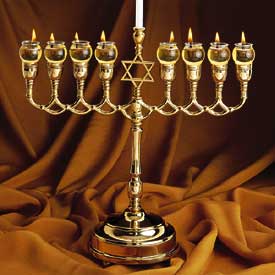
Keeping the above picture in mind, lets examine some aspects of this Chanukiya: The oil, the wick, and the flame. To understand these, we need to start with a bit of background.
Man has five levels of soul and a connection of that soul to HaShem. The five levels of the soul of man are:
|
Level |
Torah |
Explanation[3] |
Meaning |
|
Nephesh |
|
This is the externally oriented part of the human being, the senses and drives which connect him with the world around him. The survival drives for food, sex, shelter, and the like, which sustain the human race, have their origin in the nefesh which supports the body. When the nefesh is able to function properly, the human being has good health. An allusion to the mitzva to take care of our health is found in the following words: "Only take heed, and guard your nefesh exceedingly" [Devarim (Deuteronomy) 4:9]. |
Rest |
|
Ruach |
Shemot |
The feeling and emotions of the heart. This spirit is the internally oriented part of the human being, which enables him to think and feel, and gives rise to his sense of self. It is the origin of all intellectual, emotional, and social activity. When the ruach is able to function properly, the human being has self-confidence and self-respect. |
Wind |
|
Nesahama |
Bereshit |
The mind and it’s higher consciousness. The supernal soul is the human being's link with the trans-physical realms of the Creation, with the spiritual world and with the Creator; it is the source of the human being's craving for a relationship with the Creator. Everyone is cognizant of his nefesh and his ruach, but not everyone is cognizant of his neshamah. Someone who is truly aware of his neshama will come to recognize that he is created in the Divine image with the capacity to emulate the love and compassion of his Creator. This leads to a deeper sense of self-respect. One's awareness of his neshamah depends upon how great is his sensitivity to spiritual matters; and this sensitivity is a reflection of how much one has sanctified his life by removing materialistic strivings from it. When the neshama is able to function properly, the human being experiences inner joy and peace. |
Breath |
|
Chaya |
|
A living vitality that surrounds the body, in Hebrew it is called an aurah. |
Life (force) |
|
Yachida |
|
The soul that connects us with the root of G-dliness. It surrounds what surrounds us.[4] |
Singular |
The nephesh, נפש, is the name of one of the five levels of soul. The nephesh is the cli, the container that contains the others, the place where the connection is made. A human being is the only creature with a nephesh and a ruach, a higher and a lower soul. Animals have a nephesh and no ruach. Angels have a ruach and no nephesh. Only in man do these parts come together.
The letters of nephesh, נפש also are an acronym for:
נ for נר ner - flame,
פ for פתילה p’tilah - wick, and
ש for שמן Shemen – oil.
Lets look at what each of these represent.
Flame: Ner נר: Flame = nun resh = nephesh and ruach. These are the two levels of the soul where the soul connects. There are five levels of the soul. We will look at just two of these. The Nefesh is where the soul connects with the body, while the movement of air or energy from the higher world is through the ruach. When these two meet, a flame is struck. This is the glowing of the spiritual world.
Wick: p’tilah פתילה: The physical human body is the physical element. The only part that actually burns. It is never consumed until there is no oil. The wick, the human body, is just a medium to convey the oil. Our wick burns down at the end of our life. The wick is just a medium to draw the oil.
Olive Oil: Shemen שמן: Is always the symbol of connection. The oil connects the flame and the wick. This is important! Let me repeat that: The oil is ALWAYS the symbol of connection. The Jewish people are likened to oil. Oil always floats above water. If oil is mixed with other liquids, it always separates itself out from the others. Oil burns and gives a very bright hot flame.
We get olive oil by squeezing the olive. The best oil seeps out with just the pressure of the other olives. Like the neshama, the soul, olive oil is something that exists below the surface, and seems non-existent until some sort of process is performed to reveal it. Just like the olive must be squeezed to produce light-giving oil from a seemingly bitter olive, so too must the body be "squeezed" before the light of the soul can be revealed. This is the role of a mitzva, which creates a spiritual crisis of sorts to draw the soul out of the person and make them "shine." This is the oil used for the menorah in the Holy place. Oil connects the wick to the flame. Lets look at this connection in a little more detail.
HaShemen השמן is Hebrew word for “the oil”. If you rearrange the letters it spells neshama (soul) נשמה. The neshama is the body’s connection to the higher world. If you rearrange these letters again, they spell Mishna משנה, the essence of the Torah SheBaalPeh, the Oral Torah. The Mishna is the connection between this world and the higher world. If we rearrange the letters they spell shemonei שמנה, the number eight. Eight is the connection between the natural world of seven (seven colors in the rainbow and notes in music spectrum) and the higher mystical worlds. The eighth day is always miraculous, that is why a brit takes place on the eighth day as we help the body to transcend this world. That is also why Chanukah is eight days. That is why the Chanukah miracle relates to the oil. This is the feast that transcends this world. If you rearrange the letters again, they spell Menashe מנשה, Yosef HaTzadik’s son who provided the light of Torah in Egypt.
Nefesh = cli or vessel. Nefesh is spelled: Nun pey shin, and it is an acronym for: Ner P’tilah Shemen, which means: The flame, the wick, and the oil.
Mishle (Proverbs) 20:27 The soul of man [is] the flame of HaShem, searching all the inward parts of the belly.
These three elements, the flame, the wick, and the oil are indicative of a connection. Three is always indicative of a connection. These three stand for a higher part, a lower part, and a connection.
Consider the following:
A candle melts the wax and makes oil which then burns. This is why candles are kosher for use in the chanukiyah.
The Chanukiya, the Chanukah lights, are placed outside the front door of your house, on the left hand side, opposite the mezzuza. It literally marks the beginning of the public domain.
The “public domain” (reshut ha-rabim, literally, “the domain of the many”) suggests the idea of multiplicity or lack of unity; and the “left-hand side” is the name for the source of that life in which there is separation and disunity. "Public domain" and “left-hand side” are therefore related by being symbolic names for the dimension of division and alienation from HaShem.
The Chanukah light is of an infinite kind, because it brings light to the “left-hand side” and the “public domain” – both symbols of impurity and alienation from HaShem.
One can therefore readily understand why we put the symbol of connection in such a place.
Jewish kings are inaugurated by having the prophet pour a large quantity of oil on their head. Jewish kings are anointed with oil to indicate their connection with the higher world. The oil is poured on the King’s head, the highest part of a man. The place of the crown. Oil is always a symbol of connection.
Shemot (Exodus) 29:4-7 And Aaron and his sons thou shalt bring unto the door of the tabernacle of the congregation, and shalt wash them with water. 5 And thou shalt take the garments, and put upon Aaron the coat, and the robe of the ephod, and the ephod, and the breastplate, and gird him with the curious girdle of the ephod: 6 And thou shalt put the mitre upon his head, and put the holy crown upon the mitre. 7 Then shalt thou take the anointing oil, and pour it upon his head, and anoint him.
And Mashiach is one who has oil poured on his head. We learn this from the very name Mashiach. This word means The Annointed One. He will be the one who makes the connection between us and the higher world. That is why He is annointed with oil.
1 Sh’muel (Samuel) 15:1 Samuel also said unto Saul, HaShem sent me to anoint thee [to be] king over his people, over Israel: now therefore hearken thou unto the voice of the words of HaShem.
1 Sh’muel (Samuel) 16:1 And HaShem said unto Samuel, How long wilt thou mourn for Saul, seeing I have rejected him from reigning over Israel? fill thine horn with oil, and go, I will send thee to Jesse the Beth-lehemite: for I have provided me a king among his sons.
1 Melachim (Kings) 1:39 And Zadok the priest took an horn of oil out of the tabernacle, and anointed Solomon. And they blew the trumpet; and all the people said, G-d save king Solomon.
Why do Jews, alone, make their kings by pouring oil on them?
Shemen, oil, is always the symbol of connection to a higher being. When a man reaches an exalted status relative to other men, the prophet pours oil on the head which is a symbol of the higher world. The head is also a symbol of connection. This oil is the Jewish crown!
The ultimate king has the title of Anointed One, He is called The One who has oil poured on his head - Mashiach. The Mashiach is the ultimate connection between us and the higher world.
This idea of a connection is why Yochanan calls Mashiach The Word:
Yochanan (John) 1:1 In the beginning was the Word, and the Word was with G-d, and the Word was G-d. The same was in the beginning with G-d.
A word also is a connection. Words are what connects the soul to the physical world. In fact, things are called by the same root used for word:
Bereshit (Genesis) 15:1 After these things the word of HaShem came unto Abram in a vision, saying, Fear not, Abram: I [am] thy shield, [and] thy exceeding great reward.
Bereshit (Genesis) 18:14 Is any thing too hard for HaShem? At the time appointed I will return unto thee, according to the time of life, and Sarah shall have a son.
Bereshit (Genesis) 19:8 Behold now, I have two daughters which have not known man; let me, I pray you, bring them out unto you, and do ye to them as [is] good in your eyes: only unto these men do nothing; for therefore came they under the shadow of my roof.
Bereshit (Genesis) 19:22 Haste thee, escape thither; for I cannot do any thing till thou be come thither. Therefore the name of the city was called Zoar.
Bereshit (Genesis) 22:16 And said, By myself have I sworn, saith HaShem, for because thou hast done this thing, and hast not withheld thy son, thine only [son]:
Words are the way a soul communicates within the world. That is why words are formed and pronounced by organs in the center of the body. The center of the body only contains organs which are used for connecting.
The mouth, for example, is used for three functions: Eating, kissing, and talking.
If one fails to eat at the proper time, one feels faint as the soul begins to separate from the body.. If he keeps from eating long enough, the soul completely separates from the body and the body dies. Food, therefore, is what keeps the soul connected with the body. This, by the way, is why the korbanot, the sacrifices are called HaShem’s food. These korbanot are what keeps HaShem’s soul connected with the earth.
Vayikra (Leviticus) 3:11 And the priest shall burn it upon the altar: [it is] the food of the offering made by fire unto HaShem.
Vayikra (Leviticus) 3:16 And the priest shall burn them upon the altar: [it is] the food of the offering made by fire for a sweet savour: all the fat [is] HaShem’s.
The second function of the mouth is for talking. Talking is the only way a soul can connect and communicate with the world.
The third function of the mouth is for kissing. Kissing is how two souls connect in love.
With the mouth as an example, one can quickly grasp how the other organs in the center of the body are used for connecting.
The Beit HaMikdash, the Temple, is the connection between Heaven and Earth. That is why HaShem commanded that korbanot not be brought to any altar, but only to the altar at HaMakom,[5] The Place of connection.
There is a special connection between the Chanukah and the chanukat ha'mizbei'ach, the inauguration of the altar, which took place in the desert when the Jews were traveling from Egypt to Eretz Yisrael. The construction of the Mishkan, the desert Sanctuary, was completed on the 25th of Kislev but the Mishkan was not actually put up until the month of Nisan. (The Mishkan was a 'pre-fabricated' building which was designed to be easily torn down and put up so that it could travel with the Jewish people in the desert. The actual parts of the Mishkan were completed but they were not assembled till Nisan.) The Midrash says that HaShem said, "I am obligated to pay [the month of] Kislev back." HaShem paid Kislev back by having the re-dedication of the Temple by the Chashmonayim, the Maccabees, occur in it's time.
Again, we see that Chanukah is the Yom Tov, the festival, of the connection to HaMakom (The Place – another of HaShem’s names).
The Hebrew word for the intimate connection between husband and wife is Daat, knowledge:
Bereshit (Genesis) 4:1 And Adam knew (daat) Eve his wife; and she conceived, and bare Cain, and said, I have gotten a man from HaShem.
Daat, knowledge, is achieved when we connect with a person or a piece of information. Daat is not merely collecting facts, it is an intimate connection with them. Daat always means an intimate connection which produces fruit.
Intimate relations between husband and wife, takes place in an inner chamber of the home, just as the Beit HaMikdash[6] has an inner chamber. As husband and wife embrace in the inner chamber, so too, do the male and female Cherubim, in the Holy of Holies, embrace in love. When HaShem talks about His Beloved, He uses the terms of marriage and of intimate relations (Yehezechel, Ezekiel).
At Chanukah, the Torah readings concern the individual offerings brought by each of the tribal Princes, at the inauguration of the Mishkan, the Tabernacle. The Mishkan is HaMakom, The Place of connection. One can also readily understand why each of the tribal Princes saw fit to include oil as part of his offering.
This passage in Bamidbar (Numbers) chapter 7 describes the conception of HaMakom, The Place of connection, and the gifts used for the korbanot, the food of connection in HaMakom.
Notice that the tribe of Levi, and therefore Aaron, has no gift for the altar, in Bamidbar chapter seven. The Sages tell us that this so bothered Aaron that he grew weak. HaShem reassured Aaron of his part in the conception of HaMakom, in that his descendants would renew the dedication of the altar, in the days of the Maccabees, at Chanukah.
Everything goes after the moment of conception. This inauguration of the Mishkan was a cosmic event! The conception is everything since all things proceed according to their beginnings. Chanukah is a step in the process of the inauguration of the connection. This inauguration was equivalent to the creation of the world. It was trully cosmic!
Chanukah is the last of the festivals and the only festival which is entirely rooted in the Torah SheBaalPeh, the Oral Torah (Remember the word Mishnah that we looked at earlier? This is the essence of the Oral Torah). The Torah SheBaalPeh is the oral Word, the oracles of HaShem. Remember that the essence of words is the connection. Words connect us. It is therefore no accident that the festival which celebrates our connection with HaShem, revolves around a miracle of oil, the symbol of connection, and the Torah SheBaalPeh, the connection of The Word.
Aaron wanted a part in lighting the light. He wanted a part in the conception of the connection. But, according to Bamidbar (Numbers) chapter seven, he did not. Never the less, Aaron’s descendents, the Kohanim, The Priests, would play a pivotal role in the relighting of the oil at a time when the light was dangerously low. The Kohanim would renew the oily connection. It is therefore understandable why the primary function of the Kohanim is to teach The Word to the people. They are to maintain the light of Torah even as they maintain the oil and lights of the Menorah.
Aaron’s sons would make Chanukah! The Kohanim would be responsible for relighting the light at a time when the light was dangerously low. The Kohanim would institute Chanukah. The light of Chanukah has kadusha, holiness. With it we light up the night of exile.
Chazal teach us that the proper time for marital intimacy is at night.[7] Further, the most desireable time, according to the Gemara, is at night on Shabbat.[8] This is oneg Shabbat, the joy of the Sabbath. (See my study titled SABBATH for more information on connecting on the sabbath.)
Nidah 17a R. Hisda ruled: A man is forbidden to perform his marital duty in the day-time, for it is said, But thou shalt love thy neighbour as thyself. But what is the proof? — Abaye replied: He might observe something repulsive in her and she would thereby become loathsome to him. R. Huna said, Israel are holy and do not perform their marital duties in the day-time. Raba said, But in a dark house this is permitted; and a scholar may darken a room with his cloak and perform his marital duty. [But] we have learnt, OR SHE MUST PERFORM IT IN THE LIGHT OF A LAMP? — Read: SHE MUST examine IT IN THE LIGHT OF A LAMP.
Thus, even though it is permitted to have relations at whatever time one wants, the Jewish People are holy and don't have relations during the daytime hours.[9]
We know, from experience, that night is the time for dreams. Why is night the time for dreams? (See my study titled MASHAL for more information on dreams.)
From these two activities we can begin to understand that night is the time for the daat to function. It can only function when the rational mind is not focused on it. As soon as we employ the outer eye (the rational mind), the inner eye (daat) is disabled, and vice versa. We dream when the daat is being used, at night, as the retional mind is sleeping. A dream is a taste of the next world. It is an experience of connecting with the next world.
Daat, as we have previously learned in the study titled: Daat, is normally translated knowledge. However, it is the knowledge of marital relations, it is the knowledge of connection! Since Shabbat is the day of connection it makes sense that connecting with one’s spouse (daat) would be most appropriate on the day (Shabbat) of connection at the time (night) of connection.
Gematria reveals hidden wisdom. Words which are translated according to the rules of Gematria will always have the same meaning. Gematria involves a translation to numbers and also to various technical translations. ATBASH is one of these technical translations. In ATBASH, whenever we encounter a letter, it is swapped with the opposite corresponding letter according to the chart on the next page.
ATBASH is a letter substitution cipher. In this form of Gematria, we take, for example, a male letter and substitute it for the corresponding female letter, and vice versa.
In ATBASH, if a word contains a ת tav, we substitute it for the corresponding male letter so that the ת tav becomes an א aleph.
Similarly, a ב beit becomes a ש shin.
This ATBASH device is to be found in the Book of Yiremiyahu (Jeremiah) where in 25:26 and 51:41 the word “Sheshach” is an ATBASH for “Bavel”, and in 51:1 “Lebkamai” is an ATBASH for “Kasdim” (Chaldea). It appears that the Psalmist of chapters 25 and 34, having omitted the ו vav, now compensate for this omission by concluding with a פ peh, which is, of course, a ו vav in the language of ATBASH!
The male and female letters act the same way that male and female human beings work. The male (the man) gives the flash of inspiration that it is concretised in a tiny speck of seed. The seed is analogous to the blueprints which are used to construct the building. There is no substance, yet it contains everything to show what the building will become. In the same way, the female (the woman) takes the male seed and builds it into reality. This is analogous to the builders who build the building based on the blueprints. The most male part is the flash of inspiration. The most female part is the completed baby or building.
To repeat, ATBASH is a letter substitution cipher. In this form of Gematria, we take, for example, a male letter and substitute it for the corresponding female letter, and vice versa.
Male = The letters of Genesis or beginning.
Female = The letters of building or construction.
The following chart shows this relationship in detail:
|
א - Alef |
ת - tav |
|
ב - Beit |
ש - shin |
|
ג - Gimmel |
ר - reish |
|
ד - Dalet |
ק - kuf |
|
ה - Hei |
צ - tzadik |
|
ו - Vav |
פ - pei |
|
ז - Zayin |
ע - ayin |
|
ח - Chet |
ס - samech |
|
ט - Tet |
נ - nun |
|
י - Yud |
מ - mem |
|
כ - Kaf |
ל - lamed |
נפש (nephesh - soul) is an ATBASH of תוב (tov - good). So, in HaShem’s world, the male world of creation, you have tov, good. This intangible male word is given concrete, female, reality in the nephesh, the soul of man. A nephesh, a soul, is the ability to connect, as we have seen before. That nephesh which connects with HaShem is tov, is good. That soul which burns and makes the connection, is tov, is good. This נר, this ner, this flame, this nephesh ruach, when it becomes lit up, it becomes tov, good. Where does the flame of connection between us and HaShem burn? It burns in the Beit HaMikdash, HaMakom, The Place of connection. Thus our nephesh connects with HaShem in The Place of Daat, the place of connection. That is what the menorah signifies!
This menorah connection is a permanent connection in that the western lamp of the menorah miraculously burned continuously, as the Talmud details:
Shabbath 22b Said Rab: That was the western branch [of the candelabrum ] in which the same quantity of oil was poured as into the rest, and yet he kindled [the others] from it and ended therewith.
Aleph is the most male of the letters. It is the most potent letter of creation.. It is so high that it is silent, it has not yet condensed into the world. Aleph, in Hebrew, means to teach, to raise to a higher spiritual level. Elef means 1000, the highest letter of the number system. Aluf is the highest rank. All of the aleph words are words of elevation. Aleph is two yuds with a vav, which is equal to 10 + 10 + 6 = 26 = yud (10) hay (5) vav(6) hay(5), the tetragrammaton, the name of HaShem. An aleph is the ultimate letter of connection. A yud י coming down from the higher world, a yud י going up from the lower world, and a vav ו, a hook, connecting them. These three pieces form a connection, as we have spoken about earlier. Aleph also has a Gematria of one, it is a unity, a total unity. When HaShem came down on har Sinai, His first word was anoki, I am, which begins with an aleph.
The Beit, the number two, means fragmentation. That is why creation begins with a Beit (bara). Then the letters break down into more detail.
The female letters starts with detail and builds to unity, just the opposite of the male letters. The female brings reality into the world. She catches the male spark and produces real fruit in the world.
Male and female are always opposites. The female always starts with detail and works towards totality. The male always starts with totality and works down to detail.
Architect’s plans, for example, are very much a male thing, because they start with the totality of the building and lead to the detail of where each brick will go. The female, on the other hand, starts with the bricks and works towards the building. This explains why women are always so concerned with the detail and have very little interest in the big picture. Male and female are always opposites, but you knew that. J
We build a physical building, by starting with a brick. Bringing to physical reality is the female side. Conceiving the building is the male side. The four letters at the middle of the alephbet, the yud י, kaf ק, lamed ל, and mem מ, are the letters where male and female come together. A קלים (kaf lamed yud mem) kalim, is the Hebrew word for tools. Tools are the connection between plans and the building.
When Yaakov Avinu had his vision of a ladder going up to heaven and angels ascending and descending, he had that vision at Beit El (the House of G-d), the Beit HaMikdash (The House of the Holy One), the Temple.
Bereshit (Genesis) 28:11 And he lighted upon a certain place, and tarried there all night, because the sun was set; and he took of the stones of that place, and put [them for] his pillows, and lay down in that place to sleep.
Then he said something very strange:
Bereshit (Genesis) 28:17 And he was afraid, and said, How awesome [is] this place! this [is] none other but the house of G-d, and this [is] the gate of heaven.
The Hebrew word for “awesome”, נורא nora, can be rearranged to spell ארון aron, The ark of the covenant. The Sages therefore understand that the place where Yaakov Avinu slept, was the place of connection, the place where the ark of the covenant would be placed!
When Yaakov Avinu picked up the stones from under his head and returned them in the morning, he found a stone that had a jar of oil in it, and he used it to pour on the top stone (of the monument he built). When it refilled itself, Yaakov knew it was set aside for HaShem. He said, “It's not right to leave this here...”[10] This was the jar he returned for, in Bereshit (Genesis) 32:23. This jar is why he wrestled with an angel!
(This happened at the beginning of an exile that would last thirty-six years, the number of candles we light over the eight days of Chanukah.)
Hmmmm. Sounds familiar, doesn't it? Oil that replenishes itself. In fact, the above Midrash continues by telling us that this same oil lasted throughout the generations, and was even used to anoint the Mishkan in Moshe's day, hundreds of years later, and it never lost a drop, but constantly replenished itself. (twelve log of oil, one for each of the twelve rocks he slept on)!
By the way, this jar of oil also explains another mystery:
Bereshit (Genesis) 32:22-24 And he rose up that night, and took his two wives, and his two womenservants, and his eleven sons, and passed over the ford Jabbok. And he took them, and sent them over the brook, and sent over that he had. And Jacob was left alone; and there wrestled a man with him until the breaking of the day.
These verses refer to Yaakov's return to Canaan in advance his confrontation with Esau. On his way back from Padan Aram and all his years with his uncle Lavan, he had to cross the Yavok (Jabbok) river. Person by person, piece by piece, Yaakov moved each from one side of the river to the other. However, nightfall caught him on the "wrong" side of the river, where he fought with the "stranger" whom the Midrash identifies as Esau’s angel. What had caused him to be there at that time? The Talmud tells us:
Chullin 91a And Jacob was left alone.[11] Said R. Eleazar: He remained behind for the sake of some small jars.[12] Hence [it is learnt] that to the righteous their money is dearer than their body; and why is this? Because they do not stretch out their hands to robbery.
The Midrash tells us his reward for going back for those “small jars”:
Midrash Tzeida Laderech HaShem said to Yaakov, “For endangering yourself for a small container, I Myself will repay your children with a small container to the Chashmonaim.”[13]
What made Yaakov so conscientious that, after a full day of traveling and moving, he went back for those little containers. The truth is, the jars Yaakov returned for was no ordinary jars, nor were they empty. These jars contained the oil from Beit El![14]
נגהש = 358 = משיח
Nun gimel hay shin, the letters on the dreidel which stand for Nes Gadol Haya Sham, A Great Miracle Happened There, have the same numerical value as mem מ, shin ש, yod י, chet ח, the letters that spell Mashiach משיח.
Chazal say that there were three men who’s names preceded them in the world, who fit into a special category: Yitzchak, King Shlomo, and King Yoshiyahu. These three are therefore related:
Midrash Rabbah - Genesis XLV:8 AND THE ANGEL OF THE LORD SAID UNTO HER: BEHOLD, THOU ART WITH CHILD, etc. (XVI, 1). R. Isaac said: Three were called by their names before they were born, Isaac, Solomon, and Josiah. What is said in the case of Isaac? And G-d said: Nay, but Sarah thy wife shall bear thee a son; and thou shalt call his name Isaac (Gen. XVII, 19). In the case of Solomon? Behold, a son shall be born to thee, who shall be a man of rest; and I will give him rest from all his enemies round about; for his name shall be Solomon (I Chron. XXII, 9). In the case of Josiah? And he cried against the altar by the word of the Lord: O altar, altar, thus saith the Lord: Behold, a son shall be born unto the house of David, Josiah by name (I Kings XIII, 2).
What is it that connected these three men? They were all intimately associated with the Beit HaMikdash, the Temple. I have written extensively on this connection in the study titled: Temple.
Bereshit (Genesis) 17:19 And G-d said, Sarah thy wife shall bear thee a son indeed; and thou shalt call his name Yitzchak: and I will establish my covenant with him for an everlasting covenant, [and] with his seed after him.
Yitzchak is best known for being the korban (normally translated as sacrifice, the Hebrew word means to draw near) of the akeida. He was offered at HaMakom, The Place. He was the fire, he was what burned!
Berachoth 62b Samuel said: He beheld the ashes of [the ram of] Isaac, as it says, G-d will see for Himself the lamb
Ta'anith 16a And why does everyone else put ashes on his head?- With regard to this there is a difference of opinion between R. Levi b. Hama and R. Hanina. One says: [To signify thereby], We are merely like ashes before Thee; and the other says: That [G-d] may remember for our sake the ashes of Isaac. What is the difference between them? — The difference is with regard to [the use of] ordinary dust.
Only in the physical world did Yitzchak step down from the altar. In the higher world he was the flame!
The Torah depicts Yitzchak as a korban, a sacrifice, then the next time we see Yitzchak is when he gets married and produces Yaakov, Israel.
Yitzchak means laughter. Laughter occurs when two opposites come together. Yitzchak is the connection between the higher and the lower worlds. The higher world is just the opposite of this world. It is what this world was supposed to be. No wonder this connection was named Yitzchak, Laughter.
Yitzchak is the korban at HaMakom, The Place of connection.
Divrei Hayamim (1 Chronicles) 22:9 Behold, a son shall be born to thee, who shall be a man of rest; and I will give him rest from all his enemies round about: for his name shall be Solomon, and I will give peace and quietness unto Israel in his days.
King Shlomo built the Beit HaMikdash, The Temple. King David prepared the materials and wrote down the plans
Shlomo means perfection.
שלמה, Shlomo, can be rearranged to spell המשל, hamashal, the analogy. Shlomo put the Torah into words of analogy that people could understand. Shlomo connected the higher and the lower worlds with his words of analogy. The letters can be further rearranged to spell למשה, leMoshe, to Moshe Rabbenu. This means that his level of Torah nearly reached the level of Moshe, except for one small detail, the connection, Moshe brought the Torah down.
Melachim aleph (1 Kings) 13:2 And he cried against the altar in the word of HaShem, and said, O altar, altar, thus saith HaShem; Behold, a child shall be born unto the house of David, Josiah by name; and upon thee shall he offer the priests of the high places that burn incense upon thee, and men's bones shall be burnt upon thee.
Yoma 52b GEMARA. To what are we referring here? If it be the first Sanctuary, was there then a curtain? Again, if it is to the second Sanctuary, was there then an Ark? Surely it has been taught: When the Ark was hidden, there was hidden with it the bottle containing the Manna, and that containing the sprinkling water, the staff of Aaron, with its almonds and blossoms, and the chest which the Philistines had sent as a gift to the G-d of Israel, as it is said: And put the jewels of gold which you return to Him for a guilt-offering in a coffer by the side thereof and send it away that it may go. Who hid it? — Josiah hid it. What was his reason for hiding it? — He saw the Scriptural passage: The Lord will bring thee and thy King whom thou shalt set over thee therefore he hid it, as it is said: And he said to the Levites, that taught all Israel, that were holy unto the Lord: Put the holy ark into the house which Solomon, the son of David, King of Israel did build. There shall no more be a burden upon your shoulders now. Serve now the Lord your G-d and His people Israel.
King Shlomo had a prophecy that the Temple would not stand. So, he made a special hiding place for the the vessels, of the Beit HaMikdash. These underground chambers were used by King Yoshiyahu. He sent men to the prophetess Hulda to inquire about the Babylonian army that was coming. The Prophetess sent the men back to the King to let him know that he would not have the pain of seeing the destruction of the Beit HaMikdash. He took the flame of the menorah, the heart of the Beit HaMikdash, with its western lamp still burning, into these hidden caves, along with the ark and the other vessels.
From this time on, the holy vessels were never again put into the Beit HaMikdash. They will not be revealed until the days of Mashiach.
Yitzchak gave himself for the flame of connection. King Shlomo built the vessel which held the flame. He gave the flame reality in the world. King Yoshiyahu built the future Beit HaMikdash by preserving the flame and the vessels for that Beit HaMikdash. He gave the Beit HaMikdash the dimension of eternity.
The Sefat Emet says that in that dark hiding place, the western lamp of the menorah is still burning.
The Nazarean Codicil[15] details another two men who’s name preceded Him in the world:
Luqas (Luke) 1:13 But the angel said unto him, Fear not, Zacharias: for thy prayer is heard; and thy wife Elisabeth shall bear thee a son, and thou shalt call his name Yochanan.
Yochanan (John), of course, was a Levite and a Priest. We know this because his Abba, his father, was Zecharyia. Zecharyia received this prophecy while ministering the incense in the Beit HaMikdash as a priest.
Yochanan’s mission was to prepare the people to receive Yeshua. HaShem had long ago indicated that he desired to live in, and with, His people:
Shemot (Exodus) 25:8 And let them make me a sanctuary; that I may dwell among them.
1 Corinthians 3:9 For we are labourers together with G-d: ye are G-d's husbandry, [ye are] G-d's building.
To put it another way, Yochanan was building the Bnei Israel, the Sons of Israel, into a dwelling for HaShem. No wonder he is associated with Yitzchak, King Shlomo, and King Yoshiyahu!
The second person, in the Nazarean Codicil, who’s name preceded Him in the world, was Yeshua:
Matityahu (Matthew) 1:21 And she shall bring forth a son, and thou shalt call his name YESHUA: for he shall save his people from their sins.
What connection does Yeshua have with the Beit HaMikdash, the Temple?
Yeshua has a most interesting connection with the Beit HaMikdash, The Temple. As Yitzchak was a korban, an offering, so too, was Yeshua a korban:
Ephesians 5:2 And walk in love, as Mashiach also hath loved us, and hath given himself for us an offering and a sacrifice to G-d for a sweet smelling savour.
What connection does Yeshua have with the Beit HaMikdash?
As King Shlomo built the Beit HaMikdash, The Temple, so too did Yeshua build the Beit HaMikdash:
Yochanan (John) 2:18-21 Then answered the Jews and said unto him, What sign shewest thou unto us, seeing that thou doest these things? Yeshua answered and said unto them, Destroy this temple, and in three days I will raise it up. Then said the Jews, Forty and six years was this temple in building, and wilt thou rear it up in three days? But he spake of the temple of his body.
In a mystical sense, Yeshua IS THE BEIT MAMIKDASH!
Revelation 21:22 And I saw no temple therein: for the Lord G-d Almighty and the Lamb are the temple of it.
As King Yoshiyahu hid the kalim, the vessels of the Beit HaMikdash, in order to prepare them for the eternal Beit HaMikdash, so too did Yeshua hide “His vessel” to prepare it for being revealed as the ultimate Beit HaMikdash:
Yochanan (John) 14:2-3 In my Father's house are many mansions: if [it were] not [so], I would have told you. I go to prepare a place for you. And if I go and prepare a place for you, I will come again, and receive you unto myself; that where I am, [there] ye may be also.
As the completion of each of the three men of the Tanakh (Old Testament), Yitzchak, King Shlomo, and King Yoshiyahu, and Yochanan in the Nazarean Codicil (New Testament), Yeshua was truly fit to be numbered among those who’s names preceded them in the world. As the ultimate Beit HaMikdash, Yeshua effectively completes the list of men who’s names preceded them in the world.
A Hebrew name always means an essence. Your Hebrew name is your reality is this world and the world to come. Your Hebrew name is what you are! When a name precedes a person, his essence precedes him. His connection is so strong that it appears before he does. These five, Yitzchak, King Shlomo, King Yoshiyahu, Yochanan, and Yeshua, all had this incredibly strong connection with the higher world. A connection so strong that it’s essence preceded them in the world. These men made a connection between the higher and the lower worlds, therefore, they built the Beit HaMikdash, the ultimate connection between the higher and the lower world.
We are the נר, the ner, the nephesh ruach, the flame. Our job is to kindle that flame and put it into the window so that it can be seen:
Matityahu 5:14-16 Ye are the light (flame) of the world. A city that is set on an hill cannot be hid. Neither do men light a candle, and put it under a bushel, but on a candlestick; and it giveth light unto all that are in the house. Let your light so shine before men, that they may see your good works, and glorify your Father which is in heaven.
The miracle must be shown, it must be made public. We make the connection between this world and the higher world. We are responsible for lighting the flame, HaShem will keep it going. We must do our part. We must kindle that one small flame.
The rest of this study was taken from a lecture given by my beloved teacher Hakham[16] Dr. Yoseph ben Haggai:
James 5:14-15 Is any sick among you? let him call for the elders of the church; and let them pray over him, anointing him with oil in the name of the Lord: And the prayer of faith shall save the sick, and the Lord shall raise him up; and if he have committed sins, they shall be forgiven him.
Here the Hakhamim[17] are coming to the sick one who has committed a sin that requires restitution. So, the Bet Din[18] administers justice and anoints with the lamp oil.
1 Corinthians 11:28-31 But let a man examine himself, and so let him eat of [that] bread, and drink of [that] cup. For he that eateth and drinketh unworthily, eateth and drinketh damnation to himself, not discerning the Lord's body. For this cause many [are] weak and sickly among you, and many sleep. For if we would judge ourselves, we should not be judged.
Many Jews were Helenizing and doing the mitzvot in an unworthy manner.
The Hakhamim used anointing oil so that the sick would know that it was their selfishness that got them into sickness ... and their lack of oil ... Torah study and Torah observance! And so the Hakham anoints them with oil to symbolize that they must return to Torah!
Joseph is the expressed visible image of his father, Israel / Jacob. We know this because the Torah says: These are the generations of Jacob, Joseph. Since we have learned previously that Israel is the same as Mashiach, we know, therefore, that Mashiach = Israel = Joseph.
Now Israel was commanded to be a light to the nations, the Goyim, the Gentiles. So, too, was Mashiach a Light to the Goyim. So, too, is the Chanukiya to be a light to the Goyim.
There is / was a special light on the menorah, the candlestick. That light, the ner merabi, the western lamp represents the Shekhinah, the presence of HaShem. It also represents His people Israel. This lamp is still burning in its hidden place, but the Chanukiya is burning outside the homes of all Israel.
The Holy Zohar commenting on the annual cycle Parashah which falls on Chanukah, Vayeshev, comments:
Esoterically speaking, benediction does not abide save where male and female are together, and since at that time [182b] the male was not with her, all the souls that issued then were not the same as they had been when the sun was in union with the moon, as already said. This union is symbolized by the relation of Joseph to Jacob, as expressed in this verse, “These are the generations of Jacob: Joseph.” This form of expression implies that Jacob's image was completely reproduced in Joseph, and that whatever happened to the one happened to the other also, the two being parallel and having the same esoteric symbolism."
What relationships are there between Mashiach ben Yosef and Chanukah? After all we read in the Annual cycle of Torah readings about Yosef during Chanukah!
Yosef is the express image of Ya'aqov = Yisrael.
So then Mashiach ben Yosef is the expressed image of Yisrael, as well as the expresses image of Mashiach ben David, and you can't tell them apart save by their different roles.
Mashiach ben Yosef is like the Chanukiya in that both are a testimony to the Goyim (world).
In Midrash Rabba Beresheet 34:1 we read:
"AND JACOB DWELT IN THE LAND OF HIS FATHER'S SOJOURNINGS, ETC." (Ber. 37:1). It is written, "When thou criest, let them that thou hast gathered deliver thee, etc." (Yeshayahu 58:13). It was taught: His (Jacob's) gathering and the gathering of his sons delivered him from the hands of Esau (Rome)."
We light the Chanukiya in the front porch of our houses or in the front window of our houses in the diaspora to call, so to speak, all the sparks scattered to come, join, and burn together as the bright lights of our Chanukiya do in the darkness of our diaspora. Thus, it is written, “When thou criest, let them that thou hast gathered deliver thee, etc.” (Yeshayahu 58:13). And so, as Israel of old found deliverance in Yosef so too once again Israel will find deliverance in Bnei Yosef.[19]
In the mean time, this Chanukiya the emblem of Bet Yosef[20] calls all the scattered sparks of our diaspora to come and join together and be part of this great miracle which last for eight seasons of 250 years. The word Chanukah = 83 and the first word in the Torah that equals 83 is found in B'resheet 1:18 – “UvaLailah”, meaning “and over the night.” Thus, we not only light the Chanukiya during the night (i.e. after sundown with the beginning of a new day) but the Chanukiya gives light "over the night" of our exile.
Chet - 8 Vav - 6
Nun - 50 Vet - 2
Khaf- 20 Lamed - 20
Hai - 5 Yod - 10
---------- Lamed - 20
Total 83 Hai - 5
----------
There are other words in the Torah which also spell 83. Here are some of them:
a) Bereshit 3:24:
"L'Gan", "from the Garden (Paradise)"
b) Bereshit 14:3:
"HaMelach" - "the salt"
c) Bereshit 22:17:
"HaLechem" - "the bread"
d) Bereshit 41:8:
"Chakhameah", "its wise men" (i.e. its Hakhamim)
e) Shemot 7:1:
"N'Viekha" - "your prophet"
f) Devarim 7:9:
"V'HaChessed" - and your mercy"
g) Devarim 16:9:
"Mehachel" - "from the beginning"
It is obvious then that there are a number of connections between Chanukah, the Oral Torah, and its Hakhamim.
Also, the word Yosef = 156, and it literally means: "he shall add/gather"
As for example,
a) Shemot 34:11:
"HaAsikh" - "ingathering" = 156
b) Vayikra 22:14:
"VaYasaf" - "and he shall gather" = 156
c) Bamidbar 1:18:
"Hiq'hilu" - "they assembled together" = 156
d) Devarim 31:28:
"Haq'hilu" - assemble them" =156
e) Bereshit 21:18:
"Qumi" - "arise" = 156;
f) Shemot 21:19 and Devarim 25:6:
"Yaqum" - "he rise/ he shall stand / he shall succeed" = 156;
g) Shemot 34:11; Devarim 4:5
"M'tsauv'kha" - "commanding you" = 156
h) Devarim 6:2:
"Vay'kon'neakh" - "and established you" = 156
i) Devarim 12:14:
"Mimino" - "from his right hand" = 156.
It seems to demand an accounting from Israel as the light to the nations.
The Chanukiya is a symbol of redemption and so is Mashiach ben Yosef. The mission of Mashiach ben Yosef is Chanukah!
Matityahu (Matthew) 28:19 “As you go Talmudise[21] the Goyim.”
All Israel shall be saved. Saved because they talmudised the Goyim. Salvation comes by fulfilling the mitzvoth.
So then, Israel is saved at the coming of Mashiach because they have been a Chanukiya to the Goyim, because they talmudised the Goyim! And it does not take a lot of light, just one little candle.
In Sefer Revelation we have seven congregations and not eight, Where is the eighth congregation?
We light the Chanukiya from right to left, as viewed from the public domain, and the eighth light, as viewed from the public domain, is the Ner Tamid. The Ner Tamid = Eternal Light above the Ark where the Torah is kept.
So who is this eighth congregation that has been shining all along ?
The eighth congregation is:
Yisrael = Ya'aqov = Yosef.
So this Eighth Light is Ner Tamid, the perpetual light. This is where the miracle happened. It shows that Yisrael is L'Olam, Forever! The ner tamid of the menorah of the Holy place is still burning on the ner merabi, the western lamp, hidden in its cave by King Yoshiyahu.
And why then do we light last this Ner Tamid?
And also to show that just as what eight means that everyone else has had their say, but Yisrael will triumph over all! The Gentiles shall come in and then all Israel shall be delivered!
It seems that this ner merabi, this western lamp, this ner tamid is to be the beacon to advertise the salvation of the Goyim even as the Chanukiya performs the same function. It advertises that the light has not gone out, there is still hope.
Of the many allusions to Chanukah found in Tanakh, one specifically talks of the Beit HaMikdash:
Haggai 2:18 Consider now from this day and upward, from the four and twentieth day of the ninth [month, even] from the day that the foundation of HaShem's temple was laid, consider [it].
This pasuk suggests that the following event also occurred on Kislev 24/25:
Bereshit (Genesis) 28:18 And Jacob rose up early in the morning, and took the stone that he had put [for] his pillows, and set it up [for] a pillar, and poured oil upon the top of it.
It is interesting that Havdalah, and its flame, separates between holy and profane, and Chanukah, and its flame, separates between a priestly nation and lay nations, and oil keeps itself separate as we have seen.
If one lights the Chanukiah with the lights in the correct place when "facing me" do we need to “turn it around” so that the lights are in the correct place when seen from the street? No!
Whilst we see the first light our neighbors are seeing the Ner Tamid! They are seeing Israel, they are seeing Yaakov, they are seeing Yoseph, they are seeing Mashiach!
The Goyim see Mashiach for eight days, whilst we only see Messiah the Ner Tamid on the eighth day.
Joseph is the expressed visible image of his father, Israel/Jacob. We know this because the Torah says: These are the generations of Jacob, Joseph. Since we have learned previously that Israel is the same as Mashiach, we know, therefore, that:
Now Israel was commanded to be a light to the nations, the Goyim, the Gentiles. So, too, was Mashiach a Light to the Goyim. So, too, is the Chanukiya to be a light to the Goyim.
There is/was a special light on the menorah, the candlestick. That light, the ner merabi, the western lamp represents the Shekhinah, the presence of HaShem. It also represents His people Israel. This lamp is still burning in its hidden place, but the Chanukiya is burning outside the homes of all Israel.
This hidden and this revealed light represent the light of the world. It represents Israel and her mitzvot as she makes disciples of the Goyim.
* * *
Again let us look at three texts:
Holy Zohar 31b "AND G-D SAID, LET THERE BE LIGHT, AND THERE WAS LIGHT." This is the original light which G-d created. This is the light of the eye. It is the light which G-d showed to Adam, and through which he was able to see from one end of the world to the other. It was the light which G-d showed to David, who on seeing it burst forth into praise, saying, "Oh, how abundant is Thy goodness which Thou hast laid up for them that fear Thee" (Psalm 31:20). It is the light through which G-d showed to Moses the Land of Israel from Gilead to Dan. When G-d foresaw that three sinful generations would arise, namely the generation of Enosh, the generation of the Flood and the generation of the Tower of Babel, He put it away so that they should not enjoy it, and gave it to Moses for the first three months after he was born when his mother hid him. When he was brought before Pharaoh G-d withdrew it from him, and only restored it to him when he stood upon the mountain of Sinai to receive the Torah. From that time he had the use of it for the rest of his life, so that the Israelites could not approach him till he put a veil over his face (Exodus 34:30)."
Yochanan (John) 1:1-13:
1. |1722| In |9999| {the} |0746| beginning (i.e. B'resheet) |2258| was |3588| the |3056| Word (i.e. LOGOS = Torah), |2532| and |3588| the |3056| Word (Torah)|2258| was |4314| with |3588| - |2316| G-d, |2532| and |2316| of G-d |2258| was |3588| the |3056| Word (Torah).
2. |3778| This One |2258| was |1722| in |0746| beginning (B'resheet) |4314| with |3588| - |2316| G-d.
3. |3956| All things |1223| through |0846| him (the Torah/Messiah) |1096| existed, |2532| and |5565| without |0846| him |1096| existed |3761| not even |1520| one |3739| that |1096| has come to exist.
4. |1722| In |0846| him (Torah/Messiah) |2222| life |2258| was, |2532| and |3588| the |2222| life |2258| was |3588| the |5457| light |0444| of men,
5. |2532| and |3588| the |5457| light |1722| in |3588| the |4653| darkness |5316| shines, |2532| and |3588| the |4653| darkness |0846| it |3756| not |2638| did comprehend.
6. |1096| There was |0444| a man |0649| having been sent |3844| from |2316| G-d, |3686| name |0846| to him, |2491| Yochanan.
7. |3778| This one |2064| came |1519| for |3141| a testimony, |2443| that |3140| he could testify |4012| about |3588| the |5457| light. |2443| That |3956| all |4100| could adhere |1223| through |0846| him (to Torah).
8. |3756| not |2258| He was |1565| that |5457| light, |0235| but |2443| that |3140| he could testify |4012| about |3588| the |5457| light.
9. |2258| He was |3588| the |5457| light |0228| true, |3739| which |5461| enlightens |3956| every |0444| man |2064| coming |1519| into |3588| the |2889| world.
10. |1722| In |3588| the |2889| world |2258| he was, |2532| and |3588| the |2889| world |1223| through |0846| him |1096| became, |2532| and |3588| the |2889| world |0846| him |3756| did not |1097| know.
11. |1519| Into |9999| {his} |2398| idea |2064| he came, |2532| and |9999| {his} |2398| idea, |0846| of him |3756| not |3880| speakable.
12. |3745| as many as |1161| But |2983| received |0846| him, |1325| he gave |0846| to them |1849| authority |5043| Sons |2316| of G-d (i.e. Hakhamim), |1096| to become |3588| to those |4100| adhering |1519| into |3588| the |3686| authority |0846| of him,
13. |3739| who |3756| not |1537| of |0129| bloods, |3761| nor |1537| of |9999| {the} |2307| will |4561| of {the} flesh, |3761| nor |1537| of |9999| {the} |2307| will |0435| of man, |0235| but |1537| from |2316| G-d |1080| were born."
Now note that this light does not change it is the same as from Genesis! We have the privilege of absorbing the same primordial light! And we do this by way of study of the Oral Torah! Every time we study Torah, with a Hakham, it is as if we lit a Chanukiya. As it is written: “In His light do we see light.”
Now interesting that in Chanukah we celebrate the freedom that the Maccabees gave us to teach and study Torah and also a new redemption of Yisrael.
Who are destined to be the New Generation of Maccabim? The Nazareans will be the new generation of Kohanim.
Now here is a mystery: We are like pure oil and so we are called to be, we can't mix with water. And if we are not to mix with water (a symbol of the Goyim), this also calls us to be separate. For if we are not separate from them, then we can't be us!
For if we are not separate then we can't carry out our function. Much as Yosef could not be fully united with his family until he became King over Egypt.
The covenant of Avraham between the parts, says the Midrash, is an allusion to Israel going to the Galut (exile). But that is not all of the story whilst in the Galut they were to, “in thee shall all the Goyim Y'tebarikh, be grafted in!” This is clear when we see that a great multitude came out of Egypt from amongst the Goyim with the Jews.
So to the question: When will Mashiach return? The answer obviously is when the last Gentile becomes grafted in!
But first we need to become oil and separate in community, and in the measure we are successful in doing that HaShem will add to the congregation as many as he wants!
Ya'aqov (James) 1:17:
17. |3956| Every |1394| giving |0018| beneficial |2532| and |3956| every |1434| gift |5046| perfect |0509| from above |2076| is, |2597| coming down, |0575| from |3588| the |3962| Father |5457| of lights, |3844| with |3739| whom |3756| not |1762| there is |3883| variation |2228| or |5157| of turning |0644| shadow.
What relationships are there between Mashiach ben Yosef, Chanukah and Light, and the Oral Torah? After all Chanukah is called the Festival of Lights.
Take as an example:
Oil triumphs over water. Oil keeps unto itself separate from the rest. The light dispels darkness. Light can not be mixed with darkness it keeps unto itself separate from darkness.
Mashiach ben Yosef (Oil) will triumph over the Goyim (water) through Chinukh (education in the Oral Torah). Mashiach ben Yosef keeps himself and his separate from the rest for he and they have a special anointing (oil).
The Chet ח of Mashiach stands for Chanukah. And this oil = word is tried. It has been crushed and distilled in the form of Oral Torah. Pure Oil!
* * *
Commenting on Shemot 30:23 the Saintly Hakham Chayim ben Attar of blessed memory wrote:
"AND AS FOR YOU, TAKE FOR YOURSELF, ETC." The plain meaning of the verse is that Moshe was to pay for the anointing oil out of his own pocket. This is why the Torah prefaced the directive with the word "V'ATAH." Moshe was to perform this particular commandment personally, as opposed to the other commandments concerning which G-d had also addressed him in direct speech, commanding him to perform the respective directive. Even though the Torah included the oil and the various spices in the list of items to be donated by the general public (25:3), the Torah here revealed its intention that these items be contributed by Moshe personally.
We have a Baraita in Keritut 5 according to which Moshe boiled the oil he took to anoint the priests with during the seven-day inaugural service of the Tabernacle. The remnants of the oil were preserved for future occasions. We have been taught that no such oil was ever again prepared at any time as the oil Moshe had prepared was used again and again and it did not diminish in quantity. Maimonides rules in Chapter 1 of his treatise Kley HaMishkan that apart from the quantity of anointing oil prepared by Moshe, none was ever made again. This is the additional dimension of the words "V'ATAH (And you) QACH-LKHA (take for yourself)," indicating to Moshe that only he would have the privilege to prepare this oil for anointing. Yalkut Shimoni item 764 sees in these words an allusion to the fact that in Messianic times it will be the resurrected Moshe who will personally perform the Temple service."
Interestingly a vial of this anointing oil, "SHEMEN HaMISHCHAH" or The Shemen Afarshimon, the Holy Anointing Oil, from the Holy Temple, was found in April, 1988 by the VJRI excavation team. After intensive testing by the Pharmaceutical Department of Hebrew University, financed by the VJRI, the substance inside the small juglet was verified to indeed be the Shemen Afarshimon of Psalm 133.
The oil was used as the fragrance on the oblation for a sweet smelling savor on the sacrifices. It was also used as the Holy Anointing Oil for the priest, prophets, and kings.
The finding of the oil was important for two reasons. It is the first item to be found from the First Temple period and is one of the items listed among the treasures in the Copper Scroll. On February 15, 1989, the news of the find was broken to the public by the New York Times newspaper. During the ensuing few weeks, most major news media institutions, ABC, CBS, NBC and CNN, carried the story on national and international television. In October, 1989, National Geographic Magazine featured the find, followed by Omni Magazine in December of the same year. Countless other news sources carried the story for their publications.
Now, this is not the same oil as that used for the Menorah. This is clear from Shemot 27:20 where we read:
Shemot (Exodus) 27:20 "You must command the children of Israel, that they bring you clear illuminating oil made from hand-crushed olives to keep the lamp burning constantly."
This pure illuminating oil made from hand-crushed olives is known as "SHEMEN LaMAOR, Oil for the lamp."
Again Hakham Chayim ben Attar, of blessed memory, commenting on Shemot 27:20 states:
A moral-ethical approach to our verse may be based on the ZOHAR CHADASH found on Genesis 8, that the Israelites were or would be redeemed from each of their four exiles due to a specific merit. The Jews were redeemed from their first exile in Egypt thanks to the merit of the Patriarch Avraham. They were redeemed from the second exile thanks to the merit of Yitschaq; they were redeemed from the third Exile thanks to the merit of Ya'aqov, whereas they will be redeemed from the fourth exile thanks to the merit of Moshe. Moshe's merit was that of his dedication to Torah-study. The interminable wait for the redemption from the forth exile is due to our not pursuing the study of Torah and the performance of its commandments with sufficient vigour and diligence. As long as we do not engage sufficiently in Torah study, Moshe on his part is not willing to invoke his merit to redeem the Israelites who continue to neglect his Torah.
The words "they will take to you pure olive oil" are an allusion to the Torah which has been compared to oil. Just as oil lights up the universe, so does the study of Torah result in enlightenment. This is basically, what the Zohar we have mentioned before had in mind."
Again, we read in the Epistle of Hakham Ya'aqov (James) 5:14-15
Ya'aqov (James) 5:14-15 "Is any sick among you? let him call for the elders of the congregation (i.e. Synagogue); and let them pray over him, anointing him with oil in the name (authority) of HaShem. And the prayer of the faith shall save the sick, and HaShem shall raise him up; and if he have committed sins, they shall be forgiven him"
So today, in our first and second session we shall discuss the symbolism and use of oil in relation to Chanukah, the Oral Law, and Mashiach.
Q. Do we anoint candidates for the Rabbinate (Hakhamim) with oil?
A. No, we only anoint Prophets, Priests, and Kings.
Q. But why not anoint Hakhamim?
A. They generally do not relate to klal Israel but to a smaller community.
Q. Is this anointing oil of Moshe the same oil that burned in the Menorah lamp?
A. No.
Q. Now why was Moshe asked to pay for this special anointing oil for Kings, priests and prophets from his own pocket?
A. Because it had to be earned. So you see Moshe was a King and HaShem said, “You want to be King over Israel?” Fine bring your own oil! So Moshe is asked to pay for his anointing! Everything we get from HaShem comes at a price.
So please do not mix this anointing oil with the oil for the lamps.
Q. What kind of oil is Hakham Ya'aqov mentioning here to be used?
Ya'aqov (James) 5:14-15 "Is any sick among you? let him call for the elders of the congregation (i.e. Synagogue); and let them pray over him, anointing him with oil in the name (authority) of HaShem. And the prayer of the faith shall save the sick, and HaShem shall raise him up; and if he have committed sins, they shall be forgiven him"
A. He is speaking of the pure virgin olive oil used for the lamps. The same oil HaShem used to make a miracle for eight days.
Q. Who are the "elders" in Yisrael?
A. The Hakhamim. Those who sit on the Bet Din as judges. And to this day in British Courts all attorneys and Judges wear wigs to show that they are the elders! This come from British people thinking they are the new Israel.
So then if a man is sick call the Hakhamim.
Q. Why the Hakhamim?
A. Because the sickness has a spiritual dimension that requires Hakhamim. The judge comes so that the person that is ill will know what he has to RESTITUTE!
Q. Why do Hakhamim administer oil to the sick, pure virgin olive oil to burn in the Menorah?
A. To reconnect the sick one to the source of blessing, to make them a light to the world?
Q. So what is the connection between ill health and Chanukah?
Q. What was the problem in Chanukah and how is it connected to 1 Corinthians 11:29-31?
A. Many Jews were Helenizing and doing the mitzvot in an unworthy manner. So their wicks were full of water and their light could not burn, and so they needed some discipline, they needed the establishment of justice. So the Maccabees started fearlessly doing just that. So likewise in Corinthians there were people "not discerning their place in the body", there was too much water in the wick. So they become sick and they needed a Hakham[22] to affect restoration and anointing oil so that they know that it was selfishness that got them into sickness. They had a lack of oil, that is, a lack of TORAH study and Torah observance! And so the Hakham anoints them with oil to symbolize that they must return to Torah!
So you see, there is a lack of Torah order to sickness. There are exceptions to this rule although in truth not even Job had an exception! For at one point in time he feared loosing everything more than he trusted HaShem and then ended up loosing everything.
* * *
O.K. in the next two sessions of this lecture we are going to discuss the Menorah the lights and the wicks in connection with the Oral Torah, Mashiach, and the eight day festival of Chanukah. In Tanna Debe Eliyyahu Chapter 21, we read:
"His disciples asked R. Eliezer: Our master, tell us in what light shall we rejoice, in the light of the Holy One or in the light of Jerusalem? R. Eliezer replied: In the light of the Holy One, as it is said, HaShem is G-d, and will give us light.[23] The disciples challenged him, saying, But is not Jerusalem told: Arise, shine, for your light is come?[24] Thereupon R. Eliezer began his discourse saying: The verse is to be considered in regard to what David, King of Israel, was inspired by the holy spirit to say: For with Thee is the fountain of life; in Thy light shall we see light.[25] To whom was David attributing these words? To none other than the congregation of Israel, which still says to HaShem: Master of the universe, because of this fountain which was with You before all the work of creation, I shall shine with Your light in the time-to-come! By the fountain of life is meant the Torah, of which it is said, She is a tree of life to them that lay hold upon her.[26]
In Thy light shall we see light.[27] What this statement means is that the light which the Holy One created on the first day was used for three days before the sun and the moon were created. After these luminaries were created, as it is said, And G-d made the two great lights,[28] the Holy One took and hid the light He had created on the first day. Why did the Holy One hide it? Because the nations of the world were destined to provoke Him and so were unworthy of it. Let not those wicked ones make use of that pristine light, He said, let them use instead the light of the sun and of the moon which one day will cease to be even as the nations will cease to be. But that first light is to endure for ever and ever. Let the righteous come and make use of it, as it is said, And G-d saw the light that it was for the good.[29] By the good are meant the righteous, as it is said, The light for the righteous rejoiceth.[30]
Ya'aqov (James) 5:14-15 Is any sick among you? let him call for the elders (i.e. Hakhamim) of the congregation; and let them pray over him, anointing him with oil in the name of HaShem; and the prayer of the faith (the Amidah) shall save the sick, and HaShem shall raise him up; and if he have committed sins, they shall be forgiven him.
The term "SHEMEN" (oil) = 390
The term "SHAMAYIM" (Heaven) = 390
The phrase "MiSifre" (My book) in Shemot 32:23 = 390
"And HaShem said unto Moshe, Whosoever hath sinned against me, him will I blot out of My book.."
We know that this "Book" of G-d in which the names of the righteous are written is the Torah and of which we read:
Tehillim (Psalms) 119:89 For ever, O HaShem, Thy word is settled in heaven.
Thus the SHEMEN is a symbol of the Torah Min Shamayim - The Oral Torah, which we find in the mouth of a Hakham.
We also spoke how two special oils, Moshe's "anointing oil" and the "pure virgin olive oil" come together in the Menorah. The ANOINTING OIL was used to consecrate the Menorah in the Tabernacle, and the pure olive oil was used to light the lamps of the Menorah.
Lets study the Menorah and lets start early by positing that the Menorah is very much a type (remez) or emblem of a Hakham.
Gematria:
1) The word MENORAH = 301
2) The word "ROFEKHA" (that heals you) - Shemot 15:26 = 301
Shemot (Exodus) 15:26 And said, If thou wilt diligently hearken to the voice of HaShem thy G-d, and wilt do that which is right in His sight, and wilt give ear to His commandments, and keep all his statutes, I will put none of these diseases upon thee, which I have brought upon the Egyptians: for I am HaShem that healeth thee.
Compare with:
Ya'aqov (James) 5:14-15 Is any sick among you? let him call for the elders (i.e. Hakhamim) of the congregation; and let them pray over him, anointing him with oil in the name of HaShem; and the prayer of the faith (the Amidah) shall save the sick, and HaShem shall raise him up; and if he have committed sins, they shall be forgiven him
3) The word "ESH" (fire) - B'resheet 15:17 = 301
And it came to pass, that, when the sun went down, and it was dark, behold a smoking furnace, and a burning lamp that passed between those pieces.
Compare with:
2 Luqas (Acts) 2:3 And there appeared unto them cloven tongues like as of fire, and it sat upon each of them.
4) The word "QARA" (He called) - B'resheet 1:5 = 301
B'resheet 1:5 And G-d called the light Day, and the darkness He called Night. And the evening and the morning were the first day.
Compare with:
Romans 1:1 Shaul, a servant of Yeshua HaMashiach, called to be a Sheliach,[31] separated unto the Oral Torah of G-d.
Romans 1:7 To all that be in Rome, beloved of G-d, called to be Tsadiqim: Chessed to you and Shalom from G-d our Father, and to the Master Yeshua HaMashiach
1 Corinthians 1:1 Shaul called to be a Sheliach of Yeshua Ha-Mashiach through the will of G-d,
1 Corinthians 1:2 Unto the congregation of G-d which is at Corinth, to them that are sanctified (consecrated) into Yeshua Ha-Mashiach, called to be Tsadiqim.
Ephesians 1:18 That the G-d of our Master Yeshua the Messiah, the Father of glory, may give unto you the spirit of wisdom and revelation in the knowledge of Him (G-d); the eyes of your understanding being enlightened; that ye may know what is the hope of His (G-d's) calling, and what the riches of the glory of his inheritance with the Tsadiqim.
2 Timothy 1:9 Who (G-d) hath saved us, and (G-d) called us with an holy calling, not according to our works, but according to his own purpose and grace, which was given to us in Yeshua the Messiah before the world began.
5) The word "SHA" (lift up, or pardon / forgive) in B'resheet 13:14 & 50:17 =301
Bereshit (Genesis) 13:14 And HaShem said unto Abram, after that Lot was separated from him, Lift up (SHA) now thine eyes, and look from the place where thou art northward, and southward, and eastward, and westward.
Bereshit (Genesis) 50:17 So shall ye say unto Joseph, Forgive (SHA), I pray thee now, the trespass of thy brethren, and their sin; for they did unto thee evil: and now, we pray thee, forgive (SHA) the trespass of the servants of the G-d of thy father. And Joseph wept when they spake unto him.
Compare with:
Yaaqov (James) 5:14-15 Is any sick among you? let him call for the elders (i.e. Hakhamim) of the congregation; and let them pray over him, anointing him with oil in the name of HaShem; and the prayer of the faith (the Amidah) shall save the sick, and HaShem shall raise him up; and if he have committed sins, they shall be forgiven him.
6) The word HaTSUR" (the Rock) - Shemot 17:6 = 301
Shemot Exodus) 17:6 Behold, I will stand before thee there upon the rock in Horeb; and thou shalt smite the rock, and there shall come water out of it, that the people may drink. And Moses did so in the sight of the elders of Israel.
Compare with:
1 Corinthians 10:4 And did all drink the same spiritual drink: for they drank of that spiritual Rock that followed them: and that Rock was Messiah
Thus from a Gematria perspective alone we can see that a Menorah is very much an emblem or type of a Hakham.
The Oral Torah comes from the Hakhamim, the oil comes from the Hakhamim.
And In James we read that the Hakhamim anoint with oil to heal and ROFEKHA (G-d that heals you) has the same numerical value as the Menorah.
So, the Menorah holds the oil even as the Hakhamim hold the Oral Torah and the oil.
ROLES OF THE MENORAH
For Rashi: Facilitating the various ceremonies (learning, atonement, connection)
For the Ramban: Creating ambience in the House of G-d.
From Hakham Hirsch:
The meaning of the menorah in the Sanctuary would seem obvious. Light symbolizes knowledge, and the candlestick, especially by virtue of its place opposite the table in front of the Ark of the Covenant would signify that spiritual enlightenment which, together with the table, the symbol of material prosperity, would symbolize the Jewish national life that stems from G-d’s law and remains consecrated to the law forever. However, through study of the pertinent Scriptural passages reveals a deeper meaning beyond this basic interpretation of the menorah.
True, ner and ohr, lamp and light, are not uncommon metaphors in Scripture for the source and giver of spiritual enlightenment. There is the term HaE'er, to give light, to denote the granting of light, enlightenment and insight.
Tehillim (Psalms) 119:105 The word of G-d is a lamp unto my feet and a light unto my path.
Mishlei (Proverbs) 6:23 For the Commandment is a lamp and the Teaching a light.
Tehillim (Psalms) 19:9 The Commandment of G-d is clear, enlightening the eyes.
Tehillim (Psalms) 119:130 The opening of His word gives light, affording insight to the most inexperienced.
Yeshayahu (Isaiah) 42:6 G-d has called Israel in righteousness, has taken it by the hand and preserved you and destined you for a covenant of the peoples, for a light of the nations.
Yeshayahu (Isaiah) 51:4 For instruction shall go forth from Me, and I will create a quiet abode for My right, so that it may shine upon the nations.
Yeshayahu (Isaiah) 2:5 O House of Jacob, come and let us walk in the light of G-d.
Yeshayahu (Isaiah) 60:2 For behold, darkness shall cover the earth and gloom the peoples, but upon you G-d will shine, and his glory shall appear over you, and nations shall walk in Your light and kings in the ray of Your dawn.
Iyov (Job) 24:13 When society perishes through murder and misery, it occurs because they rebel against the light, do not recognize the ways of G-d and never seek serenity in His paths.
Yet, equally beyond any doubt, and even much more frequently, Scripture uses "NER" and "OHR," lamp and light, as metaphors for the source of growth and life, of unfolding and flowering, of undisturbed progress and happiness, joy and felicity.
Job laments:
Iyov (Job) 29:2-3 Would that I had again the months of old, the days when G-d protected me, when his lamp shown above my head and I walked through darkness by his light.
G-d says regarding Zion:
Tehillim (Psalms) 132:17 There will I cause the horn of David to grow; there have I ordered a lamp for my anointed.
Iyov (Job) 21:17 But how much longer until the lamp of the wicked burns out and calamity overcomes them.
Thus we note the extinguishing of a lamp as a metaphor for the end of happiness (Job 18:5; Prov. 13:9; 20:20; 24:20). Conversely, light is sown for the righteous, and gladness for the upright, (Ps. 97:11). The light of the righteous rejoices, but the lamp of the wicked shall be put out, (Prov. 13:9). The light of the eyes gladdens the heart, (Prov. 15:30). Light is sweet, (Eccl. 11:7). Job had looked for good, but evil came, waited for light but there came darkness, (Job 30:26); see also Isaiah 59:9; Jeremiah 13:16). For the Jews there was light and joy, gladness and honour, (Esther 8:16). G-d delivers from the path to the grave him who mends his ways, so that his soul may yet look into the light, that he may yet be enlightened by the light of life, (Job 33:28,30). Your dead will come alive again, My corpses shall rise awake and rejoice, O sleepers in the dust! For the dew of light is your dew, while the earth will cast down the deceased, (Isaiah 26:19).
If we summarize the symbolic significance of light in Jewish thought, we will note that to define light as representing merely enlightenment or perception would be a partial presentation of the over-all concept of light in the Biblical text. The other essential component in the symbolism of light is movement, which must be joined to perception in order to achieve the desired effect and thus also to realize more fully the idea for which light stands. Movement in this context does not carry the purely mechanical connotation of a change of physical location. It is movement in that organic connotation which characterizes all processes of organic, vital and spiritual development. Light illuminates life and also activates it; these two functions make light the metaphor of both cognition and the pulsating joy of living. For joy is essentially the feeling of awareness of blossoming life (compare sameakh = tzemmakh; shayish = tzayitz ).
The atmosphere impregnated with the ideas of Jewish symbolism in general, and the symbols of the Sanctuary in particular, contains the spiritual and moral human relationships that involve both the individual and the nation as its main focus. It leads to cognition and action, light and life, illuminating the mind and initiating movement. This powerful spark finds its beautiful symbolic meaning in the expression ruach, spirit. ruach grants enlightenment, insight and wisdom, and at the same time stirs man to moral volition and accomplishment.
Joseph, who was gifted with a higher level of perception, is described as a man in whom the spirit of G-d was found.[32] Bezalel was filled with the spirit of wisdom, the spirit of G-d.[33] The spirit of G-d came upon Balaam.[34] Moses was commanded to install Joshua as his successor because Joshua was a man in whom the spirit dwells.[35] Joshua was full of the spirit of wisdom.[36] The spirit that was upon Moses came upon the chosen elders of Israel and Moses expressed the wish: Would that all of G-ds people were prophets, that G-d would instill His spirit upon them.[37]
The spirit of G-d spoke through David, and His word was on David's tongue.[38] The spirit of G-d rests upon Israel and the words of G-d are in its mouth.[39] G-d will pour out His spirit upon our children[40] and ultimately upon all flesh.[41] Who could fathom the spirit of G-d?[42] The prophet becomes a fool, the man of the spirit a madman.[43] My spirit began to search.[44] It is the spirit in man and the breath of G-d that understands, (the experiences accumulated over the years),[45] and it is the spirit that answers Job out of his understanding.[46]
In other Biblical passages, however, spirit does not signify perception or cognition but the moral element which moves the human will to action, either good or evil. Because there was another spirit in Caleb and he has followed me fully.[47] Everyone whom his heart lifted up came, and everyone whose spirit moved him offered his homage to G-d.[48] G-d caused the spirit of Sichon to be hard and his heart to be bold in order to deliver him into the hand of Israel.[49] G-d sent an evil spirit between Abimelekh and the lords of Shechem.[50] Then the spirit of G-d came upon Jephthah, and he passed over Gilead and Manasseh.[51] The spirit of G-d began to move Samson.[52] The spirit of G-d clothed Gideon, (Judges 6:34) and Amasai.[53] G-d put a spirit into the king of Assyria to make him return to his own land.[54] G-d stirred up the spirit of Cyrus, king of Persia to permit Israel to return from exile.[55] The spirit of harlotry led Israel astray.[56] G-d will remove the spirit of impurity from the earth.[57] David implores G-d to renew within him the steadfast, free-willed spirit.[58] G-d promises to put a new spirit into Israel.[59]
The meaning of the Word of G-d itself is quite clear in the well known message addressed to Zerubabel at the time of the return to Zion from Babylon. Zechariah, the Prophet, was the messenger of G-d to Zerubabel. The leader of the nation, Zerubabel, was about to lay the cornerstone for a new Jewish national life upon the ruins of the state that had perished. In this task he was to encounter large obstacles at every turn. The Prophet was shown in a vision the menorah with its seven lamps. When he asked the angel who had brought him this message from G-d to explain this vision, the angel replied: Zechariah, do you not know what these lamps signified? Upon Zechariah's answer, No, my lord, the angel said to him: This is the Word of G-d to be brought to Zerubabel: Not by armed might, nor by force, but with My Spirit, says HaShem Tzvaot.[60] We are shown here that this spirit, meaning the spirit of G-d, is indeed the concept represented by the menorah that bears the seven lamps. And this symbolic connotation should be so obvious, so clear to everyone, that the question with which the angel counters Zechariahs inquiry: Do you not know what these are?
Sounds almost like a reprimand of the prophet for requiring an explicit interpretation of this symbolic vision. Let us note here also that, if the attention of Zerubabel is called to the spirit of G-d as the element with and through which he will accomplish his mission, spirit here, too, denotes not merely the means for attaining perception but also the motivation for action. For the word was addressed only to Zerubabel as the leader of his people, not as their teacher. He was not to teach his followers the will of G-d but to recognize it himself and to carry it out. He had been charged with the mission of laying the cornerstone for an edifice toward which the abundance of Divine Providence was directed.
Moreover, the Word of G-d itself has described for us elsewhere in Scripture the nature and the content of that spirit which G-d calls His spirit. Vnakhah alav and there shall rest upon him, we read in Isaiah 11:2 concerning the shoot which is expected to grow from the stock of Yishai, Ruach HaShem, and the term proceeds at once to explain the spirit of G-d as, ruach chokhmah uve'enah, ruach eitzah ug'vurah, ruach da'at vyirat HaShem, the spirit of wisdom and of understanding, the spirit of counsel and of strength, the spirit of knowledge and the fear of G-d. Thus we should consider it certain beyond any doubt that the spirit which G-d regards as His spirit and which, as Zechariah teaches us, is symbolized by the candlestick with its lamps, is not a spirit of mere theoretical knowledge and perception, but one that bestirs both perception and practical action.
If the light borne by the menorah symbolizes the spirit of understanding and action granted by G-d to man, what is the relationship of the candlestick to the light that it bears?
If we reflect on the physical features of the candlestick, then its flower-shaft base, its shaft and its branches with their almond-shaped flower cups, knobs and blossoms recall to us a tree growing in a straight, upward direction from its root stock to become the bearer of light.
The menorah was the only object in the Sanctuary that was made entirely of metal, namely, of gold. Thus, by virtue of the substance from which it ought to be made, the candlestick was intended to symbolize firmness, constancy and permanence, its appearance representing a process of unfolding and development.
Let us now examine the individual components of the menorah. First, the fact that there are seven lamps implies that the spirit nurtured here is not restricted, so that one lamp would have been sufficient to represent it, but that this spirit encompasses a great diversity of elements. If we recall the symbolic significance of the number seven, which we already have noted in the essay on milah, we will see at once that this is not simply a random number but is meant to signify the depth of all spiritual perception and moral volition. If we consider the lamps more closely, we will note that this character of diversity is joined by the ideal of utmost harmony and unity. We can see that the lamp in the center turns its light to shine upward, or straight ahead, while the lamps with their lights on either side, to the right and to the left, shine toward the center lamp. All the lamps are, accordingly, united in the same direction. Thus, the light in the center represents the ultimate goal of all the other lights on the menorah; or, that object upon which this central light shines is the goal common to all the other lights on the menorah. These lights, in turn, are borne by six branches. However, none of these has a separate base or shaft of its own. Rather, they all stand upon one base; they all have one root, and one shaft supports them all. Indeed, a more detailed examination will show that, as specified also in Scripture, the shaft on which the center light rests and which rises straight upward from the root stock, is the menorah itself, from which starting only at midpoint the other six branches sprout forth upward in pairs on either side.
Our attention is repeatedly called to the fact that these six branches emanate from the center shaft. Thus the light in the middle is not only the ultimate goal of all the lights, which serves to unite them all, but also the starting point from which all other lights emanate. All the lights go forth from the one central shaft and all of them together strive toward the one central light. Thus we must interpret the presence of seven lights not in terms of simply seven, but in terms of one and six, as the single entity from which six lights come forth, and within which these six eventually come together again.
We described the number six as symbolizing the physical world of creation, with the number one the seventh representing the One Being Who stands outside the physical world, yet remains linked to it. Thus the number seven stands for the One G-d and for the G-dly elements that emanate from Him. We would therefore have to interpret the one central shaft and its one central light as symbolizing the spirit of cognition and volition that aspires toward G-d, the spirit that strives to recognize and to serve Him.
As for the six branches with their six lights, we are to see them as symbolizing man's spiritual endeavour of cognition and volition that are directed toward the physical world. But then it is the one central shaft itself that branches out into these six lateral branches; the six lateral branches all emanate from the same central shaft and, with their six lateral lights turn in the direction of the one central light.
This teaches us that the concept of the recognition and service of G-d is not an abstraction, or a concept isolating us from the general knowledge and aspirations of the outside world. Rather, it is a concept that is fully activated in endeavours to understand and build the world. Thus, no motive of thought and deed is alien to G-d and His Service, because both source and goal are rooted in G-d and give basis and sanctity to thought and action. All that is truly moral and spiritual has only one base, one root, and one goal: G-d is its beginning, G-d its end, tkhilat chokhmah yirat HaShem[61] and resheet chokhma yirat HaShem.[62] The fear of G-d is the beginning (chief part) of wisdom, and the crowning glory of all wisdom is the fear of G-d. The text clearly stresses the distinction between the one central shaft the candlestick proper and the lateral branches; - vasitah mnorat zahav vshishah kanim yotzim mitzidehhah. But the text repeatedly speaks of the lateral branches themselves, dividing them into two sections: Three branches of the candlestick out of its one side and three branches of the candlestick out of its other side. This distinction is further defined by showing that two branches each project from the same point on the candlestick above one knob; vkaphtor takhat shnei ha kanim mimehnu vgomer. In this manner the central seventh light, the light of Spirit, that is turned toward G-d also dominates the physical world (symbolized by the number six). By turning its light toward the physical world, it seems to support a dichotomy between the spiritual and physical, which, however, is reconciled by the harmonious reunion of all the lateral lights at their central point of origin.
We have already noted how ruach, the spirit, which is symbolized by the light of the menorah in the Temple, should be understood as that element which perceives, or even grants perception, as well as the element which is moved or makes movement possible. In man we have noted this duality in the form of cognition and volition. Spiritual perception and moral volition are the two phases which demonstrate the presence of the spirit. Thus we can consider the two sides of the menorah as symbolizing this duality of spiritual knowledge and moral action. They are so inseparable in their origin and in their reality that each of necessity presupposes the existence of the other. True morality, the free-willed implementation of the good, presupposes the existence of perception, of cognition. Otherwise it would be a mindless action rather than an act of free-willed morality. But merely perceiving the good presupposes the presence of moral volition because it demands that ones cognitive faculties should be directed, of ones own free will, toward the object that has been recognized as good. But then every conscious directing of a human faculty toward a desired end is in itself an activity arising from moral volition. Thus, essentially, the spirit inherent in man comprises both theoretical knowledge and practical volition. Volitional perception and perceptive volition spell out the life of the spirit.
Only the abstract character of our understanding makes a distinction that labels the former as a manifestation of theoretical cognition and the latter as a demonstration of practical volition. This distinction depends on whether the goal of the endeavour is mental activity or physical action, which in turn both depend on the predominant purpose of a spiritual act. The difference lies in the result, not in the source, of the activity. At their root, both elements are in fact one, and they strive toward one another also in their objectives. Any perception of truth is of value only if it is directed toward the practical implementation of what is good; that is, if it ultimately serves to benefit the good. Also, every implementation of good must always be oriented toward the recognition of truth; only from the perception of truth can good derive its motivation and the assurance that it really represents a true, genuine value.
Each pair of the lateral branches emanates from the same point on the central shaft, and once they have reached the same level, the branches turn their lights toward one another, and thus at the same time toward the central point that is common to them both. This connecting point for the pair of lateral branches is part of the seventh, thus symbolizing the spirit that strives toward G-d in the Sanctuary, the spirit nourished and fostered in the Sanctuary of G-d's Law.
In this central point all perception and volition originate from one common root and then unite to aspire toward one common goal. For we can recognize the origin of our own spiritual life which aspires toward G-d only in the spirit that takes hold and refreshes and completes both mind and heart with the same pristine power and strength. Scripture defines this as yirat HaShem. The fear of G-d, yirat HaShem, constitutes the highest level of cognition which brings with it the highest form of morality. It is the spirit in which the perception of the highest truth is intertwined with the accomplishment of the consummate good.
According to Menachoth 98b, the tradition regarding the position of the menorah in the Sanctuary is uncertain. We know that the menorah stood at the south side of the Sanctuary, opposite the table. What is not clear is the direction in which the branches of the candlestick extended; whether from east to west or from north to south. If it was east to west, then the central light rose straight upward, continuing the direction of the central shaft, while the lateral lights inclined from west to east on the one side and from east to west on the other. If it was north to south, then the central light was directed toward the west, toward the Holy of Holies, while the lateral lights inclined from south to north on the one side and from north to south on the other.
We might point out that the sides of the Sanctuary derived their significance from the kelim, vessels, that were placed nearest to them. On the west there was the Ark of the Covenant with its cover and the cherubim; on the north side was the table with the showbreads; on the south side the menorah with its lights. The east was the side facing the people. Here was the entrance and here, too, one behind the other separated by the enclosure of the Sanctuary stood the two altars that invited the people to dedicate themselves joyously to the Law of G-d that awaited them near the western side.
The western side symbolizes the centrality of the Law and of the nearness of G-d attained through the observance of the Law. The north side symbolizes the material aspects of life, the south side symbolizes the spiritual aspects of life, and the east side symbolizes the nation invited to elevate itself through its dedication to G-d and His Law.
If the menorah was placed in a north-south direction, then its central light was turned west toward the Ark of the Covenant which reposed in the Holy of Holies. The spirit granted by G-d and activated in His Sanctuary would have been defined more closely as the spirit striving to find G-d in his revealed Law and in the covenant which He established with Israel and which centers around the Law. Both of these aspects are symbolized by the Ark of the Covenant. The southern lights shining northward would then represent the nature of this spirit, the permeation of the material with the spiritual. The northern lights shining southward would symbolize the creation of that volition and accomplishment which implement the spiritual element within the material sphere. This spirit always returns, again and again, to its source at its central point to G-d, to His Law and to his covenant. The central light would be, at the same time, the ner ma'aravi, that ner tamid which was never extinguished but had to be kept burning at all times, shemimehnah madlik uvah hayah msayem, from which all the other lights are kindled and with whose tending each day ends. The permanence of this light was to testify that the Presence of G-d dwelt in the midst of Israel, edut hoo shehashkhinah shorah byisrael. Thus, by virtue of its physical aspect and its care, the light would be consistent in every respect with ideas we have already found embodied in the construction of the central shaft of the menorah.[63]
If the menorah was placed in an east-west direction, then its central light would shine straight upward. In that case, the lateral lights from the west and east would define the spirit fostered in G-d’s Sanctuary and turned toward Him as one deriving from the Law of G-d and from the Divine Covenant which was established around it and which bears that spirit through history. This spirit is to permeate the people of Israel, which yearns for sanctification and consecration. The lights shining from east to west would symbolically offer up all of Israel's volition and energy for sanctification and consecration to that spirit emanating from the Holy of Holies. Both the spirit of the Torah and the actions of Israel would then be brought together to rally about the source and the ultimate goal that both have in common, around the spirit that strives upward to G-d.
The Torah looks to the Jewish people for its realization, and they look to the Torah for the content of their lives and both limud uma'aseh (study and action) have meaning only if both are l'shem shamayim, dedicated to the attainment of one and the same objective: to strive selflessly toward G-d and to find a common purpose in this lofty endeavour. If the menorah were in this east-west position, the ner ma'aravi would not be identical with the central light. The middle one of the eastern lights that shines westward the focal point for the cultivation of the spirit - hatavah vhadlakah -- could then not be sought at the place where, according to the construction and appearance of the menorah, the origin and the objective of the spirit are located (meaning the central shaft). If the central light of the lights shining from east to west were that ner maaravi, which must be, tamid liphnei HaShem, mimenah madlik umimenah msayem, then the cultivation of the spirit would be connected with Israel's innate, never-ceasing, ever-striving endeavour to come closer to G-d and His Law. The very fact that this spark will never disappear in Israel, that Israel will forever remain G-d's, forever the people of His Law, that Israel will always turn toward the Shekhinah which hovers above the Law, will be proof that the Shekhinah is indeed enthroned in Israel's midst.
It might be difficult to establish in the basis of the extant traditional sources which of the two opinions regarding the position of the menorah is the correct one. Rambam in hilkhot beit habkhirah perek gimmel adopts the first view; i.e., that the candlestick was placed in a north-south direction. Raavad and Rashi and most other authorities, on the other hand, favour the assumption that the menorah was placed in an east-west direction. (We follow the latter opinion and position the menorah in our synagogues on Chanukkah in an east-west direction.) (See Menachoth 97b, Sabbath 22b, Rashi ibid., kesseph mishnah on Rambam, Mizrakhi on Numbers 8:2).
The Prophet Zechariah (4:6) speaks of the significance of the menorah as a symbol of the ruach HaShem, and further comments are offered in Isaiah 11:2 with regard to a more precise definition of the ruach HaShem. The Divine spirit resting upon man is described here in its most sublime form. We at once discern two distinct dimensions of this spirit, chokhmah, eitzah, daat - wisdom, counsel, and knowledge on the one hand, and beenah, gvurah, yirah - understanding, strength and fear of G-d on the other; thus, there is theory and practice, perception and accomplishment. If we examine this passage from Isaiah more closely, we will find it consistent with all that we have noted as the construction plan of the menorah, a consistency so striking that we cannot help thinking that this passage is, in fact, an expression in words of the ideas symbolized by the menorah.
Vnakha alav ruach HaShem, ruach chokhmah uveenah, ruach eitza ugvurah, ruach daat vyirat HaShem - And the spirit of G-d shall rest upon it; the spirit of wisdom and of understanding, the spirit of counsel and strength, the spirit of knowledge and of the fear of G-d. Here we see the spirit defined in its totality as one single entity which then unfolds into six distinct components. These form three pairs, and each of these pairs has one common bearer, for the text does not read Ruach Chakmah vRuach beenah vgomer but Ruach Chakmah uveenah vgomer. This is indeed a true replica of the mnorat hazahav which is described specifically in the text.
The passage in Isaiah continues: vherikho byirat HaShem - and he shall be enlivened by the fear of G-d. According to all etymological analogies herikho can only mean to permeate a man with a spirit, to fill him with a spirit, or to spiritualize him. Thus, the Divine spirit coming to rest upon the shoot from the stock of Yishai is described in terms of the sevenfold fullness of its many aspects, and one of these seven aspects is singled out as the root of, and medium for, all this spiritualization. Similarly, in the case of the seven lights of the menorah, there was one light from which all the other lights were kindled and which was tended at the end of each day: mimehnah madlik uvah msayem. To make the analogy complete, the bearer of this seven-rayed Divine spirit comes forth as a shoot growing from one root; it is upon this bearer that the one Divine spirit rests with its six parts. Thus, if we portray the passage in Isaiah graphically, we should have a diagram of the menorah in terms of its symbolism as follows:
Chiefly what we have said so far is that the Menorah is a symbol/type of a Hakham that in Zechariah it says that Mashiach is the Menorah which emanates from the central shaft. Now this should not surprise us since Mashiach is as Melekh Yisrael the Supreme Chief Magistrate as is Her Majesty the Queen in the British system of Law.
O.K. here we are getting into some trouble ...
let me say this ...
There is a Light called OR ENSOF ...
this is the light of HaShem which has 10 spheres ...
and at its end Keter, it joins with the supernal light created on the first day of creation and this light is Mashiach which also has ten spheres. This is the light of the Adam Kadmon or Primordial or Prototype man. From which we are just a photocopy. All I am saying is that OR EN SOF is not the same as OR ADAM KADMON. And it is the OR ADAM KADMON the light which lights every man at birth.
Adam = man
Kadmon = prototype or model or primordial. This is what Hakham Shaul calls the SECOND ADAM he was the model or pattern from which G-d created man, in this sense he was the PROTOTYPE. When G-d made man he made him in the image of a pattern of a model this was the ADAM KADMON.
If he was a prototype, how is he called a SECOND Adam? Because he comes to this earth after Adam Rishon has lived. So He is second and PROTOTYPE see John 1:1
So he is then made outside of time. Does He then appears within time after Adam Rishon? Yes!
Adam Kadmon was made outside human time and he comes on earth second in human time after Adam Rishon. Just as Yitzhak and Yosef!
Adam Rishon is a copy of the Adam Kadmon. And the Second Adam is the Original not a copy.
It is important to know that Adam Kadmon is called second just because there was Adam Rishon first, not that He was created second. And that this Adam Kadmon is the Tree of Life in Gan Eden and the Light of Gan Eden and the Sanctuary. They are the Throne of Glory.
Now please understand that the Temple, For the Tabernacle was a recreation of Gan Eden and in fact the Temple stood exactly where Gan Eden was. So you see when we speak of the Temple or the Tabernacle we need to focus on Gan Eden which is the pattern of what Moshe saw. When G-d showed Moshe the pattern on how to build the Tabernacle He showed him Gan Eden!
The Menorah = The Tree of Life
Thus far we have considered only those features of the menorah which are mandatory even in cases where the menorah cannot be made from gold but through the pressing needs of the time must be made from some other metal. We should stress here once again that the menorah must never be made from min hagrutaot, scrap metal.
This specification may well convey the message that the inclinations of man, which are to be bearers of the Divine spirit, must be those original unadulterated gifts with which man was endowed at the time of his creation, but not elements acquired from other sources, artificially grafted onto his personality. At the same time, however, it symbolizes the truth that any man, not only the unusually gifted, is qualified to strive for such a spiritual development. Even as the menorah need not be made from gold, the most precious of all metals but, in the absence of gold, might also be made from other metals, so, too, it could be constructed piece by piece not necessarily miksheh, hammered from one piece. The spiritual development set forth by the menorah is by no means confined to intellectual prowess and philosophical speculation, but should provide the conditions for moral perfection. We will find this idea expressed in the provision that every man is qualified by his natural gifts to become a bearer of light symbolized by the menorah. Thus, every one must strive to reach this state. Any man, at his own individual level and with the faculties bestowed upon him, is capable of attaining that supreme objective of moral perfection commensurate with his own level and with the aid of his own faculties. In this manner, every man can reach the summit of his own spiritual and moral calling. Every individual can obtain his own share of the Ruach HaShem, of Ruach Chakmah uveenah eitza ugvurah daat vyirat hashem, in direct proportion to his individual efforts.
What is true for the individual applies equally to the entire Jewish community. The possibility to aspire toward the spirit of G-d is not restricted to a golden age such as that of a David or a Solomon. Rather, independently of external circumstances, favorable or adverse, even in days of brass and iron, Israel remains bound to its Divinely-ordained spiritual destiny and is expected to strive toward the height of that vocation. Of course, it is true that the spiritual and moral goal symbolized by the menorah is the highest level of spiritual and moral perfection given to man and requires the service of the finest qualities in man. The very noblest there is in man must be dedicated to the Most High. But wherever this spiritual and moral development takes place under conditions symbolized by the purest gold and with the aid of the noblest human talents, this development is not only miksheh, fashioned all in one piece of material shaped by masterly craftsmanship from beginning to end, but becomes evident also in its many unique and meaningful details.
Only if the menorah was made from gold, then its base, shaft and branches had to have gviim kaphtorim uphrakhim, flower cups, knobs and blossoms. The position and number of these ornamentations were precisely specified and, as mentioned earlier, were so essential that not a single one could be missing makvin zeh et zeh.
Of these three ornamentations the symbolic significance of the prakhim flowers is the most obvious. pehrakh is the term commonly used for flower or blossom, and proakh the term commonly used for flowering or blossoming. Hence, wherever prakhim occur as symbolic ornamentations, we should not depart from the image conveyed by flowers and flowering. Indeed, they will remain our point of reference when we establish the significance of the other ornamentations associated with them; in the present context, these are mainly the gviim flower cups and kaphtorim the knobs.
The symbolic significance of gaviah is also quite clear. The term denotes chalice, or flower cup. The use of this term in Jeremiah 35:5 (and I set before the house of Rehabites cups full of wine, and goblets) seems to indicate that gaviah refers not to the drinking cup but to a larger vessel in which the wine was brought to the table and from which it was then poured into kossot goblets. We are told that gviim mleiim yayin and kossot were offered together. This explanation would be consistent with the connotations of the roots koss and gehvah. koss derives from its relationship to kesses the connotation of apportioning, of counting out something to someone. koss therefore denotes a vessel in which the individual who drinks from it is served a measure or portion specifically intended for him. Accordingly, it is used as a metaphor denoting mans destiny apportioned to him by G-d. The related roots of givah, gehvah, gehvakh, gavohah, gavo refer to an accumulation of matter. Hence, gaviah would be that receptacle in which the entire amount of liquid available for drinking is received, accumulated and held together.
koss is the vessel into which the portion intended for the individual is poured from the gaviah. Thus, the basic connotation of gaviah would be the antithesis of pehrakh. For while gaviah connotes an accumulation of matter, pehrakh, in all its related roots and derivatives, and the Rabbinic and Chaldean parakh, to fly has the connotation of becoming free, unbridled.
For the term kaphtor, however, we find little linguistic analogy in Scripture other than Amos 9:1 and Zeph. 2:14. We must therefore rely on tradition, as taught in Menachoth 28b, according to which the kaphtorim were shaped kmin tapukhei hakartiim, like Cretan apples. Hence these ornamentations that protruded on the shaft and on the branches of the candlestick were forms whose shape suggested a fruit.
If we review these ornamentations in their context and in the order in which they are consistently mentioned in Scripture, gaviah, kaphtor and pehrakh, they appear to be the components of one single system. The obvious connotation of pehrakh, flower, blossom, as well as the explanation of kaphtorim as fruit-like shapes, which would fit into this context, indicates to us that we must turn to botany in our study of this system. The term mshukadim, almond-like, or almond-shaped, which Scripture adds as a more detailed characteristic of these ornamentations will also prove most significant in the total picture.
The structure of a plant as an organic system corresponds to the shapes we are now studying.
Normally a flower consists of three basic parts: (1) an outer covering, usually consisting of green leaves, the calyx or flower cup; (2) a capsule that contains the seed and collects pollen (the fertilizing agent) through the pistil (which eventually becomes the fruit), and (3) surrounding the filaments, a corolla, which is the blossoming flower.
These parts correspond precisely to the three shapes on our menorah: the flower cup, the knob, and the flower. We must therefore interpret these structures as symbols as a blossoming that bears fruit. We will then also understand why these ornamentations were indispensable parts of the menorah, particularly when the latter was made miksheh zahav standing before us in consummate purity, made of gold and fashioned all of one piece. This symbol was necessary precisely to show that this whole light-bearing tree, though made of one piece and representing perfection in all its parts, should signify not a rigid form of existence but a life of eternal, fruitful blossoming.
Now that we have flower cups, pistils (seed-bearing pods) and the corolla-flower, could the filaments and the pollen, that element which gives life to the whole be lacking? We learn from Menachoth 28b that the flower cups, the pistils and the corolla-flower occupied the three upper tphakhim of the height of the shaft. The shaft terminated in the pehrakh, the flower in which rested the vessel with the wick that bore the light. Mishnah Kelim XI,7 tells us that pehrakh came to be the term used for the depression on a lamp that held the actual light. If, therefore, the menorah culminated in flower cups, pistils and corolla-flower, and if the light that burned on the wick protruded from the corolla, then the burning wick on the menorah corresponded to the filament which bears the fertilizing pollen. It is the light itself, the spirit, the spirit of G-d, the fructifying element which, coming into existence upon the tree of light, brings life to the seed which came into being upon that tree. The seed required stimulation and development. The spirit brings it to maturity as a ripe fruit.
We thus have the flower cup, the seed-bearing pod, the corolla-flower and the light, the fertilizing element on the filament. The flower-cup, the seed-bearing pod and the corolla-flower surely represent specific concepts even as the filaments with their pollen obviously correspond to the fertilizing, life-giving element of the light and the spirit.
We have noted earlier that Scripture itself defined the light of the menorah as symbolizing the spirit of G-d, and that the spirit has six distinct aspects. If we reflect more closely upon these six aspects of spiritual unfolding, we will find that they actually appear in three phases, or that the six aspects are stated in terms of three pairs:
hakhma vebina - wisdom and understanding,
etza vegevura - advice and judgment,
da'at veyirat HaShem - knowledge and awe of G-d
These three factors of spiritual development have possibly the same relationship to Ruach HaShem representing both their source and their culmination as do gaviah, kaphtor pehrakh flower cup, seed-bearing pods and corolla-flower to the ner, to the filament with its quickening and life-giving elements.
gaviah, the flower cup, both etymologically and objectively, has been shown to connote a collecting agent, a formative center for new plant growth.
kaphtor, the seed-bearing pod is the place where the entire wealth of the plant in substance is transformed into seeds for the creation of new plants. All the other parts which, up to this point, have grown on the plant stem or trunk, branches, twigs, and leaves remain attached to the plant as dependent structures. But the function of the structures in the seed is to become independent, to detach themselves from the parent plant in order to begin a life of their own. There is latent within the tiny seeds an infinite wealth of formative charges and powers. But as long as these seeds remain inside the pod they are dormant, waiting to be released from their confinement for a life of their own. (Perhaps the etymological origin of the term kaphtor is kephet, to bind, plus, to release.
pehrakh are the plants wings of freedom, which strive upward with the spread of their blossoms to draw to their filaments the dust of life which in turn awaken the seeds within the pistil for growth, life, and freedom.
Let us see how the phenomena just described relate to the three aspects of spiritual life as it strives upward to the Ruach HaShem.
Chakmah uveenah both figure in the recognition of goodness and truth. Truth includes all that is true and good, the former representing the truth that is, and the latter, the truth that should be. Truth is a given absolute, so that in the final analysis any perception of truth is only a gathering and accepting what has already been objectively, irrevocably stated. Chakmah primarily denotes the intellectual perception; beenah denotes the productive aspect of cognition. Chakmah may be the element in the perception, grasping, comprehension and retention of given truths, while binah, as expressed in havein davar mitokh davar, may be intellectual exercises and inferences to reformulate truths.
But all is not what it seems to be. Any new truth is new only when viewed in subjective terms. A truth seems new only in that it has not yet been consciously noted by the cognitive intellect. Moreover, it is truth only insofar as it was already inherent in given truths that had been recognized as such before. Credibility depends entirely on the extent to which it can be traced back to a premise already recognized as given truth in the past. The additional factor in beenah is that it affords a comprehensive view of every given truth in terms of all the inferences and conclusions implicit in that truth. Any new truth which claims to be more than an aspect of, or a conclusion from, and old truth that merely had not yet been recognized by the conscious mind, ceases to be truth and moves off into the realm of fantasy and delusion. G-d has laid down in His world and in His Revelation all the truths that man is capable of perceiving and has given us the sum of all the truths within the reach of human cognition. Chakmah uveenah only reclaim these treasures to gather and to comprehend them, to obtain from them a clearer and more perfect and detailed knowledge in terms of their remotest implications, and to retain this knowledge in the conscious mind.
The spirit becomes truly creative only in eitza ugvurah, in counsel and in that energy through which the knowledge gained through Chakmah uveenah is shaped into planned action. This is the energy through which the individual, who until that point has only reflected, becomes ready to step outside of himself and to intervene actively in the world of events, of cause and effect, his own free-willed activity as a potent seed to be brought to fruition by the future.
eitzah ugvurah correspond to the seed-bearing pod that shapes within its womb resolutions and decisions as seeds for the future, and holds them in readiness for evolving into deeds.
The flower cup, at its best, opens to form the corolla to collect for the seeds the fertilizing element of the pollen. So, too, if resolution is to ripen into action, action that is right and hence the only genuine action that will truly reach into eternity, action that is vital, viable and life-giving, the noblest flower of perception, that is, daat HaShem vyirat HaShem must strive upward to gain in Ruach HaShem the true spirit which alone can cause resolutions and energy to ripen and to culminate in the proper action.
If all knowledge does not lead us to perceive G-d in the world and to perceive the world as derived from G-d, if all the perceptions of Divine revelation does not inspire us with the fear of G-d, with the realization and acknowledgment of our own personal relationship with G-d, with the desire not to be anything else but a servant of G-d in this world of His, then the seeds that should build the world and eternity will lie dormant and there will be no resolution and no free self-determination. The seeds will atrophy, the noblest and G-dliest qualities in man will remain unborn, because all his knowledge and all his strength will lack the quickening, enlightening breath of G-d. The spirit of G-d descends only where all knowledge culminates in the recognition of Him and all strength in the fear of G-d. When the recognition and fear of G-d admit the spirit of G-d to enrich all human counsel and strength, when all counsel and strength are thus offered to the spirit of G-d, only then will life germinate and bear fruit.
In conclusion:
- Ruach HaShem ner = pollen
- da'at vyirat HaShem pehrakh = corolla-flower
- eitzah ug'vurah kaphtor = pistil; seed-bearing pod
- Chakmah uveenah gaviah = flower cup
As we have mentioned at the outset, tradition is uncertain whether, as indicated by the accentuation, the term m'shukadim refers also to the shape of the kaphtorim and the prakhim. The term shaked, both as a verb and as a noun, almond, is used in Scripture to describe a most intensive, single-minded concentration upon a subject or purpose. The almond tree is the earliest to blossom (as early as March in our part of the world) and sprouts flowers even before it grows leaves, so, too, the name of this tree, shaked, is generally used as a metaphoric expression for zealous, ceaseless mental activity, ever alert and diligent, striving steadily toward a speedy attainment of a goal. The term connotes that which we would call diligence and earnest study. If G-d does not guard the city, then the watchman watches shakad in vain, (Ps. 127:1); Fortunate he who hearkens to Me, lishkod watching diligently at My gates day by day, (Prov. 8:34); Even as shakadti alehem I have watched over them diligently to ruin and destroy without cease, so eshkod alehem livnot vlintoah will I watch over them diligently without cease to build and plant, (Jeremiah 31:27).
What do you see? Jeremiah was asked (1:11) when he received his first call from G-d. I see makel shaked, the rod of an almond tree. You have seen well, G-d replied, for shaked ani al dvari laasoto, I watch diligently over My word to fulfill it.
In Numbers 17:23 the prince of the tribe was to be identified as chosen by G-d by the fact that his staff would sprout blossoms, and this staff was to be kept before the Ark of the Testimony as an everlasting memorial. We are told concerning the staff of Aharon, which, by bringing forth blossoms, reaffirmed that the tribe of Levi, and the family of Aharon within the tribe, had been chosen for the priesthood: vayigmol shkedim, It brought forth flowers, sprouted filaments and grew almonds. We see here shaked, the earnest and unceasing dedication to ones calling, as that character trait which showed that the Aharonite family was indeed qualified for the lofty spiritual calling of Jewish priesthood. We believe we can interpret this as a substantiation of our view of the almond-like flower formations on the menorah. For the shaft and the branches of the candlestick bore those very symbols which identified Aharon's staff, reposing in front of the Ark of the Testimony, as the staff of a priest. In both instances we see almond blossoms ripening into almonds. We have rendered tzitz as filaments, and we believe this interpretation is supported by other Scriptural passages; in Ezekiel 8:3, tzitzith describes a lock of hair I was taken by a lock of my head, and in Numbers 15:38 tzitzit denotes the fringes to be placed on the corners of ones garments.
It is also significant that the idea of ceaseless diligence, expressed by shaked, is symbolized by the gviim, the flower cups on the menorah which receive and gather knowledge, Chakmah uveenah. It is interesting to note here that each kaphtor and each pehrakh is preceded by a triple flower cup: shloshah gviim msukadim. Thus the function of the gviim is singled out from among those of all the others both quantitatively (shloshah) and qualitatively (mshukadim). Therefore, the symbolism of the gviim, the gathering, collecting and retaining of truths, reflects the activity we call limud, learning, requiring our unceasing devotion yomam valailah.
We have drawn these parallels: flower cups = Chakmah uveenah; pistil seed-bearing pods = eitzah ugvurah; and flower = daat vyirat HaShem. Therefore, we have these same manifestations of the spirit in the three side branches of the menorah. They appear to be independently developed, while, on the shaft, they appear only as stages in the development toward the ner HaShem, which is the Ruach HaShem. These same flower cups, pistils, and flowers also appear on the sides of the menorah, leading to the following thought:
Chakmah uveenah, eitzah ugvurah, daat vyirat HaShem must be furthered to such a degree that they are inspired by the Ruach HaShem. This Ruach HaShem will enrich every phase of that spiritual development, and each of these phases will blossom separately as an independent achievement, as a fruit ripened by the spirit of G-d.
In order to reach the ultimate goal of perfection, Chakmah no less than beenah, eitza no less than gvurah, and daat no less than yirat HaShem, each one a level of intellectual and spiritual attainment, requires a most diligent search for truth as symbolized by the almond-blossom shaped flower cups, a molding of methodical intellect and creative energy, and a knowledge of G-d and fear of G-d that will seek their inspiration in the spirit of G-d.
Thus, the middle shaft of the menorah, the bearer of the spirit of G-d, provides one pistil for each of these levels; cf. kaphtor takhat shnei hakanim mimehnah, because eitzah vgvurah, mind and strength (the mind, eitzah, that works deliberately toward a practical objective and the strength that will overcome all obstacles) gvurah the concentrated potency raised to intensifies power, kaphtor, are needed to attain these levels of the spirit in a state of G-dly purity and perfection.
Our attention is drawn also to certain other parts of this fruit-blossom ornamentation in two places on the shaft.
yerekh, the base the root stock from which the tree of light emerges has, at the place where the shaft begins, pehrakh, one single flower that has neither flower cup nor pistil. After a space of two tphakhim we note, within the third tephakh, the sixth in the total height of the shaft measured from the bottom, a complete flower structure including flower cup, pistil and corolla, but all on a reduced scale. While the flower structure at the top of the shaft measures three tphakhim, with each part measuring one tephakh, this flower structure in miniature flower cup, pistil and corolla is concentrated within the space of one tephakh[64] vtephakh. Moreover, it has only one simple flower cup, while the formation at the top of the shaft has three such cups.
If we study the menorah, we will see the flowers in four distinct stages of development:
1. pehrakh at the yehrekh;
2. gaviah, kaphtor and pehrakh in the sixth tehpakh;
3. kaphtor takhat shnei hakanim mimehnah; and
4. shloshah gviim, kaphtor and pehrakh in the last three tphakhim at the top of the shaft.
It is interesting to note that this development of the flower begins at the lowest position with the same form as that with which it concludes at the peak of perfection. pehrakh, the corolla-flower, is the last sprout at the top of the shaft, but it is also pehrakh, a corolla-flower, that marks the beginning of the blossom at the lowest step. True, this latter formation does not emanate from a flower cup, nor does it bear seeds for which it would need the life-giving element of pollen as symbolized by the light. It is merely a blossom through which the trunk emerges from the roots. We have identified this flower upon the tree of the spirit as a symbol of the recognition of G-d and the fear of G-d, daat HaShem vyirat HaShem, forming the noblest, consummate flowering of spiritual life that can unfold from man and that is needed on the highest level if the spirit of G-d is to be won and the human mind is to be perfected as a bearer of the Divine spirit.
Are these not in truth the very same elements with which mans spiritual development must begin in earliest childhood, from the origin of spiritual life? These are truly reshit daat, in a double sense the earliest beginning and the consummate flower of human knowledge. The tree which symbolizes man's spiritual development in the Sanctuary of G-d sets forth the profound and unchangeable truth that if the knowledge of G-d and the fear of G-d are to reach the highest level in mature man, then this knowledge and fear of G-d must have been nurtured already at the very root of spiritual existence, in earliest childhood. It forms the basis for all spiritual development.
To be sure, at that level it is still only a blossom without a flower cup and without a seed-bearing pod. At this level it is daat vyirat HaShem, a knowledge of G-d and a fear of G-d that has not yet emerged from cups that would already have gathered Chakmah uveenah, and that it is not yet directed toward the production of fruit in the form of action, eitzah ugvurah. Rather, it is a blossom of the knowledge and the fear of G-d that was given directly along with the origin of the human spirit -- yarkah uphirkhah (Ps. 8:3) mipi ollim vyonkim yassadtah oz, which can be awakened and trained from its deepest core even without the flower cup, i.e. without theoretical preparations.
A child's daat v’yirat HaShem need not yet concern itself with sowing the seeds for eitzah ugvurah, for that seed which stimulates action is not yet present at this point. Rather, daat v’yirat HaShem in the child must arise out of an unconscious willingness to grow toward the light. Later, in his youth, there will begin to appear these three levels of spiritual life, and he will first exercise and develop the capacity for drawing Chakmah uveenah, the capacity for the creation of eitzah ugvurah, and the capacity for daat v’yirat HaShem which begets action. In other words, the youth will then exercise and develop the natural tendencies toward all these qualities on a small scale.
Only in adolescence will the individual employ all his eitzah ug'vurah, all his energies of strength and resolve for the separate development of each of these three manifestations:
kaphtor takhat shnei hakanim mimehnah, vkaphtor takhat shnei hakanim mimehnah, vkaphtor takhat shnei hakanim mimehnah one knob under the two branches that go out from it, and one knob under the second pair of branches that go out from it, and one knob under the third pair of branches that go out from it.
Then, finally, in manhood, he must turn all these three branches back to the one central point in order to develop from the wellspring of Chakmah uveenah the daat vyirat HaShem that will know how to attain the light and the quickening spirit from above, in the ner HaShem the spirit of G-d, for the quickening and maturing of the eitzah ugvurah which results in all action: shloshah gviim mshukadim kaphtor vaphehrakh valehhah ner HaShem.
in each branch of the six branches and on the main stem of the candelabra there were cups and flowers and if we study these it shows human development through the ages of man
We can surely bring Mashiach's words about sending another comforter that we might bring much fruit, in other words those who are full of the Ruach HaShem do bear much fruit indeed!
Because Torah needs to express itself in action and the more we know about Torah the more we need to express it in actions.
Now some asked before where is the tree of the knowledge of good and evil ...
There was the tree of life, he who ate of this tree only knows of a dichotomy life or death no? He measures everything in life whether it brings life or it brings death. And he knows that if he steps outside of Torah he will surely know death.
Now he who eats of the tree of knowledge of good and evil can he discern what produces life or produces death? No because there may be things that look good and may be good but not necessarily produce life we do not measure things in our Bet Din whether they be good or evil we measure them whether they produce life or death.
So then the chief part of wisdom is the fear of HaShem this is life producing and it is neither good nor evil it just produces life! Now in the book of Revelation we do no longer find this tree in Gan Eden the tree of the knowledge of good and evil all we see is the Ets Chayim the Tree of Life which is depicted in the Temple / Tabernacle by the Menorah.
Torah = Tree of Life,
Your Own opinion = tree of good and evil
Now let me explain this differently, if one meets a person in the street, he/she normally judges things like Christians do whether it is good or evil no?
However we who love Torah judge in terms as to whether it produces life or it produces death different value system. At time we may coincide but not always.
Good = Tree of Knowledge,
Holy = Tree of Life
Vayikra (Leviticus) 11:44 For I am HaShem your G-d: ye shall therefore sanctify yourselves, and ye shall be holy; for I am holy:.... –
Aleph Kefa (1 Peter) 1:16 Because it is written, Be ye holy; for I am holy.
Now, so if our Menorah is a perfect example of Mashiach and of every Hakham, what does the Chanukiya with 4 + 4 branches mean? The answer is simple: The Chanukiya has eight branches as a symbol of a miracles but there was never any Chanukiya nor will it ever be one in the Bet HaMiqdash. So the Chanukiya points to a miracle of the Menorah and that is why it is shaped like a Menorah. The miracle did not happened on a Chanukiya, but on the Menorah with seven lamps.
In Revelation we find Messiah waking amongst some congregations and he warns them do this or that or I will take the Menorah from amongst you, what was he saying? Could he have been saying do this or that or I will take the Hakhamim from among you? And did this not actually happen? Well what happened with these seven congregations, it seems to me that all of them fell into apostasy, except Philadelphia, and with it all Hakhamim were taken from them. Of Nazareans in Israel since the subject was particularly Nazarean Congregations. Now:
Revelation 1:12-13 And I turned to see the voice that spake with me. And being turned, I saw seven golden candlesticks; 13. And in the midst of the seven candlesticks one like unto the Son of man, clothed with a garment down to the foot, and girt about the paps with a golden girdle.
Now seven is also completion so you can see here a picture of Melekh Yeshua supervising the totality of Hakhamim. The Hakhamim being depicted as candle sticks or Menorot., Also the number seven denotes Shabbat and this is the main aim of every Hakham to bring his community to the fullness of Shabbat as Hakham Shaul has said. And in this Kabbalistic treatise it says that Shabbat can only exists in Philadelphia = Phileo + Adelphos in communities where there is brotherly love.
1. Behold, how good and how pleasant it is for brethren to dwell together in unity!
2. It is like the precious ointment upon the head, that ran down upon the beard, even Aaron's beard: that went down to the skirts of his garments;
3. As the dew of Hermon, and as the dew that descended upon the mountains of Zion: for there the Lord commanded the blessing, even life for evermore.
Looks like Phileo + Adelphos to me.
By the way we do not have time, but another day and time we shall spend some time looking at those cups and flowers and their position in the Menorah and their relationship to the Hebrew letters in the Aleph Bet, as well as to the ten Sephirot of the Or Adam Kadmon.
The Ten Spheres of Intransitive Light of the Adam Kadmon

1 = Keter -> Crown
2 = Chokhmah -> Wisdom
3 = Binah -> Understanding or Intelligence
Hidden -> Da’at -> Knowledge
4 = G’dolah -> Greatness
Chessed -> Mercy or Grace
5 = G’vurah -> Might, Severity, Power
Din -> Judgement
6 = Tiferet -> Beauty
Rahamim -> Mercy
7 = Netsach -> Victory, Constancy
8 = Hod -> Glory, Majesty
Yesod -> Foundation
Tsedek -> Justice
10 = Malkhut -> Kingdom
Shekhinah -> Divine Immanence
Colosians 1:9-15 “9. For this cause we also, since the day we heard it, do not cease to pray for you, and to desire that ye might be filled with the knowledge (Da’at -> Hidden) of his will in all wisdom (Chokhmah -> # 2) and spiritual understanding (Binah -> # 3);
10. That ye might walk worthy of HaShem unto all pleasing, being fruitful (Sod -> # 9) in every good work, and increasing in the knowledge of G-d;
11. Strengthened with all might (G’vurah -> # 5), according to his glorious power (G’dolah -> # 4), unto all patience (Tiferet -> # 6) and longsuffering (Netsach -> # 7) with joyfulness;
12. Giving thanks unto the Father, which hath made us meet (najestic -> Hod -> # 8) to be partakers of the inheritance of the Tsadiqim in light (i.e. the ten spheres of light):
13. Who hath delivered us from the power of darkness, and hath translated us into the kingdom (Malkhut -> # 10) of his dear Son:
14. In whom we have redemption through his blood, even the forgiveness of sins:
15. Who is the image of the invisible G-d (Ein Sof = Incomprehensible G-d), the firstborn (Adam Kadmon = Prototype man) of every creature:”
The Ten Spheres of Intransitive Light of the Adam Kadmon in the Menorah
 1 = Keter -> Crown
2 = Chokhmah -> Wisdom
3 = Binah -> Understanding or Intelligence Hidden -> Da’at -> Knowledge
4 = G’dolah -> Greatness Chessed -> Mercy or Grace
5 = G’vurah -> Might, Severity, Power Din -> Judgement
6 = Tiferet -> Beauty Rahamim -> Mercy
7 = Netsach -> Victory, Constancy
8 = Hod -> Glory, Majesty
9 = Sod -> Secret Yesod -> Foundation Tsedek -> Justice
10 = Malkhut -> Kingdom Shekhinah -> Divine Immanence
Yeshayahu 11:2
1. And there shall come forth a rod out of the stem of Jesse, and a Branch shall grow out of his roots:
2. And the spirit of HaShem shall rest upon him, the spirit of wisdom and understanding, the spirit of counsel and might, the spirit of knowledge and of the fear of HaShem;
The spirit of HaShem = #1 (Keter) + Hidden Da’at + # 6 (Tiferet) + #9 (Sod) + #10 (Malkhut)
The spirit of wisdom = #2 (Chokhmah) & The sprit of understanding = #3 (Binah)
The spirit of counsel = #4 (G’dolah) & The spirit of might = #5 (G’vurah)
The spirit of knowledge = #7 (Netsach) & The spirit of fear of HaShem = #8 (Hod)
The Temple Menorah as illustrated by Hakham Aryeh Kaplan
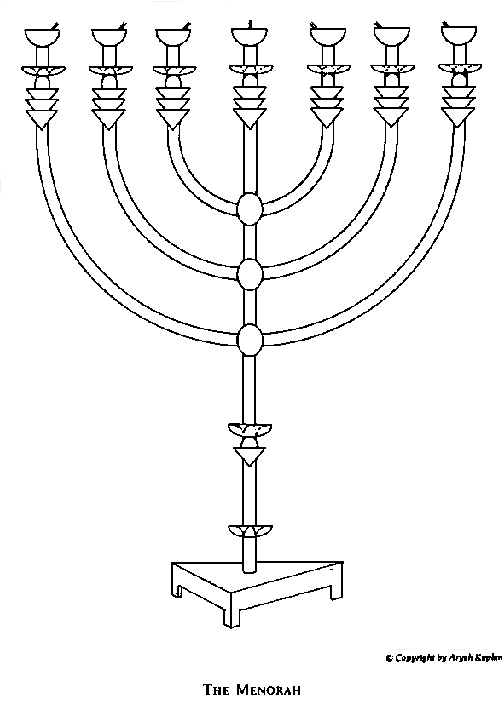
The Menorah and the Jewish Week, Year, and Week of Years.
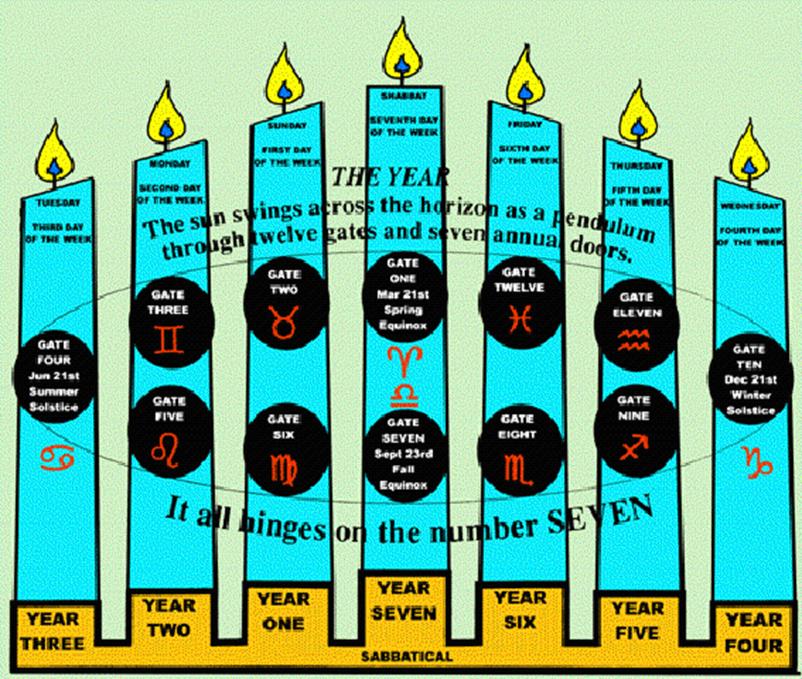
The Hebrew Letters in the Cups of the Menorah
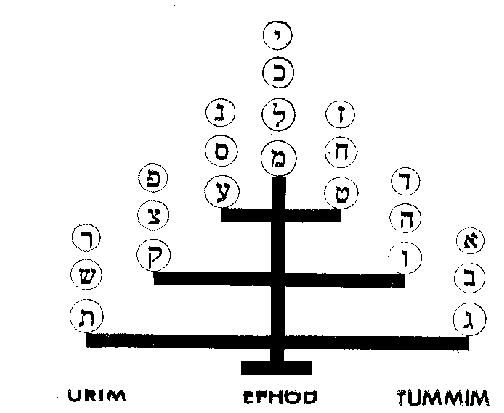
Sh’mot 25:39
“[The menorah], including all its parts, shall be made of a talent of pure gold.”
The menorah and all its utensils were made out of one talent (kikar) of pure gold, no more and no less. A talent is 32 libras, where each Libra is 25 selaim.
Shemot 25:40 Carefully observe the pattern that you will be shown on the mountain, and make [the menorah] in that manner.
We can now describe the entire menorah. Regarding the menorah's shaft, the Torah says, "The menorah shall have four embossed cups, along with its spheres and blossoms" (25:34). This indicates that the central shaft of the menorah contained four cups. These cups had the form of Alexandrian cups, with wide mouths, gradually tapering off. There were two such cups on the shaft. The "spheres" had the form of apples that grow in the city of Keroth. They are ovoid in shape, round and long on both sides, like an egg. There were two such spheres on the shaft.
The blossoms are like the blossoms that are made on marble columns. They were thus like forms cut with a stonecutters hammer. Their edge was bent outward. There were two such flowers on the menorah's stem. Besides these, there was also a third blossom near the menorah's base. The base of the menorah had three feet. There were also another three spheres on the menorah's shaft in the area where the branches extended from it. The menorah had six branches, three to the right, and three to the left. These branches extended upward diagonally from the stem toward the top of the menorah. The lowest branch was the longest of them all, the next a bit shorter, and the highest, the shortest of them all. Thus, the tops of all the branches were at exactly the same height. The lamps on all six branches were thus at the same level as the lamp on the menorah's stem.
The centre shaft was known as "the menorah's face" (p'ne hamenorah). Each branch also had three cups, one sphere and one blossom. All of them were "almond decorated." That is, they were decorated with the forms of almonds. The verse can thus be interpreted, "The menorah shall have four almond decorated (meshukadim) cups, along with its spheres and flowers." There is a question as to whether "almond decorated" relates only to the "cups," or whether it also relates to the "spheres and flowers." Therefore, all were almond decorated. Even if it is not required on the spheres and flowers, it is of no harm if it is done. Conversely, however, if they all required such decoration, and it was not done, the menorah would not be made properly.
It thus comes out that the menorah had a total of 22 cups. There were 18 on the six branches, three on each branch, and an additional four on the stem of the menorah. The menorah also had eleven spheres, six on the six branches, three on the shaft where the branches extend, one near the bottom, and one in the upper three handbreadths of the shaft. The last sphere was together with the three upper cups. The menorah also had nine flowers. There were six, one on each of the six branches, and three on the shaft. All these were absolutely necessary if the menorah was to be valid. If one of the above forty-two cups, spheres or flowers were missing, the menorah was invalid. The same is true if any of the seven branches or seven lamps were missing.
The menorah was eighteen handbreadths (54 inches) high. It was made in this manner: From the base to the lower flower was three handbreadths. There were then two handbreadths smooth, and then, within one handbreadth, there was a cup, sphere and flower. There were then two handbreadths smooth, and then a sphere taking up one handbreadth, from which two of the branches extended. There was then one handbreadth smooth, and another sphere taking up a handbreadth, from which the next two branches extended. There was then another two handbreaths smooth, and then a third sphere taking up one handbreath, from which the third set of branches extended. Above this there was another two handbreadths smooth. Thus, what we have already counted is a total of fifteen handbreaths.
There was then an additional three handbreadths remaining until the top of the menorah. In these three handbreadths, there were three cups, one sphere and one flower. The Torah therefore says, "And this (ve’zeh) is the structure of the menorah" (Numbers 8:4). The numerical value of vezeh is 18, denoting the height of the menorah. There was a large stone in front of the menorah. This stone had three steps, and the priest would stand on it in order to light the menorah and clean out the lamps. On this stone also stood the wick tongs and ash snips which were used for the menorah. This stone was made of the finest, most beautiful marble, which was more precious than gold. It was 8 1/2 handbreadths (251/z inches) high, and nine handbreadths (27 inches) wide.
The menorah stood to the south of the Tabernacle, while the showbread table stood to the north. They were both in the inner sanctuary, directly outside the Holy of Holies. When a person would enter the sanctuary, the menorah would be to his right, and the table to his left. Although the Torah specifies that the menorah must be made of pure gold, this was merely a preference, and not an absolute requirement. Therefore, if the community was poor and had to replace the menorah, they could make it out of any type of metal, whether silver, copper or the like. However, it could not be made of wood, bone, ivory, or glass, and if it is made of anything other than metal, it is invalid. All the embellishments, such as the cups, spheres and blossoms, that the Torah requires for a menorah, are required only when it is made of gold. However, if it is made of silver or any other metal, it is made without the cups, spheres and blossoms.
Similarly, the Torah requires that the menorah be made of a talent (kikar) of metal only when it is made of gold. Moreover, the requirement that it be hammered out of a single piece of metal only applies when it is made of gold. If the menorah is made of other metals, neither of these conditions must be met. Nevertheless, even if it is made of other metals, the menorah cannot be made of small parts." The Torah literally says, "Make it (the menorah) out of a talent of pure gold, and all these utensils" (25:39). In the Talmud, there is a dispute regarding the meaning of this verse. Rabbi Yehudah maintained that the menorah and its lamps were made of a talent of gold. This was the mass of gold out of which the menorah was to be made. The tongs and snips, however, were made separately, and were therefore not included in the talent. The "utensils" mentioned in the verse do not include the tongs and snips, but do include the lamps. These also had to be made of the original mass of gold, and are referred to as "utensils" (kelim), only because they are usually separate from a candelabrum.
Rabbi Nechemiah, on the other hand, maintained that the talent only included the menorah itself, and not the lamps, tongs or snips. He maintained that the lamps were attached, and not an integral part of the menorah. When the Torah says, "and all these utensils," it does not mean that they are included in the talent of metal, but only that they also had to be made of pure gold. The accepted opinion is that the menorah and its lamps were made out of a single piece of gold, weighing one talent. The snips and tongs, however, were not included in the talent.
Each of the lamps had a gold cover that could be opened and closed. These covers protected the oil so that it was not left uncovered. They also prevented dust and ashes from the wicks from falling into the oil. According to one opinion, these were the milkachaim on the menorah. [This opinion disputes that cited earlier that the milkachaim were tongs.] According to this opinion, the machtoth on the menorah [were not snips or scoops. Rather, they] were protrusions under the lamps to catch any ashes or sparks from the wicks. All these were made of the same mass of gold as the rest of the menorah.
The seven branches of the menorah were solid, not hollow. The Torah moreover specifies that the spheres and branches should be made of "pure gold" (25:36). One should not think that the insides of the spheres and branches, which cannot be seen, may be made of alloyed gold. The Torah therefore specifies that even the unseen internal portions of the menorah must be made of pure gold. Although the description of the menorah appears fairly straightforward, it was not a simple thing to communicate. All the people found it very difficult to conceptualize the menorah.
Moshe also found it very difficult to picture the menorah. G-d therefore showed him a fiery menorah in the heaven. Regarding this, G-d said, "This is the form of the menorah" (Numbers 8:4). The word "this" indicates that G-d was actually pointing to something that He was showing Moses. G-d here told Moshe, "Carefully observe the pattern that you will be shown on the mountain" (25:40). G-d was speaking of the form of the menorah that he would show Moshe. The Torah literally says, "make [the menorah] with the form (betavnit, that you will be shown . . ." It does not say, "like the form" (ketavnit). This was because it was impossible for Moshe to make the menorah exactly like the one he saw in heaven. The heavenly menorah was a spiritual object, made of red, white and green fire. The difference between something spiritual and something physical is very great indeed.
Moreover, the word be’tavnit is not the object of the word "make" but of the word "see." The verse is actually saying, "Look at the form that you will be shown on the mountain, and make [the menorah]." G-d was telling Moshe to look carefully at the pattern of the spiritual menorah so as to have the wisdom to make the menorah out of gold. The Torah thus says, "This is the form of the menorah: mikshah of gold" (Numbers 8:4). [Although mikshah is usually translated as "a single piece of beaten work,"] it can also be translated as "difficult." This indicates that Moshe found it too difficult to make the menorah. G-d therefore told Moshe, "Take a talent of gold, and throw it into the fire. When you take it out, the menorah will be made, with all its cups, spheres and flowers." The Torah therefore says, "It shall be made of a single piece of metal" (25:31), using the passive, rather than the active voice. This alludes to the fact that the menorah was made by itself. According to Rabbi Yose, son of Rabbi Yehudah, G-d showed Moshe three things, the Ark, the Table, and the Menorah. G-d showed Moshe a form of each of these objects made of fire that descended from heaven. Moshe saw them and was then able to make them.
One should not think that this contradicts what we have said above. Rather, what happened was this: At first, when G-d told Moshe to make the menorah, it was very difficult for him to understand. He could not comprehend it, and he asked, "How can something like this be made?" G-d then showed him a fiery menorah in the sky, and he understood. However, when Moshe descended from Mount Sinai, he forgot how to make it. He said, "Master of the Universe, I forgot the form of the menorah." G-d then showed it to him again. But now Moshe found it very difficult to understand. G-d took a mass of fire, and showed Moshe how it could be made into a menorah, but Moshe still could not understand. Finally, G-d said to him, "Go to Betzalel, and he will make it." G-d was actually telling Moshe to take a talent of gold, bring it to Betzalel, so that he could throw it into the fire, and allow the menorah to be made on its own. G-d, however, did not want to say this explicitly to Moshe, so He merely told him to go to Betzalel. Moshe went to Betzalel and gave him the gold, and Betzalel was able to make the menorah immediately. When Moshe saw this, he said to Betzalel, "G-d showed me the menorah twice, but I still could not fathom how to make it. You, however, made it without ever seeing it. Maybe you were there when G-d showed me the menorah !"
The form of the menorah symbolized the Torah. The seven branches parallel the seven words in the first verse in Genesis (in the original Hebrew). The eleven spheres on the menorah parallel the 11 words in the first verse of Exodus. The 9 blossoms parallel the nine words in the first verse in Leviticus. The height of the menorah was 18 handbreadths, as we said. One handbreadth, however, was not complete, so the actual height of the menorah was 17 handbreadths and a bit extra. These paralleled the 17 words in the first verse in Numbers. The 22 cups on the menorah parallel the 22 words in the first verse of Deuteronomy. It therefore comes out that the first verses of all five books of the Torah are alluded to in the menorah. The total number is forty-nine.
We are forbidden to duplicate any of the Tabernacle's furniture. Therefore, we are forbidden to make a se branched candelabrum, even if it is not made of gold. It is forbidden even if the candelabrum does not have the cups, knobs and blossoms that the one menorah had, and even if it is not eighteen handbreadths tall. Although it is not exactly like the menorah, it is still forbidden, since as we explained earlier, these decorations are merely preferable, but not absolutely required. The main thing that the Torah requires of the menorah is that it have seven branches. Therefore, there is no prohibition against making a candelabrum having five, six or eight branches. It is forbidden to make a seven branched candelabrum, even if it is made in pieces made to be attached or screwed together. The dictum that the Menorah be made of a single piece of gold was only a preference. However, if it was made of attached pieces, the Menorah was still valid, as long as it was not made of gold.
There are large candelabra made with seven branches. It is important to realise that if the branches extend from a central shaft, this is absolutely forbidden. However if it does not have branches, then it is permitted, even if it has seven lamps.
* * *
This study was written by
Rabbi Dr. Hillel ben David
(Greg Killian).
Comments may be submitted to:
Rabbi Dr. Greg Killian
12210 Luckey Summit
San Antonio, TX 78252
Internet address: gkilli@aol.com
Web page: http://www.betemunah.org/
(360) 918-2905
Return to The WATCHMAN home page
Send comments to Greg Killian at his email address: gkilli@aol.com
[1] Many of the ideas in this paper were given to me by Hakham Akiva Tatz and my Beloved Teacher, Hakham Dr. Yosef ben Haggai.
[2] Hakhamim (Heb. “wise ones”) = Rabbis.
[3] There are two levels within our souls: One level refers to the soul as it enclothes itself in the our conscious powers. This itself has four mediums of expression: nefesh, ruach, neshamah, and chayah, which parallel the four spiritual worlds: Asiyah, Yetzirah, Beriah, and Atzilus. And there is a level of soul which transcends our entire range of powers, the level of yechidah. This level is at one with Hashem as He is manifest as yachid, "the singular One," a level that transcends the spiritual cosmos.
[4] The highest aspect of the Jewish soul - the yechidah - is so sublime that it cannot be contained within the body, and it spreads to a distance of four cubits [approx 6 feet] around a person. The yechidah is also a level of the soul which can never become tarnished, because it is not susceptible to any negative influences. Thus, when G-d placed the entire Land of Israel within four cubits of Yaakov to stress his future ownership of it, the Land became connected with Yaakov's yechidah, and so too, with the yechidah of every single one of his descendants. And that is the reason why "it would be as easily conquered by his children", because the Land was associated with a level of the soul which is impervious to any opposition. Likutei Sichos Lubavitcher Rebbe
[5] HaMakom is a Hebrew word which means “The Place”.
[6] Beit HaMikdash is a translitterated Hebrew word which means “House of The Holy One”, and is another name for the Temple.
[7] The Gemara teaches un, in Berachot, that night is a remez for the the galut, the exile.
[8] Kethuboth 62b, Baba Kama 82a
[9] Niddah 17A
[10] Yalkut Reuveni, VaYishlach
[11] Genesis 32: 25
[12] He had already taken across that which he had (ibid. 24), but he must have returned for some small jars.
[13] The Chashmonaim were the Maccabees, the heroes of the Chanukah story.
[14] The House of G-d
[15] Also known as the New Testament.
[16] Rabbi
[17] Rabbis
[18] Rabbinic court.
[19] Joseph’s descendants
[20] The House of Joseph
[21] Teaching
[22] Hakham is another was of saying Rabbi. Hakham means “wise one”.
[23] Tehillim (Psalms) 118:27
[24] Yeshayahu (Isaiah) 60:1
[25] Tehillim (Psalms) 36:10
[26] Mishlei (Proverbs) 31:18 & 36:1
[27] Tehillim (Psalms) 36:10
[28] Bereshit (Genesis) 1:15
[29] Bereshit (Genesis) 1:4
[30] Mishlei (Proverbs) 13:9
[31] A Sheliach is like the Bailiff of a court. He is the one sent to do the will of the congregation.
[32] Genesis 41:38
[33] Exodus 28:3; 31:3; 35:31
[34] Numbers 24:2
[35] Numbers 27:18
[36] Deuteronomy 34:9
[37] Numbers 11:29
[38] II Samuel 23:2
[39] Isaiah 59:21
[40] Isaiah 44:3
[41] Joel 3:1
[42] Isaiah 40:13
[43] Hosea 9:7
[44] Psalms 77:7
[45] Job 32:8
[46] Job 20:3
[47] Numbers 14:24
[48] Ex. 35:21
[49] Deut. 2:30
[50] Judges 9:23
[51] Judges 11:29
[52] Judges 13:25
[53] I Chron. 12:18
[54] II Kings 19:7
[55] Ezra 1:1
[56] Hosea 4:12 and 5:4
[57] Zechariah 13:2
[58] Ps.51:12,14
[59] Ezekiel 11:19; 18:31; 36:26; 37:14
[60] Zechariah 4:6
[61] Proverbs 9:10
[62] Psalms\. 11:10
[63] see Sabbath 22b
[64] See tosfot mnakhot 28b