
A Talit With Tzitzith
By Rabbi Dr. Hillel ben David (Greg Killian)
I. Introduction
My understanding of the Talit I received from my teacher, Hakham Dr. Yosef ben Haggai.
Originally the word talit meant "gown" or "cloak".
In this paper I would like to examine the mitzva to have tzitzith, fringes, on any four cornered garment that we wear. If a man puts on a garment having four corners during the day he is commanded to put tzitzith, fringes, in its corners, as it says:
Bamidbar (Numbers) 15:37-40 And HaShem spake unto Moses, saying, Speak unto the children of Israel, and bid them that they make them tzitzith (fringes) in the borders of their garments throughout their generations, and that they put upon the tzitzith of the borders a ribband of blue: And it shall be unto you for a fringe, that ye may look upon it, and remember all the commandments of HaShem, and do them; and that ye seek not after your own heart and your own eyes, after which ye use to go a whoring: That ye may remember, and do all my commandments, and be holy unto your God. I [am] HaShem your God, which brought you out of the land of Egypt, to be your God: I [am] HaShem your God.
Additionally, the Torah commands that whenever we wear a four-cornered garment we are obligated to tzitzith:
Devarim (Deuteronomy) 22:12 Thou shalt make thee tzitzith upon the four quarters of thy vesture, wherewith thou coverest [thyself].
Clearly, tzitzith serve two functions: as a reminder of all 613 mitzvot ("commandment," from the Hebrew root which means "to connect") recorded in Torah, and also as a buffer against the evil inclination. The words “after your heart and after your eyes,” our sages say, refer specifically to sexual temptation:
Menachoth 42b And for what purpose do the Rabbis use the expression ‘That ye may look upon it’? — They require it for the following teaching: ‘ That ye may look upon it, and remember’, that is, look upon this precept and remember another precept that is dependent upon it, namely, the reading of the Shema’. As we have learnt: From what time in the morning may the Shema’ be read? From the time that one can distinguish between blue and white. Another [Baraitha] taught: ‘That ye may look upon it, and remember’, that is, look upon this precept, and remember another precept that is next to it, namely, ‘the law concerning mingled stuffs, for it is written, Thou shalt not wear a mingled stuff, wool and linen together’. Thou shalt make thee twisted cords. And another [Baraitha] taught: That ye may look upon it, and remember all the commandments of the Lord: as soon as a person is bound to observe this precept he must observe all the precepts. This is in accordance with R. Simeon's view that [the tzitzith] is a precept dependent on time. And another [Baraitha] taught: ‘That ye may look upon it and remember all the commandments of the Lord’: this precept is equal to all the precepts together. And another [Baraitha] taught: ‘That ye may look upon it and remember . . . and do them’: looking [upon it] leads to remembering [the commandments], and remembering leads to doing them. R. Simeon b. Yohai says, Whosoever is scrupulous in the observance of this precept is worthy to receive the Divine presence, for it is written here, ‘That ye may look upon it’, and there it is written, Thou shalt fear the Lord thy God, and Him shalt thou serve.
R. Eliezer b. Jacob said, Whosoever has the tefillin on his head, the tefillin on his arm, the tzitzith on his garment, and the mezuzah on his doorpost, is in absolute security against sinning, for it is written, And a threefold cord is not quickly broken; and it is also written, The angel of the Lord encampeth round about them that fear Him, and delivereth them.
Since it is not possible, however, for a person to fulfill all of the 613 mitzvot every day, some of them for reasons beyond his control, HaShem gave us one mitzva, the mitzva of tzitzith, as a representation of all the mitzvot. For by its observance, we are reminded every day of all the mitzvot that we have taken upon ourselves to fulfill. Considering that to HaShem a commendable resolve to act is like the action itself, by our very remembering and thinking daily of the 613 mitzvot of HaShem, it is as if we are fulfilling them every day.
The Midrash echoes this connection of the tzitzith and the commandments:
Midrash Rabbah - Numbers XVII:6 THAT YE GO NOT ABOUT AFTER YOUR OWNHEART AND YOUR OWN EYES (XV, 39). The heart and the eyes are the touts of the body, for they lead the body astray. THAT YE MAY REMEMBER, AND DO ALL MY COMMANDMENTS (ib. 40). This may be illustrated by the case of one who has been thrown into the water. The captain stretches out a rope and says to him: ‘Take hold of this rope with your hand and do not let-go, for if you do you will lose your life! ' In the same way the Holy One, blessed be He, said to Israel: ‘As long as you adhere to the commandments, then, Ye that did cleave unto the Lord your God are alive every one of you this day’ (Deut. IV, 4). In the same strain it says, Take fast hold of instruction, let her not go; keep her, for she is thy life (Prov. IV, 13). AND BE HOLY UNTO YOUR GOD (XV, 40). When you perform the commandments you are sanctified and the fear of you lies upon the idolaters. But if you part from the commandments you become profaned. The Holy One, blessed be He, said to Israel: ‘In this world, owing to the influence of the Evil Inclination, you keep away from the commandments, but in the time to come I shall eradicate it from you’; as it says, I will take away the stony heart out of your flesh... and I will put My spirit within you, etc. (Ezek. XXXVI, 26 f.).
Our
Obligation
The Torah says that when we see the tzitzith that we will be reminded about the mitzvot. How do tzitzith remind us of the mitzvot, the commandments, of HaShem?
To answer this question we will need to examine some of the details of the tzitzith. There is great significance in all of the particulars of the tzitzith.
To make tzitzith, we take four strings and pass them through a hole in the corner of the talit, our four-cornered garment. These four strings are therefore doubled and hang down as eight strings. We then make a double knot followed by windings, followed by another double knot, followed by more windings. We repeat this sequence until we have five double knots and four sets of windings.
Rashi taught us that the numerical value of the Hebrew word ,tzitzith, is 600; when we add the eight strings and five double knots we arrive at a total of 613, a reminder of the 613 Torah commandments.
From the juxtaposition of tzitzith next to Korach’s rebellion and the Shabbat desecration, in the Torah, we learn that tzitzith is compared to all the mitzvot, rendering tzitzith unique among the mitzvot. We will look at this relationship in greater detail, later in this paper.
The Midrash, Tanna D'Bai Eliyahu Rabba, Chapter 26 recounts the following conversation between HaShem and Moses:
"Said the Holy One Blessed be He to Moses, What it is the cause for this violation of the Shabbat? (referring to the gathering of sticks on the Shabbat mentioned just prior to the mention of tzitzith) He said to Him, 'I don't know." Said the Holy One Blessed be He to him,' I will tell you, six days of the week the Israelites have tefillin on their heads and arms, they see them and are careful of what they do. But on the Shabbat when they haven't them, they therefore violate the Shabbat. Then The Holy One Blessed be He said to Moses, Go and clarify for them the mitzvah that they will be accustomed to fulfill on Sabbaths and Holy Days, this is the mitzva of tzitzith."
The five knots remind us of the five books of Moshe that make up the Torah. Wherever we turn, Torah is there.
The word tzitzith has the same root as the word Tzutz, meaning "to look." tzitzith are therefore something to look at. The torah says of the tzitzith, "You shall see them, and not stray after your heart and after your eyes, which have led you to immorality." The Talmud explains that the injunction not to stray "after your eyes" refers to visual sexual stimulation. Clothing in general acts as a natural barrier to such arousal, and the tzitzith serve to reinforce this barrier.
The mitzvah of tzitzith is unique in that it is the only positive mitzva that relates to our clothing.
A righteous man should endeavor to wear a four-cornered garment because this will obligate him to wear tzitzith, fringes, especially during his prayers, since the Torah makes all the commandments depend on the commandment about the tzitzith, as it says:
Bamidbar (Numbers) 15:39 "And you shall see it and remember all the commandments of HaShem".
The above pasuk indicates that the reason we wear tzitzith is to be reminded of the commandments of HaShem. It is like tying a string around ones finger to remind him to do a task.
All Jewish men are obligated to tzitzith if they wear a four-cornered garment. One only needs to wear Tzitzith during the daytime; therefore it is a positive time-bound commandment. For this reason women are exempt from wearing them:
Menachoth 43a Our Rabbis taught: All must observe the law of tzitzith, priests, Levites, and Israelites, proselytes, women and slaves. R. Simeon declares women exempt, since it is a positive precept dependent on a fixed time, and women are exempt from all positive precepts that are dependent on a fixed time.
The Master said, ‘All must observe the law of tzitzith, priests, Levites, and Israelites’. Is not this obvious? For if priests and Levites and Israelites were exempt, then who would observe it? — It was stated particularly on account of priests. For I might have argued, since it is written, Thou shalt not wear a mingled stuff, wool and linen together, and [it is followed by,] Thou shalt make thee twisted cords, that only those who are forbidden to wear mingled stuff must observe the law of tzitzith, and as priests are permitted to wear mingled stuff they need not observe [the law of tzitzith]; we are therefore taught [that they, too, are bound], for although while performing the service [in the Temple] they may wear [mingled stuff] they certainly may not wear it when not performing the service.
R. Simeon declares women exempt’. What is R. Simeon's reason? — It was taught: That ye may look upon it: this excludes a night garment. You say it excludes a night garment, but perhaps it is not so, but it excludes rather a blind man's garment? The verse, when it says, Wherewith thou coverest thyself, clearly includes a blind man's garment; how then must I explain the verse, That ye may look upon it? As excluding a night garment. And why do you choose to include a blind man's garment and to exclude a night garment? include a blind man's garment since it is looked upon by others, whilst I exclude a night garment since it cannot be looked upon by others.
In the Shulchan Arukh we find that if one wears a four-cornered garment, then he is obligated to wear tzitzith. However, there is no requirement to wear a four-cornered garment.
During shacharit (morning) prayers, the custom is to wear a large rectangular garment with tzitzith (talit gadol) and pray while wrapped in it. There are different customs as to when this is done. Most Ashkenazic men will begin wearing the talit when they get married. In Sephardic and some Ashkenazi communities, a boy will put on a talit when he becomes a bar mitzvah (thirteen years old).
The talit is worn only during morning prayers except on Tisha B’Av [fast of the fifth month], when it is donned at the afternoon service. The exception to this rule is with regard to the one who is called to read from the Torah. Generally, if this person does not have a talit, he is asked to borrow one while reading, regardless of the time of day.
Inside or Outside?
The Arizal ruled that we are to wear tzitzith of the talit katan inside our clothing rather than outside? The Pshat meaning of Bamidbar 15:39 tells us we are to look upon them and see them...so why did the Arizal rule otherwise?
Since two talitot are worn, the outer one, the talit gadol, is considered to be "ohr makif" (the surrounding light outside a vessel) and the inner (talit katan) is "ohr pnimi" (the inner light) and therefore not seen from the outside. Additionally, many consider the talit katan to be the "beged Shechina", the garment of the Shechina and therefore in exile or hidden from view, so to speak.
II. Analysis
Chazal, our Sages, teach us that we can understand pasukim, verses, in the Torah by understanding how they are connected to the passages immediately before and after. We can also gain clarity by examining the words and their structure as used elsewhere in the Torah. We will use both of these techniques to broaden our understanding of tzitzith.
Adjacent Verses
Chazal, our Sages, teach us that we can understand passages in the Torah by understanding how they are connected to the passages immediately before and after. The following table shows these pasukim:
|
BEFORE Bamidbar 15:32-36 |
TZITZITH Bamidbar 15:37-40 |
AFTER Bamidbar 16:1-35 |
|
|
|
|
|
Korach’s rebellion yields the death penalty. |
From the juxtaposition of tzitzith next to Korach’s rebellion and the Shabbat desecration, in the Torah, we learn that tzitzith is compared to all the mitzvot, rendering tzitzith unique among the mitzvot.
Korach rebelled against Moses saying "for all the community, all of them are holy." But the tzitzith idea of holiness (which appears in the paragraph above the Korach story) differs from that of Korach. The tzitzith concept of holiness is one to be strived for, it is a goal; while Korach believes it is something that is granted. Korach has absolved himself of responsibility; he boasts that he is a member of a holy nation, even though he is contemptible. Are the people holy or do they become holy through their actions and performance of certain tasks? Our tzitzith affirm that we become holy through our actions[1].
Ibn Ezra connects the incident of gathering sticks and the tzitzith:
“The episode of the man gathering sticks (on the Sabbath) is mentioned because he acted presumptuously. And owing to G-d's great mercy upon Israel the passage of tzitzith is recorded here as a reminder that a person should not act presumptuously, or that he should not forget.”
Hakham Yaakov Culi in Meam Loez, makes this connection between the gathering of sticks and the mitzva of tzitzith:
"Have you seen how he had desecrated the Sabbath!" said God to Moses after the episode of the Mekoshesh, the man who gathered sticks.
But Moses replied, "Let not his desecration of the Sabbath
appear so damning in Your eyes. The Israelites have
just emerged from Egypt, where until now they did
not have the responsibility of fulfilling any commandments;
since they have not yet become deeply grounded in their observance, their
adherence to the Torah is weak.
"It is particularly true in this case. Throughout the week, the phylacteries they don serve as a sign
that reminds them of their faith; but on the Sabbath
they do not put on phylacteries (tefillin) and thus they forget the commandments of the Torah. They work as on any weekday,
as a carry-over of what they had been accustomed to do in Egypt. Thus, it is
not willful desecration of the Sabbath for which
they should be held to account, but merely forgetfulness."
Thereupon God said to him: "I will give you a special commandment, and every day including on the Sabbath, they will carry on their persons this sign to remind them of the commandments,
and they will thus no longer be unmindful of them."
Accordingly the Torah says, "And when you see them, you shall remember all
of God's commandments so as to keep them."
Explained, therefore, is why the present chapter immediately follows the
chapter dealing with the gathering of sticks.
Hakham Culi goes on to explain why the portion on Korach’s rebellion immediately follows the command of tzitzith:
This portion begins with the words "Vayikach Korach," literally, "Korach took." It refers to the all-blue wool talit that Korach had taken with him when he presented himself to Moses and asked him whether such an all-blue talit required the attachment of fringes. When Moses declared that fringes were indeed obligatory in this case, they began to mock and ridicule.
Moses had just been teaching the Israelites about the commandment of tzitzith. So when Korach returned home and his wife asked him what new things were brought up by Moses in the course of that day's assembly, he replied, "Today he instructed us in a new commandment, that of putting on fringes of blue-wool."
"What does this commandment of blue wool mean?" asked his wife. And Korach replied, "He told us in God's name that we must affix fringes on each of the four corners of a four-cornered garment: three threads of white wool and one of blue wool."
"He is playing games with you, that one," said she. "Every day he comes to you with something new and says that God had so commanded him. But in fact, all these things he says on his own as they come to him on the spur of the moment.
"If blue wool is so potent that with one thread the obligation is fulfilled, let me make for you and for all those with you, prayer shawls (talitot) entirely of blue-wool. Take them to Moses and ask him what law applies to such a talit, whether or not it too must have fringes attached to it. You will see what answer he gives you!
"Then you will realize that everything he told you was of his own invention, designed to make himself great, a king no less, and to have his brother appointed High Priest and his nephews priestly deputies. …
"How can this be!" cried Korach. "When one thread of blue wool is sufficient to exempt an entire talit that is made of a different material and render it fit for wearing, how can it be that a talit which is entirely of blue-wool should not exempt itself?"
They then proceeded to ask him another question. "What of a house that is
filled with sacred volumes; need a mezuzah scroll be
attached to it or not? And when Moses told them that a mezuzah
was required, they again began mocking him.
"How can it be?" they queried. "If the two
chapters comprising the mezuzah scroll---the Shema and
"V'hayah im shamoa"--- suffice for a house that is empty of books
when but placed on the doorpost, should not a house full of sacred books
including the five books of Moses with all their 275
chapters, be exempt from a mezuzah? It only proves
that the commandments are at your invention."
Provided here is an explanation why the chapter relating to Korach immediately follows the chapter that dealt with
the commandment of tzitzith. It teaches us that the beginning point of Korach's revolt was related to the subject matter of
tzitzith. In other words, "Korach took---he took
the talit which was made entirely of blue-wool, and came before Moses to begin
quarrelling with him.
|
BEFORE Devarim 22:11 |
TZITZITH Devarim 22:12 |
AFTER Devarim 22:13-21 |
|
|
|
|
|
Shatnez – Don’t mix wool and linen in the same garment. |
Tzitzith required on four-cornered garment. |
A wife is hated and must prove her virginity. |
The following insight into the above relationship is provided by Rabbi Mordecai Kornfeld. His Eminence assumes familiarity with the following Talmudic passages:
Yevamot 4a Because it is written, Thou shalt not wear a mingled stuff . . . Thou shalt make thee twisted cords, and R. Eleazar said, ‘Whence is the rule of proximity [of texts] derived from the Torah? As it is said, They are established for ever and ever, they are done in truth and uprightness.’
Yevamot 4b Similarly in the case of zizith, if you wish I might reply: Because [there the deduction] is obvious. And if you prefer I might reply: Because [there the text] is superfluous. ‘If you prefer I might say: Because [there the deduction] is obvious’, for otherwise, the All Merciful should have written [the precept] in the section of zizith; with what other practical rule in view has he written it here? ‘And if you prefer, I might reply: Because [there the text] is superfluous’, for observe: It is written, Neither shall there come upon thee a garment of two kinds of stuff mingled together. What need then was there for stating, Thou shalt not wear a mingled stuff? Hence it must be concluded that the object was to provide a superfluous text.
But [surely] both these texts are required? For if the All Merciful had only written, Neither shall there come upon thee it might have been assumed that all kinds of ‘putting on’ were forbidden by the All Merciful, even that of clothes dealers, hence the All Merciful, has written, Thou shalt not wear a mingled stuff, [showing that the ‘putting on’ must be] of the same nature as that of wearing for personal comfort. And if the All Merciful had only written, Thou shalt not wear it might have been assumed that only wear [is forbidden] because the pleasure derived therefrom is great, but not mere ‘putting on’, hence the All Merciful has written, Neither shall there come upon thee! — If so, the All Merciful should have written, ‘Thou shalt not wear a mingled stuff’ what need was there for adding, ‘Wool and linen’? For observe: It is written, Neither shall there come upon thee a garment of two kinds of stuff mingled together, and in connection with this a Tanna of the School of R. Ishmael taught: Whereas garments generally were mentioned in the Torah, and in one particular case Scripture specified wool and linen, all must consequently be understood as having been made of wool and linen, what need, then, was there for the All Merciful's specific mention of wool and linen? Consequently it must be concluded that its object was to provide a superfluous text.
But the text is still required [for another purpose]! For it might have been assumed [that the limitation applies] only to ‘putting on’, where the benefit is not great, but that in respect of wear, the benefit from which is great, any two kinds were forbidden by the All Merciful, hence has the All Merciful written, ‘wool and linen’! — If so, Scripture should have omitted it altogether and [the law would have been] deduced [by analogy between] ‘mingled stuff’ and ‘mingled stuff’ [the latter of which occurs in connection with the law] of ‘putting on’.
As to the Tanna of the School of R. Ishmael, is the reason [why ‘mingled stuff’ is permitted in zizith] because the All Merciful has written ‘wool and linen’, but if He had not done so, would it have been assumed that the All Merciful had forbidden two kinds of stuff in the zizith? But, surely it is written, And they shall make them fringes in the corners of their garments and a Tanna of the School of R. Ishmael [taught]: Wherever ‘garment’ [is written] such as is made of wool or flax [is meant], and yet the All Merciful said that in them ‘purple’ shall be inserted, and purple, surely, is wool. And whence is it deduced that purple is wool? Since linen is flax, purple must be wool. — [The text] was necessary; for it might have been assumed [that the interpretation is] according to Raba. For Raba pointed out a contradiction: It is written, the corner, [which implies that the fringes must be of the same] kind of [material as that of the] corner, but then it is also written, wool and linen. How then [are these texts to be reconciled?] Wool and linen discharge [the obligation to provide fringes] both for a garment of the same, as well as of a different kind of material, while other kinds [of material] discharge [the obligation for a garment made] of the same kind [of material] but not for one made of a different kind [of material].
But the Tanna of the School of R. Ishmael, surely, does not hold the same view as Raba! — [The text] is still necessary; for it might have been assumed that Raba's line of argument should be followed: ‘The corner’ [implies that the fringes must be made of the same] kind of [material as the] corner, and that what the All Merciful meant was this: ‘Make wool [fringes] for wool [garments] and linen ones for linen; only when you make wool fringes for wool garments you must dye them’; but no wool fringes may be made for linen or linen fringes for wool, hence the All Merciful has written ‘wool and linen’ [to indicate] that even wool fringes [may be] made for linen garments or linen fringes for woolen garments.
The Gemara in Yevamot 4a says that we learn that a positive commandment overrides a negative commandment from the fact that the Torah permits a mixture of wool and linen, shatnez, for the mitzva of tzitzith. Thus, the positive commandment of tzitzith overrides the negative commandment of shatnez. Asks Tosafot, perhaps a positive commandment never overrides a negative commandment, not even the positive commandment of tzitzith. The only reason why one may make tzitzith out of shatnez is because the prohibition of shatnez was never said with regard to a garment that is obligated in tzitzith!
It must be that there is no such thing as the Torah making an exception to a prohibition. Rather, the prohibition exists, but it is outweighed by the positive commandment.
The Chavot Yatr defends Rashi's explanation. Rashi did not mean that whenever the Torah explicitly states an exception to a prohibition (such as in the case of using shatnez to make tzitzith) that we understand it to mean that the prohibition never applied in such a situation. Rather, when the Torah states both the prohibition and the exception in the same place, then we say that the prohibition indeed does not apply. In the case of using shatnez to make tzitzith, the words from which we learn that tzitzith may be made of shatnez[2]) were not written as an explicit exception to the rule of shatnez (Devarim 22:11). The prohibition of shatnez and the commandment to make tzitzith are two separate verses; it is merely from the proximity of the verses that we learn that shatnez is outweighed by the mitzva of tzitzith.
"Do not wear a forbidden mixture, in which wool and linen are together [in a single garment]." This forbidden mixture is known as shatnez. The Torah goes on to state, "You shall make tzitzith on the four corners of the garment with which you cover yourself." Because these verses are contiguous, we deduce that tzitzith may be made of shatnez.
* * *
Why are tzitzith adjacent to a disfavored wife?
Chazal teach us that the primary purpose of clothing is to be a barrier to lust. It seems to me that the tzitzith are especially favored for this purpose. In addition to being a physical barrier, they also have a reminder built in. Now the wife who has fallen out of favor with her husband may be disliked because he has his eye on another woman. This juxtaposition suggests that the tzitzith are a preventative and maybe even an antidote for this problem.
Word Analysis
The passage on tzitzith (Bamidbar 15:37-41) is familiar to most of us because it one of the passages read daily in the Shema. Never the less, since we often become complacent about familiar things and therefore are not sensitive enough to the questions that arise from a close study of these verses. Lets look at a few interesting points:
1) The pasuk does not begin with the usual formulation, "HaShem spoke (vayyidabber) to Moshe, saying," rather with the less common and exceptional formulation, "HaShem said (vayyomer) to Moshe as follows."
2) The last verse, which serves as the concluding formulation, is also exceptional: it begins and ends with the formulation, "I, HaShem [am] your G-d." Now this phrase occurs in Tanakh countless times at the beginning, middle, or end of a verse, but nowhere else does a verse begin and end with this formulation.
3) Most of the verses in this passage (39-41) are addressed to the Israelites and spoken in the second person: That shall be your tzitzith, ... you shall look at it, ... etc. But at the beginning of the passage (v. 38) Moshe is commanded to speak to the Israelites, the contents of the message being in the third person: instruct them to make for themselves ... on their garments...
4) The key word in the passage is tzitzith, fringes, which appears three times here, and only once elsewhere in all of Scripture: "And took me by the hair (Hebrew: tzitzith) of my head" (Ezek. 8:3), where it means a bunch of hair, perhaps the forelock. But this meaning for the word tzitzith, a bunch of woven threads or one braided thread, can only make sense in verse 38: "instruct them to make for themselves a bunch of fringes ... let them attach a cord of blue to the bunch of fringes at each corner." In other words, the fringes were to be mostly white, but one of them was to be blue[3]. When we come to verse 39, "That shall be your fringe," this meaning for tzitzith no longer suits. Nor does it matter whether the antecedent of "that" is the "corner fringe" (tzitzith hakkanaf) or the "blue thread" (petil tekhelet); the phrase is a bit unclear.
Word
Association
The Shema (Devarim 6:4-9, 11:13-21, and Bamidbar 11:13-21) is the quintessential Jewish declaration of the Oneness of HaShem. We declare His Oneness during our morning and evening prayers and before going to sleep. The third paragraph of the Shema is a recital of Bamidbar 15:37-41, the Torah passage regarding tzitzith.
It is customary for worshipers wearing a talit to hold the four fringes in the left hand while reciting the Shema. In the third paragraph of the Shema, when the word tzitzith is said three times and when the word emet is said at the end, it is customary to kiss the tzitzith as a sign of affection for the mitzvot.
The third paragraph of the Shema contains two word associations with the story of the spies, in Bamidbar 13. The one is the word ureitem, the other is the word taturoo.
|
|
Ure'item |
taturoo |
|
Spies |
Ure'item et ha'aretz - see the land |
latur et ha'aretz - to spy out the land |
|
Tzitzith |
Ure'item oto - see it |
velo taturu acharei levavechem - don't wander after your hearts |
From the word associations, it may be that the mitzvah of tzitzith is for us to see and concentrate on the mitzvot and not let our hearts wander off into other things. The spies had taken their eyes off the Land of Israel, that HaShem given, and allowed other considerations to take over.
Now what makes us stop and pause over this understanding is the comments of our Sages on:
Micah 7:15 According to the days of thy coming out of the land of Egypt will I shew unto him marvelous [things].
Thus we know that our future redemption will be like the redemption from Egypt. We will effect a tikkun as we work backwards through the sequence of events. This suggests that the tzitzith will be part of the tikkun of the sins of the spies… in the future!
III. What
are Tzitzith?
We use the English word fringes to translate what the Torah calls tzitzith.
Each fringe is made of four threads and is passed through a point between one and three thumb-breadths away from the corner of the garment so that the eight ends of the threads hang evenly from the corner and are at least four thumb-breadths long; one of the threads is wound around the others and knotted. If possible, one of the threads (which must be of wool) should be dyed with a special blue dye, as it says "And they shall put on the fringe a blue thread"; the other threads should be of the same color as the garment.
Sefardim tie the tzitzith to reflect the gematria of HaShem’s name, as illustrated:
vuvh (HaShem’s name, AKA the tetragrammaton, AKA YHVH)
h = 10
v = 5
u = 6
v = 5
Thus we have a double knot followed by ten windings, a double knot followed by five windings, a double know followed by six windings, ending with a double knot followed by five windings followed by a double knot.
Tzitzith tied according to Nusach Sefard:
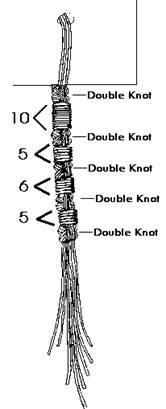
Each of the tzitzith has a strand longer than the others; this is called the shamash. The significance of the number of times that the shamash is spiraled around the strands is vital to the understanding of this mitzva.
When we tie tzitzith on a four-cornered garment we make the Brakhah or say the following:
"L'shem mitzvat tzitzith"
("For the sake of the commandment of tzitzith").
The four tzitziot (fringes) of the Talit represent the Divine Presence and the Torah in the Four Corners of the world.
Peyotes
We have seen that tzitzith are associated with “corners” (kanfot). Tzitzith are also used in an unusual way as pertaining to the head. Do heads have corners?
Yahezekel (Ezekiel) 8:3 And he put forth the form of an hand, and took me by a lock (tzitzith) of mine head; and the spirit lifted me up between the earth and the heaven, and brought me in the visions of God to Jerusalem, to the door of the inner gate that looketh toward the north; where [was] the seat of the image of jealousy, which provoketh to jealousy.
In the above pasuk, the Prophet is telling us that tzitzith apply to head. The translator has translated “tzitzith” as “lock”. So, are the tzitzith on the head associated with corners too?
Yayikra (Leviticus) 19:27 Ye shall not round the corners (peah) of your heads, neither shalt thou mar the corners (peah) of thy beard.
Yayikra (Leviticus) 21:5 They shall not make baldness upon their head, neither shall they shave off the corner (peah) of their beard, nor make any cuttings in their flesh.
Thus we see that the head does indeed have corners and that these corners also have tzitzith!
Peah is the Hebrew word used to define the edges or borders of the head. Peah is also used to define the corners of a field which must be left for the poor.
Tzitzith Root Meaning
The Torah tells us to "gaze" at the tzitzith, in Bamidbar 16:39. Interestingly, the word tzitzith itself comes from the Hebrew root tzatz, meaning "to peer" or "to gaze." This is seen in:
Shir HaShirim (Song of Songs) 2:9 My Beloved is like a gazelle or a young deer. [I thought He had abandoned me forever, but] behold, He was near the entire time, standing behind our wall, supervising from the windows, peering (me-tzitz) through the lattices.
We will see next in this study that the tekhelet, which is blue in color, is to be gazed at, in order to be reminded of HaShem.
IV.
Shatnez
Ramban’s Commentary for: Vayiqra (Leviticus) 19:19 Similarly, in respect of that which the Rabbi [Rashi] wrote with reference to combing, that [the wool and linen] must also be compressed and twisted together, and in a similar manner he also wrote in his commentaries to the Gemara,[4] other scholars,[5] have already commented that Rashi's interpretation is not in accord with what the Rabbis have said [in the following text of the Talmud]:[6] "You must deduce from this[7] that the upper knots[8] in the Fringes are required by Scriptural law. For if you should think that they are not required by Scriptural law, why then did the Merciful One have to state a [special] permission for using mingled stuff of wool and linen in Fringes! Do we not hold the law to be established that if one fastens two pieces together with only one stitch, it is not considered joined!" [9] Thus the Rabbis [of the Talmud] have revealed to us that a garment made of linen, in which woolen fringes have been tied with two knots, constitutes diverse kinds by law of the Torah, even though they have not been compressed and twined together!
A cardinal principle in Torah law is that, subject to certain general exceptions, any duty of fulfilling a positive commandment overrides a negative commandment (see juxtaposition of these two verses: You will not wear a mingled stuff, wool and linen together You will make twisted cords upon the four corners of your covering, wherewith you cover yourself (Deuteronomy 22: 11-12). The closeness of the two verses intimates that the commandment of Fringes overrides the prohibition of sha'at neiz, so that the Fringes may be made with threads of wool even if the garment itself is of linen. The Gemara now argues on the basis of the second principle mentioned, that we must say that the upper knots [formed at the lower edge of the garment] after the four threads are passed through the opening and doubled, are obligatory by law of the Torah, "for should you think etc."
Targum Pseudo-Jonathan for: Devarim (Deuteronomy) 22:11-12 You will not clothe nor warm yourselves with a garment combed (carded) or netted, or interwoven with wool and linen mixed together. 12. Nevertheless on a robe of linen thread you may be permitted to make fringes of wool upon the four extremities of your vestments with which you dress in the day.
JERUSALEM: Fringes of threads will you make upon the four edges of your vestments with which you dress.
V. Tekhelet
One of the threads, of the tzitzith, should be the color of tekhelet, which is a blue-green dye made from a specific aquatic animal, the Chalizon. Nowadays we are unsure of the identity of the Chalizon and the process of making tekhelet, which is why all the strings of our Tzitzith are white.
The commentators call the Chalizon a `fish' since it lives in the water. It appears, though, that the Chalizon is not a normal `fish,' but has a shell and is actually a type of snail. It ascends to the land very rarely, only once every 70 years.
Over time, the exact identity of Chalizon became obscure for various reasons: One reason was its extreme rarity. Because of this, its cost was prohibitive: Ten to twenty times its weight in gold. Another reason: In the 4th century Rome decreed that only `blue-blooded' royalty could wear tekhelet. Although some modern-day Torah scholars maintain that they have re-discovered the Chalizon, their opinion is not universally accepted.[10]
The Talmud spends a great deal of ink discussing this blue thread:
Menachoth 42b Abaye enquired of R. Samuel b. Rab Judah, How do you dye the blue thread? He replied, We take the blood of Chalizon together with other ingredients and put them all in a pot and boil them together. Then we take out a little in an eggshell and test it on a piece of wool; and we throw away what remains in the eggshell and burn the wool. One can infer three things from this: [i] that the dye used for testing is unfit; [ii] that the dyeing must be for the specific purpose [of the precept]; and [iii] that the dye used for testing renders the rest unfit. Are not the rules that the test quantity is itself unfit and that the dyeing must be for the specific purpose [of the precept] identical in meaning? — R. Ashi answered, One states the reason for the other, as much as to say: Why is the test quantity itself unfit? Because the dyeing must be for the specific purpose [of the precept]. This, however, is a matter of dispute between Tannaim, for it has been taught: The test quantity is itself unfit, for it says, All of blue. So says R. Hanina b. Gamaliel. But R. Johanan b. Dahabai says, Even the second dyeing is valid, for it says, And scarlet.
Our Rabbis taught: There is no manner of testing the blue thread; it should therefore be bought only from an expert. The tefillin can be tested; nevertheless they should only be bought from an expert. Scrolls of the Law and Mezuzot can be tested, and may be bought from anyone.
Is there then no manner of testing the blue thread? But R. Isaac the son of R. Judah used to test it (mnemonic sign: with Ge Shem) thus: He used to mix together liquid alum, juice of fenugreek, and urine of a forty-day old child, and soak [the blue thread] in it overnight until the morning; if the color faded it is invalid, but if not, it is valid. Moreover, R. Adda stated the following test before Raba in the name of R. ‘Avira: One should take a piece of hard leavened dough of barley meal and bake it with [the blue thread] inside; if the color improved it is valid, but if it deteriorated it is invalid; and in order to remember this, think of the phrase ‘a false change, a true change!’ — The statement ‘There is no manner of testing the blue thread’ refers to the test quantity.
Menachoth 43a Mar of Moshke once obtained in the time of R. Ahai some blue thread; on testing it by the test submitted by R. Isaac the son of R. Judah its color faded, but on testing it by R. Adda's test its color improved. He was about to declare it invalid when R. Ahai said to him, This is neither genuine blue nor imitation blue! We must therefore say that one test supplements the other thus: if the test of R. Isaac the son of R. Judah had been applied and the color had not faded it is certainly valid, but if its color had faded we should then test it by R. Adda's test by [baking it in] a hard piece of leavened dough; if its color improved it is valid, but if it deteriorated it is invalid. A message was sent from there [Palestine] saying, The tests supplement each other.
Mani was most particular when buying [the blue thread]. In accordance with the restrictions of the above Baraitha; whereupon a certain old man said to him, Those who long preceded you acted so, and they were successful in their business.
According to the Talmud the blue-green color is a reminder of the sea, which reflects the heavens, and HaShem's Throne of Glory. Therefore wearing Tzitzith is a constant reminder of HaShem's Presence in the world. Thus blue strand has the ability to inspire people to heavenly thoughts.
Menachoth 43b It was taught: R. Meir used to say, Why is blue specified from all the other colours [for this precept]? Because blue resembles the color of the sea, and the sea resembles the color of the sky, and the sky resembles the color of [a sapphire, and a sapphire resembles the color of] the Throne of Glory, as it is said, And there was under his feet as it were a paved work of sapphire stone, and it is also written, The likeness of a throne as the appearance of a sapphire stone.
Rabbi Moshe Feinstein suggests an interesting lesson based on this understanding of the blue strand. Just as the tekhelet reminds us of HaShem through a progressive stage process (sea, heavens, throne of glory), so too our spiritual growth should be through a step-by-step process. The most productive way to genuinely grow closer to HaShem is through gradual development.
Menachoth 44a Our Rabbis taught: The Chalizon resembles the sea in its color, and in shape it resembles a fish; it appears once in seventy years, and with its blood one dyes the blue thread; and therefore it is so expensive.
Tekhelet was also a key ingredient in the identity of a lady in the Nazarean Codicil:
II Luqas (Acts) 16:12-15 And from thence to Philippi, which is the chief city of that part of Macedonia, [and] a colony: and we were in that city abiding certain days. And on the Sabbath we went out of the city by a river side, where prayer was wont to be made; and we sat down, and spake unto the women which resorted [thither]. And a certain woman named Lydia, a seller of purple (tekhelet), of the city of Thyatira, which worshipped God, heard [us]: whose heart the Lord opened, that she attended unto the things which were spoken of Paul. And when she was baptized, and her household, she besought [us], saying, If ye have judged me to be faithful to the Lord, come into my house, and abide [there]. And she constrained us.
While many assume that Lydia sold purple cloth, the text actually just says “purple”. This purple dye was used to dye the single thread a blue[11] color. When the purple dye was exposed to ultraviolet light (like the sun) it dyes the string a beautiful sky blue!
Lydia was a seller of the rare dye used to make tekhelet and assist the Jewish people in the performance of the mitzva of tzitzith.
Hakham Hirsch
Hakham Shimshon Hirsch understands many aspects of this mitzvot to be osot, symbols HaShem uses to convey certain concepts and priorities to the core of each Jew. He finds the role and function of each of these components of the human condition alluded to in the mitzvah of tzitzith in two different ways: in the color of the strings in the tzitzith, and in their number. In `Collected Writings' (Volume III page. 126) Hirsch comments:
We find only three terms to encompass the colors of the spectrum: adom for red, yaroq for yellow and green, and tekhelet for blue and violet....
Red is the least refracted ray; it is the closest to the unbroken ray of light that is directly absorbed by matter. Red is light in its first fusion with the terrestrial element: adom, related to adamah [footstool, earth as man's footstool -- M.B.] Is this not again man, the image of G-d as reflected in physical, earthly matter: `vatichsareihu me'at mi'Elokim' (Tehillim. 8,6).
The next part of the spectrum is yellow-green: yaroq.
Blue-violet is at the end of the spectrum: tekhelet.
The spectrum visible to our eye ends with the violet ray, tekhelet, but additional magnitudes of light radiate unseen beyond the visible spectrum. Likewise, the blue expanse of the sky forms the end of the earth that is visible to us. And so tekhelet is simply the bridge that leads thinking man from the visible, physical sphere of the terrestrial world, into the unseen sphere of heaven beyond....
Tekhelet is the basic color of the sanctuary and of the High Priest's vestments; the color blue-violet representing heaven and the things of heaven that were revealed to Israel... no other color was as appropriate as tekhelet to signify G-d's special relationship with Israel. A thread of tekhelet color on our garments conferred upon all of us the insignia of our high-priestly calling, proclaiming all of us: `And you shall be holy men to Me' (Shemot. 19:6).
If we now turn our attention to the pisil tekhelet on our tzitzith, we will not that it was precisely this thread of tekhelet color that formed the krichot, the gidil, the thread wound around the other threads to make a cord. In other words, the vocation of the Jew, the Jewish awareness awakened by the Sanctuary, that power which is to prevail within us, must act to unite all our kindred forces within the bond of the Sanctuary of HaShem's law.
VI. In The Tanakh
The command to wear tzitzith is found in the Torah. Throughout the rest of the Tanakh we see that tzitzith are the norm.
Four
Corners - Wings
The Torah tells us that the tzitzith are to be on the four corners:
Devarim (Deuteronomy) 22:12 Thou shalt make thee fringes upon the four corners of thy vesture, wherewith thou coverest [thyself].
What is interesting is that the Hebrew word for corners, ,upbf (kanfot), is the same Hebrew word translated as wings in:
Shemot (Exodus) 19:4 Ye have seen what I did unto the Egyptians, and [how] I bare you on eagles' wings, and brought you unto myself.
This same word, kanfot, is also translated as wings when it belongs to a HaShem:
Rut (Ruth) 2:12 HaShem recompense thy work, and a full reward be given thee of HaShem God of Israel, under whose wings thou art come to trust.
This same word, kanfot, is also translated as wings when it belongs to a man:
Rut (Ruth) 3:9 And he said, Who [art] thou? And she answered, I [am] Ruth thine handmaid: spread therefore thy skirt over thine handmaid; for thou [art] a near kinsman.
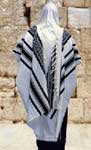
Thus we learn that the talit’s corners are also known as wings. When viewed from behind, as in the above picture, the talit makes the man appear as if he has wings folded against his back.
These wings, according to the Prophet, have healing associated with them:
Malachi 4:2 But unto you that fear my name shall the Sun of righteousness arise with healing in his wings; and ye shall go forth, and grow up as calves of the stall.
This healing we will see again in the Nazarean Codicil.
The four corners of the talit are also the four corners of the earth:
Yeshayahu (Isaiah) 11:12 And he shall set up an ensign for the nations, and shall assemble the outcasts of Israel, and gather together the dispersed of Judah from the four corners of the earth.
There is a sense that when we take hold of the four tzitzith on the corners of the talit that we are taking hold of the four corners of the earth. This connection is effectively made for us in the words of the Siddur, in the shacharit service:
“and gather us in peace from
the four corners of the earth”.
At this point we gather the four corners of our talit, the tzitzith, and hold them in one hand, in preparation for the Shema. This signifies the coming together of the four corners of the earth. This is also an expression of the complete unification of HaShem. The Shema is also an affirmation of HaShem's oneness.
Again, we find our word for the corners of the talit to be the same Hebrew word for the four corners of the earth – kanfot, in the above pasuk from Yeshayahu.
David
and Saul
His Majesty King Saul was chasing the heir to the throne with the intent to kill him. At one point in the chase, His Majesty came under the power of David:
1 Sh’muel (Samuel) 24:4-5 And the men of David said unto him, Behold the day of which HaShem said unto thee, Behold, I will deliver thine enemy into thine and, that thou mayest do to him as it shall seem good unto thee. Then David arose, and cut off the skirt of Saul's robe privily. And it came to pass afterward, that David's heart smote him,
because he had cut off Saul's skirt.
David cut off the corner of the king’s robe to show that he had the power to kill the king. After David cut off the corner, he realized that he had taken a mitzva, with it’s blessing, from the king.
The Talmud sees David’s treatment of Saul’s garment as the root for troubles later in David’s life:
Berachoth 62b Then David arose and cut off the skirt of Saul's robe privily. R. Jose son of R. Hanina said: Whoever treats garments contemptuously will in the end derive no benefit from them; for it says, Now King David was old and stricken in years; and they covered him with clothes, but he could get no heat.
In the Yemenite Midrash Gadol, on the same verse, we read: For Saul persecuted David and it would have been permissible for David to kill him, but he was punctilious about the commandment to wear tzitzith, as it is said:
I Sh’muel (Samuel) 24:4 Then David arose, and cut off the skirt of Saul's robe privily. And it came to pass afterward, that David's heart smote him, because he had cut off Saul's skirt.
He said, "Woe is me, for I have prevented him from observing the mitzva of tzitzith for a short time"--for the mitzva requires the presence of all four tzitziyot [and David had cut off one corner].
HaShem’s Tzitzith
Chazal, Our Sages, teach us that just as we enwrap ourselves in a talit, so also does HaShem enwrap Himself in a talit. Whereas ours is made of cloth, His is made of light:
Tehillim (Psalm) 104:1-2 Bless HaShem, O my soul. HaShem my God, thou art very great; thou art clothed with honour and majesty. Who coverest [thyself] with light as [with] a garment: who stretches out the heavens like a curtain: …
We said earlier that the purpose of the tzitzith was to remind us of the 613 mitzvot of HaShem. We also said that the numerical value of the word tzitzith is 600; when we add the eight strings and five double knots we arrive at a total of 613 - a reminder of the 613 Torah commandments.
This suggests that the Tzitzith = Torah. Now we know from previous studies that Mashiach = Torah. We can also see this concept embodied in:
Yochanan (John) 1:1 In the beginning was the Word, and the Word was with God, and the Word was God.
Therefore, we can conclude that:
Tzitzith = Torah = Mashiach
This suggests that HaShem enwraps Himself in His Mashiach who is light:
Mishle (Proverbs) 6:23 For the commandment [is] a lamp; and the law [is] light; and reproofs of instruction [are] the way of life:
Our Sages teach us that HaShem also enwraps Himself in a talit with tzitzith. This talit is used like a reader of the Torah uses his talit:
Rosh Hashanah 17b And ‘the Lord passed by before him and proclaimed [etc.]. R. Johanan said: Were it not written in the text, it would be impossible for us to say such a thing; this verse teaches us that the Holy One, blessed be He, drew his robe round Him like the reader of a congregation and showed Moses the order of prayer. He said to him: Whenever Israel sin, let them carry out this service before Me, and I will forgive them.
The Zohar echoes this understanding that Torah is HaShem’s garment:
Soncino Zohar, Bereshit, Section 1, Page 23b Certainly God created nothing which was not required.’ What is more, the created Torah is a vestment to the Shekinah, and if man had not been created, the Shekinah would have been without a vestment like a beggar. Hence when a man sins it is as though he strips the Shekinah of her vestments, and that is why he is punished; and when he carries out the precepts of the Law, it is as though he clothes the Shekinah in her vestments. Hence we say that the fringes (tzitzith) worn by the Israelites are to the Shekinah in captivity like the poor man's garments, of which it is said, “for that is his only covering, it is his garment for his skin, wherein shall he sleep?” (Ex. XXII, 26).
Midrash Rabbah - Genesis I:6 AND GOD SAID: LET THERE BE LIGHT (I, 3), and the manner of this, too, is not explained. Where is it explained? Elsewhere: Who coverest Thyself with light as with a garment (Ps. CIV, 2).
Midrash Rabbah - Genesis III:4 AND GOD SAID: LET THERE BE LIGHT, etc. R. Simeon b. R. Jehozadak asked R. Samuel b. Nahman: ‘As I have heard that you are a master of Haggadah, tell me whence the light was created?’ He replied: ‘The Holy One, blessed be He, wrapped Himself therein as in a robe and irradiated with the lustre of His majesty the whole world from one end to the other.’ Now he had answered him in a whisper, whereupon he observed, ‘There is a verse which states it explicitly: Who coverest Thyself with light as with a garment (Ps. CIV, 2), yet you say it in a whisper!’ ‘Just as I heard it in a whisper, so have I told it to you in a whisper,’ he rejoined.
In our morning prayers we enwrap ourselves in the talit with tzitzityot. Before we don this majestic garment, we check the tzitzith to make sure that there are no tears or breaks. While checking the tzitzith before donning the talit, we say:
"Bless HaShem, O my soul! HaShem, my God, You are very great; You have clothed Yourself with majesty and splendor; cloaked in light as with a garment, stretching out the heavens like a curtain."
The garment of the talit, then, is compared to a garment of light by our Sages, and the tzitzith are compared to the heavens stretching and hanging downward. Thus we learn that the tzitzith we wear are comparable to HaShem’s garment of light.
Adam’s
Tzitzith
There is a tradition says that the clothes HaShem made for Adam and Chava were tzitzith[12].
Our clothing serve as a barrier against the evil inclination, and the lust it engenders, which drives us away from HaShem and spirituality, and the 613 mitzvot protect us from a breakdown of our relationship with HaShem. And that is why we wear a reminder of the 613 mitzvot on our clothing: to remind us of why HaShem made clothing for man.
VII. In
The Nazarean Codicil
The Nazarean Codicil is replete with many direct and indirect examples of the talit with tzitzith. Here are a few of them:
A Great
Sheet
Peter’s vision in II Luqas is often used by the foolish to “prove” that unkosher food can be eaten by the Christian. The truth could not be further out of their grasp. This vision was given to prove that Gentiles were clean according to Hakham Tzefet’s own interpretation in II Luqas 10:28:
II Luqas (Acts) 10:9-16 On the morrow, as they went on their journey, and drew nigh unto the city, Peter went up upon the housetop to pray about the sixth hour: And he became very hungry, and would have eaten: but while they made ready, he fell into a trance, And saw heaven opened, and a certain vessel descending unto him, as it had been a great sheet knit at the four corners, and let down to the earth: Wherein were all manner of four footed beasts of the earth, and wild beasts, and creeping things, and fowls of the air. And there came a voice to him, Rise, Peter; kill, and eat. But Peter said, Not so, Lord; for I have never eaten any thing that is common or unclean. And the voice [spake] unto him again the second time, What God hath cleansed, [that] call not thou common. This was done thrice: and the vessel was received up again into heaven.
II Luqas (Acts) 10:28 And he said unto them, Ye know how that it is an unlawful thing for a man that is a Jew to keep company, or come unto one of another nation; but God hath showed me that I should not call any man common or unclean.
The identity of this great sheet as a talit is taken from its identification by “four corners” and by its effect upon its contents, namely the Gentiles.
The purpose of a talit is to enwrap its contents, usually a man, in the commandment’s of HaShem. Thus were the Gentiles enwrapped, in this pasuk. The goal was to enwrap the Gentiles in the 613 mitzvot – to bring them under the Torah.
Capital
Punishment
II Luqas (Acts) 22:22-23 And they gave him audience unto this word, and [then] lifted up their voices, and said, Away with such a [fellow] from the earth: for it is not fit that he should live. And as they cried out, and cast off [their] clothes, and threw dust into the air,
They cast off their tzitzith when they gave a capital punishment judgment. At this point the whole Sanhedrin has to be disbanded because they are a killing Sanhedrin.
A Tzadik
with a Talit[13]
Lets take a look at the talit of a Tzadik, a righteous man:
Marqos (Mark) 5:22-24 Then one of the synagogue rulers, named Jairus, came there. Seeing Yeshua, he fell at his feet And pleaded earnestly with him, "My little daughter is dying. Please come and put your hands on her so that she will be healed and live." So Yeshua went with him. A large crowd followed and pressed around him...
Keep in mind that Yair, Jarius, is a prominent Rabbi on the bet din of a large synagogue in a large city. He is a very prominent man who is held in high esteem by many people. Yet, notice that he acknowledges the superiority of the Torah wisdom of His Majesty King Yeshua.
Now His Majesty is being asked to lay hands – that is, to take the source of blessing, the hands sanctified by washing, and use them to bring the blessing of healing to the daughter of this Torah Sage.
Suddenly, we have an interruption to our story:
Marqos (Mark) 5:25-34 And a certain woman, which had an issue of blood twelve years, And had suffered many things of many physicians, and had spent all that she had, and was nothing bettered, but rather grew worse, When she had heard of Yeshua, came in the press behind, and touched his tzitzith. For she said, If I may touch but his clothes, I shall be whole. And straightway the fountain of her blood was dried up; and she felt in [her] body that she was healed of that plague. And Yeshua, immediately knowing in himself that virtue had gone out of him, turned him about in the press, and said, Who touched my tzitzith? And his disciples said unto him, Thou seest the multitude thronging thee, and sayest thou, Who touched me? And he looked round about to see her that had done this thing. But the woman fearing and trembling, knowing what was done in her, came and fell down before him, and told him all the truth. And he said unto her, Daughter, thy faith hath made thee whole; go in peace, and be whole of thy plague.
This woman who had been with a flow of blood (from malfunctioning ovaries – the source of life with the medium of life, the blood) for twelve years, signifying a problem related to justice twelve relates to government – the twelve tribes – which exists solely to dispense the justice of HaShem.
This anonymous woman touches the tzitzith, the symbol of Torah, the wings with healing in them, on His Majesty the Living Torah:
Malachi 4:2 But unto you that fear my name shall the Sun of righteousness arise with healing in his wings; and ye shall go forth, and grow up as calves of the stall.
The tzitzith, as an extension of the very body of His Majesty, when touched can be felt just as we can feel the touching of any of our bodies.
The woman who’s life, the blood the symbol of life, even as Torah is the symbol of life, has been ebbing out of her, is healed when she comes under the talit, under the authority of the Torah. The Torah that she grasps now gives her life and the outflow of her life fluid now ceases.
She placed herself under the discipline of the Master and of the Torah. Mida kneged mida (measure for measure) – She had some minor sin that needed to be rooted out. It could be a very minor problem – yet to get correction we must go back under the authority of the Torah. Her sin was in not being under Torah authority.
Her faithful obedience to place herself under authority of the Torah had healed her.
However, because she has touched Yeshua, he has become unclean. The virtue going out of Yeshua is just another way of saying that He had become unclean. He will no longer be able to lay hands on the daughter of Yair because He has become unclean. So, the story picks up where it left off before the interruption:
Marqos (Mark) 5:35-43 While Yeshua was still speaking, some men came from the house of Jairus, the synagogue ruler. "Your daughter is dead," they said. "O Why bother the teacher any more?" Ignoring what they said, Yeshua told the synagogue ruler, "Don't be afraid; just believe." He did not let anyone follow him except Peter, James and John the brother of James. When they came to the home of the synagogue ruler, Yeshua saw a commotion, with people crying and wailing loudly. He went in and said to them, "Why all this commotion and wailing? The child is not dead but asleep." But they laughed at him. After he put them all out, he took the child's father and mother and the disciples who were with him, and went in where the child was. He took her by the hand and said to her, <"Talitha koum!"> (which means, "Little girl, I say to you, get up!"). Immediately the girl stood up and walked around (she was twelve years old). At this they were completely astonished. He gave strict orders not to let anyone know about this, and told them to give her something to eat.
Note the juxtaposition of the key phrases between these two stories:
Your faith has healed you – fear not only believe.
Note also that the three greatest (in Torah learning) disciples (Tsefet, Ya’aqov, and Yochanan the brother of Ya’aqov) are forming a Bet Din. These Hakhamim (Rabbis) in training are learning on the job.
It is also necessary that we understand that a child under twelve normally takes refuge under the talit of the Hakham (Rabbi) when he does the Aaronic benediction, in the synagogue. This teaches us that those under twelve are under the authority of their fathers and Hakhamim who are their teachers. They grasp his tzitzith whilst he gives the blessing.
A pre-pubescent female is known as a Talitha.
Children under the age of twelve are called to come under the talit of the Hakham when he does the Aaronic benediction. A menstruating woman over the age twelve – is no longer under the talit of the father or Hakham.
Why does he tie her hands with the talit and lay the talit over the girl? A talit does not become unclean because it is touched by something unclean. A talit always maintains its purity as long as the tzitzith are intact. We must not worry about becoming unclean, because our cleanliness is ONLY for the benefit of others. We are clean for a purpose. We must not worry about performing a mitzvah because it makes us unclean. Mashiach’s hands were unclean, therefore he could not touch the little girl. Therefore, He tied her hands without touching her. This tying was the same as the binding in:
Yeshayahu (Isaiah) 8:16-20 Bind up the testimony, seal the law among my disciples. And I will wait upon HaShem, that hideth his face from the house of Jacob, and I will look for him. Behold, I and the children whom HaShem hath given me [are] for signs and for wonders in Israel from HaShem of hosts, which dwelleth in mount Zion. And when they shall say unto you, Seek unto them that have familiar spirits, and unto wizards that peep, and that mutter: should not a people seek unto their God? For the living to the dead? To the law and to the testimony: if they speak not according to this word, [it is] because [there is] no light in them.
Binding the tzitzith to the hands means that the person comes under the authority of the Torah, and the Torah always brings life!!! Laying the talit, further, over the girl’s head is the same as the little children coming under the talit of the Hakham giving the Aaronic benediction.
The Peshitta does not contain this ending: ‘Damsel (I say to thee), arise.’ My teacher translates this verse as:
41 (YbH) and, having tied the hands of the child (with his tzitzith), said to her: ‘Talitha Qumi;’ [which is, being interpreted, ‘She that is under the Talit arise’].
The greatest form of teaching is to bind the Torah on his talmidim. Sickness is just death by degrees. The root cause is a misalignment between the life of the individual and the exactness of Torah.
He charged them not to spread the word that He was a miracle worker – rather He wanted to be known as a Torah teacher. The ministry of Mashiach ben Yosef is to bring people closer to the Torah.
Yeshayahu (Isaiah) 61:1 The spirit of the Lord HaShem [is] upon me; because HaShem hath anointed me to preach good tidings unto the meek; he hath sent me to bind up the brokenhearted, to proclaim liberty to the captives, and the opening of the prison to [them that are] bound;
* * *
The story of the woman with the flow of blood is also described in Matityahu 9 and Luqas 8. In Matityahu 9:20, and Luqas 8:44, the Greek word, translated “hem”, is:
2899 kraspedon, kras'-ped-on; of uncert. der.; a margin, i.e. (spec.) a fringe or tassel:-border, hem.
Healing
in His Wings[14]
In the book of Malachi, we read:
“But to you who fear My Name the sun of righteousness/generosity will arise with healing in His wings.” (Malachi 3:20 or 4:2)
Many Christians accurately see a reference to the Messiah in this verse. Judaism also recognizes this as a messianic prophecy:
“Moses asked: ‘Will they remain in pledge for ever?’ God replied: ‘No, only until the sun appears’, that is, till the coming of the Messiah; for it says, But unto you that fear My name will the sun of righteousness arise with healing in its wings.” (Exodus Rabbah 31:10, Soncino Press Edition)
Examining Malachi 3:20 in Hebrew, is most interesting, for there we read:
“But to you who fear My Name the sun of righteousness/generosity will arise with healing in His wings (kanaf).”
In the books of Bamidbar (Numbers) and Debarim (Deuteronomy), the Torah uses the word “kanaf” for the commandment of the tzitzit (fringes):
Bamidbar 15:38, Debarim 22:12 Again HaShem spoke to Mosheh, saying, “Speak to the children of Israel: Tell them to make צִיצִת עַל-כַּנְפֵי tassels (tzitziyot) on the corners (kanaf) of their garments throughout their generations, and to put a blue thread in the tassels of the corners.”
The “kanaf” of a garment was the corner, edge, or “hem.” The Strong's Concordance defines kanaf as:
כּנף Kanaf (kaw-nawf');
Noun Feminine, Strong #: 3671
Wing, extremity, edge, winged, border, corner, shirt
- Wing
- Extremity skirt, corner (of garment)
The Greek word for “border” is κράσπεδον kraspedon, corresponding to the Hebrew word “kanaf,” as Strong's Concordance notes:
κράσπεδον Kraspedon (kras'-ped-on)
Noun Neuter, Strong #: 2899
The extremity or prominent part of a thing, edge, skirt, margin
- The fringe of a garment
- In the NT a little appendage hanging down from the edge of the mantle or cloak, made of twisted wool
- A tassel, tuft: the Jews had such appendages attached to their mantles to remind them of the law
A question for many arises as to why this woman was intent in taking hold of the Tzitzith of the Tallit of the Master and just touch him. With regards to this question Marcus[15] comments:
“… the woman touches only Jesus’ garment in order to avoid passing her ritual impurity to him. But although impurity contracted through contact with clothes is less serious that impurity contracted through contact with flesh (cf. Leviticus 15:7), it is still defiling; otherwise the instruction to wash one’s clothes would be senseless (cf. Lev. 15:11, 21-22. Etc.; cf. Mishnah Kelim 27-28 on the impurity of clothes).”
This is in part true. First, any unclean person touching the Tzitzith of a Tallit does not render the Tallit unclean for greater is the holiness of the Tallit than any uncleanness it can come into contact with. The only way to tamper with the holiness of the Tallit is to destroy or cut its Tzitzith. Nevertheless, if an unclean person touches the Tzitzith of a person wearing it, the Tallit remains ceremonially clean but the person wearing it looses his ceremonial status as clean.
And this is exactly what we are being told in v.30!
v. 29 - And immediately was the fountain of her blood dried up, and she knew in the body that she had been healed of the plague.
Rabbis and Paqidim, like all human beings are full of imperfections and even sin. Nevertheless, in general, Rabbis and Paqidim do sacrifice much in the pursuit of Torah justice and for the good of others, and do take much care to remain relatively in a state of cleanliness (physically and spiritually). Further, as we have seen from the rationale of the lady in question the aim was to touch the Tzitzith of a great rabbi, the primary emphasis being the Tzitzith rather than the “great rabbi.” So, if we match the holiness of the Tzitzith with the living holiness of the Master we have a most powerful healing combination.
The result was evident: the lady not only was healed but she felt in herself that she was healed from this malady that had afflicted her for the past 12 years. The efficacy of the state of ritual cleanliness of the Master in combination with the holiness power of the Tzitzith in which the name of G-d is inscribed by means of knots causes an “immediate” healing reaction.
Further, all Orthodox Jews during the recitation of the Shema twice a day (morning and evening) do kiss their four Tsitsiyot at certain points when reciting this key prayer of our sacred liturgy. Why? At least for three important reasons, (a) as a sign of respect and devotion for the name of G-d and what it represents, (b) for the healing and spiritual cleanliness of the person praying and that of his dependents, and (c) to become a conduit of G-d’s power for the healing of this world.
In this regard it is important to remember the statement of Zechariah the Prophet, when he said in the name of Ha-Shem, most ble He:
Zechariah 8:23 “Thus says HaShem of hosts: In those days it will come to pass, that ten men will take hold, out of all the languages of the Gentiles, will even take hold of the Tzitzith of him that is a Jew, saying: ‘We will go with you, for we have heard that God is with you.’”
There is a note of humour in this verse of Zechariah. It says that the Gentiles will state: “we have heard that God is with you.” But the Jew does not need to speak and tell anyone that “G-d is with him,” for he constantly wears a Tallit Qatan (Small Tallit) that has four knotted fringes which numerically spell G-d’s Holy Name! It would have been more appropriate for the Gentiles to have said “for we see that G-d is with you (i.e. you wear the Name of G-d in your Tzitzith)”! Nevertheless, the verse is correct and G-d does not make errors! The Gentiles in this verse probably came to this conclusion after reading the Bible or hearing some say that G-d, the Creator of the universe is to be found with and amongst His Jewish people!
Let me reiterate that wearing a Tallit is something very serious. For not only one has pledged unconditional and absolute loyalty to G-d and His people, but one also has pledged to unconditionally bring healing to this world.
A Priestly Tzadik
A Righteous person is called a tzadik in Hebrew. To be a tzadik, all that is required is that you obey all of the commandments that apply to you. We see that Zechariah the Priest, is a tzadik in:
Luqas (Luke) 1:5-6 There was in the days of Herod, the king of Judea, a certain priest named Zacharias, of the course of Abia: and his wife [was] of the daughters of Aaron, and her name [was] Elisabeth. And they were both righteous before God, walking in all the commandments and ordinances of the Lord blameless.
Thus we see that the Nazarean Codicil declares that Zechariah is a tzadik. We therefore understand that Zechariah was wearing tzitzith on his talit because this was one of the commandments which applied to a man.
Hakham Shaul is also described as a tzadik:
Philippians 3:6 Concerning zeal, persecuting the church; touching the righteousness which is in the law, blameless.
This suggests that Hakham Shaul also wore tzitzith.
The Shema
The Zohar in Parshat Shelach says that one who recites the Shema without tzitzith is giving false testimony about himself, for he reads the commandment of tzitzith and is not fulfilling it. Therefore we know that Yeshua was wearing tzitzith when he taught this pasuk:
Marqos (Mark) 12:28-30 And one of the scribes came, and having heard them reasoning together, and perceiving that he had answered them well, asked him, Which is the first commandment of all? And Yeshua answered him, The first of all the commandments [is], Hear, O Israel; HaShem our God is one: And thou shalt love HaShem thy God with all thy heart, and with all thy soul, and with all thy mind, and with all thy strength: this [is] the first commandment.
The
Triumphal Entry
Marqos 11:7-10 And they brought the colt to Yeshua, and cast their garments on him; and he sat upon him. And many spread their garments in the way: and others cut down branches off the trees, and strewed [them] in the way. And they that went before, and they that followed, cried, saying, Hosanna; Blessed [is] he that cometh in the name of HaShem: Blessed [be] the kingdom of our father David, that cometh in the name of the Lord: Hosanna in the highest.
Marqos (Mark) 11:8 And many spread their garments in the way: and others cut down branches off the trees, and strewed [them] in the way.
+-------------------------------------------------+
3598 hodos, hod-os'; appar. a prim. word; a road; by impl. a progress (the route, act or distance); fig. a mode or means:-journey, (high-) way.
Many Christians view the above pasuk as:
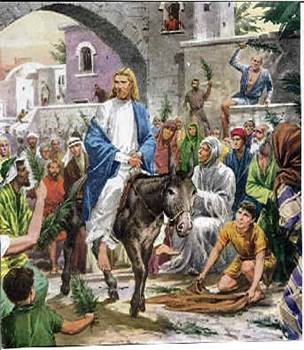
An observant Jew would never have such a view, it would be sacrilegious.
Jewish law forbids putting a talit with its tzitzith on the ground. Therefore, this outer garment with tzitzith would not have been laid on the ground.
A Jew also knows that the Mashiach is the living embodiment of the Torah. They also know that a Torah scroll never goes out in public without being covered by a Chupa, the same canopy used at a wedding. The folks were then using their talits to make a chupa to spread over the Living Torah. Here is a picture of Jews escorting a Torah scroll under a chupa:
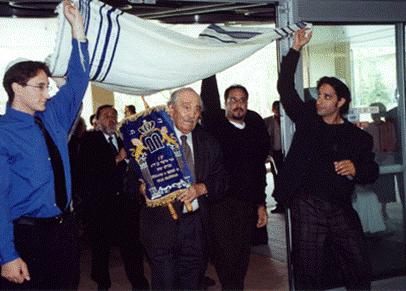
Matityahu (Matthew 21:7) And brought the ass, and the colt, and put on them their clothes, and they set [him] thereon.
When do we get in a chupa? When we move a Torah scroll publicly.
Yochanan (John) 1:1 In the beginning was the Word, and the Word was with God, and the Word was God.
Mashiach and the torah are the same. Therefore we need a chupa to proclaim the Mashiach publicly.
II Luqas (Acts) 11:5-6 I was in the city of Joppa praying: and in a trance I saw a vision, A certain vessel descend, as it had been a great sheet, let down from heaven by four corners; and it came even to me: Upon the which when I had fastened mine eyes, I considered, and saw four footed beasts of the earth, and wild beasts, and creeping things, and fowls of the air.
The Gentiles were made clean by being enwrapped in a tzitzith which is the 613 commands.
1 Corinthians 11:4 Every man praying or prophesying, having [his] head covered, dishonoureth his head.
He who prays shacharit (the morning service) without a talit over his head, dishonors his head.
Luqas 8:43-44 And a woman having an issue of blood twelve years, which had spent all her living upon physicians, neither could be healed of any, Came behind [him], and touched the border of his garment: and immediately her issue of blood stanched.
Her blood flow stopped because she touched the name of HaShem, which is represented by the knots of the tzitzith. She was healed because she was at oneness with HaShem.
Coat
of Many Colors
His Majesty King Yeshua wore a talit similar to Yoseph’s talit that was given to him by Yaakov:
Yochanan (John) 19:23-24 Then the soldiers, when they had crucified Yeshua, took his garments, and made four parts, to every soldier a part; and also [his] coat: now the coat was without seam, woven from the top throughout. They said therefore among themselves, Let us not rend it, but cast lots for it, whose it shall be: that the scripture might be fulfilled, which saith, They parted my raiment among them, and for my vesture they did cast lots. These things therefore the soldiers did.
This exceptional garment was of such fine character that it was not divided.
Public
Torah Reading
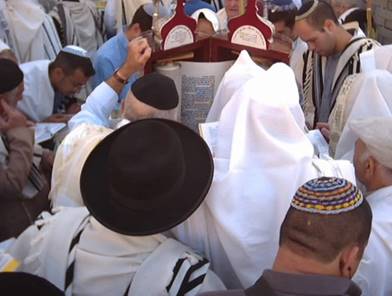
A person called to receive an aliyah, should wrap himself in a talit according to the Shulchan Arukh chapter 9, law 11. Here we see Yeshua receiving an aliyah to the Torah:
Luqas (Luke) 4:16 And he came to Nazareth, where he had been brought up: and, as his custom was, he went into the synagogue on the Sabbath day, and stood up for to read.
So, when Yeshua receives an aliyah to the Torah He would have been wearing a talit.
* * *
II Luqas (Acts) 12:8 And the angel said unto him, Gird thyself, and bind on thy sandals. And so he did. And he saith unto him, Cast thy garment about thee, and follow me.
The Prayer
Closet
During certain prayers, like the Amidah, Jews put the talit over their head and “shut the doors”. This is the prayer closet spoken by Matityahu:
Matityahu (Matthew) 6:5-6 And when thou prayest, thou shalt not be as the hypocrites [are]: for they love to pray standing in the synagogues and in the corners of the streets, that they may be seen of men. Verily I say unto you, They have their reward. But thou, when thou prayest, enter into thy closet, and when thou hast shut thy door, pray to thy Father which is in secret; and thy Father which seeth in secret shall reward thee openly.
This next picture shows a group of men in their prayer closet performing the Aaronic benediction:
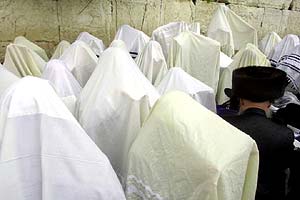
The Head
Covering
Many Christians are convinced that men should not wear a head covering. They usually base that on a mistaken understanding of this pasuk:
1 Corinthians 11:4 Every man praying or prophesying, having [his] head covered, dishonoureth his head.
During Shacharit an observant Jewish male will pull his talit over his head to form a prayer closet. It would be uncomfortable to do this if he were wearing a hat. Therefore, we do not wear a hat during shacharit. We always pull the talit over our head when the Torah is taken out of the ark.
In the mincha (afternoon) and arbit (evening) prayers, however, we do not lift the talit over the head so it is common for men to wear hats during mincha and maariv.
Pride
Pride causes us do things that will cause us to be noticed by men:
Matityahu (Matthew) 23:1-7 Then spake Yeshua to the multitude, and to his disciples, Saying, The scribes and the Pharisees sit in Moses' seat: All therefore whatsoever they bid you observe, [that] observe and do; but do not ye after their works: for they say, and do not. For they bind heavy burdens and grievous to be borne, and lay [them] on men's shoulders; but they [themselves] will not move them with one of their fingers. But all their works they do for to be seen of men: they make broad their phylacteries, and enlarge the borders (tzitzith) of their garments, And love the uppermost rooms at feasts, and the chief seats in the synagogues, And greetings in the markets, and to be called of men, Rabbi, Rabbi.
What is interesting about this passage is that the tzitzith are enlarged. Since we have halachic requirements as to their length, those who were enlarging their tzitzith were going outside the bounds of halachic law:
Menachoth 41b Our Rabbis taught: How many threads must one insert? Beth Shammai say, Four; but Beth Hillel say. Three. And how far must they hang down? Beth Shammai say, Four [fingerbreadths]; but Beth Hillel say, Three. And as for the three [fingerbreadths] stated by Beth Hillel each must measure one fourth part of the handbreadth of an ordinary person. R. Papa said, The handbreadth of the Torah is equal to four times the width of the thumb, or six times the width of the little finger, or five times the width of the middle finger.
R. Huna said, Four [threads] must be [inserted in the garment] within [the distance of] four [fingerbreadths from the corner], and they must hang down for four [fingerbreadths]. Rab Judah said, Three [threads] must be inserted within three [fingerbreadths from the corner], and they must hang down for three [fingerbreadths]. R. Papa said, The law is: Four [threads] must be inserted within three [fingerbreadths from the corner], and they must hang down for four [fingerbreadths].
“Tentmakers”
Paul, and a couple of his friends, were “tentmakers”:
II Luqas (Acts) 17:33 – 18:3 So Paul departed from among them. Howbeit certain men clave unto him, and believed: among the which [was] Dionysius the Areopagite, and a woman named Damaris, and others with them. After these things Paul departed from Athens, and came to Corinth; And found a certain Jew named Aquila, born in Pontus, lately come from Italy, with his wife Priscilla; (because that Claudius had commanded all Jews to depart from Rome:) and came unto them. And because he was of the same craft, he abode with them, and wrought: for by their occupation they were tentmakers.
Now, a “tentmaker” is not one who makes a a canvas dwelling place, as most of us would envision. A “tentmaker”, according to my teacher, is one who makes talitot. This suggests that Hakham Shaul was making Jewish garments for Jews. Why is a talit maker called a “tentmaker”? Because a tent is a dwelling place and THE dwelling place of the righteous is with HaShem in his prayer closet. Except we are privately alone and communing with HaShem, we are not dwelling in the dwelling of the righteous.
VIII. The Talit Katan
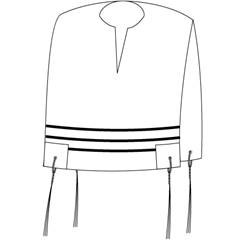
The talit katan, the small talit, is also known by its Hebrew name: Arba Kanfot, “Four Corners”.
The Talit Katan consists of a simple rectangle of cloth, with a hole for the neck. The Talit Katan should be at least a cubit (or Amah) square on each side.
It is good and proper for every person to be careful to wear a "talit katan" [the small garment with tzitzith that is worn under a shirt] all day, in order that he remember the commandment[s] every second.[16]
IX. In The Talmud
The Talmud is part of the oral law. The Talmud presumes that an observant Jewish male will wear a talit. Lets look at some of the more interesting example used in the Talmud that did not seem to fit anywhere else:
Exemptions
Menachoth 40a Our Rabbis taught: A linen garment is, according to Beth Shammai, exempt from tzitzith; but Beth Hillel declare it liable. The Halakhah is in accordance with Beth Hillel. R. Eliezer son of R. Zadok said, Is it not a fact that any one in Jerusalem who attaches blue threads [to his linen garment] causes amazement? Rabbi said, If that is so, why did they forbid it? Because people are not versed in the law.
Protection From Sin
Menachoth 43b "Whoever wears Tefillin on his head and arm, Tzitzith on his clothes, and has a Mezuzah on his door can be assured he will not sin, since he has many reminders. They are the angels who prevent him from sinning, as [Psalms 34:8] declares: 'The angel of G-d camps around those who fear Him and rescues them.'"
The Gemara tells us about a student of Rabbi Meir who had far too much money for his own good. He once heard there was a harlot in Rome who was an outstanding in every way:
Menachoth 44a It was taught: R. Nathan said, There is not a single precept in the Torah, even the lightest, whose reward is not enjoyed in this world; and as to its reward in the future world I know not how great it is. Go and learn this from the precept of tzitzith. Once a man, who was very scrupulous about the precept of tzitzith, heard of a certain harlot in one of the towns by the sea who accepted four hundred gold [denars] for her hire. He sent her four hundred gold [denars] and appointed a day with her. When the day arrived he came and waited at her door, and her maid came and told her, ‘That man who sent you four hundred gold [denars] is here and waiting at the door’; to which she replied ‘Let him come in’. When he came in she prepared for him seven beds, six of silver and one of gold; and between one bed and the other there were steps of silver, but the last were of gold. She then went up to the top bed and lay down upon it naked. He too went up after her in his desire to sit naked with her, when all of a sudden the four fringes [of his garment] struck him across the face; whereupon he slipped off and sat upon the ground. She also slipped off and sat upon the ground and said, ‘By the Roman Capitol, I will not leave you alone until you tell me what blemish you saw in me. ‘By the Temple’, he replied, ‘never have I seen a woman as beautiful as you are; but there is one precept which the Lord our God has commanded us, it is called tzitzith, and with regard to it the expression ‘I am the Lord your God’ is twice written, signifying, I am He who will exact punishment in the future, and I am He who will give reward in the future. Now [the tzitzith] appeared to me as four witnesses [testifying against me]’. She said, ‘I will not leave you until you tell me your name, the name of your town, the name of your teacher, the name of your school in which you study the Torah’. He wrote all this down and handed it to her. Thereupon she arose and divided her estate into three parts; one third for the government, one third to be distributed among the poor, and one third she took with her in her hand; the bed clothes, however, she retained. She then came to the Beth Hamidrash of R. Hiyya, and said to him, ‘Master, give instructions about me that they make me a proselyte’. ‘My daughter’, he replied; ‘perhaps you have set your eyes on one of the disciples?’ She thereupon took out the script and handed it to him. ‘Go’, said he ‘and enjoy your acquisition’. Those very bedclothes which she had spread for him for an illicit purpose she now spread out for him lawfully. This is the reward [of the precept] in this world; and as for its reward in the future world I know not how great it is.
X.
In the Midrash
Mordecai
Midrash Rabbah - Leviticus XXVIII:6 … R. Levi said: When Mordecai saw Haman coming towards him leading the horse in his hand, he remarked: ‘It appears to me that this villain comes for the sole purpose of slaying me.’ His disciples were sitting and learning in his presence. Said he to them: ' Rise and flee, lest you be scorched by my coal!’ They answered him: ‘Whether to be killed or to remain alive, we are with you, and will not desert you!’ What did he do? He enveloped himself in his Tallit and stood before the Holy One, blessed be He, in prayer, while his disciples sat and learned.
Judah and
Tamar
Midrash Rabbah - Genesis LXXXV:9 AND HE SAID: WHAT PLEDGE SHALL I GIVE THEE? AND SHE SAID: THY SIGNET AND THY CORD, AND THY STAFF THAT IS IN THY HAND (XXXVIII, 18). R. Hunia said: A holy spirit was enkindled within her. THY SIGNET alludes to royalty, as in the verse, Though Coniah the son of Jehoiakim king of Judah were the signet upon My right hand, etc. (Jer. XXII, 24); AND THY CORD (PETHIL - EKA) alludes to the Sanhedrin, as in the verse, And that they put with the fringe of each corner a thread (pethil) of blue, etc. (Num. XV, 38) AND THY STAFF alludes to the royal Messiah, as in the verse, The staff of thy strength the Lord will send out of Zion (Ps. CX, 2). AND HE GAVE THEM TO HER... AND SHE CONCEIVED BY HIM-men mighty like himself and righteous like himself.
Noach
The talit is associated with the covering that Shem did for Noach his father:
Midrash Rabbah - Genesis XXXVI:6 AND SHEM AND JAPHETH TOOK A GARMENT. R. Johanan said: Shem commenced the good deed, then Japheth came and hearkened to him. Therefore Shem was granted a Tallit and Japheth a pallium. AND LAID IT UPON BOTH THEIR SHOULDERS. Now since it is said, AND WENT BACKWARDS, do we not know that THEY SAW NOT THEIR FATHER'S NAKEDNESS? This, however, teaches that they hid their faces with their hands and walked backward, giving him the respect due from a son to a father. Said the Holy One, blessed be He, to Shem: ‘Thou didst cover thy father's nakedness: By thy life! I will reward thee When these men are bound in their cloaks (be-sarbelehon), ' etc. (Dan. III, 21). (R. Judan and R. Huna [differed as to the meaning of ’ be-sarbelehon ‘]: R. Judan said: It means in their prayer cloaks; R. Huna said: It means in their robes of state.) The Holy One, blessed be He, said to Japheth: 'Thou didst cover thy father's nakedness: By thy life, I will reward thee, for It shall come to pass on that day, that I will give unto Gog a place fit for burial in Israel’ (Ezek. XXXIX, II). The Holy One, blessed be He, said to Ham: ' Thou didst bring thy father's nakedness into disgrace: By thy life, I will requite thee: So shall the king of Assyria lead away the captives of Egypt, and the exiles of Ethiopia, young and old, naked and barefoot, and with buttocks uncovered to the shame of Egypt ‘ (Isa. XX, 4).
Rashi (9-23) quotes this midrash to tell us that Shem's reward for covering his father in a modest way was that his children received the mitzvah of tzitzith to uphold. Rashi is teaching us that the true reward for a mitzvah is another mitzvah, as the Tanna says in Avot: The reward of a mitzva is a mitzva. The Talmud[17] relates that one who is careful in observing the mitzvah of tzitzith will merit to see the Shechinah.
The
Proselyte
Midrash Rabbah - Numbers VIII:9 Aquila, the proselyte, once went in to R. Eliezer and said to him: ‘All the glory of the proselyte, then, consists in that He "Loveth the proselyte, in giving him food and raiment"!’ Said the latter to him: ‘Is this such a trifling matter in your eyes? It is a thing for which that ancestor of ours3 prostrated himself in prayer, saying, And will give me bread to eat, and raiment to put on (Gen. XXVIII, 20), and now comes this man and He offers it to him on a tray [lit. " reed "]! ' He [Aquila] came in to R. Joshua, and the latter began to speak consolingly to him. "’Bread," ' he said ‘alludes to Torah; as it says, Come, eat of my bread (Prov. IX, 5).4 "Raiment" alludes to the Tallit. If a man is worthy of acquiring Torah he is privileged to perform good deeds. Nay, more; they [the pious proselytes] marry their daughters into the priesthood, and their children's children will offer burnt-offerings upon the altar [and so], "bread" refers to the showbread, and "raiment" to the robes of High Priesthood.’ This applies to the Sanctuary. Whence that they have a share in the gifts due to the priest from the land? ‘Bread’ refers to the first cake of the dough, and ‘raiment’ to the first of the fleece. For this reason the text, AND EVERY MAN'S HALLOWED THINGS SHALL BE HIS is placed in the section dealing with the proselyte.
Tzitzith
and the Dead
Midrash Rabbah - Ecclesiastes IX:4 FOR THE LIVING KNOW THAT THEY SHALL DIE (IX, 5). R. Hiyya Rabbah and R. Jonathan were walking in front of the bier of R. Simeon, the son of Jose b. Lekunia, and the Tallit of R. Jonathan dragged upon his coffin. R. Hiyya Rabbah said to him: ' My son, lift up your Tallit so that [the dead] shall not say, "To-morrow they will come to us, and yet they revile us[18]."’ He said to him, My master, is it not written, BUT THE DEAD KNOW NOT ANYTHING? He answered, My son, you know Scripture but not Midrash. FOR THE LIVING KNOW refers to the righteous who are called LIVING even in their death; BUT THE DEAD KNOW NOT refers to the wicked who, even in their lifetime, are called DEAD. Whence do we know that the righteous are called living even in their death? As it is said, Unto the land of which I swore unto Abraham, to Isaac, and to Jacob, saying (Ex. XXXIII, 1). It is not stated here "to the patriarchs", but "unto Abraham, to Isaac, and to Jacob"; He said to Moses, "Go and tell them that the oath which I swore to them I have fulfilled," as it is stated, To thee will I give it, and to thy seed for ever (Gen. XV, 15). The wicked are called dead, as it is written, I have no pleasure in the death of the dead (Ezek. XVIII, 32). Can "the dead" die! In fact it alludes to the wicked who, even in their lifetime, are called dead.’ [R. Jonathan] said to him, ‘Blessed be he who has taught me Midrash,’ and kissed him on his head.
Midrash Rabbah - Ecclesiastes VII:16 Some time later Elisha b. Abuyah became ill, and it was told R. Meir that he was sick. He went to visit him and said, ‘Repent.’ He asked, ‘Having gone so far will I be accepted?’ R. Meir replied, ‘Is it not written, Thou turnest man to contrition (Ps. XC, 3), i.e. up to the time that life is crushed out [the penitent is accepted]?’ Then Elisha b. Abuyah wept and died. R. Meir rejoiced, saying, ‘My master seems to have departed in a mood of repentance.’ When, however, they buried him, fire came to burn his grave. They went and told R. Meir, ‘The grave of your master is ablaze!’ He went out, spread his Tallit over it, and said to him, ' Tarry this night (Ruth III, 13) in this world which is wholly night, And it shall be in the morning, if he who is good will redeem thee, he will redeem thee (ib.). What means "And it shall be in the morning"? In the world which is wholly good. [What means] " If he who is good will redeem thee"? It alludes to the Holy One, blessed be He, as it is said, The Lord is good to all (Ps. CXLV, 9). But if He [i.e. God] will not redeem thee, then will I [Meir] redeem thee, as the Lord liveth; lie down until the morning’ (Ruth loc. cit.). The fire was then extinguished.
R. Meir's disciples asked him, ' Rabbi, in the World to Come should you be asked, " Whom do you want, your father or your teacher? " what would you say? ' He replied, ‘First my father and then my teacher.’ They said to him, ‘And will they listen to you?’ He answered them, ' Is there not a Mishnaic teaching that [in the event of a fire on the Sabbath] the case of a book may be saved with the book and the case of phylacteries together with the phylacteries! So may Elisha be saved through the merit of his knowledge of Torah.’
XI. Customs
According to Ashkenazic custom, the blessing on tzitzith is Le'hitatef Ba-tzitzit (to enwrap in THE tzitzith). It's interesting to note that the Sephardic custom is to say Be-tzitzith (to enwrap in tzitzith). According to the Sephardic custom, only if one wears THE authentic tzitzith would he say Ba-tzitzith (in THE tzitzith). Authentic tzitzith have not only white strands, but have a strand of blue-tekhelet as well. If one can obtain tekhelet and puts it on his garment, then the Sephardic custom would be to say Ba-tzitzit, since he would be fulfilling the commandment in the most perfect manner[19].
* * *
What Torah mitzvah (mitzvah d'oraita) is it that, if done one way, one blessing is said, and if done another way a different blessing is said (according to Ashkenazic custom)?
The Mitzvah of Tzitzith
The Torah commands that if we wear a four-cornered garment (talit) we must attach tzitzith, fringes, to each corner. When donning a large talit, the type worn for prayer, the blessing is "Blessed are You, G-d... who commanded us to enwrap ourselves in tzitzith" (l'hitatef ba'tzitzit). But when donning a small talit (the type which is generally worn under the shirt) the blessing said (according to Ashkenazic custom) is "Blessed are You...who commanded us regarding the mitzvah of tzitzith" (al mitzvat tzitzith).
According to Sephardic custom, l'hitatef may be said on the small talit as well.
ALTERNATIVE ANSWER: The blessing on brit mila is "Blessed are You...who commanded us regarding circumcision" (al hamila). But if the father of the child performs the brit himself, then according to Rambam the blessing is "...Who commanded us to circumcise the son" (Lamul et haben).[20]
* * *
At Shacharit, on Simchat Torah, a chupa is often made over the Bima by four tall guys with a talit, as the Torah is completed.
* * *
We tie them on our fingers when we say the Shema.
* * *
The minimum size of a talit is that which would suffice to clothe a small child able to walk[21].
* * *
"It is a great disgrace for a Torah scholar to pray without being wrapped in a Talit"[22]
* * *
Since talmudic times, it has been customary to bury a male, clothed in a kittel, in the talit which he had used during his lifetime, after its fringes have been deliberately rendered ritually unfit.
* * *
No talitot in a cemetery
Based upon Mishle (Proverbs) 17:5:
Mishle (Proverbs) 17:5 Whoso mocketh the poor reproacheth his Maker: [and] he that is glad at calamities shall not be unpunished.
Neither talit nor tefillin should not be worn in a cemetery, nor should a Torah scroll be read there so as not to "shame" the dead who are no longer able to perform these mitzvot[23].
* * *
"It is the way for all Sages and their students to pray only when (unless) wrapped in a Talit"-- [24]
Kinyan
– Acquisition
The sages of Yemen employed the corner of the talit to make a Kinyan sudar (a form of contractual agreement whereby the seller or buyer lifts up an object--often a handkerchief--which the other gives him). Rabbi Y. Kafich, esteemed Yemenite Rabbi and scholar, considers this use of the talit a tradition of ancient times, and this receives some support from Saadia Gaon, for in his commentary on the book of Proverbs, Saadia compares:
Mishle (Proverbs) 6:1 "You have struck your hands for a stranger"
To the procedure for a kinyan, remarking that the best garment for this purpose is one that reminds us of the mitzvot, commandments. The Yemenite practice of using a corner of a talit for a kinyan sudar is therefore most appropriate, since we are told in Bamidbar 15:39 that looking at the tzitziyot should make us "remember all the commandments of HaShem."
How does one have an aliyah?
The person honored with the aliyah comes forward when called. The reader will open the scroll and point to where s/he will begin reading. The person called to the Torah takes the tzitzith of the talit and touches them to the first word to be read and kisses the tzitzith. The Torah will then be rolled closed and, in many congregations, covered. The one blessing the Torah holds the wooden rollers and recites the first blessing. After the reading completes reading the section for that aliyah, the reader will point out the last word read to the person who is blessing the Torah, who again takes the tzitzith, touches the last word, and kisses the tzitzith. The scroll is again rolled closed, and the person reciting the blessing holds the wooden rollers and recites the second blessing.
The Chupah
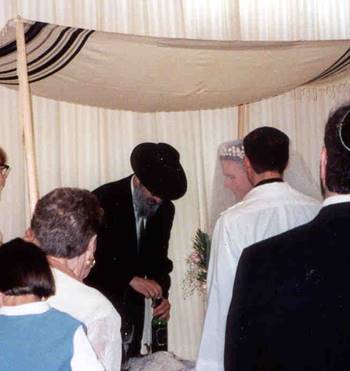
The talit is often spread across four poles to form a marriage canopy under which kiddushin (marriage) takes place.
Birchat Kohanim
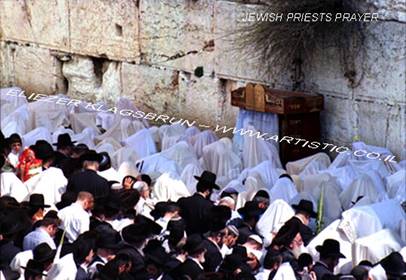
The kohanim recite the blessing with their talitot drawn forward to cover their heads and their hands stretched out at shoulder height with the palms facing forward. The hands are held touching at the thumbs with the first two fingers of each hand separated from the other two, thus forming a sort of fan.
Aharon and his offspring were commanded to bless the Children of Israel. As in ancient times, the Kohanim act as a conduit through which HaShem’s blessings are bestowed on us. Today, this enduring mitzva seems to be cloaked with special meaning as we envelop our children under the talit while the Kohanim chant the berachot.
Blessing the Children on Simchat Torah
After all but the three designated adults have been summoned for an aliyah on Simchat Torah, all the children are invited to the bimah for a ceremony called Kol Hane’arim ("all the youngsters"). Enough talitot are held over their heads to cover them like a canopy while blessings are recited over the Torah and the children.
Burial:
There is a custom to bury a man with his talit. When the talit is used as a burial garment, the tzitzith are removed or cut to signify that the commandments of Torah are no longer binding on the one who has died.
Upon Arising:
Those that are stringent in their observance of mitzvot do not walk four amot without wearing tzitzith.
Talit Katan:
Since it is a widely held custom to wear a talit katan, one may not change from the custom of our fathers. Today, therefore, one is obligated to wear a talit katan all day long[25].
It is proper to wear a talit katan in order to be able to keep the mitzva the entire day.
XII.
Mystical Understanding
When Yehudah left Tamar, he left with her a sign:
The Zohar says that he left her with talit and tefillin. Tefillin is the cover. Talit is the ultimate covering. This was the beginning of bringing Mashiach. She was saying you have to cover for me. Everybody knows Boaz was the neshama of Yehudah and Ruth was the neshama of Tamar. When Ruth said, "And you will spread your wings over your servant", she brought back the talit which Yehudah gave to Tamar and she said, "Now, put it over me."
* * *
Tumah, uncleanness, sticks to the fingertips. It likes to stick on the edges of things, onto the husks of things. This is where it does the most good, clinging to the outer shell of things within this world.
By placing the tzitzith on the corners of our material garments,
we are protecting them, and ourselves, by way of HaShem’s
Holy Name, and His 613 mitzvot.
When one is wrapped within the Talit, it is as if he resembles HaShem and the angels. He is wrapping himself in garments of majesty and light, the splendor of HaShem’s commandments.
* * *
The dualism, which marks this passage, is not incidental. The dualism is found in the repetition of expressions:
1) said – saying;
2) fringes on the corners – the fringe at each corner;
3) recall and observe – you shall be reminded to observe;
4) I the Lord am your G-d – I the Lord your G-d.
It is also in pairs of expressions:
1) To make – attach;
2) Recall – observe;
4) Be reminded – observe. Perhaps to the latter list one could also add: whoring – being holy.
Form and content are not independent entities. There is no content without form, and "form ... is not indifferent to content; it is saturated with content and expresses this content in lasting statements. Thus it is quite possible that the dualistic structure of the passage on tzitzith should be tailored to its fundamental idea: Two paths lay before us; each and every day of our lives we are called upon to choose, and the blue fringe on the tzitzith symbolizes to us the correct choice.
* * *
In Jewish mysticism the mitzva of tzitzith is particularly connected to the letter u, vav. The Bahir, for examples, says:
They said to him: But what is Vav? He said: The world was sealed with six directions. They said: Is not Vav a single letter? He replied: It is written[26], "He wraps Himself in light as a garment, [he spreads out the heavens like a curtain]."
Thus the mystical book, the Tanya, states that he who omits tzitzith blemishes the letter u, vav, of His name. The letter u has the meaning of a hook and is the common prefix that mean “and”. Thus the u means a connection.
In The Zohar
Soncino Zohar, Bereshit, Section 1, Page 23b Prayer which is not whole-hearted is pursued by numbers of destructive angels, according to the Scriptural expression: “all her pursuers have overtaken her, etc.” (Lam. I, 3). Therefore it is well to preface one's prayer with the verse, “but he is merciful and forgives iniquity, etc.” (Ps. LXXVIII, 38). The word “iniquity” signifies Samael, who is the serpent; “he will not destroy” signifies the destroyer; “he turneth his anger away” refers to the demon Af (anger); “and doth not stir up all his wrath” refers to the demon Hemah (wrath). To these powers are attached many destructive angels, which are under seven chiefs with seventy under-chiefs, dispersed in every firmament, and under them are myriads of others. When an Israelite wearing fringes and phylacteries prays with devotion, then the words of the Scripture are fulfilled: “All the peoples of the earth shall see that the name of the Lord is called upon thee and they shall fear thee” (Deut. XXVIII, 10). We have agreed that “the name of the Lord” refers to the phylactery of the head; and when the destructive angels see the name of Tetragrammaton on the head of him who is praying, they at once take to flight, as it is written, “a thousand shall fall at thy side” (Ps. XCI, 7).
Soncino Zohar, Bereshit, Section 1, Page 28b In regard to them it is written, “Whoso hath sinned against me, him will I blot out of my book” (Ex. XXXII, 33), for they are of the seed of Amalek, of whom it is said, “thou shalt blot out the memory of Amalek” (Deut. XXV, 19): it was they who caused the two tablets of the Law to be broken, whereupon, AND THE EYES OF BOTH OF THEM WERE OPENED AND THEY KNEW THAT THEY WERE NAKED, i.e. Israel became aware that they were sunk in the mire of Egypt, being without Torah, so that it could be said of them “and thou wast naked and bare”.... Next it says, AND THEY SEWED FIG LEAVES, that is to say, they sought to cover themselves with various husks from the “mixed multitude”; but their real covering is the fringes of the Tzitzith and the straps of the phylacteries, of which it is said, AND THE LORD GOD MADE FOR THE MAN AND HIS WIFE COATS OF SKIN AND COVERED THEM; this refers more properly to the phylacteries, while the fringes are designed in the words AND THEY MADE FOR THEMSELVES GIRDLES.
Soncino Zohar, Bereshit, Section 1, Page 141a AND ISAAC DIGGED AGAIN THE WELLS, ETC . R. Eleazar said: ‘In digging these wells Isaac acted fittingly, for he discerned from his knowledge of the mysteries of Wisdom that in this way he could attach himself more firmly to his faith. Abraham likewise made a point of digging a well of water. Jacob found the well already prepared for him, and he sat down by it. Thus they all looked for a well and strove through it to preserve their faith pure and undiminished. And nowadays Israel hold fast to the well through the symbolism of the precepts of the Torah, as when each day every Israelite performs the precept of the fringes in which he envelops himself, and of the phylacteries which he puts on his head and on his arm. All these have a deep symbolism, since God is found in the man who crowns himself with the phylacteries and envelops himself in the fringes. Hence, whoever does not envelop himself in the latter, nor crown himself with the former each day to invigorate himself in faith, makes it appear as though faith does not dwell within him, and fear of his Master has departed from him, and so his prayer is not as it should be. Hence our ancestors strengthened themselves in the true faith in digging the well, symbolic of the supernal well, which is the abode of the mystery of perfect faith.’ AND HE REMOVED FROM THENCE, AND DIGGED ANOTHER WELL.
XIII.
Redemption
Bamidbar (Numbers) 15:37-40 And HaShem spake unto Moses, saying, Speak unto the children of Israel, and bid them that they make them tzitzith (fringes) in the borders of their garments throughout their generations, and that they put upon the tzitzith of the borders a ribband of blue: And it shall be unto you for a fringe, that ye may look upon it, and remember all the commandments of HaShem, and do them; and that ye seek not after your own heart and your own eyes, after which ye use to go a whoring: That ye may remember, and do all my commandments, and be holy unto your God. I [am] HaShem your God, which brought you out of the land of Egypt, to be your God: I [am] HaShem your God.
The Exodus represents both a physical and spiritual liberation, but in an important sense, it also involves the liberation from domination by one's sexual appetites. Egypt was known as a place of extreme sexual immorality. When the Jews left Egypt, this was one of the things that they were to leave behind (cf. Yoma 75a). In serving to check our passions, the tzitzith tend to reinforce this aspect of the Exodus[27].
The end of the above section on tzitzith says, “I am HaShem your G-d who took you out of the land of Egypt” (the exodus from Egypt, which was the beginning and source of all subsequent redemptions), teaching us that the mitzva of tzitzith is connected with, and hastens, the true and complete redemption, as it is said:
Micah 7:15 As in the days of your exodus from the land of Egypt, I will show you wonders.
“The four corners” of the tzitzith correspond to the four terms describing the redemption: “I will take out,” “I will save,” “I will redeem,” and “I will take” (Rashi, end of Parshat Shelach) as found in:
Shemot (Exodus) 6:6-7 Wherefore say unto the children of Israel, I [am] HaShem, and I will bring you out from under the burdens of the Egyptians, and I will rid you out of their bondage, and I will redeem you with a stretched out arm, and with great judgments: And I will take you to me for a people, and I will be to you a God: and ye shall know that I [am] HaShem your God, which bringeth you out from under the burdens of the Egyptians.
Indeed, the redemption will also be from “the four corners of the world.”
* * *
This study was written by
Rabbi Dr. Hillel ben David
(Greg Killian).
Comments may be submitted to:
Rabbi Dr. Greg Killian
6970 Axist St. SE
San Antonio, TX 78252
Internet address: gkilli@aol.com
Web page: http://www.betemunah.org/
(360) 918-2905
Return to The WATCHMAN home page
Send comments to Greg Killian at his email address: gkilli@aol.com
[1] This insight came from Yeshayahu Leibowitz
[2] "Gedilim Ta'aseh Licha" (Devarim 22:12)
[4] Yebamoth 5b; Niddah 61b. See my Hebrew commentary p. 122.
[5] Tosafoth. Yebamoth 5b.
[6] Menachoth 39 a. To understand the following text it is necessary to clarify these two points: (a) The commandment of Tzitzith (Fringes) consists of making for each of the four corners of the garment four threads specially woven for that purpose. They are then passed through a hole situated a few thumbs' breadth away from each of the four corners, the threads are doubled, and two knots are then formed at the lower edge of the garment, followed by a series of windings and other double knots (see "The Commandments," Vol. I, p. 22, for precise details). (b) A cardinal principle in Torah law is that, subject to certain general exceptions, any duty of fulfilling a positive commandment overrides a negative commandment (see juxtaposition of these two verses: You will not wear a mingled stuff, wool and linen together You will make twisted cords upon the four corners of your covering, wherewith you cover yourself (Deuteronomy 22: 11-12). The closeness of the two verses intimates that the commandment of Fringes overrides the prohibition of sha'at neiz, so that the Fringes may be made with threads of wool even if the garment itself is of linen. The Gemara now argues on the basis of the second principle mentioned, that we must say that the upper knots [formed at the lower edge of the garment] after the four threads are passed through the opening and doubled, are obligatory by law of the Torah, "for should you think etc."
[7] I.e., from the fact that the Torah intimated a special permission showing that the commandment of the Fringes overrides the prohibition of wearing sha'atneiz (see Note 116 (b)).
[8] "Knots." The Hebrew is kesher - "knot" in the singular. But Ramban himself further on refers to "two knots" which are made at the lower edge of the garment. Basically, however, it is the first knot with which we are concerned, since if the threads are of wool and the garment of linen, and they are joined together with only one knot. which holds them together. nonetheless the prohibition of sha'atnetz would be incurred by wearing them afterwards, were it not for the fact that in that case the Torah especially permitted it.
[9] Hence if the commandment of the Fringes required merely the passing of the four threads through the hole, and then doubling them, without tying them with a knot. there would have been no need for the Torah to intimate a special permission for sha'atneiz in Fringes, since the woolen threads and linen garment would not be considered "joined together." But if, on the other hand, after the threads are passed through the opening and are doubled they must then be tied with a knot, that constitutes already an act of joining the woolen Fringes and the linen garment together, which ordinarily would render it forbidden to be worn, and then we would understand that in the case of the Fringes, the Torah had to intimate a special permission. Thus far is the reasoning of the Talmud. Ramban now deducts from it, that in order to be included in the prohibition of sha'atnetz it is not necessary that the wool and linen themselves be combed, spun and twisted together, as Rashi had written.
[10] Rabbi Y.M. Tuchashinski, "The Holy City & Temple" 5:5-6
Rabbi Y.H. Hertzog, `Royal Purple & Biblical Blue' ch.11.
[11] Elsner, Otto Solution of the enigmas of dyeing Tyrian purple and the biblical tekhlet Dyes in History and Archaeology, 1991, 10, pp11-16. The ratio of indigotin to dibromoindigotin in the purple dye derived from Phyllonotus (Murex) trunculus alters as this mollusc changes its sex. The dye must be vatted, although other shellfish such as Thais (Purpura) haemostoma may be used as direct dyes. A range of shades can be obtained, one of which may be the biblical 'tekhelet'
[12] Zohar 1:28b
[13] Much of this section comes from my teacher Hakham Dr. Yosef ben Haggai.
[14] This section comes from my teacher Hakham Dr. Yosef ben Haggai.
[15] Marcus, J. (2000), The Anchor Bible: Mark 1-8 – A New Translation With Introduction and Commentary, New York: Doubleday, pp. 358-359.
[17] Menachoth 43b
[18] The Tallit was provided with fringes (v. Num. XV, 38), from which the dead are exempt. R. Hiyya meant that by allowing his fringes to trail over their coffins (or graves) R. Jonathan seemed to be reproaching the dead that they lacked a precept, which he possessed.
[19] Baruch Sterman had this comment
[20] Shulchan Arukh Chaim 8:5,6; Shulchan Arukh Yoreh Deah 265:1,2; See also Shulchan Arukh Yoreh Deah 305:10
[21] Sh. Ar., OH 16:1
[22] Mishna Torah / Hilcoth Tzitzith 3:12
[23] Sh. Ar., YD 367:2–4
[25] Moshe Feinstein
[26] Psalm 104:2
[27] R. Aryeh Kaplan, Tzitzith, NCSY, pp. 43-52