
Zechut Avot - The Merit of Our Fathers
By Rabbi Dr. Hillel ben David (Greg Killian)
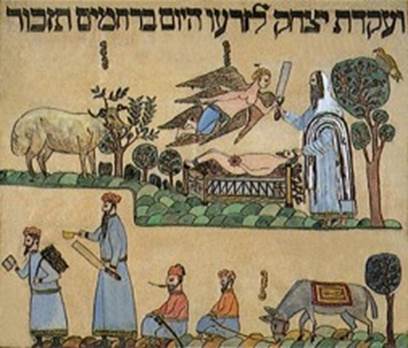
VI. The Akeida – A Completed Event
VIII. For Converts – Jews By Choice
IX. The Akeida and Mashiach ben Yoseph
c) Execution at the Divine Appointed Place
d) “HaShem Will Stare at This Place”
Against “Mutilating the Shoots of Faith” & 2 Luqas 15

Question: What do you call a religion that maintains that salvation depends upon the sacrifice of a beloved son centuries ago? What do you call a religion whose adherents believe that their sins are expiated because someone long ago offered himself up to be sacrificed?
Answer: “Judaism”.
I. In Judaism
Judaism is a religion that maintains that salvation depends upon the sacrifice of a beloved son centuries ago. The Midrash teaches us that when Avraham put the knife to Yitzchak’s throat, his soul departed. Judaism is a religion whose adherents believe that their sins are expiated because someone long ago offered himself up to be sacrificed. Though this may be hard to believe, it is absolutely true.
The sacrifice of which I speak is not the crucifixion of Yeshua, but rather it is the binding of Yitzchak from the book of Bereshit (Genesis). Because Avraham willingly offered his beloved son to HaShem as a sacrifice, HaShem blessed Avraham, and, just as important, HaShem blessed Avraham's descendants. This is straight from the Torah. According to our Sages, because Yitzchak offered himself freely to HaShem as a sacrifice, HaShem blessed Yitzchak, and, just as important, HaShem blessed Yitzchak's descendants. Therefore, our generation, a generation of descendants, benefits from the righteousness of Avraham and Yitzchak. We are blessed because of their willingness to sacrifice.
One aspect of this blessing is that HaShem is merciful toward us. Because our ancestors so dutifully obeyed HaShem's command, HaShem is more willing to look past our sins. Indeed, our Sages teach that HaShem is more willing to forgive our sins because of our righteous heritage. If our sins are thereby forgiven, then we will secure our place in the world to come. Simply stated: Because Avraham and Yitzchak obeyed HaShem, HaShem blessed their descendants. This blessing includes HaShem's mercy, and HaShem's forgiveness of our sins. Our sins having been forgiven, we will enjoy eternal life in the world to come. Through this progression, we can draw a causal connection between the attempted sacrifice of a beloved son and the forgiveness and salvation of a later generation. Believe it or not, this is Jewish.
Zechut Avot is the doctrine by which we benefit from the good deeds of those who came before us. In addition to our patriarchs, we also benefit from the righteous deeds of the matriarchs. For instance, our Sages teach in the Midrash that HaShem will return the exiles to Israel because of the merits of the matriarch Rachel.
The merits of the forefathers are not a stagnant thing. It is not only our patriarchs and matriarchs, but, also our own grandfathers, Grandmothers, fathers, and mothers. Each generation should earn merits as a legacy for future generations.
II. In The Torah and Tanach
Though we may be unfamiliar with Zechut Avot, it is actually a central tenet of Judaism. Though it may seem foreign to us, we can actually find it in three familiar sources. Zechut Avot plays a prominent role in the Torah, in our daily worship, and in our High Holiday liturgy. Let us begin with our Torah portion. We read in:
Devarim (Deuteronomy) 12:1 "These are the statutes and the ordinances which you shall observe to do in the land which HaShem, the G-d of your fathers, has given you to possess."
There are many names for HaShem, so when a text specifies a particular name for HaShem there is often a special significance. In this passage, the Torah introduces a series of commandments which the Israelites must fulfill in order to possess the land that HaShem has promised. What is significant here is the nature of that promise. The Israelites' sole claim to the land is that HaShem had promised it to their forefathers, Avraham, Yitzchak and Jacob. The Israelites will receive the land because of Zechut Avot, the merit of their ancestors. That is why we find in this verse the particular name for HaShem as "Lord, G-d of your fathers."
The theme Zechut Avot is reiterated time and again in the Torah:
Bereshit (Genesis) 22:16-18 And said, By myself have I sworn, saith the HaShem, for because thou hast done this thing, and hast not withheld thy son, thine only [son]: That in blessing I will bless thee, and in multiplying I will multiply thy seed as the stars of the heaven, and as the sand which [is] upon the sea shore; and thy seed shall possess the gate of his enemies; And in thy seed shall all the nations of the earth be blessed; because thou hast obeyed my voice.
Shemot (Exodus) 32:11-14 And Moshe besought the HaShem his HaShem, and said, HaShem, why doth thy wrath wax hot against thy people, which thou hast brought forth out of the land of Egypt with great power, and with a mighty hand? Wherefore should the Egyptians speak, and say, For mischief did he bring them out, to slay them in the mountains, and to consume them from the face of the earth? Turn from thy fierce wrath, and repent of this evil against thy people. Remember Avraham, Yitzchak, and Israel, thy servants, to whom thou swarest by thine own self, and saidst unto them, I will multiply your seed as the stars of heaven, and all this land that I have spoken of will I give unto your seed, and they shall inherit [it] for ever. And the HaShem repented of the evil which he thought to do unto his people.
* * *
Yeshayahu (Isaiah) 41:8 But thou, Israel, [art] my servant, Jacob whom I have chosen, the seed of Avraham my friend.
III. In Our Prayers
Another place we find Zechut Avot is in our daily prayers. The most important aspect of the Jewish worship service is the Amidah, also known as the Shemone Esrei or Eighteen Blessings. This is the climactic moment in the center of the service in which we make our requests of HaShem. It begins when we rise as a congregation and recite: “Blessed are You, HaShem our G-d, and G-d of our fathers, G-d of Avraham, G-d of Yitzchak, and G-d of Jacob." Doesn't it seem peculiar that at the height of our liturgy, the very climax of our worship service, that we would take the time to mention each of our patriarchs by name? Yet, there is a reason for this, a calculated reason. When our Sages authored this prayer over a thousand years ago, they questioned what right they had to make a request before HaShem. Who are we that we should bother HaShem with our needs? And why should HaShem listen to us? With these concerns in mind, the Hakhamim preceded their petitions with this clever and calculated mention of the patriarchs. In essence they are saying, "Dear HaShem, we are not so righteous; we are not worthy of your attention. But Avraham, he was righteous. Yitzchak was righteous. Jacob was righteous. We are their descendants, O HaShem, and for their sake hear our prayers." That is why we mention the patriarchs. That is another example of Zechut Avot.
Only the horn of a ram, a shofar, can summon HaShem on our behalf, because only the horn of a ram will remind HaShem of when Avraham offered his son to HaShem and instead sacrificed a ram, a ram whose horns were caught in a nearby thicket. The shofar is inextricably linked to the Akeida, the binding of Yitzchak. When we blast the shofar next Rosh HaShanah, we will be reminding HaShem of the righteousness of Avraham.
The Mussaf service on the 2nd day of Yom Teruah, Rosh HaShanah, contains the following prayer:
"Remember unto us, Adonai our G-d, the covenant, the loving-kindness and the oath which you swore to Avraham our father on Mount Moriah. May the binding with which Avraham our father bound his son Yitzchak on the altar appear before you, how he overcame his compassion in order to do your will with a perfect heart."
On the day of judgment, Yom Teruah, we will ask HaShem to remember Avraham, and thereby forgive our sins. The High Holidays are all about Zechut Avot.
IV. In The Torah She Baal Peh
We also find the notion of Zechut Avot in the Torah She Baal Peh, the Oral Torah. Here we find that the ashes of the Akeida are to remind us of the merit of Avraham:
Midrash Rabbah - Genesis XLIX:11 AND ABRAHAM ANSWERED AND SAID: BEHOLD NOW, I HAVE TAKEN UPON ME TO SPEAK UNTO THE LORD, WHO AM BUT DUST AND ASHES (XVIII, 27). He said: Had Nimrod slain me, would I not have been dust, and had he burnt me, would I not have been ashes? Said the Holy One, blessed be He, to him: ‘Thou didst say, I AM BUT DUST AND ASHES; by thy life, I will give thy children atonement therewith,’ as it says, And for the unclean they shall take of the ashes (‘afar) of the burning of the purification from sin (Num. XIX, 17); also, And a man that is clean shall gather up the ashes of the heifer (ib. 9). We learnt’: What was the ritual of a fast? The Ark was carried out into the public square of the town and burnt ashes were sprinkled on the Ark. R. Judan b. R. Manasseh and R. Samuel b. Nahman disagreed. One maintained: [The ashes were to recall] the merit of Avraham, for it is written, I WHO AM BUT DUST AND ASHES. But the other maintained that they were to recall the merit of Yitzchak; he learnt ‘ashes’ only. The following statement of R. Judah b. Pazzi disagrees, for he would publicly announce: If the congregational beadle cannot get to anyone [to pour ashes on his head], let him take ashes himself and pour them on his own head. [That is not so, for] R. Judah b. Pazzi's announcement teaches that ‘afar (dust) and efer (ashes) are identical
Midrash Rabbah - Genesis LXX:8 … in the Messianic era the merit of the Patriarchs will avail.
* * *
The Gemara[1] states that Zechut Avot, the merit of the Patriarchs which protects us, has been exhausted:
Shabbath 55a And since when has the merit of the Patriarchs been exhausted? — Rab said, Since the days of Hosea the son of Beeri, for it is written, [And now] will I discover her lewdness in the sight of her lovers, and none shall deliver her out of mine hand.( Hosea 2:12. ‘and none’, i.e., their merit) Samuel said. Since the days of Hazael, for it is said, And Hazael king of Syria oppressed Israel all the days of Jehoahaz;(II Kings 13:22) and it is written, But the Lord was gracious unto them, and had compassion upon them, and had respect unto them, because of the covenant with Avraham, Yitzchak, and Jacob, and would not destroy them, neither cast he them from his presence until now.(II Kings 13:22. ‘Until now’ implies, but no longer.) R. Joshua b. Levi said: Since the days of Elijah, for it is said, And it came to pass at the time of the offering of the evening oblation, that Elijah the prophet came near, and said, O Lord, the G-d of Avraham, of Yitzchak, and of Israel, let it be known this day that thou art HaShem in Israel, and that I am thy servant, and that I have done all these things at thy word.(I Kings 18:36. Here too this day implies a limitation.) R. Johanan said: Since the days of Hezekiah, for it is said, Of the increase of his government and of peace there shall be no end, upon the throne of David, and upon his kingdom, to establish it, and to uphold it with judgment and with righteousness for henceforth even for ever. The zeal of the Lord of hosts shall perform this. (Isaiah 9:6. ‘The zeal, etc.’ implies, but not the merit of the Patriarchs, this being exhausted by now.)
Nevertheless, Tosafot writes in Brit Avot (HaShem's covenant with the forefathers), the merit has not been exhausted:
Vayikra (Leviticus) 26:40-45 If they shall confess their iniquity, and the iniquity of their fathers, with their trespass which they trespassed against me, and that also they have walked contrary unto me; And [that] I also have walked contrary unto them, and have brought them into the land of their enemies; if then their uncircumcised hearts be humbled, and they then accept of the punishment of their iniquity: Then will I remember my covenant with Jacob, and also my covenant with Yitzchak, and also my covenant with Avraham will I remember; and I will remember the land. The land also shall be left of them, and shall enjoy her Sabbaths, while she lieth desolate without them: and they shall accept of the punishment of their iniquity: because, even because they despised my judgments, and because their soul abhorred my statutes. And yet for all that, when they be in the land of their enemies, I will not cast them away, neither will I abhor them, to destroy them utterly, and to break my covenant with them: for I [am] HaShem their G-d. But I will for their sakes remember the covenant of their ancestors, whom I brought forth out of the land of Egypt in the sight of the heathen, that I might be their G-d: I [am] the Lord.
The Gemara also mentions the merit of the Matriarchs as well as the merit of the Patriarchs:
Rosh HaShana 11a R. Eliezer said: Whence do we know that the Patriarchs were born in Tishri? Because it says, And all the men of Israel assembled themselves unto King Solomon, at the feast in the month Ethanim; that is, the month in which the mighty ones [ethanim] of the world were born. How do you know that this word ethan means ‘mighty’? — Because it is written, Thy dwelling-place is firm [ethan], and it also says, Hear, ye mountains, the Lord's controversy, and ye mighty rocks [ethanim] the foundations of the earth. It also says, The voice of my beloved, behold he cometh, leaping upon the mountains, skipping upon the hills, [where] ‘leaping upon the mountains’ means, for the merit of the patriarchs, and ‘skipping upon the hills’ means, for the merit of the matriarchs.
The notion of Zechut Avot is not just a Christian notion, but a deeply rooted Jewish tenet. We find it in our Torah portion; we find it in our daily worship, we find it in our High Holiday liturgy, and we find it in the Torah She Baal Peh, the Oral Torah.
 While
the Christian Church prays to HaShem
for pardon and blessing through Yeshua HaMashiach,
the Jewish people beseech HaShem
to have compassion upon them for the sake of the
binding of Yitzchak.
While
the Christian Church prays to HaShem
for pardon and blessing through Yeshua HaMashiach,
the Jewish people beseech HaShem
to have compassion upon them for the sake of the
binding of Yitzchak.
V. In The Nazarean Codicil
The notion of Zechut Avot, the merit of our ancestors, is also spoken about in the Nazarean Codicil:
I Luqas (Luke) 1:67-75 And his father Zacharias was filled with the Holy Ghost, and prophesied, saying, Blessed [be] the Lord G-d of Israel; for he hath visited and redeemed his people, And hath raised up an horn of salvation for us in the house of his servant David; As he spake by the mouth of his holy prophets, which have been since the world began: That we should be saved from our enemies, and from the hand of all that hate us; To perform the mercy [promised] to our fathers, and to remember his holy covenant; The oath which he sware to our father Avraham, That he would grant unto us, that we being delivered out of the hand of our enemies might serve him without fear, In holiness and righteousness before him, all the days of our life.
Bereans (Hebrews) 11.17-19 By faith Avraham, when G-d tested him, offered Yitzchak as a sacrifice. He who had received the promises was about to sacrifice his one and only son, even though HaShem had said to him, "It is through Yitzchak that your offspring will be reckoned." Avraham reasoned that HaShem could raise the dead, and figuratively speaking, he did receive Yitzchak back from death.
Matityahu (Matthew) 3:9 And think not to say within yourselves, We have Avraham to [our] father: for I say unto you, that HaShem is able of these stones to raise up children unto Avraham.
Romans 9:3-10 For I could wish that myself were set apart(like a sacrifice) from Mashiach for my brethren, my kinsmen according to the flesh: Who are Israelites; to whom [pertained] the adoption, and the glory, and the covenants, and the giving of the law, and the [worship] service [of G-d], and the promises; Whose [are] the fathers (Patriarchs), and of whom as concerning the flesh [they are] Mashiach, who is over all, G-d blessed for ever. Amen. Not as though the word of G-d hath taken none effect. For they [are] not all Israel, which are of Israel: Neither, because they are the seed of Avraham, [are they] all children: but, In Yitzchak shall thy seed be called. That is, They which are the children of the flesh, these [are] not the children of G-d: but the children of the promise are counted for the seed. For this [is] the word of promise, At this time will I come, and Sarah shall have a son. And not only [this]; but when Rebecca also had conceived by one, [even] by our father Yitzchak;
Galatians 4:28 Now we, brethren, as Yitzchak was, are the children of promise.
Bereans (Hebrews) 11:17-19 By faithful obedience, Avraham offered up Yitzchak. He was tested, having accepted the promises, offered up his only begotten son, Of whom it was said, That in Yitzchak shall thy seed call: Reckoning that even from the dead, HaShem was able to raise Him up; from whence also he received a parable.
From the Akeida we obtain a parable, as did Avraham. (that Yitzchak died and Yitzchak=Israel like Mashiach=Israel). From this we learn that there are two who are called ‘seed’; namely, Yitzchak and Mashiach.
As Mashiach ben Yoseph was the salvation of the Gentiles, so too was Yitzchak the salvation of Israel (Israel was another name for Jacob):
Zohar, Bereshit, Section 1, Page 119b David prayed, “Command the salvation of Jacob”, as much as to say: “When messengers are sent into the world, order such as are of the side of mercy.” ‘R. Abba said: ‘The words “command the salvation of Jacob” allude to those in exile, for whose redemption David prayed. Further, Jacob was the crown of the patriarchs, but if not for Isaac he would not have appeared in the world; hence the request “command the salvation of Jacob” refers primarily to Isaac, since the saving of his life was the salvation of Jacob.’
Another interesting correlation between Mashiach and Yitzchak is that they were both the “image” of their father. Of Mashiach it is said:
Colossians 1:15 Who is the image of the invisible God, the firstborn of every creature:
Of Yitzchak it is said:
“HaShem therefore performed another miracle and made Isaac look exactly like Abraham. The miracle was even greater than it seems; when Isaac was born, he did not look at all like Abraham. When people began to talk, his face changed and resembled that of his father, stopping all gossip.' Since Isaac looked exactly like Abraham, without any difference at all, everyone admitted that he was Abraham's son."[2]
Baba Metzia 87a And she said, Who would have said unto Abraham, that Sarah should have given children suck? How many children then did Sarah suckle? — R. Levi said: On the day that Abraham weaned his son Isaac, he made a great banquet, and all the peoples of the world derided him, saying, ‘Have you seen that old man and woman, who brought a foundling from the street, and now claim him as their son! And what is more, they make a great banquet to establish their claim!’ What did our father Abraham do? — He went and invited all the great men of the age, and our mother Sarah invited their wives. Each one brought her child with her, but not the wet nurse, and a miracle happened unto our mother Sarah, her breasts opened like two fountains, and she suckled them all. Yet they still scoffed, saying, ‘Granted that Sarah could give birth at the age of ninety, could Abraham beget [child] at the age of a hundred?’ Immediately the lineaments of Isaac's visage changed and became like Abraham's, whereupon they all cried out, Abraham begat Isaac.
VI. The Akeida – A Completed Event
One of the most intriguing commentaries on the Akeida sees the sacrifice as actually having been consummated, and as effecting atonement for Israel in the same manner as animal sacrifices:
“There was a remarkable tradition that insisted that Avraham completed the sacrifice and that afterward Yitzchak was miraculously revived. According to this Aggadah, Avraham slew his son, burnt his victim, and the ashes remain as a stored-up merit and atonement for Israel in all generation.”[3]
The Baal HaTurim quotes a Pirke d’Rebbi Eliezer that at the time of the Akeida, Yitzchak actually died and was immediately brought back to life.
Leviticus Rabbah. 29:9 R. Judah says: When the sword touched Yitzchak's throat his soul flew clean out of him. And when He let his voice be heard from between the two cherubim, 'Lay not thy hand upon the lad, 'the lad's soul returned to his body. Then his father unbound him, and Yitzchak rose, knowing that in this way the dead would come back to life in the future; whereupon he began to recite, Blessed art Thou, O Lord, who quickens the dead. Pirke de-Rav Eliezer 31
The Torah also alludes to the death of Yitzchak in Bereshit chapter 22. In this chapter of the Torah, there is no reference to Yitzchak returning home with his father.
Through the Akeida, Yitzchak had attained the status of a korban and was forbidden to leave Eretz Canaan[4]. Yitzchak was 37 years old at the time of the Akeida.[5]
In Bereshit 22:9, the word “binding”. Va Ya’akod, is found nowhere else in Tanach in conjugative form. This “binding” was something truly unique!
Yitzchak’s death was NOT caused by Avraham, the Torah is clear on this point. It appears that Yitzchak gave up his own soul. This matches well with Mashiach Who was not killed by the Romans, but instead laid down His own life.[6]
VII. The Akeida – The Timing
There appears to be some support for the Binding of Yitzchak taking place on Pesach. Rashi tells us that the Akeida was on Pesach.[7] The Zohar also makes this point.[8] Finally, the Talmud gives us a hint that the Akeida took place on Pesach:
Rosh HaShana 11a …on New Year the bondage of our ancestors in Egypt ceased; in Nisan they were redeemed and in Nisan they will be redeemed in the time to come. R. Joshua says: In Nisan the world was created; in Nisan the Patriarchs were born; in Nisan the Patriarchs died.
There is also some relationship between Rosh HaShanah and the Binding of Yitzchak:
The Maharil, Rav Yaakov HaLevi Segal Moelin, compiled a detailed and authoritative compendium of the customs of his native Ashkenaz. In Chapter 9 of the section on Rosh HaShana, he explains:
"On Rosh HaShana, after the meal, we have the custom of going to the lakes and rivers to cast into the depths of the sea all of our sins. This commemorates the Akeida, in accordance with the Midrash[9] which says that [on the way to the intended sacrifice of Yitzchak] Avraham Avinu passed through a river until the water reached up to his neck, and said, 'Rescue me, HaShem, for the waters have reached until the soul'.[10] And it was actually Satan, who made himself into a river in order to prevent Avraham from performing the Akeida."
The Maharil emphasizes that Tashlich (when we cast crumbs into the water on Yom Teruah) is a commemoration of the Akeida. By going to the river, we demonstrate to HaShem that we recall Avraham's determination to fulfill His command. Not only was Avraham willing to sacrifice his only son, but he was willing to endure great hardship in order to do so. We imply that we too are willing to overcome obstacles to carry out HaShem's will.
By emphasizing our continuing connection to Avraham Avinu, showing that we are his spiritual as well as his genetic heirs, we show that we are fully worthy of sharing in the blessing which HaShem swore to Avraham's descendants as a result of the Akeida.[11]
According to our tradition, when we sound the shofar on the morning of Rosh Hashanah, HaShem hears the sound and remembers the ram that Avraham Avinu, Father Avraham, offered as a sacrifice (instead of his son Yitzchak) atop Mount Moriah so many generations ago. Our act of association resurrects the merit of Avraham, and his merit of faith is attributed to us. Simply because we made the connection.
You don’t get the Zechut unless you make the connection. Unless you sound the shofar, invoke the symbolic link (whatever it may be) that affirms your bond, their merit is of no value.
Why should a dissolute Jew who identifies as a Jew be redeemable? Here it gets mystical. According to our sages, the Patriarchs and Matriarchs passed their spiritual DNA down to their descendants. Their spiritual achievements were not personal. In virtually every Divine revelation to the Patriarchs, God makes promises dealing with their descendants – they will be “like the stars of the heaven” and “like the sands of the seashore,” they will inherit the Land of Israel, etc. Among the promises was that God would not let a Jewish soul hit rock bottom without Divine intervention to stop his free-fall. This spiritual safety net is called, “Zechut Avot,” the merit of the forefathers.[12]
According to the Midrash, at the Splitting of the Sea, the angel of Egypt protested to God that both the Hebrews and the Egyptians were idol worshippers. Why should the Hebrews be saved, and the Egyptians drowned? God answered that the Hebrews are the descendants of Abraham, Isaac, and Jacob. Zechut Avot, the merit of the forefathers.
But Zechut Avot, like any inheritance, only becomes yours if you claim it. Your grandfather can bequeath you a bank account worth a million dollars, but if don’t show up at the lawyer’s office and identify yourself as Jake Levy’s grandson, you won’t have access to his fortune. If you don’t actively identify as a Jew, you can’t inherit the precious fortune of Zechut Avot.
Zechut Avot is like a skydiver’s reserve chute. If the main parachute fails to open, and the skydiver is falling at 120 mph, she can be saved by the reserve chute. But only if she pulls the cord! The cord that activates the merit of the forefathers is Jewish identity.
Jewish identity is what prompted Kirk Douglas to fast every Yom Kippur. As he proudly stated, “I might be making a film, but I fasted.”
Jewish identity is what prompted Supreme Court Justice Ruth Bader Ginsburg to post a large silver mezuzah on the doorpost of her Supreme Court chambers.
Jewish identity is what prompted movie star Scarlet Johansson to stand up for Israel at the cost of her prestige as an Oxfam ambassador.
The Passover Seder speaks about four sons. Only one of them is cast as “wicked.” As the Haggada states: “The wicked son, what does he say? ‘What is this service to you?’ ‘To you,’ but not to him. Because he excludes himself from the community, he is a heretic. … Say to him, ‘Because of what God did for me when I went out of Egypt.’ For me, but not for him, because if he would have been there, he would not have been redeemed.”
The first Passover marked the birth of the Jewish nation. Every Passover since poses the challenge to every Jew: Are you in or are you out?
VIII. For Converts – Jews
By Choice
But what of those among us who have no ancestors from whom to derive such Zechut? What of the orphans who do not know upon whom to connect? Or the Jews by choice, the convert, who have no Jewish ancestry at all? This is the good part. It’s not hereditary! It’s not in our chromosomes or our cell structure. It’s in our history. The collective memory of our people. It’s open to anyone who chooses to remember:
Galatians 3:6-9 Even as Avraham believed HaShem, and it was accounted to him for righteousness. Know ye therefore that they which are of faith, the same are the children of Avraham. And the scripture, foreseeing that HaShem would justify the heathen through faith, preached before the gospel unto Avraham, [saying], In thee shall all nations be blessed. So then they which be of faith are blessed with faithful Avraham.
Do we really believe that we’re genetically related to Avraham and Sarah? Do we actually think that if we could trace back our ancestry as far as we wanted we would find Jacob, Moshe, and Ruth? Does it matter? We’re related to them when we choose to relate to them. You see, the act of connecting to them, to the deeds they performed, to the choices they made is, for us, a choice as well. What makes the Zechut happen is just as dependent upon our conscious decisions as it was upon theirs. It’s a two-way street. Their merit is credited to us by our merit. And in both instances, the merit is the simple product of making a choice.
IX. The Akeida and Mashiach
ben Yoseph
Yitzchak Avinu was an atonement for the Jews just as Yeshua was an atonement for the Gentiles. How do we know this?
To understand this answer requires a bit of background. Please bear with me as we gain this background.
The Jews are separate from the world. We see this in:
Shemot (Exodus) 19:5-6 Now therefore, if ye will obey my voice indeed, and keep my covenant, then ye shall be a peculiar treasure unto me above all people: for all the earth [is] mine: And ye shall be unto me a kingdom of priests, and an holy (or separate) nation. These [are] the words which thou shalt speak unto the children of Israel.
Shemot (Exodus) 33:16 For wherein shall it be known here that I and thy people have found grace in thy sight? [is it] not in that thou goest with us? so shall we be separated, I and thy people, from all the people that [are] upon the face of the earth.
Vayikra (Leviticus) 20:24 But I have said unto you, Ye shall inherit their land, and I will give it unto you to possess it, a land that flowed with milk and honey: I [am] the HaShem your G-d, which have separated you from [other] people.
Bamidbar (Numbers) 23:9 For from the top of the rocks I see him, and from the hills I behold him: lo, the people shall dwell alone, and shall not be reckoned among the Goyim.
Devarim (Deuteronomy) 33:28 Israel then shall dwell in safety alone: the fountain of Jacob [shall be] upon a land of corn and wine; also his heavens shall drop down dew.
Melachim (1 Kings 8:53) For thou didst separate them from among all the people of the earth, [to be] thine inheritance, as thou spakest by the hand of Moshe thy servant, when thou brought our fathers out of Egypt, O Lord HaShem.
So, when ever we see “world” or “nation”, we should see the Goyim, the Gentiles:
Bereshit (Genesis) 10:5 By these were the isles of the Gentiles divided in their lands; every one after his tongue, after their families, in their nations.
In the above verse, both the word “Gentile” and the word “nation” come from the Hebrew word “Goyim”.
Now, consider the following verses:
1 Yochanan (John) 2:1-2 My little children, these things write I unto you, that ye sin not. And if any man sin, we have an advocate with the Father, Yeshua Mashiach the righteous: And he is the kippurim, [the atonement,] for our sins: and not for ours only, but also for [the sins of] the all the Goyim.
Matityahu (Matthew) 24:14 And this gospel of the kingdom shall be preached in all the Goyim for a witness unto all nations; and then shall the time of the end come.
Matityahu (Matthew) 28:19-20 Go ye therefore, and talmudize all the Goyim, immersing them into the authority of the Father [obeying the Torah], and of the Son, [accepting the yoke of the kingdom] and of the Shechinah: Teaching them to observe all things whatsoever I have commanded you: and, lo, I am with you always, [even] unto the end of the world. Amen.
We will need to unpack this next verse because this verse contains the essence of Zechut Avot, the merit of our ancestors:
Yochanan (John) 3:16 For HaShem so loved the Goyim, that he gave his only begotten Son [Mashiach (Psalm 2:7) / Israel (Shemot 4:22-23)], that whosoever believeth in him (in HaShem) should not perish, but have everlasting life.
I have added some information within the brackets that needs to be unpacked a bit. First, lets look at:
Tehillim (Psalm) 2:7 I will declare the decree: HaShem hath said unto me, Thou [art] my Son; this day have I begotten thee.
In this verse, HaShem is declaring that He has a Son. This Son is Yeshua HaMashiach.
Now let’s look at another “Son”:
Shemot (Exodus) 4:22 And thou shalt say unto Pharaoh, Thus saith the HaShem, Israel [is] my son, [even] my firstborn: And I say unto thee, Let my son go, that he may serve me: and if thou refuse to let him go, behold, I will slay thy son, [even] thy firstborn.
In this verse, Israel is declared HaShem’s son! Now let’s put Yochanan 3:16 into perspective:
Yochanan (John) 3:16 For HaShem so loved the Goyim, that he gave his only begotten Son [Mashiach], that whosoever believeth in HaShem should not perish, but have everlasting life.
This tells us that the Goyim will gain everlasting life because of Mashiach. But since this verse allows us to use both “Sons”, we need to look at this perspective:
Yochanan (John) 3:16 For HaShem so loved the Goyim, that he gave his only begotten Son [Israel], that whosoever believeth in Him (in HaShem) should not perish, but have everlasting life.
Now, hopefully, we can see that there is more to this verse than meets the eye. This verse clearly indicates that the Jews are the key, along with Mashiach, to the everlasting life of the Goyim.
Let’s examine one more verse in the Nazarean Codicil:
Yochanan (John) 4:40-42 So when the Samaritans were come unto him, they besought him that he would tarry with them: and he abode there two days. And many more believed because of his own word; And said unto the woman, Now we believe, not because of thy saying: for we have heard [him] ourselves, and know that this is indeed the Mashiach, the Saviour of the Goyim.
Now that we have this background, lets look at Yitzchak to see how he saved the Jews.
Yitzchak died at the Akeida, before he had children, as we see from the Midrash and from the book of Hebrews:
Leviticus Rabbah. 29:9 R. Judah says: When the sword touched Yitzchak's throat his soul flew clean out of him. And when He let his voice be heard from between the two cherubim, 'Lay not thy hand upon the lad, 'the lad's soul returned to his body. Then his father unbound him, and Yitzchak rose, knowing that in this way the dead would come back to life in the future; whereupon he began to recite, Blessed art Thou, O Lord, who quickens the dead. Pirkei de-Rav Eliezer 31
Hebrews 11:17 By faith Abraham, when he was tried, offered up Yitzchak: and he that had received the promises offered up his only begotten, 18 Of whom it was said, That in Yitzchak shall thy seed be called: 19 Accounting that God was able to raise up, even from the dead; from whence also he received him in a parable.
Zohar 60a “When Yitzchak was sacrificed on the altar, his soul which was in him in This World departed. But when it was said by Abraham, Blessed be He who quickens the dead, his soul of the World to Come came back to him."
Minhat Yehudah, by R. Judah bar Eliezer ad Gen 24:64 and Paaneah Raza by R. Isaac bar Juda ha-Levi, 29a No wonder Rebecca lost her equilibrium "and she fell from her camel" (v. 64) - for what she perceived was Yitzchak coming down from Paradise, and he walked the way the dead walked, head down and feet up.
Zevachim 62a As for the Temple, it is well, for its outline was distinguishable; but how did they know [the site of] the altar? — Said R. Eleazar: They saw [in a vision] the altar built, and Michael the great prince standing and offering upon it. While R. Isaac Nappaha said: They saw Yitzchak’s ashes lying in that place. R. Samuel b. Nahman said: From [the site of] the whole House they smelt the odour of incense, while from there [the site of the altar] they smelt the odour of limbs.
Since Yitzchak died, this presents a potential problem for the messianic line in that he had not married and had no children. When Yitzchak died, all of his descendants died with him. Therefore, Yaakov and his twelve sons, the tribes of Israel, all died with him. Of course, they were also resurrected with him! So, like Yeshua, Yitzchak gave up his spirit and was resurrected. This resurrection saved every Jew as the soul of every Jew was in Yitzchak’s loins when he died. Thus they paid the penalty for sin.
Notice the similarity between the Akeida and the binding of Yeshua in the following verses:
Bereshit (Genesis) 22:2 And He said, "Take now your son, your only begotten son, whom you love, Yitzchak, and go to the land of Moriah; and offer him there as a burnt offering on one of the mountains of which I will tell you."
Yochanan (John) 3:16 For HaShem so loved the Goyim, that he gave his only begotten Son [Mashiach (Psalm 2) / Israel (Shemot 4:22-23)], that whosoever believeth in him (in HaShem) should not perish, but have everlasting life.
So, at this point we can begin to analyze the Akeida to try to answer our question. In the Akeida, we have the following characters:
Avraham -
Yitzchak –
The Ram –
In this story of atonement, Yitzchak is the appointed sacrifice, yet The Ram is sacrificed instead. Since Yitzchak was the father of Israel, The Ram was a substitute for Israel.
In the sacrifice of Yeshua, the Goyim were the intended sacrifice and Yeshua, The Lamb, was sacrificed instead. The Lamb, i.e. Yeshua, was a substitute for the Goyim.
Let’s examine the comparison between Yitzchak (Israel) and Gentiles in greater detail:
Yitzchak (Israel) was, as the elect are, the promised seed of Avraham (Galatians 4:28): “Now we, brethren, as Yitzchak was, are children of promise.” Yitzchak was “born ... through promise” (v.23) as the physical descendant HaShem promised to Avraham (Genesis 17:15-19).
The elect are the promised spiritual descendants of Avraham:
Galatians 3:7,29 those who are of faith are sons of Avraham”; “And if you are Mashiach’s then you are Avraham’s seed, and heirs according to the promise.
Other points of comparison found in Galatians 4:21-31 between Yitzchak (Israel) and the elect: Yitzchak (Israel) was, as the elect are, born of Sarah the freewoman, not of Hagar the bondwoman; Yitzchak (Israel) was, as the elect are, persecuted by the offspring of the bondwoman; Yitzchak (Israel) was, as the elect are, the only heir of Avraham.
Yitzchak (Israel) was, as the elect are, appointed by HaShem to die. Yitzchak was appointed to die when HaShem commanded Avraham to “Take now ... your only son Yitzchak (Israel), ... and go to the land of Moriah, and offer him there as burnt offering” (Genesis 22:1f).
The elect are appointed to die because they are sinners (Romans 3:23), and HaShem has decreed “The soul who sins shall die” (Ezekiel 18:4; cp. Romans 6:23). (Lest any should accuse HaShem of acting capriciously when He ordered the death of Yitzchak (Israel), remember that Yitzchak (Israel) was as much a sinner as is every other member of fallen humanity.)
The lamb which was sacrificed in the place of Yitzchak (Israel) was typical of Mashiach. In Mashiach, HaShem has fulfilled the promise of Avraham to Yitzchak that “HaShem will provide for Himself the lamb for a burnt offering” (Genesis 22:8).
Mashiach was “led as a lamb to the slaughter” as the penal substitute of HaShem’s elect, and all those for whom this Lamb died shall be delivered from their sins and the eternal death they justly deserve (Isaiah 53:7ff). We therefore exhort you to “Behold the Lamb of HaShem who takes away the sin of the Goyim” (John 1:29).
Addendum 1
Addenda to the Binding of Yitzchak Document of His Honor Paqid Adon Hillel ben Avraham. This section was written by my beloved teacher, His Eminence Hakham Dr. Yoseph ben Haggai.
EIGHT FURTHER CO-INCIDENTAL SIMILARITIES BETWEEN THE TWO BINDINGS:
Coincidence is usually described as the occurrence of events together or in sequence in a startling way, without any casual connection. However, if the term is understood from a geometric perspective, we define then co-incidence as the intersection of two or more lines travelling in different directions or from differing starting points. It is this latter meaning of the term co-incidence that we are alluding in the following facts.
a) Death by Divine Decree
The deaths of Yitzchak at the place of binding [Mt. Moriah] and the of His Majesty King Yeshua the Mashiach at the same place of binding [the Gilgulet (Hebrew for “skull”) a term derived from the word Gilgal (meaning returning to the starting point in a circumferential manner, and in such way as a circumcision (a cutting around) to return to the original place of the Garden of Eden which was also situated at Mt. Moriah)] was by Divine Decree.
In the case of Yitzchak it is written:
Bereshit (Genesis) 22:2 “And He (HaShem) said, Please take your son, your only one, whom you love – Yitzchak - and go to the land of Moriah; bring him up there as a burnt offering upon one of the mountains which I will tell you.”.
And in the case of His Majesty King Yeshua the Messiah we read:
Yochanan 3:16 “For HaShem so loved the Gentiles, that He gave (as a sacrifice) His only one son, that whosoever believes in Him (in HaShem) should not perish, but have everlasting life.” [cf. Bereans (Hebrews) 11:6].
In other words, this is not a command for every father to sacrifice his son as a purported act of worship, HaShem forbid! For the command was issued to two specific persons and it was given as a special Divine decree to accomplish a predetermined purpose in the plan of HaShem for humanity. However it should be said that anyone establishing the commandments of HaShem as per the written and oral Torah in faithful obedience to HaShem is credited to him/her as having shown the same obedience as Avraham, Yitzchak and His Majesty did, specially, if in doing so an apparent great loss or cost is incurred.
b) Willingness of the Victims
In both cases, Yitzchak and His Majesty King Yeshua the Messiah were both willing participants in presenting themselves as sacrifices in perfect obedience to the command of HaShem.
In the case of Yitzchak it is written:
“Another comment: R. Yitzchak said: when Avraham wished to sacrifice his son Yitzchak, he said to him: ‘Father, I am a young man and am afraid that my body may tremble through fear of the knife and I will grieve thee, whereby the slaughter may be rendered unfit and this will not count as a real sacrifice; therefore bind me very firmly. Forthwith, HE BOUND ISAAC.” (Midrash Rabba 56:8)
And in the case of His Majesty King Yeshua, he thus stated:
Yochanan (John) 10:17-18 “Therefore does my Father love me, because I lay down my life, that I might take it again. No man takes it from me, but I lay it down of myself (willingly). I have power to lay it down, and I have power to take it again. This commandment (to lay down my life as Yitzchak) have I received of my Father.”.
In both cases we do not find a sign of complaint. But to the contrary, there seems to be perfect and joyful acquiescence to the will of HaShem as expressed in His commands. Some will ask, what about the protestation of His Majesty: “My HaShem, my HaShem, why have You forsaken me?” [Marqos (Mark) 15:34]. The answer to this, is that here we find another error of translation, for the Aramaic Peshitta has – “My HaShem, my HaShem, for this I was chosen! A triumphant and obedient exclamation in faithful obedience to HaShem’s command, even in the face of death!
c) Execution at the Divine Appointed
Place
The two sacrifices were not just offered anywhere at random or caprice, for HaShem’s command is:
Devarim (Deuteronomy) 12:13-14 “Take heed to thyself that thou offer not thy burnt offerings in every place that thou seest. But in the place which HaShem shall choose in one of thy tribes, there thou shalt offer thy burnt offerings, and there thou shalt do all that I command thee.”
It becomes obvious then that by this rule, both the Binding of Yitzchak and the death of His Majesty King Yeshua the Mashiach ben Yosef must have of necessity occurred in the “place which HaShem shall choose” – also known as Mt. Moriah or the Gilgulet (in the Greek being transliterated to Golgotha)
Midrash Rabba (55.7) thus teaches:
AND GET THEE INTO THE LAND OF MORIAH. R. Hiyya the Elder and R. Jannai discussed this. One said: To the place whence instruction (hora’ah) went forth to the world (i.e. the Gentiles). While the other explained it: To the place whence religious awe (yirah) went forth to the world. Similarly, the word aron (the Ark). R. Hiyya and R. Jannai – one said: The place whence orah (light) goes forth to the world; while the other explained it: The place whence yirah (religious reverence) goes forth to the world. Similarly, the word debir (in 1 Kings 6:19 – EV ‘sanctuary’; AV ‘oracle’ – i.e. the Holy of Holies). R. Hiyya and R. Jannai discussed this. One said: The place whence [HaShem’s] speech (dibur) went forth to the world; while the other explained it: The place whence retribution (deber) goes forth to the world. Rabbi Joshua ben Levi said: It means the place whence the Holy One, blessed be He, shoots (moreh) at the other nations (i.e., instructs other nations) and hurls them into Gehenna (should they disobey His laws). Rabbi Simeon b. Yohai said: To the place that corresponds (ra’ui) to the Heavenly Temple. R. Judan b. Palya said: To the place that He will show (mareh) thee (probably through a special sign). R. Phinehas said: To the seat of the world’s dominion (marwetha) The Rabbis said: To the place where incense would be offered, as you read, I will get me to the mountain of myrrh – Mor (S.S. IV,6) [All these being plays on the word Moriah].
The Nazarean Codicil states in Marqos (Mark) 15:22:
“And they bring him unto the place Golgotha, which is, being interpreted, The place of a skull.”
As commented above, the exact Hebrew word for “skull” is Gilgulet - a term derived from the word Gilgal (meaning returning to the starting point in a circumferential manner, and in such way as a circumcision (a cutting around) is performed pointing to a return to the original place of humanity - the Garden of Eden which was also situated at Mt. Moriah). This is again intimated in many places, particularly in Midrash Rabbah XIV.8, where we read:
“OF THE GROUND (ADAMAH) – (Bereshit 2:7). R. Berekiah and R. Helbo in the name of Samuel the Elder said: He was created from the place of his atonement (the future sight of the Temple), as you read, An altar of earth (adamah) thou shalt make unto Me (Shemot 20:21). The Holy One, blessed be He, said: ‘Behold I will create him from the place of his atonement, and may he endure!’”
Consequently, if the Temple was to contain the righteous people of Israel, as well as the righteous from among the Gentiles, is was necessary that their place of atonement both for Jews and Righteous Gentiles be located in the same place from where Adam was created – the unity of mankind under the government of the One HaShem, Most Blessed be He!
d) “HaShem
Will Stare at This Place”
After sacrificing “the ram caught in a thicket by his horns” (Bereshit 22:13), we read in the next verse: “And Avraham called the name of that place HaShem-Yireh: as it is said to this day, In the mount of HaShem it shall be seen” (ibid. v.14). Again, Midrash Rabba 56.10 comments on this verse as follows:
“AND ABRAHAM CALLED THE NAME OF THE PLACE ADONAI-JIREH – HASHEM SEETH (22:14). R. Bibi Rabbah said in R. Johanan's name: He said to Him: 'Sovereign of the Universe! When Thou didst order me, "Take now thy son, thine only son" (ibid. v.2), I could have answered, "Yesterday Thou didst promise me, For in Yitzchak shall seed be called to thee (ibid. 21:12) and now Thou sayest, 'Take now thy son,' etc." Yet Heaven forefend! I did not do this, but suppressed my feelings of compassion in order to do Thy will. Even so it may be Thy will, O HaShem our G-d, that when Yitzchak's children are in trouble, Thou wilt remember that binding in their favour and be filled with compassion for them.'
Avraham called it 'Yireh': AND ABRAHAM CALLED THE NAME OF THAT PLACE ADONAI-JIREH. Shem called it Salem [Shalem]: And Melchizedek king of Salem (Bereshit 14:18 – and the same was Shem). Said the Holy One, blessed be He: 'If I call it Yireh as did Avraham, then Shem, a righteous man, will resent it; while if I call it Salem as did Shem, Avraham, the righteous man, will resent it. Hence I will call it Jerusalem, including both names, Yireh Salem (He will see peace). R. Berekiah said in R. Helbo's name: While it was yet Salem the Holy One, blessed be He, made Himself a tabernacle and prayed in it, as it says, In Salem also is set His tabernacle, and His dwelling-place in Zion (Tehillim 76:3). And what did He say: 'O that I may see the building of the Temple!'
Another interpretation: This verse teaches that the Holy One, blessed be He, showed him the Temple built, destroyed and rebuilt. For it says, AND ABRAHAM CALLED THE NAME OF THAT PLACE ADONAI-JIREH (HASHEM SEETH): this alludes to the Temple built, as in the verse, Three times in a year shall all thy males be seen ... in the place where He shall choose (Deut. Devarim16:16 – thus ‘seeing’ is connected with the Temple whilst it was standing); AS IT IS SAID TO THIS DAY: IN THE MOUNT refers to it destroyed, as in the verse, For the mountain of Zion, which is desolate [Eicha (Lamentations) 5:18]; WHERE HASHEM IS SEEN refers to it rebuilt and firmly established in the Messianic era, as in the verse, When HaShem hath built up Zion, when He hath been seen in His glory [Tehillim (Psalm) 102:17].”
So, in the same way that Jews plead in their time of trouble, as well as when beseeching HaShem for forgiveness, that “He remember the binding of Yitzchak in their favor and be filled with compassion for them,” so too the Righteous Gentile in his time of trouble, as well as when imploring forgiveness from HaShem, do have a right to ask HaShem to remember the binding of His Majesty King Yeshua ben Yosef in their favor and be filled with compassion for them. And if their plea is sincere, HaShem, Most Blessed be He opens his hand of compassion and forgiveness for He stares at Yireh-Salem and equally forgives and blesses them both. For at Jerusalem, the place of man’s creation and of the two great openings / bindings of faith He sees them both as righteous.
e) “Let his blood
be upon us”
Now, when His Majesty King Yeshua the Mashiach ben Yosef was being judged by the Priests at Jerusalem at that time, we read in the Nazarean Codicil in Yochanan (John) 18:14:
“Now Caiaphas was he, which gave counsel to the Jews, that it was expedient (necessary) that one man should die for the people (i.e. the Gentiles).”
Who is this Caiaphas? From history we understand that the priestly regime of the Chashmoniam offered respite from the cruel persecution of the Greek King Antiochus Epiphanes but then later gave way to chaos and internal strife. An illegitimate priestly lineage from the wicked House of Boethus began to oppress the people of Israel with their perverted courts. They bought the Priesthood from the Greeks, then sold the country to the Romans (cf. Yochanan 19:15 – “we have no king but Caesar”). The final destruction can be marked from the time that this Priesthood was led by a clan of four known as Annanias [Hananiah], Jason, Kathros [Caiaphas] and Ishmael Ben Phabi. The Talmud thus alludes to these wicked priests in the Talmud with the following words:
Pesachim 57a It was taught, Abba Saul said: There were sycamore tree trunks in Jericho, and the men of violence seized them by force, whereupon the owners arose and consecrated them to Heaven. And it was of these that Abba Saul b. Bothnith said in the name of Abba Joseph b. Hanin: ‘Woe is me because of the house of Boethus; woe is me because of their staves (with which they beat the people)! Woe is me because of the house of Hanin, woe is me because of their whisperings (their secret conclaves to devise oppressive measures)! Woe is me because of the house of Kathros (the same is Caiaphas – cf. Josephus, Antiquities XX, 1.3), woe is me because of their pens (with which they wrote their evil decrees)! Woe is me because of the house of Ishmael the son of Phabi, woe is me because of their fists! For they are High Priests (wielding great political power) and their sons are Temple treasurers and their sons-in-law are trustees and their servants beat the people with staves (cf. Josephus, Antiquities XX, 5.2).
Yet despite his illegitimacy and perversion, and with due respect for the office that he was occupying at the time, HaShem gave this corrupt priest some insightful words about the work of Mashiach ben Yosef when he stated:
Yochanan (John) 11:49-50 “And one of them, named Caiaphas, being the high priest that same year, said unto them, Ye know nothing at all, Nor consider that it is expedient for us (Israel), that one man should die for the people (i.e. the Gentiles), and that the whole (Gentile) nations perish not.”.
In retrospect, and from a Kabbalistic perspective, Yochanan adds by way of commentary:
Yochanan (John) 11:51-52 “And this spoke he (Caiaphas) not of himself: but being high priest that year, he prophesied that Yeshua should die for (on behalf of) the Gentiles; And not for the (Gentile) nations only (at that time), but that also he should gather together in one the children of HaShem (of the Gentiles) that were scattered abroad (in time to come).”
Therefore, what Caiaphas was articulating through prophecy, was that in the same manner that in the same way that it was accounted as Yitzchak having died for the whole Jewish nation, so too it was necessary for Mashiach ben Yosef to die on behalf of the Gentile nations. This is none other than the Jewish doctrine of Zechut Avot, The Merit of our Fathers.
However, a question may be asked as to what basis in Scripture did Caiaphas prophecy have? After all, Caiaphas was not reading a Nazarean Codicil, since such thing was not available at the time! Caiaphas was apparently basing his utterance on the prophecy of Yeshayahu (Isaiah) 53, which in the Tanach does not start with 53:1 but with 52:13-5, and thus making the Gentile Kings and not Israel the protagonists of this prophetic chapter.
Carrying the wood
In both instances of binding, we have the “wood” factor involved, since it is supposed to be a “burnt offering.” In the case of Yitzchak, we find that the Scripture states:
Bereshit (Genesis) 22:6 “And Avraham took the wood of the burnt offering, and laid it upon Yitzchak his son; and he took the fire in his hand, and a knife; and they went both of them together.”
And in the case of His Majesty King Yeshua Mashiach ben Yosef we read:
Yochanan (John) 19:16-17 “Then delivered he (Pilatus) him (King Yeshua) therefore unto them (the Roman Soldiers) to be crucified. And they took Yeshua, and led him away. And he bearing his cross went forth into a place called the place of a skull, which is called in the Hebrew Gilgulet.”
Again, co-incidentally in the passage of Bereshit (Genesis) 22:6 there is a most interesting key word. This same word is used by His Majesty King Yeshua the Messiah in Yochanan (John) 10:30 which has been mistranslated to read:
“I and my Father are one.”
His Majesty did not say “I am my Father are one in number.” The Hebrew word “Echad” means one in number, however the word that His Majesty used is found in the key passage of Bereshit 22:6 – “And Avraham took the wood of the burnt offering, and laid it upon Yitzchak his son; and he took the fire in his hand, and a knife; and they went both of them together” The word “together” is the Hebrew: “Yachdav” – and meaning: “one in purpose.”
Yitzchak and his father Avraham, “went up the two of them as one,” – in unity of purpose concerning the sacrifice, and it is clear that they did not go up as “one” in number. And it is to this passage that Mashiach alludes when he states:
Yochanan (John) 10:17-18, 30 “Therefore does my Father love me, because I lay down my life, that I might take it again. No man takes it from me, but I lay it down of myself. I have power to lay it down, and I have power to take it again. This commandment (to lay down my life as Yitzchak) have I received of my Father. … (in this sacrifice) I and my Father are Yachdav (in unity of will and purpose)”.
Is this just mere coincidence, or more of a premeditated co-incidence?
Mothers
After the binding of Yitzchak the angel of HaShem blesses Avraham in relation to Yisrael in Bereshit (Genesis) 22:17, and in relation to the Gentiles in Bereshit (Genesis) 22:18, and thus clearly speaking of the two binding which would issue forth from Avraham – the binding of Yitzchak and the binding of His Majesty King Yeshua Mashiach ben Yosef. Immediately after the binding of Yitzchak and in the next chapter we read about the death of Sarah out of the distress of hearing that her son had been sacrificed.
Again, after the death of His Majesty King Yeshua ben Yosef, we no longer hear about Miriam the mother of His Majesty. And, no doubt, seeing the number of precedents before us, we must interpret said silence as the death of Miriam out of the distress of seeing her son executed by the Roman authorities in collusion with the illegitimate and perverted political and religious authorities ruling at that time in Jerusalem, as explained above.
The resurrection
After the binding of Yitzchak we no longer hear of him for a while. In fact, in Bereshit (Genesis) 22:19 we read:
“So Avraham returned unto his young men, and they rose up and went together to Beersheba; and Avraham dwelt at Beersheba.”
Two interesting points to make is that:
(a) Avraham return alone back “to his young men (servants)” and no mention is made of Yitzchak; and
(b) that Avraham goes with his servants to Beersheba, whilst in the next chapter we are informed that Sarah died in Hebron.
Whilst there are a number of diverging Midrashim that answer both of these puzzling statements, let us say that we find no more mention of Yitzchak until Bereshit (Genesis) 24:62-66, where we read:
“And Yitzchak came from the way of the well Lahairoi; for he dwelt in the south country. And Yitzchak went out to meditate in the field at the eventide: and he lifted up his eyes, and saw, and, behold, the camels were coming. And Rebecca lifted up her eyes, and when she saw Yitzchak, she lighted off the camel. For she had said unto the servant, What man is this that walketh in the field to meet us? And the servant had said, It is my master: therefore she took a veil, and covered herself.”
Whatever the meaning of this most enigmatic well may imply, let us say that according to the Biblical record, the only person to see Yitzchak alive after his binding is a young woman by the name of Rebecca as we read above. Equally we read in the Nazarean Codicil:
Marqos (Mark) 16:9 “Now when Yeshua was risen, early the first day of the week, he appeared first to Miriam of Magdala, out of whom he had expelled seven unclean spirits.”
In both cases it is a woman who greets for the first time a man who had been bound as a sacrifice.
Whilst there are many more co-incidences in these two bindings, let us that these which we have quoted are by way of a sample to show that the similarities between these two bindings obviously goes beyond the realm of mere chance or probability.
DO THE TWO OPENINGS OF FAITH LEAD TO TWO DISTINCT RELIGIONS?
Some may say that since we have here two openings of faith for two distinct peoples that there may be a justification then for the inception of two equally valid religions. Far be this from the truth, since in commandment “thou shalt have no other gods beside Me” [Shemot (Exodus) 20:3] prohibits the starting of any “new” religion outside Judaism. So, then, how do we explain these two distinct doors of faith?
The Example of the Temple
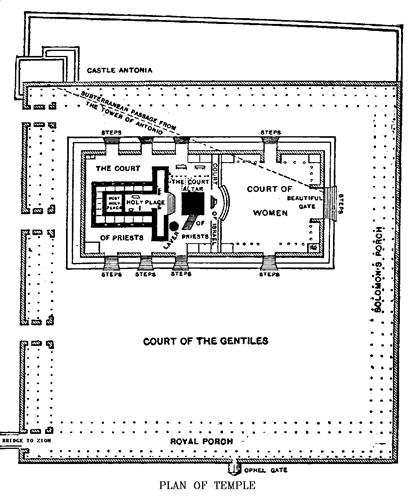 In
the Temples of Solomon and in the Second Temple we
find the Holy of Holies, the Holy Place, the court where the altar and the
wash-stand was located and adjoining the court of the Israelites divided into male and female
courts, and then the court of the Righteous Gentiles.
Similarly, in the depiction of the Heavenly Temple by
Yochanan in the Book of Revelation, there is a division in the Heavenly Temple with the One-hundred-and-forty-four-thousands (please note
the plural) and the great multitude of Righteous Gentiles
that could not be numbered. Both illustrate the fact that whilst they are in
separate gates and courts yet they inhabit the same Temple,
and are beneficiaries of the one Theocratic Governance
by the One HaShem, His Torah
and His Mashiach. That two
different openings of faith and that there are two
distinct courts in the same Temple does not at all
purport or justify the idea of two distinct religions.
In
the Temples of Solomon and in the Second Temple we
find the Holy of Holies, the Holy Place, the court where the altar and the
wash-stand was located and adjoining the court of the Israelites divided into male and female
courts, and then the court of the Righteous Gentiles.
Similarly, in the depiction of the Heavenly Temple by
Yochanan in the Book of Revelation, there is a division in the Heavenly Temple with the One-hundred-and-forty-four-thousands (please note
the plural) and the great multitude of Righteous Gentiles
that could not be numbered. Both illustrate the fact that whilst they are in
separate gates and courts yet they inhabit the same Temple,
and are beneficiaries of the one Theocratic Governance
by the One HaShem, His Torah
and His Mashiach. That two
different openings of faith and that there are two
distinct courts in the same Temple does not at all
purport or justify the idea of two distinct religions.
It is not of chance then, that Israel was forty years in the Sinai Wilderness. HaShem had shown Moshe the Heavenly Tabernacle, or Temple, and had instructed Moshe to make a Tabernacle in the wilderness alike the order of the one shown to him at the mountain. It took one year to build the Tabernacle, which Israel used as the meeting place of HaShem with them for the remaining thirty-nine years. During those thirty-nine years, Israel spent six years moving about with the Tabernacle dismantled and unused. This brings us to the point that the Tabernacle of Israel was in use as the meeting place for HaShem and His people for exactly thirty-three years of the forty years of the wilderness experience. In the Jewish year of 3828 on the ninth day of the month of Av, the Romans destroyed the Temple for the second time. However, Titus, alike Nebuchadnezzar, put Jerusalem under siege on the day of Lag B'Omer. And again, co-incidentally when His Majesty King Yeshua was Lag B’Omer in age (thirty-three years of age) his body (temple) was put to death by Roman execution of the cross.
In Avraham
As mentioned above, the angel of HaShem, spoke to Avraham after the Binding of Yitzchak and said to him in Bereshit (Genesis) 22:
v. 16 By myself I swear – the word of HaShem – that because you have done this thing, and have not withheld your son, your only one,
v. 17 that I will surely bless you and greatly increase your offspring like the stars of the heavens and like the sand of the seashore; and your offspring shall inherit the gate of its enemy.
v. 18 And all the Gentiles of the earth shall be engrafted into your offspring because you have listened to my voice.”
Compare with the words of Hakham Shaul to the Romans, chapter 11:
v. 17 And if some of the (natural) branches be broken off, and you, being a branch from a wild olive tree, were grafted in among them, and with them partakes of the root and fatness of the olive tree;
v. 18 Boast not against the branches. But if you boast, you bare not the root, but the root bares you.
A dispassionate analysis of the three verses quoted above from Bereshit (Genesis) clearly indicates that in Yitzchak an opening of faith was created for all Jews, but v.18 clearly indicates that an opening of faith in the future would be established for the Gentiles so that they can legitimately be grafted into Yisrael. Nevertheless, both texts from Bereshit and from the Epistle to the Romans make clear that this engrafting is into Israel and the Jewish olive tree of which the Jewish Rabbinic authorities are its custodians. Whilst these two texts sanction two openings of faith (i.e. two bindings), they most categorically prohibit the formation of any religion outside Jewish Orthodoxy.
Against “Mutilating the
Shoots of Faith” & 2 Luqas 15
In commenting upon the erection of the Tower of Babel, the Ramban (Nachmanides) states:
“However, he who knows the meaning of the word “name” – as they said, and we will make for us a name [Bereshit (Genesis) 11:4] – will understand their intent and will know the extent of their evil intention in constructing the tower. And then he will understand the whole subject, namely, that theirs was an evil thought, and the punishment that came over them – to be dispersed in their languages and countries – was meted out measure for measure for “they mutilated the shoots” of faith by seeking to undermine the principle of the Unity.” (Genesis: Parashat Noach)
The people at Babel wanted a “name” that was different from that which Noach and Eber worshipped, and to this day there are many who in the name of Mashiach ben Yosef want a name distinct from Israel’s economy and from the wise and sacred teachings of Torah and our Hakhamim, something which Mashiach himself never purposed to do nor his Talmidim. To say that because we have two distinct openings of faith, one for the Jews through Yitzchak, and one for the Gentiles through Mashiach ben Yosef, we have a mandate for two separate religions or to separate from the Theocratic economy of Israel, amounts to falling in to the same error as those at Babel – “mutilation of the shoots of faith.” The reward for this great sin is nothing but a life full of intellectual and spiritual Babel – confusion, devoid of any blessings from HaShem, Most Blessed be He.
It is for this reason, and to warn all concerned, that in the Nazarean Codicil we find Hakham Yaaqov Ha-Tsadiq most solemnly adjudicating once and for all as a Rosh Bet Din:
2 Luqas (Acts) 15:21 “For the rest Moshe (i.e. Written and Oral Torah) of old time has in every city them that proclaim him, being read to you in the (Jewish) synagogues every Shabbat.”
It is true that in certain places Orthodox Jews who adhered to His Majesty King Yeshua the Messiah were thrown by uninformed and misguided Jews from local Jewish Orthodox Synagogues, and therefore resorted to creating Synagogues of their own. However, this is no way is a carte-blanche to the starting of a new religion, or unnecessary divisions of the faith, far be it from the truth! For anyone who in truth adheres to the Messiah of Israel, must of necessity belong to the Theocratic economy of Israel, worshipping the same HaShem, and abiding by the same Torah and Halachah as Orthodox Jews do. To do otherwise is but “mutilating the shoots of the faith by seeking to undermine the principle of the Unity.”
Yes, there are Bresslover Chassidim, Bostoner Chassidim, and Lubavitcher Chassidim, but there is no such thing as Bresslover Judaism, or Bostoner Judaism, nor Lubavitcher Judaism. We surely have various schools of thought and practice in Judaism but it is all one Orthodox Judaism. We all say similar prayers and bide by the same Torah. Nazarean Judaism or Messianic Judaism in opposition to Orthodox Judaism is no Judaism at all, and destroys completely the work of Mashiach ben Yosef, his principles and his goal:
Malachi 2:10 “Have we not one Father? Did not one HaShem created us all? Why, then, is one person betrayed by another, in order to defile the covenant of our forefathers?”
* * *
This study was written by
Rabbi Dr. Hillel ben David
(Greg Killian).
Comments may be submitted to:
Rabbi Dr. Greg Killian
12210 Luckey Summit
San Antonio, TX 78252
Internet address: gkilli@aol.com
Web page: http://www.betemunah.org
(360) 918-2905
Return to The WATCHMAN home page
Send comments to Greg Killian at his email address: gkilli@aol.com
[1] Shabbat 55a
[2] Yalkut Me’Am Lo’Ez by Hakham Ya’aqov Culi
[3] The Torah: A Modern Commentary (UAHC, 1981), p. 151, n.5
[4] Bereshit 26:1-2
[5] Midrash Bereshit Rabbah 56:8
[6] I Yochanan (John) 3:16
[7] Rashi on Bereshit 18
[8] see the Zohar on Bereshit (Genesis) 28:11
[9] Yalkut Shimoni, Vayera 99
[10] Tehillim 69:2
[11] Bereshit 22:16-18
[12] The end of the section was written by by Sara Yoheved Rigler.