The Significance of Yom Teruah (Rosh Hashanah)
By Rabbi Dr. Hillel ben David (Greg Killian)

IX. Why do we Blow the Shofar?
XVI. A Day for Eating and Drinking:
XX. In the the Nazarean Codicil
XXI. Books for further insight study

In this study I would like to examine the festival that begins a new year. In the Torah, this feast is known as Yom Teruah – יום תרוה, the Day of Shofar Sounding – the Feast of Trumpets. Most of us know the feast as Rosh HaShanah - ראש השנה the New Year[1]. Surprisingly, this feast is never called Rosh HaShanah in the Torah.[2]
Yom Teruah, The Day of Blowing the Shofar, occurs on the first day of the seventh month, the month of Tishri on the Biblical calendar, the month of Tishri. Because it occurs on the first day of the month, it is by definition also Rosh Chodesh, a new moon.
Rosh HaShanah / Yom Teruah begins, this year, on the evening of September 16, 2012 (Tishri 1, 5773) and will end at sundown on September 18, 2012 (Tishri 2, 5773). This festival always lasts for forty-nine hours.
Because all new moons are sanctified by the Sanhedrin (The Beit Din Gadol – The Great Court) on the basis of the testimony of two witnesses. HaShem[3] and all His hosts, must literally wait, up to twenty-four hours, for men to sanctify the new moon before He can come and judge us.
Since Yom Teruah can occur on the weekly Shabbat, it has a rather unique status among all of the festivals. It is the only festival on which all of the following sacrifices[4] can be offered:
1. The daily offerings.
2. The Shabbat offerings.
4. The festival offerings.
This is truly a day to draw near to HaShem! Lets begin our study by seeing what the scriptures have to say about drawing near to HaShem:
Yeshayahu Isaiah) 55:1 - 56:8 "Come, all you who are thirsty, come to the waters; and you who have no money, come, buy and eat! Come, buy wine and milk without money and without cost. Why spend money on what is not bread, and your labor on what does not satisfy? Listen, listen to me, and eat what is good, and your soul will delight in the richest of fare. Give ear and come to me; hear me, that your soul may live. I will make an everlasting covenant with you, my faithful love promised to David. See, I have made him a witness to the peoples, a leader and commander of the peoples. Surely you will summon nations you know not, and nations that do not know you will hasten to you, because of HaShem[5] your God, the Holy One of Israel, for he has endowed you with splendor." Seek HaShem while he may be found; call on him while he is near. Let the wicked forsake his way and the evil man his thoughts. Let him turn to HaShem, and he will have mercy on him, and to our God, for he will freely pardon.
When is HaShem near? Surely He is near during Yamim Noraim (the Awesome Days)! The Yamim Noraim are the ten days from Yom Teruah to Yom HaKippurim (the day of Atonement).
On Yom Teruah it is the duty of HaShem's people to recite:
Tehillim (Psalms) 118:24 This is the day HaShem has made; let us rejoice and be glad in it.
Let us strive to draw near to HaShem even as His Mashiach was near to Him:
Yochanan (John) 10:30 I and [my] Father are one.
The following is an excerpt from Reflections & Introspections, Elul – Rosh Hashanah – Yom Kippur – Sukkos, TORAH INSIGHTS OF HAGAON HAGADOL RavMoshe Shapiro.
“The Sages state (Yalkut Shimoni chapter 782), “In each month of the summer months, the Holy Blessed One wished to give to Israel a festival. In Nisan He gave to them Passover, in Iyar He gave to them Passover Minor,” which we call Pesach Sheni, “and in Sivan He gave to them Shavuot. In Tammuz, He had in mind to give to them a great festival, but they made the Golden Calf, and it cancelled Tammuz, Av, and Elul. Tishri came, and it recompensed them with Rosh Hashanah, Yom Kippur, and Succoth. The Holy Blessed One said of it, “Shall it recompense others and not take its own? Give it its day: “On the eighth day, it shall be Atzeret for you” (Bamidbar 29:35).”
“The implication is that the great festival of the Seventeenth of Tammuz was to be Rosh Hashanah, but due to what occurred, it became the fast of the Seventeenth of Tammuz. The great festival of the Ninth of Av was to be Yom Kippur, but again, due to what occurred, it became the bitter and evil day of destruction. At the beginning of Elul was to be the Festival of Succoth, and it would conclude the festivals of summer. The festival of Tishri itself was to be what we currently call Shemini Atzeret; this festival belongs to Tishri inherently.”
“In fact, Shemini Atzeret, the Atzeres of Succoth was to arrive just as Shavuot, the Atzeret of Passover. There, we count forty-nine days from the day after the first of Passover, and the fiftieth day is Shavuot. Here, we were to count forty-nine days from the day after the first of Succoth, meaning from the second day of Elul. This ends on Hoshana Rabbah, and the fiftieth day is Shemini Atzeret.”
“The sages ask this in actuality.[6] Why do we not have the same custom regarding the Atzeret of Succoth as we have regarding the Atzeret of Passover? Why do we not count fifty days from Succoth and then celebrate the Atzeret of Succoth?”
“They answer that the Creator did not wish to overburden the Jewish People to come to Jerusalem for the pilgrimage during the rainy season. Fifty days from the current date of Succoth would occur in the middle of the winter, and it is not conducive for travel.”
“Clearly, it is befitting for there to be a counting of forty-nine days and then to celebrate the Atzeret of Succoth. Thus, if Succoth were in Elul that is how it would be.”
The Torah’s teaching on this feast is very brief, consisting of only two passages:
Vayikra (Leviticus) 23:23-25 HaShem said to Moses, "Say to the Israelites: 'On the first day of the seventh month you are to have a day of rest, a sacred assembly commemorated with shofar blasts. Do no regular work, but present an offering made to HaShem by fire.
Bamidbar (Numbers) 29:1 "'On the first day of the seventh month hold a sacred assembly and do no regular work. It is a day for you to sound the shofarot.
Chazal, our sages, teach us that we are NOT to sound the shofar on Shabbat in accordance with the above passage from Vayikra (Leviticus). This pasuk indicates that the shofar in not sounded but commemorated. This is in accordance with the understanding that we do do not carry, even a shofar, from a private domain to a public domain on Shabbat. The reason we do not carry is because carrying from a private to a public domain was one of the labors required to build the Mishkan (Tabernacle). The Talmud also speaks of this issue of carrying a shofar on Shabbat:
Rosh hashana 29b mishnah. If the festive day of new year fell on a shabbat, they used to blow the shofar in the temple but not in the country: after the destruction of the temple, Rabban Johanan ben Zaccai ordained that it should be blown [on shabbat] in every place where there was a beth din. R. Eliezer said: Rabban Johanan ben Zaccai laid down this rule for Jabneh only. They said to him: it applies equally to Jabneh and to any place where there is a beth din. Jerusalem had this further superiority over Jabneh, that in every city from which it could be seen or heard and which was near and from which it was accessible they used to blow [on Shabbat], whereas in Jabneh they used to blow in the beth din only.
GEMARA. Whence [in the Scripture] is this rule derived? — R. Levi b. Lahma said: One verse says, a solemn rest, a memorial of blast of horns, while another verse says,it is a day of blowing the horn unto you! [Yet] there is no contradiction, as one refers to a festival which falls on Shabbat and the other to a festival which falls on a weekday. Raba said: If the prohibition [on Shabbat] is from the Written Law, how comes the shofar to be blown in the Temple? And besides, [the blowing] is no work that a text should be needed to except it. For it was taught in the school of Samuel: [When it says], Ye shall do no servile work [on New Year], this excludes the blowing of the shofar and the taking of bread from the oven, these being kinds of skill and not work! — No, said Raba. According to the Written Law it is allowed, and it is the Rabbis who prohibited it as a precaution; as stated by Rabbah; for Rabbah said, All are under obligation to blow the shofar but not all are skilled in the blowing of the shofar. [Hence] there is a danger that perhaps one will take it in his hand [on Shabbat] and go to an expert to learn and carry it four cubits in public domain. The same reason applies to the lulab and the same reason to the Megillah.
Shabbath 35b The School of R. Ishmael taught: Six blasts were blown on the eve of the Shabbat. When the first was begun, those who stood in the fields ceased to hoe, plough, or do any work in the fields, and those who were near [to town] were not permitted to enter [it] until the more distant ones arrived, so that they should all enter simultaneously. But the shops were still open and the shutters were lying. When the second blast began, the shutters were removed and the shops closed. Yet hot [water] and pots still stood on the range. When the third blast was begun, what was to be removed was removed, and what was to be stored away was stored away, and the lamp was lit. Then there was an interval for as long as it takes to bake a small fish or to place a loaf in the oven; then a teki'ah, teru'ah and a teki'ah were sounded, and one commenced the Shabbat. R. Jose b. R. Hanina said: I have heard that if one comes to light after the six blasts he may do so, since the Sages gave the hazzan of the community time to carry his shofar home. Said they to him, If so, your rule depends on [variable] standards. Rather the hazzan of the community had a hidden place on the top of his roof, where he placed his shofar, because neither a shofar nor a trumpet may be handled [on the Shabbat]. But it was taught: A shofar may be handled, but not a trumpet? -Said R. Joseph: There is no difficulty: The one refers to an individual[‘s]; the other to a community[‘s].
Since Yom Teruah lasts for forty-nine hours and spans two days, even when one day is Shabbat, the other will be a weekday. This means that on Yom Teruah the shafar is ALWAYS sounded during the forty-nine hours of this feast!
The following excerpt is from the Jewish Encyclopedia:
"Originally, the New Moon was not fixed by astronomical calculations, but was solemnly proclaimed after witnesses had testified to the reappearance of the crescent of the moon. On the 30th of each month, the members of the High Court[7] assembled in a courtyard in Jerusalem, named Beit Ya'azek, where they waited to receive the testimony of two reliable witnesses; they then sanctified the New Moon. If the moon's crescent was not seen on the 30th day, the New Moon was automatically celebrated on the next day."
According to the Talmud the witnesses were entertained lavishly to induce witnesses to come forward. They were then tested to ascertain that they were true witnesses:
Rosh hashana 23b: mishnah. There was a large court in jerusalem called Beth Ya'azek. There all the witnesses used to assemble and the beth din used to examine them. They used to entertain them lavishly there[8] so that they should have an inducement[9] to come. Originally they used not to leave the place the whole day,[10] but Rabban Gamaliel the elder introduced a rule that they could go two thousand cubits from it in any direction. These were not the only ones [to whom this concession was made]. A midwife who has come [from a distance] to help in childbirth or one who comes to rescue from a fire or from bandits or from a river in flood or from a building that has fallen in — all these are on the same footing as the residents of the town, and may go two thousand cubits [on shabbat] in any direction.
GEMARA. The question was raised: Do we read here Beth Ya'azek or Beth Ya'zek? Do we read Beth Ya'azek, regarding the name as an elegantia[11] based on the Scriptural expressions, And he ringed it round and cleared it of stones?[12] Or do we read Beth Ya'zek, taking the name to connote constraint,[13] as it is written, being bound in chains?[14] — Abaye said: Come and hear [a proof that it is the former]: THEY USED TO ENTERTAIN THEM LAVISHLY THERE SO THAT THEY SHOULD HAVE AN INDUCEMENT TO COME. [This is not conclusive], as perhaps they treated them in both ways.[15]
Mishnah. How do they test the witnesses? The pair who arrive first are tested first. The senior of them is brought in and they say to him, tell us how you saw the moon — in front of the sun or behind the sun?[16] to the north of it or the south? How big was it, and in which direction was it inclined?[17] and how broad was it? If he says [he saw it] in front of the sun, his evidence is rejected.[18] after that they would bring in the second and test him. If their accounts tallied, their evidence was accepted, and the other pairs were only questioned briefly,[19] not because they were required at all, but so that they should not be disappointed, [and] so that they should not be dissuaded from coming.[20]
GEMARA. ‘IN FRONT OF THE SUN’ is surely the same as ‘TO THE NORTH OF IT’, and ‘BEHIND THE SUN’ is surely the same as TO THE SOUTH OF IT’?[21] — Abaye said: [It means], whether the concavity of the moon is in front of the sun or behind the sun.[22] If he says, in front of the sun, his evidence is rejected, since R. Johanan has said: What is meant by the verse, Dominion and fear are with him, He maketh peace in his high places?[23] Never did the sun behold the concavity of the new moon nor the concavity of the rainbow. It never sees the concavity of the moon, so that she should not feel humiliated.[24] It never sees the concavity of the rainbow so that the worshippers of the sun should not say, He is shooting arrows [at those who do not worship him].[25]
* * *
Originally, Yom Teruah was to occur on the seventeenth of Tammuz and Yom Kippurim on the ninth of Av, as the sages assert.[26] Yom Teruah is the day of man’s creation, as we say in the prayers of Yom Teruah, “This day is the beginning of Your works, the remembrance of the First Day,” and the seventeenth of Tammuz was to be the true day of man’s creation. The Creator had formed man to live eternally in the Garden of Eden, but man sinned. On the seventeenth of Tammuz, the Jewish People were to receive the First Tablets.[27]
* * *
Yom Teruah is always celebrated for two days, even in Israel. These two days are celebrated as though it is just one long day of forty-nine hours.[28]
These days of Yom Teruah are called “yoma arichta” (one long day) to indicate that the sanctity of both is not a doubtful sanctity, but a definite one. See also KNOWDAY.
The reason that we celebrate for two days is because if we waited to start our celebration until after the new moon had been sanctified, we would have missed half the celebration because the new moon can only be sanctified during daylight hours. The new moon is also very difficult to see on the first day because it can be seen only about sunset, close to the sun, when the sun is traveling north. So, looking for a very slim faint crescent moon, which is very close to the sun, is a very difficult thing to do.
This two day celebration makes me think of:
Matityahu (Matthew) 24:29-39 "Immediately after the distress of those days 'the sun will be darkened, and the moon will not give its light; the stars will fall from the sky, and the heavenly bodies will be shaken.' "At that time the sign of the Son of Man will appear in the sky, and all the nations of the earth will mourn. They will see the Son of Man coming on the clouds of the sky, with power and great glory. And he will send his angels with a loud shofar call, and they will gather his elect from the four winds, from one end of the heavens to the other. "Now learn this lesson from the fig tree: As soon as its twigs get tender and its leaves come out, you know that summer is near. Even so, when you see all these things, you know that it is near, right at the door. I tell you the truth, this generation will certainly not pass away until all these things have happened. Heaven and earth will pass away, but my words will never pass away. "No one knows about that day or hour, not even the angels in heaven, nor the Son, but only the Father. As it was in the days of Noah, so it will be at the coming of the Son of Man. For in the days before the flood, people were eating and drinking, marrying and giving in marriage, up to the day Noah entered the ark; And they knew nothing about what would happen until the flood came and took them all away. That is how it will be at the coming of the Son of Man.
Matityahu (Matthew) 25:13 "Therefore keep watch, because you do not know the day or the hour.
Marqos (Mark) 13:28-37 "Now learn this lesson from the fig tree: As soon as its twigs get tender and its leaves come out, you know that summer is near. Even so, when you see these things happening, you know that it is near, right at the door. I tell you the truth, this generation will certainly not pass away until all these things have happened. Heaven and earth will pass away, but my words will never pass away. "No one knows about that day or hour, not even the angels in heaven, nor the Son, but only the Father. Be on guard! Be alert! You do not know when that time will come. It's like a man going away: He leaves his house and puts his servants in charge, each with his assigned task, and tells the one at the door to keep watch. "Therefore keep watch because you do not know when the owner of the house will come back--whether in the evening, or at midnight, or when the rooster crows, or at dawn. If he comes suddenly, do not let him find you sleeping. What I say to you, I say to everyone: 'Watch!'"
Revelation 16:15 "Behold, I come like a thief! Blessed is he who stays awake and keeps his clothes with him, so that he may not go naked and be shamefully exposed."
I Thessalonians 5:1-11 Now, brothers, about times and dates we do not need to write to you, For you know very well that the day of the Lord will come like a thief in the night. While people are saying, "Peace and safety," destruction will come on them suddenly, as labor pains on a pregnant woman, and they will not escape. But you, brothers, are not in darkness so that this day should surprise you like a thief. You are all sons of the light and sons of the day. We do not belong to the night or to the darkness. So then, let us not be like others, who are asleep, but let us be alert and self-controlled. For those who sleep, sleep at night, and those who get drunk, get drunk at night. But since we belong to the day, let us be self-controlled, putting on faith and love as a breastplate, and the hope of salvation as a helmet. For God did not appoint us to suffer wrath but to receive salvation through our Lord Yeshua Mashiach. He died for us so that, whether we are awake or asleep, we may live together with him. Therefore encourage one another and build each other up, just as in fact you are doing.
The command seems to be that we know the season, but not the day or the hour. Yom Teruah is the ONLY moed (appointment) that we do not know the day or the hour in which to keep it. Therefore, we have to be on the alert and watch for it. The Rabbinic suggestion that we not sleep on Yom Teruah seems to be justified from these verses. According to the Mishna, Rosh Chodesh must be announced during daylight hours.[29]
Abraham, in the Book of Jubilees, also stayed awake and watched:
Jubilees, Chapter 12:15... And Terah went forth from Ur of the Chaldees, he and his sons, to go into the land of Lebanon and into the land of Canaan, and he dwelt in the land of Haran, and Abram dwelt with 16 Terah his father in Haran two weeks of years. And in the sixth week, in the fifth year thereof, [1951 A.M.] Abram sat up throughout the night on the new moon of the seventh month to observe the stars from the evening to the morning, in order to see what would be the character of the year with regard to the rains, and he was alone as he sat and observed. And a word came into his heart and he said: All the signs of the stars, and the signs of the moon and of the sun are all in the hand of the Lord. Why do I search (them) out?
Statistics:
Rosh HaShanah cannot, in our fixed calendar, fall on a Sunday, Wednesday, or Friday. That leaves four days of the week that Rosh HaShana can fall. They are (with their frequency of occurence): Monday (27.4%), Tuesday (11.5%), Thursday (32.1%), and Shabbat (28.9%). Notice that The frequencies of Monday, Thursday,and Shabbat are roughly similar. Tuesday's frequency, on the other hand, is less than half that of any of the other days.
Normally an announcement is made, in the synagogue, on the Shabbat preceding the new moon. This announcement tells us the precise time of the new moon and the name of the new month.
However, we do not make this announcement on the last Shabbat of Elul, to announce the new moon of Tishri. The Baal Shem Tov gave the following reason as to why we do not make this announcement for the new month on the Shabbat preceding the beginning of the month of Tishri, as we do on the Shabbatot that precede all other new months:
"The seventh month [of the festival calendar], which is the first month of the months of the year [of the calendar, i.e., the month of Tishri], is blessed by HaShem Himself on Shabbat Mevarchim, which is the last Shabbat of the month of Elul. Thus empowered, the Jewish people bless the [other] months, eleven times in the year."[30]
The Baal Shem Tov then went on to explain what HaShem's blessing entails:
"Scripture states [in the beginning of the Torah portion of Nitzavim[31], 'You are all standing today....' 'Today' refers to Rosh HaShanah, which is the day of judgment.... You (the Jewish people) stand fast and upright on this day; i.e., you are judged favorably. On the Shabbat preceding Rosh HaShanah, which is the last Shabbat of the month of Elul, we read the annual portion of 'You are all standing today....' This is HaShem's blessing on the Shabbat when we bless the 'seventh month,' [a month] that is satiated and satiates all Jews with abundant goodness the year round."
We understand from the above that although the month of Tishri is blessed by HaShem Himself, nevertheless even this blessing is drawn down by the Jewish people through their reading of the Torah on the preceding Shabbat.
The only difference between this and other months is that in the case of the other months the blessing itself comes from the Jewish people, while the blessing for Tishri is recited by HaShem Himself, though in order for it to be drawn down below, the
Jewish people must read the portion of Nitzavim.
* * *
Rosh Chodesh literally means "beginning renewal" and idiomatically means the "beginning of the month" or "new moon". Strong’s definition is:
7218 ro'sh, roshe; from an unused root appar. mean. to shake; the head (as most easily shaken), whether lit. or fig. (in many applications, of place, time, rank, etc.):-band, beginning, captain, chapiter, chief (-est place, man, things), company, end, X every [man], excellent, first, forefront, ([be-]) head, height, (on) high (-est part, [priest]), X lead, X poor, principal, ruler, sum, top.bands beginning beginnings beheaded captain captains chapiters chief chiefest companies company ends every excellent first forefront head heads height high highest lead principal rulers sum top tops
2320 chodesh, kho'-desh; from 2318; the new moon; by impl. a month:-month (-ly), new moon.
---------------- Dictionary Trace --------------
2318 chadash, khaw-dash'; a prim. root; to be new; caus. to rebuild:-renew, repair.
In the school of Rabbi Ishmael it was taught: Had Israel merited no other privilege than greeting the presence of their heavenly Father once a month [by reciting the benediction over the new moon], they would be contented! Abbaye said: Therefore [since it is a greeting of HaShem's presence], we must recite it standing.[32]
Since the end of the Sanhedrin, the Beit Din Gadole, we no longer sanctify the new moon as we used to. When the Beit Din Gadole is restored, we will return to the old way of sanctifying the new moon. Now, we say the following blessing on the third through the seventh day of the month, preferably on the Shabbat:
Kiddush Lavanah (The Blessing Over the New Moon):
Blessed are You, HaShem our God, King of the universe whose word created the heavens, whose breath created all that they contain. Statutes and seasons He set for them, that they should not deviate from their assigned task. Happily, gladly they do the will of their Creator, whose work is dependable. To the moon He spoke: renew yourself, crown of glory for those who were borne in the womb, who also are destined to be renewed and to extol their Creator for His glorious sovereignty. Blessed are You, HaShem who renews the months.
David, King of Israel, lives and endures.
For more insight into the Torah calendar, see the author’s study on CALENDAR.
Now, lets look at some background to help us understand the new moon:
The renewal of the moon represents good tidings. It represents the renewal of man; renewal of the individual and of the community, "For they are destined to renew themselves like her", the renewal of the kingship of Israel and of the Kingship of heaven, which is the crux of Rosh HaShanah.
Judah and Tamar had twins: Zerach and Peretz. Zerach (shining) was so called on account of the sun which always shines, and Peretz (breach) on account of the moon which is sometimes breached [i.e. its light is sometimes hidden (at the end of the month) and sometimes completely intact.] But Peretz [symbolizing the moon] was the first born, although the sun is greater than the moon? [i.e. why should the firstborn be symbolized by the smaller orb?]. In a sense Zerach, who stuck out his hand first, was to be the firstborn; but Peretz, the ancestor of the House of David, was given the Divine privilege of actually being the first born. The Davidic dynasty is likened to the moon because it underwent various stages of ascendancy and descendancy.
Since the Davidic dynasty evolved from Peretz who was likened to the moon, Chazal[33], when wishing to inform the Jews in other countries that the New Moon had appeared and been sanctified, would use the message 'David King of Israel lives and exists'[34]
The Hakhamim (Rabbis) taught that the heavenly court does not assemble for judgment until the court on earth has sanctified the month. HaShem waits for men![35]
Yom Teruah falls on the first day of the seventh month. By arrangement of the calendar it cannot fall on Sunday, Wednesday, or Friday. This is to prevent Yom HaKippurim from falling on the first or the sixth day.
The first day begins a period of penitence lasting for ten days, ending with Yom HaKippurim (Day of the Atonements). Yom Teruah is the only festival which has an uncertain beginning, since the first day of the month, Rosh Chodesh, depends on sighting the new moon by two witnesses. For this reason, even in Israel this festival is celebrated for two days.
Notice that even Ezra observed two days:
Nehemiah 8:2-3 So on the first day of the seventh month Ezra the priest brought the Law before the assembly, which was made up of men and women and all who were able to understand. He read it aloud from daybreak till noon as he faced the square before the Water Gate in the presence of the men, women and others who could understand. And all the people listened attentively to the Book of the Law.
Nehemiah 8:13 On the second day of the month, the heads of all the families, along with the priests and the Levites, gathered around Ezra the scribe to give attention to the words of the Law.
Both days of Yom Teruah are considered as one long day possessing equal sanctity.[36]
Just as judgment is executed by day, so also must the sanctification of the month take place by day. All legal judgments are announced by day.
* * *
The name of the seventh month is "Tishri". This name has two possible meanings:
1. To loosen, to untie, or to dissolve. Thus the theme of Yom Teruah - "Dissolve and pardon our iniquities".
2. "You shall begin" from:
Devarim (Deuteronomy) 16:9 Count off seven weeks from the time you begin to put the sickle to the standing grain.
The names of the months are all Babylonian. Chazal have ruled that the names remain Babylonian, even though idolatrous, because of what Jeremiah said in:
Yiremyahu (Jeremiah) 16:14-15 "However, the days are coming," declares HaShem, "when men will no longer say, 'As surely as HaShem lives, who brought the Israelites up out of Egypt,' But they will say, 'As surely as HaShem lives, who brought the Israelites up out of the land of the north and out of all the countries where he had banished them.' For I will restore them to the land I gave their forefathers.
Chazal have ruled that we should return to biblical, that is numbered, names when ALL Israel is restored to the land. In the mean time, the names of the months are a reminder. The Sages have also stated that there is deep meaning to these Babylonian names that speak to HaShem's people today.
The Yom Teruah is a "moed", an appointment, with HaShem, like an appointment with a doctor, it involves meeting at a particular place for a specific purpose.
Vayikra (Leviticus) 23:1-2 HaShem said to Moses, "Speak to the Israelites and say to them: 'These are my appointed feasts (moed), the appointed feasts (moed) of HaShem, which you are to proclaim as sacred assemblies (mikra)...
This feast is also a rehearsal meeting, a "mikra". Like any rehearsal, this involves particular costumes, words, and props:
Vayikra (Leviticus) 23:23-25 HaShem said to Moses, "Say to the Israelites: 'On the first day of the seventh month you are to have a day of rest, a sacred assembly (mikra) commemorated with shofar blasts. Do no regular work, but present an offering made to HaShem by fire.'"
The clothing, the prayers, and the props (the shofar) are all spelled out in the oral law. The way we celebrate is nearly always spelled out in the oral Torah rather than in the written Torah. Those who eschew the oral Torah have never tried to fulfill the written Torah's commands.
Rosh Hashanah - Which means the beginning or "head" of the year. Most Jews use this name to refer to this feast (moed). This name is mentioned only once in the scriptures in:
Yehezekel (Ezekiel) 40:1 In the twenty-fifth year of our exile, at the beginning of the year, on the tenth of the month, in the fourteenth year after the fall of the city--on that very day the hand of HaShem was upon me and he took me there.
Chazal recognize that this is not referring to Yom Teruah, but to Yom HaKippurim in a Jubilee year.
Yom Teruah: Which means a day of blowing (the shofar) or breathing. This name is found in:
Bamidbar (Numbers) 29:1 "'On the first day of the seventh month hold a sacred assembly and do no regular work. It is a day for you to sound the shofarot.
and
Vayikra (Leviticus) 23:24 "Say to the Israelites: 'On the first day of the seventh month you are to have a day of rest, a sacred assembly commemorated with shofar blasts.
Teruah in Hebrew means not only a certain unique sound. It also connotes "to break", as the prophet says:
Yeshayahu (Isaiah) 24:19 The earth is utterly broken down, the earth is clean dissolved, the earth is moved exceedingly.
After the earth quaked, something broke to pieces. Teruah is associated with breakage and damage, for example we find the people of Sodom threatened to do damage to Lot for not turning over his guests to them.
Yom Ha-Zekaron: Which means a day of memorial or remembrance. This is derived from the verse:
Vayikra (Leviticus) 23:24 Speak unto the children of Israel, saying, In the seventh month, in the first day of the month, shall ye have a sabbath, a memorial of blowing of trumpets, an holy convocation.
Rosh HaShanah: This is the common name used by most Jews.
On what basis do the Sages identify this day as the Day of Judgment (Yom HaDin)? Why do the Sages call this day 'Rosh HaShana' while the Torah makes no mention of this term?
Apparently we have only one source to guide us in understanding the biblical significance of the 'Yom teruah', the 'Parshat HaHatzotzrot', the portion dealing with the shofarot. For our purposes the last two pesukim of this parsha are of particular note: “And if you go to war in your land against the enemy that oppresses you, then you shall blow an alarm with the shofarot ("veharei'otem b'hatzotzrot"); and you shall be remembered ("veniz'kartem") before HaShem your God, and you shall be saved from your enemies. Also in the day of your gladness, and in your solemn days, and in the beginnings of your months, you shall blow with the shofarot ("ut'ka'tem b'hatzotzrot") over your burnt offerings, and over the sacrifices of your peace offerings; that they may be to you for a remembrance ("l'zikaron") before your God - I am HaShem.
Yom Hakeseh (The Day of Concealment) - The sages say that the verse:
Tehillim (Psalms) 81:3 Sound the ram's horn at the New Moon, and when the moon is full, on the day of our Feast;
Should be translated:
Tehillim (Psalms) 81:3 Blow the shofar at the new moon, at the covered time for our feast day.
Which is the feast on which the moon is covered over? You must say that this is Yom Teruah[37]; and it is written in this connection:
Tehillim (Psalms) 81:4 This is a decree for Israel, an ordinance of the God of Jacob.
Tehillim (Psalms) 81:1-16 {For the director of music. According to <gittith.> Of Asaph.} Sing for joy to God our strength; shout aloud to the God of Jacob! Begin the music, strike the tambourine, play the melodious harp and lyre. Sound the ram's horn at the New Moon, and when the moon is covered, on the day of our Feast; This is a decree for Israel, an ordinance of the God of Jacob. He established it as a statute for Joseph when he went out against Egypt, where we heard a language we did not understand. He says, "I removed the burden from their shoulders; their hands were set free from the basket. In your distress you called and I rescued you, I answered you out of a thundercloud; I tested you at the waters of Meribah. <Selah> "Hear, O my people, and I will warn you--if you would but listen to me, O Israel! You shall have no foreign god among you; you shall not bow down to an alien god. I am HaShem your God, who brought you up out of Egypt. Open wide your mouth and I will fill it. "But my people would not listen to me; Israel would not submit to me. So I gave them over to their stubborn hearts to follow their own devices. "If my people would but listen to me, if Israel would follow my ways, How quickly would I subdue their enemies and turn my hand against their foes! Those who hate HaShem would cringe before him, and their punishment would last forever. But you would be fed with the finest of wheat; with honey from the rock I would satisfy you."
All that transpires on this day is characterized by concealment. All other festivals fall either when the moon is full or near full. Yom Teruah, however, falls on the first day of the month, when the new moon is just barely revealed. The House of Israel is symbolically compared to the moon and is radiant on its Shabbats and Festivals. On Yom Teruah, however, Israel diminishes herself and conceals its greatness in awe of the Day of Judgment. HaShem, too, places a cover of concealment over His people’s sins and accords them forgiveness.
The very character of Tishri one, as the Day of Judgment, is similarly concealed and is not mentioned explicitly in the Torah, so that a person might not be apprehensive over his sins all year and not delay his teshuva (returning) till Yom Teruah.
Yom HaDin: Which means a Day of Judgment. In anticipation of this judgment, we begin teshuvah, to repent, at the beginning of Elul, thirty days earlier. We will have our final time for repentance at the end of this forty day period, on Yom HaKippurim. [Note that His Majesty King Yeshua, the Mashiach’s fast for forty days in the wilderness is very much related to this festival of Yom HaKippurim.] Repentance is also the important concept in the ritual of tashlich, where we symbolically cast our sins away, on this day.
On this day man is judged for all of his actions, and all that will transpire and occur during the coming year is recorded. The Talmud[38] derives this from the verse:
Devarim (Deuteronomy) 11:12 The eyes of God, your Lord, are upon it [the land] from the beginning of the year until the end of the year.
Rosh Hashanah was ordained as a day of judgment for two reasons:
1. This is the day the world was created. The world was created by Elokim, the name used when the attribute of justice is exercised.
2. This is the day Adam was judged, he repented, and he was forgiven. Yom Teruah is “the sixth day” when Adam was created. This is also the day when Adam will be reborn into an indestructible body.
The teaching of the Sages that each person is judged on Rosh Hashanah does not refer to whether a person will merit Gan Eden, the Garden of Eden, if he is worthy, or Gehinom and eternal destruction if he is unworthy. Rather, man is judged on Rosh Hashanah concerning only this world: Whether he is worthy of life and peace, or death and affliction.
* This is the day that Israel will be gathered.
* This is the coronation day of the King of kings.
* This is resurrection day.
* This is a day for judgment. Psalm 81:4
* This is a day to remember the fathers.
* This is a day to blow the shofar.
* This is the day that the world was created.
The Jewish New Year's day, known to all by the Hebrew name of Rosh HaShana, is singled out by the Talmud as both the start of the Jewish year, and the annual Day of Judgment. This may come as a surprise to the innocent reader of the Torah. After all, the Torah[39] refers to the holiday celebrated on the first day of the seventh month (=Tishri) only as "Yom Teruah" (The Day of Shofar-blasts).
Chazal however, point out that there indeed are biblical indications supporting our Mesorah regarding the Rosh HaShana holiday. In Devarim 11:12 the Torah tells us that our destiny, whether financial, physical, or other, is preordained on one day each year for the entire duration of that year[40]. The Gemara identifies the day on which this judgment takes place with the Yom Teruah of Bamidbar,[41] basing this on Tehilim 81:4: "Sound the Shofar on the New Moon, on the day that marks our holiday, for it is [time for] the judgment of the God of Yaakov." Since there is only one holiday that occurs on a new moon, namely, Yom Teruah, the "time of judgment" referred to must be on that same holiday, the day we call Rosh HaShanah. The mention of the Shofar in the verse from Tehilim bears out the contention that it is referring to the Yom Teruah holiday. Besides being the beginning of the year in terms of the formulation of man's yearly destiny, the first of Tishri is considered the first day of the year for several other Halachic purposes. It is the day on which the Sabbatical and Jubilee years begin, and it is the first day of the year in terms of calculating Ma'aser (Tithe) and Orlah (see Vayikra 19:23). It is also the day on which the date for legal documents (nowadays the figure 5768 is used) goes up one notch[42].
The festival Torah cycle has the following readings:
Day 1:
Bereshit (Genesis) 21:1-34
Maftir: Bamidbar (Numbers) 29:1-6
Haftarah: 1 Samuel 1:1 - 2:10
The theme of the readings is "remembered". Sarah and Hannah will be remembered by HaShem. A Talmudic dictum[43] says that on Yom Teruah, Sarah, Rachel, and Hannah were "remembered".
Day 2:
Bereshit (Genesis) 22:1-24
Maftir: Bamidbar (Numbers) 29:1-6
Haftarah: Yiremyahu (Jeremiah) 31:1-19
The Akeida Yitzchak (the binding of Isaac) is the subject of this days Torah reading. This passage was selected to recall the faith of Abraham and Isaac during this episode. Ran adds that one of the reasons for blowing the shofar on this day is to recall the Akeidat Yitzchak at which a ram was sacrificed in place of Isaac. The left horn (shofar) of Isaac’s ram was blown when the Torah was given at Mt. Sinai, and the longer right one will be blown when Mashiach comes.[44]
The last verse of the Haftarah is the special theme for this day: repentance.
The Torah readings of Yom Teruah are Bereshit chapter 21 on the first day and Bereshit chapter 22 on the second day. The Hakhamim have associated the first day of the seventh month as the birthday of both Yitzchak and Shmuel. This association (of the root "z.k.r." and of the idea to remember) hint towards the choice of the first day's Torah and Haftarah reading (the first day's Torah reading describes the birth of Yitzchak and the Haftarah of the first day describes the birth of Shemuel and the prayer of Hannah (1 Samuel 1:1-2:10)).The Torah reading of the second day describes the binding of Yitzchak. The reason for the choice of this chapter is explained in the Talmud:
Rosh Hashanah 16a R. Abbahu said, "why is a ram's horn blown? The Holy One, Blessed be He, said: Blow the ram's horn in order that I will remember the binding of Yitzchak, son of Abraham and so that I will consider it as if you yourselves had bound yourselves to me.
The readings also show HaShem's mercy on Hagar, Yishmael, and Yitzchak and also the idea of trying Abraham ("And HaShem tested Abraham" Gen.22:1), and his being found as a God-fearing person. An additional reason for the choice of the Haftarah for the first day is the fact that there are nine mentionings of HaShem's name in the prayer of Hannah. These correspond to the nine blessings contained in the Hazarah (repeat prayer) of Musaf on Rosh Hashanah. In addition the nature of the mentionings of HaShem's name in the prayer of Hanah are very appropriate and correspond to some of the ideas of the day. For example, HaShem is a God of Knowledge, HaShem kills and revives, HaShem makes poor and wealthy, the earth is HaShem's and God judges the ends of the earth. The Haftarah of the second day is Jeremiah chapter 31. Rashi[45] explains the choice of this portion as based on the last verse of the Haftarah:
Yeremiyahu (Jeremiah) 31:19 Isn't Ephraim my precious son, a delightful child, as soon as I speak of him I surely remember him and ...I will surely have mercy upon him.
This is one of the verses recited in the "Zichronot" section of the Musaf (Additional) prayer. Additionally, it is likely that as Rosh Hashanah begins the period known as the ten days of repentance, the poignant confession of Ephraim found at the end of the Haftarah serves as a model for repentance and desire to connect again to HaShem. The prophet exclaims: "I have heard the wandering Ephraim: He has chastised me and I have learned my lesson, like an untamed calf, bring me back and I will return, because you are HaShem my God. Because I have returned and I have regretted, and after I was made to know, I clapped my hand to my thigh, I am ashamed and embarrassed because I bear the disgrace of my youth. "The heartfelt repentance displayed by these verses brings about HaShem's compassionate and merciful memory of his child Ephraim. The Haftarah thus models the type of wholehearted repentance necessary to bring about HaShem's compassionate acceptance of His children.
(from the "Gateway to Judaism")
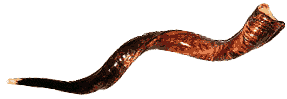
The Shofar: This ancient wind instrument is traditionally blown on Yom Teruah except when the holiday falls on the Shabbat. It is to remind the worshippers of HaShem's providence, of the ram that was substituted for the sacrifice of Isaac, and of HaShem's revelation at Sinai. During the month of Elul, the shofar is sounded every day except the Shabbat, after the morning service, as a reminder of the coming days of judgment. Since this festival lasts for two days, the shofar will always be sounded!
The Rosh Hashanah Machzor (prayer book) has a VERY interesting reading that is part of the shofar service. We have just sounded TEKIAH SHEVARIM-TERUAH TEKIAH, three times, then a prayer that is inserted by some congregations is read. That prayer says:
“May it be Your will that the tekiah-shevarim-Teruah-tekiah blasts that we sound be embroidered into the [heavenly] curtain by the appointed angel , just as You accepted prayers through Elijah, who is remembered for good; Yeshua (the Kohen Gadol), minister of the inner Chamber, and the ministering angel; and may You be filled with mercy upon us. Blessed are You, Master of Mercies.”[46]
The shofar has played a major role in several biblical events:
1. When the Torah was given:
Shemot (Exodus) 19:16-19 On the morning of the third day there was thunder and lightning, with a thick cloud over the mountain, and a very loud shofar blast. Everyone in the camp trembled. Then Moses led the people out of the camp to meet with God, and they stood at the foot of the mountain. Mount Sinai was covered with smoke, because HaShem descended on it in fire. The smoke billowed up from it like smoke from a furnace, the whole mountain trembled violently, And the sound of the shofar grew louder and louder. Then Moses spoke and the voice of God answered him.
2. When the walls of Jericho fell:
Yahoshua (Joshua) 6:20 When the shofarot sounded, the people Teruah’d, and at the sound of the shofar, when the people gave a Teruah gadol, the wall collapsed; so every man charged straight in, and they took the city.
3. When Mashiach returns:
Zechariah 9:13-15 I will bend Judah as I bend my bow and fill it with Ephraim. I will rouse your sons, O Zion, against your sons, O Greece, and make you like a warrior's sword. Then HaShem will appear over them; his arrow will flash like lightning. The Sovereign HaShem will sound the shofar; he will march in the storms of the south, And HaShem Almighty will shield them. They will destroy and overcome with slingstones. They will drink and roar as with wine; they will be full like a bowl used for sprinkling the corners of the altar.
I Thessalonians 4:13-18 Brothers, we do not want you to be ignorant about those who fall asleep, or to grieve like the rest of men, who have no hope. We believe that Yeshua died and rose again and so we believe that God will bring with Yeshua those who have fallen asleep in him. According to the Lord's own word, we tell you that we who are still alive, who are left till the coming of the Lord, will certainly not precede those who have fallen asleep. For the Lord himself will come down from heaven, with a loud command, with the voice of the archangel and with the shofar call of God, and the dead in Mashiach will rise first. After that, we who are still alive and are left will be caught up together with them in the clouds to meet the Lord in the air. And so we will be with the Lord forever. Therefore encourage each other with these words.
4. To gather the outcast of Israel:
Yeshayahu (Isaiah) 27:12-13 In that day HaShem will thresh from the flowing Euphrates to the Wadi of Egypt, and you, O Israelites, will be gathered up one by one. And in that day a great shofar will sound. Those who were perishing in Assyria and those who were exiled in Egypt will come and worship HaShem on the holy mountain in Jerusalem.
Traditionally, one hundred notes are sounded during the Rosh HaShana service. There are two main series of shofar blasts, each consisting of a number of sets. The shofar is blown during the Musaf (additional) service on Rosh Hashanah. The first series (30 blasts) is blown before the Musaf silent prayer (Amidah). The second series (30 blasts) is blown during the repetition of Musaf, integrated into narratives describing HaShem's kingship (Malkiyot), remembrance of our ancestor's merit (Zichronot), and hopes for the messianic era (Shofarot). For Ashkenazim, the remaining blasts fall at the end of the service; for Sephardim, they are split between the silent Musaf and the end of the service.
The commandment to hear the shofar blowing requires conscious intent to fulfill the mitzva. Because this is a legal action, it must take place during daylight hours, from sun up till sun down. Thos who hurry to fulfill the mitzva are praise worthy.
The shofar blower recites two blessings; the community must listen to the blessings and respond, "Amen"; to each one. One should stand during the recitation of the blessings and for all of the shofar blasts. It is forbidden to speak from the beginning of the first blessing until after the final shofar blast (at the end of Mussaf).
There are four different sounds associated with the blowing of the shofar during the Yom Teruah service. These sounds are interpreted as follows:
1. TEKIAH - A pure unbroken sound that calls man to search his heart, forsake his wrong ways, and seek forgiveness through repentance.
2. SHEBARIM - A broken, staccato, trembling sound. It typifies the sorrow that comes to man when he realizes his misconduct and desires to change his ways.
3. TERUAH - A wave-like sound of alarm calling upon man to stand by the banner of HaShem.
4. TEKIAH GEDOLAH - The prolonged, unbroken sound typifying a final appeal to sincere repentance and atonement.
In Bamidbar (Numbers) 10:7, two notes are specifically differentiated. There it says:
Bamidbar (Numbers) 10:7 But when the congregation is to be gathered together, ye shall blow, but ye shall not sound an alarm.
by which tekuah is differentiated from hariah. Tekiah is accordingly a different note to teruah and they have different meanings for the purpose of giving signals. Tekiah is the signal for gathering about Moses, Teruah, the signal to strike camp. It nevertheless, in verses 5 and 6 the order for the signal to strike camp does not run: ירעו תרועה תרועה והרעותם, but: יתקעו תרועה, תרועה ותקעתם, the breaking up signal is described as a combination of teruah and tekiah, the teruah is to be introduced by a tekiah, (תרועה והרעותם), and concluded by one (יתקעו תרועה). There by the assembling signal is differentiated from the breaking up signal by תריעו ולא תתקעו that the tekiah is blown without a following teruah[47]. The word תקע means to bring something energetically into something else: to ram home, to thrust into, to sink, to plunge into. Hence also the term used for the symbolic binding by a handshake as a sign of assurance and emphasis on the transaction to be made. By it, the one party thrusts his hand to remain (symbolically) permanently in the hand of the other. Here, at a wind instrument it designates the sustained unbroken note produced by a prolonged blowing of air into the shofar. It is the calling note, calling your attention and holding you.
The word teruah from רעע, רוע, to break, designates the broken note interrupted by shorter or longer quavers (shevarim or teruah). It is the note for bustling, speeded activity, the signal for breaking up. The combined notes of tekiah and teruah as a signal for decampment and moving on worked as follows: the tekiah called the people to attention to Moses. If no teruah were to follow, they had to hurry to him to receive his orders. But the teruah following immediately, informed them at once that it was a signal for striking tents and breaking up camp. And then the final tekiah after packing up, called them forward thither to where HaShem had indicated their new resting place. Quite in this way, with every teruah consisting of the threefold note introduced by, and concluding with, a tekiah does tradition teach the procedure for blowing the prescribed teruah on the shofar on Yom Teruah and יובל.... The preparatory tekiah would be the summons in general to listen to HaShem, to receive from Him the orders for the day. Then the teruah would then give His order to be breaking off and away from every attachment that estranges us from HaShem, and from consciousness of having the power of moral freedom of will, and leaving everything worthless behind, in short in giving up everything in our present mode of life which is displeasing to HaShem. The tekiah which then follows, calls one to the new standpoint, to the new attitude to life, to faithfully giving oneself up to following the road set out by HaShem, which alone is the path of freedom, and which is blessed by the favor of HaShem.[48]
Before the shofar is sounded, the Baal Tokea (the shofar blower) prepares himself for his task of blowing the shofar for the congregation and says:
"I am prepared to fulfill HaShem's commandment to blow the shofar, as it is prescribed in the Torah, 'a day of blowing unto you.'"
The Baal Tokea then recites the following blessing:
Baruch ata HaShem Eloheinu melech ha-olam, asher kidishanu bemitzvotav vetzvivanu leshemoa kol shofar.
Blessed are You, HaShem, our God, King of the universe, Who has sanctified us with your commandments and has instructed us to hear the shofar.
Baruch ata HaShem Eloheinu melech ha-olam, asher kidishanu bemitzvotav vetzivanu lazman hazeh.
Blessed are You, HaShem, our God, King of the universe, Who has kept us alive, sustained us, and brought us to this season.
* * *
Devarim (Deuteronomy) 11:25 And all the nations of the land will see that the name of HaShem is called on you (Ki Shem HaShem Nekrah) and they will fear you”.
During the prayers on each day of Rosh Hashanah we blow 100 Tekiyot. These 100 Tekiyot contain 300 different sounds. The Tekiah is 1, the Shevarim is 3, and the Teruah is 9. There are ten different sets of Tekiyot.
Each set contains the following:
4 Tekiah, Shevarim, Teruah, Tekiah
3 Tekiah, Shevarim, Tekiah
3 Tekiah, Teruah, Tekiah
Ten Tekiyot
There are ten of these sets throughout the prayers. Each of these sets contains:
6 Tekiyot
6 Shevarim
18 Teruot
30 sounds in total. x 10 sets = 300 sounds throughout the day.
The verse says: Ki Shem HaShem Nekrah. The Roshei Teivot (first letter of each word) of the words Shem HaShem Nekra are Shin, Yud, Nun which spells the word Shin, whose gematria is 300, a remez to the 300 sounds. The last letters of the same words are Mem, Hey, Alef, which spell the word Meah, whose gematria is 100, a remez to the 100 Tekiyot.
There are several differences between Ashkenazim and Sepharadim in the sound, content and blowing of the Shofar, and even in the Shofar itself. Sepharadim blow during both the silent 'Amidah and the repetition and blow a total of one hundred and one calls (101 is the Gematria for Mikhael, Israel's guardian angel). The last one being a Teruah Gedolah after 'Aleinu Leshabbeyah’. Ashkenazim blow only one hundred calls and the last one is a Tekiah Gedolah instead.
Shofar Sounds
TEKIAH, SHEBARIM, TERUAH, TEKIAH GEDOLAH, Combinations of one hundred of these sounds are arranged in three sets of blasts:
1. "tashrat"
TEKIAH, SHEBARIM, TERUAH, TEKIAH
TEKIAH, SHEBARIM, TERUAH, TEKIAH
TEKIAH, SHEBARIM, TERUAH, TEKIAH
2. "tashat"
TEKIAH, SHEBARIM, and TEKIAH
TEKIAH, SHEBARIM, and TEKIAH
TEKIAH, SHEBARIM, and TEKIAH
3. "tarat"
TEKIAH, TERUAH, and TEKIAH
TEKIAH, TERUAH, and TEKIAH
TEKIAH, TERUAH, and TEKIAH GEDOLAH
(Rosh HaShanah Machzor, Mezorah Publications)
The Talmud[49] explains that the nine blasts are derived from a combination of three separate verses dealing with the shofar (Vayikra 25:9, 23:24; Bamidbar 29:1). Taking all three verses together, we find the word TERUAH mentioned three times; this accounts for the three TERUOT. The TEKIAH before each TERUAH is derived from the verse: And you shall sound the shofar, a TERUAH... (Vayikra (Leviticus) 25:9). Here we see that preceding the TERUAH there is a simple sounding of the shofar, i.e., extended and unvaried, for it is referred to simply by the word shofar. After the TERUAH we again find that there is to be a simple sounding of the shofar, for the verse continues: You shall sound the shofar. Thus there are nine blasts in all, TEKIAH, TERUAH, TEKIAH, sounded three times. These, then, are the blasts of the scriptural order.
On the Rabbinic level, there are more shofar blasts, the extra ones necessitated by doubt as to the nature of the Biblical TERUAH. One possibility is that when the Torah calls for TERUAH, it means a sound similar to the sound of groaning, the type of blast now called SHEBARIM, literally broken. Another possibility is that the Biblical TERUAH is the sound of whimpering, the intermittent quavering blast that we refer to as TERUAH. A third possibility is that what the Torah meant by TERUAH is a combination of both of these sounds. In order to fulfill all possible meanings, R' Abahu in Caesarea enacted a Rabbinic decree that the blowing should consist as outlined above.
R' Hai Gaon was asked, how it is possible that doubt could arise as to the nature of a mitzva (the Biblical TERUAH) which is performed every year? The gist of his reply is: From earliest times there were two customs in Israel. Some blew light short blasts (those called TERUAH today), and others blew heavy short blasts, that is, SHEBARIM. Either manner of blowing was sufficient to fulfill the obligation. R' Abahu decreed that all Israel should follow a single practice so that there should not be among them anything that might be misconstrued as a division.
Tehillim (Psalms) 89:15 Blessed [is] the people that know the joyful TERUAH: they shall walk, HaShem, in the light of thy countenance.
In the Rosh HaShanah Machzor, on both days, we read the following:
"May it be Your will that the tekiah-shebarim-Teruah-tekiah blasts that we sound be embroidered into the [heavenly] curtain by the appointed angel [טרטיאל], just as You accepted prayers through Elijah, who is remembered for good; Yeshua (the Kohen Gadole), minister of the inner chamber, and the ministering angel; and may You be filled with mercy upon us. Blessed are You Master of Mercies." [50]
Here is the first place I have found, in an orthodox publication, the name of our High Priest, Yeshua.
* * *
Devarim (Deuteronomy) 28:10 And all the nations of the land will see that the name of HaShem is called on you and they will fear you.
 |
R. Isaac said: "Why do we sound the shofar on Yom Teruah? You ask, why do we sound? The All-Merciful has told us to sound!"[51]
“We find that when the Torah speaks of Rosh HaShana, it tells us "Yom Teruah yih'yeh lachem," "a day of teruah (sounding the horn) should be to you." Although the verses do not elaborate on what type of horn or instrument is being sounded, our sages have taught us that it refers to the Shofar, which is usually a ram's horn.
Why do we sound the Shofar? What is it supposed to accomplish? The Sefer HaChinuch (Book of Education) tells us that we must understand the nature of "man", human beings. As 'man' is a creature from the physical realm, he is only aroused and inspired to action by something stirring, something that will cause him to snap out of the ordinary routine. We see this concept in practice at a time of war: In order to stir up the troops, shofarot are sounded, in hope that this arouses and motivates the soldiers to action. On Rosh HaShana, we do the same. We "awaken," by means of the Shofar, all who are to be judged on this day. We try to incite all who have sinned to plead with HaShem and request mercy from Him when judging. HaShem is receptive, as he is gracious, compassionate and forgiving, of those who return to Him with a complete heart. If the sounding of the Shofar has its intended effect, HaShem will graciously accept the repentance of all on Rosh HaShana.[52]
The sound that emanates from and the shape of the Shofar are meant to inspire us as well. The Sefer HaChinuch writes that the Shofar is a reminder that man should strive to break the impulses of his heart which are evil with the sinful cravings of the world. How does the sound of the Shofar accomplish this? The actual sound emitted from the Shofar is broken; it is not one straight note, but a series of staccato blasts. The broken sound reminds us that we have a job of "breaking" to do as well, the breaking of our evil inclination. The shape of the Shofar is not straight like a shofar. Rather, the end of the Shofar is curved and bent. This bent shape is to remind us that we should bend our hearts in subservience to HaShem.”
A. The first day of Yom Teruah can fall only on the second, third, or fifth day of the week, or on Shabbat. It can never fall on the first, fourth, or sixth day of the week. This regulation is an ordinance of Chazal (Our Sages).
B. It is customary, in some Ashkenazi and most Sephardi synagogues, to wear white kittels on this day.
C. The Temple / synagogue service included the musaf (additional) service for both Rosh Chodesh and Yom Teruah.
D. As at all Shabbats and festivals, candles are lit. The following two blessings are sung:
Blessed are You, HaShem, our God, King of the universe, Who has sanctified us with His commandments, and has instructed us to kindle the light of the festival.
Blessed are You, HaShem, our God, King of the universe, Who has kept us alive, sustained us, and brought us to this season.
A twenty-four hour candle is used so that it's light may be enjoyed for both days of the festival.
E. One of the customs for Yom Teruah is to avoid sleeping, especially during the evening and morning hours, and to study Torah, or recite “Tehillim” (Psalms) while awake. If one is idle, it is as if he slept. It is stated in the Jerusalem Talmud: “If one sleeps at the year’s beginning (i.e. on Yom Teruah), his good fortune likewise sleeps. And if one’s head aches and he would find it difficult to utter the Mincha (afternoon) prayer with proper concentration, because of fatigue, he is permitted to nap briefly during the afternoon.
F. In the Yom Teruah Amidah[53], we recite one of the most well known prayers of the daily service, Aleinu. Indeed, Yom Teruah is the time for which it was originally created, by Joshua, just as they crossed the Jordan. It was intended by one of the great Hakhamim of the Talmud, Rav, to introduce the Kingship section of the Yom Teruah Amidah. That is why the Aleinu refers again and again to HaShem as triumphant ruler, to Whom we owe our loyalty beyond all earthly kings and institutions:
(Aleinu and V'Anachnu)
It is incumbent upon us to praise the Master of all, to exalt the creator of the world, for He has made us distinct from the nations and unique among the families of the earth. Our destiny is not like theirs, our calling is our task.
We therefore bow, bend the knee, and prostrate ourselves in awe and thanksgiving before the One who is sovereign over all, the Holy One, blessed be He. For He stretched forth the heavens like a tent and established the earth. Truly there is none like our Lord and King. As the Torah says,
"You shall know this day and reflect in your heart that it is the Lord who is God in the heavens above and on the earth beneath, there is none else."
We hope, HaShem our God, to soon behold Your majestic glory when all abominations shall be removed and all false gods shall be at an end.
Then shall the world be perfected under the rule of the Lord Almighty and all mankind shall call upon Your name. For to You every knee must bow and every tongue declare that You are God.
Reign over us soon and forever. May the kingdom of David's greater son be established forever. For then shall the words be fulfilled, "The Lord shall be king forever", and, "the Lord shall be king over all the earth; on that day the Lord shall be one, and his name one." (Psalm 104:1-2, Devarim (Deuteronomy) 4:39, Psalm 10:16, Zechariah 14:9)
The unique three middle blessings of the Rosh HaShana Amidah correspond to the major themes of the High Holy Day: HaShem's kingship over the Jewish people and the world (malchuyot); HaShem's remembering us as a unique and eternal nation, (zichronot); and HaShem's revelation to, and redemption of Israel through the sound of the shofar (shofarot).
The blowing of the shofar is incorporated into the Musaf (additional) service three times. Each one is followed by Biblical verses that form the keynote of the entire service:
1. MALKIYOTH - The existence of HaShem as ruler.
Tekiah Shevarim-Teruah Tekiah
Tekiah Shevarim Tekiah
Tekiah Teruah Tekiah
2. ZICHRONOTH - HaShem's divine justice.
Tekiah Shevarim-Teruah Tekiah
Tekiah Shevarim Tekiah
Tekiah Teruah Tekiah
3. SHOFAROTH - HaShem's revelation.
Tekiah Shevarim-Teruah Tekiah Tekiah Shevarim Tekiah
Tekiah Teruah Tekiah-Gedolah
There are three essential themes to Rosh Hashanah: Malchuyot (Kingship), Zichronot (Remembrance) and Shofrot (Revelation). The musaf (additional) prayer service is structured around these three themes. The Book of Our Heritage elucidates:
“In the Kingship section we acknowledge G-d's creation of all existence, His active supervision of the entire universe, and our acceptance of His eternal rule.”
In the Remembrance section we proclaim our understanding that:
1) The Creator has a one on one relationship with every human being.
2) HaShem cares about what we do with our lives and sees and remembers everything.
3) There are Divine consequences for our actions.
In the Revelation section we accept the Torah as if it were given once again with thunder and lightning and mighty shofar blasts. We also await the final redemption which is to be heralded by the “shofar of the Mashiach”.
One of the central themes of Rosh HaShana is HaShem’s kingship over the world. Chazal call this idea "Malkiyot", and it appears as one of the three main topics of the Musaf Prayer on Rosh HaShana. In addition, we find this idea in every Tefilah of Rosh HaShana, as well as in the Rosh HaShana Kiddush. It seems that in order to understand Rosh HaShana, we must understand its connection to HaShem's kingship.
Maimonides explained the meaning of the sounds of the shofar as follows:
"Awake, ye sleepers from your slumber, and rouse you from your lethargy. Scrutinize your deeds and return in repentance. Remember your Creator, ye who forget eternal truth is the trifles of the hour, who go astray all your years after vain illusions which can neither profit nor deliver. Look well into your souls and mend your ways and your actions; let each one of you forsake his evil path and his unworthy purpose, and return to HaShem, so that He may have mercy upon you."
This reminds me of what Paul wrote to the Ephesians:
Ephesians 5:1-20 Be imitators of God, therefore, as dearly loved children And live a life of love, just as Mashiach loved us and gave himself up for us as a fragrant offering and sacrifice to God. But among you there must not be even a hint of sexual immorality, or of any kind of impurity, or of greed, because these are improper for God's holy people. Nor should there be obscenity, foolish talk or coarse joking, which are out of place, but rather thanksgiving. For of this you can be sure: No immoral, impure or greedy person--such a man is an idolater--has any inheritance in the kingdom of Mashiach and of God. Let no one deceive you with empty words, for because of such things God's wrath comes on those who are disobedient. Therefore do not be partners with them. For you were once darkness, but now you are light in the Lord. Live as children of light (For the fruit of the light consists in all goodness, righteousness and truth) And find out what pleases the Lord. Have nothing to do with the fruitless deeds of darkness, but rather expose them. For it is shameful even to mention what the disobedient do in secret. But everything exposed by the light becomes visible, For it is light that makes everything visible. This is why it is said: "Wake up, O sleeper, rise from the dead, and Mashiach will shine on you." Be very careful, then, how you live--not as unwise but as wise, Making the most of every opportunity, because the days are evil. Therefore do not be foolish, but understand what the Lord's will is. Do not get drunk on wine, which leads to debauchery. Instead, be filled with the Spirit. Speak to one another with Tehillim (Psalms), hymns and spiritual songs. Sing and make music in your heart to the Lord, Always giving thanks to God the Father for everything, in the name of our Lord Yeshua Mashiach.
G. The Torah refers to Yom Teruah in two ways: as a remembrance of blowing (Lev. 23:24), and as a day of blowing (Num. 29:1) The term "remembrance of blowing" implies that the shofar is only remembered, but not actually blown. This is a scriptural support for the Rabbinic prohibition against blowing the shofar on Yom Teruah that falls on the Shabbat.[54] The verse in Vayikra (Leviticus) reads: "a rest day a remembrance of blowing". the term "a rest day" may also allude to a Shabbat prohibition.
H. Various symbolic foods are eaten at the festive meal on Yom Teruah:
Challah is normally eaten. There is a custom of baking the Challot in the shape of a crown (round) or a ladder (from Bereshit (Genesis) 28:10-22 to look forward to the day when they are linked again). There is an almost universally accepted Ashkenaz custom of dipping the first piece of Challah into honey. It is said that on Yom Teruah we are apportioned an abundant share for the coming year; and we must rely wholeheartedly on HaShem's beneficence for our sustenance. The 'bread from heaven' remembers this beneficence. And what was the taste of the 'bread from heaven'? Its taste was that of dough fried with honey. So, we dip our challah in honey to remember HaShem's beneficence!
In accordance with Sephardi minhagh, the Challah must be dipped three times in sugar and three times in salt. Salt is used because the table is likened to the altar and the Challah to the offering thereon. And on this it is written:
Vayikra (Leviticus) 2:13 And every oblation of thy meat offering shalt thou season with salt; neither shalt thou suffer the salt of the covenant of thy God to be lacking from thy meat offering: with all thine offerings thou shalt offer salt.
Sephardim also abstain from the use of honey, as it is further written in connection with the offering of incense:
Vayikra (Leviticus) 2:11 No meat offering, which ye shall bring unto HaShem, shall be made with leaven: for ye shall burn no leaven, nor any honey, in any offering of HaShem made by fire.
For this reason, sugar is to be preferred.
Sephardim eat apples dipped or cooked in sugar because the Torah admonishes us against having honey in any sacrifice.
A deeper allusion to the custom of dipping the challah into honey may be found in:
Tehillim (Psalms) 81:16 But you would be fed with the finest of wheat; with honey from the rock I would satisfy you."
Remember that Psalm 81 is about Yom Teruah!
This verse comes at the end of the psalm which the Talmud identifies as the song sung by the Levite chorus of the Beit HaMikdash to accompany the Temple sacrifices on Yom Teruah.
Tehillim (Psalms) 81:3-4 Blow the shofar at the new moon, at the covered time for our feast day. Because it is a decree for Israel, a judgment day for the God of Jacob.
This psalm, which we read at Rosh Chodesh, obviously also refers to Yom Teruah. This translation from the Artscroll Machzor for Succoth, page 341, shows clearly the reason for the understanding that this is the time that HaShem sits in judgment, to which Rashi agrees. (The New Moon, for Tishri, is not announced the Shabbat before, so as not to warn ha-Satan.)
After the challah has been eaten, a piece of apple sweetened with honey is given to each participant and the blessing is recited:
Blessed are You, HaShem our God, King of the universe, Who creates the fruit of the tree.
A small piece of apple is eaten and the following prayer is recited before the apple is finished:
May it be Your will, HaShem our God and the God of our ancestors, that You renew for us a good and sweet year.
The selection of the apple, above other fruits, for this symbolic purpose is based upon:
Bereshit (Genesis) 27:27 So he went to him and kissed him. When Isaac caught the smell of his clothes, he blessed him and said, "Ah, the smell of my son is like the smell of a field that HaShem has blessed.
The Talmud identifies this fragrance as that of a field of apple trees. Moreover there is a view that the blessing of Jacob, which is prefaced by this verse, took place on Yom Teruah.
Fenugreek is eaten because its Aramaic name, רוביא implies increase or abundance. Magen Avraham writes that one may use any food whose name carries this implication, even if the name is not Hebrew. Based on this view, it has become customary to eat carrots because their Yiddish name is mehren, a word which can also mean "to increase".
May it be Your will, HaShem our God and the God of our forefathers, that our merits increase.
Leeks (karti - "to cut down") or cabbage.
May it be Your will, HaShem our God and the God of our forefathers, that our enemies be decimated.
Beets (silki - "to remove") (not sour borscht, for only sweet foods should be eaten):
May it be Your will, HaShem our God and the God of our forefathers, that adversaries be removed.
Dates (tamri - "to consume"):
May it be Your will, HaShem our God and the God of our forefathers, that our enemies be consumed.
Squash (kara - "to read"):
May it be Your will, HaShem our God and the God of our forefathers, that the decree of our sentence be torn asunder; and may our merit be proclaimed (read) before You.
Pomegranate:
May it be Your will, HaShem our God and the God of our forefathers, that our merits increase as [the seeds of] a pomegranate.
Fish:
May it be Your will, HaShem our God and the God of our forefathers, we be fruitful and multiply like fish.
Head of a sheep (or fish):
May it be Your will, HaShem our God and the God of our forefathers, that we be as the head and not as the tail.
For the head of a sheep, some add:
And may it be Your will that the merit of our Patriarch Isaac be remembered for us.
Another custom is to avoid eating nuts. The Hebrew word for nut is chet, a whose gematria is the same as "sin". On this day we want to avoid any hint of sin. Some say we avoid nuts, and similar foods, because we want to minimize phelgm which might disturb our concentration in prayer.
I. Another custom is to give charity. This is based on:
Nehemiah 8:10 Nehemiah said, "Go and enjoy choice food and sweet drinks, and send some to those who have nothing prepared. This day is sacred to our Lord. Do not grieve, for the joy of HaShem is your strength."
Here we have another allusion to Psalm 81:1
I suspect that that is why Yeshua said the following AFTER telling his disciples to keep watch:
Matityahu (Matthew) 25:31-46 "When the Son of Man comes in his glory, and all the angels with him, he will sit on his throne in heavenly glory. All the nations will be gathered before him, and he will separate the people one from another as a shepherd separates the sheep from the goats. He will put the sheep on his right and the goats on his left. "Then the King will say to those on his right, 'Come, you who are blessed by my Father; take your inheritance, the kingdom prepared for you since the creation of the world. For I was hungry and you gave me something to eat, I was thirsty and you gave me something to drink, I was a stranger and you invited me in, I needed clothes and you clothed me, I was sick and you looked after me, I was in prison and you came to visit me.' "Then the righteous will answer him, 'Lord, when did we see you hungry and feed you, or thirsty and give you something to drink? When did we see you a stranger and invite you in, or needing clothes and clothe you? When did we see you sick or in prison and go to visit you?' "The King will reply, 'I tell you the truth, whatever you did for one of the least of these brothers of mine, you did for me.' "Then he will say to those on his left, 'Depart from me, you who are cursed, into the eternal fire prepared for the devil and his angels. For I was hungry and you gave me nothing to eat, I was thirsty and you gave me nothing to drink, I was a stranger and you did not invite me in, I needed clothes and you did not clothe me, I was sick and in prison and you did not look after me.' "They also will answer, 'Lord, when did we see you hungry or thirsty or a stranger or needing clothes or sick or in prison, and did not help you?' "He will reply, 'I tell you the truth, whatever you did not do for one of the least of these, you did not do for me.' "Then they will go away to eternal punishment, but the righteous to eternal life."
Notice that when the Son of Man returns it will be in all His glory. I believe that this is an allusion to His CORONATION which the sages have said will take place on Yom Teruah. The sage, Saadia Gaon, said that the first reason for blowing the shofar on this day is: "Because this day is the beginning of creation, on which the Holy One, blessed be He, created and reigned over it. Just as is with kings at the start of their reign - shofarot and horns are blown in their presence to make it known and let it be heard in every place - thus it is when we designate the Creator, may He be blessed, as king on this day, for David said:"
Tehillim (Psalms) 98:6 With shofarot and the blast of the ram's horn--shout for joy before HaShem, the King.
J. As at all Shabbats and festivals, special holiday clothing is worn, after we have bathed and shaven.
K. We do not weep because we are to be judged:
Nehemiah 8:10 Do not mourn and do not weep, eat delicacies and drink sweet things and send gifts of food to those who lack, for the day is holy unto our Master. Do not grieve for God's joy is your strength.
L. On the first night of Rosh Hashanah, after the Arbit service, it is customary to wish one another the following greeting:
To a man - Leshana tova tikateiv v'techateim!
To a woman - Leshana tova tikateivi vetichatemi!
"May you be inscribed and sealed for a good year, and for good life immediately."
M. We do not recite Hallel. Why? Because it is a day for judgment. Should we rejoice on such a day? Hallel is recited when our hearts are joyful. On this day our hearts are full of fear and trembling.
Israel will be gathered, and His place of rest will be GLORIOUS!
Yeshayahu (Isaiah) 11:1-16 A shoot will come up from the stump of Jesse; from his roots a Branch will bear fruit. The Spirit of HaShem will rest on him--the Spirit of wisdom and of understanding, the Spirit of counsel and of power, the Spirit of knowledge and of the fear of HaShem-- And he will delight in the fear of HaShem. He will not judge by what he sees with his eyes, or decide by what he hears with his ears; But with righteousness he will judge the needy, with justice he will give decisions for the poor of the earth. He will strike the earth with the rod of his mouth; with the breath of his lips he will slay the wicked. Righteousness will be his belt and faithfulness the sash around his waist. The wolf will live with the lamb, the leopard will lie down with the goat, the calf and the lion and the yearling together; and a little child will lead them. The cow will feed with the bear, their young will lie down together, and the lion will eat straw like the ox. The infant will play near the hole of the cobra, and the young child put his hand into the viper's nest. They will neither harm nor destroy on all my holy mountain, for the earth will be full of the knowledge of HaShem as the waters cover the sea. In that day the Root of Jesse will stand as a banner for the peoples; the nations will rally to him, and his place of rest will be glorious. In that day the Lord will reach out his hand a second time to reclaim the remnant that is left of his people from Assyria, from Lower Egypt, from Upper Egypt, from Cush, from Elam, from Babylonia, from Hamath and from the islands of the sea. He will raise a banner for the nations and gather the exiles of Israel; he will assemble the scattered people of Judah from the four quarters of the earth. Ephraim's jealousy will vanish, and Judah's enemies will be cut off; Ephraim will not be jealous of Judah, nor Judah hostile toward Ephraim. They will swoop down on the slopes of Philistia to the west; together they will plunder the people to the east. They will lay hands on Edom and Moab, and the Ammonites will be subject to them. HaShem will dry up the gulf of the Egyptian sea; with a scorching wind he will sweep his hand over the Euphrates River. He will break it up into seven streams so that men can cross over in sandals. There will be a highway for the remnant of his people that is left from Assyria, as there was for Israel when they came up from Egypt.
Ezra 3:1-7 When the seventh month came and the Israelites had settled in their towns, the people assembled as one man in Jerusalem. Then Jeshua son of Jozadak and his fellow priests and Zerubbabel son of Shealtiel and his associates began to build the altar of the God of Israel to sacrifice burnt offerings on it, in accordance with what is written in the Law of Moses the man of God. Despite their fear of the peoples around them, they built the altar on its foundation and sacrificed burnt offerings on it to HaShem, both the morning and evening sacrifices. Then in accordance with what is written, they celebrated the Feast of Tabernacles with the required number of burnt offerings prescribed for each day. After that, they presented the regular burnt offerings, the New Moon sacrifices and the sacrifices for all the appointed sacred feasts of HaShem, as well as those brought as freewill offerings to HaShem. On the first day of the seventh month they began to offer burnt offerings to HaShem, though the foundation of HaShem’s temple had not yet been laid. Then they gave money to the masons and carpenters, and gave food and drink and oil to the people of Sidon and Tyre, so that they would bring cedar logs by sea from Lebanon to Joppa, as authorized by Cyrus king of Persia.
Nehemiah 8:1-12 All the people assembled as one man in the square before the Water Gate. They told Ezra the scribe to bring out the Book of the Law of Moses, which HaShem had commanded for Israel. So on the first day of the seventh month Ezra the priest brought the Law before the assembly, which was made up of men and women and all who were able to understand. He read it aloud from daybreak till noon as he faced the square before the Water Gate in the presence of the men, women and others who could understand. And all the people listened attentively to the Book of the Law. Ezra the scribe stood on a high wooden platform built for the occasion. Beside him on his right stood Mattithiah, Shema, Anaiah, Uriah, Hilkiah and Maaseiah; and on his left were Pedaiah, Mishael, Malkijah, Hashum, Hashbaddanah, Zechariah and Meshullam. Ezra opened the book. All the people could see him because he was standing above them; and as he opened it, the people all stood up. Ezra praised HaShem, the great God; and all the people lifted their hands and responded, "Amen! Amen!" Then they bowed down and worshipped HaShem with their faces to the ground. The Levites--Jeshua, Bani, Sherebiah, Jamin, Akkub, Shabbethai, Hodiah, Maaseiah, Kelita, Azariah, Jozabad, Hanan and Pelaiah--instructed the people in the Law while the people were standing there. They read from the Book of the Law of God, making it clear and giving the meaning so that the people could understand what was being read. Then Nehemiah the governor, Ezra the priest and scribe, and the Levites who were instructing the people said to them all, "This day is sacred to HaShem your God. Do not mourn or weep." For all the people had been weeping as they listened to the words of the Law. Nehemiah said, "Go and enjoy choice food and sweet drinks, and send some to those who have nothing prepared. This day is sacred to our Lord. Do not grieve, for the joy of HaShem is your strength." The Levites calmed all the people, saying, "Be still, for this is a sacred day. Do not grieve." Then all the people went away to eat and drink, to send portions of food and to celebrate with great joy, because they now understood the words that had been made known to them.
"Rabbi Yehoshua says, the world was created in Nisan. In Nisan the patriarchs were born, and in Nisan the patriarchs died, and Yitzchak was born at Pesach. Sarah, Rachel, and Chana were all granted the ability to conceive on Rosh HaShana; Yosef was freed from prison on Rosh HaShana, and on Rosh HaShana our forefathers were freed from labor in Egypt. We were redeemed from Egypt in Nisan, and we are destined to be redeemed in Nisan."
The halakha follows Rabbi Yehoshua.
Here we see an event that Yeshua participated in:
Luqas (Luke) 7:18-23 And the disciples of John reported to him about all these things. And summoning two of his disciples, John sent them to the Lord, saying, "Are You the Expected One, or do we look for someone else?" And when the men had come to Him, they said, "John the Baptist has sent us to You, saying, 'Are You the Expected One, or do we look for someone else?'" At that very time He cured many {people} of diseases and afflictions and evil spirits; and He granted sight to many {who were} blind. And He answered and said to them, "Go and report to John what you have seen and heard: {the} blind receive sight, {the} lame walk, {the} lepers are cleansed, and {the} deaf hear, {the} dead are raised up, {the} poor have the gospel preached to them. "And blessed is he who keeps from stumbling over Me." And when the messengers of John had left, He began to speak to the multitudes about John, "What did you go out into the wilderness to look at? A reed shaken by the wind? "But what did you go out to see? A man dressed in soft clothing? Behold, those who are splendidly clothed and live in luxury are {found} in royal palaces. "But what did you go out to see? A prophet? Yes, I say to you, and one who is more than a prophet. "This is the one about whom it is written, 'Behold, I send My messenger before Your face, Who will prepare Your way before You.' "I say to you, among those born of women, there is no one greater than John; yet he who is least in the kingdom of God is greater than he."
So, what were the people expecting? A suffering servant? - NO WAY!!! They expected a KING! So, Yeshua's answer is NO, but...you should be expecting me. That is why we should avoid stumbling over the suffering servant.
Tishri (Ethanim) Always has 30 days. Mazal is Maznaim (Scales). Tribe is Dan.
1rst Moon is in Bethulah.
New Moon. Bamidbar (Numbers) 10:8-10
Yom Teruah (Rosh Hashanah). Vayikra (Leviticus) 23:24
The month of the strong - 1 Kings 8:2
The new year for Kings begins. Mishna: Seder Moed: Tractate Rosh HaShanah: 1:1
The Awesome Days / Yamim Noraim, day 1.
Period of teshuvah / repentance day 30.
Adam and Eve are created, it is the sixth day. Sanhedrin 38b
Cain and Abel are born. Bereshit Rabbah 22
Noah's birthday. 1st day of the 1st month, 1056 AM (ATB, pg.307[55]). Bereshit (Genesis) 8:13 (Seder Olam;Radak)
Noah has dry land. Noah removes the cover of the ark and dispatches the dove. Bereshit (Genesis) 8:5, 8:13 Rashi
HaSatan stands before HaShem to accuse Job. Job 1:6, Targum Jerus
Rebecca and Leah are remembered. (Tanhuma, Vayera)
Sarah conceives Isaac. Yevamot 64b
Rachel conceives Joseph. Bereshit (Genesis) 30:22ff is read (Rosh HaShannah 10b) Yevamot 64
Pharaoh's cup bearer and baker have dreams related to their judgment. Oznaim L'Torah, Rosh Hashanah 10a
Joseph was released from prison. Rosh Hashanah 10b-11a
Pharaoh freed the Israelites from Slavery. Rosh HaShannah 11a
Plague of wild beasts begins (Plague number 4). Shemot (Exodus) 8:24 Zihron Yemot Olam
Moses is up on Mount Sinai, the third time, to get the second set of stone tablets. - day 30. Shemot (Exodus) 34:1
Hannah conceives Samuel. Yevamot 64 1 Samuel 1:2-10
Nabal refuses to feed David's men. Abigail did feed them. 1 Samuel 25:1-35
David is forgiven after sinning with Bathsheba. Shabbat 56a
Elisha prophesied the birth of a son to the Shunamite. 2 Kings 4:16, Zohar, Be-Shallah
Daniel 7:9-14 took place on this day. (seated for judgment) Joseph Good
Daniel sees a vision of judgment. Daniel 7:9-10
Zerubbabel brought the first offering on the new altar in Jerusalem in 538 BCE, Nehemiah 8:2
Daily sacrifice restored by Zerrubbabel. Talmud Zevachim 62a
Ezra begins to reads the law to the people in 444 BCE. Nehemiah 8:2
Revelation 4:1-4 took place on this day (seated for judgment) Joseph Good
Burnt offerings begin before Ezra's foundation. Ezra 3:6
Herod slays the children trying to kill Yeshua. Matityahu (Matthew) 2:13-23 (see the haftorah for the second day.)
John the Baptist wants to know if Yeshua is the "expected" One, after raising widow's son. Luke 7:11-35
Judgment of the righteous Revelation 20:4-6
The resurrection of the righteous. 1 Thessalonians 4:16-17, I Corinthians 15:51-57
Remembrance of the fathers Revelation 21:12-14
Coronation of the King Revelation 11:15-18
"The day of the Lord" begins on this day. Zephaniah 1:14,16
The revelation of Yeshua took place on this day. Revelation 1:9-11
Torah section for the first day is Bereshit (Genesis) 21:1-34, Bamidbar (Numbers) 29:1-6. Haftarah is 1 Samuel 1:1 - 2:10.
Torah section for the second day is Bereshit (Genesis) 22:1-24, Bamidbar (Numbers) 29:1-6. Haftarah is Yiremyahu (Jeremiah) 31:1-19.
2nd
Period of teshuvah / repentance day 31.
The Awesome Days / Yamim Noraim, day 2.
God blesses the seventh day and sanctifies it because He rested from all the work of creating.
Bereshit (Genesis) 2:3, Sanhedrin 38b
Moses is up on Mount Sinai, the third time, to get the second set of stone tablets. - day 31. Shemot (Exodus) 34:1
The letters engraved on law tablets were created at dusk on the eve of the first Shabbat.
Pirkei De-Rabbi Eliezer 19
Ezra celebrates the second day of Yom Teruah by reading the law again. Nehemiah 8:13
For more insight into events of the Torah, see the author’s study on FEASTS.
At four junctures, of the year, the world is judged;
on Pesach for the grain;
on Shavuot for the fruit of the tree;
on Yom Teruah all who walk the earth pass before Him like young sheep, as scripture states: Tehillim (Psalms) 33:15 He who forms the hearts of all, who considers everything they do; and
on Hag HaSuccoth for water (Rosh Hashanah 1:2).
The meaning of Psalm 33:15 is: The Creator sees their hearts together and comprehends all their deeds.[56]
I Corinthians 15:42-58 So will it be with the resurrection of the dead. The body that is sown is perishable, it is raised imperishable; It is sown in dishonor, it is raised in glory; it is sown in weakness, it is raised in power; It is sown a natural body, it is raised a spiritual body. If there is a natural body, there is also a spiritual body. So it is written: "The first man Adam became a living being"; the last Adam, a life-giving spirit. The spiritual did not come first, but the natural, and after that the spiritual. The first man was of the dust of the earth, the second man from heaven. As was the earthly man, so are those who are of the earth; and as is the man from heaven, so also are those who are of heaven. And just as we have borne the likeness of the earthly man, so shall we bear the likeness of the man from heaven. I declare to you, brothers, that flesh and blood cannot inherit the kingdom of God, nor does the perishable inherit the imperishable. Listen, I tell you a mystery: We will not all sleep, but we will all be changed-- In a flash, in the twinkling of an eye, at the last shofar. For the shofar will sound, the dead will be raised imperishable, and we will be changed. For the perishable must clothe itself with the imperishable, and the mortal with immortality. When the perishable has been clothed with the imperishable, and the mortal with immortality, then the saying that is written will come true: "Death has been swallowed up in victory." "Where, O death, is your victory? Where, O death, is your sting?" The sting of death is sin, and the power of sin is the law. But thanks be to God! He gives us the victory through our Lord Yeshua Mashiach. Therefore, my dear brothers, stand firm. Let nothing move you. Always give yourselves fully to the work of the Lord, because you know that your labor in the Lord is not in vain.
Revelation 19:15-16 Out of his mouth comes a sharp sword with which to strike down the nations. "He will rule them with an iron scepter." He treads the winepress of the fury of the wrath of God Almighty. On his robe and on his thigh he has this name written: KING OF KINGS AND LORD OF LORDS.
Revelation 11:15-17 The seventh angel sounded his shofar, and there were loud voices in heaven, which said: "The kingdom of the world has become the kingdom of our Lord and of his Mashiach, and he will reign for ever and ever." And the twenty-four elders, who were seated on their thrones before God, fell on their faces and worshipped God, Saying: "We give thanks to you, Lord God Almighty, the One who is and who was, because you have taken your great power and have begun to reign.
See also: Yeshayahu (Isaiah) 24, Yiremyahu (Jeremiah) 23:1-8, and Revelation 20:4-6.
Only two people, besides Yeshua, are ever called King of kings: Artaxerxes - Ezra 7:12 and Nebuchadnezzar in Daniel 2:37 and Yehezekel (Ezekiel) 26:7
Since we know that Yom Teruah is a time for judgment, it follows that the most terrible judgment will begin on this appointed day. It follows also that this is why we should pray that our flight not take place on the Shabbat - there would be no warning shofar blast:
Matityahu (Matthew) 24:15-21 "So when you see standing in the holy place 'the abomination that causes desolation,' spoken of through the prophet Daniel--let the reader understand-- Then let those who are in Judea flee to the mountains. Let no one on the roof of his house go down to take anything out of the house. Let no one in the field go back to get his cloak. How dreadful it will be in those days for pregnant women and nursing mothers! Pray that your flight will not take place in winter or on the Shabbat. For then there will be great distress, unequaled from the beginning of the world until now--and never to be equaled again.
Since Yom Teruah is the appointed day for Yeshua to be seen by all flesh and declared King, it follows that this event will be appointed for this day:
Matityahu (Matthew) 24:29-31 "Immediately after the distress of those days 'the sun will be darkened, and the moon will not give its light; the stars will fall from the sky, and the heavenly bodies will be shaken.' "At that time the sign of the Son of Man will appear in the sky, and all the nations of the earth will mourn. They will see the Son of Man coming on the clouds of the sky, with power and great glory. And he will send his angels with a loud shofar call, and they will gather his elect from the four winds, from one end of the heavens to the other.
Notice that the moon will not give it's light. Why? Because it is the Rosh Chodesh for Tishri!
“Likewise, on Rosh Hashanah, we do not act according to the custom of the world. We transform this day into a festival because it is the time of the Resurrection, which is com- pletely against the customary functioning of the world, an absolute miracle. Our certainty in the miracle is our com- plete faith. Life is being renewed from its Source, and our sense of connection to the Source of Life is the festival.”[57]
There are two resurrections and two judgments. The resurrection of the righteous occurs a thousand years before the resurrection of the wicked.
Revelation 20:4-5 I saw thrones on which were seated those who had been given authority to judge. And I saw the souls of those who had been beheaded because of their testimony for Yeshua and because of the word of God. They had not worshipped the beast or his image and had not received his mark on their foreheads or their hands. They came to life and reigned with Mashiach a thousand years. (The rest of the dead did not come to life until the thousand years were ended.) This is the first resurrection.
II Luqas (Acts) 1:4-11 On one occasion, while he was eating with them, he gave them this command: "Do not leave Jerusalem, but wait for the gift my Father promised, which you have heard me speak about. For John baptized with water, but in a few days you will be baptized with the Holy Spirit." So when they met together, they asked him, "Lord, are you at this time going to restore the kingdom to Israel?" He said to them: "It is not for you to know the times or dates the Father has set by his own authority. But you will receive power when the Holy Spirit comes on you; and you will be my witnesses in Jerusalem, and in all Judea and Samaria, and to the ends of the earth." After he said this, he was taken up before their very eyes, and a cloud hid him from their sight. They were looking intently up into the sky as he was going, when suddenly two men dressed in white stood beside them. "Men of Galilee," they said, "why do you stand here looking into the sky? This same Yeshua, who has been taken from you into heaven, will come back in the same way you have seen him go into heaven."
Notice that the Lord will return with the sound of the shofar. And when He return, the righteous will get the first invisible transport to Israel, as it says in Yehezekel (Ezekiel) 37:13-14.
I Thessalonians 4:14-18 We believe that Yeshua died and rose again and so we believe that God will bring with Yeshua those who have fallen asleep in him. According to the Lord's own word, we tell you that we who are still alive, who are left till the coming of the Lord, will certainly not precede those who have fallen asleep. For the Lord himself will come down from heaven, with a loud command, with the voice of the archangel and with the shofar call of God, and the dead in Mashiach will rise first. After that, we who are still alive and are left will be caught up together with them in the clouds to meet the Lord in the air. And so we will be with the Lord forever. Therefore encourage each other with these words.
If we are standing on the earth, watching the Lord return in the clouds, then the Lord will be returning in the same way that He left!
Matityahu (Matthew) 24:29-31 "Immediately after the distress of those days 'the sun will be darkened, and the moon will not give its light; the stars will fall from the sky, and the heavenly bodies will be shaken.' "At that time the sign of the Son of Man will appear in the sky, and all the nations of the earth will mourn. They will see the Son of Man coming on the clouds of the sky, with power and great glory. And he will send his angels with a loud shofar call, and they will gather his elect from the four winds, from one end of the heavens to the other.
Since Yom Teruah is on Rosh Chodesh, and since, the sun will be darkened, this implies a solar eclipse as the moon is always between the sun and the moon at Rosh Chodesh. This leaves a situation where the moon will not give it's light, and the sun will be darkened. The sign of the Son of Man is probably Rosh Chodesh with a solar eclipse, during the day! This would account for the world gazing intently at the sky when Yeshua returns. The clouds could also represent, in addition to clouds, Israel as we meet the Lord in the air!
Yeshayahu (Isaiah) 30:25-33 In the day of great slaughter, when the towers fall, streams of water will flow on every high mountain and every lofty hill. The moon will shine like the sun, and the sunlight will be seven times brighter, like the light of seven full days, when HaShem binds up the bruises of his people and heals the wounds he inflicted. See, the Name of HaShem comes from afar, with burning anger and dense clouds of smoke; his lips are full of wrath, and his tongue is a consuming fire. His breath is like a rushing torrent, rising up to the neck. He shakes the nations in the sieve of destruction; he places in the jaws of the peoples a bit that leads them astray. And you will sing as on the night you celebrate a holy festival; your hearts will rejoice as when people go up with flutes to the mountain of HaShem, to the Rock of Israel. HaShem will cause men to hear his majestic voice and will make them see his arm coming down with raging anger and consuming fire, with cloudburst, thunderstorm and hail. The voice of HaShem will shatter Assyria; with his scepter he will strike them down. Every stroke HaShem lays on them with his punishing rod will be to the music of tambourines and harps, as he fights them in battle with the blows of his arm. Topheth has long been prepared; it has been made ready for the king. Its fire pit has been made deep and wide, with an abundance of fire and wood; the breath of HaShem, like a stream of burning sulfur, sets it ablaze.
This is the day for breathing. It is the day for blowing the shofar. It is the day that we get our spirit back!
It is customary, on the day preceding Yom Teruah, to visit the cemetery after the morning service, to prostrate oneself on the graves of the righteous and to give alms to the poor.
The sages say that we should remember the 'fathers' on Yom Teruah because on this day Abraham and Jacob were born.
Revelation 21:10-14 And he carried me away in the Spirit to a mountain great and high, and showed me the Holy City, Jerusalem, coming down out of heaven from God. It shone with the glory of God, and its brilliance was like that of a very precious jewel, like a jasper, clear as crystal. It had a great, high wall with twelve gates, and with twelve angels at the gates. On the gates were written the names of the twelve tribes of Israel. There were three gates on the east, three on the north, three on the south and three on the west. The wall of the city had twelve foundations, and on them were the names of the twelve apostles of the Lamb.
* Here we are "remembering" the fathers.
* Fourteen men were called "apostles". One fell -
Judas. One was chosen extra: Mathias.
* Paul was also was called an apostle, but, he was
never numbered with the twelve.
All are viewed in a single scan… [as it says]:
Tehillim (Psalms) 33:15 He Who fashions their heart as one, Who comprehends all their deeds...
Rosh HaShana 18a This must mean, "The Creator sees their hearts all at once and comprehends all their deeds".
Din opens us to a vision of a world made whole, united In perspective and joined in awareness:
Machzor Rosh haShana All will blend into a single fellowship to do Your will with perfect heart…
On this day of wholeness, the individual must be circumspect, careful not to draw attention to his separateness, blending into the totality of din. The Shunamite woman who cared for Elisha, despite her burning desire for a child, was apprehensive about having the navi pray for her on Rosh HaShana:
Melachim bet (II Kings) 4:11-13 And it happened on that day that he [Elisha] came there... "You have gone to such trouble for us, what can be done for you—would you be spoken for to the king?... And she said, "I dwell among my people”.
Zohar Bereshit 44a-b on that day—the special day, Rosh haShana, when the barren are remembered…
spoken for to the king - That day the Holy One is called the King of Justice and Elisha said, "Do you need something from the King regarding your deeds"?
she said, "I dwell among my people" - when it is the time of Din one should never be separate and distinct, never be known individually…
Just as the Shunamite was afraid to stand out as an individual on Rosh haShana, so are we careful In our prayers to talk only of Creation as a whole, never mentioning our personal needs no matter how intense.
Rosh haShana is a day when each person is seen as an individual, "as if walking along the mountain pass of Beit Meron where two cannot go by at one time', but it is also the day to crush individuality, when "all are viewed in a single scan”, not daring to be seen as separate. Rosh HaShana then exposes us to two opposing faces of Din at once, where we are both assigned the potential for new individuality and also viewed in the relentless vision of totality.
Ezra indicated that on Yom Teruah we should ...
Nehemiah 8:10 Nehemiah said, "Go and enjoy choice food and sweet drinks, and send some to those who have nothing prepared. This day is sacred to our Lord. Do not grieve, for the joy of HaShem is your strength."
The sages believe that this incident happened the day before Yom Teruah:
I Shmuel (Samuel) 25:4-12 While David was in the desert, he heard that Nabal was shearing sheep. So he sent ten young men and said to them, "Go up to Nabal at Carmel and greet him in my name. Say to him: 'Long life to you! Good health to you and your household! And good health to all that is yours! "'Now I hear that it is sheep-shearing time. When your shepherds were with us, we did not mistreat them, and the whole time they were at Carmel nothing of theirs was missing. Ask your own servants and they will tell you. Therefore be favorable toward my young men, since we come at a festive time (Yom Tov). Please give your servants and your son David whatever you can find for them.'" When David's men arrived, they gave Nabal this message in David's name. Then they waited. Nabal answered David's servants, "Who is this David? Who is this son of Jesse? Many servants are breaking away from their masters these days. Why should I take my bread and water, and the meat I have slaughtered for my shearers, and give it to men coming from who knows where?" David's men turned around and went back. When they arrived, they reported every word.
Lessons to be learned:
1. This day is sacred to the Lord. Repeated three
(3) times.
2. Do not grieve. Repeated three (3) times.
3. Enjoy choice food and sweet drinks. Repeated
two (2) times.
4. Send some to those who have nothing prepared.
Repeated two (2) times.
K'rithoth 6a Said Abaye: Since you hold that symbols are meaningful, every man should make it a habit to eat on New Year pumpkin, fenugreek, leek, beet and dates.
Because of this Gemara, it is a custom to eat these listed foods, as well as other foods, which represent good things. The goal of these omens is to act as a reminder. By eating all of these foods that have positive connotations, a person realizes that now is the time he needs to be asking for these good things, because now is the time he is being judged. As soon as the person realizes that now is the time that he is being judged, he will realize that omens alone will not be enough for his salvation, and that repentance is needed. Therefore, eating these omens, which are a reminder that now is the time for repentance, is extremely appropriate for Rosh HaShana.
Dates
The word for the fifth and final food "Tamri" or dates, sounds like the word "sheyitamu," "that they be consumed." Hence, we request that implores "may... our enemies be consumed.
Banana or beets
The word for the fourth food, "Silka" or beets, sounds like the "siluk," meaning "removal." We therefore request: "may our adversaries be removed."
Leeks or cabbage
The word for the third food, "Karsi," leeks or cabbage, sounds like the word "kares," "to cut off/destroy." We therefore request: "may... our enemies be destroyed."
Swiss chard
Swiss chard is called‚ Salka which sounds like disappear in Aramaic. Therefore the request is‚ “may our enemies disappear. (sometimes we use spinach leaves here)
Fenugreek, black-eyed peas, or carrots
The second food mentioned is "Rubia," or fenugreek. The word "Rubia" sounds like the word "yirbu," the word for "increase." We therefore request: "may...our merits increase."
Carrots (gezer in Hebrew) are a popular item since in Hebrew, gezer, is the same word for carrot and a decree. So we request that HaShem will with hold any evil gezar (decree).
there is also some sort of vegetable that is called "rubia" which is something like a string bean. The word "rubia" which is Aramaic is similar to the word in Hebrew, "rabu" which means, "increase". Being that this is the case, we are to take the "rubia" and ask HaShem to grant us increase. I really don't know what this is so sometimes we use string beans and sometimes we don't. In Israel they sell a small white bean that has a dark dot. The custom is that this is "rabu".
Gourd (pumpkin)
When we eat the gourd, there are two possible requests that can be said. The first goes "May it be your will HaShem that our merits be read / proclaimed before you." The other is "...that the decree of our sentence should be torn up."
Pomegranate
Another food that is eaten is the pomegranate. The pomegranate has many cells in which the fruit surrounds the many seeds. So we ask HaShem to increase our merit like the pomegranate (which has many seeds).
Another food that is traditional to have is the head of an animal. The purpose of having a "head" on your table is not to turn your stomach, but that we should use it as a simmon; we pray to HaShem that we be the head and not the tail.
Apple in honey / sugar
Another food that we eat is honey, because of its sweet taste. We dip Chalah (holiday loaves of bread) and apples in honey. Upon eating the apple and honey, we make a request that beseeches from HaShem that "You (should) renew us for a good and sweet year."
Just like we try to eat special dishes on Rosh HaShanah, we refrain from other foods. Nuts are avoided because 1) they have a tendency to lodge in the throat, thus making proper prayer difficult and 2) because they have the same numerical equivalent (in Hebrew) as sin, which we are trying to avoid.
The Aqedah of Yitzchaq Abinu is a very important theme on both Rosh Hashanah and Yom Kippur. HaShem said to Abraham that the shofar should be blown on Rosh Hashanah. Through this, whenever His people would sin, the shofar would remind him of the Aqedah and He would forgive them.
Abraham asked HaShem what a shofar was and on this it is written "...And Abraham lifted his eyes and behold a ram was caught in the thicket by his horns."
The shofar is first blown on the first morning of Rosh Hashanah (unless it falls on Shabbat) and is preceded by the blessing of Sheheheyanu. On the second day Sheheheyanu is not recited. This is in accordance with Sepharadim who, in general, follow the teachings of Maran in the Shulhan Arukh. Ashkenazim, who generally go according to the Rama, recite the blessing on both days.
Some sit for the recitation of the blessings of the shofar, while others stand. The custom at Midrash BEN ISH HAI is for the congregation to sit during the blessings. In accordance with the custom of the Sepharadim, the congregation sits during the blowings prior to the Amidah.
Women are, in theory, exempt from hearing the shofar. However, most women nowadays are considered to have made a vow to hear it and, as such, if they are unable to hear it on Rosh Hashanah they must make an annulment of that vow prior to the onset of the holy day.
Rosh Hashanah is one of the holiest days in the year and a day of judgment for all mankind. In preparation, on the morning of erev Rosh Hashanah, one should cut ones hair (specifically before midday, as according to the kabbala hair should not be cut in the afternoon). Both men and women go to the mikveh, (ritual-bath) and some fast. Hattarath Nedareem (the annulment of vows) is made.
It is customary to visit the cemeteries on the eve of the holiday. In Jerusalem, a Hakham should be consulted concerning changes made to this custom.
When Rosh Hashanah falls on Thursday and Friday, one must remember to prepare the Erub Tabshileen in order to be able to cook on Rosh Hashanah for Shabbat.
The wearing of white clothes is prescribed for Rosh Hashanah and Sepharadim should be strict in this regard. When the nations of the world are to be judged, they wear black. But the Jewish nation, coming in judgment before its Creator, wears white as a sign of faith and confidence that the Heavenly Father, in his abundant mercy, will bless us with a good and favorable judgment. However, one should not wear new clothes on the first day, as this might lead to arrogance at a time when one is pleading for mercy.
During the Arbit prayer, it is a good custom, and common in several Sepharadi communities, for the amidah to be read aloud.
Extreme care should be taken to avoid anger on Rosh Hashanah. To assist in this, the lady of the house should ensure that the table is laid and everything preprared when her husband returns home from Synagogue. But if it is not, the husband must take care not to be bothered by it in any way.
While some eat fish during Rosh Hashanah, it is correct to abstain, in accordance with the teachings of (among others) Rab Hida. Dagh is likened to the word for worry Deagha. If it is not practical to place a Rosh Kebes (ram’s head) on the table, a rooster head should be used instead. In any case a fish head should be avoided for the above-mentioned reason.
On the first day, Tashlikh, the casting of ones sins into the water, is recited. When the first day of Rosh Hashanah fall on Shabbat, Some postpone Tashlikh to the second day. However, according to the ruling in Ben Ish Hai, Tashlikh must be made on the first day, even when it is on Shabbat. In such a case, however, since one may not carry outside an erub, only the portion of "Mi E-l Kamokha" is recited by heart at the water, and the portions before and after are read in the Synagogue. Tashlikh is preceded by the reading of Tehillim and Adra Zota. (Tehillim are also read on the second day, followed by Adra Rabba).
Rabbi David Yosef, the son of HaRav Ovadiah Yosef addresses this issue in his Torat HaMoadim on the Yamim HaNoraim (3:20).
"When [day one of] Rosh HaShana falls on Shabat, if there is eruv in town, or the place of saying the order of tashlikh is outside the eruv boundaries, one should refrain from saying the order of tashlikh on Shabat. [This is] so that the public will not stumble by carrying Mahzors from a private domain into a public domain. That year tashlikh should be recited on the second day of Rosh HaShana.
If the recitation of the order of tashlikh is performed within the boundaries of the eruv tashlikh can be recited even on Shabat. Even those who makhmir (follow stricter opinions) not to rely on the eruv and do not carry anything in the public domain on Shabat (even with an eruv) are still able to recite the order of tashlikh on Shabat. They can hand the Mahzors to children below the age of observing the mitzvot to carry for them.
There are those who always postpone reciting the order of tashlikh to the second day when the first day of Rosh HaShana falls on Shabat. If there is an eruv in a place it is always more correct to recite it on day one of Rosh HaShana, even when that day is on Shabat."
The reading of Tehillim and Adra Zota and Rabba usually takes place at people's homes, in groups of ten to fifteen. It is followed there by the the praying of Minha (afternoon prayers), except on Shabbat, when all pray at the Synagogue, in order to hear the Sefer Torah.
When the first day is on Shabbat, Ashkenazim postpone the recitation of Tashlikh to the second day. In the holy work BEN ISH HAI, however, it is written that Tashlikh is made on the first day, even when this is on Shabbat. In such a case, however, great care must be taken not to carry a prayerbook (or anything else) in a place where there is no erub.
Some Ashkenazim symbolically throw bread into the water at Tashlikh services. However, there is a difference of opinion among Ashkenazim on this matter and others do not, since it is forbidden to feed the fish in the sea on Shabbat or Yom Tov. Sepharadim do not have this custom and may not throw bread into the water on Rosh Hashanah.
During the ten days from Rosh Hashanah to Yom Kippur one should be particularly careful about ones actions and speech, be repentant and increase the giving of charity.
--------------------------------------------------------
Taken from the writings of Hakham Ya'aqob Menashe.
‘Aqedath Yishaq’[60]
(The sacrifice [lit. binding] of our father Isaac).
At the age of one hundred years and ninety years respectively, after numerous years of waiting, when all thought it could not be done, Abraham and Sarah were blessed with a son: Yitzchaq.
Then one day, HaShem called out to Abraham: "Abraham", and he replied: "Here am I". And HaShem said: "Take now your...only son ... Yitzchaq, whom you love and go to the land of Moriah and offer him there for a burnt-offering, on one of the mountains that I will tell you of."
Abraham did not know how to approach Sarah, as he knew that her soul was bound up with that of her son's. He told her that their son was now grown but had not had the opportunity to learn how to serve HaShem. He would take him to the Midrash of Shem and Eber where he would learn the ways of HaShem.
All that night Sarah held her son tight and instructed Abraham to take good care of him for she had no other son. In the morning, all cried hard and long as Abraham took two of his young men with him and Yitzchaq his son and they set off on their way.
On the way, Satan came to Abraham in the guise of an old man of lowly spirit. "Have you lost your mind," he said to Abraham, "that you are going to slaughter your only child, whom HaShem gave you late in life? Surely you realize", he added, "that this is not HaShem's beckoning. The Almighty would never command you to do such a thing as take your son's life!"
Abraham paid him no heed for he realized that this was Satan and scolded him and chased him away. But Satan returned.
This time he came in the guise of a very good-looking young man and approached Yitzchaq. "Did you know", he said to him, "that your old father has lost his mind and is going to slaughter you today for naught?"
"Ignore him," Abraham said to his son Yitzchaq, "for he is Satan and has come to turn us away from the mitzva that HaShem has instructed us to perform". And they continued on their way.
On the third day Abraham lifted up his eyes and saw the place from afar. He saw a pillar of fire from the ground to the Heavens and a heavy cloud in which he saw the Glory of HaShem. He asked Yitzchaq if he too could see the mountain, to which Yitzchaq replied that he could also see a pillar of fire and the Glory of HaShem in a cloud.
However, the two young men he took with him (Yishmael and Eliezer) could only see the mountain. From this Abraham deduced that they were not to accompany him and should stay with the donkey. So he put the wood for the sacrifice on his son Yitzchaq, took the fire and knife in his hand and he and his son continued on alone.
When they reached the place, Abraham built the altar and laid the wood upon it. Yitzchaq, knowing he was to be the sacrifice, helped his father to prepare it. Abraham then bound his son to place him upon the altar.
Yitzchaq requested his father to take the remaining ashes and give them to his mother Sarah, "But please do not tell her of this while she is near a well or a high place", he added, "lest she throw herself off because of me, and die".
Upon hearing this Abraham cried exceedingly, as did his son, till Yitzchaq requested him not to delay what the Almighty had commanded him to do. With that Abraham placed him upon the altar and stretched forth his hand to slay his son.
And the angel of HaShem called to him from Heaven and said: "Abraham, Abraham," and he replied: "Here am I." And he said: "Lay not thy hand upon the lad... for now I know that thou art a G-d fearing man, seeing that thou hast not withheld... thine only son from me." Then Abraham lifted up his eyes and looked and behold... a ram was caught in the thicket by his horns and he offered it as a burnt-offering instead of his son.
In the meantime, Satan, in the guise of a very humble old man visited Sarah. "Do you know", he said to Sarah, "what Abraham did to Yitzchaq your son? He built an altar and sacrificed him on it, mercilessly, while Yitzchaq was crying and screaming."
Upon hearing this Sarah cried an exceedingly loud and bitter cry. She then went with her servants to Hebron to ask if anyone had seen her son, but she received no reply. Then Satan returned, in the guise of a man, and said: "I lied to you, for Abraham did not slaughter Yitzchaq and he is not dead."
When Sarah heard this her joy was so great that her soul left her and she died and was gathered unto her people.
Abraham and Yitzchaq met up with the two lads whom they left on the way and all returned home. They asked of the whereabouts of Sarah and they were told that she went to look for them because of the thing that was told to her.
The obligations to honor and enjoy the festival are fulfilled by preparations like bathing, haircuts, special (new) clothing and cleaning the house. A husband must buy new clothing or jewelry for his wife. Treats are given to the children. The woman of the household lights candles before sunset of the first night and a half hour after sunset on the second night of Rosh Hashanah and recites blessings over the candles. The festival is sanctified in words (Kiddush) over wine at the night and also during the day, before the meals.
Foods representing joy and blessing are eaten at the night meals, and prayers are recited for a good year using puns based on the names and nature of the foods (simanim): fish head, carrots, pomegranate (lettuce, raisin, celery).
Two festive meals each day. Guests!
Maimonides - "One who celebrates but closes his door to the less fortunate is engaged in joy of the stomach and not joy of a mitzva."
If a Jew was limited to only two Jewish books, which ones should he choose? My own suggestion: the Code of Jewish Law and a Siddur or Machzor. With these, one would know how to act and pray as a Jew. But on an even deeper level, the Code of Jewish Law is the distillation of the knowledge in the Talmud and Commentaries; the Siddur is a compilation of Jewish philosophy culled from accepted rabbinic attitudes. The prayer book thus contains the fundamental theology of Judaism. To understand the meaning of the Torah festivals, it is crucial to study the prayers and their origins. Preparation for Rosh Hashana should include, in addition to the daily shofar blast, the 27th Psalm, penitential prayers, visiting the cemetery and dispensing charity, an intensive study of the Rosh Hashana Machzor.[61]
In Pesach we look at a new beginning a new age so to speak from the age of slavery and bondage to the age of nobility and kingship.
When we sit for Pesach don't we put cushions on the chairs and eat in the manner of Kings. And we eat Pesach with Mashiach at the wedding feast will we not be as consorts of the King?
Now in Rosh HaShanah we look at also a new age, from chaos to an age of order and kingship and sovereignty which Adam had in Gan Eden.
Marqos starts his Mishna with an incredible statement: the "Resheet" of the "gospel" of Yeshua the Mashiach the Chief Hakham and King (Son of G-d).
Well let me see, we know from ethymology that gospel comes from the Old English G-d's spell, or the story of the acts of HaShem and thus this idea that a gospel is a biography of Mashiach, which a great error. We know from Hakham Shaul that G-d is going to the judge the world by the "Gospel" so out goes through the window this idea of a "biography" and yes it reamins no other solution but Torah. Havings said this what kind of Torah?
If we take this Gospel as chronicling Tishri with the Yamim HaNoraim as the time when Yochanan preached repentance as well as the month of Elul, then Tishri is very much a festival of Oral Torah, whilst Pesach, and specially, Shavuot is of Written Torah. Why? Well to start up with the emeblem of Rosh HaShanah or Yom Teruah is the shofar or horn. The Written Torah tells us to blow the horn but it does not tell us how to do it or what sounds to make.
The blowing of the horn with different notes alludes then to the Oral Torah being blown through the horn specially when w blow - Ye-Shu-ach. Yeshuach = Salvation I just hyphenated it because it uses three notes with the middle one prolonged a bit more than the beginning note and the last note.
So, Yeshua is blown though the shofar a symbol of the Akedah. In fact the Akedah has much more significance in the Oral Torah than in the written one. In the Orah Torah we have the sacrifice of Yitschaq, and the horn which symbolises the sacrifice of Yitschaq also sings of the sacrifice of Yeshua. And it is these two sacrifices which in my opinion constitute the foundation of the Oral Torah. Therefore a Gospel is the Oral Torah.
Marqos (Mark) 1:1 Ha-Reshit of the Torah Shebe Al Peh (or Masorah) of Yeshua Ha-Mashiach the Rosh le Yisrael.
Do you see a gap between Marqos 1:1 and Marqos 1:2?
Marqos (Mark) 1:1 The beginning of the gospel of Yeshua Mashiach, the Son of God;
Marqos (Mark) 1:2 As it is written in the prophets, Behold, I send my messenger before thy face, which shall prepare thy way before thee.
The gap in Marqos is very similar to the gap we see between Bereshit (Genesis) 1:1 and Bereshit (Genesis) 1:2
Bereshit (Genesis) 1:1 In the beginning God created the heaven and the earth.
Bereshit (Genesis) 1:2 And the earth was without form, and void; and darkness [was] upon the face of the deep. And the Spirit of God moved upon the face of the waters.
Like there was a world created or universe created which must have been good, but all of a sudden turns into chaos.
If we return now to Marqos 1:1 we find a Reshit of the Gospel but it is not explained like suddenly everything is descended into a chaos no?
The missing link between vv. 1 & 2 of Marqos is given to us in Pirqe Avot 1:1.
There was an oral tradition received from Har Sinai from Moshe until the times of the Bet Din Gadol, but the Scribes and Pharisees ended up controlling the Bet Din Gadol and creating a split with many of the apostate Kohanim which held to a different halakha then that of SOLA SCRIPTURA (scripture only) or Sadducees, and then we had the true Kohanim in the Araba with also some strange puritanical Halakha, so Mashiach somes to an age where the Halakaha is being sorted out.
And so we are at with Marqos v.2 and this ordering of the universe of the Halakha, very much like in Bereshit (Genesis) we have an ordering in the seven days of creation. O.K. so, like in Bereshit, we have here in Marqos a creation, a catastrophe, and a reordering and shaping of this Halakha. And these three verses in Marqos are like the index or introduction of the Book. But back to Yom Teruah, the notes of the shofar also are in a way a restructuring of the world through sound representing the restructuring and reordering of the world and of the Halakha.
This is why I said that Yom Teruah is a festival celebrating the Halakha as we have it ordered to day. there will be further reordering of the Halakha in the Messianic Age, but basically it is in this age that the Halakha is being sorted out. In fact over the last two centuries there has been a tremendous publishing, joining, and codifying of Halakha, which culminated with the publication of thousands of Responsas and ancient documents in CD ROM by the Jewish University of Bar Ilan
For more insight into the bipolarity of the Torah, see the author’s study on RAINS.
In this section I have detailed the verses in the Nazarean Codicil which deal with Yom Teruah. My teacher, His Eminence Hakham Dr. Yoseph ben Haggai, gave over these ideas.
Recall that the machzor, the prayerbook, divides the service into three parts: Malchiyot (Kingship of HaShem), Zichronot (Remembrance), and Shofarot (Shofar sounds). Lets start with a Shafarot (Shofar sounds) verses:
In the Hebraic mind, alms are given to avert danger. With this understanding lets examine:
Matityahu (Matthew) 6:2 Therefore when thou doest [thine] alms, do not sound a shofar before thee, as the hypocrites do in the synagogues and in the streets, that they may have glory of men. Verily I say unto you, They have their reward.
The aversion of danger with alms (or shekels J), is described in the Gemara:
Shabbath 156b From Samuel too [we learn that] Israel is immune from planetary influence. For Samuel and Ablat were sitting, while certain people were going to a lake. Said Ablat to Samuel: ‘That man is going but will not return, [for] a snake will bite him and he will die.’ ‘If he is an Israelite,’ replied Samuel. ‘he will go and return.’ While they were sitting he went and returned. [Thereupon] Ablat arose and threw off his [the man's] knapsack, [and] found a snake therein cut up and lying in two pieces — Said Samuel to him, ‘What did you do?’ ‘Every day we pooled our bread and ate it; but to-day one of us had no bread, and he was ashamed. Said I to them, "I will go and collect [the bread]". When I came to him, I pretended to take [bread] from him, so that he should not be ashamed.’ ‘You have done a good deed,’ said he to him. Then Samuel went out and lectured: But charity delivereth from death; and [this does not mean] from an unnatural death, but from death itself.
Yom Teruah is a day set aside for the gathering of the elect:
Bamidbar (Numbers) 29:1-6 And in the seventh month, on the first [day] of the month, ye shall have an holy convocation (this is a day set aside for gathering); ye shall do no servile work: it is [a Yom Teruah], a day of blowing the shofar unto you. And ye shall offer a burnt offering for a sweet savour unto HaShem; one young bullock, one ram, [and] seven lambs of the first year without blemish: And their meat offering [shall be of] flour mingled with oil, three tenth deals for a bullock, [and] two tenth deals for a ram, And one tenth deal for one lamb, throughout the seven lambs: And one kid of the goats [for] a sin offering, to make an atonement for you: Beside the burnt offering of the month, and his meat offering, and the daily burnt offering, and his meat offering, and their drink offerings, according unto their manner, for a sweet savour, a sacrifice made by fire unto HaShem.
Now, compare the above verses with the prophecy of the gathering of the elect:
Matityahu (Matthew) 24:31 And he shall send his angels (His minister) with a great sound of a shofar, and they shall gather together his elect from the four winds, from one end of heaven to the other.
In the gathering of the elect, the shofar is prominent, as it is on Yom Teruah. Therefore, we must conclude that the gathering of the elect will take place on Yom Teruah.
To understand these next phrases, we must consider how a shofar, a ram’s horn, was used in Biblical times. Today a shofar is considered a piece of Judaica, a religious item. To get a shofar one would go to the local synagogue or Judaica store. However, in Biblical times you would have gone down to the local sword or javelin maker, because the shofar was primarily a weapon of war. The shofar was used by military commanders and officers to signal the troops. This is illustrated by:
Shoftim (Judges) 7:16-22 And he divided the three hundred men [into] three companies, and he put a shofar in every man's hand, with empty pitchers, and lamps within the pitchers. And he said unto them, Look on me, and do likewise: and, behold, when I come to the outside of the camp, it shall be [that], as I do, so shall ye do. When I blow with a shofar, I and all that [are] with me, then blow ye the shofarot also on every side of all the camp, and say, [The sword] of HaShem, and of Gideon. So Gideon, and the hundred men that [were] with him, came unto the outside of the camp in the beginning of the middle watch; and they had but newly set the watch: and they blew the shofarot, and brake the pitchers that [were] in their hands. And the three companies blew the shofarot, and brake the pitchers, and held the lamps in their left hands, and the shofarot in their right hands to blow [withal]: and they cried, The sword of HaShem, and of Gideon. And they stood every man in his place round about the camp: and all the host ran, and cried, and fled. And the three hundred blew the shofarot, and HaShem set every man's sword against his fellow, even throughout all the host: and the host fled to Beth-shittah in Zererath, [and] to the border of Abel-meholah, unto Tabbath.
In the above example, the enemy was terrified when they heard so many shofarot because those were only the commanders, or so they thought, and yet there was a great multitude!
The shofar is then an implement of war. Whenever we see the shofar, we should have, in our mind, the vision of a weapon of war. Its use was for war and for preparation for war. This is beautifully shown in:
Zephaniah 1:12-16 And it shall come to pass at that time, [that] I will search Jerusalem with candles, and punish the men that are settled on their lees: that say in their heart, HaShem will not do good, neither will he do evil. Therefore their goods shall become a booty, and their houses a desolation: they shall also build houses, but not inhabit [them]; and they shall plant vineyards, but not drink the wine thereof. The great day of HaShem [is] near, [it is] near, and hasteth greatly, [even] the voice of the day of HaShem: the mighty man shall cry there bitterly. That day [is] a day of wrath, a day of trouble and distress, a day of wasteness and desolation, a day of darkness and gloominess, a day of clouds and thick darkness, A day (yom) of the shofar and alarm (teruah) against the fenced cities, and against the high towers.
Hmmm, a Yom Shofar Teruah…
To sum it up, lets note that the shofar, this implement of war, is designed to terrify:
Amos 3:6 Shall a shofar be blown in the city, and the people not be afraid? shall there be evil in a city, and HaShem hath not done [it]?
With this in mind, lets look at another commander:
1 Corinthians 4:16 For the Master himself [Mashiach] shall descend from heaven with a shout, with the voice of the archangel [His Chief minister], and with the shafar of God: and the dead in Mashiach shall rise first:
Note the association of the shofar with the command of the Archangel (Chief Minister = Commander). Thus Yom Teruah is associated with a battle.
Now lets examine verses of Zichronot (Remembrance).
1 Corinthians 14:8 For if the shofar give an uncertain sound, who shall prepare himself to the battle?
Now, compare that with:
Bamidbar (Numbers) 10:8-9 And the sons of Aaron, the priests, shall blow with the shofarot; and they shall be to you for an ordinance for ever throughout your generations. And if ye go to war in your land against the enemy that oppresseth you, then ye shall blow an alarm with the shofarot; and ye shall be REMEMBERED (and/or you will remember) before HaShem your God, and ye shall be saved from your enemies.
These verses allude to the fact that Yom Teruah will be a day for battle preparation.
1 Corinthians 15:52 In a moment, in the twinkling of an eye, at the last blast of the shofar: for the shofar shall sound, and the dead shall be raised incorruptible, and we shall be physically transformed.
Compare the above verses with:
Vayikra (Leviticus) 23:23-25 And HaShem spake unto Moses, saying, Speak unto the children of Israel, saying, In the seventh month, in the first [day] of the month, shall ye have a Shabbat, a memorial [Zichronot - a remembrance] of blowing of shofarot, an holy convocation [a day set aside for gathering]. Ye shall do no servile work [therein]: but ye shall offer an offering made by fire unto HaShem.
So, on The Day of Zichronot, of Remembrance, the righteous living and dead shall be gathered and transformed.
Bereans (Hebrews) 12:18-19 For ye are not come unto the mount that might be touched, and that burned with fire, nor unto blackness, and darkness, and tempest, And the sound of a shofar, and the voice of words (commandments – as at Mt. Sinai); which [voice] they that heard intreated that the word (command) should not be directly addressed to them any more:
Note how the Israelites panicked and ran at the voice of HaShem from Mt. Sinai:
Midrash Rabbah - Shemot (Exodus) XXIX:4 Another explanation of I AM THE LORD THY GOD. R Aha b. R. Hanina began: Hear, O My people, and I will speak (Ps. L, 7). (As it is written on the Decalogue down to) R. Simeon b. Yohai said: The Holy One, blessed be He, said to Israel: ‘I am God over all earth's creatures, yet I have associated My name only with you; for I am not called "the god of idolaters" but "the God of Israel".’ R. Levi said: Israel asked of God two things-that they should see His glory and hear His voice; and they did see His glory and hear His voice, for it says, And ye said: Behold, the Lord our God hath shown us His glory and His greatness, and we have heard His voice out of the midst of the fire (Deut. V, 21). But they had no strength to endure [this Revelation], for when they came to Sinai and God revealed Himself to them, their souls fled because He spoke with them, as it says, My soul failed me when He spoke (S.S. V, 6). It was the Torah that pleaded for mercy for them before God: ‘Is there a king who gives his daughter away in marriage and slays his own family? The whole world is now rejoicing, yet Thine own children are dead.’ Whereon their souls immediately returned, for it says, The law of the Lord is perfect, restoring the soul (Ps. XIX, 8). R. Levi said: Was it not obvious to God that if He revealed His glory to Israel and made them hear His voice, they would not be able to endure it? God, however, foresaw that they would one day worship idols, and to prevent them from pleading, ‘Had God shown us His glory and greatness, and made us hear His voice, we would not have worshipped idols’- for this reason does it say, ’Hear, O My people, and I will speak. '
Midrash Rabbah - Shemot (Exodus) XXIX:9 Another explanation of I AM THE LORD THY GOD. It is written, The lion hath roared, who will not fear? (Amos III, 8), which explains the verse, Who would not fear Thee, O King of the nations? For it befitteth Thee (Jer. X, 7). The prophets said to Jeremiah: ' Why do you say " O King of the nations"? All the other prophets call Him "King of Israel", whereas you call Him, "King of the nations."’ To which he replied: ‘I heard Him say to me, " I have appointed thee a prophet unto the nations " (ib. I, 5), and therefore do I say "King of the nations", thereby implying that if He does not spare His own children and His family, will He then spare others?-as it says, Awful is God, because of thy holy places (Ps. LXVIII, 36).’ ’ Who would not fear Thee, O King of the nations?’-Who will not be afraid of Thee? It is as if a money-lender having filled his pocket with gold coins stood crying out loudly: ' Whosoever wishes can come and borrow,’ and when people heard this, they fled, saying: ' When the time comes for him to be repaid, which debtor will be able to bear it? ' Similarly, God came down to Sinai to give the Decalogue so that the world shall not totter,as it says, The earth trembled, the heavens also dropped at the presence of God (ib. 9). The mountains also quaked before God and also the pillars of heaven shook, and Israel also trembled, as it says, And all the people... trembled (Ex. XIX, 16). The mountain trembled, for it says, And the whole mount quaked greatly (ib. 18). Why did they all quake? Because He spoke words of life,1and the prophet cries out, ’ The lion hath roared, who will not fear?’ R. Jeremiah said: If the earth trembled when He gave life to the world, how much the more so when He comes to punish the wicked for transgressing the words of the Torah?-as it says, Who can withstand His wrath? (Nahum 1:6). And who may abide the day of His coming? (Mal. III, 2). If no creature has power to stand before Him when He is pleased, then who can stand before Him when He rises in His fierce wrath? Hence ’Who would not fear Thee, O King of the nations?’ (Jer. X, 6). Another explanation: ’The lion hath roared.’ It is written, They shall walk after the Lord, who shall roar like a lion (Hos. XI,10). R. Simon said: It is like a king who entered his palace, and when his lady heard this, she made room for him and trembled. If the lady trembled, what should the maid-servant and men-servants do? So when God revealed Himself to give the Torah to Israel, they heard the voice and died, as it says, ’My soul failed when He spoke’ (S.S.V, 6); if Israel were so afraid, then how much more were the nations?
Also note in the Book of Revelation in:
Revelation 1:10 I was in the Spirit on the Lord's day, and heard behind me a great voice, as of a shofar,
Revelation 4:1-2 After this I looked, and, behold, a door [was] opened in heaven: and the first voice which I heard [was] as it were of a shofar talking with me; which said, Come up hither, and I will shew thee things which must be hereafter. And immediately I was in the spirit; and, behold, a throne was set in heaven, and [one] sat on the throne.
Note that sitting is always in respect of judgment. A king sits on his throne ONLY in respect of judgment!:
Devarim (Deuteronomy) 33:21 And he provided the first part for himself, because there, [in] a portion of the lawgiver, [was he] seated; and he came with the heads of the people, he executed the justice of HaShem, and his judgments with Israel.
Daniel 7:9-10 I beheld till the thrones were cast down, and the Ancient of days did sit, whose garment [was] white as snow, and the hair of his head like the pure wool: his throne [was like] the fiery flame, [and] his wheels [as] burning fire. A fiery stream issued and came forth from before him: thousand thousands ministered unto him, and ten thousand times ten thousand stood before him: the judgment was set, and the books were opened.
Remember, a throne is ALWAYS a place of judgment!
Revelation 8:2-3 And I saw the seven angels which stood before God; and to them were given seven shofarot. And another angel came and stood at the altar, having a golden censer; and there was given unto him much incense, that he should offer [it] with the prayers of all saints upon the golden altar which was before the throne.
Notice how the shofar ushers in the judgment. In this vein, we can understand that war is also a way in which HaShem judges people. The battle trully belongs to HaShem!
Revelation 8:6-13 And the seven angels which had the seven shofarot prepared themselves to sound. The first angel sounded, and there followed hail and fire mingled with blood, and they were cast upon the earth: and the third part of trees was burnt up, and all green grass was burnt up. And the second angel sounded, and as it were a great mountain burning with fire was cast into the sea: and the third part of the sea became blood; And the third part of the creatures which were in the sea, and had life, died; and the third part of the ships were destroyed. And the third angel sounded, and there fell a great star from heaven, burning as it were a lamp, and it fell upon the third part of the rivers, and upon the fountains of waters; And the name of the star is called Wormwood: and the third part of the waters became wormwood; and many men died of the waters, because they were made bitter. And the fourth angel sounded, and the third part of the sun was smitten, and the third part of the moon, and the third part of the stars; so as the third part of them was darkened, and the day shone not for a third part of it, and the night likewise. And I beheld, and heard an angel flying through the midst of heaven, saying with a loud voice, Woe, woe, woe, to the inhabiters of the earth by reason of the other voices of the shofar of the three angels, which are yet to sound!
Revelation 9:13-16 And the sixth angel sounded, and I heard a voice from the four horns of the golden altar which is before God, Saying to the sixth angel which had the shofar, Loose the four angels which are bound in the great river Euphrates. And the four angels were loosed, which were prepared for an hour, and a day, and a month, and a year, for to slay the third part of men.
Notice how the blast of the shofar is associated with the theme of judgment and with the autumn festivals.
Midrash Rabbah - Vayikra (Leviticus) XXIX:10 And Abraham lifted up his eyes, and looked, and behold behind him a ram caught in the thicket by its horns (Gen. XXII, 13). This teaches that the Holy One, blessed be He, showed our father Abraham the ram tearing itself free from one thicket and getting entangled in another. The Holy One, blessed be He, said to Abraham: ‘In a similar manner are your children destined to be caught by iniquities and entangled in troubles, but they will ultimately be redeemed through the horns of the ram.’ Hence it is written, The Lord God will blow the horn (Zech. IX, 14).1 R. Huna son of R. Isaac said: It teaches that the Holy One, blessed be He, showed Abraham the ram tearing itself free from one thicket and getting entangled in another. The Holy One, blessed be He, said to Abraham: ‘In a similar manner are your children destined to be caught by the nations and entangled in troubles, being dragged from empire to empire, from Babylon to Media, from Media to Greece, and from Greece to Edom, but they will ultimately be redeemed through the horns of the ram.’ Hence it is written, The Lord shall be seen over them, and His arrow shall go forth as the lightning; and the Lord God will blow the horn (ib.). R. Abba son of R. Pappi and R. Joshua of Siknin in the name of R. Levi said: All the days of the year Israel are occupied with their work, and on New Year they take their horns and blow before the Holy One, blessed be He, who rises from the Throne of Judgment and moves to the Throne of Mercy, and is filled with compassion for them. When? IN THE SEVENTH MONTH.
Midrash Rabbah - Vayikra (Leviticus) XXIX:6 R. Berekiah opened his discourse with the text: Blow the horn at the new moon when it is concealed for our feast-day (Ps. LXXXI, 4). 2 But is there not new moon every month? Or will you answer, ’When it is concealed’? And are not all new moons concealed? Or will you answer, ’For our feast-day’? Is not Nisan a month in which the moon is concealed and has a festival of its own? The meaning can only be as follows: which month is it where the moon is concealed and has a festival, and the festival falls on that very day [of new moon]? You will not find any other except the month of Tishri. In this month then you shall turn over a new leaf with the blowing of the horn (shofar). In this month you shall amend (shapperu) your deeds. The Holy One, blessed be He, said to Israel: ‘If you will amend (shippartem) your deeds I shall become unto you like a horn (shofar). As the horn takes in [the breath] at one end and sends out at the other, so will I rise from the Throne of Judgment and sit upon the Throne of Mercy and will change for you the Attribute of Justice into the Attribute of Mercy. When? IN THE SEVENTH MONTH.
Berachoth 12b Raba b. Hinena the elder also said in the name of Rab: Throughout the year one says in the Tefillah, ‘The holy God’, and ‘King who lovest righteousness and judgment’, except during the ten days between New Year and the Day of Atonement, when he says, ‘The holy King’ and ‘The King of judgment’. R. Eleazar says: Even during these days, if he said, ‘The holy God’, he has performed his obligation, since it says, But the Lord of Hosts is exalted through justice, and the holy God is sanctified through righteousness: When is the Lord of Hosts exalted through justice? In these ten days from New Year to the Day of Atonement; and none-the-less it says, ‘the holy God’. What do we decide? — R. Joseph said: ‘The holy God’ and ‘The King who loves righteousness and judgment’; Rabbah said: ‘The holy King’ and ‘The King of judgment’. The law is as laid down by Rabbah.
* * *
My teacher has taught that the incident of the ten virgins refers to Yom Teruah. His Eminence has indicated that the reason for having extra oil is because they did not know the hour.
Matityahu (Matthew) 25:1-13 Then shall the kingdom of heaven be likened unto ten virgins, which took their lamps, and went forth to meet the bridegroom. And five of them were wise, and five [were] foolish. They that [were] foolish took their lamps, and took no oil with them: But the wise took oil in their vessels with their lamps. While the bridegroom tarried, they all slumbered and slept. And at midnight there was a cry made, Behold, the bridegroom cometh; go ye out to meet him. Then all those virgins arose, and trimmed their lamps. And the foolish said unto the wise, Give us of your oil; for our lamps are gone out. But the wise answered, saying, [Not so]; lest there be not enough for us and you: but go ye rather to them that sell, and buy for yourselves. And while they went to buy, the bridegroom came; and they that were ready went in with him to the marriage: and the door was shut. Afterward came also the other virgins, saying, Lord, Lord, open to us. But he answered and said, Verily I say unto you, I know you not. Watch therefore, for ye know neither the day nor the hour wherein the Son of man cometh.
The last service on Yom HaKippurim is called neilah. Neilah means “closing the door”. This is the final opportunity for repentance. It is the final opportunity to enter the kingdom.
In addition, the door was shut as Chazal teach that when Mashiach comes there will be no more converts:
Yevamoth 24b Our Rabbis learnt: No proselytes will be accepted in the days of the Messiah. In the same manner no proselytes were accepted in the days of David nor in the days of Solomon. Said R. Eleazar: What Scriptural [support is there for this view]?-Behold he shall be a proselyte who is converted for my own sake,’ he who lives with you shall be settled among you, he only who ‘lives with you’ in your poverty shall be settled among you; but no other.
|
The Book of Our Heritage |
Eliyahu Kitov - Feldheim Publishers |
|
The Complete Artscroll Machzor: Rosh Hashanah |
Rabbi Nosson erSchman |
|
Rabbi Nathan Bushwick |
|
|
Patterns in Time, Vol.1 - Rosh Hashanah |
Matis Weinberg |
Most of these books can be obtained from Mesorah Publications. A free catalog can be obtained by calling: 1-800-MESORAH. Mesorah publications is also on the web.
* * *
This study was written by
Rabbi Dr. Hillel ben David
(Greg Killian).
Comments may be submitted to:
Rabbi Dr. Greg Killian
12210 Luckey Summit
San Antonio, TX 78252
Internet address: gkilli@aol.com
Web page: http://www.betemunah.org/
(360) 918-2905
Return to The WATCHMAN home page
Send comments to Greg Killian at his email address: gkilli@aol.com
[2] it is called Rosh HaShanah only in Ezekiel 40:1
[3] HaShem is a Hebrew word meaning "The Name", it is how pious Jews refer to the yod-hay-vav-hay - יהוה, the tetragrammaton, Name of God
[6] Shir HaShirim Rabbah 7:4; cf. Da’as Zekeinim to Bamidbar 28:25
[7] Bet Din Gadol – The Sanhedrin
[8] Lit., ‘they made for them large banquets’.
[9] Lit., ‘become accustomed to come’.
[11] Lit., ‘an elevated’ or ‘refined expression’, i.e., not belonging to the language of everyday life.
[12] Isa. V, 2. E.V. ‘and he digged it and cleared it’. The Heb. is uvezghu which the Talmud connects with the Aramaic tezg ‘a ring’, so that Beth Ya'azek would refer to the stone wall round the court.
[13] In allusion to the fact that they were (originally) confined to the courtyard the whole of the day. But cf. Tosaf. s.v. ut .
[15] I.e., both kindly and rigorously.
[17] I.e., in which direction were the horns turning.
[18] Lit., ‘he has not said anything’.
[19] Lit., ‘with heads of subjects’.
[20] Lit., ‘so that they should (still) be accustomed to come’.
[21] The new moon can be seen only about sunset, close to the sun, when the sun is travelling towards the north. We should therefore naturally take ‘in front of the sun’ to mean ‘to the north of the sun’, and ‘behind the sun’ to mean ‘to the south of the sun’.
[22] I.e., whether the rim of the moon visible from the earth is concave or convex in relation to the sun. By ‘in front of’ Abaye understands ‘turned towards’, and by ‘behind’, ‘turned away from’.
[23] Job XXV, 2.
[26] Yalkut Shimoni, Pinchas 782
[27] Reflexions & Introspection Elul, Rosh Hashanah, Yom Kippur, Sukkos, Torah Insights of Hagon HaGadol Rav Moshe Shapiro, by Moshe Antebi
[28] From candle lighting time, eighteen minutes before sundown; to havdalah time, forty-two minutes after sundown.
[29] Rosh HaShanah 3:1
[31] Devarim (Deuteronomy) 29:9.
[33] Rosh HaShanah 25a
[34] Ramban citing Sefer HaBahir
[35] Rosh Hashanah 8a-b
[36] "The Rosh HaShanah Anthology", Philip Goodman, JPS
[37] Sanhedrin 11b
[38] Rosh Hashanah 8a
[39] Bamidbar 29:1
[40] Rosh Hashanah 8a
[41] Rosh Hashanah 16a
[42] Rosh Hashanah 2a
[43] Rosh Hashanah 10b
[44] Yalkut Shimoni 1:101
[45] Megillah 31a
[46] The Complete Artscroll Machzor, Rosh Hashanah, Mesorah publications, page 437.
[47] see Rosh HaShana 34a
[48] “The Pentateuch”, translation and commentary by Samson Raphael Hirsch.
[49] Rosh HaShanah 34a
[50] The Complete ArtScroll Machzor for Rosh Hashanah (Ashkenaz), page 436 and 437, Mezorah Publications
[51] Rosh HaShanah 16a
[52] R' Yehudah Prero
[53] This section was excerpted from the book "Seasons of our Joy".
[54] Rosh Hashanah 29b
[55] Artscroll Tanach on Bereshit.
[56] Rosh Hashanah 18a
[57] Reflections & Introspections, Elul – Rosh Hashanah – Yom Kippur – Sukkos, TORAH INSIGHTS OF HAGAON HAGADOL RavMoshe Shapiro. Pg 162
[58] This section is an excerpt from: Patterns in Time, Vol.1 - Rosh Hashanah, by Matis Weinberg
[59] From Ben Ish Chai
[61] Rabbi Shlomo Riskin