
By Rabbi Dr. Hillel ben David (Greg Killian)
II. The Lives of Our Forefathers

In this paper I would like to study the import of Edom. I would like to understand the purpose of Edom and I would like to understand the tikkun, the correction, for Edom.
I. Background
The first mention of the word Edom is found in:
Bereshit (Genesis) 25:30 And Esau said to Yaaqov, Feed me, I pray thee, with that same red [pottage]; for I [am] faint: therefore was his name called Edom.
Edom is the name which was given to Esau, the first-born son of Yitzchak, on the day he sold his birthright to Yaaqov for a mess of pottage, the reddish color of which gives it its name—‘Adom’.
The Torah’s first use of the word Edom, sets the word in the context of two brothers mourning the death of Avraham Avinu. One has just returned from a day of raping and murder, the other has spent the day mourning and preparing the traditional mourner’s meal of lentils. Both events center around the color red. Edom is shedding blood whilst Yaaqov is cooking red lentils. This will be an important understanding as we progress in this study.
The Torah repeats the association of Edom with Esau in:
Bereshit (Genesis) 36:1 Now these [are] the generations of Esau, who [is] Edom.
Bereshit (Genesis) 36:8 Thus dwelt Esau in mount Seir: Esau [is] Edom.
Bereshit (Genesis) 36:43 Duke Magdiel, duke Iram: these [be] the dukes of Edom, according to their habitations in the land of their possession: he [is] Esau the father of the Edomites.
Now we know that when Torah repeats a matter it is to emphasize the connection. Thus Torah is connecting Esau to Edom.
This encounter shows that Esau is more concerned for this world than for the next world:
Bereshit (Genesis) 25:32 Esau cried out, “Why do I need the birthright?”
Midrash HaGadol 25:32 A Heavenly Voice echoed, “Why do you need the blessing?”
Blessings made the difference between living ONLY in this world and also living in the Olam HaBa, the World to Come:
Yitzchak avoided using HaShem’s Name in Esau’s blessing since the purpose of Esau’s blessing was to grant him his full reward in this world so that he should be excluded from the blessings of the World to Come.[1] We have examined this issue in greater detail in the study titled: WICKED.
For, that is what Edom is all about, THIS WORLD, even at the cost of eternity. Thus, by extension, Galut Edom, the fourth and final exile of the Jewish people has been meant to endure in advance of Mashiach’s arrival, is one that eternalizes the temporal.
Midrash PESIQTA deRAB KAHANA, Pisqa Seven: R. Levi, son-in-law of R. Zechariah, in the name of R. Berekhiah said, "As at the news concerning Egypt, so they shall be startled at the fall of the adversary (Is. 23:5)." Said R. Eliezer, "Whenever the name of Tyre is written in Scripture, if it is written out [with all of the letters], then it refers to the province of Tyre. Where it is written without all of its letters (and so appears identical to the word for enemy). the reference of Scripture is to Rome. [So the sense of the verse is that Rome will receive its appropriate reward.]"
II. The Lives of Our
Forefathers
Our Sages teach us that the lives of the forefathers foreshadow events in the lives of their descendants. To understand the events of history, relative to Israel, all we need to do is study the lives of the Patriarchs.
The Ramban calls Bereshit (Genesis), Sefer Simanim, the book of signs. Bereshit is not just the story of what happened, it also foretells what will happen!
The Rambam tells us that the Torah’s purpose in writing about the encounter between Esau and Yaaqov, in Bereshit 32, is to tell us that Esau will never defeat Yaaqov, though he will try with all of his might.
Yaaqov’s life-and-death struggle with Esau is to characterize all of subsequent Jewish history. The night (exile) will be long and the battle will be intense.
The Zohar comments on the verse
Bereshit (Genesis) 25:26 “And afterwards his brother came out and his hand was holding on to the heel of Esav; and his name was called Yaakov”.
The Zohar[2] states that Esau is compared to the Original Snake (nachash kadmoni). The force in this world that represents the Original Snake, in the Garden of Eden, that tricked Adam and Chava into eating from the Tree of the Knowledge of Good and Evil, the personification of that Snake in this world, is Esau. This gives us a bit of a hint into what Edom really is.
The Zohar says that when the verse tells us that Yaaqov’s hand was holding Esau’s heel, the Torah is setting the stage and is telling us how Yaaqov Avinu, in the future, will have to deal with Esau. He is going to have to deal with him by attacking at the heel; he is going to have to deal with him, sometimes, deceitfully and surreptitiously. That is the only way one can deal with that Snake.
Our Sages taught the meaning of this verse:
II Shmuel (Samuel) 22:27 “With a pure one, You show Yourself pure; but with a perverse one, You deal crookedly.”
They taught that you cannot always be up front and straight forward with a person who is a liar. Even Yaaqov, the man of truth, has a mandate from the Torah, that the way to deal with Esau is by ‘heel,’ which is connoted in Yaaqov’s name.
Yaaqov’s meeting with Esau represented the paradigm of how Jews must deal with the non-Jewish world.
The Sforno writes: The events which occurred to Yaaqov when he first left his father’s house foreshadow Jewish history during the first exile, while the events which occurred to him after he returned to his father’s house foreshadow Jewish history during the Second Temple and subsequent exile and the redemption at the end of time”.
III. In the Womb
Yaaqov and Esau started fighting before they were born:
Bereshit (Genesis) 25:21-23 And Isaac entreated HaShem for his wife, because she [was] barren: and HaShem was entreated of him, and Rebekah his wife conceived. And the children struggled together within her; and she said, If [it be] so, why [am] I thus? And she went to inquire of HaShem. And HaShem said unto her, Two nations [are] in thy womb, and two manner of people shall be separated from thy bowels; and [the one] people shall be stronger than [the other] people; and the elder shall serve the younger.
These two, Yaaqov and Esau, are going to be fighting throughout history. Later, these powers coalesce; Rome gives rise to the Western culture and its religion and it continues to fight the Jewish people.
* * *
Avraham paved the way for Galut Mitzrayim (Egyptian exile), Yitzchak for Galut Bavel (Babylonian exile), and Yaaqov, for Galut Edom (our current exile).
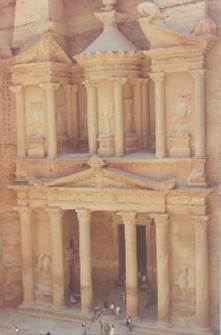
Petra in Edom
Petra is also known as Mount Seir, Mount Hor, Selah, and is Edom’s strong city.
* * *
‘The deeds of the forefathers are a blueprint for the children’, our Sages have said. Therefore lets observe how Yaaqov acted towards Edom:
Bereshit (Genesis) 32:13-20 And he lodged there that same night; and took of that which came to his hand a present for Esau his brother; Two hundred she goats, and twenty he goats, two hundred ewes, and twenty rams, Thirty milch camels with their colts, forty kine, and ten bulls, twenty she asses, and ten foals. And he delivered [them] into the hand of his servants, every drove by themselves; and said unto his servants, Pass over before me, and put a space betwixt drove and drove. And he commanded the foremost, saying, When Esau my brother meeteth thee, and asketh thee, saying, Whose [art] thou? and whither goest thou? and whose [are] these before thee? Then thou shalt say, [They be] thy servant Jacob’s; it [is] a present sent unto my lord Esau: and, behold, also he [is] behind us. And so commanded he the second, and the third, and all that followed the droves, saying, On this manner shall ye speak unto Esau, when ye find him. And say ye moreover, Behold, thy servant Jacob [is] behind us. For he said, I will appease him with the present that goeth before me, and afterward I will see his face; peradventure he will accept of me.
Bereshit (Genesis) 33:1-17 And Jacob lifted up his eyes, and looked, and, behold, Esau came, and with him four hundred men. And he divided the children unto Leah, and unto Rachel, and unto the two handmaids. And he put the handmaids and their children foremost, and Leah and her children after, and Rachel and Joseph hindermost. And he passed over before them, and bowed himself to the ground seven times, until he came near to his brother. And Esau ran to meet him, and embraced him, and fell on his neck, and kissed him: and they wept. And he lifted up his eyes, and saw the women and the children; and said, Who [are] those with thee? And he said, The children which God hath graciously given thy servant. Then the handmaidens came near, they and their children, and they bowed themselves. And Leah also with her children came near, and bowed themselves: and after came Joseph near and Rachel, and they bowed themselves. And he said, What [meanest] thou by all this drove which I met? And he said, [These are] to find grace in the sight of my lord. And Esau said, I have enough, my brother; keep that thou hast unto thyself. And Jacob said, Nay, I pray thee, if now I have found grace in thy sight, then receive my present at my hand: for therefore I have seen thy face, as though I had seen the face of God, and thou wast pleased with me. Take, I pray thee, my blessing that is brought to thee; because God hath dealt graciously with me, and because I have enough. And he urged him, and he took [it]. And he said, Let us take our journey, and let us go, and I will go before thee. And he said unto him, My lord knoweth that the children [are] tender, and the flocks and herds with young [are] with me: and if men should overdrive them one day, all the flock will die. Let my lord, I pray thee, pass over before his servant: and I will lead on softly, according as the cattle that goeth before me and the children be able to endure, until I come unto my lord unto Seir. And Esau said, Let me now leave with thee [some] of the folk that [are] with me. And he said, What needeth it? let me find grace in the sight of my lord. So Esau returned that day on his way unto Seir. And Jacob journeyed to Succoth, and built him an house, and made booths for his cattle: therefore the name of the place is called Succoth.
Yaakov’s strategy here is a sign that in the times of Mashiach (which this episode portends), the Erev Rav (the mixed multitude) will lead all Israel (a curse that we are experiencing today), the ordinary people will be next in line and the talmidei-Hakhamim last.
IV. The Number
Four
The number four signifies completion or fullness in this world.
The Sages often use the following pasuk to help us understand the number four as it relates to Pesach:
Shemot (Exodus) 6:6-7 Wherefore say unto the children of Israel, I [am] HaShem, and
1. I will bring you out from under the burdens of the Egyptians, and
2. I will rid you out of their bondage, and
3. I will redeem you with a stretched out arm, and with great judgments: And
4. I will take you to me for a people, and I will be to you a God: and ye shall know that I [am] HaShem your God, which bringeth you out from under the burdens of the Egyptians.
|
|
|
“I am HaShem and I will separate you from Egyptian bondage, |
|
|
|
Deliverance |
|
I will deliver you (through plagues), |
|
|
|
|
|
I will redeem you with an outstretched arm, |
|
|
|
Completion |
|
I will take you as My own people and I will be your God.” |
|


Our Sages teach us that the four statements speak to four exiles of Babylon, Media-Persia, Greece, and Rome:
|
I will bring you out |
|
|
I will rid you out of their bondage |
Persia |
|
I will redeem you |
Greece |
|
I will take you to me for a people |
Rome (Edom) |
Midrash Rabbah - Genesis LXXXVIII:5 On what grounds did the Sages institute the four cups of Passover? R. Huna said in R. Banayah’s name: [They instituted them] in allusion to the four expressions of redemption which occur in connection with Egypt: I will bring you out... and I will deliver you... and I will redeem you... and I will take you (Ex. VI, 6 f.). R. Samuel b. Nahman said: In allusion to the four cups mentioned in our text: AND PHARAOH’S CUP WAS IN MY HAND; AND I TOOK THE GRAPES, AND PRESSED THEM INTO PHARAOH’S CUP, AND I GAVE THE CUP INTO PHARAOH’S HAND... AND THOU SHALT GIVE PHARAOH’S CUP INTO HIS HAND (XL, II, 13). R. Levi said: In allusion to the four empires. R. Joshua b. Levi said: In allusion to the four cups of fury which the Holy One, blessed be He, will make the nations of the world to drink, as it says, For thus saith the Lord, the God of Israel, unto me: Take this cup of the wine of fury, etc. (Jer. XXV, 15); Babylon hath been a golden cup in the Lord’s hand (ib. LI, 7); For in the hand of the Lord there is a cup (Ps. LXXV, 9); And burning wind shall be the portion of their cup (ib. XI, 6). Corresponding to these the Holy One, blessed be He, will give Israel to drink four cups of salvation in the Messianic future, as it says, O Lord, the portion of mine inheritance and of my cup, Thou maintainest my lot (ib. XVI, 5); Thou preparest a table before me in the presence of mine enemies; Thou hast anointed my head with oil; my cup runneth over (ib. XXIII, 5); I will lift up the cup of salvations, and call upon the name of the Lord (ib. CXVI, 13): it does not say ‘The cup of salvation,’ but ‘The cup of salvations’--one in the days of the Messianic future and one in the days of Gog and Magog.
Midrash Rabbah - Exodus XV:6 THIS MONTH SHALL BE UNTO YOU (XII, 2). Another interpretation: It is written: Who is she that looketh forth as the dawn? (S.S. VI, 10). Four eulogies of Israel are mentioned here, corresponding with the four exiles, throughout which Israel did not deny God. How do we know that this was so in the Babylonian exile? Because it is said: ‘ Who is she that looketh forth as the dawn?’ Nebuchadnezzar used to worship the sun, as it says: How art thou fallen from heaven, O day-star, son of the morning (Isa. XIV,12), but Daniel used to rise early and pray unto the Omnipresent, for it says: Now his windows were open in his upper chamber toward Jerusalem (Dan. VI, 11), evening, morning, and noon. Why did he get up early and pray? So that God should have compassion on Israel. Concerning him does Solomon say: He that early [E.V. ‘diligently’] seeketh good seeketh favour (Prov. XI, 27). For this reason was God with them in the time of their trouble, as it is said: I love them that love me (ib. VIII, 17).6 And so we find that when Daniel was cast into the lions’ den, he was not harmed, for it says: My God hath sent His angel, and hath shut the lions’ mouths, and they have not hurt me (Dan. VI, 23). Hananiah, Mishael, and Azariah were cast into the fiery furnace but were not harmed, for it says: Nor was the hair of their head singed... nor had the smell of fire passed on them (ib. III, 27).7 Instead of which they gave light to the world, like the dawn which gives light to the world; therefore does it say: ‘ that looketh forth as the dawn.’ Moreover, they made idol-worshippers recognise God and praise Him; for when Hananiah, Mishael, and Azariah emerged from the furnace, Nebuchadnezzar said: Blessed be the God of Shadrach, Meshach, and Abed-nego, the servants of the God on High (ib28). So, too, Darius, when Daniel fell into the lions’ den, said: Let men tremble and fear the God of Daniel; for He is the living God (ib. VI, 27). Hence does it say:’ Who is she that looketh forth as the dawn?’
‘Fair as the moon’ (S.S. loc. cit.)--during the Median [i.e. Persian] captivity. You find that if the moon does not appear in the sky at night, the world is so dark that a man cannot walk about even within the city, but as soon as the moon appears in the sky, all rejoice and walk about. So it was in the days of Ahasuerus who decreed that Israel should be destroyed, slain, and made to perish; but Esther came and brought light to Israel, for it says: The Jews had light and gladness, and joy and honour (Est. VIII, 16). ‘ Fair as the moon ‘refers, therefore, to the Median captivity. Should you inquire why Esther is compared to the moon, the answer is that just as the moon renews itself every thirty days, so did Esther say: But I have not been called to come in unto the king these thirty days (ib. IV, 11). ‘Fair as the moon’ refers, therefore, to the Median captivity. ‘Clear as the sun’ (S.S. Ioc. cit.) refers to the Greek kingdom. Alexander the son of Helios was his name, and the Sun is called a hero, as it is said, He rejoiceth as a strong man to run his course (Ps. XIX, 6). During the summer cycle all flee from it [the sun], for who can endure its scorching rays, as it says: And there is nothing hid from the heat thereof (ib. 7)? Thus it was with the Greek kingdom; all were afraid of it. But Mattathias the priest and his sons stood firm in their faith in God, with the result that the Greek legions fled from before them and were all slain. Hence God said unto them: Beat your ploughshares into swords, and your pruning-hooks into spears; let the weak say: I am strong (Joel IV, 10), the verse: So perish all Thine enemies, O Lord; but they that love Him be as the sun when he goeth forth in his might (Judg. v, 31) corroborating the words, ‘clear as the sun.
They were terrible as an army with banners (S.S. VI, 10) in Edom; and why is she [Israel] called ‘terrible ‘? Because she was placed in a kingdom which inspired awe; for it says: And behold a fourth beast, dreadful and terrible, and strong exceedingly (Dan. VII, 7).
The Shulchan Aruch explicitly says that it is possible to add more cups[3] to the seder at Pesach. The one exception is that it is forbidden to add cups of wine between the third and fourth cups.[4] The Maharal explains that this halacha is connected to the four stages of redemption. It is possible to “interrupt” between the first three stages. But it is forbidden to interrupt between the third and fourth stages. The national independence of the Jewish people, “I will redeem you”, has meaning only in context of our identity as HaShem’s nation as the recipients of His Torah: “And I will take you to me as a nation, and I will be to you as G-d” -when we accept the Torah.[5]
The four expressions of the Egyptian Passover have their counterparts in the Messianic redemption:
Yehezekel (Ezekiel) 34:13-14 I will bring them out from the nations and gather them from the countries, and I will bring them into their own land. I will pasture them on the mountains of Israel, in the ravines and in all the settlements in the land. I will tend them in a good pasture, and the mountain heights of Israel will be their grazing land. There they will lie down in good grazing land, and there they will feed in a rich pasture on the mountains of Israel.
The number four signifies the completion of our exiles. The nation of Israel became full and complete upon the fulfillment of the fourth utterance of redemption, this fourth and final stage in their development.
V. The Exiles
According to our Sages, Edom is one of the four great exiles: Babylonian, Persian, Greek and Edom. The pattern for these four major exiles is found in the account of the four kings versus the five kings:
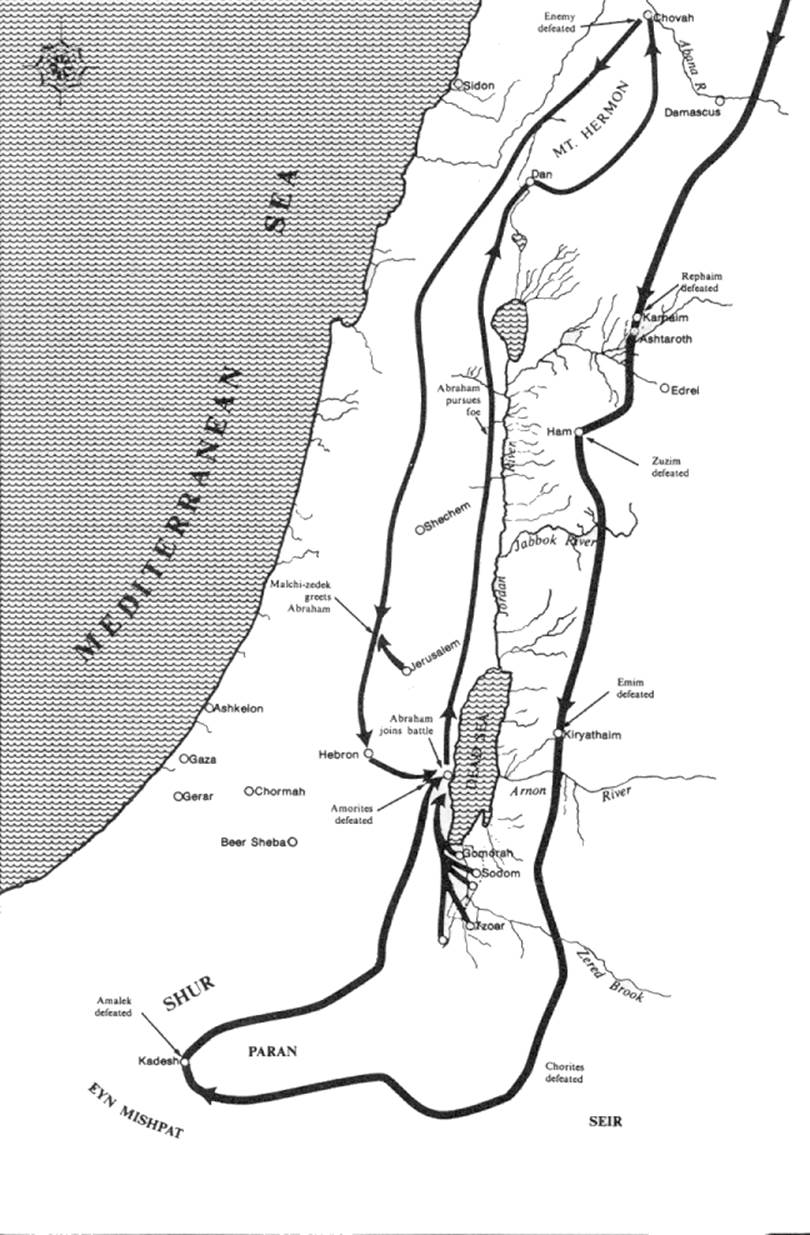
Bereshit (Genesis) 14:1-9 And it came to pass in the days of Amraphel king of Shinar, Arioch king of Ellasar, Chedorlaomer king of Elam, and Tidal king of nations: [That these] made war with Bera king of Sodom, and with Birsha king of Gomorrah, Shinab king of Admah, and Shemeber king of Zeboiim, and the king of Bela, which is Zoar. All these were joined together in the vale of Siddim, which is the salt sea. Twelve years they served Chedorlaomer, and in the thirteenth year they rebelled. And in the fourteenth year came Chedorlaomer, and the kings that [were] with him, and smote the Rephaims in Ashteroth Karnaim, and the Zuzims in Ham, and the Emims in Shaveh Kiriathaim, And the Horites in their mount Seir, unto El-paran, which [is] by the wilderness. And they returned, and came to En-mishpat, which [is] Kadesh, and smote all the country of the Amalekites, and also the Amorites, that dwelt in Hazezon-tamar. And there went out the king of Sodom, and the king of Gomorrah, and the king of Admah, and the king of Zeboiim, and the king of Bela (the same [is] Zoar;) and they joined battle with them in the vale of Siddim; With Chedorlaomer the king of Elam, and with Tidal king of nations, and Amraphel king of Shinar, and Arioch king of Ellasar; four kings with five.
The narrative, in Bereshit 14, describes the battle between the four kings and the five kings. Who were these kings and their subjects? The five kings were kings of cities in the Jordan Valley plains. The four kings were kings of cities in Babylon and Assyria. The armies of the five kings lost to the armies of the four, and subsequently served the strongest of the victors, Chedorlaomer.[6]
It is worth noting that the Amalekites are mentioned in the above pasuk long before Amalek was even born! Concerning this anomaly, the Midrash writes:
Midrash Rabbah - Genesis XLII:7 AND THEY TURNED BACK, AND CAME TO EN - MISHPAT-THE SAME IS KADESH (XIV, 7). R. Aha said: They came only in order to attack the eyeball of the world; the eye which executed judgment in the world they desire to blind! THE SAME (HI) IS KADESH: R. Aba said: This is written hu (he): it was he [Abraham] that sanctified (kiddash) the name of the Holy One, blessed be He, in the fiery furnace.1 AND THEY SMOTE ALL THE COUNTRY OF THE AMALEKITES. Amalek had not yet arisen, yet you say, AND THEY SMOTE ALL THE COUNTRY OF THE AMALEKITES! But, He declareth the end from the beginning (Isa. XLVI, 10). AND ALSO THE AMORITES, THAT DWELT IN HAZAZON--TAMAR: this means, in En-gedi of the palm-trees.3 AND THERE WENT OUT THE KING OF SODOM... FOUR KINGS AGAINST THE FIVE (XIV, 8 f.). Four kings waged war with five and defeated them.
Alternatively, this was not a battle between two alliances of cities. Rather, this was a battle between a coalition of five cities and a confederation of four countries. The four kings joined forces in order to conquer the world. The reason, therefore, that the five kings paid tribute to Chedorlaomer, wasn’t because he was the strongest of the four kings, but rather because the territory of their five cities fell out in his lot of the world[7].
The war was fought over only one thing, money.
It was midnight, we are told, when Avraham reached northern Israel and battled the four kings. Avraham’s deliverance came at midnight, as we read in the haggada. The idea of midnight is the that this is a time for prayer to be heard and redemption to be accomplished. Night time also alludes to the galut, the exile.
Midrash Rabbah - Genesis XLII:2 R. Abin said: Just as he commenced with four kings, so will he conclude with four kings. [He commences with four kings, viz.]: With Chedorlaomer king of Elam, and Tidal king of Goiim, and Amraphel king of Shinar, and Arioch king of Ellasar (Gen. XIV, 9); so he ends with four kingdoms: the kingdom of Babylon, the kingdom of Media, the kingdom of Greece, and the empire of Edom [i.e. Rome]. R. Phinehas quoted in R. Abin’s name: But they know not the thoughts of the Lord, neither understand they His counsel, for He hath gathered them as the sheaves to the threshing- floor (Micah IV, 12). Thus, why Came all these as allies (Gen. XIV, 3)? In order that they might come and fall by the hands of Abraham; hence it is written, AND IT CAME TO PASS lN THE DAYS OF AMRAPHEL, etc.
|
King’s Name |
Peshat Kingdom |
Drash Kingdom |
|
Amraphel (aka Nimrod) amar pol, meaning, “he said ‘fall’” |
Shinar |
|
|
Arioch Lion-like Man |
Elasaar |
Media |
|
Chedorlaomer (Elam son of Shem) A Handful of Sheaves |
Eylam Hidden or distant |
Greece |
|
Tidal Fear or Reverence |
Rome |
Midrash Rabbah - Genesis XLII:4 AND IT CAME TO PASS IN THE DAYS OF AMRAPHEL. He was called by three names: Cush, Nimrod, and Amraphel. Cush, because he was indeed a Cushite; Nimrod, because he incited the world to revolt (himrid) Amraphel denotes: he made a declaration (amar imrah), ‘ I will cast down (appilah).’ [Another interpretation is] that he made sport of (amar we-afle) the world, also that he made sport of Abraham; again, that he ordered Abraham to be thrown (amar we-hippil) into the furnace. ARIOCH KING OF ELLASAR. R. Jose of Milhaya said: Why are they [hazel-nuts] called elsarin? Because [they grow in the territory] of Ellasar. CHEDORLAOMER KING OF ELAM, AND TIDAL KING OF GOIIM. R. Levi said: There is a place which is so called there [sc. in Babylon], and [its inhabitants] took a certain man and made him king over them. R. Johanan said: And his name was Tidal. Another interpretation: AND IT CAME TO PASS IN THE DAYS OF AMRAPHEL KING OF SHINAR: this alludes to Babylon; ARIOCH KING OF ELLASAR: that alludes to Greece; CHEDORLAOMER KING OF ELAM: that is Media; AND TIDAL THE KING OF GOYIM [lit. ‘nations’]: this alludes to the wicked Power [i.e. Rome] which levies troops from all the nations of the world. R. Eleazar b. R. Abina said: When you see the Powers fighting each other, look for the coming [lit. ‘ feet ‘] of the King Messiah. The proof is that in the days of Abraham, because these Powers fought against each other, greatness came to Abraham.
Tidal being called the King of nations brought to mind the ‘melting pot’ that is now leading a coalition in war against a king, or kings, in the Middle East (The Gulf War)…
At the time, Abram’s star, Jupiter, was on the ascendancy, giving him additional power for success.
“Ma’aseh Avot siman l’banim”
The actions of the father are a sign for the children.
The four kings represent a world-view where everything in creation is subsumed under the “forces of nature.” This view holds that there is nothing else in this world, except this world. Four always denotes a complete set or fullness in this world.
Avraham and the five kings were focused on an existence beyond this world. This is the world view represented by the number five. Five in Hebrew is represented by the letter v heh. If you look at the letter v heh, you will see that it is composed of the letter s dalet (which stands for four) plus the letter h yud. h Yud is a unique letter. It is the only letter which doesn’t touch the line on which you write. It is no more than the smallest dot floating above the line, representing intangible, spiritual existence. The written letter v heh, then, is a pictogram of this world focused and revolving around that which is above this world — the s dalet (the “four” of this world) with the h yud of spirituality at its axis. Avraham fought on behalf of the five kings against the four kings. Avraham was the first person to look at this world and see an existence beyond. If there was a creation, there had to be a Creator. After Avram fought the war against the four kings, HaShem added a letter to his name. Not surprisingly, that letter was the letter v heh. For Avraham stood for all that the v heh represents, that this world revolves around a Higher Existence.
The number five thus represents the perfection of the natural order (the number four), with the addition of one: HaShem Himself.
Bereshit chapter 14 contains the Torah account of a cosmic battle which will reverberate till we hear the footsteps of the Mashiach. This was the cataclysmic battle of ascendancy of the great forces of the world.
The battle of the four kings against the five kings leads to victory for the four kings. These four kings, in turn, are defeated by Avraham and his trusty servant, Eliezer.
The Torah is foreshadowing Jewish, and world, history. There will be four kingdoms that will rule the world. These four will ultimately be conquered by Avraham’s descendents.
In the end of days this battle will occur again. As in the beginning, so it will be in the end. The kings of the world will fight against each other and the redeemer of the Children of Israel will defeat the victors. The captives will be set free and a tithe will be paid to the King of Righteousness.
In this next pasuk we see one of the keys to understand Edom:
Bereshit (Genesis) 25:26 And after that came his brother out, and his hand took hold on Esau’s heel; and his name was called Jacob: and Isaac [was] threescore years old when she bare them.
The final exile is called ‘Galut Edom,’ the ‘Exile of Edom’. The exile of Edom, who descended from Esau, coincides with the last 2,000 years of history referred to by the Talmud as, the ‘Footsteps of Mashiach!’
Sanhedrin 97a [Wherewith thine enemies have reproached, O Lord,’ wherewith they have reproached the footsteps of thine anointed.] it has been taught, R. Judah said: in the generation when the son of David comes, the house of assembly will be for harlots, Galilee in ruins, Gablan lie desolate, the border inhabitants wander about from city to city, receiving no hospitality, the wisdom of scribes in disfavour, God-fearing men despised, people be dog-faced, and truth entirely lacking, as it is written, Yea, truth faileth, and he that departeth from evil maketh himself a prey. What is meant by ‘yea, truth faileth [ne’edereth ]’? — The Scholars of the School of Rab said: This teaches that it will split up into separate groups and depart. What is the meaning of ‘and he that departeth from evil maketh himself a prey [mishtollel ]’? — The School of R. Shila said: He who departs from evil will be dubbed a fool by his fellow-men.
Thus we see that the Mashiach will come at the end of the galut Edom.
In the Midrash we have a similar idea with a bit of elaboration:
Pesiqta deRab Kahana, Midrashic sermons for Shabbat HaChodesh V:IX And Rabbis say, In the septennate in which the son of David comes, in the first of the seven year spell, I shall cause it to rain on one town and not on another (Amos 4:7). In the second, the arrows of famine will be sent forth. In the third there will be a great famine, and men, women, and children will die in it, and the Torah will be forgotten in Israel. In the fourth, there will be a famine which is not really a famine, and plenty which is not plentiful. In the fifth year, there will be great plenty, and people will eat and drink and rejoice, and the Torah will again be renewed. In the sixth there will be great thunders. In the seventh there will be wars. And at the end of the seventh year of that septennate, the son of David will come. Said R. Abbaye, How many septennates have there been like this one, and yet he has not come! But matters accord with what R. Yohanan said, In the generation in which the son of David comes, disciples of sages will perish, and those that remain will have faint vision, with suffering and sighing, and terrible troubles will come on the people, and harsh decrees will be renewed. Before the first such decree is carried out, another will be brought along and joined to it. Said R. Abun, In the generation in which the son of David comes, the meeting place will be turned over to prostitution, the Galilee will be destroyed, Gablan will be desolate, and the Galileans will make the rounds from town to town and find no comfort. Truthful men will be gathered up, and the truth will be fenced in and go its way. Where will it go? A member of the household of R. Yannai said, It will go and dwell in small flocks in the wilderness, in line with this verse of Scripture: Truth will be among bands (Is. 59:15). Said R. Nehorai, In the generation in which the son of David comes, youths will humiliate old men, sages will rise before youths, a slave girl will abuse her mistress, a daughter-in-law her mother-in-law, a man’s enemies will be his own householders, a son will not be ashamed for his father, the wisdom of scribes will turn rotten, the vine will give its fruit but wine will be expensive. Said R. Abba bar Kahana, The son of David will come only to a generation which is liable for total extermination. Said R. Yannai, The son of David will come only to a generation the principal leaders of which are like dogs. Said R. Levi, If you see one generation after another blaspheming, look for the footsteps of the messiah-king. What verse of Scripture indicates it? Remember Lord the taunts hurled at your servant, how I have borne in my heart the calumnies of the Gentiles; so have your enemies taunted us, 0 Lord, taunted the successors of your anointed king (Ps. 89:5 1). What follows? Blessed is the Lord for ever, amen, amen (Ps. 89:52).
The present exile is seen as an extension of the Roman exile (Edom is Rome), since culturally and legally, Western civilization shares the values and worldview of ancient Rome. A subset of this exile is that of Ishmael, the Arabs, who are seen as an antithesis of Roman civilization and values, and who will rule over the Jewish people for a time concurrently with the exile of Rome.
The exile of Ishmael and the exile of Edom are represented by the legs in the vision interpreted by Daniel:
|
|
|
|
Media |
|
|
Greece |
|
|
Rome (Edom) |
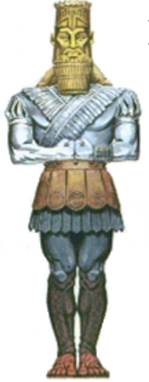
Daniel 2:31-34 Thou, O king, sawest, and behold a great image. This great image, whose brightness [was] excellent, stood before thee; and the form thereof [was] terrible. This image’s head [was] of fine gold, his breast and his arms of silver, his belly and his thighs of brass, His legs of iron, his feet part of iron and part of clay. Thou sawest till that a stone was cut out without hands, which smote the image upon his feet [that were] of iron and clay, and brake them to pieces.
In this vision, our Sages see Babylonia as corresponding to the head, as it is written:
Daniel 2:38 “… You are the head of gold.”
Some of our Sages see Media and Persia corresponding to the two arms, Greece corresponds to the body, and Edom and Ishmael correspond to the two legs. This is why the latter two exiles are long. These two exiles run concurrently. Thus we are simultaneously in the exile of Edom and the exile of Ishmael.
My Teacher, Hakham Yosef ben Haggai, and many other Sages see Edom as having two legs:
“In Daniel we see Esav as being identified as the “(two) legs of iron, his (two) feet made part of iron and part of clay” of the great image the King saw. These are the two divisions of the Esav empire today known as “the West” with a “Western leg” headed by the U.S. and the U.K. and the “Eastern leg” headed by Russia and Greece. These are also known as the Christian nations – the Western leg largely under the Roman Catholic Church and the Eastern leg largely under the Russian and Greek Orthodox churches. Messiah further tells us that these two groups of peoples are like blind men with many sincere souls found amongst them. The task of Yehuda embodied by Mashiach ben Yosef is to heal the blindness of all sincere souls found in the midst of the nations symbolized by these two legs and feet. Interestingly, the peoples of the Western nations which the Sages of the Talmud identify as drinking from the breasts of Rome before the Empire and the Catholic Church split in two (the embodiment of Esav in Rabbinic literature), have largely provided the bulk of converts to Judaism something which Islam forbade under the penalty of death. The Hakhamim identify the Muslim nation (i.e. all nations that follow Islam), with various notable exceptions, as being the descendants of Yishmael since they have partaken by converting to Islam, largely of his (Yismael’s) religion, culture and heritage.”
According to Jewish tradition we are presently in the Diaspora of Edom, the last of the four Diasporas, the one immediately preceding the arrival of the Mashiach. The Torah tells us that Esau is synonymous with Edom. And these are the descendants of Esau, he is Edom. (Bereshit 38:1) This Diaspora is also known as the Roman Diaspora. It began with the destruction of the second Temple by the Romans, and the cultural and spiritual basis of the Western world, the broader venue of this entire Diaspora was the Holy Roman Empire. The destruction of the second Temple is also coincident with the birth and rise of Christianity, the cornerstone of Western morality and ethics.
Jewish tradition gives us the following formula:
Esau=Edom=Rome=Christianity.
The name “Edom” is also used by the Sages of the Talmud for the Roman empire, and they applied to Rome every passage of the Bible referring to Edom or to Esau. In Leviticus Rabbah 23 Rome, under the name of “Edom,” is compared to a boar:
Midrash Rabbah - Leviticus XIII:5 R. Phinehas and R. Hilkiah, in the name of R. Simeon, said: Out of all the prophets, only two, namely Asaph and Moses, named it [i.e. the fourth beast]. Asaph said: The boar (hazir) out of the wood doth ravage it (Ps. LXXX, 14), Moses said: AND THE SWINE (HAZIR) BECAUSE IT PARTETH THE HOOF, AND IS CLOVEN FOOTED, BUT CHEWETH NOT THE CUD, HE IS UNCLEAN TO YOU (XI, 7). Why is it [i.e. Edom or Rome] compared to a ‘hazir’ [swine or boar]?-To tell you this: Just as the swine when reclining puts forth its hooves as if to say: See that I am clean, so too does the empire of Edom [Rome] boast as it commits violence and robbery, under the guise of establishing a judicial tribunal. This may be compared to a governor who put to death the thieves, adulterers, and sorcerers. He leaned over to a counselor and said: ‘I myself did these three things in one night.’
The Romans destroying the Holy Temple, and then the wars of Christianity against Judaism – imposing their religion ‘by the sword’, are all manifestations of Esau’s gevurah approach in his battles with the world.
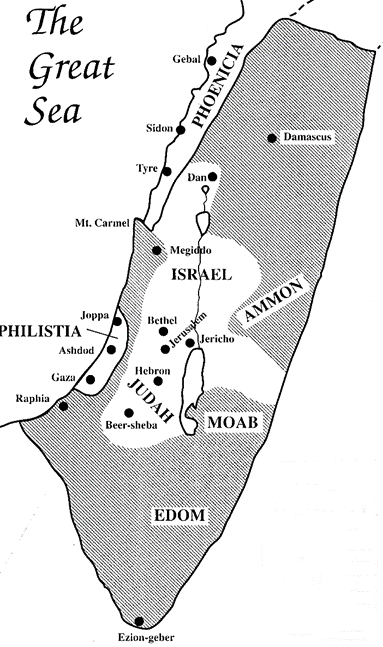
Additionally, Seir is also seen as a synonym for Edom:
Bereshit (Genesis) 32:3 And Jacob sent messengers before him to Esau his brother unto the land of Seir, the country of Edom.
Galut (exile), although appearing to us to be a negative phenomenon, actually carries the potential for the highest good. And now that we are in the last days of the final exile, we approach an era of unprecedented spirituality and goodness, for although the first and second Temples were eventually destroyed, the third Temple is to stand forever, and our coming redemption will have no exile to follow.
VI. The Land of Edom
Bereshit (Genesis) 36:20-31 These [are] the sons of Seir the Horite, who inhabited the land; Lotan, and Shobal, and Zibeon, and Anah, And Dishon, and Ezer, and Dishan: these [are] the dukes of the Horites, the children of Seir in the land of Edom. And the children of Lotan were Hori and Hemam; and Lotan’s sister [was] Timna. And the children of Shobal [were] these; Alvan, and Manahath, and Ebal, Shepho, and Onam. And these [are] the children of Zibeon; both Ajah, and Anah: this [was that] Anah that found the mules in the wilderness, as he fed the asses of Zibeon his father. And the children of Anah [were] these; Dishon, and Aholibamah the daughter of Anah. And these [are] the children of Dishon; Hemdan, and Esh-ban, and Ithran, and Cheran. The children of Ezer [are] these; Bilhan, and Zaavan, and Akan. The children of Dishan [are] these; Uz, and Aran. These [are] the dukes [that came] of the Horites; duke Lotan, duke Shobal, duke Zibeon, duke Anah, Duke Dishon, duke Ezer, duke Dishan: these [are] the dukes [that came] of Hori, among their dukes in the land of Seir. ¶ And these [are] the kings that reigned in the land of Edom, before there reigned any king over the children of Israel.
Of what interest are all the names of the Children of Seir, asks the Gra?
Simple, he replies. All the names of the Children of Seir were also names of towns in Seir which fell into the hands of Esau. And that’s what makes them important, because even though Esau’s territory was one of the ten lands promised to Avraham’s children:
Bereshit (Genesis) 15:18-21 In the same day HaShem made a covenant with Abram, saying, Unto thy seed have I given this land, from the river of Egypt unto the great river, the river Euphrates: The Kenites, and the Kenizzites, and the Kadmonites, And the Hittites, and the Perizzites, and the Rephaims, And the Amorites, and the Canaanites, and the Girgashites, and the Jebusites.
The land of Edom was one of the three that would not be given to them until the days of Mashiach. Until then, it was given to Esau. It is therefore necessary to tell us the names, so that we should know which lands not to conquer.
Rashi gives us some more insight into these three lands:
[I have given Mount Seir] to Esau for an inheritance from Abraham. I gave ten nations to Abraham, seven of them for you [the seven of Canaan], and the Kenites, the Kenizzites, and the Kadmonites (Gen. 16:18-21), who are Ammon, Moab, and Seir. One of them is for Esau, and the other two are for the children of Lot (Gen. Rabbah 44). As a reward [for Lot] for going with him [Abraham] to Egypt and for keeping silent when Abraham said, regarding his wife, “She is my sister,” He treated him [Lot] as his [Abraham’s] son [to inherit part of the land promised to Abraham] (Gen. Rabbah 44).
VII.
Juxtaposition
The way that HaShem has arranged the passages in the Torah is meant to clarify and explain events. The Torah has juxtaposed the ordinance of the red heifer with the “water from the rock” with the near war with Edom. This suggests that by understanding the red heifer we can understand the incident at Meribah. And by understanding Meribah we can then understand the war with Edom. [9]
The Brisker Rav[10] said that it is THIS specific mitzva, the mitzva of the RED HEIFER that is the key to ending the final exile, Galut Edom, the ‘Exile of Edom,’ and bringing on the ‘Final Redemption‘.
The red heifer occurs first to give us the cure:
Bamidbar (Numbers) 19:1-2 And HaShem spake unto Moses and unto Aaron, saying, This [is] the ordinance of the law which HaShem hath commanded, saying, Speak unto the children of Israel, that they bring thee a red heifer without spot, wherein [is] no blemish, [and] upon which never came yoke:
Rashi indicates that the red heifer was meant as an atonement for the sin of the golden calf.
The Arizal suggested that the giving of the law at Mt. Sinai was the same as returning to Gan Eden before the fall. In other words, the Children of Israel attained sinlessness when they accepted the Torah. At that point they were ready to usher in the Messianic age.
The way that HaShem has arranged the passages in the Torah is meant to clarify and explain events. Edom is mention in the passage adjoining the one of Moshe’s most fateful days:
Bamidbar (Numbers) 20:11-13 And Moses lifted up his hand, and with his rod he smote the rock twice: and the water came out abundantly, and the congregation drank, and their beasts [also]. And HaShem spake unto Moses and Aaron, Because ye believed me not, to sanctify me in the eyes of the children of Israel, therefore ye shall not bring this congregation into the land which I have given them. This [is] the water of Meribah, because the children of Israel strove with HaShem, and he was sanctified in them.
HaShem told Moshe and Aharon, “Since you did not believe in Me to sanctify Me...” (Bamidbar 20:12) That is, you did not believe that I would bring the water out from the rock, an impossible situation, by speaking to the rock, by simply working the spiritual controls. Survival in Eretz Israel means using one’s spiritual abilities to accomplish physical goals.
What follows this episode in the Torah?
Bamidbar (Numbers) 20:14-21 And Moses sent messengers from Kadesh unto the king of Edom, Thus saith thy brother Israel, Thou knowest all the travail that hath befallen us: How our fathers went down into Egypt, and we have dwelt in Egypt a long time; and the Egyptians vexed us, and our fathers: And when we cried unto HaShem, he heard our voice, and sent an angel, and hath brought us forth out of Egypt: and, behold, we [are] in Kadesh, a city in the uttermost of thy border: Let us pass, I pray thee, through thy country: we will not pass through the fields, or through the vineyards, neither will we drink [of] the water of the wells: we will go by the king’s [high] way, we will not turn to the right hand nor to the left, until we have passed thy borders. And Edom said unto him, Thou shalt not pass by me, lest I come out against thee with the sword. And the children of Israel said unto him, We will go by the high way: and if I and my cattle drink of thy water, then I will pay for it: I will only, without [doing] any thing [else], go through on my feet. And he said, Thou shalt not go through. And Edom came out against him with much people, and with a strong hand. Thus Edom refused to give Israel passage through his border: wherefore Israel turned away from him.
What follows this episode in the Torah? Near war with Edom, which many commentaries say is an allusion to the war with Edom at the End-of-Days. As Rashi points out more than once, sections of the Torah are placed together because their context is often a clue to their meaning and deeper message for the Children of Israel throughout history.
Hence, on one side of the episode is the red heifer, which the Brisker Rav said is a key to ending Galut Edom, and on the other side is an actual unfriendly confrontation with the people of Edom themselves, which many say is an allusion to the future and final exile itself! Sandwiched between the two is the tragic episode of Moshe hitting the rock, and the last chance for the Jewish people to bring the Final Redemption in Moshe Rabbeinu’s time, and more than likely, until the End-of-Days since Moshe is the only who possessed the ability to actually bring it early.
We must be ready to forsake this world for Olam HaBa, the world to come, or else we are doomed to lose the Olam HaBa as we succumb to this world’s allures.
* * *
Eliphaz, from the book of Iyov (Job) one a descendant of Esau:
Bereshit (Genesis) 36:16 Duke Korah, duke Gatam, [and] duke Amalek: these [are] the dukes [that came] of Eliphaz in the land of Edom; these [were] the sons of Adah.
The kings of Edom precede the kings of Israel:
Bereshit (Genesis) 36:31 And these [are] the kings that reigned in the land of Edom, before there reigned any king over the children of Israel.
The Children of Israel became greatly discouraged because they were not allowed, by the Edomites, to pass through Edom:
Bamidbar (Numbers) 20:18 And Edom said unto him, Thou shalt not pass by me, lest I come out against thee with the sword.
Bamidbar (Numbers) 20:20-21 And he said, Thou shalt not go through. And Edom came out against him with much people, and with a strong hand. Thus Edom refused to give Israel passage through his border: wherefore Israel turned away from him.
Bamidbar (Numbers) 21:4 And they journeyed from mount Hor by the way of the Red sea, to compass the land of Edom: and the soul of the people was much discouraged because of the way.
Many commentaries say that the above passage is an allusion to the war with Edom at the End-of-Days.
VIII. Escape
Our Sages have indicated that we need to study Bereshit 32 when ever we are struggling with Edom (Rome), as this passage teaches us how to deal wisely with these folks. These verse do contain the secret to our survival as a nation:
Bereshit (Genesis) 32:9 “And the remaining camp will be able to escape”
The Ramban writes that these are prophetic words which enabled the Children of Israel to survive despite the greatest persecutions. Yaaqov testified that Eisav would never be successful in wiping out the entire Jewish people.
The acts of the Patriarchs foreshadow the fate of their offspring. When Yaaqov uttered these words, it became part of HaShem’s plan: There will always be a remaining camp that will escape destruction. The Ramban cites a Midrash: ‘If Esau comes to the camp and smites them’, this refers to our brethren in the south, ‘... and the remaining camp will be spared’, this refers to our brethren in the exile.
Thus HaShem has assured our survival by dividing His people into different camps.
IX. The Fall of Edom
Edom will fall because of its transgressions:
Amos 1:11-12 Thus saith HaShem; For three transgressions of Edom, and for four, I will not turn away [the punishment] thereof; because he did pursue his brother with the sword, and did cast off all pity, and his anger did tear perpetually, and he kept his wrath for ever: But I will send a fire upon Teman, which shall devour the palaces of Bozrah.
Ah, but which nation will cause the downfall of Edom?
Yoma 10a R. Joshua b. Levi in the name of Rabbi said: Rome is designed to fall into the hand of Persia, as it was said: Therefore hear ye the counsel of the Lord, that He hath taken against Edom; and His purposes that He hath purposed against the inhabitants of Teman: surely the least of the flock shall drag them away, surely their habitation shall be appalled to them. Rabbah b. ‘Ullah demurred to this: What intimation is there that ‘the last of the flock’ refers to Persia? [Presumably] because Scripture reads: The ram which thou sawest having two horns, they are the kings of Media and Persia. But say [perhaps] it is Greece, for it is written, And the rough he-goat is the king of Greece? — When R. Habiba b. Surmaki came up, he reported this interpretation before a certain scholar. The latter said: One who does not understand the meaning of the passage asks a question against Rabbi. What does, indeed, ‘the least of the flock’ mean? The youngest of his brethren, for R. Joseph learnt that Tiras is Persia.
Rabbah b. Bar Hana in the name of R. Johanan, on the authority of R. Judah b. Ila’i, said: Rome is designed to fall into the hands of Persia, that may be concluded by inference a minori ad majus: If in the case of the first Sanctuary, which the sons of Shem [Solomon] built and the Chaldeans destroyed, the Chaldeans fell into the hands of the Persians, then how much more should this be so with the second Sanctuary, which the Persians built and the Romans destroyed, that the Romans should fall into the hands of the Persians. Rab said: Persia will fall into the hands of Rome. Thereupon R. Kahana and R. Assi asked of Rab: [Shall] the builders fall into the hands of the destroyers? — He said to them: Yes, it is the decree of the King. Others say: He replied to them: They too are guilty for they destroyed the synagogues. It has also been taught in accord with the above, Persia will fall into the hands of Rome, first because they destroyed the synagogues, and then because it is the King’s decree that the builders fall into the hands of the destroyers. Rab also said: The son of David will not come until the wicked kingdom of Rome will have spread [its sway] over the whole world for nine months, as it is said: Therefore will He give them up, until the time that she who travaileth hath brought forth; then the residue of his brethren shall return with the children of Israel.
Bamidbar (Numbers) 24:18 And Edom shall be a possession, Seir also shall be a possession for his enemies; and Israel shall do valiantly.
1 Shmuel (Samuel) 14:47 So Saul took the kingdom over Israel, and fought against all his enemies on every side, against Moab, and against the children of Ammon, and against Edom, and against the kings of Zobah, and against the Philistines: and whithersoever he turned himself, he vexed [them].
2 Shmuel (Samuel) 8:14 And he put garrisons in Edom; throughout all Edom put he garrisons, and all they of Edom became David’s servants. And HaShem preserved David whithersoever he went.
1 Divre Hayamim (Chronicles) 18:11 Them also king David dedicated unto HaShem, with the silver and the gold that he brought from all [these] nations; from Edom, and from Moab, and from the children of Ammon, and from the Philistines, and from Amalek.
1 Divre Hayamim (Chronicles) 18:13 And he put garrisons in Edom; and all the Edomites became David’s servants. Thus HaShem preserved David whithersoever he went.
Tehillim (Psalm) 137:7 Remember, HaShem, the children of Edom in the day of Jerusalem; who said, Rase [it], rase [it, even] to the foundation thereof.
Yeshayahu (Isaiah) 11:14 But they shall fly upon the shoulders of the Philistines toward the west; they shall spoil them of the east together: they shall lay their hand upon Edom and Moab; and the children of Ammon shall obey them.
Yeshayahu (Isaiah) 34:5 For my sword shall be bathed in heaven: behold, it shall come down upon Idumea, and upon the people of my curse, to judgment.
Yeshayahu (Isaiah) 34:6 The sword of HaShem is filled with blood, it is made fat with fatness, [and] with the blood of lambs and goats, with the fat of the kidneys of rams: for HaShem hath a sacrifice in Bazrah, and a great slaughter in the land of Idumea.
Yeshayahu (Isaiah) 63:1 Who [is] this that cometh from Edom, with dyed garments from Bazrah? this [that is] glorious in his apparel, travelling in the greatness of his strength? I that speak in righteousness, mighty to save.
If Esau / Edom’s success is inversely proportional to that of Yaaqov / Israel, then it follows naturally that the punishment of Edom who now enslaves us in exile will come at the same time as the redemption.
The small book written by the prophet Ovadiah contains a prophecy regarding the end of Edom:
Ovadiah 1:17-21 But upon mount Zion shall be deliverance, and there shall be holiness; and the house of Jacob shall possess their possessions. And the house of Jacob shall be a fire, and the house of Joseph aflame, and the house of Esau for stubble, and they shall kindle in them, and devour them; and there shall not be [any] remaining of the house of Esau; for HaShem hath spoken [it].And [they of] the south shall possess the mount of Esau; and [they of] the plain the Philistines: and they shall possess the fields of Ephraim, and the fields of Samaria: and Benjamin [shall possess]Gilead. And the captivity of this host of the children of Israel [shall possess] that of the Canaanites, [even] unto Zarephath; and the captivity of Jerusalem, which [is] in Sepharad, shall possess the cities of the south. And saviours shall come up on mount Zion to judge the mount of Esau; and the kingdom shall be HaShem’s.
It is interesting to note that Ovadiah was also an Edomite according to the Talmud:
Sanhedrin 39b Ephraim Maksha’ah, the disciple of R. Meir, said on the authority of R. Meir: Obadiah was an Edomite proselyte: and thus people say, From the very forest itself comes the [handle of the] axe [that fells it].
The book of Ovadiah is read, in the annual cycle, as the Haftorah for parsha Vayishlach (Bereshit 32:4 – 36:43). this portion is normally read a week or two before Chanukah.
The book of Ovadiah is read, in the triennial cycle, as the haphtarah for parsha Vayishlach (Bereshit 32:4 – 36:43). This portion is normally read around the time of Succoth, in the first year of the cycle.
The readings for this time, in the triennial cycle are:
|
Torah: |
Bereshit (Genesis) 32:4-33:17 |
|
Haftorah: |
Ovadiah (Obadiah) 1:1-21 |
|
27 |
|
|
N.C. |
Matityahu 9:27-31 |
We have a tradition from our ancestors that the weekly Parasha, for both the annual and the triennial portions, and its latent messages relate and are integrally connected to the time of year during which the Parasha is read. This gives us a time frame for the beginning and the completion of the events related to Edom.
In the end, after the destruction of the Edomite, Israel will inherit Edom’s territory.
In Bereshit 15:19 Rashi tells us that when HaShem promised Avraham that his descendants will inherit Eretz Israel, He listed the ten lands which would become part of it. HaShem told Moshe Rabeinu that they would inherit only seven nations (Devarim 7:1), as happened in the days of Yehoshua. The other three nations, Kenites, Kenizzites, and Kadmonites, will be given to us in the days of Mashiach. These three lands are better known by the names, Edom, Moav, and Ammon. HaShem later promised that He would eventually give these three lands to us when He said (Devarim 12:20), “HaShem your G-d will enlarge your border as He has promised you....”
X. Edom
in the Targum
Reading From the Targums
And Jacob sent messengers before him to Esau his brother in the land of Gabla the territory of the Edomites, and instructed them to say, Thus shall you speak to my lord Esau: Thus saith thy servant Jacob, With Laban have I dwelt, and have tarried until now. And of all that in which my father blessed me there is nothing in my hand; but I have a few oxen and asses, sheep, and servants and handmaids; and I have sent to tell my lord that that blessing hath not profited me; that I may find mercy in thine eyes and that thou mayest not maintain (enmity) against me on account thereof.
And the messengers returned to Jacob, saying, We
came to thy brother, to Esau, and he also cometh to meet thee, and four hundred chief-warriors with him. [Jerusalem.
And four hundred men, warlike leaders with him.] And Jacob was greatly afraid, because for twenty years he
had not been mindful of the glory of his father: and he had anxiety; and he
divided the people who were with him, the sheep, and oxen, and camels, into three troops, for a portion. to Leah, and a portion to
Rachel. And he said, If Esau come to the one troop of
them and smite it, the remaining troop may escape. And Jacob
said, God of my father Abraham, Thou, the God of my
father Yitzchak, the Lord, who saidst to me, Return to
thy country and to thy kindred, and I wilt do thee good: I am altogether less
than any of the (acts of) goodness and truth which Thou hast exercised towards
Thy servant: for with my staff, alone, I passed this
Jardena, and now I am become two bands.
Deliver me I pray, from the hand of my elder brother, from the hand of Esau, for I fear him: for he hath been mindful of the glory of his father; lest he come and smite the mother with the children. But Thou hast promised, I Will surely do thee good, and will make thy sons many as the sand of the sea be numbered for that cannot be numbered for multitude.
And he abode there that night; and he took what was ready at his hand a present for Esau his brother: she-goats two hundred, and he-goats twenty; ewes two hundred and rams twenty: milch camels with their young ones thirty; cows forty, and bulls ten, small colts ten..[Jerusalem. Arid small colts ten.] And he made them ready by the hand of his servants in flocks apart, and said to his servants, Pass over before me, and put much (room) between flock and flock. And he instructed the first, Saying, When Esau my brother shall meet thee, and ask of thee, saying, Whose art thou, and whither art thou journeying and whose are these before thee? Thou halt and sayth it is a gift of thy servant Jacob, which he sends to my lord Esau, and, behold, he also cometh after us. And so he instructed the second, and the third, and all them who followed the flock, saying According to these words You must speak with Esau when you find him, and say, And, behold, thy servant Jacob also cometh after us. For he said, I will make his countenance friendly by the gift which goeth before me, and afterward will see his face: peradventure he may accept me. And the present passed over before him, and he abode that night in camp And the night in the camp. And he arose in the night and took his two wives, and his two concubines, and eleven children, and went over the ford Jubeka. And taking them he made them pass over the torrent, and all that he had went over.
And Jacob remained alone beyond the Jubeka; and an Angel contended with him in the likeness of a man. And he said, Hast thou not promised to give the tenth of all that is thine? And, behold, thou hast ten sons and one daughter: nevertheless thou hast not tithed them. Immediately he set apart the four firstborn of the four mothers, and there remained eight. And he began to number from Shimeon, and Levi came up for the tenth.
Michael answered and said, Lord of the world is Thy lot. And on account of these things he (Michael) remained from God at the torrent till the column of the morning was ascending. And he saw that he had not power to hurt him, and he touched the hollow of his thigh, and the hollow of Jacob’s thigh was distorted in his contending with him.
And he said, Let me go, for the column of the morning ascendeth; and the hour cometh when the angels on high offer praise to the Lord of the world: and I am one of the angels of praise, but from the day that the world was created my time to praise hath not come until now.
And he said, I will not let thee go, until thou bless me. [JERUSALEM. And the hollow of Jacob’s thigh was displaced in contending with him. And he said, Send me away, for the column of the dawn ariseth, and, behold, the hour cometh for the angels to praise. And he said, I will not release thee until thou bless me.]
And he said, What is thy name? He answered, Jacob. And he said, Thy name shall be no more called Jacob but Israel, because thou art magnified with the angels of the Lord and with the mighty, and thou hast prevailed with them. And Jacob asked and said, Show me now thy name. And he said, Why dost thou ask for my name? And he blessed Jacob there.
And Jacob called the name of the place Peniel; for he said, I have seen the Angels of the Lord face to face, and my soul is saved. And the sun rose upon him before his time, (the sun) which on his account had set before his time, on his going out from Beersheba, as he crossed over Peniel. And he began to journey, and was lame upon his thigh. Therefore the sons of Israel eat not the sinew which shrank, which is in the hollow of the thigh of cattle and of wild animals, until this day; because the angel touched and laid hold of the hollow of the right thigh of Jacob, in the place of the sinew which shrank.
XXXIII. And Jacob lifted up his eyes and looked, and, behold, Esau came, and with him four hundred men of war. And be divided the children unto Leah, and to Rachel, and to the two concubines, and placed the concubines and their sons foremost; for he said, If Esau come to destroy the children and abuse the women, he will do it with them, and meantime we will arise and encounter him in fight; and Leah and her children after, and Rachel and Joseph after them. And he himself went over before them, praying and asking mercy before the Lord; and he bowed upon the earth seven times, until he met with his brother. And Esau ran to meet him, and embraced him, and fell upon his neck and kissed him, and they wept. Esau wept on account of the pain of his teeth which were shaken; but Jacob wept because of the pain of his neck. [JERUSALEM. And Esau ran to meet him, and hugged him, and fell upon his neck and kissed him. Esau wept for the crushing of his teeth, and Jacob wept for the tenderness of his neck.
And he lifted up his eyes and saw the wives and the children, and said, Who are these with thee? And he said, They are the souls which have been given to me through mercy from before the Lord upon thy servant. And the concubines came near, they and their children, and bowed themselves; and Leah also approached, and her children, and bowed; and afterward Joseph came near and stood before Rachel, and hid her by his stature, and they bowed. And he said, What to thee is all this troop that I have met? And he said, It is a present I have sent to find mercy in the eyes of my lord. And Esau said, I have much substance, my brother; let what thou hast be confirmed to thee. And Jacob said, Say not so, I beseech thee. If now I have found favor in thy eyes, accept my present from my hand; because I have seen the look of thy face, and it is to me as the vision of the face of thy angel; for, lo, thou art propitious to me. Receive now the present which is brought to thee, because it hath been given me through mercy from before the Lord, and because I have much substance. And he urged upon him, and he received.
And he said, Let us journey and proceed, and I will
go along with thee, till thou come to the house of thy habitation. And he said
to him, My lord knoweth that the children are tender, and the flocks and kine
giving milk are with me; and if I overdrive them one
day, all the flock may die. Let me beseech my lord to pass over and journey before thy servant, and I will lead oil quietly
alone, according to the foot of the work which is
before me, and according to the foot of the instruction
of the children; until the time that I come to my lord
at Gabla. [JERUSALEM. That the children are tender.]
And Esau said, Let me now leave with thee some of the soldiers who are with me.
But he said, Why this? Let me find favour before thee, my lord. And a miracle
was wrought for Jacob, and that day Esau returned
on his way to Gabla.
And Jacob journeyed to Succoth, and sojourned there the twelve months of the year; and he builded in it a midrasha, and for his flocks he made booths; therefore he called the name of the place Succoth.
XI. Edom
in Sefer HaYashar
Chapter 32:1-73
- And at that time Jacob sent
messengers to his brother Esau toward the land of Seir, and he spoke to him words of supplication.
- And he commanded them,
saying, Thus shall ye say to my lord, to Esau, Thus saith thy servant Jacob, Let not my lord imagine that my father’s
blessing with which he did bless me has proved beneficial to me.
- For I have been these
twenty years with Laban, and he deceived me and changed my wages ten times, as it has all been already told unto my
lord.
- And I served him in his
house very laboriously, and God afterward saw my affliction, my labor and
the work of my hands, and he caused me to find
grace and favor in his sight.
- And I afterward through God’s
great mercy and kindness acquired oxen and asses and cattle, and men
servants and maid servants.
- And now I am coming to my land and my home to my father and
mother, who are in the land of Canaan; and I have sent to let my lord know all this in order to find favor in the sight of
my lord, so that he may not imagine that I have of myself obtained wealth,
or that the blessing with which my father blessed me has benefited me.
- And those messengers
went to Esau, and found him on the borders of the land of Edom going
toward Jacob, and four
hundred men of the children of Seir the Horite were standing
with drawn swords.
- And the messengers of Jacob told Esau all the words that Jacob had spoken to them concerning Esau.
- And Esau answered them
with pride and contempt, and said unto them, Surely I have heard and truly
it has been told unto me what Jacob has done
to Laban, who exalted him in his house and gave him his daughters for
wives, and he begat sons and daughters, and abundantly increased in wealth
and riches in Laban’s house through his means.
- And when he saw that his
wealth was abundant and his riches great he fled with all belonging to
him, from Laban’s house, and he led Laban’s daughters away from the face of their father, as captives taken by the sword
without telling him of it.
- And not only to Laban
has Jacob done thus but also unto me has he
done so and has twice supplanted me, and shall I be silent?
- Now therefore I have
this day come with my camps to meet him, and I will do unto him according
to the desire of my heart.
- And the messengers
returned and came to Jacob and said unto him,
We came to thy brother, to Esau, and we told him all thy words, and thus
has he answered us, and behold he cometh to meet thee with four hundred men.
- Now then know and see what thou shalt do, and pray before God to deliver thee from him.
- And when he heard the
words of his brother which he had spoken to the messengers of Jacob, Jacob was
greatly afraid and he was distressed.
- And Jacob prayed to the
Lord his God, and he said, O Lord God of my fathers,
Abraham and Isaac, thou
didst say unto me when I went away from my father’s house, saying,
- I am the Lord God of thy
father Abraham and the God of Isaac, unto thee do I give this land and thy seed after thee, and I will make thy seed as the stars of heaven, and thou shalt spread forth to the four sides of heaven, and
in thee and in thy seed shall all the families
of the earth be blessed.
- And thou didst establish
thy words, and didst give unto me riches and children and cattle, as the
utmost wishes of my heart didst thou give unto thy
servant; thou didst give unto me all that I asked from thee, so that I
lacked nothing.
- And thou didst afterward
say unto me, Return to thy parents and to thy birth
place and I will still do well with thee.
- And now that I have
come, and thou didst deliver me from Laban, I shall fall in the hands of Esau who will slay me, yea, together
with the mothers of my children.
- Now therefore, O Lord God,
deliver me, I pray thee, also from the hands of my brother Esau, for I am greatly afraid
of him.
- And if there is no
righteousness in me, do it for the sake of Abraham
and my father Isaac.
- For I know
that through kindness and mercy have I acquired this wealth; now therefore
I beseech thee to deliver me this day with thy kindness and to answer me.
- And Jacob ceased praying to
the Lord, and he divided the people that were with him with the flocks and
cattle into two camps, and he gave the half to the
care of Damesek, the son of Eliezer, Abraham’s
servant, for a camp, with his children, and the
other half he gave to the care of his brother Elianus the son of Eliezer,
to be for a camp with his children.
- And he commanded them,
saying, Keep yourselves at a distance with your camps, and do not come too
near each other, and if Esau come to one camp and slay it, the other camp
at a distance from it will escape him.
- And Jacob tarried there that night, and during the
whole night he gave his servants instructions concerning the forces and
his children.
- And the Lord heard the prayer of Jacob on that
day, and the Lord then delivered Jacob from
the hands of his brother Esau.
- And the Lord sent three angels of the angels of heaven, and they
went before Esau and came to him.
- And these angels appeared unto Esau and his people as two thousand men, riding upon horses furnished with
all sorts of war instruments, and they appeared in the sight of Esau and
all his men to be divided into four camps, with four chiefs to them.
- And one
camp went on and they found Esau coming with four hundred
men toward his brother Jacob, and this camp ran toward Esau and his people and terrified
them, and Esau fell off the horse in alarm, and all his men separated from
him in that place, for they were greatly afraid.
- And the whole of the camp shouted after them when they fled from Esau,
and all the warlike men answered, saying,
- Surely we are the
servants of Jacob, who is the servant of God,
and who then can stand against us? And Esau said unto them, O then, my
lord and brother Jacob is your lord, whom I
have not seen for these twenty years, and now that I have this day come to
see him, do you treat me in this manner?
- And the angels answered him saying, As the Lord liveth,
were not Jacob of whom thou speaketh thy
brother, we had not let one remaining from thee and
thy people, but only on account of Jacob we
will do nothing to them.
- And this camp passed from Esau and his men and it went away,
and Esau and his men had gone from them about a league when the second camp came toward him with all sorts of weapons, and
they also did unto Esau and his men as the first camp had done to them.
- And when they had left
it to go on, behold the third camp came toward him and they were all terrified,
and Esau fell off the horse, and the whole camp
cried out, and said, Surely we are the servants of Jacob,
who is the servant of God, and who can stand against us?
- And Esau again answered
them saying, O then, Jacob my lord and your
lord is my brother, and for twenty years I have not seen his countenance
and hearing this day that he was coming, I went
this day to meet him, and do you treat me in this manner?
- And they answered him,
and said unto him, As the Lord liveth, were not Jacob
thy brother as thou didst say, we had not left a remnant from thee and thy
men, but on account of Jacob of whom thou
speakest being thy brother, we will not meddle with thee or thy men.
- And the third camp also passed
from them, and he still continued his road with his men toward Jacob, when the fourth camp came toward him, and they also did unto him
and his men as the others had done.
- And when Esau beheld the
evil which the four angels
had done to him and to his men, he became greatly afraid of his brother Jacob, and he went to meet him in peace.
- And Esau concealed his
hatred against Jacob, because he was afraid of
his life on account of his brother Jacob, and
because he imagined that the four camps that he
had lighted upon were Jacob’s servants.
- And Jacob tarried that night with his servants in
their camps, and he resolved with his servants to give unto Esau a present
from all that he had with him, and from all his property; and Jacob rose up in the morning, he and his men, and
they chose from amongst the cattle a present for Esau.
- And this is the amount
of the present which Jacob chose from his
flock to give unto his brother Esau: and he selected two
hundred and forty head
from the flocks, and he selected from the camels and asses
thirty each, and of the herds he chose fifty
kine.
- And he put them all in ten droves, and he placed each sort by itself, and he
delivered them into the hands of ten of his servants, each drove by itself.
- And he commanded them,
and said unto them, Keep yourselves at a distance from each other, and put
a space between the droves, and when Esau and those who are with him shall
meet you and ask you, saying, Whose are you, and whither do you go, and to
whom belongeth all this before you, you shall say unto them, We are the
servants of Jacob, and we come to meet Esau in
peace, and behold Jacob cometh behind us.
- And that which is before
us is a present sent from Jacob to his brother
Esau.
- And if they shall say
unto you, Why doth he delay behind you, from coming
to meet his brother and to see his face, then you
shall say unto them, Surely he cometh joyfully behind us to meet his
brother, for he said, I will appease him with the present that goeth to
him, and after this I will see his face,
peradventure he will accept of me.
- So the whole present
passed on in the hands of his servants, and
went before him on that day, and he lodged that night with his camps by
the border of the brook of Jabuk, and he rose
up in the midst of the night, and he took his wives and his maid servants,
and all belonging to him, and he that night passed them over the ford
Jabuk.
- And when he passed all
belonging to him over the brook, Jacob was
left by himself, and a man met him, and he wrestled with him that night
until the breaking of the day, and the hollow of Jacob’s
thigh was out of joint through wrestling with him.
- And at the break of day
the man left Jacob there, and he blessed him
and went away, and Jacob passed the brook at
the break of day, and he halted upon his thigh.
- And the sun rose upon him when he had passed the brook,
and he came up to the place of his cattle and children.
- And they went on till
midday, and whilst they were going the present was passing on before them.
- And Jacob lifted up his eyes
and looked, and behold Esau was at a distance, coming
along with many men, about four hundred, and Jacob was greatly afraid of his brother.
- And Jacob hastened and divided his children unto his
wives and his handmaids, and his daughter Dinah he put in a chest, and
delivered her into the hands of his servants.
- And he passed before his
children and wives to meet his brother, and he bowed down to the ground,
yea he bowed down seven times until he approached
his brother, and God caused Jacob to find grace and favor in the sight of Esau and his men,
for God had heard the prayer of Jacob.
- And the fear of Jacob and his terror fell upon his brother Esau,
for Esau was greatly afraid of Jacob for what
the angels of God had done to Esau, and Esau’s
anger against Jacob was turned into kindness.
- And when Esau saw Jacob running toward him, he also ran toward him
and he embraced him, and he fell upon his neck,
and they kissed and they wept.
- And God put fear and
kindness toward Jacob in the hearts of the men
that came with Esau, and they also kissed Jacob
and embraced him.
- And also Eliphaz, the
son of Esau, with his four brothers, sons of Esau,
wept with Jacob, and they kissed him and
embraced him, for the fear of Jacob had fallen
upon them all.
- And Esau lifted up his eyes and saw the women with their offspring, the
children of Jacob, walking
behind Jacob and bowing along the road to
Esau.
- And Esau said unto Jacob, Who are these with thee, my brother? are
they thy children or thy servants? and Jacob
answered Esau and said, They are my children which God hath graciously
given to thy servant.
- And whilst Jacob was speaking to
Esau and his men, Esau beheld the whole camp,
and he said unto Jacob, Whence didst thou get
the whole of the camp that I met yesternight?
and Jacob said, To find favor in the sight of
my lord, it is that which God graciously gave to thy servant.
- And the present came
before Esau, and Jacob pressed Esau, saying,
Take I pray thee the present that I have brought
to my lord, and Esau said, Wherefore is this my purpose? keep that which
thou hast unto thyself.
- And Jacob said, It is incumbent upon me to give all
this, since I have seen thy face, that thou still
livest in peace.
- And Esau refused to take
the present, and Jacob said unto him, I
beseech thee my lord, if now I have found favor in thy sight, then receive
my present at my hand, for I have therefore
seen thy face, as though I had seen a god-like face, because thou wast pleased with me.
- And Esau took the
present, and Jacob also gave unto Esau silver
and gold and bdellium, for he pressed him so much that he took them.
- And Esau divided the
cattle that were in the camp, and he gave the
half to the men who had come with him, for they had come on hire, and the
other half he delivered unto the hands of his
children.
- And the silver and gold
and bdellium he gave in the hands of Eliphaz
his eldest son, and Esau said unto Jacob, Let
us remain with thee, and we will go slowly along with thee until thou
comest to my place with me, that we may dwell
there together.
- And Jacob answered his brother and said, I would do
as my lord speaketh unto me, but my lord knoweth that the children are
tender, and the flocks and herds with their young who are with me, go but
slowly, for if they went swiftly they would all die, for thou knowest
their burdens and their fatigue.
- Therefore let my lord
pass on before his servant, and I will go on slowly for the sake of the
children and the flock, until I come to my lord’s place to Seir.
- And Esau said unto Jacob, I will place with thee some of the people
that are with me to take care of thee in the road, and to bear thy fatigue
and burden, and he said, What needeth it my lord, if I may find grace in thy sight?
- Behold I will come unto
thee to Seir to dwell there together as thou
hast spoken, go thou then with thy people for I will follow thee.
- And Jacob said this to Esau in order to remove Esau
and his men from him, so that Jacob might
afterward go to his father’s house to the land of Canaan.
- And Esau hearkened to
the voice of Jacob, and Esau returned with the
four hundred men that were with him on their road
to Seir, and Jacob and all belonging to him
went that day as far as the extremity of the land of Canaan in its
borders, and he remained there some time.
XII. My Teacher’s
comments
In Sefer Mishlei (Book of Proverbs) we read: “As a troubled fountain and a corrupted spring, so is the righteous man (Heb. Tzadik) that gives way before the wicked. It is not good to eat much honey; so for men to search out their own glory is not glory” (Mishlei 25:26-27. The Midrash comments on the first verse:
Bereshit Rabba 75.2 R. Judah b. R. Simon commenced his discourse: As a troubled fountain, and a corrupted spring, so is a righteous man that giveth way before the wicked (Prov. XXV, 26). As a fountain cannot be [permanently] troubled [muddied] nor a spring [permanently] corrupted, so is it impossible for the righteous to sink [permanently] before the wicked; and as a troubled fountain and a corrupted spring, so is a righteous man who abases himself before the wicked [It is unworthy for a righteous man to act thus. The word ‘permanently’ is added in order to reconcile what is otherwise an obvious contradiction. Th., however, proposes that the passage be emended: As it is possible for a fountain to be troubled, etc]. Said the Holy One, blessed be He, to him [Jacob]: ‘He [Esau] was going his own way, yet thou didst send to him, saying, THUS SAITH THY SERVANT JACOB.’
R. Judah is correctly reading Mishlei 25:26 based upon the statement of King Shlomo in the previous chapter of his work – Mishlei 24:16 – “For a righteous man (Heb. Tzadik) falls seven times, and rises up again, but the wicked stumble under adversity.” Hakham Bachya ben Asher of blessed memory joins these two passages together with a parable:
Mishlei (Proverbs) 25:26 with 24:16 “For the righteous will rise even if he falls seven times.” In the end he will regain his composure and his honour and dignity. The whole matter can be compared to a well of spring water which someone steps into and momentarily causes the water in that well to become murky. After a short while of leaving those waters to themselves they will become clear again. Similarly, the righteous will regain his composure and hence his dignity. The wicked is unable to permanently suppress the superior qualities of the righteous.”
And concerning Mishlei 25:27, Hakham Bachya comments:
“Having told us that it is impossible to permanently sully and debase the reputation of a righteous person, just as it is impossible to permanently pollute such waters as he had described, Solomon goes on to say that one must investigate, i.e. seek out and praise the good qualities of the righteous. He describes the more ethical value of discovering these good qualities of the righteous by a conscious effort to find these qualities as something better than eating a lot of honey. Whereas the consumption of too much honey is not beneficial, spending a lot of effort in finding the good character qualities of the righteous is a very worthwhile discipline and trains a person to think along the right lines. There can be no question that praising the character of a righteous person is the result of a good nature, one that seeks out the good in a person rather than the negative qualities he may have. This is why Solomon describes the time spent extolling the righteous, the virtuous, as better than the time spent eating honey. The reverse is true of someone who praises good qualities he has found in a wicked person. This reflects bad characteristics of the person doing so and if persisted in will lead to the one who thought he had discovered “goodness” in the wicked person praising him altogether, not just a particular good characteristic he had discovered in such a person. It is a psychological truth that a person is apt to extol the virtues of people whose general characteristics he shares, i.e. when you hear who praises whom you know that they are “birds of a feather.” In Chapter 28:4-5 of his Book of Proverbs Solomon is on record stating:
“They that forsake the Torah praise the wicked; but such as keep the Torah contend with them. Evil men understand not justice; but they that seek HaShem understand all things.”
That is, “praising a wicked person is typical of someone who has abandoned the path of Torah.” The reason is simply that people have a habit of praising those with whom they have the most in common. Kind David already made the same point in Psalms 15:4, when he said: “but who honours those that fear Ha-Shem.” Our Sages in Makkot 24 understood this verse to apply to Yehoshaphat, King of Yehudah, who used to rise from his chair when he saw a Torah Scholar and who would embrace him and kiss him and call him ‘my teacher.’ …
We must remember that when Yaakov displayed a demeaning attitude when bowing repeatedly to Esau the wicked and addressing him as “my master,” as well as when sending gifts to him, this was all part of Yaakov’s momentary weakness though in the end he roused himself and assumed the posture fitting to a man of his stature.”
We started this new year and this month of Tishri with a slice of apple dipped in honey, not only to wish our loved ones, Israel and ourselves a sweet year but also to symbolize that we start the year by recommitting ourselves to “investigate, i.e. seek out and praise the good qualities of the righteous” which are more profitable and precious than honey. Surely all Tzaddikim have sins and imperfections but their good traits and virtues fall outweigh and excel all their sins and imperfections put together.
Interestingly we also find in our portion of Matityahu for this Shabbat this theme of “seeking out and praising the good qualities of the righteous.” There we read:
Matityahu 9:27-31 “And as Yeshua passed by from thence, two blind men followed him, crying out, and saying, ‘Have mercy on us, you son of David.’ And when he was come to the house, the blind men came to him. And Yeshua says to them, ‘Do you believe that I am able to do this?’ They say to him, ‘Yes, Master.’ Then he touched their eyes, saying, ‘According to your faith be it done unto you.’ And their eyes were opened. And Yeshua sternly charged them, saying, ‘See that no man know this.’ They, however, going forth, made him known throughout the whole of that land.”
There is a most interesting statement on the part of Yaaqov made in Bereshit 32:6 – “and I have oxen, and asses, sheep, and bondmen, and bondwomen; and I have sent to tell my Master, that I may find favour in your eyes.” Hakham Bachya comments on this statement:
“Yaaqov mentioned his great wealth by understating it, i.e. as if he had only acquired a single ox, and a single donkey, etc., as he did not want to appear boastful. He followed the dictates of Jeremiah 9:22 – “let not the wealthy boast of his wealth.” It is customary for all righteous people to belittle themselves and their belongings. The wicked by contrast, boast of their wealth as we see from Esau who claimed “I own a great deal” (Bereshit 33:9). Actually if the Torah had followed its own rules, it would have mentioned the sheep first, seeing that the category of sheep and goats, is the most superior species amongst the animals. We find that the Torah does so in the case of Avraham (Bereshit 12:16) – “and he treated Avram well on her account so the he acquired (flocks of) sheep and (herds of) cattle, etc.” We find a similar sequence in the way the Torah describes Yitzchak’s wealth (Bereshit 26:14) – “he acquired flocks of sheep and herds of cattle.” We also find this order of Yaaqov’s wealth when the Torah describes it in 30:43 – “ he acquired many sheep and maid-servants and men-servants and camels and donkeys.” You will note that in all of these instances the sheep (and goats) are mentioned first. If Yaaqov did not want to mention first this was because Esau had “lost” his blessing on account of these goats. Rivka had sent Yaaqov to the herds instructing him to select two good goats to prepare a meal for Yitzchak which could compete with the venison Esav was expected to hunt (Bereshit 27:9). Mentioning the goats first would have sounded like rubbing salt in Esav’s wound. It is interesting to note that after the angels (ministers) had returned to Yaaqov with their report of Esav approaching in a hostile manner, the Torah describes Yaaqov as dividing his earthly possessions into two camps (Bereshit 32:8) Again the Torah lists the flocks of sheep and goats first before any other livestock. Even after Yaaqov and Esav had reconciled and Esav had accepted Yaaqov’s gifts as a sign of reconciliation, the Torah again lists the flocks of sheep and goats first in Bereshit 33:13.
A Midrashic (Tanchuma Vayishlach 1 – a Halachic Midrash) approach to our question: “Why did Yaaqov first mention the fact that he had acquired “oxen”? He hinted that Yosef, who was to be known as “SHUR” (ox), had already been born. Yosef was to be the natural enemy of Esav and what Esav represented. When describing future events, the prophet Ovadiah 1:18 uses Yosef as symbolic of the entire Jewish people when he predicts: “and the house of Yosef flame, and the house of Esav straw; they shall burn it and devour it, and no survivor will be left of the house of Esav, for HaShem has spoken.” In Devarim 33:17, when Moshe blesses the Jewish people, he wrote of Yosef: “like the firstling bull in his majesty, he has horns like the horns of a wild ox.”
Back again, our portion of Matityahu in a parable identifies also Esav as consisting of two peoples who are stricken with the same disease. Similarly in Daniel we see Esav as being identified as the “(two) legs of iron, his (two) feet made part of iron and part of clay” of the great image the King saw. These are the two divisions of the Esav empire today known as “the West” with a “Western leg” headed by the U.S. and the U.K. and the “Eastern leg” headed by Russia and Greece. These are also known as the Christian nations – the Western leg largely under the Roman Catholic Church and the Eastern leg largely under the Russian and Greek Orthodox churches. Mashiach further tells us that these two groups of peoples are like blind men with many sincere souls found amongst them. The task of Yehuda embodied by Mashiach ben Yosef is to heal the blindness of all sincere souls found in the midst of the nations symbolized by these two legs and feet. Interestingly, the peoples of the Western nations which the Sages of the Talmud identify as drinking from the breasts of Rome before the Empire and the Catholic Church split in two (the embodiment of Esav in Rabbinic literature), have largely provided the bulk of converts to Judaism something which Islam forbad under the penalty of death. The Hakhamim identify the Muslim nation (i.e. all nations that follow Islam), with various notable exceptions, as being the descendants of Yishmael since they have partaken by converting to Islam, largely of his (Yismael’s) religion, culture and heritage.
What is more important though is the way that Yehuda will heal the blindness of the sincere souls of these two legs of Esav. On a Peshat Level through literacy, technological and medical advances (something which the West - including the nations of the Eastern Roman empire excel over all the Islamic nations put together), and from a Drash level through the teaching of Torah (both Written and Oral) to all men of good will. This places a great calling upon those who call themselves Nazareans to be among the best in their profession or trade as well as the calling to be the best teachers of Torah to the Gentiles (a perfect embodiment of Mashiach ben Yosef).
There is also here in the Midrash of Matityahu a wonderful play on words between the Hebrew words “Shur” (Strong’s # 7789 = “to appear” or “to be seen”) and “Shor” (Strong’s # 7794 = “ox”) which are spelled the same except for the pointing in the letter “vav” in a pointed Hebrew text. The gifts, given prior to the meeting between two dignitaries, are like the offerings made when one appears before HaShem on the festivals, called in the Mishna olat re’iyah. The root of re’iyah means “to see”. So too the biblical word teshura (I Sam. 9:7), meaning present or gift, comes from the root sh-u-r, meaning to appear, be seen. In other words, he who gives the gift of sight (both physical and spiritual) – “sh-u-r” - also is the physical manifestation of the “sh-o-r” – “ox” – (Mashiach ben Yosef).
With these explanations in mind it now becomes rather easy to understand the Prophecy of Sefer Ovadiah (Book of Obadiah). Please remember that the nations of Christian West and East are the two legs of Esav, and that the nation of Islam (the majority of nations following Islam) are represented by Ishmael. In fact, the Rambam (Maimonides) of blessed memory calls the founder of Islam in his treatise on “The Laws of Kings”: “that Ishmaelite.” Perhaps then after reading this short book with this understanding we can see more clearly the meaning of present events as well as those over the last two weeks.
Hakham Dr. Yosef ben Haggai
XIII. The Song of Moses
According to Jewish Tradition, this Song relates to the Future, the “Acharit HaYamim,” the End of Days, the Time of the Mashiach:
Shemot (Exodus) 15:1-19 Then sang Moses and the children of Israel this song unto HaShem, and spake, saying, I will sing unto HaShem, for he hath triumphed gloriously: the horse and his rider hath he thrown into the sea. HaShem [is] my strength and song, and he is become my salvation: he [is] my God, and I will prepare him an habitation; my father’s God, and I will exalt him. HaShem [is] a man of war: HaShem [is] his name. Pharaoh’s chariots and his host hath he cast into the sea: his chosen captains also are drowned in the Red sea. The depths have covered them: they sank into the bottom as a stone. Thy right hand, HaShem, is become glorious in power: thy right hand, HaShem, hath dashed in pieces the enemy. And in the greatness of thine excellency thou hast overthrown them that rose up against thee: thou sentest forth thy wrath, [which] consumed them as stubble. And with the blast of thy nostrils the waters were gathered together, the floods stood upright as an heap, [and] the depths were congealed in the heart of the sea. The enemy said, I will pursue, I will overtake, I will divide the spoil; my lust shall be satisfied upon them; I will draw my sword, my hand shall destroy them. Thou didst blow with thy wind, the sea covered them: they sank as lead in the mighty waters. Who [is] like unto thee, HaShem, among the gods? who [is] like thee, glorious in holiness, fearful [in] praises, doing wonders? Thou stretchedst out thy right hand, the earth swallowed them. Thou in thy mercy hast led forth the people [which] thou hast redeemed: thou hast guided [them] in thy strength unto thy holy habitation. The people shall hear, [and] be afraid: sorrow shall take hold on the inhabitants of Palestina. Then the dukes of Edom shall be amazed; the mighty men of Moab, trembling shall take hold upon them; all the inhabitants of Canaan shall melt away. Fear and dread shall fall upon them; by the greatness of thine arm they shall be [as] still as a stone; till thy people pass over, HaShem, till the people pass over, [which] thou hast purchased. Thou shalt bring them in, and plant them in the mountain of thine inheritance, [in] the place, HaShem, [which] thou hast made for thee to dwell in, [in] the Sanctuary, HaShem, [which] thy hands have established. HaShem shall reign for ever and ever. For the horse of Pharaoh went in with his chariots and with his horsemen into the sea, and HaShem brought again the waters of the sea upon them; but the children of Israel went on dry [land] in the midst of the sea.
* * *
Shoftim 5:4 HaShem, when thou wentest out of Seir, when thou marchedst out of the field of Edom, the earth trembled, and the heavens dropped, the clouds also dropped water.
Shoftim 11:17 Then Israel sent messengers unto the king of Edom, saying, Let me, I pray thee, pass through thy land: but the king of Edom would not hearken [thereto]. And in like manner they sent unto the king of Moab: but he would not [consent]: and Israel abode in Kadesh.
Shoftim 11:18 Then they went along through the wilderness, and compassed the land of Edom, and the land of Moab, and came by the east side of the land of Moab, and pitched on the other side of Arnon, but came not within the border of Moab: for Arnon [was] the border of Moab.
1 Melachim 9:26 And king Solomon made a navy of ships in Ezion-geber, which [is] beside Eloth, on the shore of the Red sea, in the land of Edom.
1 Melachim 11:14 And HaShem stirred up an adversary unto Solomon, Hadad the Edomite: he [was] of the king’s seed in Edom.
1 Melachim 11:15 For it came to pass, when David was in Edom, and Joab the captain of the host was gone up to bury the slain, after he had smitten every male in Edom;
1 Melachim 11:16 (For six months did Joab remain there with all Israel, until he had cut off every male in Edom:)
1 Melachim 22:47 [There was] then no king in Edom: a deputy [was] king.
2 Melachim 3:8 And he said, Which way shall we go up? And he answered, The way through the wilderness of Edom.
2 Melachim 3:9 So the king of Israel went, and the king of Judah, and the king of Edom: and they fetched a compass of seven days’ journey: and there was no water for the host, and for the cattle that followed them.
2 Melachim 3:12 And Jehoshaphat said, The word of HaShem is with him. So the king of Israel and Jehoshaphat and the king of Edom went down to him.
2 Melachim 3:20 And it came to pass in the morning, when the meat offering was offered, that, behold, there came water by the way of Edom, and the country was filled with water.
2 Melachim 3:26 And when the king of Moab saw that the battle was too sore for him, he took with him seven hundred men that drew swords, to break through [even] unto the king of Edom: but they could not.
2 Melachim 8:20 In his days Edom revolted from under the hand of Judah, and made a king over themselves.
2 Melachim 8:22 Yet Edom revolted from under the hand of Judah unto this day. Then Libnah revolted at the same time.
2 Melachim 14:7 He slew of Edom in the valley of salt ten thousand, and took Selah by war, and called the name of it Joktheel unto this day.
2 Melachim 14:10 Thou hast indeed smitten Edom, and thine heart hath lifted thee up: glory [of this], and tarry at home: for why shouldest thou meddle to [thy] hurt, that thou shouldest fall, [even] thou, and Judah with thee?
1 Divre Hayamim 1:43 Now these [are] the kings that reigned in the land of Edom before [any] king reigned over the children of Israel; Bela the son of Beor: and the name of his city [was] Dinhabah.
1 Divre Hayamim 1:51 Hadad died also. And the dukes of Edom were; duke Timnah, duke Aliah, duke Jetheth,
1 Divre Hayamim 1:54 Duke Magdiel, duke Iram. These [are] the dukes of Edom.
2 Divre Hayamim 8:17 Then went Solomon to Ezion-geber, and to Eloth, at the sea side in the land of Edom.
2 Divre Hayamim 25:20 But Amaziah would not hear; for it [came] of God, that he might deliver them into the hand [of their enemies], because they sought after the gods of Edom.
Tehillim 60:1 {To the chief Musician upon Shushaneduth, Michtam of David, to teach; when he strove with Aram-naharaim and with Aram-zobah, when Joab returned, and smote of Edom in the valley of salt twelve thousand.} o God, thou hast cast us off, thou hast scattered us, thou hast been displeased; O turn thyself to us again.
Tehillim 60:8 Moab [is] my washpot; over Edom will I cast out my shoe: Philistia, triumph thou because of me.
Tehillim 60:9 Who will bring me [into] the strong city? who will lead me into Edom?
Tehillim 83:6 The tabernacles of Edom, and the Ishmaelites; of Moab, and the Hagarenes;
Tehillim 108:9 Moab [is] my washpot; over Edom will I cast out my shoe; over Philistia will I triumph.
Tehillim 108:10 Who will bring me into the strong city? who will lead me into Edom?
Yirmeyahu 9:26 Egypt, and Judah, and Edom, and the children of Ammon, and Moab, and all [that are] in the utmost corners, that dwell in the wilderness: for all [these] nations [are] uncircumcised, and all the house of Israel [are] uncircumcised in the heart.
Yirmeyahu 25:21 Edom, and Moab, and the children of Ammon,
Yirmeyahu 27:3 And send them to the king of Edom, and to the king of Moab, and to the king of the Ammonites, and to the king of Tyrus, and to the king of Zidon, by the hand of the messengers which come to Jerusalem unto Zedekiah king of Judah;
Yirmeyahu 40:11 Likewise when all the Jews that [were] in Moab, and among the Ammonites, and in Edom, and that [were] in all the countries, heard that the king of Babylon had left a remnant of Judah, and that he had set over them Gedaliah the son of Ahikam the son of Shaphan;
Yirmeyahu 49:7 ¶ Concerning Edom, thus saith HaShem of hosts; [Is] wisdom no more in Teman? is counsel perished from the prudent? is their wisdom vanished?
Yirmeyahu 49:17 Also Edom shall be a desolation: every one that goeth by it shall be astonished, and shall hiss at all the plagues thereof.
Yirmeyahu 49:20 Therefore hear the counsel of HaShem, that he hath taken against Edom; and his purposes, that he hath purposed against the inhabitants of Teman: Surely the least of the flock shall draw them out: surely he shall make their habitations desolate with them.
Yirmeyahu 49:22 Behold, he shall come up and fly as the eagle, and spread his wings over Bazrah: and at that day shall the heart of the mighty men of Edom be as the heart of a woman in her pangs.
Eicha 4:21 Rejoice and be glad, O daughter of Edom, that dwellest in the land of Uz; the cup also shall pass through unto thee: thou shalt be drunken, and shalt make thyself naked.
Eicha 4:22 The punishment of thine iniquity is accomplished, O daughter of Zion; he will no more carry thee away into captivity: he will visit thine iniquity, O daughter of Edom; he will discover thy sins.
Yechezkel 25:12 Thus saith the Lord HaShem; Because that Edom hath dealt against the house of Judah by taking vengeance, and hath greatly offended, and revenged himself upon them;
Yechezkel 25:13 Therefore thus saith the Lord HaShem; I will also stretch out mine hand upon Edom, and will cut off man and beast from it; and I will make it desolate from Teman; and they of Dedan shall fall by the sword.
Yechezkel 25:14 And I will lay my vengeance upon Edom by the hand of my people Israel: and they shall do in Edom according to mine anger and according to my fury; and they shall know my vengeance, saith the Lord HaShem.
Yechezkel 32:29 There [is] Edom, her kings, and all her princes, which with their might are laid by [them that were] slain by the sword: they shall lie with the uncircumcised, and with them that go down to the pit.
Yechezkel 35:15 As thou didst rejoice at the inheritance of the house of Israel, because it was desolate, so will I do unto thee: thou shalt be desolate, O mount Seir, and all Idumea, [even] all of it: and they shall know that I [am] HaShem.
Yechezkel 36:5 Therefore thus saith the Lord HaShem; Surely in the fire of my jealousy have I spoken against the residue of the heathen, and against all Idumea, which have appointed my land into their possession with the joy of all [their] heart, with despiteful minds, to cast it out for a prey.
Daniel 11:41 He shall enter also into the glorious land, and many [countries] shall be overthrown: but these shall escape out of his hand, [even] Edom, and Moab, and the chief of the children of Ammon.
Yoel 3:19 Egypt shall be a desolation, and Edom shall be a desolate wilderness, for the violence [against] the children of Judah, because they have shed innocent blood in their land.
Amos 1:6 Thus saith HaShem; For three transgressions of Gaza, and for four, I will not turn away [the punishment] thereof; because they carried away captive the whole captivity, to deliver [them] up to Edom:
Amos 1:9 Thus saith HaShem; For three transgressions of Tyrus, and for four, I will not turn away [the punishment] thereof; because they delivered up the whole captivity to Edom, and remembered not the brotherly covenant:
Amos 1:11 Thus saith HaShem; For three transgressions of Edom, and for four, I will not turn away [the punishment] thereof; because he did pursue his brother with the sword, and did cast off all pity, and his anger did tear perpetually, and he kept his wrath for ever:
Amos 2:1 Thus saith HaShem; For three transgressions of Moab, and for four, I will not turn away [the punishment] thereof; because he burned the bones of the king of Edom into lime:
Amos 9:12 That they may possess the remnant of Edom, and of all the heathen, which are called by my name, saith HaShem that doeth this.
Ovadiah 1:1 The vision of Obadiah. Thus saith the Lord HaShem concerning Edom; We have heard a rumor from HaShem, and an ambassador is sent among the heathen, Arise ye, and let us rise up against her in battle.
Ovadiah 1:8 Shall I not in that day, saith HaShem, even destroy the wise [men] out of Edom, and understanding out of the mount of Esau?
Malachi 1:4 Whereas Edom saith, We are impoverished, but we will return and build the desolate places; thus saith HaShem of hosts, They shall build, but I will throw down; and they shall call them, The border of wickedness, and, The people against whom HaShem hath indignation for ever.
XIV. Ishmael
HaRav Elchonon Wasserman says every event that takes place in the world is intended exclusively for Israel (Koveitz Maamorim, Zechor Yemos Olom).
Despite the great hardships we are suffering at the hands of the Arabs, i.e. Malchut Ishmael, we must keep in mind that we are in Galut Edom, the last galut, which will continue until the arrival of Mashiach, as explained by Chazal in many places[11].
Malchut Yishmael
Since we are in Galut Edom, we must clarify the task of Malchut Ishmael during the footsteps of the Mashiach at the end of Galut and the meaning behind the calamities we and the entire world are suffering at the hands of the Ishmaelite Kingdom. The Maharal and Pachad Yitzchak explain why Malchut Ishmael was not among the four kingdoms (i.e. galuyot) mentioned in Daniel: “The four kingdoms received their power as the result of the fall of Israel [according to the historical pattern of] one nation falls and the next rises. Therefore when the people of Israel sinned and descended from their spiritual elevation, they fell into the hands of each of the kingdoms and were enslaved. However Ishmael does not receive its power through the fall of Israel, but has a special power from HaShem Himself in the merit of their descent from Avraham Avinu:
Bereshit (Genesis) 17:20 And as for Ishmael I have heard thee. Behold, I have blessed him and will make him fruitful and will multiply him exceedingly . . .
And this power allows them to overcome and oppose Am Israel.”
Understanding the Current Period
The Ishmaelites have undermined the peace of mind of the materialistic life and have induced a worldwide state of fear of havoc and destruction.
This appears to be more than a temporary trend: various observers say that the world is heading toward a sharp polarization -- modern, Western culture versus traditional and conservative Arab culture, and that a collision between these two powers is inevitable.
(In fact the War of Gog and Magog is described as a war between Edom and Yishmael “because their beliefs are divergent” [Malbim, Yechezkel 32:17].) As bin Laden said, “Americanization pollutes the Islamic home” (quoted in Thomas Friedman’s Luxury and the Olive Tree).)
* * *
Yalkut Shimoni (421): Rabbi Yishmael would say: Three wars of confusion will be waged by the Bnei Yishmael in the future at the end of days. One at sea and with drawn bow, one on dry land with drawn sword, and one on a great city which is worse than the other two, as it says, “and because of the severity of war” and from there Ben David will sprout and will see the destruction of these and those, and from there he will come to Eretz Yisrael, as it says, “who is this who comes from Edom...why are your clothes red...for it is a day of vengeance in my heart... (Melachim remez 261).
* * *
When Hagar had her child, HaShem told her to name him “ Ishmael,” which literally means that G-d listened to her prayers. But the Midrash informs us that this word means “Yishma Kel - G-d will listen,” for it prophetically revealed that Ishmael’s descendants, the Arabs, would generate many Jewish prayers, causing HaShem to listen to the urgent cries of His people. How amazing! A boy is born to a former bondmaid and a prophecy is revealed that, thousands of years later, his myriad descendants would repeatedly cause Tehillim to be said by Jews all around the world.
Indeed the description of Ishmael is replete with amazing prophecy. The description that he will be a “a wild (ass-like) man” is a perfect description of the Arab mentality. Who else would send little children with rocks to confront high-tech tanks? Who else but a wild subhuman people would go on suicide mission after suicide mission? And what about the testimony of what the pasuk says, “And everyone’s hands will be in him,” which the Targum translates to mean “That all will need him.” How awesome a prophecy this is, that nations - world over - are in urgent need of Arab oil. And what about the verse that tells us “That he (Ishmael’s descendants) will dwell on the face of all of his brethren.” How uncannily accurate is this description of how the Arabs totally encircle the Jewish people, literally camping upon all of their borders.
Ishmael’s (the Arabs of today) rights in eretz Israel can be exercised when the Jews do not exercise their blessing of clinging to HaShem. Thus, our struggle with Ishmael for the rights to Eretz Israel is not simply a physical struggle, but a spiritual one as well. It will be successful when we realize the blessing of spiritual connectedness that HaShem gave to Avraham, and that was transmitted to us through our father Yitzchak.
This is also why our sages refer to the final stages of the exile as “the heels of the Mashiach,” for in that time it will be necessary to elevate [the Divine sparks] that have become enmeshed in the lowest elements [of these exiles], the feet.
Zohar Torah portion of Va’era page 32a Come and see - for four hundred years the supervising angel of Yishmael beseeched G-d. He said “whoever is circumcised has a portion with you?” G-d replied, “Yes.” He said, “Well, Yishmael is circumcised; how come he doesn’t have a portion with you like Yitzchak?” G-d replied, “This one (Yitzchak) is circumcised properly, and this other one (Yishmael) is not. Also, this one does it properly on the eighth day.” He asked him “And despite all this, even though he is circumcised he gets no reward?” G-d responded by distancing the children of Yishmael from Himself in the upper worlds, and He gave them a portion below in the Holy land, because they are circumcised. In the future, the children of Yishmael will rule over the Holy land for a long time while the land is empty, just as their circumcision is empty and without completion. And they will hinder the children of Israel from returning to their place, until their merit in the Holy land runs out. In the future the children of Yishmael will stir great wars in the world. And the children of Edom [the West] will gather against them, and make war with them, one on the sea, and one on the land, and one by Jerusalem; and each one will prevail over the other but the Holy land will not fall to the hands of Edom. At the same time, a nation from the end of the world will be awakened against wicked Rome.(Rome here is said to refer to the spiritual center of western civilization) and it will make war against her for three months, and many nations will gather there, and they will fall by her hand, until all the children of Edom will gather against her from all corners of the earth. And then G-d will awaken Himself against them, as it says, “a sacrificial slaughter for the Lord in Batzra”, and it says, “to shake the corners of the Land”. And after this, the children of Yishmael will be finished from the world. And all the supernal powers of the nations will be broken, and no power will remain above except for the power of Israel alone.
* * *
“The Arabs will evoke many battles around the world invoking Edom [the descendents of Esav—another great bargain!] into fierce battles at sea, on land and near Jerusalem. They will attack and conquer each other…and additional armies will join the battle…Until God ‘will grab the corners of the Land [and the wicked will be shaken from it]’ (Job 38:13). He will remove the children of Ishmael from the Land…Then, I will transform all the nations into a pure tongue, that all shall call in God’s Name and serve Him in unity (Zephaniah 3:9).”
All this is stated in the Zohar, written by Rabbi Shimon bar Yochai some 1800 years ago.
The lives of the Patriarchs foreshadow events in the lives of their descendants. Just as Yaakov emerged from his battle with Esav victoriously, so should we merit redemption from our exile, and reach the heights of Yisrael.
If we ever wonder why Jews have so much ‘trouble’ from the Arabs, like everything else in world history, it can be traced back to “The actions of the Patriarchs foreshadow the actions that happen to the children.” This lack of compassion that was manifested by Sarah, in the treatment of Hagar. was the cause, as the Ramban points out, of the persecution manifested by the descendants of Ishmael to the Jewish people:
Bereshit (Genesis) 16:4-6 And he went in unto Hagar, and she conceived: and when she saw that she had conceived, her mistress was despised in her eyes. And Sarai said unto Abram, My wrong [be] upon thee: I have given my maid into thy bosom; and when she saw that she had conceived, I was despised in her eyes: HaShem judge between me and thee. But Abram said unto Sarai, Behold, thy maid [is] in thy hand; do to her as it pleaseth thee. And when Sarai dealt hardly with her, she fled from her face.
XV. The Great battle
The Sages speak about a great battle between Edom and Ishmael. This great battle was foreshadowed by the Crusaders against the Turks in their battles for control of Eretz Israel. The final battle between these two titans will make the crusades pale in significance. The final battle between these two peoples was mentioned in Pirke De-Rabbi Eliezer:
PIRQE DE-RABBI ELIEZER §30 (END) according to HUC MS.75 FOL. 44A-B R. Ishmael said: The Ishmaelites will do fifteen things in the Land (of Israel) at the End of Days, to wit: They will measure the Land with ropes, and make cemeteries (places) for the lodging of flocks and (for) dunghills, and they will measure from them and by them on the mountains. Deceit will increase and truth will be hidden, and royal coinage will be cancelled. They will confuse scarlet-dye and worm, and {paper and pen} will wither. They shall rebuild the roads and refurbish the destroyed cities. They shall plant gardens and parks, and repair the holes in the walls of the houses of study. They shall build a structure at (the site of the) Temple. Two brothers shall be installed over them as leaders.
In those days the sons (sic!) of David will sprout up, as Scripture says: ‘and in the time of those kings the God of heaven will establish a kingdom etc.’ (Dan 2:44). R. Ishmael said: The Ishmaelites will fight three great battles at the End of Days, as Scripture affirms: ‘for they fled from swords’ (Isa 21:15); the expression ‘swords’ means ‘battles.’ One (will be) in the forest— ‘from the drawn sword’ (ibid.); one (will be) on the sea— ‘from the drawn bow’ (ibid.); and one (will be) in the great …(?), which is in Rome, for it (will be) more important than the (preceding) two, as Scripture states: ‘from the glory (!) of battle’ (ibid.). From there (Rome) the son of David will sprout up and come to the Land of Israel and behold the destruction of both these and those, as Scripture states: ‘Who is this who comes from Edom, red of garment from Basra, this one majestic in his clothing etc.’ (Isa 63:1).
The Zohar also speaks of this cosmic battle:
Soncino Zohar, Shemoth, Section 2, Page 32a Abram prayed to God: “O that Ishmael might live before thee!” Now, although the Holy One, blessed be He, promised Abraham that he would beget Isaac, yet Abraham was so attached to Ishmael, that the Holy One had to promise him: “As for Ishmael, I have heard thee: behold, I have blessed him... and I will make him a great nation” (Ibid. 20). Through his circumcision Ishmael entered into the holy covenant before Isaac was born. Now, for four hundred years the supramundane representative of Ishmael stood before the Holy One, blessed be He, and pleaded thus with him: “He who is circumcised, has he a portion in Thy Name? “ “Yes.” “But what then of Ishmael? Is he not circumcised? Why then has he no portion in Thy Name, like Isaac?” The Holy One answered: “Isaac was circumcised according to rule, [Tr. Note: i.e. with the peri’ah, or exposure of the flesh.] not so Ishmael; moreover the Israelites attach themselves to me from the eighth day of their birth, but the Ishmaelites for a long time are far from me.” Said he: “Yet, as Ishmael has been circumcised, he ought to have a reward!’, Woe, woe, that Ishmael was born into the world and was circumcised! What did the Holy One do? He banished the children of Ishmael from the heavenly communion and gave them instead a portion here below in the Holy Land, because of their circumcision. And they are destined to rule over the land a long time, so long as it is empty, just as their form of circumcision is empty and imperfect; and they will prevent Israel from returning to their own land until the merit of the children of Ishmael shall have become exhausted. And the sons of Ishmael will fight mighty battles in the world, and the sons of Edom will gather against them, and make war against them, some on land, others on sea, and some close to Jerusalem, and one shall prevail over the other, but the Holy Land will not be delivered to the sons of Edom. Then a nation from the furthest ends of the earth will rise against wicked Rome and fight against her for three months, and many nations will gather there and fall into the hands of that people, until all the sons of Edom will congregate against her from all the ends of the earth. Then the Holy One will rise against them, as it says: “A slaughter of the Lord in Basra and a great slaughter in the land of Edom” (Isa. XXXIV, 6). He will “take hold of the ends of the earth that the wicked might be shaken out of it” (Job XXXVIII, I3). He will wipe out the children of Ishmael from the Holy Land, and crush all the powers and principalities of the nations in the supramundane world, and only one power will remain above to rule over the nations of the world, namely the power representing Israel, as it is written: “The Lord is thy shadow at thy right hand” (Ps. CXXI, 5). For the Holy Name is at the Right, and the Torah is at the Right, and therefore all depends on the Right, and likewise the future salvation is at the Right, as it says: “Save with thy right hand” (Ps. LX, 7). Concerning that time it is written: “Then I will turn to the peoples a pure language that they may all call upon the name of the Lord to serve him with one consent” (Haggai III, 9), and on that day “will the Lord be one and his name one “ (Zech. XIV, 9). Blessed be the Lord for ever and ever. Amen and amen.’
So, Ishmael and Edom will wage war against each other for three months and end up destroying each other. Wow!
Our festival readings during Succoth also speak to the war between Edom and Ishmael. The Haftorot for both the first day of Succoth, from Zechariah 14:1-21, and Shabbat Chol HaMoed Succoth. from Yechezkel 38:18 – 39:16, describe the wars of Gog and Magog, the battles preceding the advent of the Messianic Era. These battles revolve around Jerusalem with the chief combatants being Edom and Yishmael (see Malbim to Yechezkel 38:2). Certainly the recent tragic events, once again pitting Christian (the traditional inheritors of the Edom dynasty) countries against Moslem (descendants of Yishmael) countries, are frightening reminders of the eventual fulfillment of these prophecies.
It is mentioned in the Tur, Orach Chaim: 490, in the name of Hai Gaon, that the war of Gog and Magog will break out during Chol HaMoed Succoth, and the resurrection of the dead will be in Nisan.
I suspect. as well, that this cosmic battle will take place during Succoth.
Abarbanel has an interesting perspective on the following verse:
Zechariah 14:4 And his feet shall stand in that day upon the mount of Olives, which [is] before Jerusalem on the east, and the mount of Olives shall cleave in the midst thereof toward the east and toward the west, [and there shall be] a very great valley; and half of the mountain shall remove toward the north, and half of it toward the south.
Abarbanel says that the events described here, in Zechariah 14, are not to be taken literally, but rather are referring to the battle between Edom and Ishmael, which will take place on the Mount of Olives, which will therefore be split between them. The reason this prophecy cannot be taken literally, is because HaShem does not do miracles for no reason (and there doesn’t seem to be any obvious reason why this miracle should be necessary).
The Abarbanel brings another possibility, that the description is literal, in the sense that the mountain will be levitated by the warring parties
XVI.
Amalek
Hashgacha Pratis - Divine Providence
The Rambam (Hilchot Ta’anith 1:3) warns against seeing events as being coincidental:
“If they do not cry out and do not shout, but rather say ‘this thing happened to us through the natural course of events; this trouble came about by chance,’ this is the way of cruelty.”
The Gulf war was an illogical war as it applied to the Jew. Saddam, like Hitler and Haman, had no particular education, training, or noble birth that he should be entitled to rule. It seems that his only qualification to rule was because HaShem wished to use his intense hatred of Jews, just like Amalek. When he wished to fight Kuwait and the allied army, he shot scud missiles at Israel. What an illogical reaction. This response, alone, should make us realize that HaShem’s hand is behind it. The very lack of logic should cause us to see the hand of HaShem.
To a physical, illogical, and irrational, hatred that focuses on our physical destruction, our response must be spiritual! We must recognize that HaShem is behind this. We must see that our total response must be teshuva, repentance! We must not react physically.
The Gulf War ceasefire - Adar 14, 5751 (February 28, 1991)
It is the morning of February 28, 1991. Inside the synagogues, the Book of Esther is read aloud. It is the story of a great turn of events for the Jewish people. The wicked viceroy of Persia, Haman, had plotted to murder all the Jews in the kingdom. Through a sequence of inexplicable and miraculous events, the tables were turned, and through the efforts of the Jewish leaders Mordechai and Esther, Haman was hanged on the very day that he chose to kill the Jews. For 2,500 years, Purim has been a day to celebrate the triumph of good over evil.
The Gulf War started on Shevat 1, 5751 (Sabbath reading: Bo, Ex 10:1-13:16 - Prophets: Jer 46:13-28), January 16 1991, when the allied forces began the aerial bombing of Iraq, following the Iraqi invasion of Kuwait the previous summer.
Iraqi troops invaded Kuwait on Av 11, 5750 (Sabbath reading: Va-Ethannan, Deut 3:23-7:11 - Prophets: Isa 40:1-26, Nahamu), August 2 1990.
War in Afghanistan begins – Tishri 22, 5762 (October 9, 2002)
George Bush attacked Afghanistan on the 22nd day of Tishre. After weeks of preparation and deliberation, George Bush Jr. finally let loose on Sunday, October 7th. However, according to the Jewish calendar in Israel, it was already (just barely) Monday, 22 of Tishre - Hoshana Rabbah - the one day of the year that HaShem judges the Gentile nations as well as the Jewish people.
Things that don’t make sense:
A. Iraq declared, “We will pull out of Kuwait, if the Israelis pull out of the ‘occupied’ territories”.
B. The whole world, except Israel, fought against Iraq in the Gulf War. So who did Iraq attack? You guessed it – Israel!!!
C. 39 scuds fell on Israel and no more than one death that may be attributed to the attacks. Open miracles were happening.
D. The crushing defeat of a mortal enemy of the Jewish people without one Israeli soldier firing a shot.
Have we SEEN the miracle?
The Jews who saw the splitting of the Red Sea recited a Song of Praise (Shirah). We saw a miracle and we must recite a ‘Song of Praise’ as well.
XVII. Palestinians
Amos 1:4-6 Thus saith HaShem; For three transgressions of Gaza, and for four, I will not turn away [the punishment] thereof; because they carried away captive the whole captivity, to deliver [them] up to Edom: But I will send a fire on the wall of Gaza, which shall devour the palaces thereof: And I will cut off the inhabitant from Ashdod, and him that holdeth the sceptre from Ashkelon, and I will turn mine hand against Ekron: and the remnant of the Philistines shall perish, saith the Lord HaShem.
XVIII.
Mashiach
There is also a reference [to Mashiach] in the passage concerning Balaam, who prophesies about the two anointed [kings]: the first anointed [king][12][2], David, who saved Israel from her oppressors, and the final anointed [king] who will arise from among his descendants and save Israel [at the End of Days][13][3]. The following [quoted] phrases are from that passage: [Bamidbar 24:17-18]
“I see it, but not now” - This refers to David; “I perceive it, but not in the near future” - This refers to King Mashiach.
“A star shall go forth from Yaakov“ - This refers to David; “and a staff shall arise in Israel” - This refers to King Mashiach.
“He shall crush all of Moab’s princes” - This refers to David, (as it is written [II Shmuel 8:2], “He smote Moab and measured them with a line”); “he shall break down all of Seth’s descendants” - This refers to King Mashiach, (about whom it is written [Zechariah 9:10], “He will rule from sea to sea”).
“Edom will be demolished” - This refers to David, (as it is written [Cf. II Shmuel 8:6 and 8:14], “Edom became the servants of David”); “his enemy, Seir, will be destroyed” - This refers to Mashiach, (as it is written [Ovadiah 1:21], “Saviors will ascend Mount Zion [to judge the mountain of Esau....]”).
* * *
This study was written by
Rabbi Dr. Hillel ben David
(Greg Killian).
Comments may be submitted to:
Rabbi Dr. Greg Killian
12210 Luckey Summit
San Antonio, TX 78252
Internet address: gkilli@aol.com
Web page: http://www.betemunah.org/
(360) 918-2905
Return to The WATCHMAN home page
Send comments to Greg Killian at his email address: gkilli@aol.com
[2] Soncino Zohar, Bereshit, Section 1, Page 166b
[3] SA OC 473:3
[4] SA OC 479
[5] Based on Gevurot HaShem chapter 60
[6] Abarbanel
[7] Malbim
[8] The Living Torah by Arey Kaplan
[9] This section was derived from a teaching by Hakham Pinchas Winston.
[10] Bais HaLevi al HaHaggadah
[11] see Bereshit Rabbah Chap. 44; Vayikra Rabbah Chap. 29