By Rabbi Dr. Hillel ben David (Greg Killian)
In this study I would like to examine the relationship of Benyamin (Benjamin), son of Yaakov, to Yoseph and to Mashiach (Messiah).
Benyamin was named by his mother, Rachel:
Ben Oni, “Son of Sorrows”.
But, Yaakov named him:
Ben Yamin, “Son of My Right Hand”, or
“Son of Power”.
Benyamin is from the right side only. In fact when Moshe (Moses) blesses him, he calls him:
Devarim (Deuteronomy) 33:12 [And] of Benyamin he said, The beloved of the HaShem shall dwell in safety by him; [and HaShem] shall cover him all the day long, and he shall dwell between his shoulders.
The word “beloved” comes from the Hebrew word “yadid”, which is spelled yod dalet yod dalet. Yod dalet (yad) is the way we spell “hand” in Hebrew. So, “yadid” can mean hand hand. Since everyone has two hands, this obviously has a different meaning. Chazal say that it means he has two right hands.
Why was the blessing to Benyamin given after Levi's but before Yoseph's? Since Levi's blessing was to serve in the Temple it was fitting subsequently to bless the tribe which would have the Temple in its portion, Benyamin. The tribe of Yoseph would also have the Shekinah, the Divine Presence, residing in its portion. However, this was temporary, as Shiloh (a place within the borders of Yoseph) housed only the Tabernacle and not the Temple itself (Rashi). Why did the tribe of Benyamin merit to have the Shekinah and the Holy Temple reside in its portion of the land? Benyamin had three unique qualifications:
Bereshit (Genesis) 33:1-7 And Yaakov lifted up his eyes, and looked, and, behold, Esau came, and with him four hundred men. And he divided the children unto Leah, and unto Rachel, and unto the two handmaids. And he put the handmaids and their children foremost, and Leah and her children after, and Rachel and Yoseph hindermost. And he passed over before them, and bowed himself to the ground seven times, until he came near to his brother. And Esau ran to meet him, and embraced him, and fell on his neck, and kissed him: and they wept. And he lifted up his eyes, and saw the women and the children; and said, Who [are] those with thee? And he said, The children which God hath graciously given thy servant. Then the handmaidens came near, they and their children, and they bowed themselves. And Leah also with her children came near, and bowed themselves: and after came Yoseph near and Rachel, and they bowed themselves.
Bereshit (Genesis) 35:16-19 And they journeyed from Beth-el; and there was but a little way to come to Ephrath: and Rachel travailed, and she had hard labour. And it came to pass, when she was in hard labour, that the midwife said unto her, Fear not; thou shalt have this son also. And it came to pass, as her soul was in departing, (for she died) that she called his name Ben-oni: but his father called him Benyamin. And Rachel died, and was buried in the way to Ephrath, which [is] Beth-lehem.
The names Benoni and Benyamin allude to Mashiach:
Yochanan (John) 16:19-22 Now Yeshua knew that they were desirous to ask him, and said unto them, Do ye enquire among yourselves of that I said, A little while, and ye shall not see me: and again, a little while, and ye shall see me? Verily, verily, I say unto you, That ye shall weep and lament, but the world shall rejoice: and ye shall be sorrowful, but your sorrow shall be turned into joy. A woman when she is in travail hath sorrow, because her hour is come: but as soon as she is delivered of the child, she remembereth no more the anguish, for joy that a man is born into the world. And ye now therefore have sorrow: but I will see you again, and your heart shall rejoice, and your joy no man taketh from you.
Matityahu (Matthew) 26:64 Yeshua saith unto him, Thou hast said: nevertheless I say unto you, Hereafter shall ye see the Son of man sitting on the right hand of power, and coming in the clouds of heaven.
Benyamin and Yoseph are bound together by blood and love. They were both the sons of Yaakov and Rachel. They were both loved in a special way, by there father because of his love for Rachel.
Benyamin is also linked to his brothers who make up the twelve tribes of Israel. All the brothers, with the exception of Benyamin, were born within a span of seven years; Reuben being the first and Yoseph the last. After the family arrived in the land of Israel, Beyamin was born.
Throughout the scriptures, the tribes are sorted in different orders to emphasize a particular attribute. For example, the order of the tribes in their first appearance in Bereshit (Genesis), is in birth order. Their first appearance in Shemot (Exodus), is in the order they camped around the Mishkan (Tabernacle). There is also an order according to how they marched in the wilderness.
To understand these orders you will need to examine the lives (life stories) of each of Yaakov’s twelve sons. For this study, we will focus on the life story of Binyamin.
Binyamin was the last son born to Yaakov, and the last son born to Rachel. So, according to this order, Binyamin would be associated with the last month of the year, the month of Adar.
According to Chazal (the Sages of the Talmud), Benyamin was sinless:
Shabbath 55b An objection is raised: Four died through the serpent's machinations,[3] viz., Benyamin the son of Yaakov, Amram the father of Moses, Jesse the father of David, and Caleb the son of David. Now, all are known by tradition, save Jesse the father of David, in whose case the Writ gives an explicit intimation. For it is written, And Absalom set Amasa over the host instead of Joab. Now Amasa was the son of a man whose name was Ithra the Israelite, that went in to Abigail the daughter of Nahash, sister to Zeruiah Joab's mother.[4] Now, was she the daughter of Nahash? Surely she was the daughter of Jesse, for it is written, and their sisters were Zeruiah and Abigail?[5] Hence it must mean, the daughter of one who died through the machinations of the nahash [serpent].[6] Who is [the author of this]? Shall we say, the Tanna [who taught] about the ministering angels? — Surely there were Moses and Aaron too! Hence it must surely be R. Simeon b. Eleazar, which proves that there is death without sin and suffering without iniquity. Thus the refutation of R. Ammi is [indeed] a refutation.
The Talmud relates that only 'Four died through the serpent's machinations (and not on account of their own sins):
Benyamin son of Yaakov,
Amram father of Moses,
Jesse father of David and
Caleb son of David'.
Benyamin was the most perfect and sinless of Yaakov's sons. The sinlessness of Benyamin links him to Mashiach who also was sinless:
2 Corinthians 5:20-21 Now then we are ambassadors for Mashiach, as though God did beseech [you] by us: we pray [you] in Mashiach's stead, be ye reconciled to God. For he hath made him [to be] sin for us, who knew no sin; that we might be made the righteousness of God in him.
The one who comes at the end (birth order) has to have absolute perfection.
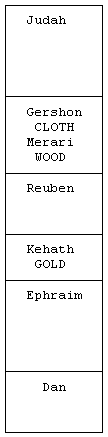
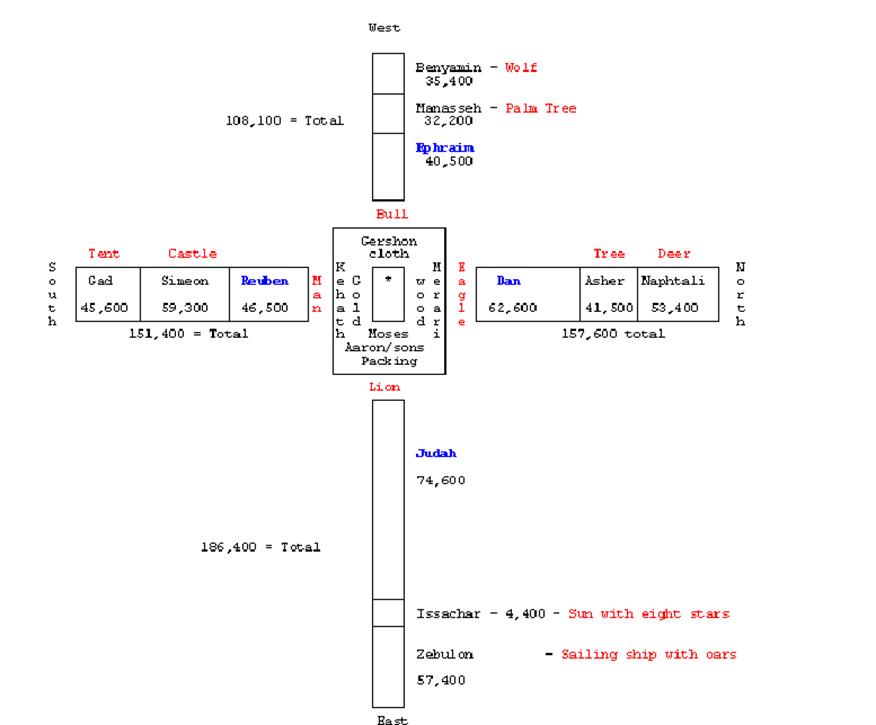
The complete camp was set up as a square:
Judah, Issachar and Zebulun camped to the east under Judah's banner.
Reuben, Simeon and Gad stayed in the south under Reuben's banner.
Ephraim, Menashe and Benyamin were positioned to the west under Ephraim's banner.
Dan, Asher and Naphtali were left in the north under Dan's banner.
The Levites were in the middle, along with the Tabernacle, Moses and Aaron.
Why was the camp arranged in this manner?
Judah is the tribe of the kingship[7],
Issachar is the tribe of the Torah[8], and
Zebulun is the tribe of wealth[9]. Since this triumverate includes the Torah and the kingship, it camps and marches first. To the right is Reuben's camp.
Reuben represents repentance[10],
Gad represents valor[11] and
Simeon stays between them for forgiveness-by-association. This team is second to camp and move, because even though repentance is extremely important, it is still secondary to the Torah.
Behind them in the west comes Ephraim's banner. This is the grouping of Rachel's descendants (Ephraim, Manasheh, and Benyamin). The Divine Presence stays in Benyamin's portion. Later, the Temple would be built in Benyamin's portion (in the western part of Israel). Benyamin also represents strength and security[12]. This representation of strength follows those of Torah and repentance, symbolizing that a person must use his strength to grow in Torah and overcome his evil inclination.
Marching last and camping in the north are the forces of Dan. Just as the north would later bring evil to Israel[13], so too Dan's portion (in the northern part of Israel) would be a center for idolatry[14]. Dan marched last because he had the power to retrieve those who had fallen outside the cloud.
Asher, however, is Dan's neighbor, to counter this darkness with his light[15]. To help Asher is…
Naphtali, who represents blessing[16]. This contingent must move last, because idolators must remain in the back (Bamidbar Rabbah).
Purim is celebrated in Adar and points plainly at Binyamin. Mordecai, a major participant in the story, was a Benjamite:
Esther 2:5 [Now] in Shushan the palace there was a certain Jew, whose name [was] Mordecai, the son of Jair, the son of Shimei, the son of Kish, a Benjamite;
Haman, the enemy of the Jews in the book of Esther, was the descendant of an Amalekite who was supposed to be slain by a Benjamite. His name was King Saul:
1 Shmuel (Samuel) 9:21 And Saul answered and said, [Am] not I a Benjamite, of the smallest of the tribes of Israel? and my family the least of all the families of the tribe of Benyamin? wherefore then speakest thou so to me?
1 Shmuel (Samuel) 15:7-8 And Saul smote the Amalekites from Havilah [until] thou comest to Shur, that [is] over against Egypt. And he took Agag the king of the Amalekites alive, and utterly destroyed all the people with the edge of the sword.
Mordechai, in megilat Esther, refused to bow down (he was from the tribe of Benyamin). In fact, he always stood.
In Shoftim, we learn that the Benjamite King is supposed to destroy Amalek:
Shoftim (Judges) 5:14 Out of Ephraim was there a root of them against Amalek; after thee, Benjamin, among thy people; out of Machir came down governors, and out of Zebulun they that handle the pen of the writer.
King Saul comes to destroy Amalek and fails. He is replaced with King David.
In the future, I expect to see the same pattern:
A Benjamite king comes first to destroy Amalek, Then Mashiach ben David comes to reign. Look for the pattern!
Throughout the scriptures, Yoseph and Benyamin are intimately linked. They were the only children of Yaakov and Rachel:
Bereshit (Genesis) 35:24 The sons of Rachel; Yoseph, and Benyamin:
Rachel died on 11th Cheshvan, at the age of 36, while giving birth to Benyamin. She was buried in Ephrat / Bethlehem because Yaakov foresaw that the Babylonian exiles were destined to pass that spot and pray; at that time Rachel would beg mercy for them:
Yeremyahu (Jeremiah) 31:14-16 "A loud voice is heard, Rachel weeping for her children and refusing to be comforted...they will return from their enemy's land...within their own borders.".
Yoseph and Benyamin were the only children of the only woman who was ever called Yaakov’s wife:
Bereshit (Genesis) 46:19 The sons of Rachel Yaakov's wife; Yoseph, and Benyamin.
Midrash Rabbah - Bereshit (Genesis) LXXIII:2 He hath remembered His mercy and His faithfulness toward the house of Israel; all the ends of the earth have seen the salvation of our God (ib. XCVIII, 3). ’ He hath remembered His mercy’ alludes to Abraham, as it says, Mercy to Abraham (Micah VII, 20); ’ And His faithfulness,’ to Yaakov, as it says, Thou wilt show faithfulness to Yaakov (ib.); ’ Toward the house of Israel’ means Israel the patriarch’. Who was the ’house’ of our ancestor Yaakov? Surely Rachel! For in connection with all the others it is written, And the children of Leah: the firstborn of Yaakov was Reuben... and the children of Zilpah Leah's maid were Gad and Asher... and the children of Bilhah Rachel's maid were Dan and Naphtali (Gen. XXXV, 23-6). But in the case of Rachel it is written, The sons of Rachel, Yaakov's wife[17]: Yoseph and Benyamin (ib. XLVI, 19). Another interpretation: ’He hath remembered His mercy and His faithfulness toward the house of Israel’ alludes to, AND GOD REMEMBERED RACHEL, AND GOD HEARKENED TO HER.
When Yoseph was born, Rachel, his mother, prophesied that another son would be added to this one:
Bereshit (Genesis) 30:24 And she called his name Yoseph; and said, HaShem shall add to me another son.
Chazal says that this son which is added to Yoseph, will be Benyamin:
Midrash Rabbah - Bereshit (Genesis) LXI:4 Bar Kappara said: The addition granted by the Holy One, blessed be He, exceeds the principal. Cain was the principal, yet since Abel is recorded as an addition,[18] he was born together with two twin sisters.[19] Yoseph was the principal, yet since Benyamin is recorded as an addition,[20] he begot ten sons, as it is written, And the sons of Benyamin: Bela, and Becher and Ashbel, Gera, etc. (ib. XLVI, 21).
Midrash Rabbah - Bereshit (Genesis) LXXIII:6 AND SHE CALLED HIS NAME YOSEPH, SAYING: THE LORD ADD TO ME ANOTHER SON (XXX, 24). ANOTHER [i.e. different] in respect of exile. R. Judah b. R. Simon said: The tribes of Judah and Benyamin were not exiled to the same place as were the other ten tribes. The ten-tribes were exiled beyond the River Sambatyon,[21] whereas the tribes of Judah and Benyamin are dispersed in all countries.[22] ANOTHER SON-in respect of dissension.[23] R. Phinehas said: Through Rachel's prayer the tribes of Judah and Benyamin did not revolt [against the Davidic dynasty] together with the remaining ten tribes.[24] ANOTHER denotes the behaviour of others.[25]
They stood together on Mount Gerazim, the mount of blessing:
Devarim (Deuteronomy) 27:12 These shall stand upon mount Gerizim to bless the people, when ye are come over Jordan; Simeon, and Levi, and Judah, and Issachar, and Yoseph, and Benyamin:
Their inheritance in the land of Israel were together:
Yehoshua (Joshua) 18:11 And the lot of the tribe of the children of Benyamin came up according to their families: and the coast of their lot came forth between the children of Judah and the children of Yoseph.
Ezekiel puts their gates to the city of Jerusalem together:
Yehezekel (Ezekiel) 48:32 And at the east side four thousand and five hundred: and three gates; and one gate of Yoseph, one gate of Benyamin, one gate of Dan.
And so it goes; nearly everytime that Benyamin is mentioned, Yoseph is closely connected.
After the “death” of Yoseph, Yaakov treated Benyamin like his only son:
Bereshit (Genesis) 42:4 But Benyamin, Yoseph's brother, Yaakov sent not with his brethren; for he said, Lest peradventure mischief befall him.
Bereshit (Genesis) 42:36 And Yaakov their father said unto them, Me have ye bereaved [of my children]: Yoseph [is] not, and Simeon [is] not, and ye will take Benyamin [away]: all these things are against me.
The Midrash tells us that Benyamin is the only one of Yaakov’s son’s who is not associated with the selling of Yoseph:
Midrash Rabbah - Bereshit (Genesis) XCIX:1 BENYAMIN IS A WOLF THAT RAVENETH, etc. (XLIX, 27). It is written, Why look ye askance (terazdun), ye mountains of peaks (Ps. LXVIII, 17)? R. Jose the Galilean and R. Akiba discussed this. R. Jose the Galilean applied the verse to the mountains. When the Holy One, blessed be He, came to reveal the Torah on Sinai, the mountains ran about and contended with each other, each claiming: ‘The Torah shall be revealed on me.’ Tabor came from Beth Elim and Carmel from Apamea. Thus it is written, As I live, saith the King, whose name is the Lord of hosts, surely like Tabor among the mountains and like Carmel by the sea so shall he come (Jer. XLVI, 18). The one says, ‘I have been called,’ and the other says, ‘I have been called.’ Said God to them: ‘"Why look ye askance (terazdun), ye mountains of peaks" (gabnunim)? Ye are all indeed high mountains, and yet ye are rather "gabnunim", which has the same meaning as in the verse, Or crook-backed (gibben) or a dwarf (Lev. XXI, 20); idolatrous worship has been performed on the tops of all of you. But Sinai, upon which no idolatrous worship has taken place, is The mountain which God hath desired for His abode’ (Ps. loc. cit.); therefore, And the Lord came down upon Mount Sinai (Ex. XIX, 20). Nevertheless, Yea, the Lord will dwell therein forever (Ps. loc. cit.)-in the Eternal House. R. Akiba related the verse to the tribes. When Solomon came to build the Temple, the tribes ran and contended with one another, one saying, ‘Let it be built in my territory,’ while the other said, ‘Let it be built in my territory.’Said the Holy One, blessed be He, to them: ‘Ye tribes, why look ye askance (terazdun)? Ye are all tribes, ye are all righteous. Yet ye are gabnunim.’ What does gabnunim mean? Ganabim (thieves); ye were all associated in the selling of Yoseph. But since Benyamin was not associated in the selling of Yoseph, [his is] ‘The mountain which God hath destred for his abode’. And thus you find that four hundred and eighty years previously the sons of Korah prophesied that it would be within Benyamin's portion, as it says, My soul yearneth, yea, even pineth for thc courts of the Lord (Ps LXXXIV, 3). And thus it says, Lo, we heard of it as being in Ephrath; we found it in the field of the wood (Ps CXXXII, 6). R. Judah said: The Temple was built in Judah's territory, for it is written, The Ephrathite of Beth-lehem in Judah (I Sam. XVII, 12). R. Simeon said: It is in the territory of the son of the woman who died in Ephrath. And who died in Ephrath? Rachel. You might then think that it is in the portion of Yoseph, seeing that he too was her son: therefore it states, ‘We found it in the field of the forest,’ which implies: In the portion of him who was likened to the beast of the forest. And who was so likened? Benyamin, as it is written, BENYAMIN IS A WOLF THAT RAVENETH.
We can see from the above Midrash that the Temple was built in the land that was allocated to Binyamin. The Temple was the point where heaven and earth kiss. The Temple is like the neck of the body; it connects the higher world (head) to the lower world (the body). It is the place where HaShem meets with man. This alludes to the fact that Benyamin is where heaven and earth kiss.
When the land of Israel was divided among the tribes, the territories of Judah and Binyamin ended up converging by the location of the altar in the future altar. As a result, the south-eastern portion of the altar was in the territory of Yehudah, and the north-western part of the Temple was in the land of Binyamin. However, it was only around these two sides that a base of about two feet wide wrapped around the altar, called the Yesod (foundation – the place of the brit mila), a merit that Binyamin earned because of his intense desire to be a host to the Divine Presence.
As an aside, it is insightful to remember the reunion between Yoseph and Binyamin in Mitzraim (Egypt), and that it, too, was related to the Temple:
After forgiving his brothers, Yoseph was overcome with emotion and "he fell upon his brother Benyamin's neck and wept, and Benyamin wept upon his neck"[26]. This scene doesn't make sense given the background provided by Chazal. The Midrash says that Yoseph identified himself to Benyamin. After the brothers brought Benyamin to Egypt, Yoseph took him aside, showed him an astrological map of Egypt, and asked him to use his divine inspiration to locate his long-lost brother Yoseph. Benyamin successively identified the district, the city, and the building in which they were sitting. When shown a map of the palace, he indicated the room they were in, and said "my brother is beside me." This puts everything in a new light! If Yoseph had already revealed himself to Benyamin, why did this emotional scene take place when Yoseph identified himself to the rest of his brothers? Rashi explains that Yoseph was weeping "for the two Temples that were to be in Benyamin's portion [of the land of Israel] and were destined ultimately to be destroyed," while Benyamin was weeping over "the Mishkan [Tabernacle (predecessor of the Temple in Jerusalem)] of Shiloh destined to be in Yoseph's portion, which also ended in destruction." This seems like a non-sequitur. Why did the brothers' reunion elicit this response from Yoseph and Benyamin?
Chazal tell us that the destruction of the Beit HaMikdash was divine punishment for the baseless hatred that existed among the Jews at that time.
The Midrash also says that Yoseph and Binyamin were equal:
Midrash Rabbah - Bamidbar (Numbers) XIV:8 ON THE NINTH DAY ABIDAN THE SON OF GIDEONI, PRINCE OF THE CHILDREN OF BENYAMIN (VII, 60). Why did Benyamin present his offering after the sons of Yoseph? Because, just as the Shechinah resided in the territory of the former at Shiloh, so it dwelled in the territory of Benyamin in the Temple at Jerusalem. Another exposition: It was in reference to what Scripture says, Before Ephraim and Benyamin and Manasseh, stir up thy might, and come to save us (Ps. LXXX, 3).[27] HIS OFFERING WAS ONE SILVER DISH (KA’ ARATH) (VII, 61). Read not KA'ARATH but ’ikkereth (chief). It symbolised Rachel who was the main pillar of the house; she being Yaakov's chief wife; for it says, The sons of Rachel, Yaakov's wife[28]: Yoseph and Benyamin (Gen. XLVI, 19) and it says, Rachel died unto me (ib. XLVIII, 7).[29] ONE SILVER. It was a result of her prayer that Benyamin was born, for it says, And she called his name Yoseph, saying: The Lord add to me another son (ib. XXX, 24), and it is to her that the text applies,’ The tongue of the righteous is as choice silver’ (Prov. X, 20)--righteous man or righteous woman. THE WEIGHT THEREOF WAS A HUNDRED AND THIRTY SHEKELS (VII, 61). Benyamin was born when Yaakov was a hundred years old,-it was for this reason that he was called by the name of Benyamin (ben yamin),[30] namely, because was born when his father was a hundred years old-and he himself was thirty years of age when he went down to Egypt. This gives you a total of a hundred and thirty. ONE SILVER BASIN (MIZRAK) (VII, 6}). A mizrak is the same thing as a gabia’ (goblet) and the MIZRAK here alludes to Yoseph who tested the righteousness of his brothers in regard to Benyamin by means of the goblet. When Yoseph saw that Judah risked his life for Benyamin he realised the righteousness of his brothers and made himself known to them. Moreover, because Yoseph drank wine (yayin) in a goblet and the numerical value of yayin is seventy,[31] the weight of the basin was for that reason SEVENTY SHEKELS, AFTER THE SHEKEL OF THE SANCTUARY (ib.). BOTH OF THEM FULL. BOTH OF THEM, Yoseph and Benyamin, were equal, for the Tabernacle was erected in the territory of Yoseph at Shiloh and the Temple in the territory of Benyamin at Jerusalem. This also explains the expression: FINE FLOUR MINGLED WITH OIL FOR A MEAL-OFFERING (ib.).[32] ONE GOLDEN PAN OF TEN SHEKELS (ib. 62) was in allusion to the ten sons that Benyamin had when he went down to Egypt; as it says, And the sons of Benyamin: Bela, and Becher, etc. (Gen. XLVI, 21), all of whom were righteous. This explains the phrase, FULL OF INCENSE. ONE YOUNG BULLOCK, ONE RAM, ONE HE-LAMB, etc. (VII, 63). Here you have three kinds of burnt-offerings. They allude to the three times that the Temple was to be built in his territory; once in the days of Solomon, once in the days of the returned exiles, and the third in the days of the Messiah. ONE MALE OF THE GOATS FOR A SIN-OFFERING (ib. 64). This was in allusion to the edifice which Herod constructed, for it was built by a sinful king and the building was intended by him as an atonement for having slain Israel's Sages. AND FOR THE SACRIFICE OF PEACE-OFFERINGS, TWO OXEN (ib. 65). This was in allusion to the two kings who came out of Benyamin, viz. Saul and Ishbosheth. An alternative explanation: In allusion to the two redeemers who came from that tribe, namely Mordecai and Esther. FIVE RAMS, FIVE HE-GOATS, FIVE HE-LAMBS (ib.). You have here three varieties of five each, corresponding to the three advantages that Benyamin received in each of which ‘five’ is mentioned. They are as follows: (1) Benyamin's portion was five times so much as any of theirs (Gen. XLIII, 34); (2) To Benyamin he gave three hundred shekels of silver, and five changes of raiment (ib. XLV, 22); and the third was when Mordecai, who hailed from Benyamin, attained to the privilege of wearing five royal vestments; as it says, And Mordecai went forth from the presence of the king in royal apparel of blue and white, and with a great crown of gold, and with a robe of fine linen and purple. (Est. VIII, 15).1 THIS WAS THE OFFERING OF ABIDAN, etc. (VII, 65). When he had presented his offering in accordance with the above scheme, the Holy One, blessed be He, began to praise his offering, saying: THIS WAS THE OFFERING OF ABIDAN, etc.
Benyamin had to go down to Egypt because he was the only son of his father. Does this sound familiar?
Matityahu (Matthew) 2:13-15 And when they were departed, behold, the angel of the Lord appeareth to Yoseph in a dream, saying, Arise, and take the young child and his mother, and flee into Egypt, and be thou there until I bring thee word: for Herod will seek the young child to destroy him. When he arose, he took the young child and his mother by night, and departed into Egypt: And was there until the death of Herod: that it might be fulfilled which was spoken of the Lord by the prophet, saying, Out of Egypt have I called my son.
Yochanan (John) 3:16 For God so loved the world, that he gave his only begotten Son, that whosoever believeth in him should not perish, but have everlasting life.
So, Mashiach ben Yoseph, the Messiah from the House of Yoseph, is closely linked with Benyamin.
Torah verses that speak about Benyamin
Bereshit (Genesis) 35:15-27 Yaakov called the place where God had talked with him Bethel. Then they moved on from Bethel. While they were still some distance from Ephrath, Rachel began to give birth and had great difficulty. And as she was having great difficulty in childbirth, the midwife said to her, "Don't be afraid, for you have another son." As she breathed her last--for she was dying--she named her son Ben-Oni. But his father named him Benyamin. So Rachel died and was buried on the way to Ephrath (that is, Bethlehem). Over her tomb Yaakov set up a pillar, and to this day that pillar marks Rachel's tomb. Israel moved on again and pitched his tent beyond Migdal Eder. While Israel was living in that region, Reuben went in and slept with his father's concubine Bilhah, and Israel heard of it. Yaakov had twelve sons: The sons of Leah: Reuben the firstborn of Yaakov, Simeon, Levi, Judah, Issachar and Zebulun. The sons of Rachel: Yoseph and Benyamin. The sons of Rachel's maidservant Bilhah: Dan and Naphtali. The sons of Leah's maidservant Zilpah: Gad and Asher. These were the sons of Yaakov, who were born to him in Paddan Aram. Yaakov came home to his father Isaac in Mamre, near Kiriath Arba (that is, Hebron), where Abraham and Isaac had stayed.
Bereshit (Genesis) 42:1-5 When Yaakov learned that there was grain in Egypt, he said to his sons, "Why do you just keep looking at each other?" He continued, "I have heard that there is grain in Egypt. Go down there and buy some for us, so that we may live and not die." Then ten of Yoseph's brothers went down to buy grain from Egypt. But Yaakov did not send Benyamin, Yoseph's brother, with the others, because he was afraid that harm might come to him. So Israel's sons were among those who went to buy grain, for the famine was in the land of Canaan also.
Bereshit (Genesis) 42:29 – 46:22 When they came to their father Yaakov in the land of Canaan, they told him all that had happened to them. They said, "The man who is lord over the land spoke harshly to us and treated us as though we were spying on the land. But we said to him, 'We are honest men; we are not spies. We were twelve brothers, sons of one father. One is no more, and the youngest is now with our father in Canaan.' "Then the man who is lord over the land said to us, 'This is how I will know whether you are honest men: Leave one of your brothers here with me, and take food for your starving households and go. But bring your youngest brother to me so I will know that you are not spies but honest men. Then I will give your brother back to you, and you can trade in the land.'" As they were emptying their sacks, there in each man's sack was his pouch of silver! When they and their father saw the money pouches, they were frightened. Their father Yaakov said to them, "You have deprived me of my children. Yoseph is no more and Simeon is no more, and now you want to take Benyamin. Everything is against me!" Then Reuben said to his father, "You may put both of my sons to death if I do not bring him back to you. Entrust him to my care, and I will bring him back." But Yaakov said, "My son will not go down there with you; his brother is dead and he is the only one left. If harm comes to him on the journey you are taking, you will bring my gray head down to the grave in sorrow." Now the famine was still severe in the land. So when they had eaten all the grain they had brought from Egypt, their father said to them, "Go back and buy us a little more food." But Judah said to him, "The man warned us solemnly, 'You will not see my face again unless your brother is with you.' If you will send our brother along with us, we will go down and buy food for you. But if you will not send him, we will not go down, because the man said to us, 'You will not see my face again unless your brother is with you.'" Israel asked, "Why did you bring this trouble on me by telling the man you had another brother?" They replied, "The man questioned us closely about ourselves and our family. 'Is your father still living?' he asked us. 'Do you have another brother?' We simply answered his questions. How were we to know he would say, 'Bring your brother down here'?" Then Judah said to Israel his father, "Send the boy along with me and we will go at once, so that we and you and our children may live and not die. Then Judah said to Israel his father, "Send the boy along with me and we will go at once, so that we and you and our children may live and not die. I myself will guarantee his safety; you can hold me personally responsible for him. If I do not bring him back to you and set him here before you, I will bear the blame before you all my life. As it is, if we had not delayed, we could have gone and returned twice." Then their father Israel said to them, "If it must be, then do this: Put some of the best products of the land in your bags and take them down to the man as a gift--a little balm and a little honey, some spices and myrrh, some pistachio nuts and almonds. Take double the amount of silver with you, for you must return the silver that was put back into the mouths of your sacks. Perhaps it was a mistake. Take your brother also and go back to the man at once. And may God Almighty grant you mercy before the man so that he will let your other brother and Benyamin come back with you. As for me, if I am bereaved, I am bereaved." So the men took the gifts and double the amount of silver, and Benyamin also. They hurried down to Egypt and presented themselves to Yoseph. When Yoseph saw Benyamin with them, he said to the steward of his house, "Take these men to my house, slaughter an animal and prepare dinner; they are to eat with me at noon." The man did as Yoseph told him and took the men to Yoseph's house. Now the men were frightened when they were taken to his house. They thought, "We were brought here because of the silver that was put back into our sacks the first time. He wants to attack us and overpower us and seize us as slaves and take our donkeys." So they went up to Yoseph's steward and spoke to him at the entrance to the house. "Please, sir," they said, "we came down here the first time to buy food. But at the place where we stopped for the night we opened our sacks and each of us found his silver--the exact weight--in the mouth of his sack. So we have brought it back with us. We have also brought additional silver with us to buy food. We don't know who put our silver in our sacks." "It's all right," he said. "Don't be afraid. Your God, the God of your father, has given you treasure in your sacks; I received your silver." Then he brought Simeon out to them. The steward took the men into Yoseph's house, gave them water to wash their feet and provided fodder for their donkeys. They prepared their gifts for Yoseph's arrival at noon, because they had heard that they were to eat there. When Yoseph came home, they presented to him the gifts they had brought into the house, and they bowed down before him to the ground. He asked them how they were, and then he said, "How is your aged father you told me about? Is he still living?" They replied, "Your servant our father is still alive and well." And they bowed low to pay him honor. As he looked about and saw his brother Benyamin, his own mother's son, he asked, "Is this your youngest brother, the one you told me about?" And he said, "God be gracious to you, my son." Deeply moved at the sight of his brother, Yoseph hurried out and looked for a place to weep. He went into his private room and wept there. After he had washed his face, he came out and, controlling himself, said, "Serve the food." They served him by himself, the brothers by themselves, and the Egyptians who ate with him by themselves, because Egyptians could not eat with Hebrews, for that is detestable to Egyptians. The men had been seated before him in the order of their ages, from the firstborn to the youngest; and they looked at each other in astonishment. When portions were served to them from Yoseph's table, Benyamin's portion was five times as much as anyone else's. So they feasted and drank freely with him. Now Yoseph gave these instructions to the steward of his house: "Fill the men's sacks with as much food as they can carry, and put each man's silver in the mouth of his sack. Then put my cup, the silver one, in the mouth of the youngest one's sack, along with the silver for his grain." And he did as Yoseph said. As morning dawned, the men were sent on their way with their donkeys. They had not gone far from the city when Yoseph said to his steward, "Go after those men at once, and when you catch up with them, say to them, 'Why have you repaid good with evil? Isn't this the cup my master drinks from and also uses for divination? This is a wicked thing you have done.'" When he caught up with them, he repeated these words to them. But they said to him, "Why does my lord say such things? Far be it from your servants to do anything like that! We even brought back to you from the land of Canaan the silver we found inside the mouths of our sacks. So why would we steal silver or gold from your master's house? If any of your servants is found to have it, he will die; and the rest of us will become my lord's slaves." "Very well, then," he said, "let it be as you say. Whoever is found to have it will become my slave; the rest of you will be free from blame." Each of them quickly lowered his sack to the ground and opened it. Then the steward proceeded to search, beginning with the oldest and ending with the youngest. And the cup was found in Benyamin's sack. At this, they tore their clothes. Then they all loaded their donkeys and returned to the city. Yoseph was still in the house when Judah and his brothers came in, and they threw themselves to the ground before him. Yoseph said to them, "What is this you have done? Don't you know that a man like me can find things out by divination?" "What can we say to my lord?" Judah replied. "What can we say? How can we prove our innocence? God has uncovered your servants' guilt. We are now my lord's slaves--we ourselves and the one who was found to have the cup." But Yoseph said, "Far be it from me to do such a thing! Only the man who was found to have the cup will become my slave. The rest of you, go back to your father in peace." Then Judah went up to him and said: "Please, my lord, let your servant speak a word to my lord. Do not be angry with your servant, though you are equal to Pharaoh himself. My lord asked his servants, 'Do you have a father or a brother?' And we answered, 'We have an aged father, and there is a young son born to him in his old age. His brother is dead, and he is the only one of his mother's sons left, and his father loves him.' "Then you said to your servants, 'Bring him down to me so I can see him for myself.' And we said to my lord, 'The boy cannot leave his father; if he leaves him, his father will die.' But you told your servants, 'Unless your youngest brother comes down with you, you will not see my face again.' When we went back to your servant my father, we told him what my lord had said. "Then our father said, 'Go back and buy a little more food.' But we said, 'We cannot go down. Only if our youngest brother is with us will we go. We cannot see the man's face unless our youngest brother is with us.' "Your servant my father said to us, 'You know that my wife bore me two sons. One of them went away from me, and I said, "He has surely been torn to pieces." And I have not seen him since. If you take this one from me too and harm comes to him, you will bring my gray head down to the grave in misery.' "So now, if the boy is not with us when I go back to your servant my father and if my father, whose life is closely bound up with the boy's life, Sees that the boy isn't there, he will die. Your servants will bring the gray head of our father down to the grave in sorrow. Your servant guaranteed the boy's safety to my father. I said, 'If I do not bring him back to you, I will bear the blame before you, my father, all my life!' "Now then, please let your servant remain here as my lord's slave in place of the boy, and let the boy return with his brothers. How can I go back to my father if the boy is not with me? No! Do not let me see the misery that would come upon my father." Then Yoseph could no longer control himself before all his attendants, and he cried out, "Have everyone leave my presence!" So there was no one with Yoseph when he made himself known to his brothers. And he wept so loudly that the Egyptians heard him, and Pharaoh's household heard about it. Yoseph said to his brothers, "I am Yoseph! Is my father still living?" But his brothers were not able to answer him, because they were terrified at his presence. Then Yoseph said to his brothers, "Come close to me." When they had done so, he said, "I am your brother Yoseph, the one you sold into Egypt! And now, do not be distressed and do not be angry with yourselves for selling me here, because it was to save lives that God sent me ahead of you. For two years now there has been famine in the land, and for the next five years there will not be plowing and reaping. But God sent me ahead of you to preserve for you a remnant on earth and to save your lives by a great deliverance. "So then, it was not you who sent me here, but God. He made me father to Pharaoh, lord of his entire household and ruler of all Egypt. Now hurry back to my father and say to him, 'This is what your son Yoseph says: God has made me lord of all Egypt. Come down to me; don't delay. You shall live in the region of Goshen and be near me--you, your children and grandchildren, your flocks and herds, and all you have. I will provide for you there, because five years of famine are still to come. Otherwise you and your household and all who belong to you will become destitute.' "You can see for yourselves, and so can my brother Benyamin, that it is really I who am speaking to you. Tell my father about all the honor accorded me in Egypt and about everything you have seen. And bring my father down here quickly." Then he threw his arms around his brother Benyamin and wept, and Benyamin embraced him, weeping. And he kissed all his brothers and wept over them. Afterward his brothers talked with him. When the news reached Pharaoh's palace that Yoseph's brothers had come, Pharaoh and all his officials were pleased. Pharaoh said to Yoseph, "Tell your brothers, 'Do this: Load your animals and return to the land of Canaan, And bring your father and your families back to me. I will give you the best of the land of Egypt and you can enjoy the fat of the land.' "You are also directed to tell them, 'Do this: Take some carts from Egypt for your children and your wives, and get your father and come. Never mind about your belongings, because the best of all Egypt will be yours.'" So the sons of Israel did this. Yoseph gave them carts, as Pharaoh had commanded, and he also gave them provisions for their journey. To each of them he gave new clothing, but to Benyamin he gave three hundred shekels of silver and five sets of clothes. And this is what he sent to his father: ten donkeys loaded with the best things of Egypt, and ten female donkeys loaded with grain and bread and other provisions for his journey. Then he sent his brothers away, and as they were leaving he said to them, "Don't quarrel on the way!" So they went up out of Egypt and came to their father Yaakov in the land of Canaan. They told him, "Yoseph is still alive! In fact, he is ruler of all Egypt." Yaakov was stunned; he did not believe them. But when they told him everything Yoseph had said to them, and when he saw the carts Yoseph had sent to carry him back, the spirit of their father Yaakov revived. And Israel said, "I'm convinced! My son Yoseph is still alive. I will go and see him before I die." So Israel set out with all that was his, and when he reached Beersheba, he offered sacrifices to the God of his father Isaac. And God spoke to Israel in a vision at night and said, "Yaakov! Yaakov!" "Here I am," he replied. "I am God, the God of your father," he said. "Do not be afraid to go down to Egypt, for I will make you into a great nation there. I will go down to Egypt with you, and I will surely bring you back again. And Yoseph's own hand will close your eyes." Then Yaakov left Beersheba, and Israel's sons took their father Yaakov and their children and their wives in the carts that Pharaoh had sent to transport him. They also took with them their livestock and the possessions they had acquired in Canaan, and Yaakov and all his offspring went to Egypt. He took with him to Egypt his sons and grandsons and his daughters and granddaughters--all his offspring. These are the names of the sons of Israel (Yaakov and his descendants) who went to Egypt: Reuben the firstborn of Yaakov. The sons of Reuben: Hanoch, Pallu, Hezron and Carmi. The sons of Simeon: Jemuel, Jamin, Ohad, Jakin, Zohar and Shaul the son of a Canaanite woman. The sons of Levi: Gershon, Kohath and Merari. The sons of Judah: Er, Onan, Shelah, Perez and Zerah (but Er and Onan had died in the land of Canaan). The sons of Perez: Hezron and Hamul. The sons of Issachar: Tola, Puah, Jashub and Shimron. The sons of Zebulun: Sered, Elon and Jahleel. These were the sons Leah bore to Yaakov in Paddan Aram, besides his daughter Dinah. These sons and daughters of his were thirty-three in all. The sons of Gad: Zephon, Haggi, Shuni, Ezbon, Eri, Arodi and Areli. The sons of Asher: Imnah, Ishvah, Ishvi and Beriah. Their sister was Serah. The sons of Beriah: Heber and Malkiel. These were the children born to Yaakov by Zilpah, whom Laban had given to his daughter Leah--sixteen in all. The sons of Yaakov's wife Rachel: Yoseph and Benyamin. In Egypt, Manasseh and Ephraim were born to Yoseph by Asenath daughter of Potiphera, priest of On. The sons of Benyamin: Bela, Beker, Ashbel, Gera, Naaman, Ehi, Rosh, Muppim, Huppim and Ard. These were the sons of Rachel who were born to Yaakov--fourteen in all. The son of Dan: Hushim. The sons of Naphtali: Jahziel, Guni, Jezer and Shillem. These were the sons born to Yaakov by Bilhah, whom Laban had given to his daughter Rachel--seven in all. All those who went to Egypt with Yaakov--those who were his direct descendants, not counting his sons' wives--numbered sixty-six persons. With the two sons who had been born to Yoseph in Egypt, the members of Yaakov's family, which went to Egypt, were seventy in all.
Benyamin was used to ransom his brothers. Hmmm, does this sound familiar? Notice what we find in the Nazarean Codicil:
Marqos (Mark) 10:45 For even the Son of man came not to be ministered unto, but to minister, and to give his life a ransom for many.
Now, lets see how Yaakov ben Yitzchak (Jacob son of Isaac) blessed Benyamin:
Bereshit (Genesis) 49:27-28 "Benyamin is a ravenous wolf; in the morning he devours the prey, in the evening he divides the plunder." All these are the twelve tribes of Israel, and this is what their father said to them when he blessed them, giving each the blessing appropriate to him.
Now lets see how the Midrash describes this “wolf”:
Midrash Rabbah - Bereshit (Genesis) XCV:1 AND HE SENT JUDAH BEFORE HIM UNTO YOSEPH (XLVI, 28). This illustrates the verse, The wolf and the lamb shall feed together (Isa. LXV, 25). Come and see how all whom the Holy One, blessed be He, hath smitten in this world He will heal in the future that is to come.[33] The blind will be healed, as it says, Then the eyes of the blind shall be opened (ib. XXXV, 5); the lame: Then shall the lame man leap as a hart (ib. 6); the dumb: And the tongue of the dumb shall sing. Thus all shall be healed, save that as a man departs [this life] so will he return resurrected. If he departs blind, he will return blind; if he departs deaf, he will return deaf; if he departs dumb, he will return dumb; if he departs lame, he will return lame. As he departs clothed, so will he return clothed, as it says, It is changed as clay under the seal; and they stand as [in] a garment (Job XXXVIII, 14). Now from whom do you learn this? From Samuel the Ramathite. When Saul brought him up [from the dead], what did he say to the woman? What form is he of? And she said: An old man cometh up; and he is covered with a robe (I Sam. XXVIII, 14). For even so was he clothed [in life], as it says, Moreover his mother made him a little robe (ib.II, 19). Why does a man return as he went? So that the wicked of the world should not say: After they died God healed them and then brought them back![34] Apparently these are not the same but others. ‘If so,’ says God to them, ' let them arise in the same state in which they went, and then I will heal them.’ Why so? That ye may know that... before Me there was no God formed, neither shall any be after Me (Isa. XLIII, 10).[35] After that animals too will be healed, as it says, The wolf and the lamb shall feed together.[36] But the one that brought the blow upon all will not be healed, as it says, And dust [earth] shall be the serpent's food (ib.). Why so? Because it brought all down to the dust [earth]. Another interpretation of ‘wolf’ and ‘lamb’ is that ‘wolf’ alludes to Benyamin, as it says, Benyamin is a wolf that raveneth (Gen. XLIX, 27), while ‘lamb’ alludes to the tribes, as it says, Israel is a scattered sheep (Jer. L, 17). ‘Shall feed together’: when is that? When Benyamin goes down with them. Yaakov indeed said to them. My son shall not go down with you (Gen. XLII, 38); yet when the hour came that they went down and Benyamin with them, they watched over and guarded him. And thus of Yoseph too it says, And he lifted up his eyes and saw Benyamin his brother... and he said: God be gracious unto thee, my son (ib. XLIII, 29).[37] The lion (Isa. LXV, 25) alludes to Judah, as it says, Judah is a lion's whelp (Gen. XLIX, 9); Like the ox (Isa. loc. cit.), to Yoseph, as it says, [And of Yoseph he said:...] His beauty is that of his firstling bullock (Devarim XXXIII, 13, 17).[38] All these were found eating together, as it says, And they sat before him, the firstborn according to his birthright... and portions were taken, etc. (Gen. XLIII, 33 f.). And the lion shall eat straw like the ox (Isa. loc. cit.)--therefore we read: AND HE SENT JUDAH BEFORE HIM UNTO YOSEPH.[39]
Shemot (Exodus) 1:1-5 These are the names of the sons of Israel who went to Egypt with Yaakov, each with his family: Reuben, Simeon, Levi and Judah; Issachar, Zebulun and Benyamin; Dan and Naphtali; Gad and Asher. The descendants of Yaakov numbered seventy in all; Yoseph was already in Egypt.
Bamidbar (Numbers) 1:36-38 From the descendants of Benyamin: All the men twenty years old or more who were able to serve in the army were listed by name, according to the records of their clans and families. The number from the tribe of Benyamin was 35,400. From the descendants of Dan: All the men twenty years old or more who were able to serve in the army were listed by name, according to the records of their clans and families.
Bamidbar (Numbers) 2:18-24 On the west will be the divisions of the camp of Ephraim under their standard. The leader of the people of Ephraim is Elishama son of Ammihud. His division Bamidbar (Numbers) 40,500. The tribe of Manasseh will be next to them. The leader of the people of Manasseh is Gamaliel son of Pedahzur. His division Bamidbar (Numbers) 32,200. The tribe of Benyamin will be next. The leader of the people of Benyamin is Abidan son of Gideoni. His division Bamidbar (Numbers) 35,400. All the men assigned to the camp of Ephraim, according to their divisions, number 108,100. They will set out third.
Bamidbar (Numbers) 7:60-65 On the ninth day Abidan son of Gideoni, the leader of the people of Benyamin, brought his offering. His offering was one silver plate weighing a hundred and thirty shekels, and one silver sprinkling bowl weighing seventy shekels, both according to the sanctuary shekel, each filled with fine flour mixed with oil as a grain offering; One gold dish weighing ten shekels, filled with incense; One young bull, one ram and one male lamb a year old, for a burnt offering; One male goat for a sin offering; And two oxen, five rams, five male goats and five male lambs a year old, to be sacrificed as a fellowship offering. This was the offering of Abidan son of Gideoni.
Bamidbar (Numbers) 10:14-25 The divisions of the camp of Judah went first, under their standard. Nahshon son of Amminadab was in command. Nethanel son of Zuar was over the division of the tribe of Issachar, And Eliab son of Helon was over the division of the tribe of Zebulun. Then the tabernacle was taken down, and the Gershonites and Merarites, who carried it, set out. The divisions of the camp of Reuben went next, under their standard. Elizur son of Shedeur was in command. Shelumiel son of Zurishaddai was over the division of the tribe of Simeon, And Eliasaph son of Deuel was over the division of the tribe of Gad. Then the Kohathites set out, carrying the holy things. The tabernacle was to be set up before they arrived. The divisions of the camp of Ephraim went next, under their standard. Elishama son of Ammihud was in command. Gamaliel son of Pedahzur was over the division of the tribe of Manasseh, And Abidan son of Gideoni was over the division of the tribe of Benyamin. Finally, as the rear guard for all the units, the divisions of the camp of Dan set out, under their standard. Ahiezer son of Ammishaddai was in command.
Bamidbar (Numbers) 26:38-41 The descendants of Benyamin by their clans were: through Bela, the Belaite clan; through Ashbel, the Ashbelite clan; through Ahiram, the Ahiramite clan; Through Shupham, the Shuphamite clan; through Hupham, the Huphamite clan. The descendants of Bela through Ard and Naaman were: through Ard, the Ardite clan; through Naaman, the Naamite clan. These were the clans of Benyamin; those numbered were 45,600.
Devarim (Deuteronomy) 27:11-14 On the same day Moses commanded the people: When you have crossed the Jordan, these tribes shall stand on Mount Gerizim to bless the people: Simeon, Levi, Judah, Issachar, Yoseph and Benyamin. And these tribes shall stand on Mount Ebal to pronounce curses: Reuben, Gad, Asher, Zebulun, Dan and Naphtali. The Levites shall recite to all the people of Israel in a loud voice:
Devarim (Deuteronomy) 33:12 About Benyamin he said: "Let the beloved of HaShem rest secure in him, for he shields him all day long, and the one HaShem loves rests between his shoulders."
Yehoshua (Joshua) 18:10-28 Joshua then cast lots for them in Shiloh in the presence of HaShem, and there he distributed the land to the Israelites according to their tribal divisions. The lot came up for the tribe of Benyamin, clan by clan. Their allotted territory lay between the tribes of Judah and Yoseph: On the north side their boundary began at the Jordan, passed the northern slope of Jericho and headed west into the hill country, coming out at the desert of Beth Aven. From there it crossed to the south slope of Luz (that is, Bethel) and went down to Ataroth Addar on the hill south of Lower Beth Horon. From the hill facing Beth Horon on the south the boundary turned south along the western side and came out at Kiriath Baal (that is, Kiriath Jearim), a town of the people of Judah. This was the western side. The southern side began at the outskirts of Kiriath Jearim on the west, and the boundary came out at the spring of the waters of Nephtoah. The boundary went down to the foot of the hill facing the Valley of Ben Hinnom, north of the Valley of Rephaim. It continued down the Hinnom Valley along the southern slope of the Jebusite city and so to En Rogel. It then curved north, went to En Shemesh, continued to Geliloth, which faces the Pass of Adummim, and ran down to the Stone of Bohan son of Reuben. It continued to the northern slope of Beth Arabah and on down into the Arabah. It then went to the northern slope of Beth Hoglah and came out at the northern bay of the Salt Sea, at the mouth of the Jordan in the south. This was the southern boundary. The Jordan formed the boundary on the eastern side. These were the boundaries that marked out the inheritance of the clans of Benyamin on all sides. The tribe of Benyamin, clan by clan, had the following cities: Jericho, Beth Hoglah, Emek Keziz, Beth Arabah, Zemaraim, Bethel, Avvim, Parah, Ophrah, Kephar Ammoni, Ophni and Geba--twelve towns and their villages. Gibeon, Ramah, Beeroth, Mizpah, Kephirah, Mozah, Rekem, Irpeel, Taralah, Zelah, Haeleph, the Jebusite city (that is, Jerusalem), Gibeah and Kiriath--fourteen towns and their villages. This was the inheritance of Benyamin for its clans.
Yehoshua (Joshua) 21:1-4 Now the family heads of the Levites approached Eleazar the priest, Joshua son of Nun, and the heads of the other tribal families of Israel At Shiloh in Canaan and said to them, "HaShem commanded through Moses that you give us towns to live in, with pasturelands for our livestock." So, as HaShem had commanded, the Israelites gave the Levites the following towns and pasturelands out of their own inheritance: The first lot came out for the Kohathites, clan by clan. The Levites who were descendants of Aaron the priest were allotted thirteen towns from the tribes of Judah, Simeon and Benyamin.
Midrashim that speak about Benyamin
Midrash Rabbah - Bereshit (Genesis) LXI:4 Yoseph was the principal, yet since Benyamin is recorded as an addition,[40] he begot ten sons, as it is written, And the sons of Benyamin: Bela, and Becher and Ashbel, Gera, etc. (ib. XLVI, 21).
Midrash Rabbah - Bereshit (Genesis) LXXI:5 Rachel made silence her metier,[41] and so all her children practised concealment. [Thus the stone representing] Benyamin [in the High Priest's breastplate was the] yashpeh, signifying yesh peh (has he a mouth)! he knew of Yoseph's sale, yet did not reveal it. Saul: But concerning the matter of the kingdom... he told him not (I Sam. X, I6). Esther: Esther had not made known her people or her kindred (Est. II, 10).
Midrash Rabbah - Bereshit (Genesis) LXXI:9 The Rabbis debated: To which tribe did Elijah belong? R. Leazar said: To Benyamin, for it is written, And Jaareshiah, and Elijah, and Zichri, were the sons of Jerobam... All these were the sons of Benyamin (I Chron. VIII, 27, 40). R. Nehorai said: To Gad, for it says, And Elijah the Tishbite, who was of the settlers of Gilead, said (I Kings, XVII, 1). Said R. Philippi to R. Nehorai: What reason have you for saying so?[42] Because it is written, And their [sc. the Gaddites’] border was Jazer, and all the cities of Gilead (Josh. XIII, 25), he replied. How does R. Eleazar interpret the verse quoted by R. Nehorai? ’Of the inhabitants of Gilead’ means, of those who sat in the Hall of Hewn Stones.[43] And how does R. Nehorai interpret the verse quoted by R. Eleazar, ’And Jaareshiah and Elijah’? These names are meant for allegorical interpretation: when He [God] would shake (mar'ish) the world [in His wrath], Elijah recalls (mazkir) the merit of the ancestors, whereupon, lo, ’The sons of Jerobam,’ which means, God is filled with compassion (rahamim) for His world. On one occasion our Rabbis were debating about him [Elijah], some maintaining that he belonged to the tribe of Gad, others, to the tribe of Benyamin. Whereupon he came and stood before them and said, ' Sirs, why do you debate about me? I am a descendant of Rachel.’[44]
Midrash Rabbah - Bereshit (Genesis) LXXIII:4 What did He remember in her favour? Her silence on her sister's behalf. When Leah was being given to him, she knew it, yet was silent. AND GOD REMEMBERED RACHEL: and this was but just, because she had brought her rival into her home.[45] R. Huna and R. Aha in R. Simon's name quoted: Dan, Yoseph, and Benyamin (I Chron. II, 2). For the sake of Dan, Rachel was remembered, for the sake of Dan, Yoseph and Benyamin were born.[46]
Midrash Rabbah - Bereshit (Genesis) LXXVIII:10 AND HE LIFTED UP HIS EYES... THE CHILDREN WHOM GOD HATH GRACIOUSLY GIVEN THY SERVANT (XXXIII, 5). R. Benyamin b. Levi said: We thus hear of grace in connection with the eleven tribal ancestors, but not in connection with Benyamin.[47] Where then do we hear it? Further on: And he sad: God be gracious unto thee, my son (ib. XLIII, 29). THEN THE HANDMAIDS CAME NEAR, etc. (XXXIII, )
Midrash Rabbah - Bereshit (Genesis) LXXXII:4 AND GOD SAID UNTO HIM: I AM GOD ALMIGHTY. BE FRUITFUL AND MULTIPLY (XXXV, 11). R. Judan said in R. Isaac's name: I used to wonder: Reuben was already born, Simeon was already born, and Benyamin had already gone forth from his loins, though still in his mother's womb?[48] Subsequently, however, I understood that A NATION alludes to Benyamin, [49] while AND A COMPANY OF NATIONS applies to Manasseh and Ephraim,[50] for it is written, And his [Ephraim's] seed shall become a multitude of nations (Gen. XLVIII, }9). R. Berekiah and R. Belbo interpreted it in R. Samuel b. Nahmans name: AND KINGS SHALL COME OUT OF THY LOINS alludes to Jeroboam and Jehu.[51] The Rabbis said: Was it possible that Abner, who was a righteous man, should yet fight against the Davidic dynasty [52] In fact, he interpreted a text, as a result of which he proclaimed Ishbosheth king, viz. AND KINGS SHALL COME OU.T OF THY LOINS. this alluding to Saul and Ishbosheth.[53] On what grounds [did the Israelites first] expel [the tribe of Benyamin] and then readmit them in the incident of the concubine at Gibeah?[54] The fact is that they read a text and expelled them, and then read a text and readmitted them. They read a text and expelled them, viz. Ephraim and Manasseh, even as Reuben and Simeon, shall be mine (ib. 5); they read a text and readmitted them: A NATION AND A COMPANY OF NATIONS SHALL BE FROM THEE.[55]
As the Midrash explains, the basis for rescinding the oath banning Benjamin from intermarrying with the other tribes was the promise made by God to Jacob when he returned to the land of his fathers after two decades of exile - “And God said to him, I am El Shaddai. Be fruitful and multiply; a nation and a congregation of nations will descend from you, and kings will issue from your loins”.[56] As the words “and kings will issue from your loins” were said in the future tense, the tribes understood that the foretold kingship was to come of a child that had not yet been born at the time of the promise, and the only one of Jacob’s children yet to be born at that time was Benjamin. By the time of the incident at Giv’ah, the promised kings had not yet appeared, and so the other tribes understood that they could not allow the tribe of Benjamin to become extinct.[57]
Midrash Rabbah - Bereshit (Genesis) LXXXII:8 … What is the meaning Of, AND IT CAME TO PASS, WHEN SHE WAS IN HARD LABOUR, THAT THE MIDWIFE SAID TO HER: FEAR NOT, FOR THIS ALSO IS A SON FOR THEE? - A woman in confinement is thus soothed,’ they replied, ' and she is told when she is giving birth, " Fear not, for you have given birth to a male child." ' 'Your teacher Joshua did not expound it thus,’ he retorted, ‘but with every tribal ancestor a twin sister was born; even as Abba Halpa the son of Koriah said: An additional twin sister was born with Benyamin’[58]
Midrash Rabbah - Bereshit (Genesis) LXXXII:9 AND IT CAME TO PASS, AS HER SOUL WAS DEPARTING-FOR SHE DIED- THAT SHE CALLED HIS NAME BEN - ONI (XXXV, 18)-which means, the son of my sorrow; BUT HIS FATHER CALLED HIM BENYAMIN-in Hebrew.[59]
Midrash Rabbah - Bereshit (Genesis) LXXXIV:20 AND YAAKOV RENT HIS GARMENTS (XXXVII, 34). R. Phinehas said in R. Hoshaya's name: The tribal ancestors caused their father to rend his garments; and where were they requited? In Egypt: Then they rent their clothes (Gen. XLIV, 13). Yoseph caused the tribal ancestors to rend their clothes,[60] and his grandson was requited therefor: And Joshua rent his clothes (Josh. VII, 6). Benyamin caused the tribal ancestors to rend their garments,[61] and where was he requited? In Shushan the capital: Mordecai rent has clothes (Esther IV,1).[62] Manasseh caused the tribal ancestors to rend their garments,[63] therefore his heritage was rent [divided], and he received half in Transjordan and half in Eretz Israel. AND HE PUT SACKCLOTH UPON HIS LOINS. R. Aibu said: Because Yaakov resorted to sackcloth, therefore it will not leave him or his descendants to the end of time. Thus, Ahab: And he [Ahab] put sackcloth upon his flesh, and fasted (I Kings XXI, 27). Joram: And the people looked, and, behold, he had sackcloth within upon his flesh (II Kings VI, 30). Mordecai: And he put on sackcloth and ashes (Esther IV, 1). AND MOURNED FOR HIS SON MANY DAYS-viz. twenty-two years.[64]
Midrash Rabbah - Bereshit (Genesis) XCI:6 … When there was no more bread, Judah urged him: ‘If Benyamin goes, he may be seized and he may not be seized; but if he does not go with us, we must all die. It is not good to avoid a doubtful evil and plunge into a certain one.’ ‘Then who will go surety for him?’ he demanded. 'I am surety‘: I will be surety for him, etc. (ib. XLIII, 9). He sent him forthwith, and when Yoseph saw him he rejoiced, because he was like his mother.
Midrash Rabbah - Bereshit (Genesis) XCII:5 AND THE MAN BROUGHT THE MEN INTO YOSEPH'S HOUSE... AND HE [YOSEPH] ASKED THEM OF THEIR WELFARE, AND SAID: IS YOUR FATHER WELL, THE OLD MAN OF WHOM YE SPOKE, etc. (XLIII, 24-27). R. Hiyya the Elder met a Babylonian [in Eretz Israel] and asked him, ‘How is my father[65]? He replied, ‘Your mother [in Babylon] has inquired about you.’ ‘I ask you one thing and you speak to me of another!’ he exclaimed. ‘People ask about the living but not about the dead, he replied.[66] Thus, IS YOUR FATHER WELL alludes to Yaakov; THE OLD MAN OF WHOM YE SPOKE, to Isaac; AND THEY SAID: THY SERVANT OUR FATHER IS WELL, HE IS YET ALIVE, etc.[67] AND HE LIFTED UP HIS EYES, AND SAW BENYAMIN. etc. (XLIII, 29): R. Benyamin b. Levi said: We have heard grace mentioned in connection with the eleven tribal ancestors, but not in connection with Benyamin. Where then do we hear it? In the present passage: AND HE SAID: GOD BE GRACIOUS UNTO THEE, MY SON. AND YOSEPH MADE HASTE; FOR HIS HEART YEARNED TOWARD HIS BROTHER... AND THEY SAT BEFORE HIM THE FIRSTBORN ACCORDING TO HIS BIRTHRIGHT. etc. (XLIII, 30-33). He took the cup and pretended to smell.[68] Let Judah, who is king, sit at the head, he declared, and Reuben, who is firstborn, sit second. Again, I have no mother and this youth [Benyamin] has no mother, for his mother died on giving birth to him; therefore he must come and sit near me. For that reason, THE MEN MARVELLED ONE WITH ANOTHER. AND PORTIONS WERE TAKEN UNTO THEM FROM BEFORE HIM; BUT BENYAMIN'S WAS FIVE TIMES SO MUCH AS ANY OF THEIRS (XLIII, 34). Yoseph gave him one portion, Asenath another, Manasseh another, Ephraim another, while he also took a portion with his brethren; hence it is written, BUT BENYAMIN'S PORTION WAS FIVE TIMES, etc. AND THEY DRANK AND WERE MERRY WITH HIM. With him they drank, but away from him they did not drink. For R. Levi said: During the whole of the twenty-two years that he did not see them he tasted no wine, and they too tasted no wine until they saw him.
Midrash Rabbah - Bereshit (Genesis) XCII:8 WITH WHOMSOEVER OF THY SERVANTS IT BE FOUND... AND HE SAID: NOW ALSO LET IT BE ACCORDING UNTO YOUR WORDS (XLIV, 9 f.). Lo, your words are indeed correct, for when one of a company of ten is discovered to be a thief, are not all liable to be imprisoned? Yet will I not do so, but rather, HE WITH WHOM IT IS FOUND SHALL BE MY BONDMAN; AND YE SHALL BE BLAMELESS. AND HE SEARCHED, BEGINNING AT THE ELDEST, etc. Lest they should say, ‘He knew where it was.’ AND THE GOBLET WAS FOUND IN BENYAMIN ‘S SACK. When it was thus found they exclaimed to him, 'What! you are the thief and the son of a thief!’[69] To which he retorted, ‘Have we a he-goat here?[70] Have we here brothers who sold their brother!’
Midrash Rabbah - Bereshit (Genesis) XCIII:7 THEN JUDAH CAME NEAR UNTO HIM. What precedes this passage? And he lifted up his eyes, and saw Benyamin his brother (Gen. XLIII, 29). R. Samuel b. Nahman said: When Yoseph saw Benyamin, his mind was immediately set at rest and he exclaimed, ' God be gracious unto thee, my son’ (ib.). ' Bring him near to me,’ he ordered. He then questioned him: ‘Have you a brother?’ ‘I had a brother,’ he replied, ‘but do not know whither he has gone.’ ' Have you a wife? ' he pursued. ' I have a wife and ten sons.’ ‘What are their names?’ ‘Bela, and Becher, and Ashbel,’ etc. (ib. XLVI, 21), he replied. Bela signifies that he [my brother] was swallowed up (nith-bala’) from me; Becher, that he was a firstborn (bechor)[71]; Ashbel, that he was taken away captive (nishbah) from me; Gera, that he became a stranger (ger) in a strange country; Naaman, that his actions were seemly (na'im) and pleasant (ne'im-im); Ehi, that he indeed was my brother (ahi)[72]; Rosh, that he was my superior (rosh)[73]; Muppim, that he was exceedingly comely (yafeh ‘ad me'od) in all matters; and Huppim, that I did not see his marriage-canopy (huppah) and he did not see mine; and Ard, that he was like a rose-bloom (ward). Another interpretation of ‘Bela, and Becher, and Ashbel ‘. Why did you give them these names? I gave them all in reference to my brother, he replied. Bela signifies that he was swallowed up (nibla’) in the world, and I do not know whither he has gone; Becher, that he was a firstborn (bechor) to his mother; Ashbe, that he was taken away captive (nishba) from his father and has gone; Gera, that he dwelt (gar) in inns.[74] Naaman, that he was sweet (na'im) to his father and to his mother; Ehi, that he was my brother (ahi); Rosh, that he was my superior (rosh); Muppim and Huppim, that his head is covered (hafuy) among the idolaters[75]; and Ard, that he descended (yarad) from country to country. Another interpretation: Since the day he was exiled I have not bathed (hafafti) nor combed my hair but have been like a mourner. In that moment Yoseph was filled with yearning, as it says, And Yoseph made haste, for his heart yearned toward his brother (Gen. XLIII, 30). And he washed his face... and they sat before him, the firstborn according to his birthright, etc. (ib. 33). R. Samuel b. Nahman said: What did Yoseph do? He prepared a great feast for them, and when they came to recline [at the meal] he took the cup, struck it, and declared, Reuben, Simeon, Levi, Judah, Issachar, and Zebulun are the sons of one mother; where are they? Bring them and let them sit together. Dan and Naftali are the sons of one mother: bring them and let them sit together. Gad and Asher are the sons of one mother: bring them and let them sit together. Thus Benyamin was left. Said he: He is motherless and I am motherless, so he and I will sit together. And portions were taken... but Benyamin's portion was five times so much as any of theirs (ib. 34).
Midrash Rabbah - Bereshit (Genesis) XCIII:12 AND HE FELL UPON HIS BROTHER BENYAMIN'S NECKS (XLV, 14). Did Benyamin then have two necks? In fact, said R. Eleazar, he foresaw through the Holy Spirit that two Temples would be built in Benyamin's portion, and both would be destroyed. AND BENYAMIN WEPT UPON HIS NECK: he saw that the Tabernacle of Shiloh would be built in Yoseph's portion and would be destroyed.[76] AND HE WEPT ALOUD (XLV, 2). As Yoseph became reconciled to his brothers from the midst of weeping, so will the Holy One, blessed be He, redeem Israel from the midst of weeping, as it says, They shall come with weeping, and with supplications will I lead them; I will cause them to walk by rivers of waters, etc. (Jer. XXXI, 9).
Midrash Rabbah - Bereshit (Genesis) XCV:4 AND FROM AMONG (MIKZEH) HIS BRETHREN HE TOOK FIVE MEN, etc. (XLVII, 2). Why does Scripture say MIKZEH?[77] Scripture comes to teach that they were not the strongest of the tribal ancestors. And who were these five? Reuben, Simeon, Levi, Benyamin, and Issachar. And why did the righteous Yoseph take these five of his brethren? Because he knew who were the strong men among his brethren, and he reasoned wisely: If I present the strongest to Pharaoh, he will on seeing them make them his warriors. Therefore he presented these five, who were not mighty men. How do we know that they were not? You find them in the blessing of our teacher Moses. Every one whose name he repeated in his blessing was mighty, while he whose name he did not repeat was not mighty. Judah, whose name he repeated, was mighty, for it says, And this for Judah, and he said: Hear, Lord, the voice of Judah (Devarim XXXIII, 7); therefore he did not present him to Pharaoh. Likewise Naphtali, as it says, And of Naphtali he said: O Naphtali, satisfied with favour (ib. 23). Likewise Asher: And of Asher he said: Blessed be Asher above sons (ib. 24). Likewise Dan: And of Dan he said: Dan is a lion's whelp (ib. 22). Zebulun too: And of Zebulun he said: Rejoice, Zebulun, in thy going out (ib. 18). Gad too: And of Gad he said: Blessed be He that enlargeth Gad (ib. 2c). Therefore he did not present them to Pharaoh. But the others, whose names were not repeated, are not mighty, therefore he presented them to Pharaoh.[78]
Midrash Rabbah - Bereshit (Genesis) XCVII ... BENYAMIN IS A WOLF THAT RAVENETH (XLIX, 27). This means, a great and powerful tribe. This [prophecy of Yaakov] bears out the verse, For the Lord God will do nothing, etc. (Amos III, 7). At first His secret was with those who fear the Lord, as it says, The secret [E.V. ‘counsel’] of the Lord ts with them that fear Him (Ps. XXV, 14). Then He imparted it to the upright, as it says, But His secret [E.V. ‘counsel’] is with the upright (Prov. III, 32). Finally He entrusted it to the prophets, as it says, ’For the Lord God will do nothing, but He revealeth His secret [E.V. ‘counsel’] unto His servants the prophets.’[79] Everything the righteous do, they do under divine inspiration. When Yaakov blessed the tribe of Judah, he blessed him to be like a lion, as it says, He stooped down, he couched as a lion (Gen. XLIX, 9), for he coupled him [in battle] with the Babylonian empire, since Daniel, Hananiah, Mishael, and Azariah fought against it.[80] Yoseph he opposed to the wicked empire [Esau-Rome], for there is a tradition that Esau will fall only through the hands of Rachel's descendants. Moses pitted the tribe of Levi against the Greek Empire, for the Hasmoneans were of the tribe of Levi.[81] He likened Benyamin [to a wolf] with the empire of Media in mind, for Mordecai, who was of the tribe of Benyamin, would take vengeance thereon[82]; while it is written of the empire of Media, And behold another beast, a second, like to a wolf-E.V. ‘bear ' (Dan. VII, 5); it [Media] was thus likened [to a wolf] in allusion to the tribe of Benyamin, which was compared to a wolf.[83] A WOLF THAT RAVENETH. As a wolf seizes [his prey], so did the tribe of Benyamin seize, as it says, And see, and, behold, if the daughters of Shiloh come out... then seize you every man his wife, etc. (Judg. XXI, 21). This teaches that they seized wives for their sons, on account of the oath sworn by the Israelites to give no wives to them in marriage. IN THE MORNING HE DEVOURETH THE PREY. This alludes to the sacrifices which were offered in the Temple,[84] as it is written, The one lamb shalt thou offer in the morning (Num. XXVIII, 4).
Midrash Rabbah - Bereshit (Genesis) XCV … BEFORE HIM: to him [Yoseph] who will receive the kingdom before him [Judah].[85] Now when an ox attacks, a lion can come and rescue; but if a lion attacks, an ox cannot come and rescue. Thus of Judah and Yoseph, let Yoseph receive [power first], because his is temporary; and then Judah, because his is for ever.[86] If a wolf attacks, a lion can come and rescue; but if a lion attacks, a wolf cannot come and rescue. Hence of Judah and Benyamin, let Benyamin receive [power first], for his is temporary,[87] and then Judah, for his is for ever. As for Shiloh and the Eternal House [the Temple]: let Shiloh first receive [sanctity], for it is but temporary, and then the Eternal House, which is for all time. Israel and the Nations of the world: let the Nations of the world receive [dominion first], because they are but for a time; and then Israel, who exist for ever. This world and the World to Come: let this world receive [dominion first], since it is but temporary, and then let the future world receive dominion, since it is for all time.
Midrash Rabbah - Bereshit (Genesis) XCVIII:2 … AND HE SAID: GATHER YOURSELVES TOGETHER (HE'ASEFU)... ASSEMBLE YOURSELVES, AND HEAR (XLIX, 1 f.). GATHER YOURSELVES TOGETHER from the land of Egypt, and ASSEMBLE YOURSELVES into Raameses; GATHER YOURSELVES TOGETHER from [the exile of] the ten tribes, and ASSEMBLE YOURSELVES to the tribes of Judah and Benyamin. He thus commanded them to show honour to the tribes of Judah and Benyamin.[88] R. Aha interpreted [the word HE'ASEFU], ‘Purify yourselves,’ as in the verse, And they gathered themselves together... and they purified themselves (Neh. XII, 28 ff.).[89] The Rabbis say: He warned them against dissension, bidding them, Be ye all one assembly. Thus it says, And thou, son of man, take thee one stick, and write upon it: For Judah, and for the children of Israel his companions (Ezek. XXXVII, 16). ' His companion ' is written[90]: when the children of Israel unite in one band, then they may prepare themselves for redemption. For what follows this? And I will make them one nation in the land, etc. (ib. 22).
Midrash Rabbah - Bereshit (Genesis) XCIX:2 For the Lord God will do nothing, but He revealeth His counsel [secret] unto His servants the prophets (Amos III, 7). Yaakov coupled two, corresponding to two, and Moses coupled two, corresponding to two. [Yaakov blessed] Judah with the Babylonian empire in mind, for each is likened to a lion. The former: Judah is a lion's whelp (Gen. XLIX, 9); the latter: The first was like a lion (Dan. VII, 4). By whose hand shall the empire of Babylon fall? By the hand of Daniel, descended from Judah. [Yaakov blessed] Benyamin in allusion to the empire of Media, the former being likened to a wolf and the latter being likened to a wolf. The former is likened to a wolf: Benyamin is a wolf that raveneth, etc. (Gen. XLIX, 27). And the latter is likened to a wolf: And behold another beast, a second, like to a wolf (Dan. VII, 5).[91] R. Hanina said: The word is written Ie-dob [defectively],[92] and Dob was its name. That is R. Johanan's view, for R. Johanan said: Wherefore a lion out of the forest doth slay them (Jer. V, 6) alludes to Babylon; A wolf of the deserts doth spoil them (ib.), to Media. By whose hand will the empire of Media fall? By the hand of Mordecai, descended from Benyamin.
Midrash Rabbah - Bereshit (Genesis) XCIX:3 BENYAMIN IS A WOLF THAT RAVENETH. This alludes to the judge descended from him.[93] As a wolf seizes, so did Ehud seize Eglon's heart.[94] Thus it is written, And Ehud came unto him, and he was sitting by himself alone in his cool upper chamber (Judg. III, 20): this means, in a cool upper chamber.[95] And he said: I have a secret errand unto thee, O king, etc. (ib. 19): thus has the Sovereign of the Universe bidden me, said he: Take a sword and plunge it into his bowels. And the dirt came out (ib. 22)[96]: his excrements. Then Ehud went forth into the porch (ib. 23). R. Judan said: It means, into the public square. R. Berekiah said: It means, the place where the ministering angels sat in ordered fashion.[97] Another interpretation: The text alludes to the king descended from him.[98] As a wolf seizes, so did Saul seize the kingdom, as it says, So Saul took [captured] the kingdom over Israel (I Sam. XIV, 47). IN THE MORNING HE DEVOURETH THE PREY-And fought against all his enemies on every side (ib.). AND AT EVEN HE DIVIDETH THE SPOIL-So Saul died and his three sons (I Sam. XXXI, 6).’[99] The text alludes to the queen descended from him.[100] As a wolf seizes, so did Esther seize[101] the kingdom [royalty], as it is written, Esther was taken into the king's house (Est. II, 8). IN THE MORNING HE DEVOURETH THE PREY-On that day did the king Ahasuerus give thc house of Haman the Jew's enemy unto Esther the queen (ib. VIII, 1), AND AT EVEN HE DIVIDETH THE SPOIL-And Esther set Mordecai over the house of Haman (ib. 2). The text speaks of his land: as a wolf seizes, so did the land of Benyamin ‘seize’ its crops.[102] IN THE MORNING HE DEVOURETH THE PREY: this alludes to Jericho, whose fruit was the first to ripen. AND AT EVEN HE DIVIDETH THE SPOIL: this alludes to Bethel, where they ripened last. R. Phinehas applied the verse to the altar. As a wolf seizes, so did the altar seize the sacrifices. IN THE MORNING HE DEVOURETH THE PREY-The one lamb shalt thou offer in the morning (Num. XXVIII, 4). AND AT EVEN HE DIVIDETH THE SPOIL-And the other lamb shalt thou offer at dusk (ib.).
Midrash Rabbah - Shemot (Exodus) XXXVIII:8 … My covenant was with him of life and peace (Mal. II, 5).[103] R. Isaac said: The merit of the tribes entered with him; for it says, AND THIS IS (ZEH) THE THING THAT THOU SHALT DO UNTO THEM, and the numerical value of ZEH is twelve. These were the twelve stones placed on Aaron's breastplate upon which the names of the tribes were engraved,[104] in the following order: Reuben [sardonyx],[105] Simeon [shimpozin],[106] Levi [hyacinth],[107] Judah [chalcedony],[108] Issachar [sapphire], Zebulun [emerald], Dan [carbuncle], Naphtali [agate], Gad [amethyst], Asher [beryl], Yoseph [onyx], Benyamin [jasper].
Midrash Rabbah - Shemot (Exodus) XXXVIII:9 AND THOU SHALT SET IN IT SETTINGS OF STONES (XXVIII, 17). How were they set? A ROW O F CORNELIAN, TOPAZ, AND SMARAGD SHALL BE THE FIRST ROW (ib.). On the CORNELIAN were written the names of Abraham, Isaac, Yaakov,[109] and Reuben. On the TOPAZ was written Simeon, and on the SMARAGD Levi. AND THE SECOND ROW, A CARBUNCLE, A SAPPHIRE, AND AN EMERALD (ib. 18). On the CARBUNCLE was written Judah, on the SAPPHIRE Issachar, and on the EMERALD Zebulun. AND THE THIRD ROW A HYACINTH, AN AGATE, AND AN AMETHYST (ib. 19). On the HYACINTH was written Dan, on the AGATE Naphtali, and on the AMETHYST Gad. AND THE FOURTH ROW A BERYL, AND AN ONYX, AND A JASPER (ib. 20). On the BERYL was inscribed Asher, on the ONYX Yoseph, and on the JASPER Benyamin--the tribes of Jeshurun.[110]
* * *
This study was written by
Rabbi Dr. Hillel ben David
(Greg Killian).
Comments may be submitted to:
Rabbi Dr. Greg Killian
12210 Luckey Summit
San Antonio, TX 78252
Internet address: gkilli@aol.com
Web page: https://www.betemunah.org/
(360) 918-2905
Return to The WATCHMAN home page
Send comments to Greg Killian at his email address: gkilli@aol.com
[1] see Bereshit [Genesis] 38
[2] Torah Temimah
[3] I.e., because the serpent caused Adam and Eve to sin, but not on account of their own sin. — This is not to be confused with the doctrine of Original sin, which is rejected by Judaism, v. B.B., Sonc. ed., p. 86, n. 11.
[4] II Sam. XVII, 25
[5] I Chron. II, 16. ‘Their sisters’ refers to the sons of Jesse; v. preceding verse.
[7] Bereshit [Genesis] 49:10
[8] Devarim [Deuteronomy] 33:18
[9] Bereshit [Genesis] 49:13
[10] Bereshit [Genesis] 37:29- 30, Rashi ad loc.
[11] Bereshit [Genesis] 49:19
[12] Devarim 33:12
[13] Yerimiyahu 1:14
[14] Kings I 12:29
[15] Devarim 33:24
[16] Devarim 33:23
[17] She alone is so designated.
[18] Cur. edd.: as it says, And she bore an additional son (E.V. ' and again she bore’), his brother Abel (Gen. IV, 2),
[19] Supra, XXII, 2
[20] V. Gen. XXX, 24: The Lord add to me another son.
[21] A legendary river, said to run with tremendous force the whole week, carrying along stones and earth, and consequently unnavigable, but resting on the Sabbath.
[22] Thus the second son for whom she prayed-Benjamin-was to be ANOTHER from Joseph in the matter of exile.
[23] Whereas Joseph (i.e. the tribes of Ephraim and Manasseh) revolted against Rehoboam, Benjamin remained loyal.
[24] This makes good sense, but the emendation of ‘E.J. is preferable: Benjamin did not separate itself from Judah as did the other ten tribes.
[25] Cur. edd. read: Because he acted differently from such as Jeroboam and his companions. This, however, has already been said in different words, the text is probably corrupt.
[26] Gen. 45:14
[28] None of the other wives are so described.
[29] The expression signifies that the death was apparently his peculiar loss.
[30] Heb. inh ic = inh years of age; i.e. 10 + 40 + 50 = 100.
[31] ihh =10 + 10 + 50=70
[32] These recall the offerings in the Tabernacle and the Temple. Mingled alludes to the fact that the Shechinah rested on both alike.
[33] The context shows this to refer to resurrection.
[34] It is absurd to believe that!
[35] Commentaries quote v. 8: The blind people that have eyes shall be brought forth, etc. v. also Sanh. (Sonc. ed.), p. 604, n. 12, which may throw light on the relevance of this quotation.
[36] Possibly ‘healed’ in this contest is to be understood to mean, from their evil bent; thus the wolf will be ' healed ' from its predatory instincts.
[37] He too, like the brethren, showed his love for him.
[38] E.V.: ‘His firstling bullock, majesty is his.
[39] Judah and Joseph were now at peace. The verse from Isaiah indicates that in the Messianic era there will be a reunion of all the tribes and they will again live in brotherly love.
[40] V. Gen. XXX, 24: The Lord add to me another son.
[41] She kept silent and did not reveal Laban's proposed deception.
[42] How does this verse prove it, seeing that Gilead belonged to the tribes of Reuben and half of Manasseh as well as Gad?
[43] M.K.: Gilead denotes gal'ed, ' a heap and a witness ' (cf. Gen. XXXI, 47). The Hall of Hewn Stones, where the Sanhedrin, the supreme religious court,sat,was the heap (edifice) whence the testimony of the Torah went forth to Israel.
[44] Hence of Benjamin.
[45] E.J.: hence GOD (ELOHIM) REMEMBERED RACHEL-i.e. in pursuance of judgment and justice. ' Rival ' probably refers to Bilhah, as in the next passage.
[46] I.e. as a reward for bringing a rival into her house by giving Bilhah, her maid, to Yaakov, from whom was born Dan; cf. G supra, LXXI, 7 ad fin.
[47] For Benjamin was not yet born.
[48] I.e. how could this blessing, Be fruitful and multiply, which indicates in the future, be applied to Yaakov, seeing that all his children were already born, and even Benjamin was already conceived, and therefore would not be the result of his subsequent fruitfulness?
[49] Notwithstanding that he was already conceived, yet the blessing was applicable since he was not yet born.
[50] Who were regarded literally as Yaakov's sons, and therefore constituted separate tribes.
[51] They regard this too as a promise that kings would descend from Yaakov's future children, hence from Manasseh and Ephraim. from whom Jehu and Jeroboam respectively were descended.
[52] He supported Ishbosheth, Saul's son, against David.
[53] He held that the reference must be actually to Yaakov's unborn son, viz. Benjamin; thus at least two kings would have to be descended from Benjamin, these being Saul and Ishbosheth.
[54] V. Judges XIX-XXI.
[55] ‘E.J.: they had a tradition that there must be not less than twelve tribes, nevertheless they expelled Benjamin, in reliance upon the former text, since Ephraim and Manasseh made up the twelve without Benjamin. But on considering the latter text they decided that Benjamin must be included, since A COMPANY OF NATIONS refers to Manasseh and Ephraim, so that A NATION could only refer to Benjamin. Or perhaps more simply FROM THEE implies that there must be actually twelve who were Yaakov's own sons. Translation follows the order of cur. edd. as more convenient.
[56] Bereshit (Genesis) 35:11
[57] Rising Moon - Unraveling the Book of Ruth, by Moshe Miller, pg.11
[58] Additional’ would imply that two twin sisters were born with him, the deduction being from the words FOR THIS ALSO which implies extension. Some MSS. omit ‘additional’. It was with this that they comforted her.
[59] This is difficult. The names of all Yaakov's sons are Hebraic, ' Benjamin ' meaning ' the son of my right hand ‘-probably, the son who will comfort me (for Rachel's death). ' Ben- oni ' too is Hebraic, and the present remark seems pointless. According to cur. edd. the explanation might be this: SHE CALLED HIS NAME BEN-ONI-i.e. she actually called him ' Bar Za'ari ' (son of my sorrow), in Aramaic, which Scripture itself has translited into Hebrew, Ben-oni; BUT HIS FATHER CALLED HIM BENJAMIN - actually, in Hebrew.
[60] In the verse just quoted.
[61] Indirectly, the brothers rending their garments when Joseph pretended to be keeping Benjarnin as a slave.
[62] He was descended from Benjamin. Meg. 12b.
[63] According to the Rabbis (Tanhuma ed. Buber Gen. XIII) it was Manasseh who put the cup into Benjarnin;s sack.
[64] Joseph was seventeen years old when this happened (Gen. XXXVII, 2), and thirty years old when he stood before Pharaoh (ib. XLI, 46); to this must be added the seven years of plenty, while Yaakov's reunion with him took place after two years of famine.
[65] R. Hiyya hailed from Babylon.
[66] He had thus gently intimated that his father was dead.
[67] From which Joseph understood that Isaac was dead.
[68] As though practising divination.
[69] His mother Rachel had stolen Laban's teraphim; v. Gen. XXXI, 34.
[70] In allusion to the he-goat in whose blood they had dipped Joseph's coat.
[71] To his mother.
[72] Probably: a full brother, from the same father and mother.
[73] I.e. an elder brother.
[74] Not in a proper home.
[76] In the M.T. of the Bible ‘neck’ is both times plural in form. But in other MSS. it was apparently plural the first time and singular the second.
[78] For a different view v. B.K. 92a.
[79] Supra, XLIX, 2.
[80] The point is that Judah was blessed to be like a lion because his descendants, Daniel, etc., would have to succour Israel from the Babylonian empire, which too was likened to a lion (Dan. VII, 4).
[81] By the Greek Empire is meant the Hellenising Seleucids, and particularly Antiochus Epiphanes, whose attempt to force Hellenism upon the Jews caused the Hasmonean (Maccabean) revolt.
[82] By having Haman and his sons executed and defeating the enemies who sought to destroy them.
[83] Thus both Yaakov and Moses in likening the tribes to certain animals did so prophetically, God having revealed the future (‘His secret ‘) to them.
[84] Which was in Benjamin's territory, though the greater part of Jerusalem was in Judah's portion.
[85] Th.: The reference is to the Messiah son of Joseph who will precede the Messiah son of David, descended from Judah. Possibly too the reference is to Joshua (descended from Joseph) who wielded authority over Israel before Judah's descendant did, viz. David.
[86] Judah and Joseph are likened to a lion and an ox respectively.
[87] The allusion is to Saul.
[88] The Midrash explains the duplication of GATHER YOURSELVES TOGETHER and ASSEMBLE YOURSELVES, and interprets this with reference to their future redemptions. On this exodus from Egypt they halted at Raameses (Ex. XII, 37); while with respect to the later redemption the hope was cherished that the northern ten tribes would enjoy redemption along with Judah and Benjamin (v. Isa. XI, 12; LVI, 8 and Sanh. 110b)
[89] The two expressions being regarded as parallel.
[90] In the singular--thus all Israel (the ten tribes) are counted as one.
[91] E.V. ’bear’.
[92] csk instead of cusk . This, in his opinion, shows that its meaning is that of the Syriac and Aramaic diba, wolf.
[93] Ehud.
[94] Deceive him.
[95] The Hebrew is rendered by a more familiar Aramaic term. Having mentioned Ehud, the Midrash comments on the passage dealing with him.
[96] A.V. has been followed here in preference to J.V., in accordance with the Midrashic rendering.
[97] He connects misdronah (E.V. ‘porch’) with seder, ‘order.’ They sat there to protect Ehud from harm.
[98] Sc. Saul.
[99] Rendering: And at even (the evening of Saul-his defeat and death) he shall cause spoil to be divided-his own spoil to be divided by the enerny.
[100] Sc. Esther.
[101] Midrash Hagadol reads: so was Esther seized, etc. This is preferable.
[102] Cause thern to ripen quickly.
[104] Though Aaron did not wear the ephod, upon which these names were engraved, when he entered the Holy of Holies, the Midrash means that the merit of the names of the twelve tribes which he usually wore on the ephod stood him in good stead on this solemn day too (Mah.).
[105] Perhaps a kind of smaragd (Levi).-The name of each tribe was set in a different jewel. These are given in brackets above after the name of each tribe; cf. Num. R. n, 7.
[106] What this jewel was is unknown.
[107] Jast., who makes a slight emendation in this word as well as in some of the following.-Levi was represented on the High Priest's breastplate by a hyacinth, that is a precious stone (Heb. ,erc ) probably in the shape of that flower.-Many of the renderings that follow are only conjectured.
[108] A chalcedonian stone.
[109] The names of the patriarchs were inscribed in order to have all the letters of the alphabet on the Urim and Thumrnim that spelt out the answer to the inquirer; Yoma 73b. The Rabbis held that the patriarchs certainly merited to be engraved on the breastplate, if the tribes were.
[110] I.e. the words ' the tribes of Jeshurun ' were written on the last stone. In all the previous names a teth ( y ) was still missing, and this was made up in this phrase (Heb. iuruah hyca).