
By Rabbi Dr. Hillel ben David (Greg Killian)
I. Definitions and explanation:
Do the stars control us? Are we under a mazel?
V. Star and Constellation Names
VII. Josephus and the celestial bodies?
VIII. Book of Jubilees and the celestial bodies?
X. Interesting Talmudic Passages:
XI. Relationship to the twelve tribes:

The Mazzaroth, also known as the zodiac, is the name given to the pattern of stars found on the celestial equator, or ecliptic. The ecliptic is an imaginary zone of the heavens containing the twelve signs within which lie the paths of the principal planets, and through which the sun passes in its annual course.
Mazzaroth is the Hebrew word for constellation. There is also a related Hebrew word: mazzaloth.
In this paper I would like to explore the wealth of information that relates to the celestial bodies. I will examine the Scriptures, the oral law, and the wisdom of the Jewish Sages in my quest to understand the purpose of the celestial bodies.
The Sages teach us that the primary use of the astronomical bodies is for calculating times and seasons and to serve as signs. The torah also emphasises this idea:
Bereshit (Genesis) 1:14 And God said, Let there be lights in the firmament of the heaven to divide the day from the night; and let them be for signs, and for seasons, and for days, and years:
The Torah emphasises the importance of time and keeping track of time. Therefore, keep this in mind as we study. The astronomical bodies are to serve as:
Rashi says the following about ‘signs’:
2 [If there will arise among you a prophet...] and he gives you a sign Hebrew אוֹת , [meaning a sign] in the heavens, as it is stated in the case of Gideon [who said to the angel]: “then show me a sign (אוֹת) “ (Shoftim [Judges] 6:17), and then it says [further], “let it be dry only upon the fleece [and upon all the ground let there be dew]” (Shoftim [Judges] 6:39).
Thus we learn that anytime we see an ot, a sign, we are looking at a reference to the celestial object.
In the Sanctum of the Holy Temple there were two major holy vessels, the menorah and the shulchan [Table] upon which the lechem hapanim were arranged. The menorah consisted of seven candles, corresponding to the seven “moving stars” [from our earthly perspective]– the sun, the moon, and the five planets closest to the earth. Arranged upon the Table were twelve loaves of showbread, corresponding to the twelve constellations used as astrological signs of the Zodiac. These loaves are arranged in two tiers of six because of the twelve signs, six are always ascending and six are in decline. Thus, the menorah stood for the heavenly lights and the table for the astrological signs.[1]
The very first mitzva given to the Jewish people concerned time and it’s calculation:
Shemot (Exodus) 12:1-4 And HaShem spake unto Moses and Aaron in the land of Egypt, saying, This month [shall be] unto you the beginning of months: it [shall be] the first month of the year to you. Speak ye unto all the congregation of Israel, saying, In the tenth [day] of this month they shall take to them every man a lamb, according to the house of [their] fathers, a lamb for an house: And if the household be too little for the lamb, let him and his neighbour next unto his house take [it] according to the number of the souls; every man according to his eating shall make your count for the lamb.
Such is the importance of time and the astronomical bodies!
The Talmud[2] speaks about the influence of the constellations on a person’s destiny. Being born under a certain constellation can predispose a person to certain personality traits, but it’s up to the individual into which area to channel these predilections. For example, someone who is influenced by Mars (the “red planet”) will have a tendency to shed blood. This can express itself in becoming a murderer or a surgeon, a butcher or a mohel (who performs circumcisions). The choice is up to the individual. Any talent, character trait or aptitude can be used for the highest good or the basest evil. We are the ones who make the choice.
4216 Mazzarah, maz-zaw-raw’; appar. from 5144 in the sense of distinction; some noted constellation (only in the plur.), perh. collect. the zodiac:- Mazzaroth. Comp. 4208.
------------------- Dictionary Trace -------------------
5144 nazar, naw-zar’; a prim. root; to hold aloof, i.e. (intrans.) abstain (from food and drink, from impurity, and even from divine worship [i.e. apostatize]); spec. to set apart (to sacred purposes), i.e. devote:- consecrate, separate (-ing, self).
4208 mazzalah, maz-zaw-law’; appar. from 5140 in the sense of raining; a constellation, i.e. Zodiacal sign (perh. as affecting the weather):- planet. Comp. 4216.
Mazzaroth occurs twice in scripture. The first is in:
Iyov (Job) 38:31-33 “Can you bind the beautiful Pleiades? Can you loose the cords of Orion? Can you bring forth the constellations in their seasons or lead out the Bear with its cubs? Do you know the laws of the heavens? Can you set up [God’s] dominion over the earth?
The second time it is in a slightly different form:
II Melakim (Kings) 23:3-5 The king stood by the pillar and renewed the covenant in the presence of HaShem--to follow HaShem and keep his commands, regulations and decrees with all his heart and all his soul, thus confirming the words of the covenant written in this book. Then all the people pledged themselves to the covenant. The king ordered Hilkiah the high priest, the priests next in rank and the doorkeepers to remove from the temple of HaShem all the articles made for Baal and Asherah and all the starry hosts. He burned them outside Jerusalem in the fields of the Kidron Valley and took the ashes to Bethel. He did away with the pagan priests appointed by the kings of Judah to burn incense on the high places of the towns of Judah and on those around Jerusalem -- those who burned incense to Baal, to the sun and moon, to the constellations and to all the starry hosts.
CONSTELLATION[3]. For untold thousands of years men have traced the outlines of familiar things among the stars. These patterns in the night sky are called constellations, from Latin words meaning together and stars.
Many of the constellations have names that are very old. The Sumerian shepherds and farmers of Mesopotamia 7,000 years ago may have called the Bull, the Ram, the Lion, and many other constellations by the same names we use. Students of history are sure these names started in Mesopotamia because the choice of animals suggests this. If the names had first been used in Egypt, there should be a hippopotamus or elephant among the stars. If they had started in ancient India, there should be a tiger or crocodile.
The later people of Mesopotamia took over the old Sumerian names for the constellations and still later the Greeks adopted them. The Greeks added many names of heroes and demigods to the list of constellations. The Romans used the Greek list but translated the names into Latin.
About AD 150 the Egyptian astronomer Ptolemy listed the 48 constellations known to him in his book the ‘Almagest’. His list did not cover the entire sky. There were blank spaces between constellations; and there were no constellations at all for the southernmost stars because these could not be seen from the Mediterranean region. In later centuries astronomers added constellations to Ptolemy’s list. Some of these later constellations are named for scientific instruments, such as the Sextant, the Compasses, and the Microscope. Others bear the names of birds and beasts in tropical regions (the Giraffe, the Chameleon, the Toucan). Today 88 constellations are recognized by astronomers.
To most people a constellation is a group of bright stars, but to an astronomer it is a definite area in the sky. Thus every star, no matter how dim, lies in one constellation or another, just as any point in the world is in one country. Although all the stars in the same constellation look close together in the sky, they are not necessarily close in space because some may be much farther out in space than others. The boundaries of the constellations used to be very irregular and had many curved lines. In 1928 astronomers straightened them out so that the outline of any constellation includes only straight lines running north and south or east and west. Astronomers use the constellation names to identify most bright stars and all variable stars, so it was important to make the boundaries clear and precise.
The constellations are useful to astronomers today, not for their connections with ancient myths, but for telling where in the sky different stars can be found. Many of the brightest stars have individual names that come from Greek, Latin, or Arabic, and the navigators of ships and aircraft call them by these names. Astronomers, however, find it more convenient to name them by their constellations, with a Greek letter to distinguish the different stars in each constellation. For example, Polaris, the Pole Star, in the Northern Hemisphere, is the brightest star in the constellation Ursa Minor, the Little Bear, and the astronomers’ name for it is alpha Ursae Minoris.
The path of the sun among the stars is called the ecliptic. The twelve constellations that lie along the ecliptic form the Zodiac. The other constellations are divided into those north of the Zodiac and those south of it.
From one place on the Earth different constellations are seen at different times of the year. This happens because, as well as turning on its axis, the Earth is always moving around the sun, making one orbit each year. A star that is visible at night during one part of the year may appear close to the sun six months later; it would not then be seen at night.
Some constellations can be seen only from the Northern Hemisphere and some only from the Southern Hemisphere. The constellations of the Zodiac can be seen from both hemispheres.
The equator system[4] is based on the concept of the celestial sphere. All the stars and other heavenly bodies can be imagined to be located on a huge sphere that surrounds Earth. The sphere has several imaginary lines and points. One such line is the celestial equator, which is the projection of Earth’s equator onto the celestial sphere. Another is the line of the ecliptic, which is the sun’s apparent yearly path along this sphere. The celestial equator and the ecliptic intersect at two points, called the vernal equinox and the autumnal equinox. (When the sun is at either point, day and night on Earth are equally long.) The north and south celestial poles are extensions of the North and South poles of Earth along Earth’s axis of rotation.
In the equator system, the position of a star is given by the declination and the right ascension. The declination locates the star from the celestial equator, and the right ascension locates the star from the vernal equinox. Since this system is attached to the celestial sphere, all points on Earth (except the poles) are continually changing their positions under the coordinate system.
Bereshit (Genesis) 1:14-19 And God said, “Let there be lights in the expanse of the sky to separate the day from the night, and let them serve as signs to mark seasons and days and years, And let them be lights in the expanse of the sky to give light on the earth.” And it was so. God made two great lights--the greater light to govern the day and the lesser light to govern the night. He also made the stars. God set them in the expanse of the sky to give light on the earth, To govern the day and the night, and to separate light from darkness. And God saw that it was good. And there was evening, and there was morning--the fourth day.
Season:
4150 mow`ed, mo-ade’; or mo`ed, mo-ade’; or (fem.) mow`adah (2 Chron. 8:13), mo-aw-daw’; from 3259; prop. an appointment, i.e. a fixed time or season; spec. a festival; conventionally a year; by implication, an assembly (as convened for a definite purpose); technically the congregation; by extension, the place of meeting also a signal (as appointed beforehand):-appointed (sign, time), (place of, solemn) assembly, congregation, (set, solemn) feast, (appointed, due) season, solemn (-ity), synagogue, (set) time (appointed).
Govern:
4910 mashal, maw-shal’; a prim. root; to rule:-(have, make to have) dominion, governor, X indeed, reigh, (bear, cause to, have) rule (-ing, -r), have power.
Years:
8141 shaneh (in plur. only), shaw-neh’; or (fem.) shanah, shaw-naw’; from 8138; a year (as a revolution of time):-+ whole age, X long, + old, year (X -ly).
------------- Dictionary Trace ---------------
8138 shanah, shaw-naw’; a prim. root; to fold, i.e. duplicate (lit. or fig.); by impl. to transmute (trans. or intrans.):-do (speak, strike) again, alter, double, (be given to) change, disguise, (be) diverse, pervert, prefer, repeat, return, do the second time.
In the account of the fourth day of creation, the sun and moon are referred to as the “great luminaries”, but then, within the same verse, the sun retains that title, but the moon is called the “small luminary”. In fact, both descriptions are correct. When considered from our human perspective, both the sun and the moon are large. They are the only two sources of light that appear to the naked eye as more than a point oflight in the sky. (Planets appear as disks only when viewed with telescopes; stars, even giant ones, remain “points” even under very high magnification.) In fact, the sun and the moon appear to be almost exactly the same size, as seen from Earth. This results from the sun having a diameter approximately four hundred times that of the moon, while being approximately four hundred times as distant. On the other hand, the moon is actually quite small in comparison to the sun. One commentator noted that when the sun and moon are referred to as “M’orot birkiya hashamayim”, luminaries in the heavens, the word “M’orot” is spelled “deficiently”, without a “vav”, indicating that in the heavens, they are not on equal footing. The moon doesn’t even provide its own light. There really is only one (major) luminary in the heavens. However, when the phrase used is “M’orot birkiya hashamayim l’ha’ir al ha-aretz”, luminaries to illuminate the Earth, then the word “M’orot” has a “vav[5]”, since from our perspective, there are two (major) sources of light in our sky. The Torah speaks (mostly) in terms that fit our perspective.
Compare also:
Tehillim (Psalms) 136:1-9 Give thanks to HaShem, for he is good. <His love endures forever.> Give thanks to the God of gods. <His love endures forever.> Give thanks to the Lord of lords: <His love endures forever.> To him who alone does great wonders, <His love endures forever.> Who by his understanding made the heavens, <His love endures forever.> Who spread out the earth upon the waters, <His love endures forever.> Who made the great lights--<His love endures forever.> The sun to govern the day, <His love endures forever.> The moon and stars to govern the night; <His love endures forever.>
Tehillim (Psalms) 19:1-6 {For the director of music. A psalm of David.} The heavens declare the glory of God; the skies proclaim the work of his hands. Day after day they pour forth speech; night after night they display knowledge. There is no speech or language where their voice is not heard. Their voice goes out into all the earth, their words to the ends of the world. In the heavens he has pitched a tent for the sun, Which is like a bridegroom coming forth from his pavilion, like a champion rejoicing to run his course. It rises at one end of the heavens and makes its circuit to the other; nothing is hidden from its heat.
The “heavens“ seem to be outer space.
Tehillim (Psalms) 97:1-6 HaShem reigns, let the earth be glad; let the distant shores rejoice. Clouds and thick darkness surround him; righteousness and justice are the foundation of his throne. Fire goes before him and consumes his foes on every side. His lightning lights up the world; the earth sees and trembles. The mountains melt like wax before HaShem, before the Lord of all the earth. The heavens proclaim his righteousness, and all the peoples see his glory.
Tehillim (Psalms) 50:1-6 {A psalm of Asaph.} The Mighty One, God, HaShem, speaks and summons the earth from the rising of the sun to the place where it sets. From Zion, perfect in beauty, God shines forth. Our God comes and will not be silent; a fire devours before him, and around him a tempest rages. He summons the heavens above, and the earth, that he may judge his people: “Gather to me my consecrated ones, who made a covenant with me by sacrifice.” And the heavens proclaim his righteousness, for God himself is judge. <Selah>
Notice that the heavens and the earth are witnesses against us.
Proclaim:
5046 nagad, naw-gad’; a prim. root; prop. to front, i.e. stand boldly out opposite; by impl. (causat.), to manifest; fig. to announce (always by word of mouth to one present); spec. to expose, predict, explain, praise:-bewray, X certainly, certify, declare (-ing), denounce, expound, X fully, messenger, plainly, profess, rehearse, report, shew (forth), speak, X surely, tell, utter.
Devarim (Deuteronomy) 4:14-19 And HaShem directed me at that time to teach you the decrees and laws you are to follow in the land that you are crossing the Jordan to possess. You saw no form of any kind the day HaShem spoke to you at Horeb out of the fire. Therefore watch yourselves very carefully, So that you do not become corrupt and make for yourselves an idol, an image of any shape, whether formed like a man or a woman, Or like any animal on earth or any bird that flies in the air, Or like any creature that moves along the ground or any fish in the waters below. And when you look up to the sky and see the sun, the moon and the stars--all the heavenly array--do not be enticed into bowing down to them and worshiping things HaShem your God has apportioned to all the nations under heaven.
The “heavenly array” could also be translated the “heavenly army”. This is a military term!
Devarim (Deuteronomy) 4:25-27 After you have had children and grandchildren and have lived in the land a long time--if you then become corrupt and make any kind of idol, doing evil in the eyes of HaShem your God and provoking him to anger, I call heaven and earth as witnesses against you this day that you will quickly perish from the land that you are crossing the Jordan to possess. You will not live there long but will certainly be destroyed. HaShem will scatter you among the peoples, and only a few of you will survive among the nations to which HaShem will drive you.
Devarim (Deuteronomy) 30:19 This day I call heaven and earth as witnesses against you that I have set before you life and death, blessings and curses. Now choose life, so that you and your children may live
Devarim (Deuteronomy) 31:24-30 After Moses finished writing in a book the words of this law from beginning to end, He gave this command to the Levites who carried the ark of the covenant of HaShem: “Take this Book of the Law and place it beside the ark of the covenant of HaShem your God. There it will remain as a witness against you. For I know how rebellious and stiff-necked you are. If you have been rebellious against HaShem while I am still alive and with you, how much more will you rebel after I die! Assemble before me all the elders of your tribes and all your officials, so that I can speak these words in their hearing and call heaven and earth to testify against them. For I know that after my death you are sure to become utterly corrupt and to turn from the way I have commanded you. In days to come, disaster will fall upon you because you will do evil in the sight of HaShem and provoke him to anger by what your hands have made.” And Moses recited the words of this song from beginning to end in the hearing of the whole assembly of Israel:
Midrash Rabba[6] writes: “The sun and the moon shed light upon the world. What is their source of light? Sparks of light from the heavens, as it is written, “From the light of Your arrows as they speed, and at the shining of Your glittering spear’.[7] The light above is so intense that creatures cannot bear to see it; only one in a hundred” (a fraction of a percent). Perhaps an example is the sun during an eclipse, which can only be viewed through smoked glass. Similarly, the tremendous light released during atomic fission or fusion.
The sun and moon are, therefore, creations which serve as a medium for the illumination of the spiritual light. They are the fallout, the residue of a very mighty spiritual light that penetrates everything, a light that illuminates from one end of the world to the other.
If these luminaries transmit a spiritual light, then they must be spiritual themselves, as well. This leads us to what the Rambam taught.
The heavens are made up of spheres. There are nine spheres. The closest to us is that of the moon. Above it, the second sphere contains the planet Kochav (Mercury). Above this, the third sphere contains the planet Nogah (Venus). The fourth sphere contains the Sun. The fifth contains the planet Ma’dim (Mars). The sixth sphere contains the planet Tzedek (Jupiter). The seventh contains the planet Shabbtai (Saturn). The eighth sphere contains all the stars we see in the sky. The ninth sphere revolves from east to west every day. It surrounds and encompasses everything. The planets and stars all appear to be in a single sphere even though one is higher than another. This is because the spheres themselves are pure and refined like glass or sapphire.... This is why the stars in the eighth sphere may appear lower than the first sphere.
Each of the eight main spheres containing the planets and stars is itself divided into many individual spheres, one above the other like the layers of an onion. Some of these spheres revolve from west to the east, others from east to west... There is no empty space between any of them.
None of the spheres are light or heavy. They are neither red, black nor any other color. Although we see them as blue, this is only our perception because of the height of the atmosphere. Similarly they have neither taste nor smell, because those qualities are present only in lower forms of matter. All these nine spheres surrounding the world are spherical like a ball, and the Earth is suspended in the middle...
From knowing the daily movements of the stars and planets, their positions north or south in the sky and their distance from or closeness to Earth, it is possible to know the total number of spheres and the way they revolve. This is the science of astronomy. Many books about these subjects were written by the wise men of Greece.
The Zodiac
The ninth sphere, which encompasses all the others, was divided by the sages of the early generations into twelve sections. They gave each of these sections a name based on the shapes that appeared to be formed by the stars in the corresponding section of the eighth sphere just below it. These are the mazalot (lit. sources of influence): the Ram (Aries), the Ox (Taurus), the Twins (Gemini), the Crab (Cancer), the Lion (Leo), the Virgin (Virgo), the Scales (Libra), the Scorpion (Scorpio), the Bow (Sagittarius), the Goat (Capricorn), the Bucket (Aquarius) and the Fish (Pisces).
The ninth sphere itself has no divisions and does not possess any of these shapes or stars. Rather, the larger stars in the constellations of the eighth sphere are seen in the shape of these forms or in a form resembling them. These twelve forms corresponded to these divisions only at the time of the flood, which is when they were given these names. However at present they have already moved slightly, because all the stars in the eighth sphere move just like the sun and the moon. It is just that these stars move more slowly...
All the stars and spheres possess a soul, knowledge and intellect. They are alive and stand in recognition of the One who spoke and brought the world into being.
According to their size and level, they all praise and glorify their Creator, just like the angels. And just as they are aware of the Holy One, blessed-be-He, they are also conscious of themselves and of the angels above them. The level of consciousness of the stars and spheres is less than that of the angels but greater than of humans.
Avraham Ibn Ezra
Especially influential is Avraham Ibn Ezra’s astrological treatise called Sefer HaOlam (The Book of the World). Its main message is to warn users against wrong applications of astrology. Of course, like most scholars until modern times, he was an ardent believer in astrology, but only when it is practiced correctly.
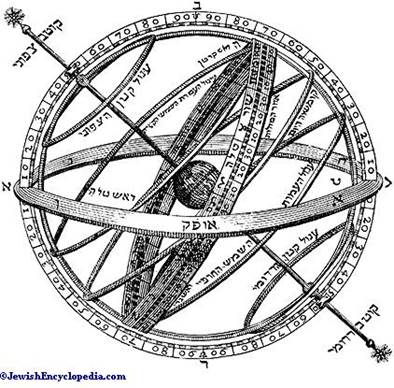
In particular, he warned that all the astronomical tables predicting the times of planetary conjunctions are erroneous, because they assume uniform motion of the planets. He also made a very good point on the accumulation of errors, and for the need to account for experimental errors, and how unreasonable it is to extrapolate from ancient data. Hence, he only relied on astronomical observations made by contemporary ‘sages of experiments’.
Do the stars control us? Are we under a mazel?
The “eighth day,” the eighth day of the inauguration of the Mishkan. It was on this day that the Divine Presence finally descended and “inhabited” the Mishkan. For, the number eight always alludes to a departure from the “natural” world, and entry into the supernatural world (which is why Chanukah also is eight days long). Therefore, brit milah acts as a threshold of sorts for the new baby, over which he crosses to enter into the world ABOVE mazel.
There is a discussion in the Talmud about whether or not a Jew is subject to mazel, that is, destiny[9]. We believe that, for the most part, events are predetermined as part of a master plan for creation. Within the stars is encoded six thousand years of history, and a true astrologer can peek into the stars and foretell the future, as Avraham did when he told HaShem that he saw that he was to remain childless through his wife Sarah; Hagar bore Yishmael for him.
However, HaShem told Avraham that he was not necessarily correct, for, he could by choice rise above his mazel, and beat his destiny, so-to-speak. And as history and the Torah testifies, Avraham did precisely that with the birth of his son Yitzchak, something, apparently, he could only achieve AFTER he had performed brit milah (first he was commanded to perform brit milah, and then Yitzchak was conceived).
Hence, brit milah is far more than an initiation rite into Judaism; it is a mystical door through which the Jewish nation passes on the way to freedom from nature.
Ramban tells us some very interesting things about angels:
Ramban’s Commentary for: Vayiqra (Leviticus) 17:7 Know that just as the formation at the original Creation of man's body as well as that of all living creatures, vegetation and minerals, was from the four elements,[10] which were combined by Divine power to form material bodies which as a result of their thickness and coarseness could be perceived by the five senses,[11] even so there was a creation from only two elements, fire and air, resulting in a body which cannot be felt, nor perceived by any of the [five] senses, just as the soul of an animal cannot be perceived by human senses because of its delicacy. The body [of these creatures of two elements] is of a spiritual nature; on account of its delicacy and lightness it can fly through fire and air. And just as the combination of the four elements in any object is the cause of its existence and its destruction [since everything that is composite must ultimately revert to its original components],[12] so is it with these beings created from a combination of only two elements; when the elements combine, the creature lives, and when they separate [decompose], it is like the dead. It is for this reason that our Rabbis have said:[13] "Six characteristics have been said of sheidim, in three they are comparable to the ministering angels and in three to human beings. The three things in which they are comparable to the ministering angels are that they have wings, they fly, and they know what is about to happen, as do the ministering angels. [On this statement the Gemara asked: ] 'How can it enter your mind to say that the sheidim know the future [when even the ministering angels do not know it]! Say rather thus: They hear [from behind the Curtain of heaven] what is about to happen.' The three things in which they are comparable to human beings are that they eat and drink, procreate, and die as do human beings." [14] Now the cause of death generally is the separation [decomposition] of the components of the body, this being true of all kinds of bodies [whether they are composed of the four elements like humans or of only two, like sheidim]. The reason for their ability to fly is because of the lightness of the [two] elements [fire and air] of which they are composed, as may also be seen in the case of a fowl, in which, because the elements of fire and air dominate over the small parts of the other two elements [earth and water], the fowl can hover in the air and fly [although it is composed of all four elements]. Surely, then, the above-mentioned creatures that have nothing in them of the heavy elements [earth and water], possess great hovering power in the air, to be able to fly tirelessly. The matter of "eating" [mentioned above in connection with these creatures] means their deriving nourishment from the moisture of water and the odors of fire, something like the fire that licked up the water that was in the trench.[15] This is the purpose of the burnings which necromancers perform to the demons. The reason [for their need to "eat"] is that the fire in the air causes the drying up of their bodies, which must therefore be restored just as man's need for food is due to depletion in his body. As for that which has been said concerning their "hearing what is about to happen," it is because in the course of their flying on high they become aware of things that are about to happen from the powerful forces contained in the atmosphere, these being "the princes of the quiver." [16] It is also from there that "those who have wings tell matters" [17] of the future, as has been tested by enchanters,[18] and as I will explain in its place[19] with the help of G-d. But neither of them know what is to happen for many days to come and for times that are far off;[20] but they can only inform of that which is to happen in the near future, as we know from their encounters [i.e., those of enchanters], that they gain knowledge from the sheidim as to what has been decreed to come. Therefore Onkelos rendered the verse, They sacrificed unto demons, 'lo eloha' (no gods), [21] as "they sacrificed unto demons in which there is no utility," meaning that there is no need for them, as they do not prevent harm that is destined to come, neither do they do anything productive, nor do they inform of times far off so that a person may knowingly guard himself. It is this which is the sense of the expression, lo eloha, which is as if it said, "no power or rulership," for the word Elohim is an expression of strength and power, [a composite word consisting of the words] e-il heim.[22] Thus the verse is stating that demons have no strength or power whatsoever, and hence there is no need for them, for they cannot do evil, neither is it in them to do good.[23]
But there is a secret to this matter.
We have already made known that the constellations have
lords that lead them, these being "the souls" of the circuits of the spheres,
and the lords of the tail and [head of] Aries (the Ram)
are near the earth, these being termed "the princes of the quiver," that
make the future known. It is through
them that the signs in the birds indicate things to come,
not for long duration or distant future do they tell,
but only of events that are about to happen. Some make
them known by utterance of bitter sounds [resembling wailing]
over the dead, and some by spreading their wings. This is what has been said, for
a bird of the air shall carry the voice - a reference to
those who suggest by their wings.
According to Ramban there is some truth in Divination, sooth-saying and astrology
but we Jews are only to believe in G-d alone and inquire
through prophecy and the Urim VeTummim of the Supreme being who is in control over
the whole system and not through His celestial deputies
who he appointed under Him. Ramban utilized the idea
that the Jews are directly under G-d's Providence and
are therefore not subject to the celestial constellations
as are other nations to explain a large variety of biblical
verses and laws. Yet, he maintained that this idea also assumed
a universe determined by the stars.
One of the most important factors in astrology is the time and date of a person’s birth. The Talmud states that there is a “Mazal of the hour.” The time, day, and date when a person is born has an important influence on his destiny. The stars in the sky also form an important link in G-d’s providence over the physical world. Between G-d and Man, there are many levels of interaction, the lowest being those between the angels and stars. The Midrash and Zohar state, “There is no blade of grass that does not have a “constellation”—Mazal—over it, telling it to grow.” This means that G-d’s providence works through the angels, but these angels in turn work through the stars and planets. In a sense, we could speak of the angels as souls to the stars. Some sources speak of the stars as having intelligence, but the commentaries note that this is actually speaking of the angels that are associated with them. The Zohar teaches that every star in the universe has a name, and the Midrash indicates that the names of the stars correspond to the names of the different angels. We see that the Divine influence and flow comes through the angels, through the stars, and finally to earth. We may also now understand why they started to worship the stars in the days of Enosh. Although the founders of star worship knew about G-d, they mistakenly believed that G-d is far beyond the vanities of this world and they felt it would be better to serve the underling stars, who seemed to be more of an influencing presence. In time, the underlings became the principal and the notion of monotheism was lost until Abraham (see Ch.2). It must be clear that despite the seeming influence of the stars upon human life, the concept of Mazalot (constellations) is essentially a physical concept. It is a channel through which spiritual forces flow down to the world. A person can establish direct contact with G-d through prayer, and bypass the influence of the stars.
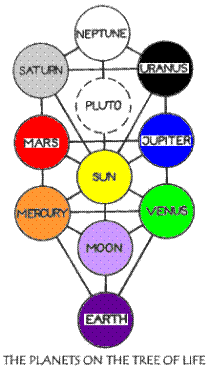
Influence extends only from the visible members of our solar system. The distant planets such as Uranus, Neptune, and Pluto, which are invisible to the unaided eye, are not considered to have any significant astrological influence.
The Torah states[24] “There shall not be found among you one who calculates times.” The Talmud, in the name of Rabbi Akiva, specifically applies this prohibition to one who calculates auspicious times, meaning that one should not make astrology a dominant influence in one’s daily life and predictions through astrology are forbidden. Therefore one should not use horoscopes to determine one’s future actions, though it is permitted to do character analyzes through astrology.
It is the prevalent custom that on a happy occasion such as a birth, one wishes “Mazal tov” indicating the wish that the planetary influence on the child should be a good one. Yet we are not slaves to the planets, as the Torah states, “You shall be perfect with the L-rd your G-d” (The Torah states[25] “There shall not be found among you one who calculates times.” The Talmud, in the name of Rabbi Akiva, specifically applies this prohibition to one who calculates auspicious times, meaning that one should not make astrology a dominant influence in one’s daily life and predictions through astrology are forbidden. Therefore one should not use horoscopes to determine one’s future actions, though it is permitted to do character analyzes through astrology.
It is the prevalent custom that on a happy occasion such as a birth, one wishes “Mazal tov” indicating the wish that the planetary influence on the child should be a good one. Yet we are not slaves to the planets, as the Torah states, “You shall be perfect with the L-rd your G-d”.[26] This means that the more we perfect our relationship with the spiritual dimension, the more G-d is going to aid us in changing the natural course of events. This makes any action based on astrological predictions needless. It states clearly in the Talmud that “Ein Mazal LeYisroel” or “there is noMazal for the Jewish people.” This simply means that the Jewish people as a whole were lifted above the Mazalot by virtue of their receiving the Torah.
This means that the more we perfect our relationship with the spiritual dimension, the more G-d is going to aid us in changing the natural course of events. This makes any action based on astrological predictions needless. It states clearly in the Talmud that “Ein Mazal LeYisroel” or “there is no Mazal for the Jewish people.” This simply means that the Jewish people as a whole were lifted above the Mazalot by virtue of their receiving the Torah.
Tehillim (Psalms) 147:1-5 Praise HaShem. How good it is to sing praises to our God, how pleasant and fitting to praise him! HaShem builds up Jerusalem; he gathers the exiles of Israel. He heals the brokenhearted and binds up their wounds. He determines the number of the stars and calls them each by name. Great is our Lord and mighty in power; his understanding has no limit.
HaShem gives them their names?
Revelation 8:10-11 The third angel sounded his trumpet, and a great star, blazing like a torch, fell from the sky on a third of the rivers and on the springs of water-- The name of the star is Wormwood. A third of the waters turned bitter, and many people died from the waters that had become bitter.
Yeshayah (Isaiah) 40:25-26 “To whom will you compare me? Or who is my equal?” says the Holy One. Lift your eyes and look to the heavens: Who created all these? He who brings out the starry host one by one, and calls them each by name. Because of his great power and mighty strength, not one of them is missing.
Iyov (Job) 9:7-10 He speaks to the sun and it does not shine; he seals off the light of the stars. He alone stretches out the heavens and treads on the waves of the sea. He is the Maker of the Bear and Orion, the Pleiades and the constellations of the south. He performs wonders that cannot be fathomed, miracles that cannot be counted.
Iyov (Job) 38:28-33 Does the rain have a father? Who fathers the drops of dew? From whose womb comes the ice? Who gives birth to the frost from the heavens When the waters become hard as stone, when the surface of the deep is frozen? “Can you bind the beautiful Pleiades? Can you loose the cords of Orion? Can you bring forth the constellations in their seasons or lead out the Bear with its cubs? Do you know the laws of the heavens? Can you set up [God’s] dominion over the earth?
Amos 5:6-10 Seek HaShem and live, or he will sweep through the house of Joseph like a fire; it will devour, and Bethel will have no one to quench it. You who turn justice into bitterness and cast righteousness to the ground (He who made the Pleiades and Orion, who turns blackness into dawn and darkens day into night, who calls for the waters of the sea and pours them out over the face of the land--HaShem is his name-- He flashes destruction on the stronghold and brings the fortified city to ruin), You hate the one who reproves in court and despise him who tells the truth.
Shoftim (Judges) 5:19-20 Kings came, they fought; the kings of Canaan fought at Taanach by the waters of Megiddo, but they carried off no silver, no plunder. From the heavens the stars fought, from their courses they fought against Sisera.
Yeshayah (Isaiah) 13:6-10 Wail, for the day of HaShem is near; it will come like destruction from the Almighty. Because of this, all hands will go limp, every man’s heart will melt. Terror will seize them, pain and anguish will grip them; they will writhe like a woman in labor. They will look aghast at each other, their faces aflame. See, the day of HaShem is coming--a cruel day, with wrath and fierce anger--to make the land desolate and destroy the sinners within it. The stars of heaven and their constellations will not show their light. The rising sun will be darkened and the moon will not give its light.
Constellation:
3685 Keciyl, kes-eel’; the same as 3684; any notable constellation; spec. Orion (as if a burly one):-constellation, Orion.
------------- Dictionary Trace ---------------
3684 keciyl, kes-eel’; from 3688; prop. fat, i.e. (fig.) stupid or silly:- fool (-ish).
Bamidbar (Numbers) 24:15-19 Then he uttered his oracle: “The oracle of Balaam son of Beor, the oracle of one whose eye sees clearly, The oracle of one who hears the words of God, who has knowledge from the Most High, who sees a vision from the Almighty, who falls prostrate, and whose eyes are opened: “I see him, but not now; I behold him, but not near. A star will come out of Jacob; a scepter will rise out of Israel. He will crush the foreheads of Moab, the skulls of all the sons of Sheth. Edom will be conquered; Seir, his enemy, will be conquered, but Israel will grow strong. A ruler will come out of Jacob and destroy the survivors of the city.”
What does this mean?
Iyov (Job) 9:9 He is the Maker of the Bear and Orion, the Pleiades and the constellations of the south.
Bear:
5906 `Ayish, ah’-yish; or `Ash, awsh; from 5789; the constellation of the Great Bear (perh. from its migration through the heavens):-Arcturus. Ayath. See 5857.
------------- Dictionary Trace ---------------
5789 `uwsh, oosh; a prim. root; to hasten:-assemble self.
5857 `Ay, ah’-ee; or (fem.) `Aya’ (Neh. 11:31), ah-yaw’; or `Ayath
(Isa. 10:28), ah-yawth; for 5856; Ai, Aja or Ajath, a place in Pal.:-Ai, Aija, Aijath, Hai.
Orion:
3685 Keciyl, kes-eel’; the same as 3684; any notable constellation; spec. Orion (as if a burly one):-constellation, Orion.
------------- Dictionary Trace ---------------
3684 keciyl, kes-eel’; from 3688; prop. fat, i.e. (fig.) stupid or silly:- fool (-ish).
Pleiades is the Septuagint translation of:
3598 Kiymah, kee-maw’; from the same as 3558; a cluster of stars, i.e. the Pleiades:-Pleiades, seven stars.
--------------- Dictionary Trace -------------
3558 kuwmaz, koo-mawz’; from an unused root mean. to store away; a jewel (prop. gold beads):-tablet.
II Luqas (Acts) 28:11 After three months we put out to sea in a ship that had wintered in the island. It was an Alexandrian ship with the figurehead of the twin gods Castor and Pollux.
Constellation: Bethulah
Meaning......: Virgin
Star...: Tsemech
Meaning: Branch. Used exclusively of the Messiah. Jer 23:5-6, Zech 3:8, Zech 6:12 Isa 4:2.
Star...: Zavijaveh
Meaning: Gloriously beautiful. Isa 4:2
Constellation: Mozanaim
Meaning......: Scales. Iyov (Job) 31:6, Eze 45:10
Ibn Ezra (From “The Secret of the Torah”, A translation of Abraham ibn Ezra’s Sefer Yesod Mora Ve-Sod Ha-Torah, by H. Norman Strickman.)
The secret of the ephod[27] is extremely precious[28], for six names[29] were inscribed on each one of the two sapphire stones that were on the ephod. One stone was on its right, and one[30] was on its left[31].
Observe: There was no image on the stones [of the ephod]. This alludes[32] [to the twelve sections of the sky]. These sections can be perceived only by the mind[33]. They correspond to the number of the tribes of Israel.
The breastplate was like the work of the ephod (Shemot (Exodus) 28:15)[34]. It was square[35], corresponding to the four compass points. Each one of its stones[36] was therefore[37] unlike the other.[38] The boxes and the rings that were permanently set in the breastplate[39] allude to the celestial equator.
The urim[40] are to be taken at face value.[41] So is the tummim.[42] The tummim corresponds to the cubed number.[43] Moses first placed them[44] on the breastplate, in accordance with the position of the heavenly bodies[45], on the day that he erected the tabernacle. The wise will understand.
B. Talmud
Yoma 73b... And although the decree of a prophet could be revoked, the decree of the ‘Urim and Thummim’ could not be revoked, as it is said: By the judgment of the Urim. Why were they called ‘Urim and Thummim’? ‘Urim’ because they made their words enlightening.[46] ‘Thummim’ because they fulfil their words. ...
Yoma 73b ... in wrong order and received his answer in right order.[47] And as soon as he knew that he had asked in wrong order, he asked again in right order, as it is said: Will the men of Keilah deliver up me and my men in to the hand of Saul? And the Lord said.’ They will deliver thee up.[48] But if the occasion required both questions, both were answered, as it is said: And David inquired of the Lord, saying: Shall I pursue after this troop? Shall I overtake them? And He answered him: pursue; for thou shalt surely overtake them and shalt without fail recover all.[49] And although the decree of a prophet could be revoked, the decree of the ‘Urim and Thummim’ could not be revoked, as it is said: By the judgment of the Urim. Why were they called ‘Urim and Thummim’? ‘Urim’ because they made their words enlightening.[50] ‘Thummim’ because they fulfil their words. And if you should ask: Why did they not fulfil their words in Gibeah Benjamin?[51] It is because they did not inquire[52] [whether the result would be] victory or defeat.[53] But at last, when conquered, they [the Urim and Thummim] approved their action, as it is said: And Phinehas, the son of Eleazar, the son of Aaron, stood before it in those days, saying: ‘Shall I yet again go out to battle against the children of Benjamin my brother, or shall I cease?’ and the Lord said: Go up, for tomorrow I will deliver him into thy hand.[54]
How was it effected? — R. Johanan said: [The letters] stood forth.[55] Resh Lakish said: They joined each other. But the ‘Zade’ was missing?[56] R. Shmuel (Samuel) b. Isaac said: They contained also the names of Abraham, Isaac and Jacob. But the ‘Teth’, too, was missing? — R. Aha b. Jacob said: They contained also the words: The ‘tribes’[57] of Jeshurun.
An objection was raised: No priest was inquired of who does not speak by means of the Holy Spirit and upon whom the Divine Presence does not rest, for Zadok inquired and succeeded, whilst Abiathar inquired and failed, as it is said: But Abiathar went up until all the people had done passing out of the city?[58] — He helped along.[59]
AND ONE INQUIRED ONLY FOR A KING. Whence do we know these things? — R. Abbahu said: Scripture said, And he shall stand before Eleazar the priest, who shall inquire for him by the judgment of the Urim;[60] ‘he’ i.e., the king, ‘and all the children of Israel with him’, i.e., the [priest] Anointed for Battle, ‘even all the congregation’, that is the Sanhedrin.
* * *
A prophet needs no “tools” to speak the word of HaShem, but I would point out to you that the oracle of Urim and Thummin was used by HaShem’s prophets and priests to divine the will of HaShem, dozens of times in the Tanakh, the Old Testament. See for example: Shemot (Exodus) 28:30. Interestingly the words Urim and Thummin are of Chaldean origin and translate as “perfects lights”. Lights could be taken as a reference to the heavenly hosts. Is it mere coincidence that the modern hymn of the three wise men sung at Christmas should go “guide us to thy perfect light.”?
Ur (same root as Urim) of the Chaldees, birthplace of Abraham, translates “Light of the Astrologers.”:
Yirimiyah (Jeremiah) 50:10 And Chaldea shall be a spoil: all that spoil her shall be satisfied, saith HaShem.
+------------------------------------------------+
3778 Kasdiy, kas-dee’ (occasionally with enclitic Kasdiymah, kas-dee’-maw; towards the Kasdites:-into Chaldea), patron. from 3777 (only in theplur.); a Kasdite, or desc. of Kesed; by impl. a Chaldean (as if so descended); also an astrologer (as if proverbial of that people):- Chaldeans, Chaldees, inhabitants of Chaldea.
-------------- Dictionary Trace -----------------
3777 Kesed, keh’-sed; from an unused root of uncert. mean; Kesed, a relative of Abraham:-Chesed.
The Urim and Thummin oracle was thought to be two distinct objects fastened to the breastplate of the high priest for discerning HaShem’s will. This bares a remarkable resemblance to a legend recalled in the Torah[61] concerning a large astrological tablet which Abraham, the Chaldean, bore on his chest at times when he was consulted as a prophet by kings of the east.
Jacob’s son Joseph who is a prophet of God makes use of a prophetic tool called a “cup of divination”:
Bereshit (Genesis) 44:1-5 Now Joseph gave these instructions to the steward of his house: “Fill the men’s sacks with as much food as they can carry, and put each man’s silver in the mouth of his sack. Then put my cup, the silver one, in the mouth of the youngest one’s sack, along with the silver for his grain.” And he did as Joseph said. As morning dawned, the men were sent on their way with their donkeys. They had not gone far from the city when Joseph said to his steward, “Go after those men at once, and when you catch up with them, say to them, ‘Why have you repaid good with evil? Isn’t this the cup my master drinks from and also uses for divination? This is a wicked thing you have done.’”
And has predictive dreams with what is clearly astronomical meaning. The only way to correctly interpret his dream is my means of astronomy. His father immediately understands Joseph’s dream of the sun and the moon being references to himself and his wife:
Bereshit (Genesis) 37:5-10 Joseph had a dream, and when he old it to his brothers, they hated him all the more. He said to them, “Listen to this dream I had: We were binding sheaves of grain out in the field when suddenly my sheaf rose and stood upright, while your sheaves gathered around mine and bowed down to it.” His brothers said to him, “Do you intend to reign over us? Will you actually rule us?” And they hated him all the more because of his dream and what he had said. Then he had another dream, and he told it to his brothers. “Listen,” he said, “I had another dream, and this time the sun and moon and eleven stars were bowing down to me.” When he told his father as well as his brothers, his father rebuked him and said, “What is this dream you had? Will your mother and I and your brothers actually come and bow down to the ground before you?”
This further suggests that Jacob himself understood astronomy. These predictions of Joseph are fulfilled EXACTLY, see: Bereshit (Genesis) 45:9-12. Joseph is further described in scripture as a “God fearing man” Bereshit (Genesis) 42:18, who receives the blessing of his father Jacob after his prophesy with its astronomical symbolism concerning him comes to pass.
Scripture clearly states that Daniel was “learned” in the knowledge of the Chaldean astrologers and in fact was made “Chief of the astrologers”:
Daniel 4:4-9 I, Nebuchadnezzar, was at home in my palace, contented and prosperous. I had a dream that made me afraid. As I was lying in my bed, the images and visions that passed through my mind terrified me. So I commanded that all the wise men of Babylon be brought before me to interpret the dream for me. When the magicians, enchanters, astrologers and diviners came, I told them the dream, but they could not interpret it for me. Finally, Daniel came into my presence and I told him the dream. (He is called Belteshazzar, after the name of my god, and the spirit of the holy gods is in him.) I said, “Belteshazzar, chief of the magicians, I know that the spirit of the holy gods is in you, and no mystery is too difficult for you. Here is my dream; interpret it for me.
He was obviously a different kind of prophet from the other royal advisers. At no point does he explicitly condemn Astronomy as such. Only that HaShem alone provides the “inspiration” (ie. Holy Spirit) for correct prophesy. Indeed, He even intervenes to prevent the execution of the pagan astrologers and is kindly towards them.
First century historian of the Jews, Herodias asserts that the Patriarch Abraham was the inventor of astrology. There is widespread misconception that Astrology started solely with the “pagan” Greeks when it actually started with the Chaldeans. The Midrash supports the notion that Abraham was an astrologer. Biblical evidence of this may be found in Bereshit (Genesis) 17:15 where HaShem orders Abraham to change this wife’s name from Sarai to Sarah in order that she conceive a child. It is a Jewish custom that changing or adding a name blesses that person with a “new” new beginning. HaShem has supreme knowledge of the future because he is the first cause in creation, and hence has complete knowledge of all subsequent beginnings following from that as it is written “declaring the end from the beginning. “Yeshayahu (Isaiah) 46:11.
THE ANTIQUITIES OF THE JEWS, Book 3, Chapter 6:7
7. Over against this table, near the southern wall, was set a candlestick of cast gold, hollow within, being of the weight of one hundred pounds, which the Hebrews call Chinchares, if it be turned into the Greek language, it denotes a talent. It was made with its knops, and lilies, and pomegranates, and bowls (which ornaments amounted to seventy in all); by which means the shaft elevated itself on high from a single base, and spread itself into as many branches as there are planets, including the sun among them. It terminated in seven heads, in one row, all standing parallel to one another; and these branches carried seven lamps, one by one, in imitation of the number of the planets. These lamps looked to the east and to the south, the candlestick being situate obliquely.
THE ANTIQUITIES OF THE JEWS, Book 3, Chapter 7:7
7. Now here one may wonder at the ill-will which men bear to us, and which they profess to bear on account of our despising that Deity which they pretend to honor; for if any one do but consider the fabric of the tabernacle, and take a view of the garments of the high priest, and of those vessels which we make use of in our sacred ministration, he will find that our legislator was a divine man, and that we are unjustly reproached by others; for if any one do without prejudice, and with judgment, look upon these things, he will find they were every one made in way of imitation and representation of the universe. When Moses distinguished the tabernacle into three parts, and allowed two of them to the priests, as a place accessible and common, he denoted the land and the sea, these being of general access to all; but he set apart the third division for God, because heaven is inaccessible to men. And when he ordered twelve loaves to be set on the table, he denoted the year, as distinguished into so many months. By branching out the candlestick into seventy parts, he secretly intimated the Decani, or seventy divisions of the planets; and as to the seven lamps upon the candlesticks, they referred to the course of the planets, of which that is the number. The veils, too, which were composed of four things, they declared the four elements; for the fine linen was proper to signify the earth, because the flax grows out of the earth; the purple signified the sea, because that color is dyed by the blood of a sea shell-fish; the blue is fit to signify the air; and the scarlet will naturally be an indication of fire. Now the vestment of the high priest being made of linen, signified the earth; the blue denoted the sky, being like lightning in its pomegranates, and in the noise of the bells resembling thunder. And for the ephod, it showed that God had made the universe of four elements; and as for the gold interwoven, I suppose it related to the splendor by which all things are enlightened. He also appointed the breastplate to be placed in the middle of the ephod, to resemble the earth, for that has the very middle place of the world. And the girdle which encompassed the high priest round, signified the ocean, for that goes round about and includes the universe. Each of the sardonyxes declares to us the sun and the moon; those, I mean, that were in the nature of buttons on the high priest’s shoulders. And for the twelve stones, whether we understand by them the months, or whether we understand the like number of the signs of that circle which the Greeks call the Zodiac, we shall not be mistaken in their meaning. And for the mitre, which was of a blue color, it seems to me to mean heaven; for how otherwise could the name of God be inscribed upon it? That it was also illustrated with a crown, and that of gold also, is because of that splendor with which God is pleased. Let this explication suffice at present, since the course of my narration will often, and on many occasions, afford me the opportunity of enlarging upon the virtue of our legislator.
Jubilees, Chapter 12:15... And Terah went forth from Ur of the Chaldees, he and his sons, to go into the land of Lebanon and into the land of Canaan, and he dwelt in the land of Haran, and Abram dwelt with Terah his father in Haran two weeks of years. And in the sixth week, in the fifth year thereof, [1951 A.M.] Abram sat up throughout the night on the new moon of the seventh month to observe the stars from the evening to the morning, in order to see what would be the character of the year with regard to the rains, and he was alone as he sat and observed. And a word came into his heart and he said: All the signs of the stars, and the signs of the moon and of the sun are all in the hand of the Lord. Why do I search (them) out?
Antiquities of the Jews:
Book 1 - Chapter 3:9. Now when Noah had lived three hundred and fifty years after the Flood, and that all that time happily, he died, having lived the number of nine hundred and fifty years. But let no one, upon comparing the lives of the ancients with our lives, and with the few years which we now live, think that what we have said of them is false; or make the shortness of our lives at present an argument, that neither did they attain to so long a duration of life, for those ancients were beloved of God, and [lately] made by God himself; and because their food was then fitter for the prolongation of life, might well live so great a number of years: and besides, God afforded them a longer time of life on account of their virtue, and the good use they made of it in astronomical and geometrical discoveries, which would not have afforded the time of foretelling [the periods of the stars] unless they had lived six hundred years; for the great year is completed in that interval. Now I have for witnesses to what I have said, all those that have written Antiquities, both among the Greeks and barbarians; for even Manetho, who wrote the Egyptian History, and Berosus, who collected the Chaldean Monuments, and Mochus, and Hestieus, and, besides these, Hieronymus the Egyptian, and those who composed the Phoenician History, agree to what I here say: Hesiod also, and Hecatseus, Hellanicus, and Acusilaus; and, besides these, Ephorus and Nicolaus relate that the ancients lived a thousand years. But as to these matters, let every one look upon them as he thinks fit.
The following text is quoted from: Abraham Ibn Ezra’s Sefer Yesod Mora Ve-Sod Ha-Torah
 Ten is the foundation of all sums,[62]
for all sums that follow ten[63]
are made up of a part[64]
or parts of ten,[65] or one come into being by doubling ten,[66]
multiplying ten[67] or by a
combination of the two.[68] Furthermore,
it is well known that wind and fire
form one sphere, and water and earth a second sphere.[69]
There is indisputable proof that these spheres are circled by eight other spheres.[70] All of this
clearly adds up to ten. The yod[71]
therefore has the shape of the periphery of a circle that encompasses everything
in it.[72]
Ten is the foundation of all sums,[62]
for all sums that follow ten[63]
are made up of a part[64]
or parts of ten,[65] or one come into being by doubling ten,[66]
multiplying ten[67] or by a
combination of the two.[68] Furthermore,
it is well known that wind and fire
form one sphere, and water and earth a second sphere.[69]
There is indisputable proof that these spheres are circled by eight other spheres.[70] All of this
clearly adds up to ten. The yod[71]
therefore has the shape of the periphery of a circle that encompasses everything
in it.[72]
The word yod means a gathering.[73] It comes from the same root[74] as the words todah [company[75] and todot [companies][76] in And the other company (Ezra-Nechemiah (Nehemiah)-Nechemiah (Nehemiah) 12:38)
Now if one starts counting the spheres from the first sphere,[77] then the first sphere is the holy sphere.[78] On the other hand, if one starts the count of the spheres from the lunar sphere,[79] then the tenth sphere is the holy sphere. Both the firstborn and the tenth born are there fore holy.[80]
However, from another point of view, the integers end with nine.[81] For ten is the first of the tens, and one is not considered a number. There are thus only eight numbers.[82] Four of them-namely, two, three, five, and seven, are prime numbers.[83]
When we add one, which is a root, and a square, a foundation[84] and a cube, to the square of the first of the even numbers,[85] we get five[86] If we add one to the square of the first of the odd numbers,[87] we get ten.[88]
We thus have the revered name of God.[89] If we add one to the square of five, we get the sum of God’s entire name.[90] The same is also the case if we add up the letters that spell out yod, heh.[91] If we add one to the square of seven, we get fifty, [which alludes to] the holy jubilee year[92] and the day when the festival of Shavuot is observed.[93]
Berachoth 58b OVER SHOOTING-STARS [ZIKIN]. What are ZIKIN? Shmuel (Samuel) said: A comet.[94] Shmuel (Samuel) also said: I am as familiar with the paths of heaven as with the streets of Nehardea, with the exception of the comet, about which I am ignorant. There is a tradition that it never passes through the constellation of Orion, for if it did, the world would be destroyed. But we have seen it pass through? — Its brightness passed through, which made it appear as if it passed through itself. R. Huna the son of R. Yahoshua (Joshua) said: Wilon[95] was torn asunder and rolled up,[96] showing the brightness of Rakia.[97] R. Ashi said: A star was removed from one side of Orion and a companion star appeared on the other side, and people were bewildered and thought the star had crossed over.[98]
Shmuel (Samuel) contrasted two texts. It is written, Who maketh the Bear, Orion, and the Pleiades.[99] And it is written elsewhere, That maketh Pleiades and Orion.[100] How do we reconcile these? Were it not for the heat of Orion the world could not endure the cold of Pleiades; and were it not for the cold of Pleiades the world could not endure the heat of Orion. There is a tradition that were it not that the tail of the Scorpion has been placed in the Stream of Fire,[101] no one who has ever been stung by a scorpion could live. This is what is referred to in the words of the All-Merciful to Iyov (Job): Canst thou bind the chains of Pleiades or loose the bands of Orion?[102]
What is meant by Kimah [Pleiades]?6 Shmuel (Samuel) said: About a hundred [ke’me-ah] stars. Some say they are close together; others say that they are scattered. What is meant by ‘‘Ash [the Bear]’?6 — Rab Judah said: Jutha. What is Jutha? — Some say it is the tail of the Ram; others say it is the hand of the Calf.[103] The one who says it is the tail of the Ram is more probably right, since it says: ‘Ayish will be comforted for her children .[104] This shows that it lacks something, and in fact it looks like a piece torn off;[105] and the reason why she follows her is because she is saying to her: Give me my children. For at the time when the Holy One, blessed be He, wanted to bring a flood upon the world, He took two stars from Kimah and brought a flood upon the world. And when He wanted to stop it, He took two stars from ‘Ayish and stopped it. But why did He not put the other two back? — A pit cannot be filled with its own clods;[106] or another reason is, the accuser cannot become advocate. Then He should have created two other stars for it? — There is nothing new under the sun.[107] R. Nahman said: The Holy one, blessed be He, will one day restore them to her, as it says: and ‘Ayish will be comforted for her children.[108]
Shabbath 146a the serpent came upon Eve he injected a lust into her:[109] [as for] the Israelites who stood at Mount Sinai, their lustfulness departed; the idolaters, who did not stand at Mount Sinai, their lustfulness did not depart.[110] R. Aha son of Raba asked R. Ashi. What about proselytes? Though they were not present, their guiding stars[111] were present, as it is written, [Neither with you only do I make this covenant and this oath], but with him that standeth here with us this day before the Lord our God, and also with him that is not here with us this day.[112] Now he differs from R. Abba b. Kahana, for R. Abba b. Kahana said: Until three generations the lustful [strain] did not disappear from our Patriarchs: Abraham begat Ishmael, Isaac begat Esau, [but] Jacob begat the twelve tribes in whom there was no taint whatsoever.[113]
Rosh HaShana 11b R. Yahoshua (Joshua) and R. Eliezer are herein consistent [with views expressed by them elsewhere], as it has been taught: ‘In the sixth hundredth year of Noah’s life, in the second month, on the seventeenth day of the month.[114] R. Yahoshua (Joshua) said: That day was the seventeenth day of Iyar, when the constellation of Pleiades sets at daybreak and the fountains begin to dry up, and because they [mankind] perverted their ways, the Holy One, blessed be He, changed for them the work of creation and made the constellation of Pleiades rise at daybreak and took two stars from the Pleiades and brought a flood on the world. R. Eliezer said: That day was the seventeenth of Marheshvan, a day on which the constellation of Pleiades rises at daybreak, and [the season] when the fountains begin to fill , and because they perverted their ways, the Holy One, blessed be He, changed for them the work of creation, and caused the constellation of Pleiades to rise at daybreak and took away two stars [from it] and brought a flood on the world’.[115]
Baba Bathra 16b The Lord had blessed Abraham in all things[116] [ba-kol].What is meant by ‘in all things’? R. Meir said: In the fact that he had no daughter; R. Judah said: In the fact that he had a daughter. Others say that Abraham had a daughter whose name was ba-kol. R. Eliezer the Modiite said that Abraham possessed a power of reading the stars[117] for which he was much sought after by the potentates of East and West.[118]
Shabbath 156a It was stated. R. Hanina said: The planetary influence gives wisdom, the planetary influence gives wealth, and Israel stands under planetary influence. R. Johanan maintained: Israel is immune from planetary influence.[119] Now, R. Johanan is consistent with his view, for R. Johanan said: How do we know that Israel is immune from planetary influence? Because it is said, Thus saith the Lord, Learn not the way of the nations, and be not dismayed at the signs of heaven, for the nations are dismayed at them:[120] they are dismayed but not Israel.[121] Rab too holds that Israel is immune from planetary influence. For Rab Judah said in Rab’s name: How do we know that Israel is immune from planetary influence? Because it is said, and he brought him forth from abroad.[122] Abraham pleaded before the Holy One, blessed be He, ‘Sovereign of the Universe! one born in mine house is mine heir.’[123] ‘Not so,’ He replied, ‘but he that shall come forth out of thine own bowels.’[124] ‘Sovereign of the Universe!’ cried he, ‘I have looked at my constellation and find that I am not fated to beget child.’ ‘Go forth from [i.e., cease] thy planet [gazing], for Israel is free from planetary influence. What is thy calculation?
Shabbath 156a R. Hanina said to then, [his disciples]: Go out and tell the son of Levi, Not the constellation of the day but that of the hour is the determining influence. He who is born under the constellation of the sun[125] will be a distinguished[126] man: he will eat and drink of his own and his secrets will lie uncovered; if a thief, he will have no success. He who is born under Venus will be wealthy and unchaste [immoral]. What is the reason? Because fire was created therein.[127] He who is born under Mercury will be of a retentive memory and wise. What is the reason? Because it [Mercury] is the sun’s scribe. He who is born under the Moon will be a man to suffer evil, building and demolishing, demolishing and building. eating and drinking that which is not his and his secrets will remain hidden: if a thief, he will be successful.[128] He who is born under Saturn (Shabbtai) will be a man whose plans will be frustrated.[129] Others say: All [nefarious] designs against him will be frustrated. He who is born under Zedek [Jupiter] will be a right-doing man [zadkan] R. Nahman b. Isaac observed: Right-doing in good deeds. ‘He who is born under Mars will be a shedder of blood. R. Ashi observed: Either a surgeon, a thief, a slaughterer, or a circumciser. Rabbah said: I was born under Mars.[130] Abaye retorted: You too inflict punishment and kill.[131]
Shabbath 156b Because Zedek [Jupiter][132] stands in the West?[133] I will turn it back and place it in the East.’ And thus it is written, Who hath raised up Zedek from the east?[134] He hath summoned it for his sake.[135]
Midrash Rabbah - Bamidbar (Numbers) X:8 Wine and intelligence have been compared to Kimah[136] and to Scorpio. Whenever Kimah is visible in the sky, Scorpio is invisible, and as soon as Scorpio appears Kimah goes out of sight. So wine is like Scorpio and knowledge is like Kimah. As the scorpion injures with its tail so wine injures in the end; as it says, At the last it biteth like a serpent (ib. XXIII, 32). And as Kimah ripens the fruit and gives it flavour, so intelligence imparts fragrance and relish to a man’s words. When the wine goes in intelligence takes its leave. Wherever there is wine there is no intelligence. ‘When the wine enters, the secret (sod) comes out’; the numerical total of wine (yayin) is seventy2 and the total of sod (secret) is seventy.3
Devarim (Deuteronomy) 32:1-9 Listen, O heavens, and I will speak; hear, O earth, the words of my mouth. Let my teaching fall like rain and my words descend like dew, like showers on new grass, like abundant rain on tender plants. I will proclaim the name of HaShem. Oh, praise the greatness of our God! He is the Rock, his works are perfect, and all his ways are just. A faithful God who does no wrong, upright and just is he. They have acted corruptly toward him; to their shame they are no longer his children, but a warped and crooked generation. Is this the way you repay HaShem, O foolish and unwise people? Is he not your Father, your Creator, who made you and formed you? Remember the days of old; consider the generations long past. Ask your father and he will tell you, your elders, and they will explain to you. When the Most High gave the nations their inheritance, when he divided all mankind, he set up boundaries for the peoples according to the number of the sons of Israel. For HaShem’s portion is his people, Jacob his allotted inheritance.
The stars, too, were bounded according to the number of the sons of Israel.
Midrash Rabbah - Bamidbar (Numbers) II:7 7. ACCORDING TO THE ENSIGNS (II, 2).[137] There were distinguishing signs for each prince; each had a flag and a different color for every flag, corresponding to the precious stones on the breast[138] of Aaron. It was from these that governments[139] learned to provide themselves with flags of various colors. Each tribe had its own prince and its flag whose color corresponded to the color of its stone. [In Aaron’s breast-plate]
Reuben’s stone was ruby and the color of his flag was red; and embroidered thereon were mandrakes.[140]
Simeon’s was topaz and his flag was of a green color; the town of Shechem was embroidered thereon.[141]
Levi’s[142] was smaragd and the color of his flag was a third white, a third black, and a third red; embroidered thereon were the Urim and Thummim.[143]
Judah’s was a carbuncle and the color of his flag was something like the heavens; embroidered on it was a lion.[144]
Issachar’s was a sapphire and the color of his flag was black like stibium, and embroidered thereon was the sun and moon, in allusion to the text, And of the children of Issachar, men that had understanding of the times[145] (I Chron. XII, 33).
Zebulun’s was an emerald and the color of his flag was white,[146] with a ship embroidered thereon, in allusion to the text, Zebulun shall dwell at the shore of the sea (Gen. XLIX, 13).
Dan’s was jacinth and the color of his flag was similar to sapphire,[147] and embroidered on it was a serpent, in allusion to the text, Dan shall be a serpent in the way (Gen. XLIX, 17).
Rabbenu Bachya says that the image was an eagle.[148]
Gad’s[149] was an agate and the color of his flag was neither white nor black but a blend of black and white; on it was embroidered a camp, in allusion to the text, Gad[150], a troop shall troop upon him (ib. 19).
Naphtali’s was an amethyst and the color of his flag was like clarified wine of a not very deep red; on it was embroidered a hind, in allusion to the text, Naphtali is a hind let loose (ib. 21).
Asher’s was a beryl and the color of his flag was like the precious stone with which women adorn themselves; embroidered thereon was an olive-tree, in allusion to the text, As for Asher, his bread shall be fat (ib. 20).
Joseph’s was an onyx and the color of his flag was jet black; the embroidered design thereon for both princes, Ephraim and Manasseh, was Egypt, because they were born in Egypt.
On the flag of Ephraim was embroidered a bullock, in allusion to the text, His firstling bullock (Deut. XXXIII, 17), which applies to Yahoshua (Joshua)[151] who came from the tribe of Ephraim.
On the flag of the tribe of Manasseh was embroidered a wild ox, in allusion to the text, And his horns are the horns of the wild-ox (Deut. XXXIII, 17), which alludes to Gideon son of Joash who came from the tribe of Manasseh.[152]
Benjamin’s was jasper and the color of his flag was a combination of all the twelve colors; embroidered thereon was a wolf, in allusion to the text, Benjamin is a wolf that raveneth (Gen. XLIX, 27). The reason, then, why it is said, ACCORDING TO THE ENSIGNS is because each prince had his own distinguishing sign.
For pictures and more information please see the study titled, “tribes.html”.
Midrash Rabbah - Esther VII:11 With Kislev came the merit of Hanukah,[153] with Tebeth the merit of Nehemiah, as it says, And the children of the captivity did so. And Nehemiah the priest... were separated... in the first day of the tenth month... and they were finished with all the men that had married foreign women, etc. Nehemiah X, 16 f.). With Shebat came up the merit of the Men of the Great Synagogue; for on the twenty-third of that month all Israel gathered together to take counsel about the concubine of Gibeah and the graven image of Micah.[154] When the month of Adar came up, he found no merit in it and he began to rejoice. He then turned to examining the signs of the Zodiac. In the sign of the Lamb[155] he found the merit of Passover, as it says, Every man a lamb, according to their fathers’ houses (Ex. XII, 3). In that of Taurus (ox) was found the merit of Joseph who was called ox, as it says, His firstling bullock, majesty is his (Deut. XXXIII, 17); and also the merit of the offering, as it says, When a bullock, or a sheep, or a goat is brought forth, etc. (Lev. XXII, 27). In Gemini (twins) was found the merit of Peretz and Zerach[156] who were called twins, as it says, Behold, twins were in her womb (Gen. XXXVIII, 27). In Leo (lion) was found the merit of Daniel who was from the tribe of Judah which is called lion, as it says, Judah is a lion’s whelp (ib. XLIX, 9). In Virgo (virgin) there was the merit of Hananiah, Mishael, and Azariah, who were like a maiden that knows no man except her husband; so they did not change their God or their law and clung to their Judaism. Libra (scales) is Iyov (Job), as it says, O that my vexation we weighed, and my calamity laid in the balances (Iyov (Job) VI, 2). Scorpio is Yechezkel (Ezekiel), as it says, Thou dost dwell among scorpions (Ezek., 6).[157] Sagittarius (bowman) is Joseph, as it says, But his bow abode firm (Gen. XLIX, 24). Capricornus (kid) is Jacob, as it says, And she put the skins of the kids of the goats upon his hands (ib. XXVII, 16). Aquarius (water-carrier) is Moses, as it says, And moreover he drew water for us (Ex. II, 19).[158] On reaching the sign of Pisces (fishes) which shines in the month of Adar, he found no merit in it and rejoiced saying, ‘Adar has no merit, its sign has no merit, and what is more, in Adar Moses their master died.’ He, however, did not know that on the first[159] of Adar Moses died and on the first of Adar he was born. He said: ‘Just as fishes swallow one another, so I will swallow them.’ Said the Holy One, blessed be He, to him: ‘ Wretch! Fishes sometimes swallow and sometimes are swallowed, and now it is you who will be swallowed.’ Said R. Hanan: The same thing is intimated by the verse, Whereas it was turned to the contrary, that the Jews had rule over them that hated them (Est. IX, 1). R. Tanhuma said: And the Lord said not that He would blot out the name of Israel (II Melakim (Kings) XIV, 27), but what He said was, For I will utterly blot out the remembrance of Amalek (Ex. XVII, 14)
Midrash Rabbah - Vayikra (Leviticus) XXIX:8 8. R. Hiyya b. Abba in the name of R. Levi opened his discourse with the text, Sons of Adam[160] are vanity, and sons of man[161] are a lie; if they be laid in the balances, they are together from nothingness (Ps. LXII, 10).[162] In the ordinary way, what do people say? Such-and-such a man shall marry such-and-such a woman; but ‘Sons of Adam are vanity’; such-and-such a woman shall be married to So-and-so, but ‘Sons of man are a lie; they are together from nothingness’.[163] R. Hiyya explained this to mean that while they are still composed of nothing in the womb of their mother they are united. R. Nahman explained the verse to mean: In spite of all the vanities and lying acts which the children of Abraham our father commit in this world, he is sufficiently worthy to make atonement for them all. Hence it is written, He was the greatest man among the Anakim (Josh. XIV, 15).[164] If they be laid in the balances’-- (be-moznayim): they are granted atonement during ‘moznayim’; that is to say, in the month whose constellation is Libra (moznayim). Which month is that? It is the month of Tishri, which signifies: Mayest Thou dissolve (tishre), pardon, and atone for the sins of Thy people. When? IN THE SEVENTH MONTH. Another exposition: It is called ‘the seventh (hashebi’i) month’ because it is full[165] (mesubba’) of everything; in it the wine-vats are full, in it there are blessings, there is atonement in it, there is the festive booth, the palm-branch and the willow’ in it.
* * *
The sign of Nisan is T’leh / Aries / Ram corresponding to Judah and the faculty of speech. This is the month the Jews overcame the Egyptian
deity of the ram. Judah means “thanks”, related to speech and on Passover of this month the Pascal lamb was offered and we recite the haggada.
Iyar is Shor / Taurus / Bull corresponding to Issachar (Torah scholars) and the faculty of thought. In this month we must be as strong and stubborn as a bull in preparation to receive the Torah.
Sivan is Te’umim / Gemini / Twins corresponding to Zevulun (Torah supporters) and the faculty of motion. This is the month of Shavuot when we received the double tablets and should strengthen our efforts to support Torah.
Tamuz is Sartan / Cancer / Crab corresponding to Reuven (means “see”) and the faculty of sight. Just as the crab hides, so we should refrain from the distractions of this summer month and direct our sights toward spiritual pursuits.
Av is Ari / Leo / Lion corresponding to Shimon (means “hear”) and the faculty of hearing. In this month, the lion-like nations of Babylon and Rome destroyed the Temple and we must listen to the lesson and return to G-d.
Elul is Bethulah / Virgo / Virgin corresponding to Gad and the faculty of action. This is the month of repenting, to purify our thoughts and deeds in preparation of Rosh Hashana.
Tishri is Moznaim / Libra / Scales corresponding to Ephraim (fruitful) and the faculty of coition. In this month is Rosh Hashana on which we are judged, and hope to merit a productive new year.
Cheshvan is Akrav / Scorpio / Scorpion corresponding to Menashe and the faculty of smell. This month lacks a holiday and may be spiritually cold as venom, yet one must work hard to change the letters of Menashe to “neshama” - spirituality.
Kislev is Kashet / Sagittarius / Archer corresponding to Benjamin (warriors) and the faculty of sleep. Here we must direct and propel the inspiration from Chanukah through the rest of the winter to overcome spiritual slumber.
Tevet is Gedi / Capricorn / Kid corresponding to Dan (judge) and the faculty of anger. The siege against Jerusalem began in this month as a result of baseless hatred among Jews. Here we must be as steadfast as a goat to refrain from judging unfavorably which leads to anger and destruction.
Shevat is D’li / Aquarius / Water Drawer corresponding to Asher (wealth) and the faculty of taste. By this month most of the rain in Israel has fallen and we celebrate Tu b’Shevat by eating bountiful fruits.
Adar is Dagim / Pisces / Fish corresponding to Naftali and the faculty of laughter. Just as fish are covered by the sea, in this month we observe Purim which celebrates the hidden miracles of G-d which bring salvation and joy to the Jewish people.
* * *
Pesiqta de Rab Kahana, Pisqa Twenty-Three:The New Year, XXIII:VIII 2. Said R. Nahman, “All of the vanities and lies that the Israelites do in this world — Abraham, our father, is worthy of effecting atonement for all of them, What is the Scriptural proof text? He was the greatest man among the Anakim (Joshua 14:15).
“If they are placed in the balance, when does he effect atonement for them in the scales? It is in the month that is subject to the constellation of the scales [of Libra]. And which month is subject to the constellation of Libra? It is Tishri.
According to the Smag (an acronym for the Medieval index of commandments called: Large Book of Mitzvot), this is one of the 613 commandments. In his words: “It is a positive commandment to compute tekufot and mazalot and moladot….” These three words “tekufot, mazalot, moladot” refer to the various cycles of the stars and planets (today, we call this astrophysics).
On the verse, “for it is your wisdom and your understanding in the eyes of the nations,” Rashi writes that science is “recognizable wisdom,” because all the nations of the world can recognize it. Science has an advantage over the wisdom of the Torah because it predicts. The Torah does not appear to predict anything and only the Jewish mind fully appreciates it. Torah is like concealed wisdom compared to science. As we know, the strength of any scientific theory is its power of prediction. So, according to the sages, the most important scientific endeavor is astrophysics, which it is a commandment to pursue.
Now, tekufot, which literally means “cycles,” are a time image and mazalot, which literally mean “star constellations,” or “galaxies” are a space image, which also implies that it is a mitzva to unite time and space. This appears at the end of the discussion in the Talmud regarding the tearing of the fabric of the tapestry of the Tabernacle, which corresponds to the fabric of space-time.
This is all written here in short, but the lesson in that according to the Smag it is a positive commandment to compute the various cycles of the stars and planets, to learn astrophysics.
* * *
The word Mazal does not literally mean “luck.” The Hebrew word Mazal, which literally means the astrological zodiac sign or the luck which comes from the stars, has been said to really be composed of three words: makom, z’man, limmud, being in the right place at the right time and knowing how to utilize opportunities.
“Mazal” is literally associated with the twelve signs of the Zodiac, which are called the “Mazalot,” but we use the word in a way which means more than just the Zodiac. Rabbi Moshe Chaim Luzatto explains that there is a multi-leveled conceptual system through which HaShem interacts with the physical creation. In other words, “energy” which originates with HaShem travels through this system and eventually reaches us. At some point along the way, this energy is said to pass through the Mazalot, the stars and the planets, which then transfer it to the rest of creation. This explains how people trained in astrology may know what will happen to an individual in the future. They are “reading,” through the configuration of the Mazalot, the energy that is yet to be delivered. However, we are actually forbidden to engage in the prediction of the future via astrology even though it may work. The source of this prohibition is, “You shall be tamim (pure, perfect, simple) with HaShem your G-d.”
Mazal (“sign,” pl. mazalot):
1. a spiritual conduit of Divine beneficence (from the Hebrew root “to flow” [nozel]).
2. specifically, the thirteen tufts of the “beard“ of Arich Arpin.
3. a physical embodiment of such a spiritual conduit, such as a star, planet, constellation, etc.
4. specifically, the twelve constellations of the zodiac.
5. According to our sages, the Jewish People are not under the influence of the mazalot[166].
HaShem chose not to give the Torah in Nisan or Iyar, for the mazal of Nisan is a lamb and the mazal of Iyar is a bull and neither is capable of singing praise. Rather, He gave the Torah in Sivan, for the mazal of Sivan is twins, who have hands with which to clap and legs with which to dance.[167]
In Kabbala and Chasidut, it is explained that the thirteenth mazal transforms the entire set of mazalot into attributes of mercy. This is because numerically, twelve is a closed, rigid, perfect system; reflected in the physical world by the twelve lunar months and the twelve signs of the zodiac; in the Jewish people, by the twelve tribes; in the spiritual realm, by the twelve permutations of the letters of the Divine Name Havaya, and so on. In each of these sets, however, there is a (sometimes hidden) thirteenth element that adds the flexibility and adaptive quality that makes the set alive, pliable and viable. This is perhaps most clearly evident with regard to the twelve lunar months. In the Jewish calendar, a thirteenth month is added in seven out of every nineteen years in order to align the lunar year with the solar year. Here, the thirteenth lunar month makes the twelve original ones into an empathic system that can coexist with its solar “mate.” Similarly, the thirteenth tribe, Levi, officiates at the Temple, reconciling the twelve tribes of the Jewish people with their “mate,” HaShem.
By Rabbi Yaakov Bernstein and Bereshit (Genesis), ‘97
To Rashi, the meaning of the verses becomes: “If you will struggle diligently in Torah study in order to guard and perform the commandments, I will give rain in its season the earth will give forth its produce and the tree will yield its fruit...”
The reward is difficult to understand... for keeping the commandments there will be tangible reward in this material world? Didn’t the Talmud say: “The reward for mitzvot is not in this world?”[168]
Similarly, the Talmud states[169]: “Children, Length of days and wealth are not dependent on merit [alone] but on ‘mazal’ (fortune).”
However, the Tosafot commentary there mentions that “a great mitzva is different,” and can change one’s “mazal.” The legal commentary Elya Rabba explains that this is Rashi’s meaning here, as well. Amailot Batorah, diligent application to Torah studies, is a “great mitzva” that can help inspire a change in one’s mazal.
Indeed, Torah study is unlike any other study. In Midrash Tanchuma to Parshat Noach, the Hakhamim describe to what lengths the Torah Scholars must go: “The people who walked in darkness, saw a great light,” refers to them, because they deny themselves sleep, struggling over obscure passages in the Talmud, until the great light of understanding comes. They deny themselves food and drink and pleasures in this world, instead spending their time toiling, struggling to understand the Torah.
Mishlei (Proverbs) 16 “The soul of the working man works for him, for his mouth forces him.”
Sanhedrin 99b The soul of the man striving for Torah works for him, for while he works in one area of Torah study, his soul strives for him in another area.
The Elya Rabba explains: One who constantly reviews his learning, it will become orderly for him. This is the meaning of the prayer (in the daily blessings over Torah study): “Please, HaShem, make the words of Your Torah sweet in our mouths... so that we... may all know Your name and learn Torah for Your name’s sake...”
“So that we may all know Your name:” All the Torah is the Name of HaShem. Another explanation: The Zohar states (like Rashi and Tosaphot quoted above), that diligent study of Torah can change a heavenly decree. Therefore, we will know HaShem’s name, and not the name of the “mazal” (literally, a constellation).
(c) Rabbi Yaakov Bernstein and Bereshit (Genesis), ‘97
* * *
The Egyptians worshiped Capricorn (toleh) which was the “first-born” of the zodiac. When the Israelites saw that Capricorn had fallen, they assumed that the sign of Taurus (shor), which comes after Capricorn, was now foremost and had conquered Capricorn. Because of this error they made the Calf, which parallels the sign of Taurus. Therefore, whatever they did, they learned from the Egyptians. It is not surprising that they followed what they were accustomed to.
[Hakham Yitschaq Magriso (Constantinople, 1746) of blessed memory and form part of the Yalkut MeAm Lo’ez (Comentario delPueblo Ladinador)]
* * *



The Camp: Bamidbar (Numbers) 2:2 “The Israelites are to camp around the Tent of Meeting some distance from it, each man under his standard with the banners of his family.”
W
The camp of Reuben The Camp of Ephraim
-------------
Reuben 46,500 | Bull | Ephraim 40,500
Simeon 59,300 | | Manasseh 32,200
Gad 45,600 | E | Benjamin 35,400
------ | P | ------
151,400 | H | 108,100
| R |
Numbers 2:10-16 | A | Numbers 2:18-24
| I |
| M |
| |
-------------
-------------- ------------- --------------
| | | L E V I | | |
The Camp of Levi | Man | |L ----- L| | Eagle |
Numbers 1:44-53 | | |E | * | E| | |
S | REUBEN | |V | | V| | DAN[170] | N
| | |I ----- I| | |
| | | L E V I | | |
-------------- ------------- --------------
-------------
| |
| Lion |
| |
The Camp of Judah | | The Camp of Dan
| |
Judah 74,600 | J | Dan 62,700
Issachar 54,400 | | Naphtali 53,400
Zebulon 57,400 | U | Asher 41,500
------ | | ------
186,400 | D | 157,600
| |
Numbers 2:3-9 | A | Numbers 2:25:31
| |
| H |
| |
| |
| |
| |
| |
| |
| |
-------------
E
If the above image is scrambled, then the following image may be viewable:

Yechezkel (Ezekiel) 1:4-13 I looked, and I saw a windstorm coming out of the north--an immense cloud with flashing lightning and surrounded by brilliant light. The center of the fire looked like glowing metal, And in the fire was what looked like four living creatures. In appearance their form was that of a man, But each of them had four faces and four wings. Their legs were straight; their feet were like those of a calf and gleamed like burnished bronze. Under their wings on their four sides they had the hands of a man. All four of them had faces and wings, And their wings touched one another. Each one went straight ahead; they did not turn as they moved. Their faces looked like this: Each of the four had the face of a man, and on the right side each had the face of a lion, and on the left the face of an ox; each also had the face of an eagle. Such were their faces. Their wings were spread out upward; each had two wings, one touching the wing of another creature on either side, and two wings covering its body. Each one went straight ahead. Wherever the spirit would go, they would go, without turning as they went. The appearance of the living creatures was like burning coals of fire or like torches. Fire moved back and forth among the creatures; it was bright, and lightning flashed out of it. The creatures sped back and forth like flashes of lightning.
|
Month |
Mazzalot |
Mazzalot Latin |
Faculty |
Gem |
||
|
Toleh |
Aries |
Ram |
Yehuda |
Speech |
Nofech / Carbuncle |
|
|
Shor |
Taurus |
Bull |
Issachar |
Thought |
Safir / Sapphire / Lapz Lazuli |
|
|
Teumim |
Gemini |
Twins |
Zebulun |
Motion |
Yahalom / Pearl / Diamond |
|
|
Sartan |
Cancer |
Crab |
Reuven |
Sight |
Odem / Ruby |
|
|
Ari |
Leo |
Lion |
Shimon |
Hearing |
Pitdah / Emerald |
|
|
Betula |
Virgo |
Gad |
Action |
Achlama / Crystal |
||
|
Moznaim |
Libra |
Scales |
Ephraim |
Coition |
Shoham / Onyx ?? |
|
|
Cheshvan |
Akrav |
Scorpio |
Scorpion |
Menashe |
Smell |
|
|
Kashet |
Sagittarius |
Archer |
Yashpheh / Jasper |
|||
|
Tevet |
Gedi |
Capricorn |
Kid |
Dan |
Anger |
Leshem / Topaz |
|
Dli |
Aquarius |
Water Drawer |
Asher |
Taste |
Tarshish |
|
|
Dagim |
Pisces |
Fishes |
Naftali |
Shevo / Turquoise |
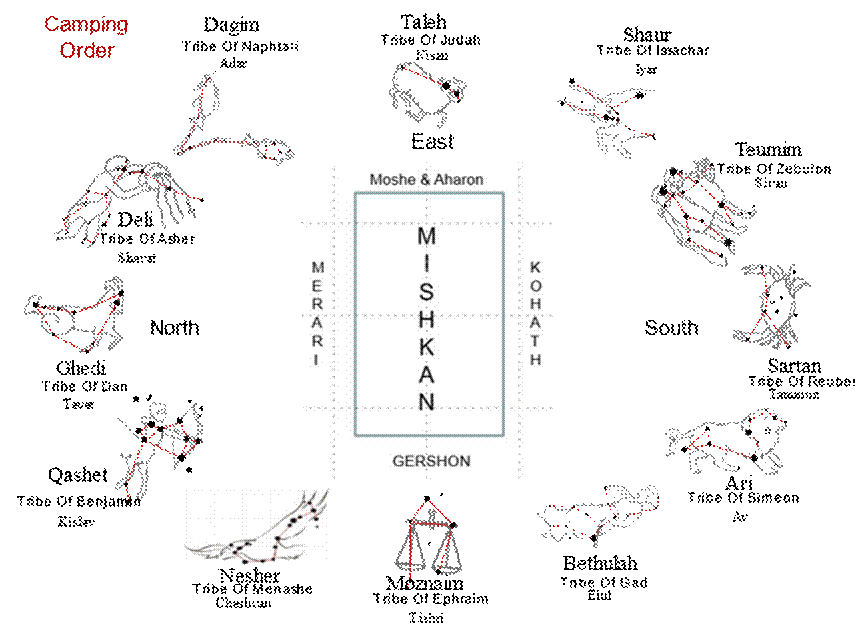
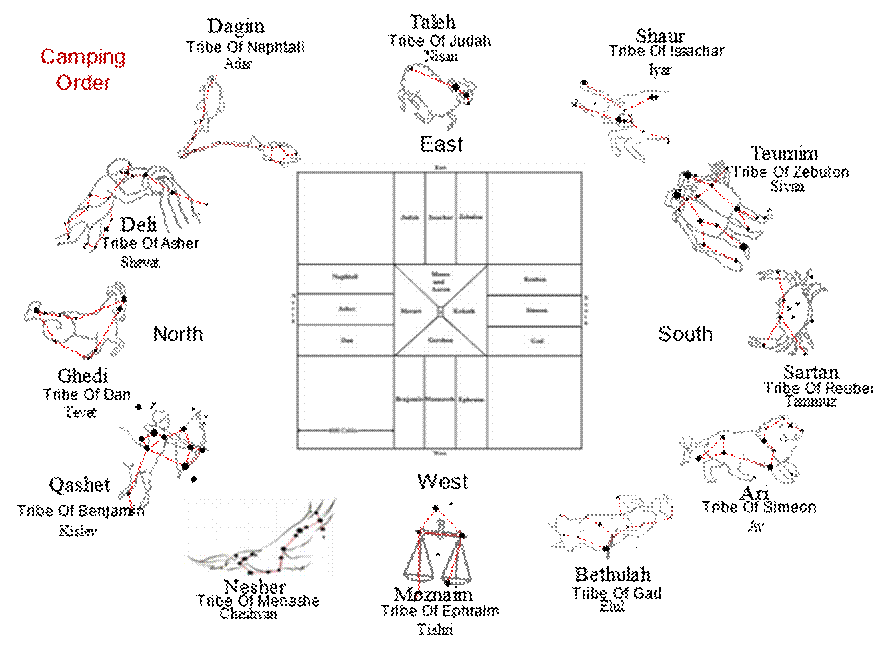
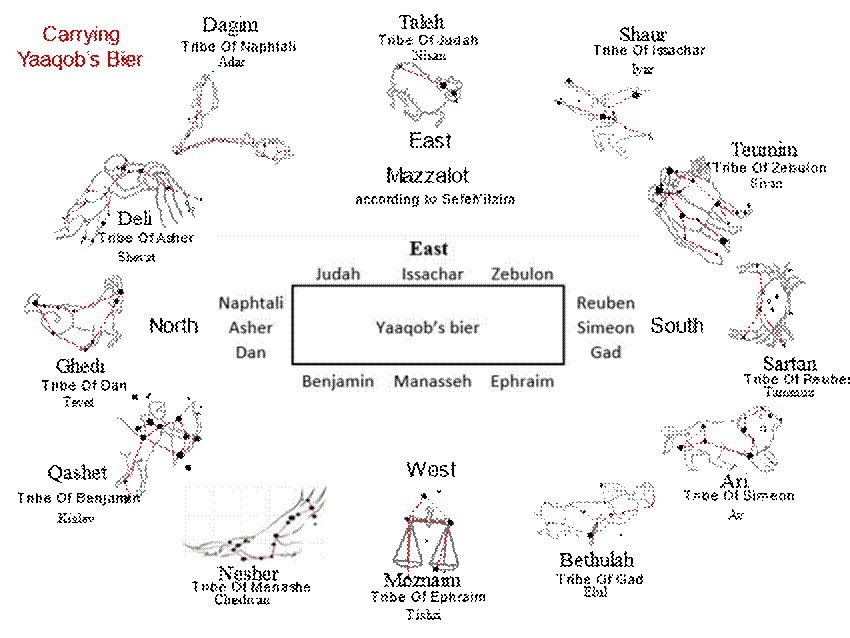
Constellation order, birth order, numerical order, and alephbet order:
|
Month |
-4k Years Greek |
-4K Years |
Value |
|||
|
Taurus |
Reuben |
Shaur |
Toleh |
Hay |
5 |
|
|
Gemini |
Simeon |
Teomaim |
Shaur |
Vav |
6 |
|
|
Cancer |
Levi |
Sartan |
Teomaim |
Zayin |
7 |
|
|
Leo |
Judah |
Arieh |
Sartan |
Het |
8 |
|
|
Virgo |
Zebulon |
Bethulah |
Arieh |
Tet |
9 |
|
|
Libra |
Issachar |
Meoznaim |
Bethulah |
Yod |
10 |
|
|
Tishrei |
Scorpio |
Dan |
Aqurav |
Meoznaim |
Lamed |
30 |
|
Cheshvan |
Sagitarius |
Gad |
Qashot |
Aqurav |
Nun |
50 |
|
Capricorn |
Asher |
Ghedi |
Qashot |
Samnkh |
60 |
|
|
Tevet |
Aquarius |
Napthali |
Deli |
Ghedi |
Ayin |
70 |
|
Pisces |
Dagim |
Deli |
Tzadi |
90 |
||
|
Aries |
Toleh |
Dagim |
Koph |
100 |
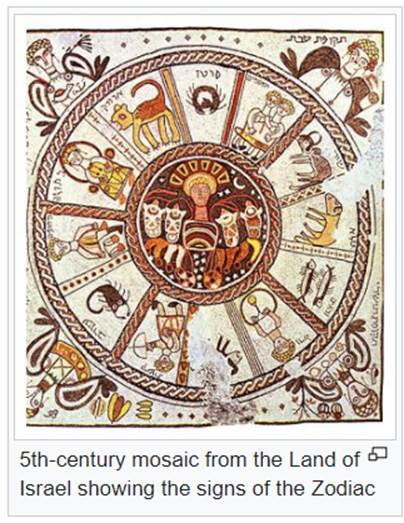
Permutes (4 factorial minus two factorial) to 12 different combinations:
|
Month |
Latin |
Composition |
|||
|
יהוה |
Reuben |
Toleh - טלה |
Aries |
represented by 13 stars |
|
|
יההו |
Simeon |
Shaur - שור |
Taurus |
represented by 33 stars |
|
|
יוהה |
Levi |
Teomaim - תאומים |
Gemini |
represented by 18 stars |
|
|
הוהי |
Judah |
Sartan - סרטן |
Cancer |
represented by 9 stars |
|
|
הויה |
Zebulon |
Arieh - אריה |
Leo |
represented by 60 stars |
|
|
ההיו |
Issachar |
Bethulah - בתולה |
Virgo |
represented by 25 stars |
|
|
Tishrei |
והיה |
Dan |
Meoznaim - מאזנים |
Libra |
represented by 8 stars |
|
Cheshvan |
וההי |
Gad |
Aqurav - עקרב |
Scorpio |
represented by 21 stars |
|
ויהה |
Asher |
Qashet - קשת |
Sagitarius |
represented by 31 stars |
|
|
Tevet |
היהו |
Napthali |
Ghedi - גדי |
Capricorn |
represented by 28 stars |
|
היוה |
Deli - דלי |
Aquarius |
represented by 42 stars |
||
|
ההוי |
Dagim - דגים |
Pices |
represented by 34 stars |
Mazzorah according to Rabbi Yoel (Joel) C. Dobin: (in Massaroth order and in birth order)
|
Reuben |
Taurus |
|
Simeon |
Gemini |
|
Levi |
Cancer |
|
Judah |
Leo |
|
Zebulon |
Virgo |
|
Issachar |
Libra |
|
Dan |
Scorpio |
|
Gad |
Sagitarius |
|
Asher |
Capricorn |
|
Napthali |
Aquarius |
|
Pices |
|
|
Aries |
Dobin also says that “Magen” as in “Magen David” is a technical term meaning the “position of the stars at a fixed point in time”.
Mazzorah according to A.E. Partridge[171]:
|
Reuben |
Aquarius |
|
|
Simeon |
Pisces |
|
|
Levi |
|
|
|
Judah |
Leo |
|
|
Zebulon |
Capricorn |
Tevet |
|
Issachar |
Cancer |
|
|
Dan |
Scorpio / Eagle[172] |
|
|
Gad |
Aries |
|
|
Asher |
Libra |
Tishrei |
|
Napthali |
Virgo |
Elul/Tree with goodly branches |
|
Taurus |
||
|
Gemini |
||
|
Manasseh |
Sagitarius |
|
יז יְהִי-דָן נָחָשׁ עֲלֵי-דֶרֶךְ, שְׁפִיפֹן עֲלֵי-אֹרַח--הַנֹּשֵׁךְ, עִקְּבֵי-סוּס, וַיִּפֹּל רֹכְבוֹ, אָחוֹר. |
17 Dan shall be a serpent in the way, a horned snake in the path, that biteth the horse's heels, so that his rider falleth backward. |
Babylonian Cuniform from before 500 B.C.:[173]
|
Month |
Meaning |
|
|
Agaru (Aries) |
The messenger of the new year |
|
|
Temennu (Plieiades) |
The fountain |
|
|
|
Alap-same (Taurus) |
The bull of heaven |
|
Ri-u-but-same (Orion) |
The shephard |
|
|
|
Tuame (Gemini) |
The Spirit of Heaven |
|
|
rabuti (Gemini) |
The great twins |
|
Namgaru (Cancer) |
The Crab |
|
|
|
Nagar-asurra |
Workman of the river bed. |
|
Aru rabu (Leo) |
The Great Lion |
|
|
Siru (Spica) |
The ear of corn |
|
|
Ziba [lacuna] (Libra) |
The claws |
|
|
Aqrabu (Scorpio) |
The Scorpion |
|
|
Qesheth[bow] (Sagitarius) |
||
|
Tevet |
Enzu (Capricorn) |
The Goat |
|
Ka-d (Aquarius) |
The Urn |
|
|
Riksu (Pisces) |
The Cord |
|
Zodiacal Guardians and their symbols: 1
|
Candle Box pictures:
|
The Mazzaroth according to E.W. Bullinger:
|
Mazzaroth |
Scripture |
|
|
Taurus |
Joseph(Ephraim and Manasseh) |
Devarim (Deuteronomy) 33:17 |
|
Gemini |
|
|
|
Sagitarius |
Asher |
|
|
Scorpio |
Dan |
|
|
Capricorn |
Naphtali |
|
|
Cancer (Ass) |
Issachar |
|
|
Leo |
Judah |
|
|
Virgo |
Zebulon |
|
|
Pices |
Simeon |
|
|
Aquarius |
Reuben |
|
|
Aries |
Gad |
|
|
Libra |
Levi |
|
The Mazzaroth according to the Jewish Encyclopedia:
|
Latin Names |
Approximate Date |
Approximate Hebrew Date |
||||
|
Aries |
Toleh |
March 21 |
March 27 |
x |
m |
|
|
Taurus |
Shor |
April 21 |
April 26 |
m |
n |
|
|
Gemini |
Teomim |
May 22 |
May 25 |
n |
o |
|
|
Cancer |
Sartan |
June 22 |
June 24 |
o |
p |
|
|
Leo |
Aryeh |
July 23 |
July 23 |
p |
q |
|
|
Virgo |
Bethulah |
August 24 |
August 23 |
q |
r |
|
|
Libra |
Moznayim |
September 24 |
Tishrei |
September 22 |
r |
s |
|
Scorpio |
Akrab |
October 24 |
Cheshvan |
October 22 |
s |
t |
|
Saggitarius |
Keshet |
November 23 |
November 19 |
t |
u |
|
|
Capricorn |
Ghedi |
December 22 |
Tevet |
December 18 |
u |
v |
|
Aquarius |
Deli |
January 20 |
January 16 |
v |
w |
|
|
Pisces |
Dagim |
February 19 |
February 15 |
w |
x |
The Mazzaroth according to the Encyclopedia Judaica, Volume 3, page 798
|
Mazzaroth |
Month |
|
Aries |
|
|
Taurus |
|
|
Gemini |
|
|
Cancer |
|
|
Leo |
|
|
Virgo |
|
|
Libra |
|
|
Scorpio |
Marsheshvan |
|
Saggitarius |
|
|
Capricorn |
Tevet |
|
Aquarius |
|
|
Pices |
According to Sefer Yetzirah:
|
Month |
|
|
Judah |
|
|
Issachar |
|
|
Zebulun |
|
|
Reuben |
|
|
Shimon |
|
|
Gad |
|
|
Ephraim |
|
|
Menashe |
Marsheshvan |
|
Dan |
Tevet |
|
Asher |
|
|
Naftali |
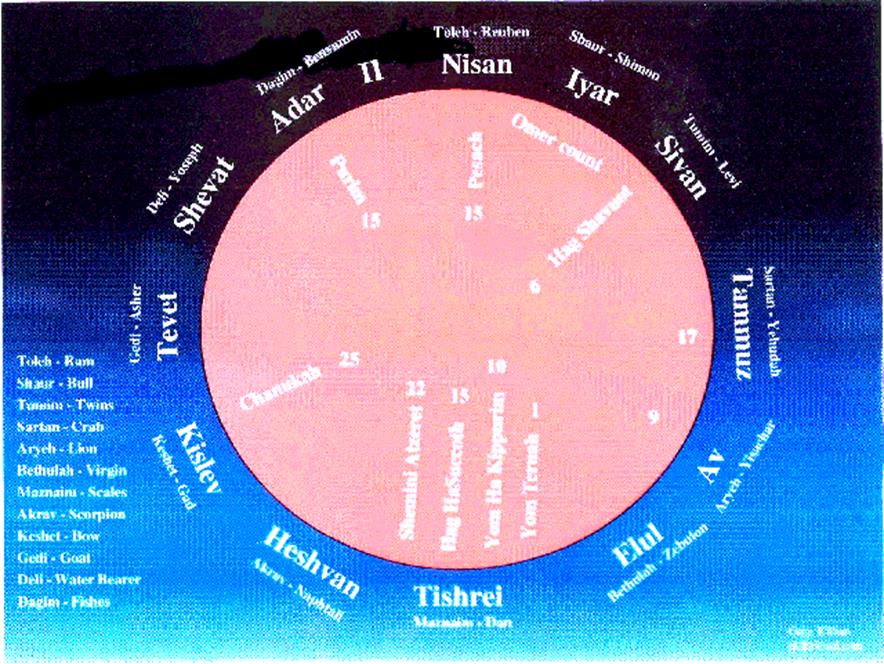
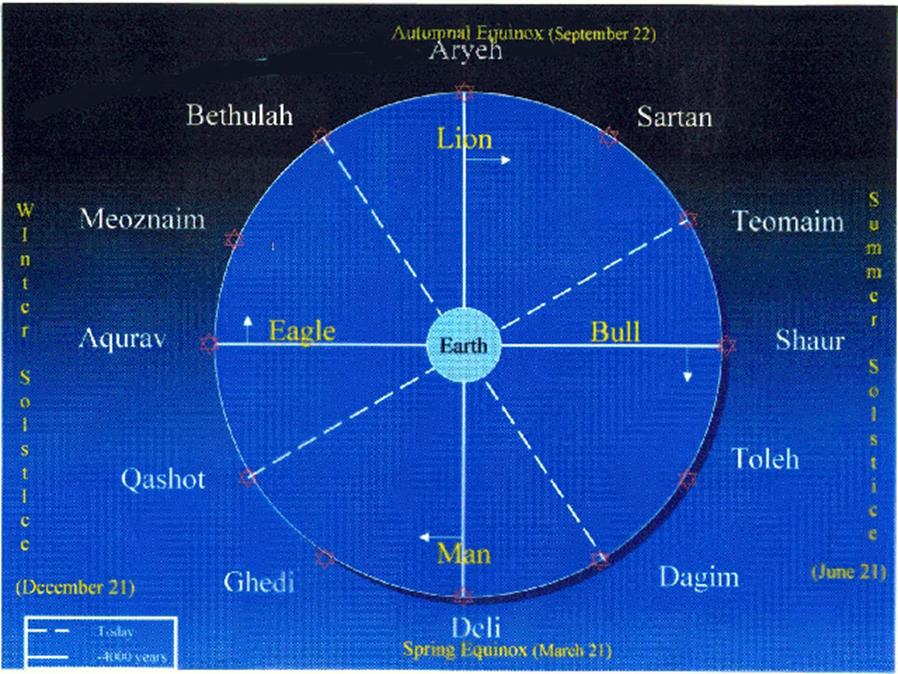
The encyclopedia Judaica also indicates that there is a relationship between the mazzaroth and the tribes that is detailed in: Yal., Ex.418; Yal., I Melakim (Kings) 185
The Encyclopedia Judaica indicates that “mazalot” in 2 Melakim (Kings) 23:5 indicates “planets”.
II Melakim (Kings) 23:5 He did away with the pagan priests appointed by the kings of Judah to burn incense on the high places of the towns of Judah and on those around Jerusalem--those who burned incense to Baal, to the sun and moon, to the constellations and to all the starry hosts.
The planets as mentioned in scripture:
Saturn (ht,ca – Shabtai - Kevan) is found in:
Amos 5:26. But you shall carry Sikuth your king, and iyun, your images, your star-god, which you made for ourselves.
The planet that influences Tevet, Shabbtai (Saturn), symbolizes the power of contemplation which characterizes the Shabbat experience: Refraining from the mundane, the world of the transcendent is revealed... (Seasons of the Moon - Tevet)
Venus – (vdub - Nogah, Meleket haShamayim, the queen of heaven). This is understood from from the fact that cakes are baked for her. Among the Assyro-Babylonians the cake-offerings were called “the bread of Ishtar” (Venus).[174] This usage is found in:
Yirimiyah (Jeremiah) 7:18. The children gather wood, and the fathers kindle the fire, and the women knead their dough, to make cakes to the queen of heaven, and to pour out drink offerings to other gods, that they may provoke me to anger.
Jupiter (esm – tzedek - Gad “fortune”). This is a supposition. It is found in:
Yeshayah (Isaiah) 65:11 “But as for you who forsake HaShem and forget my holy mountain, who spread a table for Fortune and fill bowls of mixed wine for Destiny,
There is some speculation that “Destiny”, in the above verse refers to Venus.
|
Planet Names |
||
|
Greek |
Transliteration |
|
|
|
|
|
|
Saturn |
ht,ca |
Shabbtai |
|
Jupiter |
esm |
Zedek |
|
Mars |
ohstn |
Madim |
|
vnj |
Chamah |
|
|
Venus |
vdub |
Nogah |
|
Mercury |
cfuf |
Kokav |
|
vbck |
Lavanah |
|
|
|
|
(Sefer Yetzirah) |
|
PLANET |
INFLUENCE |
|
Saturn |
Poverty, destruction, internal injury, and sickness |
|
Mars |
Blood, wickedness, strife, external injury, war, hatred, and jealousy |
|
Jupiter |
Life, peace, good, prosperity, religious feelings, joy, wealth, and political advance |
|
Venus |
Grace, love, lust, children, and fruitfulness |
|
Mercury |
Wisdom, skill, writing, and language |
|
Holds keys to heaven and earth, surrogate for good and evil |
(Sefer Yetzirah)
Mars, Madim, is not to be found in the Tanakh. The root, though, is found[175]. The root is Edom:
123 ‘Edom, ed-ome’; or (fully) ‘Edowm, edome’; from 122; red [see Gen. 25:25]; Edom, the elder twin-brother of Jacob; hence the region (Idumaea) occupied by him:-Edom, Edomites, Idumea.
This word means: (very) red or (very) mad. The red connection with Mars is obvious. The use of this root in the understanding of “mars” is in:
Yeshayah (Isaiah) 63:1-6 Who [is] this that cometh from Edom, with dyed garments from Bozrah? this [that is] glorious in his apparel, travelling in the greatness of his strength? I that speak in righteousness, mighty to save. Wherefore [art thou] red in thine apparel, and thy garments like him that treadeth in the winefat? I have trodden the winepress alone; and of the people [there was] none with me: for I will tread them in mine anger, and trample them in my fury; and their blood shall be sprinkled upon my garments, and I will stain all my raiment. For the day of vengeance [is] in mine heart, and the year of my redeemed is come. And I looked, and [there was] none to help; and I wondered that [there was] none to uphold: therefore mine own arm brought salvation unto me; and my fury, it upheld me. And I will tread down the people in mine anger, and make them drunk in my fury, and I will bring down their strength to the earth.
Dobin says: “Mars is the planet of intense energy, and the word takes it’s meaning from astrological understanding of the nature of the planet, Mars. Both intensity of action and redness are implied in the Hebrew name of the planet. Mars was known to be the planet which causes strife and war...”
* * *
Dobin’s translations:
Chavakkuk (Habakkuk) 3:11 Sun and moon stood still in the heavens at the glint of your flying arrows, at the lightning of your flashing spear.
Should be:
Chavakkuk (Habakkuk) 3:11 The sun and the moon stand still in their habitation; Thine arrows go towards the Sun, Thy glittering spear towards the Moon.
Chavakkuk (Habakkuk) 3:2-4 HaShem, I have heard of your fame; I stand in awe of your deeds, HaShem. Renew them in our day, in our time make them known; in wrath remember mercy. God came from Teman, the Holy One from Mount Paran. <Selah> His glory covered the heavens and his praise filled the earth. His splendor was like the sunrise; rays flashed from his hand, where his power was hidden.
Should be translated:
Chavakkuk (Habakkuk) 3:2-4 O Lord, I have heard the report of Thee, and am afraid; O Lord, Thy work has its life in the midst (or by means of) of the years, It shall be known by means of the years. God cometh from (the direction of) Capricorn-Aquarius, And the Holy One (from the direction of) Mount Paran. Selah. And the Moon (or Venus), like the sun, will be rays at His side, and therein will lie the secret of His power.
Bamidbar (Numbers) 24:17 “I see him, but not now; I behold him, but not near. A star will come out of Jacob; a scepter will rise out of Israel. He will crush the foreheads of Moab, the skulls of all the sons of Sheth.
Bamidbar (Numbers) 24:17 What I see for them is not yet, What I behold will not be soon; A star rises from Jacob, a meteor comes forth from Israel, It smashes the brow of Moab, The foundation of all the children of Seth.
The Mishna states: “On comets, earth tremors, thunder, storm winds and lightning, say: ‘Blessed is He whose strength and might fill the world.’ On mountains, hills, rivers, oceans and desserts, say: ‘Blessed is He who makes the works of creation.’”
The Talmud explains the Mishna as follows: On mountains, hills, etc., there is only one possible blessing which can be said - namely, “Who makes the works of creation.” But on comets, earth tremors, etc., you can say either blessing you want. You can say either “Whose strength and might fill the world” or you can say “Who makes the works of creation.” The custom is to say “Who makes the works of creation,” but the other one is also acceptable.
Some commentaries understand the Mishna as referring to meteors (‘shooting stars’), not comets. In practice, you say a blessing on both comets and meteors.
Sources:
Tractate Berachot 54a, 59a
Mishna Berurah 227:1
What ever happened to the meteors that were left suspended in the sky in 2448?
Some of the miraculous hailstones stayed suspended in space until Yehoshua`s war with the Emori, when they came crashing down on their enemy, forty-one years later. There are still many more meteors which will come crashing down on Gog and Magog when Mashiach battles with them soon!
Meteors seem to be designed to provide light as we see from the following Midrash:
Midrash Rabbah - Genesis LX:1 Another interpretation: ‘Who is among you that feareth the Lord’ alludes to Eliezer; ‘ Who heareth the voice of his servant,’ for he was Abraham’s servant.’ Who walked in darkness’ when he went to fetch Rebekah. ‘And hath no light’: who then gave him light? The Holy One, blessed be He, illumined his path with meteors and lightnings. ‘Let him trust in the name of the Lord, and stay on his God: thus it is written, AND HE SAID: O LORD, THE GOD OF MY MASTER ABRAHAM, SEND ME, I PRAY THEE, GOOD SPEED THIS DAY.
* * *
Says the Zohar HaKodesh.
I will show you, but not for now, for these things will only come to be at that time, some after time and some in the Days of King Mashiach. “A star has gone forth from Ya’akov [Jacob] ...” (Bamidbar [Numbers] 24:17). This teaches us that in the future, The Holy One, Blessed is He, will build Jerusalem and one star will spark within seventy pillars of fire and seventy sparks will receive light from it in the middle of the sky. The other seventy stars will be swallowed within it. It will give off light and blaze for seventy days. At the end of the sixth day [6,000 years] it will become visible at the beginning of the twenty-fifth day of the sixth month [25 Elul 5761, September13, 2001]. It will be gathered in at the end of seventy complete days [November 20, 2001] and be visible in the city of Rome, and on that day, three great walls will fall and great hail will fall [Leonid meteor shower? November 14-21, 2001], and the power of that city will die. Then this star will become visible in the world, and it will instigate a great war from all four sides. When Mashiach becomes revealed the people of the world will be suffering trouble after trouble, and the enemies of the Jewish people will be prevailing. Then the spirit of Mashiach will be aroused and the evil Edom [Esau, Jacob’s brother] will be destroyed and the Land of Seir [Esau’s land] will be burned with fire ... (Zohar, Balak, 212b)
Talmudic teachings can be divided into two categories: Halacha and Aggada. While the halachic teachings are always meant to be taken literally, the aggadic teachings are not always meant to be taken literally.
According to the Maharal of Prague, one of the most authoritative commentators on the aggadic portions of the Talmud, they are always, with only a few exceptions, meant as metaphors. He writes that the Talmudic statements in Tractate Berachot 58b regarding astronomical events should be understood as metaphors as well.
Some commentaries explain that this Talmudic passage is not referring to comets at all, but rather to meteors (‘shooting stars’). If so, this passage is irrelevant to the Hale-Bopp comet.
This is not to say that comets have no ‘gravity.’ According to traditional sources, a new star appeared in the sky 4,100 years ago. That was the year the world was destroyed by a flood in the time of Noah. This star, apparently a comet, traveled through all the constellations in a month’s time. It was an omen for the people in the world to reconsider their wicked lifestyles and practices. (Interestingly, NASA reports that Hale-Bopp last appeared about 4,200 years ago [Astronomy Magazine Feb. ‘97].)
Whether or not this comet is a sign of destruction, I think it’s important to point out another Talmudic teaching: “When the People of Israel do the will of HaShem, they need fear none of these astronomical omens, as indicated by the following verse: ‘So says HaShem: Don’t imitate the ways of the wicked, and don’t be afraid of heavenly omens.’”
Sources:
Talmud Berachot 58b
Be’er Hagolah, Rabbi Yehuda Loewe of Prague
Netzach Yisrael, Chapter 60
Mishna Berurah 227:1
Seder Hadorot
Talmud Sukkah 29a
Research Credit: Rabbi Zev Rosen
* * *
Bereshit (Genesis) 11:27-32 This is the account of Terah. Terah became the father of Abram, Nahor and Haran. And Haran became the father of Lot. While his father Terah was still alive, Haran died in Ur of the Chaldeans, in the land of his birth. Abram and Nahor both married. The name of Abram’s wife was Sarai, and the name of Nahor’s wife was Milcah; she was the daughter of Haran, the father of both Milcah and Iscah. Now Sarai was barren; she had no children. Terah took his son Abram, his grandson Lot son of Haran, and his daughter-in-law Sarai, the wife of his son Abram, and together they set out from Ur of the Chaldeans to go to Canaan. But when they came to Haran, they settled there. Terah lived 205 years, and he died in Haran.
“Ur of the Chaldeans” literally means “Light of the Astrologers”.
* * *
The Encyclopedia Judaica indicates that 1 Divrei HaYamim (Chronicles) 12:33 indicates that the tribe of Issachar were the astronomers of Israel:
1 Divrei HaYamim (Chronicles) 12:33 of the Issacharites, men who knew how to interpret the signs of the times, to determine how Israel should act; their chiefs were 200, and all their kinsmen followed them;[176]
The blesssing of Bereshit (Genesis) 24:1 is interpreted as the gift of astronomy[177].
Bereshit (Genesis) 24:1 Abraham was now old and well advanced in years, and HaShem had blessed him in every way.
* * *
SHOR
7794 showr, shore; from 7788; a bullock (as a traveller):-bull (-ock), cow, ox, wall [by mistake for 7791].
----------------- Dictionary Trace ---------------------
7788 shuwr, shoor; a prim. root; prop. to turn, i.e. travel about (as a harlot or a merchant):-go, sing. See also 7891.
7791 shuwr, shoor; from 7788; a wall (as going about):-wall.
TE’OMIM
8380 ta’owm, taw-ome’; or ta’om, taw-ome’; from 8382; a twin (in plur. only), lit. or fig.:-twins.
ARIEH
738 ‘ariy, ar-ee’; or (prol.) ‘aryeh, ar-yay’; from 717 (in the sense of violence); a lion:-(young) lion, + pierce [from the marg.].
The sign of Av is Aryey, the lion, while the sign of Elul is Bethulah, the virgin. Our sages thus taught us that one should go in the right way “after a lion,” which represents the month of Av. We should not go “after a woman,” this being the virgin, the sign of Elul. One should not wait until Rosh HaShanah [which follows Elul] to begin repenting, but should do so “after a lion,” at the end of Av. The entire month of Elul should then be spent in repentance, so that one will approach Rosh HaShanah in purity.
BETHULAH
1330 bethuwlah, beth-oo-law’; fem. pass. part. of an unused root mean. to separate; a virgin (from her privacy); sometimes (by continuation) a bride; also (fig.) a city or state:-maid, virgin.
MOZNAYIM
* * *
THOUGHTS ON THE DAILY DAF
brought to you by Kollel Iyun Hadaf of Har Nof
Rosh Kollel: Rav Mordecai Kornfeld
Rosh Hashanah 11b
2) THE RISE AND DESCENT OF THE MAZALOT
QUESTION: The Beraita says that according to Rebbi Yehoshua, the flood occurred in the month of Iyar, when the constellation of Kimah is “sinking” or descending (Shoke’a) during the daytime. However, in order to bring the flood upon the world, Hashem changed its pattern and made it “rise” (Oleh) during the daytime. According to Rebbi Eliezer, the flood occurred in Marcheshvan, when Kimah is rising, and thus Kimah was rising as usual and it was not necessary for HaShem to change its pattern.
Rashi explains that Kimah is the tail of the constellation Tleh (Aries), which is also the head of Shor (Taurus). The Mazal of the month of Iyar is the constellation Shor. This means that in Iyar, Shor is in the background behind the sun (and thus Shor is not visible at night the entire month - precession not being taken into consideration). Consequently, the constellation Tleh, which travels ahead of Shor, rises just before the sun rises (and thus is visible at the end of the night), and travels through the daytime sky, setting at the western horizon just before sunset. Therefore, during the entire month of Iyar, Kimah, which is the tail of Tleh, is up in the sky the entire day, until a moment before sunset when it sets (since it is traveling directly in front of the sun). If so, how can the Beraita say that the constellation of Kimah is “Shoke’a” during the day in Iyar, which implies that it sinks, or sets, during the day. In Iyar, it is rising during the day!
Similarly, Rashi (near the end of 11b) writes concerning Tleh that in Iyar, “the entire day it is Shoke’a.” How can he write that it is Shoke’a during the day in the month of Iyar? It is *rising* during the day (at least during the first half of the day). In fact, not only does Kimah not “sink” during the day in Iyar, but it *does* “sink” in Marcheshvan. Why does the Gemara say that according to Rebbi Eliezer Kimah rises during the day!
Rebbi Eliezer says that the flood occurred in the month of Marcheshvan. The Mazal of Marcheshvan is Akrav (Scorpio), which is six Mazalot away from Shor, just like Marcheshvan is six months away from Iyar, and at the opposite point in the sky. This means that in Marcheshvan, Kimah (the tail of Tleh) will be a little over six Mazalot ahead of the sun (six more Mazalot than Akrav is Shor, and a bit more is the tail of Tleh). Accordingly, Kimah is setting by the time the sun rises, because there are only six Mazalot in the sky at a time, and Kimah is more than six Mazalot away from the sun. Kimah rises again 12 hours later, or just before the sun sets. If so, according to Rebbi Eliezer, the Beraisa should say that Kimah is Shoke’a the entire day! Why does it say that Kimah is Oleh during the day according to Rebbi Eliezer, and Shoke’a during the day according to Rebbi Yehoshua? It should say the opposite!
ANSWERS:
(a) RASHI learns that when the Beraita says that Kimah is Shoke’a in Iyar, it means that it has already made its appearance in the sky. From the moment that the Mazal fully appears in the sky, it is considered to be descending (i.e. it is heading towards the western horizon) until it sets and completely disappears beneath the horizon. At that point, after it has set, it is considered to be beginning its ascent (i.e. it is heading towards the eastern horizon) and is “Oleh.” It completes its ascent the moment that it rises and fully appears in the sky. This also explains why the Beraita says that according to Rebbi Eliezer, Kimah is considered to be rising during the day in the month of Marcheshvan, because by sunrise it has completely disappeared below the horizon, and therefore it is considered to be “Oleh” the entire day, as it makes its way up towards the horizon in order to rise and appear in the sky.
Rashi apparently learns that a Mazal is able to influence the world only during the time that it is Oleh (that is, when it is beneath the world), and more specifically, while it is rising over the eastern horizon. After it has completely risen and it begins to cross the sky, its power wanes. Hence the only time that the flood could begin was while the Mazal Kimah was rising and above the world, at which time the floodwaters could pour forth through the two stars that were removed from it and inundate the world (as Rashi says, the rain came through the holes that were made when two stars in Kimah were removed from their places). Therefore, according to Rebbi Yehoshua who says that the flood occurred in Iyar when Kimah rises before sunrise, the Mabul could not have occurred because Kimah was already on its way down by the time that the day began (sunrise). Therefore, HaShem had to change the pattern of the world and make Kimah rise later than usual, so that in would rise when it was already day.
According to Rebbi Eliezer, there was a moment at the end of the day, right before sunset, at which Kimah was in the process of rising, and therefore the flood could come to the world through Kimah at that time.
(b) TOSFOT, BA’AL HA’ME’OR and others reverse the Girsa, so that according to Rebbi Eliezer, Kimah is Shoke’a during the day (in Marcheshvan), and according to Rebbi Yehoshua, it is Oleh during the day (in Iyar). As such, the Gemara works out simply, because Kimah is indeed rising in the sky during the days in Iyar and it is descending beneath the world during the days in Marcheshvan, as we explained in our question.
The Me’or expresses wonderment at why Rashi found it necessary to change this Girsa and insist on his own Girsa, which just complicates matters. Perhaps Rashi was bothered by the wording of the Beraita in the Gemara. Tosfot says that Kimah is up during the day in Iyar and it is down during the day in Marcheshvan. According to that explanation, the words “Shoke’a” and “Oleh” are inappropriate; it should say instead that Kimah is either “above” the earth or “below” it.
(c) The ARUCH (Erech Kimah, and as recorded in the addendum of Talmidei Rashi that is printed at the end of the Maseches, on Daf 35a) had the Girsa of Tosfot, but did not give the same explanation as Tosfot. Rather, he explains that the Mazalot of this Sugya have nothing to do with the actual position of the stars relative to the sun. Rather, these Mazalot are just an astrological formula which express a method for predicting world events. It is similar to the seven Mazalot of the hours (Sha’os) as described in the Gemara in Shabbat (156a), whereby each hour is represented by a different planet which has power over that hour, and they rotate in cycles of seven on an hourly basis.
According to this method of astrology, all twelve Mazalot serve during the daytime, as well as during the nighttime, each one “serving” one hour during the day and one hour during the night. Each month the night (and day) begins with a different Mazal. When the Gemara says that a Mazal is “Shoke’a,” it is referring to the Mazal whose turn comes right after midday or after midnight. A Mazal that is “Oleh” refers to a Mazal whose hour comes during the first half of the day or night. Therefore, according to Rebbi Eliezer who says that the flood occurred in Marcheshvan, when Akrav is the leading Mazal, the hour of Shor (which includes Kimah, the tail of Tleh) comes six hours later, which is the first hour after midday, and therefore it is said to be “Shoke’a,” because it only comes to power after midday. According to Rebbi Yehoshua, the flood occurred in Iyar, when the leading Mazal is Shor, and thus the hour of Kimah occurred when the sun was on the rise, in the first half of the day, and thus it is said to be “Oleh.”


Sefer Yezirah - more material on mazzaroth.
Frances Rolleston “Mazzaroth” or “The Constellations” . In London by Rivingtons, 1876.
Joseph A. Seiss “The Gospel in the Stars” . In Philadelphia by J.B.Lippincott, 1885.
Admon, Bo’smat Sefer Mishpete Kokhavim: Astrologyah lefi ha-Yahadut (Hod ha Sharon: Astrolog, 1996)
Bakal, Meir, (ed.) Seder 12 ha-Mazalot (Jerusalem: Hotsa`at Bakal, 1994)
Erlanger, Gad, Signs of the Times: the Zodiac in Jewish Tradition (New York, NY: Feldheim, 2001)
Glazerson, Matityahu, Above the Zodiac: Astrology in Jewish Thought (Northvale, NJ: J. Aaronson, 1997)
Glazerson, Matityahu, En Mazal le-Yisrael (Israel: M. Glazerson, 1980, 1985)
Ibn Ezra, Abraham ben Meir Le Livre des fondements astrologiues: (precede de) Le Commencement de la
sapience des signes [introduction, traduction et notes de Jacques Halbronn] (Paris, Retz, 1977)
Megilat Ta’anit: Baraita de-13 midot de-Rabi Yishma`ek. Baraita di-Shmu’el Yarhina’ah. `Inyan ha-Tekufot (Israel: 1980)
Solomon ben Isaac, Shene Sefarim Niftahim: Isur ver-Heter le-Rashi (1973)
Altmann, A., “Astrology,” Encyclopedia Judaica (Jeruslaem: Keter, 1973), vol. 3, pp. 788-795
Blau, L., & Kohler, K., “Astrology,” Jewish Encyclopedia (NY: Fink & Wagnells, 1901-1905), vol. 2, pp. 241-245
Sarfatti, G.B., “An Introduction to ‘Barayta de-Mazzalot’,” Bar-Ilan Yearbook 3 (1965), 56-82 [Heb]
Dobin, Joel C., The Astrological Secrets of the Hebrew Sages: to Rule Both Day and Night (New York, NY: Inner Traditions International, 1983)
Dobin, Joel C., To Rule Both Day and Night: Astrology in the Bible, Midrash, and Talmud (New York, NY: Inner Traditions International, 1977)
Dobin, Joel C., Kabbalistic Astrology: the Sacred Tradition of the Hebrew Sages (Rochester, NY: Inner Traditions, 1999)
Levy, R., Astrological Works of Abraham ibn Ezra (Baltimore, Md., Paris, Johns Hopkins University Press; Les Presses Universitaires, 1927)
Jospe, Raphael, “The Torah and Astrology According to Abraham ibn Ezra,” World Congress of Jewish Studies 11, C2 (1994), pp. 17-24
This study was written by
Rabbi Dr. Hillel ben David
(Greg Killian).
Comments may be submitted to:
Greg Killian
12210 Luckey Summit
San Antonio, TX 78252
Internet address: gkilli@aol.com
Web page: https://www.betemunah.org
(360) 918-2905
Return to The WATCHMAN home page
Send comments to Greg Killian at his email address: gkilli@aol.com
[3] Compton’s Living Encyclopedia
[4] Compton’s Living Encyclopedia
[6] Bamidbar 15
[7] Chavakuk 3:11
[8] From Rambam’s Mishneh Torah, Hilkhot Yesodei HaTorah (Laws Relating to the Fundamentals of Torah) Chapter 4.
[10] Fire, water, earth, and air. See Vol. I, p. 26. These basic elements were first created by G-d, and out of a combination of them. He made man, etc.
[11] Sight, hearing, taste, smell and touch.
[12] See Ramban on Genesis 2:17, Vol. I, p. 75.
[13] Chagigah 16a.
[14] Ramban now begins to explain the text quoted on the basis of certain scientific concepts that were prevalent in his times. A prefatory word is in place. The serious student will not look upon these concepts with an eye for criticism. The theory that the whole physical world is founded upon various combinations of four elements, was an Aristotelian legacy which ruled man's minds for a millenium. The extension of that theory into the elusive world of the spirit was logical. That scientists today have moved to other theories to explain the universe and the various phenomena of life, has no bearing upon the explanations which were accepted in the past, for who can foretell what knowledge will do to "the established truths" of today? The important thing in Ramban's presentation of this whole obstruse subject is his final conclusion that only G-d in His Providence exercises power over man's destiny.
[15] I Kings 18:38.
[16] A reference to the forces involved in the movement of the constellations. See my Hebrew commentary p. 96.
[17] The expression is based on Ecclesiastes 10:20: For a bird of the air will carry the voice, and that which has wings will tell the matter.
[18] See Maimonides' "The Commandments," Vol. II, pp. 30-35.
[19] Deuteronomy 18:9.
[20] Ezekiel 12:27.
[21] Deuteronomy 32:17.
[22] See Ramban, Genesis 1 : 3 (Vol. I, p. 25) where he explains the name to mean: e-il (Force), heim (they), the word "they" alluding to all other forces. Thus Elohim means "the Force of all forces."
[23] Jeremiah 10:5.
[24] Devarim (Deuteronomy) 18:10
[25] Devarim (Deuteronomy) 18:10
[26] Devarim (Deuteronomy) 18:13
[28] According to I.E., the ephod was an astrological instrument that the High Priest used to predict the future. See I.E. on Exodus 28:6 and Nahmanides on Exodus 28:6.
[31] The twelve names on the two stones of the ephod correspond to the twelve constellations, six of which are found in the northern part of the sky and six in the southern part of the sky. The twelve names on the ephod are divided into two groups.
[32] Lit., corresponds
[33] Lit., to thought. The sky is divided into twelve sections containing the twelve constellations. The lines marking off these sections can not be seen by the eye. They can be conceived only by the mind.
[34] It had similiar astrological significance. Its function, however, was not identical to that of the ephod. For heavenly beneficence descended upon Israel through the breastplate and not through the ephod. See I.E. on Exodus 28:6
[37] Because heavenly beneficence descended upon Israel through the breastplate.
[43] Five. Tummim means “whole” or “complete”. All numbers, with the exception of five, disappear when cubed or squared. For example 22 = 4; 52 = 25; 23 = 8; 53 =125. Hence five is a whole number. The tummim corresponds to the number five and alludes to the five moving stars (planets). It should be noted that the ancients were aware of only the five visible planets, namely, Venus, Mars, Jupiter, Saturn, and Mercury.
[44] The urim and tummim.
[45] The constellations.
[46] Etym. ‘Urim’- lights. ‘Thummim’-tam-to be complete, perfect; here true, fulfilled.
[48] I Sam. XXIII, 12.
[49] Ibid. XXX, 8.
[50] Etym. ‘Urim’- lights. ‘Thummim’-tam-to be complete, perfect; here true, fulfilled.
[51] Judg. XX.
[52] [The text of cur. edd. is not clear and the rendering follows the reading of MS.M. Rashi, on the basis of the present text, explains: They (the Urim and Thummim) did not state clearly, etc.].
[53] The single question was who should lead them.
[54] Judg. XX, 28.
[55] The names of the twelve sons of Jacob were inscribed on the Urim and Thummim. The answer always came through the letters which stood in relief.
[58] II Sam. XV, 24. [This is explained, that he retired from the priesthood because he received no reply from the Urim and Thummim. This in turn would indicate that it is the Holy Spirit resting on the priest that gives that reply and not the letters of the Oracle].
[60] Num. XXVII, 21.
[61] Ab Zarah 5a
[64] For example 15 = 10 + 10 / 2
[65] For example 17 = 10 + 10 / 2 + 10 / 5
[66] 20 is 10 x 2.
[67] According to Creizenach.
[68] Multiplying ten and adding a part or parts of ten to it. Thus: 65 = 6 x 10 + 10 / 2; 68 6 x 10 + 10 / 2 + 10 / 10
[69] According to Aristotle, the sublunar world consists of four elements: earth, water, wind (air), and fire.
[70] The sphere of the moon, the sphere of the sun, the spheres of each of the five planets, and the sphere of the constellations. I.E. omits the diurnal sphere and the sphere of the active intellect because they do not contain any body.
[72] According to the Pythagoreans, the number ten was sacred. It was symbolized by the dotted triangle, the tatractys, “source and root of everlasting nature.” See Encyclopedia of Philosophy, vols. 7 and 8, p. 38.
[74] Hence, it has a similar meaning.
[75] From the root yod, dalet, heh.
[76] The plural of todah.
[77] From the sphere of the active intellect. There are ten spheres surrounding the earth, namely, the lunar sphere, the solar sphere, the five spheres of the planets, the sphere of the constellations, the ninth sphere-which moves all of the above-mentioned spheres-and the sphere of the active intellect.
[78] The sphere of the active intellect is known as the kisse ha-kavod, God’s glorious throne, and is thus holy.
[79] Lit. its counterpart.
[80] They allude to the sphere of the active intellect, which is both the first and the tenth sphere.
[86] That is, 1 + 22 = 5
[88] That is, 1 + 32 = 10
[91] The divine name Yah. Yah is spelled yod, heh. Yod is enuciated yod, vav, dalet. Heh is sounded heh, alef,. Yod, vav, dalet, heh, and alef = 26. Lit. The same is also the case if we add the sum of the two letters.
[92] The fiftieth year. See Leviticus 25:10-12
[94] Kokeba di-Shabi Lit., ‘Star that draws’. What exactly is meant is a matter of dispute. Rashi explains as ‘shooting-stars’.
[96] Rashi and Tosaf. omit ‘and rolled up’.
[98] I.e., mere error of perspective, v. on the passage Brodetsky, Jewish Review July, 1909, p. 167 ff.
[99] Job IX, 9.
[100] Amos V, 8. The order is here reversed.
[101] Mentioned in Dan. VII, 10, denoting probably the Milky Way.
[102] Job. XXXVIII, 31.
[103] This constellation follows that of the Ram.
[104] Ibid. 32. E.V. ‘or canst thou guide the Bear with her sons’.
[105] And then stuck on artificially.
[106] V. supra, p. 10, n. 1.
[107] Eccl. 1, 9.
[108] Job. XXXVIII, 32. E.V. ‘or canst thou guide the Bear with her sons’.
[109] Cf. II Esdras IV, 30.
[110] The idea is that the serpent infected Eve (i.e., the human race) with lust, from which, however, those who accept the moral teachings of the Torah are freed. Cf. B.B. 16a: The Holy One, blessed be He, created the evil passions, but He also created the Torah as their antidote. Thus this passage does not teach the doctrine of ‘Original Sin’, which Judaism rejects; v. Hertz, Genesis, pp. 59-60, ‘Jewish view on the “Fall of Man,’’. V. also Weiss, Dor, II, p. 9.
[111] On mazzal v. Sanh., Sonc. ed., p. 629, n. 10.
[112] Deut. XXIX, 14f. The teachings of Judaism and its spiritual ennoblement were freely meant for all mankind.
[114] Gen. VII, 11.
[115] There seems to be some confusion in the text here. To make it astronomically correct we should read (with the Seder Olam) in the dictum of R. Joshua, ‘When Pleiades rises at daybreak’, and in the dictum of R. Eliezer, ‘sets at daybreak’.
[116] Gen. XXIV, 1.
[117] [A variant rendering: ‘He possessed an astrological instrument’. Current texts have ‘in his heart’ — Tosef. Kid. V, reads ‘in his hand’. V. Bacher, Agada der Tanaiten, I, 200.]
[118] Lit., ‘the potentates . . . used to attend early at his gate’.
[119] Lit., there is no mazzal (planetary influence) to Israel.
[120] Jer. 10:2.
[122] Gen. 15:5, q.v.
[123] Cf. n. 3.
[124] Meat that has gone so hard and dry that there are splits in it.
[126] Or: bright, handsome.
[127] During the hours ruled over by Mercury.
[128] Just like the moon, which waxes and wanes, has no light of its own but merely reflects the sun’s light, and is in general dark.
[129] kyc (to frustrate) is the Chaldaic equivalent of ,ca. (10) Rash: charitable.
[130] And am none of these.
[131] Not to be taken literally. of course. V. supra 153a.
[132] Which is thy constellation.
[133] Which is an unpropitious combination for begetting children.
[134] E.V. ‘righteousness’.
[139] So Warsaw ed. The Vilna ed. has the singular and ‘the state’, which might refer to Rome.
[140] V. Gen. XXX, 14: And Reuben went tn the days of wheat harvest, and found mandrakes in the field; and cf. Gen. R.LXXII, 5.
[141] His prowess and his self-sacrifice in the interest of morality were demonstrated at Shechem (cf. Gen. XXXIV, 25 f.).
[142] Perhaps the reference to Levi should, with R. Bechaye, be deleted, since he was not included among the twelve tribes (Rad.).
[143] Cf. Deut. XXXIII, 9.
[146] Like silver, symbolical, according to R. Bechaye, of their great wealth;
[147] Rad.; they were the great merchants and seafaring traders; v. Rashi on Gen. XLIX, 13.
[148] Midrash Rabbeinu Bachya, Torah commentary by Rabbi Bachya ben Asher, volume 6, page 1891
[149] Rad. prefers the reading ‘black’, adopted by R. Bechaye.
[150] Though Naphtali’s birth is recorded before Gad’s (v. Gen. XXX, 8-1l), Gad precedes Naphtali in the present enumeration of the tribes (see vv. 14, 29) and also in the blessings of both Jacob and Moses (v. Gen. XLIX, 19, 21; Deut. XXXIII, 20, 23). There is consequently no need to assume with Rashi, that we have a printer’s error here.
[152] This passage on Joseph is not quite clear. Reference is made to Joseph’s flag, though, in fact, there was no separate tribe of Joseph; nor is the meaning of the phrase ‘the embroidered design thereon for both princes, Ephraim and Manasseh, was Egypt’ quite certain. It apparently means that Ephraim and Manasseh were both included in one twin flag. Egypt was depicted across the whole of it, the background of which was entirely black, yet the flag was divided into two (perhaps by a vertical or horizontal line), and each part bore a device representing its particular tribe. Another explanation might be that they each had a separate flag, placed side by side, while a third flag represented Joseph as a whole. This seems rather less likely.
[154] Judg. XX. The date of the twenty-third of Shebat is given in Megillath Ta’anith. Radal emends: ‘With Tebeth came up the merit of Ezra and the men of the great Synagogue,etc.; with Shebat came up the merit of the twenty-third day thereof on which all Israel, etc.
[155] Judg. XX. The date of the twenty-third of Shebat is given in Megillath Ta’anith. Radal emends: ‘With Tebeth came up the merit of Ezra and the men of the great Synagogue,etc.; with Shebat came up the merit of the twenty-third day thereof on which all Israel, etc.
[156] Sons of Judah and Tamar.
[157] I.e. wardest off the evil from the constellation Scorpio (Mah.).
[160] E.V.: ‘Men of low degree.’
[161] E.V.: ‘Men of high degree.’
[162] E.V.: ‘Lighter than vanity.’
[163] This apparently means that when men imply that marriage is the result of present agreement of the parties concerned they are ‘vanity’ and ‘ a lie ‘ for it was decreed that they should be ‘together’--married--’from nothingness’--before they were born.
[165] Cf. Lev. XXIII, 40.
[167] The Book of Our Heritage by Eliyahu Kitov.
[168] Kidushin 39b
[170] Rabbi Joel C Dobin, DD in his book, Kabblistic Astrology, informs the reader that in ancient times, Scorpios were depicted as being either eagles or serpents.
[172] Many have said that Dan’s banner contained the image of a snake according to Yaakov’s blessing. But Rabbi Abraham ibn Ezra commented: "There were signs on each of the [four main] standards. Thus the ancient’s sages said that on Reuben's standard there was a figure of a man decorated with mandrakes, and on Judah's standard there was the form of a lion, to which Jacob had compared him, and on Ephraim's standard was the figure of an ox, based upon [the expression that Moses used in speaking of that tribe], "the firstborn of his ox", and on Dan's standard was the figure of an eagle. Thus [the four signs on the four main standards] were similar to the four figures that the prophet Ezekiel saw [in the Divine Charriot]." It was understood that each tribe had it’s own banner in addition to the four main banners. The eagle was on the main banner and the snake was on Dan’s banner. [Adapted from Rabbi Dr. Charles Chavel's annotated translation of Rabbi Moshe ben Nachman's (Ramban) commentary on the Torah. (Numbers 2:2]
[177] Tosefta Kid. 5:17