
By Rabbi Dr. Hillel ben David (Greg Killian)
The seven seals (mezuzah mitzvot)
The mezuzah provides protection

In this study I would like to examine the mitzva[1] of mezuzah (literally doorpost). As we shall see, the mitzva of mezuzah has a way to cause us to draw close to HaShem, and in the process, secure His protection. Further, this mitzva has the ability to bring us true freedom, the freedom that can only be achieved by serving HaShem.
A mezuzah is a small scroll inside an ornamental holder which is attached to the doorpost.
A kosher mezuzah scroll is hand-written on genuine parchment, prepared from the skin of a kosher animal. A specially trained scribe, known as a sofer, carefully writes the words using special black ink and a quill pen. The letters must be written according to halacha, found in the Oral Torah, and every letter and word must be correct. Any mistakes or missing letters invalidates the entire parchment, much like a small piece of missing wire causes a radio not to function.
Though mezuzah refers to the actual parchment itself, mezuzah is colloquially used to also describe the decorative case the scroll is stored in. Unfortunately, many homes have ornate cases containing invalid scrolls, or no scroll at all! The internal depth of the command has been stripped away, leaving nothing more than a posh exterior. Indeed, a xeroxed mezuzah is not kosher, and serves no purpose whatsoever.
Interestingly, from the first time mezuzah is used in the Torah, we can see that the word means doorpost:
Shemot (Exodus) 12:7 They shall take some of its blood and place it upon the two mezuzoth (plural of mezuzah) and on the lintel…
Yet, the piece of parchment itself along with its housing has forever been known as a mezuzah. Hebrew is rich enough for it to have had its own name, but no such name exists. It is called a mezuzah – a doorpost. How strange; the parchment is the doorpost?
In reality, yes it is; the mezuzah itself is the spiritual equivalent of the physical doorpost. Just as a doorpost allows passage between public space and the private home so the mezuzah does the same. The word mezuzah is derived directly from the Hebrew word zuz meaning move.
The custom of a groom carrying his bride through the doorway probably originated with the spiritual importance of that portal.
The scroll contains two passages from the Torah: Devarim (Deuteronomy) 6:4-9 and Devarim (Deuteronomy) 11:13-21. The scroll contains the first two paragraphs of the shema prayer, declaring the oneness of HaShem, and commanding us “to write [these words] on the doorpost of your house and on your gates”. The second passage teaches that Jewish destiny, both individually and nationally, depends upon fulfilling HaShem’s will.
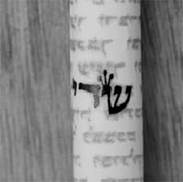 On
the reverse side[2]
of the mezuzah scroll is the Hebrew name of HaShem, Shaddai -
שדי. This name is an acronym for:
On
the reverse side[2]
of the mezuzah scroll is the Hebrew name of HaShem, Shaddai -
שדי. This name is an acronym for:
שׁוֹמֶר דְלָתוֹת יִשְׂרָאֶל
Guardian of the Doors of Israel.[3] Additionally, there are often three words at the bottom of the backside of the scroll: כוזו במוכסז כוזו. These mysterious words, transliterated as: Kozo bemuskaz Kozo. These three words are an altered form of the phrase “HaShem Elokeynu HaShem”, which means “G-d, our Lord, G-d”. It is actually a form of Gematria (אב׳גד) where each letter is “raised” to the next letter. Thus, an Alef becomes a Bet, and a Bet becomes Gimel, and so on. Here, the letters for HaShem’s name yud, hey and vav, hey become caf, vav, zayin, vav (cuzu); and the letters for Elokeynu (alef, lamed, heh, yud, nun, vav) become bet, mem, vav, caf, samach, zayin (bmucsz). Rabbi Moshe Isserlis quotes the Hagahot Maimoni[4] as the source for this custom. It is only a custom and a mezuzah without these words is still valid.
The only kind of scroll that is written both on the inside and outside, that I am aware of, is the mezuzah.
A very significant difference between mezuzot (plural of mezuzah) and tefillin compared to other scrolls is that the letters must be written in the order in which they appear in the Torah. Every letter must be written in order, so a single mistake invalidates the scroll. Unlike a Torah scroll where we can remove the incorrect word and finish writing the sentence.
Targum to Tehillim (Psalms) 121:4-5 4. Behold, He does not slumber and He will not sleep, the guardian of Israel. 5. HaShem will guard you, HaShem will overshadow you, on account of the mezuzah affixed on your right side as you enter.
The mitzva of mezuzah first became obligatory when the Children of Israel began living in houses in the promised land. As long as they were living in tents, in the wilderness, there was no requirement for mezuzah because the tents did not have doorposts.
In general, mitzvot apply to individuals and can be conditioned by certain geographical or temporal factors. For example, a person must eat matza on the 15th of Nisan. The mitzva devolves upon each person on that day. Similarly, a person must, under certain circumstances, offer a sacrifice in the Temple. Though the mitzva cannot be performed outside of the Temple, the mitzva still applies to the person; the holy precinct is merely the site of the execution of the mitzva. One notable exception is the mitzva of mezuza, which applies to the house. A person is not obligated to live in a house with a mezuza; rather, if a Jew owns a house, he or she must then convert it into a house with mezuzot. In this instance, the mitzva which a person must perform relates directly to the house.
This connection between the mezuzah and the house is reinforced by the Talmud:
Shabbath 23b R. Huna said: He who habitually practises [the lighting of] the lamp will possess scholarly sons; he who is observant of [the precept of] mezuzah will merit a beautiful dwelling; he who is observant of fringes will merit a beautiful garment; he who is observant of the Sanctification of the Day will be privileged to fill barrels of wine.
A mezuzah, with its scroll, is affixed to the doorpost of every room, except bathrooms and closets, of a Jewish home to fulfill the mitzva (Biblical commandment) to inscribe the words of the Shema “on the doorposts of your house”.[5]
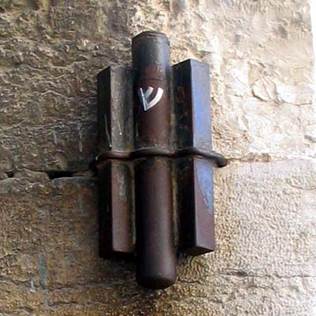
Mezuzah container on Jaffa gate.
Additionally, the mitzva of mezuzah applies also to the gates of a city or house if it contains doorposts and a lintel. All of the gates of Jerusalem have a muzuzah except the Damascus gate. That mezuzah was removed by the Arabs and has never been replaced. The mezuzot on the gates of Jerusalem are placed according to Sephardic tradition. The above picture shows the mezuzah on the Jaffa gate. It is worth noting that the mezuzot on the gates of Jerusalem are all attached according to Sefardi tradition, stright up and down. Ashkenazim have a tradition to slant the mezuzah when attaching it.
Having a mezuzah on each room means that whenever we move from one domain, one sphere of activity, to another, we must renew our consciousness of HaShem’s presence and act in a way that sanctifies His Name.
 As
we mentioned earlier, on the reverse
side of the mezuzah scroll is the Hebrew name of HaShem, Shaddai -
שדי.
As
we mentioned earlier, on the reverse
side of the mezuzah scroll is the Hebrew name of HaShem, Shaddai -
שדי.
The root of Shaddai is shadad (שדד). Shadad means to overpower or to destroy. This suggests a connection to what we find in sefer Revelation.
Revelation 6:1 And I saw when the Lamb opened one of the seals, and I heard, as it were the noise of thunder, one of the four beasts saying, Come and see. 2 And I saw, and behold a white horse: and he that sat on him had a bow; and a crown was given unto him: and he went forth conquering, and to conquer.
The word conquer carries the same connotation as overpower.
 This name, Shaddai, is an acronym for: ישראל
שומר דלתות, Guardian of the Doors of Israel. This
suggests that the Guardian of Israel guards those that observe the mitzva of mezuzah. (Shin - ש,
the first letter of this Name, often appears on the mezuzah case.)
This name, Shaddai, is an acronym for: ישראל
שומר דלתות, Guardian of the Doors of Israel. This
suggests that the Guardian of Israel guards those that observe the mitzva of mezuzah. (Shin - ש,
the first letter of this Name, often appears on the mezuzah case.)
The name שדי appears in connection with three mitzvot: Tefillin, mezuzah, and brit mila. The name appears on the bayit and knots of the tefillin. This name is visible on the outside of the mezuza, as we saw above, and the name שדי was used when HaShem commanded Avraham to perform his own brit.
Nachmonides tells us that the name El Shaddai personifies HaShem as the power that bends nature to His will. This is why we see this name in connection with the Patriarchs. HaShem changed nature to assist the Patriarchs.
Thus we learn that there is significant benefit to those who observe the mitzva of mezuzah, and that the mezuzah serves as a constant reminder of HaShem and His Torah.
The seven seals (mezuzah mitzvot)
Nachmanides and Sefer HaChinnukh[6] point out that:
At the root of the mitzva [of the mezuzah] lies the purpose that it should remind a person about faith in HaShem every time he [or she] enters the home or leaves it.
Abraham ibn Ezra, in his treatise on the philosophy of mitzvot Sefer Yesod Morah Ve-Sod Ha-Torah, gives a similar rationale for the precept of mezuzah as a reminder to observe all religious precepts. He writes:
The reason Scripture gives for tzitzith (fringes) is, ‘you may remember and do all My commandments’[7] when you constantly look upon the tzitzith[8]. The same applies to “And thou shalt bind them (tefillin)... and thou shalt write them (mezuzah) [on the doorposts]”.[9]
Thus, according to ibn Ezra, a mezuzah (just like the tzitzith and tefillin) serves as a reminder to fulfill all commandments. Thus we see that the Ibn Ezra agrees that the mezuzah is a pars pro toto,[10] an allusion, for the whole Torah.
Notice how the mitzvot found in the mezuzah tend to reinforce our remberance of HaShem.
The first parsha of the mezuzah contains the most fundamental concept of Torah: The unity of HaShem. This concept, that all the diverse phenomena that exists in this world are the result of One Source, and not the result of conflicting forces, is the foundation of our faith and is what sets Judaism apart from all the ancient and modern ideas and religions.
The first parsha, Devarim 6:4-9, contains seven specific mitzvot, according to Maimonides[11].
- The precept
of the oneness of the Eternal Lord. (+417
Devarim 6:4)
- The
precept of love for the Eternal Lord. (+418
Devarim 6:5)
- The
precept of Torah
study. (+419
Devarim 6:7)
- The
precept of the mezuzah on the doorpost. (+423 Devarim 6:9)
The second parsha, Devarim 11:13-21, does not contain any mitzvot, according to Maimonides[12].
The second parsha, of the mezuzah, teaches the principle of a divine expense account. The mezuzah is a reminder in times of prosperity that our abundance is an expense account which is dependent upon our observance of the Torah and the teaching of the Torah to the world. In times of deprivation, our expense account misfortunes come as a punishment for our sins, our failure to deliver the goods. More importantly, the performance of the mitzvot is to be done to love, or connect, with HaShem. We do not serve for a reward. That comes in the olam haba. The “rewards” mentioned are merely the expense account whereby we are enabled to continue to live easily so that we will have time to serve HaShem and to connect with Him.
Why did HaShem command us regarding the mezuzah? The mezuzah is a portion of Holy Torah, inscribed in the same manner and script as a Torah. The mezuzah contains the commands that HaShem has given Israel to remind them to remember, and to perform, all the commands of the Torah. The mezuzah is a par-pro-toto of the entire Torah. Because it is impossible to write an entire Torah scroll on the doorposts of our homes, HaShem gave us a reminder, the mezuzah. Thus the mezuzah sums up the Torah as a reminder. One who is diligent to remember and perform the commands of HaShem, will have a mezuzah to form a reminder to obey the mitzvot of the Torah. This reminder will greet them every time they enter a room of their house.
These seven mitzvot are the seven seals that constitute our Torah obligations as a summary of the entire Torah. Further, they constitute our protection from the wrath of HaShem. This is the scroll written on the inside and out, which will be used to judge the Children of Israel and the world.
The protection of the mezuzah is a bit like the protection that angels have from sinning. Even though, technically, an angel has freewill, he will almost never sin because the consequences are so clear. It is like asking a sane man to step off the roof of a fifty story building. It just won’t happen. Not because he can’t, but rather he won’t because the consequences are so clear.
In the same way, one who constantly sees his mezuzot has a constant reminder of HaShem and the consequences for sin.
Now lets take a look at some sources which suggest that the one who observe the mitzva of mezuzah, has the ability to be protected from evil.
The mezuzah provides protection
Hakham Yaakov Tzemach[13] wrote the following:
This is the mystery of the mezuzah,
which is the embodiment of Sovereignty,
because the mezuzah is numerically
the same as the Divine Name of A D N Y (65).
The mezuzah is placed on the bottom part of the top third
of the doorpost, to signify Sovereignty, which emerges
from the higher third part of
Beauty of the Little Face.
This is the mystery of the sentence
“Yea, the Almighty shall be your defence, and you shall
have plenty of silver,” which uses the name
Sh’a’dd’ai’ (the Almighty)[14]
which is a shield against the Shells (external forces)
that are called tzarich (need).
For this is how Sovereignty emerges.
The Sovereignty indicates the mezuzah,
which is on the outside of the Little Face,
so the Shells will not have a grasp there.
There is a power in the name of Shaddai to dissipate the
Shells, which are called tzarich
Does a mezuzah protect the people in a house, as Hakham Yaakov Tzemach suggests? To answer this requires a bit of information from the Rambam.
In the Laws of Mezuzah, the Rambam writes, “A person should pay heed to the precept of the mezuzah; for it is an obligation perpetually binding upon all. Whenever one enters or leaves a home with the mezuzah on the doorpost, he will be confronted with the declaration of HaShem’s unity, blessed by His holy name; and will remember the love due to HaShem, and will be aroused from his slumbers and his foolish absorption in temporal vanities. He will realize that nothing endures to all eternity save knowledge of the Ruler of the universe. This thought will immediately restore him to his right senses and he will walk in the paths of righteousness.”[15]
Maimonides says that the point of the mitzva is to change the person who performs it. When you do the mitzvah, you’re connecting to HaShem, by thinking about the text of the mezuzah or just by doing what HaShem commanded. Since HaShem is the “protector of Israel”, as the morning prayer says, when you connect with Him, you get His protection.
The mezuzah is there to keep away evil spirits. Not those that float around, the figments of a rich imagination. But those that we can control, inside our doors and our hearts. Most mitzvot have the power to protect while we are actively engaged in performing them, but the mezuzah is unique in that it protects even as we sleep.[16]
The word mezuzah appears for the first time, in the Torah, in the account of the Exodus from Egypt. Before the last plague, killing the Egyptian firstborn, HaShem warned the Bne Israel to mark their doorposts with the blood of the Pesach (Passover) lamb so that HaShem would pass over their houses. The Torah says:
Shemot (Exodus) 12:7,23 And they shall take of the blood and they shall put it on the two mezuzot (doorposts) and on the lintel... For the Lord will pass through to smite the Egyptians, and when He seeth the blood upon the lintel, and on the two doorposts, the Lord will pass over the door, and He will not allow the destroyer to come in unto your houses to smite [you].
Obviously, HaShem does not need signs to know whether a Jew or an Egyptian lives in a certain house. HaShem sees everything without needing splatterings of blood on doorposts. So what is the meaning of this? Based on the Zohar, the Kabbalist, Rabbi Eliahu Leon Levi, explains that the underlying mystical meaning is speaking about us. The two side posts of the door represent the legs of person. The upper mantle represents the torso. The blood was to be placed where a mezuzah is fastened to a doorpost, two-thirds of the way to the top. This represents the place of the brit mila, the male organ. Just as the word שדי - shaddai is written on the outside of a mezuza, signifying one of the Names of HaShem, so too, the brit milah is considered to be invisibly stamped with this same Name of HaShem.
This is why this festival is called Pesach, because HaShem passed over the houses with the blood on the doorposts. The Mechilta, in Parshat Bo, states that these verses are the source of the concept of mezuzah:
Now consider: The blood of the Passover sacrifice was but of little weight, for it was required but once, not for all generations, and by night only, not by day; yet He would ‘not allow the destroyer... to strike you.’ How much more will He not permit the destroyer into the house which bears a mezuzah, which is of greater weight, seeing that the Divine Name is repeated there ten times, it is there by day and night, and it is a law for all generations.
The mezuzah, therefore, recalls the Exodus from Egypt, when the lamb’s blood smeared on the doorpost identified the homes of the Bne Israel that HaShem passed over during the plague of the first born. The Zohar speaks of this connection:
Soncino Zohar, Shemoth, Section 2, Page 36a Said R. Abba: ‘In how many ways does the Holy One show His lovingkindness to His people! A man builds a house; says the Holy One to him: “Write My Name and put it upon thy door (mezuzah), and thou wilt sit inside thy house and I will sit outside thy door and protect thee!” And here, in connection with the Passover, He says: “You inscribe on your doors the sign of the mystery of My Faith and I shall protect you from the outside!”
Further, the mezuzah and the blood on the door posts are both connected to Mashiach.
Blood on doorposts came from Pesach lamb which represents Mashiach.
1 Corinthians 5:7 Purge out therefore the old leaven, that ye may be a new lump, as ye are unleavened. For even Mashiach our passover is sacrificed for us:
The mezuzah is a pars pro toto for the Torah, and the Mashiach is the Living Torah, as Yochanan explains.
Yochanan (John) 1:1-3 In the beginning was the Word, and the Word was with God, and the Word was God. The same was in the beginning with God. All things were made by him; and without him was not any thing made that was made.
We understand that when someone is talking about the “Word of G-d” that they are referring to the Torah. In this pasuk, Yochanan is clearly calling Yeshua, The Word of G-d, the Torah.
Thus we understand that the:
Mezuzah
= Blood on the doorposts
The Torah promises that anyone who carefully observes the mitzva of mezuzah will lead a longer, richer life, as will their descendants:
Devarim (Deuteronomy) 11:18-21 Therefore shall ye lay up these my words in your heart and in your soul, and bind them for a sign upon your hand, that they may be as frontlets between your eyes. 19 And ye shall teach them your children, speaking of them when thou sittest in thine house, and when thou walkest by the way, when thou liest down, and when thou risest up. 20 And thou shalt write them upon the door posts of thine house, and upon thy gates: 21 That your days may be multiplied, and the days of your children, in the land which HaShem sware unto your fathers to give them, as the days of heaven upon the earth.
Notice that the command to attach a mezuzah is immediately followed by the promise of long life. The twelfth rule of Rabbi Ishmael says: A matter derived from its context, or a matter derived from its end (i.e. from what follows it). Thus we learn that a mezuzah will prolong our days and the days of our children, because it immediately follws the command to attach a mezuzah.
It is further strengthened and elevated to Jewish law, halakhah, in the Shulchan Arukh:
He who is careful and particular in the observance of mezuzah – his days and the days of his children will be lengthened.
Furthermore, the Code of Jewish Law[17] rules that the mezuzah, aside from its reward of longevity for oneself and one’s children stated in the Torah, has the effect of guarding the house and its inhabitants from any harm. The Beth Yosef calls this an open miracle.
The Targum of Pslam 121:5 makes it clear that HaShem guards us on account of the mezzuzah:
Psalms (Tehillim) 121:1 A song that was uttered on the ascents of the abyss. I will lift up my eyes to the mountains. Whence will come my help? 2. My help is from the presence of the Lord, who made heaven and earth. 3. He will not allow your foot to falter, your guardian does not slumber. 4. Behold, He does not slumber and He will not sleep, the guardian of Israel. 5. The Lord will guard you, the Lord will overshadow you, on account of the mezuzah affixed on your right side as you enter. 6. By day, when the sun rules, the morning-demons will not smite you, nor will the liliths, at night, when the moon rules. 7. The Word of the Lord will guard you from all harm, he will guard your soul. 8. The Lord will guard your going out for business and your coming in to study Torah, from now and forevermore.
The Talmud also has a few of passages which speak about the protection afforded by the mezuzah:
Tractate Menochot 43b Rabbi Eliezer b. Yaakov said, If a person wears tefillin, tzitzit on his garment, and has a mezuzah on his door, it can be taken for granted that he will not sin, for it says, “A three-ply cord (tefillin, tzizith, and mezuzah) is not easily cut”[18]
Avodah Zarah 11a [When] Onkelos the son of Kalonymus became a proselyte, the Emperor sent a contingent of Roman [soldiers] after him, but he enticed them by [citing] scriptural verses and they became converted to Judaism. Thereupon, the Emperor sent another Roman cohort after him, bidding them not to say anything to him. As they were about to take him away with them, he said to them: ‘Let me tell you just an ordinary thing: [In a procession] the torchlighter carries the light in front of the torchbearer, the torchbearer in front of the leader, the leader in front of the governor, the governor in front of the chief officer; but does the chief officer carry the light in front of the people [that follow]?’ ‘No!’ they replied. Said he: ‘Yet the Holy One, blessed be He, does carry the light before Israel, for Scripture says. And the Lord went before them . . . in a pillar of fire to give them light.’[19] Then they, too, became converted. Again he sent another cohort ordering them not to enter into any conversation whatever with him. So they took hold of him; and as they were walking on he saw the mezuzah which was fixed on the door-frame and he placed his hand on it saying to them: ‘Now what is this?’ and they replied: ‘You tell us then.’ Said he, ‘According to universal custom, the mortal king dwells within, and his servants keep guard on him without; but [in the case of] the Holy One, blessed be He, it is His servants who dwell within whilst He keeps guard on them from without; as it is said: The Lord shall guard thy going out and thy coming in from this time forth and for evermore.’[20] Then they, too, were converted to Judaism. He sent for him no more.
Menachoth 33b Raba said, The proper performance of the precept is to fix it in the handbreadth nearest to the street. Why? — The Rabbis say, So that one should encounter a precept immediately [on one’s return home]; R. Hanina of Sura says, So that it should protect the entire house.
Rashi, commenting on the above passage, indicates that a properly place mezuzah will protect the entire house from dangers.
A careful reading of the Bait Yosef[21] tells us that the mezuzah contains the power of open, visible miracles.
“The protection of the house is an open miracle in that the others who live in houses without Mezuzot are not protected and those who live in a house with Mezuzot are protected.”
The Zohar tells us that a mezuzah on our doorposts will protect us from evil spirits:
Soncino Zohar, Devarim, Section 3, Page 265b R. Eleazar said: ‘Against all this God desired to protect Israel, and therefore a man should inscribe on the door of his house the Holy Name in which all faith is summed up. For wherever the Holy Name is the evil species cannot come and are not able to accuse a man. The place of the door of the supernal House is called mezuzah, which is a necessary part of the house, and from it flee the emissaries of justice and punishment. Correspondingly when on earth a man affixes a mezuzah to his door with his Holy Name inscribed in it, such a one is crowned with the crowns of his Master and no “evil species” come near to the door of his house.’
Finally, we should be aware that the mitzvot of the Torah are expressions of the will of HaShem. We do not affix a mezuzah for its protection, that is merely a side benefit. We affix a mezuzah, lay tefillin, light Shabbat or Chanukah candles, etc. for no other reason than because HaShem wants us to do so. We performs these acts out of love for HaShem, and for no other reason. The purpose of the scheme of creation is that the Bne Israel, through performance of the mitzvot, should express HaShem’s will, and thereby His sovereignty, in this world.
A kosher mezuzah is hand-written on genuine parchment, prepared from the skin of a kosher animal. A specially trained scribe carefully writes the words using special black ink and a quill pen. The letters must be written according to halacha, and every letter and word must be correct. Any mistakes or missing letters invalidates the entire parchment.
Because of humidity, temperature changes, and natural aging, the letters on a mezuzah can become cracked or faded. For this reason, a mezuzah should be checked twice every seven years[22]. This suggests that we should check our mezuzah when we finish reading the Torah according to the triennial cycle. This cycle lasts three and a half years.
Yoma 11a For it has been taught: The mezuzah of an individual’s [house] should be examined twice every seven years, and of public buildings twice every fifty years.
This connection between the triennial Torah cycle and the inspection of the mezuzah is not coincidental. Since the mezuzah is a pars pro toto for the entire Torah, then it makes sense that we would inspect the mezuzah as often as we read (inspect) the whole Torah.
The mezuzah and the Chanukah
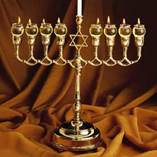 According
to the Talmud, the chanukiyah should be outside of
the door on the left side and the mezuzah should be on the right side in order
that we should be surrounded by HaShem’s commandments.
According
to the Talmud, the chanukiyah should be outside of
the door on the left side and the mezuzah should be on the right side in order
that we should be surrounded by HaShem’s commandments.
Shabbath 22a Rabbah said: The Hanukkah lamp should be placed within the handbreadth nearest the door. And where is it placed? R. Aha son of Raba said: On the right hand side: R. Samuel of Difti said: On the left hand side. And the law is, on the left, so that the Hanukkah lamp shall be on the left and the mezuzah on the right.
The Talmud compares the menorah to the mezuzah. We can see that there are several differences between the two. The mezuzah is on the right; the chanukiyah is on the left. The mezuzah is on the outside, but it is for the inside of the house; it protects the inhabitants. The menorah is on the outside; its message is for the outside world to proclaim to all the miracle of Chanukah.
The Talmud goes on to tell us the advantage of the chanukiyah and the mezuzah.
Shabbath 23b R. Huna said: He who habitually practises [the lighting of] the lamp will possess scholarly sons; he who is observant of [the precept of] mezuzah will merit a beautiful dwelling;
Why is the chanukiyah placed on the left and the mezuzah on the right? Would they not serve their purpose if the order were reversed? To understand why the chanukiyah must be placed to the left, while the mezuzah goes on the right, we must see their essential function. The mitzva of mezuzah entails the affixing of a handwritten parchment scroll containing the Shema to one’s doorposts. The verses quoted in the mezuzah include the directive to love HaShem with all your heart, all your soul, and all your possessions. The mitzva of mezuzah thus serves as a symbol of the concept that by dedicating ourselves and all the substance of this world to the service of HaShem, we express HaShem’s sovereignty even where it is not obvious, and bring out that the will of HaShem is manifest even within that which was created by the word of HaShem. The mezuzah represents the mitzva candle which makes possible the light of Torah, found in the chanukiyah.
This light of Torah is precisely what the ancient Greeks sought to extinguish during the period of Chanukah. The Greeks did not wish to annihilate the Jews physically; their goal was to Hellenize them and, as the al hanissim Chanukah prayer expresses it, “cause them to forget Your Torah” (G-d forbid!).
Mitzva observance is associated with the right side, since mitzvot draw us closer to HaShem, and Scripture says:
Shir HaShirim (Song of Songs) 2:6 His left hand is under my head, and his right hand does embrace me.
And
Sota 47a It has been taught: R. Simeon b. Eleazar says: Also human nature[23] should a child and woman thrust aside with the left hand and draw near with the right hand.[24]
“And His right hand embraces me.” On the other hand, the left side is associated with a “distant,” as opposed to close, relationship. The Greeks tried to push HaShem into the distance, even “off the map,” as the saying goes.
Further, we must see that scripture itself hints to the mezuzah on the right and the chanukiyah on the left.
Mishlei (Proverbs) 3:16 Length of days is in her right hand; and in her left hand riches and honour.
As we have previously seen, the mezuzah is associated with long life, both because it represents keeping all the mitzvot of the Torah, and because it affords protection from evil. The chanukiyah is associated with riches and honor as is seen when the menorah was kindled, in the days of the Maccabees, that it brought honor to HaShem and His people. The riches are associated with our nearness to HaShem, the ultimate in in richness.
What are the technical specs? According to the Talmud,[25] the following conditions obligate a room in mezuzah:
- The room must be at
least 4 cubits by 4 cubits (about four square
meters).
- The entrance must have two doorposts and a lintel, and the entrance should be
at least ten handbreadths high (about 80-100 cm.).
If the right side of the opening is flush with the wall, or if the top of
the opening is flush with the ceiling, no mezuzah is required.
- The room should be
non-holy. This excludes a synagogue, which is
holy. (Since our synagogues today also contain
an office, social hall, etc,, a mezuzah is required.)
- The room should be intended
for human occupancy (e.g. excluding a barn), and for permanent occupancy
(e.g. excluding a succah).
- The room should be made for
dignified occupancy (e.g. excluding a bathroom).
When placing the mezuzah in the case or on the wall, be sure that the Hebrew word “Shaddai,” which is written on the back of the parchment, is facing outward (i.e. toward the entrance once it is affixed). Also, make sure the mezuzah is not upside down!
The mezuzah should be placed on the right-hand doorpost, i.e. on the right side of the door as you enter the room. The Talmud learns this from the word “your house” (beit’echa), which can be rendered “as you enter” (bi’atcha).
How far up on the doorpost? The mezuzah should be placed on the lower part of the upper-third of the doorpost -- approximately shoulder height. (The Talmud compares this to Tefillin, which is placed on the upper arm.)
At which angle? The Ashkenazi custom is to position the mezuzah at a slight angle, with the top half pointing toward the room you are about to enter. The Sephardi custom is to place the mezuzah straight up vertically. (If the doorpost is too narrow to allow for a slant, Ashkenazim also place it vertically.)
If the doorway is deep, the mezuzah should be placed on the doorpost within three inches of the entrance. If the doorway has little depth, i.e. it is not possible to place the mezuzah on the doorpost within the doorway itself, then the mezuzah is placed on the outer part of the doorpost, within three inches of the doorway.
The mezuzah should be permanently affixed, with glue, nails, or screws. Tape that would easily fall off if bumped into is regarded as too temporary to be considered affixed. Similarly, velcro and magnets may not be used.
The mezuzah must be affixed both on the top and bottom. When using double-sided foam tape, either use one long piece which reaches the top and bottom of the mezuzah case, or put two pieces, one on top and one on the bottom.
A strong glue or double-sided foam tape is acceptable only if the case opens from the top or bottom. If the case opens from the back, then by using glue or foam tape, only the removable back of the cover will be “affixed to the doorpost,” while the hollow section containing the mezuzah will not. Therefore, a case which opens from the back should be affixed with nails or screws. [If that option does not exist, one may use tape to seal the back of the case to the body of the case, and then post it as such.]
The mouinting procedure is to hold the mezuzah against the spot upon which it will be affixed, then recite this blessing:
אֲשֶׁר קִדְּשַׁנוּ בְּמִצְוֹתָיו .בָּרוּךְ אַתָּה יי אֱלֹהֵינוּ מֶלֶךְ הָעוֹלָם,
וְצִוָנוּ לִקְבּוֹעַ מְזוּזָה
Baruch atta Adonai Eloheinu melech haolam, asher kideshanu bemitzvotav vetzivanu likboa mezuzah.
Blessed are You, HaShem our God, King of the Universe, Who sanctified us with His mitzvot, and commanded us to affix a mezuzah.
The mezuzah contains twenty-two lines of 713 letters, composing 170 words. Every letter has a several laws pertaining to its form. In order for a mezuzah to be written in accordance with all 4649 of its laws, it must thus meet thousands of requirements. If even one of the 713 letters in a mezuzah is missing or shaped incorrectly, the mezuzah is rendered invalid, the mitzva is unfulfilled, and the blessing recited over it is in vain.
The following section was written by Alexander Poltorak.
A mezuzah is traditionally written on twenty-two lines, corresponding to the twenty-two letters of the Alef Beth. These twenty-two letters together with ten numbers-sefiroth (Divine Emanations) comprise thirty-two Paths of Wisdom. The letters represent the qualitative aspects of the Creation, while the numbers represent the quantitative aspects. Even though the mezuzah has only twenty-two lines, corresponding to the twenty-two letters, it implicitly contains reference to the ten sefiroth as well, since twenty-two lines connect the ten points in the array (Figure 1).
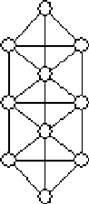
Figure 1
This is further alluded to in the very word mezuzah, which has a milui[26] equal to 231, the number of all possible pairs of letters in the 22-letter Alef-Beth (fig. 2). These 231 Gates of Wisdom contain the mystery of creation, and it is said that they have been used in the manufacture of a Golem[27] through meditation upon these letter combinations.
The text of a mezuzah has 170 words. The number 170 is equal to the combined gematria of two words: banim[28] (children) and chayim[29] (life), as it is written,
Deavrim (Deuteronomy) 11:13-21 “...So that your days may be multiplied; and the days of your children...”.
The number 170 is also equal to the sum total of the gematria of the words chayim (life) and emunah[30] (faith), as it is written,
Habakkuk 2:4 The righteous shall live by his faith.
The text of the mezuzah has 713 letters. The number 713 is the numerical value (gematria) of the word teshuvah, repentance. The word mezuzah has the numerical value of 65, the value of another Name of G‑d, Adonai (Master, L‑rd). This Name is associated with the Divine Attribute of Malkhuth (Kingship). Perhaps this comes to teach us that by looking at the mezuzah we remind ourselves of the great Master of the Universe, the King of Kings to Whose Supreme Will we must subjugate our will, submitting to the yoke of the Heavenly Kingdom. This moves us to repentance.
The gematria of mezuzah (65) equals the gematria of the word hekhal, chamber, as in Hekhal HaKodesh, the Holy Chamber, or Hekhal, the main Hall of the Temple. This supports the notion that the mezuzah can turn a house into a place of holiness, a miniature temple.
The sum total of the number of lines, words, and letters, in the mezuzah, is equal to 22+170+713=905. This number is the gematria of the phrase found in the Grace After Meals: Berachah Merubah Babaith HaZeh (Great blessing to this house).
The sixth Lubavitcher Rebbe, Rabbi Joseph I. Schneersohn, points out that the word mezuzah consists of three syllables, me-zu-zah. The first syllable, me-, alludes to the Mishna, the Oral Torah, because the Mishna and the Talmud start and end with the letter Mem. The second syllable -zu- alludes to the Jewish nation as it is written:
Shemot (Exodus) 15:13 Am Zu gaalta – this people which Thou hast redeemed.
The third syllable -zah- alludes to G‑d, as it is written:
Shemot (Exodus) 15:2 Zeh Ey-li v’anveyhu–this is my G‑d, and I will glorify Him.
This shows the unity of the nation of Israel with G‑d as it is achieved through the Torah, as the Zohar states:
Three things are bound up one with the other: Israel is bound with the Torah and the Torah is bound up with G-d.
Rabbi Menachem Mendel Schneerson elaborates on this concept further. He points out that the second syllable, -zu-, is the feminine pronoun this. The third syllable, -zah-, has the same letters as zeh, the masculine pronoun this. As the Rebbe explains, this alludes to the unification of the feminine and masculine aspects of the Divine as it is expressed in Torah.
The word mezuzah itself is derived from the root zuz, to move. The first letter of the word mezuzah – Mem, being the middle letter of the Alef-Beth, also denotes a transition between past and future. It is the first letter of the word mayim, water, denoting passage of time. The letter Shin traditionally displayed on the mezuzah case is the first letter of the word Shanah, year, and Shinui, change. Yet the mezuzah must be affixed to the doorposts of a house, the symbol of settlement. Moreover, the law requires that mezuzah is to be affixed to a doorpost in a permanent and immovable manner. Perhaps this apparent contradiction contains a message. We are forever caught up in a race of time, in a race of life. On the other hand, the letter Mem, the first letter of the word mezuzah and also the first letter of the words mikvah[31] and mayim (water) represents the present moment. Passing through the door and touching the mezuzah to kiss it, we ground ourselves in the present moment, in the here and now. We ground ourselves in our timeless tradition. We realize at that moment that in these fast-changing times we must not forget the eternal values of Torah.
In the Book of Shemot (Exodus) we find the word mezuzah in a most unexpected context. In Shemot 21:5-6, Torah enjoins a master to set his Jewish slave free, in the seventh year, after six years of service. The Torah continues with this connection to the mezuzah:
Shemot (Exodus) 21:5-6 But if the servant shall plainly say: I love my master, my wife, and my children; I will not go out free; then shall his master bring him unto the judges, and he shall bring him to the door, or unto the doorpost (mezuzah); and his master shall bore his ear through with an awl; and he shall serve forever[32].
A slave who rejects his freedom is liable to have his ear pierced next to the mezuzah.
The doorpost is when the blood of the Passover lamb was applied. As such, it was the place where are freedom began. After all, only a free man can celebrate Passover. In the above passage we see that the doorpost is also used for the slave who prefers to be a slave to a man rather than a slave to HaShem. Only those who serve HaShem are truly free.
Thus a man loses his freedom when his ear is pierced next to the mezuzah. Thus the mezuzah is associated with freedom. It is associated with those who serve HaShem and obey His mitzvot. We see that the mezuzah was the witness to the transformation of a nation of slaves into a nation of HaShem’s servants. The mezuzah is an eternal symbol of freedom.
Gentiles and the mezuzah
According to Ashkenaz halacha[33], when a Jew and a Gentile share a house, each having his own designated room or area, then a mezuzah is not required on the common doorway. However, halacha does permit the shared house to have a mezuzah on the common doorway. Thus we learn that a Gentile may have mezuzot on his doorposts, but, he is not required to have them.
According to Sephardi halacha[34], the Rashba teaches that a common doorway is required to have a mezuzah.
There is a well known passage in the Jerusalem Talmud which illustrates that even the Gentile can merit protection through the mezuzah.
Talmud Yerushalmi, Peah 1:1 The Parthian king, Artiban, once sent a priceless jewel to Rabbi Judah the Prince (135 c.e. - 220 c.e.), who was the compiler of the Mishna and one of the wealthiest Jews. The king made it obvious that he expected something of equal value in return. The Rabbi’s return gift to the king was a Mezuzah. The king’s reply was: “I sent you something priceless and you sent me something that can be bought for a paltry sum!?” The Rabbi answered: “You sent me something that I must hire a guard to watch and I sent you something that will watch over you!” After a while, the king’s daughter fell ill (in the words of the Talmud she was possessed by a demon), and all of the doctors could not cure her. Rebbe instructed him to place the mezuzah on her door, and she recovered.
Additionally, the Sanhedrin’s special beit din for Bnei Noach halacha has issued a halachic ruling that Noachides can hang mezuzot on their doorways.
My Beloved teacher, Hakham Haggai, has taught us that Gentiles who fear HaShem MUST affix mezuzot, according to II Luqas 15:
II Luqas (Acts) 15:19-21 Wherefore my sentence is, that we trouble not them, which from among the Gentiles are turned to God: 20 But that we write unto them, that they abstain from pollutions of idols, and fornication, and things strangled, and blood. 21 For Moses of old time hath in every city them that preach him, being read in the synagogues every sabbath day.
Our Sages have taught[35] that women are obligated to mezuzah because they need to live and be protected. Surely the same logic applies to the Noachide.
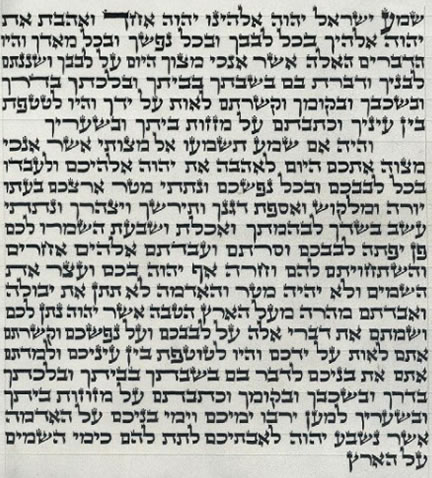
The first passage is “Shema Israel”. The second passage is “Vehaya”.
The first scroll is the common Ashkenazi scroll:
This second scroll is the common Sefardi scroll:
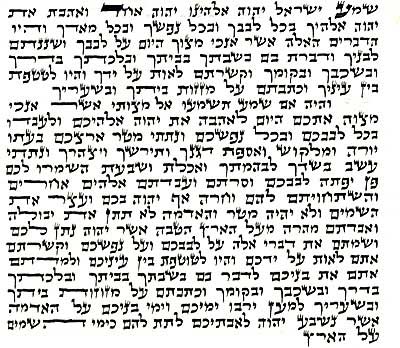
Hear, O Israel, HaShem is our God, HaShem is one. You shall love HaShem, your God, with all your heart, with all your soul, and with all your might. And these things that I command you today shall be upon your heart. And you shall teach them to your children, and you shall speak of them when you sit in your house and when you walk on the way, when you lie down and when you rise up. And you shall bind them as a sign upon your arm and they shall be an ornament between your eyes. And you shall write them upon the doorposts of your house and on your gates.
And it will be that if you hearken to my commandments that I command you today, to love the Lord, your God, and to serve him with all your hearts and all your souls. And I will place rain for your land in its proper time, the early and the late rains, that you may gather in your grain, your wine, and your oil. And I will provide grass in your field for your cattle, and you will eat and you will be satisfied. Watch yourselves, lest your heart be seduced and you turn astray and serve other gods, and prostrate yourselves to them. And the wrath of God will be upon you, and he will restrain the heaven and there will be no rain, and the ground will not yield its produce, and you will be lost quickly from upon the good land that God gives you. And you shall place these words of mine on your hearts and on your souls, and you shall bind them as a sign upon your arms and they shall be ornaments between your eyes. And you shall teach them to your children to discuss them, when you sit in your house and when you walk on the way, and when you lie down and when rise up. And you shall write them upon the doorposts of your house and upon your gates, in order to prolong your days and the days of your children upon the good land that God swore to your fathers to give them, like the days of Heaven over earth.
In the shema, HaShem commands us to love Him with all your heart, with all your soul, and with all your might. If you will search the Tanach[36], diligently, you will find only one individual who ever loved HaShem with all his might. This amazing individual could have been Mashiach except the people were not yet ready. King Yoshiahu (Josiah) was the last righteous king before the captivity in Babylon. Note what the Tanach says about this great man:
II Melachim (Kings) 23:24-25 Moreover the workers with familiar spirits, and the wizards, and the images, and the idols, and all the abominations that were spied in the land of Judah and in Jerusalem, did Josiah put away, that he might perform the words of the law which were written in the book that Hilkiah the priest found in the house of HaShem. 25 And like unto him was there no king before him, that turned to HaShem with all his heart, and with all his soul, and with all his might, according to all the law of Moses; neither after him arose there any like him.
When we begin looking for the Mashiach, what should we be looking for? How will we recognize this individual? I believe that we should study the life of King Yoshiahu to find the traits of the Mashiach.
The story with this mezuzah is absolutely fascinating, as it shows the great power it contains.
The son of Mr. M.S. was complaining of headaches and sharp pain in the eyes. When he went to the doctor for a checkup, he was advised to see an eye specialist at once. After a thorough examination by the eye doctor, he was told that his son would need to be operated on immediately; otherwise he would lose his sight in one eye. The operation was set for the next day.
M.S. called his Rov and asked that they say Tehillim for his son in synagogue and pray for a refuah shleimoh. The Rav told him to have his mezuzot checked at once. M.S. said that he had already had all his mezuzot checked just recently, and they all turned out to be fine. The Rav told him to at least take off the one by his son’s bedroom and have it checked again.
That same night, the father took off the mezuzah and brought it to the sofer. He asked him to check it very carefully. Fifteen minutes later, Mr. M.S. got a call from the sofer that the mezuzah was posul.
The very next morning, the father bought the very best Mezuzah that money could buy and put it up on the door. That very same day, at approximately 2:00 P.M., he brought his son to the hospital for a final checkup before having the operation. He was extremely nervous and edgy. Imagine his great surprise and exhilaration when the doctor came out of the examination room to inform him that he had decided not to operate as yet. He had noticed a small change for the better and decided to wait a few more days and see what would happen.
A week passed, and to the great surprise of the doctor, the headaches disappeared and the eye healed completely. Even the doctor admitted that it was an open miracle. There was no other rational explanation.
Here is a reproduction of the mezuzah. When you see this mistake it will really boggle your mind.
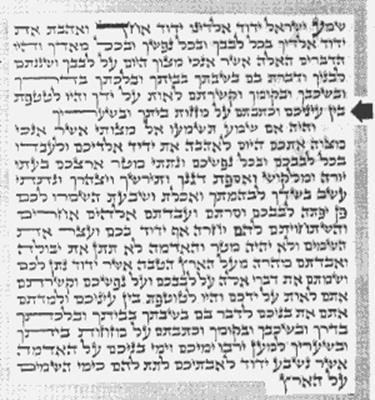
If you carefully compare the defective word to the proper word in my reproduction, you will see that the word einechem – עֵינֵיכֶם, in Devarim 6:8, is written with a final letter mem, which makes it a plural for eyes. This word should be einecha, which means eye singular. Thus the headaches and eye pain were directly related to the mezuzah’s defective word, on the boys bedroom doorposts! Now that is mind boggling!
* * *
Rabbi Isaiah Horowitz, the Shelah, writes: Performance of different mitzvot represents allusion to varying levels of our attachment to the Olam HaBa. In this regard, the act of affixing a mezuzah ranks higher than donning tefillin.
* * *
Mishlei (Proverbs) 8:34 Blessed is the man that heareth me, watching daily at my gates, waiting at the mezuzah of my doors.
Those who observe the mitzva of mezuzah will merit four things, according to our study:
- Long life
- Protection
- Kept from sin
- A beautiful home
This suggests a powerful incentive for one to be carefull in the observance of this mitzva. Despite this, the Tur[37] admonishes us to be carefull to fulfill the mitzva for its own sake, we should have mezuzot attached to our doorposts just because HaShem commanded us, and not because of its other benefits.
* * *
This study was written by
Rabbi Dr. Hillel ben David
(Greg Killian).
Comments may be submitted to:
Rabbi Dr. Greg Killian
12210 Luckey Summit
San Antonio, TX 78252
Internet address: gkilli@aol.com
Web page: http://www.betemunah.org/
(360) 918-2905
Return to The WATCHMAN home page
Send comments to Greg Killian at his email address: gkilli@aol.com
[1] The Hebrew word for commandment “mitzva - מִצְוָה” comes from the word “Tzavta” which means a “connection.” This is because HaShem’s commandments connect us to Him in a way we could never have achieved on our own.
[2] Revelation 5:1
[3] Kol Bo 90, 101:4, ad Hil. Telifin, Umezuzah Vesefer Torah 5.4
[4] A commentary on the Mishne Torah (which details Ashkenazi customs) by the Rambam.
[5] Devarim (Deuteronomy) 6:9
[6] 13th-century Jewish classic written in Spain by an anonymous Rishon (one of the early scholars), ascribed to R. Aaron ha-Levi of Barcelona. The book was written by a father for his young son as rational explanations of the Commandments in order of the Torah parshioth (weekly portions).
[7] Bamidbar 15:40
[8] Bamidbar 15:39
[9] Devarim (Deuteronomy) 6:8-9.
[10] Latin for “a part for the whole”.
[11] Sefer HaChinuch, book four, pages 249-289
[12] Sefer HaChinuch, book four, pages 339-351
[13] Lurianic kabbalist
[14] The letters of Sh’a’dd’ai’ (Shin Daled Yud) are the acronym for “guardian of the Doors of Israel” (Shomer Daltot Yisrael).
[15] Mishne Torah, Hilchot Mezuzah 6:13
[16] Shulchan Aruch Yoreh Deah: 285
[17] Shulchan Aruch
[18] Ecclesastes 4;12
[19] Shemot (Exodus) 13:21
[20] Tehillim (Psalms) 121:8
[21] Tur Yoreh Deah: 285
[22] Babylonian Talmud, Yoma 11a, Shulchan Aruch (291:1)
[23] One must learn to control it so as to avoid extremes.
[24] One must not be too severe in chiding a child or reproving a wife lest they be driven to despair.
[25] Yoma 11, Succah 3b
[26] Full gematria calculated by spelling out each letter of the word and calculating the sum total. Thus, the letter Alef, with a regular gematria of 1, is spelled Alef-Lamed-Pay and has a milui gematria of 1+30+80=111.
[27] A man created by a kabbalist from mud.
[28] The word bonim is spelled BNYM. The gematria is (Beth = 2) + (Nun = 50) + (Yud = 10) + (Mem = 40) = 102.
[29] The word chaim is spelled ChYYM. The gematria is (Cheth = 8) + 2x(Yud = 10) + (Mem = 40) = 68.
[30] The word emunah is spelled AMVNH. The gematria is (Alef = 1) + (Mem = 40) + (Vav = 6) + (Nun = 50) + (Heh = 5) = 102.
[31] Ritual pool used for purification by Jewish women once a month as a matter of law and by (mostly Chasidic) men every morning as a matter of custom.
[33] Rama Y.D. 286:1 with Pitchei Teshuva 3
[34] Bedek Habayit, Yoreh Deah 286
[35] Berachoth 20b
[36] The “old Testament”.
[37] Yoreh Deah: 285