
Betrothal
By Rabbi Dr. Hillel ben David (Greg Killian)
Betrothal
By Rabbi Dr. Hillel ben David (Greg Killian)
In many Sephardic congregations, prior to the Torah reading on the first day of Shavuot, a Ketubah le-Shavuot (marriage certificate for Hag Shavuot) is read, as a symbolic betrothal of HaShem and His people Israel. There are various versions of such piyyutim, nearly all similar in terminology to the traditional tenaim (premarital document specifying the conditions agreed upon between the two parties) or the Ketubah (certificate the bridegroom presents to the bride at the wedding ceremony). These are hymns based on the verses:
Hoshea (Hosea) 2:14-20 “Therefore I am now going to allure her; I will lead her into the desert (at Sinai?) and speak tenderly to her. There I will give her back her vineyards, and will make the Valley of Achor a door of hope. There she will sing as in the days of her youth, as in the day she came up out of Egypt. “In that day,” declares HaShem, “you will call me ‘my husband’; you will no longer call me ‘my master.’ I will remove the names of the Baals from her lips; no longer will their names be invoked. In that day I will make a covenant for them with the beasts of the field and the birds of the air and the creatures that move along the ground. Bow and sword and battle I will abolish from the land, so that all may lie down in safety. I will betroth you to me forever; I will betroth you in righteousness and justice, in love and compassion. I will betroth you in faithfulness, and you will acknowledge HaShem.
And:
Yiremeyahu (Jeremiah) 31:31-34 “The time is coming,” declares HaShem, “when I will make a renewed covenant with the house of Israel and with the house of Judah. It will not be like the covenant I made with their forefathers when I took them by the hand to lead them out of Egypt, because they broke my covenant, though I was a husband (betrothed) to them,” declares HaShem. “This is the covenant I will make with the house of Israel after that time,” declares HaShem. “I will put my Torah in their minds and write it on their hearts. I will be their God, and they will be my people. No longer will a man teach his neighbor, or a man his brother, saying, ‘Know HaShem,’ because they will all know me, from the least of them to the greatest,” declares HaShem. “For I will forgive their wickedness and will remember their sins no more.’
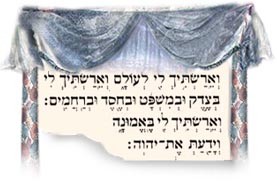
The most widely used text of a Ketubah le-Shavuot is that of the prolific Safed mystic and poet Israel Majara (c.1550-c.1625). Many of his piyutim are founded in the liturgy of oriental Jews. This hymn is included in the Sephardic prayer book for Shavuot:
The sixth day of the week (Friday), the sixth of Sivan, the day appointed by the Lord for the revelation of the Torah to His beloved people. ... The Invisible One came forth from Sinai, shone from Seir and appeared from Mount Paran unto all the kings of the earth, in the year 2448 since the creation of the world, the era by which we are accustomed to reckon in this land whose foundations were upheld by God, as it is written: “For he founded it upon the seas and established it upon the waters.” (Tehillim (Psalms) 24:2).
The bridegroom (God), Ruler of Rulers, Prince of princes, Distinguished among the select, Whose mouth is pleasing and all of Whom is delightful, said unto the pious, lovely and virtuous maiden (the House of Israel) who won His favor above all women, who is as beautiful as the moon, radiant as the sun, awesome as bannered hosts: Many days wilt thou be Mine and I will be thy Redeemer. Behold, I have sent thee golden precepts through the lawgiver Jekuthiel (Moses). Be thou My mate according to the law of Moses and Israel, and I will honor, support, and maintain thee and be thy shelter and refuge in everlasting mercy. And I will set aside for thee, in lieu of thy virginal faithfulness, the life-giving Torah by which thou and thy children will live in health and tranquility. This bride (Israel) consented and became His spouse. Thus an eternal covenant, binding them forever, was established between them. The Bridegroom then agreed to add to the above all future expositions of Scripture, including Sifra, Sifre, Aggadah, and Tosefta. He established the primacy of the 248 positive commandments which are incumbent upon all...and added to them the 365 negative commandments. The dowry that this bride brought from the house of her father consists of an understanding heart that understands, ears that hearken, and eyes that see. Thus the sum total of the contract and the dowry, with the addition of the positive and negative commandments, amounts to the following: Now all has been heard; here is the conclusion of the matter: “Revere God and keep his commandments, for this is the whole [duty] of man.” (Kohelet (Ecclesiastes) 12:13). The Bridegroom, desiring to confer privileges upon His people Israel and to transmit these valuable assets to them, took upon Himself the responsibility of this marriage contract, to be paid from the best portions of His property...
All these conditions are valid and established forever and ever. The Bridegroom has given His oath to carry them out in favor of His people and to enable those that love Him to inherit substance. Thus the Lord has given His oath. The Bridegroom has followed the legal formality of symbolic delivery of this document, which is bigger than the earth and broader than the seas. Everything, then, is firm, clear, and established...
I invoke heaven and earth as reliable witnesses.
May the Bridegroom rejoice with the bride whom He has taken as His lot and may the bride rejoice with the Husband of her youth while uttering words of praise.
By Israel Najara; Translated by Solomon Feffer
The Mishna comments that the wedding day of King Solomon (Shir HaShirim (Song of Songs) 3:11) refers to the day of the giving of the Torah:
Ta’anith 26b LIKEWISE IT SAYS, GO FORTH, O YE DAUGHTERS OF ZION, AND GAZE UPON KING SOLOMON, EVEN UPON THE CROWN WHEREWITH HIS MOTHER HATH CROWNED HIM IN THE DAY OF HIS ESPOUSALS, AND IN THE DAY OF THE GLADNESS OF HIS HEART. ‘ON THE DAY OF HIS ESPOUSALS:’ THIS REFERS TO THE DAY OF THE GIVING OF THE LAW. ‘AND IN THE DAY OF THE GLADNESS OF HIS HEART:’ THIS REFERS TO THE BUILDING OF THE TEMPLE; MAY IT BE REBUILT SPEEDILY IN OUR DAYS.
* * *
I have written more on this subject in a paper titled: Wedding.
* * *
This study was written by
Rabbi Dr. Hillel ben David (Greg Killian).
Comments may be submitted to:
Rabbi Dr. Greg Killian
12210 Luckey Summit
San Antonio, TX 78252
Internet address: gkilli@aol.com
Web page: http://www.betemunah.org/
(360) 918-2905
Return to The WATCHMAN home page
Send comments to Greg Killian at his email address: gkilli@aol.com