
Revelation and the Seven Congregations
By Rabbi Dr. Hillel ben David
Paqid Adon Micah ben Hillel, &
Paqid Adon Poriel ben Avraham

FOREWORD
By: Hakham Dr. Yosef ben Haggai
Many tomes have been published offering a commentary on the Book of the Apocalypse of Yochanan (John) Chapters 1:1 – 3:22 dealing with seven symbolic Nazarean Jewish congregations in Asia Minor. Some of these tomes are big, others small, some are of substance, others are just inconsequential and money making enterprises. None to this day, however to my knowledge have dealt with this rich mystical passage with Jewish eyes. In fact, one of the problems that characterize all the commentators so far is that they are limited by their theological straightjackets of their pagan liturgical calendar and festivals, as well as an extreme ignorance of the Jewish Festivals and how the Jewish people understand and use their Scriptures.
Whilst this essay does not claim to be a profound scholarly exegesis of the verses in question, it surely does offer any student of the Bible a bold perspective by which to understand this extremely complex portion of this great Jewish mystical book. Some of its great pearls of wisdom are only basically explored and other important secrets are just brought to the surface in the form of mere allusion.
Before one enters to examine this profound Jewish mystical book, one needs to understand that Jewish mystics speak and write using symbolical language to describe cosmic realities that affect all. One also needs to have a good grasp of the Jewish liturgical year and its sacred festivals, including the weekly Sabbath. Lastly one needs to understand the very reality which is turned into a symbol in order to better comprehend that symbol.
Professor Walter J. Veith[1] aptly describes the reason why these seven congregations were symbolized in order to use these as the medium in which a very special message from HaShem is conveyed to all Nazareans wherever they be and at whatever period in history they might live. He states:
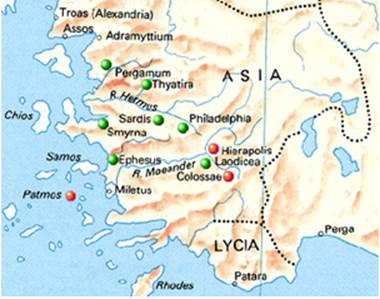
The seven congregations to which the seven letters were addressed were those of Ephesus, Smyrna, Pergamos, Thyatira, Sardis, Philadelphia and Laodicea. These cities stood along one of the ancient postal Roman roads of that day, and, beginning at Ephesus, would have been visited in the order in which they are named. The distance between them is about 50-60 kilometers; a full day's journey, on foot.
Also, when the Roman Emperor sent out governors each year to outlying provinces, these would make the circuit, stopping in certain towns to hear cases and grievances. The governor who oversaw Asia Minor would land in Ephesus, continue to Smyrna, then Pergamum, etc. through all of the seven congregations mentioned in the book of the Apocalypse.
If we take these congregations as symbolic of a Divine circuit in definite period of time with seven stopovers, then we can see that these are types of seven human spiritual conditions for which HaShem offers the Jewish observant soul seven clinics, or seven respite centers, i.e. seven festivals, along his/her pilgrimage throughout the circuit of the year, in which to receive healing and nourishment for the soul. Another such Divine circuit in time is presented to us by the Septennial readings of Scriptures concluding with a Sabbatical year. Each of these Divine circuits and its seven recharging stopovers are also intimately related to the seven ministries or gifts of the Spirit to any Nazarean Jewish congregation[2].
This understanding, of course, has more to do with bringing heaven down to earth, and making presently fallen and unjust realities conform to heavenly realities. The idea that these seven congregations represent seven points in Christian history[3] is therefore totally erroneous, presenting a flight from reality, and a rejection of the five-fold divine task given to man, “to be fruitful, to multiply, to replenish the earth, to subdue it, and to have dominion over it through the observance of HaShem’s commandments.”[4]
One of course, needs to abide by the critical counsel of Hakham Shaul (Apostle Paul) given in his Epistle to the Romans:
“What then is the advantage of being a Jew? Or what is the benefit of circumcision? Much in every way! For indeed first and foremost, that they [the Jewish people] were entrusted with the oracles of HaShem.” - Romans 3:1-2
Any other approach that is not based on the “oracles” (i.e. Jewish oral traditions) of interpreting sacred writings is absolutely doomed to failure, and will be found lacking the authenticity, intellectual and spiritual satisfaction of those who believe in HaShem’s Word and observe the commandments of HaShem.
The book of Revelation is an interesting one. It’s the last book in the Nazarean Codicil, making it the last book in many bibles. The last word in the book is ‘Amen’, which has a sort of inspirational feeling to it, which is further accentuated by its aforementioned position within the Good Book.
However, to most people the book is quite incomprehensible. That’s largely because it is suppose to be. Revelation was written at the Sod level of Jewish hermeneutics, which is the deepest and most complex of the four levels. It is, what you might call, the strongest form of encryption you’ll find in Jewish literature. This is either really troublesome or really exciting depending on how you look at it.
So then, depending on your point of view, this study will be troublesome or exciting as well, because the goal of this study is to begin to uncover the rich garden of secrets this book contains; makes me sprout a green thumb just thinking about it.
However, we will limit our scope to understanding what relationship Revelation has to the biblical festivals and the Shmita (Triennial / Septennial) Torah-reading cycle. With this we will fence in our garden.
We have previously learned that whenever you see a number of items, like seven festival Sabbaths, you can be assured that it will teach you about another group of seven items, like the seven congregations. In this paper we will be looking to use this technique to understand the book of Revelation. We started by building tables which show the relationships between the congregations and the festival Sabbaths.
As we studied the connections between the seven congregations and the seven festivals, we found that there seems to be a correlation only with the Nisan cycle of the triennial or Shmita Torah reading cycle. This cycle starts in Nisan and ends, three and a half years later, in Tishri. Therefore, our tables reflect the festival Sabbaths as starting in Nisan. Additionally, the festivals are normally viewed as starting with Pesach, in Nisan. Let’s look at the connections between the festivals and the seven congregations.
So first we are introduced to the deep symbolism of the Menorah. It says:
Revelation 1:4-20 Yochanan (John) to the seven congregations that are in Asia: Grace to you, and peace, from Him who is, and who was, and who is coming, and from the Seven Spirits that are before His throne
...
What you do see, write in a scroll, and send to the seven congregations that are in Asia; to Ephesus, and to Smyrna, and to Pergamos, and to Thyatira, and to Sardis, and to Philadelphia, and to Laodicea.
...
I saw seven golden lamp-stands, and in the midst of the seven lamp-stands, one like to a son of man
...
having in his right hand seven stars
...
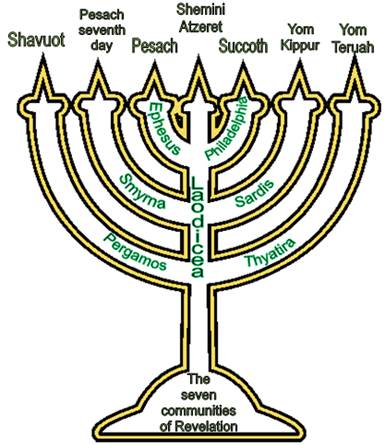
the secret of the seven stars that you have seen upon my right hand, and the seven golden lamp-stands: the seven stars are prophets of the seven congregations, and the seven lamp-stands that you have seen are seven congregations.
Rule 1 of Sod: Ignore numbers at your own peril. Rule 2 of Sod: When something is repeated, that means it’s important.
We have three apparent sets of seven. We have seven congregations, stars, and lamp-stands. They are clearly being planted near each other in this garden for a reason. As it says in the Torah:
Devarim (Deuteronomy) 22:9 You shall not sow your vineyard with two [different] kinds of seed.
So, in our garden, seeds planted together are not different, but are in fact the same. But what are we to learn from this juxtaposition of symbols? Let us dig deeper.
In the next two chapters, Revelation deals mainly with the sins of each of the above seven congregations. Those congregations and their sins are as follows:
- Ephesus,
Rev 2:4 ‘But I have [this]
against you, that you left your first love!’
- Smyrna,
Rev 2:10 ‘Stop being afraid of what you are about to be suffering’
- Pergamos,
Rev 2:14 ‘that you have there [some] holding to the teaching
of Balaam’ (Parasha Balaq)
- Thyatira,
Rev 2:20 'you allow that woman Jezebel, who calls herself a prophetess to teach and to seduce my servants to commit
fornication, and to eat things
sacrificed unto idols'
- Sardis, Rev 3:2 ‘I have not
found your works having been completed before My HaShem.’
- Philadelphia, No obvious sin
- Laodicea,
Rev 3:16 ‘So then, because you are lukewarm, and not hot nor cold...’
So now we must analyze these and unearth their hidden meanings. Of course, as we said earlier, we’ve limited our scope and thereby biased ourselves towards understanding Revelation’s relationship to the biblical festivals and the years in the Shmita Torah-reading cycle.
 It just so happens
that there are seven festival
Sabbaths and seven years in a Shmita
Torah-reading cycle. I wonder if there is any
relationship between these. To answer this question, we must first
list the festivals. They are:
It just so happens
that there are seven festival
Sabbaths and seven years in a Shmita
Torah-reading cycle. I wonder if there is any
relationship between these. To answer this question, we must first
list the festivals. They are:
- Pesach, first day
- Pesach, last day
- Shavuot
- Yom Teruah (Rosh Hashanah)
- Yom HaKippurim
- Succoth, first day
- Succoth, last day
If you are familiar with the festivals, you may have thought that the list would be like so:
However, it will become apparent later on why that list does not fit with the seven congregations and their sins. However, the mindful reader will note the symmetry of the first list.
Our hypothesis is that the festivals act like a medicine of sorts. Each festival enacts a tikkun, a reparation, of the sins each of these communities sinned. Of course, even today we commit these sins, and so we require regular treatment via the festivals to atone for those sins.
To be a medicine, the festivals must specifically target the source of the sins, reversing their effects. So then, the next thing we must do is test our hypothesis and observe whether there is some truth to it. In the process, we'll be able to test whether we are mingling unlike seeds together with this hypothesis.
The book of Revelation opens with the words: The Revelation of Yeshua HaMashiach. This meshes perfectly with Shemot (Exodus) 20:1 as it introduces the revelation of the Torah: And HaShem spoke all these words, saying… We can also see that this accords with Yochanan (John) 1:1 where the mystical term used to describe Yeshua is The Word. The Word is also a connection to the Torah.
Each of the seven communities is introduced with a salutation to the Angel of the Congregation. This is no accident. The Angel of the Congregation was the public minister of the synagogue. He was responsible for public prayer, or appointing those who read from the Torah, and he sometimes preached if there were no others to discharge this office. This man did not read the Torah publicly, but, every Shabbat (Sabbath) he called out seven of the synagogue (on other days fewer) whom he judged fit to read. He stood by those that read and carefully made sure that they read correctly. He would correct them if they made an error. It is for this reason that he was also called an ‘overseer’. Thus, if HaShem has a message for a congregation He would entrust it to this man in order to ensure that it was read in the synagogue.
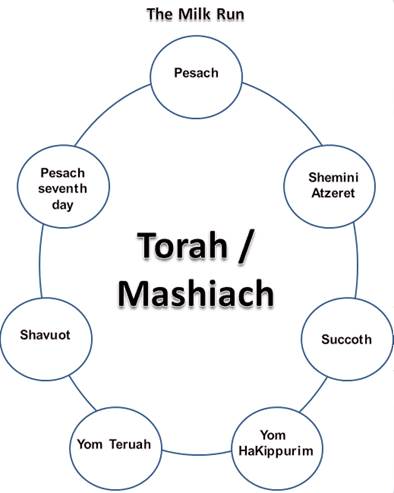
Each of the seven communities were in a trade route which we shall call a milk run. In the same way, we encounter each of the seven festivals as we trace a path through the year. The following chart illustrates this concept:
Revelation 2:1-7 1 `To the prophet of the Ephesian congregation write: These things says he who is holding the seven stars in his right hand, who is walking in the midst of the seven lamp-stands--the golden: 2 I have known your works, and thy labor, and your endurance, and that you art not able to bear evil ones, and that you have tried those saying themselves to be shliachim (apostles) and are not, and have found them liars, 3 and you did bear, and have endurance, and because of my name have toiled, and have not been weary. 4 `But I have against you: That your first love you did leave! 5 remember, then, whence you have fallen, and reform, and the first works do; and if not, I come to you quickly, and will remove you lamp-stand from its place--if you may not reform; 6 but this you have, that you do hate the works of the Nicolaitans, that I also hate. 7 He who is having an ear--let him hear what the Spirit says to the congregations: To him who is overcoming--I will give to him to eat of the tree of life that is in the midst of the pardes (paradise) of HaShem.
The sin here is specifically that we have “left our first love”. But what does it mean, symbolically, to leave one's first love?
I suppose it would be even better to first ask, why would one leave his or her first love? Bordom? Finding fault with him or her? Perhaps one found something else one loves even more? Any one of these seems like a reasonably good guess.
Perhaps then, the symbolism is that our love changes based on our perception of HaShem. That is, we no longer see Him as our first love and lose the connection that comes with that perception of Him.
If so, which festival would this allude to then? It certainly isn’t Yom HaKippurim, the tone of voice isn’t right for that festival; Yom HaKippurim is a time of judgment and we don't have any indication that this passage relates to judgment. The same is true, in part, for Yom Teruah.
Pesach appears to be a good fit. On Pesach we prepare ahead of time by searching our house for leaven[5] and purging it; it is a time of introspection whereby we reveal our most hidden inclinations and faults. Later, we recall the miracles that HaShem did when He took us out of Egypt, redeeming His people from the harsh, laborious slavery which they endured for over 200 years. We recapture the passion that we had at that time for our Savior and we rekindle our love for Him.
Support for this argument can be found in the Tanakh[6] where it states:
Yiremeyahu (Jeremiah) 2:2 Go and cry in the ears of Jerusalem, saying, Thus says HaShem; I remember you, the kindness of your youth, the love of your espousals, when you went after me in the wilderness, in a land that was not sown.
The community at Ephesus is introduced as being spoken by the One who holds the seven stars in his hand and walks in the midst of the seven golden candlesticks. The seven stars were defined in verse 1:20 as being the angels of the seven communities. The candlesticks are the seven communities. Thus we can see that this admonition to the community at Ephesus is directed to the Angel of the Community in order to insure that it be read to the members of the community. This suggests that the praise and condemnation is to be absorbed by the community, not by an individual.
So the first day of Pesach seems to naturally sprout from this passage from Revelation where we followed HaShem into the wilderness during Pesach. This was the time of our first love. Thus the congregations at Ephesus present the tikkun, for the sin of leaving our first love, by reminding us to return to our first love by following after HaShem, His Torah, and the teachers of the Torah.
So, how do we return to our first love? How do we return to HaShem? The answer is the best kept secret of the Jews. Yeshua gave us the answer in a very succinct manner. He said, “If you love me, keep my commands” [7]. Thus we learn that we need to observe Pesach according to the halacha. We need to clean the leaven out of our houses, celebrate the seder, and eat matza.[8]
Leaven is a symbol of the yetzer hara[9], the evil inclination. We took on the yetzer hara when Adam and Chava ate from the tree of the knowledge of good and evil. It was the result of eating of the tree of doubt. The yetzer hara is what caused us to move away from HaShem and pretend that we could hide from Him. By eliminating the yetzer hara, we return to our state before Adam’s sin. We can return to our first love, we return to HaShem.
So, how does the seder contribute to the tikkun? The main focus of the seder are the miracles. What was the purpose of the miracles? Chazal, our Sages, teach the miracles were designed to teach the Egyptians that HaShem is HaShem. Now surely if it convinced the skeptics; what do you suppose would be the effect on those who already believed? The best way to relate to this, is to imagine the state of a man who falls over a cliff and is miraculously saved by being levitated back to the top of the cliff. Even a confirmed skeptic would become religious after an experience like that. Now, imagine that you experienced the mighty miracles that HaShem sent as plagues on the Egyptians. I suspect that this would cause us to return to our first love.
Finally, Pesach would not be Pesach without matza. Matza is the food we ate on that first Pesach because the bread did not have time to rise, as we learn from the haggada[10]. Matza symbolizes redemption according to Maharal[11]. The time of our redemption was the time of our following HaShem into the wilderness. It was the time when we followed our first love. When we eat matza we renew the redemptive relationship we had with HaShem when we followed Him into the wilderness.
Next is Smyrna. Some sources on the internet and otherwise believe that Smyrna has no sin, and that might work nicely if we were to correlate the symmetry of the festivals with the list of congregations, but unfortunately Smyrna does have a sin.
Revelation 2:8-11 8 `And to the prophet of the congregation of the Smyrneans write: These things says the First and the Last, who did become dead and did live; 9 I have known your works, and tribulation, and poverty--yet you art rich--and the evil-speaking of those saying themselves to be Jews, and are not, but are a synagogue of the Adversary. 10 `Be not afraid of the things that you art about to suffer; lo, the devil is about to cast of you to prison, that you may be tried, and you shall have tribulation ten days; become you faithful unto death, and I will give to you the crown of the life. 11 He who is having an ear--let him hear what the Spirit says to the congregations: He who is overcoming may not be injured of the second death.
Initially, the sin is not obvious, but with close examination we can see there is indeed a sin. The sin of the community at Smyrna is fear of future suffering and tribulations.
“Wait”, you may say, “how can fear be a sin?! That’s ridiculous.” It may sound that way, but the fear here is a paralyzing fear that keeps one from doing what is correct. If one believes in the sovereignty of HaShem and believes that He is the source of everything, especially suffering, then one would never have such a fear. So then the fear here reveals that Smyrna did not fully understand HaShem’s sovereignty, and they are being chastised regarding that.
You may say to me, “But it doesn’t say that HaShem will bring suffering, but rather the Devil will!” I would then respond, “And who made the Devil?” Everything is from HaShem, and anybody that believes otherwise is committing the sin spoken of here.
If we are to correlate this congregation and sin to a festival that acts as a tikkun, a reparation, of that sin, then the seventh day of Pesach would fit well. We know from a previous study that the passage of the Israelites through the Yam Suf (Sea of Reeds), on the seventh day of Pesach, was a time of tribulation analogous to being born. This was the birth of the nation of Israel. On the seventh day of Pesach, the Israelites were at the Yam Suf, and their belief in HaShem’s sovereignty was tested there, and we remember that testing on that day. This presents a tikkun for those going through the stress of birth by causing us to focus on the miracles and goodness of HaShem and not on the tribulations.
The Egyptians were pursuing us from behind while the Yam Suf blocked our forward movement. We were being squeezed one last time. Suddenly the birth canal opened with the splitting of the Yam Suf. As we hurried down that canal, the Egyptians pursued us with the intent to bring us back to slavery after having their way with us first. This was a death experience. Remember the fear that the Israelites felt as they were waiting to cross the Yam Suf?
Shemoth (exodus) (Exodus) 14:10 And when Pharaoh drew near, the children of Yisrael lifted up their eyes, and, behold, the Egyptians marched after them; and they were sore afraid: and the children of Israel cried out unto HaShem.
This shows us that the fear in Smyrna and the fear of the Israelites at the Yam Suf were the same. They were both afraid of tribulations.
Consider also that when we crossed the Yam Suf we were being baptized into Moshe:
1 Corinthians 10:1-2 Moreover, brethren, I would not that ye should be ignorant, how that all our fathers were under the cloud, and all passed through the sea; 2 And were all baptized unto Moses in the cloud and in the sea;
Baptism is a death experience. It symbolizes our death and resurrection. As we remember the tribulations of the seventh day of Pesach, we realize that HaShem is taking care of us and that our current tribulation will also turn out HaShem’s way. His mighty hand saved us then, and His mighty hand will save us now. As we celebrate this festival Shabbat, we see that the tikkun for our fears is the subject of our Torah studies and the our prayers.
Shemoth (exodus) (Exodus) 14:10-14 10 And when Pharaoh drew near, the children of Yisrael lifted up their eyes, and, behold, the Egyptians were marching after them; and they were sore afraid; and the children of Yisrael cried out unto HaShem. 11 And they said unto Moses: 'Because there were no graves in Egypt, have you taken us away to die in the wilderness? wherefore have you dealt thus with us, to bring us forth out of Egypt? 12 Is not this the word that we spoke unto you in Egypt, saying: Let us alone, that we may serve the Egyptians? For it was better for us to serve the Egyptians, than that we should die in the wilderness.' 13 And Moses said unto the people: 'Fear you not, stand still, and see the salvation of HaShem, which He will work for you to day; for whereas you have seen the Egyptians to-day, you shall see them again no more for ever. 14 HaShem will fight for you, and you shall hold your peace.'
By recalling the testing at the Yam Suf and by acknowledging HaShem’s sovereignty such that we no longer fear the tribulation, we repair the sin that they sinned at the Yam Suf (Sea of Reeds). Part of the tikkun involves an acknowledgment that HaShem has a plan for our Shabbat rest, but it comes after the labors and tribulations of the six days:
Bereans (Hebrews) 4:1-13 Let us therefore fear, lest, a promise being left us of entering into his rest, any of you should seem to come short of it. 2 For unto us was the Masorah (gospel) preached, as well as unto them: but the word preached did not profit them, not being mixed with faithful obedience in them that heard it. 3 For we which have faithfully obeyed do enter into rest, as he said, As I have sworn in my wrath, if they shall enter into my rest: although the works were finished from the foundation of the world. 4 For he spoke in a certain place of the seventh day on this wise, And HaShem did rest the seventh day from all his works. 5 And in this place again, If they shall enter into my rest. 6 Seeing therefore it remains that some must enter therein, and they to whom it was first preached entered not in because they had not faithfully obeyed: 7 Again, he limits a certain day, saying in David, To day, after so long a time; as it is said, To day if you will hear his voice, harden not your hearts. 8 For if Yehoshua had given them rest, then would he not afterward have spoken of another day. 9 There remains therefore a rest to the people of HaShem. 10 For he that is entered into his rest, he also hath ceased from his own works, as HaShem did from his. 11 Let us labor therefore to enter into that rest, lest any man fall after the same example of unbelief. 12 For the word of HaShem is quick, and powerful, and sharper than any two-edged sword, piercing even to the dividing asunder of soul and spirit, and of the joints and marrow, and is a discerner of the thoughts and intents of the heart. 13 Neither is there any creature that is not manifest in his sight: but all things are naked and opened unto the eyes of him with whom we have to do.
Thus, we see that the tribulation at Smyrna was for the sake of entering His rest. The seventh day of Pesach bids us to enter into Shabbat, the seventh day.
The next two congregations are interesting ones to look at. Let us begin by looking at the congregation of Pergamos:
Revelation 2:12-15 12 And to the prophet of the congregation in Pergamos write; These things says he which hath the sharp sword with two edges; 13 I know your works, and where you dwell, [even] where Satan's seat [is]: and you hold fast my name, and hast not denied my faith, even in those days wherein Antipas [was] my faithful martyr, who was slain among you, where Satan dwell. 14 But I have a few things against thee, because you hast there them that hold the doctrine of Balaam, who taught Balaq to cast a stumbling block before the children of Yisrael, to eat things sacrificed unto idols, and to commit fornication. 15 So you also have them that hold the doctrine of the Nicolaitans, which thing I hate.
Shavuot was the time of the receiving of the Torah. This was the time when we were able to understand the quality of our relationship with HaShem. This provides the perfect tikkun to the sin of the congregations at Pergamos which had descended into idolatry and fornication. When we reflect of the relationship and intimacy with HaShem, as we had at Sinai, we see the correction to following after a relationship and intimacy with false gods.
Yiremeyahu (Jeremiah) 3:8 And I saw, when for all the causes whereby backsliding Israel committed adultery I had put her away, and given her a bill of divorce; yet her treacherous sister Judah feared not, but went and played the harlot also.
The primary mitzvot for Shavuot is the tikkun leil Shavuot (studying all night) and hearing the Ten Commandments. By immersing ourselves in the Torah the night before Shavuot, we replace our idolatry with attachment to HaShem as we remember this day of our betrothal. We remember the awe we had as we heard the giving of the Ten Commandments, our betrothal gift. This is the tikkun for idolatry.
When we reflect of the relationship and intimacy with HaShem, as we had at Sinai, we see the correction to following after a relationship and intimacy with false gods.
The community at Pergamos is the third to be named in the list of the seven congregations mentioned. Next in the list after the seventh day festival sabbath of Pesach comes Shavuot (Pentecost – the Feast of Weeks). It was on Shavuot, the sixth of the month of Sivan, that Moshe Rabbenu (Moses) received the Torah from Sinai, who then transmitted it to Yehoshua ben Nun (Joshua);[12] this was the same torah that the children of Israel received. On Shavuot, one of the events that happened forty days after this date was the sin of the golden calf; in other words, idolatry. Also, the first few commandments of the Ten Commandments deals with serving HaShem and not created things, so this would seem a perfect fit with Pergamos.
The Nicolaitans[13] were known to follow after the example of Balaam. As their name connotes, they exacted authority over the people and cast stumbling blocks before them. The Nicolaitans prodded and incited the people of Yisrael to idolatry like the Erev Rav, the mixed multitude (which Onkelos designates as strangers, in his Targum), which came out of Egypt with the Israelites.
Thus, the Tikkun for the problem at Pergamos is to attach and cleave ourselves back to HaShem, the leaders of the communities and study Torah. This is the tikkun for adultery / idolatry we experience during Shavuot [as Pergamos].
Let us move on to the next community, Thyatira.
Revelation 2:18-20 18 And unto the prophet of the community in Thyatira write; These things says the Son of HaShem, who has his eyes like unto a flame of fire, and his feet [are] like fine brass; 19 I know your works, and tzedakah (charity/generosity), and Avodah (service/worship), and emunah (faithful obedience), and your patience, and your works; and the last [to be] more than the first. 20 Notwithstanding I have a few things against your, because you suffer that woman Jezebe[14]l, which call herself a prophetess, to teach and to seduce my servants to commit fornication, and to eat things sacrificed unto idols.
Here we find something similar to the trouble we find in Pergamos. Why is it that both of these communities have a few sins that are keeping them from complete approval? And why are both their sins, idolatry (fornication) and breaking the laws of kashrut (eating things sacrificed to idols), similar to the other? We know that there are seven congregations, and with a careful look into the book of Revelation, even a child will be able to understand that the events mentioned in the book will be executed within a cycle of seven years.
Thus far, the only differences that we find with these two communities is that the first, Pergamos, has a giving role since they hold to the teaching of Balaam (Balaq) who is male; whilst Thyatira holds a receiving role, a female quality, since they suffer the teaching of Jezebel. The other is that some in Pergamos hold to the teaching of the Nicolaitans.
In Judaism, once we hear about a “seven-year-cycle” we immediately recall to mind the Shmita cycle. This cycle, as most know it, deals with farming cycles (and farming cycles are based on the seasons), however, in the days of the Master of Nazareth, the Torah was read twice (two, three-and-a-half year reading cycles) in a Sabbatical cycle of seven years.
The sins of Thyatira:
1) Allow that woman Jezebel (whore of Baal) to teach.
2) A woman establishes herself as the leader of the community.
3) Seduces the slaves causing them to go astray.
4a) Sexual immorality
4b) Intermarriage
4c) Idolatry/Apostasy
5b) Celebrate pagan festivals instead of HaShem's festivals
5c) Abandon laws of Kashrut
Let us take a look at Jezebel[15]:
Strongs concordance, number 348, [16] describes her name as meaning Chaste which comes from Iy, meaning idea of a query, and Zebul, meaning a dwelling place or residence. Jewish tradition, however, renders the meaning of this name, not exalted, based on the vowels used.
“But it is highly unlikely her parents would have given her such a name. Read with different vowels it can be understood as meaning "Where is the Prince?" ('ay zebul in Hebrew). In fact, early Syrian inscriptions from Ugarit demonstrate that "the Prince" (equivalent of Hebrew "Zebul") was a popular title for the storm god of the Phoenicians. The sentence "Where is the Prince?" is even found in Ugaritic literature. It is a form of invocation, calling on the god named to appear and act. In other words, this Tyrian princess was given a name in praise of the chief god of her people (whom the Hebrew Bible refers to mainly by the title "Baal", meaning "lord, master"). "Jezebel" is, then, a reinterpretation, intended to mock this Queen and her god, whom she encouraged Israel to worship.”[17]
The first sin of Thyatira is that they allowed this Jezebel, a non-Jewish woman, to marry one of their leaders (probably the shliach tzibbur himself). They also condoned her teaching the community. We find this explained in 1 Melachim (Kings) 16:31, where Yirmeyahu (Jeremiah) tells us that Jezebel was a Phoenician princess, daughter of Ithobaal I, the King of Tyre, and married King Ahab when he took the throne of the Northern Tribes.
2 Melachim (kings) tells us that when Jezebel was murdered, her body was left for dogs to consume in a vineyard; only her head, hands and legs were spared by the dogs.
This led to the second error the community of Thyatira committed in which they allowed Jezebel to become the Angel of the Congregation. In Jewish law, there is no role of Queen, in this case, she was the Angel of the Congregation. Though, there are certain laws which pertain to the king's wife, they in no way invest her with power to rule, or lead as a king. In 2 Melachim, chapters 9 and 10, we read that Jezebel was referred to as Gebirah, a term which connotes power, or Iron Lady; different from the term Giberet, a term which connotes a woman in a respectful manner. Gebirah is then the feminine equivalent of Gibor, a powerful man.
It was Jezebel who taught the people of Yisrael to commit adultery / idolatry and to abandon the laws of Kashrut; and Thyatira allowed the honor of Torah to be subsided.
This leads to the third error of Thyatira, allowing Jezebel to seduce the people astray. The Tosefta, in Sanhedrin 4:5, uses Jezebel as an example when commenting on the warning the Torah gives a king in not being wed to too many wives. The Torah, as the Tosefta says, is warning a king about wives, like Jezebel, who will seduce him into evil acts.
But how does Jezebel relate to the Shmita cycle? Jezebel appeared after the split between the northern Kingdom of Israel and the southern kingdom of Yehudah. It was during this time, after Ahab took the throne, that Eliyahu (Elijah) the prophet came to inform Ahab of a drought which would last 3½ years. Here, in Thyatira, Jezebel appears at the very split between the end of the first 3½ years and the beginning of the second 3½ years of the Shmita cycle.
In relation to the Nazareans, Jezebel was the force by which the Nazarean movement was being divided into two camps: those who were faithfully obedient which were outnumbered, and the majority which were the idolatrous. It is at this point in time the idolatrous ones were beginning to show their true color. Hakham Shaul spoke of them:
2 Thessalonians 2:3-11 Let no man deceive you by any means: for [that day shall not come], except there come a falling away first, and that man of transgression of Torah (sin) be revealed, the son of perdition; 4. Who opposes and exalts himself above all that is called HaShem, or that is worshipped; so that he as HaShem sits in the temple of HaShem, showing himself that he is HaShem. … 7. For the mystery of iniquity does already work: only he who now lets [will let], until he be taken out of the way.
The author of the book of Revelation writes, in his masorah:
1 Yochanan 4:3 this is that [spirit] of antichrist, whereof you have heard that it should come; and even now already is it in the world.
The faithfully obedient of the Nazareans were being divided and hunted in the days of the Roman Emperor Constantine. What is even more, we see that this Jezebel, by being an imposter, was the one which caused a split between the Nazareans and normative Judaism.
The sins that the congregation of Thyatira committed are to undermine the Biblical leadership of the community, establish foreign ideals and non-Jewish rule.
Does not Thyatira share similar sins to that of Pergamos? Could it possibly be related to the next festival, Yom Teruah? Here, some tradition must be shared. The Rabbi's have stated that if it were not for the sin of the golden calf, and if the children of Israel were truly receptive of the Torah, at Mount Sinai, on Shavuot, then the fall festivals would not have existed in the same way they are now. In fact, the spring festivals would have been emphasized more than the fall festivals; however, it works the other way around today because of these errors. Thyatira rightly belongs to Yom Teruah. On Yom Teruah we make HaShem the King! What is our tikkun? We are put on the balance scales. Do we make HaShem our King or some other thing our ruler?
The Rosh HaShana machzor (prayer book) divides the Musaf (special service for the festival) service into three parts: Malchiyot, Zicranot, and Shofarot. On Yom Teruah we celebrate the crowning of HaShem (Malchiyot) and His Mashiach as our king. We recall how HaShem remembered (Zicranot) the mothers of the Tanach, to bring them children. There can be no attachment to foreign gods while we stand in the presence of The King. As at Shavuot, some have a custom of remaining awake during the time of our judgment. During these hours we study Torah to renew our attachment to HaShem. These two items are the tikkun for the assemblies at Thyatira which was involved in idolatry. How can one be involved with a foreign god when he stands before the judge of the universe? We do these things with the power of the shofar. A shofar (Shofarot) comes from a clean animal which provides the tikkun for the lack of kashrut experienced by the congregation at Thyatira.
As it appears, the main difference between Thyatira and Pergamos is that in Pergamos, there were those that followed Nicolaus, who in turn followed the way of Balaam (Balaq), i.e. to erect a stumbling block for the people of Yisrael. In Thyatira, however, Jezebel was meant to assimilate Jews into something else and to completely usurp them. What was going on in Thyatira, which indeed tales place today, seems more insidious. The Nicolaitans seemed more interested in defeating the Jews and getting rid of them rather than assimilating them like Jezebel. Both, none-the-less, discovered that the only way to defeat the Jewish people had to be done from the inside.
We now come to the community at Sardis. Here, we find something very peculiar about this community:
Revelation 3:1-4 1 And unto the prophet of the community in Sardis write; These things says he that has the seven Spirits of HaShem, and the seven stars; I know your works, that you have a name that you live, and are dead. 2 Be watchful, and strengthen the things which remain, that are ready to die: for I have not found your works perfect before HaShem. 3 Remember therefore how you have received and heard, and hold fast, and repent. If therefore you shall not watch, I will come on thee as a thief, and you shall not know what hour I will come upon thee. 4 Thou hast a few names even in Sardis which have not defiled their garments; and they shall walk with me in white: for they are worthy.
So what is the sin here? Initially it doesn’t appear there is one, but close examination reveals a sin so prevalent that it is the main topic of one of the Torah festivals, that sin being egotism.
The community of Sardis appears to have believed that they had no room for improvement in their observance of the Torah. The text implies that they believed their works were perfect, but to the contrary, “I have not found your works perfect before HaShem”!
Of course, many people fall into the trap of believing that they are good enough, or even perfect, and then they turn on the proverbial cruise-control of Torah observance and go on with their lives. This should not be so, since this can later result in one leaving your first love, having found something or someone else out their that captures your passion, when we should indeed continue to find new ways of demonstrating our love for HaShem.
So which festival provides the cure for this cruise-control? Out of all the festivals, Yom HaKippurim is by far the most suited to this task. Many people see Yom HaKippurim as a day of turning from our sins, which is true, but the most important thing we repent of, on that day, is not the sins that we committed, but the mitzvot that we neglected!
On Yom HaKippurim, a very prominent part of the service is the retelling of the Akeida, when Abraham took Isaac, at HaShem’s command, to Mount Moriah to kill him. It’s a bitter-sweet story since although Isaac eventually leaves the mountain unharmed, we also know that his mother Sarah dies when she finds out that he had in fact been killed there. On that day, when Abraham held the knife to Isaac’s neck, and angels above beseeched HaShem to have mercy on His moon! [18]
It’s a powerful story, but one wonders about its relevance to Yom HaKippurim. Perhaps we remember that day and are to say to ourselves, “Thanks to Abraham, we can go to the Olam HaBa[19]”? Heaven forbid! When we say that, it implies that we only need to repent our evil deeds and then Abraham can do the heavy lifting and bring us into the Olam HaBa, when in fact the whole point of recalling the Akeida is to spur us to do enough mitzvot to be as worthy as Abraham was on that day. We are to say to ourselves, “Like Abraham, I will use all that is within me to show my love for HaShem, never ceasing in finding new ways to do so!”
An obvious connection for the community of Sardis to Yom HaKippurim are the white garments. On Yom HaKippurim we wear white kittles to reflect our repentant state on this festival. A groom wears this same garment at his wedding. The wedding is where the two halves of the soul are reunited, giving rise to a new creation. This should be the ultimate for both physical and spiritual life. This is the elevation, the tikkun, that the community of Sardis required.
There is more to this community of Sardis, though. The works of the community at Sardis show physical life and spiritual death. We fast on Yom HaKippurim to free ourselves from the physical and to accentuate our spiritual side. It is well known that our lower self speaks to us in the first person (I would love to eat that cake), while our higher self speaks to us in the second person, as a visitor looking in (You know you don’t need those calories). Yom HaKippurim gives us a chance to put our lower self out on the street while putting our higher self in his house. We do this by totally denying the lower self and reuniting with our higher self via the mitzvot of Yom HaKippurim.
Yom HaKippurim is the time of our atonement. It is a time for the mitzvot that effect the tikkun, the mitzvot where we deny the body any physical pleasure. We avoid all food and water for the entire day, as though we were angels. We avoid bathing and anointing as though our bodies are already in their proper state. We avoid the pleasures of sex, the uniting with our spouse, in favor of uniting with The Holy One, blessed is He! We do not wear leather shoes as they symbolize our bodies, as they carry and support us through this world. We step out of our bodies, so to speak. As we give up the physical pleasures which serve our lower self, we begin to focus on our spiritual self and how to elevate ourselves beyond our physical body, by focusing on our higher self. These things provide the tikkun for the community at Sardis which had physical life and spiritual death. On Yom HaKippurim we have preeminent spiritual life while denying the physical.
Yom HaKippurim thus presents a tikkun for the sin of the community at Sardis whose works show physical life and spiritual death, by having works which show spiritual life at the expense of physical life.
There is also another way of viewing the tikkun for the community at Sardis. True life, spiritual life, is found in the Torah. Those who attach themselves to Torah have attached themselves to true life. Those who teach Torah to the lawless ones, the Gentiles, have shared true life with those that HaShem wishes to draw near. We are perfect when we take the Torah to the Gentiles. As we gather for Yom HaKippurim, we have the ability to beckon the Gentiles to come with us to the synagogue, which is called a little Temple in Yehezekel (Ezekiel) 11:16. The synagogue is especially suited for the Gentiles:
Yeshayahu (Isaiah) 56:7 Even them will I bring to my holy mountain, and make them joyful in my house of prayer: their burnt offerings and their sacrifices shall be accepted upon mine altar; for mine house shall be called an house of prayer for all people.
Thus when we bring Gentiles to the Temple, we have brought them to the Torah and to Mashiach. This is the perfection of Yom HaKippurim, this is bring spiritual life to the world!
Following Sardis comes Philadelphia, the sixth congregation.
NO OBVIOUS SIN
Revelation 3:7- 13 And to the prophet of the congregation in Philadelphia write; These things says he that is holy, he that is true, he that has the key of David, he that open, and no man shut; and shut, and no man open; 8 I know your works: behold, I have set before thee an open door, and no man can shut it: for you hast a little strength, and have kept my word, and have not denied my name. 9 Behold, I will make them of the synagogue of Satan, which say they are Jews, and are not, but do lie; behold, I will make them to come and worship before your feet, and to know that I have loved you. 10 Because you have kept the word of my patience, I also will keep you from the hour of temptation, which will come upon all the world, to try them that dwell upon the earth.
Succoth begins to show us that we were able to achieve the atonement of Yom HaKippurim. As we enter Succoth, we enter without sin. This connects us with the assemblies at Philadelphia which had no obvious sin.
Part of the process of Yom HaKippurim is to reconcile the sins between brothers. We spend the entire month of Elul going to our neighbors and seeking forgiveness for the transgressions that we have committed. This reconciliation of brothers is reflected in the meaning of the name Philadelphia, the city of brotherly love.
The wording of the comments to this congregation also carry an allusion to the succah.
Revelation 3:8 I have set before you an open door, and no man can shut it: for you have a little strength, and have kept my word, and have not denied my authority.
We understand that HaShem returns our good works to us mida-keneged-mida, measure-for-measure. On Succoth, we have a succah with an open door for visitors to come and enjoy good food and teaching. Our hospitality is repaid by HaShem with open gates like those spoken of during the prayer service for Yom HaKippurim.
Thus we see Philadelphia as a community without an obvious sin, which is the state of those who received atonement on Yom HaKippurim with their marriage to HaShem. They arrive at the bridal chamber as a new creation, sinless.
Finally, we arrive at Shemini Atzeret. On this festival we relax with HaShem, basking in our relationship. This is an intense time when we enjoy and appreciate our relationship with HaShem. This provides the tikkun for the congregation at Laodicea, the seventh and final community, which was lukewarm and saw themselves as self-sufficient.
Revelation 3:14- 18 14 And unto the prophet if the congregation of the Laodiceans write; These things says the Amen, the faithful and true witness, the beginning of the creation of HaShem; 15 I know your works, that you are neither cold nor hot: I would you were cold or hot. 16 So then because you are lukewarm, and neither cold nor hot, I will spew you out of my mouth. 17 Because you say, I am rich, and increased with goods, and have need of nothing; and know not that you art wretched, and miserable, and poor, and blind, and naked: 18 I counsel you to buy of me gold tried in the fire, that thou may be rich; and white raiment, that you may be clothed, and [that] the shame of thy nakedness do not appear; and anoint your eyes with eyesalve, that you may see.
The sin here is that of being lukewarm, neither hot nor cold, but what does that mean exactly? What does it mean to be lukewarm? The passage specifically says that HaShem looked at the Laodiceans’ works, their deeds. Perhaps their deeds, or lack thereof, revealed their tepidness?
There is proof in the Tanakh that this problem of tepidness is not a recent problem, but is quite ancient:
Yehoshua (Joshua) 24:15 and if wrong in your eyes to serve HaShem – choose for you today whom you do serve; whether the gods whom your fathers served, which are beyond the River, or the gods of the Amorite in whose land you are dwelling; and I and my house – we serve HaShem.'
In describing Ahab[20], R. Yochanan states that Ahab had honor for the Torah and according to R. Nachman, Ahab was lukewarm. Though, Ahab committed idolatry by way of his wife Jezebel, he was generous with his money, and because he used to benefit scholars with his wealth, half [his sins] were forgiven. The Talmud first lists Ahab's idolatrous achievements; then it mentions his respect for Torah which was his good deed. R. Yochanan then states that Ahab has no portion in the World to Come because he wrote upon the gates of Samaria, “Ahab denies the HaShem of Israel.”
We also see another example of tepidness when Eliyahu ha Navi (Elijah the prophet) speaks to the people of Yisrael:
I Melachim (Kings) 18:21 How long do you hold between two opinions? if HaShem [be] HaShem, follow him: but if Baal, [then] follow him. And the people answered him not a word.
Let’s examine Shemini Atzeret and see what it is that we do then, hopefully revealing more about this sin of tepidness.
On Shemini Atzeret, we have an especially joyous time, dancing and singing whilst holding the Torah scroll. On this day we end the reading of the Torah and begin a new septennial cycle with the hakhel, where the king of Israel would read the Torah to all the people. With this festival we experience the intensity of our relationship with HaShem and His Torah.
It seems that if we correlate our celebration with the sin stated here, the deeds that reveal our tepidness are the ones related to our love of Torah. Our added pizzazz, on Shemini Atzeret, would seem to be for the purposes of lighting our fire for HaShem’s word, thereby repairing the problem of tepidness, replacing it with whole-hearted passion.
Since Shemini Atzeret is the 8th day of Succoth, it also has a relationship to circumcision. Circumcision is how one enters the covenant, and so is also a day totally dedicated to studying the Torah which is central to being part of the covenant. On this day we promise to embody the Torah just like Abraham, Isaac, Jacob, Moses, Aaron, David, Elijah, and Yeshua did. On this day we dedicate ourselves to tabernacle in the flesh, just as we see in the Nazarean Codicil:
Yochanan (John) 1:14 And the Word became flesh, and did tabernacle among us, and we beheld his glory, glory as of an only begotten of a father, full of grace and truth.
Many Christian authors have attempted to correllate the seven churches with seven epochs, or ages of the Christian church.[21] They use various dates for the epochs and various reasons for the epoch. This does not fit with the Jewish character of the Book of Revelation. This section of Revelation is not about Christian churches! This section is about Jewish communities.
To help us understand this concept, it is worth noting that the earliest church (Greek - Ecclesia), in time, if found in second Luqas:
II Luqas (Acts) 7:37-38 This is that Moses, which said unto the children of Israel, A prophet shall the Lord your God raise up unto you of your brethren, like unto me; him shall ye hear. 38 This is he, that was in the church in the wilderness with the angel which spake to him in the mount Sina, and our fathers: who received the lively oracles to give unto us
Now, obviously there were no Christians in the church in the wilderness with Moshe. This church was a congregation of Jews and a large mixed multitude of Gentiles. They were a congregation, a community, a Jewish community. They all studied Torah and they were all involved in fulfilling the mitzvot (Torah commandments). Christian churches do not do these things.
Once we understand that these seven churches were seven Jewish communities, it becomes obvious that the epochs assigned by Christian authors are irrelavant because those epochs apply to epochs dealing with Christianity, not those dealing with Jewish communities.
The arbitrary nature of the dates and the reasons for the dates should alert us to the fact that something is wrong. If the Christian authors had related them to the seven days of creation, or the seven millenium that correspond with the creation days, then we have something substantial, that is no longer arbitrary. But, they do not do this. Instead they make up seven artificial time periods dealing with the development of Christianity. Thus, we can see that it is not reasonable to correlate the seven Jewish communities with seven periods of Christian development.
The book of Revelation is dealing with revelations which are applicable to Jews, to those who study and obey the Torah. It is this group which will be able to discern the symbols and the meaning behind the symbols.
Finally, our Sages teach us that every seven in the Torah is realted to every other seven found in the Tanach and in the physical world. These realationships are not arbitrary, but are given by HaShem to teach us about HaShem and His ways. In this paper we have related the seven communities to the Sabbatical cycle and the seven festival sabbaths. We have barely scratched the surface of this facinating subject. There are many more connections to other sevens, including the days of creation and the millenial days.
As you study, do not seek arbitrary epochs and do not seek to relate this book to the Gentiles. Seek to relate these revelations to the Jews and their communities. If you do this, then Mashiach and Torah will truly be revealed.
* * *
So now we have listed all the communities, their sins, and the festivals used as treatments for the sins. Here are some tables giving a brief index of what we've already learned.
|
(tikkun) |
ASSEMBLIES |
|
|
Ephesus |
Left first love |
|
|
Pesach seventh day |
Smyrna |
Fear of Tribulations. |
|
Pergamos |
Doctrine of Balaam (Idolatry and fornication) |
|
|
Thyatira |
Idolatry and lack of kashrut |
|
|
Yom HaKippurim |
Sardis |
|
|
Philadelphia |
No obvious sin |
|
|
Laodicea |
Lukewarm (rich and having no needs) |
|
Third Day |
Second Day |
First Day |
Sixth Day |
Fifth Day |
Fourth Day |
|
|
Pesach seventh day |
Yom HaKippurim |
Yom Teruah |
||||
|
Pergamos |
Smyrna |
Ephesus |
Laodicea |
Philadelphia |
Sardis |
Thyatira |
|
Doctrine of Balaam (Idolatry and fornication) |
Tribulations |
Left first love |
Lukewarm (rich and having no needs) |
No obvious sin. |
||
|
|
Baptism in Yam Suf – Born again |
|
|
Right after Yom HaKippurim |
|
|
|
Age (Kohelet Rabbah 1:2) |
|
|
Ephesus |
At a year old he is like a king seated in a canopied litter, fondled and kissed by all. |
|
Smyrna |
At two and three he is like a pig, sticking his hands in the gutters. |
|
Pergamos |
At ten he skips like a kid. |
|
Thyatira |
At twenty he is like a neighing horse, adorning his person and longing for a wife. |
|
Sardis |
Having married, he is like an ass. |
|
Philadelphia |
When he has begotten children, he grows brazen like a dog to supply their food and wants. |
|
Laodicea |
When he has become old, he is [bent] like an ape. |
|
Meaning[22] |
Sephirot |
||
|
Ephesus |
Permitted |
Chesed |
Left first love |
|
Smyrna |
Myrrh |
Gevurah |
Fear of Tribulations. |
|
Pergamos |
Height or Elevation |
Teferet |
Doctrine of Balaam (Idolatry and fornication) |
|
Thyatira |
Odor of affliction |
Netzach |
|
|
Sardis |
Red ones |
Hod |
|
|
Philadelphia |
Brotherly love |
Yesod |
No obvious sin. |
|
Laodicea |
Justice of the people |
Malkhut |
Lukewarm (rich and having no needs) |
|
Year 3
Rishon was given to the Levites and Priests
And ani was given to the poor.
rishon & ani |
Year 2
Rishon was given to the Levites and Priests
Sheni was taken to Jerusalem and eaten.
rishon & sheni |
Year 1
Rishon was given to the Levites and Priests
Sheni was taken to Jerusalem and eaten.
rishon & sheni |
Year 7
No tithe |
Year 6
Rishon was given to the Levites and Priests
And ani was given to the poor.
rishon & ani |
Year 5
Rishon was given to the Levites and Priests
Sheni was taken to Jerusalem and eaten.
rishon & sheni |
Year 4
Rishon was given to the Levites and Priests
Sheni was taken to Jerusalem and eaten.
rishon & sheni |
|
Pesach seventh day |
Yom HaKippurim |
Yom Teruah |
||||
|
The ascent and descent |
The separation |
The birth |
The resurrection the rebirth |
The honeymoon |
The return |
The King comes |
|
At two and three he is like a pig, sticking his hands in the gutters. |
At a year old he is like a king seated in a canopied litter, fondled and kissed by all. |
When he has become old, he is [bent] like an ape. |
When he has begotten children, he grows brazen like a dog to supply their food and wants. |
Having married, he is like an ass. |
At twenty he is like a neighing horse, adorning his person and longing for a wife. |
|
|
Pergamos Height or Elevation[24] |
Smyrna Myrrh |
Ephesus Permitted |
Laodicea Justice of the people |
Philadelphia Brotherly love |
Sardis Red ones |
Thyatira Odor of affliction |
|
Doctrine of Balaam (Idolatry and fornication) |
Fear of Tribulation |
Left first love |
Lukewarm (rich and having no needs) |
No obvious sin. |
||
|
Tiferet |
Gevurah |
Chesed |
Malkhut |
Yesod |
Hod |
Netzach |
* * *
This study was written by
Rabbi Dr. Hillel ben David,
Micah ben Hillel,
Poriel ben Avraham
Comments may be submitted to:
Rabbi Dr. Greg Killian
12210 Luckey Summit
San Antonio, TX 78252
Internet address: gkilli@aol.com
Web page: http://www.betemunah.org/
(360) 918-2905
Return to The WATCHMAN home page
Send comments to Greg Killian at his email address: gkilli@aol.com
[2] Cf. Ephesians 4:7-13
[3] For a good overview of Christian interpretation of the seven congregations in Rev. 1:1 – 3:22 please see: Mounce, Robert H., The Book of Revelation: The New International Commentary of the New Testament, Grand Rapids, Michigan: Eerdmans Publishing Co., 1977, pp. 83-85; as well as Ladd, George Eldon, A Commentary On The Revelation of John, Grand Rapids, Michigan: Eerdmans Publishing Co., 1972, pp. 10-14 .
[4] Cf. Genesis 1:28
[5] Leaven is an allusion to our Yetzer HaRa, our evil inclination.
[6] An acronym for Torah, Neviim, and Ketuvim (Law. Prophets, and Writings) – the so called Old Testament.
[7] Cf. John 14:15; 15:10.
[8] Cf. 1 Corinthians 5:8.
[9] Cf. 1 Corinthians 5:8
[10] Cf. Exodus 12:39.
[11] Gevurot HaShem (Ch. 36 &51)
[12] Cf. Pirke Abot 1:1
[13] For the root meaning of this name see: Gerhard Kittel, Theological Dictionary of the New Testament, Grand Rapids, Michigan: Eerdmans Publishing Co., 1967, Vol. IV, pp. 942-945; and Joseph H. Thayer, Thayer’s Greek-English Lexicon of the New Testament, Grand Rapids, Michigan: Baker Book House, 1977, p.426, Entry: 3531.
[14] Melachim (kings) alef 18:4
[15] Melachim (kings) alef 18:4
[16] For further information on this name see: Samuel Prideaux Tregelles, Gesenius’ Hebrew-Chaldee Lexicon to the Old Testament, Grand Rapids, Michigan: Baker Book House, p.37, entry number 348.
[17] Wikipedia: Jezebel
[18] See the Orot Sephardic Yom Kippur Machzor, pager 825. The Midrash Rabbah on Bamidbar 2, compares Avraham to the son, Yitzchak to the moon, and Yaaqov to the stars.
[19] Olam HaBa – The coming world – Paradise.
[21] Cf. for example: John F. Walvoord, The Revelation of Jesus Christ, Chicago: Moody Press, 1966, pp. 11-78.
[22] From Strongs
[23] Kohelet Rabbah 1:2
[24] From Strongs